74.1 F
Chicago
Thursday, July 30, 2026
Home Blog Page 4050

Bolsonaro Supporters Storm Brazil National Congress, Breach Presidential Palace, Top Court: Live Feed

0
Bolsonaro Supporters Storm Brazil National Congress, Breach Presidential Palace, Top Court: Live Feed

What appears to be thousands of supporters of former Brazilian President Jair Bolsonaro stormed the National Congress building in Brasilia on Sunday, as well as the Presidential Palace and the nation’s top court, according to news agency LUSA.

The protesters are calling for military intervention to overthrow President Luiz Inacio Lula da Silva, who was inaugurated last week.

Since the October 30 elections, in which Lula defeated Bolsonaro, hundreds of people have been camped in front of the Army Headquarters in Brasília.

Footage shared on social media showed hundreds of people pouring into the building. The protesters were met with police tear gas. 

A Brasília-based reporter shared a video on Twitter purportedly showing the protesters storm the building. –DW

According to LUSA, the group, wearing yellow and green T-shirts and Brazilian flags, crossed police barriers and climbed the ramp which allows access to the roof of the Chamber of Deputies and Senate buildings.

And a live feed:

Has anyone seen this guy?

Tyler Durden
Sun, 01/08/2023 – 14:14

China Extends Aggressive Gold Buying With Another 30 Tons Purchase In December

0
China Extends Aggressive Gold Buying With Another 30 Tons Purchase In December

One week ago, in his latest – and arguably most important note of 2022 – Credit Suisse repo guru Zoltan Pozsar discussed the two key anchors of the Bretton Woods III regime he believes will replace the world in which the dollar is a reserve currency: i) commodity encumbrance (i.e., rehypothecation) and ii) the Petroyuan, and – intertwined inbetween them – China’s aggressive accumulation of gold.

This was hardly a coincidence: just a few weeks earlier, we learned that for the first time in years, China had bought 32 tons of gold in the month of November, its first official purchase since September 2918 (even as it had unofficially been buying up much more gold over the past three years). We added the following:

Back in March we pointed out that according to JPMorgan, “while the world is short on commodities, China is not given they have started stockpiling commodities since 2019 and currently hold 80% of global copper inventories, 70% of corn, 51% of wheat, 46% of soybeans, 70% of crude oil, and over 20% of global aluminum inventories.” And now, China is aggressively stockpiling every ounce of physical gold it can get its hands on. Almost as if China is actively preparing for war.

And while our conclusion appears spot on, especially in light of Zoltan’s latest just published note which we will discuss shortly, what is just as notable is that for the second month in a row, China reported an increase in its gold reserves topping up holdings again after its first reported purchase in more than three years.

The People’s Bank of China raised its holdings by 30 tons in December, according to data on its website on Saturday. This follows November’s addition of 32 tons, which was the country’s first reported inflow since September 2019. Prior to that, the last previous increase was in October 2016. The recent official purchases bring the nation’s holdings to a total of 2,010 tons.

As reported last month, central bank purchases of bullion hit a record in the third quarter of last year at almost 400 tons, with only a quarter going to publicly identified institutions, according to the World Gold Council’s demand trends report. Since then, China’s disclosure of its gold buying confirms that the identity of the no-longer mystery buyer; and in keeping with Pozsar’s thesis, market watchers speculate that Russia, whose gold holdings are near all time highs…

… could be another purchaser.

Additionally, China’s end-December foreign currency reserves rose $10.2 billion from the previous month, and totaled $3.13 trillion at the end of last month, People’s Bank of China data showed on Saturday. Asian nations have been replenishing their war chests amid waning dollar strength.

With its aggressive December purchases, China was likely once again the biggest buyer of the yellow metal in the open market: according to the World Gold Council, central banks bought a further 50 tonnes on a net basis during the month, a 47% increase from October’s (revised) 34t.1 Of this net total, three central banks accounted for gross buying of 55t, while two largely contributed to gross sales of 5t , showing the strength of demand.

The Central Bank of Türkiye continued to buy gold in November, adding a further 19t to its official (central bank + Treasury) reserves.2 This lifts its YTD net purchases of gold to 123t – the largest reported by any country – and its official gold reserves to 517t (27% of total reserves). The Central Bank of the Kyrgyz Republic added to its gold reserves for the first time this year, buying 3t in November to increase its total gold reserves to 16t (+61% YTD).  

On the sales side, the National Bank of Kazakhstan and the Central Bank of Uzbekistan were the largest sellers. Kazakhstan reduced its gold reserves by around 4t to 380t (-5% YTD), while Uzbekistan’s gold reserves fell by almost 2t to 397t, 10% higher YTD. We have noted previously that it is not uncommon for central banks who purchase gold from domestic sources – as both Kazakhstan and Uzbekistan do – to also be frequent sellers of gold.

The record purchases of gold by central banks has been one of the highlights of the gold market in 2022, having bought a net 673t between Q1 and Q3.  Looking ahead to the full year picture, it’s likely  that central banks accumulated a multi-decade high level of gold in 2022, a number which will be revealed officially in mid-January.

Tyler Durden
Sun, 01/08/2023 – 14:00

Mr. Market May Be In Denial Over The Shift In Interest Rates

0
Mr. Market May Be In Denial Over The Shift In Interest Rates

Authored by Jesse Felder via TheFelderReport.com,

They say there are five stages of grief; the same might be said about bear markets as investors typically go through a similar process beginning with denial.

In this regard, the biggest development seen in the markets during 2022 was the breakout higher in interest rates driven by the return of inflation. The 10-year treasury yield broke out of its multi-decade downtrend channel and above the key 3% level which has marked overhead resistance since the Great Financial Crisis ended over a decade ago. It’s hard to overstate the significance of this as it marks a dramatic change in the environment investors had become inured to in recent years.

Last year’s bear market for stocks was largely driven by this reversal in interest rates along with that in both fiscal and monetary accommodation. This combination significantly dampened euphoric risk appetites which had driven the broad stock market to the most extreme valuation levels in history. It’s important to note, however, that even after last year’s decline in stock prices valuations remain more extreme than at any point in time outside of the pandemic-induced blowoff top.

Moreover, there appears to be a lagged relationship between equity valuations and interest rates, with the former following the lead of the latter roughly 18 months later (as it takes time for the effects to be felt in terms of risk appetites, profit margins, etc.). When we overlay interest rates on the indicator above it immediately becomes clear that stock prices have not yet discounted the new, higher level of interest rates as indicated by the 10-year treasury yield.

In other words, the stock market seems to be anticipating a return to ultra-low interest rates in the near future. Of course, this is not the whole story; there are a myriad of other factors at work. However, the chart above is the best visual representation I’ve found to support the idea that most investors believe, rather than marking the start of a new regime, last year’s shifts in inflation and interest rates were an aberration and markets and the economy will soon return to the pre-pandemic paradigm.

Of course, if they’re wrong and just in denial about a larger regime change underway it means the bear still has a good deal of work left to do.

Tyler Durden
Sun, 01/08/2023 – 13:30

Elon Musk Aims To Move Fraud Trial From California To Texas To Avoid “Local Negativity”

0
Elon Musk Aims To Move Fraud Trial From California To Texas To Avoid “Local Negativity”

Elon Musk is aiming to move an upcoming fraud trial with Tesla shareholders moved out of San Francisco and into Texas. Musk’s lawyers have claimed that jurors in the California region “will probably be biased against him” due to recent layoffs at Twitter and “local negativity”, Bloomberg reported this weekend.

Musk is seeking to have the trial held in West Texas, the report says, where Tesla recently moved its headquarters. The request was made in court filings late on Friday afternoon. 

Musk’s lawyers wrote that jurors in the Bay Area are “likely to hold a personal and material bias against Mr. Musk as a result of recent layoffs at one of his companies as individual prospective jurors — or their friends and relatives — may have been personally impacted.”

They continued: “The existing baseline bias has been compounded, expanded, and reinforced by the negative and inflammatory local publicity surrounding the events.”

“To be clear, this motion is not being brought simply because Mr. Musk has been the subject of negative news coverage. Mr. Musk has been a public figure for more than a decade and recognizes that being the subject of negative and even unfair media attention comes with the territory,” the motion says. 

“The local media and political establishment have attempted to depict Mr. Musk as personally responsible for causing material economic harm to the significant number of potential jurors impacted by the layoffs and to the City of San Francisco as a whole.” 

It concludes: “Mr. Musk is far likelier to receive a fair trial in the Western District of Texas. Mr. Musk has not been the subject of overwhelming, pervasive, and inflammatory press coverage by the local media in the Western District of Texas, like he has in this district. Texas news outlets publish far fewer stories about Mr. Musk.”

The trial is about Musk’s August 2018 tweets where he claimed he had “funding secured” to take the company private for $420 per share. The investors that are suing Musk said that his statements were “indisputably false” and cost them billions as Tesla’s stock price reacted wildly to the news. 

As Musk has said in the past, he is claiming that the Saudi Arabia sovereign wealth fund had, in fact, agreed to help him with funding in a go-private transaction. 

Tyler Durden
Sun, 01/08/2023 – 12:00

Luongo On 2023: Biden Impeached, Riyal De-Pegged, & Fed Terminal Rate Closer To 7%

0
Luongo On 2023: Biden Impeached, Riyal De-Pegged, & Fed Terminal Rate Closer To 7%

Authored by Tom Luongo via Gold, Goats, ‘n Guns blog,

Consider this, Consider this the hint of the century
Consider this, the slip, that dropped me to my knees, failed.
What if all these fantasies come flailing around?
And now, I’ve said…. too much

– R.E.M. – Losing My Religion

I probably should have codified these before the turn of the new year but I didn’t even think of doing one of these lists until someone mentioned it on Twitter a few days ago.

So, here it goes.  

My predictions for 2023 and all center around the big theme of 2023, the loss of confidence in the world we’ve always known.

In other words 2023 will embody the phrase we use down here in the South, “Losing my Religion.”

1)  Inflation will return with a vengeance. 

What we’ve experienced so far came from the big commodity pump-and-dump post-COVID.  Commodities went through a massive run as more money chased broken supply chains in 2020-21. Then in 2022 the inevitable bust happened, but left us with commodity prices across the board at levels which used to be resistance on the long-term price charts which has now become support.

The next round of commodity-based cost-push inflation will mix dangerously with the growing realization that we can’t avoid things breaking.  There will be no ‘soft landing.’ The hard landing may not happen in 2023, but the set up for it will certainly take place. 

Cost-push will mix with Loss of Institutional Confidence to light the fire of real inflation versus tangible assets in a way we haven’t seen since the late-1970’s.  We should see a return to increasing YoY CPI levels beginning in Q2 after the baseline effects are past and China’s reopening keeps a bid under commodities.

January will not set the tone for commodities in 2023, but more likely be a ‘false move’ overcorrecting against the primary trend, which is clearly higher.

2) The Fed’s terminal rate is closer to 7% than the ~5% the markets are handicapping.

The Fed hiked by 50 bps in Dec.  The markets are signaling 25 bps on Feb. 1st.  I think it will be another 50.  In fact, my base case now is four 50 bp hikes followed by four 25’s by December for a terminal rate of 7% by this time next year.  

Even I was surprised by the violence of Powell’s hawkishness in 2022.  He did what I wanted him to do, be aggressive and attack the source of Davos’ power, the leveraged offshore dollar markets.  He forced out into the open the unsustainability of a weaker dollar based on the clown show on Capitol Hill being worse than the real collapsing governments across Europe.

Powell’s plan has worked so far, forcing everyone to climb the wall of worry that The Fed Put is dead. That so many refuse to accept this is why markets this January, like last January, are completely mispriced. Until this is accepted, Powell will use every excuse to keep raising rates as fast as he can to ‘finish the job.’

Today’s job’s number and unemployment rate support this. Revised Q3 2022 GDP at +2.6% is another. The market keeps wanting to believe in a 5.25% to 5.50% terminal rate for this move. But if I’m right about #1 and structural inflation returns in Q2, the Fed will not slow down until we reach near parity with, of all people, the Bank of Russia.

Rising inflation makes this prediction a slam dunk

3) The Euro will collapse to $0.80 or lower

The ECB is trapped.  It can’t accept higher rates but it can’t afford for the euro to collapse either.  A falling euro means energy input costs skyrocket in real terms.  While a zombie banking system and Sovereigns in debt to someone else’s eyeballs (e.g. $1.1+ trillion in TARGET2 liabilities) see budgets blow out with higher debt servicing costs.

ECB Chair Christine Lagarde bought herself some time in 2022 with the TPI — Transmission Protection Instrument — and some big moves to subvert the UK government, putting Brexit on the ropes.  She’s behind the inflation curve worse than Powell is.  But she can’t attract capital today without big rate moves, Powell’s beat her to that punch.

Ultimately, Lagarde will protect credit spreads while letting the euro go.

The EU still believes it can bolt on more problems like the UK and now Croatia (#20 in the euro-zone) to stave off the collapse of the euro by expanding its reach. We ended 2022 with the euro ‘painting the tape’ at $1.07. It’s already given us a preview of the volatility we should expect in this first week of trading.

The Eurocrats in Brussels still believe in the EU’s inevitability, not because it is true, because they have to. The EU is a religion to the political class of Europe and its Davos paymasters.  They, like real communists, see this period as the end-state of capitalism and that the dialectic is true.  History was written, as it were.

They are wrong.  And the beginning of the end of the European Union starts in 2023 with another 20% to 25% collapse of the euro.

4) The War in Ukraine Will Continue Dangerously

The West is suffering under many illusions about what’s going on in Russia and, by extension, its war in Ukraine.  The UK/US neocons believe, like the EU, that history is already written about Russia’s future –balkanization and collapse.

All pressure that the West places on Russia only exacerbates their demographic time bomb.  China’s as well.  And in that sense this is the race they are running.  Can they grind up enough Russians to ensure that even if Russia wins the war in Ukraine the West wins because the long-sought breakup of the USSR/Tsarist Empire will be achieved.

For this reason neither the UK/US Neocons nor Davos believe having a reverse gear vis a vis Russia is the right play.  This is their strategic vision, regardless of the costs to the West itself.

For Russia there is no other play for them but to continue increasing the costs on the West.  The longer the war goes on the deeper divisions within the EU get.  Those divisions then drive even more animosity within the Eurocracy towards the Brits and the Yanks, who some feel are taking advantage of the situation.

When as ardent an Eurocrat as Guy Ver Hofstadt is now frothing at the mouth about the costs of sanctions, you know the Mafiosi in Brussels are getting nervous. They are beginning to crack under the strain of this war of financial and political attrition Russia is so good at playing against its European partners.

Even though I’ve argued strenuously that the EU leadership walked into Ukraine with its eyes open, the 2nd tier of the Eurocracy did not.  And those are the ones having cold feet now and who the Russians are hoping will drive a pivot from Davos off Ukraine.  

At the same time, expect Putin to keep opening up new fronts for the US/UK to deal with, see my next point.

The UK/US Neocons’ only play, then, on the battlefield then is further escalation to the brink of a nuclear exchange, which these insane people think they can win.

The other option is assassinating Putin in the hopes that Russia goes mad, nukes someone and that justifies the unthinkable.

Either way we’re inching way too close to midnight for my tastes.

5) The US Will Leave Syria in 2023

The recent meeting between Russian, Syrian and Turkish Defense Ministers paves the way for a similar upcoming meeting between the three countries’ Foreign Ministers.  

Once that happens, Syrian President Assad and Turkish President Erdogan will presumably sit down with Russian President Putin and end Turkiye’s involvement in Syria.  This will hang their pet jihadists in Idlib out to dry and leave the US forces there heavily exposed. 

We’re already seeing them come under rocket fire though you’d never hear about this in the Western press.  I went over this in grave detail in a recent post.

By making the deals with Erdogan over becoming the new “Gas Hub” into Europe, Putin has effectively done to the US and UK what they always try to do to Russia, open up another front to distract it from the main problem, i.e. Ukraine.

Now Syria becomes the 2nd battleground for the US to decide if it will defend or will it suffer another ignominious retreat like Afghanistan?  

6) De-Dollarization Will Accelerate / USDX Will Rise.

Along with the collapse of the euro, the US dollar will lose more ground in the global payment system for international commodities and trade.  

These two dynamics will create a very weird moment where the USDX — the US Dollar Index — will rise but the US dollar will be under sincere pressure vs. gold, commodities, and other rising emerging/developed market currencies.

The USDX is heavily weighted towards the euro and the British pound but the Chinese yuan is not represented at all.  So, from one perspective the US dollar could be in a bull market but from another be in a bear market.

The one thing holding gold back has been its lack of bull market versus the dollar. It’s not a ‘secular’ bull market in gold until it’s rising versus all currencies. Even if the USDX does nothing but hold its ground in 2023 versus the rest of its fiat competition, a rally in gold will still be fed by people the world over ‘losing their religion’ with respect to the dollar.

That said, that fall in faith will likely not outpace the fall in faith of the “Fed Put.” I expect the ‘religion’ of the Fed Put is still stronger than the dollar itself which should put upward pressure on the US dollar overall. Because, let’s not forget that overseas US dollar synthetic short positions, known as US dollar-denominated debt, are still pretty biblical in size, keeping a strong bid under the dollar globally even as its position as a reserve and trade settlement currency erodes.

Because of all of these competing forces — inflation, de-dollarization, war, etc. — the last US dollar bull market for the foreseeable future should be on tap in 2023.  For how long? It’s a good question, I can’t answer.  

But I do know that it’s tied to #7 and to the Fed’s need to keep raising rates…

7) Saudi Arabia will de-peg the Riyal 

In fact, I also expect the Hong Kong Dollar peg to fall, but maybe not in 2023.  It depends on the strength and rate of internationalization of the Chinese yuan this year.

Oil prices are going higher once China’s economy is past the Omicron 2.0 wave crashing over it right now. The Saudis have been tendered the offer by China’s Xi to begin weaning itself off the US dollar.  Crown Prince Mohammed bin Salman seems agreeable to this.  

When (not if) the Saudis put their first oil tender up for bid in Shanghai, that will signal the end of the currency peg that created the petrodollar.  It will be a subtle thing that will gain steam over time, just like Russia and China diversifying their holdings into each other’s debt and currencies has taken years to develop.

So, the petrodollar will continue to die by a thousand cuts.  The Saudis will lead OPEC+ out of the US dollar arena, validating both China’s onshore futures markets while also moving a significant amount of the gold trade away from London to Hong Kong.

By hedging their oil profits in gold on China’s international exchange they strengthen both the onshore (CNY) and offshore (CNH) yuan markets and laying the foundation for a much different financial future, including one where the Hong Kong dollar either floats or re-pegs itself to the yuan, likely the former.

8) Oil will Open 2023 Near the Yearly Low

The fundamentals for oil are truly bullish.  China ending Zero-COVID just after the EU put its idiotic price cap on seaborne Russian oil was a strategic move to subvert “Biden’s” wish to refill the now nearly depleted US Strategic Petroleum Reserve at or below $70 per barrel.  

He may get that from domestic producers for a while.  But Brent ended 2022 at $86 and a little downside momentum may be in place with early US dollar strength, but then fundamentals easily overcome this.

“Biden” will not refill the SPR at $70 per barrel now that China just blew up the entire “deflation through higher rates” narrative.  The US economy has held up better to the Fed than expected.  Even Q3 GDP wasn’t uniquely terrible. The jobs report and low unemployment rate, while possibly artifacts of a changing labor market, still give us signals that the US economy isn’t as bad as many want it to be at 4.5% Fed Funds Rate to validate their place in the commentariat.

Europe is getting a small reprieve with the extremely mild winter so far, pushing energy prices down, especially natural gas, for now.

The global recession talk is vastly overblown until something fundamentally breaks. Anyone looking at the end of the year book squaring in things like the Reverse Repo balance (+$300b in one week) is overthinking the problem. The banks are allowed to tailor their reserves to present whatever quarterly numbers they want. It’s been going on since the Bernanke Era.

As such, I see a kind of perfect storm for oil here.  Russia will pull production off the market and shift exports from St. Petersburg (Urals grade) to Kosmino, near Vladivostok (ESPO grade), nabbing higher prices in the long run.

Arab OPEC can’t hit its production quotas as it is and China’s reopening its entire economy.

The Davos demanded ESG investment protocols have the oil industry anywhere from $600b to $1trillion underinvested in exploration and production and that number is rising.

Increased demand, tight supply, low replenishment investment and WAR.  Even a moron or Joe Biden can see that $70 per barrel Brent is out of the question for any significant period of time.

9) Dow Jones 40,000+

As we enter 2023 the Dow Jones Industrials sit right around 33,000.  It was a tumultuous 2022. After hitting a new all-time high a year ago at 36952.53 it was all downhill for most equity indices.

The stronger USD fueled a lot of capital reorganization, interest rates were finally forced higher by the Fed and incessant talk of recession kept everyone selling first and asking questions later.

But in this ‘pivot-obsessed,’ low pain environment, relief rally after relief rally was snuffed out until finally in Q4 the Dow made everyone stand up and take a little notice as to what was happening… flight to quality into tangible assets with deep liquidity pools.

The Dow lost 8.7% in 2022.  The S&P 500?  15.8%.  The NASDAQ?  27.7%

For all of the bitching gold bugs did in 2022, gold was up 1.6% 

If we begin to move into the next stage of stagflation (#1) then the Dow will continue to outperform the broader US equity markets as well as major foreign equity markets.

2022 Foreign Performance:

  • German DAX in 2022: -9.2%

  • Euro Stoxxx 50: -7.2%

  • FTSE 100: 1.2%

Are those indexes sustainable given the economic outlook for Europe and the ECB following the Fed up the rate curve lest everyone ‘lose their religion’ in it? Or will the still weakly expanding US economy look more tasty to global investors and the hopeless Brits look insanely overvalued?

If we have another year like we did in 2022 where high inflation outpacing nominal growth drives tangible asset investment we should see an outperformance from the US vs. Europe as the currencies collapse and the ECB’s tools prove inadequate. Emerging Markets, depending on their proximity to China and the US may have banner years, especially those that underperformed in 2022.

10) Biden is Impeached

This looks like the long-shot of 2023, but I think we are very close to the moment where Sen. Joe Manchin (D-WV) goes one step further than Kyrsten Sinema (I-AZ) and not only leaves the Democrats but flips to the GOP, giving them the outright majority in the Senate (50-49-1)

Even though Kevin McCarthy didn’t lose his bid for re-election as House Speaker, which has turned CSPAN into must-see TV these past few days, the fight itself is indicative of serious change coming to Capitol Hill.

This is the essence of the ‘counter-revolution’ in the US I wrote about a few weeks ago.

The soft underbelly for Biden at this point is FTX and divulsions of the US Gov’t’s censorship activities on Twitter.  All of these things, along with corruption in Ukraine, can easily be tied back to Biden.  

The majority of people are so black-pilled at this point that they believe nothing will ever change on Capitol Hill.  But the first rule of good investing is remembering that the majority is almost always wrong.

And it is the sudden realization of their real power by a critical mass of people that alter the landscape literally overnight. So, while it looks like Matt Gaetz (R-FL) and Lauren Boebert (R-CO) tilted at windmills against a terminally corrupt Uniparty, they are simply fanning the smoldering embers of long-thought-dead principles on Capitol Hill.

This was the subject of my latest podcast with Bill Fawell, the state of the revolution in the US. {N.B. Bill and I discussed his Cycle of Revolutions in Episode #110 last summer}

And when you read the rules deal that McCarthy signed to get elected, this is a recipe for the weakest Speaker from a Uniparty perspective we’ve had in decades. It’s a win. A small win but a win nonetheless.

Since the mid-terms, this transition period has exposed yet even more malfeasance by GOP leadership and the natives are more than restless.  They are angry.  There is no appetite for what the GOPe is selling (out) anymore.  

The façade of the two-party system is over. 

The 2024 election cycle begins in a few months and the mood of the country will tell you which of those up for re-election that will happily cross party lines to save their skins.

It still leaves open the idea of Donald Trump swooping in after McCarthy tries to betray this deal. Matt Gaetz told you the plan when he nominated Trump from the floor.

Embedded in the deal crafted are sincere nods to exactly the kind of signals to fiscal conservatism – halting the budget at FY 2022 levels, balanced budget in 10 years, 3/5ths vote on tax increases, etc. — that I’ve argued is needed to back up Powell and the Fed’s monetary tightening.

Congress has a bigger wall of worry to climb to regain its credibility than the Fed does, but this is a good first step. It’s the step the world wants as well.

Whether it will hold together or not is absolutely up for grabs. But more weakening of the Uniparty in the coming weeks sets the stage for getting rid of Biden and the rest of the vandals on Capitol Hill.

There are a ton of ‘manilla envelopes’ being passed out right now. There is a lot of arm-twisting and overt threats happening. The Davos Mafiosi on The Hill will call in every marker.  We will see a lot of surprising behavior from unlikely sources in 2023.  The energy is there for something big and the incentives are lining up.

Sacrificing “Biden” on this altar may be a small price to pay.

In closing I want you to remember that few of America’s “enemies” want the US to collapse in a disorderly manner, not even China.  

Davos is the only one with that agenda in mind because it fuels their megalomania.

The strident anti-US commentariat is a curious mix at this point of shills for foreign powers, egoists who can’t bare to be wrong, and anti-capitalist ideologues talking their book.  The thoughtful are few and far between and I fear they’ve been gaslit into making huge analytic errors about what’s really going on.

But when you think through what’s happening right now, everyone wants a rational, less arrogant US to settle down, accept a smaller piece of the future pie, and get back to business.  Our criticisms leveled at both Europe and the US is their colonial behavior and their imperial attitude.  

So many will ‘lose their religions’ in 2023 that the changes which come will blindside people, including me.  Honestly, looking at this list, I think many of these predictions err on the side of caution.

That’s the core issue driving all of these trends and my predictions stem from it.

*  *  *

Join my Patreon if you are the change you want to believe in.

Tyler Durden
Sun, 01/08/2023 – 11:30

Home Sellers Get Desperate, Shower Buyers With Concessions

0
Home Sellers Get Desperate, Shower Buyers With Concessions

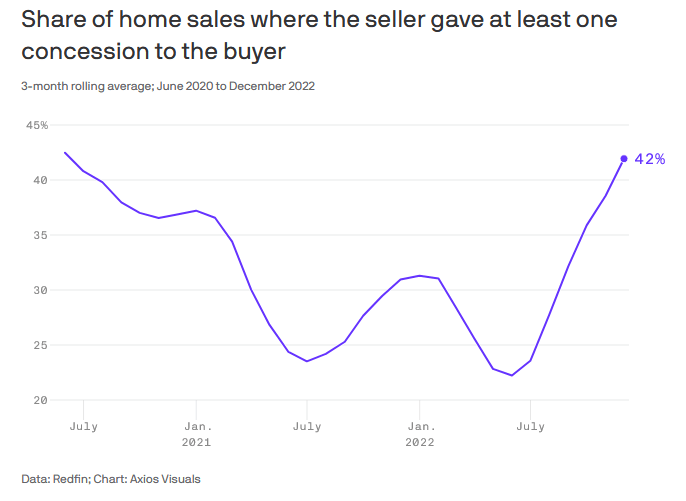
As the real estate market continues to soften amid rising rates and reduced appetites, home sellers are starting to toss in the kitchen sink and more, Axios reports.

According to the report, 42% of recent sellers have offered at least one concession to buyers, typically in the form of cash credit for things like repairs, mortgage rate buydowns, or closing costs.

This is up from 31% a year ago, and is back to levels seen in July 2020, when the housing boom was taking off.

This is in stark contrast to the depths of the pandemic real estate boom, when sellers had the upper hand, and buyers were going to extreme measures to close deals – paying way over asking, and waiving inspections, among other things.

As Axios further notes;

State of play: Concessions were smaller and much less frequent last year, Van Welborn, a Redfin agent in Phoenix, tells Axios.

  • But when mortgage rates started shooting up last fall, sellers grew desperate to attract buyers and concessions mounted a comeback.
  • Since sellers built up so much equity over the past few years, they’ve been willing to shell out more cash than before the pandemic, he says.
  • In the last month, one of Welborn’s clients got $25,000 from a seller on a $650,000 house to pay for a roof (plus they threw in all of the home’s midcentury modern furniture for $10). Another collected $10,000 to help with closing costs.

Plus: Homebuilders are offering concessions to real estate agents who bring in buyers, too. One builder in Houston is giving agents a $10,000 bonus on top of their typical 3% commission and a chance to win a Mercedes, per a flyer, shared with Axios.

According to Angela Cherry, communications director at Redfin, the boost in concessions could help explain why prices haven’t fallen faster – because even though buyers are paying less money, list prices and closing prices don’t change.

“They’re kind of masking the true cost of the transaction,” she said.

As we noted last week, housing supply has jumped the most on record as the market has begun to freeze up. What’s more, an estimated 30% of realtors “will likely quit” during the upcoming housing crash, according to Nick Gerli, CEO and founder of Reventure Consulting.

Tyler Durden
Sun, 01/08/2023 – 11:00

Global ESG Bond Issuance Records First-Ever Annual Decline

0
Global ESG Bond Issuance Records First-Ever Annual Decline

Global sales of environmental, social, and governance (ESG) linked corporate bonds declined for the first time ever as interest rates soared, market turmoil persisted, and economic uncertainty turned borrowers away from debt markets. 

Bloomberg data shows companies and governments worldwide raised $863 billion in ESG bonds in 2022, a 19% drop compared to a year earlier of a record $1.1 trillion. This is the first decline in ESG bonds since green bonds first emerged on Wall Street in 2007. 

Total issuance is down, much of that has to do with soaring borrowing costs amid central banks racing to tame the highest inflation in a generation. Bloomberg sheds more color on souring ESG space: 

Social bond issuance dropped 34% to about $141 billion last year, the biggest decline across all the labels, as government agencies and corporations dialed back spending on eligible projects. Big borrowers including sovereigns have pivoted to long-term climate goals, following a rush to raise funds for pandemic relief that boosted social issuance. 

Sales of sustainability bonds, whose proceeds can be used for both social and green projects, fell by 22% to $154 billion, the second biggest drop. By country, the UK and the US fell most, with 52% and 39% declines, respectively. The most scrutinized segment of the market for environmental, social and governance-related debt — sustainability-linked bonds — plunged 21% to $86 billion. 

Green bonds, meanwhile saw the smallest year-on-year decline, dropping 11% to about $480 billion, propped up by a surge in sales from China. BNP Paribas SA, the biggest underwriter of green bonds in 2022, expects sales of green debt to recover to 2021 levels this year, driven largely by Europe and China. The biggest boost will come from China, thanks to supportive local policy and a recent alignment of its local taxonomy, according to a BNP outlook report published in November.

Besides soaring borrowing costs, perhaps many issuers shored up their balance sheets earlier last year before rates soared. Also, securities regulators from Europe to the US have increasingly focused on the ESG space from scams and misleading info by issuers or asset managers who package up ‘green’ funds. 

Deutsche Bank AG and its asset management arm, DWS Group, were one such group that came under fire by regulators for exaggerating green investments in ESG products. DWS recently said it would dial back hype in ESG sales pitches to wealthy clients. 

And all of this comes as global bond markets have been in turmoil for more than a year. 

For the ESG space to thrive once more, it all depends on when global central banks halt aggressive rate hikes and pivot back to rate cuts. IMF head warned earlier this week of an impending global recession

Tyler Durden
Sun, 01/08/2023 – 09:55

Number Of Germans Rejecting Military Service Quintupled In 2022 Following Outbreak Of War In Ukraine

0
Number Of Germans Rejecting Military Service Quintupled In 2022 Following Outbreak Of War In Ukraine

Authored by Thomas Brooke via Remix News,

Almost five times as many serving members of the Bundeswehr applied to conscientiously object to taking up arms in 2022 than in the previous year

Close to 1,000 actively serving members of the Bundeswehr refused military service last year following the outbreak of the Russo-Ukrainian conflict.

In total, Germany’s Federal Office for Family Affairs and Civil Society Functions received 951 applications for conscientious objection among serving members of the Bundeswehr in 2022.

“In 2021, we received 201 applications for conscientious objection,” a spokesperson for the federal office told German news outlet RDN on Friday.

According to a report by the office, many applicants justified their objection to military service on the basis that they simply were not expecting military confrontation in Europe during their given service time.

The German army is not actively mobilized or involved in the conflict between Ukraine and Russia, but the conflict on Europe’s doorstep has seen numerous allied nations provide armaments and military support to Kyiv.

On Thursday, the German government announced it will supply Ukraine with Marder infantry fighting vehicles (IFVs) and one Patriot missile defense system in a show of solidarity with Ukrainian President Volodymyr Zelensky’s troops.

“Soldiers who come to the conclusion in these explosive security times that they do not want to shoot and kill or injure other people must be offered an easy way out of the army,” Michael Schulze von Glaßer, the political director of the German Peace Society, told RND.

Meanwhile, Germany’s Federal Defense Minister Christine Lambrecht (SPD) has called for greater numbers of women and migrants to be recruited for military service, according to German news outlet Junge Freiheit.

Her comments, which were also quoted in Der Spiegel on Friday, follow an announced investment of over €40 billion in the infrastructure of Germany’s armed forces over the next decade.

Lambrecht aims to see the Bundeswehr grow from its current capacity of 180,000 to 203,000 service members by 2031.

Read more here…

Tyler Durden
Sun, 01/08/2023 – 09:20

Biden Blames Southern Border Crisis On Republicans Before His First Planned Trip To The Region

0
Biden Blames Southern Border Crisis On Republicans Before His First Planned Trip To The Region

The Biden White House has been ignoring the border crisis for the past two years, with Biden refusing to visit the region to see the chaos in person and even denying the reality of the situation despite all evidence to the contrary.  Both Biden and the Department of Homeland Security have been actively seeking to erase Title 42, the only framework in place for slowing the tide of illegal migrants flooding across into the US.  However, now that the Supreme Court has ruled that Title 42 must remain, Biden is suddenly changing his tune.

For the first time in his residency at the Oval Office, Joe Biden is set to take a trip to the southern border, specifically El Paso.  The Democrat run Texas city has been an epicenter of the ongoing migrant surge, with Mayor Oscar Leeser finally admitting a couple weeks ago that El Paso is in a state of emergency.   Leeser originally refused to label the mass invasion of illegals as a crisis (he says the White House pressured him not to), but with El Paso running out of funds to deal with the influx and thousands of migrants crowding into sleeping bag cities on the streets he has been forced to acknowledge reality.

It should be noted that, conveniently, El Paso has been engaged in a massive clean-up effort to reduce the level of homeless migrants right before Biden’s arrival, which suggests there is an attempt to hide the scale of the crisis from the American people.  Measures include the building of a make-shift border wall using shipping containers and barbed wire, which reports say has been very effective in slowing the flow of migrants into the city.  It’s rather ironic that the Democrats are now forced to build a border wall just to make Biden’s visit to El Paso look good after years of sabotaging any efforts to build a wall under the Trump Administration. 

It’s also rather hypocritical that after conservatives spent years trying to get any traction from leftists on border security, Democrats now blame Republicans for the crisis. Biden took to his teleprompter this week to lambast conservatives for rejecting his immigration policies, most of which are designed to make it easier for illegals to get citizenship through amnesty measures.  It is these same policies which are attracting more migrants rather than dissuading the marching caravans from rushing across the border.  


Biden suggests that Title 42 actually makes the migrant problem worse because, by kicking illegals back to where they came from, they then might try to cross the border again.  This kind of warped logic is pervasive in the White House response to immigration – Biden is essentially saying that if we simply let most of the illegals into the country the first time around, then we won’t have to deal with them at the border again in the future.  Of course, this defeats the purpose of having a border in the first place. 

Biden also argued that conservatives prefer that the crisis continues so that they can use it to gain more votes in future elections.  One would think that if this were the case, Biden and the Democrats would be anxious to close the border, build a wall and keep Title 42 in place. 

Border patrol encounters with migrants plummeted under Title 42 in 2020, proving that the law works when enforced properly.  The reason for the sudden surge in encounters is the presence of Joe Biden in the White House and the expectation that Title 42 would be rescinded.  Luckily, the Supreme Court has blocked this action and now the White House is forced to pretend as if they care about the migrant crisis.

Amnesty measures are a rationalization for open border policies, nothing more.  Biden claims that most immigrants are coming from oppressed nations seeking freedom.  However, nearly 40% of all illegal migrants are from Mexico.  Beyond Mexico, the largest number of migrant encounters are from Ecuador and Brazil (not countries of origin eligible for amnesty).  Set aside the fact that anyone can say they are seeking amnesty and are from an oppressed nation and there is no way to verify their claim.  Finally, there are many countries that real amnesty seekers could apply to for citizenship – Why is the US the only nation that is pressured to take them all in? 

At least 5 million foreign nationals have entered the US illegally since Biden took office.  Since 2018, at least 60% of all migrants seek some form of welfare benefits, which is why Democrat run cities like New York and DC cannot handle 10,000 to 20,000 migrants, let alone millions.  Without secure borders, there will not be an America left for migrant “dreamers” to come to in the near future.  But perhaps that is the point…     

Tyler Durden
Sun, 01/08/2023 – 08:45

How Global Strikes Play Right Into The Great Reset’s Hands

0
How Global Strikes Play Right Into The Great Reset’s Hands

Authored by Kit Knightly via Off-Guardian.org,

For the past few months strikes have wrought havoc with the UK’s national infrastructure, and will likely continue to do so well into 2023.

The run-up to Christmas saw postal strikes for the UK’s Royal Mail service.

Throughout the second half of 2022, transport strikes were routine. There’s one happening today that has effectively shut down all train journeys.

There’s a possibility of a teachers’ strike later this month, that would see kids sent home from school. Nurses went on strike in December, and will likely do so again this month

It’s not just the UK either. Strikes in several sectors took place all across Western Europe in December and into early January so far.

New York’s nurses are ready to go on strike next week, and Minnesota nurses only narrowly avoided a strike last month.

It was only Joe Biden’s presidential overreach that prevented a nation-wide rail workers’ strike just before Christmas.

A google trends search for the terms “strike” or “industrial action” have seen surging interest worldwide in the last few months. An admittedly crude measure, but certainly not meaningless.

Strikes are suddenly becoming a high profile global phenomenon.

Given the economic hardships currently being imposed this is not surprising of course.

Corporations price fix and cut costs at every turn, and wages have stagnated for decades while profits soar. No wonder workers and their representatives are trying to redress this balance in any way they can.

But in the New Normal world, what does that mean? And is it possible this perfectly just cause is being manipulated into furthering the great reset agenda?

After all the Union model has a clear disadvantage in the current situation:

It is built on the underlying assumption that bosses want their workers to work.

But post-scamdemic is this any longer reliably the case?

For almost three years we have seen the vast majority of the corporate-political structure dedicated to stopping workers from working.

Covid and “lockdowns” have demonstrated that the establishment wants to:

  • Stop people travelling

  • Stop people working

  • Breakdown healthcare and medical services

  • Cripple supply chains

  • Increase the cost of living

  • Generally ruin the economy

Governments around the world have shown us they want stagnation, disruption and misery.

However just the cause, it’s also true that strikes further almost all of these goals.

And of course they can easily be created by leveraging workers through inflation & price hikes into taking industrial action just to preserve a living wage.

There’s also the handy bonus of shifting the blame at the same time. Just as the appalling state of the economy was blamed on the war in Ukraine in 2022, it will be blamed on striking unions in 2023.

Another reason for repeating the mantra: “the system is broken, we need a new way of doing things.”

…and then, of course, comes another step toward the Great Reset.

What that specifically means in this instance is not yet clear, although some kind of Universal Basic Income system seems likely (it’s in the zeitgeist right now, as we predicted in our This Year in the New Normal post).

Maybe more “public” ownership of utilities, or perhaps new legislation for a state-backed employment mandate where the unemployed are given digital busywork to do from home, like a cyber work camp.

In the UK at least we won’t know for sure until we have a Labour government installed to “save the day”.

Other “resets” could include higher “benefits” that accompany some kind of agreement to not unionise and never go on strike. A proto-social credit system.

It might be sold as “the end of the need to strike”, and everyone will celebrate the new law that makes striking illegal, while anyone who points out the further reduction of our rights will be called old-fashioned and, of course, a “conspiracy theorist”.

“We don’t need strikes with the new way of doing things, and people that want to go on strike will ruin it for everyone else,” could so easily be the line touted by all the usual suspects.

That’s just speculation, of course. One possible future.

Other knock-on effects could play a role in the GR as well.

For example, if corporations are “forced” to increase their pay rates, they will naturally increase their prices to preserve profit margins – meaning strikes can be directly parlayed into exacerbating the cost of living crisis, even as they are called a “victory” for working people.

Or maybe nursing strikes will mean we “lose control of the Covid situation”, and have to endure a new wave of masks and lockdowns.

We can’t be sure what the exact next steps will be, but we can be aware of the high likelihood this current wave of “worker unrest” is being manipulated to further the aims of the globalist narrative-makers, that the government-corporate-union trifecta will guarantee strikes continue, and that it’s playing an important part in shaping our new normal future.

Tyler Durden
Sun, 01/08/2023 – 08:10