You Can Now Live In This Swiss City Solely On Bitcoin
If you’ve ever sought to live entirely on bitcoin, look no further than Lugano Switzerland…
Now you can live in Lugano just using #Bitcoin!
Find out all you need to enjoy your stay in Lugano through the map with all Lugano’s Plan ₿ merchants 🍔👕🎓🏝
As BTCCASEY reports below via Bitcoin Magazine, The Plan ₿ foundation recently took to Twitter to announce a new map which showcases the hundreds of merchants across the city that accept bitcoin. “Now you can live in Lugano just using Bitcoin!,” the tweet read. “Find out all you need to enjoy your stay in Lugano through the map with all Lugano’s Plan ₿ merchants.”
A screenshot of the map posted.
Plan ₿ is a city initiative designed in collaboration with Tether to attract wealth, smart minds and opportunities. Part of this plan involved Lugano making bitcoin a de-facto legal tender, which was announced in March 2022.
This was followed by the announcement of the Plan ₿ Summer School, an educational opportunity for those looking to learn more about bitcoin and businesses, which took place in July 2022. The school featured expert speakers including the likes of Blockstream CEO Adam Back.
Most recently, the Plan ₿ foundation partnered with GoCrypto to onboard multiple merchants to accept bitcoin, including McDonald’s and various art galleries. At that time, the foundation predicted it would serve over 2,500 customers using bitcoin by the end of the year.
The Plan ₿ foundation confirmed on Twitter today that visitors and residents alike can “pay with Bitcoin for food, drinks, art, fashion, jewelry, cars, watches, tattoos, real-estate, municipal taxes, and services and so much more…”
In Lugano you pay with #Bitcoin for food, drinks, art, fashion, jewelry, cars, watches, tattoos, real-estate, municipal taxes, and services and so much more…
As the bitcoin ecosystem grows, various jurisdictions will continue to vie for the business of Bitcoiners and Bitcoin companies. This can be seen in examples like Lugano, as well as that of Madeira, Bitcoin Beach and several others. While bitcoin is still in its infancy, developments like these serve both as a testing battle ground and a way to push for greater adoption and improvements.
The Chinese Communist Party (CCP) is “disturbed” by Turkey’s support for Uyghurs, one of China’s largest Muslim minorities, as Turkey refused to extradite Turkic Uyghurs to China, a Turkish official said on Dec. 29.
Turkish Foreign Minister Mevlut Cavusoglu said claims about Turkic Uyghurs being extradited to China were “a total lie” and that Turkey won’t cave to Beijing’s pressure, even if it hurts their bilateral relations.
“Turkish–Chinese ties have suffered over Beijing being disturbed by our attitude on the Turkic Uyghurs issue,” he told reporters in Turkey’s capital city of Ankara, Middle East Monitor reported.
“They have extradition requests for people who are our citizens, who live in Turkey all the time. Therefore, we don’t grant any such requests.”
Cavusoglu cited a 2022 U.N. report detailing abuses allegedly committed by the CCP against Uyghurs and other Muslim minorities in China’s Xinjiang region, which it states amounted to crimes against humanity and called for immediate action from the international community.
Ethnic Uyghur women take part in a protest against China, in front of the Caglayan Courthouse in Istanbul, Turkey, on Jan. 4, 2022. (Dilara Senkaya/Reuters)
“We defend Turkic Uyghurs’ rights in the international arena, and this disturbs China. But this is a humanitarian issue,” he said.
Cavusoglu claimed that Chinese authorities had blocked the Turkish ambassador from visiting the Uyghurs in the Xinjiang region and demanded that he adhere to a “program that they provide.”
The foreign minister said Turkey wants to cooperate with China in a transparent manner.
“Why should we become a tool for China’s propaganda? We want to cooperate. We don’t see this as a political issue,” he said.
“We are categorically not anti-Chinese. We have always said that we support the ‘One-China’ policy.”
50 Countries Condemn China
A perimeter fence surrounds a forced reeducation center in Dabancheng, Xinjiang region, China, on Sept. 4, 2018. (Thomas Peter/Reuters)
Turkey was one of 50 countries that signed a joint statement at the U.N. General Assembly on Oct. 31, 2022, urging the CCP to uphold its human rights obligations and release those who are “arbitrarily deprived of their liberty” in Xinjiang.
The United States, Japan, the UK, Australia, Germany, and Israel made up the largest group of countries to publicly condemn the Chinese regime’s ongoing human rights abuses.
The signatory countries urged Beijing to promptly release all detained individuals in Xinjiang, urgently clarify the fate and whereabouts of missing family members, and facilitate safe contact and reunion.
“Such severe and systematic violations of human rights cannot be justified on the basis of counterterrorism,” the joint statement reads.
UN Votes Down Debate on Uyghurs
Leaders from the United States, the UK, and Canada called for a debate on the CCP’s suppression of Uyghurs and other minorities in Xinjiang after a U.N. report documented possible crimes against humanity in the region.
“The extent of arbitrary and discriminatory detention of members of Uyghur and other predominantly Muslim groups … may constitute international crimes, in particular crimes against humanity,” the report reads.
“Serious human rights violations have been committed [in Xinjiang] in the context of the Government’s application of counterterrorism and counter-‘extremism’ strategies.”
Despite widespread concern about the U.N. report on the situation in Xinjiang, the U.N. Human Rights Council voted 19–17 against the motion for a debate, with 11 nations abstaining. It’s only the second time in the council’s 16-year history that a motion has been rejected.
The New York law that enables the seizure of guns from people who haven’t committed a crime is unconstitutional, a state Supreme Court judge has ruled.
This red flag law, or the Extreme Risk Protection Order law, lets individuals – including police officers – petition a court to allow the seizure of firearms from a person they believe poses a threat to themselves or others.
If a judge agrees, the judge can direct law enforcement to take guns from the person in question.
The law took effect in 2019 and has led to the issuance of more than 1,900 removal orders.
But the law is in violation of the U.S. Constitution’s Second and Fourteenth Amendments because it doesn’t “sufficiently protect a citizen’s rights,” New York State Supreme Court Judge Thomas Moran said in a ruling in late December 2022.
The red flag law, per an update in July 2022, states that police officers and district attorneys must file for a risk protection order “upon the receipt of credible information that an individual is likely to engage in conduct that would result in serious harm to himself, herself, or others.”
The law points to a separate statute, the Mental Hygiene Law, that defines the likelihood to result in serious harm as “(1) substantial risk of physical harm to himself as manifested by threats of or attempts at suicide or serious bodily harm or other conduct demonstrating that he is dangerous to himself; or (2) a substantial risk of physical harm to other persons as manifested by homicidal or other violent behavior by which others are placed in reasonable fear of serious physical harm.”
The Mental Hygiene Law requires a person to have been admitted involuntarily to a hospital and that a doctor has determined the person to be likely to cause serious harm. A second doctor must confirm the determination if the person is held in a facility for more than 48 hours. In contrast, the red flag law doesn’t require the involvement of medical personnel.
“Why should respondents under the Mental Health Law be granted greater safeguards (such as having their case be reviewed by a physician with the educational background and experience to make such a determination) than matters pursuant to [the red flag law] in which ‘laypeople’ make such a determination?” Moran said.
“These are similarly situated people (by legislative definition) but as such are not to be treated equally, nor afforded the same constitutional guarantees that protect all citizens of New York state.”
Nonmedical workers such as police officers shouldn’t be authorized to determine if a person is likely to cause serious harm, according to the ruling.
In addition, under the U.S. Supreme Court’s standards in its 2022 ruling striking down New York’s concealed carry law, the red flag law doesn’t fit under the nation’s tradition of regulating firearms, the judge said.
The majority said in the 2022 decision that the Constitution protects people’s rights to carry firearms and that a government must, for each gun restriction, “demonstrate that the regulation is consistent with this Nation’s historical tradition of firearm regulation.”
“This Court is not unmindful of the dangers firearms may pose when possessed in the hands of a person suffering a mental illness, harboring a criminal intent, or both. However, when viewed objectively, [the law’s] goal of removing weapons from the otherwise lawful possession of them by their owners, without adequate constitutional safeguards, cannot be condoned by this Court,” Moran added later.
“While some may advocate that ‘the ends justify the means’ in support of [the law], where those means violate a fundamental right under our Bill of Rights to achieve their ends, then the law, on it’s face, cannot stand.”
The ruling only applies to the specific situation and doesn’t strike the law down statewide, a source familiar with the case said.
Case
The ruling came in a case brought by a woman, C.N., whose estranged boyfriend, G.W., lodged an application for the removal of guns from the woman. G.W. claimed that C.N. made statements indicating she’d harm herself with a gun if she had access to one.
According to court documents, though, the petition inaccurately said the statements were made in 2022, but they were actually made no later than Feb. 27, 2021.
The court granted the request and ordered the seizure of any weapons from C.N., in addition to prohibiting her from buying or possessing any guns. Additionally, the court suspended C.N.’s pistol permit based on the risk protection order and the allegations made against her.
Daniel Strollo, an attorney representing C.N., said in a statement that he was “very happy” with Moran’s ruling.
Strollo told WHAM-TV that the red flag law implemented a “very quick and easy mechanism to deprive somebody of their fundamental Second Amendment rights.”
“You have people who are essentially not medical professionals expressing medical opinions that result in the deprivation of rights,” Strollo said.
“And you have a procedure that essentially allows somebody to lose those rights without ever having gone in front of a judge.”
The year 2022 was one of surprises: Russia’s invasion of Ukraine, persistent inflation fueled by energy costs, the collapse of FTX and crypto markets, the revelations of the so-called Twitter Files, and one of the worst equity markets in recent history, to name but a few.
The year 2023 is poised to present some equally challenging circumstances. Here are 12 trends, events, or surprises that may come to shape and define the year ahead.
1) Inflation Returns
I may be the minority report here, but I do not believe we’ve seen the end of—or worst of—inflation in the United States. I argue that following a lag in which price growth appears to moderate, Consumer Price Index (CPI) inflation returns to the 8–12 percent range, where it persists for the rest of the year. This will be cost-push inflation, not demand-pull (see the second point below), and a lagging result of trebling the money supply in the United States since 2009. Stagflation returns, with the Misery Index (inflation plus unemployment) hitting new highs.
2) The U.S. Economy Enters Recession
This is a less controversial proposition at this stage, as most economists and analysts agree that recession looks highly probable for 2023. The first half of 2023 is likely to be characterized by negative GDP, rising unemployment, and an insecure consumer. The wave of layoffs which began in the tech sector in 2022 spreads to other industries and sectors, and migrates down from large-cap corporations like Meta and Amazon to small- and medium-sized enterprises which are disproportionately affected by the slowdown.
3) European Energy Crisis Worsens
While in the near term Western Europe may be spared the worst possible outcomes due to a mild winter, the underlying factors which led to the energy crisis haven’t been resolved. Germany, the European Union’s largest economy, made a Faustian bargain believing that it could abandon its coal industry and any nuclear aspiration and instead place their trust in the Russians—against all historical experience—and a green utopia. France similarly backed away from its path to energy independence—nuclear power—and are paying the price. While both have recently repented these misjudgments, the path to recovery will take years, not months. In the meantime, supply shortages will continue to plague these economies.
4) Oil, Crypto, and Gold Perform
Energy markets will continue their bull run for the foreseeable future as a result of continued supply disruptions and refinery constraints. Bitcoin and Ethereum emerge from a long, dark crypto winter, but altcoins remain frozen out. The dollar begins a long, if slow and turbulent, slide from 2022 highs, as peak demand from rapidly rising interest rates eases.
5) Continued Rise of Resource Nationalism
The unforgettable geopolitical lesson of the pandemic era has been that just-in-time supply-chain dependence on countries that many or may not have another nation’s interest at heart represents a dangerous strategic folly. It’s well and good that we learned this lesson when we did. Countries around the world are now aggressively working to realign their supply chains and ensure that they have strategic resources in adequate supply to meet unexpected, Black Swan events. Look for increasingly protectionist and nationalistic policies to dominate trade discussions.
6) Traditional Global Alliances Break, New Ones Form
Long-standing partnerships, such as the United States’s relationship with Saudi Arabia, have already begun to unravel. Expect further strengthening of the China and Russia-led alliance involving former U.S. allies, or at least non-aligned nations such as India, Turkey, South Africa, and Brazil. Most vulnerable to geopolitical shifts are countries in Africa, Southeast Asia, and South America. Because of sanctions warfare and incoherent or at least inconsistent foreign policy, the United States ends up in a net deficit position, losing more friends than it gains in this process.
7) U.S. Dollar Dominance Continues to Erode
Hard money returns to favor, with commodity-backed currencies taking the spotlight. Alt payment systems, petrodollars being replaced with petrorubles or petroyuans, as well as central bank-issued digital currencies, will all conspire to slowly erode the U.S. dollar’s share of global financial and trade flows.
8) The West, Weary of Cost of Ukraine War, Sues for Peace
While it may not be realistic to think that Russia can bomb the Ukrainian people into submission, the increasing costs of supporting Ukraine’s war with Russia will challenge political leaders across the West. This fatigue will increase as more citizens start to ask reasonable questions about whether hundreds of billions of dollars or euros might not be better spent to take on some of the domestic economic and social challenges that these nations face at home. Eventually, Western governments and Putin each decide that a half a loaf is better than no loaf at all.
9) Domino Effectof Exposure
The recent uncovering of high-level frauds and corruptions involving U.S. government agencies and personnel continues. Increasing transparency leads to accountability. Eventually, the evidence becomes too overwhelming to ignore; arrests, trials, and convictions ensue. Congressional hearings lead to wave of resignations and first steps toward fundamental institutional reform.
10) China Barks, but Doesn’t Bite, at Taiwan
While we should expect the growling and barking to grow louder, with more frequent air space incursions, naval activity, intimidations, and outright threats, it is highly unlikely that China invades Taiwan in 2023. While China most certainly would prefer to confront Taiwan while the Biden administration remains in power, rather than face an improbable return of Donald Trump to the presidency, Xi Jingping’s government will conclude that they are not ready, militarily, politically, or otherwise, to invade Taiwan. Domestic issues, including a worsening economy and rising social unrest within mainland China, will mean that creating a row with the United States and other trading partners in the West remains untenable for the time being. While Russia might be able to make do without selling gas to Germany, there is no way the Chinese economy can survive if abruptly cuts itself off from the United States and Western Europe.
11) Second-Half Rebound in Economy and Markets
While I am not optimistic about the first half, I take great comfort in the breadth and resilience of the American economy. There is enormous unleashed latent potential in oil and gas, in manufacturing onshoring, in supply-chain realignment, and in new technologies such as AI, quantum computing, blockchain, and cold fusion.
12) More of the Same
What could derail a more V-shaped recovery are the same forces that helped bring the recession about: poor policy decisions that continue to damage our energy industry, keep our borders insecure, and fail to dismantle the out-of-control regulatory bureaucracy that is impeding innovation in energy, manufacturing, financial services, and technology. These are some of the largest sectors in the economy and those which have been most negatively affected by the Biden administration’s imprudent return to Obama-era economic policies.
New Chinese Foreign Minister Seen As Xi’s Attempt To Soften US-China Relations
Among the bigger developments out of Beijing this week impacting the future of US-China relations is the appointment of a new Chinese foreign minister.
Last Friday the appointment was unveiled to be China’s ambassador to the United States Qin Gang, who will take over the top diplomatic post from former FM Wang Yi, recently removed by a decision of the National People’s Congress Sanding Committee.
Bloomberg and others noted he represents a “softer” side of Beijing’s stance toward America, already said to have been on display during his relatively short tenure in Washington for the past seventeen months.
In the past two days the new Chinese FM has even grabbed the attention of Western press by tweeting out that he’s “deeply impressed” by the American people, while vowing to push forward US-China relations in a positive way.
“I want to pay sincere thanks to the people of the United States for the strong support and assistance given to me and the Chinese Embassy during this period,” Qin tweeted Monday evening (US time).
“I have been deeply impressed by so many hard-working, friendly and talented American people that I met,” Qin added, saying he had “made many friends across the US.” He pledged to “support the growth of China-US relations” in his capacity as China’s top diplomat.
The replacement of former FM Wang, who had served as foreign minister for almost a decade, is being widely seen as a sign that President Xi Jinping wants to urgently repair fraying relations with the US and the West more broadly.
Interestingly, prior words of Qin are now being widely reported related to the Ukraine war. He was recently on record as expressing that China would have attempted to dissuade Russia from invading Ukraine if it had known about it. This is in contrast to some US officials and media reports which claim Beijing knew about the invasions plans and turned a blind eye.
Tried my first throw at an NBA game @WashWizards. Also renewed our special relationship as Washington Wizards was the first NBA team to visit China in 1979 when our two countries established diplomatic relationship. pic.twitter.com/VCX7JncN7i
Up to 100 million Americans will soon be enrolled in Medicaid, according to an enrollment monitoring project by the Foundation for Government Accountability (FGA), a think tank focused on welfare and health care policy.
On Dec. 28, FGA announced it believes that the number of Americans enrolled with Medicaid will cross the 100 million mark in about 76 days, or approximately March 14. The Naples, Florida-based think tank also launched a countdown clock for the date they project Medicaid enrollment to hit 100 million.
According to Medicaid.gov data, through August 2022, some 90,550,412 individuals were enrolled in Medicaid and the Children’s Health Insurance Program (CHIP) in the 50 states and the District of Columbia.
FGA compiled more recent state-by-state Medicaid enrollment figures showing 96.2 million Americans are now enrolled in the government health care program. Based on the state-by-state growth trends, FGA projects 98.9 million Americans will be enrolled in Medicaid by the end of January and another 1.1 million Americans will be enrolled in the program by mid-March.
FGA Warns of ‘Grim’ Medicaid Milestone
“For years, FGA has been warning about the rising number of people on government welfare programs,” said Hayden Dublois, the data and analytics director for FGA.
“Now, we’re nearing a grim milestone—nearly one-third of the country will be on Medicaid. Our research and data show as welfare enrollment increases, workforce participation decreases. We’re in the midst of a nationwide workforce crisis, yet the Biden administration is pushing policies to entice people into government dependency at record levels while limiting opportunities to achieve the American Dream.”
According to the FGA, the rise in Medicaid enrollment is due in large part to federal COVID-19 public health emergency policies, like the Families First Coronavirus Response Act (FFCRA). The pandemic-era measures provide states with extra Medicaid funding but block states from being able to change their eligibility and enrollment procedures and require that everyone currently enrolled in the program remain in place.
FGA estimates that an additional 24 million enrollees are on Medicaid as a result of the pandemic-era measures, including more than 21 million people who would have previously been disqualified from the health care program.
$1.7 Trillion Omnibus Lets States Change Medicaid Enrollment After April 1
While pandemic-era federal policies locked states in with their current Medicaid enrollments, the $1.7 trillion federal omnibus bill to fund government provision allows states to redetermine Medicaid eligibility starting on April 1.
“While there are many concerning provisions in this omnibus spending bill, we’re optimistic states may soon regain control of their Medicaid programs and reverse two years of unchecked enrollment growth,” said FGA President and CEO Tarren Bragdon.
“FGA has championed Medicaid reform to combat the devasting impact pandemic-era policies have had on the American economy and workforce. If this provision is enacted, states must step up and start redeterminations as soon as possible—our struggling economy and weakened workforce depend on it.”
While the omnibus allows states to resume their Medicaid eligibility checks, the provision also means that millions of people could soon be kicked off the government health care program.
“This is a positive for states in terms of planning, however, this will come at the cost of some individuals losing their health care,” Massey Whorley, a principal at health consulting firm Avalere, told The Associated Press.
The Kaiser Family Foundation (KFF) estimates between 5.3 million and 14.2 million Medicaid recipients could be disenrolled after the pandemic-era continuous enrollment requirement ends on April 1.
Robin Rudowitz, the director of Medicaid at KFF, advised Medicaid recipients to make sure their contact information is up to date on their accounts and check their mail frequently for any notices of changes to their Medicaid eligibility.
“There is likely to be people who fall through the cracks,” Rudowitz told The Associated Press.
It’s January 4th, 2023, which means Twitter Files stories have been coming out for over a month. Because these are weedsy tales, and may be hard to follow if you haven’t from the beginning, I’ve written up capsule summaries of each of the threads by all of the Twitter Files reporters, and added links to the threads and accounts of each. At the end, in response to some readers (especially foreign ones) who’ve found some of the alphabet-soup government agency names confusing, I’ve included a brief glossary of terms to help as well.
Recounting the internal drama at Twitter surrounding the decision to block access to a New York Post exposé on Hunter Biden in October, 2020.
Key revelations: Twitter blocked the story on the basis of its “hacked materials” policy, but executives internally knew the decision was problematic. “Can we truthfully claim that this is part of the policy?” is how comms official Brandon Borrman put it. Also: when a Twitter contractor polls members of Congress about the decision, they hear Democratic members want more moderation, not less, and “the First Amendment isn’t absolute.”
THE “EXITING” OF TWITTER DEPUTY GENERAL COUNSEL JIM BAKER
A second round of Twitter Files releases was delayed, as new addition Bari Weiss discovers former FBI General Counsel and Twitter Deputy General Counsel Jim Baker was reviewing the first batches of Twitter Files documents, whose delivery to reporters had slowed.
Bari Weiss gives a long-awaited answer to the question, “Was Twitter shadow-banning people?” It did, only the company calls it “visibility filtering.” Twitter also had a separate, higher council called SIP-PES that decided cases for high-visibility, controversial accounts.
Key revelations: Twitter had a huge toolbox for controlling the visibility of any user, including a “Search Blacklist” (for Dan Bongino), a “Trends Blacklist” for Stanford’s Dr. Jay Bhattacharya, and a “Do Not Amplify” setting for conservative activist Charlie Kirk. Weiss quotes a Twitter employee: “Think about visibility filtering as being a way for us to suppress what people see to different levels. It’s a very powerful tool.” With help from @abigailshrier, @shellenbergermd, @nelliebowles, and @isaacgrafstein.
THE REMOVAL OF DONALD TRUMP, October 2020 – January 6th, 2021
First in a three-part series looking at how Twitter came to the decision to suspend Donald Trump. The idea behind the series is to show how all of Twitter’s “visibility filtering” tools were on display and deployed after January 6th, 2021. Key Revelations: Trust and Safety chief Yoel Roth not only met regularly with the FBI and the Department of Homeland Security, but with the Office of the Director of National Intelligence (ODNI). Also, Twitter was aggressively applying “visibility filtering” tools to Trump well before the election.
This thread by Michael Shellenberger looks at the key day after the J6 riots and before Trump would ultimately be banned from Twitter on January 8th, showing how Twitter internally reconfigured its rules to make a Trump ban fit their policies.
Key revelations: at least one Twitter employee worried about a “slippery slope” in which “an online platform CEO with a global presence… can gatekeep speech for the entire world,” only to be shot down. Also, chief censor Roth argues for a ban on congressman Matt Gaetz even though it “doesn’t quite fit anywhere (duh),” and Twitter changed its “public interest policy” to clear a path for Trump’s removal.
As angry as many inside Twitter were with Donald Trump after the January 6th Capitol riots, staffers struggled to suspend his account, saying things like, “I think we’d have a hard time saying this is incitement.” As documented by Weiss, they found a way to pull the trigger anyway.
Key revelations: there were dissenters in the company (“Maybe because I am from China,” said one employee, “I deeply understand how censorship can destroy the public conversation”), but are overruled by senior executives like Vijaya Gadde and Roth, who noted many on Twitter’s staff were citing the “Banality of Evil,” and comparing those who favored sticking to a strict legalistic interpretation of Twitter’s rules — i.e. keep Trump, who had “no violation” — to “Nazis following orders.”
Twitter’s contact with the FBI was “constant and pervasive,” as FBI personnel, mainly in the San Francisco field office, regularly sent lists of “reports” to Twitter, often about Americans with low follower counts making joke tweets. Tweeters on both the left and the right were affected.
Key revelations: A senior Twitter executive reports, “FBI was adamant no impediments to sharing” classified information exist. Twitter also agreed to “bounce” content on the recommendations of a wide array of governmental and quasi-governmental actors, from the FBI to the Homeland Security agency CISA to Stanford’s Election Integrity Project to state governments. The company one day received so many moderation requests from the FBI, an executive congratulated staffers at the end for completing the “monumental undertaking.”
The Twitter Files story increases its focus on the company’s relationship to federal law enforcement and intelligence, and shows intense communication between the FBI and Twitter just before the release of the Post’s Hunter Biden story.
Key Revelations: San Francisco agent Elvis Chan “sends 10 documents to Twitter’s then-Head of Site Integrity, Yoel Roth, through Teleporter, a one-way communications channel from the FBI to Twitter,” the evening before the release of the Post story. Also, Baker in an email explains Twitter was compensated for “processing requests” by the FBI, saying “I am happy to report we have collected $3,415,323 since October 2019!”
HOW TWITTER QUIETLY AIDED THE PENTAGON’S COVERT ONLINE PSYOP CAMPAIGN
Lee Fang takes a fascinating detour, looking at how Twitter for years approved and supported Pentagon-backed covert operations. Noting the company explicitly testified to Congress that it didn’t allow such behavior, the platform nonetheless was a clear partner in state-backed programs involving fake accounts.
Key revelations: after the U.S. Central Command (CENTCOM) sent over a list of 52 Arab-language accounts “we use to amplify certain messages,” Twitter agreed to “whitelist” them. Ultimately the program would be outed in the Washington Post in 2022 — two years after Twitter and other platforms stopped assisting — but contrary to what came out in those reports, Twitter knew about and/or assisted in these programs for at least three years, from 2017-2020.
Lee wrote a companion piece for the Intercept here:
The Christmas Eve thread (I should have waited a few days to publish!) further details how the channels of communication between the federal government and Twitter operated, and reveals that Twitter directly or indirectly received lists of flagged content from “Other Government Agencies,” i.e. the CIA.
Key revelations: CIA officials attended at least one conference with Twitter in the summer of 2020, and companies like Twitter and Facebook received “OGA briefings,” at their regular “industry” meetings held in conjunction with the FBI and the Department of Homeland Security. The FBI and the “Foreign Influence Task Force” met regularly “not just with Twitter, but with Yahoo!, Twitch, Cloudfare, LinkedIn, even Wikimedia.”
David Zweig drills down into how Twitter throttled down information about COVID that was true but perhaps inconvenient for public officials, “discrediting doctors and other experts who disagreed.”
Key Revelations: Zweig found memos from Twitter personnel who’d liaised with Biden administration officials who were “very angry” that Twitter had not deplatformed more accounts. White House officials for instance wanted attention on reporter Alex Berenson. Zweig also found “countless” instances of Twitter banning or labeling “misleading” accounts that were true or merely controversial. A Rhode Island physician named Andrew Bostom, for instance, was suspended for, among other things, referring to the results of a peer-reviewed study on mRNA vaccines.
and
Twitter Files Parts 11and 12, by @mtaibbi, January 3, 2023
HOW TWITTER LET THE INTELLIGENCE COMMUNITY IN
and
TWITTER AND THE FBI “BELLY BUTTON”
These two threads focus respectively on the second half of 2017, and a period stretching roughly from summer of 2020 through the present. The first describes how Twitter fell under pressure from Congress and the media to produce “material” showing a conspiracy of Russian accounts on their platform, and the second shows how Twitter tried to resist fulfilling moderation requests for the State Department, but ultimately agreed to let State and other agencies send requests through the FBI, which agent Chan calls “the belly button of the USG.” Revelations: at the close of 2017, Twitter makes a key internal decision. Outwardly, the company would claim independence and promise that content would only be removed at “our sole discretion.” The internal guidance says, in writing, that Twitter will remove accounts “identified by the U.S. intelligence community” as “identified by the U.S.. intelligence community as a state-sponsored entity conducting cyber-operations.”
The second thread shows how Twitter took in requests from everyone — Treasury, HHS, NSA, FBI, DHS, etc. — and also received personal requests from politicians like Democratic congressman Adam Schiff, who asked to have journalist Paul Sperry suspended.
GLOSSARY OF “TWITTER FILES” TERMS
Government Agencies and NGOs
CISA: The Cybersecurity and Infrastructure Security Agency, an agency within the Department of Homeland Security (DHS)
CENTCOM: Central Command of the Armed Forces
ODNI: Office of the Director of National Intelligence
FITF: Foreign Influence Task Force, a cyber-regulatory agency comprised of members of the FBI, DHS, and ODNI
“OGA”: Other Government Agency, colloquially — CIA
GEC: Global Engagement Center, an analytical division of the U.S. State Department
USIC: United States intelligence community
HSIN: Homeland Security Information Network, a portal through which states and other official bodies can send “flagged” accounts
EIP: Election Integrity Project, a cyber-laboratory based at Stanford University that sends many reports to Twitter
DFR: Digital Forensic Research lab, an outlet that performs a similar function to the EIP, only is funded by the Atlantic Council
IRA: Internet Research Agency, the infamous Russian “troll farm” headed by “Putin’s chef,” Yevgheny Prigozhin
Twitter or Industry-specific terms
PII: Can have two meanings. “Personally identifiable information” is self-explanatory, while a “Public Interest Interstitial” is a warning placed over a tweet, so that it cannot be seen. Twitter personnel even use “interstitial” as a verb, as in, “Can we interstitial that?”
JIRA: Twitter’s internal ticketing system, through which complaints rise and are decided
PV2: The system used at Twitter to view the profile of any user, to check easily if it has flags like “Trends Blacklist”
SIP-PES Site Integrity Policy — Policy Escalation Support. SIP-PES is like Twitter’s version of a moderation Supreme Court, dealing with the most high-profile, controversial rulings
SI: Site integrity. Key term that you’ll see repeately in Twitter email traffic, especially with “escalations,” i.e. tweets or content that have been reported for moderation review
CHA: Coordinated Harmful Activity
SRT: Strategic Response Team
GET: Global Escalation Team
VF: Visibility Filtering
GUANO: Tool in Twitter’s internal system that keeps a chronological record of all actions taken on an account
VIT: Very Important Tweeter. Really.
GoV: Glorificaiton of Violence
BOT: In the moderation content, an individualized heuristic attached to an account that moderates certain behavior automatically
BME: Bulk Media Exploitation
EP Abuse: Episodic abuse
PCF: Parity, commentary and fan accounts. “PCF” sometimes appears as a reason an account has escaped an automated moderation process, under a limited exception
FLC: Forced Login Challenge. Also called a “phone challenge,” it’s a way Twitter attempts to verify if an account is real or automated. “Phone challenges” are seen repeatedly in discussions about verification of suspected “Russia-linked” accounts
IO: Information Operations, as in The GEC’s mandate for offensive IO to promote American interests.
This page will be kept open and updated as needed. If you have questions about terms, please send them to taibbi@substack.com
Macron Pledges ‘First Western Tanks’ To Ukraine While US Mulls Bradley Fighting Vehicles
French President Emmanuel Macron on Wednesday announced he intends to send ‘light tanks’ to Ukraine, which will make France the first to supply Western-manufactured tanks to the conflict, after some like Poland earlier transferred Soviet tanks.
While NATO allies have gradually increased the sophistication of weaponry shipped to Kiev, including longer range missiles and more recently Patriot systems approved by the US, they have stopped short of sending either tanks or fighter jets, largely on fears of Moscow expanding the war in response.
“The president wanted to increase… aid” to Ukraine “by accepting to deliver AMX-10 RC light tanks” – a Macron aide told reporters following the French leader holding a call with Ukrainian President Volodymyr Zelensky.
The AFP has described the French-made AMX-10 RC as an older light model tanks which the French infantry used in the 1980s, but has since been phased out. It is six-wheeled and not on tracks, thus it’s sometimes called a “wheeled tank” – but has a powerful 105 mm gun on a turret.
Among other medium and heavy equipment, France and other countries have already delivered armored personnel carriers to Ukraine, so this appears the next step up, perhaps paving the way to heavier more conventional tanks to match Russia’s significant tank forces.
Previously, Poland and the Czech Republic have sent Soviet-era tanks to Ukraine, even as Western Europe and the US were reluctant.
As for the United States, the Biden administration is mulling sending Bradley Fighting Vehicles to Ukrainian forces, with the president responding “yes” to a journalist’s question Wednesday when asked about prior reporting…
Scoop: Biden admin is discussing sending Bradley Fighting Vehicles to Ukraine, sources tell me and @AlbertoNardelli. “Bradleys would provide a major increase in ground combat capability because it is, in effect, a light tank,” one analyst says.https://t.co/nYg4pRBPPRpic.twitter.com/DAmqxKmMhM
Bloomberg was the first to report last week that “The US government is considering sending Bradley Fighting Vehicles to Ukraine as part of a further package of military support, according to people familiar with the matter.”
“A final decision hasn’t yet been made, one of the people said,” the report said. “When the vehicles would be operational is also unclear, said the people, who spoke on condition of anonymity to discuss the sensitive issue.” Biden on Wednesday officially confirmed the deliberations are underway.
Kevin McCarthy And The Terrible, Horrible, No Good, Very Bad Day
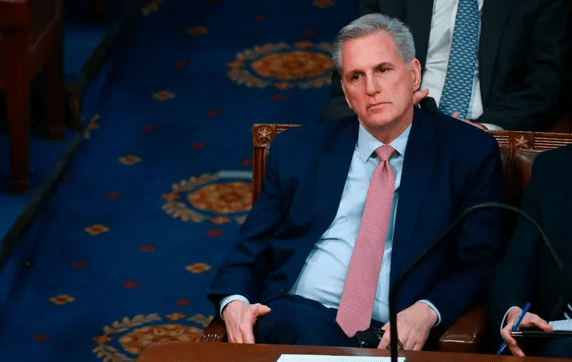
Update (2100ET): Kevin McCarthy has now suffered defeat six times in his bid to become House Speaker.
His allies are spending Wednesday night trying to appeal to at least 20 holdouts who have blocked his bid for a second day.
After taking a several-hour break on Wednesday to stall any further votes, the House quickly voted to adjourn until Noon on Thursday – with all Democrats and four Republicans voting against the pause.
The motion to adjourn was made by GOP Rep. Tom Cole of Oklahoma, while the four GOP lawmakers who opposed adjournment were Reps. Andy Biggs, Lauren Bobert, Matt Gaetz and Rep.-elect Eli Crane.
When the House meets again on Thursday it will hold its seventh round of votes for speaker.
Of note, the House cannot conduct any other business until a speaker is elected – including swearing in new members.
On the holdout side, Rep. Chip Roy thinks he can get 10 anti-McCarthy reps to change their tune if ongoing negotiations pan out, according to CNN, citing GOP sources familiar with the internal discussions. Additional detractors may be willing to vote ‘present,’ reducing the number of votes McCarthy needs to succeed.
According to the report, the talks between McCarthy allies and holdouts have been the ‘most productive and serious ones to date.’
* * *
Update (1640ET): The House has adjourned until 8 p.m. ET Wednesday after failing to receive a majority of the vote for a sixth time.
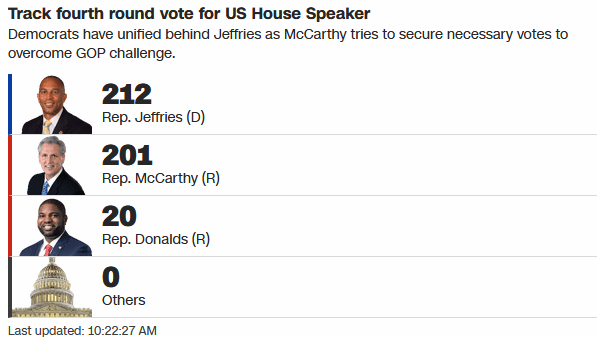
Rep. Victoria Spartz of Indiana once again voted present, making the threshold for McCarthy to win 217.
The final tally – which was unchanged from the previous two votes, was:
212 for Jeffries
201 for McCarthy
20 for Donalds
1 present vote
Update (1620ET): Kevin McCarthy appears set to lose yet another round of voting for House Speaker.
That said, in a potentially positive development for McCarthy,Rep. Chip Roy said there have been ‘productive’ negotiations over the past two hours, according to CNN, who added that he expects to be part of Wednesday evening negotiations.
Roy added that he is not a ‘hard no’ on McCarthy, and that the GOP conference is “trying to repair that damage today, and progress has been made.”
CNN is also reporting that Republicans are considering appointing four members each from the pro/anti McCarthy camps to negotiate a path forward.
One Democratic lawmaker also tells CNN they overheard Rep. Jim Jordan tell members huddled on the House floor that McCarthy wants each side to appoint four members to negotiate after this sixth round of voting for House speaker.
The huddle came after McCarthy lost a fifth bid to secure the speakership, as a group of 20 Republicans remain opposed to the California Republican for the top position. –CNN
An earlier version of this report briefly included an statement wrongly attributed to Former President Trump indicating he had withdrawn support for McCarthy. That has been removed and the post updated.
* * *
Update (1441ET): And just like that, McCarthy loses a the fifth round for House Speaker. The vote was identical to the fourth round.
Looks like McCarthy lost the fifth round of voting. Stay strong to the Republicans preventing him from becoming house speaker. pic.twitter.com/GDGztkY0jG
According to CNN‘s Manu Raju, Rep. Byron Donalds says he’s spoken with McCarthy and plans to speak with him again today.
He declined to comment when asked if McCarthy should drop out.
House Republicans are at a contentious stalemate over who will serve as the next speaker amid what appears to be hardened opposition to McCarthy from a group of 20 conservatives who voted for Donalds in today’s first vote.
He told CNN that the chief demand is to allow just one member to call for a vote seeking a speaker’s ouster.
That is down from the five-member threshold that McCarthy has proposed, which is lower than conference rules that sets it at half the conference. -CNN
Rep Byron Donalds told reporters that he has spoken to Kevin McCarthy and plans to again today. He declined to comment when asked if McCarthy should drop out.
Asked him what he wants: He said his chief demand is to allow just 1 member to call for a vote seeking speaker’s ouster pic.twitter.com/kmwl2pgT38
Earlier in the day, GOP Rep. Ken Buck of Colorado says he’s had a “number of conversations” with McCarthy – and told him that he needs to cut a deal with the opposing GOP members or step aside.
“I said to Kevin at some point, you know, you’ve got to make sure you gotta either cut a deal or you’ve got to give Steve [Scalise] a chance or others a chance to see if they can put it together. My feeling is Kevin gets more votes than anybody else,” Buck told reporters outside the House chamber.
“There are a few of those 20 that just aren’t going to vote for Kevin McCarthy but would vote for somebody else. There are some of the others … who want changes in the rules and there are some others who care about policy. I think if Steve meets those three needs, he will be able to move forward and take the speakership,” he then told CNN‘s Dana Bash, adding that “today the conference as a whole needs to make a decision” as the House is in a “state of disarray and chaos.“
* * *
Update (1415ET): And once again, McCarthy lacks the votes in the fifth round.
* * *
Update (1320ET): McCarthy has officially lost again after a fourth round of voting for Speaker – garnering just 201 votes out of the 218 required. For reference, he received 203 votes in the first round.
Interestingly, Rep. Victoria Spartz of Indiana, who previously voted for McCarthy, voted ‘present’ in the fourth round.
Update (1130ET): Kevin McCarthy and his allies are actively discussing adjourning the House until Thursday, but might not even have the votes to pull that off, CNN reports, citing multiple sources.
McCarthy and crew are worried that they could lose more votes if they go to a fourth ballot, which would completely undermine their claims of regaining momentum. At present, they lack the votes to move forward.
In order to adjourn the House, however, they need 218 votes – which they don’t have.
Their hope is that furious negotiations that have happened since yesterday evening through this morning have peeled away some of the no-votes and given McCarthy forward momentum ahead of a critical fourth ballot. But, he is still unlikely to get 218 votes on that ballot to win the speakership.
Here’s why a vote to adjourn might fail: Voting to adjourn would require 218 votes, and Democratic sources say they would actively whip against a motion to adjourn. Plus some Republicans will likely vote against it as well. -CNN
If they can’t adjourn, the vote goes to a fourth ballot.
Rep. Matt Gaetz (R-FL), meanwhile, called Trump’s endorsement of McCarthy “Sad!” in a Wednesday statement to Fox News, adding “This changes neither my view of McCarthy, nor Trump, nor my vote.”
Oh – and the Democrats are about to pour salt in McCarthy’s wound if he tries to adjourn.
House Dems officially whipping NO if Republicans request motion to adjourn.
Motion expected to fail and we will resume votes for speaker. We are onto ballot #4 pic.twitter.com/1l9YUlbisf
After yesterday’s chaos at the House, which saw support for Rep. Kevin McCarthy’s (R-CA) increasingly wane throughout three failed votes for Speaker, the House begins Wednesday in a state of crisis.
Roughly 10% of the Republican conference has voted against McCarthy, leaving him 16 votes shy of a win.
As such, no Speaker means no committees, and no rules. As Punchbowl News notes, “There are members-elect, but the chaos Tuesday prevented any lawmakers from being officially sworn in. Nothing resembling this has occurred in more than a century.”
Indeed, McCarthy appears to be on the ropes – with 20 GOP lawmakers sitting staunchly opposed to the California lawmaker, led by Reps. Matt Gaetz (FL), Chip Roy (TX) and Scott Perry (PA).
On Tuesday night, Roy appeared on Fox News‘ “Ingraham Angle’ where he accused McCarthy of rejecting a list of conservative demands regarding committee assignments.
“[McCarthy] turns around and he lies about us. Then he has [Alabama Rep.] Mike Rogers stand up and talk about kicking us off committees. He just burned himself. He just solidified 15 or 20 [members] who were against him,” he said.
.@chiproytx: “When the leadership actually votes with the…Democrats to steamroll Republicans, which is the past history of our Republican leadership, then MAYBE we should do something different.” pic.twitter.com/5Sy63o9FH9
As Axios‘ Alexi McCammond points out, the ‘nightmare’ scenario Nancy Pelosi faced from ‘The Squad’ in 2019 has become McCarthy’s reality.
Indeed, McCarthy is scrambling – having dispatched top emissaries late Tuesday to begin negotiating with the group of 20 dissenters. Key allies include Reps. Patrick McHenry (NC), French Hill (AR), Garret Graves (LA.), Brian Fitzpatrick (PA) and Guy Reschenthaler (PA), who McCarthy hopes can convince his detractors to flip.
These McCarthy allies were also instructed to share the conservatives’ demands with the entire conference. McHenry, a top leadership lieutenant during the Trump presidency, told us this about his task:
“Everyone needs to be on the same page about what the needs are for rules and structural changes so we can have Speaker McCarthy elected [Wednesday].”
Elect a speaker today? We’re not so sure that will happen.
McHenry is one of the smartest inside players in the House and a potential speaker should McCarthy falter. He and the rest of the McCarthy emissaries are working to socialize exactly what the conservatives want so everyone can “come to terms with getting the 20 [no votes] on board.”
There is a lot of horse-trading going on right now. Or, as McHenry put it:
“In a legislative institution, all the gifts of the institution are available when you have a moment like this… It can look as shambolic as you want it to look for as long as possible, but it still gets resolved.”
One of the keys here is that it’s not only McCarthy and his top aides involved in the talks now – it’s a wider swath of members with different skills and different relationships. The conservatives have a lot of scar tissue with McCarthy. Widening the circle could help with reaching an accord.
Meanwhile, former President Trump (whose conduct on January 6 McCarthy called “atrocious and totally wrong,” and that he was “inciting people”) gave McCarthy an ALL CAPS ENDORSEMENT, posting to Truth Social;
“Some really good conversations took place last night,” adding “and it’s now time for all of our GREAT Republican House Members to VOTE FOR KEVIN, CLOSE THE DEAL, TAKE THE VICTORY, & WATCH CRAZY NANCY PELOSI FLY BACK HOME TO A VERY BROKEN CALIFORNIA.”
“Kevin McCarthy will do a good job, and maybe even a GREAT JOB – JUST WATCH!” Trump continued, apparently forgiving Kevin for joking in 2016 that Putin was ‘paying Trump.’
Will Trump’s endorsement speak to Biggs, Gaetz or Chip Roy?
Not likely.
“If you want to drain the swamp, you cannot put the biggest alligator in charge of the exercise,” Gaetz said on Tuesday.
Trump’s biggest weakness was who he picked for key positions during his Presidency.
Update (1415ET): And once again, McCarthy lacks the votes in the fifth round.
* * *
Update (1320ET): McCarthy has officially lost again after a fourth round of voting for Speaker – garnering just 201 votes out of the 218 required. For reference, he received 203 votes in the first round.
Interestingly, Rep. Victoria Spartz of Indiana, who previously voted for McCarthy, voted ‘present’ in the fourth round.
Update (1130ET): Kevin McCarthy and his allies are actively discussing adjourning the House until Thursday, but might not even have the votes to pull that off, CNN reports, citing multiple sources.
McCarthy and crew are worried that they could lose more votes if they go to a fourth ballot, which would completely undermine their claims of regaining momentum. At present, they lack the votes to move forward.
In order to adjourn the House, however, they need 218 votes – which they don’t have.
Their hope is that furious negotiations that have happened since yesterday evening through this morning have peeled away some of the no-votes and given McCarthy forward momentum ahead of a critical fourth ballot. But, he is still unlikely to get 218 votes on that ballot to win the speakership.
Here’s why a vote to adjourn might fail: Voting to adjourn would require 218 votes, and Democratic sources say they would actively whip against a motion to adjourn. Plus some Republicans will likely vote against it as well. -CNN
If they can’t adjourn, the vote goes to a fourth ballot.
Rep. Matt Gaetz (R-FL), meanwhile, called Trump’s endorsement of McCarthy “Sad!” in a Wednesday statement to Fox News, adding “This changes neither my view of McCarthy, nor Trump, nor my vote.”
Oh – and the Democrats are about to pour salt in McCarthy’s wound if he tries to adjourn.
House Dems officially whipping NO if Republicans request motion to adjourn.
Motion expected to fail and we will resume votes for speaker. We are onto ballot #4 pic.twitter.com/1l9YUlbisf
After yesterday’s chaos at the House, which saw support for Rep. Kevin McCarthy’s (R-CA) increasingly wane throughout three failed votes for Speaker, the House begins Wednesday in a state of crisis.
Roughly 10% of the Republican conference has voted against McCarthy, leaving him 16 votes shy of a win.
As such, no Speaker means no committees, and no rules. As Punchbowl News notes, “There are members-elect, but the chaos Tuesday prevented any lawmakers from being officially sworn in. Nothing resembling this has occurred in more than a century.”
Indeed, McCarthy appears to be on the ropes – with 20 GOP lawmakers sitting staunchly opposed to the California lawmaker, led by Reps. Matt Gaetz (FL), Chip Roy (TX) and Scott Perry (PA).
On Tuesday night, Roy appeared on Fox News‘ “Ingraham Angle’ where he accused McCarthy of rejecting a list of conservative demands regarding committee assignments.
“[McCarthy] turns around and he lies about us. Then he has [Alabama Rep.] Mike Rogers stand up and talk about kicking us off committees. He just burned himself. He just solidified 15 or 20 [members] who were against him,” he said.
.@chiproytx: “When the leadership actually votes with the…Democrats to steamroll Republicans, which is the past history of our Republican leadership, then MAYBE we should do something different.” pic.twitter.com/5Sy63o9FH9
As Axios‘ Alexi McCammond points out, the ‘nightmare’ scenario Nancy Pelosi faced from ‘The Squad’ in 2019 has become McCarthy’s reality.
Indeed, McCarthy is scrambling – having dispatched top emissaries late Tuesday to begin negotiating with the group of 20 dissenters. Key allies include Reps. Patrick McHenry (NC), French Hill (AR), Garret Graves (LA.), Brian Fitzpatrick (PA) and Guy Reschenthaler (PA), who McCarthy hopes can convince his detractors to flip.
These McCarthy allies were also instructed to share the conservatives’ demands with the entire conference. McHenry, a top leadership lieutenant during the Trump presidency, told us this about his task:
“Everyone needs to be on the same page about what the needs are for rules and structural changes so we can have Speaker McCarthy elected [Wednesday].”
Elect a speaker today? We’re not so sure that will happen.
McHenry is one of the smartest inside players in the House and a potential speaker should McCarthy falter. He and the rest of the McCarthy emissaries are working to socialize exactly what the conservatives want so everyone can “come to terms with getting the 20 [no votes] on board.”
There is a lot of horse-trading going on right now. Or, as McHenry put it:
“In a legislative institution, all the gifts of the institution are available when you have a moment like this… It can look as shambolic as you want it to look for as long as possible, but it still gets resolved.”
One of the keys here is that it’s not only McCarthy and his top aides involved in the talks now – it’s a wider swath of members with different skills and different relationships. The conservatives have a lot of scar tissue with McCarthy. Widening the circle could help with reaching an accord.
Meanwhile, former President Trump (whose conduct on January 6 McCarthy called “atrocious and totally wrong,” and that he was “inciting people”) gave McCarthy an ALL CAPS ENDORSEMENT, posting to Truth Social;
“Some really good conversations took place last night,” adding “and it’s now time for all of our GREAT Republican House Members to VOTE FOR KEVIN, CLOSE THE DEAL, TAKE THE VICTORY, & WATCH CRAZY NANCY PELOSI FLY BACK HOME TO A VERY BROKEN CALIFORNIA.”
“Kevin McCarthy will do a good job, and maybe even a GREAT JOB – JUST WATCH!” Trump continued, apparently forgiving Kevin for joking in 2016 that Putin was ‘paying Trump.’
Will Trump’s endorsement speak to Biggs, Gaetz or Chip Roy?
Not likely.
“If you want to drain the swamp, you cannot put the biggest alligator in charge of the exercise,” Gaetz said on Tuesday.
Trump’s biggest weakness was who he picked for key positions during his Presidency.
If we want social / economic renewal, we have to make it easy to climb the ladder to middle class security for anyone willing to adopt the values and habits of thrift, prudence, negotiation, and hard work.
Let’s stipulate that the rise of the middle class is the core driver of expansion, innovation and democracy and the decay of the middle class is the core source of economic / political / social disorder and decline.
The pathway to middle class security has profound social, political and economic consequences. As people acquire means, they can afford more education, and they have a stake in the system that needs to be defended / advocated. This advocacy nurtures a diversity of views, democratic / legal institutions and a free press.
As the book The Inheritance of Rome detailed, the egalitarian aspects of Roman rule continued to influence everyday life for hundreds of years.
It took centuries for feudalism to eradicate these holdovers from Roman rule (for example, peasant ownership of land).
The rise of ths middle class broke the stranglehold of feudalism by encouraging free movement of labor and capital, and strengthening weak central governments to the point that feudal fiefdoms answered to the central government again, as in the Roman and Carolingian eras.
The key factor that determines the rise of a middle class is the relative ease of laborers becoming middle class. In the classical Roman era, freed slaves often ended up doing very well for themselves and becoming middle class, as the class boundaries were porous enough to enable craftworkers and small merchants to improve their lot in life.
This boils down to this question: are thrift, prudence, negotiation, and hard work enough to transform a family from penury to middle class?
If the answer is “yes,” then the ladder to middle class security is open to anyone who adopts these values / habits.
If the answer is “no,” then the ladder to middle class security is not open to everyone, and the economy stagnates.
Broadly speaking, virtually anyone who rigorously adopted thrift, prudence, negotiation, and hard work in the fifty years from 1946 to 1995 could (once they married and gained a two-income household) eventually afford a family and a stake in the system–a house and/or small business, a pension, etc.
Once financialization and globalization rose to dominance and distorted the economy with increasing wealth and income inequality (“winner take most”), this was no longer the case.
Workers of average skill, motivation and wages who adopt thrift, prudence, negotiation, and hard work can no longer afford a family or a stake in the system–at least in high-cost, enormously unequal locales.
This is true not just of the U.S. but globally.
This reality has fueled two trends of decay: 1) a dependence on speculation as the only means to “get ahead” and 2) “laying flat” / “let it rot”–giving up on marrying, having a family and acquiring a stake in the system.
Once these aspirations are only available to those with the right connections or extraordinary drive / talent, society and the economy decay and collapse under the weight of inequality–an inequality defended by those who made it to the top and want to preserve the status quo as it is.
This is the driver of decay and collapse: once the elites devote themselves to suppressing adaptations and defending extremes of wealth-income-power inequality that benefit them, the system loses the adaptability that arises from a broad-based middle class.
The top 10% want the status quo to continue as is, even as the bottom 90% fall behind. When enough of the bottom 90% decide to “let it rot,” the entire structure collapses under its own weight.
If we want social / economic renewal, we have to make it easy to climb the ladder to middle class security for anyone willing to adopt the values and habits of thrift, prudence, negotiation, and hard work. The dominance of a class of self-interested insiders and rentiers precludes this, as this class will expend the last of its resources defending the corrupting inequality that has enriched them so gloriously.
* * *
This essay was drawn from a weekly Musings Report sent exclusively to subscribers and patrons at the $5/month ($50/year) and higher level. Thank you, patrons and subscribers, for supporting my work and free website.