68.7 F
Chicago
Wednesday, July 29, 2026
Home Blog Page 4085

Netflix Customers Could Face Criminal Charges For Sharing Their Password

0
Netflix Customers Could Face Criminal Charges For Sharing Their Password

Authored by Bryan Jung via The Epoch Times,

Netflix customers may soon face criminal charges for sharing their password next year.

The popular streaming service is planning to put an end to password sharing beginning in early 2023, according to The Wall Street Journal.

Netflix has been exploring ways to crack down on it for some time, and this is the first official notice that the changes will finally happen.

The company claimed that out of the 222 million households around the world with valid subscriptions, there were at least “100 million additional households” using their services via password sharing.

Households using Netflix through password sharing reportedly include more than 30 million households across the United States and Canada, Newsweek reported.

Netflix offers shared accounts with separate profiles and multiple streams in its plans, but only people living under the same roof apply.

The online media platform has been losing revenue for years to unauthorized password sharing, but it was willing to overlook the matter due to a surge in subscriptions over the past two years.

However, revenue has been falling since the start of this year, as it faces its first drop in subscribers in a decade.

The company has introduced fees for people sharing accounts not living in the same household in order to fight a decline in subscribers.

Subscription sharing has also made it more difficult for the company to expand its service and productions into new markets, according to the company.

The Netflix logo on top of their office building in Hollywood, Calif., on Jan. 20, 2022. (Robyn Beck/AFP via Getty Images)

Netflix’s terms of service had never allowed for multi-household sharing, which has read that it is the responsibility of “the member who created the Netflix account and whose payment method is charged” for any activity that occurs through the account.

“To maintain control over the account and to prevent anyone from accessing the account, the account owner should maintain control over the Netflix ready devices … and not reveal the password or details of the payment method associated with the account to anyone,” according to the terms.

“We can terminate your account or place your account on hold in order to protect you, Netflix or our partners from identity theft or other fraudulent activity.”

At one time, it considered offering pay-per-view content to discourage those with accounts from sharing their passwords, but company executives voted against that plan.

Netflix Executives Enforce Sharing Rules Due to Revenue Shortfall

Meanwhile, Reed Hastings, the Netflix co-CEO,  decided it was now the time to act on the password-sharing issue, which was neglected for too long.

His co-CEO Ted Sarandos agreed and said that the streaming service would finally crack down on it.

Viewers generally oppose price hikes, and the company needs to find a way to handle the sharing issue so people will “see the value” in the company, Sarandos told CNBC.

“There are folks who are enjoying Netflix, literally for free today,” said Sarandos.

“So, they’re getting a lot of value out of it. I think they’ll be happy to have their own account.”

Netflix will slowly phase out password sharing over time rather than ending it immediately so to avoid alienating customers and will ask those who share accounts with others outside of their household to start paying in 2023.

Users Will Be Tracked to Enforce Restrictions on Non-Subscribing Users

Those who continue to share an account outside the primary subscriber’s immediate household will have to pay additional fees under the new rules.

Netflix said it may possibly charge just below its $6.99 ad-supported plan for non-household users to boost revenue and wants those who are sharing passwords illegally to sign up for their own subscription.

The streaming service also expects to introduce other ad-supported subscription plans over time.

For example, Netflix’s current premium plan allows for Ultra HD 4K streaming and support for watching on four supported devices like iPhones, iPads, and Macs at one time, as long as those devices are owned by people in the same household but it does not allow multiple viewers watching outside of the same household.

The company will consider tracking particular information, such as Device IDs, IP addresses, and account activity, to help identify whether viewers are part of the same household to enforce the new rules, reported The Dallas Morning News.

The online video service had been testing add-on payments for password sharing in some Latin American countries, with an additional $3 fee.

The trial program reportedly makes primary account holders provide a verification code to anyone outside their household in order to access their account and repeatedly asks for the code until a monthly fee is paid to add non-household subscribers.

A similar method may be imposed on users in North America next year.

Tyler Durden
Mon, 12/26/2022 – 17:30

China Sends Record 71 Warplanes Near Taiwan In Show Of Force Aimed At US

0
China Sends Record 71 Warplanes Near Taiwan In Show Of Force Aimed At US

China has sent 71 warplanes and seven ships near Taiwan over a 24-hour period this weekend, which was intended as a clear warning signal in response to President Biden signing the 2023 National Defense Authorization Act, given it includes $10 billion in military grant assistance to Taiwan. 

The majority of those warplanes are said to have crossed the median line of the Taiwan Strait, with the Taiwanese military counting 47 jets breaching the de facto boundary line. The threatening flights occurred between 6 a.m. Sunday and 6 a.m. Monday.

A statement from the People’s Liberation Army’s  Eastern Theater Command included a rare direct reference to the United States and its deepening ties to Taipei. “This is a firm response to the current US-Taiwan escalation and provocation,” the Eastern Command statement said.

Over the weekend, and while much of the West was celebrating the Christmas holiday, China’s Foreign Ministry elaborated its response to the NDAA passage, signed into law by President Biden Friday, just before the bulk of PLA aircraft buzzed the island, saying the new funding for more weapons for Taiwan “blatantly interferes in China’s internal affairs.”

“This sends a gravely wrong signal to ​’​Taiwan independence​’​ separatist forces and severely affects peace and stability across the Taiwan Strait. Taiwan is China’s Taiwan. No external interference in China’s internal affairs will be tolerated​,” it said further.

“The US needs to stop seeking to use Taiwan to contain China, stop fudging, distorting and hollowing out the one-China principle, and stop moving even further down the wrong and dangerous path​,” the foreign ministry continued.

The latest sortie from the PLA included 18 J-16 fighter jets, 11 J-1 fighters, 6 Su-30 fighters and drones, according to Taiwan’s defense ministry, which typically scrambles its own fighters in response and uses coastal anti-air defense systems to monitor inbound activity.

President Tsai Ing-wen in response vowed to bolster the island’s civil defense systems. “The more preparations we make, the less likely there will be rash attempts of aggression. The more united we are, the stronger and safer Taiwan would become,” Tsai ​said.​​

On Friday the PLA military had sent 39 aircraft and three warships toward Taiwan. But Sunday into overnight Monday’s flights marked a record number of Chinese aircraft breaching Taiwan’s air defense identification zone over a single day period.

Tyler Durden
Mon, 12/26/2022 – 17:00

Russia Willing To Resume Gas Supplies To Europe Via Yamal Pipeline

0
Russia Willing To Resume Gas Supplies To Europe Via Yamal Pipeline

By Charles Kennedy of OilPrice.com

Russia has said it’s willing to resume natural gas supplies to Europe through the Yamal-Europe Pipeline. The Yamal-Europe Pipeline usually flows westward but has been mostly reversed after Poland turned away from buying from Russia in favor of drawing on stored gas in Germany.

“The European market remains relevant, as the gas shortage persists, and we have every opportunity to resume supplies. For example, the Yamal-Europe Pipeline, which was stopped for political reasons, remains unused” TASS has cited Russian Deputy Prime Minister Alexander Novak as saying. 

Previously, state-owned gas producer Gazprom revealed that it expected to pump 43 million cubic meters of gas per day to Europe via Ukraine through Sudzha. Unfortunately, the pipeline blew up during planned maintenance work near the village of Kalinino, about 150 km (90 miles) west of the Volga city of Kazan. 

To put the size of the pipeline in context, its run rate is a tiny portion of the 155 billion cubic meters of natural gas that Europe imported from Russia in 2021. Europe has managed to stockpile huge volumes of natural gas for the winter season, so much so that prices have tumbled sharply in recent months.

Whereas supplies of Russian pipeline gas – the bulk of Europe’s gas imports before the Ukraine war – are down to a trickle, Europe has been hungrily scooping up Russian LNG in the meantime. The Wall Street Journal has reported that the bloc’s imports of Russian liquefied natural gas jumped by 41% Y/Y. Novak has revealed that in the 11 months of 2022, Russian LNG exports to Europe increased to 19.4 bcm, with the figure expected to hit 21 bcm by year-end.

Russian LNG has been the dark horse of the sanctions regime,” Maria Shagina, research fellow at the London-based International Institute for Strategic Studies, told WSJ. Importers of Russian LNG to Europe have argued that the shipments are not covered by current EU sanctions and that buying LNG from Russia and other suppliers has helped keep European energy prices in check.

Tyler Durden
Mon, 12/26/2022 – 16:30

Nio CEO Warns Of “Challenging” First Half To 2023 For The EV Maker

0
Nio CEO Warns Of “Challenging” First Half To 2023 For The EV Maker

Questions are already looming about the health of the auto market – and specifically the EV space – after it was announced just days ago that Tesla would be suspending operations at its key Shanghai plant for one day longer than expected this week.

Now, it looks as though NIO is joining the party, with its CEO warning investors of a potentially rocky start to 2023 on the horizon. 

Bloomberg reported on Sunday that Chief Executive Officer William Li said this week that the company could “face a challenging first half as a cut in government subsidies and the broader economic slowdown erode local demand in the world’s largest new-energy vehicle market”. 

Li said that demand could be pulled forward to the end of 2022 as customers look to try and place vehicle orders before national subsidies run out. He made the comments in Hefei, Central China this week, also noting that that the residual effects of the pandemic continue to mire the company. 

“It will also take time for both the supply chain and consumer confidence to recover from the pandemic,” he said.

Though Li says he expects a “full recovery” by May or June, we’re not so sure. The industry looks bleak. For example, Tesla also announced last week it would be halting production for slightly longer than expected at its Shanghai plant this month.

Additionally, just days ago we published commentary from an auto industry insider who said that a “massive wave” of car repossessions and loans defaults would soon be on the horizon in the United States. 

As we noted in early December, for almost a year now, we have been dutifully tracking several key datasets within the auto sector to find the critical inflection point in this perhaps most leading of economic indicators which will presage not only a crushing auto loan crisis, but also signal the arrival of a full-blown recession, one which even the NBER won’t be able to ignore, as the US consumers are once again tapped out. We believe that moment has now arrived.

But first, for those readers who are unfamiliar with the space, we urge you to read some of our recent articles on the topic of car prices – which alongside housing, has been the biggest driver of inflation in the past 18 months – and more specifically how these are funded by the US middle class, i.e., car loans, and last but not least, the interest rate paid for said loans. Here are a few places to start:

Tyler Durden
Mon, 12/26/2022 – 16:05

The Rise And Fall Of The Great Powers – 35 Years Later

0
The Rise And Fall Of The Great Powers – 35 Years Later

Authored by Francis Sempa va RealClearDefense.com,

Thirty-five years ago, Yale historian Paul Kennedy’s The Rise and Fall of the Great Powers was released to widespread acclaim.

It was (and is) riveting history, explaining the interaction of economics, geopolitics, and social momentum in international relations since the 16th century. One of the main themes of Kennedy’s history was the concept of imperial overstretch – that the relative decline of great powers often resulted from an imbalance between a nation’s resources and commitments. And Kennedy opined that the United States needed to worry about its own imperial overstretch.

Kennedy summarized his historical findings with a passage that has great relevance to 21st century global politics:

[I]t has been a common dilemma facing previous “number one” countries that even as their economic strength is ebbing, the growing foreign challenges to their position have compelled them to allocate more and more of their resources into the military sector, which in turn squeezes our productive investment and, over time, leads to the downward spiral of slower growth, heavier taxes, deepening domestic splits overspending priorities, and a weakening capacity to bear the burdens of defense.

The timing of Kennedy’s book was bad. It appeared in 1987, yet two years later the United States won its long Cold War victory over the Soviet Union.

How could the U.S. be in decline when it just won an historic victory in what President John F. Kennedy called the “long twilight struggle?” But Paul Kennedy’s history was sound. Great power decline, as Kennedy showed in his survey of five centuries of international politics, usually takes a long time – often centuries. And “decline” in international politics is a relative term – a great power declines usually in relation to other powers. Decline does not mean collapse – though that sometimes happened–but it does signal a shift in the global balance of power.

And great power statesmen rarely appreciate that decline. President George H. W. Bush declared a “new world order” after the fall of the Soviet empire. His son, President George W. Bush, after the September 11, 2001, attacks made it U.S. policy to spread democracy throughout the world. He launched the Global War on Terror and the United States fought two long wars that in the end accomplished very little. In the meantime, China was rising economically and militarily, and soon would begin to flex its geopolitical muscles in the western Pacific and across Eurasia.

Kennedy’s book took the long view of history. Unipolar moments–a term coined by Charles Krauthammer–are just that: brief moments in history that do not erase long term trends. It is arguable that America’s decline began when President Woodrow Wilson and congress made the United States a belligerent in the First World War. Wilson and his “progressive” cohorts started the U.S. on the path to globalism, which after a brief interlude in the 1920s, was continued under Franklin Roosevelt’s administration which attracted “progressives” by the thousands to Washington, D.C., and government service. “Progressives” think they can use national power to make the world a perfect place. James Burnham brilliantly captured the progressive approach when he noted that progressives like Eleanor Roosevelt treat the world as their slum.

Our victory in World War II disguised that decline – it was another unipolar moment where the United States’ power appeared unchallenged relative to other great powers. The Truman administration took imperial overstretch to new limits. As Walter Lippmann and later George Kennan pointed out, the Truman Doctrine was a globalist’s delight, and its global reach required the institutionalization of the national security state–what President Eisenhower later called the “military-industrial complex.” Eisenhower knew all about the military-industrial complex – he had been a part of it since the beginning of the Cold War and observed its growth and growing influence during his presidency.

It was Richard Nixon and his top foreign policy aide Henry Kissinger who recognized the existence of long-term relative decline that Paul Kennedy later wrote about in The Rise and Fall of the Great Powers. Nixon and Kissinger understood history and the realities of international politics in Toynbeean terms. That is why they simultaneously pursued the opening to China and detente with the Soviet Union. Eurasia had to remain geopolitically pluralistic for the United States to be secure. Korea and Vietnam were symptoms of decline – wars that perhaps we should not have fought, or that we should not have had to fight, and that we refused to win, but that fed the beast of the military-industrial complex. And the roots of those wars also extended back to the Truman administration’s catastrophic “loss of China.”

Some observers in 1949 – including Eisenhower, General Douglas MacArthur, and then-congressman Richard Nixon – recognized how disastrous the communist victory in China was to future American security. Taking the long view of history, our “tie” in Korea and loss in Vietnam pale in significance to the loss of China because China’s rise in the 21st century may end up being the proximate cause of America’s relative decline.

Toward the end of The Rise and Fall of the Great Powers, Kennedy expressed the then-controversial belief that great power wars were not a thing of the past. “Those who assume that mankind would not be so foolish as to become involved in another ruinously expensive Great Power war perhaps need reminding that that belief was also widely held for much of the nineteenth century.” For three decades after the fall of the Soviet Union, the United States thought and acted as if great power wars were behind us. It took the Trump administration’s national security strategists – especially Elbridge Colby – to redirect our national defense strategy toward great power competition. Our sleepwalk through history ended with the simultaneous challenges of China and Russia. Paul Kennedy’s great book deserves to be remembered as a warning that the “end of history” is a dream.

Tyler Durden
Mon, 12/26/2022 – 15:40

S.Korea Fires Shots, Scrambles Jets After North Sends Drones Near Seoul

0
S.Korea Fires Shots, Scrambles Jets After North Sends Drones Near Seoul

A rare and hugely significant incident occurred Monday along the heavily fortified border which separates the Korean peninsula. South Korea’s military has confirmed it fired warning shots and scrambled jets after the north sent drones that violated the south’s sovereign airspace.

It is reported to be the first such major territory breaching incident in a half-decade, also resulting in Seoul sending surveillance aircraft across the border in response. The North Korean drones penetrated deep into the south’s territory, resulting in civilian commercial flights to be temporarily grounded in and around Seoul. 

“South Korea’s military detected five drones from North Korea crossing the border, and one traveled as far as the northern part of the South Korean capital region, which is about an hour’s drive away, South Korea’s Joint Chiefs of Staff said,” according to The Associated Press.

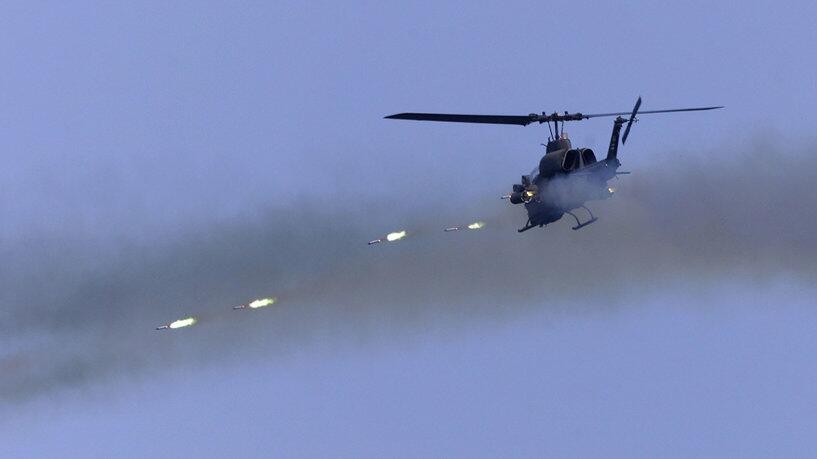
Illustrative file image

“The military responded by firing warning shots and launching fighter jets and attack helicopters to shoot down the North Korean drones,” the report based on official military statements contines. “The attack helicopters fired a combined 100 rounds but it wasn’t immediately known if any of the North Korean drones were shot down, according to the Defense Ministry.”

Only one of the five drones was observed flying back across the border into North Korea, while the others disappeared from radar, according to the south’s Joint Chiefs.

Among surveillance countermeasures authorized in response, the Joint Chiefs said that its surveillance aircraft photographed sensitive North Korean facilities from which drones usually operate.

The south’s significant rapid response to the drones breaching the border resulted in a crashed manned aircraft. Seoul identified that one of its KA-1 light attack airplanes crashed while taking off, resulting in both pilots ejecting safely.

“Our military will thoroughly and resolutely respond to this kind of North Korean provocation,” Maj. Gen. Lee Seung-o, spokesman for the South Korean Joint Chiefs of Staff, said at a press briefing.

Tensions along the militarized border have already been high due to Pyongyang firing off a record number of ballistic and other missiles this year, including a pair fired last week toward Japan. With now days left in 2022, analysts have tracked over 90 missiles fired this year.

“North Korea has launched at least 92 ballistic and other missiles in 2022 — more than in any previous year,” The New York Times has tallied in a new report. “Each was in defiance of U.N. Security Council resolutions that ban the country from testing ballistic missiles, as well as nuclear devices.”

Monday’s fresh incident illustrates how close the rival sides of the Korean peninsula are to firing on each other’s military assets at any time. The Kim Jong-Un regime has also been expressing anger over recent US-S.Korea military drills which has featured US nuclear-capable bombers and F-22 stealth jets flying over the peninsula and regional waters.

Tyler Durden
Mon, 12/26/2022 – 12:50

THE TWITTER FILES: How Twitter Rigged The Covid Debate

0
THE TWITTER FILES: How Twitter Rigged The Covid Debate

Another day, another TWITTER FILES drop exposing the incestuous relationship between big tech and government.

Today’s edition, dropped by journalist David Zweig, focuses on ‘how Twitter rigged the Covid debate‘ by taking direction from both the Trump and Biden administrations (while at the same time trying to censor the former president). What’s somewhat notable is how aggressive government (and ex-government) officials were in trying to stifle free speech, while Twitter’s non-government-linked employees would often push back (and then totally fold) – a theme we’ve observed in previous drops. In one such instance, former head of Twitter’s Trust & Safety team Yoel Roth tells former FBI lawyer and then-Twitter Deputy General Counsel Jim Baker to calm his tits over a Trump tweet.

Of course, in the end the government typically got its way, as you will read below.

Zweig, who was granted access to internal files while on assignment for The Free Press, notes that “both the Trump and Biden administrations directly pressed Twitter executives to moderate the platform’s pandemic content according to their wishes.

What’s more, the censorship effort extended to Google, Facebook, Microsoft and others.

Continued via The Free Press (emphasis ours),

In July 2021, then-U.S. Surgeon General Vivek Murthy released a 22-page advisory concerning what the World Health Organization referred to as an “infodemic,” and called on social media platforms to do more to shut down “misformation.”

“We are asking them to step up,” Murthy said. “We can’t wait longer for them to take aggressive action.” 

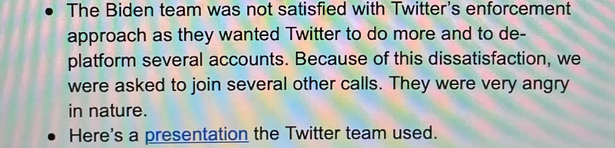
That’s the message the White House had already taken directly to Twitter executives in private channels. One of the Biden administration’s first meeting requests was about Covid, with a focus on “anti-vaxxer accounts,” according to a meeting summary by Lauren Culbertson, Twitter’s Head of U.S. Public Policy.

They were especially concerned about Alex Berenson, a journalist skeptical of lockdowns and mRNA vaccines, who had hundreds of thousands of followers on the platform:

By the summer of 2021, the day after Murthy’s memo, Biden announced publicly that social media companies were “killing people” by allowing misinformation about vaccines. Just hours later, Twitter locked Berenson out of his account, and then permanently suspended him the next month. Berenson sued Twitter. He ultimately settled with the company, and is now back on the platform. As part of the lawsuit, Twitter was compelled to provide certain internal communications. They revealed that the White House had directly met with Twitter employees and pressured them to take action on Berenson. 

The summary of meetings by Culbertson, emailed to colleagues in December 2022, adds new evidence of the White House’s pressure campaign, and illustrates how it tried to directly influence what content was allowed on Twitter. 

Culbertson wrote that the Biden team was “very angry” that Twitter had not been more aggressive in deplatforming multiple accounts. They wanted Twitter to do more.

Twitter executives did not fully capitulate to the Biden team’s wishes. An extensive review of internal communications at the company revealed that employees often debated moderation cases in great detail, and with more care for free speech than was shown by the government. 

But Twitter did suppress views—and not just those of journalists like Berenson. Many medical and public health professionals who expressed perspectives or even cited findings from accredited academic journals that conflicted with official positions were also targeted. As a result, legitimate findings and questions about our Covid policies and their consequences went missing.

There were three serious problems with Twitter’s process.

First: Much of the content moderation on Covid, to say nothing of other contentious subjects, was conducted by bots trained on machine learning and AI. I spent hours discussing the systems with an engineer and with an executive who had been at the company for more than a year before Musk’s takeover. They explained the process in basic terms: Initially, the bots were fed information to train them on what to look for—but their searches would become more refined over time both as they scanned the platform and as they were manually updated with additional chosen inputs. At least that was the premise. Though impressive in their engineering, the bots would prove too crude for such nuanced work. When you drag a digital trawler across a social media platform, you’re not just catching cheap fish, you’re going to snag dolphins along the way.

Second: Contractors operating in places like the Philippines were also moderating content. They were given decision trees to aid in their process, but tasking non-experts to adjudicate tweets on complex topics like myocarditis and mask efficacy data was destined for a significant error rate. The notion that remote workers, sitting in distant cube farms, were going to police medical information to this granular degree is absurd on its face.

Embedded below is an example template—deactivated after Musk’s arrival—of the decision tree tool that contractors used. The contractor would run through a series of questions, each with a drop down menu, ultimately guiding them to a predetermined conclusion.

Third: Most importantly, the buck stopped with higher level employees at Twitter. They chose the inputs for the bots and decision trees. They determined suspensions. And as is the case with all people and institutions, there was both individual and collective bias. 

At Twitter, Covid-related bias bent heavily toward establishment dogmas. Inevitably, dissident yet legitimate content was labeled as misinformation, and the accounts of doctors and others were suspended both for tweeting opinions and demonstrably true information.

Take, for example, Martin Kulldorff, an epidemiologist at Harvard Medical School. Dr. Kulldorff often tweeted views at odds with U.S. public health authorities and the American left, the political affiliation of nearly the entire staff at Twitter. 

Here is one such tweet, from March 15, 2021, regarding vaccination.

Internal emails show an “intent to action” by a Twitter moderator, saying Kulldorff’s tweet violated the company’s Covid-19 misinformation policy, and claimed he shared “false information.”

But Kulldorff’s statement was an expert’s opinion—one that happened to be in line with vaccine policies in numerous other countries. 

Yet it was deemed “false information” by Twitter moderators merely because it differed from CDC guidelines. After Twitter took action, Kulldorff’s tweet was slapped with a “misleading” label and all replies and likes were shut off, throttling the tweet’s ability to be seen and shared by others, a core function of the platform.

In my review of internal files, I found numerous instances of tweets about vaccines and pandemic policies labeled as “misleading” or taken down entirely, sometimes triggering account suspensions, simply because they veered from CDC guidance or differed from establishment views. 

For example, a tweet by @KelleyKga, a self-proclaimed public health fact checker with more than 18,000 followers, was flagged as “misleading,” and replies and likes disabled, for showing that Covid was not the leading cause of death in children, even though it cited the CDC’s own data.

Read the rest here…

Tyler Durden
Mon, 12/26/2022 – 12:15

Ukrainian Drone Attack On Airbase Deep Inside Russian Territory Kills 3 Soldiers

0
Ukrainian Drone Attack On Airbase Deep Inside Russian Territory Kills 3 Soldiers

A fresh Ukrainian attack deep inside Russian territory has left three dead, Russian news agencies are reporting Monday, which further describe that an enemy drone was intercepted before debris came down on bystanders below. 

The Ukrainian drone was inbound over a military base in southern Russia identified as Engels airbase in the Saratov region, which is located more than 600km from the Ukrainian border. “On December 26, at around 01:35 Moscow time, a Ukrainian unmanned aerial vehicle was shot down at low altitude while approaching the Engels military airfield in the Saratov region,” the Russian defense ministry said in a statement.

Russian MoD/TASS: Supersonic strategic bomber-missile-carrier Tu-160 “Vladimir Sudets” at the Engels air base.

“As a result of the drone’s wreckage falling, three Russian technicians who were at the airfield were fatally injured,” the statement added, as quoted in TASS. The ministry said that no aircraft were damaged in the attack, with Saratov governor Roman Busargin telling local residents there is “absolutely no threat” at this time. 

Given the drone attack from Ukraine set off some degree of panic, Busargin additionally warned the public that “All stories about the evacuation from the city are blatant lies, created far from the borders of our country.”

The incident marks a rare moment in which three Russian military personnel were killed while at a base far away from the front lines of conflict in neighboring Ukraine. Engels is also known to host advanced hypersonic and nuclear-capable bombers.

Currently there’s speculation that the drone may have directly impacted the base, and that Russian authorities are advancing the narrative that it was intercepted by anti-air defenses in order to deny the Ukrainians a ‘successful’ military operation, and for Kremlin leadership to save face. Related to the speculation and rumors, the Saratov governor had additionally warned against residents spreading “fake information.”

Via Newsweek

Monday’s deadly incident is actually the second known instance of the more than 10-month long war that Engels air base came under Ukrainian attack.

Multiple videos have been widely circulating purporting to show the moment of impact – though Russian authorities say the drone was shot down “at low altitude”, resulting in explosions or debris crashing on the ground…

On Dec.5 Ukraine’s military mounted simultaneous drone assaults on an air base in Ryazan, in western Russia which hosts nuclear-capable strategic bombers, and also Engels base.

That earlier Engels strike had constituted the deepest the Ukrainians had ever attacked inside of Russia proper.

This is a dangerous, escalatory trend which could result in Russia expanding its operation – also given just days ago President Putin for the first time referenced the “war” in Ukraine (as opposed to the heretofore officially sanctioned language of “special military operation”). There are remaining fears that Belarus could formally join Russia’s invasion by sending ground forces.

Feeling emboldened by a handful of successes, including prior attacks and bombings in Crimea, Ukraine forces will likely try to continue hitting targets inside Russia, also as their capability grows given they have been supplied with ever-longer range rockets from the US and NATO countries. Another key question remains as details are still emerging from Monday’s drone attack: is this another example of US intelligence assisting Kiev with targeting Russian military assets?

Tyler Durden
Mon, 12/26/2022 – 11:40

Will 2023 Be “Just An Average Recession In An Average Year” Or Will It Be Transformational?

0
Will 2023 Be “Just An Average Recession In An Average Year” Or Will It Be Transformational?

Authored by Charles Hugh Smith via OfTwoMinds blog,

It shouldn’t surprise us if 2023 turns out to be atypical and disruptively transformational in ways few believe possible.

It seems expectations about 2023 cleave neatly into two camps: the dominant mainstream view is that 2023 will be economically difficult due to a mild recession, but this will be nothing more than a run-of-the-mill recession.

Inflation will likely moderate but remain higher than recent averages. Everything else–politics, social issues, entertainment, fashion, social media, etc.–will continue on whatever path it is currently on.

In other words, 2023 will be much like any other year.

The implicit assumption in the mainstream view is that historical cycles are figments of fevered imaginations. The flow of human history is entirely contingent and follows no pattern or cycle.

The much smaller “outlier” camp sees the potential for a disruptive transformational year.

Those of us who conclude cycles are based on the ebb-and-flow dynamics of credit, energy and human nature and are therefore not just real but consequential despite their predictive imprecision see 2023 as a potential pivot in cycles which entered a new phase in the 2020-2021 time frame.

This cyclical shift isn’t a result of Covid or the response to Covid. It’s the result of diminishing returns and the exhaustion of the dynamics which powered the previous era: hyper-financialization, hyper-globalization and low-cost, abundant energy.

In terms of human nature, confidence and complacency rise and fall, euphoric greed and panicky fear ebb and flow and as Peter Turchin has demonstrated, order and disorder take turns as reasons to cooperate decay into reasons not to cooperate.

As David Hackett Fischer demonstrated in The Great Wave: Price Revolutions and the Rhythm of History, systemic increases in price–what we call inflation–sow the seeds of economic, social and political disunity, conflict and collapse.

In his book The Upside of Down: Catastrophe, Creativity, and the Renewal of Civilization, Thomas Homer-Dixon proposes a cyclical dynamic powered by the relative costs and rewards of participation in the status quo:

Once the costs exceed the rewards, people lose the incentive to support the status quo with their labor and participation. They drift away (what I term opting out) or reduce their effort to align with the diminished rewards and opportunities to advance their own interests.

The Russian economist Kondratieff famously observed how credit cycles between expansion and contraction, and this cycle powers economic expansion or contraction.

The Collapse of Complex Societies by Joseph Tainter outlines a dynamic in which the advantages of adding complexity to a social / economic system are substantial at the beginning but as the returns from additional complexity diminish, the costs eventually outweigh any gains and the system decays.

The success of adding complexity is institutionalized by the status quo, which then clings to this strategy even as the returns on adding complexity become negative and thus destructive.

I call this “doing more of what’s failed.”

Other systems analysts (Donella Meadows et al.) have illuminated the nonlinear character of systemic transformations. Ugo Bardi calls this “The Seneca Cliff”: systems which expanded slowly and steadily can decay and collapse quite suddenly and violently, surprising everyone who took the previous stability as permanent.

Systems follow their own rules, and so unlike politics, our opinions don’t change the results.

All of these dynamics are (in my analysis) clearly visible in the global status quo. The rational conclusion is the risks of disruption, disorder and conflict as things decay and fall apart are relatively high.

While some trends and conflicts can last for decades (the Thirty Years War in Europe, the Cold War between the US and the USSR), diminishing returns on status quo “solutions” that no longer work as anticipated tend to unravel on the periphery which then spreads quickly to the core.

Those economies and societies which are hidebound / centralized politically and economically are brittle because they lack the systemic means to adapt quickly and successfully to diminishing returns and seismic shifts in price and the availability of essentials.

Brittle systems that lack the structural means to adapt decay and collapse. This is scale-invariant, which means this is equally true of households, small businesses, global enterprises, nations and empires.

There are many such brittle systems in the global status quo, and to expect all of them to remain stable as diminishing returns start yielding negative returns (i.e. cost more than they produce in gains) and scarcities drive prices higher than the bottom 90% can afford as inflation reduces the purchasing power of their earnings–this expectation is based on a confidence that past trends are essentially permanent and every system in the world today will adapt successfully to scarcity, disorder and the reversal of financialization and globalization.

Maybe this will be the case, but given all the dynamics that are so readily visible, it would be prudent to consider the potential for dominoes falling on the periphery (i.e. in “places that don’t matter”) will soon be toppling dominoes in the core centers of power and control.

In my analysis, the dominant dynamic is always natural selection. Our opinions and projections don’t change anything. What divides the systems that endure and become stronger and those that decay and collapse is their evolutionary vigor, which is a function of decentralized competition, transparency, sharing of information and experimentation that is rewarded rather than punished.

I cover these dynamics in my book Global Crisis, National Renewal: A (Revolutionary) Grand Strategy for the United States.

Simply put: systems that view dissent and disorderly churn as threats will decay and collapse because the most powerful forces of adaptability are dissent and disorderly churn.

It shouldn’t surprise us if 2023 turns out to be atypical and disruptively transformational in ways few believe possible.

*  *  *

This essay was first published as a weekly Musings Report sent exclusively to subscribers and patrons at the $5/month ($50/year) and higher level. Thank you, patrons and subscribers, for supporting my work and free website.

My new book is now available at a 10% discount ($8.95 ebook, $18 print): Self-Reliance in the 21st CenturyRead the first chapter for free (PDF)

Become a $1/month patron of my work via patreon.com.

Tyler Durden
Mon, 12/26/2022 – 11:05

Tesla Suspends Ops At Shanghai Plant One Day Sooner Than Expected

0
Tesla Suspends Ops At Shanghai Plant One Day Sooner Than Expected

Tesla has officially halted production of its Shanghai plant one day before it was planned, Bloomberg reported over the holiday. 

The EV maker was expected to halt production – as we noted in a previous article – but continued swirling questions about demand are once again surfacing after the company shut down operations at the key location earlier than expected. 

Recall back on December 9th we wrote that the company was shutting down operations late this month due to upgrades at the plant and waning consumer demand. 

As part of the shut down, Model Y and Model 3 production lines are expected to be suspended. Bloomberg reported earlier this month that Model 3 production could resume in early January, though Model Y output disruptions could be prolonged. A source said Model 3 production could be suspended again later in the month for the Chinese New Year. They added that this would allow for more upgrades and equipment maintenance to produce an enhanced version of the model. 

Reuters also reported on the planned shut down earlier this month, citing two people who said that the suspension of the assembly line would result in a 30% reduction in Model Y production for the month. They added this type of production halt wasn’t a common practice for the plant. 

“The Shanghai factory, the most important manufacturing hub for Elon Musk’s electric vehicle company, kept normal operations during the last week of December last year,” Reuters said. 

Earlier this month, Bloomberg also said that slumping Chinese demand would result in the factory reducing production by 20% from full capacity.

Despite a report from Shanghai Securities Journal calling it “false information” at the beginning of the month, it now looks like the the report was accurate. And, with Tesla now shutting down one day prior to expectations, more questions than answers about demand are likely being raised.  

Reuters reported last month that Tesla plans a revamped version of Model 3 to cut production costs and boost the style of the five-year-old electric sedan. Tesla has also cut prices in the second-largest economy in the world to stay competitive with domestic bands. 

Tesla shares year-to-date are now down about 65%. 

Tyler Durden
Mon, 12/26/2022 – 10:35