72.9 F
Chicago
Sunday, July 26, 2026
Home Blog Page 4176

Turkey Shrinkflation

0
Turkey Shrinkflation

Via Political Calculations blog,

Having covered the inflating cost of a Thanksgiving turkey in 2022, we’re turning our attention to something very different: the shrinking size of U.S. farm-raised turkeys in 2022.

That became a cause of concern for American consumers after the U.S. government warned that big turkeys would be scarce in 2022. Here’s Axios’ executive summary:

The U.S. government is warning of a big shortage of big birds this Thanksgiving.

Why it matters: Because of this year’s avian flu outbreaks, finding 20-pound turkeys in some regions of the country could be challenging, U.S. Secretary of Agriculture Tom Vilsack said in a call with reporters on Tuesday.

The bird flu has killed more than 8 million turkeys, according to CDC data.

What they’re saying: “Some of the turkeys that are being raised right now for Thanksgiving may not have the full amount of time to get to 20 pounds,” Vilsack said on the call, which was about the administration’s effort to reduce meat and poultry prices in the long-term.

We’ve seen this show before, since avian flu was also behind 2015’s turkey shortage. But Axios’ article doesn’t answer the direct question it raises. How much smaller are U.S. farm-raised turkeys in 2022?

To find out we started with the U.S. Department of Agriculture’s estimate of the total “Ready-To-Cook” (RTC) weight of turkeys that will brought to market during 2022. That figure is 5.214 billion pounds.

Looking at the last 10 years worth of data, we determined the RTC weight of turkeys averaged 79.1% of the live weight of U.S. farm-raised turkeys. Dividing the total RTC weight by this percentage gives us an estimated total live weight for farm-raised turkeys of 6.592 billion pounds. If we broaden our analysis to look at the range of RTC-to-Live weight percentages over the last 10 years, we find it has fallen between 77.46% (2021) and 79.94% (2015). Doing the same math with these figures gives us a potential range of 6.522 to 6.731 billion pounds for the live weight estimate. The higher the percentage, the smaller the estimated live weight.

All we need to know now is the estimated population of turkeys on U.S. farms. For 2022, that preliminary estimate is 212 million turkeys. That figure is two percent below 2021’s final count of 216.5 million turkeys.

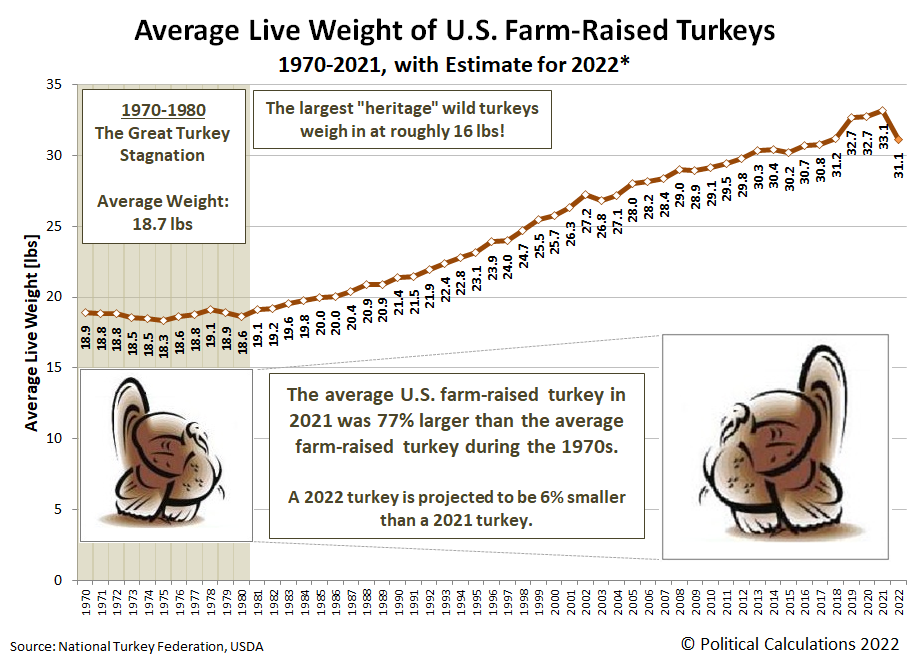
We can now estimate the average live weight of a U.S. farm raised turkey. Dividing the total live weight of all turkeys by their population in 2022 tells us that figure is 31.1 pounds (with a potential range between 30.8 and 31.8 pounds based on the range of total live weights). The following chart shows how that fits with all the data reported since 1970.

If the USDA’s estimates hold, 2022 has seen the largest year-over-year reduction in the average weight of turkeys in U.S. history. Talk about turkey shrinkflation!

Tyler Durden
Thu, 11/24/2022 – 11:00

Housing Market Obliterated: Pending Home Sales Post Record Drop As Deal Cancelations, Price Cuts Hit Record High

0
Housing Market Obliterated: Pending Home Sales Post Record Drop As Deal Cancelations, Price Cuts Hit Record High

Last week, we observed that delusion and hope can only last so long (even when one’s salary depends on it) as US homebuilder confidence crashed to COVID lockdown lows in November after failing (or refusing) to see what was obvious to everyone for months, and what homebuyers were clearly feeling as prices soared along with mortgage rates and record low affordability for most Americans. And don’t get us started on homebuyer confidence: just look at the red line below which has taken out all previous record lows (including the post-2006 housing bubble) and is hitting new record lows every single month…

Well, slowly but surely this epic collapse in sentiment is spreading to market metrics, and while it will take between 6 and 9 months for real-time data to reach the badly lagging government-level CPI and PCE data, what’s taking place in the US housing market right now is nothing short of a meteor strike, with RedFin reporting in its latest market forecast that pending home sales fell the most on record in October and deal cancellations and price cuts hit record highs as buyers were spooked by the biggest mortgage-rate jump in over four decades.

Pending sales dropped 32.1% year over year last month, the largest decline since at least 2013, when Redfin’s records begin.

Nearly 60,000 home-purchase agreements fell through, equal to a record 17.9% of homes that went under contract.

Meanwhile, almost one-quarter (23.9%) of homes for sale experienced a price drop, double the rate of a year earlier.

Surging mortgage rates also caused would-be sellers to stay put due to the lock-in effect. The average 30-year-fixed mortgage was 6.9% in October, up 3.83 percentage points from 3.07% one year earlier—the largest year-over-year increase during any month since 1981. That contributed to a 24% year-over-year drop in new listings, the steepest decrease on record aside from April 2020, when the onset of the pandemic brought the housing market to a near halt.

“The Fed’s actions to curb inflation are causing the housing market to slow at a pace not seen since the financial crisis,” said Redfin Economics Research Lead Chen Zhao. “There are already early but promising signs that inflation is cooling, which caused mortgage rates to drop last week. If that progress continues, buyers who recently backed out of deals may return to the market and sellers may be less inclined to slash their prices.”

Still, sale prices are only now just starting to fall as sellers, having held out until now, are starting to feel the need for liquidity and are increasingly hitting whatever bid they can see. And while the median U.S. home sale price declined 1.4% month over month—the largest slowdown during any October since 2012—it was still was up 4.9% from a year earlier. That will change very soon.

Prices may ease as listings linger on the market and competition slows. Homes that sold in October were on the market for a median of 35 days, up from 21 days a year earlier, and less than half (44.6%) of home offers written by Redfin agents faced competition. That compares with more than two-thirds (67.3%) in October 2021.

Here are the October highlights tabulated:

Again, none of this will show up in official US Dept of Commerce/BLS data until some time in the summer by which point the Fed may have hiked to 6% pushing the US into an all out depression.

Tyler Durden
Thu, 11/24/2022 – 10:25

Holiday Hardship: 1 In 4 Americans Skipping Thanksgiving Entirely To Save Money

0
Holiday Hardship: 1 In 4 Americans Skipping Thanksgiving Entirely To Save Money

Authored by Chris Melore via StudyFinds.org,

Thanksgiving is typically a time for big family celebrations and lots of food, but a new survey finds the struggling U.S. economy is forcing many Americans to cut back this year — or not celebrate at all!

In a poll, commissioned by digital wealth management company Personal Capital, one in four Americans say they’re actually skipping Thanksgiving altogether in order to save money. One in three are hosting smaller dinners and a staggering 88 percent are cutting at least one dish from their table in order to make ends meet.

In 2021, researchers note that an IPSOS survey found that nine in 10 Americans planned to celebrate Thanksgiving. This year, the new poll of 1,000 people found that number has fallen to just 74 percent. In fact, 47 percent say they’re celebrating “Friendsgiving” because of its more budget-friendly menu. Specifically, just 24 percent of Friendsgiving celebrations will even have a turkey on the table, with 33 percent opting for a pizza instead!

Inflation and job insecurity are raining on the Thanksgiving parade

With many Americans struggling with higher prices at the grocery store, 52 percent are asking guests to bring a dish to Thanksgiving dinner. Three in four are asking guests to bring their own alcohol, while just under half (46%) are asking people to provide the dessert. Another 42 percent are going a step further, asking their friends and family to help pay for the big meal.

Nearly six in 10 (57%) admit their Thanksgiving guest list is much smaller this year and 53 percent are cooking fewer dishes. When it comes to who’s cutting back the most, Gen Z respondents were the most likely to say they’re doing all four of those things to cover the cost of Thanksgiving in 2022.

For those who lost a job over the last year, the holidays may be even tougher. The survey finds fewer Americans who lost a job (71%) say they’ll be celebrating Thanksgiving in comparison to those who kept working (78%). However, those who lost a job are significantly more likely to attend a Friendsgiving (55%) than employed Americans (38%).

Overall, 45 percent of the country say they feel financially stressed by Thanksgiving 2022. Gen X Americans have the least amount of stress (33%) while Gen Z is feeling it the most (54%).

Thanksgiving budgets may be tighter than ever

In terms of dollars and cents, one in five Americans doubt they have enough money to afford a traditional Thanksgiving meal this year. Although 52 percent say they’re spending the same on their holiday groceries, 33 percent are slashing the budget.

In fact, 28 percent say they have less than $100 budgeted for their Thanksgiving shopping. Nearly six in 10 (57%) plan to spend between $100 and $200 for their family gathering. Just 15 percent of Americans have more than $200 set aside for the holiday feast.

Although Gen X Americans are feeling the least amount of stress this holiday season, 40 percent say they’re spending less than $100 on their Thanksgiving dinner. Perhaps they simply know the best ways to save money while shopping on a tight budget.

Respondents say the best things to do to save money are pay attention to deals (38%), use coupons (36%), and start shopping for holiday ingredients early (36%). When it comes to the items no Thanksgiving dinner is complete without, turkey tops the list (36%), followed by gravy (35%), mashed potatoes (31%), stuffing (31%), and sweet potatoes (29%).

If you’re wondering which dishes are most likely to disappear in order to save money this year, extra desserts, Brussel sprouts, squash, and creamed spinach are all on the chopping block.

Tyler Durden
Thu, 11/24/2022 – 09:50

Enjoy These Moments, Because The Outlook For After Thanksgiving Is Not Promising At All

0
Enjoy These Moments, Because The Outlook For After Thanksgiving Is Not Promising At All

Authored by Michael Snyder via The Economic Collapse blog,

I know that things aren’t great right now, but please try to enjoy the next few days, because it appears that economic conditions could quickly get a whole lot worse after Thanksgiving. 

I understand that may be difficult for many of you to hear, because we are already dealing with so much.  The worst inflation crisis in decades has been eviscerating our standard of living, major layoffs are being announced all over the nation, the housing market has started to crash, and the fallout from the collapse of FTX threatens to push over more financial dominoes in the weeks ahead.  Unfortunately, now we potentially have another major problem to add to the list.  One of the largest rail unions just voted down a tentative agreement, and so now a national railroad strike in December is a very real possibility

The likelihood of a strike that would paralyze the nation’s rail traffic grew on Monday when the largest of the 12 rail unions, which represents mostly conductors, rejected management’s latest offering that included 24% raises and $5,000 in bonuses. With four of the 12 unions that represent half of the 115,000 rail workers holding out for a better deal, it might fall to Congress to impose one to protect the U.S. economy.

Now that SMART-TD has become the fourth union to reject the tentative labor deal that was on the table, preparations for a crippling nationwide railroad strike that would begin early next month will rapidly move forward.

Such a strike would cripple thousands of supply chains from coast to coast, and even CNN has been forced to admit that an extended strike “could cause shortages and higher prices for goods including fuel and food”…

If a strike goes on for an extended period, it could cause shortages and higher prices for goods including fuel and food. If the four unions that rejected the deals are unable to reach new deals before strike deadlines, Congress could order the railroad workers to remain on the job or return to work.

The good news is that this labor dispute will eventually be resolved one way or another.

But even without a national railroad strike, most experts were already forecasting a dismal month of December.

According to the Wall Street Journal, consumers and businesses are both “bracing for a humbug holiday season”…

Households, retailers and charities nationwide, feeling the pinch of inflation, are bracing for a humbug holiday season.

U.S. consumers and businesses have trimmed spending plans for gifts, charitable contributions and holiday events, data show. The penny-pinching threatens to spoil the year-end for many, especially firms and nonprofits that tally their largest share of sales and donations in November and December.

The Federal Reserve has been waging a war against inflation for months, but prices just keep going up.

In fact, it is being reported that an average Thanksgiving dinner will cost about 20 percent more this year than it did last year…

American families will have an unwelcome guest at the dinner table this Thanksgiving: inflation.

A Thanksgiving meal for 10 will cost $64.05, a 20 percent increase from last year’s average of $53.31, the American Farm Bureau reports.

The centerpiece on most Thanksgiving tables – the turkey – is a big driver of the increase. According to the Farm Bureau,the average price per pound is up 21 percent from last year.

Meanwhile, job losses will completely spoil this holiday season for thousands upon thousands of Americans.

Sadly, many of the jobs that are being lost are good paying jobs.  For example, Cisco just announced that they will be firing over 4,000 well paid workers

San Jose-based tech giant Cisco plans to lay off over 4,000 employees, according to a report in the Silicon Valley Business Journal and later corroborated by the San Francisco Chronicle.

In a transcript of Cisco’s Q1 2023 Earnings Call published by Motley Fool, Cisco Chief Financial Officer Scott Herren characterized the move as a “rebalancing.” Chairman and Chief Executive Officer Chuck Robbins said the company was “rightsizing certain businesses.”

At one point, the average employee at Cisco was making $109,000 a year.

Those that are losing their jobs won’t be able to replace those incomes easily.

On top of everything else, U.S. consumers are now seeing their home values start to fall as the housing market crashes.

As I discussed earlier this week, home sales were 28.4 percent lower in October 2022 than they were in October 2021.

That is a nightmare figure, and those that work in the real estate business are starting to feel the pain.

In fact, Zero Hedge is reporting that a whopping 37 percent of U.S. real estate agents could not pay office rent in October…

Higher borrowing costs triggered a sharp drop in mortgage applications and home sales in the back half of the year. Deal flow is drying up for many real estate agents, resulting in financial duress that may worsen into early 2023.

In October, a shocking 37% of real estate agents struggled to pay office rent — a 10% increase from the prior month, according to Yahoo, citing a new report via Redfin. The figure could worsen as the housing market rapidly cools via the Fed-induced demand side crunch.

That is more than a third of all real estate agents!

Sadly, this is just the beginning.

Our economic momentum is taking us downhill quite quickly now, and it isn’t going to take very much to turn this downturn into an avalanche.

At this point, things are already so bad that best-selling author James Rickards is warning that “this thing is going to completely crash” and that “we are in for a worse crisis than 2008″…

Rickards points out, “Why does Warren Buffett and Brookshire Hathaway have $130 billion in cash?  Buffett is one of the greatest investors of all time.  Why isn’t he out there buying stocks?  Again, why does he have $130 billion in cash?  It’s because Buffett sees what I see.  Yes, this thing is going to completely crash.  It’s a really good idea to have cash because you can go shopping in the wreckage and pick up some bargains.  My point is, we don’t have to guess.  Look at the Treasury yield curve.  Look at the euro/dollar futures yield curve.  Look at other metrics, and guess what it looks like?  It looks like 2007.  Everything I am describing, but not quite as extreme by the way, was true in 2007. . . . These euro/dollar futures were behaving then exactly as they are now.  Except now, the inversion is even worse, which means we are in for a worse crisis than 2008.  It’s coming.  Everything I said has nothing to do with FTX.  Throw FTX on top, and as I said, you are throwing gasoline on a fire.”

If Rickards is correct, what will our nation look like a year from now?

You might want to start thinking about that, because the times we are moving into will be unlike anything we have ever seen before.

But most Americans don’t want to hear this.

Most Americans just want to blindly believe that our leaders in Washington have everything under control and that they will be able to fix things.

There is certainly nothing wrong with hoping for the best, but meanwhile you might also want to start preparing for the worst, because things are starting to get really crazy out there.

*  *  *

It is finally here! Michael’s new book entitled “End Times” is now available in paperback and for the Kindle on Amazon.

Tyler Durden
Thu, 11/24/2022 – 08:40

Millions Of Euros Of Celtic Gold Stolen From Bavarian Museum In 9 Minute Heist

0
Millions Of Euros Of Celtic Gold Stolen From Bavarian Museum In 9 Minute Heist

Burglars in Bavaria have stolen ‘several million euros’ worth of gold from a Celtic Roman Museum in Manching near Ingolstadt, Die Welt reports.

The treasure, which is over two thousand years old, consisted of 483 coins which were discovered near Manching in 1999.

The heist took just nine minutes.

At 1:26 a.m., an outside door was pried open, said the Vice President of the State Criminal Police Office, Guido Limmer, on Wednesday in Manching near Ingolstadt. The thieves then stole the coins from two showcases and left the museum at 1.35 a.m. – after only nine minutes. -Die Welt (translated)

“The loss of the Celtic treasure is a disaster,” said Bavaria’s minister of science and arts, Markus Blume. “As a testament to our history, the gold coins are irreplaceable.”

The identity of the perpetrators is unknown, while investigators are probing possible connections to the ‘spectacular’ theft of jewels from the Green Vault in Dresden, as well as another coin theft from the Bode Museum in Berlin.

The Big Maple Leaf (BML) is a 100-kilogram (220-lb) gold coin that costs $1 million (CAD) (3,215 troy ounces). The first BML manufactured is still in storage, but the Royal Canadian Mint (RCM) produced a set of six of these coins in 2007. A single Big Maple Leaf had a market value of about $4 million as of March 2017. (USD). One of the coins was stolen from a Bode museum on March 27, 2017. –Arkeonews.net

The “big maple leaf,” which is regarded as the second-largest gold coin in the world, was taken from Berlin’s esteemed Bode museum in 2017 in another numismatic robbery.

According to Guido Limmer, VP of the State Criminal Police Office, there are “parallels” between the cases, though actual  connections are unknown.

The Celtic-Roman Museum in Manching, Germany

Investigators are also looking into whether the burglary was related to sabotage at a local phone distribution branch in Manching located around 1km from the museum, which paralyzed the telephone network and the internet, thus preventing the alarm system from notifying authorities.

Tyler Durden
Thu, 11/24/2022 – 08:05

Black Friday Unlikely To Lift Dark Mood For Retail

0
Black Friday Unlikely To Lift Dark Mood For Retail

By Heather Burke, Bloomberg Markets Live analyst and reporter

Retail’s horrible 2022 is unlikely to get any better as the all-important holiday season unofficially kicks off this week amid an unprecedented cost-of-living crisis on both sides of the Atlantic.

Retail is one of the worst-performing S&P 500 GICS 2 sectors year-to-date, down more than 30% compared with the overall benchmark’s decline of about 17%. Some of that stems from the selloff in mega-tech: Amazon.com is approximately 45% of the gauge and responsible for about 75% of retail’s decline in terms of market cap.

But even minimizing Amazon with the equal-weight S&P Retail Select Industry Index (SPSIRE), down almost 30% year-to-date, underscores the sector’s underperformance.

US retail sales posted the biggest increase in eight months in October, but some discretionary categories like electronics declined, suggesting price cuts and weaker demand are weighing on the value of sales. Inflation, while slowing, remains firmly entrenched above pre-pandemic levels, meaning people are spending more on essentials like food and gas. Lower gasoline prices may help. But consumer sentiment is fragile amid rising borrowing costs. Some spending has also shifted from goods to experiences such as travel.

Retailers including Macy’s, Gap and Ross Stores rallied last week on strong earnings; for some, measures to clear inventory with big discounts paid off. But others said sales slowed in recent weeks and gave cautious outlooks. Ross said “we continue to expect a very promotional holiday selling season.” Target tumbled post-results as shoppers were hit by “inflation, rising interest rates and economic uncertainty,” the CEO said; discretionary categories have lagged.

And while Walmart boosted its forecast, part of that came from higher-income shoppers trading down, and a shift to groceries from general merchandise. Even Amazon is concerned, projecting the slowest holiday-quarter growth in its history.

The National Retail Federation forecasts sales rising by 6% to 8% in November and December, well below last year’s record 13.5% increase. Retailers may have to discount deeply to attract shoppers, threatening profitability at a peak period.

Black Friday, the informal start of the peak shopping season, comes this week amid the muted backdrop. A Goldman Sachs survey of 1,000 US consumers found that nearly half plan to spend less this holiday season than they did in 2021.

Retail stocks are also being battered in Europe and are among the most shorted. While the sector, like US peers, has benefited from the bear market rally, it’s still the second-worst performer in the Stoxx 600 year-to-date, with consumer confidence near a record low.

UK retail stocks have seen particular misery amid the sharpest drop in living standards. It’s one of the worst-performing FTSE 350 sectors so far this year. October’s retail sales were worse than expected.

Consumers face higher taxes and spending cuts as the government tries to tackle inflation and rein in the budget deficit. Disposable incomes will probably fall 7% in the next two years under last week’s measures set out by the Chancellor of the Exchequer.

Retail has become a bit of a recovery play in the recent bear market rally and US consumers have shown resilience by some measures such as credit. But with multiple retail gauges set for the worst year since the global financial crisis, it will take a remarkably strong holiday season to overcome 2022’s gloom — and next year may not be much better.

Tyler Durden
Thu, 11/24/2022 – 07:30

Britain Provides Helicopters To Ukraine For First Time In War

0
Britain Provides Helicopters To Ukraine For First Time In War

The West is inching forward with providing Ukraine significant air power, at a moment President Zelensky continues pressing for NATO countries to “close the sky”. UK Defense Secretary Ben Wallace has announced Britain will for the first time send helicopters to Ukraine’s forces.

While Britain has already sent drones, this marks the first piloted aircraft being provided since the Russian invasion began. The new transfer is to include three Sea King helicopters, which were recently retired from active service by the UK MoD, along with an additional 10,000 artillery rounds.

Sea King, via UK Defence Ministry 

One helicopter has reportedly arrived in the country, and will be used in search of rescue operations. “In the last six weeks, Ukrainian crews were trained in the United Kingdom to fly and maintain the aircraft to provide search-and-rescue capabilities,” according to international reports based on Wallace’s press briefing. 

“Our support for Ukraine is unwavering. These additional artillery rounds will help Ukraine to secure the land it has reclaimed from Russia in recent weeks,” Wallace said while on a visit to Norway.

Britain’s Defense Ministry has recently said it believes Russia’s military is likely close to exhausting its Iranian-supplied suicide drones which have for months wreaked havoc on Ukrainian cities and particularly its national energy infrastructure. 

Days ago, British Prime Minister Rishi Sunak unveiled a new £50 million ($59 million) package of defense aid which features anti-air guns and munitions, especially to combat Russian drones. 

Wallace is currently hosting meetings of the defense allies known as Northern Group aboard the HMS Queen Elizabeth aircraft carrier

The 12-strong Northern Group is a U.K. initiative aimed at promoting defense and security cooperation in northern Europe.

Other members are Denmark, Estonia, Finland, Germany, Iceland, Latvia, Lithuania, the Netherlands, Norway, Poland and Sweden. 

UK political leaders are hailing the helicopters an an important first step in bolstering Ukraine’s aerial capabilities…

While three search and rescue helicopters isn’t hugely significant, it does mark a symbolic precedent which could pave the way for the West providing more serious and lethal aerial assets. Kiev has long pressed for fighter jets, however, Europe and the US has responded with silence

Tyler Durden
Thu, 11/24/2022 – 06:55

US: Turkey Has ‘Right To Defend Itself’ As 500 Kurdish Targets Hit

0
US: Turkey Has ‘Right To Defend Itself’ As 500 Kurdish Targets Hit

Authored by Dave DeCamp via AntiWar.com,

The White House said Tuesday that Turkey has the “right to defend themselves” from Kurdish militant groups in northern Syria and Iraq following massive Turkish airstrikes in the region.

“Turkey does continue to suffer a legitimate terrorist threat, particularly to their south. They certainly have every right to defend themselves and their citizens,” National Security Council spokesman John Kirby told reporters.

Prior Turkish airstrikes on northern Syria, AFP/Getty Images

Turkey launched the strikes in response to a bombing in Istanbul that killed six people, which it blamed on the Kurdistan Worker’s Party (PKK) and its Syrian affiliates, including the US-backed SDF. The operations killed members of the SDF, and they reportedly responded by firing rockets into a Turkish district near the Syrian border.

Ankara is continuing to expand its cross-border assault

Turkish Defense Minister Hulusi Akar said Wednesday that Turkey’s military had hit nearly 500 Kurdish targets across Iraq and Syria as part of a campaign of air strikes.

“So far 471 targets have been struck and 254 terrorists were neutralized in the operation,” Akar was quoted as saying by the official Anadolu news agency.

Kirby’s only warning was that the Turkish assault could impact US and SDF operations against ISIS. He said the Turkish operation “might force a reaction by some of our SDF partners that would limit and constrain their ability to fight against ISIS…and we want to be able to keep the pressure on ISIS.”

The statement from Kirby marks a shift in the US approach to Turkey’s operations against Kurds in Syria. The US typically condemns them but is not doing so now, likely because it wants Turkey to approve Sweden and Finland’s NATO bids.

The State Department issued a short statement on the fighting between the two US allies on Monday that called for de-escalation. “We urge de-escalation in Syria to protect civilian life and support the common goal of defeating ISIS. We continue to oppose any uncoordinated military action in Iraq that violates Iraq’s sovereignty,” said State Department spokesman Ned Price.

Tyler Durden
Thu, 11/24/2022 – 06:20

Most Crucial Industrial Fuel Faces Global Shortage

0
Most Crucial Industrial Fuel Faces Global Shortage

A perfect storm in global diesel markets is unfolding. Refining capacities are tight, and stockpiles are being depleted as the Northern Hemisphere cold season begins. Supply crunches could jeopardize critical transportation networks since the industrial fuel powers ships, trucks, and trains. The fuel is also used for heating homes and businesses, as well as a power generation source for utilities. 

“Within months, almost every region on the planet will face a danger of a diesel shortage just as supply crunches in nearly all the world’s markets have worsened inflation and hurt growth,” Bloomberg warned. 

The economic impact of soaring diesel prices and shortages worldwide could have devastating effects, such as an inflation accelerant that would burden households and businesses. 

Both gasoline and diesel prices are linked to crude prices set on the global market. Due to supply constraints, diesel prices in many markets currently demand a hefty premium. 

Mark Finley, an energy fellow at Rice University’s Baker Institute of Public Policy, explained to Bloomberg that elevated diesel prices could cost the US economy $100 billion:

“Anything and everything that gets moved in our economy, diesel is there.

“Moving stuff around is one thing. People potentially freezing to death is another.” 

Diesel inventories in the US had plunged to the lowest level since 1982 when the government began reporting data on the fuel. Supplies for this time of year are at the lowest levels ever. 

According to the Energy Information Administration, the US now has just 25 days of diesel supply, the lowest since 2008; and while inventories are record low, the four-week rolling average of distillates supplied – a proxy for demand – increased to its highest seasonal level since 2007. 

Reuters’ senior market analyst John Kemp noted that diesel shortages will persist until a downturn in the economy.  

Prices for US diesel in the spot market of New York harbor have risen more than 265% since President Biden took the oath of office in 2021. Prices reached $5.37 a gallon in the spring of 2022 and have since slumped to $3.51. 

US Northeast markets are the tightest in the US, where oil refineries have been shuttered in the last several years. This has also complicated the picture of winter heating oil and jet fuel supplies in the region.  

Last month, a major fuel supply logistics company initiated emergency protocols across the Northeast and Southeast about the dangers of supplies running low that might cause delivery delays for some customers. 

“While Russia’s war in Ukraine sent diesel prices soaring, the current situation is partly the result of an interconnected, slow-building series of events that extends across the globe. Some analysts trace the roots of the US diesel shortage to a fire at Philadelphia Energy Solutions in 2019, which forced the refinery to shut down, taking out one of the Northeast’s important diesel producers,” according to the NYTimes.  

Besides the US, Northwest Europe is facing low diesel supplies. Inventories in Europe are expected to plunge further after Russian crude and crude products sanctions come into play in the coming months. Global export markets are so tight right now that emerging market countries are being squeezed out of purchasing industrial fuel, such as Pakistan. 

“It’s certainly the biggest diesel crisis that I have ever seen,” Dario Scaffardi, a former chief executive officer of the Italian oil refiner Saras SpA who spent four decades in the industry, told Bloomberg.

The cause of the global diesel shortage is very clear: 

That’s partly a function of the pandemic, after lockdowns destroyed demand and forced refiners to close some of their least profitable plants. But the looming transition away from fossil fuels has also dented investments in the sector. Since 2020, US refining capacity has shrunk by more than 1 million barrels per day. Meanwhile in Europe, shipping disruptions and worker strikes have also eaten into refinery production. -Bloomberg 

The ban on Russian crude to Europe in December could worsen the situation. Then a ban on Russian diesel in February could unleash even more chaos for the continent. Reuters said traders are panic-hoarding Russian oil products before the bans come into effect. Earlier this year, the US halted Russian diesel shipments, which last year, it was a major supplier to the East Coast. 

“If Russia is not a supplier anymore, that puts a big, big dent into the system, which is going to be really difficult to fix,” said Scaffardi, the former Saras CEO. 

Speculation mounts that the Biden administration could halt diesel exports to boost domestic supplies, but that may not have the desired effects because diesel is a globally traded commodity. Any export ban from the US would cause unwanted market gyrations. 

Labor strikes have also exacerbated diesel shortages across Europe at major refineries. French refineries experienced several labor actions this fall, and a large BP refinery in Rotterdam on Tuesday. 

The diesel crunch has been “damaging to the global economy,” said Amrita Sen, the head of research at Energy Aspects Ltd. She said the only way to “resolve diesel tightness ultimately needs new refining capacity.”

And the bad news is that Chevron CEO Mike Wirth told Bloomberg TV this past summer that no new refineries will ever be built in the US. 

Winter could exacerbate problems for the Northern Hemisphere as the worst diesel squeeze in a generation could wreak havoc on the already faltering global economy. 

Tyler Durden
Thu, 11/24/2022 – 05:45

Pope Fires Entire Leadership From Global Catholic Charity Amid Harrassment Allegations

0
Pope Fires Entire Leadership From Global Catholic Charity Amid Harrassment Allegations

Via Remix News,

In a resounding decree released on Tuesday, Pope Francis sacked all leaders of the Caritas Internationalis charity, appointing a temporary Vatican administrator to head the confederation of 162 Catholic relief, development, and social service organizations operating in over 200 countries and territories worldwide.

According to Reuters, Pope Francis decided to sack the entire management of the charity following allegations of humiliation and harassment of staff at the organization’s headquarters in Rome. Several current and former charity employees spoke to the news agency, with one former employee saying that workers at the charity headquarters had suffered harassment, fear, and “ritual humiliation.”

At the same time, the Vatican’s dicastery for development, to which the charity is subordinate, announced that a comprehensive investigation had been carried out this year at the charity’s headquarters, involving external management and psychological experts. The investigation concluded that there was indeed a basis for the above reports, read the Vatican’s press release.

It added, however, that there was no evidence that financial abuse or sexual harassment had taken place, but identified a number of problems that “require immediate action.” They said these failures were mainly in the area of corporate management and procedures, and had a negative impact on staff team spirit and morale.

The papal decision was also followed by the resignation of Cardinal Luis Antonio Tagle, often referred to in the press as ‘Francis of Asia,’ who was nominally the president of the charity but was not involved in the day-to-day running of the organization. The Filipino cardinal has been seen by some as a possible successor to Pope Francis.

Tagle will, however, retain his main ecclesiastical post and will remain head of the Dicastery for Evangelisation within the Catholic Church, responsible for the management of missionaries.

Reuters also noted that apart from the cardinal and one other priest, all the heads of the international charity were non-clerical.

Tyler Durden
Thu, 11/24/2022 – 05:10