75.2 F
Chicago
Thursday, July 23, 2026
Home Blog Page 4241

Here’s What The Fed May Say Today… And Three Things To Watch For

0
Here’s What The Fed May Say Today… And Three Things To Watch For

Earlier today we shared an extended preview of what the Fed may do both today – as a reminder, a 75bps rate hike is assured at 2pm – as well as in December and onward, where banks are split, with some expecting a 50bps “slowdown” in the pace of hiking, while others – such as Barclays and DB – expect the Fed to keep pressing on:

  • Bank of America: 75 bps, 50 bps

  • Barclays: 75 bps, 75 bps

  • Citigroup: 75 bps, 50 bps

  • Deutsche Bank: 75 bps, 75 bps

  • JPMorgan Chase: 75 bps, 50 bps

  • Goldman Sachs: 75 bps, 50 bps

  • Morgan Stanley: 75 bps, 50 bps

  • Wells Fargo: 75 bps, 50 bps

And while we said that it’s less important to the market what the Fed will say today, others disagree: as an example here is Bloomberg’s Ven Ram who breaks his proposed statement redline as follows, starting with the top where he expects only “cosmetic changes.”

Going down the statement, the BBG strategist notes that the key part will be changes to its third paragraph:

Scenario A:

If the Fed sticks to the current version of that paragraph, attention will turn to whether Chair Jerome Powell will acknowledge such a shift in his press conference.

Scenario B:

The Fed may, however, choose to explicitly acknowledge that it could be done with its jumbo increases for this cycle with a change along the following lines, which will send yields lower and stocks sharply higher:

There is also opportunity for dissent in the vote:

Statement aside, and since there is no SEP (projections) all traders get is the statement and the subsequent press conference, here are the three things traders can expect from today’s FOMC according to Ram:

Size of hike & explicit guidance:

  • The markets are well positioned for another 75-basis point increase, the fourth consecutive jumbo hike and probably the last for the cycle of such a magnitude, which means traders will be focused on what the Fed has to say about its intentions for December. Any explicit acknowledgment that the Fed is looking to slow the pace of its increases going forward in its statement will spur speculation of a lower terminal rate as an immediate reaction and cause front-end rates to rally.

Scope for dissent:

  • At least one or several members have seen a year-end Fed funds rate of 3.9% according to the latest dot plot, which will be met today if the Fed acts in line with market pricing. These participants would effectively seek a smaller hike of 50 basis points today and another of the same magnitude if they are still sticking with what they had penciled in just September.

  • Fed Kansas City President Esther George, who voted in favor of a smaller hike in June, may dissent again. The Fed should raise rates to a restrictive level while avoiding too much haste, which could “disrupt financial markets and the economy in a way that ultimately could be self-defeating,” she remarked last month.

Messaging from Powell:

  • In the absence of any explicit message in the statement about a slower pace of increases going forward, it is likely that Chair Jerome Powell will telegraph such an intent in his press conference. That wouldn’t, however, amount to a dovish pivot — it would merely align the Fed’s messaging with what is found in its dot plot, the median of which projects the year-end rate at 4.4%.

  • While Powell may concede ground on a slower pace of tightening, he is unlikely to budge on the level of the terminal rate he sees. With inflation many miles away from its 2% goal and the labor markets still tight, the Fed is unlikely to signal that it may be done early next year or even later for that matter. The message that Powell is likely to drum home is that the economy is losing momentum, but “we will do what it takes” to get inflation down and toward the Fed’s target.

More in our full preview earlier today.

Tyler Durden
Wed, 11/02/2022 – 13:00

“That’s Quite The Spin”: White House Fact Checked By CNN And Twitter After Absurd Social Security Claim

0
“That’s Quite The Spin”: White House Fact Checked By CNN And Twitter After Absurd Social Security Claim

The Biden Administration’s latest attempt to rebrand terrible economic news as good news was so blatant that even CNN’s fact-checker Daniel Dale called them out.

In a Tuesday tweet, the White House claimed that “Seniors are getting the biggest increase in their Social Security checks in 10 years through President Biden’s leadership.”

Except, that’s only because it’s tied to inflation – which has skyrocketed

“That’s quite the spin,” Dale responded, adding “The size of Social Security checks is linked, by law, to inflation. This year’s increase is unusually big because the inflation rate is unusually big.

And now, Twitter has ‘fact-checked’ the White House – something one wouldn’t normally expect pre-Elon;

“Seniors will receive a large Social Security benefit increase due to the annual cost of living adjustment, which is based on the inflation rate.”

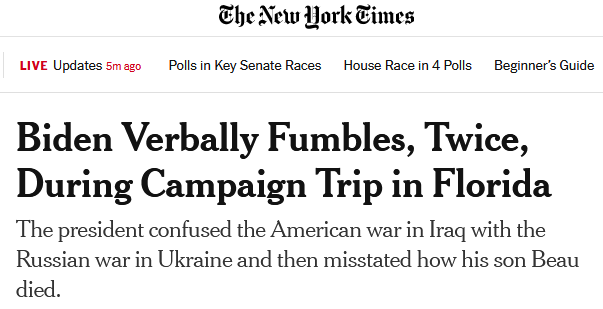
In other news, Joe Biden said that inflation is a problem because of the “war in Iraq… excuse me, the war in Ukraine,” adding “I’m thinking about Iraq because that’s where my son died.”

Biden’s son was never in Iraq and died on US soil of brain cancer.

And what did the regime media call Biden’s lie about his son? Verbal fumbles

Tyler Durden
Wed, 11/02/2022 – 10:07

EU Warns Twitter Not To Restore Free Speech Protections After Calls From Clinton & Other Democratic Leaders

0
EU Warns Twitter Not To Restore Free Speech Protections After Calls From Clinton & Other Democratic Leaders

Authored by Jonathan Turley,

We have been discussing how Democratic leaders like Hillary Clinton called on foreign companies to pass censorship laws to prevent Elon Musk from restoring free speech protections on Twitter. The EU has responded aggressively to warn Musk not to allow greater free speech or face crippling fines and even potential criminal enforcement. After years of using censorship-by-surrogates in social media companies, Democratic leaders seem to have rediscovered good old-fashioned state censorship.

Sen. Elizabeth Warren (D., Mass.) declared Musk’s pledge to restore free speech values on social media as threatening Democracy itself. She has promised that “there are going to be rules” to block such changes. She is not alone. Former President Obama has declared “regulation has to be part of the answer” to disinformation.

For her part, Hillary Clinton is looking to Europe to fill the vacuum and called upon her European counterparts to pass a massive censorship law to “bolster global democracy before it’s too late.”

New Zealand Prime Minister Jacinda Ardern recently repeated this call for global censorship at the United Nations to the applause of diplomats and media alike.

EU censors have assured Democratic leaders that they will not allow free speech to break out on Twitter regardless of the wishes of its owner and customers.

One of the most anti-free speech figures in the West, EU’s Internal Market Commissioner Thierry Breton has been raising the alarm that Twitter users might be able to read uncensored material or hear unauthorized views.

Breton himself threatened that Twitter must “fly by [the European Union’s] rules” in censoring views deemed misleading or harmful by EU bureaucrats. Breton has been moving publicly to warn Musk not to try to reintroduce protections that go beyond the tolerance of the EU for free speech. Musk is planning to meet with the EU censors and has conceded that he may not be able resist such mandatory censorship rules.

The hope of leaders like Clinton is the anti-free speech measure recently passed by EU countries, the Digital Services Act. The DSA contains mandatory “disinformation” rules for censoring “harmful” thoughts or views.

Breton has made no secret that he views free speech as a danger coming from the United States that needs to be walled off from the Internet. He previously declared that, with the DSA, the EU is now able to prevent the Internet from again becoming a place for largely unregulated free speech, which he referred to as the “Wild West” period of the Internet.

It is a telling reference because the EU views free speech itself as an existential danger. They reject the notion of free speech as its own protection where good speech can overcome bad speech. That is viewed as the “Wild West.”

Many of us are far more fearful of global censors than some whack job spewing hateful thoughts from his basement. That is why I have described myself as an Internet Originalist:

The alternative is “internet originalism” — no censorship. If social media companies returned to their original roles, there would be no slippery slope of political bias or opportunism; they would assume the same status as telephone companies. We do not need companies to protect us from harmful or “misleading” thoughts. The solution to bad speech is more speech, not approved speech.

If Pelosi demanded that Verizon or Sprint interrupt calls to stop people saying false or misleading things, the public would be outraged. Twitter serves the same communicative function between consenting parties; it simply allows thousands of people to participate in such digital exchanges. Those people do not sign up to exchange thoughts only to have Dorsey or some other internet overlords monitor their conversations and “protect” them from errant or harmful thoughts.

The danger of the rising levels of censorship is far greater than the dangers of such absurd claims of the law or science — or in this case both. What we can do is to maximize the free discourse and expression on the Internet to allow free speech itself to be the ultimate disinfectant of disinformation.

Tyler Durden
Wed, 11/02/2022 – 09:45

Ukraine Grain Shipments Resume As Russia Rejoins Deal, Wheat Futures Tumble

0
Ukraine Grain Shipments Resume As Russia Rejoins Deal, Wheat Futures Tumble

Wheat futures tumbled on Wednesday morning statements from Russia saying it has agreed to return to the Turkey and UN-brokered grain deal to allow for the continued export of Ukrainian grain through a Black Sea ‘safety corridor’. 

Moscow said it has returned to the deal after receiving assurances that Ukraine will not use the maritime safety corridor for military purposes. Russia’s Defense Ministry confirmed it has received “sufficient” guarantees from the Ukrainian government that it will demilitarize the humanitarian corridor, following last week Russia saying its ships had come under drone attack.

“Russia considers that the received guarantees are at the moment sufficient and is resuming the implementation of the agreement,” the ministry said. The vital deal is set to be renewed in mid-November after nearly 10 million tons of grains and other foodstuffs have been sent through it since it was implemented in the summer. Russia announced it had pulled out on Saturday, resulting in a diplomatic scramble to find a way forward.

Grain ships halted off the Istanbul coastline awaiting inspection under terms of the UN deal, Getty Images.

Further, Turkish President Recep Tayyip Erdogan told his parliament that “shipments will continue from 12:00 today as planned,” which had followed a call between Turkish and Russian defense ministers. 

A flurry of calls between capitals laid the groundwork for restoration of the deal, after the United Nations, the EU, and international food monitors warned that blockage of millions of tons of Ukraine grain exports could unleash famine on heavily dependent parts of the globe, such as in Africa and the Middle East. 

French President Emmanuel Macron held a phone call with Zelensky, while Turkey’s Erdogan spoke to President Putin. The Russian leader conveyed to Erdogan in the Tuesday call that he’s seeking “real guarantees from Kyiv about the strict observance of the Istanbul agreement, in particular about not using the humanitarian corridor for military purposes.”

Bloomberg: Chicago wheat futures plunged as much as 6.3%, the most since July, after surging in the first two days of the week. 

Macron and Zelensky agreed that lack of an export safety corridor “again harms global food security” – while Kiev accused Russia of using security concerns in the Black Sea as a “false pretext” to withdraw from the deal.

Commenting on these allegations of Moscow ‘weaponizing food’, Oksana Antonenko, director at Control Risks in London, said “Putin wants to compel the West to negotiate with him as soon as possible to freeze the conflict, his direct proposals did not work, so he is resorting to other strategies like talking about Ukrainian dirty bomb, threatening nuclear escalation or pulling out from the grain deal…all to get them around the table with him. But it remains that “So far it did not work and I think will not work, at least in the near future.” Speculation over the fate of the deal has resulted in prior weeks of volatility and extreme uncertainty impacting agricultural markets.

Tyler Durden
Wed, 11/02/2022 – 09:32

Treasury “Has Not Made Decision” Yet On Buybacks; Holds Quarterly Debt Sales Unchanged

0
Treasury “Has Not Made Decision” Yet On Buybacks; Holds Quarterly Debt Sales Unchanged

Yesterday we said that “with all the focus on the Fed tomorrow, it will be delightful(ly ironic) if the Treasury steals the show with a TSY buyback announcement during the 8:30am refunding announcement.”

Of course, as discussed extensively, a Treasury buyback – something that has not been done in earnest since the early 2000s – would be the functional equivalent of a QE/operation twist hybrid, only one conducted not by the Treasury, and thus any affirmative announcement today would have had an even bigger impact on markets than anything Powell would say at 2pm.

So fast forward to today’s 8:30am refunding announcement when amid the buyback discussion we read the following:

Treasury is currently studying potential buybacks.  In August, the Treasury Borrowing Advisory Committee provided updated analysis on buybacks, building on a presentation from 2015. This quarter, Treasury asked the primary dealers for their views on questions related to several potential uses for buybacks, including liquidity support and cash and maturity management.  In addition, Treasury continues to meet with a broad variety of market participants in order to assess the costs and benefits associated with buybacks.  Treasury expects to share its findings on buybacks as part of future quarterly refundings. Treasury has not made any decision on whether or how to implement a buyback program but will provide ample notice to the public on any decisions.

In other words, no buyback yet… because a quick skim of the associated TBAC discussion materials (which we will present in a follow up post) shows that Treasury buybacks are indeed coming, to wit:

Debt Manager Taylor then reviewed primary dealers’ views on a potential Treasury buyback program.  Dealers generally thought a Treasury buyback program was worth further exploration.  Some dealers focused on potential benefits for market liquidity, while others noted the potential utility for cash and maturity management.  Most recommended that potential buybacks be conducted in a regular and predictable manner, consistent with Treasury’s framework for debt issuance.  In terms of financing the purchases, most dealers suggested that the necessary increases to matched-maturity on-the-run issuance sizes would not meaningfully affect the maturity distribution of the debt, would be manageable to auction, and would not materially erode the liquidity premia associated with on-the-run securities.  On the size of a potential program focused on market liquidity, most advocated for scaling buybacks to help support liquidity in a typical market environment.  Finally, dealers highlighted the importance of clear communication from Treasury about the goals and implementation details of any potential program.  

What comes next:

The Committee asked about Treasury’s next steps regarding buybacks.  Deputy Assistant Secretary Smith indicated that Treasury was still gathering information regarding the potential costs and benefits of buybacks under a variety of use cases, including liquidity support and cash and maturity management, and that Treasury had not yet made any decision about whether or how to implement a buyback program.  The Committee thought it was prudent for Treasury to study this issue further.

With liquidity in Treasuries this year collapsing as trading volumes and volatility surged in wake of the most aggressive pace of Fed tightening in decades, numerous strategists have said buying back so-called off-the-run securities – debt that’s no longer a current benchmark – might help improve trading conditions.

Buybacks aside, there were no surprises in terms of actual bond issuance in the coming refunding week, where – as expected – the US Treasury halted the longest string of cutbacks to its quarterly sales of longer-term debt in about eight years, showcasing the end of a period of historic reduction in the fiscal deficit.

A rapidly shrinking budget gap – thanks to the end of pandemic-relief spending and by an economic recovery that spurred record tax revenues – allowed the Treasury to reduce its so-called quarterly refunding auctions the past four times. But that is all changing fast, and the deteriorating fiscal outlook – and the coming recession – are contributing to a bump in estimated borrowing needs. And the Federal Reserve’s continuing runoff of its portfolio of Treasuries is forcing the government to issue more debt to the public. In fact, as the Treasury hinted at on Monday when it unveiled its latest Q4 debt Sources and Uses, it will need to issue $150BN more than previously expected…

… the consensus is quickly shifting to a “return to normalcy” and bigger TSY auctions now that we have troughed.

Specifically, the Treasury said it will sell $96BN of long-term securities at its the quarterly refunding auctions next week. This was in line with the August operation, (which was $98BN but after accounting for previously planned trims to two-year note sales). Dealers had correctly predicted an unchanged total. The refunding auction sizes are also unchanged from the most recent new issue or reopening. The Dec. 5-year TIPS reopening will increase by $1b while the Jan. 10-year TIPS new issue will be maintained.

  • Treasury to sell $40BN of 3-year notes on Nov. 8; unch from October
  • Treasury to sell $35BN of 10-year notes on Nov. 9; unch from October
  • Treasury to sell $21BN of 30-year bonds on Nov. 10; unch from the Aug refunding, and up $3BN from October

And visually:

According to the Treasury, this issuance will raise new cash from private investors of approximately $40.7 billion. 

Reversing an earlier trend, the Treasury refrained from further cutbacks in the sales of 20-year bonds, which have struggled this year with dimmed levels of liquidity. Only a few dealers had predicted such a move, after past reductions of the maturity.

The $96BN refunding was smallest since May 2020, and compares with a peak of $126b first reached in Feb. 2021; auction sizes across the curve began rising in 2018 to finance tax cuts and surged in 2020 to finance federal pandemic response. However, over the past year, Treasury gradually decreased nominal coupon and FRN auction sizes “to better align issuance with forecasted borrowing needs.”

The  Treasury said that it “believes that current issuance sizes leave it well-positioned to address a range of potential borrowing needs, and as such, does not anticipate making any changes to nominal coupon and FRN new issue or reopening auction sizes over the upcoming November 2022 – January 2023 quarter.”

Separately, Treasury Inflation-Protected Securities (TIPS) auctions during the quarter are projected to include a $15b 10-year second reopening in Nov., a $19b 5- year reopening in Dec. and a $17b 10-year new issue in Jan.

“Given Treasury’s desire to stabilize the share of TIPS as a percent of total marketable debt outstanding and continued robust demand, Treasury will continue to monitor TIPS market conditions and consider whether subsequent modest increases would be appropriate,” it said, noting that gross issuance of TIPS to increase by $14b in 2022 after $17b in 2021.

Buybacks aside, the TBAC said that regarding the request for public comment on additional post-trade data transparency on secondary-market transactions by Aug. 26, most comments received were “broadly supportive of efforts to incrementally increase” transparency, with differences of opinion on the appropriate pace and extent; dialogue will continue at Nov. 16 conference co-hosted by New York Fed and an inter-agency working group.

Elsewhere, the Treasury didn’t offer any update on when it expects the federal debt limit to become binding on its operations.

Finally, the TBAC also discussed the financing recommendations for the current and subsequent quarter.  it noted that while near-term deficit estimates have increased somewhat, the T-bill share of outstanding debt is expected to remain near the lower end of the Committee’s recommended range. Primary dealer projections for issuance are reasonably consistent for FY 2023, though they vary significantly for FY 2024 given varied expectations on economic growth and the timing for SOMA run-off. The Committee said it “recommends maintaining auction sizes at current levels for this quarter and next. The Committee also recommends $1 billion increases in 5-year TIPS reopening in December.”

Overall, TBAC concluded that the recommended path of auction sizes for the current and next quarter should allow Treasury to meet its financing needs in an efficient manner while maintaining flexibility to accommodate further meaningful financing needs should they arise. Over a longer horizon, this issuance path is expected to:

  • keep the average maturity of Treasury debt and its average duration roughly unchanged;
  • leave the T-bill share of outstanding debt within the recommended 15% to 20% range;
  • and gradually increase the share of TIPS in outstanding debt. 

In summary, the net new bill issuance over the next three months will be around $250 billion and another $300 billion in the first calendar quarter of 2023, or over $500 billion total which should – in theory – help mitigate the drawdown in reserves at the Fed as money funds buy them and switch out of RRP (so far that has not happened, as RRP balances remain unchanged at record highs, while reserves continue to tank).

That said, given the considerable uncertainty surrounding the economy and projected borrowing needs, TBAC said that “Treasury will need to retain flexibility in its approach”; the projection is also subject to the debt ceiling not being a binding constraint; but if it is, then Treasury can draw down some of its $596 billion in cash balance.

Tyler Durden
Wed, 11/02/2022 – 09:19

Finance Is At Fault; Not Russia, Powell, Or Biden

0
Finance Is At Fault; Not Russia, Powell, Or Biden

Authored by Michael Lebowitz via RealInvestmentAdvice.com,

It’s Russia’s fault, cries the media. Others put the blame for recent stock declines at the feet of the Federal Reserve. Some fault Biden, the dollar, and OPEC. The financial media likes to have definitive explanations for every market gyration. We venture that in their current quest to explain this bear market, few media professionals realize that a simple Finance 101 formula accounts for about 90% of recent stock market losses. On the other hand, maybe they just don’t care. Biden, Russia, and OPEC garner many more viewers and advertising dollars than finance 101 basics.

This article explores finance’s discounted cash flow model (DCF) and the discount rate embedded within the formula. The DCF model provides critical insight into how interest rates affect stock prices. With an appreciation for how the recent surge in yields impacted stock prices, we can focus on the future path of interest rates and earnings to formulate a clearer picture of where stock prices may be heading. Accordingly, we use our knowledge to better assess how economic activity, inflation, and interest rates will drive stock prices.

Finance 101

Whether buying shares of Apple or a stake in a local grocery store, you are sacrificing current capital in exchange for future cash flows. Accordingly, our job as investors is to calculate a fair price for said cash flows. To do so, first, we need to forecast the cash flows. Then we need to calculate a present value for the cash flows using an appropriate discounting factor.

The discounted cash flow model (DCF), a staple in entry-level finance classes, allows us to formulate a present value of future cash flows. The following example helps us appreciate the model.

Someone approaches you with an opportunity to buy a $55 cash flow occurring this year and another $55 next year. How much would you pay?

The DCF model calculates how much money today, growing at the discount rate, equals the future cash flows. In our example below, we use a 5% discount rate to find the present value of the $55 cash flows. The sum of the present values of the two cash flows equals $102.27. If we aim to earn 5%, a price of $102.27 for the two cash flows is fair.

Variability in Discount Rates

We can use the same formula to help approximate how changing discount rates affect cash flow valuations. Keep in mind our example above was only two years. Valuing stocks entails much longer periods and with it, more variability based on changes to the discount rate.

From January 1, 2022, through October, the ten-year U.S. Treasury yield has risen from 1.63% to 4.05%. Over the same period, the S&P 500 has fallen from 4,796 to 3,856. Coincidence? We share the graph below to help answer our question. It charts the S&P 500 and the running present value of a $100 cash flow expected ten years from each date on the x-axis. The discount rate to formulate the blue line equals the appropriate ten-year Treasury yield plus a constant 5.5% risk premium. The graph shows that about 90% of the S&P 500 loss is attributable to higher interest rates. Therefore, assigning blame for the stock market declines is not too difficult.

Given that surging interest rates accounted for a good deal of the price decline, what impact did earnings changes have on the price?

Valuation Contraction

S&P 500 earnings per share were 197.87 in the fourth quarter of 2021. Current expectations peg them at 190.91 at the end of the third quarter. The price-to-earnings multiple started the year at 24.09 and currently sits at 18.78. The multiple contracted by over five. The question worth pondering is how much of the contraction is due to earnings.

If we take the current EPS and solve for price assuming price to earnings didn’t change this year, the result equals the S&P 500 price change related solely to the decline in EPS. 

The slight $6.96 decline in EPS only accounts for about 3.5% of the 20+% change in the S&P 500.

A large majority of the market decline is due to interest rates, and a marginal percentage is because of earnings.

What’s Next?

Understanding how interest rates (discount rates) and earnings influenced stock prices this year, we can now consider how they may change in the future to better form expectations.

Let’s start with earnings per share. Higher interest rates and the Fed’s QT program will likely result in a recession and weaker earnings.

The graph below shows the Fed’s favorite yield curve indicator of recessions, the 3-month/ 10-year yield curve, is negative. Typically, a recession doesn’t start until the yield curve troughs and then turns positive. From the trough in the yield curve, which likely hasn’t happened yet, to the start of a recession, it can take three months to over a year based on the prior four recessions. 

Recessions and Earnings

How much may EPS decline if we enter a recession?

Since 1920 there have been 18 recessions. On average, EPS falls by 30.8% from its peak. The median decline is 20.5%, and the average of the last four is 53.7%.

The current P/E is close to the average of the last ten years. Assuming the P/E doesn’t decline further and conservatively assuming earnings fall by the median of 20.5%, we should expect another 20% decline in stock prices.

A more bearish scenario arises if we assume the P/E declines to 15 and earnings fall by 30.8%. In such a case, the S&P could dip as low as 1,981. An even worst-case scenario using single-digit P/E ratios and a 50+% drawdown in EPS would result in a dire outlook.

There is some good news to temper the bearish outlook. Interest rates will likely fall appreciably in a recession. Accordingly, a declining discount rate factor increases the present value of expected cash flows. If rates fall back to where they were at the start of the year, a positive 20% contribution to share prices is expected.

There are bullish scenarios in which the economy remains stable and earnings flat. At the same time, inflation normalizes, and interest rates fall. Such a scenario likely means a bottom in stock prices is very near if it hasn’t been reached already.

Summary

Value isn’t measured by the extent that prices have declined, but by the relationship between prices and properly discounted cash flows. – John Hussman

Higher interest rates have taken a toll on stock prices. The rate increases thus far will inevitably hamper economic activity and inflation, ultimately resulting in lower discount rates. The bad news is that reduced economic activity will weigh on profits which can easily counter the benefits of falling interest rates.

We have outlined the two most significant factors (interest rates and EPS) likely to explain forward returns. Finance 101 formulas may not be sexy rationales like Biden, OPEC, or Putin, but you should focus on them.

Tyler Durden
Wed, 11/02/2022 – 09:18

The Mainstream Is Increasingly Accepting The Possibility That The Fed Will Blow Up The Economy

0
The Mainstream Is Increasingly Accepting The Possibility That The Fed Will Blow Up The Economy

Not more than a year ago it was generally thought impossible among mainstream economists and retail investors that the Federal Reserve would commit to raising interest rates and ending stimulus.  After 14 years of predictable QE and near zero rates, it’s not surprising that they would refuse to acknowledge the possibility that the Fed would abandon them.  Well, as with the seasons, all things must change.

At first they refused to admit that inflation was a problem, now mainstream outlets are openly discussing the idea that the Fed will have to “blow up the economy” in order to stop rising prices, with another 75 bps rate hike expected this week.  As CNN noted recently in an article titled The Fed May Have To Blow Up The Economy To Get Inflation under Control:

“It’s unclear what all this tightening will do to the economy. The housing market is already starting to show some signs of strain. Bond yields have spiked due to the Fed. And mortgage rates, which tend to move in tandem with the benchmark 10-year Treasury, have skyrocketed this year as a result.

There is also a growing chorus of lawmakers on Capitol Hill who are warning Fed Chair Jerome Powell and other Fed members to slow down the rate hikes because they fear even tighter monetary policy will lead to a recession.”

In the past, the immediate reaction by media pundits would be to suggest that a Fed “pivot” to stimulus was coming soon.  This is no longer suggested and the economists are now accepting the reality that pivot hopes are fading.

As as new Slate article admits:

“…Some economists think it’s almost impossible for the Fed to be too hawkish right now. If people believe that the Fed will do whatever it takes to get inflation down—including making unemployment rise—that will shift public expectations in a way that actually helps keep inflation down. Paradoxically, that could reduce the amount of tightening the Fed ultimately needs to do and spare us additional economic pain.”

The narrative shift is dramatic, and it’s almost as if the media is now preparing markets as well as the public for tightening to continue for far longer than they initially expected.  But why the sudden change in tone?  

From 1972 to 1980 the US witnessed a stagflationary avalanche that resulted in the Fed eventually raising interests rates to 20%.  This led to the recession of 1981-1982 and an unemployment rate of around 11%.  The effects of the recession persisted through the rest of that decade.  

At that time, the stagflation crisis was triggered primarily by the complete removal of the US dollar from the gold standard by Richard Nixon and the Fed.  The Fed claimed that the move was designed to “stop inflation”, which makes little sense given that removing all commodity backing to the dollar resulted in a historic stagflationary crisis only a few years later.  

It’s important to note that in the 1980s the country had not just witnessed tens of trillions of dollars in fiat stimulus created by the central bank on top of a doubling of the national debt in the span of eight years.  In other words, the economic conditions today are much worse than they were back then.

Another event in which the Fed raised interest rates aggressively into economic weakness was in the early years of the Great Depression, which Milton Friedman argued was the actual cause of the long term crisis.  In 2002, Ben Bernanke agreed with him.

The point is, the Fed has done all of this before and it has no reluctance about engineering a recession or even a depression in the face of inflation.  The greater threat, though, is that none of these measures will actually create stability.  Rather, they may only lead to greater instability given the unprecedented factors involved.  Furthermore, the media either doesn’t understand or doesn’t want to talk about the Fed’s culpability for the existing crisis.  

For now, they are presenting inflation as a consumer “demand issue”, which is only a side note to the bigger issue of central bank fiat money creation.  It should not be forgotten that the Fed dumped over $8 trillion on the economy in the span of two years through covid stimulus measures, and this is when prices truly skyrocketed.  That was the straw that broke the camel’s back.

How many more rate hikes will it take to deal with that level of monetary inflation?  We have no idea because such a thing has never happened in the US before.  With the latest GDP print coming in at 2.6%  and CPI prints remaining high, there is no indication that tightening will stop anytime soon.  The implication is that a far reaching deflationary effort would be required, and the Catch-22 is that this effort could cause the same kind of chaos as inflation would.  

In another year, we might find the media finally admitting that it was a damned if you do, damned if you don’t scenario all along.     

Tyler Durden
Wed, 11/02/2022 – 06:55

“You Murderous Hypocrites”: Outrage Ensues After The Atlantic Suggests ‘Amnesty’ For Pandemic Authoritarians

0
“You Murderous Hypocrites”: Outrage Ensues After The Atlantic Suggests ‘Amnesty’ For Pandemic Authoritarians

The Atlantic has come under fire for suggesting that all the terrible pandemic-era decisions over lockdowns, school closures, masking, and punishing an entire class of people who questioned the efficacy and wisdom of taking a rushed, experimental vaccine – for a virus with a 99% survival rate in most, should all be water under the bridge.

We need to forgive one another for what we did and said when we were in the dark about COVID,” writes Brown Professor Emily Oster – a huge lockdown proponent, who now pleads from mercy from the once-shunned.

“Let’s acknowledge that we made complicated choices in the face of deep uncertainty, and then try to work together to build back and move forward,” she continues.

Except, they weren’t “in the dark” about Covid.  There were numerous sources pointing out the actual science that ran contrary to the mandate claims, and they were deliberately silenced by a vast media campaign.  Evidence suggests that media platforms worked in tandem with Big Tech, the CDC and the Biden Administration.  It was not a simple matter of overreaction, there was collusion to remove all counter-information.  

Nice try, Emily.

As the Daily Sceptic‘s Michael P. Senger puts it: “There’s a lot wrong here. First, no, you don’t get to advocate policies that do extraordinary harm to others, against their wishes, then say, “We didn’t know any better at the time!” Ignorance doesn’t work as an excuse when the policies involved abrogating your fellow citizens’ rights under an indefinite state of emergency, while censoring and cancelling those who weren’t as ignorant. The inevitable result would be a society in which ignorance and obedience to the opinion of the mob would be the only safe position.”

And look at that ratio:

In one epic Twitter thread, Claremont Institute Senior Fellow Matthew J. Peterson (@docMJP) excoriates Oster’s entire premise;

Hey—sorry you lost your job b/c of the vax that doesn’t work and your grandmother died alone and you couldn’t have a funeral and your brother’s business was needlessly destroyed and your kids have weird heart problems—but let’s just admit we were all wrong and call a truce, eh?

It’s too bad we shut the entire economy down & took on tyrannical powers that have never been used before in this country—looking back, you should have been able to go to church and use public parks while we let people riot in the streets—but it was a confusing time for everyone.

Hey I’m sorry we scared the hell out of you & lied for years & persecuted & censored anyone who disagreed but there was an election going on & we really wanted to beat Donald Trump so it was important to radically politicize the science even if it destroyed your children’s lives.

OK, yes we said unvaccinated people should die & not get healthcare while never questioning Big Pharma once but we are compassionate people which is why even though we shut down the entire economy we also bankrupted the nation & caused inflation. You’re welcome! Let’s be friends.

As QTR’s Fringe Finance notes, Oster’s plea for the decency that her ilk failed to offer up to most Americans during the throws of the pandemic comes at a point where the Covid narrative has been all but lost by the Democrats and the mainstream media.

There have been several recent large wins for the unvaccinated who had the constitution and backbone to stand up for themselves throughout a year of being constantly berated and ferociously scorned as second class citizens.

A majority of the media and Democrats had demanded that these people be removed from society and generally subject to scorn and ridicule. Now, in a moment that many of us knew would eventually be coming, apologies are being made around the world for how the unvaccinated were treated.

As Fox News wrote last week:

“The premier of Alberta, Canada, said she is working on a plan to pardon residents who were fined or arrested over breaking coronavirus protocols, and apologized to unvaccinated Canadians who faced ‘discrimination.’“

In New York, a Supreme Court judge recently reinstated all employees who were fired from their jobs for being unvaccinated:

The court found Monday that “being vaccinated does not prevent an individual from contracting or transmitting COVID-19.” New York City Mayor Eric Adams claimed earlier this year that his administration would not rehire employees who had been fired over their vaccination status.

* * *

The problem was not people’s ignorance of the facts, it was the organized antagonism and censorship against anyone presenting data that was contradictory to the mandate agenda. This is setting aside proclamations like those from the LA Times, which argued that mocking the deaths of “anti-vaxxers” might be necessary and justified.  After two years of this type of arrogant nonsense it’s hard to imagine people will be willing to pretend as if all is well.

The active effort to shut down any opposing data is the root crime, though, and no, it can never be forgotten or forgiven.

People are livid

Arizona Gubernatorial candidate Kari Lake (R) wants investigations.

As QTR further notes, many Americans whipped themselves up into such a terrified hypnotic frenzy that they found themselves clinging to big government to impose their will, advocating for the same draconian and fascist-sounding policies they always claim to be fighting against.

For example, Ramussen reported in January 2022 that Democratic voters supported the following Covid policy ideas (my annotations in bold, Rasmussen in normal text):

  • Fines for the unvaccinated: Fifty-eight percent (58%) of voters would oppose a proposal for federal or state governments to fine Americans who choose not to get a COVID-19 vaccine.

  • House arrest: Fifty-nine percent (59%) of Democratic voters would favor a government policy requiring that citizens remain confined to their homes at all times, except for emergencies, if they refuse to get a COVID-19 vaccine.

  • Imprisonment for questioning the vaccine: Nearly half (48%) of Democratic voters think federal and state governments should be able to fine or imprison individuals who publicly question the efficacy of the existing COVID-19 vaccines on social media, television, radio, or in online or digital publications.

  • Forced quarantine: Forty-five percent (45%) of Democrats would favor governments requiring citizens to temporarily live in designated facilities or locations if they refuse to get a COVID-19 vaccine.

  • Stripping people of their children: Twenty-nine percent (29%) of Democratic voters would support temporarily removing parents’ custody of their children if parents refuse to take the COVID-19 vaccine. That’s much more than twice the level of support in the rest of the electorate – seven percent (7%) of Republicans and 11% of unaffiliated voters – for such a policy.

Unsurprisingly, American Federation of Teachers chief Randi Weingarten, who ‘flunked the pandemic‘ by pushing for school shutdowns as long as she possibly could before parents revolted, is a big fan of amnesty.

One cannot help but notice that the timing of the Atlantic’s appeal for passive forgetfulness coincides with the swiftly approaching midterm elections, in which polls suggest a much greater chance of a conservative upset than Democrats previously expected.  Though the Atlantic doesn’t admit it, there is a growing political backlash to the last two years of meaningless lockdowns and mandates, and Democrats were instrumental in the implementation of both.  A large swath of the population sees one party as the cause of much of their covid era strife.  

Perhaps the mainstream media is suddenly realizing that they may have to face some payback for their covid zealotry?  “We didn’t know! We were just following orders!”  It all sounds rather familiar.

Tyler Durden
Wed, 11/02/2022 – 06:40

Food Inflation Revisited

0
Food Inflation Revisited

By Russell Clark of the Capital Flows and Asset Markets substack

Food inflation has continued to surprise to the upside in the US.

That food inflation has not calmed down in recent months is somewhat surprising as we have seen weakness in commodity food prices in recent months.

Taking a long-term view, you could also convince yourself that food prices have topped out, and food deflation is more likely.

However, well before Ukraine became an issue, Chinese food prices were driving global food prices higher. In 2019, China suffered from Asian Swine Flu which destroyed much of China’s pig herd. China has more pigs than the rest of the world combined

As China rebuilt its herd, but this required large imports of pork and corn. Pork is essentially processed corn, with 4kg of corn needed to produce 1kg of pork. China in 2021 became the biggest importer of US corn, but now these imports are falling.

Currently there is no sign of African Swine Flu returning to China, but in recent months we have seen Chinese pork prices surge again.

So why are pork prices rising? The simple reason is that Chinese pork prices fell too low versus domestic corn prices, and without corn prices falling, eventually pork prices had to rise.

So Chinese pork prices have normalised relative to Chinese corn prices. The problem for the US and the rest of the world is that China now draws on global pork markets. Despite its best efforts to boost domestic supplies, China is still a large importer of pork from the US.

Why does this matter? Because currently US producers of pork are disincentivised to produce pork with the US pork to corn ratio at levels where either pork prices rise, or corn prices have to fall.

With pork price in China now three times US prices, my guess is that pork prices rise, and push food prices higher again.

Tyler Durden
Wed, 11/02/2022 – 06:30

Ukraine Civilians Wait In Long Lines For Fresh Water As Infrastructure Destroyed

0
Ukraine Civilians Wait In Long Lines For Fresh Water As Infrastructure Destroyed

There is an old lesson of warfare that says “never believe your own propaganda.” 

After the initial Russian strikes against Ukraine’s power grids and infrastructure the general narrative was that Russian cruise missiles and drones were ineffective, inaccurate and that the country’s utilities would be back up and running in no time.  The message was reticent of previous propaganda out of Ukraine which requires constant theatrics of impending victory.  As long as they act as if they are winning, billions in NATO dollars will continue to flow.

Russian tactics were decidedly restrained in the early months of the conflict, with the Kremlin mostly avoiding precision attacks on vital resources, including power, water and internet.  This is a departure from traditional military doctrine, which the US followed when it invaded Iraq and decimated vast segments of their grid utilities at the onset of the war. 

The Russian pull-back to lines in the Donbas region was a clear indication that their strategy was about to change and that wider strikes were inevitable. 

Now, Ukraine’s grid amenities are being systematically destroyed, and it is reported that Ukrainians in major cities like Kyiv are lining up for blocks daily just to fill a few meager jugs with fresh water at city well pumps.

The lack of access to utilities changes the dynamics of the war drastically. 

With winter looming, millions of civilians will face cold months without electric heat, light or easy access to water and food. 

The predictable end result of this will likely be a flood of refugees into Europe.            

Tyler Durden
Wed, 11/02/2022 – 05:45