64.7 F
Chicago
Wednesday, July 22, 2026
Home Blog Page 4269

Why The Censors Fear Information Freedom

0
Why The Censors Fear Information Freedom

Authored b y Jeffrey Tucker via The Epoch Times,

This is the age of censorship, pushed by government and interests and enacted by wholly captured Big Tech firms.

If you doubt it, look through the hundred or so pages of emails dug up in court discovery between government agencies and social media firms during the COVID crisis. The relationship is warm and wholly normalized.

If, for three years, you had a sense that you were being fed a canned line through all major media platforms, that the science was being filtered, that the talking heads were merely telling you what they were told to tell you, that dissent was being crushed, you aren’t wrong. This is exactly what was happening.

COVID was a major test case, but the model has been rolled out to cover a whole range of other topics, including election fraud, vaccine safety, and climate change. If an issue is important to a powerful interest and prevailing government priorities, the censors are tasked to get to work. The platform you have today could be gone tomorrow, no matter how much of a personal investment you have in it. In fact, large accounts seem more likely to be attacked than small ones.

We now know about a series of emails between former FDA commissioner and Pfizer board member Scott Gottlieb (now at the American Enterprise Institute) and tech firms concerning the writings of Alex Berenson. Berenson was an early critic of COVID policies and among the first to sound the alarm about vaccine efficacy and safety. Gottlieb targeted Berenson by name and told Twitter and others precisely what needed to happen as soon as possible. Berenson had to be silenced.

It’s true that Gottlieb wasn’t a government employee at the time, but these things can get murky. We know from many reports inside the White House that Jared Kushner consulted him directly in the days when they were twisting Trump’s arm to approve a lockdown of society. Gottlieb’s connections in and out of government regulatory agencies are vast.

It’s one case of hundreds, thousands, and countless other cases. People write to me daily to report that LinkedIn has taken down a message without warning, that Facebook has slapped a warning on a post, that Twitter has taken down their account, or that Google’s YouTube has dinged or deleted their account.

More intense forms are happening in web hosting (Amazon can throw you off) and even finance. PayPal has cut many individuals and institutions from access and even dared floating a fee for “misinformation”—a word we now understand to mean opinions not approved by ruling class censors. If this practice is rolled out further—and there’s no question that many intend to do so—we could find ourselves surrounded in a Chinese-like social credit system.

This raises serious legal issues which are now being litigated across the country. Governments can’t simply privatize their censorious ambitions to the private sector and pretend that is entirely consistent with the First Amendment. The freedom of speech is a general principle that prohibits government from muscling speech platforms to comply with their edicts. And this is true even with private entities who sign up willingly for the job like earnest members of the Red Guard.

There’s another reason why censorship is more pervasive than at any time in our lifetime. It’s because we have never had such access to so many varied information portals. Imagine if the whole lockdown scenario had taken place in the early 1970s. There were three television networks. Each offered 30 minutes of news each day; 10 minutes or so were devoted to national and international affairs and the rest to sports and weather. The news anchors all said essentially the same thing, which led most people to believe that this was all they needed to know.

Why did we have a sense that there was no arbitrary censorship? Probably because there didn’t need to be. The information cartel was fully intact. The ruling class was perfectly positioned to script the prevailing narrative. Not even newspapers were distributed outside their region of influence. The New York Times was for New York, The Washington Post for Washington, and so on.

There were no websites, podcasts, Substacks, discussion forums, group messages, and not even emails. There was no way to send documents except by government mail because not even the fax machine had yet been invented.

Yes, there were alternative newsletters and things, but they were often expensive, and you had to know about them to get them. Other than that, the whole population was largely in the dark. Looking back, it’s amazing that there ever were protests for civil rights or against the Vietnam War at all. This is why arts and music were so hugely important to both movements: They were a way to get the message out that the news cartel couldn’t control.

Maybe many people like that world. It seemed orderly. There was a “national culture” mostly informed by prevailing news control. No one knew a better system. But then came technology. Even by the late 1980s, things were opening up. Ronald Reagan himself credited new information flows for provoking the unrest in Eastern Europe and the Soviet Union that led to so many revolutions.

By 1995, the end of the orderly and controlled information cartel had been shattered by the web browser and the explosive growth of the internet beyond a few to everyone. It seemed to many at the time to be the beginning of a great and new renaissance. Information is the light, and with the light comes emancipation from old forms and new opportunities for everyone. It seemed like “the end of history,” and those years spawned a kind of wild optimism that humanity would forever escape the despots.

At the same time, this created a major problem for ruling class elites who once enjoyed complete hegemony over the public mind. Their control was collapsing before their eyes. We loved it.

The fix has been a quarter century in the making, one step at a time, toward somehow rebuilding what they lost. This is precisely why this is all happening now. In other words, it’s the age of censorship precisely because it’s the age of information. One follows the other.

Why is information so dangerous to some people? Because information is about ideas, and history is shaped by the ideas we hold. They’re more powerful than armies because ideas are mentally and emotionally powerful, and infinitely reproducible and malleable, and they inspire action. Once an idea takes hold in a population, nothing can stop its forward advance and eventual victory.

In other words, there’s a strange way in which censorship itself should give us hope simply because elites find it’s so desperately needed right now. Censorship is the tribute that lies pay to truth. If truth were not so powerful, no censorship would be necessary. Also, if the system of information distribution were as highly controlled and narrow as it was in the 1970s and earlier, there would be no real need to silence anyone.

Tyler Durden
Mon, 10/24/2022 – 00:00

When Can You Expect El Niño And La Niña?

0
When Can You Expect El Niño And La Niña?

The heavy rains recorded earlier this month in the Venezuelan city of Las Tejerías, south of Caracas, led to major flooding and landslides that claimed the lives of dozens and left at least 50 missing.

The region was hit with more devastating news as at least another 28 people died and thousands more were evacuated when Hurricane Julia made landfall in several Central American countries, including Nicaragua, Guatemala and El Salvador.

As Statista’s Anna Fleck notes, both tragedies are, to a great extent, a consequence of the phenomenon known as “La Niña.”

As the map below shows, using data from the International Research Institute for Climate and Society at Columbia University, climatic conditions during La Niña result in increased rainfall in northern South America, Central America, and the Caribbean, and dryer periods in Chile, Argentina, Uruguay and southern Brazil.

Infographic: When Can You Expect El Niño and La Niña? | Statista

You will find more infographics at Statista

El Niño and La Niña are both a part of the global climate cycle known as the El Niño-Southern Oscillation (ENSO).

El Niño is produced by the warming of the equatorial Pacific waters, while La Niña is what happens in the cooling phase.

When it comes to El Niño, the extreme south of South America can expect to experience heavier rainfall, leading to higher water levels.

Meanwhile, in the north of the subcontinent and much of Central America and the Caribbean, the lack of rainfall means droughts and a higher risk of forest fires are far more likely.

Tyler Durden
Sun, 10/23/2022 – 23:30

The Road To Mediocrity

0
The Road To Mediocrity

Authored by J.A.Frascino via AmericanThinker.com,

Woke progressivism seeks to strengthen the weak by weakening the strong…

We are told that the MAGA cult, Trump voters, and Republicans in general are a threat to democracy, who, if not neutralized, will lead the nation into fascism.  In theory, a politically divided nation such as ours could evolve into fascism or socialism, should a political faction gain autocratic control.  In reality, however, we are confronted with the threat of evolving into a much more unique political structure – a Mediocracy.

A Mediocracy is a social structure in which mediocrity prevails.  Those who would change America pursue mediocrity under the banner of our moral obligation to elevate the status of the underachievers, marginalized, and minorities in our society.  The basic ploy is to lump such individuals into groups and to define them as victims of oppression.  They suffer solely from the oppressive social structure of patriarchal white supremacy, which must be dismantled.  

To entertain other reasons for the obstacles they might face is hateful, immoral, and racist.  White underachievers are dispensed with as irredeemable deplorables and deserve no further attention.  Our society, based in racism and xenophobia, is deemed illegitimate.  The fact that it has grown to become the most honored and respected on earth does not redeem it.  We must throw out the baby with the bath water and restructure society.

This message is delivered to the masses via mediacracy, the utilization of the media to control, mislead, and manipulate public thought through ambiguous and deceptive language, analogous to Orwellian newspeak.  Those not adhering to the mediocracy are debased as deniers, haters, or purveyors of disinformation, and need to be silenced.  

(Cancel culture is a natural extension of political correctness; from “you shouldn’t say that” to “you can’t say that”.)

To elevate the status of those defined as oppressed, we must embark upon a program of diversity, equity, and inclusivity.  “Diversity is our strength!”  Is it?  The strength of our society lies in its ability to achieve its constitutional purpose, requiring it to align its forces with sufficient magnitude and direction so as to achieve its goals.  In physics, this thrust is referred to as a primary vector.  Diverse forces flying off in all directions only serve to weaken the vector forces.  

Strength lies in overcoming the diverse forces and aligning them with the primary vector.  In society this is achieved through assimilation.  Woke progressivism thwarts assimilation by dividing social elements into adversarial factions – the oppressors v. the oppressed – via identity politics.  Facilitating diversity, per se, in such a confrontational manner already divides and weakens our nation.

Equity is the quest of equal outcomes.  A seemingly noble quest, eclipsing that for equal opportunity.  It equates meritocracy with white privilege and mandates that advancement be based instead on race or gender – “checking the boxes”.  Checking the boxes produces a Vice President of the caliber of Kamala Harris.  When universally applied, a major step down the pathway to mediocrity.

Inclusivity relates to a union of the oppressed and their woke advocates.  Oppressors need not apply, since they are largely incapable of overcoming their white privilege, unconscious bias, and white fragility.  The left, once advocating for assimilation of the disadvantaged into the mainstream, now seeks to demonize and eliminate the mainstream.  They say that we must also legalize drugs, ignore homelessness, family breakdown, depression, suicide, crime, and an influx of unskilled labor – hardly strengthening measures.

Woke progressivism, under the banner of racism, preaches that our society, solely a product of white supremacy, is irredeemably immoral and unsustainable.  All the products of such a society, its greatness included, must be sacrificed.  The ensuing Mediocracy then will be ripe for control by the ruling elite.

Tyler Durden
Sun, 10/23/2022 – 23:00

After Xi’s ‘Crowning’, China ‘Surprises’ World With GDP Growth Beat; Yuan Slides

0
After Xi’s ‘Crowning’, China ‘Surprises’ World With GDP Growth Beat; Yuan Slides

Having delayed the avalanche of macro data just ahead of the Party Congress (with no explanation), and having now ‘crowned’ Xi to his third term, it appears China is more than willing to share what data it decides the rest of the world needs to know now.

With just two minutes notice, China dumped everything from import/export data to GDP to unemployment at 2130ET… and it will likely surprise no one at all that the data was significantly better than expected (well you can’t start a third term on a down note can you?).

Chinese GDP grew 3.9% in Q3 – significantly better than the +3.3% expected – and far better than the +0.4% recorded in Q2.

Chinese Industrial Production also beat expectations in September (+6.3% YoY vs +4.8% exp)

However, Chinese Retail Sales disappointed in September (+2.5% YoY vs +3.0% YoY exp), as did Fixed Asset Investment (+5.9% YoU vs +6.0% exp) as Property Investment continued to plunge (-8.0% YoY).

Finally, the Surveyed Jobless Rate rose to 54.5% in September (youth unemployment ticked lower in the month, which is interesting given the increase in broader unemployment. Perhaps there are seasonal issues at play such as the new academic year).

And all of this in the face of major rolling lockdowns as Zero-COVID policies remain in place.

Additionally, in dollar terms, China imports and exports were better than expected:

  • China Sept. Exports Rise 5.7% Y/Y in Dollar Terms; Est. 4.0%

  • China Sept. Imports Rise 0.3% Y/Y in Dollar Terms; Est. 0.0%

Meanwhile real estate blues persist. New-home prices in 70 cities, excluding state-subsidized housing, dropped 0.28% last month from August as September residential property sales tumbled 15.3% YoY.

Offshore Yuan is falling on the news, despite yet another strong RMB Fix…

The data (and the Yuan slide) comes after significant changes at the top in China, which were not necessarily good for those hoping for a market-friendly government that’s keen on opening to the world.

Tyler Durden
Sun, 10/23/2022 – 22:30

Lawyers Prepare To Sue Any State That Requires COVID-19 Vaccination To Attend School

0
Lawyers Prepare To Sue Any State That Requires COVID-19 Vaccination To Attend School

Authored by Zachary Stieber via The Epoch Times,

Any state that requires COVID-19 vaccination to attend school will face a lawsuit, lawyers said this week.

The Informed Consent Action Network (ICAN), run by TV host Del Bigtree, has pledged to finance up to 50 lawsuits, Aaron Siri, who frequently represents the group, said.

“ICAN has told us it will financially support a challenge against any state. So, if all 50 states require it to attend school, ICAN will support challenging the mandate in every single one of those states,” Siri told The Epoch Times.

The process would require finding parents or others who want to challenge any mandate that arises, but the funding and legal representation for such suits are in place.

The pledge comes after the Centers for Disease Control and Prevention’s (CDC) advisory panel on Oct. 20 recommended adding COVID-19 vaccines to the child and adolescent immunization schedules.

The CDC still has to accept the recommendation, but is expected to do so given its stance on vaccines throughout the pandemic. The agency did not respond to a request for comment.

Some states require most vaccines on the immunization schedules for school and daycare attendance, including Virginia, though none require annual influenza vaccines for school attendance, according to Immunize.org.

Some governors and gubernatorial hopefuls have vowed to block COVID-19 vaccine mandates for children, including the governors of Florida, Colorado, Tennessee, and Virginia.

Other states are expected to mandate the vaccines, including California.

Authorities there were preparing to require the vaccines for schoolchildren but have delayed the statewide mandate until at least July 2023. Some local governments started to mandate the shots, but at least one mandate was blocked due to a legal challenge—from Siri.

The updated CDC schedules won’t take effect until 2023, and Siri expects any mandates would not take effect until the start of the 2023–2024 school year.

But the mandates would be announced well before they take effect, to give parents time to vaccinate their children.

Siri declined to speak about the basis for any challenges.

“I don’t discuss litigation strategy for potential matters,” he said.

The basis for the San Diego case was separation of powers. Plaintiffs said the mandate, which lacked religious exemptions, violated state law. Only the state legislature can impose such mandates, San Diego Superior Court Judge John Meyer ruled.

“In a long-awaited victory by those seeking to retain the right to informed consent and medical decision-making free from coercion, the Court found that it was ‘compelled’ to invalidate the mandate as the school district had no authority to implement or enforce such a requirement,” Siri wrote on his blog at the time. “The basis for this decision, that school boards in California do not have the authority to require a COVID-19 vaccine, would apply to all school boards across California that are seeking to mandate a COVID-19 vaccine.”

Tyler Durden
Sun, 10/23/2022 – 22:00

Soaring AmEx Bad Loan Provisions Confirm Rot Spreading To Upper-Income Consumers

0
Soaring AmEx Bad Loan Provisions Confirm Rot Spreading To Upper-Income Consumers

Investors may have been ok with banks reporting a jump in bad loan provisions, but when it comes to credit card companies, they are in full-blown “Death Con 3” mode.

On Friday, American Express – which traditionally targets the upper classes of US society – tumbled the most in four months after the credit card processing giant set aside much more for bad loans than analysts expected, suggesting the fastest ever surge in interest rates is adversely impacting customers’ ability to pay their bills.

Provisions for souring loans were $778 million in the quarter, worse than the $573 million analysts in a Bloomberg survey were expecting, and the most since Q2 2022 when the US economy was still in lockdown due to covid. The move should probably not have come as a surprise after AmEx warned investors for months that charge-offs would rise as consumers begin borrowing more in the wake of the pandemic. The net write-off rate jumped to 1.1% from 0.8% a year ago.

“They’re just reverting to somewhat higher levels, exactly as we would have expected,” Chief Financial Officer Jeff Campbell said in an interview.

The unexpected surge in bad loans came even as the company reported another quarter of year-over-year spending growth and strong credit performance, not to mention an impressive 24% increase in year-over-year revenue growth: the net write-off rate on card-member loans was unchanged from the second quarter, and the rate of card-member loan payments 30-plus-days past due was up to 0.9% from 0.7%. They remain better than many other card-lenders’ metrics, even at big banks that also tend toward an affluent customer base.

There was more good news: while additional provisions crimped profits, earnings per share still topped estimates. AmEx said it added a record number of Platinum customers in the third quarter, pushing revenue up 24% to an all-time high and prompting executives to boost their profit forecast. The credit-card giant said it now expects per-share profit will be above the $9.25 to $9.65 range it previously expected.

AmEx also said spending on travel – which generates more lucrative transactions – jumped 57% during the third quarter. But overall volume on the firm’s network increased 19% to $394.4 billion, missing the $401.7 billion average estimate.

According to the company, Millennial and Gen Z-aged consumers were more than 60% of new proprietary card acquisitions in the quarter. It said that without giving them the option of using revolving debt, that group may have started out with a competitor’s card before later turning to a higher-fee, higher-reward Amex charge card. And these are good customers: Millennial and Gen-Z U.S. consumer spending grew nearly 40% year-over-year in the third quarter, almost twice the rate of Gen X and more than triple the rate of baby boomers.

For now, AmEx and its rivals are benefiting from historically high prices. That’s because the firm takes a slice of the purchase price each time a consumer uses one of its cards at checkout. But investors are concerned that the Federal Reserve’s efforts to raise interest rates and tamp down inflation may spark a recession and lead to higher card losses even as overall card volumes crater.

So far though, as the WSJ notes, credit is the dog that has not yet barked, especially for higher-income consumers. But when even the premium spender-targeting AmEx warns that the dam is starting to crack, not even the NBER will be able to avoid the reality of US recession.

Tyler Durden
Sun, 10/23/2022 – 21:33

Taibbi: Who Blew Up The Nord Stream Pipelines? “Russia, Russia, Russia!”

0
Taibbi: Who Blew Up The Nord Stream Pipelines? “Russia, Russia, Russia!”

Authored by Matt Taibbi via TK News,

About a month ago, on September 26th, explosions rocked the undersea “Nord Stream” natural gas pipelines connecting Russia to Germany, sending boiling methane rushing to the surface in masses big enough to be seen from space.

We’ve all seen the video of Joe Biden promising last February, “There will no longer be a Nord Stream 2” and “We will bring an end to it.”

The history of America’s bellicose threats with regard to Nord Stream were far more expansive than just a clip or two.

Stopping Nord Stream was a central goal of American foreign policy for nearly a decade, with politicians from both parties pounding the table to stop it, and all that history was disappeared the moment the blasts took place.

We can’t say yet who blew up the pipelines.

Matt Orfalea’s video captures three troubling things we already know about the Nord Stream blasts:

TK News subscribers can read more here…

Tyler Durden
Sun, 10/23/2022 – 21:00

The Recession In The Productive Sector Is Here

0
The Recession In The Productive Sector Is Here

Authored by Daniel Lacalle via The Mises Institute,

Governments and central banks have become the lender of first resort instead of the last resort, and this is immensely dangerous. Global debt soars, inflation creeps in, and many of the so-called supply chain disruptions are the result of zombification after years of subsidizing low productivity and penalizing high productivity with increased taxes.

There are many reasons why nations should not “spend now and deal with the consequences later.”

  • First, the spending is made by politicians that will not be held accountable for the malinvestment and unwise outlay decisions. Furthermore, the cost will always be paid by taxpayers and businesses. Think about the irony of promoting an “Inflation Reduction Act” that means spending more and monetizing more debt. But it is even more ironic to launch an “inflation reduction act” after creating massive inflation with multitrillion-dollar stimulus plans and central bank balance sheet expansion. Government presents itself as the solution to the problems it creates and passes the bill twice to taxpayers.

  • Second, governments are extremely bad at picking winners but even worse at picking losers. Policy nudging, subsidies, and grants are often aimed at obsolete or politically favored sectors which in turn leads to the rise in zombie companies. Government spending to “save” businesses tends to support those who are already highly indebted and with relevant challenges to pay their debts. This is bad, but picking losers is even worse. The world would not have a food and energy crisis because of a disruption from countries that mean less than 10 percent of supply if regulation and laws would not have placed enormous burdens on investment in farming, energy, and trade in general.

  • Third, the negative impact outweighs the positive. I remember a conversation with Judy Shelton in which she mentioned in 2021 how the US economy would be stronger if the stimulus plan had not been implemented. She was right. The enormous spending plans have created an unsurmountable structural deficit, as many programs are consolidated and increased, and the negative impact on growth, inflation, and real wages only a year and a half later are undeniable.

It is undeniable that economies come out of every crisis with higher debt, lower growth, weaker real wage growth and poorer job creation. Yet, somehow, people think that the next time will be different. They said the same about 2020. And it was different. You had your cheque and paid for it multiple times over with higher inflation and more taxes.

Critics may say that this is easy to say in a recovery, but how do we explain to citizens that governments should do nothing? Herein lies another of the tricks from interventionists. We have grown accustomed to the idea that if the government does no spend massively in a crisis, then it is doing “nothing.” Enormous demand-side policies are essential even when the problem has nothing to do with demand. Even worse, a trillion-dollar plan must be followed by a two trillion one or it will seem too small, no matter what the problem of the outcome is.

Policies should not be judged by their intentions, as Milton Friedman said, but by their results. And when the results are so poor as the ones we have witnessed for almost two decades, we must warn about this constant decision to spend more.

Why is it so dangerous to use central banks and governments as the lender and solution of first resort? Because their main resource to implement those policies is you. Your wealth. Expropriation of wealth is the other side of the “social policy” coin. Taxes and inflation, or both. Some readers might think it is a clever idea to expropriate the wealth of the rich to support the economy, but by now they should know that it is a lie. When you give extraordinary powers to a government based on the idea that stealing from the rich is valid, you are giving power to politicians to steal from you as well. And they do. There is no single example of massive government spending plans financed with higher taxes on the rich that did not end meaning higher taxes for all or more inflation, the tax on the poor.

When you read “spend now, deal with the consequences later” what you are reading is give me your wallet because you will deal with the credit card balance later.

The next time you read the dreaded sentence that titles this article, remember: there is nothing that the government gives “for free” that you do not pay one way or the other.

Tyler Durden
Sun, 10/23/2022 – 20:35

“There Is Too Much Debt In The World, So They Must Inflate It Away, Which They Will. That’s The Only Thing You Need To Know”

0
“There Is Too Much Debt In The World, So They Must Inflate It Away, Which They Will. That’s The Only Thing You Need To Know”

By Eric Peters, CIO of One River Asset Management

“Investors are beginning to come to terms with the fact that many things they believed to be true are myths,” said Sasquatch, his already enormous market footprint having deepened markedly post-pandemic. “They assumed the 60/40 portfolio was robust, and sometimes it is, but other times it is not,” he said, winding our way through the streets of London, crooked, cracked cobblestones in his footsteps. “They assumed inflation would remain low forever, expectations too. That TIPS hedge inflation. Tech outperforms. It turns out these things are not always true.”

“Real estate, it turns out, is not always a hedge for inflation. Nor is gold. And before this cycle is over, investors will discover things they believed to be true about infrastructure, private equity, and a variety of illiquid investments are also just assumptions,” continued Sasquatch, CEO of one of the world’s largest investment firms, his returns surging. “The portfolio adjustments required are dramatic, and clients need help solving such problems, so it’s unsurprising that our solutions business, like yours, is seeing strong inflows.”  

“Well it’s obvious isn’t it,” he asked, answering rhetorically, dismissive of my question, almost irritated, which made me laugh. We’d spent a couple hours together and had finally gotten onto markets. “Well, isn’t it?” he repeated, louder. I’d asked what he thinks is the most important thing to focus on. He’s one of the greatest CIOs of our generation, and keeps his macro trades liquid, his risk management tight. “There is too much debt in the world, so they must inflate it away, which they can do. They will. That’s the only thing you need to know.”  

“Well, we have gotten the inflation we last discussed,” said the Viking, leading tactical asset allocation for one of the mighty Scandinavian pools of assets. I had last visited pre-pandemic, when we had agreed that whenever the next recession arrived, it would spark an aggressive fiscal stimulus, and catapult us into a new inflationary regime. “But the firms that believed their commercial real estate investments would insulate them from this, have not done too well with that I think,” he continued, a beautiful turn of Swedish understatement.

“If you look at listed commercial real estate companies here on our stock exchange – which is overall down 35% – you find that these names are down 60-80%,” said the same Viking. “Still, you must also consider that inflation has risen by 10% which is a real loss, and the kronor is down 20% against the dollar too.” Stockholm itself was as magnificent as ever, cold but clear, leaves turning. But invisible, its highly leveraged financial architecture sagged, groaned, like everywhere. “And we have not yet seen the private markets marked lower really.”

“We are 200% funded,” said the chief risk officer for one of the largest private pension plans. “What does that mean?” I asked. “We have twice as many assets as liabilities,” he said, patiently. “Ah, apologies. I am just used to US pensions which in some cases are just 40% funded. I haven’t ever heard of 200%. How are you so well-funded?” I asked. “Good investing, I think, perhaps some good luck too,” he said, smiling. “And so you are well-positioned for the coming distressed selling, by your poorly funded and leveraged peers?” I asked. He smiled.

“How do we invest for this new environment?” asked a CIO in Stockholm. “I don’t yet know what you currently own, so that’s hard to answer,” I said. “But in general, I think we should all re-underwrite what has worked for the past couple decades of low inflation, low interest rates, financialization, mean-reversion, leverage, globalization, and peace. Ask how such strategies will perform as these dynamics reverse. Ask how your strategies will fare in a long period of financial repression, where central banks inflate away government debt.”

“Re-underwriting is hard, because we are all anchored to what has been, and the future will look very different,” I continued. “To capitalize on new opportunities and insulate yourself from risks, you’ll need to be quite open-minded. My all-in commitment to digital assets reflects this embrace of change. And systematic trend-following strategies are a highly effective way to capitalize on quantum change in traditional markets. That change has only just started. We combine trend-following with volatility trading. These were unloved strategies for the past decade. I think strategies that struggled then will now work well for years. And vice versa.”

Tyler Durden
Sun, 10/23/2022 – 20:10

NY Judge Declares ‘Vote By Mail’ Law Unconstitutional

0
NY Judge Declares ‘Vote By Mail’ Law Unconstitutional

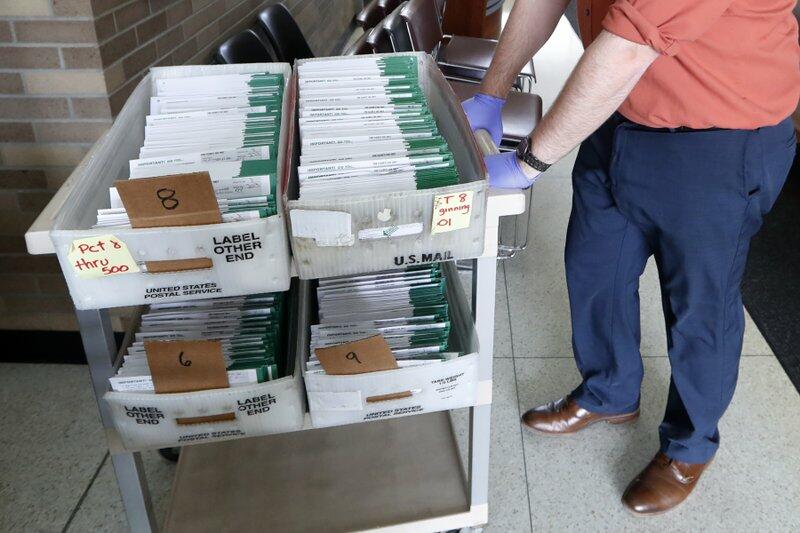
The way New York counts ballots was thrown into chaos on Friday after a judge ruled that several of the state’s recent voting reforms are unconstitutional.

State Supreme Court Justice Dianne Freestone sided with Republicans in a lawsuit brought in late September, which argued against a law which allows people to vote absentee if they fear contracting a disease like Covid-19. Freestone also ruled that the new process for “canvassing,” or ensuring that absentee ballots are inspected and prepared for counting – violates candidates’ rights in several ways, including by making it more difficult to raise a legal challenge when there are questions over a ballot’s validity.

The framers of the Constitution did not intend to grant (and did not grant) the Legislature carte blanche to enact legislation over absentee voting,” she wrote.

That said, Friday’s 28-page ruling fell just short of invalidating hundreds of thousands of absentee ballots already issued to New York voters, which the Republicans asked the judge to do.

For now, the ruling means local election officials will have to soon pause the inspection of absentee ballots, which were being processed on a rolling basis prior to Election Day for the first time this year. The Democrat-led state Legislature approved the new process in a 2021 law meant to expedite the state’s notoriously slow procedures for counting mail-in ballots.

It also means the more than 427,000 New York voters — including more than 187,000 in New York City — who have already requested and received their absentee ballots will still be able to cast their ballots for the Nov. 8 election, regardless of whether they elected to receive mail-in ballots due to fears of spreading illness. Currently, 108,000 New Yorkers have completed and returned their absentee ballots. -Gothamist

Democratic official immediately responded with a notice that they would appeal the decision.

According to Freestone, the Democrat-controlled Legislature “appears poised to continue the expanded absentee voting provisions of New York State Election Law … in an Orwellian perpetual state of health emergency and cloaked in the veneer of ‘voter enfranchisement.'”

The ruling was a blow to the State Board of Elections, with Freestone arguing that there are “uncounted reasons for this Court to second-guess the wisdom of the Legislature.”

The decision could hurt Gov. Kathy Huchul (D) who has been losing ground to GOP challenger Lee Zeldin in recent polls.

“The (state) constitution has been on our side and we will continue to fight to uphold the will of the voters and to ensure honest elections in New York,” said plaintiff Nick Langworthy, the state GOP Chairman.

“Just like their illegal Hochulmander and their non-citizen voting scheme, Democrats’ attempt to rig our elections was slapped down by the courts,” he continued, adding “When I took over as chairman of the New York GOP, I promised to usher in a new, fighting era that took on Democrats’ brazen lawlessness and this victory is another win for election integrity.”

Another plaintiff, Conservative Party Chairman Gerald Kassar, said, “This decision helps uphold the integrity of the electoral process, a major victory for New York voters and the rule of law.”

“Absentee-ballot voters have had the right to amend their votes on Election Day for decades, and cynical attempts by Gov. Hochul and the Democrat Party to strip them of those rights were wrong,” he added.

Last year, state voters rejected a proposed constitutional amendment that would have allowed no-excuse absentee voting in New York.

But lawmakers subsequently enacted a measure that allowed people to vote by mail if they feared catching COVID-19 by voting in person. That expansion of absentee voting is set to expire at the end of this year. -NY Post

On Friday, a BOE spokesperson said “Our office is still reviewing the ruling and its impact on the upcoming election.”

Tyler Durden
Sun, 10/23/2022 – 19:45