75 F
Chicago
Tuesday, August 11, 2026
Home Blog Page 437

Migrant Criminal Beats Deportation Order With Chicken Nugget Defense

Migrant Criminal Beats Deportation Order With Chicken Nugget Defense

In something you might see from the Babylon Bee, an Albanian migrant has secured the right to remain in the United Kingdom by claiming that his children hate “foreign” chicken nuggets, according to the Daily Mail.

Klevis Disha, 39, snuck into the U.K. illegally back in 2001 as a supposed unaccompanied minor. Disha used a fake name and a bogus backstory about being born in the old Yugoslavia. His asylum bid flopped but somehow dragged on, until he snagged indefinite leave to remain in the UK in 2005, the Daily Mail reported.

Fast-forward, Disha hooked up with a girlfriend and popped out a daughter and a son, and then he got nailed in 2017 with £250,000 in dirty money he couldn’t explain. The migrant was given a two-year prison sentence and a deportation order – after which Britain’s Home Office tried to boot Disha, stripping his citizenship. 

Not So Fast

Disha lawyered up and cried human rights by claiming it would be unduly harsh on his 11-year-old British son, nicknamed C in court documents, if Dad got shipped to Albania. The boy supposedly won’t touch the chicken nuggets over there because of textures and a super-picky diet. Ultimately, the judge bought the picky-eater sob story.

Britain’s Home Office appealed and a tribunal overturned the ruling. However, after endless hearings dragging into 2026, First-tier Tribunal Judge Linda Veloso ruled in Disha’s favor under Article 8 of the Human Rights Act, the Daily Mail said.

The ruling drew scorn from British conservative figures, including Reform UK’s Shadow Home Secretary Zia Yusuf.

A criminal migrant who entered Britain illegally under a false name and lied in a failed asylum claim has successfully fought his deportation by arguing his son disliked foreign chicken nuggets. This is the country the Tories and Labour have created,” Yusuf wrote on X.

If this ruling doesn’t prove Britain has become a total clown country, nothing will.

Tyler Durden
Sun, 03/22/2026 – 08:45

EU Considers Electricity Tax Cuts, Subsidies Amid Iran War Surge In Energy Costs

EU Considers Electricity Tax Cuts, Subsidies Amid Iran War Surge In Energy Costs

Authored by Evgenia Filimianova via The Epoch Times (emphasis ours),

The European Union is weighing electricity tax cuts and targeted subsidies to shield consumers and industry from surging energy costs amid the ongoing Iran war, European Commission President Ursula von der Leyen said on March 19.

European Commission President Ursula von der Leyen delivers a speech during the European Industry Summit in Antwerp, Belgium, on Feb. 11, 2026. Nicolas Tucat/Getty Images

Speaking after a European Council meeting in Brussels, von der Leyen said electricity prices are driven by energy costs, grid charges, carbon pricing, and taxes.

Electricity taxes and levies in the European Union are on average about 15 percent, she said, adding that the bloc will “propose to mandate lower tax rates on electricity” and ensure that “electricity is taxed less than fossil fuels.”

In some cases, electricity is taxed much more than gas—partially up to 15 times more. This cannot be,” said von der Leyen, according to a statement.

In the European Union, electricity is primarily taxed through the value-added tax and energy taxation under the Energy Taxation Directive, with additional national levies applied by individual member states.

In the first half of 2025, EU household electricity prices averaged 28.72 euros ($33.20) per 100 kilowatt-hours (kWh), roughly unchanged from the second half of 2024, according to Oct. 29, 2025, Eurostat figures.

Although pre-tax prices declined slightly, the share of taxes and levies rose from 24.7 percent in the second half of 2024 to 27.6 percent in the first months of 2025.

Prices varied widely across the bloc. Germany recorded the highest household rates at 38.35 euros ($44.30) per 100 kWh, followed by Belgium and Denmark, while Hungary, Malta, and Bulgaria had the lowest prices.

Compared to a year earlier, electricity costs surged in Luxembourg, Ireland, and Poland but fell in Slovenia, Finland, and Cyprus.

Supply, Prices

Von der Leyen said that the conflict’s immediate impact on Europe was higher energy prices rather than disruptions to physical supply. The EU remains diversified in its gas sourcing, which has helped shield it from shortages, she said.

Norway was the bloc’s largest gas supplier in 2025, accounting for 31.1 percent of imports, followed by the United States at 25.4 percent, Russia at 13.1 percent, and North Africa at 12.8 percent, according to the Council of the European Union. Smaller shares came from the UK and Azerbaijan.

The EU imported more than 140 billion cubic meters of liquefied natural gas (LNG) last year, with the United States supplying nearly 58 percent of that total, according to research group Bruegel. U.S. LNG deliveries have tripled since 2021. France, Spain, Italy, the Netherlands, and Belgium are the largest importers within the bloc.

Von der Leyen said energy costs themselves account for about 56 percent of electricity prices on average.

EU member states already have tools to cushion these costs through state aid, she said, and the Commission will further relax rules to allow more support for vulnerable consumers and energy-intensive industries.

Grid charges are another significant component, making up roughly 18 percent of prices.

The EU plans legal changes to boost infrastructure efficiency and potentially lower charges for heavy industry, von der Leyen said.

Carbon Market Under Scrutiny

Carbon pricing under the EU’s Emissions Trading System (ETS) is also being reviewed as leaders seek ways to stabilize power costs without abandoning climate goals.

The system requires companies to purchase permits for each ton of carbon dioxide emitted.

Von der Leyen said that the ETS has helped reduce dependence on imported fossil fuels and spurred investment in cleaner energy, but acknowledged that volatility in permit prices has raised concerns among manufacturers.

The Commission will propose measures to modernize the system while preserving its environmental objectives, she said.

EU officials aim to complete the review by July, though member states remain divided on how far reforms should go. Some governments favor expanding free emissions allowances for industry to shield companies from high energy costs.

Italian Industry Minister Adolfo Urso suggested more drastic steps could be necessary if consensus proves elusive. On March 9, he said suspending the ETS could serve as an “emergency response” if reforms cannot be agreed quickly.

Urso said industry estimates indicate that scrapping the system could cut electricity prices by 25 to 30 euros ($29 to $35) per megawatt-hour.

Tyler Durden
Sun, 03/22/2026 – 08:10

UK House Of Lords Rams Through ‘Abortion Up To Birth’ Law; Only 1% Of Brits Approve

UK House Of Lords Rams Through ‘Abortion Up To Birth’ Law; Only 1% Of Brits Approve

Authored by Steve Watson via Modernity.news,

The unelected House of Lords in the UK has just voted to embed extreme abortion provisions into law, decriminalising terminations right up to birth. This comes despite clear polling evidence that only 1% of the British public supports the move, exposing a ruling class utterly detached from the people it claims to serve.

The change forms part of Clause 208 in the Crime and Policing Bill. It removes criminal liability for a woman acting in relation to her own pregnancy at any stage, meaning self-induced abortions — even late-term — carry no legal consequences.

The disconnect could not be starker. As GB News reported: “Just 1% of the public agree with this… and yet it has now made it into law.” 

Former MEP Annunziata Rees-Mogg reacted on the same programme: “This is basically allowing for backstreet abortions to be legalised.” 

Dr Rahmeh Aladwan was equally blunt: “The UK House of Lords has just legalised abortion up to birth. Women can now end the life of their unborn baby at any stage, for any reason, without legal consequences. A truly dark day for Britain.” 

The 1% figure comes from recent YouGov research.

A Whitestone Insight poll showed 67% of the British public agreed that legal boundaries are necessary for protecting life in abortion cases, 62% believed abortion should remain illegal after 24 weeks, 53% agreed that abortion should not be an option if a baby could survive outside the womb, and only 5% supported allowing abortion up to birth.

At 34 weeks, a baby is fully formed and can survive outside of the womb.

Aborting a baby at 34 weeks is widely accepted as murder. Hospitals across Britain fight with every resource to save premature infants at this exact stage. Yet the law now removes any criminal consequence for ending that same life just days or hours earlier. The double standard is grotesque.

Peers rejected amendments to retain criminal penalties, clearing the path despite warnings from medical professionals and pro-life groups. The bill had already cleared the Commons in a rushed process critics slammed as hijacking unrelated legislation.

This vote marks another victory for an out-of-touch establishment that prioritises ideology over the clear voice of the British people. 

Britain deserves leaders who value life at every stage — not ones who normalise its destruction in the days before birth.

Your support is crucial in helping us defeat mass censorship. Please consider donating via Locals or check out our unique merch. Follow us on X @ModernityNews.

Tyler Durden
Sun, 03/22/2026 – 07:00

McGlinchey: Has America Thrown Its Service Members Into An Unjust War For Israel?

McGlinchey: Has America Thrown Its Service Members Into An Unjust War For Israel?

Via Brian McGlinchey at Stark Realities

President Trump’s decision to join Israel in launching a regime-change war on Iran has so far cost the lives of at least 13 American service members. More than 200 have been wounded, dozens seriously enough to require evacuations to military hospitals in Europe and the United States. Among them are individuals who’ve suffered traumatic brain injuries, burns and shrapnel wounds. One was facing potential amputation of an arm or leg.

As much as these service members and their families are victims of Iran’s justified retaliation for a surprise attack perpetrated amid ongoing negotiations, they’re victims of a betrayal perpetrated by their president and the joint chiefs of staff, who cast them into an unconstitutional war of aggression, packaged in lies and initiated to advance the agenda of a foreign government, while undermining the security of their own country.

Of course, US casualties comprise a small subset of the total bloodshed. In executing this unjust war, Americans have collectively inflicted far more death and dismemberment than they’ve endured, teaming up with their Israeli counterparts to kill more than 3,000 Iranians, including some 150 schoolgirls — mostly between age 7 and 12 — whose school was destroyed by Tomahawk cruise missiles at the war’s very start.

Though it should have already been apparent, Operation Epic Fury should make clear that — service members’ good intentions aside — combat waged under the US flag rarely has anything to do with American security. Moreover — and I say this as former Army Reserve enlistee and Regular Army officer — anyone thinking of starting or extending a military career should understand that their government may send them to be killed, maimed or psychologically damaged, and to slaughter foreign innocents, so long as it helps those in power remain in the good graces of the extremists who rule Israel, and their powerful collaborators inside the United States.

The casket of a soldier killed in the US-Israeli war on Iran is carried past President Trump (Mark Schiefelbein/AP via Pittsburgh Post-Gazette)

Under international law, a war of aggression is considered a supreme war crime unto itself, and Operation Epic Fury is precisely that. Like so many of America’s wars before it, this one was launched on false premises. Contrary to the US-Israeli narrative…

1. Iran was not developing a nuclear weapon. In 2007, the US intelligence community assessed that Iran halted any effort to develop a nuclear weapon in 2003. Since then, the intelligence community has periodically re-validated that conclusion, most recently in March 2025. Belying Trump’s claim that the United States had only two weeks in which to stop Iran from having a nuclear weapon, Director of National Intelligence Tulsi Gabbard this week testified that Iran had made “no efforts” to rebuild its enrichment capacity after it was devastated by last summer’s US bombing.

Note that, in 2005, Supreme Leader Ayatollah Ali Khamenei issued a fatwa — a formal interpretation of Islamic law — asserting that “the production, stockpiling and use of nuclear weapons are forbidden under Islam and that the Islamic Republic of Iran shall never acquire these weapons.” In the opening act of their latest warfare on Iran, the United States and Israel collaborated to kill him.

2. Iran did not stray from the 2015 nuclear deal until Trump did. When Trump withdrew the United States from the Joint Comprehensive Plan of Action (JCPOA), Iran was in full compliance. Among other things, the JCPOA required Iran to eliminate its medium-enriched uranium, slash its cache of low-enriched uranium by 98%, limit future enrichment to 3.67%, agree to even more external monitoring than it was already submitting to, and render its heavy-water reactor worthless by filling it with concrete. After Trump withdrew the United States from the JCPOA in 2018 and reinstated sanctions, Iran waited a year, but then began straying from its own commitments, using elevated enrichment as a lever to push for a new agreement and relief from suffocating sanctions. Iran says the JCPOA permitted it to suspend its commitments after Trump’s withdrawal, citing language governing “material breaches” and “significant non-performance.”

Iran is a member of the nuclear non-proliferation treaty, and has long cooperated with international inspections and monitoring required by the NPT. On the other hand, Israel has refused to join the NPT and has some 200 nuclear warheads, a situation that makes every dollar of American aid to Israel illegal under US law.

In 2002, Netanyahu assured Congress that “Saddam is hell-bent on achieving atomic bombs” and “guarantee[d]” that a US invasion of Iraq would have “enormous positive reverberations on the region”  

3. Iran wasn’t the problematic negotiation partner. When historians write about the run-up to this latest of American regime-change disasters, they’ll surely emphasize that fact Trump assigned Steve Witkoff and Jared Kushner to represent the United States in negotiations. While people rightly scoff at their lack of credentials, it’s far more important to appreciate their intimate ties to the Israeli government and Prime Minister Benjamin Netanyahu — who has been trying to maneuver the United States into a war with Iran for decades.

As Branko Marcetic writes in an excellent account of the negotiations at Responsible Statecraft,

Witkoff is known as a staunch supporter of Israel. He counts pro-Israel megadonor Miriam Adelson as a “dear friend” and carries a custom pager gifted to him by Netanyahu and senior Mossad officials, in a reference to an operation in which Israel remotely detonated thousands of pagers that allegedly belonged to Hezbollah officials…

Kushner, meanwhile, has been steeped in the pro-Israel community his entire life. He counted Netanyahu as a family friend growing up, with the future Israeli prime minister occasionally borrowing the teenager’s bedroom during visits. Kushner reportedly consulted with Netanyahu officials to pen Trump’s 2016 speech to the American Israel Public Affairs Committee, and he is both friends with hardline pro-Israel figures and has donated money to illegal West Bank settlement-building.

In addition to their glaring conflicts of interest, Witkoff and Kushner refused to bring nuclear experts to their meetings with the Iranians, which reportedly left the Iranians perplexed about how any progress could be made in negotiating such a highly technical subject.

Iran put forward a fresh offer less than 48 hours before being attacked. In the last meeting before bombs dropped, Iran offered concessions that included dilution of its 60%-enriched uranium, a multi-year pause on new enrichment, subsequent enrichment capped at 20%, and expanded IAEA oversight. Sources say UK national security advisor Jonathan Powell, who attended that meeting, was surprised by the strength of the Iranian offer, and saw it as reason to be optimistic about reaching a deal.

Steve Witkoff (left) and Jared Cushner at an October 2025 meeting in Israel with Netanyahu (Maayan Toaf/GOP via Times of Israel)

After learning that Witkoff was grossly mischaracterizing Iran’s stance — if not outright lying about it — Oman’s foreign minister, who’d been mediating the discussions, made an urgent trip to Washington to tell the administration and anyone who’d listen that Iran had made substantial concessions, some of which surpassed the provisions of the JCPOA. His mission failed. In the aftermath, a Gulf diplomat bluntly told the Guardian, “We regarded Witkoff and Kushner as Israeli assets that dragged a president into a war he wants to get out of.”

4. Iran’s ballistic missile program wasn’t built for offense. In an example of moving goalposts that would be laughable if the context weren’t so tragic, the Trump administration reopened nuclear negotiations with a new demand — that Iran surrender its conventional ballistic missiles. The White House claimed Iran was building a “conventional shield” that would enable future “nuclear blackmail,” but anyone who’s been paying attention could see the demand sprang from last summer’s 12-Day War, when Iran effectively used cutting-edge ballistic missiles to retaliate against Israeli aggression.

That use is consistent with US intelligence’s characterization of Iran’s military posture as primarily defensive. As the US Defense Intelligence Agency wrote in a 2019 report, “Iran’s conventional military strategy is primarily based on deterrence and the ability to retaliate against an attacker…If deterrence fails, Iran would seek to demonstrate strength and resolve, [and] impose a high cost on its adversary…this strategy is unlikely to change considerably in the near term.”

The demand for Iran’s conventional disarmament and the demand for the scientifically-advanced country to end any nuclear enrichment had something in common: both were made knowing they’d be refused. Here’s how Joe Kent — the former National Counterterrorism Center Director who resigned this week in protest of the war — characterized the enrichment demand in his in-depth, post-resignation interview with Scott Horton:

“I really frankly don’t think the Israelis cared that much about…nuclear enrichment…What I think the Israelis care about is regime change. They wanted to push this war as fast as they could, so they came up with this talking point that zero enrichment was the starting point, knowing that was a non-starter for the Iranians.”

5. Iran hasn’t been waging war on the United States for 47 years. To the contrary, the hostilities have overwhelmingly originated in Washington, and any thorough survey of the history should go back at least 73 years, to 1953. That’s when the United States and United Kingdom orchestrated the ouster of Iran’s democratically-elected prime minister, and the installation of the Shah. The ledger should also include US support of Iraq’s eight-year war on Iran in the 1980s, which included giving artillery targeting intel to Iraq, with the knowledge those targets would be hit with chemical weapons. Then there’s decades of economic blockades, which, mirroring the morality of Al Qaeda, intentionally inflict suffering on civilians with a goal of forcing political change. Last summer brought America’s unprovoked bombing of Iran’s imaginary nuclear weapons program. The ceasefire that ended the so-called 12-Day War turned out to be a mere strategic pause before all-out warfare was initiated by Israel and the United States on Feb 28.

In 2007, a US Humvee burns after the detonation of a roadside IED 60 miles north of Baghdad (AP via Al Jazeera)

A central line in the “47-year war” narrative blames Iran for killing “thousands” of Americans in Iraq, by supposedly directing Shia militias to target Americans, and equipping them with improvised explosive devices (IED). In a concise treatment at his Substack, former Marine officer Matthew Hoh, who led counter-IED efforts in Iraq, dismantled that well-entrenched narrative. His key points:

  • The great majority of American service members killed in Iraq died at the hands of Sunni resistance groups. Iran provided some support to Shia militias, but Hoh calls out the hypocrisy of US officials saying Iran alone has blood on its hands, pinning no such blame on US-aligned Gulf monarchies that backed Sunni militias in Iraq.

  • Americans were an occupying force in a country that US forces had devastated and which was beset by civil war, which means both Shia and Sunni militias had their own reasons for using violence against US troops. Hoh notes that the now-decades-old narrative that Iraqis were killing American soldiers and Marines on orders from Iran “not only helped justify a longed-for war with Iran but also bolstered the fiction of the American occupation as a benevolent and liberating one.”

  • The charge that Iran killed Americans with IEDs centers on the claim that Iran provided Shia militias with a special type of IED called an explosively formed penetrator (EFP). “Anyone with a simple understanding of explosive principles and a half-decent machine shop can make an EFP,” says Hoh. Given the abundance of explosives and other materials around war-torn Iraq, Hoh says “Shia forces were able to mass-produce EFPs in Iraq. Smuggling in EFPs from Iran was unnecessary.”

6. Iran isn’t the “world’s leading sponsor of terrorism.” If that title were awarded on the merits, top contenders would include Saudi Arabia, the United States and Israel. The US government selectively applies the “state sponsor” label to vilify countries and — more importantly — as the basis for imposing economic sanctions. As we’ve seen in the case of Cuba and others, American secretaries of state have full discretion to slap the “state sponsor of terror” label on and pull it off, with no due process or burden of proof required.

“The US’s list of terrorist organizations is at this point really laughable, because we take groups off willy-nilly based on whether we like them politically or not — not whether they’ve actually engaged in or continue to engage in terrorism,” said Trita Parsi, Quincy Institute for Responsible Statecraft co-founder, in a recent appearance on Judging Freedom. “The Sudanese got off the State Department’s terrorist list by simply agreeing to normalize relations with Israel — nothing else.”

It’s true that Iran has sponsored various groups in the Middle East that seek to thwart US and Israeli hegemony in the region. At times, some of those groups — like Hamas — have used violence against civilians to achieve political ends, which is the honest definition of terrorism. However, US and Israeli condemnation of Iran’s support for such groups is intensely hypocritical, considering the United States and Israel have themselves backed forces that have carried out terrorism. Indeed, if sponsorship of Hamas is damning for Iran, it’s also damning for Israel and Netanyahu, who long fostered the rise of Hamas even after it turned to terror.

Then there’s the regime-change campaign in Syria, which saw the United States and its Gulf allies empowering head-chopping terrorists, and saw Israel patching up al Qaeda members and sending them back into Syria to raise hell. Keep in mind, Iranian-backed Hezbollah and Shia militias were instrumental in beating back ISIS, the monstrous terror entity that sprang from the Syria regime-change campaign carried out for Israel.

The war on Iran isn’t about nuclear weapons, ballistic missiles or state-sponsored terrorism. It’s the continuation of a long-running Israeli program to achieve total dominance over the Middle East by repeatedly shattering surrounding states and territories. Here’s how the University of Chicago’s John Mearsheimer has described it:

“The Israelis want to make sure that their neighbors are weak and that means breaking them apart, if you can, and keeping them broken…The Israelis want Syria to be a fractured state. They want Lebanon to be a fractured state. What do they want in Iran? …What the Israelis want to do is to break Iran apart. They want to make it look like Syria.”

For many in Israel, this strategy isn’t merely about safeguarding the current version of Israel. Rather, it’s a means of achieving an expansionist dream of “Greater Israel.” While interpretations vary, this vision typically goes far beyond annexing the West Bank and Gaza, also taking Egyptian territory east of the Nile, along with all or portions of what is now Lebanon, Jordan, Saudi Arabia and Iraq.

IDF soldiers in Gaza were seen wearing patches depicting Greater Israel

The US government has aided and abetted this ruthless strategy in a variety of ways, from the arming of Israel, to running covert operations to foment unrest and equip militant groups, to direct use of American military force. The human cost has been incalculable. In the regime-change wars against Iraq and Syria alone, more than a half million people have been killed, and several times more are believed to have died from secondary causes like disease.

Sadly, it seems it’s now Iran’s turn to be shattered in the pursuit of Israeli supremacy. Iran has been Netanyahu’s white whale: After the launch of Operation Epic Fury, Netanyahu gushed that Trump’s collaboration meant Israel was finally doing what Netanyahu had “yearned to do for 40 years.”

Underscoring the cold-blooded and maliciously dishonest nature of the regime-destruction campaign, consider that Israel and the United States have framed their surprise attack on Iran as a virtuous endeavor meant to liberate the Iranian people from theocratic rule. On the day Israel and the United States launched this new war on Iran, Netanyahu called on Iranians to rise up: “Do not sit idly by, very soon the moment will come when you must take to the streets to finish the job and overthrow the totalitarian regime.”

However, at the same time Netayahu was calling for an Iranian uprising, senior Israeli officials were privately telling US diplomats that “the people will get slaughtered” if they act on those exhortations. Of course, any such slaughter would serve the Israeli agenda, since it could be used to propagandize for more vigorous regime-change action, up to and including what is likely Netanyahu’s greatest wish: a US ground invasion.

It’s hard to imagine, but there could be something even worse than committing one’s self to the defense of America, only to be killed or maimed in a campaign to advance the agenda of a foreign government that is far less an ally than a parasite— and that’s killing, wounding and immiserating innocent people for that same government.

Through March 19, more than 3,000 Iranians have been killed by American and Israeli attacks, according to HRANA, an Iran-focused human rights group. Of that total, 1,394 were civilians, including those several dozen schoolgirls killed on day one; 639 deaths have yet to be classified as military or civilian.

Some 150 elementary-age schoolgirls were killed by a US cruise missile strike in the opening salvos of the US-Israeli surprise attack on Iran (Ali Najafi/ AFP and Getty via NBC News)

There have been more than 1,100 Iranian military fatalities. Among those dead Iranian service members are 87 sailors whose lightly-armed ship was sunk by an American torpedo off the coast of Sri Lanka. The ship was not only far away from the war zone, but it was reportedly lightly-armed as it was returning from a largely-ceremonial, multi-national exercise hosted by India in the interest of building international maritime cooperation.

Given they died on the receiving end of an unjust war of aggression, these and other dead members of the Iranian military were likewise innocent victims of America’s war for Israel. Note too that, unlike every American who’s dishing out death from the sky, land or sea, most Iranians in uniform are conscripts, not volunteers.

That said, there’s reason to empathize with volunteer American service members who’ve now been ordered to wage this war. Ahead of their enlistment or commissioning, most are ill-equipped to peel back the patriotic red-white-and-blue veneer and discern the true nature of US military service. In a sense, they’re victims of a grand fraud. Millions of their fellow citizens are oblivious collaborators in that fraud, to the extent they help perpetuate the false assumption that military service is inherently virtuous and invariably serves the American people.

With Marines now steaming toward the Persian Gulf, the 82nd Airborne Division gearing up and Netanyahu cryptically referring to the necessity for a “ground component”, the number of dead, wounded, dismembered and PTSD-inflicted Americans could soar higher. Given the unjust nature of this war, many are certain to face a lifetime dealing with a lesser-known type of wound — moral injury, which is psychological and emotional distress springing from having witnessed, participated in, or failed to prevent acts that go against one’s moral convictions.

Importantly, the suffering that springs from this war of aggression isn’t confined to the United States, Israel, Iran and Gulf states hosting US bases. People around the world are already coping with growing scarcity and increasing cost of oil and gas. Asian countries are particularly vulnerable, and they’re already taking measures like rationing fuel, cutting workweeks, urging more people to work from home and closing hotels hit by diminished air travel — all this after less than three weeks of the Strait of Hormuz being closed to most traffic.

There’s much more to this Pandora’s box of harms. For example, the world’s supply of medicine is in growing jeopardy. “Nearly half of U.S. generic prescriptions originate in India, which relies on the Strait of Hormuz for the arrival of key inputs in drug manufacturing,” explains CNBC. The Gulf also supplies about half the world’s urea — a fertilizer component — and the price US corn farmers are paying for fertilizer has jumped upwards of 70%. That presages higher food costs all over the world, with malnourishment and starvation a distinct risk in some parts of the globe.

Clearly, if the war continues and the Strait of Hormuz remains closed, it’s certain to result in a global health catastrophe, a devastating economic depression, surging crime and social unrest. America’s standing will be profoundly and irreparably damaged in a world united in outrage over a US president’s lawless decision to launch this demented war of choice in service to Israel. American citizens are likely to suffer terrorist acts inspired by this latest savagery inflicted on a Muslim country.

And it will have all started with weapons fired by American service members…

…service members who swore to defend the Constitution, but were given unconstitutional orders to wage war without congressional authorization

…service members who joined the military to defend America, but became attack dogs for a foreign country that saps America’s wealth, depletes America’s arsenal, undermines America’s security and standing, exerts alarming influence on America’s institutions, and inspires terrorism against Americans back home

…service members who should now recognize a stark reality — that they are cogs in a machine that repeatedly inflicts death, dismemberment, disease and destitution on countless innocents in service to the expansionist State of Israel.

Stark Realities: Invigoratingly unorthodox perspectives for intellectually honest readers. Join thousands of free subscribers at starkrealities.net

* * *

Views expressed in this article are opinions of the author and do not necessarily reflect the views of ZeroHedge

Tyler Durden
Sat, 03/21/2026 – 23:20

“Going To Cripple Our Economy”: Small Businesses Sound Alarm Over Record Diesel Price Spike

“Going To Cripple Our Economy”: Small Businesses Sound Alarm Over Record Diesel Price Spike

The latest AAA fuel data from across America shows that the national average diesel price at the pump has jumped nearly 40% this month, surpassing the 2022 fuel spike that followed Russia’s invasion of Ukraine.

Surging diesel prices are already generating a shock across trucking, rail, shipping, farm equipment, construction machinery, generators, and much of industrial logistics, given that the fuel powers the core of the economy.

Seasonality: AAA Daily National Avg. Diesel 2022 vs. 2026

Companies now face three difficult choices if they did not lock in fuel prices before the spike: absorb the impact and accept margin compression, add surcharges, or raise prices.

Last week, Rapidan Energy’s Director of Refined Products, Linda Giesecke, told us that, “unlike 2022, the current tightness reflects physical supply disruptions rather than policy risk and trade reshuffling.”

Giesecke warned that if the fuel spike proves prolonged, global economic growth could suffer because of diesel’s close link to industrial production and freight activity.

BloombergNEF forecast that $5-per-gallon diesel could inflict a weekly $6 billion or more hit on the US economy because these surging fuel costs hurt truckers, construction firms, and farmers the hardest. With prices at $5.2 as of Friday, that weekly hit is set to rise next week.

Readers are already aware of the dire consequences of spiking diesel prices, as we’ve laid out in recent weeks (see here & here).

Adding more color to the fuel that underpins nearly every stage of production and transport is a Bloomberg report warning that small businesses are sounding the alarm over surging fuel costs.

Here’s one example of a small business being financially crushed by surging fuel costs:

Roger Conner sells firewood for a living, but he might know just as much about another energy source: diesel. The fuel powers every step of the supply chain for his company, RC Conner Enterprises: the megatrucks that carry the logs from suppliers to his facility in Exeter, New Hampshire; the machines that offload and process those logs into kiln-dried residential and restaurant-grade firewood; and the trucks that deliver the finished bundles and cords to customers across New England. In a normal year, Conner spends roughly $6,800 a month on diesel. Now it’s about $11,000. To absorb some of the cost, he’s added a 5% fuel surcharge; when customers saw that, several walked away.

If diesel keeps rising, “we’re going to have to keep going up on our pricing, but we probably won’t have any sales,” says Conner, 50. “This is going to cripple our economy. I don’t think people think about how much the economy rides on diesel fuel.”

Across the trucking industry, fuel costs are the second-largest expense after driver pay for carriers, according to Bob Costello, the American Trucking Associations’ chief economist. He said that even in non-crisis periods, carriers carefully manage fuel consumption because small changes in diesel costs can erode profit margins.

Surging fuel costs are already pushing up freight rates (e.g., barge transport up 27%) across the economy, leading to fuel surcharges from carriers such as UPS, FedEx, and USPS.

Joe Brusuelas, chief economist at tax consulting firm RSM US, told the outlet that a 10% rise in diesel could lift the CPI by .1%, potentially adding .4%, given the nearly 40% spike in diesel prices this month alone.

The Trump administration is doing a delicate balancing act while attempting to neuter IRGC forces while ensuring domestic fuel prices do not spike out of control. The administration has pulled two of what JPMorgan analysts say are six levers to combat triple-digit WTI prices; those two levers pulled so far include an SPR release and a waiver of the Jones Act to ensure that crude flows from emergency stockpiles move more quickly from port to port.

On Friday, President Trump hinted at “winding down” the Iran war, as CENTCOM on Saturday morning announced its biggest move so far to free up the Hormuz chokepoint by degrading IRGC forces with air-delivered munitions. The administration’s current goal is to ensure Hormuz reopens to avert what the IEA head warned last week could be the world’s largest energy shock on record.

Tyler Durden
Sat, 03/21/2026 – 22:45

The Oscars Died Last Weekend…Did Anyone Even Notice?

The Oscars Died Last Weekend…Did Anyone Even Notice?

Submitted by QTR’s Fringe Finance

“Oh, the Oscars was yesterday,” my friend said to me while walking through town. She noticed that a nearby bar had the TV tuned to a replay of the ceremony.

What surprised me was who said it. This is a person who is deeply, spiritually committed to things like what movies are in theaters and new fictional television shows. She loves the arts. She listens to jazz. She goes to see Broadway plays. She watches every prestige movie she can and regularly comments about what media has won what award. She follows celebrity gossip with the focus of a Vatican archivist. Her interests sit precisely at the intersection of everything the Oscars supposedly celebrates and is entrenched in.

And yet she missed the award show entirely.

That, in a nutshell, is the problem. Over the last several years, the Oscars have quietly drifted from being the cultural event, the night when the entire entertainment world stopped to watch, into something closer to an industry banquet that occasionally spills onto television. The ceremony still arrives with the same self-importance it had in the 1990s, but the culture around it has moved on. What used to feel like a shared national moment now feels more like political rally fused with fashion show and a desperate attempt to take 120 second acceptance speeches to prove one’s IQ is not in double digits.

Part of the issue is that the movies the Academy rewards are increasingly invisible to the people watching at home. The ceremony still talks as if the audience has seen every nominee, debated every performance, and formed passionate opinions about the cinematography categories. In reality, most viewers have maybe heard of one of the films, vaguely recognize a second, and accidentally streamed a third while half-watching it on their phone during laundry. When the biggest award of the year goes to a movie the average viewer hasn’t encountered in any meaningful way, the victory lap feels oddly private, like a group of insiders congratulating each other for something the rest of the room didn’t witness.

The show itself doesn’t help. The broadcast has developed an identity crisis in formal wear. Every year producers seem to wrestle with the same question: is the Oscars ceremony supposed to celebrate movies, chase television ratings, or gently lecture the audience about the importance of humanitarian issues? The result is a three-hour spectacle that manages to feel both desperate for attention and slightly resentful that anyone expects it to be entertaining. There are bits that go on too long, music that nobody seems to have asked for, and awkward attempts to manufacture viral moments that land with the energy of a corporate retreat icebreaker.


🔥 50% OFF FOR LIFE: Using this coupon entitles you to 50% off an annual subscription to Fringe Finance for life: Get 50% off forever


Meanwhile, the Oscars no longer function as the center of the film universe the way they once did. For decades the ceremony acted as a kind of cultural referee, the place where the industry gathered to declare what counted as the year’s great movie. That authority has eroded. Today the internet hosts a thousand parallel award ceremonies every day. Critics release their own rankings. Fans debate endlessly on movie apps. TikTok spins up new waves of film discourse every afternoon. Entire YouTube channels are dedicated to explaining why the Academy got it wrong in 1997, 2013, or last year. By the time the envelopes are opened on Oscar night, the real arguments about movies have already happened somewhere else.

What’s rushed in to fill the vacuum is something else: a stage increasingly used for political signaling. Acceptance speeches drift into activist manifestos. Presenters pause the show to deliver moral instruction. Carefully rehearsed moments of “importance” are inserted between categories as if the ceremony itself must justify its existence by proving it stands for something larger than movies. No to war! He’s so brave!

Whether one agrees with the causes or not, the effect is unmistakable. The Oscars used to sell escapism and glamour; now it often feels like a televised faculty meeting with better lighting.

And finally, there’s the simple fact that movies themselves no longer arrive in one shared cultural moment. There was a time when a handful of major releases dominated theaters and almost everyone saw them. People argued about the same performances, quoted the same lines, and had a clear sense of which films defined the year. Now the experience is fractured. Some nominees appear briefly in a few cities before migrating to streaming. Others debut quietly on platforms where they compete with thousands of other titles and an algorithm that would much rather steer you toward a true-crime documentary.

More and more, I find myself noticing how many awards are floating around out there, particularly in worlds that feel increasingly detached from the everyday concerns of the people supposedly watching. Whether it’s Klaus Schwab handing out “Global Citizen” trophies or industry groups inventing new honors for one another, there’s a growing sense of people in rarefied circles applauding themselves in increasingly elaborate ways. The more ceremonial the applause becomes, the harder it is to ignore the gap between the spectacle on stage and the problems occupying the average family at home. When the people giving the awards and the people receiving them all inhabit the same insulated orbit, the whole thing starts to feel less like recognition and more like a closed loop of mutual admiration.

The ceremony still treats itself like a cultural summit, when increasingly it looks like a room full of insiders congratulating one another while the broader audience wanders off to do something else.

The Oscars still behave as if they’re crowning the movie everyone just saw, but like other circle jerks, increasingly the attendees are the only ones who have seen them. More and more, the audience is like my friend, walking past a bar with the ceremony replaying on television, glancing up at the screen for a second, and saying with mild surprise, “Oh right. That was yesterday.”

Now read:

QTR’s Disclaimer: Please read my full legal disclaimer on my About page hereThis post represents my opinions only. In addition, please understand I am an idiot and often get things wrong and lose money. I may own or transact in any names mentioned in this piece at any time without warning. Contributor posts and aggregated posts have been hand selected by me, have not been fact checked and are the opinions of their authors. They are either submitted to QTR by their author, reprinted under a Creative Commons license with my best effort to uphold what the license asks, or with the permission of the author.

This is not a recommendation to buy or sell any stocks or securities, just my opinions. I often lose money on positions I trade/invest in. I may add any name mentioned in this article and sell any name mentioned in this piece at any time, without further warning. None of this is a solicitation to buy or sell securities. I may or may not own names I write about and are watching. Sometimes I’m bullish without owning things, sometimes I’m bearish and do own things. Just assume my positions could be exactly the opposite of what you think they are just in case. If I’m long I could quickly be short and vice versa. I won’t update my positions. All positions can change immediately as soon as I publish this, with or without notice and at any point I can be long, short or neutral on any position. You are on your own. Do not make decisions based on my blog. I exist on the fringe. If you see numbers and calculations of any sort, assume they are wrong and double check them. I failed Algebra in 8th grade and topped off my high school math accolades by getting a D- in remedial Calculus my senior year, before becoming an English major in college so I could bullshit my way through things easier.

The publisher does not guarantee the accuracy or completeness of the information provided in this page. These are not the opinions of any of my employers, partners, or associates. I did my best to be honest about my disclosures but can’t guarantee I am right; I write these posts after a couple beers sometimes. I edit after my posts are published because I’m impatient and lazy, so if you see a typo, check back in a half hour. Also, I just straight up get shit wrong a lot. I mention it twice because it’s that important.

Tyler Durden
Sat, 03/21/2026 – 22:10

New York City Is Spending $81,000 Per Year On Each Homeless Person

New York City Is Spending $81,000 Per Year On Each Homeless Person

New York City spent about $368 million last year on services for people living on the streets, which equals roughly $81,000 per unsheltered person, according to the NY Post.

Spending through the city’s New York City Department of Homeless Services street outreach programs has increased sharply over the past several years. In 2019, the city spent about $102 million on these services, averaging around $28,000 per unsheltered individual. By the 2025 fiscal year, the average cost had risen to about $81,000 per person, close to the city’s median household income of $81,228.

Unsheltered homeless individuals are those who regularly live outside rather than in shelters or permanent housing. During this same period, the number of people living on the streets grew by 26 percent, rising from 3,588 in 2019 to 4,505 in 2025. However, spending increased far faster than the population itself.

Chart: Charlie Smirkley

The NY Post writes that the rise in street homelessness has been linked partly to the COVID-19 pandemic and increased migration. Still, the report noted that the reasons spending rose so quickly are not fully clear. One possible factor is the expansion of low-barrier shelters and drop-in centers that provide services such as meals, showers, and temporary sleeping spaces, allowing people to come and go freely. Financial records do not clearly separate how much funding goes to these specific programs.

The report says the city should examine more closely how these funds are being used and whether the programs are successfully moving people into shelters or permanent housing. Spending on street homelessness programs is expected to increase further, reaching about $456 million by fiscal year 2026.

Overall homelessness in New York City has also increased significantly. The city’s total homeless population is now around 140,000 people, about 78 percent higher than in 2019. Officials note that roughly 97 percent of homeless residents receive some type of shelter placement, although the number of people living outside continues to grow.

Some housing advocates argue that filling vacant public and supportive housing units could help move more people off the streets while reducing the high costs associated with short-term shelter programs.

Tyler Durden
Sat, 03/21/2026 – 21:35

The State Will Always Socialize The Cost Of War

The State Will Always Socialize The Cost Of War

Via The Libertarian Institute

War is often sold to the public as an act of national will: decisive, necessary, and under control. The bill arrives later, in a quieter form. It shows up in insurance markets, shipping rates, emergency guarantees, higher fuel prices, and sudden policy reversals designed to keep the economic damage from spreading too far or too fast. That is what is now happening with the U.S.-Israeli war on Iran. The fighting is not only destroying lives and widening instability. It is also revealing something more familiar about the American state: when private actors no longer want to bear the risk of a war Washington helped ignite, Washington moves to spread that risk across everyone else.

The clearest example came when maritime war-risk premiums in the Gulf surged, in some cases by more than 1000%, as ships and cargoes moved through a combat zone centered on one of the world’s most important energy chokepoints. This is what markets do when governments create danger: they start pricing reality honestly. Insurance underwriters do not care about speeches about resolve or credibility. They care about missiles, mines, damaged hulls, and the odds that a vessel will not make it home intact. Once those odds change, the market does what it is supposed to do. It becomes expensive to move goods through a war.

But the American state does not like that kind of honesty, because honest prices expose the real cost of intervention. So instead of letting war become unaffordable to the people escalating it, Washington stepped in. The U.S. International Development Finance Corporation announced a maritime reinsurance facility covering losses up to roughly $20 billion on a rolling basis, and later named Chubb as the lead insurance partner. In plain English, the government decided that if the private market was no longer willing to carry the full risk of this war, the state would help carry it instead. That is not a side effect of interventionism. It is one of its operating principles. Risk is privatized on the way up, then socialized when the numbers stop working.

The same pattern is visible in energy policy. As the war tightened shipping and pushed oil prices above $100 a barrel, Washington issued a thirty-day waiver allowing purchases of stranded Russian oil at sea to stabilize markets. That move was not just an emergency adjustment. It was an admission. The administration was effectively saying that one war had already become costly enough to require loosening pressure in another theater. A foreign policy that presents itself as hard and disciplined suddenly becomes very flexible when gasoline, shipping, and inflation begin threatening domestic politics. The slogans remain moralistic. The mechanics turn transactional overnight.

This is what statism looks like in practice. It does not simply bomb another country and call it security. It also rearranges the economic landscape at home and abroad so that the political architects of the war do not face the full consequences of their decisions. The cost is pushed outward onto taxpayers who did not authorize the war, consumers who will pay more for energy and goods, and trading systems that now have to absorb new shocks because Washington and Israel chose escalation over restraint. The state does not merely fight. It conscripts logistics, insurance, credit, and public balance sheets into the campaign.

That is why it is misleading to describe this as only a military conflict. It is also an exercise in political risk transfer. The Strait of Hormuz handles around twenty million barrels per day of crude oil and oil products and roughly a quarter of the world’s seaborne oil trade. Any government that helps turn that corridor into a war zone is not just making a strategic decision abroad. It is imposing a hidden tax on ordinary life. It is raising the cost of transport, trade, fuel, insurance, and eventually everything built on those foundations. And when those costs start climbing too fast, the same government asks the public to cushion the blow in the name of stability.

There is a moral evasion built into this arrangement. The public is told to think about war in the language of necessity and strength, while the real economics are handled behind the scenes through emergency waivers, public guarantees, and market interventions. Washington bypasses the discipline that peace would impose. It subsidizes the consequences of its own escalation, then presents the cleanup operation as responsible governance. That is not prudence. It is the imperial version of sending someone else the invoice.

The libertarian objection to this war is not only that it is reckless, unjust, and likely to widen. It is also that the state is once again doing what it does best: converting elite foreign-policy choices into burdens to be carried by everybody else. When insurers retreat, the government steps in. When sanctions collide with energy reality, the rules bend. When war becomes too expensive, the price is redistributed rather than paid by the people who chose it. That is the deeper scandal here. The state is not just waging this war. It is socializing its cost.

Tyler Durden
Sat, 03/21/2026 – 21:00

Iran’s First Use Of ICBMs Raises Serious Questions About Remaining Arsenal

Iran’s First Use Of ICBMs Raises Serious Questions About Remaining Arsenal

In a startling move that has military experts questioning their assumptions about Iranian capabilities, Iran attempted to hit the joint UK-US base on the Indian Ocean island of Diego Garcia with two intermediate-range ballistic missiles (IRBMs). While US officials assured the Wall Street Journal that the base was unscathed, the Iranian strike aimed at a target roughly 4,000 kilometers from Iran suggests that the range of Iran’s retaliatory capacity could be well beyond previous external estimates and claims made by Iran. 

According to two officials who gave the Journal a Friday-night scoop on the story, one missile had a mid-flight malfunction, while the other was engaged by an SM-3 interceptor missile fired from a US Navy vessel. It’s not clear, however, if that interceptor actually hit its target. Nor does the report indicate when the strike was attempted. 

While it’s home to a joint base, Diego Garcia is a British Overseas Territory. After the bombs started falling on Iran on Feb. 28, British Prime Minister Keir Starmer initially refused to allow the United States to use Diego Garcia and other UK bases in the campaign against Iran. He soon folded, announcing that the bases could be used for so-called “defensive” operations focused on hitting Iranian missile launchers targeting UK interests. On Friday, the permission was expanded to include supporting strikes on Iranian assets targeting the Strait of Hormuz. Also on Friday, Iran warned that the accommodation of US military maneuvering makes the UK a “participant in aggression,” adding that Iran “reserve[s] our inherent right to defend the country’s sovereignty and independence.”

Last month — three days before US-Israeli surprise attack — Iranian Foreign Minister Abbas Araghchi claimed that Iran had, of its own volition, “deliberately limited” the range of its ballistic missiles to 2,000 kilometers, or 1,243 miles. On the same day, Secretary of State Marco Rubio said Iran was “certainly trying to achieve intercontinental ballistic missiles” and is “headed in the pathway to one day being able to develop weapons that can reach the continental US.” 

Officials say one of the Iranian IRBMs was engaged by an SM-3 interceptor, like this one being fired from the guided-missile cruiser USS Lake Erie (Navy photo)

There’s far more to reaching the ICBM threshold than just packing more propellant into a rocket. Because ICBM warheads spend part of their trajectory traveling in space, they require the engineering of a heat-shielded reentry vehicle, along with more sophisticated guidance technology. Last May, the Defense Intelligence Agency predicted that, if it chose to, Iran could have upwards of 60 ICBMs by 2035. “There’s a huge gap, I think, between where they are now and their ability to have anything that reaches the United States,” Defense Priorities’ Rosemary Kelanic told the Journal

For now, the bigger question is what kind of ballistic missile technology the Iranians are already packing. The Israeli Alma Research and Education Center had previously pegged Iran’s maximum range at 3,000 kilometers. This apparent debut of Iran’s IRBMs raises wider concerns than just Diego Garcia: If Iran can actually reach that island, it implies Iran could also take shots at targets as far away as Central Europe or Scandinavia.  

Earlier this month, Iran’s Space Research Center in Tehran was blown up in an Israeli-claimed strike. The IDF said the facility “contained strategic laboratories used for research and development of military satellites for various purposes, including surveillance, targeting, and directing fire toward targets across the Middle East.”

Diego Garcia had already been in the ZeroHedge headlines before this new round of warfare on Iran started on Feb 28. President Trump has sounded alarms about the UK losing its grip on the island. Last year, the UK agreed to surrender sovereignty over Diego Garcia and the entire Chagos Archipelago to Mauritius, with the UK then taking out a 99-year lease of Diego Garcia. In January, Trump called the transaction an “act of total weakness,” apparently reneging on his supposed support — Rubio last year said Trump “expressed his support for this monumental achievement.” 

An undated US Navy photo of Diego Garcia, an atoll that has about 10 square miles of dry land 

*  *  * TRY A BAG


Tyler Durden
Sat, 03/21/2026 – 20:25

Trump Warns Tehran To “Fully Open” Hormuz Or Face ‘Obliteration’ As Iran-Israel Trade Nuke-Plant Strikes

Trump Warns Tehran To “Fully Open” Hormuz Or Face ‘Obliteration’ As Iran-Israel Trade Nuke-Plant Strikes

Summary

  • Trump threatens to “obliterate” Iran’s power-plants if Hormuz is not open and safe within 48 hours

  • Natanz nuclear site attacked: Iran says “no nuclear radiation” detected, even as attacks on core sites like Isfahan nuclear facilities signal clear escalation despite earlier Trump signals of maybe “winding down.”

  • Iran has responded by targeting Israel’s Dimona nuclear facility. The Israeli army confirmed “a direct impact of an Iranian missile” on a building in the city that houses a nuclear research facility, AFP reported.

  • War expands with furthest ever Iranian missile launch: Iran fires missiles at Diego Garcia in a failed but unprecedented long-range strike.

  • US claims”degraded” Iran’s threat to traffic through Hormuz: CENTCOM says Iran has lost “significant combat capability” after 8,000+ strikes, and bunker-busting attacks on coastal facilities tied to control of the Strait of Hormuz.

  • 23 ‘allies’ sign statement of support for Hormuz traffic safety, signaling their readiness to support secure transit through the Strait,

  • Kharg invasion risk rising: US still weighing a high-risk seizure of Kharg Island as more US warships and Marines surge to the region, raising odds of boots-on-the-ground escalation.

Trump Threatens to “Obliterate” Iran’s Power Plants If They Don’t “Fully Open” Hormuz

After declaring victory “we won” on Friday, President just went 0 to ’11’ on the rhetoric scale.

In a post on his TruthSocial feed, Trump declared:

“If Iran doesn’t FULLY OPEN, WITHOUT THREAT, the Strait of Hormuz, within 48 HOURS from this exact point in time, the United States of America will hit and obliterate their various POWER PLANTS, STARTING WITH THE BIGGEST ONE FIRST!”

Seems pretty clear what the goal is here… and the clock is ticking.

Iran Says It Is Targeting Israel’s Dimona Nuclear Facility In Response To Natanz Strike

At least 39 people were injured in Dimona, home to a nuclear facility in southern Israel, following a barrage of missiles launched from Iran, Israeli media reported on Saturday. The attack marks the seventh missile strike on Dimona and its surroundings since midnight local time (2200GMT), Israel’s Channel 12 reported. Israeli ambulance services provided medical treatment and evacuated the wounded to a hospital, the outlet added.

The Israeli army confirmed “a direct impact of an Iranian missile” on a building in the city that houses a nuclear research facility, AFP reported.

Dimona sits near one of the most sensitive locations in Israel: the Shimon Peres Negev Nuclear Research Center, long linked to Israel’s undeclared nuclear weapons program.

Partial view of the Dimona nuclear power plant in the southern Israeli Negev desert (picture from March, 2014 via AFP)

The International Atomic Energy Agency says it is aware of reports of a strike in Dimona but has received no information of damage to the Negev nuclear research centre from Israel

Iran says it was targeting Dimona, which houses Israel’s main nuclear research center, as a “response” to an earlier strike on the Natanz nuclear enrichment site. The strike on Dimona came hours after a US-Israeli attack targeted Iran’s Natanz nuclear enrichment complex. Iran condemned the strike as “criminal attacks”, saying it violated international law and nuclear agreements, including the Non-Proliferation Treaty (NPT), and warned of wider consequences.

The International Atomic Energy Agency confirmed the Natanz attack but reported no rise in radiation levels outside the facility, as it launched an investigation and urged restraint. Iran had previously warned it could target Dimona if Israel continued striking nuclear sites.

A military source told Tasnim News Agency on Saturday that Iran has shifted its strategy, signalling a move beyond a policy of proportional retaliation. The source said Tehran now intends to raise the cost of any attack, warning that future responses will be broader and more damaging. 

“The enemy must have realized by now that if they attack one infrastructure, we will attack several of their infrastructures; if they attack a refinery or gas facility, we will attack several similar facilities and teach them a crushing lesson.” The source added: “Iran responds to every mistake of the enemy with surprise and sets their interests on fire.”

*  *  * Take this, it’s dangerous to go alone (three left)

Natanz Nuclear Site Suffers Direct Attack – No Radiation Leakage 

President Trump’s late in the day Friday comments proclaiming “I think we’ve won” suggested he might be readying the announcement of an offramp or at least de-escalation, but that speculation has proven premature as things definitely escalated overnight. 

For apparently the second time of Operation Epic Fury, Iran’s flagship enrichment site at Natanz nuclear facility has come under attack. Iran’s nuclear agency confirmed the strike but is keeping details deliberately vague, saying nothing about how it was carried out or what weapons were used. What it did emphasize, however, is that “no nuclear radiation” was released.

via AFP

Natanz – alongside the Isfahan nuclear facilities – sits at the core of Tehran’s nuclear program, long viewed as a prime target in the US-Israel campaign to cripple Iran’s ability to produce an atomic bomb – though it remains that even Iran’s current wartime leadership is saying it has no intent to produce a nuclear weapon. The AP says Natanz was earlier struck at least once at the opening of the conflict, writing: “The facility, Iran’s main uranium enrichment site, was hit in the first week of the war and several buildings appeared damaged, according to satellite images.”

All of this, along with steady the overnight and early morning heavy bombing of Tehran marks a definite escalation despite Trump having floated the idea of “winding down” operations in the late Friday comments.

Iran Vastly Expands Threat Radius: Diego Garcia

Another huge escalation and development: British officials are staying tight-lipped after an attempted Iranian strike on the key Indian Ocean air base on Friday reportedly failed, offering no details on what exactly happened. But this risks pulling in the UK, which has appeared reluctant to directly participate in Trump’s operation. Britain has generally condemned “Iran’s reckless attacks.”

Just hours after Iran targeted the Diego Garcia base, Britain confirmed US bombers can continue using UK facilities – including the same base – for operations aimed at stopping Iranian attacks on shipping in Hormuz.

Iran fired two intermediate-range ballistic missiles at Diego Garcia, a joint U.S.-U.K. military base in the middle of the Indian Ocean, according to multiple U.S. officials,” The Wall Street Journal details. “Neither of the missiles hit the base, but the move marked Iran’s first operational use of IRBMs and a significant attempt to reach far beyond the Middle East and threaten US-UK interests.”

“One of the missiles failed in flight, and a U.S. warship fired an SM-3 interceptor at the other, according to two of the people,” the report added. “It couldn’t be determined if an interception was made, according to one of the officials.”

Which is odd, because Araghchi said…

The geographical expanse of the war just got greatly expanded, given Diego Garcia lies about 4,000 kilometers from Iran.

23 ‘Allies’ Signal Support For Secure Transit Through Hormuz

Following the degradation of IRGC forces in the Hormuz area, a coalition of 23 Western and allied nations (UAE, UK, France, Germany, Japan, Canada, South Korea, Australia, and 15 others) issued a joint statement condemning Iran’s attacks on commercial shipping, energy infrastructure, and the strait.

The countries signaled their readiness to support secure transit through the Strait, including coordination efforts and preparatory planning. In other words, this is a major diplomatic breakthrough to reopen Hormuz.

Iran and some regional proxies continue attacking US military sites and interests across the region:

Iran’s Threat To Hormuz Traffic “Degraded”

On Saturday morning, Admiral Brad Cooper, commander of U.S. Central Command and the official overseeing Operation Epic Fury, released an update on day 22 of the combat mission and stated:

Iran has lost significant combat capability over the last three weeks. We are taking out thousands of Iranian missiles, advanced attack drones, and all of Iran’s Navy, which they use to harass international shipping. Their navy is not sailing. Their tactical fighters aren’t flying. They have lost the ability to launch missiles and drones at high rates as seen at the beginning of the conflict.

Cooper then focused on the Hormuz chokepoint, stating that U.S. forces had “destroyed intelligence support sites and missile radar relays” along the critical waterway that the IRGC used to monitor commercial shipping traffic and conduct targeting operations.

Iran’s ability to threaten freedom of navigation in and around the Strait of Hormuz has been degraded as a result. And we will not stop pursuing these targets,” Cooper noted.

A quick summary of the overnight U.S. military operations to degrade IRGC forces around the Hormuz chokepoint, which could allow tanker traffic to resume in some greater capacity next week as the world, and Asia in particular, faces an unprecedented energy shock:

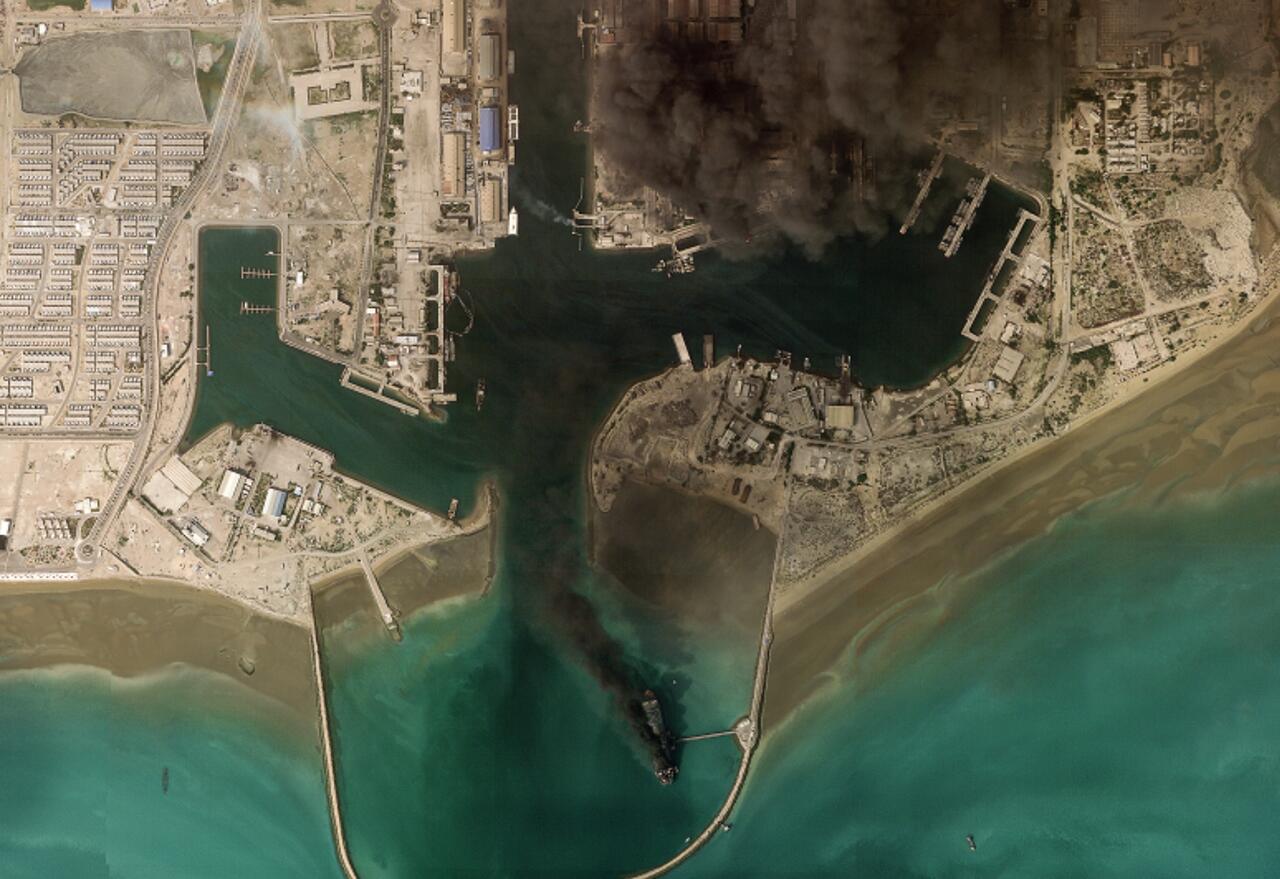
U.S. forces have destroyed Iranian radar and surveillance nodes used to track shipping in the Strait of Hormuz, struck underground anti-ship missile facilities, and hit multiple coastal military sites, as Cooper assesses that Iran’s combat capability has deteriorated over the first three weeks of the war.

Cooper’s push to neutralize IRGC forces in the Strait of Hormuz comes as shipping traffic through the waterway remained subdued last week.

Pentagon Touts ‘Obvious Progress’; Bombs Underground Facilities

CENTCOM chief Adm. Brad Cooper has said in an operational update that Iran “has lost significant combat capability” in the three weeks since the war began, also at a moment of reports that more IRGC leadership has been taken out in airstrikes. He said the US has struck more than 8,000 military targets, including 130 Iranian vessels. “Our progress is obvious,” Cooper boasted.

He described that multiple 5,000-pound bombs were dropped on an underground facility on Iran’s coastline, part of a strategy to reopen the Strait of Hormuz. “We not only took out the facility but also destroyed intelligence support sites and missile radar relays that were used to monitor ship movements,” Cooper said.

Domestic fallout amid rising prices at the gas pump looks to grow in US:

Trump is still said to be mulling a very high risk Kharg Island takeover, which to accomplish would most definitely require ground troops. A second deployment of US troops to the region was authorized earlier this week, and three warships and thousands of additional Marines are en route to the Middle East.

One among many problems in even getting to Kharg Island is that hundreds of miles of Iranian coastline must be passed by any ship hoping to reach Kharg, which lies over 300 miles deep and northwest of the Strait of Hormuz.

*  *  * ORDER BY SUNDAY NIGHT

Tyler Durden
Sat, 03/21/2026 – 20:00