52.6 F
Chicago
Sunday, April 26, 2026
Home Blog Page 44

Car-Shopping Websites Report Uptick In EV Interest Following Gasoline Price Shock

Car-Shopping Websites Report Uptick In EV Interest Following Gasoline Price Shock

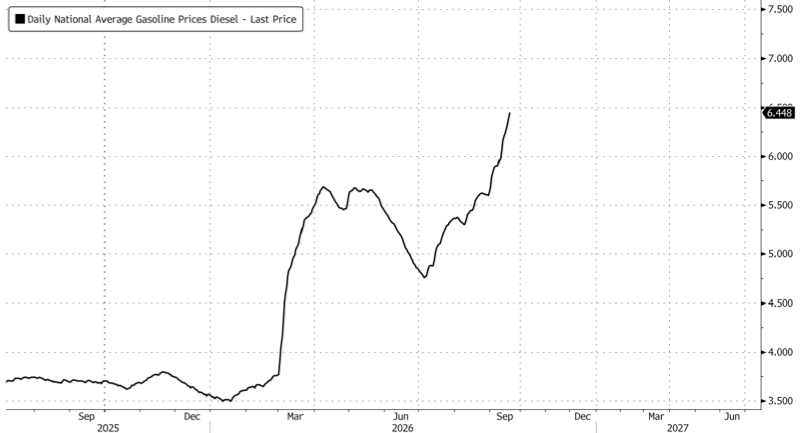
March brought the biggest fuel price shock Americans have experienced on record, or at least according to AAA data going back to the early 2000s.

A fuel price shock changes consumer behavior, especially for low-income households, by forcing folks to drive less, combine trips, cancel discretionary travel, or shift to carpooling and public transit.

For those who have the financial flexibility to do so, a fuel price shock may push some consumers toward smaller cars, hybrids, and EVs and away from large SUVs and trucks, because fuel economy suddenly matters much more.

The Wall Street Journal reports that a $4-per-gallon national average for gasoline, a politically sensitive level, is the threshold at which some consumers are beginning to think about EVs again.

Online car-shopping platforms such as Cars.com and Edmunds have reported a modest uptick in EV interest among users on their platforms in recent weeks. 

Edmunds pointed out that interest in EVs on its website has returned to where it was before federal tax incentives expired late last year.

“In the short term, a lot of Americans, and this has nothing to do with regulations, are coming back to EVs because of the cost of ownership,” Hyundai Motor Chief Executive José Muñoz told the WSJ. “Basically, the fuel costs are making them change their decision.”

Muñoz said that EVs are finding a place in the driveways of households in states like California because it makes economic sense to commute to work during the week in EVs rather than gasoline-powered cars. 

He said the thinking in some households is: “I have one car from Monday to Friday, another car for the weekend.”

We must point out that far-left states like California suffer from state-killing climate policies and terrible energy policies that are crushing households on the pocketbook level. 

Data from Cox Automotive shows that EV sales jumped 12% in the first quarter as a flood of off-lease EVs swamped the market, pushing prices lower and making them more affordable.

Edmunds data show that EVs accounted for roughly 6.2% of new-car sales in March, up from 6% in February, but this is noticeably down from September, when EVs accounted for 11.5% of sales. Higher EV sales last year were mostly driven by consumers seeing that federal tax credits were expiring at the end of the year, think of it as demand pulled forward.

Stephanie Valdez Streaty, director of industry insights at Cox Automotive, said the surge in gasoline and diesel prices at the pump during the six-week U.S.-Iran conflict led to “an uptick in consideration” of EVs. She said driving habits are hard to change, considering Americans enjoy the luxury of large SUVs and trucks.

Meanwhile, Chinese EV exports soared 140% in March, driven by surging demand outside the US amid Gulf-related energy shocks. 

Tyler Durden
Sat, 04/11/2026 – 19:15

It’s A MMIWG2SLGBTQQIA+ World And We’re Just Living In It

It’s A MMIWG2SLGBTQQIA+ World And We’re Just Living In It

Authored by Rick Moran via PJMedia.com,

What is MMIWG2SLGBTQQIA+? It might be a new, super-strong password. Maybe it’s a Gen-Whatever code-like thing that’s sweeping the internet, like “6-7” or something.

If only it could be that mundane.

In fact, MMIWG2SLGBTQQIA+ is an all-inclusive, all-encompassing, balls-to-the-wall, slam bang, wham-bam-thank-you-ma’am acronym for the totality of the gender bending, sexually “unique” population of Canada. 

For the record, as Jim Treacher helpfully points out, it stands for “Missing and Murdered Indigenous Women and Girls, Two-Spirit, Lesbian, Gay, Bisexual, Transgender, Queer, Questioning, Intersex, Asexual, and “additional identities (“+”).

The excitement was started by a Canadian New Democratic Party member of parliament, Leah Gazan, who complained that not enough money was being spent to “deal with the ongoing genocide of MMIWG2SLGBTQQIA+.”

Budgeting for each and every identity, preference, and fantasy spirit in the MMIWG2SLGBTQQIA+ community would blow up the Canadian budget. 

I fondly recall when sexual preference identities were simple: LGB and maybe T, XYZ, believe you me. It was easy. It was a simpler time then. We didn’t have to worry about offending someone by using the wrong pronoun. We didn’t have to worry about making some poor, disturbed “T” or “Q” explode in tears from being misgendered.  

It would be so much easier (and we’d be less likely to offend) if the MMIWG2SLGBTQQIA+ “community” would just walk around with name tags identifying which gender they are, what their sexual identity is, and most importantly, what pronouns they prefer to be referred to.

Yes, that’s a joke. No Nazi “Star of David” references, please.

Not that I’d use them. But since misgendering is going to be an Olympic sport in 2030, it would be helpful to know who we should insult. 

Treacher tried and failed to keep a straight face in reporting on this phenomenon.

Okay, for real, this is a serious topic. You don’t want to see women kidnapped and murdered.

Not most women, anyway. I mean, there are names that come to mind…

But no. Nobody should go through that.

Mostly.

And of course, since that’s such a long acronym and that woman just rattled it off like it’s a normal thing to say, people are having some fun with it today. “Got my new password!” That sort of thing.

There’s a British comedian named Damian Slash who has perfected a sort of straight-faced satire of… liberal excesses, let’s put it that way. Here he is explaining why MMIWG2SLGBTQQIA+ is no joke.

The internet being the internet, there was a slanderous fake news take on this story that claimed Canada was updating its LGBTQ+ acronym to MMIWG2SLGBTQQIA+.

Pink News, whose goal is to “empower generations to embrace and shape the future – making the world a gayer place,” says that simply isn’t true.

“She [Gazan] used MMIWG2SLGBTQQIA+ as a catch-all term,” says Pink News. 

“Catch-all?” Really? That’s a pretty wide net to use as a “catch-all.” 

“Various social media sites began reporting that Canada has now officially updated the LGBTQ+ acronym to MMIWG2SLGBTQQIA+, which isn’t the case,” we’re informed by Pink News.

 It’s impossible to parody leftists who are blissfully unaware of their own stupidity.

Okay, so why is this so annoying? Why does this bug me so much? Why is liberalism so irritating?

Because that’s what’s going on here. It’s not about making fun of people who are in trouble. It’s not about making fun of these women.

It’s about not just being able to say that. That these women are in trouble. They need help. Just say that they’re missing women. They’re possibly murdered. Just say that.

But that’s not inclusive.

Precisely. If this really were about saving lives, they wouldn’t use code that’s impossible to say with a straight face or highfalutin “all-inclusive” descriptions of what these people’s preferences are when it comes to who they love or prefer to sleep with.

It’s pretentious bull. And they do their cause no good by employing acronyms solely to be “inclusive” while failing to see it as the problem.

Tyler Durden
Sat, 04/11/2026 – 17:30

Netanyahu Says Israel Will Continue To Fight Iran & Proxies, Unlike Appeaser Erdogan

Netanyahu Says Israel Will Continue To Fight Iran & Proxies, Unlike Appeaser Erdogan

As expected, Israel says it is preparing to keep waging war against Iran – even as the US and Tehran are engaged in high level talks in Pakistan. Clearly Tel Aviv has a dim view of the potential outcome in the Islamabad summit.

Israeli Prime Minister Benjamin Netanyahu in a fresh statement Saturday vowed he will continue fighting Iran and its allies, in a post that also took a swipe at Turkish President Recep Tayyip Erdogan.

“Israel under my leadership will continue to fight Iran’s terror regime and its proxies,” Netanyahu wrote on X. He then turned to blasting Erdogan for “accommodating” Iran and being responsible for “massacres” of Kurdish citizens.

Ever since the Gaza war began well over two years ago, Turkey and Israel have been locked in a bitter war of words which at times included sanctions and a regional trade war.

Erdogan has frequently accused Israeli leaders of genocide and of seeking to take over the whole Middle East. In Syria, Turkish and Israeli warplanes have even come close to engaging in conflict. The two remain the most influential and powerful countries in the Near East region. In many ways they are direct rivals in the region.

It remains unclear whether Netanyahu is saying that he will keep attacking Iran no matter the outcome of ceasefire talks. Elsewhere the Israelis have said they are indeed willing to uphold a potential Trump deal, and certainly Washington would pressure them to do so in the event a final truce is agreed to.

But at the same time, Netanyahu has long sworn that he’ll never tolerate a nuclear armed Iran. For this reason, Israel’s stance remains a big wild card pending the outcome of talks. 

Watch Netanyahu’s full statement below:

Israel could potentially sabotage any ceasefire deal out of Pakistan. For example it could keep attacking Iran, or also Lebanon. This week’s major attacks in Lebanon have threatened to derail the Islamabad process before it even began.

Hezbollah has said it will respect any US-Iran deal, but has also been lobbing rockets into northern Israel. Israel’s position is that any Lebanon deal be separated out from Islamabad.

* * *

Tyler Durden
Sat, 04/11/2026 – 16:55

Texas To Face $700 Million In Federal Penalties For SNAP Errors Through 2027

Texas To Face $700 Million In Federal Penalties For SNAP Errors Through 2027

Authored by Sylvia Xu via The Epoch Times,

Texas is expected to pay $708 million more by 2027 to the federal government in penalties for erroneous distributions from the Supplemental Nutrition Assistance Program (SNAP).

The state officials released the cost in a presentation to the Senate Committee on Health and Human Services on April 8.

The state payment error rate was estimated to be nearly 9 percent in fiscal year 2025, totaling $627 million in erroneous payments.

Under the One Big Beautiful Bill Act, Texas will need to share an additional food stamps program cost of $708 million, 10 percent of the state’s total program benefits, based on its error rate, beginning October 2027.

Currently, the federal government fully funds the food stamps program, while states only need to pay half of the administrative expenses.

In fiscal year 2024, Texas received nearly $7 billion in federal funding and paid roughly $470 million for administrative costs.

Starting in October 2026, the states will need to share the administration costs at a rate of 75 percent. By 2027, Texas is expected to pay about $826 million more after adding in administrative fees of $117 million.

To avoid that result, Texas needs to bring its error rate down to 6 percent before the fiscal year ends this September.

In Texas, more than 3.2 million residents benefit from the food stamps program as of December 2025, according to U.S. Department of Agriculture data.

A family of four can receive a maximum of $994 per month on a Lone Star Card, which can be used like a debit card at any store that accepts SNAP.

Starting on April 1, SNAP recipients cannot buy candy or sweetened drinks in Texas with their Lone Star Cards.

Improper Payments

The federal government allocated nearly $100 billion to the food stamps program in fiscal year 2024; however, roughly $11 billion of that total was attributed to improper disbursement.

The food stamp error rate doesn’t come from fraud by people receiving the benefits, but from states making mistakes in determining who gets benefits and how much they receive.

Mistakes arise when beneficiaries forget to report changes in income or circumstances, or when government offices commit errors during case processing, according to the Texas Health and Human Services.

Food stamp errors accounted for 7 percent of the approximately $162 billion in improper payments recorded across 68 federal programs in fiscal year 2024, according to a report from the U.S. Government Accountability Office.

Since fiscal year 2003, cumulative federal improper payments have amounted to an estimated $2.8 trillion. The actual amount of improper payments may be significantly higher, according to the report.

Tyler Durden
Sat, 04/11/2026 – 16:20

Three Supertankers Carrying Iraqi And Saudi Crude Sail Through The Strait Of Hormuz

Three Supertankers Carrying Iraqi And Saudi Crude Sail Through The Strait Of Hormuz

The wait is over: after the Persian Gulf side of the Hormuz Strait had turned into a bit of a parking lot late last week as tankers piled up hoping to use the ceasefire and make the crossing, two Chinese supertankers loaded with crude sailed through the Strait of Hormuz hours after a Greek vessel moved through the waterway, marking a significant uptick in oil shipping traffic. It represents the biggest day of oil exits through Hormuz since the war caused traffic through the waterway to all but halt six weeks ago. More importantly, none of the ships are carrying Iranian oil or have obvious, direct links to the country.

The two Chinese supertankers are the Cospearl Lake and the He Rong Hai.  The Greek one is the Serifos. The Serifos and the He Rong Hai loaded their cargoes in Saudi Arabia, while the Cospearl Lake did so in Iraq, the tracking data show. 

All three tankers sailed eastward via south of Iran’s Larak Island, a new route outlined by Iran’s navy last week. The duo were in the Gulf of Oman by Saturday morning, ship-tracking data shows.

The two Chinese supertankers are the first from the Asian nation observed taking barrels out of Persian Gulf, a benefit for Beijing but also underscoring that the country has also been squeezed by the conflict. There’s also a third Chinese tanker, the Yuan Hua Hu, which hasn’t been signaling on Saturday, that had been waiting close by the first two before they moved to depart the Persian Gulf. 

The ships’ journeys were widely watched by marine and oil industry analysts as a sign of potential uptick for the traffic through the strait. Only two bulk carriers were allowed to pass on Friday, the fewest so far in April, according S&P Global Market Intelligence.

While the exits are significant, in oil flow terms, they are still way below peace-time levels: The three crossing tankers between them have a transport capacity of about 6 million barrels of crude. In addition, Iran, the only country really sending barrels through, exported at a rate of about 1.7 million barrels a day last month. That would imply roughly half the normal rate of shipments through the waterway — and only on a single day. 

Iran has said that vessels are allowed to sail through the waterway, but that they must get permission to do so. All three tankers followed a northerly route through the strait that has been demanded by Tehran. That path passes through Iranian waters and along the coasts of Qeshm and Larak Islands and is well away from the traditional Hormuz shipping lanes that hug the southern coast of the waterway.

The Greek tanker was signaling for Malacca in Malaysia, whose media reported on Friday a permission for the country’s freighters to depart. Malacca is also a waypoint for ships going elsewhere in Asia. 

Almost all traffic through the waterway, which normally handles about a fifth of the world’s oil and a similar portion of liquefied natural gas, ground to a halt within a day of the war starting on Feb. 28.

The reopening of Hormuz is critical to global oil trade because its closure has resulted in the loss of millions of barrels of supply to mostly Asian markets. A resumption would alleviate pressure on increasingly tight physical markets everywhere, and send prices plunging. The US and Iran are set to hold peace talks in Islamabad in the coming days.

Tyler Durden
Sat, 04/11/2026 – 15:45

Sotomayor Blames Colleagues For Flood Of Emergency Appeals

Sotomayor Blames Colleagues For Flood Of Emergency Appeals

Authored by Jackson Richman via The Epoch Times,

Justice Sonia Sotomayor said a surge in emergency appeals to the Supreme Court is largely the court’s own doing.

“We’ve done it to ourselves,” she said during an April 9 event at the University of Alabama School of Law.

She said that the volume of emergency filings has reached levels never seen before in the court’s history.


Over the past 15 months, the Trump administration submitted about 30 emergency requests to the court, succeeding in more than 80 percent of them.

Many of those rulings divided the justices along ideological lines, with 6–3 outcomes.

Sotomayor, appointed by President Barack Obama in 2009, suggested those wins reflect a shift among some of her colleagues, who now tend to assume that blocking federal policies automatically causes irreparable harm—grounds for the court to intervene.

She also said that “there’s a disagreement among us right now.”

Some justices, she said, believe that when Congress enacts a law, preventing it from taking effect inherently harms both lawmakers and the public.

“It has changed the paradigm on the court.”

Her comments were the latest from justices expressing concerns about the court’s use of the emergency docket, which is used to temporarily halt lower-court orders as litigation proceeds.

Sotomayor commented on the issue in a dissent last year after the court allowed a policy expanding deportations of immigrants to countries where they have no prior connections.

“Other litigants must follow the rules, but the administration has the Supreme Court on speed dial,” she wrote.

Supreme Court justices have been disagreeing over the emergency docket.

At an annual lecture on March 9, Justices Brett Kavanaugh and Ketanji Brown Jackson disagreed about the court’s increasing use of emergency orders, many of which have enabled President Donald Trump to move forward with key policies.

These cases are typically handled on a fast track, with limited written arguments and usually no oral hearings.

The resulting decisions are often unsigned and may include little explanation, though individual justices sometimes write concurring or dissenting opinions.

A key question in these emergency appeals is whether a challenged policy should take effect immediately while the legal process—often lasting years—continues.

Lower courts have blocked parts of Trump’s policy agenda, prompting his administration to seek emergency intervention from the Supreme Court. In many instances, the justices have granted relief by lifting those lower court orders.

Jackson, who has frequently dissented in such cases, criticized the trend during the event. She argued that the court’s conservative majority, including Kavanaugh, has too often sided with Trump in emergency rulings, undermining both the institution and the country.

She said administrations are implementing new policies and pushing for them to take effect right away, even before courts have fully reviewed their legality.

According to Jackson, the court’s growing willingness to step in at this early stage is “unfortunate” and distorts the legal process by effectively predicting outcomes before full arguments are presented.

Kavanaugh defended the court’s role, saying it is simply responding to the emergency requests brought before it.

He noted that turning to the Supreme Court for urgent relief did not begin with the Trump administration.

As passing legislation through Congress has become more difficult, Kavanaugh said, administrations increasingly rely on regulatory actions, some of which are legally valid and others not.

He also argued that some critics have been inconsistent, pointing out that similar objections were not raised when the court allowed policies from the Biden administration to take effect while legal challenges were still pending.

Tyler Durden
Sat, 04/11/2026 – 15:10

Rep. Tim Burchett Says “Names, Dates, People And Locations” Set To Be Revealed In UFO Briefings

Rep. Tim Burchett Says “Names, Dates, People And Locations” Set To Be Revealed In UFO Briefings

Authored by Steve Watson via Modernity.news,

Rep. Tim Burchett (R-TN) says he is looking forward to what he has seen in classified UFO briefings be made public next week.

In a clip that’s ripping across X, Stephen A. Smith asked point-blank: “You’ve said you’ve seen UFO briefings that would, quote, set the earth on fire, end quote. And you also said publicly, you’re not su*cidal. That’s a serious statement. What exactly are you being told that the American people aren’t allowed to hear, sir, about UFOs?”

Burchett responded: “I’ve been briefed and seen pictures and talked enough… If they would just release what I was briefed on just a couple weeks ago. Again, we had somebody come in there, a colleague, a friend if you will, that was basically there to disrupt. And they tried to ruffle this guy’s feathers and ask him stuff.”

Burchett continued, “he named names, dates, people in the meetings, where these items, if you will, are located. It’s too much. It’s too much, sir. Too much is going on.”

He doubled down on the only man who can break the logjam: “Trump’s the guy to do it. If anybody will do it, if anybody’s a disruptor, it’s Donald J. Trump, and he will disrupt with this.”

“And I had a conversation with folks at the White House today, just about that. Hopefully some things will be coming out soon,” Burchett added.

This bombshell comes as the pattern of mysterious deaths and disappearances among top scientists with access to NASA secrets and classified programs continues to explode – exactly the kind of experts who might know “too much” about the very topics Burchett is demanding be released.

As we reported days ago, the latest victim in the string was NASA Jet Propulsion Laboratory scientist Michael David Hicks, who died under suspicious circumstances with no public cause or autopsy released. That brought the toll to nine experts tied to advanced propulsion, asteroid defense, space surveillance, and programs that blur the line between civilian NASA work and military applications.

FOX 32 Chicago interviewed Harvard astrophysicist Avi Loeb about the mystery. Loeb cautioned against assuming a grand coordinated plot, telling FOX: “Each of them has a different expertise, but I think it looks like these cases are unrelated… I would caution of assigning too much significance to those.”

He added, “Of course, each of these cases is a mystery that has to be resolved.” Yet even Loeb acknowledged the risks: adversarial nations could be targeting individuals involved in classified Air Force technologies or nuclear fusion programs with major national security implications.

These losses are hitting as President Trump pushes aggressively for UAP transparency – including a direct directive to declassify information on potential nonhuman technology. Burchett’s fresh comments to the White House signal that momentum is building fast under the current administration.

For years, the deep state bureaucracy has buried this information behind layers of classification, gatekeepers, and outright disruption – exactly what Burchett described in the briefing room.

Scientists and officials with firsthand knowledge of advanced propulsion, surveillance systems, and anomalous phenomena keep turning up dead or missing while the American people are kept in the dark.

Your support is crucial in helping us defeat mass censorship. Please consider donating via Locals or check out our unique merch. Follow us on X @ModernityNews.

Tyler Durden
Sat, 04/11/2026 – 14:00

Why Is China’s Embassy In D.C. Hardening Security Perimeter With Barbed Wire

Why Is China’s Embassy In D.C. Hardening Security Perimeter With Barbed Wire

Washington, D.C.-focused local outlet Popville, short for Prince of Petworth, posted several images showing barbed wire being installed around the security perimeter of the Chinese Embassy.

The photos appear to show at least four workers installing the barbed wire atop an already hardened perimeter wall of block and iron fencing. 

Embassies in Washington face security risks, but the sudden decision to further harden the Chinese compound raises obvious questions: whether Beijing is responding to a specific threat, anticipating protests or unrest nearby, or preparing for the arrival of a senior official or foreign delegation.

We should also note that activist networks aligned with pro-China and Marxist groups have called for May 1 general strike actions aimed at disrupting the U.S. economy. It remains unclear whether the embassy’s sudden security hardening is connected to those planned demonstrations or to some other threat stream.

Tyler Durden
Sat, 04/11/2026 – 13:25

‘Next Step Mars’: Trump Congratulates Artemis II Astronauts On Historic Lunar Mission

‘Next Step Mars’: Trump Congratulates Artemis II Astronauts On Historic Lunar Mission

Authored by Aldgra Fredly via The Epoch Times,

President Donald Trump congratulated the crew of NASA’s Artemis II mission after their spacecraft splashed into the Pacific Ocean on April 10, capping their 10-day lunar voyage.

Artemis II, NASA’s 10-day test flight around the moon, concluded just after 5 p.m. PT, 8 p.m. ET, on April 10 when the Orion spacecraft gently parachuted into the Pacific Ocean off San Diego, California.

In a Truth Social post, Trump said he “could not be more proud” of the lunar mission and invited the Artemis II crew to the White House.

He anticipated the next phase of U.S. exploration of Mars.

“Congratulations to the Great and Very Talented Crew of Artemis II. The entire trip was spectacular, the landing was perfect and, as President of the United States, I could not be more proud,” the president wrote.

“I look forward to seeing you all at the White House soon. We’ll be doing it again and then, next step, Mars.”

The Artemis II mission – carrying a crew of four: NASA astronauts Reid Wiseman, Victor Glover, and Christina Koch, and Jeremy Hansen of the Canadian Space Agency – marked the first time that humans traveled to the moon and back since Apollo 17 in 1972.

The Orion spacecraft traveled 694,481 miles, surpassing the previous record set by Apollo 13 in 1970, according to NASA.

NASA said the astronauts tested the spacecraft’s life support systems, emergency equipment and procedures, survival system spacesuits, and other critical spacecraft systems to guide future lunar missions. They captured more than 7,000 images of the lunar surface and its terminator, the boundary line separating lunar day and night, the space agency said.

Their Orion capsule, dubbed Integrity, made the plunge on automatic pilot. The lunar cruiser hit the atmosphere traveling Mach 32—or 32 times the speed of sound—a blistering blur not seen since the 1960s and 1970s Apollo.

A joint NASA and U.S. military team retrieved the crew after splashdown in the Pacific Ocean, transporting them via helicopter to the USS John P. Murtha for initial medical assessments. All four crew members were reported to be in great health by medical staff.

The space agency said the crew is set to return to NASA’s Johnson Space Center in Houston on April 11.

In a statement after the splashdown on April 10, NASA Administrator Jared Isaacman called the mission a “historic achievement” and thanked the president and Congress for their support.

“With Artemis II complete, focus now turns confidently toward assembling Artemis III and preparing to return to the lunar surface, build the base, and never give up the Moon again,” Isaacman said.

Tyler Durden
Sat, 04/11/2026 – 12:50

Orban Warns “We Could Now Lose Everything”: Sunday’s Hungarian Elections Have Profound Implications For Europe

Orban Warns “We Could Now Lose Everything”: Sunday’s Hungarian Elections Have Profound Implications For Europe

As Hungarians head to the polls on Sunday, April 12, 2026, the country stands at a historic inflection point. For the first time since Viktor Orbán’s Fidesz party swept back into power in 2010, a credible challenger – Péter Magyar and his Tisza party – has a genuine shot at ending 16 years of what Orbán proudly calls his “illiberal laboratory.” In a final campaign rally, Orbán warned supporters they are choosing “not just a government, but the fate of the country” and could “now lose everything we have built together.”

Bluntly put the election is a referendum on the durability of nationalist populism in Europe, the future of EU integration, energy security amid the Ukraine war, transatlantic conservative alliances under Trump 2.0, and even the fate of billions in Chinese investment that have reshaped Hungarian industry.

Right now, it looks like Magyar has it in the bag, so read on for the implications:

Will the next Prime Minister of Hungary be Péter Magyar?
Yes 72% · No 28%
View full market & trade on Polymarket

As Goldman notes, independent polls, seat projections, and prediction markets all point to a likely Tisza victory – potentially with the two-thirds supermajority needed to rewrite the constitution. Markets have been pricing it in for over a year, yet the stakes could hardly be higher, and the outcome remains fluid until the ballots are counted. A Fidesz upset or narrow hold would reverberate from Brussels to Beijing, from Kyiv to Washington. This is the “Battle for Hungary” – and its ripples could redefine the continent’s political fault lines, as noted by Andrew Korybko. 

The Two-Man Race: Orbán’s Empire vs. Magyar’s Surge

Orbán, 62, has dominated Hungarian politics since 2010, crafting a model of “illiberal democracy” that mixes nationalist rhetoric, state-orchestrated economic control, and defiance of EU norms.

He positioned Hungary as a bulwark against mass migration, gender ideology, and Brussels overreach – exporting the playbook to allies like Donald Trump. Under his watch, Fidesz built an electoral machine that delivered supermajorities in 2010, 2014, 2018, and 2022, despite never exceeding roughly 54% of the vote, thanks to gerrymandering, diaspora voting, and first-past-the-post districts.

Enter Péter Magyar, 43, a former Fidesz insider turned insurgent.

A lawyer and ex-husband of a former justice minister, Magyar burst onto the scene in 2024 after a dramatic break with the party, railing against corruption, cronyism, and economic mismanagement. His Tisza party has consolidated the fragmented opposition into a genuine two-party contest. Magyar campaigns on restoring rule of law, unlocking frozen EU funds, and delivering economic relief without sacrificing sovereignty. He is explicitly targeting the two-thirds supermajority (133 of 199 seats) to repeal Fidesz’s “Cardinal Acts” and constitutional changes.

The numbers tell the story. Long-term polling charts show Fidesz’s support eroding from peaks near 48% in 2024 to the low 30s–low 40s today, while Tisza has rocketed from the mid-20s to 50–58% among decided voters.

Taking a ‘Naive’ Average of All Polls Suggests Tisza Will Receive Most Votes, But Fall Short of 50%

Independent pollsters like Medián consistently show Tisza at 55–58% and Fidesz at 35–38%, with “Other” parties collapsing into single digits. 

On Polymarket, Péter Magyar is trading at 72% to become the next Prime Minister (versus 28% for Viktor Orbán), with over $62 million in trading volume. The “Hungary Parliamentary Election Winner” market gives Tisza a 75% probability of winning the most seats and forming the next government (Fidesz at 26%), with roughly $60 million traded.

Will TISZA – Respect and Freedom Party (TISZA) win the most seats in the next Hungarian parliamentary election?
Yes 75% · No 26%
View full market & trade on Polymarket

Even accounting for the system’s built-in advantages for incumbents – 106 single-member FPTP districts, strong rural and Romanian-diaspora support for Fidesz – the market consensus strongly favors a decisive shift in power.

The Domestic Reckoning: Economy, Corruption, and Voter Fatigue

Hungary’s voters are not marching to the polls in a vacuum. Beneath the ideological battle lies raw economic pain. As Goldman notes further, cumulative price rises of 40% since 2021 have hammered households despite inflation cooling to +1.4%. Growth has stagnated. Corruption perceptions rank Hungary as the EU’s most graft-prone member, per Transparency International. Many Hungarians see Orbán’s system – subsidies, tax breaks, and special deals – as having enriched insiders while ordinary people footed the bill for the cost-of-living crisis.

Orbán has countered by highlighting 16 years of achievements – job creation, pension increases, and border barriers to halt illegal immigration – and warned that losing power would mean Hungarians “lose everything we have built together.”

A Tisza victory would likely deliver immediate relief: the unlocking of roughly €20 billion in frozen EU funds, contingent on judicial and anti-corruption reforms. Magyar has pledged a credible path to euro adoption by 2030, which would stabilize the forint and lower borrowing costs long-term. A supermajority would let Tisza dismantle the “Cardinal Acts” that entrenched Fidesz power over media, elections, pensions, and taxation.

As Korybko notes, the emotional undercurrent runs deeper. Orbán’s defenders credit him with shielding Hungary from the worst of the Ukraine war fallout – keeping Russian energy flowing, avoiding direct involvement, and preserving sovereignty. Many Chinese business owners in Hungary quietly echo that view: they grumble about bribes and cronyism but prefer the “devil they know” because “at least things get done,” according to SCMP

How Hungarian Elections Work

Voters cast two ballots: one for a local candidate (106 seats via first-past-the-post) and one for a national party list (93 seats via proportional representation). A simple majority elects the prime minister and passes ordinary laws; two-thirds is required for constitutional amendments and Cardinal Acts

Ballots open at 06:00 CEST and close at 19:00 CEST on Sunday. Counting begins immediately; a clear winner typically emerges election night, with official certification roughly one week later. Recounts are possible if margins are razor-thin. Turnout will be decisive: high participation historically favors challengers riding waves of discontent.

Geopolitical Earthquake: From Brussels to Beijing

Europe and the EU

Orbán has been the bloc’s most stubborn spoiler – vetoing Ukraine aid packages, blocking rule-of-law sanctions, and slowing federalization. A Tisza win would remove that veto leverage overnight. Brussels-friendly governance could accelerate EU integration, restore Hungary’s access to cohesion funds, and align Budapest with mainstream European policy.

Ukraine

Kyiv has clashed repeatedly with Orbán over energy imports from Russia and reluctance to arm Ukraine. Ukrainian pressure tactics – including weaponizing the Druzhba pipeline – have failed to move him. A

Ukraine hates Hungary too, but only because Orban refuses to arm it, continues purchasing energy from Russia, and has occasionally obstructed EU funding for this former Soviet Republic. In response, Ukraine has weaponized the Druzhba oil pipeline from Russia upon which Hungary relies to a large degree to pressure him into reversing his policies, but to no avail. Ukraine also colludes with the Hungarian opposition, which is now Ukraine’s and the EU’s joint proxy, in their Russiagate conspiracy theories. –Korybko

Magyar government would likely soften Hungary’s stance, easing EU-Ukraine funding bottlenecks and reducing pipeline friction.

United States and Trump 2.0

The international right has rallied behind Orbán. Former President Donald Trump endorsed him on social media, calling him “a truly strong and determined leader” with “a proven record of outstanding results” and a “true friend, a fighter, and a winner.”  U.S. Vice President JD Vance visited Budapest and sharply criticized Brussels for “unprecedented interference” in the election process. A Fidesz hold would bolster that transatlantic populist axis; a Tisza victory would be a setback, signaling that even the strongest illiberal outpost can fall to domestic economic grievances.

European Populist Allies

Orbán has also received strong backing from key figures on the European right. France’s Marine Le Pen praised his stance on the Ukraine war as “very brave,” Italy’s Matteo Salvini framed the vote as a contest over Europe’s future and national sovereignty versus centralized EU control, and Germany’s AfD co-leader Alice Weidel voiced her support.

Russia

Moscow’s stake is modest but real: Orbán’s pragmatic energy deals and occasional obstruction of anti-Russia measures have been valuable. Putin sees Hungary as a potential future bridge for EU-Russia détente once the Ukraine war ends. Russia has avoided overt meddling, but a Tisza shift would narrow that window.

Out of the four foreign parties with stakes in the “Battle for Hungary”, Russia’s are the least. It supports Orban’s pragmatic approach to the Ukrainian Conflict and views Hungary as a valuable partner in Europe. More than that, however, Putin believes that Orban can help repair Russian-EU relations sometime after their proxy war in Ukraine ends. While certainly game-changing if it occurs, this scenario is admittedly unlikely, ergo why Russia isn’t meddling in his support despite conspiracy theories to the contrary. –Korybko

China

Billions in Chinese FDI – most visibly CATL’s massive battery plant in Debrecen – have become politically radioactive. Banners reading “No battery, no deal,” “Debrecen belongs to Hungarians,” and “Chinese, go home” dot the city. Chinese firms face local backlash over imported labor, environmental risks, and meager local economic spillovers. Tisza has been measured – calling for “pragmatic, mutually beneficial” ties while demanding stricter EU-compliant rules on labor, environment, and taxes. Projects already under construction are unlikely to be seized, but a new government would pivot from “seduction” (subsidies and visas) to enforcement. 

Market Verdict: The Forint Has Already Spoken

Investors have been positioned for a Tisza outcome since early 2025. The forint has strengthened in anticipation. Goldman’s EM desk outlines clear scenarios:

  • Tisza win (base case): EUR/HUF –2%, swaps –20 to –30 bps, credit spreads –15 to –25 tighter.
  • Tisza + supermajority: EUR/HUF –4%, swaps –30 to –40 bps, spreads –25 to –40 tighter (+ €20bn EU funds unlock). 
  • Fidesz hold / upset: EUR/HUF +4%, swaps +40 to +50 bps, spreads +25 to +40 wider.

FX volatility desks price roughly 3% gap risk around the event, with positioning long HUF but some profit-taking near 375. 

Aftermath Scenarios: Victory, Narrow Hold, or Chaos

A decisive Tisza victory would mark the end of the Orbán era and a constitutional reset. A narrow Fidesz government or blocking minority could trigger exactly the Color Revolution fears some analysts warn of – EU- and Ukraine-backed protests framed around “Russian meddling,” exactly the kind of destabilization Orbán has accused opponents of preparing. Hungarians themselves hold the greatest stake. They will live with the consequences – economic relief or continued stagnation, EU integration or defiant sovereignty, pragmatic Chinese investment or stricter oversight. 

Why Europe – and the World – Should Watch Closely

This is more than a Hungarian election. It is a stress test for the durability of the populist wave that Orbán helped pioneer. A Tisza supermajority would deliver the clearest repudiation yet of illiberal governance in Europe, emboldening Brussels and weakening nationalist holdouts elsewhere. It would signal that economic pain and corruption fatigue can trump sovereignty rhetoric even in the EU’s most defiant member.

Conversely, an Orbán hold – against the polling tide – would validate the model’s resilience and give fresh oxygen to conservative-nationalist forces from Warsaw to Washington.

Sunday’s result will not just decide Hungary’s next prime minister. It could redraw the map of European populism, recalibrate great-power alignments, and determine whether the “illiberal laboratory” survives or becomes a historical footnote. Polls close at 19:00 CEST. By nightfall, we may know whether the Battle for Hungary ends in revolution – or resilience. The continent is watching.

Tyler Durden
Sat, 04/11/2026 – 12:15