61.6 F
Chicago
Wednesday, November 18, 2026
Home Blog Page 4616

Democrats In Panic Mode As Midterm Momentum Favors GOP

0
Democrats In Panic Mode As Midterm Momentum Favors GOP

With midterm elections weeks away, desperation among Democrats is palpable.

After horrendous polling which shows that Americans not only care most about inflation and the economy (‘Change the subject!‘), and a mass exodus of independent voters, Democrats have even resorted to shuffling a clearly-impaired President Biden around to stump for candidates and reassure the base how wonderful things are.

Here he is discussing ‘ramrod-spined’ VP Kamala Harris – who apparently has “enormous integrity.”

“Enormous integrity.”

Anyway… 

As The Hill makes abundantly clear, Democrats are freaking out right now as momentum into midterms is clearly with the GOP.

As recently as a few weeks ago, Democrats were bullish about their chances of defying harsh historical and political headwinds, believing that voter anger over the Supreme Court’s decision to overturn Roe v. Wade and lingering GOP concerns about the quality of Republican candidates might allow them to not only hold, but expand their paper-thin Senate majority.

But the political winds appear to be shifting once again in the GOP’s favor. Recent polling has found Republicans regaining an edge on the so-called generic ballot, a survey question that asks voters which party they plan to vote for in November. Meanwhile, the data website FiveThirtyEight’s Senate forecast shows Democrats’ chances of holding the Senate dropping by 11 percent over the past month. -The Hill

“A month ago, it looked like not only were the Democrats poised to hold the Senate, the question was: were they going to be able to get, you know, two extra seats?” said former Democratic pollster, Fernand Amandi, who worked on former President Obama’s 2008 and 2012 campaigns. “Now I think the hope is just to hang on.“

“Perhaps Democratic messaging hasn’t been as strong as it could be,” he continued. “But we’re talking about things tightening when the choice is between chaos and competency. The Democrats have governed with a competent, steady hand in a very volatile environment. What we’ve seen from the Republican Party over the last six years has been wholesale unhinged chaos. And what they’re offering is more chaos.“

Really?

According to Democratic strategist and former Kirsten Gillibrand (D-NY) aide Jon Reinish, “If you look at the Dobbs decision — that seems to have come a little too early for the Democrats,” referring to the Supreme Court decision that overturned Roe vs Wade.

“And I think there [are] other currents — inflation is probably the biggest one — that have kind of interfered with the singularity of that argument.”

So – the timing of the USSC overturning Roe wasn’t ideal for maximum outrage, and inflation is highly inconvenient.

Maybe Democrats can simply campaign on the economy being “strong as hell”?

According to the most recnt NYT-Siena College poll, the economy and inflation top the list of problems facing the country, while just 5% of voter said abortion is the most pressing issue. January 6th came in at 7%. Nobody cares about the hill Democrats have chosen to die on.

In one of the poll’s more alarming findings for Democrats, women who identified as independents said they preferred Republicans by an 18-point margin, a stark reversal from September, when those voters favored Democrats by a 14-point margin. Democrats have sought relentlessly to sway those voters by warning of threats to abortion rights. -The Hill

“The voters who would be most susceptible to the Democrats’ messaging on abortion are shifting,” said former GOP strategist and congressional candidate, Ford O’Connell.

“As long as the Republicans stay focused on two things — my money, my family — then they’ll win in 2022,” he added. “They’ll win in 2024. Because the Democrats aren’t showing any sign of changing their approach.”

Tyler Durden
Mon, 10/24/2022 – 20:40

Ex-Treasury Secretary Warns Of Deficit “Doom Loop”, Says Fiscal Debates Need To Be “Back On The Table”

0
Ex-Treasury Secretary Warns Of Deficit “Doom Loop”, Says Fiscal Debates Need To Be “Back On The Table”

Authored by Tom Ozimek via The Epoch Times,

Former Treasury Secretary Larry Summers said in a recent Bloomberg interview that fiscal debates need to be put “back on the table” as surging borrowing costs risk a potential deficit “doom loop.”

Summers made the remarks during Friday’s edition of Bloomberg’s “Wall Street Week,” in which he said that the Biden administration’s big spending initiatives, including the student-loan forgiveness that caused the monthly deficit to jump 562 percent, could shake investor confidence.

“If your deficit projection starts to get out of control and your real interest rates start to rise rapidly, you can get into a kind of doom loop,” Summers told the outlet.

“We’re going to need to be watching our own fiscal projections in the United States very carefully.”

While the federal budget deficit is down to $1.38 trillion this year from $2.78 trillion in fiscal 2021, it was 562 percent higher on a monthly basis compared with September 2021. The monthly jump mostly reflects Biden’s student debt forgiveness as several years’ worth of costs were compressed into a single month.

‘Stagflationary Debt Crisis’

Another prominent economist who has warned about the risks of high debt as borrowing costs rise is Nouriel Roubini, a professor of economics at New York University’s Stern School of Business who got the nickname “Dr. Doom” for his accurate prediction of the market meltdown of 2008–09.

Roubini said in an opinion piece for Time magazine that under conditions of much higher private and public debt levels now than in the past, central bank rate hikes to tame soaring inflation carry a major downside risk.

“Rapid normalization of monetary policy and rising interest rates will drive highly leveraged households, companies, financial institutions, and governments into bankruptcy and default,” he wrote.

Roubini expects the next crisis to be some combination of 1970s stagflation and the 2008–09 debt crisis, predicting a toxic mix where “the decade ahead may well be a Stagflationary Debt Crisis the likes of which we’ve never seen before.”

It comes as Republicans have criticized the Biden administration’s big-ticket spending and have been flagging the need for spending cuts.

“You can’t just continue down the path to keep spending and adding to the debt,” House Minority Leader Kevin McCarthy (R-Calif.) said in a recent interview on Punchbowl News.

The GOP lawmaker said that if Republicans win control of the House, they should consider using debt-limit negotiations to pressure Democrats to cut spending.

“And if people want to make a debt ceiling [for a longer period of time], just like anything else, there comes a point in time where, OK, we’ll provide you more money, but you got to change your current behavior.”

“We’re not just going to keep lifting your credit card limit,” he added. “And we should seriously sit together and [figure out] where can we eliminate some waste? Where can we make the economy grow stronger?”

‘Force as Much Spending Reduction’ as Possible

In a recent interview for The Epoch Times’ sister outlet NTD, Stephen Moore, former senior economic adviser to former President Donald Trump, blamed soaring inflation on the Biden administration’s massive spending packages and said the only thing that will cool price pressures is a GOP win in the midterm elections so they can pressure Democrats to “stop the spending.”

Moore acknowledged that there are limits to what a Republican-controlled Congress could do to rein in spending, as some of it is on “automatic pilot” and can’t be stopped by a vote.

“Republicans should not over-promise,” he said. “They can stop new spending, they can—in a fight over the debt ceiling—pull back some spending, as we did with [former President Barack] Obama.”

He said a GOP win would likely mean more political friction in Washington.

“Neither side is going to be very happy,” he said.

“But the more the Republicans can bring spending and regulations and taxes down, the stronger the economy.”

In order to tame soaring inflation, Republicans should “force as much spending reduction” as possible, Moore argued.

Tyler Durden
Mon, 10/24/2022 – 20:20

Cheney Says She’ll Do “Whatever It Takes”, Including Presidential Run, To Stop Trump In 2024

0
Cheney Says She’ll Do “Whatever It Takes”, Including Presidential Run, To Stop Trump In 2024

Authored by Lorenz Duscamps via The Epoch Times,

Outgoing Rep. Liz Cheney (R-Wyo.) said on Sunday that she will do everything possible, including a potential 2024 presidential run, to prevent former President Donald Trump from entering the Oval Office again.

Cheney, who has become one of the most vocal voices in the Republican Party against Trump, made the comment in an interview on NBC’s “Meet the Press,” arguing the Republican Party “will shatter” if Trump becomes the GOP presidential nominee.

“I think the party has either to come back from where we are right now, which is a very dangerous and toxic place, or the party will splinter and there will be a new conservative party that rises,” Cheney told anchor Chuck Todd, adding that if Trump becomes the Republican nominee, “the party will shatter and there will be a conservative party that rises in its place.”

Todd continued by telling Cheney that some Americans believe that if she “would be a third-party candidate” in the 2024 presidential elections, it would potentially “be enough to stop Trump” from becoming president again.

“Well, we’ll do whatever it takes as I said,” she responded.

“He will not be president again.”

Trump has not made any definitive statements on whether he would run for the nation’s highest office, but he has strongly suggested that he would in numerous speeches and interviews after departing office in January 2021.

Todd also asked Cheney, who said in mid-August that she was considering running for president but hasn’t yet made a decision on the matter, what it would take for her to run for president and face Trump.

“Look, I’m going to be very focused on all the things we’ve been talking about and I care deeply, as I know you do, as millions of people do, about this nation and about the blessing that we have as a constitutional republic,” Cheney said.

“I am focused on what we’ve got to do to save the country from this very dangerous moment we’re in,” she added, “not right now on whether I’m going to be a candidate or not.”

Cheney, who has been called a “Republican in name only” by others in her party and lost the Republican primary to Trump-backed challenger Harriet Hageman in August, said in September that she will not remain a Republican if Trump is the GOP presidential nominee in 2024.

Arizona Republican gubernatorial candidate Kari Lake in Tuscon, Ariz., on Oct. 2, 2022. (Otabius Williams/The Epoch Times)

Cheney also said that she would be willing to campaign for Democrats to stop GOP nominee Kari Lake from being elected in the Arizona gubernatorial race.

“I’m going to do everything I can to make sure Kari Lake is not elected,” Cheney said.

When asked by Texas Tribune CEO Evan Smith whether doing everything she can to ensure Lake is not elected includes campaigning for Democrats, Cheney simply stated, “Yes.”

Former television anchor Lake, who is endorsed by Trump, won the Republican nomination in the Arizona primary election in August. Lake has been vocal in alleging fraud in the 2020 election and has pledged to improve election security if she wins the gubernatorial race.

Cheney was one of 10 House Republicans to vote to impeach Trump. She is also one of two Republican members sitting on the Democrat-led House panel investigating the Jan. 6, 2021, breach of the U.S. Capitol.

Tyler Durden
Mon, 10/24/2022 – 19:40

Last Four US Cities Where Renters Can Afford A Starter Home

0
Last Four US Cities Where Renters Can Afford A Starter Home

Homebuyers feel the squeeze as vanishing inventory, soaring mortgage rates, and near-record-high home prices spark one of the worst affordability crises in decades. Homeownership has doubled in the last year, making many large metro areas unaffordable for renters to purchase their starter homes. 

“Vanishing inventory is just the tip of the unaffordability iceberg as daunting mortgage rates crush renters’ homeownership goals overnight,” real estate research firm Point2 said. 

The good news is that Point2’s new study found the last four metro areas where renters can afford starter homes. Those cities include Detroit, Michigan; Tulsa, Oklahoma; Memphis, Tennessee; and Oklahoma City, Oklahoma. 

Point2’s data shows the percentage of starter homes built over the years has collapsed. 

Once upon a time, nearly 70% of all new builds were starter homes — single-family houses with 1,400 square feet or less that started at $6,990. But that was in the 1940s. Fast forward to 1980 and that share fell to 40%. Then, in 2019, the U.S. Census Bureau reported that a mere 7% of all new homes were represented by the small, entry-level homes that are affordable for first-time buyers — and the prices aren’t even remotely similar.

Due to the increasing cost of land, as well as zoning restrictions and skyrocketing costs for building materials, the modest, bare-bones homes of yesteryear have become the stuff of myths and legends — the actual unicorns of the real estate market. More elusive than ever, this type of home seems almost extinct.

Point2′s analysis showed that as mortgage rates skyrocketed, the number of metro areas offering affordable starter homes shrank from six in August to just four this month. 

In August, when interest rates were hovering around 5.5%, renters in 6 large U.S. cities could comfortably afford to buy a starter home. One month and an interest hike later, that number swiftly fell to 5… and then 4.

To estimate affordability, Point2 follows the standard personal finance rule that a mortgage payment shouldn’t exceed 30% of a homeowner’s gross monthly income. 

What does it mean that renters could comfortably afford to buy a starter home? Well, the accepted rule is that a mortgage payment should not exceed 30% of your gross monthly income. Accordingly, after calculating how much the mortgage would be in each of the 50 cities (taking into consideration the median price of a starter home and assuming a 20% down payment), we calculated a renter’s required income and compared it to their actual income. The result? Renters in only four cities earned enough to cover their monthly mortgage payments.

Lawrence Yun, the chief economist at the National Association of Realtors, expanded more on the affordability crisis:

“Trying to balance the housing market by choking off demand via higher mortgage rates is damaging to consumers and the economy.” 

Yun is correct. Inflation has outpaced wage growth for the last 16 months. 

Under the Biden administration and Powell-led Federal Reserve, the new “American dream” is a starter home in the dangerous neighborhoods of Detroit. 

Tyler Durden
Mon, 10/24/2022 – 19:20

China’s Coming Clash With Economic Reality

0
China’s Coming Clash With Economic Reality

Authored by Jim O’Neill via Project Syndicate,

As expected, Chinese President Xi Jinping has been given an unprecedented third five-year term. More surprising was the absence of any sign that Xi intends to revise the policies that have done so much economic damage in recent years.

Judging by the reporting from the Communist Party of China’s 20th National Congress, Xi Jinping, newly anointed to an unprecedented third term as president, is tightening his political grip and strengthening the CPC’s control over society. Can successful economic development continue in this environment?

I have been thinking for many months now that one day, I would wake up to read that China was revisiting its zero-COVID strategy, overhauling the CPC’s interaction with domestic private business, truly reforming the country’s hukou system of residence permits, and rethinking crucial aspects of its Belt and Road Initiative (BRI) and its recent tactical stance on international governance. It is proving to be a very long wait.

At a meeting with a senior Chinese official a few months ago, I jokingly said that my 30-plus years of “understanding” China may have been a fluke, because I couldn’t comprehend some policies the country had adopted in recent years. The only way I could rationalize them was to conclude that they must be part of some tactical maneuver to neutralize factions within the CPC’s upper echelons ahead of the Congress. Judging by who the Congress has chosen to be next to Xi in the new leadership, there have certainly been further purges of opponents – and very few signs of a reversal of the policies of recent years.

Unless the post-Congress days and weeks produce a big surprise, I see growing dilemmas emerging for Xi and the CPC.

In the BRICs analysis (the purported rise of Brazil, Russia, India, and China) that my then-colleagues and I produced a generation ago, the decade 2021-30 was supposed to be when China’s economy closed in on the US in nominal terms. This was why the BRICs economies collectively might go on in the next decade to become larger than the G7, which would of course represent an enormous change to the modern world order.

This assumed that countries would achieve their long-term potential productivity rate, because Chinese GDP growth would decelerate as its labor-force growth peaked, implying that most of the 4.5-5% GDP growth we had assumed would reflect productivity gains. This growth rate is consistent with what China has stated is both required and desired to double its GDP per capita by 2035 from the 2020 level.

But the last three years suggest that China is unlikely to achieve this target unless it reconsiders its current policies. Virtually all scientific evidence suggests that it is impossible to eradicate COVID-19. The only plausible way to manage it is with proven vaccines. Chinese leaders’ fear that abandoning the zero-COVID policy would overrun the health system and cause mortality to rise is understandable, but the policy is entirely inconsistent with the path to the 2035 goal. It has been clear for some time that China can achieve its goal only if Chinese consumers become a central part of the country’s growth model. Rolling lockdowns make this virtually impossible.

Surely the time has come to import the best Western vaccines and change course. Among other benefits, such a step would send a powerful signal to the rest of the world that China wants to open again. In such a scenario, there could even be a reversal of the ongoing economic decoupling between China and Western countries, as well as of the growing difficulties surrounding most global governance bodies, such as the G20, the World Health Organization, the International Monetary Fund, and the World Bank.

COVID-19 is hardly the only policy area in need of rapid reform. In particular, the authorities must address the growing signs of a vicious circular weakening of the housing market and construction, as well as the lack of success of Xi’s signature BRI.

I hope these words will be read as constructive criticism from someone who saw China’s potential over 30 years ago and imagined a world where it could become the biggest economy. Back then, I thought this would benefit not only China, especially its citizens, but also the rest of us.

This month, the US National Bureau of Economic Research (NBER) published a study, “The Future of Global Economic Power,” looking all the way to 2100. It follows an analytical framework very similar to that of our BRICs analysis, and its main scenario still concludes that China will become the world’s largest economy by the end of the century, with another BRIC country, India, in second place. But there are two other scenarios with less favorable paths of productivity growth. In one of them, India, not China, is the world’s largest economy by 2100. And in the second, productivity falls short of the path of the past three decades, as it has in recent years, and China’s share of global GDP declines notably.

One can only hope that whoever Xi surrounds himself with in the coming years takes the NBER report to heart.

Tyler Durden
Mon, 10/24/2022 – 19:00

American Students Have A Math Problem

0
American Students Have A Math Problem

American students have a math problem. That’s according to the latest findings from the National Assessment of Educational Progress (NAEP), also known as The Nation’s Report Card.

As Statista’s Felix Richter reports, the new batch of results, published by the U.S. Department of Education’s National Center for Education Statistics on Monday, confirms fears about the pandemic’s disruptive effect on education, showing significant declines in mathematics and reading scores among fourth and eighth graders.

Infographic: American Students Have a Math Problem | Statista

You will find more infographics at Statista

In fact, the decline in national average math scores was the largest ever recorded in the nationally representative assessment of student performance dating back to 1969. In the test’s first results since the pandemic began, just 26 percent of eighth graders showed proficiency in math, down from 34 percent in 2019. That’s the worst result since 2000, as math performance among eighth graders declined in 51 participating states and jurisdictions. Fourth graders fared just a little better with 36 percent achieving a proficient score, down from 41 percent three years earlier.

“The results show the profound toll on student learning during the pandemic, as the size and scope of the declines are the largest ever in mathematics,” NCES Commissioner Peggy G. Carr said in a statement on Monday, while her colleague Daniel J. McGrath, acting as NCES associate commissioner for assessment, warns of possible long-term effects.

“Eighth grade is a pivotal moment in students’ mathematics education, as they develop key mathematics skills for further learning and potential careers in mathematics and science,” McGrath said.

“If left unaddressed, this could alter the trajectories and life opportunities of a whole cohort of young people, potentially reducing their abilities to pursue rewarding and productive careers in mathematics, science, and technology.”

Tyler Durden
Mon, 10/24/2022 – 18:40

Illegal Immigrant Arrests At Border Soar In September, Set New Fiscal Year Record

0
Illegal Immigrant Arrests At Border Soar In September, Set New Fiscal Year Record

Authored by Zachary Stieber via The Epoch Times,

President Joe Biden is facing fresh criticism after his administration released illegal immigrant apprehension numbers from September, showing the number of arrests soared to a record high.

Customs and Border Protection (CBP) made 227,547 arrests in September at the U.S.–Mexico border… the most in history.

That was by far the highest number for a September, coming in at some 35,000 more than the first September under Biden, the previous record, and up 12 percent from August.

It was also one of the highest numbers in fiscal year 2022, despite September traditionally being one of the months in which illegal immigration slows because of weather and other patterns.

The number “reflects an accelerating pace of apprehensions when they should be declining seasonally,” Steven Kopits, president of Princeton Policy Advisors, said in a statement.

“This speaks to both a strong U.S. labor market and deteriorating enforcement at the border.”

Biden, a Democrat, reversed or weakened various Trump-era border policies, including halting construction of the border wall. His administration has also curtailed the deportation of illegal immigrants.

“Over the past 21 months, we have witnessed the devastating harm wrought by a rogue administration that is asserting near-dictatorial powers in a relentless effort to keep our borders open,” R.J. Hauman, head of government relations and communications for the Federation for American Immigration Reform, said in a statement.

“The endless flow of illegal immigrants and the incursion of lethal narcotics pouring across our border will not end until this administration demonstrates a willingness to secure the border and enforce the law.”

Fiscal year 2021 already set a new record of apprehensions, 1.7 million, despite including nearly four months of below-average illegal immigration under former President Donald Trump. Fiscal year 2022 apprehensions reached more than 2.3 million. The new fiscal year started on Oct. 1.

In September, some 182,700 illegal immigrants were captured. Some were arrested more than once. The figure was a 15 percent jump from August.

Neither the White House nor Biden has reacted to the latest numbers, which don’t include “gotaways,” or illegal immigrants who evaded capture after entering the United States.

CBP Commissioner Chris Magnus, a Biden appointee, blamed the wave of illegal immigrants on “failing regimes in Venezuela, Cuba, and Nicaragua” but said the administration has been taking action with Mexico in a bid to slow the illegal immigration “and create a more fair, orderly, and safe process for people fleeing the humanitarian and economic crisis in their country.”

Of the illegal immigrants arrested in September, 42 percent were from Venezuela, Cuba, or Nicaragua. About half of the rest were from Mexico or northern Central America.

About three-quarters of those arrested were single adults. The rest were family units or unaccompanied children.

According to CBP figures, the number of Venezuelans trying to enter the United States dropped more than 80 percent after “additional joint enforcement actions with Mexico,” Magnus said.

CBP is part of the Department of Homeland Security (DHS).

“CBP and DHS will continue to work with our partners in the region to address the root causes of migration, expand legal pathways, facilitate removals, and take thousands of smugglers off the streets,” Magnus said.

“No matter what smugglers say, those who do not have a legal basis to remain in the country will be removed and people should not make the dangerous journey.”

Tyler Durden
Mon, 10/24/2022 – 18:20

US Oil Industry Mocks Biden Offer To Refill SPR At $72 As “Inadequate To Lift Oil Output”

0
US Oil Industry Mocks Biden Offer To Refill SPR At $72 As “Inadequate To Lift Oil Output”

Several months ago, we mocked the ridiculous idea spawned by some of the “best and brightest” progressives currently cogitating in the US, according to which even as Biden was actively steamrolling US energy companies by vowing to end US fossil fuel usage in a few decades and single-handedly crushing the price of oil through the biggest ever release of crude from the strategic petroleum reserve (where the term “emergency” now means not war or a natural disaster but Democrats lagging Republicans in midterm polling) he would be throwing them a bone by “promising” to buy oil if and when it tumbled much lower as otherwise US producers would have zero incentive ever to invest even one dollar in growth (or even maintenance) capex…. or so the “best and brightest” progressive thought went.

This is how the pro-socialist, far-leftist outlet Vox described this “brilliant plan”:

In the summer of 2022, President Joe Biden had a problem. Gas prices had been soaring for most of 2021 and 2022, due to a combination of overhang from reduced production during the height of the Covid-19 pandemic and the Russian invasion of Ukraine. And American voters hate when gas prices go up. Biden’s approval rating plunged over his first two years in office. He needed some kind of policy response to address the problem and prevent his party from getting slaughtered in the midterms.

The plan he ultimately arrived at entailed massive releases from the Strategic Petroleum Reserve combined with a new policy of buying oil futures to provide producers with an incentive to pump more in the near to medium term, preventing another shortage from arising. This approach followed very closely a proposal put out in March by the advocacy and research group Employ America, written by its executive director Skanda Amarnath and his colleagues Alex Williams and Arnab Datta. The Employ America plan explained how the administration could use the petroleum reserve to durably lower gas prices, while also setting a price floor so the cost of gas didn’t fall so far that it imperiled the transition to electric vehicles and renewable energy.

The brain (we use the term loosely) behind this plan, Skanda Amaranth, also sarcastically dubs himself “Neoliberal sellout” (actually, we merely assume it is sarcastic), and at least on paper, his master plan was noble – to lower prices while also boosting oil sector employment. Alas, as progressives so often find out, there is an gaping chasm between their idealistic vision of the future and what actually ends up happening (for the best example of this just ask Europeans who blindly followed the delightfully insane ideas of a petulant Scandinavian teenager for their energy policy).

While this plan bore some fruit at least early on, when oil and gas prices did tumble (if only because the SPR was being drained by 1 million barrels every week), the drop has since reversed sharply after OPEC+ openly defied the Biden admin (the neoliberal model did not account for that “eventuality”), and Brent is now trading well above $90, and many banks are warning that oil will soar as high as $120 after the midterms once the SPR drain ends.

But what about the brilliant progressive plan to collar oil prices while encouraging employment with the stated SPR purchase price floor? Well – and this is why we said the plan was “ridiculous” – as Reuters reports, US shale oil executive Matt Gallagher this week took a poll on Twitter to gauge sentiment toward President Joe Biden’s offer to stock the U.S. emergency oil reserve at prices around $72 a barrel, to give producers an incentive to drill more.

The result: nearly 80% of respondents said they did not expect oil futures next year will fall to a level that would trigger any U.S. purchases – negating any boost from what analysts called the “U.S. put,” or using proposed Strategic Petroleum Reserve buys to set a minimum price for new oil production. In other words, the “forward guidance” on where the US would buy SPR oil would by itself assure that the price never fell that low.

“That announcement was making it appear like he was throwing a bone to the oil industry,” said Trisha Curtis, CEO of consultancy PetroNerds, who dismissed the offer. But “what if oil does not fall to that price: Do we just keep our reserves low?” she asked rhetorically (the answer is of course).

The release of the last of a 180 million barrel sale coupled with a repurchase price was Biden “trying to walk a fine line between supporting his green base and trying to lower fuel prices. And he did neither,” said Curtis.

Another reason why the Biden plan is idiotic: with oil now selling for about $85 a barrel, the offer price of about $70 “is a price where there is no supply growth,” said Abhiram Rajendran, a director at consultancy Energy Intelligence.

But what was so patently obvious to everyone – except a handful of intellectually challenged progressives – is that even though US oil prices hit $120 per barrel this year, that did not trigger a production boom because of shortages and high costs for labor and equipment, said Hunter Kornfeind, oil market analyst at Rapidan Energy Group. The sheer intellectual arrogance of believing that there will be a capex boom if oil tumbles $50 lower but is propped up just because the US is refilling the same SPR it was draining to keep oil from rising above $100, is truly staggering.

Meanwhile, as Rebecca Babin, senior energy trader at CIBC Private Wealth said, it is tight oil supplies have pushed up price expectations into 2024. But that occurred apart from the SPR offer, she said.

If the Biden administration wants to boost oil supplies, it “should change its policies around producing more oil and gas in the United States,” said Frank Macchiarola, a senior vice president at trade group American Petroleum Institute.

Of course, that won’t happen as the same progressive groups that came up with this idiotic idea will be screaming from the rooftops, demanding that they know the oil industry better than, well, the oil industry.

Tyler Durden
Mon, 10/24/2022 – 18:00

30 House Dems Urge Dramatic Shift In Biden’s Ukraine Policy: ‘Get Serious About Diplomacy Or Risk Nuclear Miscalculation’

0
30 House Dems Urge Dramatic Shift In Biden’s Ukraine Policy: ‘Get Serious About Diplomacy Or Risk Nuclear Miscalculation’

In a wholly unexpected development, given that until just yesterday any prominent person wishing to talk Ukraine peace plan possibilities or who expressed hope for a negotiated end to the war was denounced and shouted down as a ‘Kremlin agent’, a group of 30 House Democrats is now urging the Biden administration to pursue a diplomatic track with Moscow.

The Washington Post, which detailed the contents of a letter sent to President Biden by the Congressional Dems, underscored they are calling for the US to “dramatically shift” its strategy on the Ukraine war for the first time, with the grinding conflict now reaching the eight-month mark.

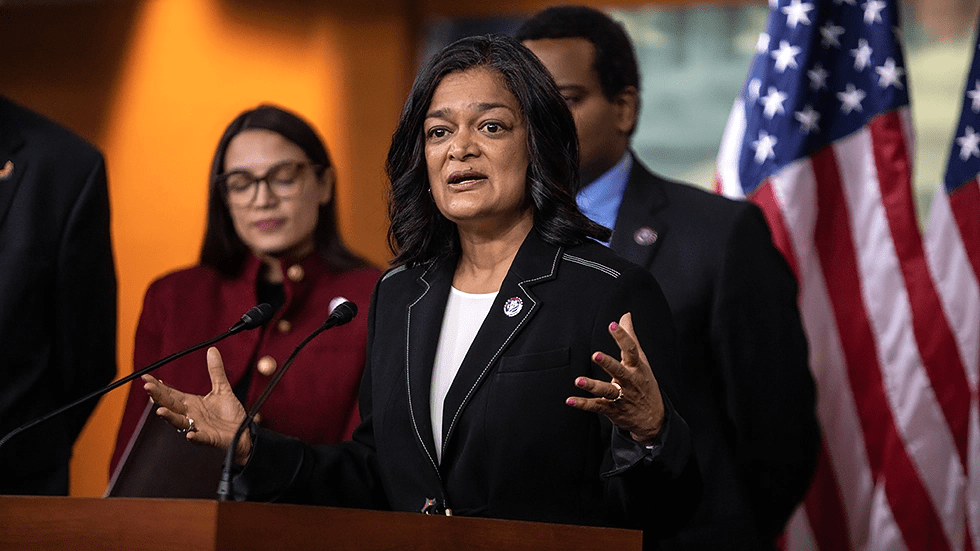
“The longer the war in Ukraine goes on, the greater the risk of escalation — to widespread, devastating effect,” Rep. Pramila Jayapal (D-Wash.), who is leading the efforts for a comprehensive strategy shift, told the Washington Post. “We should have no illusions about the challenge ahead of us, but … my colleagues and I are urging the Administration to engage in a proactive diplomatic push in an effort to seek a realistic framework for a ceasefire.”

Rep. Pramila Jayapal and other Progressive Democrats, via The Hill.

Crucially, it seems the past month of heightened nuclear rhetoric is actually waking up some of the politicians who appeared to be sleepwalking straight into “Armageddon” – as Biden’s own ultra-alarming remarks on October 6 put it. Biden had said at the time before a Democratic audience at a New York fundraiser, “We’re trying to figure out what is Putin’s off-ramp? Where does he get off? Where does he find a way out?” And he then asserted of the Russian president, “He is not joking when he talks about potential use of tactical nuclear weapons or biological and chemical weapons.”

The group of 30 Dems in their letter seize on some of these past warnings of stumbling into WW3, addressing Biden as follows…

Crucially, you achieved this while also maintaining that it is imperative to avoid direct military conflict with Russia, which would lead to “World War III, something we must strive to prevent.” The risk of nuclear weapons being used has been estimated to be higher now than at any time since the height of the Cold War. Given the catastrophic possibilities of nuclear escalation and miscalculation, which only increase the longer this war continues, we agree with your goal of avoiding direct military conflict as an overriding national-security priority.

Given the destruction created by this war for Ukraine and the world, as well as the risk of catastrophic escalation, we also believe it is in the interests of Ukraine, the United States, and the world to avoid a prolonged conflict. For this reason, we urge you to pair the military and economic support the United States has provided to Ukraine with a proactive diplomatic push, redoubling efforts to seek a realistic framework for a ceasefire. This is consistent with your recognition that “there’s going to have to be a negotiated settlement here,” and your concern that Vladimir Putin “doesn’t have a way out right now, and I’m trying to figure out what we do about that.”

Except that there really hasn’t been much in the way of earnest “efforts” seeking a “realistic framework” for ceasefire for a long time – really not since the opening three months of the war, which left off with the Istanbul negotiations. One exceptional bright spot to come out of Istanbul, however, was the UN and Turkey-brokered grain export deal, which it should be noted has been hanging by a thread.

This new push for the US to get serious about the negotiating table comes after leading Republicans signaled that in a future GOP-led house, there would be no “blank check” writing for Ukraine, after the US has already pledged an unprecedented tens of billions of dollars. So now it seems a contingency of Democrats are bracing for that distinct possibility given the nearness of the November mid-terms.

“We are under no illusions regarding the difficulties involved in engaging Russia given its outrageous and illegal invasion of Ukraine,” the Democrats’ letter continues.

“If there is a way to end the war while preserving a free and independent Ukraine, it is America’s responsibility to pursue every diplomatic avenue to support such a solution that is acceptable to the people of Ukraine.”

And yet, Ukraine’s President Volodymyr Zelensky has vowed to never negotiate or compromise on ceding territory (apparently including Crimea), especially so long as Putin is still in power. But likely Washington alone has the power to push Zelensky to back off this maximalist stance. It seems some within Biden’s party realize such an intractable posture in Kiev is recipe for a lose-lose escalation leading to catastrophe in the making.

Yet, so far those voices remain a minority. WaPo notes that despite the big Democratic Progressive names on the letter, including AOC, a major shift in administration policy in Ukraine remains unlikely for now. “The letter was signed by some of the best-known and most outspoken liberal Democrats in Congress, including Reps. Jamie Raskin (Md.), Alexandria Ocasio-Cortez (N.Y.), Cori Bush (Mo.), Ro Khanna (Calif.) and Ilhan Omar (Minn.),” the report details.

Maybe the growing pressure from progressive anti-war activists had something to do with AOC doing some soul-searching on the Ukraine issue?…

WaPo concludes, “For now, their position remains a minority in the Democratic Party, which has overwhelmingly supported Biden’s denunciations of Russia and his spearheading of a global coalition to funnel massive support to Ukraine. Biden has framed the conflict as part of his broader view that the world is witnessing a historic confrontation between authoritarianism and democracy.”

Tyler Durden
Mon, 10/24/2022 – 17:46

Johnstone: The US Government Sees Silicon Valley As Part Of Its Propaganda Machine

0
Johnstone: The US Government Sees Silicon Valley As Part Of Its Propaganda Machine

Authored by Caitlin Johnstone via Medium.com,

The Biden administration is reportedly considering opening a national security review of Elon Musk’s business ventures which could see the plutocrat’s purchase of Twitter blocked by the White House, in part because Musk is perceived as having an “increasingly Russia-friendly stance.”

Bloomberg reports:

Biden administration officials are discussing whether the US should subject some of Elon Musk’s ventures to national security reviews, including the deal for Twitter Inc. and SpaceX’s Starlink satellite network, according to people familiar with the matter.

US officials have grown uncomfortable over Musk’s recent threat to stop supplying the Starlink satellite service to Ukraine — he said it had cost him $80 million so far — and what they see as his increasingly Russia-friendly stance following a series of tweets that outlined peace proposals favorable to President Vladimir Putin. They are also concerned by his plans to buy Twitter with a group of foreign investors.

The “group of foreign investors” the Biden administration is reportedly worried about oddly includes Prince Alwaleed bin Talal of Saudi Arabia, who has already been a massive Twitter shareholder for years. The White House certainly never had a problem with foreign investors there before.

“Officials in the US government and intelligence community are weighing what tools, if any, are available that would allow the federal government to review Musk’s ventures,” Bloomberg writes. “One possibility is through the law governing the Committee on Foreign Investment in the United States [CFIUS] to review Musk’s deals and operations for national security risks, they said.”

“Musk, the world’s richest person, has taken to Twitter in recent weeks to announce proposals to end Russia’s war and threaten to cut financial support for Starlink internet in Ukraine,” says Bloomberg. “His tweets and public comments have frustrated officials in the US and Europe and drawn praise from America’s rivals.”

“If the Twitter acquisition was to be reviewed by CFIUS for national security reasons, the agency could recommend to President Biden that he nix the deal — something Musk himself has tried and failed to do in recent months,” writes Business Insider’s Kate Duffy on the Bloomberg scoop.

Indeed Musk has already indicated that he’d find it funny if the Biden administration blocked his purchase of Twitter, a $44 billion buy that the Tesla executive has made every legal effort to back out of. But how revealing is it that someone could be forbidden by the White House from purchasing a giant social media company on the grounds that they’re not sufficiently hostile toward Moscow?

Neither Bloomberg nor any other mainstream members of the imperial commentariat appear to take any interest in the jarring notion that the US government could end up banning the purchase of an online platform because it views the purchaser as having an unacceptably “Russia-friendly stance.” Not only is it uncritically accepted that the US government mustn’t allow the purchase of a social media company if the would-be buyer isn’t deemed adequately hostile to US enemies, many mainstream liberals are actively cheering for this outcome:

This just says so much about how the US government views the function of Silicon Valley megacorporations, and why it has been exerting more and more pressure on them to collaborate with the empire to greater and greater degrees of intimacy. As far as the US empire is concerned, Silicon Valley is just an arm of the imperial propaganda machine. And empire apologists believe that’s as it should be.

None of this will come as a surprise to anyone who’s been paying attention to things like the drastic escalations in online censorship since the war in Ukraine began, including on Twitter, or the ongoing expansion of internet censorship protocols that were already well underway before this war started. It will also come as no surprise to people whose ears pricked up when the White House summoned top social media influencers to a briefing in which they were instructed how to talk about the Ukraine war. It will also come as no surprise to those who paid attention to the public outcry when it was discovered that the Biden administration was assembling a “disinformation governance board” to function as an official Ministry of Truth for online content, or when the White House admitted to flagging “problematic posts” for Facebook to take down, or when Mark Zuckerberg admitted that the censorship of the Hunter Biden laptop October surprise in the last presidential race was done in conjunction with the FBI.

It is abundantly clear to anyone paying attention that Silicon Valley tech companies are a major part of the imperial narrative control system.

The US empire has invested in soft power to an exponentially greater degree than any other empire in history, and has refined the science of mass-scale psychological manipulation to produce the mightiest propaganda machine since the dawn of civilization. Silicon Valley is being used to manipulate the way people think about world events via algorithm manipulation, censorship, and sophisticated information ops like Wikipedia in an entirely unprecedented way that is becoming more and more important to imperial control as the old media give way to the new.

Narrative control centers like Silicon Valley, the news media and Hollywood are just as crucial for US imperial domination as the military. That the US government is weighing intervention to stop the purchase of an online platform, because it lacks confidence that the would-be owner would reliably advance US information interests, is just the latest glimpse behind the veil at the imperial agenda to control human understanding and perception.

*  *  *

My work is entirely reader-supported, so if you enjoyed this piece please consider sharing it around, following me on Facebook, Twitter, Soundcloud or YouTube, buying an issue of my monthly zine, or throwing some money into my tip jar on Ko-fi, Patreon or Paypal. If you want to read more you can buy my books. The best way to make sure you see the stuff I publish is to subscribe to the mailing list for at my website or on Substack, which will get you an email notification for everything I publish. Everyone, racist platforms excluded, has my permission to republish, use or translate any part of this work (or anything else I’ve written) in any way they like free of charge. For more info on who I am, where I stand, and what I’m trying to do with this platform, click here. All works co-authored with my American husband Tim Foley.

Bitcoin donations:1Ac7PCQXoQoLA9Sh8fhAgiU3PHA2EX5Zm2

Tyler Durden
Mon, 10/24/2022 – 17:40