Ugly, Tailing 30Y Auction Makes History With First 5%+ Yield Since The Great Quant Crash Of Aug 2007
Moments ago, the last refunding auction of the week, the sale of $25BN in 30Y paper, made history: it was the first 30Y auction to print with a high yield above 5%, and a coupon of 5%, since August 2007… which as veteran traders will recall was the month of the historic quant crash which marked the S&P highs at the time and eventually culminated in the global financial crisis.
The auction priced at a high yield of 5.046%, up sharply from 4.876% in April, and tailed the 5.041% When Issued by 0.5bps, the second consecutive tail following 4 stop-throughs.
But, as noted above, what is more notable was that this was the first 5% interest rate coupon 30Y auction, and the the first 30Y auction with a high yield above 5% since… August 2007 when surging rates sparked a quant crash. Come to think of it, unlike retail momentum chasers, quants have had a terrible month. How much longer can they last? But we digress…
Going back to the auction, the uglyness was all around: the bid to cover was 2.303, down from 2.385, below the 2.43 six auction average and the lowest since Nob 2025.
Internals were not quite as bad, with Indirects taking down 66.6%, up from 64.1% in April and just below the 66.8% recent average. And with Directs awarded 21.74%, Dealers were left with 11.7%.
Overall, this was an ugly, tailing auction, but the question on everyone’s lips is whether today’s quction will – like in August 2007 – be the VaR shock equivalent of a bond auction that pops this particular bubble. For the answer keep a close eye on quants who are suffering badly.
The court’s 2025–2026 term is expected to end in June with a series of rulings that could impact social issues and President Donald Trump’s agenda.
The last scheduled oral argument was held on April 29; the justices considered whether Trump wrongfully terminated deportation protections for thousands of Haitian and Syrian nationals. That decision and a ruling on Trump’s order restricting birthright citizenship could influence immigration policy for decades to come.
So far, the court has already issued opinions on Trump’s tariffs and redistricting. Its remaining decisions could change how elections are conducted, as well as alter the balance of power between Congress and the president.
Here are the main decisions expected before the end of June.
Birthright Citizenship
A key part of Trump’s immigration agenda has been his attempt to limit who receives American citizenship. The 14th Amendment states that “all persons born or naturalized in the United States, and subject to the jurisdiction thereof, are citizens of the United States and of the State wherein they reside.”
Historically, the executive branch interpreted this amendment to grant citizenship to babies born to illegal immigrants. Trump changed this interpretation on his first day in office, passing an executive order stating that the amendment only applied to children who had at least one parent with citizenship or lawful permanent residency.
In Trump v. Barbara, the president asked the Supreme Court to intervene after a federal judge blocked his executive order. During oral argument on April 1, the Justice Department said that parents should be legal residents or have some kind of allegiance to the United States before their children receive citizenship. The justices, however, seemed skeptical and indicated they may view citizenship more broadly.
Another highly anticipated decision focuses on Idaho’s and West Virginia’s laws preventing males from participating in girls and women’s sports. Federal appeals courts blocked those laws, stating that they conflict with another portion of the 14th Amendment known as the equal protection clause. That clause generally prohibits laws that classify or discriminate on the basis of certain characteristics.
The appeals courts said the state laws conflict with that clause because they classify individuals on the basis of their sex and “transgender status.” The U.S. Court of Appeals for the Fourth Circuit also said West Virginia’s law violated Title IX of the Civil Rights Act. That law prohibits sex-based discrimination in federally funded education.
The justices heard oral argument in January for the cases, known as Little v. Hecox and West Virginia v. B.P.J. Overall, the justices seemed inclined to uphold the states’ laws.
Monsanto’s herbicide, known as Roundup, has cost the company millions of dollars following lawsuits alleging one of its ingredients, glyphosate, increases cancer risk.
One of those lawsuits made it to the Supreme Court in April and could determine how much Monsanto has to pay in future lawsuits. The case, Monsanto v. Durnell, focused on a Missouri jury that held the company liable for not warning about glyphosate’s purported risks.
Monsanto told the Supreme Court that the jury’s verdict was based on a faulty interpretation of the law. The jury said Monsanto was liable under a Missouri law that requires warnings for consumer products. Monsanto argued that the jury interpreted the law in a way that conflicted with another law passed at the federal level.
The Supreme Court’s eventual decision is expected to touch on a legal doctrine known as preemption, which says that federal law takes precedence over state law when there is a conflict between the two. In this case, Monsanto said the Federal Insecticide, Fungicide, and Rodenticide Act should take precedence.
That law gives the U.S. Environmental Protection Agency authority to regulate chemicals such as glyphosate. Because the agency already approved glyphosate’s use and didn’t require additional warnings, Monsanto said Missouri couldn’t require more either. Durnell argued that the verdict didn’t conflict with federal law and that Missouri should be able to protect its citizens’ health.
Trump’s Ability to Fire Bureaucrats
One of the main legal complaints leveled during Trump’s second administration was that he fired high-level bureaucrats without good reason. Leaders of so-called “independent” agencies, such as the Federal Trade Commission (FTC), sued, alleging that Trump didn’t show the type of cause federal law required of presidents when firing officials.
In Trump v. Slaughter, Trump asked the Supreme Court to intervene after a lower court blocked his attempt to fire FTC Commissioner Rebecca Slaughter. The justices seemed inclined in December 2025 to not just allow her firing, but also expand the authority presidents have in removing bureaucrats like her.
Their eventual decision could overturn a 90-year-old precedent from Humphrey’s Executor v. United States. In that 1935 case, the Supreme Court held that former President Franklin D. Roosevelt wrongly fired a former FTC commissioner and that Congress could restrict his ability to do so.
The Trump administration argues that the Constitution gives the president greater authority and that Congress cannot use laws such as the FTC Act to restrict his ability to remove bureaucrats.
Like the FTC Act, another law, known as the Federal Reserve Act, said presidents couldn’t remove high-level officials without cause. That was the law that Federal Reserve Governor Lisa Cook cited when she challenged Trump’s attempt to fire her last year.
Trump removed Cook while citing allegations that she committed mortgage fraud, something she has denied. During oral argument in January, the Supreme Court wrestled with multiple questions: whether Trump gave Cook enough due process before firing her, how the firing would impact the economy, and how Trump’s view of his authority would impact the Federal Reserve’s independence.
Overall, the justices seemed inclined to side with Cook. The case, Trump v. Cook, followed other decisions in which the Supreme Court suggested that the Federal Reserve was more independent than agencies such as the FTC and that its members therefore deserved additional protections.
The 2020 presidential election reinvigorated debate over mail-in ballots, a controversial method of voting that Trump and others argue is vulnerable to fraud. Multiple states, including Mississippi, have allowed mail-in ballots to be counted after Election Day as long as they are postmarked on or before that day.
Trump and the Republican National Committee argue that practice violates a federal law that defines Election Day as “the Tuesday next after the first Monday in November.”
When the case, Watson v. Republican National Committee, reached the Supreme Court, the Trump administration supported the committee’s position.
“‘Election day’ was the day all voting needed to be completed; and the act of voting was not complete until a ballot had been officially received,” the Justice Department told the court.
Mississippi argues the law simply requires that voters make their choice by Election Day, not that their ballots are counted.
During oral argument in March, the justices seemed more likely to side with the committee. “We’re moving in this direction,” Justice Samuel Alito said. “We don’t have Election Day anymore. We have election month or we have election months.”
Deportation Protections
The court’s most recent oral argument focused on the Department of Homeland Security’s termination of deportation protections for thousands of Haitians and Syrians. “Temporary protected status” prevents nationals of certain countries from being removed if conditions in their home countries would make returning unsafe.
Under President Barack Obama, the department granted that status for Haiti, which was impacted by the 2010 earthquake, and Syria, which has seen ongoing political turmoil and armed conflict.
Former Homeland Security Secretary Kristi Noem terminated those protections last year, prompting lawsuits and federal judges’ orders blocking those terminations.
The justices heard oral argument in the cases, known as Mullin v. Doe and Trump v. Miot, on April 29. They considered whether those judges exceeded their authority under the Immigration and Nationality Act, which generally prohibits judicial review of the department’s determinations about temporary protected status.
Lower court judges, however, said the administration still had to follow certain procedures, but that it didn’t when it terminated those protections. The justices also considered a federal judge’s argument that the administration likely acted with racial animus toward Haitians and therefore violated the Constitution.
Campaign Finance
How much protection does the First Amendment afford political parties when they spend money on campaigns? That’s one of the questions the Supreme Court is expected to address in a case called National Republican Senatorial Committee v. Federal Election Committee.
The case originated with a lawsuit brought by then-Senate candidate JD Vance, who argued that Congress violated the First Amendment with the Federal Election Campaign Act. That law restricts how much political parties and candidates’ campaigns can coordinate their spending.
The Supreme Court upheld that restriction in 2001 on the basis that coordination opened a backdoor for corruption. In its upcoming decision, the court could maintain its prior position or overrule itself while siding with Republicans.
Up To $170 Billion Needed To Secure Full Domestic Nuclear Fuel Supply Chain
To support current commercial nuclear operations, plus 300 GW of new nuclear capacity for a total of roughly 400 GW by 2050, all fueled domestically, the country would need to invest between $105 billion and $170 billion across the entire nuclear fuel cycle.
Is it still called a bottleneck if the entire industry is the problem?
The consulting firm McKinsey & Company used the most aspirational scenario from the Trump administration’s May 2025 executive orders as its benchmark for their recent report. That means rebuilding capacity from mining and milling through conversion, enrichment, fabrication, and even reprocessing.
It’s looking more and more like the $2.7 billion award from the DOE for domestic enrichment barely scratches the surface:
$15-20 billion for mining and milling
$30-45 billion for conversion
$30-40 billion for enrichment
$10-20 billion for fabrication
$20-45 billion for reprocessing
These figures assume a mix of new and existing reactors, including Gen IV designs that will demand high-assay low-enriched uranium (HALEU).
We have documented the vulnerabilities for months. Today the United States imports about 99 percent of the raw uranium ore needed for its commercial fleet…
With milling capacity effectively nonexistent and conversion limited to a single operating facility…
And enrichment capacity covers only about one-third of domestic needs…
The gaps leave utilities exposed to geopolitical risks and price volatility, a point we highlighted when uranium spot prices pulled back earlier this year even as long-term supply deficits widened…
— zerohedge (@zerohedge) December 12, 2025 “>accelerating, however. We reported on the DOE’s Nuclear Fuel Cycle Defense Production Act Consortium, which has met repeatedly to map out a seven-year “Nuclear Dominance – 3 by 33” plan covering every link from mining to reprocessing.
DOE has also awarded nearly $3 billion for enrichment projects, including $900 million each to Centrus Energy and General Matter, while the Export-Import Bank has backed up to $4.2 billion in additional financing. Centrus recently committed $560 million to scale centrifuge manufacturing in Oak Ridge, and we covered its joint-venture discussions with Oklo for HALEU deconversion services.
The private sector is also making progress on their own, not wanting to wait for the government to sort itself out and attempt to take market share while it’s up for grabs.
Uranium Energy Corp is expanding ISR mining and advancing conversion licensing. New entrants like FluxPoint Energy and LIS Technologies are targeting conversion and next-generation laser enrichment facilities, aiming for commercial operations before 2030.
We also noted Goldman Sachs’ updates showing persistent supply-demand mismatches that continue to support higher uranium prices over the coming decades.
McKinsey stresses that capital alone will not suffice. Permitting reform, infrastructure build-out, workforce development, and advanced technologies will prove critical to compressing the long lead times inherent in fuel-cycle projects. The firm acknowledges 100% domestic sourcing will prove challenging, yet the analysis underscores that options exist if stakeholders maintain focus.
By Bas van Geffen, senior macro strategist of Rabobank
Concerns about the Middle East continued to dictate markets yesterday. The Strait of Hormuz remains closed, and there were no signs that this will change soon. Oil prices rose further. Dated Brent jumped 5% on the day to top $111.
Alongside the rise in benchmark energy prices, yields increased too. 10y US Treasury yields closed around 5bp higher, and 10y German Bund yields rose 6bp to 3.1%, dragging broader EUR yields up. Equities struggled. European bourses closed around 1.5% lower, but the S&P pared most of its losses after the European close, so the Euro Stoxx index may catch up to its US counterpart today.
This reversal happened after oil prices came off their intraday highs, and as news broke that Nvidia CEO Huang will join the US delegation to China. President Trump indicated that he wants to focus on economic issues during his summit with President Xi, more so than on geopolitical issues in the Middle East. Markets certainly seem hopeful that Trump and Xi will discuss B200 chips rather than B-2 bombers.
Of course, the Iran war complicates negotiations between the two leaders. China agrees to oppose any toll scheme for safe passage through the Strait of Hormuz, according to the US State Department. Meanwhile, Iraq and Pakistan have reportedly made deals with Iran to safeguard oil and LNG shipments from the Gulf – underscoring that Iran is able to effectively control the flow of energy through the Strait of Hormuz. China has also further diversified its oil imports. This may make China more resilient to prolonged disruptions in Hormuz, while it also cuts off more potential income for Iran.
But China will probably want something in return. President Trump will reportedly discuss US weapons sales to Taiwan with Xi, breaking with a decades-long US tradition. US allies in Asia are alarmed that Trump may agree to Xi’s request to delay or stop deliveries. That’s a longer-term geopolitical risk, but markets may shrug off any such potential concessions if the US and China report progress on economic issues.
And any optimism from the Trump-Xi summit may be overshadowed by developments in the Middle East. It’s unlikely that tensions will flare up again during the summit, but that’s only two days of respite. On his way to China, President Trump told reporters that stopping Iran’s nuclear programme outweighs Americans’ economic pain. The US presidents’ comments add to concerns that tensions in the Middle East may flare up again after the summit.
Adding further unease about the US’ next steps in the Middle East, the Wall Street Journal reports that the US president spoke with his U.A.E. counterpart to discuss “mutual interests.” This news follows on the WSJ’ report that the United Arab Emirates had secretly carried out military strikes in Iran.
Elsewhere, gilt yields’ rollercoaster ride continues, as domestic politics stack on top of geopolitical risks. Even the BBC is talking about intraday moves in gilts now, which is never a sign that things are going well. Pressure on a defiant PM Starmer is building. Several ministers resigned from their posts yesterday, after dozens of MPs had already called on Starmer to resign. Today, the 11 unions that support the Labour party are expected to issue a joint statement that calls for a roadmap to a new party leader into the next general elections.
Uncertainty about the UK’s leadership continues to weigh on both UK sovereign yields and the currency.
Qatar has requested LNG vessels near its Ras Laffan LNG port to switch off their transponders as part of safety measures at the key export port of the world’s second-largest LNG exporter before the war, anonymous sources with knowledge of the plan told Bloomberg on Tuesday.
The de facto closure of the Strait of Hormuz has trapped about 20% of daily global LNG flows, mostly those previously shipping out of Qatar and part of the UAE’s LNG flows.
In addition, Iranian drone and missile strikes on energy infrastructure in the region has damaged Qatar’s key LNG liquefaction complex Ras Laffan, the world’s single largest such facility. Due to the attacks, QatarEnergy has been forced to declare force majeure for up to five years on some long-term LNG contracts and has advised that full capacity could take up to five years to restore following extensive damage from the strikes.
The waters around Qatar have seen increased security threats since the war began on February 28. After more than two months of total blockage of Qatari shipments out of the Strait of Hormuz, the major Gulf LNG exporter is now apparently seeking to avoid being targeted.
At least nine LNG tankers that were anchored near Qatar stopped sending signals via their Automatic Identification System from May 11, vessel-tracking data compiled by Bloomberg showed, in a sign that Qatar may have indeed asked ships to go dark to avoid being targeted.
A tanker laden with LNG from Qatar successfully passed the Strait of Hormuz this weekend, the first such transit since February 28.
Crude tankers have also successfully exited the Strait in recent days, after going dark, according to shipping data cited by Reuters.
“Commercial shipping and maritime security activity around the Strait of Hormuz are increasingly shifting into dark or emissions-controlled conditions,” maritime intelligence firm Windward said on Monday.
Chinese Supertanker Sails Out Of Hormuz In Rare Exit
As president Trump was on his way to China, a Chinese tanker appears to have exited the Strait of Hormuz as it sails toward an area where the US has enforced a blockade, ahead of talks between US President Donald Trump and counterpart Xi Jinping, Bloomberg reported today, citing ship-tracking data showing the VLCC moving south along the eastern side of the chokepoint.
The supertanker which sailed past Iran’s Larak island, and into the Gulf of Oman, is Yuan Hua Hu, owned by Cosco, and would be only the third tanker carrying oil for China from the Persian Gulf that has traversed Hormuz since the start of the war. The vessel is broadcasting its Chinese origin and crew, Bloomberg said, as other vessels have done previously to secure safe passage.
Yuan Hua Hu’s draft indicates it’s fully loaded with oil, or close to the vessel’s 2 million barrel capacity. It was seen lifting from Iraq’s Basrah terminal in early March, according to ship-tracking data. The vessel was chartered by Unipec, the trading arm of Chinese state refining giant Sinopec, according to a fixture seen by Bloomberg.
In April, two very large Chinese crude carriers were allowed to pass the Strait of Hormuz under Iran’s toll system that demands payment of $2 million per supertanker to pass. One of those was the same Yuan Hua Hu that is currently moving along the strait.
China imports the bulk of its energy from the Middle East, and while it has amassed substantial crude oil stockpiles that are helping it weather the worst of the crisis – anecdotally over 1.4 billion barrels – restoring normal flows from the Persian Gulf is important for one of the world’s top energy importers.
Earlier in the war, reports emerged that Beijing had pressured Iranian officials to stop attacking vessels carrying crude oil and LNG via Hormuz. Judging from later events that involved Iranian strikes on vessels in the chokepoint, Tehran did not yield to the pressure.
The moment is delicate for relations between the United States, China, and Iran as President Trump heads to Beijing for talks with President Xi on topics that are bound to include traffic via the Strait of Hormuz. According to media reports, President Trump plans to have “a long talk” with President Xi about Iran, even as he told news agencies he did not need China’s help in resolving differences with Iran.
Two Empty Qatari LNG Tankers Head Toward Gulf After Weekend Hormuz Transit Breakthrough
Bloomberg ship-tracking specialist Stephen Stapczynski has identified two empty Qatari LNG tankers, Al Gattara and Fraiha, transiting north toward the Gulf area after idling near Mauritius.
This movement comes just days after a Qatari LNG carrier successfully transited the Strait of Hormuz, suggesting that Doha may be engaged in backchannel discussions with Tehran about a gradual normalization of LNG flows through the maritime chokepoint.
Al Gattara and Fraiha could be returning to Qatar to load LNG cargoes. If confirmed, this would mark a notable development after a Qatari LNG tanker sailed through the Hormuz chokepoint over the weekend, the first seaborne LNG export from Qatar since the war began in late February. However, no empty Qatari LNG tankers had yet returned through the critical waterway for loading operations.
As of Wednesday, Hormuz tanker flows remain highly disrupted, as the U.S. and Iran have yet to agree on a deal. President Trump landed in China earlier today, and the Trump-Xi summit will focus on unfreezing the world’s most critical waterway.
Trump Says ‘Open Up China’ Before Landing In Beijing For Pomp-Filled Red Carpet Airport Welcome
President Trump and his Air Force One entourage have arrived in Beijing on Wednesday, greeted by a lavish red carpet welcome. The American president was received by Chinese Vice President Han Zheng, China’s ambassador to Washington Xie Feng, Executive Vice Foreign Minister Ma Zhaoxuong, and US envoy to Beijing David Perdue.
Reports describe the extravagant welcoming ceremony as made up of a military honor guard and band, as well as about 300 Chinese youths waving alternating Chinese and American flags.
“We’re the two superpowers,” Trump had told reporters just before departing to China the day prior. “We’re the strongest nation on Earth in terms of military. China’s considered second.”
This is Trump’s first visit there in nearly nine years, and an array of pressing issues will be discussed over the next two days of a packed-out schedule.
Official events with President Xi Jinping will kick off Thursday at 10am (local) with a formal welcoming ceremony at the Great Hall of the People, leading into the first meeting with Xi, after which the Chinese leader will host Trump for a state banquet at 6pm.
⚡️ Trump has arrived in China — the first visit by a U.S. president to Beijing since 2017
A day earlier, the U.S. president said Washington does not need China’s help on Iran.
According to Trump, the U.S. will “win one way or another — peacefully or otherwise.”
Also looming large over the historic visit is the ongoing Iran conflict. Just before departing Washington Trump while talking to reporters raised eyebrows in remarking that the financial situation for Americans was not a factor in his decision-making when it comes to Iran and dealing with the nuclear issue.
“Not even a little bit,” he said in the remarks at a moment Americans continue to face rising gas and food prices, connected to the war.
A day earlier, the U.S. president said Washington does not need China’s help on Iran. According to Trump, the U.S. will “win one way or another — peacefully or otherwise.”
A Chinese supertanker carrying two million barrels of Iraqi crude has passed through the Strait of Hormuz, according to ship-tracking data.
The Yuan Hua Hu crude carrier is now anchored off the Gulf of Oman near where the US navy has set up a blockade of Iranian vessels. It marks the third known passage by a Chinese oil tanker through the waterway since the US-Israeli war on Iran began.
While Iran and Taiwan remain pressing geopolitical challenges between the US and China, and for the whole globe really, Trump appears ready to focus on major business deals, per the Associated Press:
But Trump appeared firmly focused on business deals, with Nvidia chief Jensen Huang boarding the plane at the last minute in Alaska and Tesla’s Elon Musk also traveling on the presidential jet.
As the global AI race hots up, China is currently banned from purchasing the cutting-edge chips that Huang’s company produces under US export rules that Washington says are to protect national security.
Trump said in a social media post en route that he would be “be asking President Xi, a Leader of extraordinary distinction, to ‘open up’ China so that these brilliant people can work their magic.”
But this is how Beijing is going to read this….
Pretty hilarious of him to say that he’s going to China with Jensen Huang to ask them to “open up,” when the whole issue is that it’s the U.S. that banned the sale of advanced Nvidia chips…
Apparently very few of the CEOs were on Air Force One, with the rest flying presumably on private jets…
The US has banned an array of Chinese technology imports, citing national security, and so it’s likely that China will only see this as having to go the other way – that it is the United States which must ‘open up’ to more Chinese business and tech.
The Chinese foreign ministry meanwhile stated Wednesday it “welcomes” Trump’s visit and that “China stands ready to work with the United States… to expand cooperation and manage differences.”
Trump Mulls ‘Operation Sledgehammer’ If Ceasefire Collapses, But Iran Has Re-Armed
The Pentagon is considering renaming the war with Iran from “Operation Epic Fury” to “Operation Sledgehammer” if President Trump orders a renewed full-scale bombing campaign against Iran, according to an NBC News report published Tuesday.
The report came on the eve of day 75 since the US and Israel launched the conflict. US sources touted to NBC that the United States now has greater military capabilities in the region than it did before the US and Israel launched the war on February 28. But US intelligence is now also suggesting Iran’s missile capability is getting back up and running as well.
After Iran had clearly withstood the shock and destruction of the opening days and couple weeks of major American and Israeli bombing raids over its cities and airbases, Trump belatedly ordered more warships, carriers, and troops into the region (Marine Expeditionary Force) – after which the blockade of Iranian ports was eventually put in place.
Now amid the heavier US naval and combined forces build-up in the CENTCOM area, “We are in a better spot now than on February 27,” a US official said to NBC. “We have more firepower and capability.”
The reported name change appears part of the Trump administration’s effort to navigate around the War Powers Resolution, which is the 1973 law designed to limit executive war powers and reinforce Congress’s constitutional authority to declare war.
According to NBC, the name change would be to underscore how seriously the administration is considering resuming the war, and could allow Trump to argue that it restarts the 60-day clock that requires congressional authorization for war, by way of the name change loophole.
While Republicans hold control of the Senate and have a slim majority in the House, there have lately been signs of bipartisan frustration at how the war is going, and the coming financial impact on the American public.
Also, even though the Pentagon has its assets in place if fighting were to resume, fresh reporting in NY Times and elsewhere indicates that Iran too has re-armed and regrouped.
“U.S. Intelligence Shows Iran Retains Substantial Missile Capabilities. Secret new assessments say Iran has operational access to 30 of its 33 missile sites along the Strait of Hormuz, suggesting that its military remains far stronger than President Trump has asserted,” NY Times reports.
The report also indicates, “The Trump administration’s public portrayal of a shattered Iranian military is sharply at odds with what U.S. intelligence agencies are telling policymakers behind closed doors, according to classified assessments from early this month that show Iran has regained access to most of its missile sites, launchers and underground facilities.”
This further opens up the possibility that US forces could sink into protracted quagmire should the White House choose to escalate the conflict through a renewed bombing campaign, or else launching some kind of ultra high-risk ground operation to recover Iran’s nuclear material.
Interesting how U.S. intelligence reports are fluctuating, one moment Iran’s military is obliterated, another it’s retaining its capabilities. No leadership, then reports of serious cracks in the system, then a conclusion that Mujtaba is consolidating power. That’s completely… https://t.co/3iZAfMhZel
Trump is still insisting on taking Iran’s “nuclear dust” out of the country, but how that precisely happens is anyone’s guess – and would likely prove to be a long shot.
On Tuesday, speaker of Iran’s parliament, Mohammad Bagher Ghalibaf, said his country’s military stands ready to “teach a lesson” to any aggressor as Trump has said the ceasefire is hanging by a thread. “Our armed forces are ready to respond and to teach a lesson for any aggression,” he said on social media. “A bad strategy and bad decisions always lead to bad results – the world already understands this.”
Yields Spike As Producer Prices Explode Higher In April
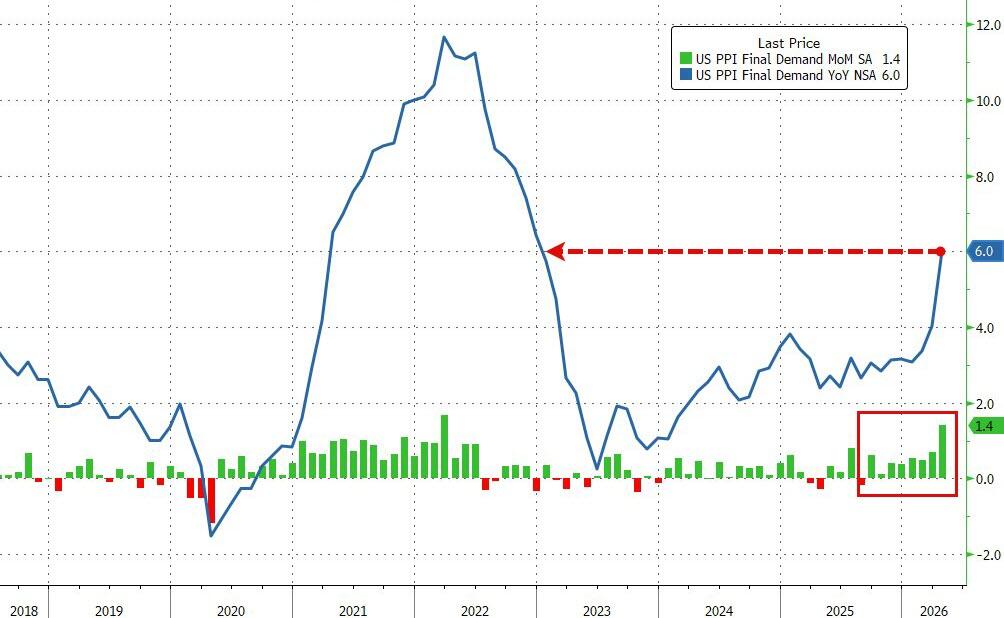
After yesterday’s hotter than expected CPI (driven in large part by Energy, but seeing some contagion into Services costs), this morning’s Producer Price print for April was expected to show a major surge in annual wholesale inflation.
With the eight straight monthly increase, PPI rose by a massive 1.4% MoM (vs +0.5% MoM exp) – the biggest MoM jump since March 2022, lifting PPI by a stunning 6.0% YoY (vs 4.8% YoY exp). That is the hottest PPI YoY since Dec 2022…
Source: Bloomberg
Services and Energy saw the biggest rise (while construction costs actually deflated very modestly)…
Core Producer Prices spiked 1.0% MoM (more than triple the +0.3% exp) smashing Core PPI YoY up 5.2% (also the hottest since Dec 2022)…
Source: Bloomberg
And finally, one could argue this is as bad as it gets for the energy component as oil prices have stabilized…
Source: Bloomberg
But of course, the pipeline of those energy costs is perhaps only just starting to trickle into the rest of the economy.
PPI triggered a spike in 2Y yields…
Now back above 4.00% at their highest since March with the market now pricing in a 50% chance of one rate-hike in 2026…
It appears any chance of Warsh cutting rates (as per Trump’s expectations) are off the table… for now.
Finally, there is perhaps a silver lining from this ugly PPI report. Other than airfares (which rose 3%) the components that feed through into PCE inflation were pretty tame; portfolio management fees dropped 2.4% and the various medical-care components showed a maximum rise of 0.3%.
That may mitigate the impact of the report, but it’s still hard to totally ignore the risk that inflation becomes a more pressing concern moving forward.