62.3 F
Chicago
Monday, September 21, 2026
Home Blog Page 511

“WE GOT HIM!”: Trump Says As 2nd Downed Pilot Recovered In High Risk Iran Special Forces Raid After ‘Dicey’ Firefight

“WE GOT HIM!”: Trump Says As 2nd Downed Pilot Recovered In High Risk Iran Special Forces Raid After ‘Dicey’ Firefight

Summary

  • Second downed pilot recovered after US Special Forces raid and firefight inside Iran.

  • Fire Breaks Out At Kuwait Oil Ministry Complex After Iran Drone Strike

  • President Trump reminds Iran of deal timeline, threatens “all hell will reign down” if time runs out.

  • Israel launched heavy strikes on Tehran, targeting Iranian air-defense and ballistic-missile sites, while a projectile also hit the perimeter of Iran’s Bushehr nuclear plant

  • The U.S. military continued search operations for an American airman who ejected after an F-15E fighter jet was shot down over Iran

*  *  *

US Special Forces Recover 2nd Downed Pilot

We have now witnessed an initial ‘boots on the ground’ moment as a high risk US special forces raid and aerial operation has recovered the second crew member from the downed F-15E jet, which was shot down in Iran on Saturday. US officials have confirmed that the downed pilot from the F-15E jet has been “recovered” in Iran following a “heavy firefight” – according to Al Jazeera, Axios, and others.

Per Axios: “The shootdown was a nightmare scenario for the U.S. military, with the Islamic Revolutionary Guard Corps (IRGC) also racing to locate the missing U.S. officer in southwest Iran over the past 36 hours. Both crew members were rescued in special forces operations inside Iran.”

The report continues, “One of the U.S. officials said Saturday’s operation was conducted by a specialized commando unit with a high volume of air cover, that the U.S. forces unleashed a hail of heavy fire, and that all of the forces were now out of Iran.”

Former Ranger/Special Forces veteran turned journalist Jack Murphy first broke the story late Saturday night. His investigative reporting on sensitive operations, particularly in Syria, has been previously featured by ZeroHedge. He writes:

Good news for once. F-15 WSO recovered alive. Was escaping and evading. Massive fire fight on tgt. Iranians were actively looking for him in the area.

He called the whole saga “dicey as hell” but says late into the night (US time) that all American forces are now out of harm’s way…

President Trump issued a statement on Truth Social: “WE GOT HIM!…”

More from Jack Murphy…

Intense Clashes Reported Between US and Iranian Forces Over Search And Rescue Of Downed F-15 Crew Member

There are intense clashes underway according to unconfirmed reports, between US and Iranian forces in Southwestern Iran, in the  Chaharmahal and Bakhtiari provinces, related to rescue operations for our downed F-15 crew member who contrary to multiple rumors, has not been extracted yet.

The video below shows fighting between USAF CSAR teams and IRGC Basij militants attempting to capture the second F-15E crew member.

According to unconfirmed reports, the IRGC has sent a special team to the region, and heavy clashes between them and the U.S. Army are ongoing.

Reports indicate that clashes continue in Kohgiluyeh and Boyer-Ahmad, with many IRGC forces present on the ground.  

According to subsequent reports, In the village of Shitab near Dehdasht, where rumors spread that the pilot had been seen, a large crowd gathered to capture him. According to reports, a U.S. A-10 fighter jet has been deployed to the area for support.

The U.S. Army has established a “fire zone” in the Dehdasht area inside Iran, around the location where the missing U.S. pilot was reportedly found alive. The U.S. is not allowing anyone to enter this area. US military search on the Kohgiluyeh and Boyer-Ahmad mountains continues

* * * 

Fire Breaks Out At Kuwait Oil Ministry Complex After Iran Drone Strike

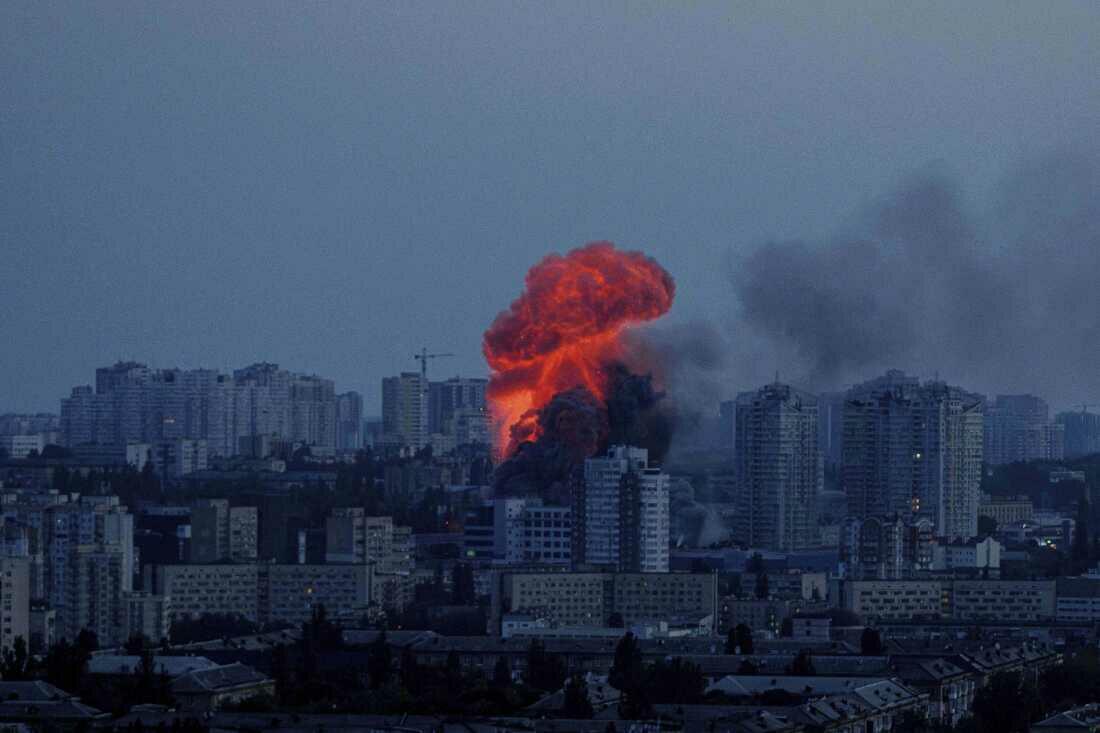
Kuwait’s Finance Ministry said an Iranian drone targeted the country’s Ministries Complex Saturday evening, causing significant material damage. No injuries were recorded and emergency teams are dealing with the incident, the ministry said in a statement. The complex, located in Kuwait City, is home to several ministries including the Finance Ministry, Industry and Commerce and the Justice Ministry. Employees of the complex will be working remotely Sunday, the statement said. A drone attack also caused a fire just a few miles away at the Shuwaikh oil sector complex in Kuwait City, officials said. Kuwait said it was intercepting waves of drones and missiles during the time of the attacks.

Additionally, according to Kuwait’s Ministry of Electricity, two Kuwaiti power and water desalination plants were attacked by Iranian drones, causing ‘significant damage.’

* * * 

President Trump Reminds Iran of Timeline, Threatens “All Hell Will Reign Down”

As the long weekend continues, President Trump has issued a statement on his social media feed, reminding Iranian negotiators of his timeline for a deal:

Remember when I gave Iran ten days to MAKE A DEAL or OPEN UP THE HORMUZ STRAIT.

And then the threat:

Time is running out 48 hours before all Hell will reign down on them.

Glory be to GOD! President DONALD J. TRUMP

The odds of ‘boots on the ground’ have soared to 83% by the end of the month:

It seems the stock market’s hope (diverging from oil’s surge) was misplaced…for now.

Search Operations Continue for Missing Airmen Continues

With U.S. and Israeli air-delivered munitions still striking targets across Iran, and Tehran retaliating by hitting high-value sites around the Gulf area, while continuing to disrupt the Strait of Hormuz, the conflict is now entering its sixth week with no credible signs of near-term de-escalation. Add in President Trump’s speech last week, which warned that intense targeting could continue for a few more weeks, and it’s a very fair assessment that the conflict will carry into next week, with momentum and escalation to the upside.

On Saturday, the U.S. military continued search operations for an American airman who ejected after an F-15E fighter jet was shot down over Iran, marking the first downed U.S. aircraft in the conflict. One crew member was rescued, but the second remained missing, with Iranian forces also racing to find the missing pilot.

The downed F-15 jet came shortly after a U.S. Black Hawk was hit by ground fire, and an A-10 Thunderbolt II reportedly crashed Friday near the Hormuz chokepoint. Friday was not a great day for U.S. aircraft as the conflict intensified.

C-17 Globemaster IIIs are on the move. 

Strikes Continue on Both Sides

In a rapidly escalating phase of the US-Israel war on Iran (now around day 36+ since late February strikes that targeted Iranian leadership and infrastructure), Tehran has intensified its retaliation while the US and Israel press air campaigns. Iranian missiles struck central Israel on Saturday, triggering widespread sirens and causing visible damage, including to residential areas and an industrial zone near Beersheba. Reports mentioned cluster bomb effects and shrapnel injuries, though Israeli defenses intercepted many projectiles.

At the same time, Israel launched heavy strikes on Tehran, targeting Iranian air-defense and ballistic-missile sites, while a projectile also hit the perimeter of Iran’s Bushehr nuclear plant, according to the semiofficial Iranian Tasnim news agency. The International Atomic Energy Agency said Iran had notified them about the incident.

Let’s not forget President Trump’s speech on Wednesday, in which he suggested the conflict could continue for weeks and insisted the missing airman would not alter efforts to negotiate an end to the conflict.

Iran launched a fresh missile barrage at central Israel, causing fires, damage in areas like Negev, Rosh Haayin, Bnei Brak, and reports of cluster munitions; minor injuries reported, with one man hurt in Bnei Brak.

An apparent Iranian drone damaged the Dubai headquarters of the U.S. tech giant Oracle on Saturday after Iranian forces threatened dozens of US firms. Iran has been targeting Gulf area data centers, and reports of a water desalination plant on Friday made headlines.

Latest headlines

(courtesy of Bloomberg):

US Military Losses

  • Iran shot down a US F-15E Strike Eagle fighter jet on Friday, with one crew member still missing and search-and-rescue operations ongoing [APW] [BN] [APW]

  • A second US combat plane reportedly crashed in the Persian Gulf the same day [BN] [APW]

  • Iran has called on the public to find the ‘enemy pilot’ and is promising a reward [APW]

  • Iran says it used a new air defence system to target the US fighter jet [NS1]

Iranian Attacks

  • Iran’s Revolutionary Guards targeted an Israel-linked ship, the MSC Ishyka, with a drone attack in the Strait of Hormuz, setting it on fire [NS8] [NS1]

  • Iranian cluster missiles hit central Israel with at least four impact sites and reports of vehicles on fire [NS8]

  • Missile fragments impacted near Tel Aviv after an Iranian missile barrage, with no casualties reported [JPT]

US-Israeli Strikes

  • US-Israeli strikes allegedly hit multiple areas in Iran on Saturday, targeting government-affiliated and industrial facilities including the Bushehr nuclear site [NS8]

  • More than 30 universities across Iran have been directly targeted by US-Israeli strikes since the war began in late February [NS8]

  • The US destroyed the B1 Bridge in Karaj on April 2 in two separate bombings, targeting what Iran describes as a civilian engineering project [NS8]

Diplomatic Efforts

  • Pakistan, Turkey, and Egypt are working to bring the US and Iran back to the negotiating table with a compromise framework focusing on ending hostilities and reopening the Strait of Hormuz [NS8]

Global Impact

  • The war has entered its sixth week with energy prices rising and little sign that Iran will back down or reopen the vital Strait of Hormuz [BN]

  • Senegal has banned all but essential foreign trips for government ministers due to cost-saving measures triggered by the energy crisis linked to the Iran war [APW]

  • Chinese firms with ties to the military are marketing detailed intelligence on US force movements as the war continues [WPT]

In commodity markets, the ongoing energy shock, with crude and LNG facilities across the Gulf area disrupted and the Hormuz chokepoint still clogged, prompted Goldman analyst Yulia Zhestkova Grigsby to ask on Friday evening: “Are We Running Out Of Oil?”

“As the last tankers that crossed the Strait of Hormuz before the war are reaching their destination, concerns about potential oil shortages are rising,” Grigsby told clients.

She said, “We analyze country-product-specific oil markets, identify pockets of potential extreme tightness, and discuss the potential evolution of near-term shortages if the Strait of Hormuz remains effectively closed for longer.”

“Our three-way analysis highlights already critically low supplies of petrochemical feedstocks — naphtha and LPG — in Asia, with cross-product scarcity in multiple Asian countries in April,” the analyst added.

To end the week, Brent futures and WTI futures both closed Friday in triple-digit territory as traders are becoming increasingly alarmed not just of the crude oil and LNG shortage spreading worldwide but also of petrochemical supply disruptions that are inbound that could affect plastics production, the core material that is bedrock for the modern economy.

Let’s remind readers of how the energy shock dominoes fall.  

JPMorgan analysts mapped out how the energy shockwave from the Iran war spreads across the world, hitting Asia first, then Africa and Europe, before settling on the US – primarily California.

Source

We’ll provide updates throughout the day as the situation in the Middle East is ongoing.

Tyler Durden
Sun, 04/05/2026 – 00:30

Ex-CIA Analyst: Trump’s Claim About Obliterated Iranian Air Defenses Was Premature

Ex-CIA Analyst: Trump’s Claim About Obliterated Iranian Air Defenses Was Premature

Authored by former CIA officer Larry Johnson

During his Wednesday night speech, Donald Trump made the following claim about Iran’s air defenses: “They have no anti-aircraft equipment, their radar’s 100% annihilated, we are unstoppable as a military force.”

The White House followed this Friday, with a statement from a spokesperson, Anna Kelley, who further emphasized, “Here are the facts: Iranian ballistic missile and drone attacks are down 90 percent, their navy is wiped out, two-thirds of their production facilities are damaged or destroyed, and the United States and Israel have overwhelming air dominance over Iran,” she said.

Photos widely circulating show destroyed US Boeing CH-47 Chinook helicopter at a base in Kuwait, which apparently took a direct hit Friday.

It appears that President Trump was a bit premature. The US Air Force had a difficult day on Friday:

F-15E (48th Fighter Wing) — Shot down in southwestern Iran. Pilot rescued; WSO still missing.

A-10C Thunderbolt II — Shot down and crashed into the Persian Gulf. Pilot reportedly recovered.

2X HH-60G Pave Hawk — Hit during CSAR mission, one crash-landed across the border in Iraq. All crew reportedly rescued.

KC-135R Stratotanker — Emergency squawk 7700 around 10:00 UTC near Tel Aviv.

F-16CJ “Wild Weasel” (F-16C Block 50/52, SEAD configuration) — Emergency squawk 7700 over Saudi Arabia near the Iraqi border around 15:00 UTC; later disappeared from FlightRadar.

KC-135R Stratotanker — Emergency squawk 7700 around 19:00 UTC near Tel Aviv.

It appears that Iran has no centralized air defense C2 or any kind of joint engagement zone (JEZ) anymore.

However, as evidenced by the incidents above, Iran appears to be relying on Vietnam-style guerrilla tactics of shoot-and-scoot air defense with their passive and highly tactical indigenous system… The IR-SA-7’s (pronounced “Ur-sah-seven”).

SA-7, Illustrative via Falcon Lounge

These Some are specially developed missiles that can loiter at altitude, almost like a glider, completely passive, that lie in wait for one of the US older generation fighters, tankers or other support aircraft to wander too close and then hone-in. While the US can claim “air supremacy” this does not mean that US aircraft can fly over Iran without incurring the risk of being shot down.

I wonder if the Russians are paying attention to Iran’s information operations? Iran is proving to be quite clever and creative in producing videos that take trolling to new heights.

Tyler Durden
Sat, 04/04/2026 – 23:55

Forget Temu’s “Bugatti” Knockoff. Texas Man 3D-Printed A Lamborghini Aventador Body

Forget Temu’s “Bugatti” Knockoff. Texas Man 3D-Printed A Lamborghini Aventador Body

Forget ordering a $30,000 “Bugatti” knockoff from Chinese e-commerce websites like Temu.

A private seller in Texas is now offering what appears to be a fully 3D-printed Lamborghini Aventador body on Facebook Marketplace, highlighting how 3D printing is revolutionizing custom vehicle manufacturing.

“This is a fully 3D-printed Lamborghini Aventador project that gives you a huge head start. It includes the complete body, front frame, rear frame, and monocoque already printed and sized to Aventador dimensions,” the listing stated.

The 3D-printed Aventador body is listed for $5,000. But the price jumps to $7,500 if buyers want the exterior and interior all glued together, or $8,500 if they want the frame pieces included in the gluing.

To complete the build, the seller says the body will still need to be reinforced with fiberglass, mounted to a steel frame, and fitted with a drivetrain, suspension, and interior (view listing here). 

Automotive website Jalopnik was the first to report the listing, offering its take:

I may have some ideas about 3D print strength that friends of mine call “overly conservative” or “downright anxious,” but I still don’t think I’d trust a car with a tub that’s been glued together out of various 3D prints. The seller doesn’t even specify what kind of plastic they’re using. ABS is an option, but ever-popular PLA filament will degrade under the kind of constant UV exposure that a car sees.

Well, this certainly beats the “Bugatti” knockoff from Temu.

*  *  * Order by midnight! Now with cheaper shipping

Tyler Durden
Sat, 04/04/2026 – 23:20

The Tyranny Of Compelled Speech

The Tyranny Of Compelled Speech

Authored by George Ramsay via The Epoch Times (emphasis ours),

While censorship is often the main focus of discussions about free speech, there’s a related phenomenon that can do just as much damage to a free society. Not by preventing people from saying things they believe in, but by forcing them to say things they do not.

A scoreboard shows a message declaring an indigenous land acknowledgement before an NHL hockey game between the Montreal Canadiens and the San Jose Sharks in Montreal on Oct. 19, 2021. The Canadian Press/Ryan Remior

Compelled speech requires people to use certain words or phrases, or to partake in upholding certain ideological beliefs. It is just as dangerous to free expression as overt censorship.

The constant recitation of indigenous “land acknowledgements” illustrates Canada’s shift towards enforced mass-compliance on complicated social issues. These statements have become ubiquitous in Canadian public life: at schools, workplaces, government functions, ceremonies, and sporting events. Institutions display them on websites, documents, email signatures, and social media. A busy person in Canada may come across dozens of land acknowledgements per day in various contexts.

Although framed as optional gestures of respect, many organizations now have policies mandating land acknowledgements; in other circumstances, social pressure can make them seem obligatory even if they’re not.

Land acknowledgements have morphed well beyond a simple sharing of history into something much more problematic: they have become a sort of sacred ritual with near-spiritual implications, tying certain ethnic groups to ownership over nature itself. When unpacked, there is a lot being said between the lines.

Stepping out of line on land acknowledgements can set off a variety of hostile reactions, ranging from social condemnation to significant legal consequences. Geoffrey Horsman is a biochemistry professor at Wilfrid Laurier University in Waterloo, Ont. As a parent of three children in the local school system and a member of his local school’s parent council, he noted the growing politicization of the regional school system. Of particular concern was the practice of opening every meeting with a land acknowledgement, which took up valuable time and reinforced what he considers a divisive premise.

I don’t think there is anything good that can come out of the idea that a certain ethnic group are the true inheritors of this land,” Horsman said in an interview. But when he raised his objections about the practice, he encountered immediate resistance. In a series of meetings with Waterloo Region District School Board staff, he was told that even discussing the issue was off the table. He has since brought a legal case against the board.

Catherine Kronas, the mother of a student attending Ancaster High Secondary School in Hamilton, Ont., actually lost her position as an elected member of her school council last year after she politely disagreed with land statements being read out loud before meetings. “School councils should decide what gets said in their meetings, and we shouldn’t have to recite something mandated by the government,” she told me. Kronas was reinstated only after threatening legal action.

Horsman’s and Kronas’s cases are both about indigenous land acknowledgements, but the issues they raise run deeper. They could have been challenging any form of imposed ideological speech. In fact, many Canadian governments and institutions are developing a worrying track record of legally enforcing ideological language on a number of topics.

The B.C. Human Rights Tribunal, for example, recently levied an astonishing $750,000 fine against Barry Neufeld, a former school board trustee, after he was critical of the integration and facilitation of transgenderism within public education. Neufeld says he will appeal the fine, which clearly aims to punish him financially for expressing his lack of belief in what the tribunal seems to think is an unquestionable truth.

Compelled speech, or compelled support for any position, quells discourse and creates a type of moral injury. Whether you support the notion of land acknowledgements or not, there is a contradiction at the core of the concept: how can words be respectful if they are coerced?

Most Canadians consider themselves polite, kind, and caring, a usually laudable set of characteristics that has lately been weaponized. How might we begin to move on from the current cultural climate of tension and towards a freer and more relaxed Canada?

Retired Manitoba judge Brian Giesbrecht has some suggestions. In an interview, Giesbrecht agrees that today’s land acknowledgements “create a divisive form of belief in which some people only have rights as ‘settlers.’” To shift this situation, he offers a list of possible ways Canadians can object to compelled speech. His list includes making a written complaint, standing up and objecting in public, walking out of a meeting, and using legal channels to challenge attempted ideological coercion.

The future of a prosperous, functional, united Canada depends on being able to say what you believe and having the freedom to remain silent when you do not. This Canada can and must be restored. Next time you encounter a belief you do not feel eager to participate in, consider abstaining or politely pushing back. If we all resist these pressures, it will no longer be an act of bravery to conduct oneself genuinely and truthfully.

George Ramsay is a recent kinesiology graduate from Victoria, British Columbia. This is an edited version of his grand-prize-winning entry in the 3rd Annual Patricia Trottier and Gwyn Morgan Student Essay Contest first published by C2C Journal.

Views expressed in this article are opinions of the author and do not necessarily reflect the views of The Epoch Times or ZeroHedge.

Tyler Durden
Sat, 04/04/2026 – 22:45

GOP Senator Opposes More Than 60 Days Of War On Iran Without War Declaration

GOP Senator Opposes More Than 60 Days Of War On Iran Without War Declaration

In what could become a key milestone in an unpopular US-Israeli war on Iran that has the world on the edge of economic catastrophe, a Republican senator from one America’s reddest states has announced his opposition to continued action against Iran beyond 60 days from the Feb 28 commencement of hostilities — unless Congress approves it. 

“I support the president’s actions taken in defense of American lives and interests,” wrote first-term Sen. John Curtis in an opinion piece published by the Desert News. “However, I will not support ongoing military action beyond a 60-day window without congressional approval.” 

Walking a careful and arguably untenable line as he represents a reliably red state that Trump won by 22 points in 2024, Curtis gave full backing to Trump’s unilateral commitment of US forces to war in concert with the State of Israel. Curtis goes so far as to declare that “Iran’s consistent and increasingly disruptive behavior presents exactly the kind of threat the War Powers Resolution envisions.” 

Note, he didn’t refer — as some others have — to an impending retaliation against US forces in the region if Israel had acted alone (an argument that itself ignores America’s theoretical power to order Israel to stand down). Instead, Curtis argued that Iran’s decades of actions in the region somehow cleared the War Powers Resolution’s hurdle of “a national emergency created by attack upon the United States, its territories or possessions, or its armed forces.” 

Curtis argues, however, that the Constitution clearly assigns responsibility for authorizing sustained war to the Congress:

“The Constitution assigns Congress the responsibility to “provide for the common defense,” and in that context, it gives Congress the corresponding power to declare war. It would be an act of disrespect to our Constitution if we were to accord the president the right to make war without any declaration of war; the Framers deliberately described a substantive power to declare war and assigned that power to Congress.”  

In addition to justifying his position the need for post-60-days congressional approval on constitutional grounds, Curtis also pointed to the grim history of the US war in Vietnam, emphasizing that what began in 1950 with the dispatching of just “thirty-five men” to assist the French in training Vietnamese troops would evolve into a peak of more than a half-million American soldiers in the country, with nearly 60,000 dying in an undeclared war. 

Curtis didn’t say whether he would vote to declare war on Iran, focusing instead on his opposition to “funding for continued military operations without Congress having the opportunity to weigh in.” There have already been several attempts to block further military action without congressional approval — all of them have been thwarted. To this point, only a few Republicans have backed these war-power resolutions: Kentucky Sen. Rand Paul joined Democrats in supporting a Senate measure, while Kentucky Rep Thomas Massie introduced one in the House, and was joined by Ohio Rep. Warren Davidson, who is a former Army Ranger.  

Way back on March 5, House Speaker Mike Johnson said such resolutions “play right into the hands of the enemy.” He also claimed “we are not at war. We have no intention of being at war. This is a limited operation.” That “not a war” argument is belied not only by a common-sense assessment of whether a massive bombing campaign on a foreign state constitutes “war,” but also by repeated characterizations of the United States being in a state of war by President Trump, Defense Secretary Pete Hegseth and others in the administration. 

There are other cracks in the GOP’s support for the war. On March 19, Colorado Rep. Lauren Boebert recoiled at the Pentagon’s wish for a $200 billion supplemental funding to pay for the war on Iran. 

“I’ve already told leadership, ‘I am a no on any war supplementals. I am so tired of spending money elsewhere. I am tired of the industrial war complex getting all of our hard-earned tax dollars. I have folks in Colorado who can’t afford to live…We need America First policies now, and that –– I’m not doing that.” 

At the time, Boebert said it was “up to the president” whether the war with Iran should stop. Increasingly, it looks like it’s up to Ayatollah Khamenei. 

Tyler Durden
Sat, 04/04/2026 – 22:10

Iran Allows Iraqi Ships To Use Strait Of Hormuz As Total Weekly Transits Reach Highest Since War Began

Iran Allows Iraqi Ships To Use Strait Of Hormuz As Total Weekly Transits Reach Highest Since War Began

Over the past two weeks we have been chronicling the increased rate of crossing across the “blockaded” strait of Hormuz as a growing number of ships from friendly nations – whether untolled Chinese tankers or toll-paying Indian, Japanese and Korean vessels – have been making the passage. And as traffic through the Hormuz strait has been picking up in the past week, the seven-day rolling average for transits on Friday reached the highest since the war started, according to Bloomberg.

More vessels are crossing, including those with no clear links to Iran or China, as nations negotiate with Tehran to get their ships through. Transits over the past day were led by liquefied petroleum gas carriers, including one headed to India and others with Iranian affiliations.

Per Bloomberg calculations, a total of 13 ships have crossed since Friday morning, with 10 exiting the Persian Gulf and three entering from the open seas, according to vessel-tracking data compiled by Bloomberg. To be sure, that’s still a trickle compared with the numbers before the war began on Feb. 28: in normal times, about a fifth of the world’s oil and liquefied natural gas passes through the strait every day.

Recent crossings included a French container ship and a Japanese-owned LNG tanker, seemingly the first such transits since the war began. It’s not clear whether those journeys were a result of diplomatic outreach or negotiations by shipping companies and their intermediaries.

Outbound traffic included five bulk carriers and one oil-product tanker joined the four LPG tankers in exiting the Persian Gulf since Friday morning. Three of the bulkers and the fuel tanker sailed on Saturday morning. Apart from the Indian LPG vessel, the others are linked to Chinese or Iranian interests.

On the inbound side, two LPG carriers and one fuel tanker with Iranian affiliations were among the inbound transits recorded since Friday morning.

But while traffic is slowly but surely rising, a potential gamechanger for energy flows and oli supplies through Hormuz was unveiled today when the Iranian military said major oil producer Iraq is exempt from shipping restrictions in the Strait of Hormuz.

“Brotherly Iraq is exempt from any restrictions we have imposed on the Strait of Hormuz,” Iran’s military spokesman said in an Arabic-language video statement published by state-run Islamic Republic News Agency.

The restrictions are imposed only on “enemy countries,” said Ebrahim Zolfaghari, a spokesman for Iran’s Khatam al-Anbiya Central Headquarters. Iran’s control of the strait has become its biggest leverage in the conflict.

The declaration has the potential to unleash as much as 3 million barrels a day of Iraqi oil cargoes. An Iraqi official, however, cautioned that the usefulness of the exemption will depend on whether shipping companies are willing to risk entering the strait to collect cargoes.

Source: Commodity Context

It’s not immediately clear if the exemption will apply to all Iraqi oil or just the nation’s tankers, or indeed how it will be enforced.

Separately, officials in Iran’s Khuzestan province said the Shalamcheh international border crossing with Iraq has reopened after a brief closure. Lofteh Derokvandi, deputy governor of Khuzestan and special governor of Khorramshahr, told Iran’s state news agency IRNA that crossings had resumed for pilgrims and traders, with commercial activity continuing without disruption.

Tyler Durden
Sat, 04/04/2026 – 21:57

In Charts: US Does Not Rely On Strait Of Hormuz Oil While Asia Stands To Lose

In Charts: US Does Not Rely On Strait Of Hormuz Oil While Asia Stands To Lose

Authored by Sylvia Xu via The Epoch Times (emphasis ours),

The Strait of Hormuz has been called the jugular vein of the world’s oil supply, and as Operation Epic Fury continues, Iran continues to have a chokehold on the critical supply route.

About one-fifth of the world’s oil and gas is typically shipped through the narrow waterway connecting the Persian Gulf to the Arabian Sea.

But Iran’s attacks on commercial vessels have brought traffic through the strait to a virtual standstill since the start of the conflict on Feb. 28.

In March, just 220 vessels transited the strait, according to data from maritime analytics platform Marine Traffic. Prior to the war, thousands of ships traversed the waterway each month.

These actions have caused oil and gas prices to surge. Brent, a global benchmark for oil prices, has risen firmly above $100 a barrel overseas. The average gas price in the United States has surged past $4 per gallon.

President Donald Trump has threatened to launch strikes on Iran’s oil wells, power plants, and critical oil infrastructure on Kharg Island unless the strait is reopened. He delayed the strikes on Iranian energy infrastructure until April 6, pending talks with the regime.

Here’s a look at how much oil travels through the Strait of Hormuz and where it goes.

An average of 20 million barrels of oil and refined products flowed through the narrow gateway between the Arabian Peninsula and Iran each day in 2025. That’s roughly 25 percent of the world’s sea-borne oil trade, according to a February analysis from the International Energy Agency.

The strait is only 21 miles wide at its narrowest point, with shipping lanes just two miles wide in each direction.

The vast majority of crude oil and condensate—a natural gas byproduct—went to Asia (91 percent), according to a U.S. Energy Information Administration analysis based on Vortexa tanker-tracking data from the first half of 2025.

Of those Asian nations, China and India absorbed about half of the crude moving through the strait—37 percent and 14 percent, respectively—followed by Japan and South Korea at 12 percent each. Sixteen percent went to other countries in Asia and Oceania.

An Indian-flagged tanker carrying liquefied petroleum gas that transited the Strait of Hormuz amid the Iran war remains docked at an offloading terminal in Mumbai, India, on April 1, 2026. The strait is a key global shipping route through which about one-fifth of the world’s oil and gas passes. Punit Paranjpe/AFP via Getty Images

The United States and Europe remained marginal buyers, receiving just 3 percent and 4 percent, respectively.

Roughly three-quarters of crude oil travel by tanker ship through the strait came from Saudi Arabia (38 percent), Iraq (22 percent), and the United Arab Emirates (14 percent). Iran shipped just 11 percent.

Crude Oil Exports Transiting the Strait of Hormuz, 2025

Additionally, the strait accounts for nearly 20 percent of the global liquefied natural gas trade. Qatar, the world’s largest gas exporter after the United States, represents 93 percent of that volume.

In 2025, Asia received almost 90 percent of the liquefied natural gas flowing through the strait. Europe received just over 10 percent.

Of Asian countries, Bangladesh, India, and Pakistan sourced almost two-thirds of their total liquefied natural gas supplies via the Strait of Hormuz last year.

A police speedboat patrols the port as oil tankers and high-speed craft sit anchored near the Strait of Hormuz in Muscat, Oman, on March 30, 2026. Iran’s attacks on commercial vessels have disrupted traffic along the vital waterway, which previously carried about 25 percent of the world’s seaborne oil trade, according to the International Energy Agency. Elke Scholiers/Getty Images

Dependency on Gulf Nations

Japan (57 percent), South Korea (55 percent), and India (50 percent) relied on the Gulf nations for at least half of their oil and gas imports in 2024. China sourced roughly 35 percent of its supplies from the region.

Additionally, Taiwan imported 40 percent of its oil and gas from the region in 2024, while Pakistan sourced more than 81 percent of its oil and gas imports from the Gulf area.

Some African countries, such as Mauritania (76 percent), Uganda (61 percent), and Kenya (55 percent), relied on the Gulf for more than half of their fuel.

Meanwhile, nearly 96 percent of Iranian oil and gas exports through the route in 2024 were designated for one destination: Pakistan.

In Europe, roughly one-third of the energy imports for Greece (35 percent), Lithuania (32 percent), and Poland (30 percent) originated from Gulf countries.

North American reliance on Gulf energy remains minimal, however. The United States received 10 percent of its imports from Gulf nations, and Canada received 5 percent.

Commuters ride past an oil tanker along a street in Islamabad on March 28, 2026. Brent crude, the global oil benchmark, has risen above $100 per barrel, while gasoline prices have climbed above $4 per gallon. Farooq Naeem/AFP via Getty Images

While regional producers have sought alternatives to the Strait of Hormuz, these options have struggled to serve as adequate replacements.

Saudi Arabia, for example, maintains an east-west pipeline that can move approximately 5 million barrels of oil a day to the Red Sea. However, the Abqaiq–Yanbu pipeline system has a maximum capacity of 7 million barrels. This terminal is already heavily used and cannot replace the strait.

The United Arab Emirates has an oil pipeline that bypasses the strait—the Abu Dhabi Crude Oil Pipeline—but it has a capacity of only 1.5 million barrels per day.

As for Qatar’s liquefied natural gas, there is no alternative route.

The strait is effectively a single point of failure for Gulf exporters, as no alternative pipeline routes can replace the volumes that move by sea.

Tyler Durden
Sat, 04/04/2026 – 21:35

Library Director Fired After Refusing To Remove Hundreds Of LGBT Books From Kids’ Section

Library Director Fired After Refusing To Remove Hundreds Of LGBT Books From Kids’ Section

When are these people going to learn to just leave the kids alone?

A Tennessee library board has voted 8-3 to remove its top librarian, Luanne James, after she refused to carry out an order to relocate hundreds of LGBT-themed books, Critical Race Theory (CRT) and feminist propaganda books from the children’s section of six Rutherford County branch libraries.

James was initially ordered to relocate books containing far-left ideology from the juvenile/children’s sections to the adult sections of libraries.  The board cited concerns that the books promoted “gender confusion,” contained LGBT themes/characters, sexual themes, feminist topics, DEI, social justice and related content.

The decision stemmed from a broader state review of thousands of materials prompted by a Tennessee Secretary of State letter and federal guidance on gender-related content. 

Actions within red states to transfer woke propaganda out of children’s spaces in school libraries and public libraries accelerated after viral complaints by parents who have read some of the horrific selections out loud at board meetings across the country.  Activist librarians have become a plague, disregarding the age and innocence of the children involved for the sake of a cult-like political ideology. 

Beyond the overtly sexualized selections being planted in kids libraries across the US, there are numerous books teaching gender fluid theories with no foundation in scientific evidence, as well as books promoting critical race theory which twists history to fit the far-left narrative of “systemic racism”. 

Luanne James had argued during the Rutherford Board hearing that moving the books to adult sections would violate First Amendment protections and go against her professional responsibility.  Keep in mind, these books were not censored or thrown out by the Rutherford Board; children are simply required to ask their parents for permission to borrow them from the adult section of the library.  This is not a violation of the First Amendment.

Parental rights supersede children’s access to content.  Legally and morally, James and library directors like her are simply in the wrong, but they know this. 

“I stand by my decision and I will not change my mind,” James said during the meeting.  After the vote, her attorney read a statement on her behalf calling the firing unlawful.  “Librarians should not be used as a filter for political agendas,” the statement said. “I stood up for the right to read, standing for the citizens of Rutherford County.”   

Ironically, leftists tend to wrap themselves in the constitution when they are challenged on giving children politically charged propaganda to read.  But when parents read these materials out loud in board meetings, those same leftists have them silenced and removed from the proceedings. 

The woke left survives by hiding within legal loopholes, double standards and blatant hypocrisy.  They thrive by targeting the easily manipulated minds of children and teens for early indoctrination.  It is becoming clear that many people working within the public education system are only there to carry out this agenda.  Their priority is not the children, their priority is the proliferation of “the message”.     

Tyler Durden
Sat, 04/04/2026 – 21:00

The Demise Of Trial By Jury

The Demise Of Trial By Jury

Authored by Celina via American Greatness,

Justice isn’t blind anymore: Multiculturalism has made impartial justice impossible

“Law grows with the growth, and strengthens with the strength of the people, and finally dies away as the nation loses its nationality.”
— Friedrich Carl von Savigny

Photo: Wyandanch, N.Y.: As the jury foreperson read the verdict of “not guilty” in the Los Angeles courtroom, women at Straight Path Beauty Supply in Wyandanch, New York react expressively on October 3, 1995. (Photo by Dick Kraus/Newsday RM via Getty Images)

On Tuesday, October 3, 1995, the verdict in the O. J. Simpson criminal trial was broadcast live across the globe, a truly defining moment of the late twentieth century. In the now-iconic split-screen imagery, as the words “not guilty” reverberated through the Los Angeles courtroom, black spectators erupted in celebration and applause, raising their fists in jubilation. Conversely, white spectators sat frozen in stunned, horrified silence, grappling with an incomprehensible subversion of the evidentiary record. The stunning juxtaposition of the visual perfectly captured the fracture of a society devoid of a shared moral consensus.

Students at Augustana College react to the verdict of O. J. Simpson’s murder trial, October 3, 1995. A man got away with a murder that everyone knew he committed, and half the room is happy because of his race.

This was obviously not an exercise in blind justice; it was an exercise in racial grievance. Decades later, juror Carrie Bess admitted with chilling indifference in a 2016 documentary that 90 percent of the predominantly black jury knew Simpson was guilty, but voted to acquit him purely as “payback” for the Rodney King incident. When asked if she believed that decision was right, she merely shrugged.

This historic moment illuminates how, in multiracial societies, jury verdicts can trigger visibly racialized reactions rather than a shared acceptance of blind justice. When the fundamental demographic and cultural realities of a nation shift, the institutions built upon its original foundations buckle. This phenomenon is not isolated to the United States. Pivoting into the British context, the exact same dynamics now threaten the ancient English jury system, eroding the foundational pillars of common law.

This institutional decay must be understood as part of a broader civilizational shift away from participatory, community-rooted institutions toward centralized legal authority. Trial by jury, the sacred “little parliament” that Englishmen fought and died for since Magna Carta, is being dismantled because, in a multiracial society flooded by non-Western demographics, it no longer delivers blind justice. It delivers ethnic loyalty.

Nonwhite jurors display clear ethnocentric bias against white defendants and in favor of their own. The data is undeniable. The elites know it. That is why they are quietly abolishing peremptory challenges, gutting jury trials, and now planning to scrap them for almost everything except murder and rape. Demography is destiny, and if the English, Americans, or Australians become a minority in their own courtrooms, there will be no justice left.

The Jury as an “Ancient Right”

Originating from the legal codifications following Magna Carta in 1215, the English jury evolved from a body of local witnesses into an independent arbiter of fact, serving as the ultimate safeguard against the arbitrary power of the sovereign. By the twentieth century, the jury was entrenched in the Anglo-American legal consciousness as a deeply democratic institution that bound the citizenry to the state. In his seminal 1956 Hamlyn Lectures, Lord Devlin famously described the jury as the “little parliament,” noting that it was the “lamp that shows that freedom lives.”

The jury functioned as a localized check on state power, granting the common citizen the authority to temper the rigid application of the law with communal common sense. The historical power of jury nullification, whereby a jury refuses to convict a defendant despite overwhelming evidence of guilt, was historically celebrated as a triumph against state overreach. Cases such as the 1735 trial of John Peter Zenger, who was acquitted of seditious libel against the Royal Governor of New York, cemented the jury’s role as a bulwark of liberty. The jury possessed the ultimate veto, ensuring that the laws enacted by the sovereign could only be enforced if they aligned with the moral intuitions of the populace.

As detailed in the University College London (UCL) academic paper, “Decline of the ‘Little Parliament’: Juries and Jury Reform in England and Wales” by Sally Lloyd-Bostock and Cheryl Thomas, the jury was vigorously defended as an ancient right and a bastion of liberty, a mechanism whereby the ordinary person’s moral compass could inform legal decisions and contain the powers of government.

Yet the foundational prerequisite for this system, a homogeneous society bound by common ethical standards, trust, and a shared cultural inheritance, has been progressively dissolved. The concept of being tried by a jury of one’s “peers” historically implied a trial by individuals who shared the same linguistic, religious, ethnic, and moral baseline as the accused and the broader society.

When a society is fractured along ethnic and cultural lines, the jury ceases to be a microcosm of a unified nation. Instead, it becomes a contested battleground for competing tribal loyalties. Historical nullification, which used to be a noble tool against state tyranny, has mutated into ethnic nullification, where jurors refuse to convict members of their own in-group regardless of the evidence. This weaponization of an ancient right paralyzes the state’s ability to maintain basic order and shatters the epistemic foundation of the legal system.

The Modern Retreat from Jury Trials

Faced with the undeniable reality that juries in multiracial, fragmented societies cannot be trusted to deliver blind justice, the political and legal elites have chosen to quietly execute the institution rather than address the demographic root cause. This trajectory has culminated in contemporary U.K. reforms that represent a significant shift in the architecture of the legal system.

The latest breaking U.K. government news confirms this terminal retreat. In March 2026, Justice Secretary David Lammy formally announced the most significant contraction of the criminal justice system in 800 years. Under the newly outlined proposals, jury trials are about to be scrapped for almost everything. Only defendants accused of murder, rape, manslaughter, and a handful of select “public interest” cases will retain the right to be judged by their peers. The vast majority of criminal cases, offenses carrying a likely sentence of three years or less, which encompass grievous bodily harm, complex frauds, severe assaults, and robberies, will be diverted to a new tier of “swift courts.” In these newly established tribunals, a lone judge will act as both the arbiter of fact and the dispatcher of sentence, entirely bypassing the citizenry.

Justice Secretary David Lammy

The government’s official justification for this draconian measure relies heavily on managerial rhetoric: reducing the record-breaking backlog of more than 78,000 Crown Court cases, cutting costs, and streamlining complexity. Drawing on the independent review of the criminal courts by Sir Brian Leveson, Lammy warned of a “court’s emergency” and asserted that eliminating the jury saves approximately 20 percent of a trial’s time, thereby ensuring greater efficiency and sparing victims the anguish of delay.

However, these technocratic excuses mask a more significant truth. The backlog is only a convenient pretext for a structural overhaul that the state has been maneuvering toward for decades. The abolition of the jury for the vast majority of crimes is the final admission that the multicultural jury experiment has failed catastrophically. The state can no longer rely on twelve randomly selected residents of modern London, Birmingham, or Manchester to share a common standard of truth, nor can it trust them not to fracture along ethnic lines. Consequently, the state is removing the public from the equation entirely. This represents a deep shift from participatory justice to managerial governance, wherein the state seeks to insulate its legal machinery from the volatile, tribal realities of the very society it has engineered.

The Problem of Impartiality in Mass Democracies

To understand why the state is terrified of its own citizens in the jury box, one must engage analytically with the overwhelming empirical evidence demonstrating the collapse of impartiality in diverse democracies. The tension between group identity and individual objectivity is mapped, quantified, and undeniable.

The baseline for this tribalism is clearly illustrated in the “How racial groups rate each other” chart from the 2021 American National Election Studies (ANES).

The data is visually structured as a four-panel grid, with each panel dedicated to the thermometer ratings provided by a specific respondent demographic: white, black, Hispanic, and Asian. While the chart clearly demonstrates universal in-group favoritism, a closer inspection reveals that the intensity and structure of this bias vary significantly across groups.

Black respondents, for instance, exhibit the most pronounced divergence, with their ratings of fellow blacks clustered at the extreme upper end of the scale, while their evaluations of whites, Hispanics, and Asians fall off sharply, producing the widest in-group/out-group gap in the dataset. By contrast, white respondents display a comparatively flattened distribution, with only a modest preference for their own group and relatively similar warmth ratings across all others. Hispanic and Asian respondents occupy an intermediate position, still favoring their own group but also revealing a discernible hierarchy in their evaluations of out-groups, suggesting that these preferences are not only binary but ordered along lines of perceived proximity or affinity. This pervasive, quantifiable tribalism forms the psychological substrate that jurors inevitably bring into the deliberation room.

When this baseline tribalism intersects with the criminal justice system, the results are catastrophic for the concept of blind justice. The Mitchell, Haw, Pfeifer, and Meissner (2005) meta-analytic table, titled “Moderator Analysis for Verdict Decisions” (Racial Bias in Sentencing Judgments), provides definitive proof.

The table tracks the effect size (d) of racial bias, where a positive number indicates a tendency to render harsher judgments against out-group defendants and more lenient judgments for in-group defendants. The data shows that black jurors exhibit a moderate, statistically significant in-group bias effect size of d = 0.428. In sharp contrast, white jurors demonstrate a negligible, statistically non-significant effect size of d = 0.028.

This immense disparity highlights that the ethnocentric bias is more than 15 times stronger for black jurors than for white jurors. This data shatters the prevailing media narrative that the legal system is plagued primarily by white racism. Instead, it proves that nonwhite jurors actively discriminate in favor of their own group, refusing to evaluate out-group defendants with the same leniency.

This dynamic is further corroborated by the U.S. pardoning-decisions bar chart titled “Black Americans and White Democrats Favor Black Criminals in Pardoning Decisions.”

The chart maps the average marginal effect on a 0-100 pardon support scale when the perpetrator is white versus black. The negative marginal effects vividly illustrate racial solidarity: white Democrats display a negative marginal effect of −7 to −8, indicating less support for pardoning white perpetrators compared to black ones. Black Democrats register a massive penalty of −12, and black Republicans also register at −12, indicating a severe, cross-partisan racial solidarity among black respondents in favor of black criminals. Meanwhile, white Republicans hover near zero (n.s.), showing no statistically significant racial preference.

The United Kingdom is not immune to these exact same forces. Research by Cheryl Thomas at UCL provides what can only be described as the smoking gun of ethnic jury nullification.

Displayed as a comparative bar chart titled “Juror Guilty Votes by Defendant and Juror Race (United Kingdom),” the graph contrasts the voting patterns of white jurors against black and minority ethnic (BME) jurors. White jurors voted to find white defendants guilty 39 percent of the time, and BME defendants guilty 32 percent of the time, demonstrating modest fairness and even a slight leniency toward minorities. However, the right side of the chart reveals a terrifying inversion: BME jurors voted to find white defendants guilty a staggering 73 percent of the time, but voted to convict BME defendants only 24 percent of the time.

This chart is the empirical death knell for the multicultural jury. It proves unequivocally that nonwhite jurors display overt levels of in-group bias and clear ethnocentric hostility toward white defendants. When jurors view the defendant box not as a space occupied by a tribal enemy or ally, the “little parliament” ceases to dispense justice. It dispenses ethnic warfare. The tension between group identity and individual impartiality cannot be resolved by mixed tribunals; it can only be suppressed by removing the public entirely and deferring to a judge-only system, which is precisely the trajectory the United Kingdom is now enforcing.

Yet, even removing the jury does not necessarily resolve the problem of impartiality. Judges, like all individuals, are not immune to social, cultural, or ideological influences. Many judges operate within broadly liberal legal frameworks, which can shape interpretive tendencies in ways that are not always neutral.

I explore this notion in greater detail in my article “They’re Not Left-Wing, They’re Anti-White,” where I examine the consequences of ideological bias.

The Decline of the “Common Culture”

The presumption that twelve randomly selected citizens can seamlessly converge upon a shared understanding of truth, duty, and justice is a uniquely Western inheritance. It presupposed a shared language, parallel moral intuitions, and a transcendent identity. The critical civilizational question now facing the United Kingdom, America, and the rest of the Western world is whether institutions built on the bedrock of cultural cohesion can survive once that cohesion has been deliberately dissolved.

The answer was forcefully articulated decades ago by Lee Kuan Yew, the founding father of Singapore. Trained as a lawyer at Cambridge, Lee initially absorbed the Anglo-American legal traditions. However, his firsthand experiences in the rapidly diversifying, post-colonial landscape of Singapore shattered any illusions about the universality of the jury system. The catalyst was the 1950 Maria Hertogh riots. The case involved a custody dispute over a Dutch-Eurasian girl, Maria, who was raised by a Malay Muslim foster mother, Che Aminah, during World War II. When a British colonial court in Singapore ordered the girl returned to her biological Dutch Catholic parents, the verdict was perceived as a tribal insult to Islam. The ensuing riots left 18 people dead and 173 injured, exposing the lethal volatility of imposing Western legal paradigms on a multireligious, multiracial populace.

Lee Kuan Yew learned from this bloodshed. As a young advocate, he later defended four Muslim men accused of murdering a British Royal Air Force officer, his wife, and his child during the riots. By his own admission in a 1977 BBC interview, Lee ruthlessly exploited the ethnic and religious allegiances of the jury, playing on their reluctance to convict their co-religionists of killing a white colonial officer in cold blood.i He secured an acquittal that left the judge disgusted and Lee himself feeling “quite sick.”ii He realized that justice was impossible when tribalism overrode the facts. Consequently, in 1969, Lee’s government completely abolished the jury system in Singapore.

His full verdict on multiracial jury trials remains a significant, black-and-white image of unvarnished truth: “In a multiracial society, trial by jury can result in communal prejudices influencing verdicts. . . . You cannot assume that each juror will set aside his race, language, and religion.” Expanding on this in his memoirs From Third World to First and in his BBC interview reflections, Lee positioned himself as the wise Asian statesman who saw clearly what Britain’s elites stubbornly refuse to admit: the Anglo-Saxon tradition of trial by jury only works for Anglo-Saxons or those thoroughly assimilated into their cultural inheritance. It fundamentally fails in a fragmented, non-Western demographic landscape because communal allegiances inevitably corrupt the scales of justice. A shared identity is the invisible scaffolding of the courtroom; without it, the edifice collapses.

Case Studies

For centuries, the defense held the right to dismiss potential jurors without cause, an essential tool for ensuring a fair trial. However, as the United Kingdom’s demographics began to shift in the twentieth century, ethnic-minority defense lawyers began weaponizing peremptory challenges to purge white jurors and architect racially stacked juries sympathetic to nonwhite defendants. The UCL paper by Lloyd-Bostock and Thomas maps this systemic erosion: the number of peremptory challenges was reduced to 12 in 1925, restricted to seven in 1949, slashed to three in 1977, and suffered total abolition by the Criminal Justice Act of 1988.

The tipping point was a notorious 1977 case in Thornton Heath, where a group of black youths was acquitted of serious charges after the defense cynically stacked the jury to ensure a sympathetic, ethnic-minority composition. As the UCL paper shows, the defense “privately agreed to exercise their peremptory challenges to ensure” a specific demographic makeup, resulting in acquittals that fueled the campaign for total abolition. The elites recognized that ethnic-minority lawyers were exploiting the rules to engineer acquittals, and rather than admit that diversity had compromised the system, they quietly revoked an ancient legal right from all citizens.

In the United States, ethnic jury nullification has repeatedly paralyzed the justice system. The Ethan Liming slaying in Akron, Ohio (2022) serves as a grim case study of this phenomenon. Liming, a 17-year-old white youth, was brutally beaten to death outside a school by three black males (including Deshawn and Tyler Stafford) following a minor altercation involving a water pellet gun. Despite the overwhelming brutality of the crime, a diverse jury acquitted the primary assailants of involuntary manslaughter, resulting in a hung jury and a mistrial on the most serious charges, allowing the perpetrators to escape with minor assault convictions. The Liming family was bewildered by grief, and their statement that they could simply not understand “why somebody who gets brutally beat by three individuals walks out with minor felonies” echoed the sentiments of a public witnessing the normalization of ethnic protectionism by coethnics in the jury box.

Similar subversions of justice occur relentlessly. In San Bernardino, California, Ari Young, a black man captured on cell phone video violently beating Deputy Megan McCarthy, stealing her service weapon, and firing it at her, was acquitted by a jury of assault with a firearm.

In Delaware, Calvin Ushery, a repeat offender caught on clear surveillance video brutally pistol-whipping and attacking 68-year-old Asian jewelry store owner Chang Suh with a hammer, was initially granted a mistrial after a jury deadlocked following two days of deliberation.

This was an overt display of black holdouts refusing to condemn a coethnic despite unimpeachable video evidence. Anecdotal accounts from jurors and prosecutors increasingly point to this reality: tribal loyalties frequently override objective evidence.

Conversely, the trial of Derek Chauvin for the death of George Floyd showcased the inverse dynamic. Juries heavily influenced by Black Lives Matter activism, operating in a heavily racialized atmosphere under the implicit threat of civil unrest, delivered swift, maximalist convictions. In these instances, the jury acts as an instrument of out-group targeting and political pacification.

In the U.K., this tribal protectionism operates in real time. Consider the recent trial of Labour Party councilor Ricky Jones at Snaresbrook Crown Court. Jones was filmed at an “anti-racist” rally explicitly calling for the throats of “disgusting Nazi fascists” to be slit, while mimicking the action across his own neck with his finger to a cheering crowd of thousands. The evidence was public and undisputed. Yet a jury swiftly returned a unanimous verdict of not guilty for the charge of encouraging violent disorder.

To understand the verdict, you must simply look at the Snaresbrook map and demographic statistics. The trial was held in a judicial district that is now less than half white British. The area is heavily populated by the very demographics sympathetic to Jones’s political and ethnic alignment. This is what “demography is destiny” looks like in real time, a jury that looked like “modern London” voted to protect one of their own, bypassing the objective law to deliver an ethnically and politically motivated acquittal. The evidence was simply ignored by a jury exercising its demographic prerogative.

Conclusion

The erosion of trial by jury is the death rattle of an ancient civilizational inheritance. The “little parliament” was forged in a society of high trust, shared heritage, and common moral purpose. It was designed to ensure that the law reflected the conscience of a unified community. But a nation cannot have a community conscience if it is no longer a cohesive community.

The empirical data referred to above is irrefutable. The evidence confirms what Lee Kuan Yew observed over half a century ago. Juries in multiracial societies deliver communal victories and tribal revenge. The elites, fully aware of this terminal decay, have chosen to dismantle the institution rather than abandon the demographic project that destroyed it.

By eliminating peremptory challenges and now rapidly moving to scrap the jury for all but the rarest of crimes under the guise of “swift courts,” the state is insulating itself from the chaotic realities of the society it has engineered. Demography is destiny. When the foundational culture is reduced to a minority in its own courtrooms, the civic institutions built by that culture perish. The lamp that shows that freedom lives is being extinguished, replaced by the cold, technocratic glare of the managerial state, ensuring that in the blind pursuit of multiculturalism, there will be no true justice left.

A great civilisation is not conquered from without until it has destroyed itself from within.”
— Will Durant

Tyler Durden
Sat, 04/04/2026 – 19:15

Tehran’s Toll Booth For Hormuz Strait Divides Countries Into 3 Categories

Tehran’s Toll Booth For Hormuz Strait Divides Countries Into 3 Categories

The last several days have seen a limited number of foreign vessels successfully and safely cross the Strait of Hormuz for the first time, amid the ongoing de facto military blockage by Iran.

A group of several vessels, namely French, Japanese, and Oman-linked ships were reported to have crossed the strait at the end of this week. This included Malta-flagged ‘Kribi,’ owned by French shipping group CMA CGM, having exited the Gulf through an Iranian-approved corridor, broadcasting “owner France” – as we reported earlier.

via Reuters/AJ

Interestingly, its route was identified by the shipping sourcel Lloyd’s List as the “Tehran Tollbooth” – which references an emerging system imposed by Tehran that requires vessels to undergo vetting, disclose ownership and cargo details, as well as obtaining approval before transiting designated corridors.

Three additional tankers, including the LNG carrier ‘Sohar LNG,’ co-owned by Japan’s Mitsui O.S.K. Lines, also completed the crossing, reportedly by hugging the Omani coastline.

Mitsui confirmed the transit, stating the vessel is “the first Japan-linked vessel and the first LNG carrier” to exit the Gulf since the US-led war began. 

As for more details on this emerging Tehran-erected toll booth: “Following a 90% plunge in traffic through the Strait of Hormuz, as reported by CNBC, Iran has established a highly controlled shipping corridor near Larak Island. The IRGC is now charging tolls starting at $1 per barrel of oil, payable in Chinese Yuan or stablecoins,” describes one source. This could amount to up to $2 million for each ship seeking passage. 

As for the vetting process, Russian media – citing Al Jazeera – says there will be three categories:

Iranian authorities have developed a system for managing shipping in the Strait of Hormuz and ensuring passage for vessels from different countries depending on the level of their relations with Tehran, Qatar’s Al Jazeera reported.

According to the TV channel, under Iran’s scheme, all states are divided into three categories: “hostile,” “neutral,” and “friendly.” Countries in the first group will be prohibited from using the Strait of Hormuz, ships from “neutral” states will be subject to high fees, and “friendly” states will be granted the right of free passage through the strait.

Tehran has not provided a complete list of the three categories; however, according to Al Jazeera, virtually all Arab countries in the Persian Gulf are classified as “neutral” or “hostile” states. Under Iran’s plan, these states will either have to pay “substantial fees” or be completely barred from passing through the Strait of Hormuz.

Will WTI Crude Oil (WTI) hit (HIGH) $200 in April?
Yes 2% · No 98%
View full market & trade on Polymarket

As a reminder, Brent futures and WTI futures both closed Friday in triple-digit territory as traders are becoming increasingly alarmed not just of the crude oil and LNG shortage spreading worldwide but also of petrochemical supply disruptions that are inbound that could affect plastics production, the core material that is bedrock for the modern economy.

Tyler Durden
Sat, 04/04/2026 – 18:40