66.3 F
Chicago
Saturday, October 24, 2026
Home Blog Page 514

U.S. Gasoline Tops $4.50 As “Shock & Awe” Level Approaches

U.S. Gasoline Tops $4.50 As “Shock & Awe” Level Approaches

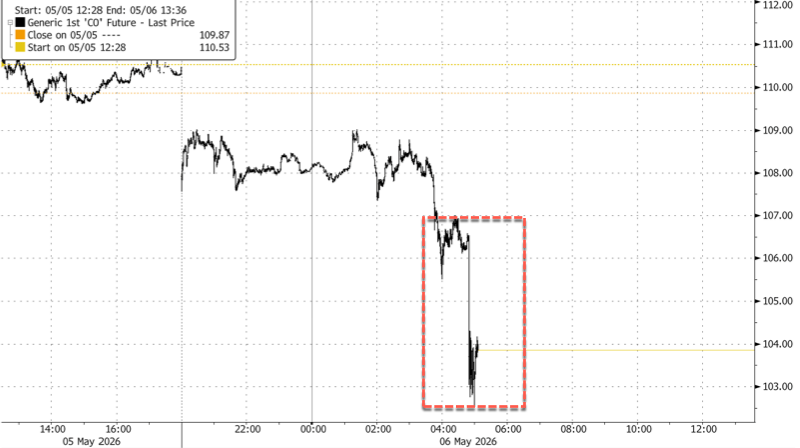
WTI futures plunged more than 11% to the $90-a-barrel level after Axios reported earlier this morning that the U.S. is nearing a preliminary agreement with Iran to end the war. The sharp decline suggests traders are beginning to price in a potential geopolitical de-escalation and the potential reopening of the Hormuz chokepoint.

At the pump, however, the latest AAA data as of Wednesday morning show that the national average for regular 87-octane gasoline has climbed to $4.50 a gallon, the highest level since July 2022.

There will be a lag. Even if the Trump administration and Tehran formalize a deal in the near term, the immediate result will not be a collapse in gas and diesel pump prices, but rather an approaching peak.

Lower crude prices typically take a few weeks to work through wholesale markets, inventories, distribution networks, and retail outlets before meaningful declines in gas and diesel are visible at pump stations to consumers.

During a Monday press conference, Trump said he expects the price of gasoline to drop “substantially” following the end of the US-Iran war.

“I see it going down very substantially when this is over, I think very rapidly too, at levels that you’ve never seen because there’s a lot of energy out there, ships all over the world that are loaded up with it,” Trump said.

“They can’t do much with it because they got kidnapped by a pretty evil place. But we’re taking care of it.”

Last week, Trump said pump prices would “come crashing down as soon as this war is over.”

GasBuddy analyst Patrick De Haan warned that the $5-a-gallon threshold is typically the “shock and awe” level that triggers demand destruction.

With the national average for gas already near $4.50 a gallon, and California prices above $6, the political and consumer pressure backdrop for the Trump administration has intensified in recent weeks.

The administration now appears to be pushing hard for a near-term Iran resolution ahead of Memorial Day weekend, one of the largest U.S. driving periods of the year after Thanksgiving.

Tyler Durden
Wed, 05/06/2026 – 09:40

Treasury Refunding: No Changes To Auction Sizes; Bessent Keeps “At Least” In Forward Guidance

Treasury Refunding: No Changes To Auction Sizes; Bessent Keeps “At Least” In Forward Guidance

In our preview to this morning‘s Quarterly Refunding Statement, we said that we do not expect major changes and that, at most, the treasury might adjust its statement language to soften the forward guidance on possibly futures increase in coupon auction sizes with one likely change would be dropping “at least” while retaining the expectation for unchanged coupon sizes over “the next several quarters” (recall Deutsche Bank said it expects nominal coupon increases beginning in February 2027). 

Overnight, JPMorgan agreed, writing that while the current auction calendar will leave Treasury well financed through FY27, “we do not think it will be adequate to meet the widening funding gap from FY27 and onward, and we continue to project a series of coupon auction increases beginning in February 2027.” Accordingly, like DB, JPM also expected the Treasury to remove “at least” from the statement that “Treasury anticipates maintaining nominal coupon and FRN auction sizes for at least the next several quarters.” The bank said that If its expectations are realized, “we think this could push intermediate yields higher.”

Well, moments ago the Treasury published its latest Quarterly Refunding Announcement, and contrary to prevailing expectations, it refused to make even a gentle hint at rising coupon sizes by keeping the “at least” language from the abovementioned statement, instead keeping it as is, or rather as was: 

Based on current projected borrowing needs, Treasury anticipates maintaining nominal coupon and FRN auction sizes for at least the next several quarters

In other words, the US Treasury signaled again that it’s still comfortable using Yellen’s Activist Treasury Issuance playbook to issue Bills, and not increase coupon issuance, to meet escalating government borrowing needs, even as warnings emerge about the strategy’s risks.

Ahead of the QRA, dealers were divided heading into the so-called quarterly refunding release on whether it might alter its guidance. Outsize US fiscal deficits make an expansion in longer-dated auctions practically inevitable at some stage. The department on Monday boosted its estimate for net borrowing this quarter amid lower net cash flows.

US debt managers have been using the same forward guidance since early 2024, in a policy that’s steadily boosted the share of bills of total debt outstanding (to roughly 22% from 14% before covid). The International Monetary Fund cautioned last month that this leaves federal debt costs more vulnerable to sudden swings in rates and shifts in sentiment, because auctions are more frequent.

And sure enough, with no changes to the forward guidance:

  • *TREASURY YIELDS EDGE LOWER AFTER UNCHANGED GUIDANCE ON AUCTIONS

The rest of the statement was also in line with expectations, with the Treasury stating “it believes its current auction sizes leave it well positioned to address potential changes to the fiscal outlook and to the size and composition of the SOMA portfolio.” It added that it was monitoring SOMA purchases of Treasury bills and growing demand for Treasury bills from the private sector.  And, as before, looking ahead the treasury continues to evaluate potential future increases to nominal coupon and FRN auction sizes, with a focus on trends in structural demand and potential costs and risks of various issuance profiles. 

Looking at the actual refunding auctions next, the Treasury’s refunding debt sales will total $125 billion, unchanged from the sum unveiled in February and in line with the expectations of Wall Street bond dealers.

Treasury also maintained guidance on coupon sizes for the coming quarters. Refunding issuance to raise new cash of approximately $41.7BN (offering $125BN to refund $83.3BN).

  • Treasury to sell $58bn of 3-year notes on May 11
  • Treasury to sell $42bn of 10-year notes on May 12
  • Treasury to sell $25bn of 30-year bonds on May 13

The table below presents the actual auction sizes for the February to April 2026 quarter and the anticipated auction sizes for the May to July 2026 quarter: 

The total compares to a peak of $126BN first reached in Feb. 2021; auction sizes across the curve began rising in 2018 to finance tax cuts and surged in 2020 to finance the federal pandemic response, and to give the Fed’s QE X securities to buy.

Here are some other highlights from the Refunding report: 

Bills

  • Treasury expects to further increase offering sizes of shorter-dated benchmark bills over the coming weeks and, in late-May, anticipates issuing a short-dated CMB to meet the peak liquidity needs at the end of May due to maturing coupon securities.
  • Given projections for receipts associated with the mid-month corporate and non-withheld tax date, Treasury expects to implement modest reductions to short-dated bill auction sizes during the month of June. 
  • Thereafter, in July, Treasury anticipates incrementally increasing bill auction sizes across the curve.  As always, Treasury will continue to evaluate near-term borrowing needs and assess additional adjustments to bill auction sizes as appropriate

TIPS

  • Treasury plans to maintain the 10-year TIPS reopening this May at $19 billion; the five-year TIPS reopening in June at $24 billion; and the 10-year TIPS new issue at $21 billion in July

20-year

  • Treasury is modifying settlement timing for 20-year bond reopening auctions.
  • From the reopening auction scheduled for June 16th, 20-year reopening auctions will settle on the Friday of the auction week, while new issues will continue to settle at month end.

Buybacks (lowers cash management buybacks in 1mth-2-year, maintains liquidity support buybacks)

  • Expects to purchase up to USD 38bln in off-the-run securities across buckets for liquidity support (unchanged) and up to USD 25bln in the 1-month to 2-year maturity bucket for cash management purposes (prev. USD 75bln in Q1).

Cash Balance

  • Treasury is assuming a $900 billion cash balance at the end of June.
  • Treasury estimates that the size of the Treasury General Account (TGA) could peak at $1 trillion (plus or minus $50 billion) in late July.  This figure is consistent with Treasury’s long-standing cash balance policy and is driven by the large outflows expected to occur at that time. 

TBAC Minutes

  • Director Pietrangeli says while current issuance sizes are adequate to cover expected borrowing needs for the remainder of FY2026 (prev. Treasury is slightly overfunded in FY2026)
  • The median primary dealer forecast for privately-held net marketable borrowing implies a USD 1.3tln funding shortfall in FY2027-28 based on current coupon auction sizes and bill supply (prev. saw USD 1.1trln).
  • Debt Manager Jensen says dealers generally anticipate that nominal coupon auction sizes might next increase in early CY2027 (prev. late CY 2026 or CY early 2027), and expect Treasury to modify its forward guidance several quarters ahead of such a change.
  • The TBACCommittee unanimously recommended that Treasury maintain nominal coupon, FRN, and TIPS auction sizes at current levels
  • TBAC continues to believe that increases in coupon issuance could be warranted in FY2027 and discussed potential changes to the forward guidance for Treasury to consider
  • Committee had a “healthy debate” whether Treasury should consider investing excess cash in the overnight Treasury repo market to generate investment returns while “maintaining prudent risk management and avoiding market disruptions”
    • Key design choices mentioned by Committee members include the time of day that Treasury deploys cash into the repo market, the specific market segment that Treasury would invest in (e.g., triparty, centrally cleared), and Treasury’s required return
    • Presenter stressed that the economic viability of investing in the repo market is dependent on the spread between the rate Treasury earns on repo investments and the Federal Reserve’s interest on reserve balances rate (IORB)
    • Committee agreed that while there are potential economic returns from such investments, their size and economic viability depend on the market environment and monetary policy, and that additional study is warranted regarding operational and implementation considerations
  • Committee discussed the expansion of central clearing in Treasury securities market and the presenter reviewed key areas of progress by both the industry and regulators since the extension of the implementation deadlines, noting the recent increase in central clearing activity
  • Presenter highlighted recent requests for exemptions related to certain inter-affiliate and extraterritorial transactions as key outstanding issues to resolve
  • Presenter concluded that, although the industry has made steady progress, some operational and implementation challenges remain as the market transitions to expanded central clearing

Tyler Durden
Wed, 05/06/2026 – 09:24

NANO Nuclear Soars On Strategic MOU With Supermicro For Powering AI Data Centers 

NANO Nuclear Soars On Strategic MOU With Supermicro For Powering AI Data Centers 

NANO Nuclear and Supermicro have agreed to explore the integration of NANO’s KRONOS microreactor system with Supermicro’s AI server and data center platforms for scalable nuclear-powered solutions. The news of the strategic collaboration – a critical moment in the integration of alternative energy source within the AI rollout – sent the stock soaring in pre-market

We anticipate the shorts are also taking notice with over 22% of shares loaned out…

“The AI revolution is fundamentally an energy challenge,” said Jay Yu, Chairman and President of NANO Nuclear, “and we believe nuclear power is the only scalable solution capable of meeting that demand.”

Through this MOU, NANO Nuclear and Supermicro will explore opportunities to:

  • Deploy NANO Nuclear’s microreactors to provide dedicated, on-site nuclear power for data centers.
  • Integrate Supermicro’s AI server racks, cooling systems, and infrastructure with nuclear-powered energy solutions.
  • Develop joint go-to-market strategies for hyperscale, enterprise, and edge data center customers.
  • Enable a new class of self-powered, grid-independent AI infrastructure.

“This is exactly where the future is heading compute and power becoming a unified solution,” said James Walker, Chief Executive Officer of NANO Nuclear. “By aligning with Supermicro, NANO Nuclear is stepping directly into the center of one of the fastest growing and most capital-intensive markets in the world.”

By partnering with Supermicro, NANO Nuclear gains direct alignment with a company at the forefront of the AI infrastructure buildout, providing:

  • Access to global data center customers and hyperscale operators.
  • Integration pathways with state-of-the-art AI hardware ecosystems.
  • A channel into one of the fastest-growing sectors of the global economy.

NANO is able to lean into their significant progress of deploying a KRONOS microreactor at the University of Illinois. The company recently submitted their construction permit application for the project and is well into the site preparation phase.

The company has also made strides with new partnerships in the Asian market, and has an agreement with BaRupOn for up to 1 GW of KRONOS microreactors for a data center campus in Texas. 

Tyler Durden
Wed, 05/06/2026 – 09:00

OpenAI Co-Founder Greg Brockman Defends Company’s For-Profit Pivot… And His Own $30 Billion Payday

OpenAI Co-Founder Greg Brockman Defends Company’s For-Profit Pivot… And His Own $30 Billion Payday

Authored by Beige Luciano-Adams via The Epoch Times,

In the second week of a high-profile jury trial that could have profound impact on the race for artificial intelligence, OpenAI president Greg Brockman rejected allegations that he and other co-founders betrayed the company’s philanthropic mission and illegally enriched themselves by flipping the non-profit lab into a for-profit corporation.

Tesla CEO Elon Musk in 2024 sued Brockman and CEO Sam Altman, alleging they bilked him of $38 million in donations then restructured as a for-profit corporation by exclusively licensing their flagship product to Microsoft—betraying a founding mission to operate as an open-source charity that would counter the risks of profit-driven AI.

OpenAI and Microsoft deny the allegations, arguing that Musk abandoned the company in 2018 to start his own for-profit competitor, xAI, when other founders rejected his bid to take full control of the operation.

“I think we’ve been very consistent on the mission,” Brockman told a federal court in Oakland.

“If you look at what we’ve accomplished—currently the foundation has $150 billion worth of OpenAI equity value. That’s something we’ve built through hard blood, sweat, and tears through all this time since Elon left.”

The company’s nonprofit foundation has a 27 percent stake in OpenAI’s for-profit corporation; Microsoft, which has invested more than $13 billion since 2019, owns 26 percent.

Called as an adverse witness for the plaintiff, Brockman over two days May 4–5 offered testimony outlining an alternate narrative and timeframe than the one Musk presented the week prior.

Brockman also attempted to add context to what he has claimed were “cherrypicked” segments of his personal diary, unsealed during the discovery process.

He often spoke in incomplete sentences, punctuated by stock phrases like, “We were solving for the mission.”

Arguably, this had less zing to it than, “You can’t just steal a charity”—a phrase Musk favored in his own testimony.

‘Morally Bankrupt’

Musk’s attorney Steven Molo grilled Brockman on a series of diary entries from 2017 and 2018, a time of intense negotiations with Musk over the future structure of the company.

In one from 2017, Brockman muses, “It’d be wrong to steal the nonprofit from [Musk] and turn it into a B-Corp without him—doing so would be pretty morally bankrupt.”

Brockman denied this contradicted his commitment to OpenAI’s mission. “I think I meant it would actually serve the mission, but it would be hard to look at yourself in the mirror,” he told the court.

Under cross-examination, he explained he was referring to the idea of voting Musk off the board of directors, which he had considered at the time.

“It had been made clear to us,” he said, “that if we didn’t come to [Musk’s] terms, he was going to start an AGI competitor.”

Artificial General Intelligence (AGI) is the hypothetical point at which digital intelligence reaches or surpasses human cognitive abilities and can operate autonomously.

Some, including Musk, believe we have already achieved an early version of it, and that AGI advancement in the wrong hands poses the greatest existential threat to humanity. Musk testified that this threat was the express motivation for creating OpenAI as an open-source, nonprofit lab.

From late 2017 to early 2018, Musk, Altman, Brockman, and Ilya Sutskever, another OpenAI co-founder and its former chief scientist, floated various ideas as they debated how to fund the project at a competitive level.

Musk, the main donor, rejected an even equity split among the four co-founders, instead proposing a deal that would give him majority stake, to be diluted as more investors joined.

Brockman said he and Sutskever were willing to accept Musk being CEO and having a majority stake. “But the one thing we could not accept was to hand him unilateral total control over the AGI.”

Musk was the wrong man for the job, according to Brockman.

“Look, he knows rockets, he knows electric cars, he did not and I believe does not know AI,” Brockman said of the Tesla and SpaceX CEO.

“And Ilya and I did not think he was going to spend the time required to actually get good at it.”

Brockman alleged Musk “didn’t recognize that spark” in early language models underlying the GPT technology. “It was there, a working version, we could see the promise. … We really needed someone running the company that had that effect.”

Molo pressed the witness, pointing to emails from Musk proposing a 16-person board for the new corporation, in which Musk would have a 25 percent influence.

“This is the man you’re saying wanted to be the AI tyrant and have absolute and total control?” Molo probed.

“He wanted a board, and conducted in a way you were not familiar with because you didn’t have the experience of corporate governance, did you?”

Brockman acknowledged, “Definitely, this is something I was new to,” but maintained that there was never a real plan for Musk to relinquish control.

In a January 2018 email to Musk and others, Brockman stressed that a moral high ground was “our best tool,” and to maintain it, the company should endeavor to remain a nonprofit. “AI is going to shake up the fabric of society, and our fiduciary duty should be to humanity.”

But back in November 2017, Molo pointed out that Brockman’s diary entries show he was worried about how it would look if the founders continued to say they were committed to a nonprofit while planning to convert to a for-profit.

“Cannot say that we are committed to the nonprofit. Don’t wanna say that we’re committed. If three months later we’re doing b-corp then it was a lie,” Brockman wrote. “Can’t see us turning this into a for-profit without a very nasty fight.”

When Musk issued an ultimatum in 2018 to “either go do something on your own or continue with OpenAI as a nonprofit,” Brockman said he was “devastated.”

“It felt like we were so close to something that could actually succeed at the mission … and it was all blown up.”

$30 Billion Question

Molo accused Brockman of plotting to use OpenAI to become a billionaire, this time referencing journal entries made six days after he’d told Musk he wanted to continue to fundraise for the nonprofit, in which he asks, “What will take me to $1 billion?”

“There’s a lot of context here,” Brockman said. “It was expression of a frustration, not a plan.”

He described it as a “fork in the road,” where he would either accept Musk’s terms or part ways with him.

The road without Musk led Brockman to a $30-billion equity stake in OpenAI’s for-profit corporation. But Brockman said it was not about the money: “I think I’d be happy with either of those routes,” he said in court.

Molo pounced. Why then, if he was “good with a billion,” would Brockman not donate the extra $29 billion to the nonprofit to which he had a fiduciary duty?

“That was really about picking between these two roads … which one will I actually be happy with? … Feel enthusiastic getting out of bed, and do [sic] the work every day?” Brockman said.

“It takes $30 billion to get you out of bed in the morning, but $1 billion doesn’t get you out of bed?” Molo asked. “You had a fiduciary duty. … You took the assets from the nonprofit, you moved them into the for-profit to create this money-making machine that resulted in you having $30 billion.”

Implying that he raided the charity to enrich himself was “a deep mischaracterization,” Brockman said.

Molo also grilled Brockman on a commitment he made to donate $100,000 to the nonprofit but never delivered—and on billions in deals that OpenAI has secured with at least three other companies in which Brockman has an ownership stake.

The plaintiff’s attorney also highlighted a 2017 “side deal” in which Altman gave Brockman around $10 million of equity in the company holding assets of his personal family office.

When pressed, Brockman said he didn’t conceal this from Musk.

“Elon’s time was relatively hard to get, there were a lot of decisions to make that we weren’t able to broadcast to him,” he told the jury.

Sam Altman listens as OpenAI President Greg Brockman testifies during Elon Musk’s lawsuit trial over OpenAI’s for-profit conversion before U.S. District Judge Yvonne Gonzalez Rogers at a federal courthouse in Oakland, Calif., on May 4, 2026, in a courtroom sketch. Vicki Behringer/Reuters

Origins

Under cross-examination, Brockman told a story about the beginnings of OpenAI—from which Musk was conspicuously absent.

The spark, he said, began at a small dinner party in Menlo Park, where attendees considered whether it was too late to create an AI lab that could compete with Google’s Deep Mind project—at the time, the world leader in AI. That was in July 2015.

Musk was there, Brockman said, but the real catalyst was an agreement between himself and Altman, the same night, that “this was the most important thing we could imagine doing.”

He got to work, acting along with Altman as “the main drivers” of the project.

By November, they had assembled a list of 10 names for an “offsite” event in Napa Valley, nine of whom ended up joining OpenAI’s team. “It was an amazing day of creative energy, people really clicked,” Brockman said. So much so that, as their van remained stalled in traffic for 1.5 hours, “no one noticed because the conversation was so good.”

Brockman said he had no contact with Musk between the dinner and the offsite. “I expected he would donate,” he said of the Tesla founder, suggesting his role was relegated to little more than closing calls and occasional advice.

Under re-direct, Molo challenged this characterization.

“I know he wasn’t in the van with you guys on the highway, but he was instrumental in founding and kickstarting OpenAI, was he not?” Molo said, noting that Musk provided the dominant funding, vision, and leveraged his formidable relationships to recruit talent and resources.

Mission Creep

Brockman also denied that Musk was concerned with open-sourcing the company’s technology, or keeping it as a non-profit forever.

By the time the company made its public launch in December 2015, Brockman said, Musk was already considering they might need to add a for-profit corporation in order to be competitive. But the Tesla CEO’s concurrent pledge to donate $1 billion never materialized.

Musk donated an estimated $38 million to OpenAI from 2015 through 2020.

OpenAI’s mission statement, posted in 2015, notes a goal of advancing digital intelligence “in the way that is most likely to benefit humanity as a whole, unconstrained by a need to generate financial return.”

Brockman edited the original, in which Musk had used the word “unencumbered.”

“I understood this as a lack of constraint, we had a lot of freedom. We had not made commitments,” Brockman said Monday.

In 2023, the year Microsoft invested $10 billion in OpenAI’s for-profit subsidiary (the company restructured in 2025 to its current form, a public benefit corporation), Brockman wrote the board with a proposed change to the OpenAI charter, indicating he had been “wrong at times” about the original set up, and that “we’ve grown to regard capitalism not as a constraint, but instead, as a positive force,” according to evidence presented by Musk’s attorneys.

The Board never approved the updated charter, but Musk’s team argues it articulates a marked shift—away from OpenAI’s mission.

“No way Microsoft is giving that as a donation in any kind of charitable way,“ Musk testified last week, recalling his thoughts at the time. ”This is a bait and switch.”

Realizing that the non-profit would be “subservient” to the for-profit, he said, “This is when I thought there had been a breach of charitable trust.”

Brockman testified he never made any commitments to Musk that OpenAI would remain a nonprofit, nor that it would continue to open source its technology.

Musk is asking that OpenAI be reverted to a nonprofit, that more than $100 billion in damages be returned to it, and that Altman and Brockman be removed from their leadership roles.

U.S. District Judge Yvonne Gonzalez Rogers Judge Yvonne Gonzalez Rogers told the jury on May 5 that she expects all evidence to be presented by early next week, at which point they may begin their deliberation.


Tyler Durden
Wed, 05/06/2026 – 08:45

Taxpayers Foot Staggering £629 Million Bill For Foreign Nationals In UK Prisons

Taxpayers Foot Staggering £629 Million Bill For Foreign Nationals In UK Prisons

Authored by Steve Watson via Modernity.news,

UK taxpayers are forking out £629 million a year to house 10,487 foreign national offenders in British prisons — a bill that could pay for 16,500 police officers or 15,000 NHS nurses.

While Labour claims it’s deporting record numbers, an ex-prison governor has torn into the “staggering” cost and the “incredibly slow process” that leaves dangerous foreign criminals draining public resources instead of being sent home. 

This is the direct result of years of open-borders policies that prioritise criminals’ “rights” over British safety.

Reform UK’s Prisons Adviser and former prison governor Vanessa Frake laid it out clearly on GB News. “The cost to this country for foreign national prisoners is staggering,” she said. “It’s a very long, drawn-out process, which kind of goes from three main areas.”

Frake detailed the excuses that keep foreign offenders here: “The problem is a lack of identity documents for these people. Quite often they get rid of their passports, so the Home Office then has to write to the country that they originate from, and that process is very slow.”

“Sometimes the country refuses. And there are of course the ECHR claims. Those under Article 8, right to life, right to family for those who have family in this country and of course, there is administration errors as well,” Frake further explained.

She added that even recent deals fall short. “They’ve just done a deal with Albania to send 200 prisoners back, but that comes with certain conditions, like improving their prison service, giving them electric Volkswagens, etcetera.” 

Frake noted the daily cost disparity: “It costs something like £109 a day in this country to keep a foreign national in prison, and we’re going to give the Albanians £32 a day, so it’s still not quick.”

Albania tops the list of foreign national prisoners, followed by Ireland and Poland. Yet Frake’s blunt conclusion was that Britain can’t simply load them onto planes. “We’re not going to get away with it by just putting them on a plane, we’ve got to persuade these countries to take these individuals back.”

This isn’t an isolated failure. It’s the pattern. Britain has repeatedly let violent offenders and known extremists stay or walk free despite clear red flags.

Take the most recent case of a Somali terrorist in London who previously stabbed police officers, and was a known extremist.

Essa Suleiman, who arrived as a child and holds British citizenship, was convicted in 2008 for stabbing two officers and a police dog. Referred to Prevent in 2020 as an extremist, he was still free to attempt to murder two Jewish people in Golders Green last month. 

Leftists seem more concerned with how police roughly handled the terrorist, however.

In another case, Al-Qaeda-inspired plotter Shah Rahman, was convicted for planning to bomb the London Stock Exchange, but can’t be sent back to Bangladesh because an immigration judge ruled it would breach his Article 3 human rights against “torture or inhuman treatment.” 

He even married a woman banned from Britain for life over ISIS material. 

In Edinburgh a reported Somali migrant went on a knife rampage, smashing a shop and stabbing victims near a school. 

Council leader Cllr Jane Meagher responded by praising Edinburgh’s “diversity” as its “biggest strength” and calling for more “tolerance.” 

In another example, Zahid Iqbal, who plotted to bomb an Army base using an Al-Qaeda manual and a toy-car IED, was freed three years early despite warnings and prior recall for breaching conditions. 

How many more are there like this — released from prison or previously charged with serious crimes — now roaming around free?

The Ministry of Justice claims more than 8,700 foreign offenders have been removed since July 2024. Yet the prisons remain full of them, the costs keep climbing, and the public keeps paying the price for a system rigged against its own people.

This growing insecurity is now reflected in public sentiment. According to a major survey, four in five parents (80%) fear their daughters will grow up feeling unsafe in public in Britain, with 40% believing this will happen at an earlier age than it did for them. 

The solution offered?

In Dumfries, Scotland, schoolgirls were handed rape alarms after repeated reports of asylum seekers stalking and photographing them — the authorities’ answer to the problem instead of stopping the influx. 

This is what unchecked mass immigration and weak deportation rules deliver: British taxpayers funding foreign criminals while violent threats walk the streets. Real border control means ending the excuses, scrapping the ECHR vetoes, and putting British safety first — before the bill gets any bigger.

Your support is crucial in helping us defeat mass censorship. Please consider donating via Locals or check out our unique merch. Follow us on X @ModernityNews.

Tyler Durden
Wed, 05/06/2026 – 07:20

Novo Nordisk Soars After New Obesity Pill Momentum Lifts Guidance

Novo Nordisk Soars After New Obesity Pill Momentum Lifts Guidance

Novo Nordisk shares jumped as much as 9% in Copenhagen, suggesting the stock may finally be bottoming out after a vicious multi-year bear market. The move followed the Danish drugmaker’s decision to raise its 2026 guidance ranges for adjusted sales and adjusted operating profit, citing solid momentum in Wegovy sales.

Novo now expects full-year sales and profit declines of around 12%, down from a previous forecast of around 13%. The upgraded outlook was “driven by increased expectations for GLP-1 product sales,” according to the company.

Here’s a snapshot of the new full-year forecast, courtesy of Bloomberg:

  • Sees adjusted change in sales at constant exchange rates -4% to -12%, saw -5% to -13%, estimate -7.63% (Bloomberg Consensus)

  • Sees adjusted change in operating profit at constant FX -4% to -12%, saw -5% to -13%, estimate -8.26%

The key bright spot was momentum in the Wegovy pill:

  • Wegovy pill was launched in the US on 5 January 2026, and for the week ending 17 April, total weekly prescriptions exceeded 200,000. Coupled with total prescriptions for Q1 2026 of around 1.3 million and now more than 2 million since launch, it marks the strongest-ever GLP-1 volume launch in the US. Q1 2026 sales for the Wegovy pill reached DKK 2,256 million, impacted by pre-launch pipeline fill with wholesalers and telehealth partners.

  • Pending regulatory decisions, the first Wegovy pill launches outside the US are expected during the second half of 2026.

“We have seen more than 1 million people using the Wegovy pill,” CEO Mike Doustdar told analysts on an earnings call earlier. He noted that patients are switching from competing products, with “limited cannibalization” of Novo’s other drugs.

Still, Novo’s overall business remains under pressure. First-quarter sales fell 10% to 70.1 billion Danish kroner, while adjusted operating profit dropped 15%. Diabetes drug sales fell 18%, with Ozempic hitting its lowest level in two years.

Novo is trying to regain momentum after losing market share to Eli Lilly’s Zepbound injection.

Novo shares in Copenhagen jumped as much as 9%. Shares have been locked in a vicious, nearly two-year bear market, down 70% from their peak.

Analyst commentary, courtesy of Bloomberg:

Barclays (equal weight)

  • Oral Wegovy was “off to a strong start,” analyst James Gordon writes in a note.

  • Sees questions on supply capacity when the pill launches in other countries, expected in 2H

  • Sees FY consensus expectations being increased by low single- digits

BMO Capital Markets (market perform)

  • The Wegovy pill “makes a splash” in its debut, analyst Evan Seigerman writes in a note.

  • It’s encouraging that roughly 15%-16% of pill patients are filling scripts for the highest dosages.

  • This “could be a leading indicator for improved revenue going forward, given their higher price.”

  • Wegovy and Ozempic injectables also beat expectations, “showing more resilience in the face of competition within class”

Jefferies (hold)

  • Although the 2026 guidance was nudged higher, it still leaves consensus expectations at the upper end of the range, analyst Michael Leuchten writes in a note.

  • The change in guidance probably won’t have a positive impact on consensus estimates.

  • It could actually drag pretax profit and EPS expectations down a couple of percent.

Intron Health (sell)

  • Sales beat expectations by 1%, driven by Wegovy pill stocking of ~$125m, analyst Naresh Chouhan writes in a note

  • Meanwhile, gross margin was 30 bps worse than expected

Morgan Stanley (equal weight)

  • 1Q sales were a “small” beat, driven by the Wegovy pill — helped by stocking — and international operations, analyst Thibault Boutherin writes in a note

  • Lower operating costs helped the adjusted EBIT beat

  • Still sees the bottom end of the guidance as “conservative” and expects the company to finish the year “in the upper half of the guidance.”

Did Novo finally bottom?

Tyler Durden
Wed, 05/06/2026 – 06:55

There Needs To Be A Stronger European Element In NATO, Says Starmer

There Needs To Be A Stronger European Element In NATO, Says Starmer

Authored by Victoria Friedman via The Epoch Times (emphasis ours),

British Prime Minister Sir Keir Starmer said on May 4 that there needs to be a stronger European element in NATO, as the United States reconsiders its relationship with the defense alliance and pivots toward other security priorities domestically and globally.

British Prime Minister Keir Starmer at the Elysee Palace in Paris on Jan 6, 2026. Ludovic Marin/AP

Starmer acknowledged during a panel discussion at the European Political Community summit in Yerevan, Armenia, that, in terms of defense and security, Europe has “got behind over many years, now.”

“We’re not where we need to be,” he said.

The British prime minister alluded to the impact of the Ukraine–Russia war and, more recently, the Iran conflict on global security and economic stability, saying that Europe, especially, had to come together around these issues.

“There needs to be a stronger European element in NATO. I have no doubt about that,” he said.

Starmer said that while there needed to be a stronger European element in defense and security, “we’ve been behind the curve for too long: over dependencies, over reliance, and assumptions about the world that we live in—they’ve gone.”

“We now need to lead out of this, and we need to do it at pace because these impacts are real,” Starmer said.

“The alliances that are under tension are real, and how we, as a group of leaders, respond now will likely define what goes on for many years—arguably for a generation.”

US Reorients Defense Priorities

U.S. President Donald Trump has long maintained that Europe should rely less on the United States for its security and that European NATO allies should increase their defense spending. This approach was formally accepted by NATO when, in June 2025, allies agreed to raise defense spending targets from 2 percent of gross domestic product to 5 percent by 2035.

The United States has also reoriented its defense and security priorities.

The Pentagon on Jan. 23 released its National Defense Strategy, which outlines the U.S. plan to prioritize homeland defense, including by “defending America’s interests throughout the Western Hemisphere,” according to the document.

It also said the United States would encourage partners in other parts of the world, including Europe, to take primary responsibility for their own defense “with critical but limited support from U.S. forces.”

Tension Over Support in Iran Conflict

In recent weeks, Trump has expressed frustration with the lack of support from NATO allies during the Iran war, prompting him to consider pulling out of the alliance.

Trump told British newspaper The Telegraph in an interview published on April 1 that his request for assistance in the Strait of Hormuz was a test that allies did not pass.

The president’s remarks followed similar comments from Secretary of State Marco Rubio.

Rubio said on March 30 that one of the benefits of U.S. membership in the alliance is that it gives Washington access to station troops, aircraft, and arms in other parts of the world—including much of Europe.

However, during Operation Epic Fury, “we have countries like Spain, a NATO member that we are pledged to defend, denying us the use of their airspace and bragging about it, denying us the use of our—of their bases,” Rubio said, adding that “there are other countries that have done that as well.”

Rubio said that while he supported NATO, his backing of the alliance was based on the assumption that there are reciprocal arrangements.

“But if NATO is just about us defending Europe if they’re attacked, but then denying us basing rights when we need them, that’s not a very good arrangement,” he said.

NATO Secretary-General Mark Rutte delivers a speech at Aselsan Defence company as part of his official visit to Turkey, in Ankara on April 22, 2026. Adem Altan/AFP via Getty Images

This week, NATO Secretary-General Mark Rutte said that NATO members had received Trump’s message about agreements allowing the United States to access European bases.

“Yes, ​there has been some disappointment from the U.S. side, but Europeans have listened,” Rutte told reporters at the same European Political Community summit in ​Armenia on May 4.

“They are now making sure that all the bilateral ​basing agreements are being implemented.”

Tyler Durden
Wed, 05/06/2026 – 06:30

Trump Pauses Project Freedom Amid “Great Progress” Towards ‘Complete & Final’ Agreement With Iran

Trump Pauses Project Freedom Amid “Great Progress” Towards ‘Complete & Final’ Agreement With Iran

Summary

  • Trump announce ‘pause’ to Project Freedom amid optimism of a “complete and final” deal with Iran; French ship confirmed hit in cruise missile attack, crew members injured

  • Rubio declares ‘offensive’ actions of Operation Epic Fury are over, and now Project Freedom is in swing. Another vessel comes under attack in Hormuz.

  • UAE under attack again, confirmed in state sources – however which Iran denies doing – instead saying its actions were directed at the United States. White House still hasn’t declared end of ceasefire.

  • Pentagon addresses whether ceasefire over or violated: Caine says Iran’s Monday operations were “all below the threshold of restarting major combat operations at this point.“

  • Contradictory statements out of Tehran on UAE attack, amid reports of division between IRGC & civilian leaders.

  • Two US Navy destroyers transited the Strait of Hormuz and entered the Persian Gulf.

  • Iranian Foreign Minister Abbas Araghchi travels to Beijing to discuss crisis with Chinese counterpart.

The odds of a peace deal being completed just jumped…

*  *  *

Trump Pauses Project Freedom

There is a knee-jerk wave of optimism across assets with WTI crude futures lower, US equity contracts and Treasury futures higher after President Trump said Project Freedom will be paused.

Trump also said there is progress toward a final agreement with Iran which is what investors really want to see as it could potentially mean a reopening of Hormuz. 

Trump statement on his TruthSocial feed (emphasis and spacing ours):

Based on the request of Pakistan and other Countries, the tremendous Military Success that we have had during the Campaign against the Country of Iran and, additionally…

…the fact that Great Progress has been made toward a Complete and Final Agreement with Representatives of Iran…

…we have mutually agreed that, while the Blockade will remain in full force and effect, Project Freedom (The Movement of Ships through the Strait of Hormuz) will be paused for a short period of time to see whether or not the Agreement can be finalized and signed. 

WTI crude futures are testing back below $100…

Polymarket odds of Hormuz traffic returning to normal has jumped to better than a coin-flip…

Don’t hold your breath though as there have been several false starts of this kind before, and traders will soon lose faith unless there are more details from the Iranian side.

Additionally late Tuesday, a French cargo ship was confirmed hit in a missile attack, injuring crew members:

A cargo ship in the Gulf region was hit by a possible land-attack cruise missile, causing several injuries among the ship’s Filipino crew, two U.S. officials told CBS News.

The hit on the CGM San Antonio — which is owned by a French firm — took place late Tuesday evening local time, the officials said. The ship was near Dubai as of midday on Tuesday, but it is not clear whether the vessel has moved since then, according to public ship tracking data.

Rubio Declares Conflict in New Stage

Secretary of State Marco Rubio has announced Tuesday afternoon that offensive stage of Iran war is ‘over’. He further said that ships stranded in the Strait of Hormuz are facing a humanitarian crisis and accused Iran of holding the world hostage by closing the Strait of Hormuz. Iran is denying that it attacked the United Arab Emirates, with the foreign ministry saying its ‘defensive actions’ were ‘exclusively directed at the U.S.’

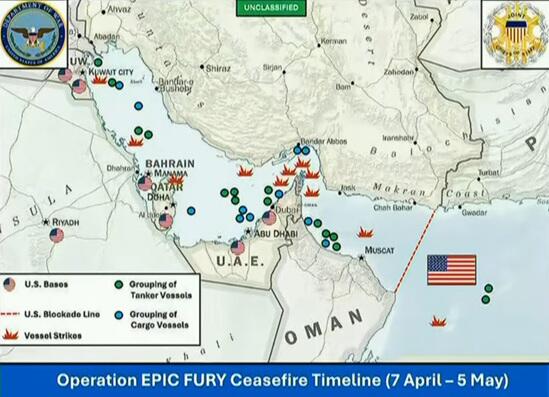
Operation Epic Fury is over, now Project Freedom.

The remarks were issued just as a new attack is unfolding on a foreign cargo ship in the strategic waterway:

Reaction in oil…

…as the goalposts keep shifting:

Trump Asked Whether Ceasefire is Dead

A revealing exchange in the Oval Office strongly suggests that even amid a second Iranian attack wave on the UAE Tuesday, the White House is unwilling to say that the ceasefire has collapsed – also given there’s yet been no direct exchange of fire between US and Iranian forces: 

President Trump, taking questions from reporters in the Oval Office on Tuesday, would not specify what Iran would need to do to violate the cease-fire. Asked by a reporter what would constitute a violation, considering that the country has fired on U.S. ships several times, Trump said: “Well, you’ll find out, because I’ll let you know.”

He added that “they know what to do,” and “they know what not to do, more importantly.”

Earlier the Pentagon clearly indicated that the ceasefire is still active, from Washington’s point of view. 

The Iranian government is meanwhile trying to bat down rumors of a division between the presidency and the IRGC/military apparatus.

Second UAE Attack Wave Active

The country’s Ministry of Defense has just released official statement of inbound projectiles out of Iran:

  • The UAE’s air defenses are currently dealing with missile and drone attacks originating from Iran.
  • The Ministry of Defense confirms that the sounds heard in scattered areas of the country are the result of the UAE’s air defense systems intercepting ballistic missiles, cruise missiles, and drones.
  • UAE Air Defences system are actively engaging with missiles and UAV threats MOD asserts that the sounds heard across the country are the result of ongoing engaging operations of missiles and UAV’s

There are meanwhile reports of explosions being heard on Iran’s Qeshm Island, and questions raised about scenes like the following:

Is Ceasefire Over? Pentagon Answers Definitively 

In the Tuesday morning Pentagon presser led by War Secretary Pete Hegseth, Joint Chiefs Chair Gen. Dan Caine stated very clearly that the US views Monday’s escalation (the attack on UAE and some vessels in the Strait of Hormuz) as actions which are “all below the threshold of restarting major combat operations at this point.“

The Trump administration has argued that it doesn’t have to seek congressional approval to continue military operations beyond a 60-day limit because there is a ceasefire in effect. But the question raised Monday is: does the fresh Iranian cross-Gulf mark the end of ceasefire? Clearly the Pentagon and Trump administration are saying no. “No adversary should mistake our current restraint for a lack of resolve,” Caine then emphasized.

Below are some of the latest top developments from various MSM sources:

—Trump’s desire to end the Iran war is being put to the test after Tehran fired at American warships on Monday and violently disrupted a U.S. effort to revive shipping in the Strait of Hormuz. Still, Trump wants to avoid a fresh bombing campaign, officials say, preferring a negotiated end to Tehran’s nuclear advancements and the weekslong war that has raised gas prices and hurt the global economy. (WSJ)

—U.S. intelligence assessments indicate that the time Iran would need to build a nuclear weapon has not changed since last summer, when analysts estimated that a U.S.-Israeli attack had pushed back the timeline to up to a year. The unchanged timeline suggests that significantly impeding Tehran’s nuclear program may require destroying or removing Iran’s remaining stockpile of highly enriched uranium. (RTRS)

—Trump says war could stretch 3 more weeks, claims US ‘already won.’ (ABC)

Below: Pentagon slide in Tuesday’s briefing showing Iranian attacks on Hormuz shipping: “Iran has fired at commercial vessels nine times and seized two container ships since the ceasefire was announced” (Gen. Caine).

And this puts things in perspective…

Internal Iranian Schism Over Monday UAE Attacks(?)

There’s a lot of chatter that Iran’s civilian government and the IRGC are at direct odds over Monday’s attack on UAE, which resulted in a large blaze at the Fujairah oil facility and the three injured Indian nationals. Al Jazeera for example observes:

By targeting the facility, Iran is sending a direct message to UAE saying: “We can target your most important economic points even if you think you can get around the Strait of Hormuz,” said Turak.

Iran’s government has not confirmed or denied responsibility for the attack. Turak noted there are “quite contradictory” statements coming out of Iran, however.

And Saudi-funded Iran International claims the following dramatic schism and internal rupture over the risky cross-Gulf operation, which could signal the end of the ceasefire (though curiously President Trump himself has not said it is broken):

Exclusive information obtained by Iran International points to a growing clash between Iran’s President Masoud Pezeshkian and its military leadership over Monday’s escalation in the Persian Gulf and attacks on the United Arab Emirates.

According to sources familiar with Tehran’s deliberations, Pezeshkian has expressed strong anger at actions by the Islamic Revolutionary Guard Corps, led by Ahmad Vahidi, describing missile and drone strikes on the UAE as “completely irresponsible” and carried out without the government’s knowledge or coordination.

Pezeshkian is said to have described the IRGC’s approach to escalating tensions with regional countries as “madness,” warning of potentially irreversible consequences.

This certainly isn’t the first time that Iran International, a London-based publication seen as also ‘close’ to Israeli intelligence, has alleged severe internal division in Iran’s wartime decision-making, but the viewpoint is beginning to be echoed and reported on more broadly.

Two US Navy Destroyers Successfully Transit Strait

To review of Monday’s major escalation, US Central Command said its forces had intercepted missiles targeting US Navy and commercial vessels, and also said American helicopters sank six small Iranian boats that officials said were targeting civilian vessels under American protection.

And also came a big milestone in terms of Washington aims to enforce Trump’s newly announced Project Freedom plan to provide military escort for ships through Hormuz. Two US Navy destroyers transited the Strait of Hormuz and entered the Persian Gulf on Monday and overnight after navigating an Iranian barrage, according to defense officials.

CBS reports, “The USS Truxtun and USS Mason, supported by Apache helicopters and other aircraft, faced a series of coordinated threats during the passage, the defense officials said. Iran launched small boats, missiles and drones against them in what officials described as a sustained barrage.” The report underscores further that “Despite the intensity of the attacks, neither U.S. vessel was struck.”

Apaches, Centcom handout

‘No Military Solution’

Iranian Foreign Minister Abbas Araghchi has issued an interesting statement decrying Trump’s attempt at escalation in Hormuz, warning that there’s no “military solution” to the crisis, while warning the US, UAE, and other regional countries against being drawn into a “quagmire” in the region.

“Events in Hormuz make clear that there’s no military solution to a political crisis,” Araghchi wrote on X. “As talks are making progress with Pakistan’s gracious effort, the US should be wary of being dragged back into quagmire by ill-wishers. So should the UAE. Project Freedom is Project Deadlock,” to top Iranian diplomat asserted.

Also of note is that Araghchi will travel to Beijing on Tuesday for discussions with his Chinese counterpart. “During the visit he will meet his Chinese counterpart [Wang Yi] to discuss bilateral ties and regional and international developments,” Iran’s Foreign Ministry said in a statement.

Below: Graham says you either pay now or you pay later. “They tried to get a nuclear weapon. If you don’t believe that, you shouldn’t be allowed to drive.”

Officially at least, Beijing has a policy of “noninterference” in other countries’ internal affairs, and has claimed to not be involved in the Iran conflict – while Washington has consistently accused China of providing intelligence to Tehran, and even possibly military hardware or weapons.

Elsewhere in the region, South Korea’s presidential secretary Choi Soung-ah says “the safety of international maritime routes and freedom of navigation should be protected under international law” and that Seoul is “watching President Trump’s remark related to this,” according Reuters. This after ann explosion and fire on a South Korean-operated ship in the Strait of Hormuz on Monday, which Trump blamed on an Iranian attack.

More Geopolitical Developments

via Newsquawk…

  •  US President Trump said Iran war could go on for another two to three weeks; time is not of the essence.
  • IRGC military source told Tasnim that the US shot two small boats carrying civilians instead of shooting IRGC speedboats.
  • “Iranian Defense Council member Ali Akbar Ahmadian: Our security does not accept negotiations, and Washington obstructed global navigation and energy security”, Al Jazeera reported.
  • Iranian President Pezeshkian has requested an immediate and emergency meeting with Supreme Leader Khamenei to ask him to stop IRGC attacks on Persian Gulf nations and prevent a recurrence, Iran International reported.
  • Pezeshkian reportedly outlined that the IRGC attack on the UAE occurred without the knowledge of the government.
  • US intelligence suggests strikes from the start of the war led to limited new damage to Iran’s nuclear programme, Reuters sources say.
  • US State Department official to Al Jazeera said the President is clear that direct communication between Israel and Lebanon is the best path toward peace; We are working to prepare the necessary conditions and political momentum to move forward with this
  • Two US Navy destroyers transited the Strait of Hormuz and entered the Persian Gulf after navigating an Iranian barrage, according to defense officials who spoke to CBS News; “Iran launched small boats, missiles and drones against them”.
  • Maersk (MAERSKB DC) said its subsidiary’s US-flagged vehicle carrier, Alliance Fairfax, exited the Gulf via Strait of Hormuz on May 4th.
  • US Treasury Secretary Bessent had a “fierce row” with UK Chancellor Reeves last month over her outspoken criticism of the Iranian war, FT sources say.
  • US CENTCOM posted “US warships and aircraft deployed to the Middle East are enforcing the naval blockade against Iran while executing Project Freedom to support the free flow of commerce through the Strait of Hormuz.”.
  • US officials say military closer to resuming combat operations than 24 hours ago, Fox reported.
  • US President Trump reiterates he feels Europe has been “very disappointing”.
  • Iranian Foreign Minister Araghchi posted “As talks are making progress with Pakistan’s gracious effort, the US should be wary of being dragged back into quagmire by ill-wishers. So should the UAE.”.
  • Full post:”Events in Hormuz make clear that there’s no military solution to a political crisis. As talks are making progress with Pakistan’s gracious effort, the U.S. should be wary of being dragged back into quagmire by ill-wishers. So should the UAE.Project Freedom is Project Deadlock.”.
  • Mehr News Agency said a fire broke out in two commercial ships and spread to two others in Dayyer port south of Iran; cause not clear.
  • “Explosions were heard tonight in the port of Bandar Abbas (Iran) and on Qassem Island (Iran) in the Persian Gulf”, N12 journalist reported citing sources in Iran.
  • IRGC political deputy said traffic in the Strait of Hormuz will only be done with Iran’s permission, ISNA reported; “Any kind of traffic in the Strait of Hormuz, if it is from the enemy, will be met with a decisive and crushing response”.
  • Iranian Parliamentary Speaker Ghalibaf said the new equation of the Strait of Hormuz is being solidified.
  • Actions of the US and allies have threatened the security of shipping and energy.
  • UNSC resolution prepared by the US, Saudi Arabia, Bahrain, Qatar, the UAE, and Kuwait opens the door for potential enforcement measures, AsharqNews reported citing the resolution “to be distributed tomorrow”.

Tyler Durden
Wed, 05/06/2026 – 06:00

S&P500 Futs Jump, Bonds Rally, Oil Tanks On Axios Report U.S.-Iran Nearing Deal

S&P500 Futs Jump, Bonds Rally, Oil Tanks On Axios Report U.S.-Iran Nearing Deal

Axios reports that the White House is nearing a preliminary deal with Iran to end the war. This is based on a 14-point, one-page memorandum that creates a 30-day negotiating window for a broader nuclear and Strait of Hormuz deal and follows President Trump’s announcement last night of “great progress” and a “complete and final” deal nearing. 

“The U.S. expects Iranian responses on several key points in the next 48 hours.

Nothing has been agreed yet, but sources said this was the closest the parties had been to an agreement since the war began,” Axios wrote in the report.

Here are the key points:

  • Iran would commit to a moratorium on uranium enrichment. The duration is still under negotiation, with the U.S. pushing for 20 years, Iran offering five, and sources suggesting 12 to 15 years may be the likely spot.

  • Iran would also pledge not to seek nuclear weapons, accept enhanced inspections, potentially halt underground nuclear facility operations, and possibly remove highly enriched uranium from the country.

  • The U.S. would gradually lift sanctions and release billions of dollars in frozen Iranian funds.

  • Shipping restrictions through the Hormuz chokepoint and the U.S. naval blockade would be gradually lifted during the 30-day talks. If negotiations fail, U.S. forces could restore the blockade or resume military action.

Axios said talks are being led by Trump envoys Steve Witkoff and Jared Kushner with top Iranian officials, both directly and through mediators.

News of this sparked risk on in U.S. equity index futures, WTI fell to the $95-a-barrel handle, and U.S. Treasury yields dipped.

Market Response:

S&P500 Futs

Brent Futs

WTI Futs

UST10Y

BTC/USD

Polymarket:

US x Iran permanent peace deal by June 30, 2026?
Yes 56% · No 44%
View full market & trade on Polymarket

Strait of Hormuz traffic returns to normal by end of June?
Yes 56% · No 44%
View full market & trade on Polymarket

*Developing…

Tyler Durden
Wed, 05/06/2026 – 05:35

UK Faces Summer Flight Disruptions As Jet Fuel Risks Mount

UK Faces Summer Flight Disruptions As Jet Fuel Risks Mount

Via City AM,

  • Ministers are expected to warn Britons that flight cancellations could disrupt summer holiday plans.

  • Allianz Trade research says the UK is especially exposed to jet fuel shortages because of import dependence.

  • Airlines are weighing cancellations, surcharges, and ticket price adjustments as fuel supply risks rise.

Ministers are set to warn the British public that flight cancellations will hit summer holiday plans as new research suggested that the UK is more exposed to jet fuel shortages than other European countries. 

Heidi Alexander, the transport secretary, is set to tell Brits that there could be flight cancellations this year as she will talk up staycations, according to The Times. 

Her warnings will follow a prompt by Sir Keir Starmer that people would have to consider changing “where they go on holiday”. 

Trade experts have warned that the supply of kerosene was set to be hit by disruptions across the Strait of Hormuz. 

Michael O’Leary, the boss of Ryanair, Europe’s biggest airline, said rivals were “desperately” searching for flights to cancel. 

Some airlines have reportedly said that the UK could escape some of the worst effects of jet fuel shortages due to obtaining supplies from other countries.  

UK is ‘particularly vulnerable’ to jet fuel shortages

But research by Allianz Trade found the UK had Europe’s “most structurally exposed markets to jet-fuel shortages”. 

It said its heavy reliance on imports, albeit from countries outside of the Middle East, would leave the UK “particularly vulnerable” to supply shocks. 

“The UK,  Germany, France, and Italy show the largest shortfalls, underscoring their reliance on external supply to meet aviation demand,” trade experts said. 

“European  aviation activity is indirectly exposed not only to global oil price dynamics but also to geopolitical and logistical risks along  key supply routes, reinforcing the region’s dependence on external refining hubs for a fuel that is essential to long-haul  connectivity.”

The worst effects of flight disruption could come in late June and July, near the peak of summer travel. 

Ministers may be looking to discourage Britons from taking long-haul flights in contingency plans being drawn up, according to reports. 

Lufthansa Group has announced it will cancel 20,000 flights over the next six months, while Virgin Atlantic added a fuel surcharge and British Airways has warned of “pricing adjustments” to tickets.

Airlines UK, the trade body, said: “UK airlines continue to operate normally and are not experiencing issues with jet fuel supply.”

Tyler Durden
Wed, 05/06/2026 – 03:30