This Is The Salary Needed To Live Comfortably In US Cities
How much do you need to earn to live comfortably in a major American city? Increasingly, the answer is a six-figure salary.
This map, via Visual Capitalist’s Bruno Venditti, shows the income required for a comfortable lifestyle across 56 U.S. cities, factoring in housing, food, transportation, savings, and discretionary spending.
The data comes from SmartAsset, using the MIT Living Wage Calculator and updated in February 2026.
The Highest-Cost Cities Now Require Nearly $160K
New York tops the list at $158,954, narrowly ahead of San Jose at $158,080.
California accounts for many of the highest-cost cities overall, with Irvine, San Diego, San Francisco, Oakland, Los Angeles, and Sacramento all ranking near the top.
Rank
City
Salary to live comfortably
1
New York, NY
$158,954
2
San Jose, CA
$158,080
3
Irvine, CA
$151,965
4
Boston, MA
$139,776
5
San Diego, CA
$136,781
6
San Francisco, CA
$134,950
7
Oakland, CA
$134,410
8
Honolulu, HI
$128,253
9
Seattle, WA
$127,296
10
Jersey City, NJ
$127,005
11
Arlington, VA
$125,882
12
Los Angeles, CA
$120,307
13
Riverside, CA
$119,974
14
Sacramento, CA
$117,021
15
Portland, OR
$116,106
16
Washington, DC
$111,155
17
Denver, CO
$110,781
18
Raleigh, NC
$110,490
19
Virginia Beach, VA
$110,448
20
Plano, TX
$109,242
21
Atlanta, GA
$108,451
22
Miami, FL
$108,077
23
Charlotte, NC
$106,205
24
Phoenix, AZ
$106,122
25
Chicago, IL
$105,830
26
Tacoma, WA
$105,290
27
Newark, NJ
$104,125
28
Boise, ID
$104,000
29
Tampa, FL
$102,710
30
Nashville, TN
$102,502
31
Reno, NV
$102,419
32
Minneapolis, MN
$102,045
33
Anchorage, AK
$101,795
34
Madison, WI
$101,754
35
Durham, NC
$101,296
36
Colorado Springs, CO
$100,464
37
Austin, TX
$98,550
38
Fort Worth, TX
$97,552
39
Richmond, VA
$97,178
40
Philadelphia, PA
$97,094
41
Dallas, TX
$96,970
42
Buffalo, NY
$96,221
43
St. Paul, MN
$96,054
44
Pittsburgh, PA
$95,472
45
Omaha, NE
$94,765
46
Orlando, FL
$93,475
47
Columbus, OH
$92,810
48
Jacksonville, FL
$92,518
49
Kansas City, MO
$92,144
50
Indianapolis, IN
$90,896
51
Houston, TX
$89,981
52
Tulsa, OK
$88,317
53
Baltimore, MD
$87,485
54
Memphis, TN
$86,320
55
New Orleans, LA
$84,406
56
San Antonio, TX
$83,242
Taken together, the top of the ranking highlights how concentrated the highest costs are in a handful of major metros, particularly in California and the Northeast.
Boston, Honolulu, Seattle, and Jersey City also stand out, showing that the highest salary thresholds extend well beyond just a handful of coastal hubs.
Six-Figure Salaries Are Becoming the Norm
A key shift in the data is how quickly six-figure income requirements have spread beyond the most expensive cities.
Beyond the usual high-cost leaders, cities such as Denver, Atlanta, Nashville, Charlotte, and Boise now require roughly $100K or more for a comfortable lifestyle. That shift suggests higher living costs are no longer confined to the country’s most expensive coastal markets.
Lower-Cost Cities Still Require Substantial Income
At the lower end of the ranking, the salary needed to live comfortably still remains substantial. San Antonio has the lowest threshold at $83,069, followed by Memphis at $86,444 and Tulsa at $87,690.
Even in the most affordable cities on the map, the income needed for a comfortable lifestyle is far above what many households earn, highlighting how even the most “affordable” major cities now require incomes that were once considered high.
The Department of Justice’s (DOJ) Civil Rights Division has launched multiple investigations into 36 Illinois public school districts to assess whether sexual orientation and gender ideology content is being taught in pre-K-12 grade classes.
If the districts are determined to be teaching sexual orientation and gender ideology-related content, “the investigations will examine whether the schools have notified parents of their right to opt their children out of such instruction,” the DOJ said in an April 30 statement.
“The investigation will also assess whether the Illinois School Districts limit access to single-sex intimate spaces (such as bathrooms and locker rooms) and girls’ sports teams based on biological sex.”
The probe will cover whether the districts violated Title IX of the Education Amendments of 1972, which explicitly prohibits discrimination on the basis of sex in education programs and activities receiving federal financial assistance. The districts are “recipients of hundreds of thousands of dollars of taxpayer funding,” the DOJ said.
The investigations will also look into whether the school districts adhere to the U.S. Supreme Court’s “extensive precedents on parental rights” as affirmed in Mirabelli v. Bonta and Mahmoud v. Taylor cases.
In the Mirabelli v. Bonta case, the Supreme Court blocked a California policy on March 2 that prohibited school personnel from informing parents when their children requested changing their preferred gender identity at schools.
“The State argues that its policies advance a compelling interest in student safety and privacy,” the court wrote in its decision. “But those policies cut out the primary protectors of children’s best interests: their parents.”
In the Mahmoud v. Taylor lawsuit, the U.S. Supreme Court sided with Maryland parents, who, for religious reasons, wanted to opt their children out from getting exposed to school storybooks promoting LGBT lifestyles.
Commenting on the DOJ’s probe into 36 Illinois school districts, Assistant Attorney General Harmeet K. Dhillon of the department’s Civil Rights Division said, “This Department of Justice is determined to put an end to local school authorities keeping parents in the dark about how sexuality and gender ideology are being pushed in classrooms.”
“Supreme Court precedent leaves no doubt: parents have the fundamental right and primary authority to direct the care, upbringing, and education of their children,” he said. “This includes exempting their children from ideological instruction that contradicts their values or decisions about their children’s health and best interests.”
The Illinois school districts under investigation include Bloomington Public Schools District, Lick Creek Community Consolidated School District, O’Fallon Community Consolidated School District, and Pembroke Community Consolidated School District.
The Epoch Times reached out to these school districts for comment but did not receive a response by publication time.
The full list of school districts being probed was posted on the DOJ website.
Gender Ideology Investigations
On April 17, the Department of Education said it found four school districts in Kansas to have violated Title IX and the Family Educational Rights and Privacy Act.
These districts had policies “that were likely to prevent schools from notifying parents of their child’s so-called ‘gender transition,’ even if the parent requested their child’s records,” the department said.
In August 2025, the Department of Health and Human Services (HHS) asked 46 states and territories to remove gender identity references from teaching materials, failing which they would face penalties, including the termination or suspension of federal funding.
This was met with a legal challenge by a coalition of 16 states and the District of Columbia, which filed a lawsuit in September 2025, arguing that terminating funding would harm “the very populations Congress intended to help.” The plaintiffs said complying with the order would conflict with their own laws and policies that require “inclusive” sex education curricula.
“The federal government’s far-reaching efforts to erase people who don’t fit one of two gender labels is illegal and wrong—and would deny services to millions more in the process,” Washington Attorney General Nick Brown said in a statement. The case is still ongoing in the court.
The HHS justified its order by citing a Jan. 29, 2025, executive order signed by President Donald Trump—Ending Radical Indoctrination in K-12 Schooling—which said that no federal dollars should go towards indoctrinating children in “radical, anti-American ideologies.”
At the time of the HHS order, Andrew Gradison, acting assistant secretary for the department’s Administration for Children and Families, said that “federal funds will not be used to poison the minds of the next generation or advance dangerous ideological agendas.”
The CDC’s report uses period life tables, which estimate how long a hypothetical group would live if it experienced the death rates observed in 2022 at every age. In other words, the measure captures current mortality conditions in each state, not a forecast for babies born there today.
Where Americans Live the Longest, and the Shortest
Among the 50 states and D.C., Hawaii had the highest life expectancy at birth in 2022 at 80.0 years. Massachusetts followed at 79.8, with New Jersey, New York, and Connecticut close behind.
The data table below shows the life expectancy of every U.S. state and D.C.:
Rank
State
Life Expectancy (Years)
1
Hawaii
80.0
2
Massachusetts
79.8
3
New Jersey
79.6
4
New York
79.5
5
Connecticut
79.4
6
California
79.3
7
Minnesota
79.3
8
Rhode Island
79.2
9
Utah
79.0
10
New Hampshire
78.7
11
Colorado
78.5
12
Idaho
78.4
13
Washington
78.4
14
Nebraska
78.3
15
Vermont
78.3
16
Wisconsin
78.1
17
North Dakota
77.9
18
Iowa
77.9
19
Florida
77.9
20
Maryland
77.8
21
Oregon
77.7
22
Illinois
77.5
23
Virginia
77.5
24
Pennsylvania
77.3
25
South Dakota
77.3
26
Montana
77.3
27
Texas
77.1
28
Wyoming
76.8
29
Michigan
76.8
30
Arizona
76.7
31
Maine
76.6
32
District of Columbia
76.6
33
Delaware
76.5
34
Kansas
76.5
35
Nevada
76.4
36
Georgia
75.9
37
North Carolina
75.9
38
Alaska
75.8
39
Ohio
75.6
40
Indiana
75.4
41
Missouri
75.2
42
South Carolina
75.1
43
New Mexico
74.5
44
Arkansas
73.9
45
Oklahoma
73.8
46
Tennessee
73.8
47
Alabama
73.8
48
Louisiana
73.8
49
Kentucky
73.6
50
Mississippi
72.6
51
West Virginia
72.2
On the other end of the ranking, West Virginia came in last at 72.2 years, behind Mississippi at 72.6 and Kentucky at 73.6.
The broad pattern is regional: the Northeast and West Coast have higher life expectancies, while many Southern and Appalachian states cluster at the bottom.
Why the National Average Misses the State Divide
While the national average is 77.5 years, only 21 states cleared that mark. Illinois and Virginia matched it exactly, and the remaining 28 states came in below it.
The CDC also found that females had higher life expectancy than males in every state and D.C., but the size of that gender gap varied widely. States on the lower end of life expectancy tended to have larger divides, while higher-ranked states had smaller gaps.
For example, New Mexico (ninth-lowest life expectancy at 74.5) recorded the largest female-male gap at 6.9 years, while Utah (ninth-highest at 79 years) had the smallest at 3.6 years.
Russia has become Syria’s leading supplier of oil since the collapse of former Syrian president Bashar al-Assad’s government and the rise to power of former Al-Qaeda chief Ahmad al-Sharaa, according to Reuters.
Shipments of Russian oil have risen by 75 percent this year to roughly 60,000 barrels per day (bpd), based on Reuters calculations using official data and vessel tracking from LSEG, MarineTraffic, and Shipnext.
While these volumes account for only a small fraction of Russia’s total global oil exports, they are significant for Syria. With domestic production still well below demand, Russian supplies have made Moscow the country’s leading crude provider.
According to two analysts and three Syrian officials cited by Reuters, the trade is driven by economic necessity in Damascus while also allowing Moscow to maintain influence in Syria.
The energy supplies risk complicating Syrian ties with Washington and the EU, sources were cited as saying.
“If the US were to fail to reach an agreement or settlement with Russia regarding Ukraine, it wouldn’t be a surprise if it told Syria overnight to stop buying these oil shipments,” said economist Karam Shaar.
Syria has undergone a major shift toward Washington and the west since Assad’s ouster. The US has declared Damascus a partner and ally in the fight against ISIS – ignoring the Syrian government’s ties to the extremist organization.
Damascus was also engaged in talks with Israel throughout last year, and began a crackdown on Palestinian resistance factions in Syria at Washington’s request.
As a result, most US sanctions have been lifted. Despite this, Syria has not been fully integrated into the global economic system.
Russia was a prime supporter of the Assad government. Throughout the 14-year war in Syria, Russian airstrikes repeatedly targeted extremist groups – which now make up the bulk of Syria’s official military and security apparatus.
But ties have improved, and Russia has retained a military presence inside Syria following negotiations with Damascus throughout 2025.
In March last year, Reutersreported that Syria was receiving currency shipments from Russia.
Estée Lauder Accelerates Turnaround, Adds 3,000 Jobs To Chopping Block
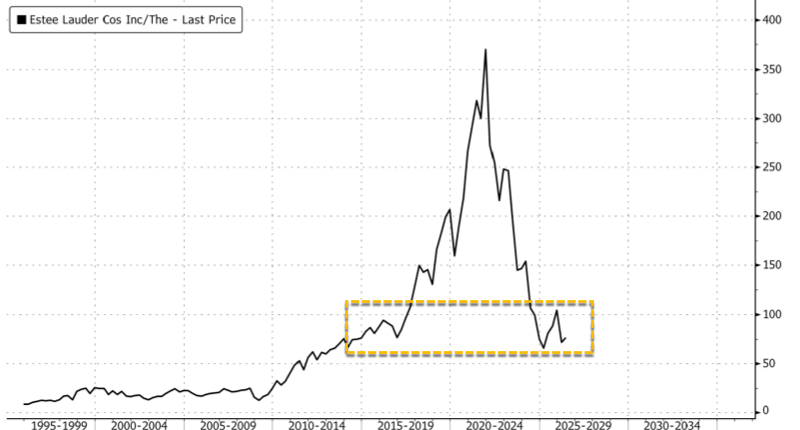
Beauty and cosmetics giant Estée Lauder is accelerating its workforce restructuring, announcing Friday morning that it will cut another 3,000 jobs, bringing total planned reductions to as many as 10,000 roles. The move is expected to unlock hundreds of millions of dollars in additional savings. Still, it also suggests a deeper reset in the company’s workforce after its hiring spree leading up to Covid, potentially putting a long-term cap on headcount.
The owner of Clinique, La Mer, MAC, Aveda, Bobbi Brown, Jo Malone London, Le Labo, Tom Ford Beauty, Too Faced, and others wrote in an earnings press release that it now “estimates a final net reduction in positions of 9,000 to 10,000, an increase from 5,800 to 7,000.” In other words, management found another 3,000 jobs to cut.
According to Bloomberg data, Estée Lauder has a global workforce of about 40,470 as of the second quarter of 2025. The total workforce peaked in 2022 at around 44,800, ending a multi-decade hiring spree.
“Over 70% of the increase is attributable to the reduction in point-of-sale demonstration roles at select unproductive doors in its department store and freestanding store channels, as the Company continues to evolve its focus towards high-growth channels,” the company noted.
Management said the restructuring is based on four objectives:
reorganization and rightsizing of certain areas,
simplification and acceleration of processes,
outsourcing of select services and
evolution of go-to-market footprint and selling models, all to help rebuild operating margin and also fuel reinvestment in consumer-facing areas to drive sustainable sales growth.
Shares jumped as much as 16% in premarket trading, and if those gains hold through the cash session, it would be the largest increase since November 3, 2011. The optimism stemmed from Estée Lauder’s earnings report, which raised its profit outlook.
The company now expects adjusted EPS of $2.35 to $2.45, above analyst estimates tracked by Bloomberg and higher than its prior $2.05 to $2.25 range. Organic sales growth is expected to be 3%, at the high end of previous guidance.
Shares are trading around 2016 levels after what can only be described as a boom-and-bust cycle, peaking in 2021. Shares remain down roughly 80%, as of Thursday’s close, from the peak of $370 in late 2021.
The question Wall Street analysts have been asking is whether CEO Stéphane de La Faverie’s turnaround will be successful.
SAN FRANCISCO—Driverless vehicles such as Waymo robotaxis could be ticketed for moving violations, according to updated autonomous vehicle (AV) regulations approved by the California Department of Motor Vehicles (DMV) on April 28, to enhance safety, oversight, and enforcement requirements.
The new rules allow law enforcement agencies to cite the companies that own the AVs for traffic violations committed by their vehicles.
Part of the regulations, which were implemented based on the California Legislature’s Assembly Bill 1777, also require companies to respond to calls from police, firefighters, and other emergency officials within 30 seconds.
The rules also authorize emergency response officials to issue electronic geofencing requests to an AV manufacturer to direct its AV fleet to leave or avoid the area within two minutes. “AVs that violate this restriction may be subject to permit restrictions or suspension,” according to DMV’s news release.
“Autonomous vehicle innovators operating in California have a clear, workable path to test and deploy, ensuring the state will continue to benefit from autonomous technology through safer roads, enhanced accessibility, and strengthened supply chains.” said Jeff Farrah, CEO of the Autonomous Vehicle Industry Association (AVIA), referring to the new regulation in an April 29 statement.
AVIA is a non-governmental organization advocating for the safe and timely deployment of autonomous driving technologies.
The new rules send a clear message that “autonomy does not remove responsibility,” Ahmed Banafa, an engineering professor of San Jose State University, told The Epoch Times via email.
“These vehicles must integrate smoothly into real-world environments that include law enforcement, pedestrians, and unpredictable situations.” he said.
Previously law enforcement officers often didn’t know how to deal with driverless cars. The new rules are meant to lead to more standardized procedures, clearer communication channels, and better coordination between AV fleets and the law enforcement agencies.
“While it may introduce additional compliance costs and slow down some rollouts, it creates a clearer framework for companies to operate within,” Banafa said.
DMV’s new rules based on AB 1777 would require AV manufacturers to maintain a dedicated emergency response telephone line, and equip each AV with a two-way voice communication device for emergency response officers to communicate with a remote human operator.
The deadline for the AV companies to comply was set as July 1, 2026.
The rule updates come after issues were revealed involving autonomous vehicles in San Francisco, including Waymo cars blocking intersections during a massive blackout that disabled traffic signals in December.
The San Francisco Fire Department also complained after dozens of incidents involving driverless vehicles interfering with emergency response teams in 2023.
To comply with the new regulations, the AV manufacturers must increase human involvement, but in a different form, Banafa ssaid. “Humans are now part of a centralized support system rather than physically inside the car.”
On Feb. 4, 2026, in a Senate Commerce Committee hearing, Waymo’s chief safety officer Mauricio Peña testified that when the company’s robotaxis encounter unusual situations, a remote human operator may step in.
Peña said some of the operators are located in the United States, while other workers are abroad, including in the Philippines.
Trump Pulling 5,000 US Troops From Germany In Punitive Move Amid Merz Spat
In a huge late in the day Friday development, the Trump administration plans to pull some 5,000 troops from NATO member Germany, CBS is reporting. Citing senior defense officials, the Pentagon expects the troop draw down will happen over a six to twelve month period, Reuters has also separately reported, in what clearly appears a punitive measure aimed at Berlin by the Trump White House.
Over several years, and stretching back decades, the US has maintained the most number of troops on the European continent in Germany – currently estimated at over 36,000 active duty personnel. So the 5,000 – while significant – is still somewhat of a symbolic move and number.
The large US presence hearkens back to the post WWII division of Germany and post-war order, and is also a legacy of the Cold War. Ironically at this very moment European leaders have hyped a ‘new Cold War’ with Russia, as the Ukraine war continues raging.
“The officials characterized the move as a signal of President Trump’s discontent with the level of assistance that European allies have offered in the U.S.-Iran war,” CBS writes.
The significance of the planned move also lies in the fact that America’s German bases serve as headquarters of US European Command and Africa Command – with the historic Ramstein Air Base being the key hub.
The announcement via US reporting comes just a day after Trump again lambasted German Chancellor Friedrich Merz:
“The Chancellor of Germany should spend more time on ending the war with Russia/Ukraine (Where he has been totally ineffective!), and fixing his broken Country, especially Immigration and Energy, and less time on interfering with those that are getting rid of the Iran Nuclear threat, thereby making the World, including Germany, a safer place!” Trump wrote on Truth Social.
Merz had in a rare moment torched US foreign policy and the Trump administration’s Iran war gambit in Monday remarks given at a local event in Germany.
Included in that very head-on critique of Operation Epic Fury came in the following: “An entire nation is being humiliated by the Iranian leadership, especially by these so-called Revolutionary Guards. And so I hope that this ends as quickly as possible.”
Merz had also claimed, “If I had known that it would continue like this for five or six weeks and get progressively worse, I would have told him even more emphatically.”
Trump blasts Merz:
Germany—he is doing a terrible job. He has got immigration problems, he has got energy problems, he has got problems of all kinds, and he has a big problem with Ukraine. pic.twitter.com/qq2sk0aA5p
Yet the reality is that criticisms from EU leaders in the opening days were somewhat muted, meager, and weak. Indeed, where was Merz during the opening days of Operation Epic Fury as it was bombs away?
Although the norm for decades, these hardships have reached catastrophic proportions as the island nation suffers its worst energy and economic crisis since the fall of the Soviet Union.
Cuba’s energy infrastructure is collapsing amid restrictions on oil imports from its key ally Venezuela, along with a U.S. military operation that has further disrupted Venezuela’s production and shipping.
With the country’s main supplier impaired, Havana is without the energy needed to keep its grid stable, leading to rolling blackouts and widespread shortages of everything from medicines to food.
The White House aims to push the communist-led nation into talks and concessions. A combination of indirect pressure through increased tariffs on Cuba’s oil suppliers and direct intervention by the U.S. Coast Guard in the region has amounted to an effective blockade of the island.
In February, the United States made a key exception: the sale of fuel directly to private businesses in Cuba. The shipments are small, however, totaling an estimated 30,000 barrels so far this year.
The Trump administration is showing some signs of easing pressure, allowing a Russia-flagged tanker to deliver 730,000 barrels of oil to Cuba on March 31—the island’s first sizable import of crude in three months. Given Cuba’s daily needs of nearly 80,000 barrels per day in 2025, the shipment provided less than 10 days of supply.
Imported oil is the lifeblood of Cuba’s energy infrastructure; net crude oil imports accounted for nearly 60 percent of the country’s total supply as of 2023, according to the International Energy Agency (IEA).
For more than 25 years, those imports primarily came from Venezuela, under a bilateral agreement based on bartering products and services instead of cash payment.
Alternative suppliers have included Mexico (25 percent), Russia (10 percent), and Algeria (4 percent), according to S&P Global Commodities at Sea data.
Even before the current blockade, imports from Venezuela and Mexico were jeopardized by those countries’ struggles to maintain fuel production.
Venezuela’s once-thriving petroleum industry has been crippled by years of mismanagement and sanctions, although the United States is now working with the interim government to rebuild its crumbling energy infrastructure.
Mexico’s state-owned company Pemex ended 2025 with its lowest level of production in 46 years amid operational and financial constraints on the country’s oil sector.
Now, U.S. foreign policy is making it even more difficult for Cuba to navigate global energy markets.
Following the U.S. capture of Venezuelan leader Nicolás Maduro on Jan. 3, President Donald Trump persuaded interim leader Delcy Rodríguez to halt oil and gas exports to Cuba.
A small shipment of oil from Mexico—86,000 barrels—arrived in Cuba on Jan. 9.
But crude oil flowing from Mexico dried up after Trump ramped up pressure on Jan. 29 with an executive order imposing tariffs on any country that “directly or indirectly provides oil to Cuba.” On Feb. 2, Trump announced that Mexico would cease oil shipments to Cuba.
On March 7, Trump told the Shield of the Americas summit: “As we achieve a historic transformation in Venezuela, we’re also looking forward to the great change that will soon be coming to Cuba.
“Cuba is at the end of the line. … They have a bad regime that’s been bad for a long time. And they used to get the money from Venezuela.”
Cuban leader Miguel Díaz-Canel announced March 13 that the regime had opened talks with the United States, and on April 20, U.S. diplomats set foot on Cuban soil for the first time since 2016.
Alejandro García del Toro, deputy director general in charge of U.S. affairs at the Cuban Ministry of Foreign Affairs, said that “the elimination of the energy embargo against the country was a top priority” for the meetings.
Senate Republicans on April 28 rejected Democratic legislation that would stop the energy blockade of Cuba without congressional approval.
Energy Sources
Over the past two decades, Cuba has attempted to somewhat emulate its neighbors Jamaica and the Dominican Republic, which have managed to offset their petroleum needs with coal, natural gas, and renewables.
The Castro regime in 2005 launched an “energy revolution”—introducing solar and wind, bolstering bioenergy consumption, and expanding distributed generation—in an attempt to diversify the country’s energy portfolio.
However, the leadership failed to address fundamental problems, such as aging Soviet-era infrastructure, underinvestment, reliance on subsidized crude, failure to finance new technologies, and lack of long-term planning and maintenance.
As of 2024, Cuba still relied on oil for 87 percent of its energy, exceeding the Central and South American average of 54 percent, according to a Reuters analysis.
The island nation dedicates more than 80 percent of its oil to electricity generation, according to 2023 data from the IEA. In fact, utilities consume more than double the oil of all other sectors combined, underscoring Cuba’s reliance on petroleum.
Cuba’s thermoelectric infrastructure, loaded with high-sulfur oil, is “old, tired, and highly inefficient,” Jorge Piñon, senior research fellow at the University of Texas at Austin’s Energy Institute, said in a 2023 interview with the Center for Engagement and Advocacy in the Americas.
To revive its power system, Cuba “must decentralize its economic model and resolve its political differences with the United States.”
“Cuba has to abandon its failed Soviet-style centralized command economic model based on state ownership of all means of production and industrial transformation,” Piñon said.
“It should welcome a market economic system in which the decisions regarding investments and production are guided by supply and demand market forces.”
More than 1 million individuals have fled Cuba since 2021. Analysts compare the exodus to that seen during 1994’s Special Period—a time of food scarcity, energy shortages, and agricultural decimation after the demise of the Soviet Union.
USAF Tests Interceptor Drone To Hunt Iranian Shahed-Style Threat
Defense Blog’s Dylan Malyasov reports that U.S. Air Force Special Warfare Airmen tested a counter-drone interceptor in Arizona, designed as a low-cost solution against one-way attack drones, such as Iran’s Shahed drone.
Malyasov said the Guardian-1 Interceptor from defense startup Powerus was recently tested at the Arizona Army National Guard’s Florence Military Reservation and involved Airmen from the 48th Rescue Squadron, 7th Air Support Operations Squadron, and 316th Civil Engineer Squadron EOD.
The field training exercise allowed the Guardian-1 Interceptor to intercept a Shahed-style drone, which is widely used by Russia in Ukraine and has become a major nuisance for US airbases in the region amid the ongoing US-Iran conflict.
Malyasov explained:
The exercise integrated a commercial kinetic interceptor with an expeditionary counter-small UAS capability to address what the Air Force describes as critical capability gaps for small teams operating outside the wire — forward-deployed elements that lack access to the fixed-site air defense systems that protect larger bases and installations.
“A beautiful sight. Our interceptor drone locking onto a target drone high above a U.S. military base. Clean skies, pure precision. This is next-gen air defense in action,” Powerus founder Brett Velicovich told the defense media outlet.
The Guardian-1 weighs around 6.6 pounds with its battery and can reach speeds in excess of 200 mph, with a maximum range of about 9.3 miles. The interceptor can reach altitudes of up to 16,400 feet.
US Air Force tested a Powerus commercial drone killer in Arizona against a simulated Shahed-type target — the same one-way attack drone used in Ukraine and the Gulf. Weighs 2.65 kg, costs a fraction of what it kills.
Interceptor drones are a low-cost solution for the U.S. against Shahed-style drones, especially after the draining of critical missile stockpiles, which cost millions of dollars per unit. Meanwhile, Shahed-style drones cost around $20,000, if not less.
Ukrainian President Volodymyr Zelensky recently launched a sales pitch to the world, claiming that his military-industrial base is ready to produce millions of interceptors and autonomous weapons to the highest bidder.
Last week, I was unexpectedly hit with a post-lockdown trauma response. While driving to a baseball game days before the NFL Draft came to Pittsburgh, I passed a digital highway sign instructing me to avoid nonessential travel.
Suddenly, memories of empty highways with signs instructing drivers to “Stay Safe and Stay Home” came flooding back to me.
As the week developed, it began to occur to me that the parallels were deeper than my subjective emotional response. Road closures intensified, rendering my beloved city of Pittsburgh less and less functional. Even sidewalks were closed.
Entire parking garages were emptied and abandoned. Pittsburgh’s “most visited museum,” the Kamin Science Center, has been closed to the public for weeks because it was within the footprint of the upcoming event. For the actual days of the draft, Pittsburgh Public Schools were shuttered as if a blizzard had rendered travel impossible.
The attempt by local officials to trigger hysteria in the populace worked, maybe too well. People traveling to Pittsburgh for the event heeded the instructions to use the special free public transit to make their way in. Parking operators, expecting a huge windfall, saw themselves lower their exorbitant prices midday. For example, the Rivers Casino quickly abandoned their plan to charge $250 per day, lowering their rate to $100 for the first day of the draft and then abandoning charging altogether for subsequent days.
Local businesses outside the official footprint of the event were told to prepare for heavy crowds, but instead experienced a weekend worse than anything they had seen since the Covid hysteria. Those who didn’t want to go to the draft were terrified to go anywhere near the city.
In summary, children were deprived of education, small business owners were drastically harmed, public spaces which exist for the common good were shuttered, and normal life ceased for those who actually live in the City of Pittsburgh. While all of this was happening, local politicians were patting themselves on the back for how well everything was pulled off, taking pride that this draft broke attendance records for the NFL and that their plans of getting people in and out of the city were effective. It was our own personal Operation Warp Speed.
I think there’s a lesson here that applies not merely to Pittsburgh politics but also to the wider dysfunction we see in elected officials throughout what used to be Western Civilization.
Our political leaders view their own constituents with a sort of boredom or indifference. In the leadup to the draft, Pittsburgh, Allegheny County, and the Commonwealth of Pennsylvania engaged in a number of public works projects designed to improve the area in preparation for the draft.
Suddenly, our governments remembered that potholes aren’t supposed to be allowed to exist and that crime isn’t supposed to be allowed to happen. For three days, Pittsburgh had a heavily subsidized and highly functional public transit system, something that hasn’t existed the entirety of my lifetime.
Any one of these projects could have been accomplished at any time, but the actual people who live there provided insufficient motivation for our leaders. Rather, what really mattered to them was looking good in front of millionaires, soon-to-be millionaires, and the powerful elites who would gather to party the night away with Nelly, Steve Aoki, and 2 Chainz.
Meanwhile, the elites themselves seem to view the common people with at least implicit contempt. They desire entire blocks to be shut down for their own amusement. The common man, including those who wait upon them, should be relegated to buses or walking so as not to encroach upon their experience. This is their party, and the city is lucky to have them there.
We live in a world where the elites view the common man as a problem to be solved and the leaders elected by the common man anxiously present themselves as lapdogs to these elites, forgetting any sense of duty or obligation to those who placed them in power.
We saw this during lockdowns, we saw this as inflation raged on, and we see it now as gas prices remain above $4. The urgent and pressing question that faces all of us: what is the political solution in a system where elected officials conspire with elites who hold the voters themselves in contempt?