Sanctions, bureaucracy, and logistics are the primary obstacles to “diversifying economic ties and correcting the existing imbalance”, but these can be surmounted through SMEs playing a greater role, more localization and procedure simplifications, and optimizing their trade corridors.
The Russian International Affairs Council (RIAC) and Gateway House, which are among their country’s top think tanks, published a joint report in late March about moving “Toward More Balanced Russia–India Economic Relations” for the second Russia-IndiaInternational Conference. It’s over 40 pages long so this piece will highlight the top takeaways and then briefly analyze them. The report began by acknowledging the challenges posed by US sanctions for reaching their goal of $100 billion in bilateral trade by 2030.
The solution that was presented, especially for the oil and financial industries, is having Indian SMEs play a much greater role due to their much less exposure (if any at all) to the US’ secondary sanctions. China’s “tea pot” model of small refineries is mentioned as an example for India’s oil industry to follow. The authors also proposed bilateral cooperation in building similar such facilities in Afghanistan, Bangladesh, Kenya, Myanmar, and Sri Lanka, for example. India would thus help Russia meet their smaller demand.
Their suggestion for expanding critical minerals cooperation is for their state-owned companies to form joint R&D initiatives to strengthen their technological self-sufficiency. As for doing the same in the broad health-related field (biotech, pharmaceuticals, etc.), it’s recommended that Indian manufacturers localize production, IP rights, etc., in Russia to better overcome bureaucratic hurdles. Russian research capabilities could also pair with Indian manufacturing capacity to expand market share in third countries.
The bureaucratic hurdles mentioned above also impede cooperation on food and textile industries, but simplifying procedures could help, especially through the creation of unified digital platforms. More industrial cooperation is possible, especially in the automotive, aviation, and railway industries, but localization is likely the prerequisite. Improving logistics across the North-South Transport Corridor and the Vladivostok-Chennai Maritime Corridor can reduce costs and thus raise incentives for scaling trade.
More technological cooperation is difficult for the multiple reasons that were enumerated in the report, not least of which is global competition, so this might prove disappointing in the future. Each’s SMEs might have better chances, but overall, this might not expand associated cooperation all that much. What’s much more promising is labor cooperation, which is already a work in progress that readers can learn more about here, basically amounting to Russia replacing Central Asian labor with Indian.
To review, sanctions, bureaucracy, and logistics are the primary obstacles to “diversifying economic ties and correcting the existing imbalance”, but these can be surmounted through SMEs playing a greater role, more localization and procedure simplifications, and optimizing their trade corridors. Although the prospects for more technological cooperation are dim, efforts nevertheless shouldn’t be abandoned due to the strategic importance of this industry, especially its AI component.
The authors conclude that Russia and India’s $100 billion trade goal by 2030 is realistic, but this requires urgently implementing the aforementioned proposals to increase 2025’s estimated $60 billion in trade by another $40 billion in the next four years, which will be very difficult to achieve and then maintain. The Third Gulf War has caused radical changes to the global energy market, Eurasian logistics, and the financial industry, however, so it’s premature to predict the odds of success till the dust finally settles.
President Donald Trump on Thursday signed a bill to extend a spying authority of Section 702 of the Foreign Intelligence Surveillance Act (FISA) for 45 days as congressional debate on the controversial measure continues.
Both chambers of Congress raced to pass the short-term measure earlier Thursday after the Senate declined to take up a House-passed bill to extend the deadline until 2029.
The House passed the “clean” extension, without reforms, which punts the deadline from April 30 to June 12, in a 261–111 vote. It was passed under a suspension of the rules, meaning it relied on Democratic support to pass. However, opposition to the measure was also bipartisan, with 26 Republicans joining 85 Democrats in casting a “No” vote.
The measure’s passage and signature into law came just hours before the critical—but contentious—power was due to expire.
The 45-day extension was proposed and passed by the Senate earlier on Thursday after it became clear that a three-year extension passed by the House the night before couldn’t pass the Senate before the midnight deadline.
Section 702 allows U.S. intelligence agencies to collect emails, phone calls, texts, and other communications of foreign nationals located outside the United States for national security purposes, such as tracking terrorism, espionage, or weapons proliferation, without obtaining an individualized warrant.
However, the data of Americans who communicate with these foreign targets can be incidentally gathered and is available to U.S. intelligence without a warrant—a “backdoor search” loophole that has come under criticism by privacy advocates.
Trump, despite his current support for a clean reauthorization of the power, has acknowledged his experience with the law in the past.
In a post on Truth Social, he described it as “the worst and most illegal abuse of FISA in [U.S.] History,” referencing disclosures that revealed that the FBI had used Section 702 of FISA to spy on Trump’s 2016 presidential campaign as part of the Crossfire Hurricane operation.
Nevertheless, Trump has praised the intelligence utility of the authority when used appropriately.
However, some lawmakers in both chambers are disinclined to agree: Bipartisan concerns about Section 702’s effects on American civil liberties, particularly Fourth Amendment protections, are as old as the legislation itself.
Despite Trump’s calls for a clean reauthorization—calls that have won the support of House Judiciary Committee Chairman Jim Jordan (R-Ohio)—many of those congressional skeptics are among Trump’s closest allies, including lawmakers like Reps. Anna Paulina Luna (R-Fla.) and Ralph Norman (R-S.C.).
On Wednesday, the lower chamber also authorized a bill that would extend Section 702 of FISA for three years, but that measure included provisions that have been opposed by Senate Democrats.
Namely, the three-year extension bill would prohibit the Federal Reserve from issuing digital currency, an asset class known as central bank digital currency.
Senate Majority Leader John Thune (R-S.D.) has long warned that such a measure would struggle in the upper chamber, and urged the House against attaching it to the reauthorization measure.
Saudi Arabia Public Investment Fund To Stop Funding LIV Golf After 2026 Season
LIV Golf is preparing to inform players and staff that its main financial backer, Saudi Arabia’s Public Investment Fund, will stop funding the league after the 2026 season, according to Golfweek. The announcement—expected midweek—would open the door for CEO Scott O’Neil to pursue new investment to keep the tour running.
Since launching in 2022 as a challenger to the PGA Tour, the circuit has reportedly burned through more than $5 billion while failing to gain meaningful U.S. viewership. Broadcast deals with The CW Network and later Fox did little to improve ratings.
Uncertainty around funding has been building. In April, O’Neil acknowledged the league is only financed through this season, saying future survival depends on securing new backers—even as he publicly maintained LIV is in its best position yet.
Golfweek writes that the timing aligns with a broader shift by PIF, led by Yasir Al-Rumayyan, toward prioritizing domestic projects over global spending.
LIV did manage to lure big names like Phil Mickelson, Dustin Johnson, Bryson DeChambeau, and Jon Rahm with lucrative deals. Still, its team-based, no-cut format struggled to resonate broadly, despite pockets of success overseas and moments like Anthony Kim’s brief resurgence.
Efforts to align with the PGA Tour—including a 2023 framework agreement that followed LIV’s antitrust lawsuit—ultimately stalled, even with involvement from Donald Trump.
Recent player movement has added to the uncertainty, with figures such as Brooks Koepka and Patrick Reed stepping away from LIV competition.
With only a handful of events remaining this season, LIV Golf now faces mounting pressure to secure fresh funding—or risk folding after 2026.
The COVID-19 pandemic marked a dramatic shift in workplace dynamics, as working from home suddenly became the norm for millions of workers in the United States and across the globe.
As Statista’s Felix Richter notes, this transformation offered employees newfound flexibility, enabling them to manage their time more effectively, eliminate commutes, facilitate childcare and often achieve a better work-life balance. Remote work also allowed for a customized work environment, fostering comfort and productivity for many.
However, traditional office settings continue to hold unique advantages, which is why, six years later, more and more employers have called their workers back to the office for most days of the week. Offices facilitate in-person collaboration, spontaneous brainstorming and social interaction, all of which are challenging to replicate virtually. Additionally, the structured environment of an office can provide clearer boundaries between work and personal life, reducing distractions and helping employees switch off when at home.
According to Statista Consumer Insights, 1 in 5 American employees still worked from home regularly in 2025, while 43 percent of respondents regularly worked in a company office.
In many cases, hybrid models combining the benefits of both setups have emerged, catering to diverse employee preferences and living situations and striking a balance between the benefits and disadvantages of both working from home and in the office.
L3Harris’ Missile Business Files To Go Public As Trump’s War Economy Prepares For Launch
We have been diligently tracking the Trump administration’s war-economy mobilization across the homeland, from the rise of so-called “war unicorns” favored by the Department of War to Trump officials talking with GM, Ford, GE Aerospace, and Oshkosh about converting underused civilian industrial capacity into weapons production. The signal to investors is becoming hard to miss: the Trump administration is preparing to expand the defense industrial base at scale to refill depleted weapons stockpiles.
Whether through venture-backed defense startups, legacy defense primes, or redirected auto and heavy-manufacturing capacity, the White House’s war policies point toward a major weapons-production boom on the horizon.
With that in mind, L3Harris Technologies has confidentially filed a draft S-1 with the SEC for a proposed IPO of its Missile Solutions business, or MSL.
L3Harris is now preparing for an IPO, as the SEC privately reviews the draft registration statement and may send comments or request changes. This occurs before the IPO roadshow begins.
Last week, L3Harris announced it had closed a $1 billion investment from the DoW into MSL, which will be used to “accelerate research and development, and increase production capacity for critical national security technologies.”
“This strategic partnership with the Department of War is a testament to the critical role L3Harris plays in our national security,” L3Harris CEO Christopher Kubasik wrote in a statement.
Kubasik noted, “The investment will allow us to accelerate innovation and enhance our ability to deliver the advanced capabilities our warfighters need to deter and defeat emerging threats. We are proud to partner with the DoW to ensure the resilience of our defense industrial base for years to come.”
MSL will be a direct play on the DoW ramping up orders for PAC-3, THAAD, Tomahawk, and Standard Missile systems, given that the two theaters of conflict across Eurasia, Ukraine-Russia and U.S.-Iran, are draining key missile stockpiles.
Aircraft Carrier Strike Group To Leave Middle East, Reducing Footprint Amid Iran War
Currently there are three American aircraft carrier groups in Middle East waters and near Iran in the context of Operation Epic Fury. By comparison, at the height of the Bush-ordered US invasion of Iraq in 2003, there were six total carrier groups – which were responsible for most of the large tomahawk missile strikes on Baghdad.
Amid the current extended ceasefire between the US and Iran (and including Israel), there are indicators that Washington is not preparing for a ground invasion of the Islamic Republic anytime soon. First and foremost is that the USS Gerald R. Ford is set to return to the United States after nearly a year deployed in wartime operations – as it was previously in the Caribbean focused on Venezuela ops.
Defense officials have newly told The Washington Post the carrier will leave the Middle East in the coming days and head back to Naval Station Norfolk, Virginia.
The publication confirms, “The aircraft carrier USS Gerald R. Ford will depart the Middle East and begin the sail for home in coming days, multiple U.S. officials said, an expected relief for roughly 4,500 sailors who have been deployed for 10 months – but a loss of significant firepower as peace talks between the United States and Iran stagnate.”
Its departure will leave the USS George H.W. Bush and the USS Abraham Lincoln in the Arabian Sea as the US Navy continues efforts to enforce a blockade on Iranian ports. Recent operations have seen dozens of Iranian vessels intercepted, even as others breached the blockade, with CENTCOM in a recent update saying that over 40 vessels have been turned back or intercepted.
There’s still as yet no clear sign of imminent breakdown of the Iranian government or society, amid what’s turned into a prolonged economic siege war – even though President Trump declared days ago that the Islamic Republic is ‘fractured’ and ‘collapsing’.
The US retains additional carrier strike groups elsewhere, including the USS Dwight D. Eisenhower and the USS Theodore Roosevelt, which remain available for potential deployment later this year.
The longer the Iran conflict drags on, the more likely it is that additional carrier groups could head toward Mideast regional waters, including patrolling the Mediterranean, near Israel.
The Ford’s return follows a record deployment exceeding 300 days that spanned the Caribbean, Europe, and the Middle East. Most recently, it had to undergo significant repairs – first in Cyprus and then at port in Croatia, for what’s been described as a laundry room fire and persistent maintenance problems during its extended mission.
(Reuters) – A U.S. naval blockade of Iranian ports has shrunk Tehran’s oil exports, stranding a growing stockpile of crude on tankers as Iranian storage sites run out of space, shipping data showed and analysts said.
With some vessels switching off tracking systems and U.S.…
The crew has been described as overstretched and exhausted, while there are reports the carrier has come under Iranian attack – though which the Pentagon has repeatedly denied posed any real threat.
Hezbollah attacked the Israeli army with a fiber-optic drone in the Galilee on Thursday, injuring at least a dozen soldiers and destroying a military vehicle.
Israeli Army Radio reported that 12 soldiers were injured when the drone struck a military position in the Shomera settlement. Two soldiers were “moderately” injured while 10 sustained minor wounds, Army Radio added, also revealing that other soldiers may be transferred to the hospital later for anxiety and ringing in the ears.
The drone directly struck an Israeli army vehicle in Shomera. Israel’s Channel 15 reported that it was likely a fiber-optic guided FPV drone.
A picture released by Hebrew media showed the military vehicle engulfed in flames. The vehicle was near the artillery launcher (howitzer), which the Lebanese resistance said it was targeting.
“In defense of Lebanon and its people, and in response to the Israeli enemy’s violation of the ceasefire and attacks targeting villages and the demolition of homes in southern Lebanon, the fighters of the Islamic Resistance targeted, at 8:45 am on Thursday, April 30, 2026, a 155 mm self-propelled artillery piece south of the town of Yaroun using an attack drone, achieving a confirmed hit,” Hezbollah said in a statement on Thursday morning.
Secondary explosions were seen in video footage on social media, as a result of the ammunition that was present at the Israeli site.
“Hezbollah successfully carried out a precise strike on an artillery battery inside Israeli territory, causing significant damage. Twelve soldiers were injured, two of them moderately. Hezbollah directed an explosive drone at a vehicle known as an ‘Alpha,’ which carries the artillery shells for the battery. The impact triggered secondary explosions that intensified the damage to the unit. A fire broke out at the site, which firefighting teams later brought under control. Soldiers from the Hasmonean Brigade assisted in treating and evacuating the wounded,” Maariv newspaper reported.
Palestinian analyst and expert on Israeli affairs, Azzam Abu al-Adas, said “the range of fiber-optic cables can reach up to 70 kilometers, which is a challenge that was not anticipated. The ability of the drone to remain airborne for several minutes, along with its capacity for evasive and flexible maneuvering, has made it a weapon more dangerous than the Kornet – even against military and logistical targets deep inside the Galilee.”
This marks the first time this type of drone has reached the western Galilee. Prior to the ceasefire, Hezbollah FPV drones targeted Kiryat Shmona and other areas in the upper Galilee.
WATCH | Footage shows secondary explosions following Hezbollah’s drone strike on Shomera due to the ammunition that was present at the targeted site.
The struck armored vehicle was located near an M109A5 “Doher” howitzer loaded with 155mm high-explosive and white phosphorus… pic.twitter.com/h3k1fxBdyr
The Hezbollah operation coincided with a report by Israel’s Channel 12, which said Israeli Prime Minister Benjamin Netanyahu has asked US President Donald Trump to limit direct talks with Lebanon to a two-to-three-week window ending in mid-May.
The report says Israel has conveyed to the US that if talks fail to produce results, it will seek approval to move forward with the original plan of expanded attacks against Hezbollah across Lebanon.
Direct talks were launched by Beirut at Washington’s request. The Lebanese government refused Iran’s efforts to include it in the truce between Washington and Tehran. While Iranian pressure resulted in an end to strikes on the capital, Israel has continued brutal attacks on the south – coinciding with a ground invasion and occupation of scores of villages with the aim of creating a ‘buffer zone.’
Israeli forces are launching airstrikes and carrying out assassinations while demolishing villages on a daily basis. As a result, Hezbollah has expanded operations against troops inside Lebanon and army positions across the border.
At least 16 Israeli soldiers have been killed by Hezbollah resistance fighters in south Lebanon since early March 2026. This week, one Israeli defense contractor was killed by a Hezbollah drone as he was destroying civilian homes in south Lebanon.
Hebrew media has expressed shock over the accuracy of Hezbollah’s FPV drones, labeling them a major challenge to troops.
$400-500 UAVs built from 3D-printed parts, Soviet RPG grenades and cheap FPV controls linked to spools of commercially-sourced fiberoptic cable are taking on tanks worth millions.
At the start of the ground operation, the Israeli army failed to achieve the stated goal of occupying Lebanese territory up to the Litani River. Israeli forces were unable to fully capture the strategic and symbolic city of Bint Jbeil, which remains inhabited by resistance fighters despite efforts to besiege the city and carry out a scorched-earth policy.
A poll published by Israel’s Broadcasting Corporation (KAN) this week found that a majority of Israelis believe that Tel Aviv has failed to secure victory on any front since October 2023.
Massive Lithium Lode In Appalachia Could Power 130 Million EVs: USGS
America’s worrisome dependency on foreign sources of lithium could become a thing of the past: About 328 years’ worth of last year’s lithium imports is buried in Appalachia, according to a new analysis published by the US Geological Survey (USGS). That’s about 2.3 million metric tons of undiscovered but economically recoverable lithium — aka “white gold.”
“This research shows that the Appalachians contain enough lithium to help meet the nation’s growing needs – a major contribution to U.S. mineral security, at a time when global lithium demand is rising rapidly,” said USGS Director Ned Mamula. “The United States was the dominant world producer of lithium three decades ago, and this research highlights the abundant potential to reclaim our mineral independence.” Today, Australia is the top producer, and China in second place — however, China boasts about 60% of the world’s lithium refining capacity for batteries.
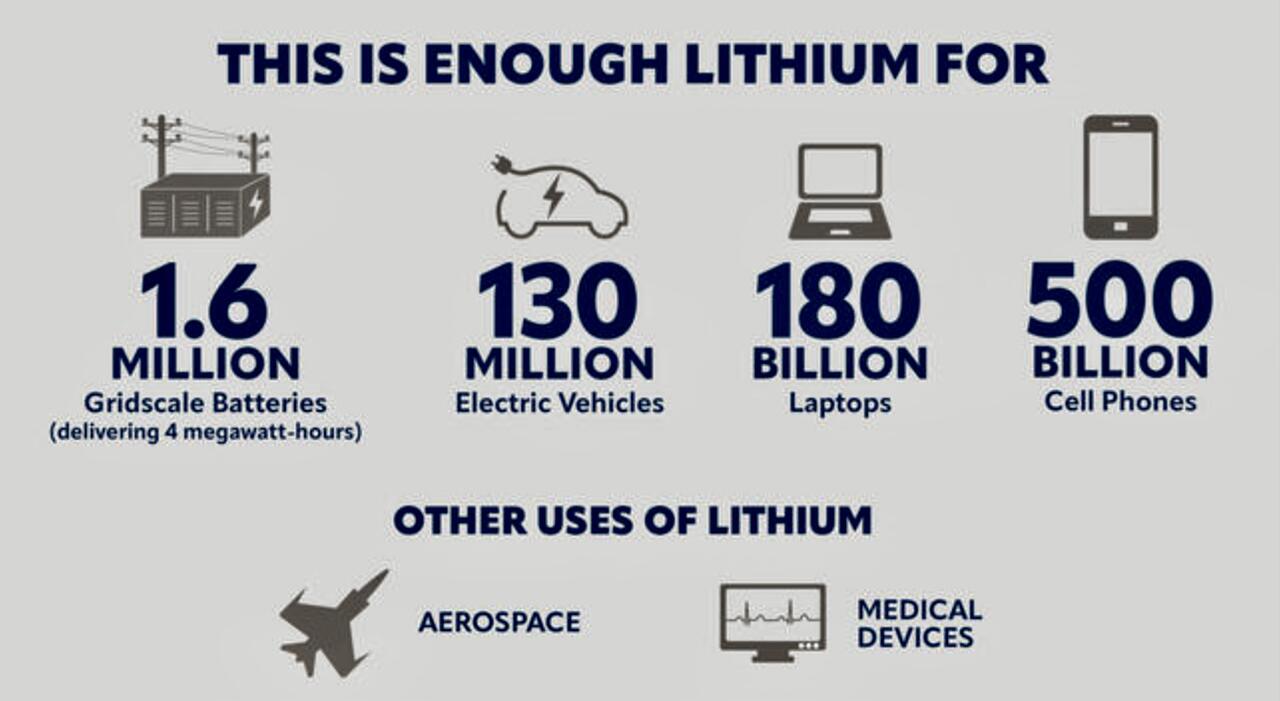
The deposits are spread over a large swath of territory. The southern Appalachians — primarily the Carolinas — have about 1.43 million metric tons, while the northern Appalachians hold 900,000 metric tons, most of it in Maine, New Hampshire and Vermont, USGS says. Added up, it’s enough to put the requisite lithium in 130 million electric vehicles, or a thousand years worth of laptop production.
USGS project global lithium production capacity will double over the next three years. In April, Finland became the first European country to host the full continuum of lithium production, from an open-pit mine that produces battery-grade lithium hydroxide, to a refinery. “The €783 million project is operated by Keliber Oy, a Finnish mining and battery-materials company,” EuroNews reported.
Today, there’s only one operating lithium mine in America: the Albemarle Silver Peak Mine in Nevada. Earlier this week, environmentalists sued to stop exploratory drilling in Oregon near the Nevada border. The US Bureau of Land Management had given the green light for HiTech Minerals to set up 168 drill sites over five years, on a 7,200-acre expanse of public land. The plaintiffs include “Great Old Broads for Wilderness.” In a 2024 analysis, USGS concluded that brines in southwest Arkansas’ Smackover Formation hold 5 to 19 million metric tons of lithium, but didn’t determine what proportion is economically recoverable.
To say the more-promising Appalachian deposits were created a long time ago is an understatement. “Lithium-rich pegmatites in the northern Appalachians formed from the same geologic forces that built the mountains more than 250 million years ago,” explained the USGS, a Department of the Interior organization and the country’s largest water, earth and biological science mapping organization. “The high heat and pressure during the mountain-building caused some of the deeper crustal rocks to melt, and some of these magmas were rich in lithium.”
What Is the Trump Administration Really Trying To Do With The Latest Comey Indictment?
On Tuesday, a federal grand jury in the Eastern District of North Carolina handed down a two-count indictment against the former FBI director James Comey, charging him with threatening the life of President Donald Trump and transmitting that threat across state lines.
The basis for the charges: an Instagram post from May 2025 in which Comey shared a photo captioned “Cool shell formation on my beach walk.” The shells on the sand spelled out “86 47.” Each count carries a maximum of ten years in federal prison.
Comey deleted the post the same day it went up and issued an immediate clarification on social media. “I didn’t realize some folks associate those numbers with violence,” he wrote. “It never occurred to me, but I oppose violence of any kind, so I took the post down.” He later told interviewers that he and his wife had simply spotted the formation during a stroll along a North Carolina beach and read it as a quirky, possibly restaurant-themed joke. Despite the dubious explanation, from the moment the post became controversial, legal analysts were skeptical that a case against him was possible.
There still appears to be bipartisan agreement on this point.
“It’s a seashell case, nine, ten months old, and it will never go anywhere,” Joe Scarborough said on MSNOW’s Morning Joe. “It will have the opposite impact, and they’ll get laughed out of court.”
Constitutional scholar Jonathan Turley, one of Trump’s more reliable legal allies, agreed the case has little legal merit, despite the indictment.
“To convict Comey, the Justice Department will have to show that his adolescent picture was a ‘true threat’ under 18 U.S.C. § 871 and § 875(c). It is not.” He went further, invoking the founding era: “This nation was founded in rage. The Boston Tea Party was rage. In forming this more perfect union, we created the world’s greatest protection of free speech in history.” Not exactly a ringing endorsement of the prosecution’s theory.
First Amendment protections for political speech are remarkably broad. Under Brandenburg v. Ohio, the Supreme Courtheld that the government cannot punish inflammatory speech unless it is “directed to inciting or producing imminent lawless action and is likely to incite or produce such action” – a standard that has shielded provocateurs far more combustible than a retired FBI director posting a picture of seashells.
Former CNN analyst Chris Cillizza has his own theory about what is really behind this latest indictment. According to Cillizza, Trump is less concerned about whether Comey goes to jail than he is with just making Comey’s life miserable.
“It’s impossible to separate both of those indictments, the one in September and the one today, from Donald Trump’s absolutely repeatedly expressed belief that the Department of Justice exists to target and punish his political enemies,” Cillizza mused. “Now, again, whether they would actually be guilty in a court of law, we shall see, but to punish these people. So we saw Comey indicted in September 2025, since dropped. We saw Letitia James, another big political enemy in Donald Trump’s mind of his, also indicted, charges dropped. We’ve seen John Bolton, the, a major Trump critic, indicted, and now we see Comey indicted again.”
Donald Trump doesn’t really care if Jim Comey goes to jail.
Cillizza gets some things wrong here. The Letitia James and the previous Comey case were tossed by a Clinton-appointed judge who claimed that the Justice Department illegally appointed the prosecutor who brought the charges at President Donald Trump’s urging. They were not tossed on the merits.
Is Trump trying to make life difficult for his enemies? Acting Attorney General Todd Blanche pushed back on this suggestion on CBS Tuesday, insisting the administration had been investigating the matter for nearly a year and that a grand jury – not the White House – returned the indictment. “Of course not, absolutely, positively not,” Blanche said when asked whether Trump directed the charges. The indictment itself argues that a “reasonable recipient who is familiar with the circumstances” would interpret the shell arrangement as a serious expression of an intent to do harm to President Trump. That framing will be tested the moment a federal judge reads the First Amendment.
There is a certain irony lodged in all of this. Trump spent years – genuinely – defending himself from what he called a weaponized justice system. The Russia investigation, the two bogus impeachments, the civil fraud trial in New York, the classified documents case, the January 6 prosecution: whatever one thinks of any individual charge, the cumulative weight of it was real and politically motivated in ways that even Trump’s critics occasionally acknowledged.
But out of those assaults, the president emerged convinced that the DOJ had become a political instrument and that the only way to respond was to go after those who abused their power in the first place.
The trouble is that a seashell photograph does not make for a compelling demonstration of that principle. There are documented, substantive cases to be made against Comey – his handling of the Hillary Clinton email investigation, his unauthorized leaking of memos to the press, and his role in initiating the surveillance of a sitting president’s campaign. Those are the cases that would survive scrutiny, attract serious legal arguments, and perhaps hold up before a jury. Instead, the administration is going to federal court over a photo of seashells.
Blanche said Tuesday, “If anybody in this country thinks … that it is okay for anybody to threaten the president of the United States … then we have a bigger problem than I even imagined.” That may be true. But first you have to prove the threat was real – and that argument, and experts on both sides aren’t seeing how this meets that standard.
Trump Says Gas Prices Will Drop “Like a Rock” Once Conflict Ends, As Senator Breaks With GOP Leadership On War Powers
Summary
Trump: “The [price of] gasoline and the oil will go down rapidly once the war’s over.” GOP Sen. Collins switches vote on war powers.
Bessent on X: “Amid the impact of Economic Fury, Iran’s currency has hit an all-time low. The Iranian people deserve a new era, which the corrupt and shambolic Iranian regime cannot provide.” Signals hope for uprising, regime change.
Israeli Defense Minister Katz: “soon we will need to act again in Iran to ensure that the regime cannot threaten Israel for years to come.” Oil spikes on this and new reports of Israeli defense build-up at ports, air hubs.
Not giving up nuclear program: Iran will “guard” its “advanced technologies” like it does its own borders, Mojtaba Khamenei said in a written speech read aloud by state TV. It will “secure the Persian Gulf region and dismantle the hostile enemy’s exploitation of this waterway.”
US military teases cutting-edge, not yet tested in battle, hypersonic missiles for Mideast region as CENTCOM head set to brief Trump on further military options at White House.
Trump’s ‘Assurances’ To Americans as GOP Members Start to Scramble
The Iran war and Hormuz closure remains a game of geopolitical chicken, where each side believes it can inflict more pain on the other while being the one to outlast. But Iran, while being subject to a years long sanctions regimen and recent large-scale US-Israeli bombing campaign, does not operation on 4-year and 2-year election cycles. With next fall’s midterms staring Congressional Republicans in the face, there this increasingly uncomfortable trend: The average price of one gallon (3.8 litres) of gasoline in the United States has reached $4.30, according to the American Automobile Association (AAA), up from less than $3 before the February 28 start of the US-Israel war on Iran.
President Trump addressed this in fielding questions in the Oval Office on Thursday,telling reporters that gas prices would “drop like a rock” as soon as the Iran war ended.
“The [price of] gasoline and the oil will go down rapidly once the war’s over,” he stated confidently – “like a rock,” he added.
President Trump cuts off a reporter when informed that the average price of gas is now $4.30.
Trump: “Yeah. And you know what? We’re not gonna have a nuclear weapon in the hands of Iran. The gas is gonna go down. As soon as the war’s over it’ll drop like a rock.” pic.twitter.com/0bCxak9d3w
However, the war is about to hit 60-days on Friday and America’s overall strategy and timeline remains anything but clear. Instead, Trump is insisting the Iranians have “nothing” in terms of a military, and yet the crisis in global energy remains, and Operation Epic Fury is still on, the extended uneasy ceasefire notwithstanding…
President Trump on Iran:
“They’re sitting in a cave and all their leaders are dead… They have no navy, they have no air force, they have no nothing. We can fly right over the middle of Tehran without being shot at because they have no anti-aircraft. They have nothing.” pic.twitter.com/L7AVoV90ZZ
Meanwhile, an interesting argument (below) from Hegseth this week, as Congress is supposed to vote on a formal war authorization once any foreign conflict hits the 60-day mark, per US law.
And the first Republican Senator has ‘switched’ and broken ranks with GOP leaders on Trump’s Iran war and Congressional authorization:
Centrist Sen. Susan Collins (R-Maine) on Thursday broke ranks with Republican leaders and most GOP colleagues by voting for a war powers resolution sponsored by Sen. Adam Schiff (D-Calif.) to halt military actions against Iran, the first Republican senator to change her position on curtailing President Trump’s military authority.
Rand was over there getting lonely defending the Constitution, but the longer the Iran conflict persists – and Americans feel it at the pump – the more Republican members will likely peel off:
Collins joined Sen. Rand Paul (R-Ky.) in voting to advance a resolution to withdraw U.S. military forces from the conflict with Iran unless Congress votes to authorize the use of force.
She and Paul voted with most Democrats for a motion to discharge the resolution from the Senate Foreign Relations Committee, but it still failed by a vote of 47 to 50.
It marked the sixth time that Senate Republicans have defeated a resolution under the 1973 War Powers Act to halt further military operations against Iran.
HEGSETH: On Iran, we are in a ceasefire right now, which I understand means the 60 day clock pauses or stops
Bessent Gloats Over Iran’s Collapsing Currency, Signals Hope For Uprising
Amid chatter that Israel could be preparing for renewed attacks on Iran, and as Trump is said to be mulling more limited strikes – but while at the same time the USS Gerald R Ford is returning to the United States after a record deployment – Iran is signaling it is ready for a long war and can endure the US naval blockade for a long time to come. However, there are also unconfirmed reports out of Pakistan that another draft peace proposal could be presented by Tehran as soon as this weekend. Iranian President Masoud Pezeshkian has newly said Thursday the blockade is effectively an “extension of military operations” by Washington, despite the extended ceasefire declared by Trump.
Also on Thursday, US Treasury Secretary Scott Bessent signaled that the US administration gameplan seems to be to drive Iran into economic ruin, in hopes of triggering some kind of uprising toward regime change. But this was the exact same ‘prediction’ and gameplan in the opening days of the war – which never materialized. One the one hand his below message on X seems to gloat over imposing widescale misery over the bombed-out country, while on the other claiming to help and support the Iranian people, saying they “deserve a new era”.
As we reported earlier, Iran’s currency on Wednesday collapsed to a record low, plunging to 1.8 million rial per dollar amid the prolonged US-Israel war and uneasy ceasefire, also as surging global energy prices hit the economy. The rial began sliding sharply two days prior to this after weeks of artificial stability. In the early phase of the war that kicked off on February 28, the currency held steady due to a near-total halt in imports and limited market activity.
Amid the impact of Economic Fury, Iran’s currency has hit an all-time low.
The Iranian people deserve a new era, which the corrupt and shambolic Iranian regime cannot provide.
With their oil industry closing and their currency plummeting, it is past time for the Iranian regime… pic.twitter.com/k7QvKoWbl2
— Treasury Secretary Scott Bessent (@SecScottBessent) April 30, 2026
Oil Spikes on Israeli Defense Chief’s Threats of New Strikes
Israel Defense Minister Katz has said in a Thursday briefing: “It is possible that soon we will need to act again in Iran to ensure that the regime cannot threaten Israel for years to come,” according to a local reporter.
According to more, he said that while Israel supports the United States’ diplomatic efforts with Iran, it may “soon be required to act again” to remove the “existential threats” posed by the Islamic Republic.
“Iran has suffered extremely severe blows over the past year, blows that have set it back years in all areas,” Katz continued at a military ceremony. “US President Trump, in coordination with Prime Minister Benjamin Netanyahu, is leading the effort to complete the campaign’s objectives in a way that ensures Iran will not return to being a threat to the existence of Israel, to the United States, and to the free world for generations to come,” he added. “We support this effort and provide the necessary backing, but we may soon be required to act again to ensure the objectives are achieved.” Oil prices shooting back up on the headline, and as Israeli media reports on a new military build-up and US defense aid at the country’s ports…
The below is via AP on a “new plan” being mulled by Trump:
Under the plan, the United States would continue its blockade on Iranian ports, while coordinating with allies to impose higher costs on Iran’s attempts to subvert the free flow of energy, according to a senior administration official. Trump is weighing multiple diplomatic and policy options to push Iran to end its chokehold on the waterway, said the official, who spoke on condition of anonymity because they were not authorized to comment publicly.
Khamenei: Protect Nuclear Program, Gulf Region Will Have Future Without America
Ayatollah Mojtaba Khamenei has never released video or voice messages, and he’s still not been seen or even photographed since the war’s start, and is believed to be severely injured and recovering. State TV on Thursday read aloud his written speech, which struck a defiant tone, declaring that the only place Americans belonged in the Persian Gulf is “at the bottom of its waters” and that a “new chapter” was being written for the whole region. State media cited security as the reason for having to read aloud his statement.
Khamenei says Iran will closely guard and protect its nuclear and missile capabilities, a clear and direct rejection of President Trump’s demand to hand over enriched uranium as the basis for a deal. Iranians will cling to the country’s nuclear and missile capabilities “as their national capital and will guard them like water, land and air borders,” Khamenei said.
Chilling: Iran supreme leader issues statement saying:
— only place Americans belong in Persian Gulf is ‘at the bottom of its waters
— Iran will protect nuclear capability
—Iran will keep Hormuz
“By God’s help and power, the bright future of the Persian Gulf region will be a future without America, one serving the progress, comfort and prosperity of its people,” Khamenei continued. “We and our neighbors across the waters of the Persian Gulf and the (Gulf) of Oman share a common destiny. Foreigners who come from thousands of kilometers away to act with greed and malice there have no place in it – except at the bottom of its waters.” He also vowed Iran’s forces will “secure the Persian Gulf region and dismantle the hostile enemy’s exploitation of this waterway.”
US Teases Hypersonic Missiles, CENTCOM to Brief Trump
As we detailed Wednesday night, United States Central Command has requested deployment of the Army’s long-delayed hypersonic Dark Eagle to the Middle East for potential use against Iran, seeking a longer-range capability to strike ballistic missile launchers deep inside the country, Bloomberg first reported. If approved, the move would mark the first deployment of the hypersonic system, which remains behind schedule and has not been declared fully operational, even as Russia and China have already long ago fielded their own versions.
The Pentagon has claimed time and again of late that it has local air superiority, meaning that in some parts of Iran its aircraft can operate without facing much of a threat. And yet dozens of MQ-9 aircraft, plus several crewed fighters, have been downed, showing that other parts of Iran’s airspace remain dangerous.
The Bloomberg report hit just as Axios rehashed an earlier report, according to which President Trump will receive a briefing on new plans for potential military action in Iran on Thursday from CENTCOM Commander Adm. Brad Cooper. The briefing signals that “Trump is seriously considering resuming major combat operations either to try to break the logjam in negotiations or to deliver a final blow before ending the war.”
Meanwhile the Iranian side has been claiming dozens of its vessels have breached the US naval blockade, which the Pentagon has been denying. Others say that while some ships have traversed the strait, they have not actually fully crossed the blockade.
Fifty two Iranian vessels have crossed a US-imposed blockade of Iranian waters within a 72-hour period… https://t.co/mZrwK5qijI
The head of the International Energy Agency (IAEA) has emphasized in new remarks that the world is facing its biggest energy crisis in history due to the war. “The oil markets and gas markets are going through big difficulties. When I looked last time, the oil price was over $120 which is putting a lot of pressure on many countries,” executive director Fatih Birol said at a conference in Paris. “Our world is facing a major economic and energy challenge.”
Indeed, benchmark Brent crude for June delivery reached as much as $126 a barrel in trading on Thursday, before easing to $114 – as oil prices have surge to their highest levels since 2022 as Trump mulls a military-enforced Iran blockade extension.
Iranian leadership in the meantime continues to troll the US over rising oil and gas prices, using its significant geographic leverage over global markets…
3 days in, no well exploded.We could extend to 30 and livestream the well here.
That was the kind of junk advice the US admin gets from people like Bessent who also push the blockade theory and cranked oil up to $120+. Next stop:140. The issue isn’t the theory, it’s the mindset.
— محمدباقر قالیباف | MB Ghalibaf (@mb_ghalibaf) April 29, 2026
More Latest Developments
via Newsquawk
US CENTCOM is to brief US President Trump on new plans for potential military action in Iran on Thursday, Axios reported citing sources; plan includes a short and powerful strike potentially targeting infrastructure to break the nuclear issue deadlock. Other options expected to be presented include a plan to take over part of the Strait to allow for commercial shipping, which could involve ground forces, and a special forces op to secure Iran’s uranium stockpile.
US CENTCOM has asked to send the Army’s hypersonic missile to the Middle East for possible use against Iran, Bloomberg reported citing sources.
US CENTCOM said the US navy has redirected 42 vessels from the blockade in the Strait of Hormuz and that the military is fully committed to enforcing the blockade.
US President Trump told Israeli PM Netanyahu that Israel should only take surgical military action in Lebanon and avoid a full resumption of the war, Axios reported.
US Treasury Secretary Bessent said sprinting for the finish line with Iran, according to Fox Business; willing to do secondary sanctions on Iran oil buyers. Every day adding more economic pressure to Iran. Close to half a billion in Iran-related crypto seized. Consumers and stock market are looking through Iran. UAE and others have requested swap lines, swap lines are not a bailout.
Iran lawmaker Mottaki says a naval blockade would amount to a declaration of war, and that fighters could decide as soon as tomorrow or next week to remove such obstacles via military action.
Iran’s Navy Commander said the Islamic Republic will soon unveil a new weapon that would deeply terrify the enemy, IRNA reported. He said Iran has closed the strategic Strait of Hormuz from the Arabian Sea. Condemned the US’s illegal seizure of several Iranian vessels as part of the blockade, which he said amounted not only to “piracy” but also “hostage-taking”.
Iran’s Navy commander warns that Iran will soon face its enemies with a very dreadful weapon that will strike fear into their hearts, according to Press TV.
Pakistan’s Foreign Ministry said channels of dialogue with officials in Washington and Tehran remain open, Al Hadath reported. ““The clock on diplomacy has snit stopped. We remain hopeful for a negotiated settlement on this issue. We will continue with our sincerest efforts”,.
China’s Military said they conducted combat readiness patrols near Scarborough Shoal, according to a statement.
“No point” in negotiating over zero enrichment, Iranian lawmaker said, Al Jazeera reported; adding “I have no objection to going to the negotiating table, but we should have looked more closely at how to proceed”.
The US administration is asking countries to join a new international coalition that would enable ships to navigate through the Strait of Hormuz, WSJ reported. The Maritime Freedom Construct would be a US-led coalition that would share information, coordinate diplomatically and enforce sanctions.
A surveillance drone near the US embassy in Baghdad has been shot down, according to Iraqi security sources.
Iranian Navy Commander said we have closed the Strait of Hormuz from the Arabian sea side and will take swift action if enemy advances, Al Araby reported.