60.4 F
Chicago
Saturday, October 31, 2026
Home Blog Page 612

Does Altman Molotov Attack Portend Pitchforks Over AI?

Does Altman Molotov Attack Portend Pitchforks Over AI?

Things might be going kinetic in the backlash against data centers and AI. 

On Friday, a 20-year-old suspect set on burning down OpenAI headquarters was charged and arrested following a predawn Molotov cocktail attack on OpenAI CEO Sam Altman’s house in the Russian Hill neighborhood of San Francisco.

OpenAI CEO Sam Altman’s home on Russian Hill in San Francisco, whose driveway is shown Friday, was the target of an incendiary device, police said.
Lea Suzuki/S.F. Chronicle

Daniel Alejandro Moreno-Gama, 20, from Texas, was arrested and booked into County Jail hours after the incident. He faces multiple felony charges including attempted murder, arson, making criminal threats, and two counts each of possession or manufacture of an incendiary device and possession of a destructive device. He is being held without bail.

“Thankfully it bounced off the house and no one got hurt,” Altman wrote in a blog post. 

According to police and OpenAI, the attack unfolded around 3:40–3:45 a.m. on April 10 when Moreno-Gama allegedly hurled a flaming bottle at the metal gate of Altman’s home at 855 Chestnut Street in the Russian Hill neighborhood. The device ignited a small fire that was quickly extinguished by on-site security, causing only minor damage and no injuries; it reportedly bounced off the house. The suspect then fled to OpenAI’s Mission Bay headquarters, where he allegedly threatened to burn down the building. Officers recognized him from surveillance footage of the residence attack and took him into custody without further incident.

OpenAI issued a brief statement confirming the events and thanking SFPD for the rapid response, noting that security had been stepped up at company offices.

Hours later, Altman published a strikingly personal blog post that has generated almost as much discussion as the attack itself. Read Altman’s full post here. In it, he shared a rare family photo with his husband Oliver Mulherin and their child, writing: “Here is a photo of my family. I love them more than anything. Images have power, I hope… Normally we try to be pretty private, but in this case I am sharing a photo in the hopes that it might dissuade the next person from throwing a Molotov cocktail at our house.”

Altman described himself as “awake in the middle of the night and pissed,” admitted he had underestimated “the power of words and narratives,” and linked the moment to broader anxiety about AI, including a recent critical profile. The post mixes personal apologies and reflections on past conflicts (including the Elon Musk trial and OpenAI board drama), a dramatic Lord of the Rings “ring of power” metaphor for the AGI race, and a call to “de-escalate the rhetoric and tactics and try to have fewer explosions in fewer homes, figuratively and literally.” 

The timing and tone of Altman’s response appear to underscore a deeper reality now playing out across the country: financially strained American households are increasingly pushing back against the infrastructure demands of the AI industry. New data this week shows residential electricity prices surging in key regions, driven in large part by the explosive growth of data centers needed to train and run large language models. Communities from Virginia to Georgia to the Midwest have mounted growing resistance – through zoning fights, moratoriums, and public hearings – over electricity costs, water consumption, land use, and limited local economic benefits, marking what one analysis described as a sharp escalation in Americans starting to revolt against data centers.

In response to the pressure, Amazon, Google, Meta, Microsoft, OpenAI, Oracle, and xAI this week signed a Trump-administration-brokered “Ratepayer Protection Pledge” committing the companies to fully fund their own new power generation, transmission upgrades, and grid improvements so that ordinary ratepayers are not left footing the bill. The move follows an emergency intervention directing the nation’s largest grid operator to hold a special auction shifting billions in costs away from households.

This backlash is fueled not only by soaring electricity costs but also by deep-seated fears that AI and large language models will trigger widespread job displacement. Many Americans, particularly recent graduates and white-collar workers, worry that rapid automation of cognitive and knowledge-based work will leave large segments of the labor force behind. Are we on the cusp of a new luddite revolution?

Wanna read something scary? Stanford software engineering grads aren’t finding work…

“Stanford computer science graduates are struggling to find entry-level jobs” with the most prominent tech brands, according to the university’s Jan Liphardt, an associate professor in bioengineering.

While the rapidly advancing coding capabilities of generative AI have made experienced engineers more productive, they have also hobbled the job prospects of early-career software engineers.

Stanford students describe a suddenly skewed job market, where just a small slice of graduates — those considered “cracked engineers” who already have thick resumes building products and doing research — are getting the few good jobs, leaving everyone else to fight for scraps.

“There’s definitely a very dreary mood on campus,” said a recent computer science graduate who asked not to be named so they could speak freely. “People [who are] job hunting are very stressed out, and it’s very hard for them to actually secure jobs.”

The shake-up is being felt across California colleges, including UC Berkeley, USC and others. The job search has been even tougher for those with less prestigious degrees. –LA Times 

While the vast majority of this pushback remains peaceful and policy-focused, the Molotov incident may be the first kinetic action in the luddite revolution. Altman himself seemed to nod to that anxiety in his post, acknowledging that “the fear and anxiety about AI is justified” and calling for societal resilience, economic transition support, and democratization so that “power cannot be too concentrated.”

Tyler Durden
Sat, 04/11/2026 – 21:35

China’s BYD Introduces 3.9-Second 0-60 Electric SUV With Massive Range

China’s BYD Introduces 3.9-Second 0-60 Electric SUV With Massive Range

Authored by Bojan Stojkovski via Interesting Engineering,

The BYD Great Tang full-size SUV is now reaching dealerships across China ahead of its planned April presale debut at the Beijing Auto Show. Early dealer data shows at least four configurations are being prepared for the market, spanning rear-wheel-drive and all-wheel-drive setups with varying performance and range ratings. 

BYD Great Tang SUV set to challenge established plug-in hybrid rivals.

In its most capable form, the SUV is expected to deliver up to around 590 miles of driving range, positioning it as a long-distance option in the segment. As the production version of the Dynasty-D concept, the Great Tang sits at the top of BYD’s SUV lineup, both in size and technology. [ZH: The range claim comes from the Chinese CLTC test cycle, which tends to be a bit optimistic]

It measures more than 17.4 feet in length and rides on a 123-inch wheelbase, making it the brand’s largest crossover to date. The model is designed with a three-row, seven-seat configuration, targeting family-oriented buyers seeking space, efficiency, and extended electric range.

3.9-second acceleration and extended-range capability

The all-electric BYD Great Tang uses the company’s second-generation Blade Battery architecture and is designed to support high-power fast charging for reduced downtime on long trips. In its rear-wheel-drive configuration, the SUV delivers up to approximately 590 miles of CLTC range from a 130.15 kWh battery pack, placing it among the longest-range electric SUVs currently announced in China, CarNewsChina reports.

Performance is significantly higher in the dual-motor all-wheel-drive variant, which produces up to 585 kW and can accelerate from 0 to 62 mph in about 3.9 seconds. This added performance comes with a trade-off in efficiency, with range reduced to around 528 miles CLTC, though it still remains competitive within the long-range EV SUV segment.

In addition to the fully electric lineup, BYD will also introduce plug-in hybrid versions of the Great Tang built on its DM-i and DM-p powertrain systems. The DM-i variant pairs a 1.5-liter turbocharged gasoline engine with a 200 kW electric motor, delivering up to approximately 213 miles of CLTC electric-only range, positioning it for efficiency-focused driving and daily commuting.

The DM-p configuration steps up output significantly, using a dual-motor setup that produces a combined 400 kW. This version is tuned for stronger acceleration and more dynamic driving characteristics, while still retaining the flexibility of a hybrid system that blends combustion and electric power for extended range capability.

Aiming for upper mid-market SUV space amid strong competition

The Great Tang is being strategically positioned within BYD’s broader SUV portfolio to avoid internal overlap with its premium Denza lineup while still targeting the upper tier of the mainstream market. This placement suggests a focus on balancing scale, technology, and accessibility within the rapidly expanding full-size SUV segment.

In the competitive landscape, the model is expected to go head-to-head with rivals such as the Geely Galaxy M9, a large plug-in hybrid SUV that has already demonstrated strong early market traction with more than 11,000 deliveries in just the first two months of the year. 

The segment is becoming increasingly crowded, with demand driven by families and long-distance users seeking a mix of electric efficiency and extended range flexibility.

Tyler Durden
Sat, 04/11/2026 – 21:00

Bitcoin Could Be Quantum-Safe Without Protocol Changes, New Proposal Claims

Bitcoin Could Be Quantum-Safe Without Protocol Changes, New Proposal Claims

Authored by Micah Zimmerman via Bitcoin Magazine.coim

A new research proposal claims it can make Bitcoin transactions resistant to quantum attacks without changing the network’s core rules, a goal that has drawn attention as concerns grow over future cryptographic risks.

In a paper published on April 9, Avihu Levy of StarkWare outlined “Quantum-Safe Bitcoin Transactions Without Softforks,” introducing a scheme called Quantum Safe Bitcoin, or QSB. The design aims to protect transactions from threats posed by quantum computers while remaining compatible with the existing Bitcoin protocol.

The proposal targets a known vulnerability in Bitcoin’s current design. Standard transactions rely on ECDSA signatures over the secp256k1 curve. In theory, a sufficiently powerful quantum computer running Shor’s algorithm could potentially break this system by solving discrete logarithms, which would allow attackers to forge signatures and spend funds.

QSB replaces reliance on elliptic curve security with hash-based assumptions. Instead of trusting ECDSA, the scheme uses it as a verification mechanism while shifting security to hash pre-image resistance. This approach draws from earlier work known as Binohash, which embeds one-time signature schemes into Bitcoin Script.

At the core of QSB is a “hash-to-signature” puzzle.

The system hashes a transaction-derived public key using RIPEMD-160 and treats the output as a candidate ECDSA signature. Only a small fraction of random hashes meet the strict formatting rules required for valid signatures, creating a proof-of-work condition. The paper estimates the probability of success at about one in ~70.4 trillion attempts.

Bitcoin resistant to quantum attacks

Because the puzzle depends on hash properties rather than elliptic curve hardness, it remains resistant to Shor’s algorithm. A quantum attacker would gain only a quadratic speedup from Grover’s algorithm, leaving meaningful security margins. The paper estimates about 118-bit second pre-image resistance under a Shor threat model.

The construction works within Bitcoin’s existing scripting limits, including a cap of 201 opcodes and a maximum script size of 10,000 bytes. It uses legacy script structures and avoids any need for consensus changes or soft forks, a feature that may appeal to developers wary of protocol fragmentation.

The transaction process unfolds in three stages, the proposal claims.

  • First, a “pinning” phase searches for transaction parameters that produce a valid hash-to-signature output, binding the transaction to a fixed structure.

  • Next, two digest rounds select subsets of embedded signatures to generate additional proofs tied to the transaction hash.

  • Finally, the transaction is assembled with all required preimages and verification data.

The design introduces tradeoffs. QSB transactions exceed standard relay policy limits, which means they would not propagate across the network under default settings. Instead, they would require direct submission to miners through services such as Slipstream. The scripts also consume significant space and computational resources.

Despite these constraints, the cost of generating a valid transaction appears within reach. The paper estimates total compute expenses between $75 and $150 using cloud GPUs, with the workload scaling across parallel hardware. Early testing reports successful puzzle solutions after several hours using multiple GPUs.

The project remains incomplete. While the paper and script generation tools are finished, parts of the pipeline, including full transaction assembly and broadcast, have not been demonstrated on-chain.

Still, the proposal adds to a growing body of research exploring how Bitcoin could adapt to a future with quantum computing. By avoiding protocol changes, QSB presents one path that relies on existing rules rather than consensus upgrades, a direction that may shape further debate on long-term network security.

[ZH: Brain fogged over? QSB makes the hard math puzzle at the heart of Bitcoin… harder…]

Tyler Durden
Sat, 04/11/2026 – 19:50

Car-Shopping Websites Report Uptick In EV Interest Following Gasoline Price Shock

Car-Shopping Websites Report Uptick In EV Interest Following Gasoline Price Shock

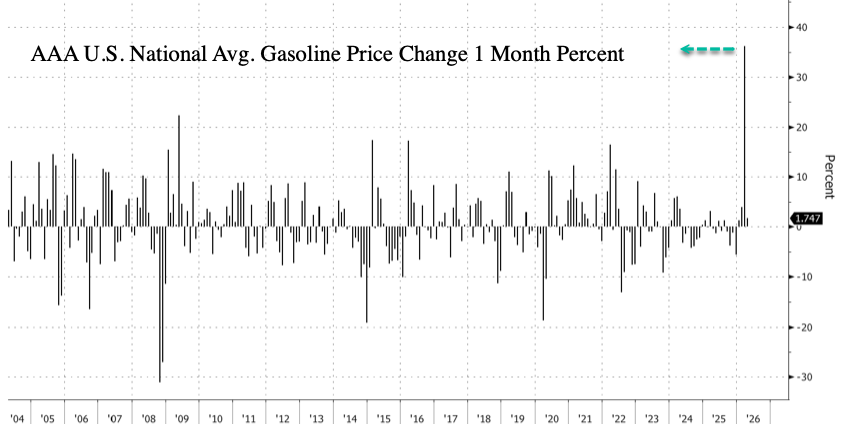
March brought the biggest fuel price shock Americans have experienced on record, or at least according to AAA data going back to the early 2000s.

A fuel price shock changes consumer behavior, especially for low-income households, by forcing folks to drive less, combine trips, cancel discretionary travel, or shift to carpooling and public transit.

For those who have the financial flexibility to do so, a fuel price shock may push some consumers toward smaller cars, hybrids, and EVs and away from large SUVs and trucks, because fuel economy suddenly matters much more.

The Wall Street Journal reports that a $4-per-gallon national average for gasoline, a politically sensitive level, is the threshold at which some consumers are beginning to think about EVs again.

Online car-shopping platforms such as Cars.com and Edmunds have reported a modest uptick in EV interest among users on their platforms in recent weeks. 

Edmunds pointed out that interest in EVs on its website has returned to where it was before federal tax incentives expired late last year.

“In the short term, a lot of Americans, and this has nothing to do with regulations, are coming back to EVs because of the cost of ownership,” Hyundai Motor Chief Executive José Muñoz told the WSJ. “Basically, the fuel costs are making them change their decision.”

Muñoz said that EVs are finding a place in the driveways of households in states like California because it makes economic sense to commute to work during the week in EVs rather than gasoline-powered cars. 

He said the thinking in some households is: “I have one car from Monday to Friday, another car for the weekend.”

We must point out that far-left states like California suffer from state-killing climate policies and terrible energy policies that are crushing households on the pocketbook level. 

Data from Cox Automotive shows that EV sales jumped 12% in the first quarter as a flood of off-lease EVs swamped the market, pushing prices lower and making them more affordable.

Edmunds data show that EVs accounted for roughly 6.2% of new-car sales in March, up from 6% in February, but this is noticeably down from September, when EVs accounted for 11.5% of sales. Higher EV sales last year were mostly driven by consumers seeing that federal tax credits were expiring at the end of the year, think of it as demand pulled forward.

Stephanie Valdez Streaty, director of industry insights at Cox Automotive, said the surge in gasoline and diesel prices at the pump during the six-week U.S.-Iran conflict led to “an uptick in consideration” of EVs. She said driving habits are hard to change, considering Americans enjoy the luxury of large SUVs and trucks.

Meanwhile, Chinese EV exports soared 140% in March, driven by surging demand outside the US amid Gulf-related energy shocks. 

Tyler Durden
Sat, 04/11/2026 – 19:15

It’s A MMIWG2SLGBTQQIA+ World And We’re Just Living In It

It’s A MMIWG2SLGBTQQIA+ World And We’re Just Living In It

Authored by Rick Moran via PJMedia.com,

What is MMIWG2SLGBTQQIA+? It might be a new, super-strong password. Maybe it’s a Gen-Whatever code-like thing that’s sweeping the internet, like “6-7” or something.

If only it could be that mundane.

In fact, MMIWG2SLGBTQQIA+ is an all-inclusive, all-encompassing, balls-to-the-wall, slam bang, wham-bam-thank-you-ma’am acronym for the totality of the gender bending, sexually “unique” population of Canada. 

For the record, as Jim Treacher helpfully points out, it stands for “Missing and Murdered Indigenous Women and Girls, Two-Spirit, Lesbian, Gay, Bisexual, Transgender, Queer, Questioning, Intersex, Asexual, and “additional identities (“+”).

The excitement was started by a Canadian New Democratic Party member of parliament, Leah Gazan, who complained that not enough money was being spent to “deal with the ongoing genocide of MMIWG2SLGBTQQIA+.”

Budgeting for each and every identity, preference, and fantasy spirit in the MMIWG2SLGBTQQIA+ community would blow up the Canadian budget. 

I fondly recall when sexual preference identities were simple: LGB and maybe T, XYZ, believe you me. It was easy. It was a simpler time then. We didn’t have to worry about offending someone by using the wrong pronoun. We didn’t have to worry about making some poor, disturbed “T” or “Q” explode in tears from being misgendered.  

It would be so much easier (and we’d be less likely to offend) if the MMIWG2SLGBTQQIA+ “community” would just walk around with name tags identifying which gender they are, what their sexual identity is, and most importantly, what pronouns they prefer to be referred to.

Yes, that’s a joke. No Nazi “Star of David” references, please.

Not that I’d use them. But since misgendering is going to be an Olympic sport in 2030, it would be helpful to know who we should insult. 

Treacher tried and failed to keep a straight face in reporting on this phenomenon.

Okay, for real, this is a serious topic. You don’t want to see women kidnapped and murdered.

Not most women, anyway. I mean, there are names that come to mind…

But no. Nobody should go through that.

Mostly.

And of course, since that’s such a long acronym and that woman just rattled it off like it’s a normal thing to say, people are having some fun with it today. “Got my new password!” That sort of thing.

There’s a British comedian named Damian Slash who has perfected a sort of straight-faced satire of… liberal excesses, let’s put it that way. Here he is explaining why MMIWG2SLGBTQQIA+ is no joke.

The internet being the internet, there was a slanderous fake news take on this story that claimed Canada was updating its LGBTQ+ acronym to MMIWG2SLGBTQQIA+.

Pink News, whose goal is to “empower generations to embrace and shape the future – making the world a gayer place,” says that simply isn’t true.

“She [Gazan] used MMIWG2SLGBTQQIA+ as a catch-all term,” says Pink News. 

“Catch-all?” Really? That’s a pretty wide net to use as a “catch-all.” 

“Various social media sites began reporting that Canada has now officially updated the LGBTQ+ acronym to MMIWG2SLGBTQQIA+, which isn’t the case,” we’re informed by Pink News.

 It’s impossible to parody leftists who are blissfully unaware of their own stupidity.

Okay, so why is this so annoying? Why does this bug me so much? Why is liberalism so irritating?

Because that’s what’s going on here. It’s not about making fun of people who are in trouble. It’s not about making fun of these women.

It’s about not just being able to say that. That these women are in trouble. They need help. Just say that they’re missing women. They’re possibly murdered. Just say that.

But that’s not inclusive.

Precisely. If this really were about saving lives, they wouldn’t use code that’s impossible to say with a straight face or highfalutin “all-inclusive” descriptions of what these people’s preferences are when it comes to who they love or prefer to sleep with.

It’s pretentious bull. And they do their cause no good by employing acronyms solely to be “inclusive” while failing to see it as the problem.

Tyler Durden
Sat, 04/11/2026 – 17:30

Netanyahu Says Israel Will Continue To Fight Iran & Proxies, Unlike Appeaser Erdogan

Netanyahu Says Israel Will Continue To Fight Iran & Proxies, Unlike Appeaser Erdogan

As expected, Israel says it is preparing to keep waging war against Iran – even as the US and Tehran are engaged in high level talks in Pakistan. Clearly Tel Aviv has a dim view of the potential outcome in the Islamabad summit.

Israeli Prime Minister Benjamin Netanyahu in a fresh statement Saturday vowed he will continue fighting Iran and its allies, in a post that also took a swipe at Turkish President Recep Tayyip Erdogan.

“Israel under my leadership will continue to fight Iran’s terror regime and its proxies,” Netanyahu wrote on X. He then turned to blasting Erdogan for “accommodating” Iran and being responsible for “massacres” of Kurdish citizens.

Ever since the Gaza war began well over two years ago, Turkey and Israel have been locked in a bitter war of words which at times included sanctions and a regional trade war.

Erdogan has frequently accused Israeli leaders of genocide and of seeking to take over the whole Middle East. In Syria, Turkish and Israeli warplanes have even come close to engaging in conflict. The two remain the most influential and powerful countries in the Near East region. In many ways they are direct rivals in the region.

It remains unclear whether Netanyahu is saying that he will keep attacking Iran no matter the outcome of ceasefire talks. Elsewhere the Israelis have said they are indeed willing to uphold a potential Trump deal, and certainly Washington would pressure them to do so in the event a final truce is agreed to.

But at the same time, Netanyahu has long sworn that he’ll never tolerate a nuclear armed Iran. For this reason, Israel’s stance remains a big wild card pending the outcome of talks. 

Watch Netanyahu’s full statement below:

Israel could potentially sabotage any ceasefire deal out of Pakistan. For example it could keep attacking Iran, or also Lebanon. This week’s major attacks in Lebanon have threatened to derail the Islamabad process before it even began.

Hezbollah has said it will respect any US-Iran deal, but has also been lobbing rockets into northern Israel. Israel’s position is that any Lebanon deal be separated out from Islamabad.

* * *

Tyler Durden
Sat, 04/11/2026 – 16:55

Texas To Face $700 Million In Federal Penalties For SNAP Errors Through 2027

Texas To Face $700 Million In Federal Penalties For SNAP Errors Through 2027

Authored by Sylvia Xu via The Epoch Times,

Texas is expected to pay $708 million more by 2027 to the federal government in penalties for erroneous distributions from the Supplemental Nutrition Assistance Program (SNAP).

The state officials released the cost in a presentation to the Senate Committee on Health and Human Services on April 8.

The state payment error rate was estimated to be nearly 9 percent in fiscal year 2025, totaling $627 million in erroneous payments.

Under the One Big Beautiful Bill Act, Texas will need to share an additional food stamps program cost of $708 million, 10 percent of the state’s total program benefits, based on its error rate, beginning October 2027.

Currently, the federal government fully funds the food stamps program, while states only need to pay half of the administrative expenses.

In fiscal year 2024, Texas received nearly $7 billion in federal funding and paid roughly $470 million for administrative costs.

Starting in October 2026, the states will need to share the administration costs at a rate of 75 percent. By 2027, Texas is expected to pay about $826 million more after adding in administrative fees of $117 million.

To avoid that result, Texas needs to bring its error rate down to 6 percent before the fiscal year ends this September.

In Texas, more than 3.2 million residents benefit from the food stamps program as of December 2025, according to U.S. Department of Agriculture data.

A family of four can receive a maximum of $994 per month on a Lone Star Card, which can be used like a debit card at any store that accepts SNAP.

Starting on April 1, SNAP recipients cannot buy candy or sweetened drinks in Texas with their Lone Star Cards.

Improper Payments

The federal government allocated nearly $100 billion to the food stamps program in fiscal year 2024; however, roughly $11 billion of that total was attributed to improper disbursement.

The food stamp error rate doesn’t come from fraud by people receiving the benefits, but from states making mistakes in determining who gets benefits and how much they receive.

Mistakes arise when beneficiaries forget to report changes in income or circumstances, or when government offices commit errors during case processing, according to the Texas Health and Human Services.

Food stamp errors accounted for 7 percent of the approximately $162 billion in improper payments recorded across 68 federal programs in fiscal year 2024, according to a report from the U.S. Government Accountability Office.

Since fiscal year 2003, cumulative federal improper payments have amounted to an estimated $2.8 trillion. The actual amount of improper payments may be significantly higher, according to the report.

Tyler Durden
Sat, 04/11/2026 – 16:20

Three Supertankers Carrying Iraqi And Saudi Crude Sail Through The Strait Of Hormuz

Three Supertankers Carrying Iraqi And Saudi Crude Sail Through The Strait Of Hormuz

The wait is over: after the Persian Gulf side of the Hormuz Strait had turned into a bit of a parking lot late last week as tankers piled up hoping to use the ceasefire and make the crossing, two Chinese supertankers loaded with crude sailed through the Strait of Hormuz hours after a Greek vessel moved through the waterway, marking a significant uptick in oil shipping traffic. It represents the biggest day of oil exits through Hormuz since the war caused traffic through the waterway to all but halt six weeks ago. More importantly, none of the ships are carrying Iranian oil or have obvious, direct links to the country.

The two Chinese supertankers are the Cospearl Lake and the He Rong Hai.  The Greek one is the Serifos. The Serifos and the He Rong Hai loaded their cargoes in Saudi Arabia, while the Cospearl Lake did so in Iraq, the tracking data show. 

All three tankers sailed eastward via south of Iran’s Larak Island, a new route outlined by Iran’s navy last week. The duo were in the Gulf of Oman by Saturday morning, ship-tracking data shows.

The two Chinese supertankers are the first from the Asian nation observed taking barrels out of Persian Gulf, a benefit for Beijing but also underscoring that the country has also been squeezed by the conflict. There’s also a third Chinese tanker, the Yuan Hua Hu, which hasn’t been signaling on Saturday, that had been waiting close by the first two before they moved to depart the Persian Gulf. 

The ships’ journeys were widely watched by marine and oil industry analysts as a sign of potential uptick for the traffic through the strait. Only two bulk carriers were allowed to pass on Friday, the fewest so far in April, according S&P Global Market Intelligence.

While the exits are significant, in oil flow terms, they are still way below peace-time levels: The three crossing tankers between them have a transport capacity of about 6 million barrels of crude. In addition, Iran, the only country really sending barrels through, exported at a rate of about 1.7 million barrels a day last month. That would imply roughly half the normal rate of shipments through the waterway — and only on a single day. 

Iran has said that vessels are allowed to sail through the waterway, but that they must get permission to do so. All three tankers followed a northerly route through the strait that has been demanded by Tehran. That path passes through Iranian waters and along the coasts of Qeshm and Larak Islands and is well away from the traditional Hormuz shipping lanes that hug the southern coast of the waterway.

The Greek tanker was signaling for Malacca in Malaysia, whose media reported on Friday a permission for the country’s freighters to depart. Malacca is also a waypoint for ships going elsewhere in Asia. 

Almost all traffic through the waterway, which normally handles about a fifth of the world’s oil and a similar portion of liquefied natural gas, ground to a halt within a day of the war starting on Feb. 28.

The reopening of Hormuz is critical to global oil trade because its closure has resulted in the loss of millions of barrels of supply to mostly Asian markets. A resumption would alleviate pressure on increasingly tight physical markets everywhere, and send prices plunging. The US and Iran are set to hold peace talks in Islamabad in the coming days.

Tyler Durden
Sat, 04/11/2026 – 15:45

Sotomayor Blames Colleagues For Flood Of Emergency Appeals

Sotomayor Blames Colleagues For Flood Of Emergency Appeals

Authored by Jackson Richman via The Epoch Times,

Justice Sonia Sotomayor said a surge in emergency appeals to the Supreme Court is largely the court’s own doing.

“We’ve done it to ourselves,” she said during an April 9 event at the University of Alabama School of Law.

She said that the volume of emergency filings has reached levels never seen before in the court’s history.


Over the past 15 months, the Trump administration submitted about 30 emergency requests to the court, succeeding in more than 80 percent of them.

Many of those rulings divided the justices along ideological lines, with 6–3 outcomes.

Sotomayor, appointed by President Barack Obama in 2009, suggested those wins reflect a shift among some of her colleagues, who now tend to assume that blocking federal policies automatically causes irreparable harm—grounds for the court to intervene.

She also said that “there’s a disagreement among us right now.”

Some justices, she said, believe that when Congress enacts a law, preventing it from taking effect inherently harms both lawmakers and the public.

“It has changed the paradigm on the court.”

Her comments were the latest from justices expressing concerns about the court’s use of the emergency docket, which is used to temporarily halt lower-court orders as litigation proceeds.

Sotomayor commented on the issue in a dissent last year after the court allowed a policy expanding deportations of immigrants to countries where they have no prior connections.

“Other litigants must follow the rules, but the administration has the Supreme Court on speed dial,” she wrote.

Supreme Court justices have been disagreeing over the emergency docket.

At an annual lecture on March 9, Justices Brett Kavanaugh and Ketanji Brown Jackson disagreed about the court’s increasing use of emergency orders, many of which have enabled President Donald Trump to move forward with key policies.

These cases are typically handled on a fast track, with limited written arguments and usually no oral hearings.

The resulting decisions are often unsigned and may include little explanation, though individual justices sometimes write concurring or dissenting opinions.

A key question in these emergency appeals is whether a challenged policy should take effect immediately while the legal process—often lasting years—continues.

Lower courts have blocked parts of Trump’s policy agenda, prompting his administration to seek emergency intervention from the Supreme Court. In many instances, the justices have granted relief by lifting those lower court orders.

Jackson, who has frequently dissented in such cases, criticized the trend during the event. She argued that the court’s conservative majority, including Kavanaugh, has too often sided with Trump in emergency rulings, undermining both the institution and the country.

She said administrations are implementing new policies and pushing for them to take effect right away, even before courts have fully reviewed their legality.

According to Jackson, the court’s growing willingness to step in at this early stage is “unfortunate” and distorts the legal process by effectively predicting outcomes before full arguments are presented.

Kavanaugh defended the court’s role, saying it is simply responding to the emergency requests brought before it.

He noted that turning to the Supreme Court for urgent relief did not begin with the Trump administration.

As passing legislation through Congress has become more difficult, Kavanaugh said, administrations increasingly rely on regulatory actions, some of which are legally valid and others not.

He also argued that some critics have been inconsistent, pointing out that similar objections were not raised when the court allowed policies from the Biden administration to take effect while legal challenges were still pending.

Tyler Durden
Sat, 04/11/2026 – 15:10

Rep. Tim Burchett Says “Names, Dates, People And Locations” Set To Be Revealed In UFO Briefings

Rep. Tim Burchett Says “Names, Dates, People And Locations” Set To Be Revealed In UFO Briefings

Authored by Steve Watson via Modernity.news,

Rep. Tim Burchett (R-TN) says he is looking forward to what he has seen in classified UFO briefings be made public next week.

In a clip that’s ripping across X, Stephen A. Smith asked point-blank: “You’ve said you’ve seen UFO briefings that would, quote, set the earth on fire, end quote. And you also said publicly, you’re not su*cidal. That’s a serious statement. What exactly are you being told that the American people aren’t allowed to hear, sir, about UFOs?”

Burchett responded: “I’ve been briefed and seen pictures and talked enough… If they would just release what I was briefed on just a couple weeks ago. Again, we had somebody come in there, a colleague, a friend if you will, that was basically there to disrupt. And they tried to ruffle this guy’s feathers and ask him stuff.”

Burchett continued, “he named names, dates, people in the meetings, where these items, if you will, are located. It’s too much. It’s too much, sir. Too much is going on.”

He doubled down on the only man who can break the logjam: “Trump’s the guy to do it. If anybody will do it, if anybody’s a disruptor, it’s Donald J. Trump, and he will disrupt with this.”

“And I had a conversation with folks at the White House today, just about that. Hopefully some things will be coming out soon,” Burchett added.

This bombshell comes as the pattern of mysterious deaths and disappearances among top scientists with access to NASA secrets and classified programs continues to explode – exactly the kind of experts who might know “too much” about the very topics Burchett is demanding be released.

As we reported days ago, the latest victim in the string was NASA Jet Propulsion Laboratory scientist Michael David Hicks, who died under suspicious circumstances with no public cause or autopsy released. That brought the toll to nine experts tied to advanced propulsion, asteroid defense, space surveillance, and programs that blur the line between civilian NASA work and military applications.

FOX 32 Chicago interviewed Harvard astrophysicist Avi Loeb about the mystery. Loeb cautioned against assuming a grand coordinated plot, telling FOX: “Each of them has a different expertise, but I think it looks like these cases are unrelated… I would caution of assigning too much significance to those.”

He added, “Of course, each of these cases is a mystery that has to be resolved.” Yet even Loeb acknowledged the risks: adversarial nations could be targeting individuals involved in classified Air Force technologies or nuclear fusion programs with major national security implications.

These losses are hitting as President Trump pushes aggressively for UAP transparency – including a direct directive to declassify information on potential nonhuman technology. Burchett’s fresh comments to the White House signal that momentum is building fast under the current administration.

For years, the deep state bureaucracy has buried this information behind layers of classification, gatekeepers, and outright disruption – exactly what Burchett described in the briefing room.

Scientists and officials with firsthand knowledge of advanced propulsion, surveillance systems, and anomalous phenomena keep turning up dead or missing while the American people are kept in the dark.

Your support is crucial in helping us defeat mass censorship. Please consider donating via Locals or check out our unique merch. Follow us on X @ModernityNews.

Tyler Durden
Sat, 04/11/2026 – 14:00