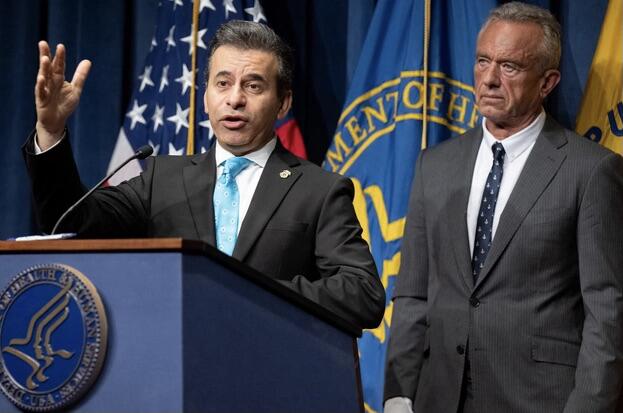
Border Czar Tom Homan Has Plan To Target Anti-Ice Agitators
Minneapolis has erupted into chaos as anti-ICE mobs rampage through the city. On Wednesday, an ICE agent fired in self-defense after being attacked by three illegal immigrants from Venezuela armed with shovels. Governor Tim Walz and Mayor Jacob Frey have fanned the flames straight out of the ‘defund the police’ playbook – turning a law enforcement operation into a political flashpoint. The violence has spiraled so far out of control that President Trump has threatened to invoke the Insurrection Act of 1807, which would allow him to deploy U.S. troops to Minneapolis to restore order since local leaders won’t.
“If the corrupt politicians of Minnesota don’t obey the law and stop the professional agitators and insurrectionists from attacking the Patriots of I.C.E., who are only trying to do their job, I will institute the INSURRECTION ACT, which many Presidents have done before me, and quickly put an end to the travesty that is taking place in that once great State,” Trumppromised in a post on Truth Social on Thursday morning.
Trump has yet to do so – telling reporters on Friday that he doesn’t think “there’s any reason right now to use it,”
President Trump: “The Insurrection Act, which has been used by 48% of presidents…It’s been used a lot. If I needed it, I’d use it. I don’t think there’s any reason right now to use it, but if I needed it I’d use it. It’s very powerful.” pic.twitter.com/YJSIlmARD6
That said, Border Czar Tom Homan offered a strategy that could hit those stirring the chaos hard, and of course may set a dangerous slippery-slope precedent for civil rights when the shoe is on the other foot. Appearing on Fox News’ The Ingraham Angle Thursday, Homan made clear that while protesters have the right to demonstrate, crossing the line by interfering with enforcement will carry consequences far beyond a court date.
“This job,” Homan told host Laura Ingraham, “and these people who wanna — you know, follow ICE, film ICE — you know what? You can protest; they have that right.” But, he added, “when you cross a line, and we’ve proven it, if you interfere or impede or assault an ICE officer, you will be prosecuted.”
Homan didn’t stop at the threat of prosecution. He said he is urging the Trump administration to take the next step, which is to “make them famous.”
“One thing I’m pushing for right now, Laura,” he said, “we’re gonna create a database, where those people that are arrested for interference, impediment, assault — we’re gonna make ’em famous. We’re gonna put their face on TV.”
The strategy, he explained, is simple: let employers, neighbors, and schools see who is disrupting federal law enforcement.
“We’re gonna let their employers and their neighborhoods and their schools know who these people are,” Homan said. “’Cause as you said, a lot of these people, they say they’re taking time off work to protest. I bet you a lot of them are calling in sick. I bet you a lot of their employers don’t know what they’re doing. But we’re going — we’re gonna make sure everybody knows who they are.”
Homan framed the policy as a response to activists who have used social media and livestreaming to amplify confrontations with ICE officers. “They wanna broadcast the ICE officer that was nearly killed all over the internet,” he said. “We’re gonna broadcast every one of these people we arrest.”
🚨 HOLY SMOKES. The Trump admin is creating a database of ALL leftist insurrectionists attacking ICE and will be broadcasting their name and face
Homan also revealed that the ICE agent who was ambushed and attacked with shovels is healing and under medical care in a secure location.
“He’s in a secure location not because he’s afraid, because of the death threats against his family,” he told Ingraham. “I’m glad he’s in a secure location ’cause I myself have seen plenty of intelligence reports that a lot of people want him dead. They want his family dead. So, he’s in a safe place right now, healing up, getting the medical attention.”
Full interview below:
According to Homan, neither Mayor Frey nor Gov. Tim Walz has contacted the agent’s family.
Economic prosperity is created in free markets by innovative companies. Over 50 percent of globally operating AI unicorns are located in the U.S., while Europe plays virtually no role. The race for the next future technology is already decided.
It seems that economic history is repeating itself. On the stock markets, companies in the artificial intelligence and data center sectors are being traded feverishly. Massive capital flows into this technology. Much of it resembles the dot-com boom 25 years ago.
Structurally and regionally, little has changed since then: The U.S. and China are fighting for pole position, while the European Union’s economy remains largely on the sidelines, pushed into a spectator role by EU regulators.
Unicorns as a Measure of Innovation
An interesting measure of the EU’s lag in artificial intelligence is the number of so-called unicorns — private startups valued at at least one billion U.S. dollars before going public. This metric is considered a valid indicator of a region’s innovative capacity — and for the EU, the comparison with the U.S. is catastrophic.
About 1,700 such innovative companies currently operate in the U.S., while the EU has only around 280. The U.S. dominates this market with over 50 percent share, whereas the European economy lags far behind with less than ten percent of the global market.
This economic gap is also reflected in investment volume. Hyperscalers such as Amazon, Microsoft, Alphabet, and Meta invested over $320 billion in AI and corresponding data center infrastructure this year alone. More than 550 new projects — with a focus in Virginia, Texas, and Arizona—are forming the backbone of a new economy.
Data center capacity in the U.S. grew by around 160 percent this year, while Europe’s capacity increased by only about 75 percent, equaling an investment volume of just under €100 billion.
With investments of around $125 billion, China’s economy also lags far behind the U.S. An interesting context — especially from the perspective of European, and particularly German, policymakers — is that nuclear power is gaining noticeable momentum in these regions.
Even if green-minded Germany refuses to acknowledge it due to its ideological stance against nuclear energy, the enormous energy demand of new technologies will in the future be covered to a significant extent by the expansion of nuclear power.
Among the few major projects in the European Union are the Brookfield project in Sweden, with an investment volume of around $10 billion, and the Start Campus in Portugal, which could also activate nearly $10 billion in investments.
Crash of Ideologies
Especially in AI, the ideological clash between the U.S. and the EU can be observed in practice and in all its consequences. While the U.S. relies on deregulation and private solutions, removing barriers for intense competition, EU Europe still adheres to the mantra of political global control. Nothing may happen unless Brussels officials have schemed it at their green table in all their wisdom.
The Draghi motto still applies here: Only massive public investments — credit-financed and centrally planned — will, in the view of EU statist planners, help overcome the enormous gap between Europe and the U.S.
In the simulations of the EU Commission’s master plan, now stretched over seven years under Ursula von der Leyen, everything seems surprisingly simple, almost simplified. The EU’s Invest-AI plan intends to borrow around €50 billion in loans and invest them in selected projects in the coming years. This is supposed to trigger private investments of €150 billion, ultimately creating four AI gigafactories.
Welcome to the socialist textbook world of “Habeckonomics”: a system in which state projects like Northvolt repeatedly fail. Yet as long as public guarantees, subsidies, and state-guaranteed purchase prices are in prospect, the small flame of political hope continues flickering in Europe’s lukewarm wind.
As usual, we also observe the typical European jungle of funding programs, subsidies, and steering projects. These include “Horizon Europe,” which is meant to strengthen computing power in science, the RAISE pilot, and the Gen-AI-4-EU initiative, together investing another billion euros in the EU’s digital infrastructure.
The Power of Competition
The ideological clash between the two major economic blocks, the U.S. and the EU, is producing strange effects. While the open capital market in the U.S. lets startups sprout like mushrooms from fertile soil, EU regulation — especially under the Digital Markets Act — has fostered a predatory mentality. That this was likely the Eurocrats’ goal from the start comes as no surprise.
Brussels imposed more than €3.2 billion in competition fines this year, mainly targeting U.S. corporations. Brussels has degenerated into a bureaucratic leviathan — a parasitic glutton absorbing economic energy and generating ossified structures and economic vacuum.
In EU Europe, the motto is: the regulatory framework matters most — and the state takes its cut. That private industry prefers other locations and withdraws capital matters little to Brussels’ extraction experts.
Against the backdrop of Europe’s massive descent into a climate-socialist dystopia, it is surprising that the roots of libertarian economic thinking originate precisely on this continent. Consider the great economist Ludwig von Mises, who repeatedly pointed out that it is the entrepreneur who drives the engine of the market economy through profit-seeking, and that without exception, decentralized processes create prosperity — while state interventions regularly derail it.
Civilization-superior models like the free market sink in the waves of ideological EU infantilism. Its repressive climate socialism promotes the growth of corporatist structures in which politics and subsidized parts of the economy carry out the extraction, eliminating competition.
The rigid adherence to centrally planned control of the new tech industry tragically mirrors the timeline of the dot-com era. What Europe fails to understand is that groundbreaking innovation inevitably triggers an investment boom, often resulting in overinvestment and a stock market crash — but ultimately leaving economically profitable structures permanently woven into the existing economy.
As with companies like Amazon, Google, or Microsoft, Europeans will look back in a few years at these months and examine this intercontinental economic bifurcation through the examples of OpenAI, Gemini, or Perplexity. The energy needed will come from French nuclear reactors and soon also from Polish nuclear power.
Biden-Appointed Minnesota Judge Limits Federal Immigration Enforcement Actions At Protests
A federal judge in Minnesota on Friday ruled that federal immigration agents can’t detain or use nonlethal munitions and crowd dispersal tools on peaceful protesters who aren’t obstructing authorities, including when these people are observing the agents.
The decision, handed down by U.S. District Judge Kate Menendez – appointed by President Biden in 2021, stems from a lawsuit brought last month by six local activists.
These individuals, backed by the American Civil Liberties Union (ACLU) of Minnesota, said that Homeland Security (DHS) personnel were infringing on their First Amendment rights when they observed federal agents performing their duties.
As Joseph Lord reports for The Epoch Times, after the ruling, Tricia McLaughlin, DHS Assistant Secretary for Public Affairs, issued a statement saying her agency was taking “appropriate and constitutional measures to uphold the rule of law and protect our officers and the public from dangerous rioters.”
She said people have assaulted officers, vandalized their vehicles and federal property, and attempted to impede officers from doing their work.
“We remind the public that rioting is dangerous—obstructing law enforcement is a federal crime and assaulting law enforcement is a felony,” McLaughlin said.
Protestors and federal agents have clashed during enforcement operations in recent months but intensified after an Immigrations and Custom Enforcement (ICE) agent fatally shot Renee Nicole Good during an encounter on Jan. 7 that was captured on video from several angles.
The incident has met with clashing interpretations, with some defending the ICE agent’s shooting as self defense and others alleging that he used excessive force.
Video shows that in the moments before the shooting, four ICE agents stopped their vehicle in the middle of the street, exited, and approached Good’s vehicle which was blocking their path. The footage also shows Good’s female partner, Becca Good, heckling immigration law enforcement.
As one agent attempted to reach into Good’s car and open her door from the inside, Good turned the wheel to the right, away from Ross, and accelerated her car, allegedly striking the agent, who fired his weapon, according to video and audio. The footage also records Good’s wife, who was outside the vehicle, telling her to “drive, baby, drive.”
Protestors took to the streets of Minneapolis on Jan. 10 following the shooting.
Attorneys for the federal side argued that agents operate under established guidelines to uphold immigration statutes and ensure personal safety.
They said officers have been attacked, harassed, and doxxed nationwide and in Minnesota, and that their responses have been appropriate and justified.
Under the new mandate, agents are barred from detaining drivers or their passengers unless they are obstructing or interfering with agents. The judge said that trailing vehicles at a safe distance does not inherently warrant a traffic stop.
Safely following agents “at an appropriate distance does not, by itself, create reasonable suspicion to justify a vehicle stop,” the ruling said.
Menendez added that agents must have reasonable suspicion supported by solid evidence of a crime or active disruption to officers duties.
Peaceful assembly and oversight, without direct meddling, fall outside permissible reasons for intervention.
The Epoch Times reached out to DHS and the ACLU but did not hear back before publication.
In what appears to be a rolling back on free speech and citizen journalism, Britain is fast-tracking a law that will ban non-consensual intimate deepfake images. This is likely aimed at the social media site X.com after its AI assistant Grok allegedly generated inappropriate images. In the scope of the global news cycle and a further ban potentially on the table, the move couldn’t be more poorly timed. It coincides with social media bans in socialist Tanzania and a sweeping Internet blackout by the Ayatollah of Iran. While Britain is not Iran, the direction of travel – using information control to manage dissent – bears uncomfortable similarities. Brits are justifiably worried: Is this the nail in the coffin of Britain’s free speech?
Keir Starmer, UK prime minister, has already come under an avalanche of scrutiny for his hand in other undemocratic activities. For example, many of the local elections in Britain will not go ahead this year, having also been canceled last year under the pretext of local government reorganization. Additionally, arrests over speech and social media posts have increased in recent years, with the arrests of over 10,000 people per year under various Orwellian laws.
To make matters worse, Starmer’s online censorship has gone even further under the new Online Safety Act. This new law is intended to protect young people from “harmful” speech but gives regulators sweeping powers to silence lawful but unpopular speech in the name of safety. An example of the British government’s new stance on what is acceptable to discuss is a new taxpayer-funded online game. This game vilifies concerns over mass migration by giving the player a red extremism score, branding them as likely to be referred to the Prevent program, the UK anti-terror watchdog.
The fact that victims of a foreign grooming gang investigation can be dismissed as “white trash” is a disgrace – made all the more striking as senior ministers simultaneously talk about banning the most pro-free-speech social media platform, where stories like this gain greater public consciousness.
Just as the UK government has brought in these speech laws, the people have become aware that they are less free. Self-censorship and caution when speaking one’s mind are common, as individuals do not know the potential consequences of expressing their opinions. An opinion expressed by the Conservative Party or Reform Party could potentially create trouble or unnecessary harm if voiced by a civilian. Examples of this are easy to find, from Graham Linehan, who was arrested by armed police upon arriving in the UK from Arizona, to Deborah Anderson, an American cancer patient harassed by police in her own home in Britain over a post on X.
Though we aren’t locked in the jaws of state tyranny yet, Britain’s parallels with the current situation in Iran are unmistakable. Just as the Iranian Revolutionary Guard Corps crack down on protest and switch off the Internet, Starmer is doing something similar for comparable reasons. It is a bad look to be constantly plagued by protest, which, as a fundamental right in a liberal society, serves to hold the government to account. While protests for a ban on X swirl online only so far, if the government were to do it, we would see freedom of speech advocates take to the streets too.
Although Britain’s governing Labour Party swept to victory in 2024 with confident rhetoric, it is keenly aware that the result reflected voter fatigue with the previous Conservative government rather than a wholehearted endorsement of its own agenda. Platforms like X have since become essential democratic pressure valves – spaces where peaceful protest is organized, government failures are documented, and information ignored by legacy media circulates freely. That very openness makes X unsettling to any administration instinctively drawn to control. When a government seeks to tax what it can and regulate what it cannot direct, attempts to constrain such platforms should be read not as benign governance, but as an early warning sign. Efforts to suppress open digital discourse, whether in Britain or elsewhere, signal a deeper discomfort with accountability itself.
A former human rights lawyer, the prime minister constantly points to international law as a beacon of what must prevail around the world. Meanwhile, at home, he simply cannot resist infringing on individual rights, replacing autonomy with bureaucracy. His demeanor now highlights the growing liberal class in Britain, which believes that the views of most hardworking British people are contemptible and that they know better. Just like Hillary Clinton and her infamous “basket of deplorables” comment, Starmer and the intolerant left he represents no longer believe in the democratic principles that built Britain.
What Britain needs is total, not selective freedoms. America is far from perfect, but it has a public consciousness aware of its citizens’ right to liberty. Many in Britain remain unaware of the country’s sleepwalk toward authoritarianism, and voices across the West must resist the mainstreaming of government tyranny.
The Central Intelligence Agency (CIA) has released a new video for Chinese citizens outlining nine step-by-step methods for establishing secure contact with the agency, according to a Jan. 16 post on X.
In the video, the CIA says it is seeking individuals inside China who have access to information about the country’s political system and are willing to share it safely.
“The CIA wants to know the truth about China,” the agency wrote in Chinese in the post.
“We are looking for people who know the truth and can share it.”
The latest post marks the CIA’s third video specifically targeting audiences in China.
It follows two Chinese-language videosreleased in May, which openly encouraged Chinese Communist Party officials to provide intelligence to the United States—an unprecedented move that drew widespread attention.
The new video focuses on operational security and offers nine practical steps for Chinese informants to minimize digital surveillance risks when contacting the agency.
According to the CIA, the first step is to purchase a new or secondhand communication device with cash or gift cards, without providing personal identification.
For used devices, the agency advises performing a full factory reset. All pre-installed software, applications, antivirus programs, browser extensions, and other programs should be removed.
The second step involves connecting to public Wi-Fi at a public location to maintain anonymity. The CIA cautions informants to ensure their screens are not visible to security cameras or passersby and suggests using privacy screen protectors.
The agency then advises downloading a web browser and a virtual private network (VPN) from an American or Western company and stresses that these tools should be used consistently throughout the process.
In the fourth step, informants are instructed to create a new anonymous email address using an email service from a Western company, without entering any information that could be traced back to them. The email should be used for this purpose only.
Once these steps are completed, the CIA advises users to directly enter the agency’s official website address rather than searching for it through a search engine. The video also provides instructions for contacting the CIA through its dark web portal using the Tor browser, offering both an onion address and a standard CIA website link.
After accessing the site, informants are told to navigate to the “contact” page and submit their anonymous email address and message. The CIA says messages may be written in any language but warns against using any applications, software, or artificial intelligence tools to write or translate the content. Individuals are encouraged to clearly describe the information they wish to share.
In the final steps, informants are instructed to delete all browser history and any traces of the CIA website after submitting their message. The agency advises against making repeated contact attempts and recommends storing the device in a secure location. The CIA says it will review all messages received.
After making contact, the agency advises informants to continue their normal daily routines while the information is being reviewed.
The agency concludes by advising that, if circumstances allow, individuals should consider traveling abroad before purchasing a device and initiating contact.
When submitting information, the CIA says users should provide their temporary location at the time and contact details. If leaving the country is not possible, some or all of the steps may be carried out by trusted relatives or close friends.
Seattle Ranks Second As Most Stressed And Burned Out U.S. City For Workers
A new study ranks Seattle as the second most stressed and burned-out city in the U.S. for workers, behind only Atlanta, according to KIRO7.
In a city full of professional “activists”, who could have guessed?
The report by Compare the Market analyzed online searches related to job stress, including terms such as “work burnout,” “work depression,” “work stress,” and “how to deal with work stress,” and converted the results into a point-based score.
“Seattle comes in at No. 2 for the USA, but despite having a much lower score than Atlanta, its higher population of 780,995 and 2,498 searches per 100,000 people around anxiety-related searches still make it a very anxious city, with a score of 76.06,” the study wrote.
The KIRO report says that over the past year, people in Seattle searched for “stress relief” more than 4,990 times.
Other U.S. cities in the top 10 include San Francisco, Denver, Boston, Las Vegas, Washington, D.C., Baltimore, Kansas City and Portland. Three Canadian cities — Victoria, London, Ontario, and Ottawa — ranked higher than Seattle for work-related stress and anxiety.
Compare the Market General Manager Steven Spicer said, “Reducing work stress starts with creating a healthier work environment, where balance and support are prioritised. Simple steps like regular breaks, open communication, and mindfulness can go a long way in easing anxiety.”
Everything around us seems to be changing at breakneck speed. Twenty years ago, smartphones were niche products. Twenty years before that, computers were clunky behemoths. Forty years before that, far more Americans traveled by train than by plane. Forty years before that, cars were just starting to supplant horses.
Over the past couple millennia, a mere blip of Earth’s history, humans have manifestly reshaped the planet – from the physical to the biological. The ground, the oceans, the air, the flora, the fauna – nothing is as it was. And yet, despite this radical transformation, it can seem like we ourselves haven’t changed much at all…
Sure, over the last 10,000 or so years, our physical alterations have been relatively muted compared to the changes seen in society and on our planet. Essentially, we’ve shrunk a bit, and our jaws have weakened. But even a little change is still change, and it begs a question: “In the far-flung future, what will happen to us, evolutionarily speaking?”
The first is a standstill – our species will remain roughly as it currently is. But Solomon thinks this is unlikely.
“So far, in the 3.7-billion-year history of life on Earth this has not happened to a single species… All species change, some faster than others, but there is no species alive today that has not undergone changes throughout its existence.”
“There are an uncomfortably high number of plausible ways this could happen,” Solomon wrote, “including another giant asteroid impact, a super-volcano eruption, nuclear war, catastrophic climate change, the spread of a devastating pandemic, or our sun exploding in a supernova.”
The third possible fate for humanity, which Solomon explored in depth in Becoming Martian, is that at least part of humanity will evolve into a different species. A decade ago, Solomon deemed this path improbable. Humans today are so interconnected that no population could be siloed enough to speciate.
But now, he thinks the chances have risen considerably. Why? Because the world’s richest men are plowing their hefty fortunes into making humans interplanetary. What once seemed science fiction is growing closer to reality with the launch of every large rocket. If a group of humans could colonize another world – Mars, for example – and cease to breed with Earthlings altogether, it may take only ten generations before they grow genetically distinct enough to no longer be considered humans, but rather Martians.
“If we do manage to spread out and survive on planets scattered across our solar system and others, we should expect to evolve, adapt, and speciate everywhere we go,” Solomon wrote.
Like the cornucopia of different creatures inhabiting Charles Darwin’s beloved Galapagos Islands, humans dwelling on different bodies within the solar system could similarly evolve “endless forms most beautiful and most wonderful.”
FDA Removes Web Content Saying Cellphones Are Harmless – HHS Launches Study
Without fanfare, the Food and Drug Administration has deleted multiple web pages asserting that cellphones are not dangerous. First reported by the Wall Street Journal, the move comes as the Department of Health and Human Services has begun a new investigation into potential health effects of cellphone radiation.
HHS Secretary Robert F. Kennedy Jr has previously declared that cellphones are causing harms that are not yet fully acknowledged. “There’s cellphone tumors. I’m representing hundreds of people who have cellphone tumors behind the ear. It’s always on the ear that you favor with your cellphone…We have the science,” Kennedy said in a 2023 appearance on the Joe Rogan Experience. “You should never put one next to your head… I put it on speakerphone or use earphones.”
Responding to a Journal inquiry about the change to the FDA website, HHS spokesman Andrew Nixon said, “The FDA removed webpages with old conclusions about cellphone radiation while HHS undertakes a study on electromagnetic radiation and health research to identify gaps in knowledge, including on new technologies, to ensure safety and efficacy.”
One of the deleted pages included a passage declaring that “the weight of scientific evidence has not linked exposure to radio frequency energy from cellphone use with any health problems.” There may be more scrubbing of the site to come: The Journal notes that the FDA’s site still has summaries of the deleted pages, but the links redirect to other generalized content about the agency’s regulatory mission.
Kennedy, who had a career as an environmental litigator, has long engaged on this issue. Kennedy represented people suing phone companies for allegedly causing brain tumors, and won a 2020 case that compelled the Federal Communications Commission to reassess its wireless-radiation regulations. He was also chairman of Children’s Health Defense, which has been involved in litigation over 5G technology, and a case blaming an Idaho man’s cardiac issues on a cellphone tower. He has also pointed to radiation as a prime suspect in the mystery of widespread chronic illnesses among America’s children, “Our children are swimming around in a toxic soup, the Wi-Fi radiation is a lot worse than people think it is…yeah, from your cellphone,” Kennedy told Rogan in 2023.
In 2025, Kennedy celebrated a large wave of cellphone restrictions that swept across the nation’s schools. In addition to pointing to links between social media use and depression, Kennedy told Fox News that “[cellphones] produce electromagnetic radiation, which has been shown to do neurological damage to kids when it’s around them all day, and to cause cellular damage and even cancer.”
Both the FDA and FCC have a hand in regulating cellphones, with the FDA providing scientific assessments to the FCC, which imposes caps on radio-frequency emissions. For now, the FCC website still has content declaring there’s no evidence linking wireless electronics to cancer.
The National Cancer Institute, a component of the National Institutes of Health, says, “evidence to date suggests that cellphone use does not cause brain or other kinds of cancer in humans.” Johns Hopkins epidemiologist Elizabeth Platz told the Journal that cellphones don’t emit the variety of radiation that is known to cause cancer. She also pointed to large studies failing to find any connection between cellphones and cancer.
However, scientific consensus about health has a long history of infamous fallibility. Confidently-wrong conclusions have caused incalculable harms, from creating a peanut-allergy epidemic to opening a Pandora’s box of harms during the Covid-19 pandemic. Given that, we don’t mind seeing RFK Jr’s revamped HHS put a new set of skeptical eyes on the cellphone-radiation consensus.
When Secretary of State Marco Rubio stood before reporters on Jan. 7 to discuss the military operation that took place in Venezuela four days prior, he added another element of intrigue. He planned to meet with Danish officials this week to discuss purchasing the world’s largest non-continental island: Greenland.
Such discussions will be new for Rubio, though it is not the first time the Trump administration has broached the subject. President Donald Trump’s brief statement to reporters on Jan. 4 aboard Air Force One was succinct: “We need Greenland from the standpoint of national security.” It was a reiteration of his March 2025 congressional address.
Additionally, Trump first mentioned purchasing Greenland in August 2019, a suggestion rebuffed by Danish officials, which led to a brief kerfuffle between the two states.
When Rubio sits with Danish leaders for those first discussions, he will have entered upon diplomatic deliberations that stretch back to the Andrew Johnson administration. The first inquiry to purchase Greenland from the Danes came in 1868 from Secretary of State William Seward. America had recently purchased a tundra to its northwest: Alaska. That purchase in 1867 was initially mocked as “Seward’s Folly” by the press, but of course, after the discovery of gold and oil, Seward’s decision was more than justified. Nonetheless, Congress proved disinterested in the icy territory to its northwest.
Seeking the ‘Small Gibraltar’
While negotiating the Alaska purchase from Russia, Seward was negotiating the purchase of the Danish West Indies from Denmark. The small islands of St. Thomas, St. John, and St. Croix—specifically the “small Gibraltar,” St. Thomas—were considered vital to national security. The Civil War had highlighted American vulnerabilities in the Caribbean, as the major European powers held possessions in the region, but the United States did not. And it was the European powers that concerned the United States.
“The West India Islands, in the possession of Denmark, are of not much danger to us,”wrote U.S. consul to Denmark, George P. Hansen, in 1864, “but it seems to me we cannot very well afford to let a powerful European nation get possession of them. If they ever change ownership, the ownership should be in the [United] States.”
The American and Danish officials had reached an agreement to purchase St. Thomas and St. John for $7.5 million in gold coins. A plebiscite on the islands overwhelmingly approved the sale. Danish King Christian IX announced the sale. But American politics ended the purchasing process. The Republican-led Senate, furious over President Johnson’s policies and Seward’s support of the president, refused to ratify the agreement. The United States’ Atlantic seaboard would remain vulnerable.
A Second Attempt
Early into the momentous year of 1898, Sen. Henry Cabot Lodge expressed his concerns about the islands in a report to the Foreign Relations Committee, stating, “So long as these islands are in the market there is always the danger that some European power may purchase, or try to purchase, them. This would be an infraction of the Monroe Doctrine, and would at once involve the United States in a very serious difficulty with the European power which sought possession of the islands. In the interest of peace, it is of great importance that these islands should pass into the hands of the United States and cease to be a possible source of foreign complications, which might easily lead to war. From a military point of view the value of these islands to the United States can hardly be overestimated.”
Three weeks later, the Spanish–American War began, during which the United States secured its Pacific seaboard by obtaining Guam and the Philippines from Spain (America also annexed Hawaii during this period). Additionally, America obtained Puerto Rico and kicked the Spanish out of Cuba, which became a quasi-protectorate.
Spain had fallen far as a European power, but Russia, France, Great Britain, and a surging Germany remained great powers. The ongoing construction of the Panama Canal by the French only increased concerns about America’s Atlantic vulnerabilities.
The State Department again began negotiations with the Danish for the West Indies. By the winter of 1902, an agreement between Secretary of State John Hay and Danish Chargé d’Affaires Constantin Brun had been reached. The Americans ratified the treaty, but this time it was the Danish who refused to ratify. The nations had signed two treaties with nothing to show for it.
Securing the Islands
In 1910, Maurice Egan, the U.S. ambassador to Denmark, believed he had come up with a plan to obtain both the Danish West Indies and Greenland. Egan wrote to the State Department with the “very audacious suggestion” of a multi-country land trade agreement. Perceiving the Danish government gave “very little attention” to Greenland—combined with what he viewed as the growing threat of a triple alliance in the Far East of Russia, Japan, and China—he believed that Germany could be utilized as a way of obtaining the islands and placing an ally in the Philippines.
He proposed swapping Mindanao, the second-largest Philippine island, for Greenland (and after further talks, the West Indies). This would allow Denmark to swap Mindanao for the Schleswig-Holstein territory it had lost to the Germans in 1864. “I assure you that it represents the desires and the opinion of some of the best minds in Denmark, and some of them most highly placed,” Egan added.
The proposal, though interesting and complex, came to nothing. Egan, however, may have been onto something.
A year into World War I, it was Germany that caused the Americans to inquire again about the West Indies. Instead of a potential ally as suggested by Egan, Germany was now a threat.
The initial inquiry about the islands by Secretary of State Robert Lansing was rebuffed by Brun, who indicated Denmark “had very large commercial interests which were vastly increasing with the construction of the Panama Canal.”
Lansing communicated that the Americans were not concerned about the Danes’ commercial interests, but about Germany’s interests. Germany’s expanding empire, militarism, and growing commercial interests led the Americans to believe they might annex Denmark or force the sale of the West Indies. If that were the case, Lansing made it clear that “the United States would be under the necessity of seizing and annexing [the islands].”
“This plain spoken threat of what might occur under certain conditions had the desired effect,” Lansing recalled. On Aug. 4, 1916, Lansing and Brun signed the treaty, which both sides ratified, and the purchase of the now-U.S. Virgin Islands was completed on March 31, 1917, for $25 million in gold coins. Part of this agreement, however, confirmed Denmark’s rights to Greenland.
The Post-World War II Attempt
The acquisition of Greenland arose almost immediately after World War II. In 1946, the State Department took a page out of Egan’s book by suggesting a land trade. America would acquire portions of Greenland in exchange for land in Alaska’s Point Barrow district. Again, the land-swap idea was a no-go.
Interestingly, U.S. diplomat John D. Hickerson echoed Egan’s belief that ‘’Greenland is completely worthless to Denmark.” The State Department then offered $100 million for the “worthless” island that appeared “indispensable to the safety of the United States.”
Brief and unofficial discussions took place, but the matter was eventually dropped. Denmark and the United States, however, did sign a treaty in 1951 to establish a base in Thule, now known as Pituffik Space Force Base.
In 1953, Greenland was incorporated into Denmark, ending two centuries as a colony. It achieved Home Rule and then Self Rule in 1979 and 2009, respectively. It has the option to pursue independence, and despite its wealth of natural resources, which the Trump administration often mentions, it is considered a “welfare state,” requiring an annual $600 million Danish block grant.
Trump and Greenland
President Trump, in the spirit of Secretary Lansing, has made it rather clear he is not concerned about Danish or Greenlandic interests. His concerns are more immediate and widespread.
“We need Greenland from a standpoint of national security, and Denmark is not going to be able to do it,” Trump stated. “The European Union needs us to have it, and they know that.”
The national security threat is no longer from European powers as it was in the 19th and first half of the 20th century. The threats now come from Russia and China, whose navies roam the Arctic Ocean with seeming impunity. Trump claimed, perhaps with a hint of sarcasm, that Denmark was not doing enough to protect American or international interests with Greenland.
“You know what Denmark did recently to boost up security on Greenland?” he rhetorically asked reporters. “They added one more dog sled.”
The world was alarmed when Trump suggested military force was an option. No doubt, as the administration has made clear, purchasing Greenland is preferable. But when Rubio sits down with Danish officials this week, he may need to pull a page out of Lansing’s book. It may again have “the desired effect.” Additionally, much like our purchase of the Danish West Indies, maybe the third attempt is the charm.
Views expressed in this article are opinions of the author and do not necessarily reflect the views of The Epoch Times or ZeroHedge.
Nuclear Bunker Faces Final Days As Coastline Rapidly Erodes
A nuclear bunker on the East Yorkshire coast is close to falling into the sea after decades of coastal erosion, according to the BBC. The structure near Tunstall, built around 1959 as a Cold War lookout post, was once more than 100 yards from the shoreline but is now dangerously exposed on the cliff edge.
Local historian Davey Robinson, who has been filming the site, said: “We live on one of the most eroded coastlines in Europe and this bunker hasn’t got long left, perhaps just a few days,” and described the bunker as “just a few days” from collapse.
The East Riding of Yorkshire Council has warned the public to stay away from the area because of unstable cliffs, while the Environment Agency confirms the region has some of the fastest-eroding coastline in the UK.
Robinson and his partner Tracy Charlton have returned to the site daily and shared footage online. “We are posting the footage on our YouTube channel and it’s getting interest from around the world,” Robinson said.
The BBC writes that the bunker, known as the Tunstall ROC Post, was part of a network of nuclear monitoring stations. It included sleeping space and basic living facilities. Robinson explained: “It was designed so that people could live inside it and just wait for a nuclear explosion to register and they could tell other people in other bunkers around the country,” adding: “It never got used thank goodness.”
The Holderness coast is losing around 6.5ft (2m) of land each year, and more than 3 miles have disappeared since Roman times. Robinson said the bunker “adds a lot of meaning” to the situation, calling it “a symbol of erosion in this area,” and adding, “This whole area is eroding at a rapid rate and to see an actual physical thing moving it just shows what’s happening really.”
Charlton said they would continue filming because the bunker “only had days left” before collapse: “We’re invested in this and I guess we’re obliged to keep visiting for the sake of the thousands of people who are now watching our videos on the YouTube channel.”