

63.6 F
Chicago
Tuesday, September 29, 2026
Home Blog Page 817

Ex-CIA Analyst: Neocons Prematurely Celebrate Over Protests In Iran

0
Ex-CIA Analyst: Neocons Prematurely Celebrate Over Protests In Iran

Authored by former CIA officer Larry Johnson

Western media, especially those outlets firmly aligned with the neoconservative view, are quick to jump on reports of protests in Iran as a sign that the Islamic Republic of Iran is about to implode. Events today in Iran provided another spurt of arousal among neocons longing to bring back the Shah and eliminate the mullahs.

Here’s a summary of the various news reports:

On December 30, 2025, protests in Iran entered their third day, spreading from initial economic grievances in Tehran’s Grand Bazaar to universities and multiple cities across the country. Triggered by the Iranian rial plunging to record lows (around 1.38–1.42 million to the USD) and inflation hitting 42.2–42.5%, demonstrations began with shopkeepers and merchants striking and closing businesses, evolving into broader anti-government chants.

Protests expanded beyond Tehran to cities including Isfahan, Shiraz, Mashhad, Hamadan, Karaj, Qeshm, Malard, Kermanshah, and Yazd. University students joined on Tuesday, chanting slogans like “Death to the dictator” (referring to Supreme Leader Ali Khamenei), calls for freedom, and pro-monarchy references (e.g., “Long live the Shah” or “Rest in peace Reza Shah”).

President Masoud Pezeshkian acknowledged “legitimate demands,” instructed the interior ministry to dialogue with protest representatives, and pledged economic reforms. The central bank governor resigned, replaced by Abdolnasser Hemmati. Officials offered talks but warned against escalation or foreign exploitation.

Hmmm… What’s really going on? Turns out that Nima Alkorshid, the host of Dialogue Works, is on an extended family vacation in Tehran. It has been 12 years since he was last in Iran. I know one thing for certain… His mom is thrilled to have her son, his wife and her grandchildren in Tehran. Anyway, I called Nima and asked him what he was seeing.
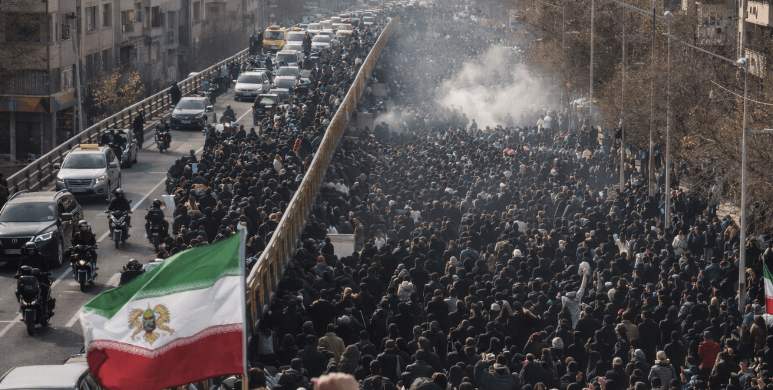
via Malta Today

According to Nima, there is frustration with the government, i.e., Pezeshkian, over the high inflation and that is one impetus driving the protests. However, it is not directed at the Islamic regime despite Western press reports claiming otherwise. Nima also pointed out that about 25% of the population is quite conservative (these are the folks who supported Ahmadinejad) and they are angry with Pezeshkian because he is viewed as too accommodating of the West.

These folks, while miffed at the government, are staunch supporters of the Ayatollah Khameni.

There is video evidence corroborating Nima’s observations. In one clip an Iranian student protester explains the reasoning behind the demonstrations, stating that they are not opposed to the Islamic Republic, but rather to corruption among government officials who are worsening the economic crisis. He says:

This is the voice of an Iranian Basiji. I would sacrifice myself for this homeland. I would give my life for the Islamic Republic. Our protest is against people like Ali Ansari and other corrupt officials. Mr. Ejei [Chief of the Judiciary], where are you?

I was pleasantly surprised by Pezeshkian’s reaction to the protests… Instead of beating the hell out of the protestors and tossing them into prison, he acknowledged the legitimacy of their complaints and fired the central bank governor while promising economic reforms. Seems like a pretty reasonable response to me.

I believe that Russia and China — who have denounced and rejected Europe’s attempt to reimpose economic sanctions on Iran — are working on measures to boost the Iranian economy and get inflation under control. While there is no denying that Iran’s economy has been badly damaged because of Western sanctions — which both Russia and China supported in 2015 as part of the JCPOA — Iran, by virtue of is membership in BRICS and closer economic, political and military ties with Russia and China, is in a stronger position now to revive the economy.

Russia’s economic support focuses on strategic partnerships and trade, and is often intertwined with military cooperation. In January 2025, Russia and Iran signed a 20-year comprehensive strategic partnership treaty, including provisions for economic cooperation. Russia also is providing advanced conventional weapons (e.g., fighter aircraft, attack helicopters) in exchange for Iranian drones, missiles, and ammunition, indirectly bolstering Iran’s economy through barter-like military trade.

Along with the economic cooperation, there have been five visits by four senior Iranian officials to Moscow since July 1, 2025, based on reported trips. These include political, military, and economic figures, with purposes ranging from nuclear discussions to military cooperation and strategic partnerships:

Ali Larijani (Supreme Leader Adviser, political) – July 20, 2025: Discussed nuclear negotiations and bilateral relations with Russian President Vladimir Putin.

Brigadier General Aziz Nasir Zadeh (Defense Minister, military) – July 21, 2025: Met with Russian Defense Minister Andrei Belousov to expand military cooperation, likely seeking assistance post-Israel-Iran conflict.

Abbas Araghchi (Foreign Minister, political) – August 2025: Sought Russian support in the aftermath of U.S. and Israeli attacks on Iranian infrastructure following the ceasefire announcement. He made a second visit on December 17, 2025, to sign a foreign ministry cooperation plan for 2026-2028 and hail expanding partnerships.

Mohammad Reza Aref (First Vice President, political/economic) – November 17-18, 2025: Attended the SCO Council of Heads of Government meeting and held bilateral talks with Russian Prime Minister Mikhail Mishustin on economic and political cooperation.

But that is not all… there is the North-South Transport Corridor (INSTC). There have been multiple bilateral and multilateral meetings/discussions between Russia and Iran (often including Azerbaijan) since July 1, 2025, focused on advancing the International North-South Transport Corridor (INSTC), a multimodal trade route linking Russia, Iran, India, and beyond. Here are the key meetings in 2025:

October 2025: Trilateral talks in Baku (Russia, Azerbaijan, Iran) on expanding the western route of the INSTC, including infrastructure inspections and agreements on logistics/cross-border efficiency.

November 2025: Railway executives from Russia, Iran, and Azerbaijan signed a memorandum in Baku to enhance the western route’s competitiveness (e.g., fixed pricing, unified rates).

December 12, 2025: Presidents Vladimir Putin and Masoud Pezeshkian discussed INSTC progress (including the Rasht-Astara railway) during a meeting in Ashgabat, Turkmenistan.

December 16, 2025: High-level talks in Tehran between Iran’s Supreme National Security Council Secretary Ali Larijani and Russia’s Deputy Prime Minister for Transport Vitaly Savelyev, emphasizing fast-tracking the corridor and removing obstacles.

And then there is China. China offers more substantial economic lifelines, mainly through oil trade and pledged investments, positioning itself as Iran’s largest trading partner. China purchases 90% (or nearly all) of Iran’s exported oil at discounted prices (as low as $14 per barrel below market), providing crucial revenue—estimated at $67 billion for the Iranian year ending March 2025 (15% of GDP). This accounts for 13.6% of China’s oil imports and funds 45% of Iran’s 2025–2026 government budget. Under the 2021 25-year comprehensive strategic partnership (reaffirmed in September 2025), China pledged $400 billion in investments for sectors like oil/gas, infrastructure, banking, telecom, ports, railways, and tourism. Infrastructure initiatives include a new railway for overland oil shipments (opened May 2025 but halted by war) and the first freight train from Xi’an to Iran’s Aprin dry port in May 2025. Discussions on economic corridors via Central Asia (e.g., May 2025 railway officials meeting) aim to enhance transit.

At least 3 senior Iranian officials (political and military) have visited China since July 1, 2025, based on publicly reported trips. These visits focused on multilateral summits (e.g., Shanghai Cooperation Organization events), bilateral cooperation, and post-conflict diplomacy following Iran’s tensions with Israel and the US:

Abbas Araghchi (Foreign Minister, political) — July 2025: Attended an SCO foreign ministers’ meeting in Tianjin and held bilateral talks with Chinese Foreign Minister Wang Yi on deepening ties and regional issues.

Masoud Pezeshkian (President, political) — September 1–2, 2025: Visited Beijing for the SCO Summit; met with President Xi Jinping to discuss comprehensive strategic partnership, trade, investment, and global governance.

Aziz Nasirzadeh (Defense Minister, military) — Late June 2025 (close to July threshold, often grouped in post-July reporting): Attended SCO defense ministers’ meeting in Qingdao; first reported foreign trip post-Israel conflict.

Iran’s efforts to resurrect a sound economy are being carried out under the shadow of renewed attacks by Israel and the United States. According to RT:

President Donald Trump warned the US could carry out further military strikes against Iran if it attempts to rebuild its nuclear and ballistic missile programs. He made the remarks to journalists alongside Israeli Prime Minister Benjamin Netanyahu at his Mar-a-Lago estate in Florida on Monday.

“If it’s confirmed, they know the consequences, and the consequences will be very powerful, maybe more powerful than the last time,” Trump said on Monday. “We’ll knock them down. We’ll knock the hell out of them. But hopefully that’s not happening.”

The US president indicated he would “absolutely” support Israeli military action against Iran’s missile program, saying the US would act “immediately” against any nuclear advances.

Rebuild ballistic missile programs? Looks like Donald Trump has not been informed that Iran’s ballistic missile programs were not destroyed during the 12-day war. Iran is not rebuilding… It is expanding and modernizing its ballistic missile force, which is safely stored below ground out of the reach of Israeli and US weapons. If Israel and Trump are foolish enough to attack Iran again, I think they will find Iran is a far more formidable and dangerous foe than the one they encountered in June 2025.

Tyler Durden
Fri, 01/02/2026 – 23:25

Beijing Wants Babies: Condoms, Contraceptive Drugs Hit With Double-Digit Tax To Boost Birth Rate

0
Beijing Wants Babies: Condoms, Contraceptive Drugs Hit With Double-Digit Tax To Boost Birth Rate

In an effort to reverse China’s sagging birth rate, Beijing has removed a three-decade tax exemption on contraceptives starting Jan. 1, when condoms and contraceptive pills will now incur a value-added tax of 13%, the standard rate for most consumer goods. 

The move comes after 2024 data marked the third consecutive year that birth rates have dropped – something experts have warned is likely to continue. Last year, China introduced an annual childcare subsidy, and exempted such subsidies from personal income tax amid a series of “fertility-friendly” measures implemented in 2024 – such as urging colleges and universities to provide “love education” to portray marriage, love, fertility and family in a positive light, Reuters reports.

Meanwhile, CCP leadership pledged in December at the annual Central Economic Work Conference to promote “positive marriage and childbearing attitudes.” 

The country’s birth rates have been falling for decades as a result of Beijing’s one-child policy implemented from 1980 – 2015, along with rapid urbanization. 

High childcare and education costs along with job uncertainty and a slowing economy has also dissuaded young Chinese from getting married and starting a family. 

As Thomas Kolbe noted two weeks ago:

China is expected to lose about 20 percent of its population over the next 30 years.

There is no doubt this will have consequences for the global economy. Societies react reflexively to such developments. China responds with aggressive subsidies for its export engine to counter these domestic distortions, which primarily manifest economically as deflationary pressures.

China’s attempt to course-correct comes as global fertility rates continue to plummet. Fertility rates (the average number of children born to a woman in her lifetime) are different from birthrates (the number of live births per 1,000 people in a population over a given period), although the terms are related and often used interchangeably.

Meanwhile, look at who has the highest fertility rates: Somalia, Chad, Niger, DRC, and other African nations. Only about 4 percent of the world’s population reside in a country with a high fertility rate – more than five children per woman – and all of those nations are in Africa, the Census Bureau noted. Even in those countries, fertility rates are generally lower than they once were.

The fertility rate in India, the world’s most populous country, has steadily declined over the past six decades. In June, the UN Population Fund reported that India’s fertility rate stood at 1.9 children per woman, down from five or six children in 1960.

In 1990, China’s fertility rate was 2.51, despite its one child policy. By 2023, it had dropped to less than one birth per woman, according to the United Nation’s population division.

In the United States, fertility has undergone a persistent decline. It fell below the replacement level in 1972 and reached 1.62 in 2023, a historic low.

Asian and European countries have the lowest fertility rates in the world, and South Korea (0.72), Singapore (0.97), Ukraine (0.977), and China (0.999) all have rates below one.

Oh, and…

Tyler Durden
Fri, 01/02/2026 – 23:00

Russia Expands Biometric ID System… Again

0
Russia Expands Biometric ID System… Again

Authored by Riley Waggaman via Off-Guardian.org,

The commercial enterprise that controls Russians’ biometric data has introduced new ways to use your face as a form of ID, resulting in unprecedented levels of safety and convenience in the Russian Federation.

Russians young and old are already reaping the benefits of their country’s “digital transformation”—including very, very young Russians.

The Russian government is working on amending federal legislation to allow schools across the country to monitor and identify students using biometrics, Kommersant reported on December 3. Plans for a standardized “biometric turnstile system” for Russian schools are already being tested in Tatarstan.

source: Kommersant.ru

Authorities have stressed that schools will be able to choose whether or not to switch to biometric identification, adding that parents must first consent before their childrens’ faces are scanned and entered into Russia’s Unified Biometric System (UBS).

A Russian schoolboy faces his completely voluntary future (source: Kommersant.ru)

Conservative-patriotic media outlets in Russia responded positively to this completely voluntary and very safe and convenient initiative.

source: Katyusha.org

Concentration camp? A bit dramatic, no? These so-called Russian patriots could learn a thing or two from disaffected westerners who read RT and understand the delicate nuances of the Russian government’s Plan, which must be trusted at all times.

Here is an unrelated excerpt from Kommersant’s recent article on the subject:

The Ministry of Education told Kommersant that the biometric school entry system is already being tested in 20 schools in Tatarstan, where “special attention is paid to security”: the school grounds are fenced, cameras are installed along the perimeter, and entry is through checkpoints.

Perfect for learning.

As this blog reported, at the end of August, Deputy Prime Minister of the Russian Federation and Chief of Staff of the Government Executive Office Dmitry Grigorenko deployed familiar language when describing the advantages of using biometrics to identify schoolchildren:

Entry to school ‘by face’ is not only convenient, but also very safe. Because it is always clear who is entering, who is exiting, who is in school… After all, this is where our children spend their lives.

But underage children aren’t the only Russians basking in the safety and convenience of biometric identification (although they are very obviously the primary targets of the country’s “digital transformation”; dehumanization must start at a young age so as to seem “normal”): Russians of all ages can now leave their unsafe and inconvenient paper IDs at home.

The Center for Biometric Technologies, the joint stock company that stores and manages Russians’ biometric data, recently unveiled a new platform for providing biometric services, “Migom” (Мигом, which can be translated as “instantly” or “in an instant”).

On December 11, the company posted a photo collage demonstrating how Migom will be incorporated into everyday life in Russia.

source: The official Telegram channel of Joint Stock Company (JSC) Center for Biometric Technologies

The accompanying caption:

[W]e want to show you how these [biometric] services look in real life. These photos show how easy it is now to access familiar services: order documents at the MFC [government services portal], check into a hotel, verify your age when purchasing age-restricted goods [including energy drinks; no, not a joke] at vending machines and self-checkouts, and soon, undergo pre-flight security checks.

Let’s have a closer look at these inspiring photographs.

A lady with nice long hair checkmates George Soros by using her FACE, and not her NATO-ENDORSED PAPER ID, to prove that she is a responsible taxpayer, and not a terrorist-biohazard!

Respectable suit-wearing man receives facial recognition-permission to buy something from a vending machine. VERY MULTIPOLAR, INDEED.

Energy drink enjoyers in Russia can now prove they are old enough (18+) to drink their favorite drink using their FACES. Davos trembles.

The End.

Tyler Durden
Fri, 01/02/2026 – 22:35

Back To Our Roots. If Baby Boomers Did It, So Can We…

0
Back To Our Roots. If Baby Boomers Did It, So Can We…

Peak winter in the Lower 48 typically occurs around mid-January, while the U.S. growing season generally begins in late March or early April. With affordability increasingly top of mind and food inflation proving sticky, it is worth remembering that our grandparents – or even our parents, in some cases – turned to “victory gardens” during World War II, which supplied about 40% of the nation’s fresh vegetables.

Between 1943 and 1944, Americans planted upwards of 20 million victory gardens. These gardens produced 10 million tons of food annually, almost entirely fresh vegetables. They were planted in backyards, community plots, and schools, and they matched or exceeded the commercial vegetable production of the entire U.S. farming sector at the time. The most common crops included tomatoes, beans, carrots, beets, lettuce, squash, and potatoes.

Secretary Robert F. Kennedy Jr.’s 2026 MAHA agenda has been released, marking an escalating war against the processed-food industry and an effort to overhaul the entire food supply chain.  

What is missing from MAHA, however, is a push for backyard and community gardens. Expanding household-level food production would boost supply, lower grocery costs, and restore self-sufficiency, reducing reliance on DoorDash and Walmart.

The lesson from history should be obvious. If our baby boomer parents could build victory gardens and achieve self-sufficiency, Americans can do the same eight decades later.

Today, roughly 40% of U.S. vegetables are sourced from California, while about 30% of fresh vegetables are imported from neighboring countries. That level of concentration and dependence exposes the food supply to disruption, especially when Chinese “agroterrorism” is an increasing risk.

A more resilient food supply chain starts in your backyard, with food production literally at our fingertips, turning thumbs green. Let’s get back to our roots.

Tyler Durden
Fri, 01/02/2026 – 22:10

Setting Up The 2026 Midterms

0
Setting Up The 2026 Midterms

Authored by J.T.Young via American Greatness,

Ten months ahead of November’s midterms, political and economic crosscurrents are colliding. Which of these conflicting trends prevails will greatly shape the next two years. And possibly even longer.

Midterm elections are always important. Besides gauging the country’s political mood, they have proven integral to maintaining America’s political equilibrium.

They are the “ebb” to the “flow” of America’s political tide. Historically, every four years, a large tide of voters goes to the polls and elects a president. Then every two years, the large voter flow ebbs back and the president’s party suffers accordingly.

This midterm is particularly important to Trump because he has proven susceptible to being baited by his opponents. After 2018, Rep. Nancy Pelosi returned to the House speakership and unrelentingly harassed Trump over the last two years of his first term. These distractions and obstructions­—especially during COVID—were undoubtedly a factor in Trump’s narrow 2020 electoral college defeat.

Today’s political crosscurrents are pronounced. As already mentioned, the president’s party historically loses seats. The last two two-term presidents, George W. Bush and Barack Obama, suffered congressional losses averaging 22 House seats and 7.5 Senate seats.

Such losses would give Democrats control of Congress: a House majority larger than Republicans’ current narrow one and a Senate majority larger than Republicans’ current six-seat one. Such outcomes would end Trump’s legislative agenda, and Democrats could set their own.

To understand the potential impact, play back the recent funding impasse when Democrats shut the government down for the longest period ever—despite not having control of either chamber.

While Trump would be able to veto Democratic legislation and Republican numbers would be ample to uphold his vetoes, Democrats would have a formal hand in shaping the political agenda. This could greatly help their 2028 presidential prospects.

However, current politics are blunting the historical midterm flow.

Trump is divisive, with just a 43.4% favorable rating; however, his job approval rating of 43.1% is higher than Obama’s (42.4%) at the same point in his second term. Further, Democrats are in abysmal shape: just a 32.5% favorability rating.

The current 2026 political map is also favorable to Republicans. While they have more seats (by 22 to 13) to protect in the Senate, the toss-up seats are evenly split: Republicans with Maine and North Carolina; Democrats with Georgia and Michigan. Mid-decade House redistricting efforts are also likely to somewhat favor Republicans; if the Supreme Court should allow race to be disregarded in drawing House districts when it rules on the Louisiana case currently before it, then even more redistricting could occur and amount to an even greater Republican advantage.

Today’s economic crosscurrents are equally pronounced.

For good or ill, incumbent presidents and their party own the economy. The question is: Which economy will Republicans own?

At the micro level, the growing issue is “affordability.”

Nationally, this is an overhang of inflation that surged during Biden’s administration and peaked at 9.1% in June 2022—a 40-year high.

Locally, affordability played well in New York City (which has been plagued by Democratic policies of rent control and excessive taxation, regulation, and litigation) in 2025’s mayoral race. It also played well in Virginia, where it linked powerfully into the record-long government shutdown. Democrats are therefore seizing on the issue with some success—particularly in the establishment media—and are trying to nationalize it.

At the macro level, the economy is a different story. Despite “expert” predictions that Trump’s tariffs, green agenda rollback, attack on illegal immigration, and reduction in government would combine to wreck the economy, the reverse has occurred. In Trump’s first two full quarters in office, GDP averaged over 4% growth: up 3.8% in Q2 and 4.3% in Q3. Inflation has also been moderate—2.7% in November—certainly not the spike experts predicted and a far cry from the previous four years.

So politically, depending on your perspective, Republicans look to outperform historically. Their Senate majority looks safe for now, with the chance Republicans could even gain a seat or two. Contrastingly, the Republicans’ House majority looks vulnerable; this could be offset slightly by current mid-decade redistricting efforts. Yet even just half the average loss of the last two administrations in their second midterms would mean an 11-seat swing and a 226-209 Democrat majority.

Economically, the question is whether the micro or the macro prevails. Can the micro become a national mood outside Democratic areas, or will the macro of strong GDP growth and moderate inflation have time to prevail? Expect political midterm fortunes to respond accordingly.

What is certain is that the midterms will shape the last two years of Trump’s second term. And possibly determine who will run and who will win the presidency in 2028.

Tyler Durden
Fri, 01/02/2026 – 21:45

US Reissues Urgent ‘Do Not Travel’ Warning For Russia, As NYT Confirms CIA’s Escalating Involvement

0
US Reissues Urgent ‘Do Not Travel’ Warning For Russia, As NYT Confirms CIA’s Escalating Involvement

The US State Department has once once again re-issued an urgent advisory warning Americans not to travel to Russia. The renewed travel advisory also tells any American citizens currently in Russia to depart immediately. It cites the danger associated with the ongoing war with Ukraine, as well as the significant risk of wrongful detention by Russian officials, and the possibility of terrorism.

This is nothing new, given such warnings have been issued going all the way back to February 2022, but it suggests that the Trump administration’s view is that things might continue to escalate as efforts toward a peace deal stall.

“Russian officials often question and threaten U.S. citizens without reason. Russian security services have arrested U.S. citizens on false charges. They have denied them fair treatment and convicted them without credible evidence. Russian authorities have opened questionable investigations against U.S. citizens for their religious activities,” the advisory reads.

US Intelligence has been helping Ukraine strike Russian energy infrastructure.

This joins no less than five fresh advisories reissued by the department since Dec. 18. They include Level 4: Do Not Travel warnings for Belarus and Yemen, as well a Level 2 warning for Jordan due to terrorism, and a Level 1 advisory for Portugal.

Currently the State Department also has active Do Not Travel warnings for Venezuela, Syria, Haiti, Ukraine, and several other countries.

One thing the official Russia travel warning leaves out is the fact that the CIA continues to assist Ukraine in actively targeting Russian territory, especially energy sites.

Even as the Pentagon has taken steps to draw down its support, the CIA has been ramping up its anti-Russia covert actions launched out of Ukraine, as The NY Times this week highlighted:

Where Mr. Hegseth had marginalized his Ukraine-supporting generals, the C.I.A. director, Mr. Ratcliffe, had consistently protected his own officers’ efforts for Ukraine. He kept the agency’s presence in the country at full strength; funding for its programs there even increased. When Mr. Trump ordered the March aid freeze, the U.S. military rushed to shut down all intelligence sharing. But when Mr. Ratcliffe explained the risk facing C.I.A. officers in Ukraine, the White House allowed the agency to keep sharing intelligence about Russian threats inside Ukraine.

Now, the agency honed a plan to at least buy time, to make it harder for the Russians to capitalize on the Ukrainians’ extraordinary moment of weakness.

“Brilliant” or foolhardy and stupid to keep poking the nuclear-armed Russian bear?

The Times report presented some jarring language which points to the Trump administration playing with fire in provoking Putin in order to force him to the negotiating table:

As the campaign began to show results, Mr. Ratcliffe discussed it with Mr. Trump. The president seemed to listen to him; they had a frequent Sunday tee time. According to U.S. officials, Mr. Trump praised America’s surreptitious role in these blows to Russia’s energy industry. They gave him deniability and leverage, he told Mr. Ratcliffe, as the Russian president continued to “jerk him off.”

The energy strikes would come to cost the Russian economy as much as $75 million a day, according to one U.S. intelligence estimate. The C.I.A. would also be authorized to assist with Ukrainian drone strikes on “shadow fleet” vessels in the Black Sea and the Mediterranean. Gas lines would start forming across Russia.

“We found something that is working,” a senior U.S. official said, then had to add, “How long, we don’t know.”

Or perhaps it’s “working” until things go boom between NATO and Moscow, mushroom cloud style.

Meanwhile, the CIA as usual has an outsized role in tipping Trump in a direction which makes peace harder, and a lot further away:

Mr. Ratcliffe, the C.I.A. chief, flew to Alaska with the president on Aug. 15 and, before the meeting, briefed him on “what we’ve got” about Mr. Putin’s intentions. It did not align with Mr. Trump’s instinct; the Russian, the agency argued, was not interested in ending the war. A senior American official described the assessment this way: “Trump isn’t going to get what he wants. He is just going to have to make Alaska a show.”

Above is a scene which has played out weekly, and almost daily, for a matter of months now. One option the Kremlin might be looking at is fully capturing Ukraine’s crucial Black Sea export hub of Odessa, which would further decimate the country economically. NATO might by that point be ready to get more directly involved. Trump has also issued warnings against seizing Odessa.

Tyler Durden
Fri, 01/02/2026 – 21:20

Sorry, Zohran, We’re Kind Of Done With The “Warmth Of Collectivism”

0
Sorry, Zohran, We’re Kind Of Done With The “Warmth Of Collectivism”

Authored by Sasha Stone via sashastone.com,

In his swearing-in ceremony, the new Mayor of New York City, Zohran Mamdani, said, “We will replace the frigidity of rugged individualism with the warmth of collectivism.”

It sent chills down the spines of most of those who understand the history of governments given over to collectivism. I think it’s likely in name only, a virtue signal for those at the top to feel better about income inequality.

Let Zohran meet the needs of the poor and the marginalized while we enjoy our mansion in the Hamptons in peace. They’ll have to cough up the taxes to buy off some of that guilt, but that’s a small price to pay compared to an unruly mob banging down your door.

It struck me a little funny since I’ve been thinking about the book Pendulum: How Generations of the Past Shape Our Present and Predict Our Future.

In it, the authors see the 80-year cycle in Neil Howe and William H. Strauss’ The Fourth Turning as two 40-year cycles: the “We” cycle (collectivism) and the “Me” cycle (individualism).

They theorize that humans always take a good thing too far. Collectivism starts well, solving problems for the underclass. Then, it becomes toxic and dangerous, like Nazi Germany dangerous. Then the pendulum begins to swing back to individualism, where it thrives for about 20 years, then winds down, as humans take a good thing too far, leading to nihilism, emptiness, and selfishness.

From the book, which was written in 2011:

The second half of the Upswing of “We” and the first half of the Downswing from it (2013–2023) bring an ideological “righteousness” that seems to spring from any group gathered around a cause. The inevitable result is judgmental legalism and witch hunts. The origin of the term witch hunt was the Salem witch trials, a series of hearings before county court officials to prosecute people accused of witchcraft in the counties of Essex, Suffolk, and Middlesex in colonial Massachusetts, between February 1692 and May 1693,6 exactly at the beginning of the second half of the Upswing toward the “We” Zenith of 1703.

Senator Joseph McCarthy was an American promoter of this witch-hunt attitude at America’s most recent “We” Zenith of 1943 (see the “House Un-American Activities Committee,” 1937–1953); Adolf Hitler was the German promoter (see the Holocaust, 1933–1945); and Joseph Stalin was the Soviet promoter (see the Great Purge, 1936–1938). Our hope is that we might collectively choose to skip this development as we approach the “We” Zenith of 2023. If enough of us are aware of this trend toward judgmental self-righteousness, perhaps we can resist demonizing those who disagree with us and avoid the societal polarization that results from it. A truly great society is one in which being unpopular can be safe.”

According to this theory, the “We” cycle peaked in 2013, just as Obama was about to enter his second term, and as Critical Race Theory began infiltrating schools, and, it was right around the time Helen Andrews says the Great Feminization began.

Michael R. Drew and Roy H. Williams, the authors of Pendulum, also targeted the height of the “witch hunt phase” at 2023, which seems to be exactly when cancel culture escalated into the indictments against Trump and brazen lawfare. Cancel culture seems like child’s play compared to trying to put your political opponent in prison and throw him off the ballots.

Even though the book Pendulum was written back in 2011, they seemed to know back then that the time we’re living through now would be very bad. Maybe not Nazi Germany bad, but Tyler Robinson and Matthew David Crooks bad. Collectivism has no choice but to go to that awful place where they demand compliance and conformity.

Rugged individualism not only built this country, but it also built New York City. It’s the land of opportunity. If you can make it there, you can make it anywhere. Deciding New York, of all places, will be a socialist hellhole is a choice the voters made. They’ll have to live with it, good or bad or ugly.

According to Pendulum, we’re in the “collectivism gone wrong” phase, and we’re moving back toward the individualism phase — and honestly, not a moment too soon.

The downstream effects of our collectivist phase are only now beginning to show themselves. There was a good piece in Compact Magazine about the Lost Generation of white men who were told not even to bother applying to jobs because they wouldn’t even be considered.

I know a lot of young men who have spent the last ten years aimless, rootless, with no place to land. It isn’t only white men, but it’s especially white men, and according to the Left, we’re not supposed to care. We have to care.

Right now, Zohran is a man with a dream. It happens to be an old dream, one proven again and again to fail, but I guess we’ll have to wait and see whether he can really change New York City for the better or whether it will just be another role he plays because it sounded good at the time.

Start spreading the news…

Anyway, Happy New Year. I have high hopes for 2026. Maybe this will be the year things start to turn around. Thank you for being such faithful readers. I so appreciate it. I meant to get my podcast out tonight, but it’s not quite ready. Until next time…

Tyler Durden
Fri, 01/02/2026 – 20:55

OnlyFans Model Gets Baptized, Reconnects With Jesus After Sex Spree 

0
OnlyFans Model Gets Baptized, Reconnects With Jesus After Sex Spree 

A viral video shows OnlyFans content creator Lily Phillips taking part in a baptism ceremony, saying she has “found Jesus” and now feels “closer to God.”

British adult OnlyFans content creator Phillips is known for a series of sensational stunts, including reportedly outdoing fellow OF creator Bonnie Blue by sleeping with more than 1,100 men. 

The baptism represents spiritual cleansing, commitment, and transformation for Phillips after years of creating adult content on OF.

The exact end of her OF activity isn’t clear. She hasn’t publicly announced any retirement, but a viral video shows Phillips getting baptized.

It’s hard to know whether this baptism- intended to wash her of sins – is genuine or a public stunt. 

One X user said… 

However, we’ve documented another well-known OF model who apparently found Jesus…

The entire OF fad for young women has generated $25 billion in earnings since 2016, but it comes at a reputational cost.

As we’ve pointed out, OF “isn’t cultural drift; it’s social engineering.”

Now, an upswing in Christianity may suggest that, once models peak, they will “find Jesus” and likely require retraining to reenter the actual workforce

Tyler Durden
Fri, 01/02/2026 – 20:30

SMRs Explained: Real-World Economics, Fuel Bottlenecks, & The Race To Scale

0
SMRs Explained: Real-World Economics, Fuel Bottlenecks, & The Race To Scale

Authored by Michael Kern via OilPrice.com,

  • The shift to Small Modular Reactors (SMRs) is driven by rising global electricity demand, especially from AI data centers, and the limitations of intermittent renewable energy sources, positioning nuclear as the essential source of 24/7 “firm” baseload power.

  • SMRs bypass the financial risks of traditional megaprojects like Vogtle by offering shorter construction timelines (3–5 years) and a lower initial cost, trading “economies of scale” for “economies of unit production” through factory-built components.

  • Key challenges for the SMR industry include the need for mass production to achieve economic viability, managing the waste issue, and navigating the geopolitical risks associated with a highly concentrated global uranium fuel supply chain.

Nuclear power is currently having its “Silicon Valley” moment. After decades of being treated as a dinosaur technology—too slow, too expensive, and too politically toxic—the industry has pivoted toward something it calls the Small Modular Reactor (SMR). The goal is to stop building energy cathedrals and start building energy appliances.

The market fundamentals are finally in place for a new era. Global electricity demand is rising at twice the rate of total energy demand, pushed over the edge by the relentless growth of AI data centers and the slow-motion electrification of the global vehicle fleet. Generation from the world’s fleet of nearly 420 reactors is already on track to reach an all-time high in 2025. This is  about a global realization that “intermittent” renewables cannot carry the load of a 24/7 civilization alone.

Baseload power is no longer a luxury; it’s the price of admission for the modern economy.

Why Small Is the Only Way Big Nuclear Survives

If you’ve spent any time reading about energy, you know the term “Small Modular Reactor” is used as a catch-all… it actually refers to three distinct shifts in how we think about the atom.

  • First, “Small” means anything up to 300 MWe. That is roughly a third of the output of a traditional Gigawatt-scale plant… enough to power about 250,000 homes or a massive industrial complex.

  • Second, “Modular” is the real economic engine. Instead of custom-designing every pipe and valve on a muddy construction site, components are factory-built and shipped via truck or rail.

  • Finally, “Reactor” is where the physics get messy. Current designs aren’t just “shrunk down” versions of the 1970s light-water tech. 

We are seeing a move toward Generation IV concepts: molten salt reactors that can’t melt down because the fuel is already liquid, and gas-cooled reactors that can provide the 700°C+ process heat required for making steel or hydrogen.

Why Megaprojects Died in Georgia

Traditional nuclear projects like the Vogtle plant in Georgia or Hinkley Point C in the UK have become legendary for their cost overruns. They aren’t just power plants; they are multi-decade civil engineering nightmares that consume capital faster than they produce watts.

Vogtle ended up costing over $30 billion… nearly double the original estimate.

No private investor wants to sit on a $30 billion debt for fifteen years before the first dollar of revenue trickles in. SMRs attempt to bypass this “Valley of Death” by shortening construction timelines to roughly 3–5 years and lowering the initial check to something a mid-sized utility or a tech giant can actually afford.

It’s an attempt to trade “economies of scale” for “economies of unit production.”

The East Is Building While the West Files Paperwork

The “Nuclear Renaissance” is already happening; it just hasn’t reached the Atlantic yet. Of the 52 reactors started since 2017, nearly half are Chinese, and the other half are Russian.

(Source: IEA) 

And the bottleneck isn’t technology…it’s fuel. Russia currently controls 40% of the world’s uranium enrichment capacity. Energy security is a hollow promise if you have to buy the uranium from your primary adversary.

AI Is the Insatiable Beast That Only Fission Can Feed

The tech giants aren’t buying nuclear because they’ve suddenly developed a passion for carbon-free baseload. They’re doing it because their AI roadmaps are hitting a physical wall… a single ChatGPT query consumes roughly ten times the electricity of a Google search.

Amazon, Google, and Microsoft have realized that wind and solar are essentially “part-time” energy sources.

When the sun goes down and the wind stops, the data centers don’t. This creates a massive, expensive problem called “intermittency” that batteries aren’t ready to solve at a multi-gigawatt scale. The SMR is the only thing on the menu that offers 24/7 “firm” power with a small enough footprint to sit next to a server farm.

For the first time in history, the primary driver for nuclear power is coming from the private sector, not the state. 

These companies have the credit ratings and the long-term horizons to do what traditional utilities can’t: they can guarantee “offtake.” 

By signing 20-year Power Purchase Agreements (PPAs), they provide the bankability that SMR manufacturers need to start their assembly lines.

Picking Winners in a Graveyard of Energy Startups

The SMR market is a graveyard of good ideas that ran out of money. To win, a company needs three things: a simple design, a licensed site, and a customer with deeper pockets than God.

The market is split between the “Old Guard” shrinking proven tech and “Disruptors” chasing Generation IV designs.

The $2,500/kW Target: Chasing the Chinese Cost Curve

This is where the marketing brochures usually stop being honest. If you build one SMR, it is the most expensive electricity on Earth. The “Modular” promise only works if you build them like airplanes—in a factory, at scale.

The IEA projects SMR investment will hit $25 billion annually by 2030. That sounds like a lot until you realize that building the first factory for these modules could eat half that budget before the first reactor is even shipped. The “learning curve” for SMRs is a steep and expensive climb. Studies suggest that “learning-by-doing” can reduce capital costs by 5% to 10% for every doubling of production. However, a report by Germany’s BASE suggests that an average of 3,000 SMRs would have to be produced before they reach true economies of mass production.

This is the central friction of the industry. No CEO wants to tell their board they are the “guinea pig” for an unproven $1 billion reactor. 

Private funding alone won’t work. The long timelines for permitting mean the “breakeven point” for a large reactor is 20-30 years after project start. SMRs cut that timeline in half, but it’s still a tough sell for commercial lenders.

This is where Green Bonds and Public-Private Partnerships come in. 

Over $5 billion in green bonds have been issued for nuclear so far, and the U.S. DOE’s Advanced Reactor Demonstration Program is throwing billions at prototypes. But the real bridge across the “Financial Valley of Death” is the credit rating of Big Tech. When Google or Amazon signs a 20-year PPA, the debt becomes bankable.

Fukushima-Proofing the Atom With Passive Physics

SMR proponents love to talk about “passive safety”—designs where physics (gravity and convection) cool the reactor even if the power goes out. It’s essentially “Fukushima-proofing” by design. Because these units are smaller, they have a lower radioactive inventory per reactor, allowing them to be placed on the sites of retired coal plants. The need: 

  • Gravity-Driven Cooling: If power is lost, cool water is naturally pulled into the core.

  • Smaller Cores: Less radioactive inventory means the “exclusion zone” can be significantly smaller.

  • Underground Siting: Placing reactors below grade adds a natural barrier against external threats.

But the waste issue remains messy. A 2022 Stanford study claimed that SMRs might actually produce more waste per unit of energy because smaller cores “leak” more neutrons, making the surrounding shielding more radioactive over time. The industry’s rebuttal? They claim they can “burn” this waste as fuel in the next generation of breeder reactors. Both sides are technically correct, but the breeder reactors aren’t here yet, and the waste is.

If we build thousands of SMRs and ship them to remote mining sites or developing nations, we are “distributing” nuclear material across the globe. That is a security nightmare. The fix is “Battery-Style” SMRs: built, fueled, and welded shut in a factory. They are shipped to a site, run for 20 years, and shipped back. The end-user never touches the fuel.

Teaching the NRC to Move at the Speed of Light

The U.S. Nuclear Regulatory Commission (NRC) was designed to regulate massive, one-off light-water reactors. Applying 1970s regulations to 2025 technology is like trying to get a Tesla licensed using rules written for steam engines.

In July 2024, the ADVANCE Act was signed into law, explicitly directing the NRC to streamline the process for microreactors and SMRs. By December 2025, the NRC had already met 30 of its 36 planned deliverables under the act. It’s an attempt to stop the “licensing-by-exhaustion” strategy that has killed so many designs in the past.

International harmonization is the next frontier. If a design is approved in Canada (like the BWRX-300), why does it need to spend another five years and $100 million being “re-approved” in the U.S. or the UK? Strategic leadership is being built in concrete while the West waits for a policy consensus.

The $1.5 Trillion Industrial Heat Prize

Most people think of nuclear as a way to keep the lights on. But electricity is only about 20% of global primary energy demand. The real monster in the room is Industrial Process Heat. If you want to make steel, cement, or glass, you need temperatures that wind and solar simply cannot provide through a wire without massive efficiency losses. Today, 89% of that high-temperature demand is met by burning fossil fuels.

The SMR—specifically the High-Temperature Gas Reactor (HTGR)—is the only zero-carbon technology that can sit “inside-the-fence” with a chemical plant and provide 750°C steam. According to a 2025 study by LucidCatalyst, the potential market for industrial SMRs could hit 700 GW by 2050. 

We’re talking about a $1.5 trillion investment opportunity.

The top five markets for this aren’t utilities… they are synthetic aviation fuels, coal plant repowering, maritime fuels, data centers, and chemicals. 

In October 2025, the European Commission launched its first pilot auction for industrial heat decarbonization. Companies like France’s Blue Capsule are designing reactors specifically for this market. 

If SMRs can’t crack the industrial heat market, Net Zero is a mathematical impossibility.

Why Desalination Might Be the Secret Middle East Play

In the Middle East and North Africa (MENA), energy security is inseparable from water security. Arab states currently account for more than 50% of global desalination capacity. Desalination is an energy hog. Traditionally, it’s been powered by oil and gas, but the GCC nations have pledged net-zero goals for 2050–2060.

SMRs offer a “dual-purpose” solution: they provide baseload power for the grid and the massive amounts of heat or electricity needed for Reverse Osmosis (RO) or Multi-Effect Distillation (MED).

 In Jordan, an IAEA team recently evaluated studies for using SMRs to pull drinking water from the Red Sea to Amman. In Saudi Arabia, the world’s largest desalinated water producer, the government is looking at nuclear as the cornerstone of its move away from an oil-based economy.

The economics are starting to pencil out. Using the Desalination Economic Evaluation Program (DEEP) model, 2025 data shows that high-temperature helium-cooled reactors can produce water at an economically viable range of $0.69 to $1.04 per cubic meter.

Microreactors Are the Frontier Batteries for the Arctic and the Mine

While the 300 MWe reactors get the headlines, a subset of the industry is going even smaller. Microreactors (under 10 MWe) are being designed as “nuclear batteries” for the most austere environments on Earth.

The U.S. Department of the Air Force is the lead customer here. In May 2025, they issued a Notice of Intent to Award a contract to Oklo, Inc. for a microreactor pilot at Eielson Air Force Base in Alaska. 

Why Alaska? 

Because shipping diesel to remote Arctic bases is expensive, dangerous, and a massive logistical vulnerability.

The Eielson project is a 30-year PPA where the vendor owns and operates the reactor. It is “Mission Assurance” in a 50-below-zero environment. But it’s not just the military. 

Remote mining operations in Canada and Australia are looking at microreactors like the eVinci (Westinghouse) or the KRONOS (Nano Nuclear). For a mine that currently spends $50 million a year on diesel fuel, a microreactor that runs for 10 years without refueling isn’t just a “green” choice… it’s a massive competitive advantage.

Navigating the Yellowcake Landmine in Kazakhstan and Niger

Now, we have to talk about the fuel. Everything we’ve discussed depends on HALEU (High-Assay Low-Enriched Uranium), and right now, the supply chain is a geopolitical landmine. Kazakhstan currently supplies over 43% of the world’s uranium. That is a terrifying level of concentration, especially given the civil unrest seen in the region.

Then there is Africa. 

The 2023 military coup in Niger effectively knocked out a reliable supplier for Europe. In 2025, no production was reported from the SOMAÏR mine.

The West is finally waking up. In late 2025, Urenco USA produced its first run of enriched uranium above 5% in New Mexico. Centrus Energy launched commercial enrichment activities in Ohio, targeting HALEU production to meet a $2.3 billion backlog. But new mines take 7–10 years to come online. We are currently in a “seller’s market,” with uranium prices hitting a range of $86 to $90 per pound in new contracts. If the fuel supply isn’t diversified, the SMR revolution will be choked in its cradle.

Overcoming the Duck Curve

The modern grid is struggling to handle the “Duck Curve“—the massive fluctuation in supply caused by solar and wind. 

(Source: DOE)

Traditionally, nuclear was considered “inflexible” baseload… you turned it on and left it at 100% for two years.

SMRs are being designed with Load-Following capabilities. 

TerraPower’s Natrium reactor, for example, includes a molten salt heat storage system. This allows the reactor to run at a constant temperature while the storage system “flexes” the electrical output to the grid. When the sun is shining, the reactor stores heat. When the sun goes down, it releases it to generate power.

It turns the nuclear reactor from a “firm floor” into a “flexible battery.” This is the missing piece of the renewable energy transition. Without this flexibility, we are forced to keep gas-fired “peaker” plants on standby, which defeats the purpose of the carbon-free goal.

Resurrecting the Rust Belt With Coal-to-Nuclear Pivots

There are over 300 retired or retiring coal plant sites in the United States alone. These sites are energy goldmines. They already have the grid connections, the cooling water access, and, most importantly, a workforce that knows how to run a thermal power plant.

The SMR is the only technology that can “slot” into these sites without requiring a total overhaul of the local economy.

NuScale is currently working with Dairyland Power in Wisconsin to evaluate VOYGR plants for retiring coal sites. It preserves high-paying jobs in rural communities that would otherwise be hollowed out by the move away from coal. It turns a liability (a dead coal plant) into a 60-year asset.

The 2030 Deadline: A Final Verdict for the Assembly Line Era

We have moved past the era of “paper reactors.” By the end of 2025, the industry has shifted its focus to the three pillars of success: Licensing, Supply Chain, and Offtake. The technology is no longer the main question… the factory is.

The IEA’s APS scenario calls for 120 GW of SMR capacity by 2050. Under today’s policy settings, we are only on track for 40 GW. The gap between those two numbers represents the difference between a grid that works and a grid that fails.

The next five years (2025–2030) will be the most important in the history of nuclear power. SMRs are not a “silver bullet,” but they are the only “firm” floor that makes a clean grid physically possible. If SMR manufacturers can reach a production rate of just one unit per month, the “learning curve” will finally drive costs toward that $4,500/kW target.

If they remain stuck in “bespoke project” mode, they will join the graveyard of 20th-century energy experiments.

The stakes are higher than they’ve ever been. 

Between AI’s hunger for power and the world’s desperate need for clean industrial heat, the SMR isn’t just an “option.” 

For a carbon-free industrial civilization, it might be the only move left on the board. The atomic renaissance is here; the only question is whether the West can build it fast enough to matter.

Tyler Durden
Fri, 01/02/2026 – 20:05

MN Lawmaker: Walz Team Threatened Whistleblowers With “Racism” & “Islamophobia” Slurs To Hide Somali Fraud

0
MN Lawmaker: Walz Team Threatened Whistleblowers With “Racism” & “Islamophobia” Slurs To Hide Somali Fraud

Authored by Steve Watson via Modernity.news,

Minnesota State Rep. Kristin Robbins has unleashed a stunning revelation, confirming that credible whistleblowers came forward with evidence that Gov. Tim Walz and his administration used threats of “racism” and “Islamophobia” labels to suppress exposures of massive Somali-linked fraud schemes draining taxpayer dollars.

In an appearance on Fox Business, Robbins detailed how the protective shield around certain communities enabled rampant abuse of state and federal funds for years.

“We have dozens of credible whistleblower reports saying that exact same thing. That people were told not to say anything because they’d be called racist or Islamophobic or it would hurt the state,” Robbins stated.

“And so people tried to come forward but were shut down and that protection of a particular community is what really allowed this fraud to flourish in Minnesota for years!”

This bombshell aligns with ongoing scrutiny of Walz’s oversight failures, as Robbins, who chairs the House Fraud Prevention and State Agency Oversight Policy Committee, has repeatedly blasted the governor for turning a blind eye to red flags.

Recent reports indicate Robbins warned Walz directly about alleged fraud in social services, including daycare and adult care programs, but claims her alerts went unheeded. 

“Minnesota fraud was not a ‘hidden secret’,” she emphasized in the interview, pointing to leadership lapses that let schemes balloon unchecked.

The slur threats are also not isolated.

The revelations build on citizen journalist Nick Shirley’s explosive investigations, which uncovered over $110 million in questionable payments to Somali-operated businesses appearing largely inactive. 

The FBI now views this as the “tip of the iceberg,” with Director Kash Patel vowing to “continue to follow the money” in an ongoing probe.

Shirley’s fieldwork exposed patterns like shared addresses, recycled officers, and shell companies—hallmarks of organized fraud networks potentially diverting funds overseas, including to terrorist groups.

As this scandal began to explode Walz attempted damage control earlier this month. stating, “I am accountable for this, and more importantly, I am the one that will fix it.” 

Yet, he now appears to be attempting to deflect the blame onto… President Trump.

Yet critics argue his administration’s inaction speaks louder, especially as federal investigators ramp up entity mapping to trace circular payments and minimal operations.

The Trump administration has seized on the scandal, using it to justify immigration raids targeting Somali communities implicated in the fraud, signaling a shift toward stricter enforcement against welfare abuse.

This protectionist playbook—silencing dissent with weaponized smears—echoes broader Democrat tactics to shield failed policies on immigration and entitlements. As Robbins’ committee pushes for more hearings, including on adult day services, the pressure builds for real consequences.

With billions potentially siphoned off, far exceeding Somalia’s GDP in scale, Minnesotans, and all Americans, deserve transparency and justice. 

Now even more citizen journalists are joining the effort to dismantle the networks exploiting America’s generosity and hold enablers accountable before billions more in taxpayer funds vanishes into the void.

Your support is crucial in helping us defeat mass censorship. Please consider donating via Locals or check out our unique merch. Follow us on X @ModernityNews.

Tyler Durden
Fri, 01/02/2026 – 18:25
