69.4 F
Chicago
Wednesday, September 30, 2026
Home Blog Page 843

Bitcoin Market Fundamentals “Couldn’t Be Better”, Says Strategy CEO

0
Bitcoin Market Fundamentals “Couldn’t Be Better”, Says Strategy CEO

Authored by Ciaran Lyons via CoinTelegraph.com,

Bitcoin’s market fundamentals have stayed strong in 2025, despite the asset’s price and sentiment declining toward the end of the year, says Strategy CEO Phong Le.

“The fundamentals of the market this year for Bitcoin couldn’t be better,” Le told the “Coin Stories” podcast on Tuesday, emphasizing that he doesn’t care too much about its short-term performance. 

Bitcoin reached an all-time high of $125,100 on Oct. 5, but has since declined nearly 30%, trading at $87,687 at the time of publication, according to CoinMarketCap.

Meanwhile, the Crypto Fear & Greed Index, which measures overall market sentiment, has shown “Extreme Fear” since Dec. 12.

Le acknowledged that Bitcoin’s price “does what it does” and isn’t always easy to explain. 

“When you’re an investor, you think about the long term of the asset class,” he said. 

Bitcoiners should be “fairly methodical” about short-term price

Le stressed that short-term price action is often unpredictable and Bitcoiners should be “fairly methodical and mathematical about it.” 

“Which is why we focus on things like mNAV, why we built out the Bitcoin treasury and why we built out the US dollar treasury,” he said.

Strategy CEO Phong Le spoke to Natalie Brunell on the Coin Stories podcast. Source: Coin Stories

Alongside Bitcoin’s price decline, Strategy’s (MSTR) mNAV, the company’s market value compared to the value of its Bitcoin holdings, has fallen below 1, trading at 0.93, according to Saylor Tracker. The company holds 671,268 Bitcoin worth around $58.63 billion.

Looking at the long-term fundamentals, he pointed to the US government being “fully supportive of Bitcoin like it’s never been before.” 

TradFi is trying to “figure out” how to catch up

Le said that he and Strategy’s executive chairman, Michael Saylor, have been meeting with traditional banks across the US and UAE, where institutions are trying to figure out how to catch up.

“If you think about what’s happening with traditional powers of the world. The US government, the US banking system, they are all getting on board with Bitcoin,” Le said.

“That’s extremely bullish for this year and 2026,” Le added. While US President Trump signed the executive order officially establishing the Strategic Bitcoin Reserve and US Digital Asset Stockpile in March, a formalized strategic plan has not been confirmed yet. 

Some analysts had forecasted it coming to fruition this year.

Galaxy Digital’s head of firmwide research, Alex Thorn, said in September that “there’s a strong chance the US government will announce this year that it has formed the strategic Bitcoin reserve.”

Tyler Durden
Fri, 12/26/2025 – 10:30

Joe Biden’s Family Christmas Photo Is So Awkward And Wrong

0
Joe Biden’s Family Christmas Photo Is So Awkward And Wrong

Authored by Matt Margolis via PJMedia.com,

Yet another Biden family photo has become a punch line on social media, and trust me, this one is a doozy.

Biden shared the image around 9 p.m. on December 24, accompanied by a fairly boilerplate message: “Wishing you a peaceful and joyful Christmas Eve filled with love.

The strange part? You kinda had to play a game of Where’s Waldo just to spot him.

Hunter Biden and his adult daughter, Maisy, grabbed the prime spots front and center in front of the Christmas tree, whereas Biden is shoved to the back, his face partially hidden behind his wife, Jill Biden. Seven family members made it into the shot, including Joe’s daughter and former showering partner, Ashley—I had to say it—and Hunter’s current wife, Melissa.

Now, one thing is clear from this photo: there was ample room for them to spread out. There was simply no reason for Biden to be pushed to the background. Frankly, it’s bizarre that the supposed patriarch of the family, and, you know, the former president-ish of the United States, ended up tucked in a corner like an afterthought, or like he was being deliberately hidden.

At least Hunter is fully clothed in this photo.

Social media users had a field day with the awkward composition.

This Christmas photo follows an unfortunate pattern of Biden appearing lost or hidden in group settings. Back in April 2022, Barack Obama visited the White House when Biden signed yet another Obamacare fix. After the signing, Biden found himself standing alone on stage, practically invisible as Democrats swarmed Obama as if he, not Biden, were the star of the event. Video showed Biden raising his hands in apparent frustration as the crowd ignored him completely.

Then came the April 2025 Easter family photo that sparked its own controversy. Biden appeared awkwardly positioned and formally dressed in a navy suit while everyone else wore casual clothing. His stiff pose and mismatched lighting prompted widespread speculation that he’d been photoshopped into the image.

Hunter was notably absent from that particular family portrait.

But, back to the Christmas photo.

As Andy Ngo noted, setting aside Biden’s status as the former sort-of president, putting the eldest member of the family in the back of a photo like this is quite disrespectful. I mean, this is the guy whose influence in Washington, D.C. helped enrich the Biden family for years. Put the guy in a chair and have everyone stand around him for crying out loud. That said, Biden has never seemed to command respect from people, whether it’s his own party or, now, apparently, his own family. It’s sad, really.

If this is how Joe Biden is treated for a photo meant to be posted on social media, how badly is he treated in private?

Tyler Durden
Fri, 12/26/2025 – 09:40

Peace Deal On Horizon? Trump & Zelensky To Meet Sunday

0
Peace Deal On Horizon? Trump & Zelensky To Meet Sunday

Ukrainian President Volodymyr Zelensky will meet with US President Donald Trump on Sunday in Mar-a-Lago to talk peace with Russia, Zelensky’s top officials have confirmed. Ukraine is touting that a deal is close – and yet outside observers might easily note that huge hurdles remain.

Zelensky also stated on Telegram that “Many things can be decided before the new year.” And yet he is still rejecting Russia’s main sticking point – the demand to control the entirety of the Donbas region under any final peace settlement. Moscow also wants international legal recognition (and so, from Washington) of the eastern territories as being part of the Russian Federation.

via Associated Press

Some level of progress must have been made in negotiations over the draft – at least from the US point of view – given that Trump said previously he would only meet Zelensky if he felt a deal was close.

Zelensky said Friday morning, “We are not losing a single day. We have agreed on a meeting at the highest level — with President Trump in the near future. A lot can be decided before the New Year.”

At the same time, Kremlin spokesperson Dmitry Peskov said Russia had received and reviewed information shared by Russian negotiator Kirill Dmitriev following his recent talks with the Witkoff-Kushner delegation in Miami. Crucially the latest talks included top negotiators from both Russia and Ukraine directly engaging. 

A senior US official characterized the talks involving envoys Rustem Umerov and Kirill Dmitriev as “positive and constructive.”

“We’ve gone as far as possible with the Russians and the Ukrainians. We’ve made more progress in the last two weeks than the last year. We want to push the ball into the goal. We’re heading in the right direction,” the official was quoted in Axios as saying.

Another point of contention between Moscow and Kiev is expected to be the strong security guarantees for Ukraine backed by the West. Zelensky has been pushing that they are akin to NATO’s Article 5 – but it’s unlikely the Kremlin would go for anything approaching this language. 

Breakthrough on the territory issue? Not likely from Russia’s point of view, given that what Zelensky is proposing still sounds like a temporary solution, and not the kind of full, legal, and permanent recognition the Kremlin seeks. Russia has emphasized many times it won’t contemplate a merely temporary truce.

“The U.S. and Europe will provide Ukraine with security guarantees. If Russia invades Ukraine there will be a military response and sanctions will be reinstated,” Zelensky told reporters earlier this week.

As for the still open question of territorial concessions, Zelensky has maintained that if land is given up, then this must be decided by the Ukrainian people in a popular referendum. But of course, the country still hasn’t had a single parliamentary or presidential vote since the war began, so it’s hard to see how such a referendum would actually happen anytime soon.

Tyler Durden
Fri, 12/26/2025 – 09:15

S&P Futures Trade At Record High As Precious Metal Surge Accelerates

0
S&P Futures Trade At Record High As Precious Metal Surge Accelerates

US equity futures are little changed in thin trading with most traders away from the screens, while the bulk of overnight actions was once again in gold and silver as precious metals soared to a new record high driven by feverish Chinese demand. As of 8:15am, S&P futures were flat after closing Wednesday’s session at a new record high, while Nasdaq 100 futs were fractionally in the green. Asian markets were mostly higher while European bourses are closed. The dollar was unchanged as were treasuries, with the benchmark 10-year yield at 4.13%. There is no macro on today’s calendar. 

In premarket trading, Mah 7 stocks were mixed (Nvidia +0.7%, Tesla +0.2%, Alphabet +0.1%, Apple little changed, Amazon -0.1%, Meta Platforms -0.1%, Microsoft -0.2%).

  • Miners including Coeur (CDE) and Freeport (FCX) are higher as gold, silver and platinum jumped to all-time highs and copper surged to a record in Shanghai and rallied in New York.
  • Biohaven (BHVN) drops 14% after a mid-stage study of the company’s experimental drug BHV-7000 for the treatment of major depressive disorder missed the primary endpoint.
  • Coupang (CPNG) gains 6.3% after Yonhap News reported the e-commerce company has identified the former employee who allegedly accessed personal data of 33 million customers; the company has retrieved all hard disk drives and devices that the ex-worker used.

As the Santa Rally accelerates, the MSCI All Country World Index gained 0.1%, rising for a seventh day, while a gauge of Asian stocks climbed 0.2%; Australia, Hong Kong and markets in Europe remain for holidays. Bloomberg’s index of the dollar held near the lowest since October. Treasuries were little changed, with the benchmark 10-year yield at 4.13%. 

Once again, the bulk of the overnight action was in gold and silver, which jumped as escalating geopolitical tensions and dollar weakness helped extend a historic rally for precious metals. Spot silver advanced for a fifth day, climbing as much as 5.2% to cross $75 an ounce for the first time. Gold, set for its best annual advance since 1979, rose as much as 1.2% to above $4,500 an ounce.

Copper surged to a record in Shanghai and rallied in New York, adding to substantial annual gains as investors bet on tighter global supplies in 2026, while also pricing in the impact of a weaker US dollar.

Meanwhile, the “Santa Claus Rally” which we said would be unleashed by Abu Dhabi’s bailout of OpenAI’s funding plans last week, is set to push stocks to fresh records even as exuberance over artificial intelligence and the Federal Reserve’s interest-rate path are being questioned. The rally is traditionally seen as taking place on the final five trading sessions of a year and the first two of the new one. Of course, the rally can well start early, and it did just that with the S&P 500 rising Wednesday for a fifth day in a shortened session ahead of the Christmas holiday. 

“As equity markets enter the fourth year of a bull market, our underlying market call remains constructive,” Scott Chronert, head of US equities strategy at Citigroup Inc., wrote in a note this week. “The current fundamental backdrop clearly has the opportunity for an ongoing AI-related tailwind to large-cap growth.”

After earlier concerns over high valuations for tech stocks amid the AI boom, traders are regaining confidence that companies will deliver solid earnings growth in 2026.

European bourses are  closed; Asian stocks extended gains for the week, helped by advances in Japan, Taiwan and South Korea.  The MSCI Asia Pacific Index climbed as much as 0.5%, putting the gauge on track for its best week since late November. Samsung Electronics, TSMC and SK Hynix were among the biggest boosts to the index’s gain. Markets in Hong Kong, Australia and Indonesia remained closed for a holiday. Markets fell in Vietnam, Thailand and India.

Tech shares traded higher, amid a year-end rally in US peers, with Samsung Electronics rising to an all-time high. Japanese stocks rose as tech shares and exporters bolstered the indexes, while buying in dividend names also lifted shares. Mainland China shares rose, with gains in stocks related to solar, precious metals, lithium batteries and new energy vehicles boosting the gauge.

“China equity markets enter 2026 with the wind at their back, and new momentum from advanced manufacturing and tech self-sufficiency drivers,” according to a note by UBS CIO. “With domestic investors on board and global investors adjusting their stance, we see more upside ahead, even if occasional volatility and geopolitical squalls lie on the horizon.”

“There were AI-related concerns earlier this month, but those seem to have been digested by the market,” said Tetsuo Seshimo, a portfolio manager at Saison Asset Management in Tokyo.

In FX, the yen weakened 0.4% to about 156.44 to the dollar after a report showed Tokyo’s inflation cooled more than expected as pressures from food and energy prices faded. That triggered weakness in the currency on bets the Bank of Japan may push back the timing of its next rate hike. Meanwhile, China set the yuan’s daily reference rate at a level that was below market estimates by a record margin, in the latest sign of policymakers’ intention to slow the currency’s appreciation.

The move came after the offshore yuan advanced past the psychological level of 7 per dollar on Thursday for the first time since September 2024. The PBOC has steered the yuan toward a path of appreciation to appease Beijing’s trading partners, but has sought to maintain a gradual pace of gains to avoid a surge of hot-money inflows.

In commodities, oil headed for the biggest weekly gain since October, as traders tracked a partial US blockade of crude shipments from Venezuela and a military strike by Washington against a terrorist group in Nigeria.

Tyler Durden
Fri, 12/26/2025 – 08:53

China Sanctions 20 US Defense Firms, Issues ‘Red Line’ Warning Over Record Taiwan Arms Deal

0
China Sanctions 20 US Defense Firms, Issues ‘Red Line’ Warning Over Record Taiwan Arms Deal

After sounding the constant warning that Washington is “playing with fire” in continually arming and supporting self-ruled Taiwan, China’s foreign ministry announced Friday new sanctions on ten individuals and 20 American defense companies, mostly notably among them Boeing, specifically in response to American arms sales to Taiwan.

The ministry described that the sanctions freeze any assets that the listed people and firms hold in China and prohibit Chinese organizations and citizens from conducting business with them, and singled out Boeing’s St. Louis-based defense branch, Northrop Grumman Systems Corporation and L3Harris Maritime Services – among others.

Also on the list is Palmer Luckey, the founder of defense firm Anduril Industries. The sanctioned executives are barred from traveling to mainland China, as well as Hong Kong and Macau.

Anduril Industries

“In response to the latest US announcement of large-scale arms sales to China’s Taiwan region, China has decided to take countermeasures in accordance with the anti-foreign sanctions law against 20 US defense-related companies and 10 senior executives who have engaged in arming Taiwan in recent years,” stated the Chinese foreign ministry.

“Anyone who attempts to cross the line and make provocations on the Taiwan question will be met with China’s firm response… No country or force shall ever underestimate the resolve, will, and ability of the Chinese government and people to safeguard national sovereignty and territorial integrity,” it added.

The ministry described that “movable and immovable properties, and other kinds of assets” of these American firms and individuals within China “shall be frozen.”

The punitive measure follows the Trump administration’s provocative announcement last week of an $11.1 billion arms package for Taiwan, which is record-setting, confirmed as the largest such US sale to the island to date.

Beijing has said “The Taiwan issue lies at the heart of China’s core interests and represents the first red line in China-U.S. relations that must not be crossed,” according to a foreign ministry spokesperson.

The Pentagon’s Defense Security Cooperation Agency said the major arms sales are intended to support Taipei’s efforts to “modernize its armed forces and to maintain a credible defensive capability.”

The biggest chunks of the package include some $4 billion of Himars truck-based missile launchers, enough for 82 of the advanced systems.

The Himars have enough range to be able to reach targets on China’s east coast, which introduces a new level of ‘deterrence’ from Taipei’s and Washington’s perspectives.

Last week, soon on the heels of this, Beijing issued a blistering statement saying, “The ‘Taiwan independence’ forces on the island seek independence through force and resist reunification through force, squandering the hard-earned money of the people to purchase weapons at the cost of turning Taiwan into a powder keg.”

That prior statement had added, “This cannot save the doomed fate of ‘Taiwan independence’ but will only accelerate the push of the Taiwan Strait toward a dangerous situation of military confrontation and war. The U.S. support for ‘Taiwan Independence’ through arms will only end up backfiring. Using Taiwan to contain China will not succeed.”

Tyler Durden
Fri, 12/26/2025 – 08:25

Gold Surges As Central Banks Brace For Global Debt Storm

0
Gold Surges As Central Banks Brace For Global Debt Storm

Submitted By Thomas Kolbe

The gold price is racing from one all-time high to the next. That’s good news for friends of the precious metal and bad news for anyone still hoping for a stabilization of global debt dynamics. 

Assuming the markets close out the year without major volatility, gold holders can look forward to an approximate 70 percent increase in value within a single year. This is remarkable—not least because 2024 already ended with a 26 percent gain for the otherwise conservative asset class of precious metals. That amounts to a doubling of value in just two years—a surge usually seen in the tech sector rather than gold.

A Store of Value in Turbulent Times 

For the most stable money humanity has ever known, which has served as a store of value in crises for millennia, this is no ordinary development. Quite the opposite. Among those who follow geopolitical developments and financial markets closely, such a compressed upward movement is an unmistakable signal: Danger is imminent. 

Whether it’s military conflicts—like the Ukraine crisis, which still carries dangerous escalation potential—or the global debt dynamics now affecting nearly every region, capital is visibly fleeing to the safe haven of gold. Gold has a key advantage over other assets: there is no counterparty risk. Physical ownership—not as an ETF held at a bank—represents a tangible value that, aside from the annual 1.6 percent mining increase, neither inflates nor can be arbitrarily frozen.

By comparison, the M2 money supply—which includes cash, deposits, short-term term deposits such as money market funds, and savings accounts—is expected to grow by seven to nine percent globally this year. Gold is becoming scarcer relative to circulating fiat money—a compelling argument, particularly in central bank circles. Banks are well aware that their interest rate policies, coupled with ongoing debt monetization, lead to planned currency devaluation. Hence, the precise move into gold—central bankers are essentially trying to secure themselves.

The size of the global gold stock is limited and fairly precisely measurable. Worldwide, there are 216,000 tons of gold, equating to a volume of 11,200 m³—forming a cube with a side length of 22.3 meters. 

Central Banks Scent Their Own Crisis 

Globally, it was again the central banks pushing gold prices higher this year. The Polish, Chinese, and Turkish central banks stand out. Combined, central banks are expected to add roughly 1,000 tons of gold to their vaults this year—a figure well above the long-term average of 400–500 tons. As mentioned: danger is imminent.

This massive buying suggests that central bankers know full well we are facing a global debt problem—or may already be in the eye of the storm. Interest rates are rising in almost every economy, prompting investors to demand higher risk premiums on sovereign bonds from highly indebted states. The U.S., with over 120 percent debt, joins France (~117 percent) and Italy (~136 percent). Even Germany, currently an exception at 65 percent debt, plans a significant buildup in the coming years. Overstretched welfare states and additional burdens from migration-related crises push public budgets further into deficit, only offset by continuously growing bond volumes.

When central banks step in and take on large parts of this new debt, the credit money supply grows alongside the actual credit process, driving inflation in both goods and asset prices. 

Subordinating monetary policy to fiscal mandates has created a powerful political unit. Debt policy becomes the norm, and the natural causality between deficit, higher taxes, and inflation is systematically stretched out over time. Who today links rising food prices or the precious metal boom to the Federal Reserve or the ECB?

Private investors feel the pressure, too: German households, for instance, bought about 9,000 tons of gold this year in the form of jewelry, goods, and coins.

Trust Crisis in the Global Financial System 

Growing private and institutional demand for safe assets, which shows no sign of abating and is expected to continue into 2026, points to a severe trust crisis. Rising sovereign bond yields—especially in Japan, with debt around 230 percent—have reached alarming levels, scaring investors and exposing the depth of the trust crisis. A storm is brewing—and Japan may well be where it begins. 

For years, Japan served as a carry trade hub: borrowing cheaply in yen and investing elsewhere for higher returns with limited currency risk. Rising rates there could abruptly make these long-standing financing models unprofitable.

The foundation of the international financial market, largely built on U.S. Treasuries, risks destabilization. Options to hedge against the monetary excess—central banks taking on massive state debts—are limited. 

Gold remains one of the safest havens. For those preferring more volatility, Bitcoin is digital gold: serving the same purpose, independent of state creditworthiness, and operating as a self-contained economic ecosystem. 

Italy and the Final Alarm Signal 

As if one more proof were needed that a storm might hit capital markets, Italy—one of the Eurozone’s three pillars—has gone on the offensive. The country is working to legally transfer gold stored at the Italian central bank to state ownership. 

Does Prime Minister Giorgia Meloni foresee that in a Euro crisis, the ECB might tap national gold reserves to stabilize the common currency?

How far has the trust crisis in capital markets already advanced? The new year may soon give us a clearer answer to this pressing question. 

Tyler Durden
Fri, 12/26/2025 – 08:00

Murders In The USA Set For Largest One-Year Drop On Record

0
Murders In The USA Set For Largest One-Year Drop On Record

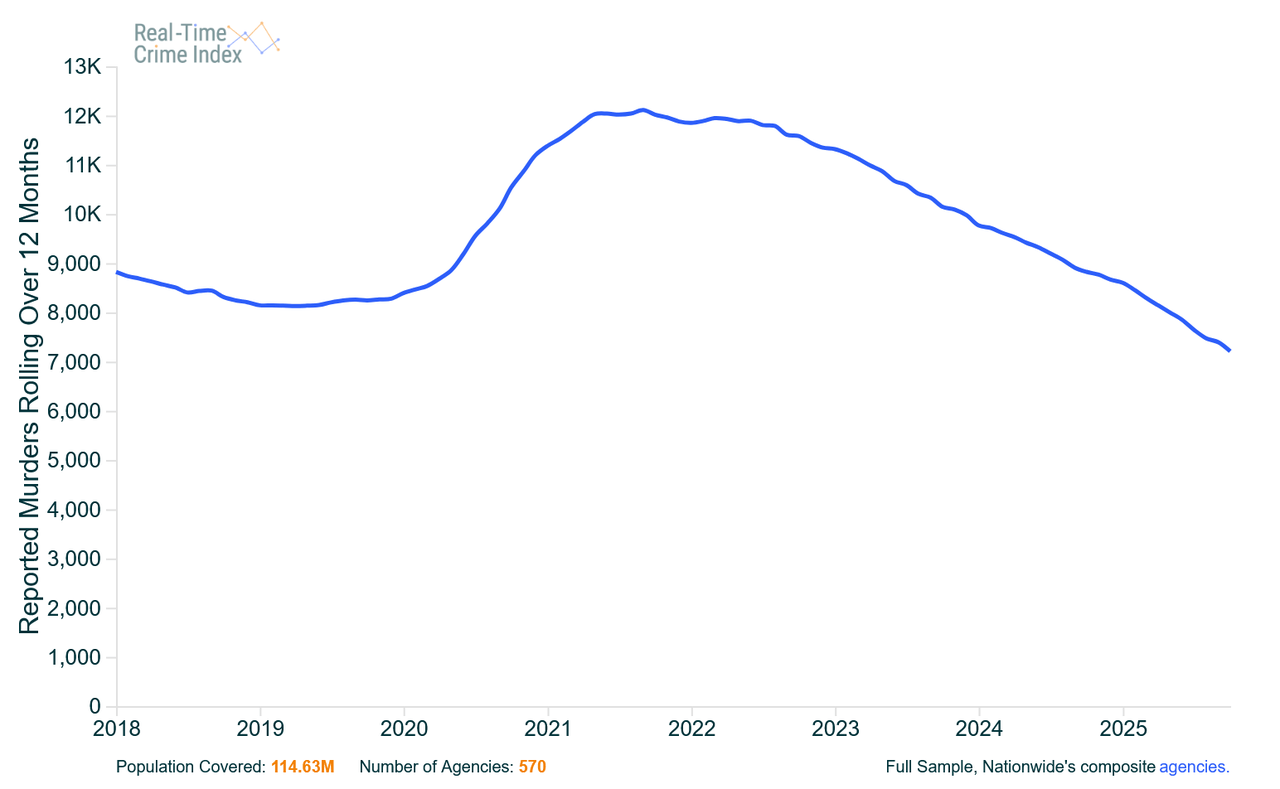
The number of murders in the US is on track for its largest one-year drop on record, according to an analysis by noted crime stats expert, Jeff Asher.

Using the Real-Time Crime Index that compares data from 570 law enforcement agencies, Asher reports a nearly 20% decline in murders in 2025 vs. the same period in 2024. The database excludes manslaughter, self-defense, negligence, or “accidental killings.” 

As Asher notes on his Substack, 

The drop in crime in 2025 continues a trend that began in 2023, accelerated in 2024, and likely became historic in 2025. A roughly 20 percent drop in murder in 2025, as is suggested by the current data, would be by far the largest decline ever recorded, eclipsing the decline in 2024 — currently pegged at -15 percent by the FBI but that’s subject to a likely upward revision next year.

Other types of crime are seeing large reported declines as well. These drops range from a nearly 23 percent decline in motor vehicle thefts in the RTCI to a smaller 9 and 8 percent drop in theft and aggravated assault respectively according to the RTCI. These numbers won’t be finalized for a while, but they paint the picture of large drops in crime even if the current numbers potentially overstate that drop by a small bit.

Other major crime categories tracked by the index were also down, including motor vehicle thefts (23.2%), aggravated assaults (7.5%) and robbery (18.3%). 

When analyzed by major city using data from City Data, Birmingham, Albuquerque, Columbus, Baltimore and Chicago led the decline, while Milwaukee, Kansas City, and Los Angeles actually saw increases YTD. 

Read the entire report here.

Tyler Durden
Fri, 12/26/2025 – 05:30

Pax Germanica

0
Pax Germanica

Authored by Conor Gallagher via NakedCapitalism.com,

German Chancellor Friedrich Merz last week decried the end of Pax Americana and declared that Germany will fill the void:

“The decades of Pax Americana for Europe and Germany are largely over for us. It no longer exists as we knew it. Nostalgia will not help us, and I would be the last person to give in to this nostalgia. This is a reality! The Americans are now very fiercely defending their interests. And that is why we must now defend our interests.”

What were the first acts in defending those interests? Germany approved a nearly $60 billion spending package—believed to be the largest in post WWII German history— that provided aboost to defense stocks, which have begun to come down slightly from their record highs. And on Friday the EU approved 90 billion euros in joint debt in an attempt to keep Project Ukraine limping along.

What does it all mean? Is Germany seriously considering conflict with Russia or is it more subterfuge to push the train down the dual tracks of enriching the capital class while holding together the supranational European project? Probably both—but as the European elite bust out their own countries, run up the tab on rearmament, and do all they can to antagonize Russia in Ukraine and elsewhere, when exactly is common sense supposed to kick in?

Let’s start with what we know.

The German political class has been going on about the end of Pax Americana for years now, just as they’ve been talking about rearmament for years. What these discussions allude to is a Pax Germanica taking the place of Washington in the European theater.

Yes, perhaps it should have “stopped Europe cold”, but then, so should have much of the events of the past four years or so. Yet whether by design or folly, it’s becoming increasingly evident that the vaunted German efficiency is a myth.

They keep pouring money into the rearmament black hole while hollowing out the economy and cutting social spending. It was fitting that on the same day the Bundestag approved the $60 billion in defense spending, the government also moved to cut welfare payments.

Merz’s speech was similar to Angela Merkel’s 2017 warning that Trump’s America was turning its back on Europe. But Merz goes much further by arguing that Europe “is no longer in peace” and that only a strong Germany can return it to such a state.

This argument is similar to the much-discussed Zeitenwende of Merz’s predecessor, Olaf Scholz. The Zeitenwende has surely been a turn, just not so much in the way it was marketed. It was supposed to mark the dawn of a new era in Europe and Germany in particular, which would undergo a massive overhaul of its armed forces in order to “deter” Russia and bring peace of course. It hasn’t done any of that. In fact, coupled with a refusal to compromise or even hold genuine discussions with Moscow, it’s made conflict more likely. But it also hasn’t produced much in the way of results for the German armed forces, which are still a long ways from being ready for any sort of sustained conflict (more on that below).

More recently, a report last year from The German Institute for International and Security Affairs (SWP) titled “Europe and the End of Pax Americana” is nearly identical to what Merz said last week. SWP is one of the foremost think tanks in Germany, and it advises the Bundestag and the federal government on foreign and security policy issues so it’s worth paying attention to, although it usually produces quite bland, toned down versions of reports from the imperial capital in DC. Here’s the meat of its Pax Americana Finis report: 

Ultimately, the decline of Pax Americana also raises the question of what role liberal-democratic values could and should play in foreign policy. German and European advocates of a values-based foreign policy could lose an important backer – namely, America – in the coming years. As far as the European security order is concerned, the situation is quite clear: the conflict with Russia is only superficially about territorial claims and military power relations; its real cause lies in irreconcilable values about Europe’s internal and external order. From the perspective of the EU and the European NATO states, Europe’s security is therefore inextricably linked to the defence of liberal-democratic values.

Standing up for values outside Europe should therefore focus on those norms, institutions and rules that directly affect the peaceful coexistence of states: inter­national and maritime law, multilateralism and, consequently, the often-cited “rules-based order” at the regional and global level. These principles are also supported out of self-interest by authoritarian states that are not major powers and therefore are confronted by more powerful neighbours. However, none of this changes the sobering fact that without the United States, it would be much more difficult to protect the rem­nants of the rules-based world order.

Ah yes, the rules-based order: 

Beyond the obvious joke of the rules-based order, what is being proposed here? That Germany will keep the fight against Russia in the name of this order (which is code for neoliberal capitalism controlled by Wall Street and the European financial class).

In What Form Is This Fight? 

If this is the war Germany is engaged in, it started a while back. And it surely isn’t for the benefit of all Germans. Let us briefly once again recall that the final nail in the coffin of the German economy was Berlin’s decision to move away from cheap and reliable Russian natural gas. Amid the hysteria of the conflict in Ukraine, which is backed by Germany, the response in Berlin has been an assault on the working class in Germany.

While the valuations of weapons companies soar, foreign investors are feasting on the German economic carcass. And the government in Berlin is now committing $35.2 billion in public guarantees, loans, and equity to “de-risk” private equity investments in energy, industry, and advanced technology. This is happening as the German engine of Europe breaks down and is dragging the Eurozone with it.  So the military keynesianism ain’t working (it’s a highly inefficient way to boost the economy) while more and more money is being directed away from social programs and into weapons companies and financialization schemes in the name of competitiveness and defending the country against the dual so-called threats of Russia and a retreating America. Nevermind that US troops remain in Germany and that Moscow was perfectly happy doing business with Germany, wanted further integration with Europe, and has no interest in having to go to war with and subdue a continent of 450 million people who are cursed with fanatically Russophobic leaders. 

Unprepared for a Real Fight 

While the European political class wants to keep Project Ukraine going, longer term their stated goal is to be ready for war with Russia. They are nowhere close. A June report from the Kiel Institute and Bruegel highlights the lack of preparedness. The authors don’t proclaim that Germany and Europe will not be ready to fight by 2030 but consider the obstacles:

  • An inability to translate spending into real capabilities and sustained growth in European force generation, sustainment, and military modernisation.

  • Reducing dependency on US systems and the overstretched US defence industrial base will be a challenge.

  • Cost effectiveness is a major problem.

  • Perhaps the greatest challenge is  reducing dependency on US forces, which means raising a large number of European troops for which the local population has shown no appetite for.

  • Meanwhile, Russia has only increased its advantage since 2022.

It would take an enormous amount of political will, vision, population-wide sacrifice, and even then they might still be far behind Russia but at least able to last more than a few weeks.

Does the current crop of European elected officials or any on the horizon appear capable of anything beyond busting out their own countries?

How about what we don’t know. 

Is It All a Ruse? 

It’s entirely possible. As we see, there are benefits for capital and its long-held wish to dismantle European welfare states. Beyond that, it aids the expansion of supranational EU power, which has nothing much to offer anymore except fear mongering of the Russian horde.

Living standards in the EU continue to decline as prices go up, real wages decline, and the social safety net is cut, and all the borrowing to juice weapons companies and pave the path for private equity are only making matters worse. As a Friday paper from the Kiel Institute highlights:

Current NATO rearmament plans could lead to permanently higher taxes in member states, according to a new analysis by the Kiel Institute based on a unique dataset. The dataset covers the financing of rearmament and wars over the past 150 years in 20 countries. It shows that military spending is initially financed through significantly higher public debt, while in the medium to long term the tax burden rises.

Spook Alignment?

The fact is we don’t know with any degree of certainty what European governments have planned because they long ago quit paying attention to voters, and so much of foreign policy (and domestic) is nowadays conducted by the spooks. As just one example, here’s the situation in the UK, which is openly discussing continuing its dirty war against Russia beyond the inevitable Ukraine collapse: 

And we see Western governments engaged in all sorts of games like fake negotiations designed to trick targets, narrative control, false flags, etc. The Washington Post, for example, just confirmed what was long suspected: that the US pretended to be in negotiations with Tehran in order to help Israel target Iranian nuclear scientists and other officials. And I’ve lost count of the number of stories over the past few years that detail angry calls from the White House to Israeli Prime Minister Benjamin Netanyahu and tell us a serious rift is emerging between the US and Israel.

With spy games as statecraft, the interests of capital taking precedent over national interest, and crazies running the show, the idea that Europe might try to further “extend” Russia into its own yard doesn’t appear far-fetched—despite their lack of preparedness for such a fight.

For example, if there is “spook alignment” in the West, the plan as discussed by some American think tankers and officials to transform the fight against Russia into an EU project while the US tries to play mediator and make imperial gains elsewhere, looks more possible—if not gaining much in the way of sense. But if the European Blob was delusional enough to go all in on Project Ukraine, what about the larger Western Blob project underway for the US to regain hegemony using oil and AI, which involves strengthening control over West Asia and domination in the Western Hemisphere in order to better confront Russia and China economically, if not militarily.

Even if there isn’t such transatlantic Blob alignment, there exists a great deal of danger for Europe.

Russia is treating the European threat very seriously. As the military buildups continue  in Eastern Europe and the dirty war plays out in multiple theaters, the chances of more direct conflict increase. The madness surrounding the so-called shadow fleet with Ukraine (with whose help?) now hitting Russian tankers in the Mediterranean Sea leaps immediately to mind as a potential source of more direct confrontation once/if Moscow runs out of patience. Even if the titans of finance and the EU power mad bureaucrats see benefits in drumming up the threat of conflict, the fallout from Europe’s economic decline will only become more unpredictable and lead to more desperation.

For now, the idea that the Europeans are bluffing and are wise enough to fold at some point requires us to ignore that nearly the entire European political class has already been willing to decimate their own countries economically in the name of this conflict, and wisdom would have been not to start it to begin with. Their actions show that they value the lives of their fellow countrymen as much as they do Ukrainians. If these actors truly believe in the logic that extending Russia will ultimately weaken it (thus far, the evidence is to the contrary) and topple the government, then when they’re no longer able to outsource the job to Ukrainians they won’t hesitate to further wreck their homelands.

They might not be insane enough to send battalions eastwards, but if they can successfully goad the Moscow, imagine how beneficial some Russian strikes on EU territory would be for the effort to burn more cash on rearmament, further scale back social spending, and centralize more power in Brussels.

So as the EU continues its free fall, perhaps the scariest thought is that the political class has already dug so deep, they’re already at bomb shelter depth.

Tyler Durden
Fri, 12/26/2025 – 05:00

World War And The Plan To Control Or Kill Young Western Men

0
World War And The Plan To Control Or Kill Young Western Men

Written by Brandon Smith via Alt-Market.us

When I think of the recent assassination of Charlie Kirk I see the event as symbolic of the death of civil discourse in the west. The timeline split at that moment leaving two distinct groups: The conservatives and centrists who cling to the fantasy that progress through traditional politics is still possible, and the patriots who now realize that a peaceful resolution is unattainable.

I also see it as symbolic of a deeper element of the culture war – Specifically, the war on young white western men. Kirk was 31 at the time of his death. Not “young”, but almost 15 years younger than I am, and it has left me thinking about the future for the next generation of western males at a time when the system is obviously hellbent on destroying them.

They have been the subject of economic warfare through DEI: Corporations and colleges give first shot to any identity group other than white males regardless of merit.

They have been targeted by social warfare: Demonized as irredeemable monsters by woke cancel culture and labeled the cause of all the world’s ills.  Their ancestors built a civilization of unprecedented prosperity and so much material bounty even the poorest people are fat.  They created the middle class, a concept which had never existed before in history.  In 1890 the average global life expectancy was 42 years; by 1990 the average life expectancy was 73 years, all because of western civilization and the technology it created.  And now, white guys are being punished for it.

They have been selected for extermination: They’re the key demographic that leftist governments want to use as cannon fodder for a mindless geopolitical mess in Ukraine.

Charlie Kirk’s biggest mistake was believing that the system could be defeated through peaceful discourse. He was wrong. It’s not just the insanity of the political left that makes peace and reason impossible, there’s also the machinations of globalist controlled governments working tirelessly to conjure a perpetual meat grinder through domestic and foreign conflicts.

One indicator of a coming purge is the open call for young men (specifically conservative men) to accept the idea of future conscription. Multiple EU member states have threatened to institute a military draft if volunteer numbers do not dramatically increase (so much for “democracy”). The purpose of the draft? To construct an EU army large enough to go toe-to-toe with Russia.

As I predicted in my article “World War III Is Now Inevitable – Here’s Why It Can’t Be Avoided”, published in April of 2024, the globalists in Europe are doing everything in their power to stop a peace plan from moving forward in Ukraine. They have been actively sabotaging the Trump Administration’s efforts for a summit which actually includes Russia instead of cutting them out of the process.

At the same time that a greater war is being fomented, there has been a relentless gnawing crusade to demoralize young white men. One could rightly say that this campaign also affects some minority men in places like the US, but let’s not play games – The primary target is without a doubt white western males.

Why? It’s hard to say for certain, but when patriots are called to action it’s usually white conservative men that answer. Minorities (third world migrants in particular) are far more inclined to lean into socialism and view western civilization as a structure to be torn down rather than protected.

This attitude is changing in some areas of South America, for example, but the fact remains that if you visit a developing nation, chances are high that free markets and individual liberty are not common societal values. It’s not racial profiling, it’s simply statistical fact.

In Europe, the current goal of the establishment is to crush the spirits of western men while protecting migrants as a precious commodity. In the UK, the narrative is focused like a laser on white conservative males as public enemy #1, while simultaneously demanding that these same men “prove their patriotism” by fighting for the elites against Russia.

I was watching a news broadcast from the BBC a few months ago in which a male journalist of military age tried to argue rational points on why men in Britain are reticent to go to war for the existing government. He noted that they do not believe that the leftist politicians in power represent them anymore and they feel they are being rapidly replaced by third worlders with hostile ideologies. Why would they fight for such a government?

A black female journalist involved in the discussion sneered at the man’s argument, then grinned as she asserted that nothing he says matters because he could be drafted whether he likes it or not. It was the evil grin of a communist – She knows she’s part of the protected class. She knows that he can be sent to die no matter how logical and reasonable his position,  Meanwhile, she risks nothing in her support of continued war.

She was reveling in the idea of white conservative men being expendable. It’s the leftist dream, is it not? To turn their political opponents into beasts of burden and fuel for the fire of their Utopian fantasy. They don’t care about being correct, or moral; they just want to crush the life out of people who disagree with them.

Progressives in Europe have taken to social media asserting that conservative men should BE SENT FIRST to war; because they are better mentally suited to combat (because conservatives are violent monsters, remember?). They are also easy to sacrifice in the name of the grand progressive experiment. There is, of course, no talk of sending the millions of military age migrant men in Europe to the front lines in Ukraine.

Again, I predicted this exact scenario in my article “Europe Goes Full Totalitarian And Puts The Entire Western World At Risk”, published in March. I stated:

“I would go even further and say that in the event of war with Russia native born citizens will be rounded up for conscription while most migrants are left behind to run the streets of London, Paris and Berlin. I believe the migrants are enforcers to keep any potentially defiant Europeans in line. Many empires and monarchs throughout history have used foreign mercenaries as muscle to prevent local rebellion. The politicians in the EU and UK are following a similar strategy…”

I’ve identified at least three separate propaganda narratives and political agendas that are working in tandem as a weapon against western men.  These mechanisms are highly coordinated across social media, with mainstream news platforms, politicians and influencers repeating the same talking points as if they all received the same script.

Lazy, Apathetic, Angry And Dangerous To Society

Social media is rife with this disinformation claim – Often perpetuated by female influencers, they assert that young men are no longer engaging with modern women and he liberal order because they are “porn addicted”, lack motivation and have no direction. They say that young males have abandoned society and that this makes them volatile and prone to unpredictable violence.

Nothing could be further from the truth. Young men are simply building their own separate society which preserves western values and protects their heritage from the ravages of deconstructionists. Feminists and establishment shills are worried about men walking away because then they can’t exploit those men for their labor and resources anymore. By extension, when men separate from the liberal herd, they have greater independence and a greater potential to rebel.

I would argue that the “incel” narrative widely promoted in the past decade by the political left has nothing to do with sincere concerns about the mental health of young men. Rather, it’s all about controlling those men before they go rogue against the establishment.

Using Economic Hardship And War To Weed Out The Strong

In George Orwell’s novel “Animal Farm”, the communist Pigs seek to dominate the other animals by keeping them busy with arduous (but empty) acts of labor. They use this aimless labor to break the backs of the strongest animals on the farm. The horse named “Boxer” is a true believer in the common good of the collective, but the Pigs see his strength as a potential threat to their long term rule.

They exploit Boxer’s patriotism and ultimately work him to death. They then sell his body to a slaughterhouse despite his faithful service to the farm.

If you are a young man and a patriot in the west and primarily in Europe, YOU are Boxer the horse. They will send you off to slaughter in the name of the collective because you represent potential opposition. They will use economic decline as a means to pressure you into conformity, or leave you no other option but to join the military. They will then celebrate your death, because they nullified your strength without ever having to fight you directly.

Young Men, The Warrior Class And The Weak Elites

Another story I’m often reminded of when contemplating the plight of young men is “The 47 Ronin”. The basic theme is one of justice vs. law and government corruption. When the benevolent lord of a samurai fiefdom is assassinated by another lord, his soldiers call for justice. However, the government intervenes and disrupts any investigation into the murder.

They know the opposing lord is a criminal, but he is also an elite valuable to the power structure. He is one of them, and to punish their own is to bring the entire feudal system into question in the eyes of the nation. They allow him to escape consequences for the sake of the “greater good.”

The samurai, though, do not share in this “enlightened” vision of gray morality. They see everything as black and white; honorable and dishonorable. They make a plan to kill the enemy lord who murdered their master.

I find this story to be the most profound when it comes to explaining the way in which men are treated by modern liberal society, specifically white men in the west. At the end of The 47 Ronin, the samurai succeed in killing the corrupt lord, but they are then required to commit mass suicide or face dishonorable execution as criminals.

They are warriors that have gone rogue; they have exited the societal reservation. They have become the most dangerous thing in existence: Honest men willing to act outside the law.  And so, they must die for the sake of the status quo.

What I see going on today is a perverse agenda to control western men and keep them subservient. The agenda stifles the next generation, through nihilist propaganda, through the apathy of the political circus, and by conditioning those men to see themselves as a dispensable utility. If the system can’t control these men, it will try to kill them by creating a war big enough to thin their ranks by attrition.

The elites view the warrior class as the ultimate danger, and young western men represent the best chance of a renewed warrior class. If these men ever realize their true power, the weakling elites would be wiped off the face of the Earth within moments. I hear the argument often that this kind of rebellion is meaningless without a detailed plan to rebuild.  This is another means of control – Demand a perfect solution before action is ever taken so that nothing ever gets done.

Warriors understand that reformation only comes from the will to take action; the will to create momentum. They understand that civil discourse has its place, but if all it does is maintain the status quo then it must be abandoned. Warriors understand that the worst thing one can do is debate the obvious while the world burns.

Views expressed in this article are opinions of the author and do not necessarily reflect the views of ZeroHedge.


Tyler Durden
Thu, 12/25/2025 – 22:30

Number Of Centenarians Skyrockets In The US

0
Number Of Centenarians Skyrockets In The US

Between the 2010 and the 2020 Census, the number of centenarians in the United States grew by 50 percent to more than 80,000 as the realities of aging populations are catching up to a country that had previously outdone its peer when it came to fertility and demographic development.

As Statista’s Katharins Buchholz reports, the recently published Census Bureau report on centenarians shows that while they remain a very small part of the U.S. population at only two out of every 10,000 Americans, they are nevertheless emblematic of global changes that see increased life expectancy meet lower fertility rates.

Infographic: Number Of Centenarians Skyrockets In The U.S. | Statista

You will find more infographics at Statista

The country with the world’s most centenarians – Japan – has more than twice as many and has been plagued by the realities of demographic change for years.

In 2020, more than 60 percent of U.S. centenarians were aged 100 or 101, while only 10 percent were aged 105 or above.

Women, who have higher life expectancies, were hugely overrepresented among the group, with 79 percent of U.S. centenarians being female.

White Americans are also overrepresented in centenarian populations.

Black and Asian Americans made up somewhat smaller shares of them than their overall population shares would suggest.

Meanwhile Latinos were hugely underrepresented among centenarians, with only around 9 percent of those reaching the age of 100 currently part of the group despite 18.7 percent in the country now identifying as Hispanic. This could be due to the fact that Latino populations are among the fastest growing in the U.S. and therefor have many younger members. Puerto Rico was the place with the second-most centenarians in the country, only surpassed by Hawaii.

The changing realities of aging and fertility have caused demographic change to accelerate recently in the United States. Between the 2010 and the 2020 Census, the number of Americans aged 65 and over rose by 4 percentage points to 16.8% as Baby Boomers entered retirement. Between 1990 and 2000 as well as between 2000 and 2010, this number had held more or less steady.

Tyler Durden
Thu, 12/25/2025 – 21:45