64 F
Chicago
Thursday, October 1, 2026
Home Blog Page 867

USDA Must Give States More Time To Implement Food Stamp Restrictions: Judge

0
USDA Must Give States More Time To Implement Food Stamp Restrictions: Judge

Authored by Zachary Stieber via The Epoch Times (emphasis ours),

The U.S. Department of Agriculture (USDA) must extend a deadline for states to implement new immigration-related eligibility restrictions on food stamps, a federal judge ruled on Dec. 15.

A sign advertises that “Food Stamps (EBT)” are accepted at a convenience store in Chelsea, Mass., on Oct. 24, 2025. Brian Snyder/Reuters

U.S. District Judge Mustafa Kasubhai, during a hearing in Eugene, Oregon, issued an injunction requiring the USDA to extend the expiration date of a grace period for the states to comply with the new restrictions on Supplemental Nutrition Assistance Program (SNAP) benefits.

The deadline was Nov. 1. It is now April 9, 2026. A written order has not been released yet.

Under the One Big Beautiful Bill Act, signed by President Donald Trump over the summer, states had to stop letting certain immigrants, including those with deportation hold orders and refugees who are not legal residents, receive food stamps from SNAP, the USDA said in an Oct. 31 memorandum.

The USDA also stated at the time that lawful permanent residents, or green card holders, would only be eligible for SNAP after a 5-year waiting period.

Twenty-one states and the District of Columbia sued over the guidance. They said that the guidance wrongly required a waiting period for all green card holders, even though another federal law allows a variety of permanent residents, including people who are blind or disabled, to receive SNAP without a waiting period.

Kasubhai said on Dec. 15 that the guidance contributed to “confusion” that impeded states’ ability to implement the new restrictions.

The USDA said it never intended for its guidance to go beyond the new immigration-related eligibility restrictions set forth in the law, and a lawyer for the Department of Justice told the judge that reflected a “misunderstanding” by the states.

On Dec. 9, the USDA issued revised guidance on implementing the new rules, stating that some permanent residents, including refugees, do not need to wait five years to receive food stamps.

The states also said in a motion for a preliminary injunction that if the judge did not block the guidance, he should extend the compliance deadline to March 1, 2026.

Kasubhai said that the updated guidance corrected the USDA’s previous position, which he said ran counter to the One Big Beautiful Act. Later in the hearing, he said the deadline for compliance was illegal, contrary to past practice, and would expose the states’ budgets to irreparable harm if not extended.

“The inability to provide compliance in the time period in which they were forced to by virtue of the guidance contributed to an erosion of trust,” Kasubhai said.

A USDA spokesperson declined to comment in an email to The Epoch Times.

Oregon Attorney General Dan Rayfield, a Democrat, said in a statement that the ruling “allows Oregon to keep administering SNAP without fear of being punished for following the law.”

Reuters contributed to this report.

Tyler Durden
Tue, 12/16/2025 – 14:45

UBS Upgrades Luxury To “Overweight” For First Time In Three Years

0
UBS Upgrades Luxury To “Overweight” For First Time In Three Years

European luxury stocks have been locked in a 4.5-year trading range, oscillating between peaks and troughs rather than the up-and-to-the-right pattern seen with AI stocks.

Global consumer uncertainty has been a persistent overhang for the last few years. Lower-income households remain under pressure from inflation and affordability constraints. By contrast, upper-income consumers have benefited from wealth effects driven by rising equity markets, cryptos, precious metals, and home prices.

UBS analyst Andrew Garthwaite now offers clarity on the next move for luxury stocks, writing in a lengthy 2026 outlook note to clients that his team has, for the first time in three years, upgraded luxury to “overweight.”

Garthwaite cited a combination of improving fundamentals, supportive valuations, and strengthening macro tailwinds entering 2026 as the primary reasons for the upgrade in luxury stocks.

The analyst laid out his case in a section of the note titled, “The major sector changes are to upgrade luxury…”: 

We take luxury up to overweight for the first time in over 3 years:

We upgraded to benchmark (from underweight) on July 1st. We raise further because: i) EPS is now back to trend (having been 100% above trend); ii) capex is now below trend (implying that future margins should improve); iii) we are now seeing EPS and revenue expectations being at the low end of range but improving (with UBS forecasting luxury EPS to be 5% above the market compared to consensus on 2% above the market) – we have seen the first signs of margin improvement since 2022; iv) P/E relatives ex Hermes are mid-range (only slightly above its normal 32% P/E premium) – on UBS HOLT, the implied CFROI and growth rate are at the bottom end of their historical range against that of the market at only a 1.3% and 1.5% premium, respectively. A quarter of the luxury cluster is US-related and if just 0.5% on the wealth gain in equities that we predict in 2026 in the US is spent on luxury, then that adds c7% to sales. The rise in gold has generated a wealth gain 3X higher than the losses in bitcoin YTD. The top income decile household stands to benefit by $12K a year (according to the CBO) from the OBBB. A stronger dollar forecast post Q1 26 has statistically speaking been very helpful for a sector with extremely high transactional exposure. High-end luxury tends to avoid the disruption associated in other sectors from Gen AI, GLP-1, governments cutting healthcare budgets or Chinese competition. We forecast outsized growth of the EM middle class, boosting demand for conspicuous status symbols. China is a risk, but Macau casino stocks (a proxy on high-end spending) have modestly outperformed YTD. The team have Buys on LVMH, Richemont and EssilorLuttoxica.

The UBS EU Luxury Goods basket has been rudderless for roughly 4.5 years, trapped in a trading range as investors search for signs of a consumer rebound.

Will a breakout be coming in 2026?

Meanwhile, U.S. Treasury Secretary Scott Bessent pointed to a brighter outlook for low-income consumers in 2026.

ZeroHedge Pro subs can read the full note in the usual place.

Tyler Durden
Tue, 12/16/2025 – 14:25

Satyajit Das: AI – Artificial Intelligence or Absolute Insanity?

0
Satyajit Das: AI – Artificial Intelligence or Absolute Insanity?

Authored by Satyajit Das via NakedCapitalism.com,

AI is tracing the familiar, weary boom and bust trajectory identified in 1837 by Lord Overstone of quiescence, improvement, confidence, prosperity, excitement, overtrading, convulsion, pressure, stagnation, and distress.

There are three primary concerns.

First, there are doubts about the technology.

Building on earlier technologies such as neural networks, rule-based expert systems, big data, pattern recognition and machine learning algorithms, GenAI (generative AI), the newest iteration, uses LLMs (large learning models) trained on massive data sets to create text and imagery. The holy grail is the ‘singularity’, a hypothetical point where machines surpass human intelligence. It would, in Silicon Valley speak, lead to ‘the merge’, when humans and machines come together potentially transforming creativity and technology.

LLMs require enormous quantities of data. Existing firms in online search, sales platforms and social media platforms can exploit their own data troves. This is frequently supplemented by aggressive and unauthorised scraping of online data, sometimes confidential, leading to litigation around access, compensation and privacy. In practice, most AI models must rely on incomplete data which is difficult to clean to ensure accuracy.

Despite massive scaling up of computing power, GenAI consistently fails in relatively simple factual tasks due to errors, biases and misinformation in datasets used.  AI models are adept at interpolating answers between things within the data set but poor at extrapolation. Like any rote-learner, they struggle with novel problems. Their ability to act autonomously interacting within dynamic environments remains questionable. Cognitive scientists argue that simply scaling up LLMs based on sophisticated pattern-matching built to autocomplete rather than proper and robust world models will disappoint. Claimed progress is difficult to measure as benchmarks are vague and inconclusive.

Cheerleaders miss that LLMs do not reason but are probabilistic prediction engines. A system which trawls existing data, even assuming that is correct, cannot create anything new. Once existing data sources are devoured, scaling produces diminishing returns. Rather than fully generalisable intelligence, generative models are regurgitation engines struggling with truth, hallucinations and reasoning.

AI models can take over certain labour-intensive tasks like data driven research, journalism and writing, travel planning, computer coding, certain medical diagnostics, testing and routine administrative tasks like handling standard customer service queries. Its loftier aims may prove elusive. Predictions of medical breakthroughs have disappointed although pre- OpenAI machine learning models, pattern recognition engines and classifiers, used for years, continue to be useful.

For the moment, GenAI, an ill-defined marketing rather than technical term, remains a costly parlour trick for some low-level applications, making memes and allowing scammers to deceive and defraud – the “unfathomable in pursuit of the indefinable”.

Second, financial returns may prove elusive.

Capital expenditure on AI is expected to total up to $5-7 trillion by 2030. AI startup valuations based on the latest round of funding were $2.30 trillion, up from $1.69 trillion in 2024, and up from $469 billion in 2020. But AI’s capacity to generate cash and returns on the investment remains questionable.

Revenues would have to grow over 20 times from the current $15-20 billion per annum to just cover current annual investment in land, building, rapidly depreciating chips and power and water operating expenses. Revenues totalling more than $1 trillion may be required to earn an adequate return. Microsoft’s Windows and Office, among the world’s most used software, generates less than $100 billion in commercial and consumer revenue. Around 5 percent of its 800 million users currently pay to use ChatGPT. Microsoft’s CEO drew the ire of true believers when he argued that AI had yet to produce a profitable killer application to match the impact of email or Excel.

The hope is AI will be paid for from higher productivity and corporate profits. But 95 percent of corporate GenAI pilot projects failed to raise revenue growth. After cutting hundreds of jobs and replacing them with AI, many firm were subsequently forced to reemploy staff when the technology proved deficient. Corporate interest is already showing sign of plateauing.

Monetisation of AI faces other uncertainties. Several Chinese firms, such as DeepSeek, Moonshot as well as Bytedance and Alibaba, have developed cheaper models which cast doubts about the capital investment intensive approach of Western firms. China’s favoured open-source design would also undermine the revenues of firms which have invested heavily in proprietary technology. Required electricity and water supplies may prove to be constraints.

In the meantime, AI firms remain a cash burning furnace. In the first half of 2025, OpenAI, owner of ChatGPT, generated $4.3 billion in revenue but spent $2 billion on sales and marketing and nearly $2.5 billion on stock-based equity compensation, posting an operating loss of $7.8 billion.

Third, there are financial circularities seen during the dot com boom. 

CoreWeave, an equipment rental business trying to cash in the AI boom, purchases graphics processers in-demand for AI applications and rents them to users. Nvidia is an investor in the company, and the bulk of revenues is from a few customers. There is concern around CoreWeave’s accounting practices, especially the rate of depreciation of the chips, and its significant borrowings.

In 2025, Nvidia, the backbone of the boom, agreed to invest $100 billion in OpenAI which in turn bought a similar dollar value of GPUs from it. Open AI proposed to invest in chipmakers AMD and Broadcom. There are side arrangements with Microsoft. Figure 1 sets out some of the complex interrelationships.

Figure 1: AI Firm Inter-relationships and Cross-Investments

This intricate web of linkages creates risks. They complicate ownership and create conflicts of interest. It was not clear how any of these commitments will work or be funded if they proceed. Open AI’s ability to finance these investments depends on continued access to new money from investors because it currently does not have the resources to meet many of these long-term obligations.

These transactions distort financial performance. The firm selling capital goods reports sales and profits while the funding of the sale is treated as an investment. The buyer depreciates the cost over several years. Given that Nvidia seemingly upgrades its chip architecture regularly, depreciation periods of anywhere up to 5 years or longer seem optimistic. This means that dubious earnings boost share prices in a dizzying financial merry go round.

The AI bubble, with its growing gap between expectations, investment and revenue potential, eerily resembles the 1990s. But it is much larger. Investment may be 17 times that of the 2000 dot com and four times the 2008 sub-prime housing bubble.

AI’s acolytes deny any excess and argue that this time it is different because it is financed by equity capital. In fact, a large proportion is funded by debt with the amount tied to AI totalling around $1.2 trillion, 14 percent of all investment-grade debt.

The funding pattern is intriguing. Hyperscalers, firms that build and operate large data centres providing on-demand cloud computing, storage, and networking services, such as Microsoft, Meta, Alphabet and Oracle, are providing much of funding alongside venture capital investors. These firms are currently spending around 60 percent of operating, not free, cash flow, on capital expenditure, the vast majority of which is to support AI projects. This is supplemented by borrowing, relying on their credit standings, to finance their investments. Increasingly, a significant proportion of the funding is being provided by private credit with. expected volumes as high as $800 billion over the next two years and $5.5 trillion through to 2035. Given the high return, high risk appetites of these lenders, the level of financial discipline applied to these loans remains uncertain.

In effect, these large firm are now acting as financiers, borrowing money which is on-lent or invested in AI start-ups with unclear prospects. This exposure is troubling. Investor and lender assumptions that their exposure is to a strong firm is undermined where it is heavily invested in speculative AI ventures with unclear prospects. Microsoft’s share of Open AI’s losses is significant, over $4 billion in the latest quarter, representing around 12 percent of its pre-tax earnings.

Oracle’s experience is salutary. The shares rose 25 percent when it announced a transaction to provide cloud computing facilities to OpenAI. The data centres do not currently exist and will have to be constructed. The transaction requires Oracle, which is significantly leveraged, to borrow funds to create these centres meaning that the firm is taking significant exposure to Open AI. As of December 2025, investor concern was palpable. Given its current net debt of over $100 billion which will need to increase substantially to finance the data centres, the cost of insuring against Oracle default rose sharply and presumably will flow through into the value of existing debt and the cost of future debt. A credit ratings downgrade from its current BBB, low investment grade, is possible, potentially to non-investment or junk grade. Its share price has fallen to levels around that before the announcement of the OpenAI transaction. While Microsoft, Meta and Amazon have stronger balance sheets, the risks are not dissimilar.

The impact of the AI boom on the wider economy is material. AI companies account for 75-80 percent of US stock returns and earnings growth and 90 percent of capital expenditure growth. It has added around 40 percent or a full percentage point to 2025 US growth.  Any retrenchment would affect the wider economy. It would also result in financial instability because of the direct and indirect exposure of banks and financial institutions to the AI sector. It is not inconceivable that some tech firms may require bailouts, such as that engineered for Intel, alongside familiar support for financiers, who will plead that without assistance the economy will collapse.

Investors have convinced themselves that the greater risk is underinvesting not overinvesting. Amazon founder Jeff Bexos hails it a “good kind of bubble” arguing that the money spent will bring long-term returns and deliver gigantic benefits to society, the tech-bro’s persistent bromide. Investors should be cautious. In the 1990s telecoms and fibre optic cable bubble, investors drastically overestimated capacity required. The percentage of lit or used fibre-optic capacity today, much of it installed during the dot com boom, is around 50 per cent, and global average network utilisation is 26 percent.

Investors believe that they have minimises risk by avoiding direct exposure to AI firms investing instead in firms like Nvidia, which provide the ‘picks and shovels’ of the revolution. The case of Cisco, for which the investment case during the halcyon days of the 1990 was similar, provides an interesting benchmark. It briefly became the world’s most valuable company on the largely correct assumption that its routers and other products would be crucial to the Internet. While the company’s financial performance has been generally steady, investors in Cisco lost out as its share price plummeted in 2000 only reaching the same level after 25 years.

When the dot com boom ended, Microsoft, Apple, Oracle and Amazon fell 65, 80, 88 percent, and 94 percent respectively taking 16, 5, 14 and 7 years to recover their 2000 peaks. The economy slowed requiring government support and historically low interest rates, at the time, to sustain economy activity which set off the housing boom which resulted in the 2008 crisis.

Consensual Tolkien-esque hallucinations notwithstanding, it would be surprising if the ending is different this time.

This is an expanded version of a piece first published on 4 November 2025 in the New Indian Express print edition.

Tyler Durden
Tue, 12/16/2025 – 14:05

Payrolls Paradox: November Jobs Rise 64K, More Than Expected But Unemployment Rate Jumps To 4 Year High

0
Payrolls Paradox: November Jobs Rise 64K, More Than Expected But Unemployment Rate Jumps To 4 Year High

Ahead of today’s jobs report, Goldman Delta One Head Rich Privorotsky wrote that with the October print backward looking and mostly govt related and irrelevant, “anywhere near consensus for November (+/-25k of 50k) feels like the sweet spot…that said, hard to see the FOMC feeling compelled to halt accommodation or even talk about hiking if labor momentum is still sub-100k on trend. Too cold (<25k or negative) and the pro-cyclical rally we’ve seen has to be questioned. Probably bigger risk to the market narrative is a re-acceleration in labor which is consistent with some of the bonce in open jobs visible in the higher frequency data.”

With that in mind, moments ago the the BLS published a very mixed report, with payrolls coming solid, thanks to a big beat in the November print, offset by an unexpected jump in the unemployment rate to 4.6%, above estimates, and the highest since Sept 2021.

Here are the details: in October, the US lost 105K jobs, entirely due to a plunge in government jobs (more below) but this was offset by the November jump of 64K jobs, which came in higher than the 50K expected. Private payrolls increased by an even stronger 69K (vs the same consensus est of 50K).

Naturally, the negative revisions continued: the BLS also reported that the change in total nonfarm payroll employment for August was revised down by 22,000, from -4,000 to -26,000, and the change for September was revised down by 11,000, from +119,000 to +108,000.  With these revisions, employment in August and September combined is 33,000 lower than previously reported. 

Of note, government employment tumbled in November by -6,000. This follows a sharp decline of 162,000 in October, as some federal employees who accepted a deferred resignation offer came off federal payrolls. Federal government employment is down by 271,000 since reaching a peak in January. (Federal employees on furlough during the government shutdown were counted as employed in the establishment survey because they received pay, even if later than usual, for the pay period that included the 12th of the month. Employees on paid leave or receiving ongoing severance pay are counted as employed in the establishment survey.)

But while payrolls were generally solid, the unemployment rate was a problem and is what will likely prompt the Fed to cut more: in November, the unemp rate rose to 4.6% (with October blank), worse than the 4.5% estimate and the highest since Sept 2021.

Among the major worker groups, the unemployment rate for teenagers was 16.3% in November, an increase from September. The jobless rates for adult men (4.1 percent), adult women (4.1 percent),  Whites (3.9 percent), Blacks (8.3 percent), Asians (3.6 percent), all rose, and just the unemp rate for Hispanics (5.0 percent) dropped.

We note that the 16-19 year-old cohort (male worse than female) is seeing a surge in unemployment while the 2024 cohort is seeing their unemployment rate decline (with females outperforming males)…

Both the labor force participation rate (62.5 percent) and the employment-population ratio (59.6 percent) were little changed from September. These measures showed little or no change over the year. 

In November, average hourly earnings for all employees on private nonfarm payrolls edged up by 5 cents, or 0.1 percent, to $36.86. Over the past 12 months, average hourly earnings have increased by 3.5%, lower than the 3.6% expected. The average workweek for all employees on private nonfarm payrolls edged up by 0.1 hour to 34.3 hours in November. In manufacturing, the average workweek changed little at 40.0 hours, and overtime was unchanged at 2.9 hours. 

Taking a closer look at the report we find the following details:

  • The number of people jobless less than 5 weeks was 2.5 million in November, up by 316,000 from  September. The number of long-term unemployed (those jobless for 27 weeks or more) changed little at 1.9 million in November and accounted for 24.3 percent of all unemployed people. 
  • The number of people employed part time for economic reasons was 5.5 million in November, an increase of 909,000 from September. These individuals would have preferred full-time employment but were working part time because their hours had been reduced or they were unable to find full-time jobs. 
  • The number of people not in the labor force who currently want a job, at 6.1 million in November, was little changed from September. These individuals were not counted as unemployed because they were not actively looking for work during the 4 weeks preceding the survey or were unavailable to take a job. 
  • Among those not in the labor force who wanted a job, the number of people marginally attached to the labor force, at 1.8 million in November, was little changed from September. These individuals wanted and were available for work and had looked for a job sometime in the prior 12 months but had not looked for work in the 4 weeks preceding the survey. The number of discouraged workers, a subset of the marginally attached who believed that no jobs were available for them, also changed little at 651,000 in November. 

Taking a closer look at the monthly change in jobs, employment rose in health care and construction while federal government employment declined by 6,000, following a loss of 162,000 in October. 

  • In November, health care added 46,000 jobs, in line with the average monthly gain of 39,000 over the prior 12 months. Over the month, job gains occurred in ambulatory health care services (+24,000),  hospitals (+11,000), and nursing and residential care facilities (+11,000).
  • Construction employment grew by 28,000 in November, as nonresidential specialty trade contractors added 19,000 jobs. Construction employment had changed little over the prior 12 months. 
  • Employment in social assistance continued to trend up in November (+18,000), primarily in individual and family services (+13,000). 
  • In November, employment edged down in transportation and warehousing (-18,000), reflecting a job loss in couriers and messengers (-18,000). Transportation and warehousing employment has declined  by 78,000 since reaching a peak in February. 
  • The big outlier was Federal government employment, which continued to decrease in November (-6,000). This follows a sharp  decline of 162,000 in October, as some federal employees who accepted a deferred resignation offer came off federal payrolls. Federal government employment is down by 271,000 since reaching a peak in January. (Federal employees on furlough during the government shutdown were counted as employed in the establishment survey because they received pay, even if later than usual, for the pay period that included the 12th of the month. Employees on paid leave or receiving ongoing severance pay are counted as employed in the establishment survey.)

And visually:

While the quantitative aspects of the report were ok, the qualitative were ugly. In November, the number of full-time workers plunged by 983K from September to 134.17 million. At the same time, in the two months since Sept, the number of part-time workers soared by over 1 million (1.025 million to be precise) to 29.486 million…

… the highest on record while full-time workers tumbled to a 2025 low!

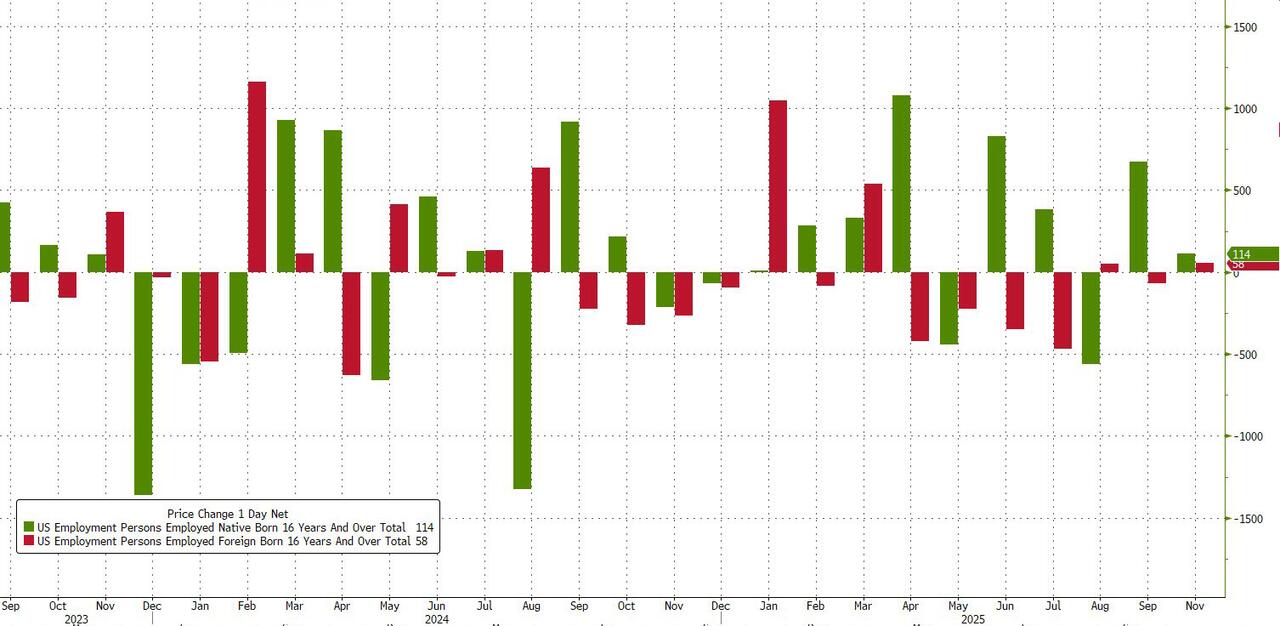
As for the closely watched “immigrant” shift, in November there were no fireworks here, with Native Born workers up 114K, while foreign-born increased by 58.

There was more: the number of people who need more than one job to make ends meet soared by almost 500K in the 2 months since Sept to 9.301 million, the highest on record!

Overall, this jobs report was weaker than it will be spun for political reasons, which however is precisely what the market is looking for because as Morgan Stanley’s Mike Wilson put it, “bad news is now good news for stocks.”

Tyler Durden
Tue, 12/16/2025 – 14:00

Will The Oil Curse Strike South America’s Wealthiest Country?

0
Will The Oil Curse Strike South America’s Wealthiest Country?

Authored by Matthew Smith via OilPrice.com,

  • Guyana’s offshore oil discoveries have driven explosive GDP growth, propelling it into the global top tier by income per capita.

  • Heavy dependence on petroleum revenues, weak institutions, and geopolitical pressure from Venezuela raise serious risks of an oil curse.

  • Despite massive state spending and infrastructure investment, much of the population remains poor, highlighting deep distributional challenges.

In a remarkable turnaround, the tiny South American country of Guyana, once one of the continent’s poorest nations, now ranks among the world’s top 10 wealthiest countries by gross domestic product (GDP) per capita. In a mere decade, Guyana went from first discovery to be lifting nearly 900,000 barrels of crude oil per day from the prolific 6.6-million-acre Stabroek Block. This, despite the lopsided deal favoring the ExxonMobil-led consortium, which controls the oil acreage, has delivered a massive economic windfall. There are concerns that this breakneck economic growth and the massive income generated by oil will see Guyana struck by the oil curse.

In a recent survey ranking the world’s wealthiest countries using projected 2025 GDP by purchasing power parity per capita, Guyana ranked in 10th place, compared to 107th a decade earlier. This put the former British colony behind wealthy countries like Brunei, Switzerland and Norway but, surprisingly, ahead of the world’s second largest economy, the United States of America. Indeed, Guyana’s GDP by purchasing power parity has skyrocketed since oil production began in December 2019. According to the International Monetary Fund (IMF) it rose sevenfold, from $10.69 billion that year, to an estimated $75.24 billion for 2025.

That immense economic expansion saw Guyana, for a brief period, become the world’s fastest-growing economy. From 2022 to 2024, the tiny country of less than one million reported annual GDP growth rates of 63.3%, 33.8% and 43.6% respectively, by far the highest each of those years for a sovereign state.

While growth has dropped off over recent months, despite petroleum output rising because of the start-up of the Yellowtail project, the former British colony’s economy is forecast to expand by 10.3% in 2025. This makes Guyana the world’s third fastest-growing economy this year.

The latest government data shows Guyana is pumping around 900,000 barrels per day, making the tiny country South America’s third-largest oil producer behind Brazil and Venezuela. Petroleum production will continue to grow with Exxon developing three additional projects in the Stabroek Block. These are the Uaru, Whiptail and Hammerhead developments with a proposed fourth facility, Longtail, subject to regulatory review. On completion of those three facilities, which start up between 2026 and 2029, will add 650,000 barrels daily, lifting Guyana’s total potential production to 1,5 million barrels per day.

There is a fourth facility under development, although it has yet to be approved. This is the 2018 Longtail discovery, which was the Exxon-led consortium’s fourth find in the Stabroek Block. The $12.5 billion Longtail project, unlike earlier developments, will be a natural gas and condensate facility. It is currently undergoing environmental permitting, with Exxon expecting to make a final investment decision (FID) by the end of 2026. Once approved, it is anticipated Longtail will come online during 2030, adding up to 1.5 billion cubic feet of natural gas and 290,000 barrels of condensate daily. This will lift Guyana’s hydrocarbon output to over 1.7 million barrels per day.

Once those offshore petroleum assets are operational, the oil produced will boost the former British colony’s GDP. The IMF predicts that between 2025 and 2030, Guyana’s GDP, based on purchasing power parity, will more than double from $75 million to $156 million. That for a country of less than one million translates to an impressive GDP per capita of just under $193,000. When using this metric, it will make Guyana the world’s second-wealthiest nation, behind Liechtenstein and ahead of Singapore. Such a massive concentration of wealth generated by a single resource, petroleum, is sparking considerable fear that Guyana will be impacted by the oil curse.

This is a phenomenon where a country blessed with copious petroleum resources becomes completely economically and financially dependent on crude oil. This typically leads to poor governance, extreme corruption, malfeasance, democratic backsliding, political instability and eventually internal conflict. A prime example of the oil curse, along with the social, political and economic impact it has on petroleum-dependent nations, is Venezuela. Decades of economic over-dependence on crude oil negatively affected Venezuela’s development, destabilising the country and eventually leading to dictatorship and economic collapse.

Incidentally, the Stabroek Block, which is estimated to contain recoverable oil resources of at least 11 billion barrels, has become a target for Caracas. After Exxon made a swathe of world-class discoveries in the offshore acreage, Venezuela’s president, Nicolas Maduro, ratcheted up his sabre-rattling and aggressive rhetoric as part of his campaign to reclaim the long-disputed Essequibo region. This area, comparable in size to the state of Georgia, comprises two-thirds of Guyana’s territory and is rich in precious metals, diamonds, copper, iron, aluminium, bauxite, and manganese.

You see, the prolific Stabroek Block lies in Guyana’s territorial waters that are part of the disputed Essequibo region, an area claimed by Venezuela since independence. Caracas over the last three years has intensified its campaign to regain control of the Essequibo, even threatening to invade the region. There are regular skirmishes between Guyana’s army and Venezuelan gangs on the border between the two countries in the Essequibo. Venezuelan military vessels have entered the Stabroek Block to harass and intimidate the crews of the Floating Production Storage and Offloading (FPSOs) operating in the offshore oil acreage.

There are very real fears that Guyana, which is a developing country with a history of corruption, lacks the good governance and institutional stability to effectively manage this massive economic windfall generated by this once-in-a-generation oil boom. Already, concerns are emerging about how Georgetown is spending the vast oil profits flowing into government coffers. Georgetown has embarked on a massive infrastructure boom, budgeting $1.2 billion in public works for 2025 to fund new roads, bridges, the development of a world-class deepwater port and public goods such as hospitals. There are, however, considerable concerns that many Guaynese are not benefiting from the tremendous economic windfall generated by oil.

Despite the economy growing at a stunning rate, a sizable portion of the population still lives in poverty. Analysts claim that up to 58% of Guyanese live below the poverty line, although an accurate number is difficult to determine because of a lack of official data. The World Bank estimated in 2019 that 48% of Guyana’s population lives below the poverty line. Despite the economy’s rapid growth, community leaders, nonetheless, claim that much of the wealth generated by the oil boom has yet to trickle down to Guyana’s poorest communities, especially in rural regions.

Those fears are exacerbated by Georgetown’s growing dependence on volatile international energy markets, at a time when the outlook for crude oil is poor. The international Brent benchmark price is down 17% over the last year, which is sharply impacting oil revenues. Analysts from major financial institutions are forecasting that Brent could plunge into the $30 per barrel range by 2027 due to overwhelming market supply. Unsurprisingly, the rapid development of Guyana’s offshore oilfields is a key contributor to this massive jump in non-OPEC global supply growth.

This will sharply impact Georgetown’s newly found oil riches. As international oil prices plunge due to an overwhelming supply glut, Guyana’s petroleum revenue will plummet. This will be exacerbated by 75% of the petroleum produced from the Stabroek Block being classified as cost oil, thus seeing it excluded from royalties and profit-sharing payments with Guyana. While this will not be enough to roil Guyana’s newfound economic boom it has the potential to trigger corruption and malfeasance, leading to uneven development while damaging an increasingly petroleum-dependent economy.

Tyler Durden
Tue, 12/16/2025 – 12:40

DOJ Sues States For Voter Information – What To Know

0
DOJ Sues States For Voter Information – What To Know

Authored by Stacy Robinson via The Epoch Times (emphasis ours),

The U.S. Department of Justice (DOJ) is suing 18 states that refused to hand over voter registration information following a series of requests made earlier this year.

The U.S. Department of Justice in Washington on Oct. 21, 2025. Madalina Kilroy/The Epoch Times

The DOJ said it wants to inspect voter rolls to make sure they are clean and up-to-date, while some states said they are worried the government has ulterior motives in requesting the information.

On Dec. 12, the department added Fulton County, Georgia, to that list; there, the government is asking for records related to the 2020 election.

Here’s what to know about the lawsuits.

The Requests

The DOJ’s inquiry began in May with a letter to Colorado Secretary of State Jena Griswold asking for voter information and certification that the state had not destroyed any records it was legally obligated to retain.

The letter said the DOJ wanted to ensure that Colorado was in compliance with the Voting Rights Act 52 U.S.C. 20701, which requires states to retain election information, including voter registrations, for 22 months following presidential and congressional races.

Similar requests went out to at least 40 states, but Maria Benson, spokeswoman for the National Association of Secretaries of State, said the DOJ told her “all states would be contacted eventually.”

The requests were sent out following President Donald Trump’s executive order asking the DOJ to verify that states were checking citizenship status for those who registered to vote, in compliance with the National Voter Registration Act.

A few states, like Minnesota, are exempt from the National Voter Registration Act. In those cases, the DOJ cited the Help America Vote Act, which requires similar preservation of voter records, and requires each state to maintain a single, computerized database of its registered voters.

Notably, the DOJ’s request to Minnesota also asked for other information, such as how the state struck deceased voters from its rolls, and how it dealt with duplicate registrations. It also asked the state to explain its procedures for identifying non-citizen voters.

In Nebraska, the DOJ asked for full voter registration data, including “full name, date of birth, residential address, his or her state driver’s license number or the last four digits of the registrant’s social security number.”

The Fulton County suit is different, in that it follows a July resolution passed by the State Election Board of Georgia “calling upon the assistance of the Attorney General to effect compliance with voting transparency.”

In October, the DOJ responded by requesting “all used and void ballots, stubs of all ballots, signature envelopes, and corresponding envelope digital files from the 2020 General Election in Fulton County.”

Fulton County officials rejected that request, saying the records “remain under seal” and will not be produced without a court order.

The Fulton request is notable, not just because it stems from internal state action, but because Trump narrowly lost Georgia in 2020 by fewer than 12,000 votes.

The Refusal

Only two states, Indiana and Wyoming, fully complied.

Some states, like Washington, responded by giving only part of the requested information, citing privacy concerns or legal prohibitions.

“While we will provide the DOJ with the voter registration data that state law already makes public, we will not compromise the privacy of Washington voters by turning over confidential information that both state and federal law prohibit us from disclosing,” Washington Secretary of State Steve Hobbs said in a statement.

Hobbs, in a letter to Assistant Attorney General Harmeet Dhillon, said Washington state law gave the federal government the right to some information, but not voters’ driver’s license and social security numbers.

Sens. Alex Padilla (D-Calif.) and Dick Durbin (D-Ill.) also issued a public letter to Attorney General Pam Bondi opposing the DOJ’s inspection, calling it a plan “to use sensitive state voter information to create a national voter database, without any direction from Congress or guardrails on how the information in the database will be used.”

“Put simply, it is neither the Department’s job nor its skillset to micromanage how election officials purge voters from state voter rolls,” the senators said.

Among other inquiries, their letter asks Bondi to clarify fully how the DOJ intends to use the information, and what protocols are in place to protect voter privacy.

The Lawsuits

The DOJ has sued 18 states, saying Title III of the Civil Rights Act of 1960 requires states to turn this information over to the attorney general upon request.

So far the Justice Department has sued California, Delaware, Maine, Maryland, Michigan, Minnesota, New Hampshire, New Mexico, New York, Oregon, Pennsylvania, Rhode Island, Vermont, Colorado, Hawaii, Massachusetts, Nevada, and Washington.

Many of these cases were delayed by the government shutdown and are still in the early stages of litigation. Oregon and Pennsylvania have filed motions to dismiss, but most other states have asked courts for extra time to respond to the suit.

Nebraska resident Dawn Essink, backed by voter advocacy group Common Cause, has sued State Secretary Robert Evnen, hoping to stop the information disclosure.

“Under current [Nebraska] law, local and state election officials are prohibited from disclosing a voter’s birth date, driver’s license information, or social security number,” their complaint reads.

A similar lawsuit was filed in South Carolina, and a judge temporarily blocked the state from releasing the records to the DOJ. That block was later overturned by the state Supreme Court.

Tyler Durden
Tue, 12/16/2025 – 12:05

Goldman’s First Take On Safety Monitor-Free Robotaxis In Austin

0
Goldman’s First Take On Safety Monitor-Free Robotaxis In Austin

On Monday, Goldman analyst Mark Delaney highlighted comments from Elon Musk and key Tesla executives touting robotaxi operations in Austin, Texas, with no safety monitors.

“We believe that removing the monitor for testing shows that Tesla is making progress with its autonomous technology,” Delaney told clients.

The analysts provided more color on what this development means for scaling driverless operations:

We think the key focus from here will be how fast Tesla can scale driverless operations (including if Tesla’s approach to software/hardware allows it to scale significantly faster than competitors, as the company has argued), and on profitability. As we have previously written, we believe how fast Tesla can scale its operating design domain or ODD (e.g. service area and the weather it works in) from a technical capability standpoint will be particularly important, and we think vehicle cost is a somewhat less important variable for profitability, given the potential ability for AV operators to amortize vehicle costs over many miles in a commercial business.

One key factor related to autonomous technology monetization is competition, given the competitive landscape both within the US and internationally for robotaxi operations (with Uber expecting to have AVs in at least 10 cities by the end of 2026 and Waymo already operating in several cities and with multiple additional planned deployments).

Specifically on the competitive landscape, we highlight several planned driverless deployments for Uber (covered by Eric Sheridan), Lyft (covered by Eric Sheridan), and Waymo robotaxis based on company announcements in the US and internationally (ex China) in Exhibits 1–3. Note that some of these overlap (e.g. in cities where Waymo and Uber partner), and we didn’t include cities with testing/data collection that have a less clear commercial objective (e.g. NYC, where state law does not currently allow for commercial AV operations).

Recall we expect the US rideshare AV market to reach ~$7 bn in 2030.

Delaney also touched on over-the-air software updates that improved FSD:

We also believe Tesla is making progress with its autonomy software for consumer vehicles (which is FSD). Recall Tesla’s CEO recently posted on X that the current v14.2.1 of FSD allows for texting while it is active in some cases depending on the context of surrounding traffic. We believe that the driver is still responsible for the vehicle in these situations (i.e. it is an L2 system). Additionally, the company had noted that v14.3 could be the version where customers could sleep while driving. Per crowdsourced data, v14.x currently can drive ~2,000–3,000 miles without a critical disengagement, though we acknowledge limitations may exist with this data, including controls on data collection and some disengagements not being classified by cause (e.g. lane issue, wrong speed, and other “non-critical” disengagements vs. safety issues, obstacles, or other “critical” disengagements). In addition, reviews, such as from Barron’s, are showing good performance with FSD v14.

Robotaxis as a long-term profit driver for Tesla:

Recall that we previously estimated that Tesla’s 2030 EPS could range from ~$2–3 to $20 (although we acknowledge there are outcomes beyond these ranges). This would assume:

  1. automotive deliveries of 2–5 mn and automotive revenue ranging from approximately $75–$225 bn;

  2. Services & Other revenue of $20–$40 bn (as the installed base grows);

  3. Software revenue of $5–$45 bn, with the low end implying a competitive FSD market and the high end potentially driven by selling software to other OEMs;

  4. Energy revenue of $35–$55 bn;

  5. Robotics revenue of $3–$25 bn (based on the TAM analysis in the report led by Jacqueline Du linked here);

  6. Robotaxi-related revenue of $2–$10 bn.

We assume EBIT margins ranging from the mid-to-high single digits to the low 20% range. We consider a middle-of-the-road scenario to be ~$7–$9 of EPS, which would imply what we view as balanced share in EVs and robotaxis, plus growth in its high-margin software/FSD business to a meaningful percentage of its own fleet as it begins providing eyes-off functionality for consumer vehicles (but not a meaningful software business for non-Tesla consumer vehicles).

The analysts are Neutral-rated on Tesla with a 12-month price target of $400. ZeroHedge Pro subscribers can read the full note in the usual place.

Tyler Durden
Tue, 12/16/2025 – 11:45

JPMorgan Launches Its First Tokenized Money Market Fund On Ethereum

0
JPMorgan Launches Its First Tokenized Money Market Fund On Ethereum

Authored by Helen Partz via CoinTelegraph.com,

JPMorgan, one of the world’s biggest banks, is advancing its presence in tokenized finance by launching its first money market fund through its $4 trillion asset management arm.

The fund, My OnChain Net Yield Fund, will trade under the ticker MONY and is available on the public Ethereum blockchain, JPMorgan said in an announcement shared with Cointelegraph on Monday.

Launched via Kinexys Digital Assets, JPMorgan’s proprietary tokenization platform, MONY is a 506(c) private placement fund providing qualified investors the opportunity to earn US dollar yields by subscribing through its institutional trading platform, Morgan Money.

“With Morgan Money, tokenization can fundamentally change the speed and efficiency of transactions, adding new capabilities to traditional products,” said John Donohue, head of global liquidity at J.P. Morgan Asset Management.

MONY investors can receive tokens at their blockchain addresses

By launching MONY, JPMorgan has become the largest global systemically important bank to introduce a tokenized money market fund (MMF) on a public blockchain, the bank said in the announcement.

The fund’s tokenization provides increased transparency, peer-to-peer transferability and the potential for broader collateral usage within the blockchain ecosystem, it said.

J.P. Morgan Asset Management’s My OnChain Net Yield Fund (MONY) is issued through Kinexys Digital Assets and is available to investors via Morgan Money. Source: JPMorgan

“This marks a significant step forward in how assets will be traded in the future,” Donohue said, highlighting the role of Morgan Money, where qualified investors can access the fund and receive tokens at their blockchain addresses.

Launched in 2019, Morgan Money provides a real-time investment dashboard and a single access point for operations, allowing investors to build stronger liquidity strategies.

“Morgan Money is the first institutional liquidity trading platform to integrate traditional and on-chain assets offering investors access to a full-range of money market products,” JPMorgan said.

Subscriptions and redemption in cash or stablecoins

According to the announcement, MONY will invest only in traditional US Treasury securities and repurchase agreements fully collateralized by US Treasury securities, allowing qualified investors to earn yield while holding the token on the blockchain.

It also offers daily dividend reinvestment, enabling investors to subscribe and redeem using cash or stablecoins through the Morgan Money platform.

Cointelegraph asked JPMorgan which stablecoins would be supported within the offering, but had not received a response at the time of publication.

JPMorgan’s MONY launch marks another milestone in the race among traditional financial institutions to introduce regulated tokenized products. The news came weeks after the company initiated the first transaction via its forthcoming fund tokenization platform, Kinexys Fund Flow, which is expected to roll out in 2026.

On Thursday, JPMorgan also announced the issuance of a US commercial paper for Galaxy Digital Holdings on the Solana blockchain, marking one of the earliest debt issuances ever executed on a public blockchain.

Tyler Durden
Tue, 12/16/2025 – 11:30

Pump-Prices Plummet As Ukraine Peace Deal Progress Sparks Oil Plunge

0
Pump-Prices Plummet As Ukraine Peace Deal Progress Sparks Oil Plunge

West Texas Intermediate oil fell below $55 a barrel for the first time since February 2021, the latest sign that crude supplies are outpacing demand as the market braces for a large surplus, and further helped rising hopes for a potential peace deal in the Russia-Ukraine conflict.

OilPrice.com’s Charles Kennedy notes that the ongoing talks about a potential peace deal in Ukraine chipped away at a longstanding geopolitical premium on crude after reports of positive discussions and progress made. 

Rising optimism over a potential peace deal to end the Russia-Ukraine conflict added to downward pressure as U.S. officials proposed NATO-style security guarantees for Ukraine in talks with Kyiv in Berlin. 

U.S. President Donald Trump suggested that the negotiators are “closer now than we have been ever.”  

A peace agreement could ease sanctions on Russia’s oil flows and raise supply on an already well-supplied global market.  

“Oil markets will be watching developments closely, given the significant supply risk from sanctions on Russia. While Russian seaborne oil exports have held up well since the imposition of sanctions on Rosneft and Lukoil, this oil is still struggling to find buyers,” ING’s commodities strategists Warren Patterson and Ewa Manthey wrote in a note on Tuesday.

“The result is a growing volume of Russian oil at sea. India, a key buyer of Russian oil since the Russia/Ukraine war began, will reportedly see imports of Russian crude fall to around 800k b/d this month, down from around 1.9m b/d in November,” the strategists added. 

As Bloomberg reports, expectations of a surplus, driven by a wave of new supply from the OPEC+ alliance and countries in the Americas, as well as subdued demand growth, drove prices down this year.

At the same time, signs of weakness are mounting across the oil market, with Middle Eastern prices entering a bearish contango pattern early on Tuesday.

Elevated premiums for fuels like gasoline and diesel relative to crude, which supported prices last month, have also eased, with national average pump-prices in the US now well below $3/gallon – the lowest since Q1 2021…

And given the lead-lag nature of the energy supply-chain, pump-prices could be set to tumble further over the holiday season…

Piling on the bearish slide (bullish for Americans’ pocketbooks), US gasoline demand continues to pull back heading into the final weeks of the year amid cold weather sweeping the country.

According to US Energy Information Administration data, the four-week average of product supplied is down 320,000 barrels a day over the last three weeks, and now sits 1.3% below year-ago levels.

This is relatively in line with typical seasonal trends as driving winds down heading into the holidays, though severe winter weather may be limiting driving activity nationwide.

But, despite all this ‘peace deal’ optimism Martijn Rats, Morgan Stanley’s global commodities strategist warned, however, that markets may be getting ahead of themselves. “We have seen this on a few occasions before and it turned out to be premature.”

Additionally, The FT reports that Energy Aspects, a consultancy, said it did not expect “a rapid peace deal” but described the latest negotiations as the biggest geopolitical wild card for the oil market, particularly during the Christmas and new year period when trading volumes are traditionally thin.

So, maybe a tank of gas is a great (affordable) Xmas gift this year?

Tyler Durden
Tue, 12/16/2025 – 11:15

Ukraine’s Anti-Corruption Investigation Appears To Be On The Brink Of Implicating Zelensky

0
Ukraine’s Anti-Corruption Investigation Appears To Be On The Brink Of Implicating Zelensky

Authored by Andrew Korybko via Substack,

The New York Times’ recent report about his government’s responsibility for the worst corruption scandal in Ukraine’s history suggests that the walls are closing in and his foreign media allies are jumping ship out of desperation to retain some of their credibility after years of deifying him.

It was earlier assessed that “Ukraine’s Anti-Corruption Investigation Is Turning Into A Rolling Coup” after it took down Zelensky’s grey cardinal Andrey Yermak, consequently weakened the already shaky alliance keeping him in power, and thus placed more pressure upon him to cede Donbass. The latest development concerns the New York Times’ (NYT) report about how “Zelensky’s Government Sabotaged Oversight, Allowing Corruption to Fester”, which brings the investigation closer to implicating him.

It also represents a stunning narrative reversal after the NYT spent the past nearly four years practically deifying him only to now inform their global audience that “President Volodymyr Zelensky’s administration has stacked boards with loyalists, left seats empty or stalled them from being set up at all. Leaders in Kyiv even rewrote company charters to limit oversight, keeping the government in control and allowing hundreds of millions of dollars to be spent without outsiders poking around.”

Predictably, “Mr. Zelensky’s administration has blamed Energoatom’s supervisory board for failing to stop the corruption. But it was Mr. Zelensky’s government itself that neutered Energoatom’s supervisory board, The Times found.” Just as scandalously, “The Times found political interference not only at Energoatom but also at the state-owned electricity company Ukrenergo as well as at Ukraine’s Defense Procurement Agency”, the latter of which Kiev plans to merge with the State Logistics Operator.

None of this was a secret either: “European leaders have privately criticized but reluctantly tolerated Ukrainian corruption for years, reasoning that supporting the fight against Russia’s invasion was paramount. So, even as Ukraine undermined outside oversight, European money kept flowing.” The NYT then detailed the political meddling employed by Zelensky’s government to “impede the (supervisory) board’s ability to act” and therefore facilitate the worst corruption scandal in Ukraine’s history.

Their report is significant since it strongly suggests that there’s now tacit consensus between the NYT’s liberal-globalist backers, the conservative-nationalist Trump Administration, and the US’ permanent bureaucracy (“deep state”) about the need to expose Zelensky’s corruption. Gone are the days when he was presented as the next Churchill since he’s now being portrayed as no less corrupt than the strongmen in Global South countries that most Americans have never heard of or can place on a map.

To be sure, the aforementioned liberal-globalists and members of the “deep state” (oftentimes one and the same) still oppose Trump’s envisaged endgame in Ukraine, but they seem to have concluded that a ‘phased leadership transition’ is in their and Ukraine’s interests.

It appears inevitable that the anti-corruption investigation will soon implicate Zelensky so it’s best for them to get ahead of the curve in order to retain some credibility among their audience and possibly shape the next government.

Their goal isn’t to facilitate Ukrainian concessions like Trump wants in exchange for Putin agreeing to a profitable resource-centric strategic partnership after the conflict ends but to clean up some corruption and thus optimize government operations in the hope of inspiring the West to rally around Ukraine. It’s likely a losing bet, however, since the political momentum favors Trump’s vision. In fact, his opponents’ narrative reversal arguably advances Trump’s goal, but they’ll accept that to save their credibility.

Tyler Durden
Tue, 12/16/2025 – 09:15