64.4 F
Chicago
Thursday, October 1, 2026
Home Blog Page 872

Hanukkah Security Ramped Up Across West After Sydney Terror Attack Shocks World

0
Hanukkah Security Ramped Up Across West After Sydney Terror Attack Shocks World

Major cities across the Western world are ramping up security around Hanukkah events after a terrorist attack killed 16 people and wounded 38 at a Jewish celebration on Sydney’s Bondi Beach over the weekend. The attack was one of the deadliest terror incidents in Australia in decades and came just days after a Trump administration official warned that the Biden-Harris regime had allowed 18,000 “known and suspected terrorists” into the U.S.

Taken together, from the Bondi Beach terror attack to Christmas market attacks in Europe, and even the Afghan national who killed one U.S. National Guard member and seriously wounded another just blocks from the White House last month, what is unfolding across the West is the dire consequence of nation-killing open border policies (promoted by Democrats) backfiring into colossal security failures.

Authorities in Berlin, London, New York, Warsaw, and across France announced heightened police presence at synagogues, public menorah lightings, and Jewish institutions.

Berlin intensified security at the Brandenburg Gate menorah lighting, New York deployed additional protection citywide, Warsaw increased armed guards at its main synagogue, and France ordered reinforced security at Jewish sites through this week and into next.

“We have long planned comprehensive security for tonight’s Hanukkah event at the Brandenburg Gate — in light of the events in Sydney, we will further intensify our measures and maintain a strong police presence there,” a spokesperson said on X.

London’s Metropolitan Police told The Times of Israel that it had increased security but did not want to provide full details.

“While there is no information to suggest any link between the attack in Sydney and the threat level in London, this morning, we are stepping up our police presence, carrying out additional community patrols, and engaging with the Jewish community to understand what more we can do in the coming hours and days,” a police spokesperson said.

France’s Interior Minister Laurent Nunez told local police to reinforce security around Jewish places of worship from Sunday through next Tuesday, a ministry spokesperson told Reuters.

At Warsaw’s main synagogue in Poland, armed security was doubled for the Sunday evening event.

Meanwhile, in the U.S., New York City Mayor Eric Adams said on X that additional security forces were being deployed for Hanukkah celebrations and synagogues across the metro area.

“We will continue to ensure the Jewish community can celebrate the holiday in safety — including at public menorah lightings across the city. Let us pray for the injured and stand together against hatred,” Adams said.

All of this is a symptom of mass migration failure driven by liberal elites across the West, whose suicidal empathy has jeopardized national security.

Political strategist and analyst from the UAE, Amjad Taha, warned on X:

I said it on 14 December 2024. And it happened on 14 December 2025. Yes, my country, the UAE, banned them. I said it clearly to the Jewish community at a Bondi Beach restaurant in Australia: when a government allows antisemitism, it invites terror. It leads directly to Muslim Brotherhood– and Islamist jihadist–inspired violence.

Today, in Western Sydney, you have glorifiers of the Sudanese Muslim Brotherhood–led army, the same people who celebrated October 7 and who are now justifying terrorist attacks. This did not come out of nowhere. This is the inevitable result of hatred that is tolerated, normalised, and protected.

In Israel, Jews are attacked. In Australia, Jews are attacked. So tell us, honestly: where do you want this nation to go? A society that cannot protect its Jewish citizens is a society losing its soul. Antisemitism is not protest. It is not opinion. It is the gateway to terror.

Humanity MUST STAND with the Jewish community now. Silence is no longer neutrality. It is surrender.

The UAE’s Foreign Minister issued a dire warning to the West in 2017:

Last week, National Counterterrorism Center Director Joe Kent warned the House Homeland Security Committee that the Biden-Harris regime flooded America with 18,000 “known and suspected terrorists”…

Disgust is brewing across the West toward liberal elites, including Democrats in the U.S., who threatened national security by importing large numbers of unvetted migrants in pursuit of a new voting base. The days of anyone challenging open border policies and being dismissed as a “racist” by Democrats are over. Time to ramp up deportations.

Tyler Durden
Mon, 12/15/2025 – 07:45

Over 10,000 Illegal Immigrants Arrested In Los Angeles In Last 6 Months: DHS

0
Over 10,000 Illegal Immigrants Arrested In Los Angeles In Last 6 Months: DHS

Authored by Kimberly Hayek via The Epoch Times (emphasis ours),

Federal immigration authorities have arrested more than 10,000 illegal immigrants living in Los Angeles since June, the Department of Homeland Security said on Dec. 11.

Law enforcement officers shoot non-lethal munitions, as people march as part of the ongoing protests against Immigration and Customs Enforcement (ICE), in Los Angeles, on June 11, 2025. Leah Millis/File Photo /Reuters

The arrests include aliens with criminal histories, including those convicted of murder, kidnapping, sexual assaults, and other violent crimes, according to officials.

Officials underscored that their operations have been consistently undertaken amid assaults on agents by protesters who have thrown projectiles and firebombs, as well as attempted to interfere with agents in the middle of detaining suspects.

“In the face of violence from rioters and demonization by sanctuary politicians, DHS law enforcement has made over 10,000 arrests in Los Angeles since operations began in June. Some of the most heinous criminal illegal aliens arrested include murderers, kidnappers, sexual predators, and armed carjackers,” Assistant Secretary Tricia McLaughlin said in a statement.

She said that California Gov. Gavin Newsom and Los Angeles Mayor Karen Bass failed the people of California, alleging that the state allows criminals to roam free.

“Thanks to our brave law enforcement, California is safer with these thugs off their streets,” McLaughlin said. “Instead of thanking our law enforcement for removing criminals from their communities, Gavin Newsom and Karen Bass repeatedly demonized our brave law enforcement during these operations.”

Among the criminal illegal aliens arrested are Alireza Hashemi, from Iran, convicted of rape, aggravated assault, domestic violence, burglary, and driving under the influence, according to the statement.

Andres Velasquez-Ocampo, from Mexico, was convicted of armed carjacking, vehicle theft, and vandalism, it said.

Juan Carlos Tamayo, from Mexico, was convicted of homicide, conspiracy to commit homicide, and multiple counts of attempted murder, it stated.

Ambartsoum Pogosium, from Armenia, was convicted of kidnapping, homicide, fraud, burglary, larceny, and forgery, it said.

Rene Reyes-Miranda, from Cuba, was convicted of a sex offense against a child, sex offender registration violation, harassing communication, cocaine possession, robbery, burglary, larceny, probation violation, property crimes, possession of stolen property, and possession of burglary tools, the statement said.

Akop Jack Kantrozyan, from Armenia, was convicted of identity theft, burglary, multiple counts of conspiracy to commit a crime, larceny, multiple counts of fraud, receiving stolen property, shooting at an inhabited dwelling/vehicle, possession of a firearm, grand theft of access cards, violation of parole, battery, and conspiracy to defraud the United States, it said.

Everado Garcia Martinez, from Mexico, was convicted of vehicle theft, armed carjacking, and amphetamine possession, according to the statement.

Jose Manuel Perfecto Hernandez Corrales, from Mexico, was convicted of possession of stolen property and attempting to import methamphetamine into the United States, it said.

Yonic Telles-Sosa, from Mexico, has been previously removed from the United States on five occasions. He received a final order of removal in 2013 and has been convicted three times of knowingly and unlawfully entering the United States, robbery, marijuana possession, and aggravated sexual assault of a child, it said.

Mohamed Chekchekani, from Kenya, was convicted of facilitating interstate commerce in aid of a racketeering enterprise, larceny, stolen property, and drug possession, it continued.

During the operations, civil rights organizations, such as the ACLU Foundation of Southern California, filed a lawsuit in July alleging that raids violated constitutional rights.

A federal judge issued a temporary restraining order in July blocking arrests without probable cause, a ruling upheld by an appeals court in August despite DHS efforts to have it overturned.

California officials announced an online portal earlier this month so that the public can report suspected misconduct by federal agents, with the goals of documenting potential rights violations and providing legal support for illegal immigrants facing arrests and deportation.

A statement from Newsom’s office said that federal agents have broad authority to enforce federal laws, including federal immigration laws, but that they must do so lawfully.

“We’re not going to stand by while anyone—including federal agents—abuses their authority in California,” Newsom said. “This new portal gives Californians an easy and safe way to speak up, share what they see, and help us hold people accountable. No one is above the law.”

Agents faced an 8,000 percent increase in death threats since the start of deportation operations, according to DHS data.

In a June raid on illegal marijuana cultivation sites in Southern California, federal agents arrested as many as 75 illegal aliens, and at least one U.S. citizen was arrested for impeding law enforcement.

Tyler Durden
Mon, 12/15/2025 – 07:20

Interactive Brokers Now Accepts Stablecoins In Bid To Remain Competitive

0
Interactive Brokers Now Accepts Stablecoins In Bid To Remain Competitive

Authored by Olivier Acuna via CoinDesk.com,

Interactive Brokers will now allow retail investors to fund individual brokerage accounts with stablecoins, a step aimed at keeping pace with the increasingly competitive retail trading market, Bloomberg reported Friday.

The Greenwich, Connecticut-based brokerage firm competes with rivals including Robinhood Markets Inc. and Charles Schwab Corp. and earlier this year expanded its cryptocurrency trading capabilities alongside its offerings of stocks, options and futures.

The development highlights how traditional brokerages are increasingly incorporating crypto-linked features to hold on to retail clients as digital assets gain a firmer foothold in mainstream finance.

Allowing stablecoins to be used for account funding places Interactive Brokers among a growing group of firms testing blockchain-based payment rails to reduce friction and speed up transfers, while keeping pace with rivals such as Robinhood that have more aggressively expanded into crypto.

The firm will gradually introduce the feature, starting with a portion of eligible US clients, an Interactive Brokers spokesperson confirmed in an emailed statement.

The firm’s chairman, Thomas Peteterffy, initially announced the new capability at a Goldman Sachs conference on Wednesday,

Using stablecoins allows customers to fund accounts directly from cryptocurrency wallets rather than bank accounts.

Interactive Brokers has also been active in adjacent crypto markets, including prediction markets tied to economic events.

In October, Interactive Brokers led a $104 million funding round for crypto and stablecoin infrastructure provider ZeroHash, which valued the company at $1 billion.

That came months after Peterffy told Reuters the firm was exploring issuing its own stablecoin, while also considering allowing customers to fund accounts using tokens issued by third parties.

The firm did not immediately respond to CoinDesk’s request for comment.

Tyler Durden
Mon, 12/15/2025 – 06:30

These Are The US States With The Most Low-Wage Workers

0
These Are The US States With The Most Low-Wage Workers

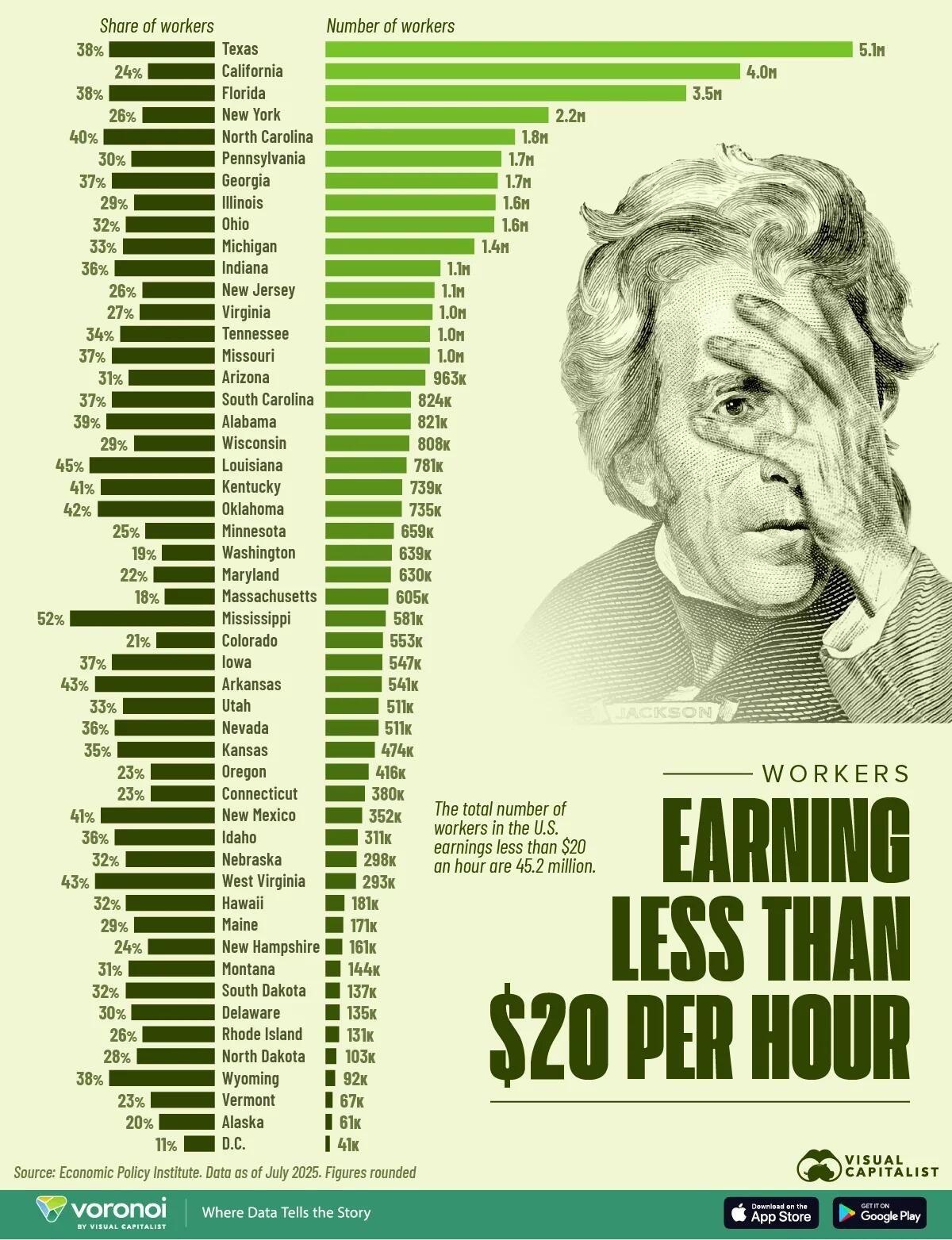
Low-wage work remains widespread across the United States. Even as the labor market continues to expand, wage gains have been uneven, leaving millions of workers earning less than $20 per hour, which is roughly $41,600 annually before taxes for full-time work.

This infographic, via Visual Capitalist’s Niccolo Conte, ranks U.S. states by the share of low-wage workers earning less than $20 per hour, using data from the Economic Policy Institute as of July 2025.

Low-Wage Workforce by State

Nationally, three in 10 workers, or 45.2 million people, fall below the $20-per-hour mark. However, this distribution varies widely by state.

The table below shows the full ranking of states by the share and number of workers earning less than $20 per hour:

Texas tops the list in terms of the number of low-wage workers with nearly 5.1 million people below the $20-per-hour mark. California, the most populous state, follows with around 4 million workers, along with Florida (3.5 million) and New York (2.2 million).

Meanwhile, Mississippi leads in terms of the share of low-wage workers, with 52% of the state’s workers earning under $20 per hour. Other Southern states also rank high, including Louisiana (45%), Arkansas (43%), West Virginia (43%), and Kentucky (41%).

In contrast, the District of Columbia has the lowest share of low-wage workers at 11%, along with Washington (19%) and Massachusetts (18%). These states tend to have a larger share of workers employed in high-paying industries like professional services, health, and information (IT) as compared to states with more low-wage workers.

State Share of workers below $20/hr Number of workers below $20/hr
Texas 38% 5,089,000
California 24% 4,002,000
Florida 38% 3,481,000
New York 26% 2,152,000
North Carolina 40% 1,828,000
Pennsylvania 30% 1,696,000
Georgia 37% 1,662,000
Illinois 29% 1,641,000
Ohio 32% 1,627,000
Michigan 33% 1,437,000
Indiana 36% 1,108,000
New Jersey 26% 1,052,000
Virginia 27% 1,033,000
Tennessee 34% 1,007,000
Missouri 37% 1,005,000
Arizona 31% 963,000
South Carolina 37% 824,000
Alabama 39% 821,000
Wisconsin 29% 808,000
Louisiana 45% 781,000
Kentucky 41% 739,000
Oklahoma 42% 735,000
Minnesota 25% 659,000
Washington 19% 639,000
Maryland 22% 630,000
Massachusetts 18% 605,000
Mississippi 52% 581,000
Colorado 21% 553,000
Iowa 37% 547,000
Arkansas 43% 541,000
Nevada 36% 511,000
Utah 33% 511,000
Kansas 35% 474,000
Oregon 23% 416,000
Connecticut 23% 380,000
New Mexico 41% 352,000
Idaho 36% 311,000
Nebraska 32% 298,000
West Virginia 43% 293,000
Hawaii 32% 181,000
Maine 29% 171,000
New Hampshire 24% 161,000
Montana 31% 144,000
South Dakota 32% 137,000
Delaware 30% 135,000
Rhode Island 26% 131,000
North Dakota 28% 103,000
Wyoming 38% 92,000
Vermont 23% 67,000
Alaska 20% 61,000
District of Columbia 11% 41,000

Minimum Wage in the U.S.

The U.S. federal minimum wage has remained at $7.25 per hour since 2009. Adjusted for inflation, that wage now has significantly less purchasing power, making it even lower in real terms.

While more than half of U.S. states have enacted higher local minimum wages, the federal standard still applies in states without their own wage laws, many of which appear at the top of the low-wage workforce rankings.

The Raise the Wage Act, which proposes lifting the federal minimum wage to $17 over five years, has been introduced repeatedly since 2017 but has yet to pass.

If you enjoyed today’s post, see this graphic on Average Salary by State in the U.S. on Voronoi.

Tyler Durden
Mon, 12/15/2025 – 05:45

Nigeria’s Christians Are Caught in A Tide Of Jihadi Violence

0
Nigeria’s Christians Are Caught in A Tide Of Jihadi Violence

Authored by Beige Luciano-Adams via The Epoch Times,

Nuhu Dauda was on a missionary trip, about 125 miles away from his home in Plateau state, Nigeria, when he got a panicked call from his younger brother.

“He said jihadists had surrounded my home and were chanting that they would kill everyone inside,” Dauda, a 67-year-old Christian evangelist, told The Epoch Times.

The police helped rescue five family members before heavily armed men burned the house to the ground and killed a young fellow evangelist, he said.

That was in 2005.

“In the 20 years since then I have seen our people massacred,” Dauda said. “I saw my family members, in-laws, and friends killed. I’ve carried the bodies of my own and I buried them.”

The plight of Christians in the country received relatively little global attention until the Trump administration threatened to intervene amid a recent spike in violence, to prevent mass killings it suggested amounts to “genocide.”

The Nigerian government denies claims of religious persecution, rather framing the violence as a security crisis with “complex socio-economic and political roots” that impacts people of all faiths.

But the increase in brutal attacks on Christian communities by radicalized insurgents in recent years both parallels and intersects a broader rise in violent Islamist extremism across the region.

Boko Haram and Surging Violence

Dauda grew up in peace with Muslim friends and neighbors in the country’s fertile Middle Belt region. But everything began to change around 2001.

“It was so strange to us, we never knew that, to see our people killed in a community where Muslims were a minority but well armed,” Dauda said of radicalized groups that began attacking Christians. “They drove us out.”

While the threat has evolved, some observers trace the root of current violence to the rise of Nigeria’s homegrown Sunni jihadist movement more than two decades ago. That movement is synonymous with the terrorist group Boko Haram, sometimes referred to as the “Nigerian Taliban.”

Ebenezer Obadare, a senior fellow for Africa studies at the Council on Foreign Relations, believes all problems are downstream of Boko Haram.

“It’s a religious campaign in the sense that this is mass killing initiated by Boko Haram, a group that targets Christians, targets Muslims, targets everybody—because it sees all of them as infidels, or apostates,” Obadare told The Epoch Times.

Caskets holding the bodies of 38 Christian villagers killed by armed Fulani Muslim militants are arranged for a funeral Mass at Government Secondary School in Mallagun, Nigeria, on Sept. 30, 2021. Luka Binniyat/The Epoch Times

Boko Haram, which means, loosely, “Western education is forbidden,” has been designated as a terrorist organization by the United States since 2013.

It embraces a strict interpretation of Islam that uses “extremely narrow criteria to define who counts as a Muslim,” according to a Brookings Institution report.

Formed in 2002, Boko Haram began an armed rebellion against the Nigerian government in 2009 and has retained a stronghold in the northeast, as well as in neighboring Chad, Cameroon, and Niger.

Since then, a mix of violent perpetrators with shifting alliances and feuds has emerged across the north, including the ISIS terror group, al-Qaeda, and Boko Haram offshoots and affiliates, as well as armed bandits, new cross-border groups and ethnic militias.

Nigeria ranks sixth on the Institute for Economics and Peace Global Terrorism Index 2025.

In the northwestern part of the country, where violence has historically been attributed to banditry, al-Qaeda and ISIS affiliates have established a foothold since 2020, and “operationalized these cells since 2024,” according to a recent analysis by Critical Threats, a project of the thinktank American Enterprise Institute.

Reports of civilian killings in Nigeria vary, from 50,000 to more than 100,000 since 2009, with millions more displaced; figures from Armed Conflict Location and Event Data (ACLED), a U.S.-based monitor, show violence targeting Christians has spiked since 2020 but still pales in comparison to the “broader surge in overall political violence,” which it reports has resulted in far more Muslim deaths.

In 2021 the United Nations estimated nearly 350,000 people had died as a result, directly or indirectly, of ongoing conflict in the country since 2009.

While estimates vary, Obadare said, “what nobody can doubt is that a lot of people are being killed—and more important is the fact that they’re being killed for a religious reason.”

U.S.-backed Syrian Democratic Forces (SDF) fighters celebrate after fighting the ISIS terrorist group near the village of Baghouz, Syria, on March 15, 2019. The increase in brutal attacks on Christian communities by radicalized insurgents in recent years both parallels and intersects a broader rise in violent Islamist extremism worldwide and especially in West Africa. Giuseppe Cacace/AFP via Getty Images

Brazen Attacks Escalate

President Donald Trump in October re-listed Nigeria as a “Country of Particular Concern,” a formal designation given to the world’s worst religious freedom offenders.

And in a Nov. 20 congressional hearing, State Department officials said they are working on a comprehensive plan to help bolster the country’s own security and counterterrorism efforts.

Just hours after that hearing, gunmen on Nov. 21 stormed a Catholic school in the Middle Belt, kidnapping more than 300 students and 12 teachers.

It was the fourth mass kidnapping that week, and one of the worst in the country’s history, surpassing even the 2014 Boko Haram kidnapping of 276 Chibok Secondary School girls. Last year Amnesty International reported more than 1,700 children have been abducted by the group in the decade since.

Kidnapping victims, according to the group, are often forced to fight, marry their captors, or are sold into sex slavery.

The wave of violence from Nov. 15 to Nov. 21 also included an attack on a Christian church during a service, in which two people were killed and 38 kidnapped; as well as the abduction of 24 female students from a secondary school, and the murder of three people and kidnapping of 64 from their homes.

(Top) A general view of a classroom at St. Mary’s Catholic School in Papiri, Agwarra local government, Niger state, Nigeria, on Nov. 23, 2025. (Bottom L) A signboard for St Mary’s Private Catholic Secondary School stands at the entrance of the school in Papiri, Agwarra local government, Niger state, Nigeria, on Nov. 23, 2025. (Bottom R) A general view of empty bunk beds and scattered belongings inside a student dormitory at St. Mary’s Catholic School in Papiri, Agwarra local government, Niger state, Nigeria, on Nov. 23, 2025. Ifeanyi Immanuel Bakwenye/AFP via Getty Images

On Nov. 24, Nigerian media reported suspected Boko Haram terrorists abducted 12 women from Borno state and razed a village elsewhere in the state.

“We hoped the [Country of Particular Concern] designation by President Trump at the end of October might stabilize the situation,“ the Most Rev. Wilfred Anagbe, a Nigerian Catholic bishop, told lawmakers during the Nov. 20 hearing, ”but instead it is deteriorating into one of the most lethal periods for Nigerian Christians in recent memory.”

While the government has tried to confront the terror threat, Dauda said, “this is not the confrontational war that militaries are used to. They hide, attack, pull away, and cover. The government has tried, but they are overwhelmed.”

The Nigerian government did not respond to requests for comment from The Epoch Times, but recently said in a statement posted on X that its security agencies since 2023 have “neutralized” more than 13,500 terrorists, arrested more than 17,000 suspects, and rescued more than 9,800 kidnap victims.

Fulani Militias

In May, Amnesty International reported at least 10,217 people had been killed in attacks by gunmen in the two years since current president Bola Ahmed Tinubu was elected, mostly in the predominantly-Christian Middle Belt states of Benue and Plateau.

Such attacks have drawn attention to longstanding conflicts between farmers, who are largely Christian, and Fulani herdsmen, who are semi-nomadic and predominantly Muslim in the Middle Belt.

The Nigerian government characterizes this as a land-use dispute driven by the climate, resource scarcity, and population growth.

According to Open Doors, an organization that tracks persecution of Christians, Fulani militants are responsible for 55 percent of recorded Christian deaths between 2019 and 2023.

The Observatory for Religious Freedom in Africa in July published research showing Fulani militias accounted for 47 percent of the 36,056 civilian killings between 2019 and 2024—more than five times the combined death toll of other prominent terrorist organizations such as Boko Haram and an offshoot known as Islamic State-West Africa Province.

A group of armed Fulani militiamen pose for a picture at an informal demobilization camp in Sevare, Mali, on July 6, 2019. Open Doors, an organization that tracks persecution of Christians, reported that Fulani militants were responsible for 55 percent of recorded Christian deaths from 2019 to 2023. Marco Longari/AFP via Getty Images

More recently, other monitors such as the International Bar Association’s Eyewitness Global have noted “considerable escalation” in violence with “religious and ethnic dimension” in the Middle Belt.

And while the 2015 Global Terrorism Index ranked armed Fulani militants the fourth-deadliest terror group in the world, the Observatory notes they have “mysteriously vanished” from international rankings despite having become “exponentially more lethal.”

Dauda, the Christian evangelist, says it’s a small number instigating and radicalizing an otherwise peaceful population. “Most Fulanis are innocent. Most want to live a peaceful life and take care of their cattle.”

Héni Nsaibia, ACLED’s West Africa senior analyst, told The Epoch Times the violence in the Middle Belt is “multidirectional” and can’t be reduced to a kind of religious war.

“To focus on the persecution of Christians really doesn’t capture the problem,” Nsaibia said. “That is not the main conflict—the real threat are the jihadi groups that are expanding and larger segments of the population are falling under their influence, and they are now competing with the state.”

Some of those groups, such as Islamic State-Sahel Province, are majority Fulani, he said, but operate primarily in majority-Muslim states, meaning their civilian victims are mostly Muslims.

As the conflict expanded across the region, Nsaibia said, the most powerful groups concentrated in Mali and Burkina Faso, where many fighters are Fulani. “So it’s more circumstantial, but also how the state has reacted to the insurgency.”

In many countries in the region, Fulani and other herder ethnicities have long been disenfranchised by the state, Nsaibia said, making them a prime target for radicalization.

‘Horrific Things’

Born a Fulani Muslim, Musa Belo converted to Christianity and became an evangelical preacher. Vocal on social media about what he calls a Christian genocide, he is currently in hiding, facing death threats from Islamists—and reprisal from the government, he says.

Belo told The Epoch Times that he typically visits many remote villages only accessible by motorcycle or on foot.

He described going to a village in Plateau state for outreach.

“We preached the gospel to them, we did medical outreach, shared Bibles, and we left. Then fast forward, this last October, we went back for a follow-up,” he said.

The whole village had been wiped out.

“You stumble on human skeletons, you stumble on a body that has not even decayed. … Horrific things,” Belo said.

Sean Nelson, an attorney with Alliance Defending Freedom (ADF), recalls visiting victims in the aftermath of a Christmas Eve 2023 attack that killed more than 200 people across mostly Christian villages in the same region.

People pose for a photograph at St. Mary’s Catholic Primary and Secondary School after armed men abducted children and staff in Papiri, Nigeria, on Nov. 21, 2025. Christian Association of Nigeria via AP

“They went after pastors’ homes. They went after churches first. The first village we went to, there was a pastor who, the militants came to his house on Christmas Eve, took him and his family, torched his house, walked him out behind the church and beheaded him.”

Every witness told him the attackers came in with machetes shouting “Allahu Akbar,” and “We will kill Christians,” Nelson said.

John Stewart, an American attorney and pastor who regularly travels to Africa to teach and train Christian leaders, described Nigerian communities devastated by systemic violence and displacement.

“I went to the relocation centers. These are Christians that have been driven out of their villages by Fulani Muslims, with the military looking the other way,” he told The Epoch Times.

“They’re sleeping on cement floors in churches. … They didn’t have anything other than shovels and rakes to defend themselves.”

‘Others Who Are Behind This’

Both Dauda and Belo say Fulanis are coming to Nigeria from other countries.

“I had an encounter with one, and I am Fulani by tribe,” Belo said. “When I spoke to him, I understood that this is not Nigerian Fulani. He told me he was from Mali, and his group was headed to Benue state.”

Nigeria’s borders with Niger and Chad are easy to penetrate, he said. “They are all using sophisticated weapons—machine guns, AK 49s, RPGs—that even our military are not using,” Belo said.

“This thing has been happening for two decades, but the Nigerian government has never brought a single perpetrator to justice,” Belo said.

Dauda marveled at the sight of Fulani herdsmen carrying machine guns.

“A Fulani man takes care of his cow—that is his bank account, the future of his children. How are such innocent Fulanis operating such guns?” he said.

“It means there are others who are behind this. And I want the world to know, they have been brainwashed,” he said. “Their target is to go across the nation—that’s why you hear of killings in churches in the south.”

Arms and ammunition recovered from Boko Haram jihadists are displayed at the 120th Battalion headquarters in Goniri, Nigeria, on July 3, 2019. Boko Haram, loosely translated as “Western education is forbidden,” has been designated a terrorist organization by the United States since 2013. Audu Marte/AFP via Getty Images

The Heart of Jihadi Terror

The Nigerian government has framed attacks on Christian communities such as Dauda’s in the country’s Middle Belt or north central region as ethnic land-use disputes, as distinct from the terror of jihadists in the northeast, or the anarchy of bandits in the northwest.

But amid transnational expansion of Islamist extremism, with weapons and fighters flowing across porous borders, some analysts say such distinctions are vanishingly relevant, and a distraction from the all-consuming threat of violent fundamentalism.

The Central Sahel region of sub-Saharan Africa, which includes Nigeria and stretches from the North Atlantic to the Red Sea, has replaced the Middle East as the epicenter of global Salafi-jihadist violence, now accounting for 51 percent of all global terrorism deaths, according to the Institute for Economics and Peace “Global Terrorism Index 2025: Measuring the Impact of Terrorism” report.

Investigations by Conflict Armament Research, a British-based group that tracks illegal weapons, has suggested proliferation of weapons throughout the Sahel was precipitated by the 2011 fall of the heavily armed Moammar Gadhafi regime in Libya.

Data from ACLED shows jihadists groups have entered “a new phase of expansion” in the Sahel.

In a December report, the group notes that as jihadist groups solidify their operations, distinctions between regional conflicts are giving way to a broader, singular threat.

ACLED reports 79 percent of ISIS operations were in Africa in 2025—up from 49 percent in 2024. Islamic State-West Africa Province “controls broad swaths of territory and has killed or displaced thousands of people in Nigeria and neighboring countries,” according to the U.S. Office of the Director of National Intelligence’s Counter Terrorism Guide.

A defensive trench built to protect against incursions by Boko Haram surrounds the town of Monguno, Borno state, Nigeria, on July 4, 2025. Joris Bolomey/AFP via Getty Images

Collaboration among jihadist groups is growing, ACLED’s Nsaibia said. In some cases, Nigerian groups have been incorporated into broader global structures such as ISIS or al-Qaeda affiliates, or coordinate with regional groups across borders to share weapons, propaganda or fighters.

As the Sahel has become the global epicenter of jihadist militancy, he explains, Nigerian groups have been expanding from their historic base in the Lake Chad Basin, and into coastal West Africa. “As these groups are finding one another, they also form a sort of junction between these two very distinct conflict theaters.”

“We know for sure that all of these groups are united at least by one aim, which is they want to destroy the modern state as we know it,” Obadare said.

In neighboring Mali, jihadists are currently on the verge of overrunning the country, according to a report last month by the Soufan Center.

Sharia and Blasphemy

In the years following Nigeria’s 1999 transition to a constitutional democracy, 12 northern states have re-integrated Islamic criminal law. In theory, sharia applies only to Muslims, but in practice, human rights advocates argue, it is used to justify mob violence and state-sanctioned capital punishment.

“Death-penalty blasphemy law in the 12 Northern States is an outrageous thing,” ADF’s Nelson said. ADF intervenes on behalf of individuals facing blasphemy and apostasy charges in Nigeria’s sharia courts.

“It is one of only seven places in the world with a law like that,” he said.

In 2024, Amnesty International reported an escalation of mob violence across the country, including killings related to blasphemy accusations in which victims have been lynched, stoned, tortured, and burned alive.

“The apparent encouragement of killings for blasphemy by religious leaders creates an environment in which mobs feel entitled to take the law into their own hands. Meanwhile, government officials rarely publicly condemn mob violence for blasphemy,” the group reported.

Six men condemned for armed robbery stand before their execution by firing squad at Kirikiri Prison in Lagos, Nigeria, on Feb. 21, 1998. Since Nigeria’s 1999 return to civilian rule, 12 northern states have reintroduced Islamic criminal law, known as sharia, which human rights advocates say has been used to justify mob violence and state-sanctioned capital punishment. AFP via Getty Images

‘A Religious Element’

Obadare from the Council on Foreign Relations said the conversation about violence in Nigeria has become increasingly muddied; there used to be consensus, he says, that the threat was fundamentalism.

“The idea that Islamist insurgents should not be described or portrayed as what they are because you don’t want to offend mainstream Muslims … I find [this] condescending to mainstream Muslims,” Obadare said.

“The more Boko Haram says our aim is religious; we want to replace Nigeria with an Islamic state; we hate democracy; unbelief is the problem … the more people on the other side double down and say, ‘Nope, you don’t know what you’re talking about. It’s climate change, it’s got nothing to do with religion.’”

Despite the constant threat, Dauda said he wouldn’t think of living anywhere else.

“We are asking God to intervene,” he said. “That’s why we even have an opportunity to tell you about this.”


Tyler Durden
Mon, 12/15/2025 – 05:00

Visualizing The Complete History Of European Colonization

0
Visualizing The Complete History Of European Colonization

Europe’s colonial empires have shaped the world’s political and economic systems for over 500 years.

From Portugal’s early ventures in the 1400s, to Britain’s massive empire in the early 20th century, European nations have competed for control of territory and trade across nearly every continent.

In this graphic, Visual Capitalist’s Marcus Lu traces the history of European colonies from 1462 to today, showing how the era of colonies rose and fell.

The data for this visualization comes from Our World in Data. It tracks the number of overseas colonies under the control of key European powers including the UK, France, Spain, Portugal, the Netherlands, and others.

These numbers provide a historical record of how European influence expanded through exploration, conquest, and colonization, and later declined through wars, independence movements, and international pressure.

The Early Days of Colonization

Portugal was the first European nation to establish an overseas colony, beginning in the 1400s along the African coast and Atlantic islands. Spain followed soon after with its vast empire in the Americas.

An important milestone was the Treaty of Tordesillas (1494), which granted Spain and Portugal exclusive rights to explore, claim, and colonize along an agreed meridian. Backed by royal patronage and emerging maritime technology, Portugal built trading outposts from Brazil to the Indian Ocean, while Spain established vast territorial colonies across the Americas through conquest, settlement, and resource extraction.

By the early 1600s, Britain, France, and the Netherlands had joined the race, creating colonies in North America, the Caribbean, and Asia. This competition fueled centuries of maritime exploration and conflict, laying the groundwork for global trade and cultural exchange.

Unfortunately, colonization also brought about exploitation and displacement, characterized by the seizure of land and resources, forced labor, and the disruption of indigenous peoples.

Decolonization and the End of Empire

After World War II, global power shifted. European empires were financially drained and politically weakened, losing the capacity to control their vast overseas territories. Meanwhile, rising nationalist movements across Asia, Africa, and the Middle East pushed for independence.

A clear example is India’s independence from Britain in 1947, which became a catalyst for global decolonization. Britain was exhausted after World War II, and with growing independence movements led by Mahatma Gandhi, the British government was forced to concede sovereignty.

Between 1945 and the late 20th century, the number of European-controlled colonial territories declined dramatically, marking the end of formal empire building. Dozens of former colonies across Asia, Africa, and the Middle East gained independence during this period.

What remains today are a small number of overseas territories—such as islands and enclaves—administered by European states under special constitutional arrangements. These territories generally have significant local autonomy and are no longer considered colonies in the traditional sense, though debates over self-determination persist in some cases.

If you enjoyed today’s post, check out The State of Global Democracy on Voronoi, the new app from Visual Capitalist.

Tyler Durden
Mon, 12/15/2025 – 04:15

A Collapse In Germany’s Chemical Sector Is A Bad Omen

0
A Collapse In Germany’s Chemical Sector Is A Bad Omen

Submitted by Thomas Kolbe,

Historically, the chemical industry has proven to be an excellent early indicator of severe economic downturns. Its present condition should serve as a warning: the climate-policy regime is at the beginning of its collapse. And Berlin’s fiscal bazooka—loaded with yet more debt—won’t change a thing.

Some readers will remember the bursting of the dot-com bubble in 2001. For five years, a relentless tech boom carried markets higher. The Nasdaq surged from one all-time high to the next in a frenzy that clouded the judgment of both institutional investors and retail traders. No one knew when the music would stop.

The Dot-Com Crash

But had investors aligned their behavior with developments in Germany’s chemical industry, they might have avoided the inevitable portfolio disaster. By mid-2000, chemical output in Germany had already fallen by six percent—a bad omen for the real economy, because chemicals are an early reflection of what is happening in the core industrial sectors: machinery, automotive, construction, and consumer goods.

Its deep integration into the value chains of the real economy makes the chemical industry a crystal ball with exceptional predictive sharpness.

And indeed, the following year the German economy drifted into recession. The U.S. economy weakened as well, immediately hurting German chemical exports. With the broader economy faltering, the stock-market dream evaporated. One pinprick, and everything collapsed. The blow struck directly at millions of small investors who paid their tuition for their first market “education” the hard way.

Markets are driven not only by sentiment but by productivity trends and money-supply dynamics. In the short run, they are expressions of liquidity conditions and mirror the credit cycle.

A Recession After Reunification

Let’s travel back another ten years—to late 1991, early 1992. The euphoria of German reunification had reached its preliminary economic peak. Government stimulus programs pumped credit into the construction sector, pushing money into inefficient, unnecessary infrastructure. An artificial post-reunification boom set in—only to be hit with its first major shock shortly thereafter.

At the turn of the year, Germany’s chemical industry slid into a sectoral recession and lost around seven percent of its real production volume over the next eighteen months. Once again, the chemical sector’s predictive power proved accurate: barely six months later, the overall economy followed it into recession.

Some 1.5 million people lost their jobs; GDP shrank 0.8 percent—and in 1994, markets slumped again.

Markets reacted to drastic tightening by the Federal Reserve, which attempted to rein in runaway inflation by squeezing liquidity. It marked the end of the business cycle—one that the chemical sector had correctly anticipated, once again, with lead time.

Recession or Structural Break?

After each downturn, Germany’s chemical sector reemerged more innovative and more export-competitive. It shed dysfunctional segments during recessions and then grew like a snake shedding its skin.

Both crises can also be read as monetary-policy phenomena. Centrally planned credit costs—set through interest-rate policy—created mild boom-bust cycles, a systemic flaw within an otherwise market-oriented system that could still absorb such central-bank interventions.

Which brings us to the present: Are we still following a classic business cycle—or have we already witnessed a structural break? The facts are clear. Since 2018, it is not only the chemical sector that has been collapsing. The entire foundation of industrial production appears to have cracked. Across all sectors, output is roughly 20 percent below 2018 levels.

Nothing in the current environment suggests this will change. No amount of artificial government credit can fill the gaping void in Germany’s industrial base—not through weapons contracts, not through subsidized green-sector patronage.

Green Tribute

Germany has entered an era of deindustrialization due to catastrophic political decisions. The numbers are unambiguous, even if corporate leaders such as BASF CEO Markus Kamieth refuse to say it openly—dependency on the state’s subsidy machinery trumps any notion of responsibility inside today’s corporate bureaucracy.

In Berlin, Brussels, Paris, and London, a corporatist mindset has taken hold. Political elites became intoxicated by the subsidy bonanza surrounding the Green Deal—an entire hallucinated green transformation built on CO₂ narratives and dumped onto taxpayers.

The continued decline of the chemical sector shows that industrial production in Germany is no longer viable under current conditions. Central-planning energy-market design generates costs that drive companies out of the country. Germany lost €64.5 billion in direct investment last year alone; this year, the figure will likely exceed €100 billion.

German society is impoverishing in fast-forward because its political class refuses to understand that industrial production is the true source of societal wealth—and because it remains convinced that a centrally planned artificial economy can replace productive enterprise.

Everything that depends on industry—complex value chains, services, suppliers, high-income jobs, even the bloated state budget—lives off the innovative strength and productive capacity of a free industrial sector.

Political Camouflage

If Germany’s green “degrowth chancellor” Friedrich Merz and his entourage now make cautious adjustments to the climate-socialist regime—floating a new EV subsidy, tying industrial electricity prices to “eco-investments”—this is nothing more than political camouflage. Policymakers are fighting desperately to preserve the green course. Merz is essentially an “autopen” of the Merkel-Scholz era—a green central planner in borrowed conservative clothes whose flock is abandoning him.

We are witnessing nothing less than a civilizational rupture—and the rise of a climate-socialist regime already lying in economic ruins before its architects could even reap an illusionary harvest.

The political response to rising criticism has been predictable and pathetic: repression, censorship, and intimidation—an admission of failure in the assault on personal liberty.

Markets should brace for high volatility, because Berlin and Brussels are tying their political survival to massive new debt issuance and an accelerating nationalization of the credit process.

The ongoing collapse of the chemical sector signals a political crisis—one that will not end until this new socialist experiment has completely failed. Until then, the German people will have to navigate an accelerating spiral of impoverishment.

Tyler Durden
Mon, 12/15/2025 – 03:30

Cocaine: Local Cultivation, Global Consumption

0
Cocaine: Local Cultivation, Global Consumption

Although cocaine is consumed in every part of the world, its base, the coca plant, is mainly cultivated in three Latin American countries: Peru, Bolivia and Colombia.

As Statista’s Anna Fleck details below, according to figures by UNODC, Colombia was responsible for almost two thirds of the total coca cultivation area in 2023 at 253,000 hectares.

Peru came in second with 93,000 hectares, while Bolivia ranked third with 31,000 hectares.

Infographic: Where Cocaine Is Produced and Where It’s Consumed | Statista

You will find more infographics at Statista

When looking at the cocaine market from the users’ perspective, North America had the largest estimated share of people reporting having consumed cocaine in 2023, with 6.5 million or 26 percent of total global users of the drug.

Overall, the Americas made up just under half of estimated cocaine users worldwide according to the UNODC data, while in Europe and Asia, the estimated number of cocaine users stood at 6 million and 3.4 million, respectively.

Tyler Durden
Mon, 12/15/2025 – 02:45

Why Is Europe Feverishly Preparing For World War III?

0
Why Is Europe Feverishly Preparing For World War III?

Authored by Michael Snyder via The End of The American Dream blog,

If there is going to be peace, why are we witnessing the largest military buildup in Europe since the end of the Cold War?  When it comes to the major players on the geopolitical stage, it is far more important to watch what they do than it is to listen to what they say.  And right now the actions that the major European powers are taking are telling us that they are preparing for a huge war with Russia.

Ukraine was supposed to be the final piece of the puzzle for the European Union.

It is an enormous chunk of territory, and it is absolutely teeming with natural resources.

For most European leaders, it is unthinkable that Ukraine could be allowed to fall back into Russian hands, but at the moment more Ukrainian territory is being taken by the Russians with each passing day.

In fact, it is being reported that the city of Seversk has just fallen…

Valery Gerasimov, Chief of the General Staff of the Russian Armed Forces, said that the “Southern” group of troops had taken control of the city of Seversk in the DPR.

“The city of Seversk has been liberated,” Gerasimov said during a report to Russian President Vladimir Putin.

Every time the Russians move forward, European leaders feel even more pressure to send troops into Ukraine.

Apparently the British already have at least some soldiers in Ukraine, because one of them just died…

The British soldier who died in Ukraine on Tuesday has been named as L/Cpl George Hooley, 28, of the Parachute regiment.

Keir Starmer told the Commons on Wednesday that Hooley had died in a “tragic accident” away from the frontlines while watching a test of “a new defensive capability” with members of the Ukrainian military.

“His life was full of courage and determination,” Starmer said. “He served our country with honour and distinction around the world in the cause of freedom and democracy, including as part of the small number of British personnel in Ukraine.”

Did you notice that Starmer was purposely vague about how many British troops are in Ukraine?

Is it 100?

Is it 1,000?

Is it 10,000?

We would like to know.

Meanwhile, we are being told that plans are in the works to significantly expand the size of the French army…

France will this week become the latest EU country to set out plans to expand its army, with Emmanuel Macron expected to announce on Thursday that military service will be restored – albeit on a voluntary basis – nearly 30 years after the end of conscription.

In the face of Russia’s military threat and uncertainty over the US’s commitment to defending its transatlantic allies, Europe is rushing to bolster its defence industry and its deployment capability after radically cutting them back since the cold war.

Why would the French need a much larger army if a peace deal is going to be negotiated with the Russians?

And why have French hospitals been instructed to prepare for tens of thousands of casualties?…

French hospitals have been told to prepare a potential armed conflict in Europe by next year, local media reported.

In a letter sent to regional health agencies, revealed by Le Canard Enchaîné , the Ministry of Health asked hospitals to prepare for a “major (military) engagement” by March 2026.

The newspaper warned that between 10,000 and 50,000 men could be expected in hospitals over a period of 10 to 180 days.

Something doesn’t add up.

We are being told one thing, but plans are being made for something else to happen instead.

Other European nations are also making plans for large scale military conflict…

Denmark’s conscription system was extended to women and lengthened to 11 months from four in June. Estonia has universal male conscription, while Latvia and Lithuania, like Denmark, select conscripts by lottery if there are not enough volunteers.

Elsewhere, Croatia, which abolished mandatory military service 17 years ago, recently restored conscription, while Poland is working on a plan to prepare large-scale military training for every adult male in an effort to double the size of its army.

Is it just a coincidence that all of these countries are suddenly makes these moves in unison?

In Germany, military spending is about to go soaring into uncharted territory…

At a moment the Russia-Ukraine war grinds on, and as Trump-led efforts to find peace have been frustrated – largely as Zelensky and his backers have balked at agreeing to any territorial compromise as the bases of a deal – Germany is busy transforming its military with an aim to boost Bundeswehr numbers and meet NATO targets.

That news dominated headlines last week, but added to this Bloombergis newly reporting Tuesday that the troop expansion will coincide with a major tech and armament expansion, given lawmakers are expected to approve a record €52 billion (about $61 billion) in military procurement contracts next week.

This will mark the largest single-year investment in defense equipment in the country’s history, underscoring Berlin’s renewed push to modernize its armed forces amid the growing European standoff with Russia.

As for 2025 numbers, prior approvals brought total defense commitments for this year to above €33 billion. So next year’s could more than double, based on the new projected figures.

If there is going to be peace with Russia, this level of military spending makes no sense at all.

But if there is going to be war with Russia, this level of military spending is easily explained.

On Thursday, NATO Chief Mark Rutte ominously warned that “we must be prepared for the scale of war our grandparents and great grandparents endured”…

NATO Chief Mark Rutte urged member countries to do more to prepare for the possibility of large-scale war, warning that Russia may be ready to attack the alliance within five years.

“We are Russia’s next target. And we are already in harm’s way,” Rutte said on Thursday during a speech in Berlin. “Russia has brought war back to Europe, and we must be prepared for the scale of war our grandparents and great grandparents endured.”

Although he welcomed the decision by NATO members to increase overall military spending to 5 percent of gross domestic product annually by 2035, Rutte argued more needed to be done, saying alliance members must shift to a “wartime mindset.”

What wars did our grandparents and our great-grandparents endure?

Obviously he was referring to World War I and World War II.

In other words, he was telling us that we need to get ready for World War III.

But the Russians have told us over and over again that they have no intention of going to war with Europe.  In fact, Russian Foreign Minister Sergei Lavrov used those exact words earlier this week.  But he did warn that there are a couple of red lines that will force the Russians to respond if they are crossed…

“As the President [Putin] emphasised, we have no intention of going to war with Europe,” said Lavrov.

“We have no such intention.

“But we will respond to any hostile steps, including the deployment of European military contingents in Ukraine and the expropriation of Russian assets.”

Sending large numbers of European troops into Ukraine would be a really foolish thing to do, because the Russians would begin shooting at them.

And once that starts happening, we will be perilously close to nuclear conflict.

This is something that they talk about on Russian television all the time.  Commenting on the confirmed death of a British soldier in Ukraine, one of the most prominent voices on Russian television boldly declared that “a nuclear strike on Britain is inevitable”…

Leading Kremlin propagandist hawk, Vladimir Solovyov, told viewers on his nightly show: “Now a nuclear strike on Britain is inevitable….” Historian Andrey Sidorov, another Putin cheerleader, said: “This incident should be considered a casus belli, when the British Ministry of Defence officially acknowledged the death of its military personnel on active duty on Ukrainian territory.” He demanded the Russian foreign ministry summon British ambassador Nigel Casey or a chargé d’affaires “to explain what an active-duty military officer was doing there”.

That is crazy talk.

But this is how they actually see the world.

We should be trying to avoid a worst case scenario while we still can.

The expropriation of Russian assets is another red line for the Russians, and it appears that the Europeans are determined to cross it as well…

Currently EU member states are rapidly advancing a plan to permanently freeze as much as €210 billion ($244.38 billion) in Russian state assets to finance Ukraine for at least the next two years. European Commission President Ursula von der Leyen is seeking to use a loophole to rush this through, based on invoking emergency powers to sanction the frozen assets on a permanent basis, instead of holding the funds based on current six-month renewals, which requires unanimous agreement from all member states.

The plan would see €90 billion (roughly $104.71 billion) released over the next two years. Von der Leyen’s scheme would allow for the plan to pass merely with a qualified majority, and so couldn’t be derailed by just a lone veto. Nations like Germany and Spain have already signaled their support.

This is a really bad idea.

But the Europeans are apparently going to do it anyway.

Meanwhile, the U.S. continues to provoke the Russians by messing with their closest ally in South America.

Yesterday, I posted an article about the oil tanker that the U.S. just seized as it was approaching Venezuela.

On Thursday, Russian Foreign Minister Sergey Lavrov wanted an explanation…

Russian Foreign Minister Sergey Lavrov on Thursday demanded that the Trump administration explain why a Venezuelan oil tanker was seized by U.S. forces.

“I really hope that the United States, although they consider themselves entitled to conduct such operations, will somehow explain, out of respect for other members of the world community, what facts led them to take such actions,” he said during an ambassadors’ roundtable on the Ukrainian crisis resolution.

And Russian President Vladimir Putin made it a point to publicly demonstrate his support for Venezuelan President Nicolas Maduro…

Russian President Vladimir Putin spoke to Venezuelan President Nicolas Maduro by phone on Thursday to reassure him of Moscow’s support for his government, shortly after the United States seized a large oil tanker off Venezuela’s coast.

Maduro has been under increasing pressure from President Donald Trump’s administration to leave office, with the U.S. conducting increasingly large military build-up in the Caribbean. Tensions escalated on Wednesday when the U.S. seized the tanker, sparking furious outcry from Venezuela.

The Kremlin said that Putin and Maduro had discussed a strategic partnership agreement and working together on several joint projects related to the economy and energy sector.

A regime change operation in Venezuela would do severe damage to our relationship with the Russians.

But officials in Washington don’t seem to care.

In fact, the White House has announced that the U.S. may soon seize even more oil tankers…

President Donald Trump is willing to seize more oil tankers off the coast of Venezuela, a White House official told CNBC on Thursday.

The U.S. seized a tanker on Wednesday that had allegedly transported oil from Venezuela to Iran. The action comes as Trump escalates pressure on President Nicolás Maduro.

I feel like I am watching a slow-motion train wreck that I am unable to stop.

I have been writing about these wars for so long, and now they are unfolding right in front of our eyes.

Personally, I have no idea why so many prominent voices out there are cheering for war.

War is not a game.

And that is especially true when nuclear weapons are involved.

The fate of billions of people is hanging in the balance, and we must step back from the brink before it is too late.

Michael’s new book entitled “10 Prophetic Events That Are Coming Next” is available in paperback and for the Kindle on Amazon.com, and you can subscribe to his Substack newsletter at michaeltsnyder.substack.com.

Tyler Durden
Mon, 12/15/2025 – 02:00

Brown University Shooting: Person Of Interest Released, Gunman Still At Large

0
Brown University Shooting: Person Of Interest Released, Gunman Still At Large

​Update (1227ET): 

Rhode Island authorities have announced that the person of interest in the shooting in the Brown University shooting has been released and the gunman is still at large.


Update (1715ET):

Both The Washington Post and NBC News cite sources briefed on the investigation who name “Benjamin Erickson” from Wisconsin as a “person of interest” in the Brown University shooting late Saturday night.

It is important to note the distinction between a person of interest and a suspect:

  • A person of interest is someone police are still evaluating.

  • A suspect is someone the police believe likely committed the crime.

NBC News reporter Tom Winter reported earlier that police seized a firearm from Erickson that had a “unique characteristic.”

What is key here is that Erickson is a person of interest and not a shooting suspect. That is an important distinction to understand.

*  *  * 

Update (1520ET):

It has been nearly 24 hours since a gunman stormed a Brown University classroom taught by Jewish professor Rachel Friedberg, who teaches the intersection of economics and Jewish studies, and reportedly “yelled something unique” before using a handgun and unleashing a hail of bullets in the classroom.

A person of interest was apprehended earlier today, but authorities have not released his name or a front-facing photograph. Given that Brown is one of the most heavily surveilled campuses in the nation, with more than 800 cameras, the absence of released footage raises questions, especially since the person of interest reportedly “yelled something unique” before killing two people and injuring nine others in a Jewish econ-studies classroom.

New details from CNN, citing multiple law enforcement sources with knowledge of the investigation, say the person of interest apprehended earlier today traveled from Wisconsin.

Here are more details from the media outlet: 

A revolver and a small Glock handgun with a laser sight attached were found in the hotel room of the person detained in connection to the Brown University shooting, according to multiple federal law enforcement sources. The person detained is a male, law enforcement sources say. Authorities traced the person of interest to the hotel in Coventry, Rhode Island. According to the sources, law enforcement banged on the door ordering him to open up. Once inside, they asked where the person had been that day and evening. He responded he was there in the hotel the whole time. 

*  *  * 

A person of interest connected to the Brown University shooting was taken into custody early Sunday morning at a hotel in Coventry, Rhode Island, according to law enforcement officials.

Latest:

  • Providence Police Chief Oscar Perez told reporters he was limited in what he could disclose about the person taken into custody. He said police intend “to coordinate with the prosecutors, to collect evidence, to conduct interviews, and then from there, we’ll be able – when it’s appropriate and accurate – to share more details.”

  • Providence Mayor Brett Smiley provided an update, noting that seven shooting victims are in stable condition, one is in critical but stable condition, and one has been discharged from the hospital. Two individuals died in the shooting. All victims were students.

  • Brown University President Christina Paxson confirmed that the shooting unfolded inside a final exam review for a Principles of Economics class.

  • The shooter then exited the east side of the Barus and Holley building, where the campus meets downtown Providence. 

The shooter “yelled something” before the attack … 

The elite Ivy League school ended the shelter-in-place order around 6:00 a.m. ET.

X users cited a 2021 study indicating that Brown University operates roughly 800 surveillance cameras across its campus.

Yet, more than six hours after the shooting, the university was still unable to release any images showing what the person of interest looked like while at large.

Then, finally, released this… 

Note that Brown’s policy generally prohibits students, faculty, staff, and visitors from bringing guns, ammunition, or other weapons onto campus, into buildings, or into residence halls. This applies regardless of whether someone has a permit to carry a firearm elsewhere in Rhode Island.

Brown University has a relatively high representation of Jewish students compared with its overall student population. The incident occurred on the night before Hanukkah, a period of heightened religious significance. Separately, Australia experienced its deadliest terrorist attack since 1996, when two shooters targeted a Jewish celebration.

*Developing…

Tyler Durden
Mon, 12/15/2025 – 00:27