Even former Vice President Kamala Harris has chimed in.
“Donald Trump’s actions in Venezuela do not make America safer, stronger, or more affordable,” Harris claimed in a post on X. “That Maduro is a brutal, illegitimate dictator does not change the fact that this action was both unlawful and unwise. We’ve seen this movie before. Wars for regime change or oil that are sold as strength but turn into chaos, and American families pay the price.”
Other Democrats claimed that the operation to capture Maduro was a “distraction.”
During an appearance on MSNOW on Saturday, Rep. Marilyn Strickland (D-Wash.) suggested the timing of Maduro’s capture served primarily as a distraction from issues Democrats plan to spotlight when Congress reconvenes, namely the upcoming anniversary of the Capitol riot on January 6, and the Epstein files.
“I think it was mentioned by one of your earlier speakers that Donald Trump is transactional, what he wants is access to those oil reserves,” Strickland said.
“At the same time, this is also a big distraction. Look at the timing of this. We go back in session on Tuesday. We are going to talk about the Affordable Care Act premiums. We’re going to talk about January 6, the Epstein files, the economy, all those things that are so important to the American people, and, what a coincidence, this happens.“
She also drew a comparison between Maduro and Trump regarding election integrity.
“It also is not a surprise of the timing. We’re going back to Congress next week… and we’ll be talking about January 6, which is kind of ironic here, because…Maduro, he actually did steal two elections. And Donald Trump tried to do that on January 6, but he failed,” Strickland said.
Strickland wasn’t the only one pushing the “distraction” angle.
“It’s not about drugs. If it was, Trump wouldn’t have pardoned one of the largest narco traffickers in the world last month. It’s about oil and regime change,” Rep. Alexandria Ocasio-Cortez (D-N.Y.) claimed.
And they need a trial now to pretend that it isn’t. Especially to distract from Epstein + skyrocketing healthcare costs,” she wrote.
However, these accusations ignored a glaring contradiction.
The Trump administration carried out an operation targeting a leader the Biden-Harris administration actively sought to apprehend.
Secretary of State Antony Blinken announced on January 10, 2025, mere days before Joe Biden and Kamala Harris left office, that the State Department would increase the reward to $25 million for Maduro.
“In solidarity with the Venezuelan people, the U.S. Government and our partners around the world are taking action today,” Blinken announced in a statement on January 10, 2025.
“The Department of State is increasing the reward offers to up to $25 million each for information leading to the arrests and/or convictions of Nicolás Maduro and Maduro’s Minister of Interior Diosdado Cabello. The Department of State is also adding a new reward offer of up to $15 million for Maduro’s Defense Minister Vladimir Padrino López. These three reward offers stem from criminal narcotrafficking indictments announced in March 2020.”
Biden’s outgoing administration framed the increased reward as part of coordinated international pressure on the illegitimate Maduro regime.
It appears that the only distraction going on here is from the Democrats, who don’t want the public to realize that Trump succeeded where Biden-Harris failed.
OPEC+ confirmed on Sunday that it will keep oil production steady through the first quarter of 2026, as eight key producers reaffirmed their commitment to market stability amid a steady global economic outlook and what they described as healthy oil market fundamentals.
Saudi Arabia, Russia, Iraq, the United Arab Emirates, Kuwait, Kazakhstan, Algeria, and Oman met virtually on January 4 to review global market conditions and outlook.
The group reiterated its decision, first announced on November 2, 2025, to pause planned production increases in February and March 2026, citing seasonal demand patterns.
Following the meeting, OPEC+ produced the following production table for February 2026:
In a joint statement, the eight producers said current market conditions remain supportive, pointing to relatively low global inventories as a sign that the oil market is well balanced despite last year’s sharp decline in crude prices.
Oil prices fell more than 18% in 2025, the steepest annual drop since the pandemic, as supply growth outpaced demand and concerns over a growing glut mounted.
The group also emphasized that the previously announced 1.65 million barrels per day of voluntary production cuts could be returned to the market either in part or in full, depending on evolving market conditions, and only in a gradual manner.
The producers stressed that flexibility remains central to their strategy, including the option to extend or reverse additional voluntary adjustments, such as the 2.2 million barrels per day of cuts announced in November 2023.
OPEC+ further reiterated its collective commitment to full conformity with the Declaration of Cooperation. The producers confirmed that any overproduction since January 2024 will be fully compensated, with compliance and compensation to be monitored by the Joint Ministerial Monitoring Committee (JMMC).
“In an environment this fragile, OPEC+ is choosing caution, preserving flexibility rather than introducing new uncertainty into an already volatile market,” said Jorge Leon, an analyst at consultant Rystad Energy AS.
“The political transition in Venezuela adds another major layer of uncertainty.”
Caracas may hold the world’s biggest oil reserves, but years of under – investment, mismanagement and international isolation have diminished the country to a fraction of its former standing.
But, bear in mind that…
When you hear that Venezuela has the world’s largest proven oil reserves, remember that ~2/3 of that comes from the Chavez and Maduro governments using generous assumptions to reclassify large volumes of lower utility, heavy crude as recoverable. https://t.co/SSA7u8Ovjypic.twitter.com/JG1VrIUqTo
Venezuela currently pumps about one million barrels of oil a day, roughly a third of what it produced a decade ago and under 1% of global supplies.
Washington’s recent seizure and pursuit of tankers while it pressured Maduro’s regime helped curb output in the country’s critical Orinoco Belt by 25%.
Production could rise by about 150,000 barrels a day within a few months if sanctions are lifted, but getting back to 2 million barrels a day or higher would require “massive reforms” and large investments from international oil companies, according to consultants at Kpler.
The eight OPEC+ countries agreed to continue holding monthly meetings to assess market conditions, compliance levels, and compensation progress. Their next meeting is scheduled for February 1, 2026.
Judge Convicted Of Helping Illegal Escape ICE Resigns, Faces 5 Years In Prison
A Milwaukee judge who was found guilty last month of obstructing federal agents by letting an illegal immigrant slip through a side door at her courthouse has resigned.
Judge Hannah Dugan, who was convicted last month on a federal felony charge, was charged by federal prosecutors after she distracted federal agents who were trying to arrest Eduardo Flores-Ruiz, a Mexican citizen who had entered the United States illegally and was scheduled to appear before Dugan for a hearing in a state-level battery case.
The indictment, dated May 13, 2025, accused her of obstructing the law by assisting Floriz-Ruiz to evade arrest, and falsely advising ICE agents that they required a judicial warrant to arrest him.
Dugan was found guilty by a federal grand jury on Dec. 18, 2025 on one count of violating Section 1505 of Title 18 of the US code. Her resignation comes as GOP members of the Wisconsin State Legislature were preparing to impeach her and remove her from office following her conviction.
Democrat Gov. Tony Evers said his office had received her resignation letter and would move forward with filling the judicial vacancy. In her resignation letter addressed to Evers, Dugan said that during her years on the bench, she oversaw thousands of cases with “a commitment to treat all persons with dignity and respect, to act justly, deliberately and consistently, and to maintain a courtroom with the decorum and safety the public deserves.” (as opposed to following the law, of course).
“As you know, I am the subject of unprecedented federal legal proceedings, which are far from concluded but which present immense and complex challenges that threaten the independence of our judiciary,” the letter continues.
“I am pursuing this fight for myself and for our independent judiciary,” she added.
Dugan, who has not been sentenced, faces up to five years in prison.
Her attorneys filed a motion with the trial judge, U.S. District Judge Lynn Adelman of the Eastern District of Wisconsin, on Dec. 23, 2025, asking to set aside the conviction.
Hannah Dugan broke the law, was found guilty by a jury, and is resigning.
A word to the wise: Don’t obstruct federal law enforcement when they are arresting a criminal illegal alien. https://t.co/fNkNdvMRn5
Wall Street’s market outlook enters 2026 in a bullish mood, albeit with nuance. After three consecutive years of substantial gains in major indexes, many strategists expect the U.S. stock market to extend its rally into another year, with the central Wall Street banks highlighting several drivers supporting continued upside, from increases in productivity due to AI to the tax cuts and deregulation from the OBBBA.
Goldman Sachs, for example, forecasts that S&P 500 earnings per share will accelerate in 2026, rising approximately 12 percent from 2025 levels. This earnings momentum underpins the constructive view on equities, and they see opportunities not just in prominent technology names, but also across cyclical sectors such as small caps, non-residential construction, and consumer stocks exposed to the middle-income consumer.
Furthermore, global growth is expected to stay sturdy in 2026. Goldman Sachs projects 2.8 percent global GDP growth, up from consensus expectations, with the U.S. economy outpacing most major peers. China’s growth is also forecast to improve, broadening the backdrop for global stock demand.
Morgan Stanley echoes a positive but tempered outlook, suggesting that U.S. equities will outperform global peers, a reversal from last year, with the S&P 500 projected to rise to about 7,800.
Regardless of the firm, several key structural factors universally support their bullish outlook:
Monetary policy is expected to remain supportive. The Federal Reserve has already enacted rate cuts in 2025, and further moderation in borrowing costs could preserve liquidity and investment demand. Historical data indicate that positive equity returns occur when rate cuts coincide with established bull markets.
Earnings growth is forecast to remain robust. Beyond headline numbers, broad sectors could benefit from technological adoption and operational leverage as companies expand margins.
Sector breadth may improve. After several years of narrow leadership dominated by mega‑cap tech, strategists see room for cyclicals, financials, and industrials to play a larger role in 2026 performance.
This combination drives the bullish premise: 2026 will not just be about extending the past year’s returns, but consolidating gains across more parts of the market. That view is supported by the earnings expectations for this year, with the Magnificent 7 growth rates slowing but the bottom 493 surging.
So, with such a bullish market outlook, what is there to worry about?
The Bearish Counterpoint: What Could Go Wrong?
Despite the bullish narrative, a thoughtful case against unbridled optimism exists. Unlike the simple bull versus bear dichotomy, credible risks could significantly dampen or reverse the more bullish market outlooks.
First, we would be remiss not to mention valuations. Forward valuations are elevated, and while they are terrible market timing devices, they do represent investor sentiment, which is universally bullish. This means the market’s upside is more sensitive to disappointments in earnings or macro trends. If earnings growth does not materialize as expected, stocks may struggle, even in a benign macro setting. We discussed this recently, in “Risks To Market Outlooks.“
“Notably, these forecasts rest on an assumption that the economy will not only avoid recession but reaccelerate in the face of waning inflation. As noted, equity markets have responded by pushing valuations higher across major indexes, with price-to-earnings ratios well above historical medians. Simultaneously, investors have rewarded narratives built on the idea of a soft landing and a return to pre-pandemic trends.”
“However, this narrative appears to overlook the trends in recent economic data. Inflation expectations have moderated, not because of increased demand, but due to weaker consumption and cooling labor dynamics. As recent economic data indicate, disinflation has accompanied slower GDP growth and a decline in personal consumption momentum. If the economy were indeed set to reaccelerate, these trends should be increasing rather than returning to historical averages.”
Secondly, the market is pricing a “soft landing” where inflation cools, growth persists, and rate cuts continue. Yet, that outcome would be historically rare. When inflation falls this quickly, it typically reflects a slowdown in demand rather than policy success. Additionally, the strong relationship between economic growth and earnings should not be dismissed. That disconnect exposes investors to market risk if growth does not materialize as expected and valuations are reconsidered.
Furthermore, if inflation stubbornly remains above targets or the labor market shows uneven data, the Federal Reserve might delay or reduce the magnitude of rate cuts. A less accommodative stance could tighten financial conditions and pressure asset prices as market outlooks reverse.
Third, earnings growth estimates are very optimistic. As we head into 2026, strategists are hopeful that the bottom 493 stocks will begin to grow earnings aggressively. As noted previously:
“Wall Street currently expects the bottom 493 stocks to contribute more to earnings in 2026 than they have in the past 3 years. This is notable in that, over the past three years, the average growth rate for the bottom 493 stocks was less than 3%. Yet over the next 2 years, that earnings growth is expected to average above 11%.
“Furthermore, the outlook is even more exuberant for the most economically sensitive stocks. Small and mid-cap companies struggled to produce earnings growth during the previous three years of robust economic growth, driven by monetary and fiscal stimulus. However, next year, even if the Fed’s soft landing narrative is valid, they are expected to see a surge in earnings growth rates of nearly 60%.”
There is nothing wrong with having an optimistic market outlook when it comes to investing; however, “outlooks can change rapidly,” which is a significant market risk, particularly when expectations and valuations are elevated.
Third, geopolitical and global trade pressures persist as a threat to more bullish market outlooks. Trade friction, geopolitical tension, or currency instability all contribute to sudden shifts in risk tolerance. Recent fund manager surveys identify AI valuation bubbles, bond market turbulence, inflation resurgence, credit stresses, and trade escalations as top concerns.
Which one will it be that “derails the apple cart?”
The most likely answer is that it will be none of them. This is because when investors are monitoring some risk, they make portfolio changes to hedge against that risk. Therefore, that “risk” becomes priced into the market. Most likely, the risk that eventually manifests itself will be something that no one is expecting. That “surprise” is what causes markets to buckle. Consider Trump’s tariff announcement last March; investors had to materially reprice the markets for a rapid change in forward expectations of earnings.
Finally, investors have become extremely complacent about above-average returns. Take a look at the total annual returns of the market since 2019.
2019 +31.2%
2020 +18.0%
2021 +28.5%
2022 -18.0%
2023 +26.1%
2024 +24.9%
2025 +17.8%
While those returns have been very healthy, they are detached from the underlying drivers of economic growth, which is why valuations have risen so much in recent years.
With analysts’ market outlooks based on strong revenue growth and margin expansion, several factors could derail the markets. As is always the case, a market priced for perfection leaves little room for earnings misses or growth shocks. If reality falls short of those optimistic assumptions, market risk could rise abruptly.
Cuba, Venezuela, China, And America’s Left-Wing Revolution
Yesterday’s spectacle would have been unthinkable a generation ago.
Donald Trump retrieved Nicolás Maduro from Venezuela and brought him to New York to be arraigned in the Southern District. Venezuelans in the diaspora celebrated the symbolic end of a tyrant’s impunity. Meanwhile, in the United States, something stranger happened: American socialist organizations erupted in rage.
🧵 Who organized and funded the pro-Maduro demonstrations?
I was up when the news broke that U.S. forces had possibly had a military strike on Caracas. Immediately, I knew where to look next, not for confirmation from the Pentagon, but for signals.
The Democratic Socialists of America (DSA) issued a statement condemning the action and demanding Maduro’s release. New York City Mayor Zohran Mamdani—a DSA member—reportedly consulted with Ramzi Kassem, a lawyer infamous for representing al-Qaeda figures, and allegedly called President Trump to “register his opposition.” At the same time, Neville Roy Singham’s network hosted a pro-Maduro protest in Times Square, even as Venezuelan exiles celebrated freedom from the man who ruined their country.
🚨BREAKING: Leftist activists and foreigners waving communist flags gathered in Times Square, NYC, calling for the release of Nicolás Maduro.
U.S. authorities should take a much harder look at who is organizing and participating in these demonstrations, especially when they… pic.twitter.com/JI698DuMp7
Venezuelans celebrate the capture of dictator Nicolás Maduro in Times Square, gleefully sing their nation’s national anthem. pic.twitter.com/420OHet4zU
So we must ask the obvious question: why? Why are ostensibly American organizations so emotionally invested in the fate of a foreign dictator? Why does the capture of a Venezuelan strongman trigger outrage in gentrified Brooklyn, rather than relief?
The first answer is ideological. Socialists, even those who insist on calling themselves “democratic”, do not fundamentally support American interests.
The branding is marketing. “Democratic socialism” is designed to sound like Scandinavia with better coffee. In practice, their heroes are Havana and Caracas, not Helsinki. They tell voters they want the Nordic model; what they defend, reflexively and ferociously, is the Cuban and Venezuelan model: centralized power, ideological conformity, and permanent opposition to the United States.
🧵 Let’s talk about what the DSA supports and so does their candidate Zohran Mamdani.
1) Here is the DSA international committee meeting with Venezuelan socialist dictator Nicolas Maduro just four years ago. They support Venezuelan & Cuban style of socialism. https://t.co/Ys5OR0kYxipic.twitter.com/ndZ6HkDFnn
— Daniel Di Martino 🇺🇸🇻🇪 (@DanielDiMartino) July 12, 2025
The second answer is historical and structural. The modern American left did not materialize spontaneously on college campuses. It was built, carefully, deliberately, over decades, beginning with Soviet influence operations and later absorbed by Cuban intelligence. And today, that network is materially dependent on Venezuela. Without Venezuelan oil, Cuba collapses. When Maduro falls, the lights quite literally go out in Havana.
As ZeroHedge noted…
Is There A “Cuba Connection” Behind The Radicalization Of America’s Nonprofit Left https://t.co/dTBlj7FIv6
To understand how we got here, we need to go back.
The first organization to understand the context of foreign front groups is the Communist Party USA (CPUSA), founded in 1919 and still operating out of New York City. CPUSA was a member of the Communist International (Comintern) from 1919 to 1943, the Soviet apparatus that coordinated global communist movements. The party received substantial covert funding from Moscow. Its leaders, like William Z. Foster and Earl Browder, were trained in the Soviet Union where they learned Marxist-Leninist tactics and internal discipline. CPUSA became an instrument of foreign power.
Next came the National Lawyers Guild (NLG), founded in 1937. As the Capital Research Center notes, the NLG has been consistently identified with radical-left politics and was heavily influenced by communists in its early years. Key Weather Underground figures like Bernardine Dohrn and Bill Ayers had strong ties to the National Lawyers Guild (NLG). Dohrn served as the first law student organizer.
Today, the Guild provides legal support and protest training for Black Lives Matter, Antifa, and other left-wing street movements, teaching activists how to push confrontation to the legal edge without crossing into prosecutable domestic terrorism.
🚨🚨 ANOTHER WAYMO AUTONOMOUS VEHICLE HAS BEEN LIT ON FIRE
Third is the Institute for Policy Studies (IPS), founded in 1963 with seed money from the Samuel Rubin Foundation. Rubin was a CPUSA member. His daughter, Cora Weiss, and her husband Peter Weiss, who also held senior roles in the National Lawyers Guild, ran the foundation and guided IPS for decades. IPS presented itself as a benign progressive think tank. Its real objective was more ambitious: to move American law, culture, and foreign policy leftward, aligning with Soviet interests.
IPS quickly became a safe haven for America’s radical left. It worked with the Castro regime on anti-war activism, hosted Black Panther figures, and nurtured activists like Barbara Ehrenreich who went on to become an early leader in the Democratic Socialists of America. It also attracted the attention of the KGB; agents from the nearby Soviet embassy reportedly convened there and attempted recruitment. In the 1960s, IPS sponsored the Venceremos Brigades, whose members were organized and trained by Fidel Castro’s intelligence service.
IPS perfected a model that still defines the American left: front groups. New issue? New organization. Feminism, NATO opposition, racial activism, each sprouted its own institute, foundation, or coalition, often sharing staff, donors, and ideology. It became a printer for anti-western astroturf groups.
Closely linked was the Center for Constitutional Rights (CCR), founded in 1966 by civil-rights attorneys, many of them NLG members. CCR co-founder Arthur Kinoy had ties to CPUSA. CCR lawyers collaborated with IPS scholars on civil liberties cases and campaigns, especially during the Church Committee era. Yesterday, CCR condemned Trump’s action against Venezuela as “unlawful aggression,” describing it as a “caricature of imperialism.” The language has not evolved; only the villains have.
According to a defected Cuban intelligence officer, sometime in the 1970s—after Cuba’s deep integration with the Soviet Union—the Cuban intelligence service (DGI) gained operational control over CPUSA, the National Lawyers Guild, and the Venceremos Brigade.
Fast-forward to today. The DSA, who just won NYC’s mayoralty, has direct roots in IPS. CODEPINK co-founder Jodie Evans sits on the IPS board. IPS receives funding from Neville Roy Singham. Singham activists like Manolo De Los Santos don’t just organize protests on behalf of the Maduro regime, they’re actually friends in real life.
New Marching Orders? Code Pink Signals “Gaza-Style” Cuba Flotilla Aimed At Trump’s Gunboat Diplomacy https://t.co/VQYJdcJH0x
All of these networks—whether the Singham organizations, the DSA, or the fake “civil rights groups” that are actually organizing protests—have been traveling to Cuba for years, where they interact with the Cuban Intelligence Service through its front group, ICAP.
Omar in Havana. Opening daycare centers?
This matters because Cuba is running on fumes, quite literally. With electricity available only a few hours a day, the Cuban regime is utterly dependent on Venezuelan oil. That reality is a huge deal for America’s revolutionary left. They see themselves not as observers, but as participants in the Cuban revolution.
When Maduro is threatened, they react as if their own infrastructure is under attack—because it is.
A list of who condemned Maduro’s capture:
1. Rep. Thomas Massie
2. CODEPINK
3. Ana Kasparian
4. The Iranian government
5. The Russian government
6. The Chinese government
7. Hamas
8. AOC
9. Head of UN
10. Editor of “The American Conservative”
BREAKING: The Democratic Socialists of America have released their statement on the capture of President Maduro, and it’s propaganda with a DSA logo on it.
They deny the premise (“no substantiated evidence”), ignore Maduro’s international legitimacy crisis, and then demand he be… pic.twitter.com/t9vNFsuHPn
When people tell you who they are, believe them. The American left is not merely influenced by Cuba, Venezuela, Russia, and China. It functions as their domestic network. Yesterday’s protests were not a moral response.
VENEZUELA: Chinese CCP PAID & ORGANIZED pro-Maduro protests in:
1) New York City
2) Chicago Illinois
3) Orlando, Florida
4) Boston, Massachusetts
5) Portland, Oregons
Maduro “Effed Around & Found Out”; Trump Says ‘We Will Run Venezuela’ Until Safe Transition After Operation ‘Absolute Resolve’
Summary:
Operation ‘Absolute Resolve’: US forces captured Venezuelan President Nicolas Maduro and his wife in an early morning raid and sent him to the US to face criminal charges.
Trump: “We’re going to stay [in Venezuela] until such time as the proper transition can take place.”
Caine: “Operation Absolute Resolve, was discreet, precise, and conducted during the darkest hours of January 2nd”
Hegseth: Maduro “effed around and found out”
Trump: “[Colombia’s Pedro] is making cocaine and they’re sending it into the United States, so he does have to watch his ass,”
Rubio: “if I were in power in Cuba, I’d be very worried right now”
Maduro has arrived on US soil
Así bajan a Nicolás Maduro del avión que aterrizó en la Base de la Guardia Nacional Aérea en el aeropuerto Internacional Stewart en Nueva York, como un criminal. pic.twitter.com/570JJQRtPK
Trump: “The Monroe Doctrine is a big deal, but we’ve superseded it by a lot. They’re now call it the Donroe Doctrine, but I don’t know.”
Watch President Trump’s address to the nation here:
* * *
President Trump discussed the military action in Venezuela with perhaps the most notable aspect of his address being the confirmation that the US will run Venezuela until a safe transition can be undertaken:
*TRUMP: AT MY DIRECTION, US CONDUCTED OPERATION IN VENEZUELA
*TRUMP: AIR, LAND, SEA USED TO LAUNCH ASSAULT ON CARACAS
*TRUMP: ASSAULT WAS TO BRING MADURO TO JUSTICE
*TRUMP: US SUCCESSFULLY CAPTURED MADURO ‘IN DEAD OF NIGHT’
*TRUMP: CALLS MADURO A DRUG ‘KINGPIN’
*TRUMP: MADURO WILL STAND TRIAL ON AMERICAN SOIL
*TRUMP: NO AMERICAN SERVICEMEMBER WAS KILLED
*TRUMP: NOT A PIECE OF AMERICAN EQUIPMENT WAS LOST
*TRUMP: WILL STAGE SECOND, LARGER ATTACK IF NEEDED, BUT PROBABLY NOT NECESSARY NOW
*TRUMP: WE WILL RUN VENEZUELA UNTIL WE CAN DO SAFE, PROPER, JUDICIOUS TRANSITION
*TRUMP: CAN’T TAKE A CHANCE THAT SOMEONE TAKES OVER VENEZUELA
*TRUMP SAYS MACHADO DOESN’T HAVE RESPECT TO LEAD VENEZUELA
*TRUMP: NO CONTACT WITH MACHADO
*TRUMP: REPEATS CLAIM THAT VENEZUELA SEIZED, SOLD AMERICAN OIL
*TRUMP: US OIL COMPANIES WILL SPEND BILLIONS ON INFRASTRUCTURE
*TRUMP: PARTNERSHIP WITH US WILL MAKE VENEZUELANS RICH, SAFE
*TRUMP: VENEZUELANS WILL BE HAPPY
*TRUMP: REASSERTING AMERICAN POWER IN ‘OUR HOME REGION’
*TRUMP: US RETAINS ALL MILITARY OPTIONS UNTIL DEMANDS MET
*TRUMP: WE HAVE SUPERCEDED MONROE DOCTRINE
*TRUMP: WHAT HAPPENED TO MADURO CAN HAPPEN TO OTHERS IN VENZ.
*TRUMP SAYS ‘NOT AFRAID’ TO DEPLOY TROOPS TO VENEZUELA IF NEEDED
The Venezuela operation “was one of the most stunning, effective and powerful displays of American military,” Trump said.
“Not a single American service member was killed, and not a single piece of American equipment was lost, many helicopters, many planes, many people involved in that fight,” Trump also said.
President Trump described Maduro’s capture during a press briefing Saturday at Mar-a-Lago, describing it as an “extraordinary military operation,” adding that no U.S. service members were killed in the process.
“Overwhelming American military power, air, land and sea was used to launch a spectacular assault, and it was an assault like people have not seen since World War II,” Trump said.
“We’re going to run the country until such time as we can do a safe, proper and judicious transition,” Trump said Saturday at a press conference at his Mar-a-Lago estate in Florida.
“So we don’t want to be involved with having somebody else get in, and we have the same situation that we had for the last long period of years.”
“We can’t take a chance that somebody else takes over Venezuela that doesn’t have the good of the Venezuelan people in mind,” Trump said Saturday in a news conference in Palm Beach, Florida.
“We’re going to stay until such time as the proper transition can take place.”
Additionally, President Trump said Saturday he would allow American oil companies to head into Venezuela to tap its massive crude reserves:
“We’re going to have our very large United States oil companies, the biggest anywhere in the world, go in, spend billions of dollars, fix the badly broken infrastructure, the oil infrastructure, and start making money for the country,” Trump told a press conference.
Defense Secretary Pete Hegseth said the military operation required months of planning.
“Nicolás Maduro had his chance, just like Iran had their chance. Until they didn’t and he didn’t.” Hegseth said.
“He effed around and he found out.”
Defense Secretary Pete Hegseth says Venezuelan leader Nicolas Maduro “effed around and found out” after the U.S. conducted an operation in Venezuela’s capital city capturing Maduro and his wife.
General Dan Caine, chairman of the Joint Chiefs of Staff, explained the operation:
“This operation, known as Operation Absolute Resolve, was discreet, precise, and conducted during the darkest hours of January 2nd.”
He said it followed months of preparation and rehearsal.
“It was the culmination of months of planning and rehearsal, an operation that, frankly, only the United States military could undertake.”
President Trump also said Saturday that his Colombian counterpart Gustavo Petro – with whom he has sparred in recent months – should “watch his ass” after the US military operation to seize Venezuelan leader Nicolas Maduro.
“He’s making cocaine and they’re sending it into the United States, so he does have to watch his ass,” Trump told a press conference.
Petro described Washington’s actions as an “assault on the sovereignty” of Latin America and said they would result in a humanitarian crisis.
Finally, Secretary of State Marco Rubio appeared to directly threaten the leaders of Cuba:
“if I were in power in Cuba, I’d be very worried right now”
Rubio and Trump then proceed to issue open threats against Colombia and Cuba – “if I were in power in Cuba, I’d be very worried right now” (Rubio) pic.twitter.com/gx6HZ0b6CU
The Venezuelan capital of Caracas was hit with overnight shock and awe after military operations resulted in extensive infrastructure damage and power outages. The scope of the operation is not yet clear, but a US official told Reuters Saturday morning on condition of anonymity that the strikes were indeed being carried out by the US military. Initial reports suggested not only US airstrikes but also Special Operations troops on the ground in Caracas.
.@POTUS on the capture of Venezuelan dictator Nicolás Maduro: “The team did an incredible job… There’s no other country on Earth that can do such a maneuver.” pic.twitter.com/sbfEyVDgUf
The explosions across the capital city came after President Donald Trump deployed a navy task force to the Caribbean and raised the possibility of ground strikes against Venezuela over the past week. It would appear that these threats were not idle.
TRUMP COMPARES MADURO’S CAPTURE TO IRAN’S SOLEIMANI, ISIS
TRUMP: PLANNED TO GET MADURO 4 DAYS AGO, BUT WEATHER WAS BAD
TRUMP ON CARTELS: SOMETHING WILL TO HAVE TO BE DONE WITH MEXICO
TRUMP: MADURO TRIED TO NEGOTIATE AT THE END, I SAID NO
VENEZUELA VICE PRESIDENT DELCY RODRIGUEZ IS IN RUSSIA: REUTERS
TRUMP SAYS MADURO NOW ON A US SHIP AND BEING TAKEN TO NEW YORK
As Jonathan Turley reports, this operation will be justified as executing the criminal warrant and responding to an international drug cartel, a very similar legal framework to the one used against Noriega in 1989. There is precedent supporting that earlier operation, which will now be used to defend the actions in Venezuela.
Full-scale military operations appear to be underway against Venezuela, with dozens of helicopters with the U.S. Army spotted over the capital of Caracas. pic.twitter.com/kIqfbGjOK4
Venezuela’s “hour of freedom” has arrived, wrote Venezuelan dissident Maria Corina Machado in a post on X, with opposition leader Edmundo Gonzalez saying “we are ready for the reconstruction of our nation.”
María Corina Machado’s statement calls for enforcing a democratic transition in Venezuela.
Venezuelans,
The HOUR OF LIBERTY has arrived!
As of today, Nicolás Maduro faces international justice for the atrocious crimes committed against Venezuelans and against citizens of many other nations. In the face of his refusal to accept a negotiated solution, the government of the United States has fulfilled its promise to uphold the law.
The time has come for Popular Sovereignty and National Sovereignty to prevail in our country. We will restore order, free the political prisoners, build an exceptional nation, and bring our children back home.
We have fought for years, we have given everything, and it has been worth it. What had to happen is now happening.
This is the hour of the citizens. Those of us who risked everything for democracy on July 28. Those who elected Edmundo González Urrutia as the legitimate President of Venezuela, who must immediately assume his constitutional mandate and be recognized as Commander-in-Chief of the National Armed Forces by all the officers and troops who serve in it.
Today we are ready to enforce our mandate and take power. Let us remain vigilant, active, and organized until the Democratic Transition is achieved. A transition that needs EVERY ONE of us.
To Venezuelans inside the country: be prepared to act on what we will very soon communicate through our official channels.
To Venezuelans abroad: we need you mobilized, engaging governments and citizens around the world, and committing them now to the great task of rebuilding the new Venezuela.
In these decisive hours, receive all my strength, my trust, and my affection. We remain alert and in contact.
VENEZUELA WILL BE FREE!
We go forward hand in hand with God, until the end.
[Signature]
María Corina Machado
Maduro has already been indicted in federal court in New York, per a statement from AG Pam Bondi.
Trump took to his Truth Social account to announce that Venezuelan socialist leader Nicolas Maduro and his wife had been captured and were en route by air out of the country.
Additionally, President Trump has posted an image of Maduro on board the Iwo Jima, from which he will reportedly be transferred to an FBI plane at Guantanamo Bay heading to New York…
In late 2025, Trump reportedly gave Maduro an ultimatum via phone: resign immediately, and Trump would offer safe passage for Maduro, his wife, and son, but Maduro refused, demanding amnesty and control over the military, which the U.S. rejected.
Frightening footage from Caracas.
Imagine you are having some drinks with your friends on a Friday night at a bar and then this happens pic.twitter.com/VMg28c22pd
Suspicions of a larger US action have been escalating for weeks as the Trump Admin pursued targeted strikes against alleged drug smuggling ships running like the Pony Express from Venezuela to waiting couriers in the Caribbean.
🚨 Excellent footage showing how coordinated and precise U.S. strikes were inside Venezuela
This was part of a broader campaign by Trump to oust Maduro, who is accused of corruption, drug trafficking, and helping to engineer the US migrant crisis, which resulted in numerous incidents of Venezuelan cartel militants (Tren de Aragua) engaging in kidnapping, torture, and murder on US soil. Maduro continued to deny any government involvement in the spread of these cartels and rejected evidence that his government benefits from billions of dollars in drug money transferred by cartels from the US into the Venezuelan economy.
Critics assert that the operation goes against Trump’s campaign promise to end the “forever war” policies of establishment elites (libertarians will probably be furious). However, from Trump’s perspective, eliminating a hostile communist regime that is a key ally of China and Russia in the western hemisphere fits directly into the administration’s “America First” policy.
🚨WOW: Venezuelan citizen records explosions in Caracas Venezuela just meters away from him as he drives his car. pic.twitter.com/kJFEvZl7Je
If the accusations against Maduro are true, then his government would represent a long-term threat to the stability of the US. And, it would appear that a “forever war” is not in the cards with Maduro in custody.
Furthermore, Venezuela is not the only country south of the border that protects the activities of drug cartels. It’s not the only country that helps migrants flood into the US.
Mexican President Claudia Sheinbaum has made multiple threats against the US in response to the strict border security and deportations. She is also suspected of shielding cartel operations from US interference. Sheinbaum is likely questioning her life decisions today as it becomes clear that Trump was not bluffing about replacing Maduro.
There is the issue of global political tensions with China and Russia and unrest in America as leftist activists once again exploit the event as an excuse to organize street mobs (as soon as the weather warms up, of course).
Then there is the question of the fast-approaching midterm elections. Trump will need to present clear justifications to the American people for grabbing a foreign leader.
If Trump stumbles on this, Democrats will seize on every opportunity label him a warmonger. They will assert that Trump is empire-building, trying to steal oil, and that Venezuela is “just the beginning.” Keep in mind, these are the same people who tried to rally Americans to support WWIII against Russia over Ukraine, but that fact will be glossed over in favor of the narrative that the Dems will “bring peace and stability.”
On the other hand, many conservatives are taking a “F*ck Venezuela” approach and argue that it’s high time something was done about an abusive and corrupt communist enclave in America’s backyard. Only time will tell if Trump’s actions garner favor or anger from his voter base.
Europe’s AI Ambitions Threatened By Soaring Memory Chip Prices
Submitted by Thomas Kolbe
The ongoing boom in artificial intelligence is sending memory chip prices skyrocketing, putting pressure on data center operators. Europe currently lacks a strategy to break free from this price spiral.
The persistent surge in digitalization, particularly in AI, requires immense data storage capacity and is driving global demand for memory chips. These so-called RAM modules (Random Access Memory) have transformed from classic commodity products into highly specialized, strategic key resources of the new economy.
This strategic battle over memory chips is also reflected these weeks in the struggle for pole position between the United States and China. Just a few weeks ago, the administration of U.S. President Donald Trump granted American chipmaker NVIDIA limited permission to export its chips to China—while simultaneously collecting a 25 percent export levy from the Chinese side.
It is clear that the U.S. will increasingly use chip exports as a geopolitical lever, much like it has already done with LNG deliveries to Europe.
Memory Chips as the Foundation of the Digital Economy
These chips are used in smartphones, data centers, AI applications, cloud solutions, servers, and nearly every industrial production process. Demand for memory chips such as DRAM and NAND Flash has surged massively over the past five years. Combined global revenue for these chips was around $120 billion in 2020—about 25 percent of the overall semiconductor market—and has increased to roughly $176 billion this year.
Worldwide lockdowns in 2020 further accelerated this trend. At the same time, they posed enormous challenges for the global economy in both energy production and memory chip manufacturing.
Europe, in particular, now faces a severe shortage problem as skyrocketing demand pushes chip prices ever higher. A few highly specialized manufacturers, such as Samsung and SK Hynix, are increasingly in the political spotlight. Their enormous pricing power directly affects European data center operators. With such market concentration, prices are rising not linearly, but exponentially, systematically stalling the expansion of European data center capacity.
Exponential Price Pressure
To provide some relief, Samsung announced it would continue producing the soon-to-be-phased-out DDR4 standard chip beyond 2026, before factories fully switch to the new DDR5 generation. The crisis has become so acute that even this outdated technology is being artificially kept alive. The price sensitivity is stark: a 16GB DDR4 chip that previously cost around $20 now exceeds $60—and can be even higher in urgent data center upgrades.
This is not classic monetary inflation, but scarcity-driven price pressure. The crisis could last for years, with no relief in sight—particularly impacting AI and high-performance computing.
European cloud providers and mid-sized data centers face the dilemma of massive price hikes alongside slim margins. High electricity costs and shrinking financial buffers in Europe, especially Germany, exacerbate the issue. Smaller European data center operators are likely to be forced out of business under these conditions.
Europe’s Dilemma
Apple represents an exception. The company relies on highly optimized specialty RAM modules (LPDDR5X) and has strategically secured long-term supply contracts, meaning the current chip supply crisis will hit Apple much later than other providers.
From a European perspective, the situation could hardly be more dramatic. Intel’s planned chip production facility in Germany highlights the dilemma: while it would have little immediate impact on the shortage of specialized memory chips, it exposes the core problem—billion-euro subsidies are insufficient to sustainably build competitive chip manufacturing in Europe. High energy costs and excessive bureaucracy cannot be subsidized away.
Big Goals, Limited Impact
In response, the European Commission launched the European Chips Act in September 2023, a strategic framework aimed at strengthening Europe’s position in the global semiconductor market and reducing dependence on imports from Taiwan, South Korea, the U.S., and China. Europe currently accounts for well under 15 percent of the global chip market. Brussels is following a familiar political pattern: funding programs for startups, SMEs, research institutions, and competence centers to build knowledge, infrastructure, and retain talent.
The EU aims to locate around 20 percent of global chip production within Europe by 2030. For example, €920 million in funding has been mobilized for Infineon in Dresden—the largest semiconductor investment in the company’s history. The goal is to bring not only low-end production but large parts of the value chain to Europe. Public and private investments totaling €43 billion are targeted by 2030.
Intel’s example highlights structural challenges: European policy supports chip production, but creating a dynamic environment for startups, venture capital, and entrepreneurial innovation is left out. Greater reliance on free capital markets, less state intervention, and reduced regulation could make Europe’s technological independence more realistic. Yet, neither Brussels nor Berlin appears ready for such a paradigm shift.
* **
About the author: Thomas Kolbe is a German graduate economist. For over 25 years, he has worked as a journalist and media producer for clients from various industries and business associations. As a publicist, he focuses on economic processes and observes geopolitical events from the perspective of the capital markets. His publications follow a philosophy that focuses on the individual and their right to self-determination.
The UK government’s digital ID push is escalating into outright dystopia, with ministers privately floating the idea of assigning digital identities to newborns right alongside their health records.
This “sinister” expansion, revealed by the Daily Mail, exposes Labour’s true agenda: a lifelong tracking system masquerading as a tool to curb illegal immigration.
The move is being slammed as a blatant power grab, with many warning it has nothing to do with border control and everything to do with eroding freedoms from birth.
?NEWBORN BABIES TO BE GIVEN DIGITAL I.D
Ministers in the Labour Government have now let slip their latest proposal
The proposal emerged in secretive Cabinet Office meetings led by minister Josh Simons, who cited Estonia’s model where infants get unique numbers at birth registration for accessing public services.
Simons even suggested digital IDs could help teenagers log into social media, tying into global crackdowns like Australia’s under-16 ban on apps such as TikTok.
Announced by Prime Minister Keir Starmer in September as a way to verify job candidates’ right to work, the scheme is slated for rollout by 2028-29 at a staggering £1.8 billion cost. But the government has stonewalled on details, fueling suspicions of mission creep.
Shadow Cabinet Office minister Mike Wood blasted the idea: “Labour said their plan for mandatory digital ID was about tackling illegal immigration. But now we hear they are secretly considering forcing it on newborns. What do babies have to do with stopping the boats? This would be a deeply sinister overreach by Labour – and all without any proper national debate.”
Former Tory Cabinet minister Sir David Davis echoed the outrage, calling it “creeping state surveillance.” He added: “The idea that we should allocate children ID at birth is frankly an affront to centuries of British history, and is being put out by stupid ministers who really don’t understand the technology they are playing with. They think they are being clever and modern, but a large number of people will be outraged by this. It will end up being hated by a lot of people.”
Davis accused Starmer of peddling the policy on a “bogus premise” before quietly ballooning it without parliamentary input, labeling it a “constitutional disgrace delivered in a disgraceful manner.”
Liberal Democrat spokesman Lisa Smart warned: “Reports that ministers may be considering dragging newborn babies into their already over-reaching digital ID scheme would be a frightening development.”
Attendees at the meetings, sworn to secrecy, described jaws dropping when the newborn ID concept was raised. One source told the Daily Mail: “The disturbing prospect of digital IDs for newborn babies shows this has nothing to do with right-to-work checks, immigration or giving people choices. It’s a cradle-to-grave digital file being dishonestly forced on every single Briton. This is a shocking, underhand way to massively expand a controversial policy our country has always rejected.”
Big Brother Watch, a leading privacy advocacy group, sounded the alarm on X:
? BREAKING ?
Newborn babies could be given Digital ID under secretive cradle-to-grave surveillance plans.
The disturbing prospect of digital IDs for newborn babies shows this was never about right-to-work checks, immigration or “choice”.
This development builds on Starmer’s broader biometric tracking rollout, the “Brit Card” system—tied to the UK One Login platform—promises to block “illegal” migrants from jobs but ignores the flood of legal asylum seekers and offers endless tools for government overreach.
With net migration hitting around 500,000 annually and only a fraction deemed “illegal,” the ID won’t stem the tide but could easily punish dissenters by revoking access to work or services. It’s a classic globalist bait-and-switch: exploit public frustration over open borders to impose surveillance that targets natives.
A government spokesman claimed: “The only mandatory area of the programme will be for digital right-to-work checks. Only people starting a new job will need to use the scheme.” But a Whitehall source admitted it’s all “hypothetical,” with a public consultation pending—hardly reassuring given the secretive plotting.
This is the death of privacy, starting at the cradle. Brits must reject this authoritarian slide before every citizen is fully reduced to a tracked data point in a vast surveillance state.
Your support is crucial in helping us defeat mass censorship. Please consider donating via Locals or check out our unique merch. Follow us on X @ModernityNews.
Insider Trading? New Polymarket Account Made 12x Gain On Venezuela Intervention
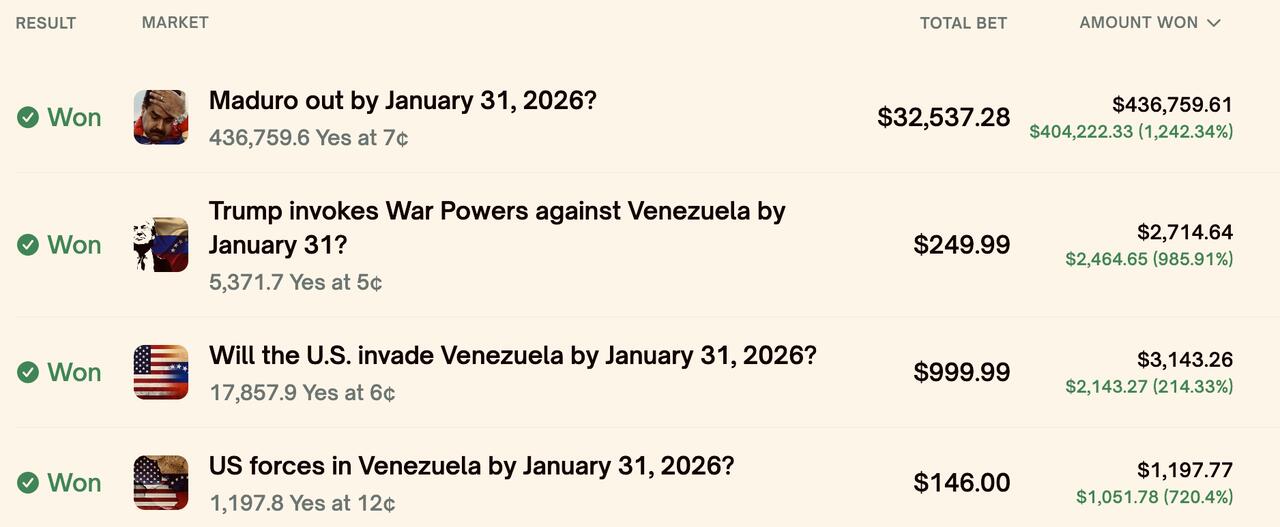
As the dust settles on President Trump’s Friday-night blitz on Venezuela, suspicions of insider trading on the secret operation are rising, after a brand-new Polymarket account scored a huge profit by betting on a US military attack just before it happened. As a result, a US House representative is already preparing to introduce a bill that would prohibit government officials from using inside info to profit in prediction markets.
The account in question was created on Dec. 27, and quickly placed roughly $34,000 in bets on US intervention in Venezuela and Maduro’s ouster both happening by January 31. On the Maduro prediction alone, the account scored a 1,242% gain, turning $32,537 into $436,760. At the time of the bets, the market placed the probability of intervention in January at just 6%.
The list of suspects could be quite a long one, given the military was poised to strike for days. “We were going to do this four days ago but the weather was not perfect,”Trump said after the attacks and Maduro’s extraction. “And then all of a sudden it opened up and we said go.” Military officials were said to have contemplated a Christmas-day attack. What’s more, given officials’ public talk about rehearsals of the operation, preparations likely spanned weeks, following months of a build-up of assets in the region.
That said, one can’t entirely rule out the possibility of someone outside reading headlines and placing a big bet, and the mystery account wasn’t the only one placing bets on US intervention. According to the Wall Street Journal, more than $56 million had been placed on Maduro’s ouster, with $11 million betting he’d be gone by Jan. 31. Another $40 million in losing bets had been placed on him leaving by Nov. 30 or Dec. 31. This X user claimed to have made $80,000 by translating a surge in Pentagon-area pizza traffic into imminent military action:
How i made 80,000$ in a single night using @Polymarket
Basically ever since the US brought their largest aircraft carrier i knew a strike was 100% going to happen, but i did not know when. So i built a vibe coded bot to track the dominos pizza orders around the pentagon because… https://t.co/Jx1ODEGtJ2
Regardless of who owns all those accounts, Democratic New York Rep. Ritchie Torres is planning to target officials’ potential to profit from access to government secrets. According to Jake Sherman of Punchbowl News, Torres will introduce the “Public Integrity in Financial Prediction Markets Act of 2026.” Here’s how Sherman’s source describes it:
This bill prohibits federal elected officials, political appointees, and Executive Branch employees from engaging in certain transactions involving prediction market contracts when they either possess material nonpublic information relevant to the transaction or could reasonably obtain such information through their official duties. The restriction applies to buying, selling, or exchanging prediction market contracts tied to government policy, government action, or political outcomes on platforms engaged in interstate commerce.
Torres is targeting a narrow universe of people, leaving plenty of opportunity for other people in government to profit from inside information — such as a staff sergeant at the Pentagon, or his girlfriend. Outside government, staffers at the Washington Post and New York Times also had an opportunity to profit on the Venezuela operation, as Semafor reports that both outlets learned of the operation shortly before it took place, but refrained from publishing the news to avoid putting US forces in peril.
Responding to news of Torres’ upcoming bill, Polymarket rival Kalshi said its rules prohibit trading by anyone inside or outside of government who “has access to material non-public information that is the subject of an Underlying of any Contract or that has the ability to exert any influence on the subject of an Underlying of any Contract.” Of course, platform rules are one thing and federal laws are another. The Block notes that Donald Trump Jr has advisory roles on both prediction platforms.
Dominic Cummings, the political strategist who oversaw Brexit, has dropped a bombshell warning to Nigel Farage: the UK establishment is plotting to crush him and Reform UK by any means necessary, including illegal tactics, to prevent a populist takeover.
As Reform surges in polls and eyes major gains in the 2026 local elections, Cummings has revealed how insiders view Farage as the next Trump-style threat they must eliminate early and ruthlessly.
Speaking on The Spectator’s Quite Right! podcast, Cummings told hosts Michael Gove and Madeline Grant: “They’ll leak medical records, they’ll leak tax records.They’ll bug his phone and leak that. They’ll do anything that they need to.”
Dominic Cummings: ‘The people around Keir Starmer and the upper echelons of Whitehall are saying to themselves: “Let’s smash the absolute living shit out of Farage and make sure he doesn’t win”.
‘They’ll leak medical and tax records, they’ll bug his phone and leak that. They’ll… pic.twitter.com/7q8wHrl7if
Cummings added that populists in other countries will be targeted too, noting “That will be happening across Europe and they’ll all be telling themselves they’re fighting fascism together.”
He pinpointed “the people around {British PM} Starmer” as driven by Brexit revenge, saying: “The people around Starmer and all through the upper echelons of the Whitehall system are looking at Trump.”
“They’re looking across Europe, and they’re saying to themselves: ‘The lesson is to strike early and strike hard and not let these people in’,” Cummings further noted.
Cummings added that establishment figures regret allowing Vote Leave to win the Brexit referendum, seeing it as “the beginning of the disaster for us.”
Cummings claimed that the ultimate goal of the establishment is “Smashing the absolute s*** out of Farage and making sure that he doesn’t win it – by fair means and foul.”
Whitehall is absolutely TERRIFIED of Nigel Farage – because they know he is destined to be the next Prime Minister.
They’ll collaborate – right and left – to make sure #REFORM doesn’t win.
Cummings also described the Conservative Party as “completely dead,” urging that “They’re like the local vagrant who used to smash everything up who is now cabbaged in a wheelchair and isn’t relevant anymore.”
The warning comes amid reports of media smears against Farage, including decades-old allegations from The Guardian, which he dismissed as backfiring: “It’s having zero effect. It’s maybe solidifying our core support.”
‘It shows how desperate they are.’
Nigel Farage MP lashes out at ‘the Guardian and the BBC’ for reporting on the racist allegations made towards the Leader of Reform. pic.twitter.com/fuTi63CMRk
Farage vowed in a New Year’s message that strong local election results could propel Reform to victory in the next general election: “If we get this right on May 7 this year, we will go on and win that General Election.”
Cummings’ exposé aligns perfectly with revelations from ex-Starmer aide Paul Ovenden, who just hours earlier accused civil servants of hijacking government via a “Stakeholder State” obsessed with fringe issues while siphoning power from voters.
Ovenden slammed this perma-class for wasting time on bizarre priorities like importing anti-white activist Alaa Abd el-Fattah, calling it a “morbid symptom of a state that has got bigger and bigger while simultaneously and systematically emasculating itself.”
This entrenched blob – NGOs, regulators, and lobbyists – now appears laser-focused on neutralizing threats like Farage, using dirty tricks to protect their grip.
It’s the same elite network plotting cradle-to-grave surveillance through newborn digital IDs, as exposed in our report on Labour’s dystopian scheme to track citizens from birth under the guise of immigration control.
The message is clear: the Deep State are not willing to let populists like Farage further disrupt their globalist agenda.
Your support is crucial in helping us defeat mass censorship. Please consider donating via Locals or check out our unique merch. Follow us on X @ModernityNews.