54.1 F
Chicago
Monday, October 5, 2026
Home Blog Page 955

Nigerian Gunmen Abduct Over 200 Christian Children, 12 Teachers In Boarding School Attack

0
Nigerian Gunmen Abduct Over 200 Christian Children, 12 Teachers In Boarding School Attack

Armed men attacked a Catholic boarding school in northcentral Nigeria’s Niger state in the early hours on Friday, abducting 215 students and 12 teachers, according to Daniel Atori, a spokesperson to the Niger state chapter of the Christian Association of Nigeria.

The attack on the church in south-western Nigeria is one in a series targeting Christians

“I have just got back to the village this night after I visited the school where I also met with parents of the children to assure them that we are working with the government and Security agencies to see that our children are rescued and brought back safely,” Atori said in a statement. 

The attack and abductions took place at St. Mary’s School, a Catholic institution in the Agwara local government’s Papiri community, said Abubakar Usman, the secretary to the Niger state government. He neither disclosed the number of students and staff abducted, nor who might be responsible for the attack. -AP

“We don’t know what is happening now, because we have not heard anything since this morning,” said Dauda Chekula, 62, whose four grandchildren were among the abductees. “The children who were able to escape have scattered, some of them ran back to their houses and the only information we are getting is that the attackers are still moving with the remaining children into the bush.”

The abduction is the latest in a spate of attacks on Christians in Africa’s most populous country, and happened just days after 25 schoolgirls were abducted in a neighboring state. 

While no description has been given for the attackers, the schoolgirls are suspected to have been taken by ‘gangs of bandits.’

As Susan Crabtree of RealClearPolitics writes:  

The timing and nature of the attack placed the fate of Nigerian Christians in stark relief. On Monday, in the early hours of the morning, a group of gunmen attacked a girl’s boarding school in northwestern Nigeria, kidnapping 25 girls, many of them Christian. The attack killed the school’s vice principal, Malam Hassan Makaku, who tried to block the door to the girl’s dormitory with his body.

The gunmen’s assault on the school took more than 20 minutes and failed to prompt any intervention from government security forces located at a checkpoint not far from the school.

The attack also took place amid new scrutiny and calls to action by President Trump. The president in late October vowed to stop the slaughter of Nigerian Christians, whom Muslim terrorist groups, including Boko Haram and Faluni militants, the Islamic State of West Africa Province, as well as armed bandits, have targeted and slaughtered by the thousands in recent years.

The abduction of the girls served as a reminder of former first lady Michelle Obama’s failed hashtag campaign to rescue 276 mostly Christian girls kidnapped by Boko Haram from a school in Chibok, Nigeria, in 2014. A decade later, 82 of the girls remain missing, and a United Nations investigation found that only 37% of schools across Nigeria have any warning system to detect threats of violence and armed attacks.

The deadly attack on the school also came the same week U.S. officials planned to highlight the plight of persecuted Christians in Nigeria at the United Nations and in Congress.

Ambassador to the United Nations Mike Waltz, singer Nicki Minaj, and religious freedom advocates gathered in New York Tuesday and joined a panel hosted by Fox News anchor Harris Faulkner. Rev. Gabriel Makan, a pastor from northern Nigeria, and Sarah Makin, former senior advisor on religious freedom in President Trump’s first administration, joined the panel to call for renewed diplomatic engagement and stepped-up actions from the Nigerian government.

Waltz, Minaj, and the other witnesses chronicled the loss of girls into what they fear is a life of sex slavery, the burning of churches, and beheadings of pastors. Entire villages, Waltz said, wake to gunfire because “they dare to commit the crime of calling Jesus their Lord, [and] people go to jail under blasphemy laws for simply wearing a cross.”

For years, religious freedom advocates have called on the U.S. government to address the slaughter of Christians in Nigeria. Trump, in his first term, designated Nigeria a “Country of Particular Concern,” but President Biden reversed that decision. In late October, Trump once again redesignated Nigeria as a CPC and vowed to do everything in his power, including have the U.S. military come in “guns blazin’,” to stop the violence.

“Protecting Christians is not about politics – it is a moral duty,” Waltz said Tuesday. “We need voices that pierce the silence we have heard from the international community, that humanize the statistics we keep hearing, and demand accountability.”

“Religious freedom means we can all can sing our faith regardless of who we are, where we live, and what we believe,” Minaj told the panel. “But today, faith is under attack in way too many places. In Nigeria, Christians are being targeted, driven from their homes and killed. Churches have been burned, families have been torn apart, and entire communities live in fear constantly, simply because of how they pray.”

New Jersey GOP Rep. Chris Smith in previous Congresses introduced bipartisan legislation calling for more action to stop what he considers a Christian genocide in Nigeria. On Thursday, Smith will lead a House Foreign Affairs Committee hearing on Trump’s renewed call for action.

Christians make up nearly half of Nigeria’s population of 200 million, but they are the victims of the vast majority of the attacks. Today, Nigeria is the most dangerous place in the world to be a Christian, according to leading religious freedom advocates.

The World Index of Christian Persecution states that Nigeria is where 89% of Christian killings throughout the world took place over the last several years. According to a report by Open Doors, a watchdog that tracks Christian persecution, attacks against Christians in Nigeria are on the rise, with 7,000 Christians dying in the first eight months of this year, up roughly 2,000 from recent years.

The Biden administration attributed the slaughter of Christians in Nigeria, which make up nearly half the population, not to religious persecution but to a conflict over resources exacerbated by climate change. Open Doors and other advocates ardently disagree about the main motivation, although most groups involved believe the conflict isn’t just religious in nature but also involves conflicts over power and control over land and resources because Christians own most of the farming areas.

Kidnapping, which helps fund Islamist terrorist groups, is big business for abductors in the lawless areas of northern Nigeria. More than 20,000 people have been abducted in Nigeria from 2019 to 2023, according to Open Doors. Roaming bandits target people wo will pay ransoms, and they’ve learned that Christians and religious leaders will respond with higher payments than others.

For these reasons, some groups, including the Vatican, have pushed back on the narrative that the slaughter of Christians is primarily religious persecution. According to Cardinal Pietro Parolin, the Vatican’s secretary of state, the root causes are “social” in nature rather than fully religious. The Trump administration rejects that assessment, arguing it’s a war on Christians by mainly Muslim extremist groups.

Regardless of the cause, the impact is alarming. Nigeria remains the world leader when it comes to the killing of Christians. The question now: What can the Trump administration do about it?

Trump, in his late October Truth Social post, vowed U.S. military action if the Nigerian government fails to take immediate action. Such a development, if it involved sending U.S. troops into Nigeria, would likely not only anger Trump’s isolationist MAGA base but could prove ineffective against roving bands of militants and terrorists in such lawless regions.

Nigerian President Bola Tinubu, who is Muslim, pushed back against Trump’s threat of military action, instead calling for non-military assistance from the U.S. and interested parties “to deepen cooperation and protection of communities of all faiths.”

Tinubu, who was elected in 2023 and faces reelection in 2027, is viewed as a far more honest broker than his predecessor, Muhammadu Buhari, a Muslim who shared his heritage with the Faluni ethnic group responsible for most of the attacks on Nigerian Christians. Tinubu’s wife is a Christian, which likely has tempered his approach.

A senior State Department official told RealClearPolitics that Trump is keeping all options on the table but noted that there is a “whole suite of options” the administration is considering, including serious economic sanctions. The official also noted the geographic complexity of the problem because in the northeastern area of the country the bad actors are Boko Haram and ISIS, while in the Middle Belt it’s Fulani militants.

The key to Tinubu’s reelection is managing “this delicate religious balance,” the official added.

“This is an opportunity for the Nigerians to show that they share this principle [of religious freedom], and they’re willing to take action on this for the benefit of our people,” the official said, noting that it requires the Nigerian government to increase its “prioritization of this issue” and “allocate resources appropriately.” 

While Tinubu appears open to Western assistance to crack down on the attacks, the real problem lies with the flow of firearms to different lawless regions and corrupt funds to the local governors of the different states, several of whom are in league with the extremist groups responsible for the violence, according to a source on the ground in Nigeria. Many of those firearms, the source said, are flowing into Nigeria from Arab states, including Saudi Arabia.

Trump this week gave Saudi Crown Prince Mohammed bin Salman a lavish welcome at the White House and even defended him over the 2018 killing of Washington Post journalist Jamal Khashoggi by Saudi agents, which U.S. intelligence agencies have concluded the crown prince approved. The White House’s renewed U.S. -Saudi partnership brings new hope to ending regional tensions with Iran and cementing the Israeli-Hamas peace deal.

But any talks of U.S. weapons sales to Saudi Arabia should also include pledges to lead an effort to stop the sales of firearms to Nigerian terrorists and militants, critics argue.

U.S. officials are planning to host a senior Nigerian delegation in Washington at the end of this week to get a better idea of short- and long-term goals and any sticking points.

“The flow of illicit weapons is just magnifying the problem there, so it’s one of the key factors that we’re going to look at, especially in the Middle Belt piece of this when we’re talking about ISIS and Boko Haram,” the State Department official said. “How these Fulani ethnic militias, which the Nigerians claim are just farmers – how they end up with heavy artillery to conduct these raids is a fundamental question.”

The State Department is in the process of conducting a review of all U.S. aid to Nigeria, including security cooperation and humanitarian and economic assistance.

“Our preferred option for them is to recognize the seriousness of the situation and act accordingly, in good faith with us, so we can all see results, and we don’t need to discuss any of these punitive aspects,” the official said. 

Tyler Durden
Fri, 11/21/2025 – 18:50

Stop The Presses – And Start Telling The Truth About Bias

0
Stop The Presses – And Start Telling The Truth About Bias

Authored by John Tillman via RealClearPolitics,

Is a culture change coming to the news media?

So it might seem, now that Bari Weiss has been appointed editor-in-chief of CBS News. Another sign is Jeff Bezos’s decision to reorient the Washington Post’s opinion page. The hope is that both outlets will move away from their blatant far-left coverage, not only bringing in some right-leaning voices, but restoring some measure of objective journalism. Other outlets are wondering if they should follow suit.

Spoiler alert: It won’t work.

That’s not the kind of culture change the media needs. Instead of fighting bias, media outlets should admit their bias, and frankly, they should own their bias. That’s the only way to make the media honest – and it’s what Americans actually want.

Make no mistake: The media landscape in this country is broken. A miniscule 8% of Americans have strong trust in the media, according to Gallup. People can’t abandon legacy outlets fast enough. But they’re not fleeing because so many outlets are biased. Everyone knows they are, and for the record, they always have been. Most outlets are strongly biased toward to the left. A few are strongly biased toward the right. What Americans don’t like is that all these bias outlets pretend to be unbiased and objective.

Americans are reacting to the media’s hypocrisy. And notice where they’re heading. It’s not to some up-and-coming or diamond-in-the-rough “objective” news sites – those don’t exist. No, Americans are rushing to outlets that are brutally honest about their political biases.

In a sense, the media landscape is reverting to the mean. The whole concept of “objective journalism” was created in the 1920s and 30s, but before then, newspapers were proud of their biases and very public about it. They were explicitly affiliated with political parties, movements, ideologies, or even individual leaders. Virtually every media outlet advanced a party line – and Americans loved it. For the record, it also strengthened America, by contributing to the vigorous clash of ideas that defines our pluralistic experiment in self-government.

By contrast, supposedly “objective” media is a historical anomaly, and it makes a mockery of our vibrant democracy. It pretends like a small group of well-educated journalists have a corner on the truth – and the wisdom to tell truth from lies. Ultimately, it says that journalists can put aside their biases. But none of this is true. Journalists are human, and humans have opinions. We should test those opinions by clashing them against each other, not give the false impression that some opinions are really objective truth.

Alas, the legacy media is too bought in to the idea of objective journalism, even as journalists report in profoundly biased ways. It’s killing them. So, on Nov. 19, I’m launching a project that will tell Americans exactly how biased reporters are – and I believe it will help the media.

It’s called MediaPedia, and its centerpiece is a bias rating system for American journalists. We developed an artificial intelligence model that ranks how liberal or conservative reporters are, based on their coverage. The AI system looks at eight criteria, from the sources they use to the tone they take, then gives them a score. A score between 0 and -50 means a reporter is liberal. A score between 0 and  +50 is conservative. For the record, my team is resisting our own biases by using an AI model. Unlike other ranking systems, we don’t want biased humans making biased calls.

MediaPedia will start by ranking journalists at five major legacy outlets: the Wall Street Journal, the New York Times, the Washington Post, the Associated Press, and Reuters. We have plans to add more outlets, including broadcast media and podcasts. Ultimately, we want to give Americans a window on as many journalists as possible, so they know exactly what angle the media’s coming from.

No doubt, some journalists will view MediaPedia as an attack, but it’s really an attempt to help them. Journalists should be honest about their biases, and it’s the only way to regain Americans’ trust. As counterintuitive as it seems, people are more willing to trust an openly biased reporter than a journalist who covers his bias under a cloak of objectivity.

At the end of the day, trust depends on honesty, and honesty is the real culture change that media needs. It’s not simply a matter of moving outlets in a different direction. What matters far more is admitting that every media outlet already has a direction – because America moves forward when the media is honest.

*  *  * Meanwhile, you can support ZeroHedge here

Tyler Durden
Fri, 11/21/2025 – 17:00

Watch: Construction Sites In Charlotte Go Dark As Illegals Hide From ICE

0
Watch: Construction Sites In Charlotte Go Dark As Illegals Hide From ICE

Federal officers from Immigration and Customs Enforcement (ICE) and U.S. Customs and Border Protection (CBP) began conducting large-scale raids across the Charlotte metropolitan area last weekend as part of Operation Charlotte’s Web. The objective is to arrest and deport criminal illegal aliens.

Operation Charlotte’s Web has given a partial understanding of just how many migrants have poured into the metro area since the Biden-Harris regime’s nation-killing open border policy.

Footage from X shows construction sites of residential homes, commercial projects, and even stores empty this week as illegals flee and go into hiding to avoid being deported.

We reported earlier this week:

Data from the Carolina Migrant Network nonprofit estimates that there are 58,000 illegals are living in Mecklenburg County, and an estimated 325,000 in North Carolina. 

What’s increasingly clear is that we may never fully grasp how many illegals crossed into the U.S. under the Biden-Harris’ open-border policies. But we get a sense of the scale when ICE sweeps turn parts of a major metro area into a ghost town overnight as illegals go into hiding. 

The deeper issue is that this illegal population has become a net drain on public resources. Americans never voted for a nation-killing illegal alien invasion – yet when voters give Trump a mandate to restore national security and deport criminal illegals, Democrats and their corrupt globalist judicial allies move to obstruct the will of the people. 

Tyler Durden
Fri, 11/21/2025 – 16:40

The Monsters’ Ball

0
The Monsters’ Ball

Authored by James Howard Kunstler,

“…the Democrat Party is no longer a political party. It is an insurrectionist crime syndicate that will torch the Constitution to stay in power.”

– Stephen Miller

The old joke goes: A-list actor is having lunch with studio chief. Studio chief says, Didya hear so-and-so (well-known Hollywood agent) dropped dead this morning. His heart. A-list actor says, Gee, I didn’t know he had one.

Kind of brings to mind the late Veep Dick Cheney, who actually did have a heart, but one so grotesquely diseased that he had his first near-fatal infarction at age thirty-seven, followed by surgeries galore, and finally, at age 71, a heart transplant that, quite remarkably, kept him going another thirteen years — long enough to function behind-the-scenes as a senior Deep State cheerleader and strategist through the Trump years. Daughter Liz Cheney, of course, did the political dirty-work, most notably on Nancy Pelosi’s sketchy J-6 Committee, prior to being voted out of office in the 2022 Republican primary for Wyoming’s at-large U.S. House seat with 28.9 percent of the vote to Harriet Hageman’s 66.3 percent.

And so, yesterday, Dick Cheney’s funeral took place at Washington’s National Cathedral, the greatest assemblage of bloodsuckers since the Hammer Film Studio went out of business in 1979.

Joe Biden was there, perky as all get-out for somebody with stage-four prostate cancer, shaking hands with Mike Pence, who pulled him over the finish line in 2021. John Brennan, coupster superbus was there. Ditto John Bolton (awaiting trial). Most cheekily of all, Dr. Fauci, the father of Covid-19 and its little helper, the Covid vaxx, was seated next to MSNBC’s loss-leader, Rachel Maddow, who famously declared in 2021, “The virus stops with every vaccinated person!” (Not.)

Also on hand, former president “W,” Mitch McConnell, Al Gore, Nancy P, Adam Schiff, Chief Justice Roberts, Veep-of-all-Veeps, Kamala Harris, and many more.

Mysteriously absent: both Clintons and both Obamas — though Bill’s office explained that he had “a scheduling conflict.”

Notably uninvited: President Donald Trump and Veep JD Vance, a downright snub, let’s be plain about it.

And with it, perhaps a message: Behold the whole gang that has labored tirelessly for a whole decade to run you out of office and stuff you into a prison cell is here to gossip and plot against you some more! Nyah, nyah. . . .”

The contrast was pretty stark: MAGA against everybody else inside the DC Beltway. Mr. Trump was certainly at the funeral as a sort of spectral presence, since you can be sure that the only thing they were chattering about was how they were finally going to get him. . . somehow! (After years of spectacular failure and astonishing reversal-of-fortune.) You might also sense what desperation lurks behind their elitist bravado. Some of these birds are headed into court themselves, perhaps to prison. The prospect must seem acutely unreal to them.

Meanwhile, Mr. Trump has become the Scarlet Pimpernel of US political history, brave, intrepid, and resourceful, driven by a chivalric hatred of tyranny and injustice while seeming to be a comedian, mocking his persecutors as he escapes one plot after another. Don’t you wish you’d been a fly-on-the-wall at the funeral, and whatever after-party they were all at? The odor of fear must have been eye-watering.

The whole wicked business appears to be lurching toward crisis now as Mr. Trump works implacably to disassemble the treasonous scaffold they operate off of. At midweek, a claque of Democratic Party Senators and Congresspersons, led by former CIA-employee, Michigan Sen. Elissa Slotkin, released a social media video appearing to prompt mutiny in America’s armed forces. Their script implied that Mr. Trump was issuing illegal orders, which officers could (and should) refuse to carry out. They offered no examples of such illegal orders.

It’s probably safe to say that they want Americans to think that any order issued by Mr. Trump as Commander-in-chief is ipso facto illegal because. . . because. . . well, because Trump! And it is all of a piece with their former rallying cry “our democracy,” flaunted by the worst gang of ballot fraudsters, free speech squashers, and lawfare lizards ever seen in this land.

Mr. Trump responded a bit intemperately on his Truth Social platform, telling the claque that their seemingly seditious act could be answered with the death penalty. He was in error on that. That is the penalty for treason outright. The law on “seditious conspiracy,” US Code Title 18 § 2384, calls for a fine of not more than $250,000 ((adjusted for inflation under 18 US Code § 3571), and a maximum prison sentence up to twenty years.

Anyway, that stunt was not exactly a win for Party of Chaos, but it does make you wonder what their next move is going to be. A Seven Days in May style military coup, perhaps? More likely this was a lame rearguard action by a party in retreat and disarray. The angels of justice are coming for them and they know it, despite the machinations of their allied judges to gum up every earnest Article II effort attempted since 1/20/25 to preserve, protect and defend the Constitution of the United States. Even while the people try to settle into the cradle of Thanksgiving hearth and harvest, the wicked creep around setting their traps.

Tyler Durden
Fri, 11/21/2025 – 16:20

Is AI A Catalyst For Growth… Or For Collapse?

0
Is AI A Catalyst For Growth… Or For Collapse?

Authored by Charles Hugh Smith via OfTwoMinds blog,

Yes, AI is a catalyst. But for what is not yet knowable.

The current narrative holds that the big problem we need to solve is conjuring up cheap energy to power AI data centers. Fortunately for us, the solutions are at hand: building modular nuclear power plants at scale and tapping North America’s vast reserves of cheap natural gas.

Problem solved! With cheap energy to power all the AI data centers, we’re on a trajectory of fantastic growth of all the good things in life.

Let’s consider the implicit assumptions buried in this narrative.

1. The unspoken assumption here is AI will solve all our problems because it’s “smart.” But this assumes the problems are intellectual puzzles rather than self-reinforcing, self-destructive structures fueled by corruption and perverse incentives embedded in the system itself.

2. The assumption is that if we replace human workers with apps and robots, that will automatically generate Utopia. But this is based on a series of baseless, pie-in-the-sky assumptions about human nature and the nature of social and economic structures.

3. The assumption is that being “entertained” by staring at screens all day is the foundation of human fulfillment and happiness, and so getting rid of human work will usher in Nirvana. The reality is humans are hard-wired to find fulfillment in purposeful, meaningful work that is valued by others. Staring at “entertainment” on screens all day isn’t fulfillment, it’s deranging and depressing.

This is human nature in a nutshell: Idle hands are the devil’s workshop.

4. Another assumption is that every technological revolution generates more and better jobs by some causal mechanism. But there is no law of nature that technology inevitably creates more jobs than it destroys, or that the resulting jobs are more rewarding. That recent history supports this idea doesn’t make it a causal law of nature. By its very nature, AI destroys jobs while generating few replacement jobs.

The handful of top AI programmers are paid (or promised) millions of dollars; the industry doesn’t need more than a handful of top designers because AI can generate its own conventional coding.

5. This narrative assumes AI will be immensely profitable and the profit motive will push its limitless expansion. But once again, there are no laws of nature that every new technology is inevitably immensely profitable just because it’s a new technology.

If the projected use-value doesn’t materialize, the investment in the new tech is mal-invested–a stupendous waste of capital chasing a delusional pipe dream. Some percentage might generate some use-value, but this use-value may be obsoleted long before the massive initial investment pays off.

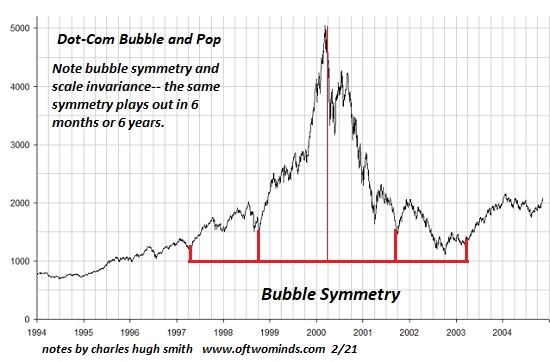
6. Even if the new technology continues expanding, the speculative bubble can deflate 80%. This is the lesson of the dot-com era: that the Internet continued to expand didn’t mean the speculative bubble continued inflating: the speculative bubble is not the same thing as the actual use-value in the real world.

The Internet continued expanding even as the dot-com stock bubble collapsed. In other words, this is the best-case scenario: if the use-value of AI is questionable, then the losses can approach 100%.

Here’s how this feels in real-time:

7. Perhaps the greatest assumption being made is that there is some law-of-nature inevitability in AI’s eventual supremacy. From the perspective laid out in What We’ve Lost, AI’s influence on systemic problems is zero because AI can’t reverse moral decay, and it actually reinforces destructive concentrations of capital and power in oligarchic cartels.

In other words, AI is a force not just of disruption (i.e. creative destruction) but of disorder, for its promoters are not accountable for its consequences, which are already visibly corrosive and potentially disastrous.

8. Every trend and every technology reaches an extreme version of its initial state. This extreme can be transformative–but not necessarily in the way proponents anticipate. AI could also be a catalyst for collapse, as the mal-investment on a vast scale bleeds the system of capital while generating consequences which destabilize a system already on the verge of disorder due to extremes of wealth-income inequality and unaffordability.

Put another way: AI is the ultimate projection of disruptive technology, but there are no guarantees that its consequences won’t catalyze systemic collapse.

9. AI boosters assume the public will either embrace or be forced to accept their AI dominance. That there could be pushback against AI supremacy that itself catalyzes disorder leading to collapse doesn’t enter their blinkered worldview.

Here is how the public may well view AI oligarchs:

10. Technocrats love to declare victory because their models indicate victory is inevitable. But models aren’t reality, as things get left out of models without the model builders being aware of what was left out. Consequences generate second-order effects that aren’t included in the projections.

Things always look great when simplified into a chart based on projections and data selected to support the shared delusion.

Yes, AI is a catalyst. But for what is not yet knowable. Never mind, here are AI’s boosters presenting their version of the “Five O’Clock Follies.”

*  *  *

My new book Investing In Revolution is available at a 10% discount ($18 for the paperback, $24 for the hardcover and $8.95 for the ebook edition) through November. Introduction (free). Check out my updated Books and Films. Become a $3/month patron of my work via patreon.com Subscribe to my Substack for free

Tyler Durden
Fri, 11/21/2025 – 15:45

Treasury To Block Tax Credits For Illegal Immigrants Under New Trump Administration Rule

0
Treasury To Block Tax Credits For Illegal Immigrants Under New Trump Administration Rule

The Treasury Department plans to issue regulations barring illegal immigrants and certain foreign nationals from receiving a range of refundable tax credits, a move the Trump administration says is necessary to ensure federal benefits are limited to those eligible under longstanding law.

Treasury Secretary Scott Bessent said Thursday that the department will implement new rules defining who may claim income tax credits covered by the 1996 Personal Responsibility and Work Opportunity Reconciliation Act, or PRWORA. The law restricts access to federal public benefits for individuals who are not U.S. citizens or qualifying residents.

“Under President Trump’s leadership, we are enforcing the law and preventing illegal aliens from claiming tax benefits intended for American citizens,” Bessent told Breitbart. 

The regulation will specify that the refundable portions of the Earned Income Tax Credit, the Additional Child Tax Credit, the American Opportunity Tax Credit and the Saver’s Match Credit constitute federal public benefits. As a result, the Treasury Department said, illegal immigrants and other foreign nationals will not be eligible to receive them.

“Treasury’s Office of Tax Policy and the Internal Revenue Service have worked tirelessly to advance this initiative and ensure its successful implementation,” Bessent said. “Their diligence and professionalism reflect this administration’s determination to uphold the integrity of our tax system. We will continue to ensure that taxpayer resources are directed only to those who are entitled under the law.”

The rule follows a recent opinion from the Office of Legal Counsel at the Justice Department, interpreting these income tax credits as federal public benefits that fall under PRWORA’s eligibility restrictions.

Research has indicated that illegal immigrants receive substantial refundable tax credits each year. A 2021 report from the Center for Immigration Studies estimated that illegal immigrants with Social Security numbers receive roughly $2.9 billion in cash payments annually, including $2 billion from the Earned Income Tax Credit and $890 million from the Additional Child Tax Credit. The report also estimated that illegal immigrants filing with Individual Taxpayer Identification Numbers receive between $870 million and $1.6 billion in Additional Child Tax Credit payments.

The Treasury Department said the new regulations will apply beginning with the 2026 tax year. (h/t Capital.news)

Tyler Durden
Fri, 11/21/2025 – 15:25

The Labubu Omen

0
The Labubu Omen

Authored by Adam Sharp via DailyReckoning.com,

Remember Beanie Babies? In the late 1990s, they were all the rage.

Tiny stuffed animals which cost less than $1 to manufacture were selling for thousands of dollars at peak.

The Princess Diana memorial bear once fetched $500+, and today it sells for around $5. Peanut the Royal Blue Elephant hit $5,000 in 1999, and today a certified mint condition specimen might fetch $50.

The BB craze started in 1997, just as the dotcom bull market was starting to go vertical. At one point, fully 10% of all eBay listings were Beanie Babies.

The timing was no coincidence. Speculation is contagious. Once a society catches the bug, it causes all sorts of strange effects.

The Beanie Baby Bubble (BBB) fell apart in mid-1999. Shortly before the dotcom bubble peaked in March of 2000.

Labubus Gone Wild

Over the past year, a new plush toy craze has gone viral. Labubus. They’re small, demonic-looking creatures sold by a Chinese company called Pop Mart:

Source: Pop Mart

The unique thing about these toys is that you initially had to buy “blind boxes”, where you don’t know which doll you’re getting. It could be an ultra rare valuable one, or a common one. The gambling aspect made it incredibly viral. For months they constantly sold out the moment more came in stock.

One notable Labubu sold for $10,585 earlier this year. It was a limited-edition Vans Old Skool Vinyl Plush Doll:

Over the summer, Forbes ran a piece on that sale, even saying that Labubus might be “good investments”.

In June, a unique 4 foot tall Labubu sold for a whopping $170,000 in China.

But since then, interest has dried up. Less than 3 months later, the same Forbes editor updated her Labubu outlook.

Is The Labubu Craze Ending? Prices Are Down And Inventory Is Up As Eyes Turn To A New Toy

On eBay, where sellers have made upwards of $10,000 on special edition Labubus, few dolls are listed for more than $2,000 and none of 60 most expensive listings have garnered bids.

At the height of the Labubu craze earlier this year, the toys sold out in a matter of seconds each time they re-stocked on the Pop Mart website and resellers were making hundreds to thousands of dollars on each wacky, toothy doll.

The high prices and low inventory drove a rise in counterfeit Labubu and stores with the dolls in stock were being overrun by customers brawling and yelling at each other to secure their toy.

I checked eBay today, and none of the most expensive Labubus have any bids to speak of. Sellers are still trying to sell the most rare ones at their peak prices, and nobody’s biting.

It looks like Labubu demand has hit a wall.

Anecdotally, my middle schooler reports that Labubus are no longer as cool as they once were.

Is Speculative Mania Peaking?

The Labubu craze is indicative of the state of markets. Just as Beanie Babies were a product of the dotcom bubble. Signs of the times.

I hate to keep hammering this point home, but it’s abundantly clear we’re in the midst of a bubble. One that could be close to peaking.

The crypto market is giving up much of its gains. Momentum stocks have hit a wall, at least for now. And even big tech is experiencing its first turbulence since the April selloff.

When this thing falls apart, the Fed will undoubtedly step in with much lower rates and unprecedented QE. But based on the size of this bubble, even with tremendous money printing, it could take a decade or more for hot stocks to recover.

I don’t claim to know exactly when the bubble will pop. It could be tomorrow, or a year from now.

Regardless, I’m steering clear of hot tech names (besides retirement target date fund exposure), and sticking with my great rotation theory. We’re doing very well in cheap emerging markets, natural resources, and gold/silver/miners. So I don’t see a need to speculate on overpriced momentum stocks at this time.

I sleep much better not having to worry about the spectre of dotcom-style 70% drawdowns.

Tyler Durden
Fri, 11/21/2025 – 15:05

House Lawmakers Press Shein Over Sale Of Childlike Sex Dolls In The US

0
House Lawmakers Press Shein Over Sale Of Childlike Sex Dolls In The US

Authored by Evgenia Filimianova via The Epoch Times,

House lawmakers have asked fast-fashion retailer Shein to explain how childlike sex dolls were allowed to appear on its e-commerce platform and whether any were sold to U.S. customers, escalating an international controversy that earlier this month led France to suspend the company’s online marketplace.

In a Nov. 20 letter to Shein CEO Xu Yangtian, Reps. Vern Buchanan (R-Fla.) and Debbie Wasserman Schultz (D-Fla.), joined by 32 other members of Congress, sought clarity on the retailer’s internal controls and whether U.S. consumers were exposed to illegal content.

Founded in China and now headquartered in Singapore, Shein is known for its low-cost, rapid-turnover fashion and for hosting thousands of independent vendors on its marketplace.

The lawmakers said the request follows reports earlier this month that access to Shein’s French site was temporarily blocked after authorities found dolls resembling children offered for sale by third-party vendors.

Buchanan, who is leading the bipartisan inquiry, said in a statement, “It is incredibly disappointing that a major global retailer allowed childlike sex dolls to be sold on its platform, products that are known to fuel pedophilia and endanger children.”

He added that companies that fail to stop such items “must be held fully accountable and prevented from ever enabling this kind of behavior again.”

Wasserman Schultz said the sexual exploitation of children cannot be stopped while such products continue to be made and sold, stressing that e-commerce companies must not allow their platforms to be used to distribute items that encourage abuse.

Letter Flags Breaches

In their letter, lawmakers said French authorities discovered on Oct. 31 that Shein’s website was selling sex dolls with a childlike appearance.

One listing described a product as a “sex doll … male [expletive] toy with erotic body …” and showed an image of a doll resembling a young girl holding a teddy bear.

Rep. Vern Buchanan (R-Fla.) arrives for a hearing on Capitol Hill in Washington on May 13, 2025. Madalina Vasiliu/The Epoch Times

The lawmakers said a Shein representative confirmed that third-party vendors began selling childlike sex dolls on the platform on Oct. 16.

They noted this directly contradicts Shein’s policies, which ban illegal or restricted goods, including items that promote child abuse and exploitation.

They added that the listings raise concerns that similar items may have been available in the United States, including in states such as Florida, Tennessee, Kentucky, Utah, and Hawaii, where the sale of such dolls is explicitly banned.

The letter cites research warning that childlike sex dolls can have a “reinforcing effect” on pedophilic ideation.

Although the lawmakers acknowledged Shein’s later decision to ban all sex dolls and suspend its adult-product category, they said it was unacceptable that the dolls were ever allowed to be listed.

They asked the company to clarify by Dec. 20 whether the dolls were sold to U.S. customers, whether law enforcement was notified, how the company plans to recall any completed sales, and what measures it will adopt to prevent future violations.

The letter also urges Shein to commit to a permanent, global ban on childlike sex dolls, even in countries where such sales are not explicitly illegal.

The Epoch Times contacted Shein for comment but did not receive a reply by publication time.

Suspension in France

France said on Nov. 5 that it was suspending access to Shein’s online platform unless the retailer proves its content complies with French law.

The government’s announcement coincided with the opening of Shein’s first physical retail location, a pop-up inside Paris’s Bazar de l’Hotel de Ville (BHV) department store.

Under French law, regulators can require online platforms to remove clearly illegal content such as child pornography within 24 hours, and failure to comply can result in orders for internet providers and search engines to block or delist the site.

Arnaud Gallais (C), president of Mouv’Enfants, a movement fighting against all forms of violence against children, gestures next to Suzanne Frugier (R), general secretary of Mouv’Enfants, holding a placard which reads as “Protect children. Not Shein,” at the Bazar de l’Hotel de Ville (BHV) department store in Paris on Nov. 5, 2025. Dimitar Dilkoff/AFP via Getty Images

A day later, on Nov. 6, France’s finance and digital ministers asked the European Commission to launch an urgent investigation, calling the listings “serious breaches” of European regulations.

Shein told The Epoch Times on Nov. 6 that it had taken note of the government’s decision and was cooperating with authorities.

“We are committed to working with the French authorities to address any concerns swiftly as we have always done,” the company said.

It added that it had temporarily suspended listings from independent third-party vendors on its French marketplace while it reviews and strengthens oversight of their activity.

Tyler Durden
Fri, 11/21/2025 – 14:25

Amb. Huckabee Under Fire For ‘Warm’ Meeting With Notorious Traitor & Spy Jonathan Pollard 

0
Amb. Huckabee Under Fire For ‘Warm’ Meeting With Notorious Traitor & Spy Jonathan Pollard 

US Ambassador to Israel Mike Huckabee is under fire and in the headlines after it was revealed he met with notorious traitor and spy Jonathan Pollard at the US Embassy in July. The former American intelligence analyst was convicted of espionage for Israel and sentenced to life in prison in 1987.

Pollard’s is widely viewed as one of the single most damaging spy cases in US intelligence history, as he passed along extensive classified information, including the NSA’s ten-volume guide to US signals-intelligence collection methods. He also directly put American intelligence agents and officials in danger, as he revealed the identities of thousands of individuals who had assisted US intelligence services.

The CIA still considers Pollard a dangerous traitor to the nation. He had passed thousands of secret documents – enough to fill a large room-full, to Israeli intelligence in exchange for money and gifts. His defense after getting caught red-handed, which included video footage showing him stealing documents, was that the US government was withholding crucial information from its close Mideast ally.

Pollard had actually been arrested while trying gain asylum at the Israeli Embassy in Washington. Later, in prison, he was granted Israeli citizenship, also amid an Israeli lobbying campaign to see him go free.

He was released from prison in 2015 during the Obama years, in his mid-60s and after serving 30 years of his sentence. After a strictly monitored five-year period of parole, he fully gained his freedom and immediately moved to Israel in 2020, where he received a “hero’s welcome” from Prime Minister Benjamin Netanyahu.

The New York Times reports this week:

The highly unusual meeting caught some U.S. officials by surprise, and appeared to be a sharp break with years of precedent for American diplomats.

The New York Times learned of the meeting from three U.S. officials who spoke on the condition of anonymity to discuss sensitive information. When The Times asked Mr. Pollard about the meeting, he confirmed it.

Mr. Pollard said it was the first time that a U.S. official had hosted him at an American government office since his release a decade ago.

The same report indicated this alarmed and angered the CIA, but which hasn’t issued official public comment on the matter. “The meeting with Mr. Pollard, a former naval intelligence analyst, was kept off Mr. Huckabee’s official schedule, two of the U.S. officials said. The fact that it occurred alarmed the Central Intelligence Agency’s station chief in Israel, three of the officials said,” The Times continued.

However, the White House defended the ambassador, saying simply “The White House was not aware of that meeting” and that “The president stands by Ambassador Huckabee and the work he is doing for both the United States and Israel.”

Pollard has openly described the Huckabee discussion as warm and said he used the opportunity to thank Huckabee for helping advocate for his release from prison, and for looking after his family while he was serving time in federal custody.

Huckabee has previously come under criticism from the MAGA movement for being ‘Israel first’ and not in truth America first. He has long maintained of Washington relations with Israel that “It’s a relationship unlike any other.”

Tyler Durden
Fri, 11/21/2025 – 14:05

CapEx Spending On AI Is Masking Economic Weakness

0
CapEx Spending On AI Is Masking Economic Weakness

Authored by Lance Roberts via RealInvestmentAdvice.com,

The U.S. economy’s recent growth has a distinctive engine: large‑scale capital expenditures (capex) tied to artificial intelligence (AI). Firms such as Microsoft, Alphabet (Google), Meta Platforms, and Amazon have announced massive investments in data centers, servers, networking equipment, and AI infrastructure.

As noted by Investing.com:

“Artificial intelligence is consuming capital faster than investors can recalibrate. Bank of America now sees global hyperscale spending rising 67% in 2025 and another 31% in 2026, with total outlays climbing to $611 billion. That is a $145 billion increase in just one month’s estimates.

The surge shows how cloud giants are doubling down. Google raised its 2025 capital budget to $92 billion, Microsoft plans even faster growth into fiscal 2026, and Meta now expects spending of about $100 billion in 2026. Amazon’s data center capacity is on track to double by 2027. None show intent to slow down, even as capex intensity approaches 30% of sales, roughly triple historic norms.

That level of investment is extraordinary. At its peak, the 5G telecom buildout consumed about 70% of operating cash flow, AI infrastructure is now approaching the same strain.

While we can certainly discuss the magnitude of those investments and the risks associated with repeating another “Dot.com” overbuild, the point I want to address with you today is how those capital expenditures are masking broader economic weakness.

For example, a recent estimate places U.S. AI‑related capex for fiscal 2025 at about 1.2% of GDP. (The chart below uses the Atlanta Fed GDP Now estimate for Q3 of 4% nominal GDP growth and assumes the same in Q4.) If we subtract out the AI-related Capex spending, growth is significantly weaker than advertised.

In raw terms, the global AI investment by key players already exceeds hundreds of billions of dollars. Analysts forecast global AI spend at around US $360 billion in 2025 with growth into 2026 and beyond. For instance, data center capex is projected to grow at a 21% CAGR to reach US$1.2 trillion globally by 2029. Such figures highlight real spending momentum, and that momentum has helped the U.S. economy avoid a steeper decline in growth. But this growth is highly concentrated. Only a handful of large tech firms comprise the bulk of the capex. Therefore, the headline numbers require deeper interpretation. Investors must recognize that, while the impact on economic growth is real, spending will eventually slow down.

Still, the rise of AI-driven investment is significant for the economy and for investors alike. It signals a shift in the composition of growth from consumption and broad business investment toward heavy‑asset, tech‑centric investment. Recognizing how that shift works is critical for understanding risks and opportunities.

What the Boom Masks – Underlying Weakness in the Economy

Although the surge in AI investment is impressive, it masks several structural weaknesses in the broader U.S. economy. First, the AI‑capex boom is concentrated among a small number of firms and sectors rather than being broadly diffused across all industries or geographies. The bulk of spending is going into servers, data‑centers, and networks. While those assets are capital‑intensive, they are not labor‑intensive in the way large manufacturing or services growth might be. As noted above, while analysts estimate that AI-capex may be 1.2% of GDP in 2025 under a standard multiplier, the real economic benefits in productivity or employment outside of the tech sector remain limited so far. We observe that in the dispersion of expected 2026 earnings growth between the largest market-capitalization-weighted stocks in the S&P 500 index and the rest.

In other words, if AI capex spending reached a broad swath of the economy, the earnings expectations for the bottom 493 companies would not be negative. It is also crucial to note that forward earnings estimates are ALWAYS overly optimistic, so the results are likely to be worse in the future.

Second, much of that investment relies on imported equipment, components, and technologies, which means the domestic multiplier of the spending is weaker than the headline number suggests. Although AI-capex is large, much of it is still classified as intermediate goods, which aren’t fully captured in GDP statistics. However, while AI capex spending is robust, spending by the rest of the economy remains muted.

Third, when you look beyond the tech sector, the traditional engine blocks of growth are weaker. Residential investment is under pressure as housing affordability remains an issue. As noted above, since business investment outside the large tech players remains muted, that is weighing on employment growth, which continues to show signs of softening.

Fourth, while AI capital expenditures (capex) are high, the economic payoff has not yet been fully proven. Productivity gains, revenue gains, and sustainable earnings from this wave of infrastructure spend have not been fully realized. One Vanguard analysis notes that to move U.S. growth above trend via AI alone would require approximately US$1 trillion in AI-related spending, which lies ahead, not behind.

Thus, the underlying condition of the economy is more fragile than the capital‑spend numbers imply. The risk is that when the tech‑capex boom slows or fails to deliver a broad spill‑over, the rest of the economy will feel the weakness more sharply.

Therefore, as an investor, the risk of assuming broad-based resilience may be critical to consider when developing your investment thesis.

Implications for Investors

For investors, the mixed nature of this growth wave presents both opportunity and risk. The current opportunity for investors is to invest directly in firms closely tied to AI infrastructure, such as chip manufacturers, data center operators, and cloud services companies, all of which are likely to benefit. Their growth trajectories may outpace the broader economy because they are at the heart of the capital expenditure surge. But these opportunities come with important caveats.

One risk is concentration. If a narrow subset of companies or sectors is driving the growth story, then portfolios that lack diversification towards non‑tech may expose investors to sharper corrections. If the tech-capex wave slows, valuations tied to presumed growth may reverse quickly, especially among firms with aggressive capital expenditures and uncertain near-term returns. For example, analysts at Goldman Sachs warn that the current contributions of AI to GDP are likely understated; however, the actual economic benefit remains modest, and future risks remain high.

Secondly, as we saw during the dot-com bubble, not all companies that jumped into the internet market survived. Those failures also included some of the largest companies at the time, such as Enron, World.com, and Lucent, among others. The current AI cycle will likely be the same; there will be some big long-term winners, but there will also be quite a few companies that are mainly trading on “hope” for future results that are far from guaranteed.

Another investor implication concerns earnings quality. Heavy capital expenditures do not guarantee near-term earnings improvement or productivity gains. Some firms may carry high depreciation, amortization, and idle capacity risk. A report notes that capital spending growth now may generate returns only years down the road. This remains one of our primary concerns, as expectations for future earnings growth are incredibly elevated. This leaves an enormous amount of room for disappointment when combined with already high valuation multiples, making the downside risk not inconsequential.

(The chart shows the current deviation of earnings growth from its long-term exponential growth trend versus the trailing P/E ratio, which is inverted. When the “E” reverses, valuations will skyrocket as they did during the Dot.com bust, the Financial crisis, and the Pandemic shutdown.)

Third, investors should monitor the masking effect. The fact that AI‑capex is propping up headline growth means the rest of the economy remains vulnerable. As shown, the economically weighted ISM index (70% services/30% manufacturing) remains in expansion territory, but just barely. If consumption or non‑tech business investment falters, the broader weakness may surface suddenly. Portfolios built only around tech optimism may lack cushions from areas less tied to the boom.

Fourth, valuations need discipline. As noted above, investors are currently pricing in the most optimistic of future outcomes. That exponentially increases the risk of disappointment at some point in the future. The correction potential rises if growth disappoints, returns are delayed, or macro weakness intensifies. Investors should consider whether the current growth base is sufficiently broad to support the expected outcomes. Are earnings projections realistic? How much is the stock’s valuation already assuming perfect execution?

In short, you must not assume that because one part of the economy is booming, everything else is strong. Please recognize that the growth narrative is narrow; therefore, as investors, we should consider some practical steps to manage future risks.

Tyler Durden
Fri, 11/21/2025 – 13:45