Unlike some recent extremely volatile months, especially in the first half of 2026, consumers expectations for inflation in August barely budged from July, as disclosed today by the latest NY Fed Survey, which showed that inflation expectations in one year were unchanged at 3.6%, estimates for inflation in five years were also flat at 3.0% for the 12th month in a row, while estimates for inflation in three years dipped to 3.2%, from 3.3%.

According to the report, median inflation uncertainty—or the uncertainty expressed regarding future inflation outcomes—increased at the one- and five-year horizons and decreased at three-year horizon.
Taking a closer look at the component, median home price growth expectations decreased by 0.2% point to 3.0%, just below its 12-month trailing average of 3.1%. The decrease was driven by those living in the Northeast.

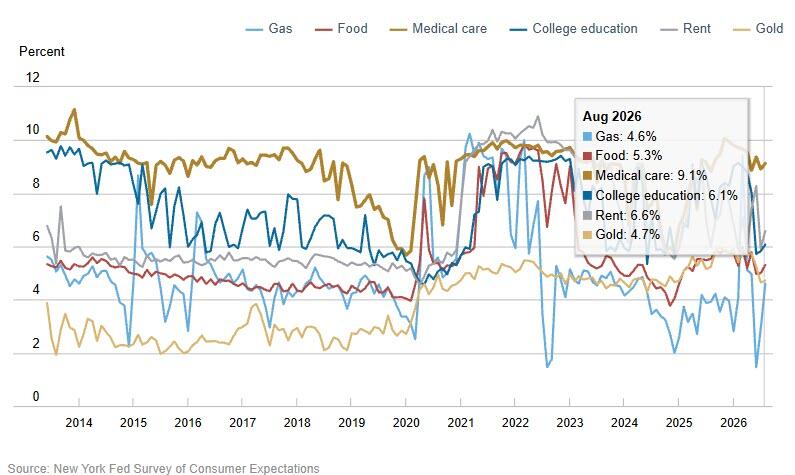
Among commodities, median year-ahead expected price changes increased by 1.7% points to 4.6% for gas, by 0.3% to 5.3% for food, and by 0.2% point to 9.1% for medical care. Median year-ahead expected price changes increased by 0.3% to 6.1% for the cost of college education and by 0.7 % point to 6.6% for rent.
While inflation expectations were tame, the view on financial wellbeing was split. On one hand, with less than three months ahead of mid-term congressional elections, the proportion of Americans reporting their financial situation was much worse or somewhat worse than a year ago rose to 38.6% last month, up from 37.6% in July. Those who expected their finances to get much worse or somewhat worse in the year ahead also climbed to 32.6% from 30.3%.

On the other hand, perspectives on the labor market improved: workers’ perceived probability of losing their job in the next year fell to 13.8%, the lowest reading since February. The likelihood of leaving a post voluntarily – a positive indicator – rose for the second straight month to 19.5%, above its 12-month average of 18.4 percent.

Both trends were driven by respondents with a high school degree at most and a household income under $100,000 per year.
On the other hand, average unemployment expectations – the probability that the unemployment rate will be higher one year from now – increased by 1.6% to 44.4%, its highest reading since April 2020.

At the same time, the mean perceived probability of finding a job if one’s current job was lost decreased by 0.8% to 45.4% .
There was some deterioration in household leverage too, as a larger percentage of consumers, 13.16% vs 12.00% in the prior month, expect to not be able to make minimum debt payments over the next three months

Despite this seeming deterioration in household finances, the mean perceived probability that US stock prices will be higher 12 months from now was 40.9%, fractionally below the multi-year high in July, but far above the recent average.

Some more results from the latest report:
Labor Market
- Median one-year-ahead earnings growth expectations ticked up by 0.1 percentage point to 2.9% in August. The series remains above its 12-month trailing average of 2.6%.
- Mean unemployment expectations—or the mean probability that the U.S. unemployment rate will be higher one year from now—increased by 1.6 percentage points to 44.4%, its highest reading since April 2020. The increase was broad-based across age, education, and income groups.
- The mean perceived probability of losing one’s job in the next 12 months decreased by 0.4 percentage point to 13.8%, its lowest reading since February 2026. The mean probability of leaving one’s job voluntarily, or the expected quit rate, in the next 12 months increased by 0.9 percentage point to 19.5%, above the series’ 12-month trailing average of 18.4%. The decrease in job loss and increase in quit expectations were both driven by those with at most a high school degree and those with annual household incomes under $100,000.
- The mean perceived probability of finding a job if one’s current job was lost decreased by 0.8 percentage point to 45.4%, just below the series 12-month trailing average of 45.5%.
Household Finance
- The median expected growth in household income remained unchanged at 3.0% in August. The series has been moving in a narrow range between 2.8% and 3.0% since June 2025.
- Median one-year-ahead household spending growth expectations increased by 0.3 percentage point to 5.2%, above its 12-month trailing average of 5.0%.
- Perceptions of credit access compared to a year ago declined, with the net share of households reporting it is harder to get credit increasing. Expectations for future credit availability also deteriorated, with a larger share of respondents expecting it will be harder to obtain credit in the year ahead and a smaller share expecting it will be easier.
- The average perceived probability of missing a minimum debt payment over the next three months increased by 1.2 percentage points to 13.2%, just above its 12-month trailing average of 12.7%.
- The median expectation regarding a year-ahead change in taxes at current income level increased by 0.5 percentage point to 3.5%, its highest reading since December 2025.
- Median year-ahead expected growth in government debt increased by 0.6 percentage point to 9.7%, remaining above its 12-month trailing average of 8.8%.
- The mean perceived probability that the average interest rate on savings accounts will be higher in 12 months increased by 0.6 percentage point to 28.8%.
- Perceptions and expectations about households’ financial situations both deteriorated with larger shares of households reporting a worse financial situation compared to a year ago and expecting a worse financial situation a year from now, and smaller shares of households reporting or expecting a better financial situation.
The New York Fed data comes days after a surprise increase in job gains in August signaled the labor market remained resilient despite uncertainties caused by the war on Iran and persistent inflation. Payrolls rose 162,000, above all estimates in a Bloomberg survey, while the unemployment rate held steady at 4.1%. The data reinforced Fed views of a stable job market. The next key readings are Thursday’s PPI report followed by the CPI on Friday.
the Fed is set to meet in Washington Sept. 15-16, after leaving interest rates steady over five straight meetings. At their last gathering, three officials favored a quarter-point hike. A growing chorus of officials has questioned whether the current level of interest rates will be high enough to tame inflation.
Tyler Durden
Tue, 09/08/2026 – 12:00