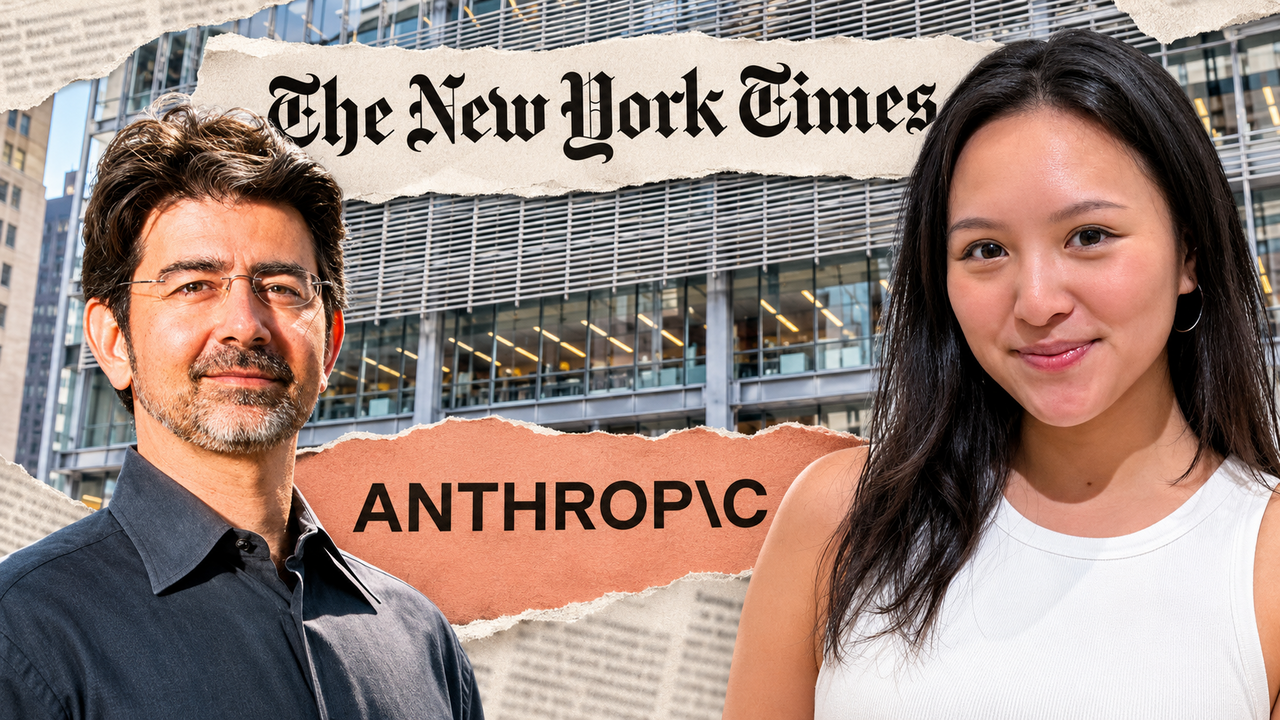
The New York Times’ new AI writer spent the first half of 2026 on a $50,000 stipend from Omidyar Network, the eBay founder’s philanthropy, which owns Anthropic stock now worth more than $55 million. She also took a grant from the Tarbell Center for AI Journalism, whose top funders include the philanthropy of early Anthropic investor Dustin Moskovitz.

On Nov. 17, the Times hired Jasmine Sun as an Opinion writer. The next day, as Anthropic priced the biggest IPO in history at $83 a share, the paper ran her essay “I Spent a Year Talking to Anthropic Employees. Here’s What They Believe.” Its author line reads in full: “Ms. Sun writes about A.I. and Silicon Valley for Opinion.”
Leo Underwood, who has been tracking the money behind the campaign against Jensen Huang, laid out the trail on Thursday in a reply to Tarbell’s executive director.
“What a compliment!”
I’d mark you guys as the first to jump up and call for Jensen Huang to resign. Just because you were the first hyena to howl.
You want a bow for transparency. Here’s yours.
Nov. 17: The New York Times hires Jasmine Sun.
Nov. 18: Anthropic prices its IPO at $83. The Times runs her “I Spent a Year Talking to Anthropic Employees.”Who paid for that year?
Omidyar Network: $50,000, mid-January to mid-July.
Tarbell: paid her the same year.On Omidyar’s payroll, she wrote up Claude Code, Dario Amodei’s essay, and Claude’s Constitution, then sided with Anthropic against the Pentagon, with no Omidyar line.
On Tarbell’s payroll, ordinary people in Midwestern towns fighting data centers got “data center NIMBYism.”
In The Times, on the eve of the IPO, Anthropic got “I do not doubt these good intentions.”
Kathleen Kingsbury runs Times Opinion. Her section hired Sun one day and ran her the next.
Did they know who paid her? Then why no disclosure?Omidyar, Tarbell, and The New York Times pushed a young writer onto the stage to be sacrificed. Then all of you hid backstage like cowards and called it transparency.
“What a transparency!”
— Leo Underwood (@VesselGhost1984) November 26, 2026
The Residency
Omidyar Network named Sun one of nine 2026 Reporters in Residence on Jan. 15, to examine “the communities, values, and subcultures that drive the AI industry.” The program paid each reporter $8,000 a month plus a $2,000 travel budget, $50,000 in all, from mid-January to mid-July, according to its job listing. Omidyar says its residents keep full editorial control over their work.
The network bought into Anthropic in March 2024, when Omidyar put $1.5 million into shares auctioned off by the bankrupt FTX estate, alongside $5 million from the Ford Foundation and $1 million from the Nathan Cummings Foundation, ImpactAlpha reported at the time. At the $111.50 Anthropic opened at on Nov. 19, Omidyar’s shares were worth more than $55 million, Forbes calculated.
On its own site, Omidyar says it “led a consortium of philanthropies that invested in Anthropic” and is “helping Anthropic adhere to its social and mission commitments.”
In February, the Guardian launched “Reworked,” an AI series made in partnership with Omidyar, without at first disclosing Omidyar’s Anthropic investment, the Daily Caller News Foundation reported in April.
1/
Omidyar Network named her a 2026 Reporter in Residence on Jan. 15: $50,000, mid-January to mid-July, to study “the communities, values, and subcultures that drive the AI industry.”
The same network paid $1.5 million in 2024 for Anthropic shares out of the FTX estate. After the IPO open, Forbes put that stake at more than $55 million.— Leo Underwood (@VesselGhost1984) November 26, 2026
What She Wrote

A week into the residency, Sun wrote on her Substack that she had spent “every day last week talking to Claude Code more than my friends.”
On Feb. 28, the day after Defense Secretary Pete Hegseth labeled Anthropic a supply chain risk, Sun posted an “emergency blog” that opened by asking who would win in a fight between “an alcoholic Fox host with a fetish for extrajudicial airstrikes” and “a neurotic Italian-American physicist running an AI company.” She called it “terrifying for the public that the Pentagon is throwing this fit over the right to mass surveillance and killer bots,” though she also called one strand of Amodei’s reasoning “naive.”
The post described her work as “fully independent journalism about AI and politics.” It made no mention of Omidyar.
Two days later, Omidyar Network’s Mike Kubzansky told ImpactAlpha that when an AI company draws a line against autonomous weapons and mass surveillance “and holds it under enormous government pressure – that’s our investment thesis in action.” “We remain as confident as ever in Anthropic’s future,” he said.
In April, still on the residency, Sun defined “AI populism” days after two attacks on OpenAI’s Sam Altman. Among the public, she wrote, it shows up as “data center NIMBYism, AI witchhunts among creatives, and in the extreme, assassination attempts like what happened to Altman this week.”
The Tarbell Grant
That summer, Sun drove through Wisconsin and Michigan reporting on towns fighting data centers. The resulting August piece, “No Data Centers In My Backyard,” closed with a line: “This story was supported by a grant from the Tarbell Center for AI Journalism.” Her travel was covered by Emergent Ventures, the same note said.
Tarbell’s supporters page puts Coefficient Giving, the grantmaker Moskovitz and his wife Cari Tuna built, in its top tier, $1 million and up, every year from 2023 to 2026. Beside it sits the Survival and Flourishing Fund, the vehicle of Skype co-founder Jaan Tallinn, who led Anthropic’s first funding round. Coefficient alone has given Tarbell more than $4.7 million, Fox News reported.

As we reported Tuesday, Tarbell’s first newsroom grants included $480,000 for Machine Gods, the NPR show from Kevin Roose and Casey Newton that gave five of its first 11 episodes to Huang’s downfall. Sun helped research and edit Roose’s latest book, “The A.G.I. Chronicles,” and her new Times job includes occasional guest spots on the relaunched Hard Fork, Roose and Newton’s old show, according to the announcement.
In July, Sun was a guest on the 80,000 Hours podcast, run by the AI-safety careers nonprofit whose largest funder is Coefficient Giving, according to its job board.
The Times
Opinion editor Kathleen Kingsbury announced the hire on Nov. 17, saying Sun would run a weekly AI newsletter and help shape the paper’s technology editorials, and praising her for tracking the data center backlash “long before it became a story in the midterms.”
The essay, which ran the next day, follows Anthropic employees through the weeks before the IPO, as they debate how to slow AI down, and weighs whether public shareholders will let the company keep its safety mission. “I do not doubt these good intentions,” Sun wrote of the company’s plans, before adding that the hopes of AI leaders, Anthropic’s included, have looked naive “once faced with market realities.” The print edition of Nov. 22 ran it under the headline “Anthropic Wants Our Money to Save the World.”
4/
Nov. 17: Kathleen Kingsbury’s Opinion section hires her. Nov. 18, Anthropic prices the IPO, and the Times runs her piece.
The line she gave Anthropic: “I do not doubt these good intentions.” Omidyar and Tarbell: not mentioned.— Leo Underwood (@VesselGhost1984) November 26, 2026
“What A Compliment!”
Tarbell also publishes Transformer, the newsletter whose editor wrote on Nov. 9 that “Jensen Huang must resign.” Transformer’s ethics page says it is “primarily funded by Coefficient Giving.” Huang quit three days later, and Nvidia’s board brought him back on Nov. 23, after the Wall Street Journal walked back key parts of its spy reporting.
On Tuesday, after researcher Kevin Bass mapped the Tarbell money, Tarbell executive director Cillian Crosson answered with a joke and a pitch: grants of $50,000 to $500,000 for reporting that holds “Anthropic, OpenAI, Nvidia, etc accountable,” with “full editorial independence.”
Wow, I wish we could take credit for the NYT investigation into Jensen Huang. What a compliment!
Tarbell *is* interested in funding more investigative journalism into AI companies though. If you want to pursue ambitious projects that hold Anthropic, OpenAI, Nvidia, etc accountable then let us know.
We have an open call for funding that closes on Dec 11. Grants will typically be $50-500k and you’ll have full editorial independence (which means that we won’t be involved editorially – eg well never ask to review stories before they’re published or be involved in deciding what you cover or how you cover it).
More here:
— Cillian Crosson (@CillianCrosson) November 24, 2026
Tarbell’s open call closes Dec. 11. Omidyar, meanwhile, wound down its separate Tech Journalism Fund on Nov. 1 and says applications for the next class of Reporters in Residence open in early 2027.