Senate Majority Leader John Thune revived discussion of a potential US diesel export ban with reporters Tuesday, a day after Interior Secretary Doug Burgum said any export halts on crude or petroleum products were unlikely to lower consumer prices. The divergence in messaging suggests growing pressure across the Trump administration to contain surging fuel costs ahead of the midterm elections as the global refining crisis pushed the US diesel crack spread to a record $117 a barrel early Wednesday morning.
US Diesel Crack Spread v. US 10Y
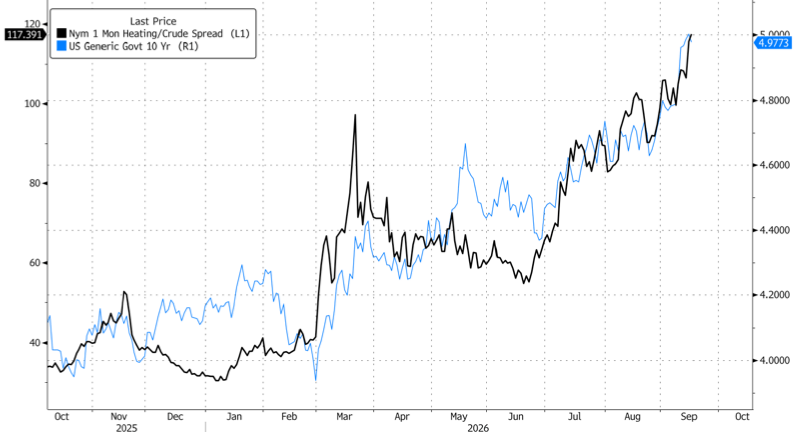
A diesel export ban could force domestic refiners to slash production, shift profits to overseas competitors, and worsen global fuel shortages while delivering little relief to US consumers, according to Barclays refining and midstream analyst Theresa Chen.
“We continue to view the possibility of an export ban as both detrimental to the US refining complex and unlikely to provide the intended price relief,” Chen wrote in a note to clients on Tuesday.
Chen outlined one major problem: keeping diesel inside the country does not guarantee it can reach gas pumps.

Gulf Coast demand is already supplied with the industrial fuel, while pipeline capacity to move additional fuel to the East Coast, Midwest and Rocky Mountain regions is limited. Domestic markets connected by those pipelines would be unable to absorb current Gulf Coast export volumes, the analyst said.

Chen added that with surplus diesel backing up, Gulf Coast refiners would likely have to reduce processing rates. Those cuts could spread to the Midwest as displaced Gulf Coast barrels pressure regional supply balances.
Any export ban covering refined products without corresponding restrictions on crude would allow overseas plants to keep buying US oil and increase production while US refiners cut runs. Refining profits would shift abroad, with little benefit for domestic buyers.
Retaliation in the era of resource nationalism is another major risk because removing US diesel from an already tight global market could deepen shortages for trading partners. If European or Asian suppliers responded with their own restrictions, consumers in regions highly dependent on imported fuel could face skyrocketing prices.
Professional subscribers can read more about refined products markets here at our new Marketdesk.ai portal.
Tyler Durden
Wed, 09/16/2026 – 11:45