The scenario we viewed as inevitable appears to be materializing, validating our decision to intensify coverage of the US-China decoupling theme and the Western-aligned miners positioned to supply the West if Beijing further weaponizes critical material exports, as it has throughout the Trump 2.0 era.
A Reuters report on Friday morning revealed that some Chinese rare-earth suppliers are refusing to ship material to US customers, citing fear of retaliation from Beijing.
The report continued:
A handful of Chinese suppliers have refused to ship rare earths to U.S. companies since early August when China imposed sanctions on the Responsible Business Alliance (RBA), a U.S. supply chain monitor, a separate source with direct knowledge of the situation said.
With China deploying its own trade compliance weapons, the companies were wary of punishment from Beijing for complying with the due diligence framework of the Responsible Minerals Initiative (RMI), a global mineral supply chain audit programme connected with the RBA, the source said.
Other Chinese rare earths companies had already stopped shipments to the U.S. to avoid entanglement in geopolitics in recent months, two other sources familiar with the trade said.
One cited four instances where Chinese firms declined to send material for fear it could be resold to banned users.
The exact number of blocked suppliers and shipments remains unknown, and that ambiguity is itself part of Beijing’s asymmetric leverage campaign against the US.
China does not need to announce a formal trade embargo to choke critical material flows. Export controls, licensing delays, and the threat of regulatory retaliation can halt shipments to US importers almost overnight.
Really, Beijing retains a kill switch inside US defense, aerospace, semiconductor, and energy supply chains, forcing companies to scramble for substitutes only after supplies have collapsed.
That’s why we’ve sounded the alarm in recent weeks that the decoupling theme should be top of mind for Wall Street desks, with our coverage focused on tungsten and germanium, both of which have been restricted from export to the US and are colliding with a rearmament cycle in the West.
Here’s what we’ve reported over the last few weeks leading up to the Reuters headline this morning:
- The AI Boom Runs On Tungsten, But Global Supplies Are “Running On Empty”
- US Tungsten Scrap Export Ban Takes Effect As Global Supply Crisis Deepens
- What Happens When A Metal The West Can’t Live Without Runs Short
- The West’s Answer To Break China’s Tungsten Stranglehold Before Historic Rearmament Cycle Ramps
- China’s Tungsten Chokehold Turns Almonty Into a Critical-Metal Lifeline
- China’s Record Ship Swarm Around Taiwan Sends Decoupling Alarm To Wall Street
China’s tungsten export restrictions have sent European prices soaring…
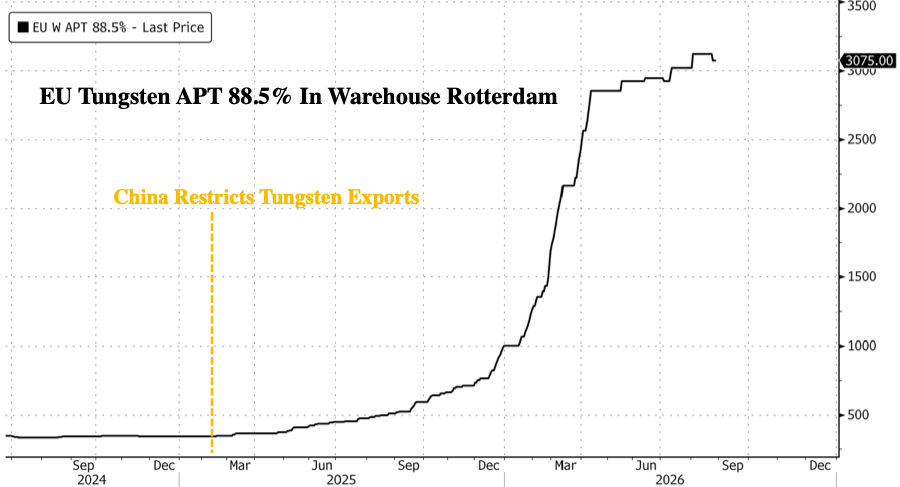
Late last month, the US Commerce Department halted exports of tungsten scrap and shredded battery material in a defensive move to retain scarce supplies inside the country. The move merely shows how rapidly Washington is shifting from the free-trade status quo toward resource security as domestic supplies dwindle and an urgent race emerges across the West to procure new ex-China supplies.
The Sino-US bilateral relationship deteriorated yet again this week after Beijing derailed the G20 joint communiqué over a single phrase, “non-market,” only weeks after the Trump administration sanctioned Chinese entities linked to Iran.
All eyes now turn to the Trump-Xi meeting in Washington later this month.
The decoupling theme should be top of mind on Wall Street as China restricts critical-material flows to the West. These materials are essential building blocks not only for next year’s rearmament supercycle but also for AI, reindustrialization trends, efforts to power up America, and even physical AI.
Tyler Durden
Fri, 09/04/2026 – 12:35