Authored by Lance Roberts via RealInvestmentAdvice.com,
Democratic Socialism promises affordability and fairness. The bill, from Caracas to Copenhagen, is something else entirely.
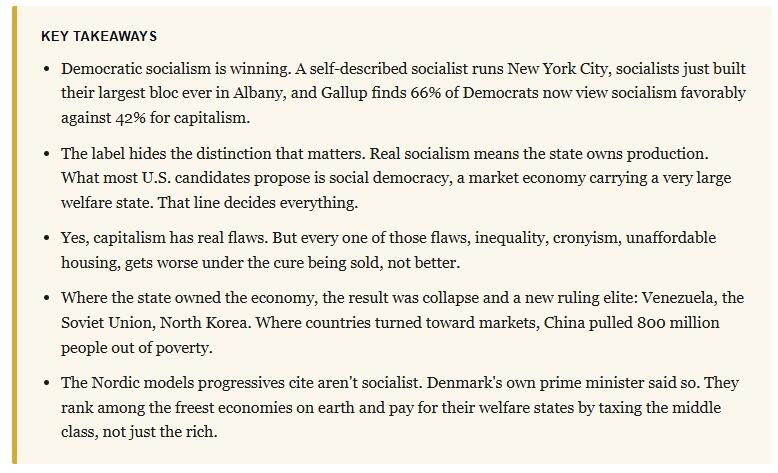
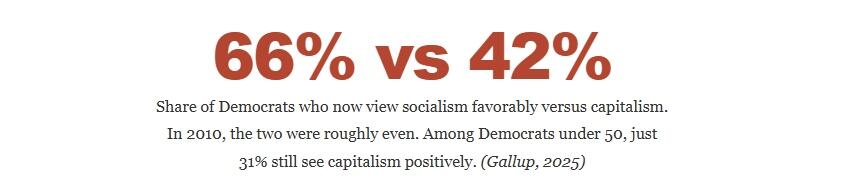
On January 1st, a self-described democratic socialist was sworn in as mayor of the largest city in America. Weeks before that, socialist candidates swept a wave of primaries, sending the largest bloc of socialist legislators in New York history to Albany and two more to Congress. Then a billionaire governor, JB Pritzker, went on CNN, was asked whether the socialist wins were a good thing, and answered that they are “the recipe for winning in 2026 and beyond.” Make no mistake, democratic socialism is no longer a fringe idea in America. It’s a live political program with real momentum. The only question that matters is what it delivers after you buy it.
I have been managing money for a very long time through many market cycles, from manias to crashes. Over that time, I have learned to separate what a policy promises from what it produces. So let’s do that honestly here, starting with a concession most defenders of markets won’t make: Capitalism has flaws.
Capitalism Has Flaws
Capitalism is not perfect, and pretending otherwise is how you lose the argument before it starts. The system distributes rewards unevenly, routinely runs in boom-and-bust cycles, and has produced a K-shaped economy where asset owners pulled away from wage earners after 2008 and again after 2020. Housing, healthcare, and childcare have all outrun paychecks, and younger workers look at home prices and tuition bills and conclude the game is rigged.
I get it, and most importantly, I agree.
However, here’s the part that should bother free-market defenders most. A lot of that anger is aimed at something real. As I’ve written before, the serial bailouts since 2008 have socialized losses for the powerful while everyone else has absorbed the cost. That’s not capitalism working. That’s capitalism being corrupted. So when a 28-year-old votes for Zohran Mamdani, the grievance underneath the vote is not stupid. It’s the diagnosis of the cure that fails, and it fails badly.
Let’s dig into something equally important.
Democratic Socialism Is Not Social Democracy
The biggest source of confusion in this whole debate is the word itself. People use “socialism” to describe two systems that could not be more different, and the sloppiness is doing real work.
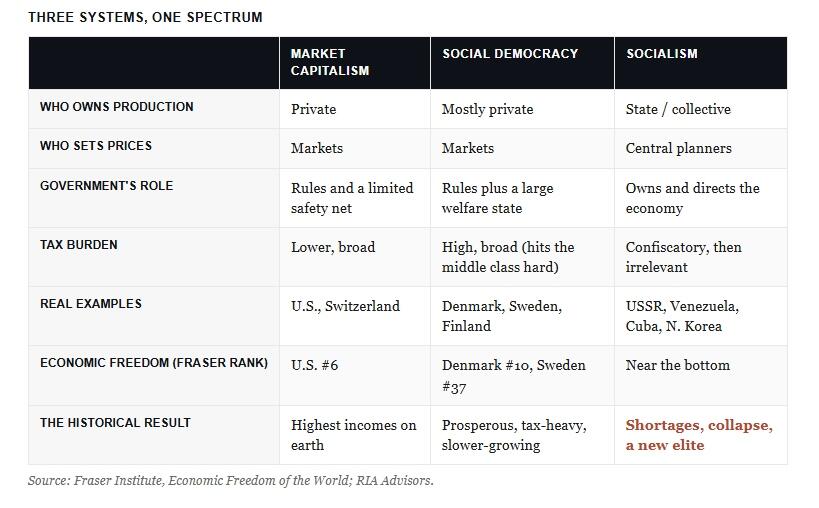
Socialism, in the textbook sense, means the state or “the community” owns the means of production. The government runs the factories, the banks, and the farms. Central planners, not markets, set prices. Social democracy is a completely different animal. It keeps private ownership, market prices, and free trade fully intact, then layers a large, tax-funded welfare state on top. One replaces the market. The other feeds off it.
Why does the distinction matter so much? Because the countries that collapsed were the first kind. And the countries American progressives actually point to, Denmark and Sweden, are the second kind, which is “Democratic Socialism.” They aren’t socialist at all. We’ll get to why that gap sinks the whole pitch. First, the table.
The Purest Version: Collapse, Then A New Elite
Start at the far end of the spectrum, because that’s where the theory gets its cleanest test. Venezuela was the richest country in Latin America, sitting atop the world’s largest oil reserves. Then Hugo Chavez and Nicolas Maduro nationalized hundreds of companies, imposed price controls, and expropriated private land in the name of the people.
The result was the deepest peacetime economic collapse in modern history outside of war. Output per person fell by roughly three-quarters. Food production dropped 75%. Inflation crossed a million percent. Nearly eight million people walked out of the country on foot.
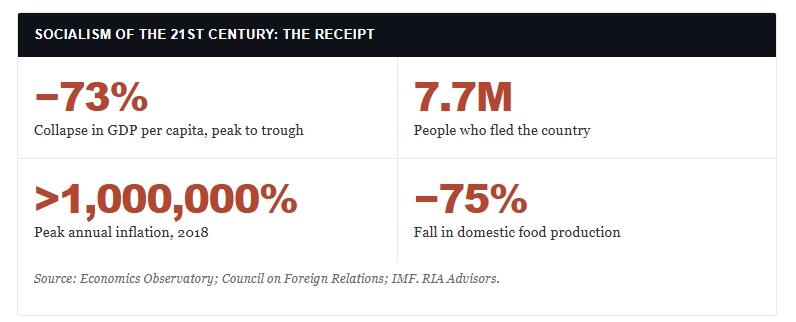
One point critics will reach for is U.S. sanctions. That is true, but those sanctions arrived later and only deepened the existing wound. But the collapse was well underway before the 2017 sanctions, and other oil states rode out the same 2014 price crash with their economies intact. The wound was self-inflicted. During the boom years, many Western admirers held up Venezuela as proof that socialism works. It wasn’t.
Now, the part that the brochure never mentions, and what you have to be very careful of when voting for it. Socialism promises to abolish the elite. In reality, it only installs a new and more deeply entrenched one.
The Soviet Union had its nomenklatura, the party class with private stores and country dachas. North Korea is on its third generation of hereditary Kim rule, a monarchy with a red flag. China favors its “princelings,” the descendants of the original revolutionaries. Venezuela produced the boliburguesia, the connected insiders who grew rich while the country starved. So, the reality is that SOMEONE will always end up on top, it just won’t be you or the average worker.
Look at who leads the movement here at home. The new face is Mamdani, son of a Columbia University professor and a globally acclaimed filmmaker. The loudest establishment cheerleader is Pritzker, heir to the Hyatt fortune, worth close to $4 billion, assuring everyone that taxing the rich is only fair. These are not people who have missed a meal. That’s the pattern across a century of these movements, and it’s no accident. The bigger the state you build to deliver “equality,” the bigger the prize for whoever captures it.
Markets, Not Manifestos, End Poverty
Run the film in reverse, and the lesson is just as sharp. Under Mao’s fully planned economy, the Great Leap Forward produced the deadliest famine in human history, killing somewhere between 10 and 40 million people. Then Deng Xiaoping said four words that changed the world: “Poverty is not socialism.” He handed farmers their own plots, opened special economic zones, and let prices and trade do their work.
The result is the single largest reduction in human poverty ever recorded.
China’s extreme poverty rate fell from roughly 88% in 1981 to under 4% by 2016. Around 800 million people climbed out of destitution, accounting for about three-quarters of all global poverty reduction over that period. India tells the same story after it dismantled its socialist “License Raj” in 1991 and let markets breathe.
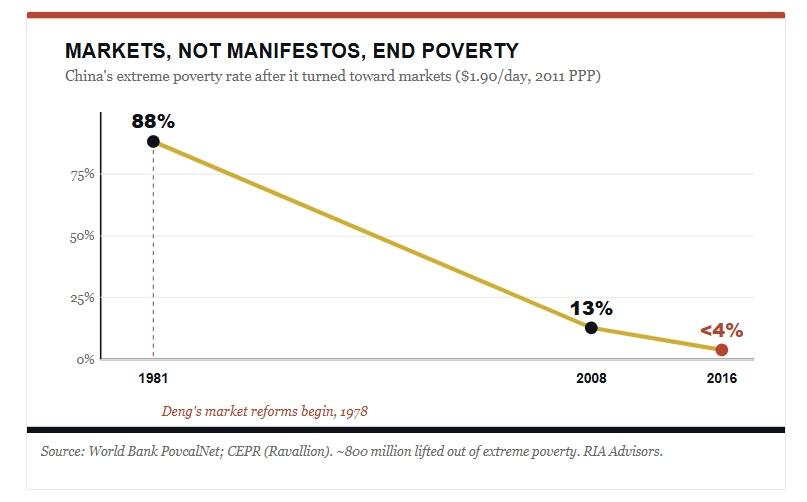
Here’s the point, and it’s the one that should stop a thoughtful young voter cold. China is not free. It’s an authoritarian state. Yet the moment it let private ownership and market prices operate, outcomes improved faster than any welfare program in history could dream of. That’s how much power sits in the market mechanism, and it’s exactly the machinery socialism proposes to switch off. We’ve laid out the deeper data on this in Capitalism: The Road To Wealth And Happiness.
“But Scandinavia Works”
This is the strongest argument the other side has for democratic socialism, so let’s take it seriously. The Nordic countries have universal healthcare, cheap college, low poverty, and citizens who report being among the happiest on earth. Bernie Sanders has spent a decade telling Americans to look to Denmark and Sweden. If that’s democratic socialism, why not copy it?
Because it isn’t socialism. Not remotely. Denmark’s own prime minister traveled to Harvard to correct the record, telling Americans plainly, “Denmark is far from a socialist planned economy. Denmark is a market economy.” The Nordics rank among the freest economies in the world. On the Fraser Institute’s index, Denmark sits at #10, ahead of most of Europe. They have flexible labor markets, no legislated national minimum wage, strong property rights, aggressive free trade, corporate taxes lower than ours, and, in Sweden’s case, a nationwide school voucher system American progressives would call heresy.
When you compare Venezuela to Denmark, the word “socialism” gets stretched across right next to each other, and the argument ends itself.
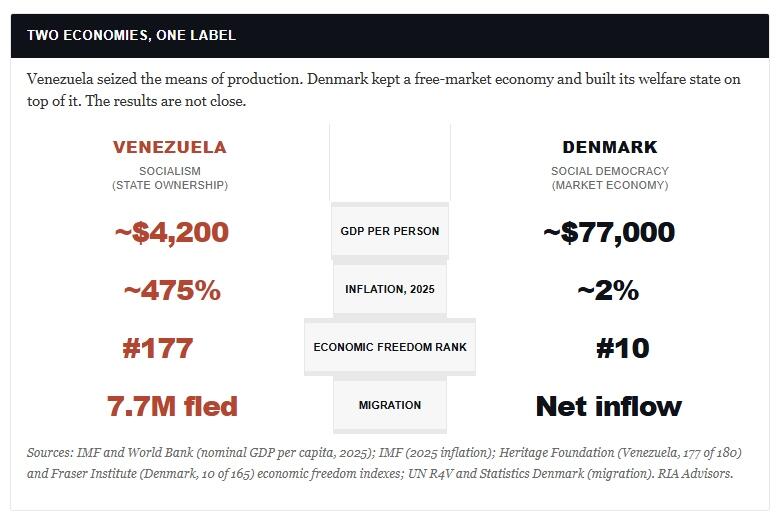
Denmark also got rich first, back when it was a low-tax economy, and then reformed hard back toward markets in the 1990s after the welfare state had stalled its growth in the 1970s and 80s. And here’s the detail the pitch always leaves out. They pay for it by taxing the middle class, not just billionaires.
Think a 25% national sales tax and income tax rates that bite ordinary workers, not a magic levy that falls only on the yacht crowd. The Nordic model is capitalism with a big, broadly financed welfare state. Copy the capitalism if you like. The part U.S. socialists want to skip, the broad taxes and the market discipline, is the part that makes the whole thing stand up.
The Bill Comes Home: Taxes, Wealth, And Free Money
The American program for democratic socialism rests on two pillars: much higher taxes and some form of guaranteed income. Both have a track record, and neither is kind.
Start with “tax the rich,” which assumes the rich aren’t already carrying the load. They are. The top 1% of earners pay 38% of all federal income taxes while earning about 21% of the income. The top 10% pay more than 70%, and the top half pays 97% of the entire federal income tax take. The bottom half pays a little over 3%. We run the most progressive income tax in the developed world.
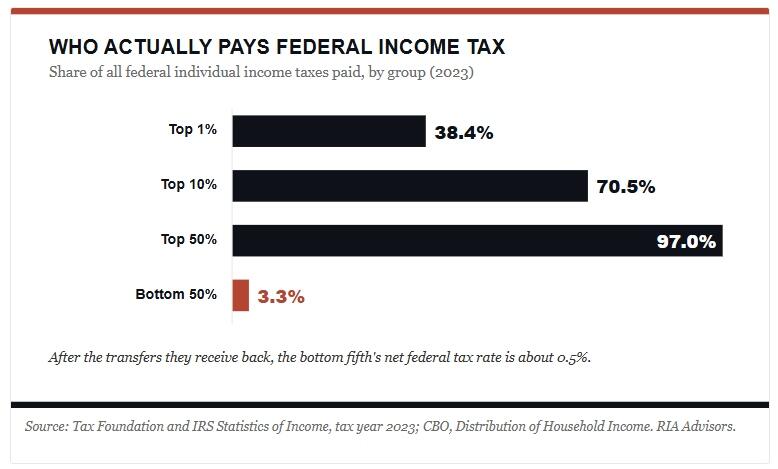
Now to the fairness point people raise, and it’s a fair one. Lower earners still pay payroll taxes. True. But once you count what comes back, the picture flips. The Congressional Budget Office finds that after transfers, Medicaid, food assistance, and refundable credits, the lowest fifth of households carries a net federal tax rate of roughly 0.5%.
In 2020, it went negative, meaning they received more than they paid. Over half of all means-tested transfers flow to the bottom fifth, three-quarters to the bottom two-fifths, while the top fifth pays more than two-thirds of all federal taxes. The reality is that the productive top is already funding the safety net. There’s no vast, untapped vein of “the rich” sitting there to bankroll a far larger state.
So how do the countries that actually run these programs pay for them? Not the way the slogans suggest. The math of democratic socialism forces the burden down onto the middle. Here is what the American tax base looks like today, next to what it would have to become if we adopted the Nordic model these candidates hold up as the goal.
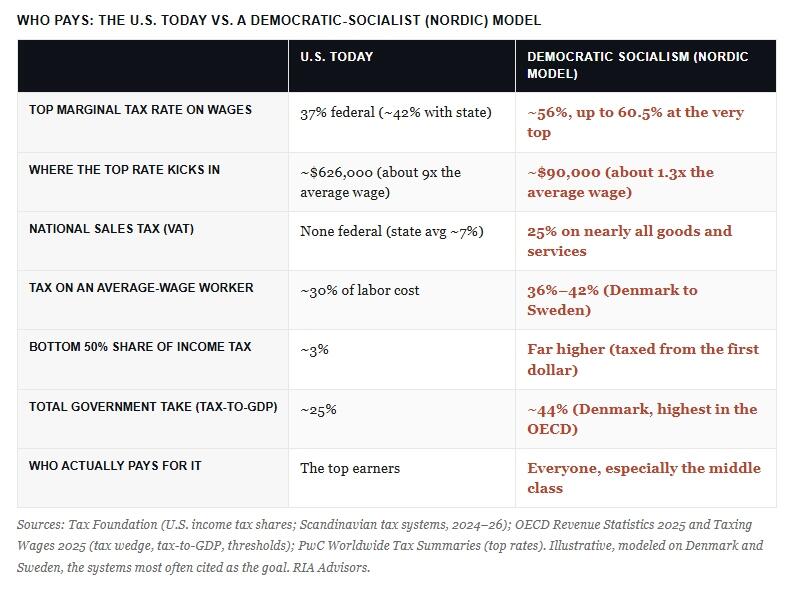
Read that table again, because it’s the whole argument in one frame. In America, the top rate hits at roughly 9x the average wage. In Denmark, it is about 1.3x the average wage. The barista and the surgeon land in nearly the same bracket, and a 25% sales tax greets both of them at the register on almost everything they buy. That is not a tax on the rich. It’s a tax on working and middle-class life, and it has to be, because as the Tax Foundation flatly concludes, mirroring the Scandinavian model would raise taxes in the U.S. “especially on the middle class.”
What about a wealth tax, then? Europe already ran that experiment. In 1990, a dozen countries levied one. Today, four do. France lost an estimated 12,000 millionaires in a single year and raised less than 0.2% of GDP before scrapping its version. Capital and the people who own it don’t sit still and wait to be taxed. They move.
And the second pillar, universal basic income? A recent review of 122 guaranteed-income pilots found that the larger, more credible studies showed employment falling rather than rising. The deeper flaw is one of economic gravity. Production has to come before consumption. Send out checks without new output, and prices simply rise to swallow them, exactly what 2021 showed. We covered this at length in UBI: Tried, Tested, and Failed As Expected and in A Robot Economy. All of it lands on a country already carrying $39 trillion in debt, north of 120% of GDP, spending more than a trillion a year just on interest. There is no fiscal room for this. None.
Every Flaw, Made Worse
Here’s where it comes together. Go back to capitalism’s real flaws, the ones I named up top, and watch what social democracy actually does to each one.
Worried about inequality? Socialism produces the most extreme concentrations of power and wealth on record, and it hands them to a political class you can’t vote out and can’t compete with. Money inequality is at least contestable. Power inequality is not. On top of that, funding the program with a printing press delivers inflation, which is the single most regressive tax there is. It robs the poor first. The cure deepens the disease.
Angry about cronyism and bailouts for the connected? Then the last thing you want is a bigger state. Every dollar of economic activity you route through government becomes another dollar the well-connected fight to capture. The bigger the prize, the harder they fight, and they always win. You don’t end cronyism by enlarging the thing cronies feed on. You starve it.
Furious about the cost of housing, healthcare, and childcare? Those are already the three most government-distorted markets in America. Rent control shrinks the housing supply. Subsidies poured in without new supply getting absorbed into higher prices, which is why childcare grew less affordable even as the subsidies grew. More of the same intervention makes the scarcity WORSE, not better. And stagnant wages? Wages rise on productivity, productivity rises on investment, and investment flees higher taxes and capital controls. Ask the thousands who left France or the millions who left Venezuela.
So yes, capitalism is flawed, but democratic socialism only makes it worse. But the honest fix is to remove the distortions, end the bailouts, stop debasing the money, break the regulatory capture, and clear the way for supply. That’s the argument I’ve made for years in pieces like our work on productivity and jobs. The fix is more competition and sounder money. It is not a system that takes every flaw you’re angry about and pours gasoline on it. As Howard Marks likes to say about cycles, the seeds of the next problem are planted in the solution to the last one. Social democracy is that seed.
What It Means For Your Money
So, what does this have to do with money and your portfolio? A durable shift of democratic socialism toward higher taxes on capital, wealth levies, and deficit-financed transfers changes the terrain on which investors stand. It raises the odds of higher structural inflation, pressures the currency, and invites the kind of capital flight that has followed these policies wherever they’ve been tried.
The practical takeaways are straightforward. Own productive assets, the businesses and hard assets that hold value when money is being debased. Watch policy risk at the state and municipal level, where these ideas arrive first and where capital and residents vote with their feet. And keep the long view. The market engine that compounds wealth over decades is precisely what’s on the ballot. Protecting your exposure to it is not a political act. It’s a risk-management one.
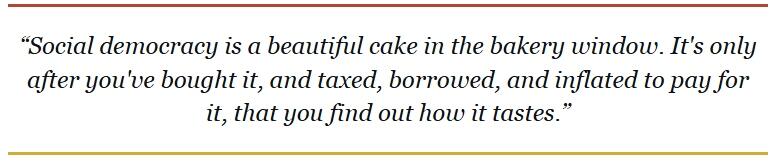
The appeal of democratic socialism is real because the pain it speaks to is real. I won’t pretend otherwise. But intentions are not outcomes, and history has handed us the outcomes in ink, from Caracas to the old Soviet bloc to the Nordic countries that quietly kept their capitalism. The promise is a beautiful cake. The aftertaste is shortages, capital flight, inflation, and a new elite standing where the old one used to be.
Capitalism’s flaws are worth fixing, and we should fix them. Replacing the system that produced the highest living standards in human history, in order to cure its imperfections, is how you end up with the imperfections and none of the living standards. That’s the trade on the table. Look closely before you take it.
Tyler Durden
Fri, 08/28/2026 – 09:00