US futures are sliding, dragged by fears of a possible AI development slowdown as well as higher oil prices (Brent > 108), though bond yields are not reacting yet (10Y yield still under 5%). As of 8:00am ET, S&P futures are down 0.6%, and potentially facing their first down 1% day since late July; Nasdaq futures plunging 1.5% as AI-linked stocks like chipmakers and memory tumble in US premarket trading following a call to put the brakes on developing cutting-edge models. Semis are down 4.7% pre-mkt, driven by the AI pullback story though China is pushing back saying the statements are alarmist; expect additional pushback from Trump. Software is +1.5% but Mag7 are weaker with NVDA -3.2%, TSLA -2.1%, and META -1.2%. Staples / HC are bid with Discretionary / Fins mixed but slightly positive. Industrials are also getting hit with AI theme (less data center contruction). Brent is rising and sitting close to $108/barrel on the shutdown of a Saudi pipeline and as a meeting between Iran and Gulf nations was delayed. That’s weighing on European bonds, mostly at the short-end. UK two-year yields are up six basis points, German two-year yields by five basis points. Treasuries are little changed at the short-end, while 10-year yields are down a basis point. The USD is seeing its strongest day in 3 wks, rallying with oil and the Bloomberg Dollar Spot Index is up by 0.4%, with the New Zealand dollar and Japanese yen among the underperformers. Gold prices are sinking and now below $4,300/oz. Commodities are mostly lower ex-Energy with WTI approaching $104/bbl with fuel prices higher; moves are driven by Saudi closing east/est pipeline and a delay on Iran/Gulf countries meetings to discuss Strait of Hormuz navigation. Base metals are outperforming Precious, but both are lower. US economic data slate empty for the session. Fed speakers remain in external communications blackout period ahead of Sept. 15-16 FOMC meeting

In premarket trading, Mag 7 stocks are mixed: Nvidia (NVDA) falls 2.3% as AI leaders called for a slower pace of development of their most advanced and lucrative models (Alphabet +1.8%, Amazon -0.4%, Apple +0.5%, Meta +2.6%, Microsoft +0.3%, Tesla -1.5%)
- Chipmakers and other artificial intelligence-related firms slide. Decliners include Intel (INTC) -6%, Micron (MU) -5% and CoreWeave (CRWV) -7%.
- Baldwin Insurance (BWIN) gains 6% after the Financial Times reported that billionaire Michael Dell’s family office is nearing a deal to acquire the insurance brokerage firm.
- Corning (GLW) falls 9% after entering into a $2 billion equity distribution agreement with Goldman Sachs.
- Definium Therapeutics (DFTX) rises 16% after the company announced that its Phase 3 Panorama study met its primary and key secondary efficacy endpoints.
- Hewlett Packard Enterprise (HPE) falls 7% after Evercore ISI downgraded the company to inline from outperform, citing valuation in the wake of recent strength.
- Olema Pharmaceuticals (OLMA) falls 9% after AstraZeneca’s Etcamah failed to meet the primary endpoint of progression-free survival in a late-stage trial in first-line advanced breast cancer.
- Rum Group (RUM) rallies 11% after the Information reported that Anthropic has struck a $13.7 billion compute pact with the firm.
- Scholar Rock (SRRK) rises 6% after the drug developer said the US FDA has approved its muscle-targeted therapy for spinal muscular atrophy. Analysts are positive about the approval, with many raising their price targets ahead of the drug launch.
In other corporate news, Anthropic was said to pick Nasdaq for a potential listing. It also told investors it expects a second straight quarter of positive adjusted operating profit, according to the FT. OpenAI will not go public in 2026, Sam Altman told Fortune Magazine in an interview, citing need for safety-related work. Kalshi is filing for regulatory approval to offer the first single-stock perpetual futures in the US and is looking to expand the contracts in commodities to include agriculture. In deals, Apollo is in discussions to acquire Johnson & Johnson’s orthopedics unit for $20 billion, according to people familiar with the matter. Billionaire Michael Dell’s family office is nearing a deal to acquire The Baldwin Insurance Group, an insurance brokerage with a market value of $4.2 billion.
Stock futures slide, led by tech names after leaders of the biggest artificial-intelligence firms proposed slowing the technology’s development. An ETF tracking key chip stocks dropped 5% in early trading as traders fretted that efforts to rein in AI could weigh on the boom driving hundreds of billions of dollars in capital spending. OpenAI backer SoftBank slid the most in nearly three months, while South Korea’s Kospi index dropped 3.3%. S&P 500 contracts were down 0.6%.
“There was a bit of irrational exuberance in the middle of the summer that’s been unwound,” said Chris Armstrong at Berenberg. “This is, I think, another leg bringing down expectations.”
Anthropic CEO Dario Amodei sparked the rout after saying on Saturday that the company would introduce fresh safeguards as he urged the industry to slow the development of its most advanced models. OpenAI’s Sam Altman backed the proposal, while xAI’s Elon Musk said “Dario is right.”
Questions remain over how committed AI leaders will be to moderate the pace of development, given intense competition from China. President Donald Trump downplayed the concerns, while China dismissed them as “fearmongering.”
“Having guardrails would help steer the direction of AI development, but we do not think it is going to slow it down,” noted Mohit Kumar at Jefferies. “The direction of travel, in our view, would still remain forward.”
Nevertheless, tech – the biggest weighting in the S&P 500 – is facing pressure on both sides of the valuation equation: Tighter financial conditions are pushing up the discount rate, while Amodei’s intervention puts fresh scrutiny on the growth assumptions underpinning the AI trade.
Fresh disruptions to crude supplies from the Middle East added to the dour mood. Brent jumped 3.7% to top $108 a barrel after Saudi Arabia closed its East-West pipeline as a precaution following attacks. The dollar rose 0.3% while treasuries slipped as money markets saw a nearly 90% chance of a Federal Reserve rate increase on Wednesday. Gold tumbled.
“Two unwelcome headwinds collide,” said Tim Waterer, chief market analyst for KCM Trade. “Warnings that AI development needs to slow down, combined with another leg higher in oil prices after the Saudi East-West pipeline closure, are a difficult mix for risk assets.”
The selloff in tech stocks comes at the start of a week in which both the Fed and Bank of Japan face pressure to raise rates as policymakers meet Wednesday and Friday, respectively, against a backdrop of mounting inflation risks. Traders are pricing a 90% chance of a 25-basis-point Fed hike this week. Most strategists aren’t too worried, with those at banks including Morgan Stanley, JPMorgan and Goldman Sachs saying any declines driven by expected tightening are likely to be short-lived given healthy earnings.
While a Bank of England hike on Thursday isn’t anticipated, the prospect of a shift toward an increase in November remains on the cards. “We will take each decision when it is needed, and we will not waver when the evidence calls for action,” Kazimir said Monday in an op-ed on the website of Slovakia’s central bank, which he heads.
Europe’s Stoxx 600 dipped 0.3%. The region’s bonds underperformed as higher oil and gas prices worsened the inflation outlook. Yields on two-year UK gilts rose eight basis points to 4.89%. The euro hit a one-month low against the dollar. Here are the biggest movers Monday:
- Campari shares rose as much as 4.5%, the most in six weeks, after Morgan Stanley upgraded the stock to overweight, noting the beverage maker’s strategy is yielding results and that a cash-flow inflection is potentially on the horizon
- Axfood climbed as much as 4.3%, the most since January, as Handelsbanken upgrades the Swedish retailer to buy from hold
- European semiconductor stocks and those linked to data centers fell after leaders of some of the world’s largest AI companies called for a slower pace of development for safety
- Fallers include Soitec (-13%), Aixtron (-9.8%), Technoprobe (-8.0%), Infineon (-8.1%), ASM International (-9.2%), BE Semi (-7.1%) and ASML (-5.4%)
- GlobalData slumped as much as 26%, the most since Jan. 2009, as JPMorgan says the research and consulting solutions firm’s outlook reset is negative for sentiment
- Cerillion shares dropped as much as 21%, the most on record, after the billings software provider said full-year revenue will be below consensus expectations due to customer order delays
Asian stocks fell after leaders of the world’s biggest artificial intelligence platforms called for slower development of advanced models, citing growing risks from the technology. The MSCI Asia Pacific Index slipped as much as 1.1% before paring some of the loss, though a subgauge of tech stocks was down 2.4% — the worst-performance among sector groups. South Korea’s benchmark Kospi slumped more than 3% to be the top loser in the region. Indian markets were shut for a holiday. In Indonesia, President Prabowo Subianto removed Finance Minister Purbaya Yudhi Sadewa in his latest cabinet shakeup, and appointed Deputy Finance Minister Suahasil Nazara as the new finance chief. The nation’s benchmark stock index rebounded from an intraday loss of 2.6% to finish the session little changed. A gauge of Asian semiconductor stocks was down 2.4%, heading for a third day of declines, which would mark its longest losing run since July 30.
“Risk assets really had no other direction to head other than down, given the comments about the pace of AI development from the US tech heavyweights, and the fresh move higher in oil,” said Tim Waterer, chief market analyst at KCM Trade. “The medium and longer term sustainability of the AI bullish momentum trend is in tact, but questions over the speed of growth in the short term have resulted in traders hitting the sell button today.”
In FX, the dollar is rallying with oil and the Bloomberg Dollar Spot Index is up by 0.4%, with the New Zealand dollar and Japanese yen among the underperformers.
In rates, the latest jump in commodity prices has not fully weighed on bonds yet: treasuries are steady with yields broadly within a basis point of Friday’s close across the curve, outperforming bunds and gilts where front-end yields are cheaper by 5bp and 6bp following a jump in energy prices. US 10-year yield is back around 4.97% after barely exceeding Friday’s multiyear high near 4.98%; European bonds lag, flattening yield curves, with WTI crude oil futures up 2.7% after the shutdown of a Saudi pipeline. European bonds are lower, mostly at the short-end. UK two-year yields are up six basis points, German two-year yields by five basis points. IG dollar issuance slate includes a couple of offerings already; dealers expect around $55 billion this week, front-loaded ahead of Wednesday’s Fed decision. Treasury auctions this week include $13 billion 20-year bond reopening on Tuesday and $19 billion 10-year TIPS reopening Thursday.
In commodities, Brent is rising and sitting close to $108/barrel on the shutdown of a Saudi pipeline and as a meeting between Iran and Gulf nations was delayed. WTI crude oil futures are up 2.7%. Gold prices are sinking and now below $4,300/oz.
US economic data slate empty for the session. Fed speakers remain in external communications blackout period ahead of Sept. 15-16 FOMC meeting
Market Snapshot
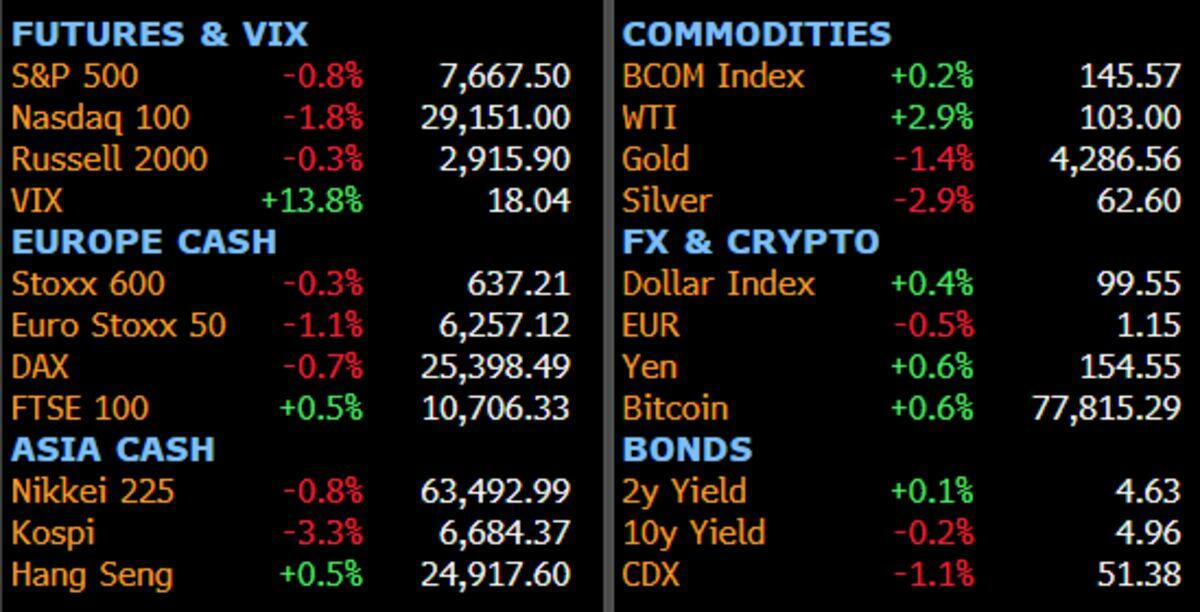
Top Overnight News
- Donald Trump played down the idea of further guardrails in most advanced AI models, saying the US needs to keep its lead over China. BBG
- China’s spy agency has warned that AI could pose a risk to the country’s political and social security, signaling growing concern in Beijing that rapid advances in the technology could be exploited against the country. FT
- Oil rose as a meeting between Iran and several Gulf nations on a temporary shipping lane was postponed, while Saudi Arabia’s East-West pipeline remained closed, following last week’s attacks by Iraqi militants. BBG
- U.S. President Donald Trump on Sunday called on Ukrainian President Volodymyr Zelenskiy to stop targeting Russian diesel infrastructure, saying the attacks were causing a shortage of the fuel that is “hurting the world”. RTRS
- A wave of long-distance Ukrainian drone attacks on Russian oil refineries in recent months has reduced that country’s fuel production, triggering gasoline shortages across the country. RTRS
- Just as Ukraine was learning how to parry Russia’s drone attacks, Moscow has moved the goal posts with a new generation of innovative jet-powered weapons. WSJ
- The CMBS market is being reshaped by a surge in data-center deals, forcing investors to grapple with an entirely new set of risks. BBG
- A year after shifting production and sourcing out of China to avoid higher U.S. tariffs, some companies are learning that replicating the country’s factory ecosystem is not so easy and are bringing manufacturing back. RTRS
- Eurozone governments are gearing up for one of the biggest leadership reshuffles in the European Central Bank’s 28-year history, with a “grand package” over its three top roles expected to be agreed by the end of December, according to people familiar with the matter. FT
- The 10-year US Treasury yield surged to nearly 5% this week, reaching its highest level since October 2023. Following an above-consensus CPI print, Goldman economists expect a 25 bp hike at the FOMC meeting next week. Their rates strategists believe that the combination of rising oil prices, a repricing of the Fed path, strong economic growth, and AI investment have lifted long-term interest rates
- House Speaker Johnson said US President Trump’s proposed $5,000 dividend for every US adult would require congressional approval, contradicting Trump’s claim that the payments can be made without authorization.
A more detailed look at global markets courtesy of Newsquawk
APAC stocks were ultimately mixed after gradually improving from the initial risk-off mood seen at the start of the session, which had been triggered by AI-related selling after key industry executives called for a slowdown in AI development. There were also headwinds from the conflict in the Middle East after Saudi Arabia shut its East-West Pipeline following drone attacks last week, which threatens the loss of 4% of global supply, while Oman postponed the Persian Gulf meeting on Monday, where Iran had planned to formally unveil a temporary shipping lane agreement for the Strait of Hormuz. ASX 200 was kept afloat in range-bound trade amid resilience in defensives and the consumer sectors, while there were some comments from RBA Assistant Governor Hunter, who stated that Australian household spending is holding up okay and business investment is showing signs of strength, but also noted inflation remains above target. Nikkei 225 slumped at the open amid notable losses in Kioxia and with SoftBank dropping by double-digit percentages owing to its heavy AI exposure, although the index is well off today’s worst levels amid mixed yields in Japan and with the TOPIX index in the green. KOSPI underperformed amid losses in semiconductor heavyweights, while today marks the start of the Korea Exchange extending trading hours to allow stock trading until 8pm local time. Hang Seng and Shanghai Comp pared opening losses and moved into the green, but with upside capped ahead of tomorrow’s activity data, while US President Trump said he is not worried about Chinese President Xi cancelling their planned summit after reports that Beijing informed Washington it will cancel the planned summit if any new arms sales to Taipei are approved.
Top Asian News
- PBoC plans to expand the yuan offshore market and will consider expanding the central bank’s macroprudential and financial stability roles, adding that they will innovate macroprudential policy tools and support steady economic recovery and growth.
European bourses are broadly lower to start the week, with Italy’s FTSE MIB the underperformer, while the SMI and FTSE 100 print decent gains, helped by updates in the Pharma space. Sectors point to a mixed picture. Health Care tops the sector pile, with Optimised Personal Care and Food, Beverages & Tobacco rounding out the leaders. Tech leads the downside, followed by Basic Resources and Industrials. The overnight downside was driven by Anthropic CEO Amodei, urging a slowdown in the development of the most advanced AI systems to prevent AI from slipping beyond human control. The effect this has on semiconductors may be slower capex investment; however, Amodei insists that pacing AI capabilities will not necessarily translate into reduced spending or growth. As a result, SK Hynix and Samsung Electronics slumped overnight (-6.4% and -4.1%, respectively), while ASML is currently down by 5.2%, while US behemoth NVIDIA slides by 2.5% pre-market.
Top European News
- Exit polls showed that Sweden’s centre-left opposition is on course for an election win in a blow to the far-right, while broadcaster SVT’s revised projections suggest the opposition bloc is on course to win 175 seats and the incumbent right-wing bloc is on course to win 174 seats.
- Swedish election is reportedly too close to call as total count may take days.
- Fitch affirmed Italy at ‘BBB+’; outlook stable.
FX
- Snapshot: G10s are lower against the broadly stronger USD, as traders increase their bets on a rate hike this week. JPY is the clear underperformer this morning on widening yield differentials, followed closely by the Kiwi. The Loonie fares a touch better vs peers, thanks to higher energy prices and simmering down in US-Canada tensions; Trump recently downplayed leaving the USMCA, with both countries suggesting that a deal would be found “fairly soon”.
- DXY is stronger this morning and currently trades towards the upper end of a 99.07 to 99.60 range. Much of the upside comes as a number of sell-side banks bring forward their bets of a hike this week; Goldman Sachs the latest to do so. As it stands, money markets assign an 86% chance of a hike this week. There’s not a whole lot on the docket heading into the Wednesday meeting, so the index will likely remain within familiar ranges – though any updates on the geopolitical situation would spur a break in either direction.
- JPY is the clear underperformer this morning on higher expectations that the Fed will join the BoJ in hiking rates this week. Much of the strength in the JPY over the past couple of weeks has been attributed to narrowing yield differentials (hawkish BoJ), and joint intervention worries. Another bout of near-term strength in the JPY would likely require a hawkish BoJ on Friday, and particularly, board members explicitly guiding for a faster pace of rate hikes. Recent source reports have suggested that the Bank could do this. USD/JPY currently holds within a 153.37 to 154.61 range.
Fixed Income
- Global fixed benchmarks are mixed. USTs (+3+ ticks) hold afloat, whilst Bunds (-4 ticks) and Gilts (-3 ticks) have been pressured by another bout of strength in the energy complex. For reference, energy benchmarks are moving higher on a) postponement of Iran-Gulf talks on the Strait and b) Saudi shutting a key pipeline.
- USTs remain firmer this morning, and currently hold within a 106-03 to 106-10+ range. Strength which comes despite sell-side banks boosting their bets of a hike this week, and higher energy prices. The environment is clouded by fiscal and geopolitical uncertainty. This is made evident by sustained elevated yields; the US 10-year (4.96%) trades just shy of the 5.00% mark, and a hawkish Fed mid-week will likely see it top that mark.
- Bunds and Gilts have been pressured throughout the European morning as energy benchmarks gradually picked up. Gilts are pressured given their high dependency on external energy, and as traders eye the BoE this week.
- BTPs have steadily fallen throughout the morning and are currently at the lower end of their 111.96-112.57 range. After-hours on Friday, Fitch affirmed Italy at ‘BBB+’; outlook stable. The credit agency commented that the “continued increase in public debt/GDP over the medium term” is a risk that could result in a downgrade. Regarding the upcoming elections, Fitch observed that the “recent political stability has been a positive anchor for Italy’s sovereign rating”, and that the law to switch the proportional electoral system could favour a stable government.
Commodities
- Snapshot: Crude benchmarks are stronger this morning on a) the postponement of the Iran-Gulf nations meeting, and b) Saudi Arabia shutting the East-West pipeline. Spot gold is hampered by a stronger USD, whilst base metals have been dented by the risk-tone.
- To recap the geopolitical environment briefly, Oman postponed the Persian Gulf meeting on Monday, where Iran had planned to formally unveil a temporary shipping lane agreement for the Strait of Hormuz. Axios suggested that Saudi was concerned that the new Strait proposal would effectively establish a new status quo; however, the Iranian FM Spokesperson suggested that the meeting was postponed due to the Yemen-Saudi situation. On the supply front, Saudi shut the East-West pipeline, which reportedly threatens the loss of c. 4% of global supply. Marhelm sources pointed out that repairs could take over a month.
- Given the above, crude benchmarks gapped higher at the open and traded sideways for most of the APAC session. As the European session got underway, the oil complex caught another bid higher (on reports that the IRGC shot down a US drone, and following Iran FM comments). As it stands, Brent Nov’26 (+2.6%) holds at the top end of a USD 106.11/bbl to 108.65/bbl range; WTI Nov’26 (+2.6%) also holds at the upper end of a USD 101.59/bbl to 103.83/bbl range.
- Spot gold (-1.6%) has been hampered by a stronger USD (increased rate hike bets) and higher energy prices. As such, the yellow metal currently sits at the bottom end of a USD 4,279.28/oz to USD 4,355.40/oz range. This week, action for gold will be dictated by any geopolitical developments and the Fed mid-week. Elsewhere, base metals are entirely in the red, given the downbeat risk tone. 3M LME Copper currently trades at the lower end of a USD 14,100-14,236/t range.
- Saudi oil buyers and traders warned the kingdom could run out of oil stocks for exports if it doesn’t restart a major pipeline to the Red Sea within days, which could lead to a loss of up to 4% of global supply.
- Marhelm cited sources within Saudi Arabia that stated the damages to the East-West Pipeline will take over a month to repair due to a lack of spare parts and deeply impacted supply chains. Furthermore, it was stated that minor damages to the pipe have been repaired, but catastrophic damage to pumping infrastructure will take longer to fix.
- Exxon (XOM) executive said that they see US LNG supply growing to make c. 30% of global LNG supply by 2030.
- Shell (SHEL LN) executive said around 36mln tonnes of LNG from the Middle East have been lost to date.
Trade/Tariffs
- US President Trump said he’s not worried about Chinese President Xi calling off their summit scheduled for this month, while Japanese media reported that Beijing informed Washington it will cancel the planned summit if any new arms sales to Taipei are approved.
- US President Trump suggested he may be willing to permit a Chinese car company to build EVs in the US if it did so with US workers. It was separately reported that President Trump said the US will lift tariffs on Irish whiskey.
- US President Trump expressed optimism regarding resolving the trade dispute with Canada soon and downplayed prospects of leaving the USMCA, while Trump took verbal jabs at Europe regarding trade and immigration during his Ireland visit.
- Canadian PM Carney is set to meet with UK PM Burnham as Canada deepens its relations with Europe, while Carney proposed that Canada should become the EU’s first ‘associate member’, and the bloc is said to be open to the idea.
Central Banks
- ECB President Lagarde said the current inflation shock is longer-lasting, with the volatility and pressure on energy prices to continue amid the conflict in the Middle East.
- ECB’s Kazaks said the case is building for more tightening and the ECB can afford to act stepwise without rushing.
- ECB’s Simkus said he cannot exclude action at any meeting, adding that December is a natural time to assess the situation more.
- ECB’s Kazimir said all options will be considered for the next decision, but action will be taken if necessary.
Geopolitics: Middle East
- US President Trump said Iran-backed Houthis asked the US not to target them, while Trump reiterated that he expects the Iran war to end this year, possibly after the Midterms, but also suggested that the US could stay in Iran and keep the oil, like the Venezuela deal.
- Iran’s Foreign Ministry Spokesperson said that Saudi Arabia insisted that the meeting between Iran and Gulf nations in Oman not to take place and it will be postponed to another date due to the Yemen situation. The spokesperson added that the MoU between Iran and Oman is the result of weeks of intensive negotiations and was drafted with full respect for the sovereign rights of the two countries. On the situation in Iran, Baghaei said Iran has no interference in Yemen and denied any participation in the attacks on a Saudi oil pipeline. On the reports about nuclear activity in Pickaxe mountain, he called them “baseless”.
- Oman postponed the Persian Gulf Foreign Ministers meeting for an indefinite period. This was later confirmed by Iran.
- Oman’s Energy Minister said the Strait of Hormuz will be open and it’s probably a short-term situation, while he is pleased Oman is still able to continue producing oil and gas. Furthermore, he stated that skyrocketing oil and LNG prices are not sustainable and the situation should stabilise in the medium-term.
- Iran’s Akbari said “The Iranian route can be a sustainable alternative to the Red Sea route and ensure the connection of Asia, India, China and Singapore to Europe in times of crisis”
- Iran’s PGSA published an updated list of 77 vessels allegedly violating Iranian Strait of Hormuz protocols. The listed vessels could face future passage restrictions, including fines, detention or confiscation. Vessels cooperating with sanctioned ships will also be added to the list.
- Houthi Spokesperson claimed the attack on Saudi’s King Khaliq Air base, stating “The Armed Forces will continue to carry out significant military operations towards Saudi territory as long as it continues its unjust aggression against our people”.
- Saudi Crown Prince met the US CENTCOM chief to discuss the latest regional developments, according to Saudi state TV.
- Saudi civil defence issued emergency alerts for Khamis Mushait, Abha City, Jizan region and Najra province but said the danger has passed.
- Saudi Yanbu oil exports were halted after a pipeline attack, while weekend reports noted multiple explosions struck Saudi Arabia’s Yanbu Industrial City on Sunday.
Geopolitics: Other
- US President Trump said he could settle the UK-Argentina dispute regarding the Falklands, while he separately commented that he would love to see Ireland unified.
- North Korea fired multiple short-range ballistic missiles towards its east coast on Saturday.
- US President Trump said he warned Ukrainian President Zelensky to stop targeting Russian oil refineries as strikes have shut down diesel refining and helped lift prices of the fuel to record levels.
US Event Calendar
- No major events scheduled
DB’s Jim Reid concludes the overnight wrap
My new chartbook is on the Deutsche Bank Research Institute site here, where it is open to all. Titled ” The Home Straight “, it examines the key market themes as we enter the final stretch of the year.
Welcome to a new week and one where I’ve started it with a severe case of manflu. My Whoop and Oura ring are flashing code red which was useful to show my wife as vague proof of my demise. While I coughed and spluttered, one of the more interesting developments over the weekend was a rare show of agreement amongst several of the most prominent AI leaders. The debate centred on whether frontier AI development is now moving so quickly that safety, oversight and our ability to fully understand the systems need more time to catch up. Whilst this falls a long way short of calling for a pause in development, it does represent one of the clearest acknowledgements yet from within the industry that there may be limits to how fast capabilities can responsibly advance. For markets, the key question is whether this is the first sign that the extraordinary AI investment cycle might eventually moderate. For now, that seems unlikely. The competitive race between companies and countries remains intense, and it’s difficult to imagine firms voluntarily stepping back while rivals continue to push ahead. It is hard to see China standing still. Indeed, that’s something President Trump said yesterday in response to the weekend news. He didn’t seem in favour of any kind of pause.
I suppose another way of looking at it is that if leading executives are openly discussing the risks of increasingly powerful systems, it could be them trying to get across how transformative they believe the technology may become and help advertise the power of their product. So rather than signalling less spending, it could simply be that a greater share of AI investment is directed towards safety, monitoring and governance alongside the continued build-out of compute infrastructure. The debate may therefore alter the composition of AI capex more than its overall scale.
Markets in Asia have reacted negatively to the story with the KOSPI (-2.74%) emerging as the region’s biggest underperformer. Chipmakers led the declines, with SK Hynix (-6.60%) and Samsung Electronics (-4.01%) weighing heavily on the index. The Nikkei 225 (-1.01%) is also under pressure amid broader weakness across the semiconductor sector. Major tech investor Softbank is -11.24% lower. Elsewhere, Chinese equities are mixed, with the CSI 300 (-0.32%) trading lower, while the Hang Seng (+0.35%) and the Shanghai Composite (+0.16%) are bucking the regional trend and remain in positive territory. S&P 500 (-0.50%) and NASDAQ 100 (-1.25%) futures are being notably impacted by the AI story, more than for Stoxx futures (-0.33%). 10yr USTs are around +0.6bps higher at 4.97%. The AI story would have probably led to a rally, but Brent is back up +2.82% to $107.56/bbl.
This follows the precautionary shutdown of a major Saudi pipeline late on Friday following recent attacks, and the postponement of today’s planned meeting between Iran and other Gulf states to discuss the creation of a temporary shipping corridor through the Strait of Hormuz. Several countries seem to have reservations about the plan. Meanwhile focus remains on the advances by the Iranian backed Houthis along the Red Sea around the Yemen coast, another important chokepoint.
Moving on, it’s a bumper week for central bank decisions, with the Fed (Wednesday), BoE (Thursday) and BoJ (Friday) all meeting. Key data releases include US retail sales (Wednesday) and industrial production (Friday), UK inflation (Wednesday) and labour market data (Tuesday), economic activity in China (tomorrow), and inflation and trade in Japan (Friday and Wednesday respectively). Other events include the annual testimony of the US Treasury Secretary namely Bessent (tomorrow), and the State of the Union address in Europe (Wednesday).
Delving into more detail now and the main event for markets will be the Fed’s decision on Wednesday. Our economists have long expected a 25bp rate hike with the market now at 87% this morning up from around 35% two Friday’s ago just before Warsh’s Jackson Hole speech. Such a move would take the target range to 3.75%-4.00%. Our economists believe the accompanying projections are likely to show a somewhat stronger growth outlook alongside still-elevated inflation. They have also added an extra hike in March to their forecast which now makes it 75bps of hikes over the next 7 months. A big focus will be Warsh’s press conference and how he squares the circle between a dislike of forward guidance and calming markets which are baying for more info. See DB’s preview note here.
Friday’s inflation data strengthened the case for action this week. Core CPI rose by 0.29% in August, a touch above expectations and up from 0.22% in July. The details were also firm, with notable strength in wireless services, airfares and lodging-away-from-home prices. Meanwhile, last Thursday’s PPI report contained hawkish elements, including stronger hospital and international airfare prices. Combining the latest CPI and PPI data, our economists estimate August core PCE increased by 0.27%, a pace they do not view as consistent with sufficient progress back towards the Fed’s inflation target.
Attention will now turn to incoming US activity data. Tomorrow, markets will receive Treasury Secretary Bessent’s annual testimony before the House Financial Services Committee. On Wednesday, August US retail sales are released and our economists expect a rebound to +0.9% month-on-month, following July’s -0.6% decline. They also forecast ex-auto sales at +0.6% and retail control sales at +0.3%, arguing that July’s weakness looked more like a temporary pause in consumer spending than the start of a broader slowdown. On Friday, industrial production is due and our economists expect growth to edge up to +0.3% from +0.2% previously.
Looking beyond the US, the BoE announces its latest policy decision on Thursday. Our economists expect Bank Rate to remain unchanged at 3.75%, with a 6-3 voting split, and continue to see the MPC remaining relatively cautious compared with some other major central banks. However, the bond market and energy moves at the end of the week make it a closer call than it was, with futures pricing in a 23% probability of a move, up from under 10% early last Thursday. See our economists’ preview here. Before that, UK labour market data are released tomorrow, while August CPI is due on Wednesday. Our economists expect headline inflation to rise to 3.04% YoY, while core CPI eases slightly to 2.53% YoY. UK retail sales, together with the GfK consumer confidence survey, follow on Friday.
In Asia, the BoJ concludes its meeting on Friday. Our economists expect a 25bp rate hike (futures price in a 98% probability now), and argue that external considerations, including pressure for greater FX stability, are likely to be at least as important as domestic economic fundamentals in driving the decision. See their preview here. Japan also releases trade data and core machine orders on Wednesday, followed by national CPI on Friday, where our economists expect core inflation excluding fresh food to remain at 1.8% YoY.
China’s August activity indicators are released tomorrow. Our economists expect industrial production growth to accelerate to 5.0% YoY from 4.5%, while retail sales and fixed-asset investment should also improve. Elsewhere, Germany’s ZEW survey is due tomorrow, while the ECB publishes its consumer expectations survey on Friday.
On the political front, the European Commission President delivers the annual State of the Union address on Wednesday, setting out priorities for the year ahead. Finally, the NATO’s Military Committee Conference takes place in Copenhagen at the end of the week.
Recapping last week now, the main story was a huge selloff for sovereign bonds, which pushed yields up to multi-year highs around the world. The main catalyst for that was a fresh surge in energy prices, with Brent crude oil up +8.65% last week (-2.81% Friday) to $104.61/bbl. Moreover, it wasn’t just confined to oil, as European natural gas futures also jumped +10.52% (-3.08% Friday) to €79.50/MWh. So that led to mounting fears of stagflation, along with growing speculation that central banks would hike rates more aggressively.
The prospect of faster hikes was given further support by the latest data. In particular, the US CPI print showed core CPI running faster than expected at +0.3% in August (vs. +0.2% expected), even as headline inflation was in line with consensus at +0.4%. So that led to mounting expectations that the Fed would deliver a rate hike at the next meeting, with futures raising the chance from 62% to 88% over the course of the week. Meanwhile, last week also saw the ECB deliver a hawkish 25bp rate hike, as their statement said that “inflation is set to remain well above target for an extended period”, and they upgraded their growth and inflation forecasts.
That backdrop meant that sovereign bonds sold off around the world. That was particularly clear at the front end, as the US 2yr Treasury yield saw its biggest weekly jump since the Liberation Day tariff turmoil in April 2025, up +25.9bps last week (+3.9bps Friday) to 4.63%. Moreover, it was also its highest closing level since July 2024. Otherwise, the 10yr Treasury yield saw its biggest weekly jump since May, up +18.5bps (+0.4bps Friday) to 4.97%. And over in Europe, the 10yr bund yield was up +16.5bps (+0.4bps Friday), ending the week at a post-2009 high of 3.50%.
All that put mounting pressure on risk assets, with the S&P 500 down -0.80% last week (+0.86% Friday). Indeed, it would have been even worse were it not for the resilience of the Mag 7, which still rose +0.63% last week (+1.00% Friday). Then in Europe, there were even bigger falls given the continent’s greater exposure to higher energy prices, and the STOXX 600 fell -1.66% last week (+0.49% Friday). Elsewhere, credit spreads were more mixed. In the US, IG spreads (-2bps) and HY spreads (-2bps) saw a modest tightening. But it was the reverse picture for Euro IG spreads (+2bps) and HY spreads (+3bps).
Tyler Durden
Mon, 09/14/2026 – 08:31