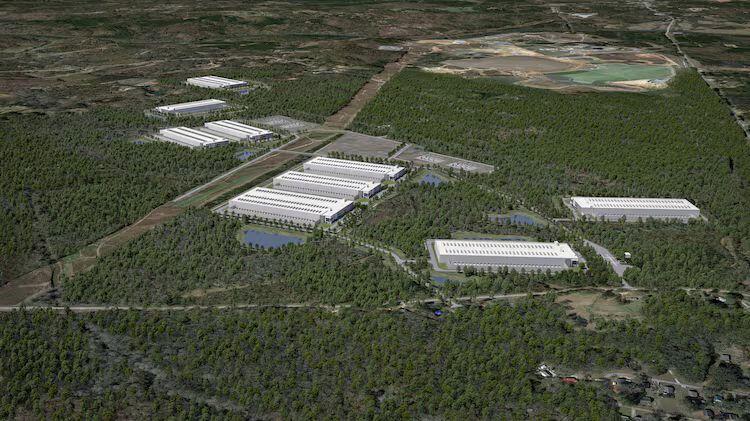
Coweta County voters will decide in a Jan. 12 special election whether to repeal the rezoning for Project Sail, a $17 billion data center campus on more than 800 rural acres about 45 miles southwest of Atlanta that county commissioners approved 3-2 in April.

Probate Judge Carrie B. Markham ordered the election Monday. Opponents filed their petition Oct. 16 under the Home Rule provision of the Georgia Constitution, which let them force a vote with signatures from 10% of the county’s electorate: 10,971 names, out of 109,703 active electors in the last general election, according to Markham’s Nov. 23 order. Organizers turned in 14,820 signatures, and the county’s director of elections verified 11,065 of them, clearing the bar by 94.
The ballot question reaches well past one project: besides repealing the April 7 rezoning, it would strip data centers from the county’s zoning code and ban data centers and cryptocurrency mining operations in every zoning district in Coweta County. The order puts it to voters this way:
“Shall the action of the Coweta County Board of Commissioners on April 7, 2026 approving REZONE 24-019 be repealed, and Appendix A. Zoning and Development of the Coweta County Code of Ordinances be amended to delete data centers and data center campuses as permitted and conditional uses in all zoning districts and to prohibit data centers, data center campuses, cryptocurrency data centers, and cryptocurrency mining operations in all zoning districts of Coweta County?”
Atlas Development, the Buford-based company that filed the rezoning, objected to the petition on Oct. 23. Markham threw the objection out in a separate order the same day she called the election, finding that under Georgia Supreme Court precedent no party has legal standing to object to a petition filed under the Home Rule provision, and that Atlas’s objection wasn’t verified in any case.
The state’s high court opened that door last year in a fight over Hogg Hummock, the Gullah Geechee community on Sapelo Island, when it ruled unanimously that a McIntosh County zoning ordinance was subject to the same referendum procedure Coweta’s opponents used.

“The County became aware of this news at the same time as our citizens,” Coweta’s communications manager, Cathy Wickey, said in a statement. “Given the unique nature of this situation, we are still assessing its potential implications. We anticipate that legal questions and challenges may arise among the entities involved.” The county will pay for the election, run it on its normal equipment and precincts, and the court will certify the result, according to the order.
Prologis, the San Francisco-based industrial REIT under contract to take over the project, said in October, when the petition’s signatures came in, that the petition “does not change our commitment to Project Sail.” Its executive JC Witt said in April that the site was chosen partly for its closeness to Georgia Power’s Plant Yates, and that “the question isn’t if this site will be developed. It’s just how.”

Atlas’s filings with the Georgia Department of Community Affairs describe 13 buildings of about 378,000 square feet each, plus substations, finished by the end of 2036 and worth $17,161,900,000 at build-out. The same filings put its water demand at 9.1 million gallons a day, with 3.03 million gallons a day of sewage and 800 tons of solid waste a year. Prologis has pitched a smaller version, nine buildings and about 4.3 million square feet drawing roughly 900 megawatts.
The tax windfall that sold the project has shrunk: Atlas first projected more than $1 billion a year in local taxes, a figure the Atlanta Journal-Constitution found was erroneous; Prologis’s latest projection is about $100 million a year, while the state filings list $163 million.

Commissioners Alphonso Smith, Jeff Fisher and John Reidelbach voted for the rezoning, which moved about 829 acres near Sargent and Wagers Mill roads from Rural Conservation to Industrial. “This is a no-brainer for the county,” Smith said at the time. A group of residents sued in May in Coweta County Superior Court to void it, alleging that commissioners ignored the land’s conservation designation and its role in groundwater recharge; that case is pending.
Yard signs against the project line home after home along Wagers Mill Road in Newnan. “The voters should have the right to decide,” resident Leroy Kenner told Atlanta News First.
“We are thrilled with the Judge’s order,” Vivian Allen, a volunteer with Citizens for Rural Coweta, said in a release. “Thousands of our neighbors signed because they wanted a say, and we can’t wait to see Coweta County turn out on January 12.” Fellow volunteer Donna Boles credited the canvassers: “This happened because people stood in parking lots, on sidewalks, and at local events collecting signatures in the summer heat. This vote belongs to them.“
Coweta has been on the front line of Georgia’s data center build-out for months: Georgia Power is seizing homes and easements across Coweta and Fayette counties for a 35-mile, 500-kilovolt line to feed AI data centers. And when voters elsewhere got a direct say this month, 41 local measures in ten states went almost unanimously against the data centers.
If Coweta’s measure passes on Jan. 12, it won’t stop at Project Sail: no data center or crypto mine could be zoned anywhere in the county.