Jeff Currie Featured on BBG TV
Veteran commodities strategist Jeff Currie has spent the summer warning that scarcity in physical commodity markets is becoming a persistent source of inflationary pressure and giving way to a commodities supercycle.
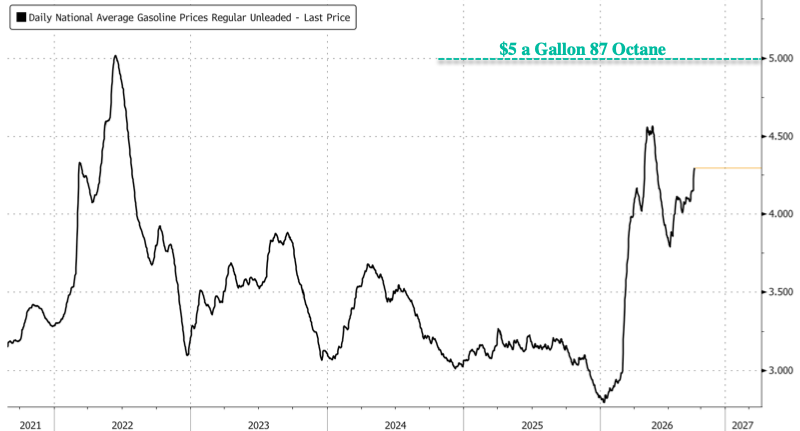
After appearing on CNBC on Thursday, he joined Bloomberg Television on Friday morning to amp up that message, warning that tightening crude products supplies make $5-a-gallon US gasoline highly likely by November.
“Crude is the signal, and now we think about products … they are the noise,” Currie said.
Currie, the founder and chief executive of Real Macro and former Goldman commodities head, also warned that scarcity and currency debasement were driving the next phase of the energy shock, with shortages spreading from refined products into crude oil.
Currie described the probability of average US gasoline prices reaching $5 a gallon by the midterm elections as “extremely high.”
Currie warned that refiners shifting production between diesel and gasoline would eventually exhaust their operational flexibility, limiting their ability to relieve shortages. US diesel prices could reach $7 to $9 a gallon, he added.
The latest AAA data show the national average price of diesel in the US has topped $6 a gallon.

US Diesel Crack Spread

Morning coverage:
- Brent Nears $110 Then Tumbles On IEA Demand Destruction Warning As Houthis Threaten Saudi Oil Escape Route, Diesel Shock Goes Global
- Huge Fire Along Saudi ‘Hormuz Bypass’ East-West Oil Pipeline After Alleged Houthi Strikes
Commodities coverage:
Got physical?
Jeff Currie Featured on CNBC TV
Former Goldman Sachs commodities chief and current Real Macro head Jeff Currie joined CNBC earlier Thursday to discuss all things commodities, warning that the latest Brent crude rally above $107 a barrel is becoming harder to dismiss as a temporary shock, with renewed Chinese buying and soaring refining margins (US diesel crack spread now $110 a barrel) signaling deeper pressure across physical commodity markets.
Currie warned that traders are underestimating an inflation cycle driven by years of underinvestment in the capacity to produce and deliver essential raw materials, echoing his summer warnings about scarcity in physical markets.
“The old economy is taking its revenge,” Currie said. “You see it in the rates markets. You see it in the commodity markets.”

Asked whether the latest flare-up in the Gulf conflict explained the jump in Brent crude this week, Currie pointed first to demand returning from Asia (read here).
“Actually, I put a bigger weight on China coming back to the market,” he said, citing strong buying interest after returning from Singapore and Hong Kong.
China had contributed to the refined-product squeeze by reducing refinery operations and exports as access to crude tightened earlier this summer, Currie explained. But exceptionally high diesel margins created a massive incentive to restart those refineries, bringing renewed crude demand into an already strained market.
He cited diesel crack spreads of $110 a barrel, exceeding the price of crude itself. That figure refers to the refining spread, rather than the outright diesel price.
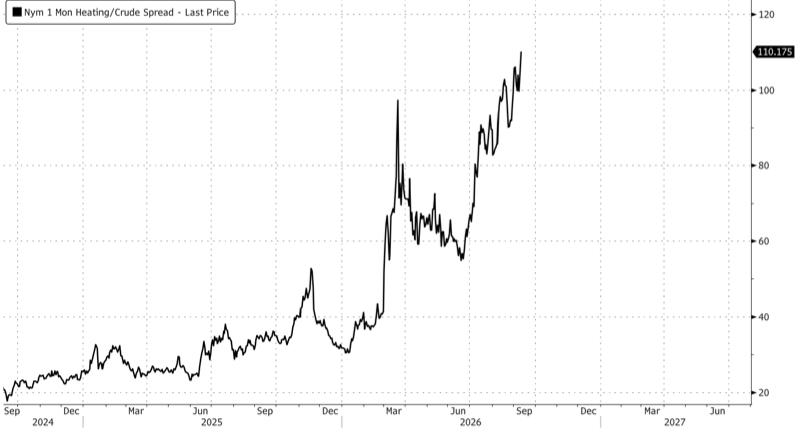
“That’s a pretty big profit,” Currie said. “They start chasing it, brought those refineries back online, and it was just like an earthquake going through here.”
The rally in Brent is showing signs of greater staying power, he pointed out, with equities and longer-dated oil prices beginning to reflect a more persistent disruption.
“People are starting to go, ‘This is not transient,'” Currie said. “It has a different flavor to it.”
Thank you to @KellyCNBC and the @CNBCTheExchange team for having me on today.
The old economy is taking its revenge.
We are dealing with higher structural inflation after years of underinvestment in the ability to supply and deliver hard assets.
There are two trades happening…
— Jeffrey Currie 🆔++ (@CommodMkt) September 10, 2026
Complementing Currie’s bull thesis on commodities, HSBC chief economist for global commodities Paul Bloxh warned in a note this week that a “super-squeeze” has begun (read report).
Tyler Durden
Fri, 09/11/2026 – 09:40