Summary:
- Musk Warns Bears (Again)
- Earnings at 1600 ET; Earnings Call at 1630 ET
- SPCX Short Position Soars
- SpaceX Earnings Preview: The Five Questions That Matter Most
Musk Comments On ZH X Post
Elon Musk has delivered another reminder to bears piling into SPCX shorts that “doubling down” can be a very costly strategy.
The stock is being squeezed nearly 10% higher in the afternoon trading hours in New York, with SpaceX set to report its first earnings as a publicly traded company in just a few hours.

“I try to warn them, but they just double down…,” Musk wrote in an X post responding to our earlier report citing proprietary data from S3 Partners.
That data shows 95% of SpaceX shares available to borrow are already out on loan, with short interest amounting to 34% of the float.
I try to warn them, but they just double down … 🤷♂️
— Elon Musk (@elonmusk) August 4, 2026
Ahead of SpaceX earnings set to be released at 1600 ET (earnings call at 1630 ET), UBS analyst Christina Dwyer provided clients with color on what to look for ahead of earnings:
SpaceX (SPCX) reports after the closing bell on Tuesday and heads into its first major earnings report as a public company with investor focus increasingly shifting beyond the quarter itself. While revenue and EBITDA performance will matter, the August 6 lockup expiration appears likely to be the bigger near-term driver, opening the door to the first meaningful wave of insider selling just days after results. On the call, management is expected to spend considerable time on AI-related initiatives. Investors will be looking for updates on data center buildouts, potential increases to compute targets and any incremental commentary around Grok deployment timelines. Stronger-than-expected AI revenue could represent one of the more credible upside catalysts. Beyond AI, attention will also center on Starlink and Starship. An updated Starlink subscriber figure could be disclosed, although the market may be hesitant to place significant weight on the metric while the network remains largely supported by V2 Mini satellites. For Starship, investors are likely to focus on execution milestones, launch cadence and any signals around the path toward operational payload launches. Positioning remains an important factor. Hedge funds still screen as notably short, which could amplify upside if AI revenue exceeds expectations or if Starlink economics surprise positively, particularly around ARPU. Even so, the desk believes the lockup expiration is likely to dominate the T+1 reaction and remain the primary stock-specific overhang in the near term.
Polymarket odds of SpaceX beating on quarterly earnings currently stand around 35%.

SPCX Short Hits 34% Of Float Ahead Of Earnings
SpaceX’s first earnings report since its record-setting early June IPO is just hours away and will test whether investors can justify the company’s lofty valuation after a vicious post-IPO bear market.
Shares hit a low of $104.83 on Monday, 22.4% below the $135 offering price and 53.5% beneath their June peak of $225, erasing more than $1 trillion in market value. However, the stock rebounded to $119 on Tuesday morning.
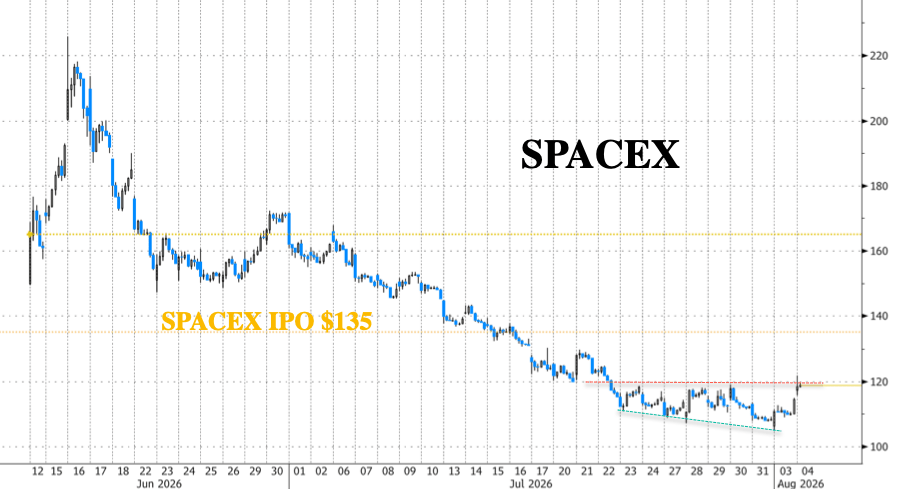
Wall Street expects a second-quarter loss of 24 cents per share on $6.8 billion in revenue, though limited financial disclosures have left analysts with little confidence in these estimates.
RBC analyst Ken Herbert outlined the five most important questions investors want answered before the earnings report, which will be released after the bell around 16:00 ET – 16:30 ET will be the earnings call (see report below).
Earlier this morning, we cited S3 Partners’ proprietary short data, which shows that 95% of SpaceX stock available to borrow is out on loan, amounting to 34% short interest as a percentage of the float.
Massive SPCX shorting ahead of earnings: 95% of SpaceX stock available to borrow is out on loan, amounting to 34% short interest as percentage of the float: S3 pic.twitter.com/rELoXcyOJu
— zerohedge (@zerohedge) August 4, 2026
Musk stated last month: “The survival probability of firms who maintain a significant short position in SpaceX over time is very low.”
The survival probability of firms who maintain a significant short position in SpaceX over time is very low
— Elon Musk (@elonmusk) July 17, 2026
Important: Mapping SpaceX’s Lockup Expirations: HSBC Calculates When The Shares Could Hit The Market
SpaceX Earnings Preview: The Five Questions That Matter Most
SpaceX has lost roughly $1.2 trillion in market capitalization since briefly peaking near $2.6 trillion in the first few trading days following its June 12 IPO. After an initial retail-driven buying frenzy, sentiment has sharply reversed, with the stock posting four consecutive weekly declines and now trading nearly 20% below its IPO price.
The steep pullback, driven largely by post-IPO technical selling, comes just ahead of the company’s first earnings release as a public company, scheduled for after the market closes Tuesday. The report follows Tesla’s quarterly results just weeks earlier.

RBC analyst Ken Herbert offered clients a preview of SpaceX’s earnings, claiming that stock selling was driven more by technical factors than by deteriorating fundamentals.
Herbert expects second-quarter revenue to rise 66%, with adjusted EBITDA margins of approximately 30%, citing continued execution across Starship, Starlink, and the company’s AI infrastructure. He warned that upcoming insider share lockup expirations are likely to put pressure on the stock.
Ahead of Tuesday’s earnings, here’s Herbert’s view:
SpaceX (SPCX) will report its much-anticipated first public results on August 4. While the stock has significantly lagged since its initial post- IPO surge (down ~52% since its ~$225 peak), we expect lingering technical factors (share unlocks) and macro sentiment to remain headwinds. We believe the current valuation is attractive (under 17x consensus 2028 EBITDA), but we believe investors are focused on long term challenges, looking past near-term strength and strong fundamentals. With this preview we highlight what we believe will be five of the most important questions investors are focused on with the 2Q26 results.
Key points:
SPCX will report its 2Q26 results after the close on August 4. Beyond the actual results (we model 66% 2Q26 revenue growth and ~30% adj. EBITDA margins), the company has achieved several import milestones. The recent V13 Starship test flight was successful (and FAA regulations on re-use and launch cadence are set to ease), and the company continues to win significant government contracts (critical for space access and infrastructure funding). The initial 2026 guide will be a focus, but we believe investors remain overly focused on the mid-term operational and financial challenges, overly discounting the near-term outlook, in our view.
We see five key questions for SPCX heading into the 2Q26 results. First, we believe the upcoming share lockup expirations will remain a headwind (technical challenges). The best remedy is strong execution. Second, we are looking for a more detailed Starship update after the recent successful test flight. Third, investors are focused on SPCX’s interest in becoming a full- scale consumer wireless operation (organically or through acquisitions)? Fourth, how is capacity expansion tracking and how will margin compute capacity be allocated? And fifth how would investors think about the software toolkit and SPCX’s ability to succeed with higher margin products?
Where have the buyers gone? After the over-subscribed IPO–and the stock trading at under $110–we are often asked about the lack of demand. We believe the lock-up expiration is a material overhang (20% of insider shares are unlocked on August 6, with the incremental ~10% trigger unlikely), followed then by rolling 7% unlocks. The comparisons to Meta (significant under-performance in first year post-IPO) is likely appropriate, but we believe the current price overly discounts the maturity of the Connectivity and Space businesses.
We are maintaining our OP rating and $225 price target. Our PT continues to be based on a SOTP valuation. We believe the upcoming share lockups have been a headwind for stock sentiment, but see them as attractive entry points for investors. Our analysis of META’s similar lockups is supportive of LT value in our view. Increasingly, we believe investors are also focused on a potential merger with Tesla, which we detailed in a recent note.
SpaceX 2Q26 Preview: Five of the most important questions investors will focus on in earnings:

Question #1: How has buying demand changed post-the heavily over-subscribed IPO and what impact could the lock-up period have on investor perception?
Answer: We believe the expected timeline for share un-lock is weighing on stock sentiment. The first lock-up period for SpaceX is scheduled for August 6, 2026, two days after the company reports 2Q26 earnings. Then, insiders will be able to sell up to ~20% of their locked-up shares, which equates to roughly ~911M shares. Comparing the company’s lock-up expiry schedule to that of META’s when it came public in 2012, we would highlight a similar stock performance to that of SPCX. META IPO’ed at $38/share and was down almost (50%) into its first 90-day lock-up expiry. SPCX is currently trading down (19.7%) from its $135 IPO price but is down (52%) from its high of $225.64.
Below, we have detailed the subsequent dates for additional lock-up expiration dates. As laid out in the prospectus, these dates are 70, 90, 105, 120, 135, and 180 days post pricing (June 12th). There is an additional lock-up expiry of 10% of shares on August 6th if SPCX closing price is greater than or equal to 30% above the IPO price of $135 ($175.50) for at least 5 of the 10 consecutive trading days ending on the first earnings release (Aug 4th), however this will not be achieved.

Question #2: What did we learn from the successful V13 Starship launch?
Answer: Last week, SpaceX launched Starship flight 13 (note here) achieving incremental steps with the launch. The launch marked a successful end-to-end mission, hitting all key milestones: the rocket lifted off from Starbase, the Super Heavy booster separated from the upper-stage and flipped for a Gulf of Mexico splashdown (though the landing was rougher than anticipated due to engine restart issues), completed its boostback burn, and the upper-stage climbed to orbit where it deployed 20 Starlink V3 satellites. Starship also successfully relit a Raptor engine in space — confirming the in-orbit restart capability that will be essential for future lunar missions — before re-entering the atmosphere to test its heat shield and splashing down in the Indian Ocean.
We believe SpaceX is likely to attempt to catch the next Starship with the tower on the next launch. After the success of flight 13, Elon Musk suggested that the company would attempt to catch the ship with the mechanical arms on the launch tower as it slows to a hover. The company has already successfully caught the Super Heavy booster but has not yet caught the upper-stage Starship with the launch tower arms. Performing a catch would entail sending Starship on a longer-range trajectory, potentially even into low-Earth orbit, in order to bring the vehicle back to the launch site. We believe formally scheduling the attempt, and successfully catching Starship could represent a positive catalyst for the stock. Given SPCX’s plans for reusability of Starship, demonstrating a catch with the launch tower, could help sentiment behind the company’s LT aspirations with Starship.
Question #3: What is the level of the company’s interest in full-scale consumer wireless operation in the US, and is an acquisition a preferred path?
Answer: As the company is looking to increase its spectrum holdings, investors are weighing the company’s opportunities to potentially acquire a carrier, build its own network, or pursue an MVNO route. As carriers are publicly shutting the door to MVNO talks with SpaceX, we view the company’s spectrum pursuit as a leverage in the MVNO negotiations. We continue to view that operating a full-scale mobile operations in the highly-competitive US market entails a range of operational challenges, investments, and executive resources. We believe that a potential market share gain from the mobility market will not suffice to justify network and spectrum investments. However, the expansion of IoT, V2X and applications for Unmanned Aerial Vehicles could provide growth opportunities in periods beyond 2028.
Question #4: How is capacity expansion tracking and how will margin compute capacity be allocated?
Answer: We are modeling the company to exit the year at ~2GW of nameplate capacity and would view as the key bottleneck if we could see potentially bigger upside in ’27. GOOGL and Anthropic are SPCX’s two flagship customers contributing $26B of ARR starting in Q3, however, with those 2 only occupying an estimated 35% of estimated year-end capacity, the company tracking ahead on its deployment schedules would be very bullish. Further, META’s commentary from Wednesday spoke to the depth of latent demand for added compute commenting that it had many offers from companies willing to pay a price that was multiples of its cost of compute (META’s). This squares with SPCX’s partnerships with the GOOGL and Anthropic deals priced at an estimated $50B annually/GW and $30B/GW, respectively.
Worth noting, on GOOGL’s earnings call last week, in laying out the strategic rationale for leasing 3p compute to supplement its own, CEO Sundar Pichai gave a theoretical example where he arbitrarily cited renting compute from a partner for 6 months (as an example) at dilutive levels as being an acceptable tradeoff given it could quickly & accretively shift those workloads to its own compute once ready to deploy. We recognize the 6-month comment was only illustrative, but it wouldn’t surprise us to hear questions probing at the durability of SPCX’s partners. In some ways, we could assert this rhymes a bit with META’s current capacity allocation conundrum where at some point, SPCX would need to show strong/accelerating traction with its own intelligence products to support the expected LT accretive mix shift of capacity allocation.
Question #5: How should we think about the software toolkit (Grok, Cursor, Build, Work,etc.c) being able to guide users tohigher-marginn products over time?
Answer: Most recent signs point to SPCX driving strong model training improvements as well as being on track for building out its expanding software & intelligence portfolio. We’d also expect some visibility around Cursor’s growth which last reported ARR above $4B on June 8th up from $2B reached back in February. We believe the consensus view is now that owning & controlling the cost of compute is the surest way to achieving a durable moat in AI, though lately, we believe sentiment regarding moat formation at the harness & application layer is also warming as jobs are not being destroyed as was previously anticipated and many high quality companies are emerging at various checkpoints in the industry previously thought destined to be controlled by the verticalized frontier labs, etc. And with the open- weight/model affordability debate appearing more and more of a one-sided in favor of intelligence software being LLM agnostic, the path to creating a sticky user experience with land and expand capabilities remains somewhat less clear (for the industry by the way, not just SPCX). As such, we expect investors to be seeking visibility on technical, financial or any other mile markers for adoption where Cursor should remain at the forefront as it expands from a coding tool to a fuller multi-agent orchestration platform while the Grok platform of products will be coming from behind relative to the other frontier coding & work automation tools.
Herbert maintained an “Outperform” rating and a 12-month price target of $225.

Where the rest of Wall Street sits:

Important: Mapping SpaceX’s Lockup Expirations: HSBC Calculates When The Shares Could Hit The Market
Professional subscribers can read more on SpaceX here at our new Marketdesk.ai portal.
Tyler Durden
Tue, 08/04/2026 – 14:26