I am returning to work slowly and will start with an update to the Bank Run Warning we issued on Friday.
Not a single financial institution sought funding through the SRF today (Wednesday), but this does not lead me to conclude that the risk of a banking crisis in the U.S. has passed. It just did not start right now.
While the borrowing from the Standing Repo Facility of the Fed has eased, for now, it does not indicate that the cash-drought some financial institutions are experiencing will be over.
The banks could have sought funding from other counterparties of the repo, or the beginning of the month could have brought more cash in.
The problem the banks currently face, relating to the government shutdown, is two-fold:
The former implies that money is not moving from the government to the accounts of some 1.4 million government employees. The latter implies that, as government employees are not getting paid, some of them are not paying back their loans (principal and/or interest) either. Both of these diminish cash flow to banks. Like we noted in the warning on Friday:
What makes the situation precarious is the fragility of banks, which we documented in the Black Swan Outlook.
There has been a massive increase in bank lending during the past few quarters.
It is possible (likely) that some banks have been overly optimistic in the credit boom and are suddenly cash-starved because interest payments and loan repayments have ceased (from their excessive lending).
This may start rumors about the survivability of a bank or a group of banks, which could trigger a bank run in the current uncertain environment.
If there’s no shock, we can assume that the banking system keeps on functioning normally, ensured, for example, by the SRF, from which banks can obtain short-term liquidity to cover for deposit withdrawals.
However, banks are always at risk of failing due to the business model we want them to have. That is, we want to deposit our money in the bank and have it provide loans at the lowest possible interest rate for us. We also want instant access to our funds (demand deposits) or, alternatively, a higher yield (interest rate) to compensate for the lack of immediate access, like in savings accounts.
A standard commercial bank is a business that receives deposits and covers them with assets to balance its balance sheet (most U.S. regional banks operate like this). These assets can be in the form of loans to households and businesses, corporate or government bonds, or central bank reserves. Therefore, if all or a very high share of deposits are withdrawn, there simply is no bank anymore. Its business model fails. This directly implies that if we lose trust in a bank, no amount of reserves can save it from failing.
For example, a slew of bad news broke the trust of depositors in the Silicon Valley Bank (SVB) in mid-March 2023, resulting in a cataclysmic run on 87% of its deposit base in just a few days. No amount of reserves (which the bank had plenty of) could have saved SVB from the devastating outflow of deposits impairing its balance sheet. Thus, the bank failed and was taken over by authorities.
When I understood the role the gargantuan increase of easily-withdrawable demand deposits played behind the runs on SVB and Signature Bank, I thought that a nationwide bank run would almost surely follow the failures of SVB and Signature Bank. However, authorities managed to return the trust to the regional banking system better than I thought (by throwing a proverbial kitchen sink at it). It reminded me of how difficult it is to anticipate the timing and length of bank runs, even though I had warned about the fragility of the U.S. banking system just three weeks before the runs started. But, while the runs were halted, the problems remained.
The fact is that the U.S. banking system has been “run-prone” since 2022 (after the gargantuan increase in demand deposits), and the cash-drought created by the government shutdown is making it worse every passing day.
Hence, the likelihood of a negative shock breaking the trust of U.S. depositors in one or more banks currently grows by the day.
Apple Taps Rival Google’s 1.2-Trillion-Parameter AI Model To Power Siri
Remember when the iPhone 16 launched in September 2024 and Apple promised “Apple Intelligence” features, such as an AI-powered Siri upgrade capable of handling autonomous tasks, that never fully materialized.
For now, Apple will integrate Google’s 1.2 trillion-parameter Gemini model to overhaul Siri, the most alarming sign yet that Tim Cook has to rely on outside AI technology.
This AI agreement will cost Cook $1 billion annually until Siri’s upcoming “Linwood” upgrade, targeted for iOS 26.4 next spring, will feature an in-house 1-trillion-parameter model, according to Bloomberg, citing people with knowledge of the matter.
Here are some key details on why Apple is turning to Google for AI support:
Gemini will handle Siri’s summarizer and planner functions, allowing for more complex reasoning and contextual understanding, while Apple’s own smaller models continue managing simpler requests.
The Gemini model will operate on Apple’s Private Cloud Compute servers, keeping user data isolated from Google.
Apple tested OpenAI’s ChatGPT and Anthropic’s Claude but ultimately went with Google’s model.
Shares of Apple and Google initially jumped on the news, but the gains quickly faded.
In short, one of the world’s largest tech giants missed the AI hype cycle – unable to deliver a viable product for consumers and forced to rely on a rival’s technology instead. Whether this marks the peak of the AI hype cycle or the beginning of Apple’s fading appeal, one thing is clear: Tim Cook now depends on Google, a sobering reality for the company worth nearly $4 trillion.
These lessons go for pretty much any asset class, but where I’ve noticed the largest concentration of inane theories, economic non-sequiturs and general outright confusion is among the most hubris-laden speculators in the market, the Bitcoin crowd. I own some Bitcoin and would love it just as much as the next guy if the price went to $1 million or $1 trillion or whatever Michael Saylor’s made up price target is today. But that doesn’t give me a hall pass to disconnect an otherwise well-functioning brain from all financial reality as we’ve ever known it.
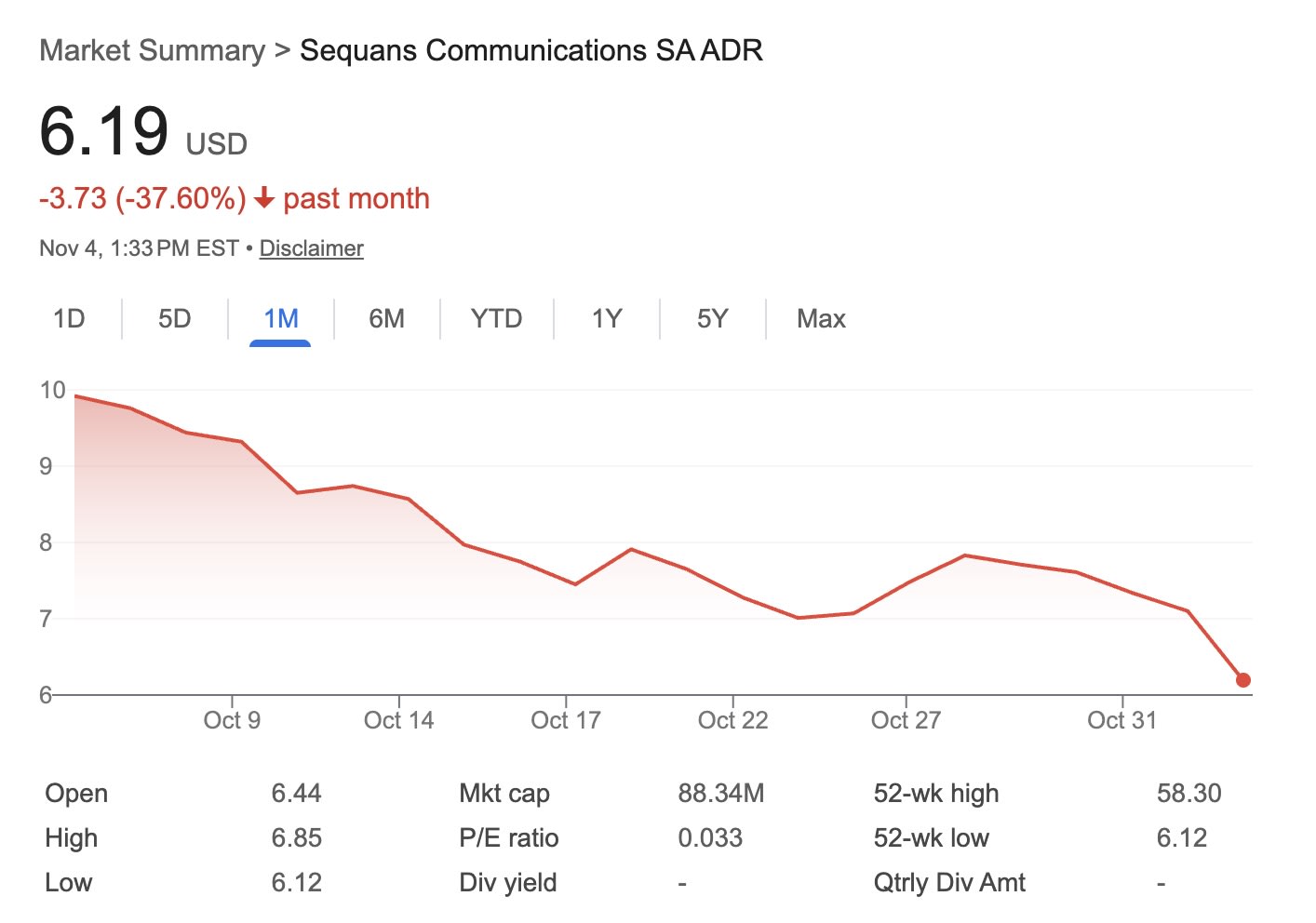
Bitcoin loyalists often repeat that holders (or HODLers) never sell, that conviction alone is enough to withstand any downturn. But as seen in the example of Sequans Communications that CoinDesk wrote about this week, even the most outspoken converts to the “BTC treasury strategy” eventually face a moment where reality overtakes belief. Sequans, which pivoted aggressively into Bitcoin earlier this year, just unloaded 970 BTC because its debt burden became too large. Go figure.
The company insisted this sale was merely tactical, yet its stock remains crushed, and its once-promoted strategy now hinges on less leverage and fewer promises.
This is not an isolated corporate event, but a preview of what happens when enthusiasm collides with the reality of financial obligations.
Bitcoin has grown into a financialized asset at every level: corporate treasuries, retail holders borrowing against their stacks, institutions using futures and leverage to enhance returns. During market strength, these decisions feel brilliant — I mean, just look at the scores of assholes who don’t know the difference between a market cap and an enterprise value bragging on social media daily about their financial acumen — and the conviction looks unshakeable. But when liquidity thins or macro stress arrives, as I predict it will in four different spots of the market, even believers discover that math is a stronger force than ideology.
There is a persistent narrative that Bitcoin supply is locked up by long-term holders who will never sell regardless of the price. But that’s not quite the truth.
🔥 50% OFF FOR LIFE: Using this coupon entitles you to 50% off an annual subscription to Fringe Finance for life: Get 50% off forever
In good times, that produces an illusion of invincibility. In downturns, it creates thin markets and a new vulnerability: when someone is forced to sell, there may not be many willing buyers on the other side.
Sequans didn’t exit the trade because it lost faith in Bitcoin. It sold because debt left it no choice. In a deeper decline, more corporations could follow the same path, not as a judgment on the asset, but as a condition for survival.
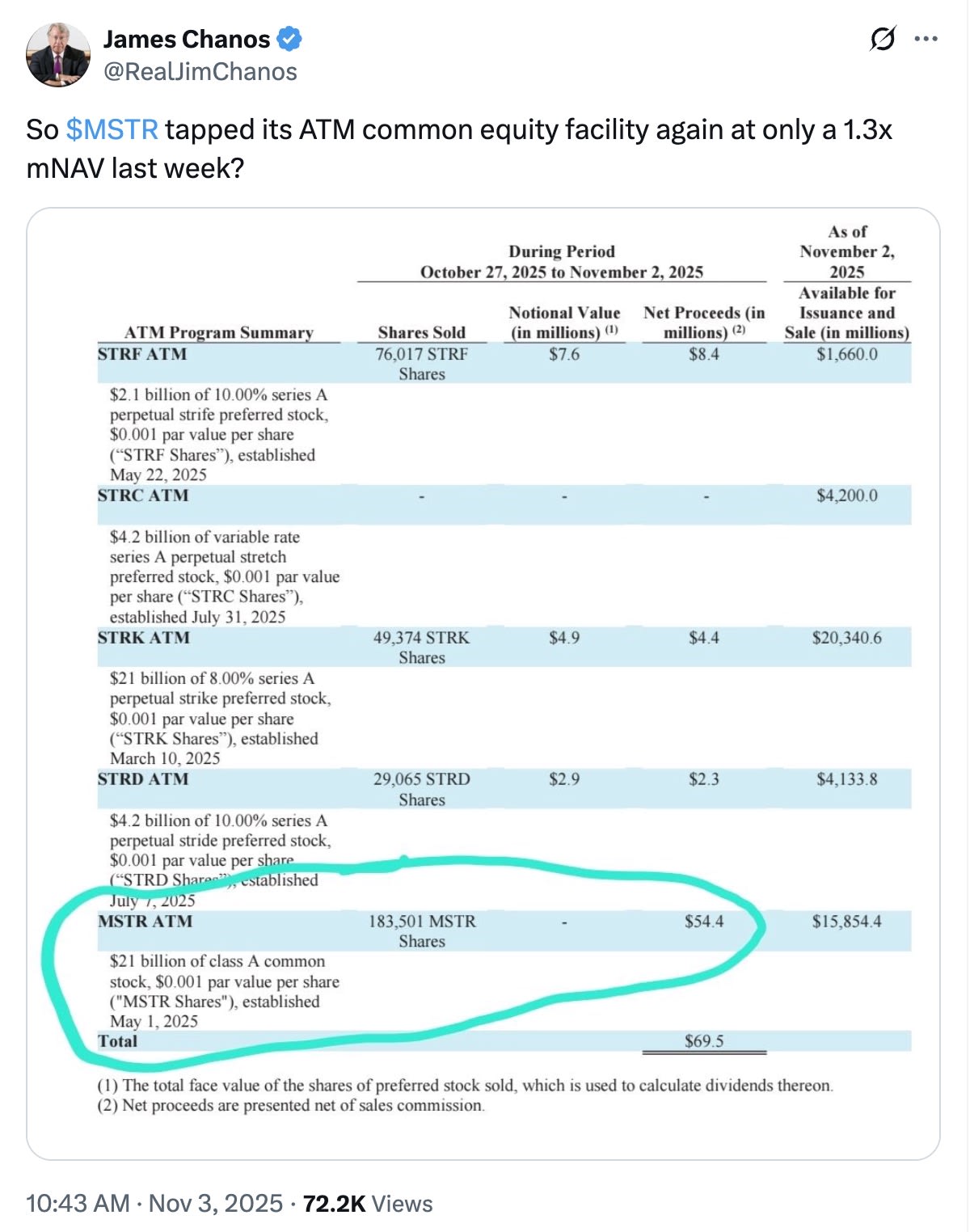
MicroStrategy, the highest-profile corporate buyer of Bitcoin, reflects the same risk dynamic from a different angle. Instead of selling, it continues to raise capital to buy more, recently issuing equity near roughly 1.3x mNAV, even as Bitcoin prices have slid from their peaks.
Short-seller Jim Chanos has been warning about this structure for years. Chanos’ core point remains timely: as long as the company borrows or dilutes shareholders to accumulate Bitcoin, it is exposed not only to BTC price risk, but to the same liquidity crunches that force other leveraged holders to capitulate when conditions turn.
The same applies to individuals who label themselves as permanent HODLers. It is easy to believe you will never sell when prices are rising or stable. Yet history shows that holders eventually capitulate when the walls close in. Margin calls, taxes, declining business revenue, personal emergencies, or simply the psychological strain of a long drawdown have all proven stronger than slogans. Those who hold through every dip are celebrated, but for every survivor, there are many others quietly forced out near the bottom.
Bitcoin’s market structure still depends on the availability of new liquidity. When that stalls, conviction does not protect portfolios. The lesson from the Sequans example is simple: holders can pretend they are immune to market cycles, but the pressure to de-risk always comes. Some capitulate early, some late, yet the cycle of forced selling repeats. The current downturn may be mild compared to what is possible when financial stress and leverage unwind together.
The belief that Bitcoin holders will never be carried out is comforting. It is also historically false. Every cycle ends with sellers who claimed they would never sell. The next one will be no different, and those most confident today may be the ones tested hardest when the market’s patience expires.
QTR’s Disclaimer:Please read my full legal disclaimer on my About page here. This post represents my opinions only.In addition, please understand I am an idiot and often get things wrong and lose money. I may own or transact in any names mentioned in this piece at any time without warning. Contributor posts and aggregated posts have been hand selected by me, have not been fact checked and are the opinions of their authors. They are either submitted to QTR by their author, reprinted under a Creative Commons license with my best effort to uphold what the license asks, or with the permission of the author.
This is not a recommendation to buy or sell any stocks or securities, just my opinions. I often lose money on positions I trade/invest in. I may add any name mentioned in this article and sell any name mentioned in this piece at any time, without further warning. None of this is a solicitation to buy or sell securities. I may or may not own names I write about and are watching. Sometimes I’m bullish without owning things, sometimes I’m bearish and do own things. Just assume my positions could be exactly the opposite of what you think they are just in case. If I’m long I could quickly be short and vice versa. I won’t update my positions. All positions can change immediately as soon as I publish this, with or without notice and at any point I can be long, short or neutral on any position. You are on your own. Do not make decisions based on my blog. I exist on the fringe. If you see numbers and calculations of any sort, assume they are wrong and double check them. I failed Algebra in 8th grade and topped off my high school math accolades by getting a D- in remedial Calculus my senior year, before becoming an English major in college so I could bullshit my way through things easier.
The publisher does not guarantee the accuracy or completeness of the information provided in this page. These are not the opinions of any of my employers, partners, or associates. I did my best to be honest about my disclosures but can’t guarantee I am right; I write these posts after a couple beers sometimes. I edit after my posts are published because I’m impatient and lazy, so if you see a typo, check back in a half hour. Also, I just straight up get shit wrong a lot. I mention it twice because it’s that important.
JPMorgan Discloses Government Probe Into Debanking Practices
US regulators are examining whether JPMorgan Chase has denied customers fair access to banking, as pressure grows over debanking decisions that were made against conservative figures, according to reporting from Financial Times and the company’s 10-Q filing.
In its quarterly filing, the bank noted it was “responding to requests from government authorities and other external parties regarding, among other things, the firm’s policies and processes and the provision of services to customers and potential customers”.
JPMorgan linked the scrutiny to an August executive order from Donald Trump directing regulators to review possible “politicised or unlawful debanking”. The bank said related inquiries include “reviews, investigations and legal proceedings,” without identifying the agencies involved.
Bank of America has similarly reported responding to government demands about “fair access to banking.” Industry lobbyists argue that regulatory rules around politically exposed persons and “reputation risk” have pushed banks to deny certain customers.
Recall, just yesterday, we noted that a top bank watchdog was making sure big banks have finally ditched debanking policies. You remember those, right? We sure do. It happened around the same time Google, Paypal and Amazon all banned us due to our (correct) take on the origins of Covid-19 and because they didn’t like our (correct) take on the BLM movement.
For those that missed it, a slew of banks under the Biden administration outright cancelled people’s accounts and didn’t allow them access to a bank account based on the industry they worked in, or many times their political views (surprise, none of them were Democrats).
Jonathan Gould, head of the Office of the Comptroller of the Currency, or OCC, told a conference that supervisors are double-checking banks really did stop blacklisting sectors like firearms from banks, according to Reuters.
This oversight follows a June executive order from President Donald Trump directing banks to avoid denying services based on industry type or political considerations.
Reuters writes that supervisors are now ensuring that the largest banks are in compliance with the updated approach.
The United States has put forth a draft resolution within the U.N. Security Council meant to end sanctions on Syrian President Ahmed al-Sharaa, leader of the Islamist militant and political group Hayat Tahrir al-Sham (HTS).
The proposal comes ahead of al-Sharaa’s anticipated meeting with President Donald Trump at the White House, set for next Monday.
The Security Council has regularly approved travel exemptions for al-Sharaa this year, meaning the White House meeting does not hinge on the outcome of the U.S. proposal.
The draft resolution, seen by Reuters on Tuesday, also advocates for the repeal of sanctions against Syria’s Interior Minister Anas Khattab.
The U.N. sanctions include a travel ban, asset freeze, and arms embargo.
It is unclear when a vote on the draft could be held. At least nine of the 15 council constituents need to vote in favor of the proposal for it to be enacted. However, Russia, China, the United States, France, and the UK each hold a veto.
Washington has for many months urged the Security Council to cease the sanctions on the regime in Syria.
President Bashar al-Assad was deposed in December 2024 after HTS-led militants effectively won a 13-year civil war in the country.
The country has languished since May 2014 on the U.N. Security Council’s sanctions list aimed at al-Qaeda and ISIS affiliates.
White House press secretary Karoline Leavitt announced al-Sharaa’s visit to the White House at a press briefing on Tuesday.
“When the president was in the Middle East, he made the historic decision to lift sanctions on Syria to give them a real chance at peace, and I think the administration, we’ve seen good progress on that front under their new leadership,” Leavitt said.
In July this year, Trump rescinded unilateral U.S. sanctions on Syria via executive order, saying it was “a chance at greatness” for the Syrian people, but he kept sanctions on Assad and other leaders.
The Trump administration also revoked the foreign terrorist organization designation for HTS.
U.N. monitors said there are no active al-Qaeda-HTS ties in a July report.
Trump last met with al-Sharaa in mid-May in Saudi Arabia’s capital, Riyadh, where the U.S. president urged the Syrian leader to join the Abraham Accords. According to the White House, Trump also asked al-Sharaa to “tell all foreign terrorists to leave Syria, deport Palestinian terrorists, help the U.S. prevent the resurgence of ISIS, and assume responsibility for ISIS detention centers in Northeast Syria.”
On Sept. 22, al-Sharaa addressed the U.N. General Assembly—the first time a Syrian president had done so since 1967—where he called for full sanctions relief and highlighted his country’s reconstruction needs.
“Contrary To Human Nature”: VDH Reminds Us That Mamdani-Style Socialism Always Ends In Disaster
Victor Davis Hanson is warning that Democrats’ move towards socialism and their embrace of figures such as Zohran Mamdani is not going to end well.
Mamdani, a socialist who’s promised to redistribute wealth, and insists that “taxation isn’t theft, capitalism is” – is pushing politics that VDH says are ‘contrary to human nature.’
“Historically, socialists always come in after capitalists have made prosperity, and then they offer and improve prosperity,” he told Fox News’ Laura Ingraham. “And it’s contrary to human nature. People like initiative. They like pride in their property. Some people like to work a lot and get compensated.”
According to Hanson, when the state is in control of human innovation and productivity, it it ‘has to be repressive.’
“It gives you that freedom of opportunity. And then the society at large benefits, Laura, from all these millions of agendas and ideas that improve, that people are free to innovate and to take experiments and risk. But when the state monopolizes all of that, it’s contrary to human nature, and then it has to be repressive,” Hanson said. “So all of these social experiments, even if they’re democratic, they end up repressive. At the worst form, it’s no accident that the greatest mass murderers in history were Mao [Zedong] and [Joseph] Stalin, 30 million, 60 million, and they were radical communists, and even people like Hitler, National Socialist Party.”
And of course, whoever is running a communist regime is living a life of privilege.
“Talented people who can help the economy, who are successful or demonized, they flee. People who want things for nothing come in. There’s open borders,” Hanson continued. “They destroy personal liberty, and they stamp out any dissent or criticism. And there’s always an elite, the billionaire Castro brothers, Chavez and Maduro. They always are never subject to their consequences, their ideology. Here in California, we are becoming socialist.”
By Elwin de Groot, Head of Macro Strategy at Rabobank
Markets were in a risk-off mood yesterday, led by a sell-off in tech shares and growing investor concerns about valuations and policy risks. The US made the books with the longest government shutdown in its history. The S&P lost 1.2%, the Eurostoxx 50 index fell 0.4%. The risk-off tone resulted in lower yields across the board, albeit modestly (1-3 bp in US/Europe). Remarkably, Bitcoin plunged and gold prices dipped as well, an unusual move suggesting broader repositioning rather than just a classic safe-haven bid.
Talks between EU environment ministers yesterday confirmed that the bloc remains committed to its headline goal of cutting greenhouse gas emissions by 90% by the 2040, but with greater flexibility built in. This flexibility introduces a higher risk that targets may not be fully met, or not within the set timeframe. Ministers agreed to include so-called brake clauses, which would allow targets to be adjusted if natural carbon sinks underperform, and to permit offsetting, meaning that part of the reductions could come from foreign carbon credits. They also discussed enabling emissions to be traded between domestic sectors such as industry and agriculture.
This shift in tone is not surprising and reflects the recalibration of priorities between economic and environmental goals advocated in the 2024 Draghi report on competitiveness. That report did not call for abandoning climate objectives, but it urged integrating decarbonization with competitiveness through a “Clean Industrial Deal” and a major investment push. The EU intends to present a unified view next week at the COP30, but many details remain unresolved and attention may already be shifting toward another critical issue: raw material supply security.
On that front, tensions between China and the Netherlands –and by extension the EU– remain unresolved. The US announced on Saturday that China would allow Dutch chipmaker Nexperia BV to resume shipments from its Chinese facilities, easing fears of disruptions to auto production. However, China escalated pressure yesterday. Beijing criticized the Dutch government’s “unilateral” actions and urged it to stop interfering in Nexperia’s internal affairs and find a constructive solution.
The broader economic impact on European or even global industry is still hard to gauge at this stage. Nexperia chips are widely used, especially in automotive applications. Since Nexperia halted wafer exports to China, supply disruptions could also affect production of consumer goods there. Automotive experts note that substitutes exist, but switching would take weeks at minimum – raising the risk of temporary production halts given low inventories in Europe. Some companies, such as Robert Bosch GmbH in Germany and Honda in the US, have already announced production reductions, while others, including Volkswagen AG, have warned they may have to follow suit.
There is little precedent for assessing the impact. The post-COVID chip shortage, which partly caused a 40% decline in motor vehicle production between November 2020 and August 2021, offers some perspective. That shortage stemmed from a perfect storm of factors: surging demand for consumer electronics during lockdowns, automakers cancelling chip orders early and then scrambling as demand rebounded, factory shutdowns, and staffing shortages at semiconductor fabs, natural disasters such as droughts in Taiwan and fires in Japan, and later raw material shortages linked to the Russia–Ukraine war.
If so, it probably requires more financial resources from governments as well, which are in short supply, as the IMF warned yesterday. The institution argues for “a rethink of the role of government […] in some countries” and notes that “if reforms and medium-term consolidation are insufficient, then more radical fiscal measures could include reassessing the scope of public services and other government functions, potentially affecting the social contract.”
Things Aren’t Looking Great For Trump In Supreme Court Tariff Arguments
Odds of the Supreme Court siding with Trump over tariffs tumbled on Wednesday, after conservative justices Kavanaugh, Gorsuch, and Coney Barrett asked tough questions during oral arguments in two cases.
After the first hour of argument, the Trump administration’s case justifying tariffs looked to be in serious trouble – specifically his claim that a 1977 economic emergency law grants the president unilateral power to impose tariffs at will.
Chief Justice John Roberts, Justice Neil Gorsuch and other conservatives raised against Solicitor General John Sauer one of the legal principles they used to strike down big priorities for the Biden administration: the Major Questions Doctrine, which holds that the executive can’t find extraordinary powers in statutes that don’t contemplate major policy changes. –WSJ
More:
Gorsuch hammered Solicitor General John Sauer over separation of powers – suggesting that if the court were to accept Sauer’s argument that Congress can delegate sweeping power to the president, there might be no limit to what other powers they could “hand off.”
The Justice then launched into a “series of skeptical – and at times openly hostile – questions at the solicitor general.” (WSJ)
Justice Brett Kavanaugh also focused on Trump’s assertion of power – noting that he’s the first president in US history to invoke wartime law to impose sweeping global tariffs.
Justice Amy Coney Barrett asked Sauer to explain how the global tariffs were necessary to respond to an “unusual and extraordinary threat.”
That said, the Trump admin has a plan if things don’t go their way with the Supremes.
As the WSJ notes;
Trump’s team for months has weighed using other laws as contingency plans to replace the Ieepa tariffs if they lose in court. That includes potentially deploying a never-before used provision in the Trade Act of 1974-Section 122– which allows for tariffs of up to 15% for 150 days to address trade imbalances with other countries. That would buy time for Trump to devise individualized tariffs for each major trading partner under a different provision of the same law, Section 301, which is used to counter unfair foreign trade practices.
That plan could be more legally defensible. The U.S. Court of International Trade, which ruled against Trump’s tariffs, pointed to Section 122 as a more reasonable legal defense for global tariffs. Section 301, meanwhile, has long been used to address unfair foreign trade practices, and was deployed to underpin Trump’s first-term tariffs on China. Additionally, the administration could also seek to use Section 338 of the Tariff Act of 1930, which allows the president to impose tariffs up to 50% on nations that discriminate against U.S. commerce.
More specifically, the justices are expected to hear two cases—Learning Resources, Inc. v. Trump, and Trump v. V.O.S. Selections, Inc.—for at least 80 minutes with input from various parties. According to the court, oral arguments will include 40 minutes from the Trump administration and 20 minutes each for both the private businesses and states challenging Trump’s policy.
Whatever the ruling, the case could have major implications for the nation’s economy and determine how much future presidents can alter trade. Here’s what you need to know heading into oral arguments.
1. What Are the Cases About?
The cases center on two groups of tariffs that the Trump administration imposed earlier this year. One group targeted Mexico, Canada, and China over their alleged failure to address fentanyl trafficking, and the other set included a lengthy list of reciprocal tariffs on countries worldwide.
The tariffs were imposed under a 1977 emergency powers law—the International Emergency Economic Powers Act. Trump is the first president to impose tariffs under this law, although President Richard Nixon used an identical provision in a predecessor law in 1971—the Trading with the Enemy Act of 1917—to declare a trade emergency and issue 10 percent tariffs on all imports.
Trump established the fentanyl tariffs in February in response to the three countries’ failure to stem the flow of illegal opioids into the United States, which created a national emergency, including a public health crisis, according to his executive orders.
The president cited the hundreds of thousands of overdose deaths of Americans and the drug crisis’s impact on the health care system, communities, and families. Mexico and Canada were also penalized for failing to stem illegal immigration.
In enacting the reciprocal tariffs in April, Trump declared an emergency over large and persistent U.S. trade deficits caused by decades of unfair trade practices by other countries in the form of tariffs and nontariff barriers.
The persistent trade imbalance has threatened national and economic security, Trump’s executive order states, by hollowing out the country’s manufacturing capacity, undermining critical supply chains, and causing the defense industry to be dependent on foreign adversaries.
Trump has said that winning the case will be “vital to the interests” of the United States. Tariffs have been used against the country for years, causing the United States to lose its domestic industries, he said in an October interview with Fox Business.
The president noted that he was able to stop several wars by using the threat of tariffs as leverage, including one earlier this year between Pakistan and India.
As of Sept. 23, revenue from tariffs imposed under the emergency law hit nearly $90 billion in fiscal year 2025, according to data by U.S. Customs and Border Protection. That’s nearly half the total tariff revenue collected in the fiscal year.
The United States faces a trade deficit of more than $1 trillion, and the Congressional Budget Office has estimated that the tariffs will reduce federal deficits by $4 trillion, according to a Justice Department (DOJ) filing.
So far, the Trump administration has reached trade deals with several countries, including the U.K., the European Union, Japan, and South Korea. These deals have led to more than $2 trillion in purchases and investment commitments in the United States.
Should the administration lose the case, Treasury Secretary Scott Bessent has said that the government could invoke other authorities to implement tariffs, although they are “not as efficient, not as powerful.”
Private companies have urged the Supreme Court to rule against the Trump administration, arguing that the tariffs represent hundreds of billions of dollars in new taxes. Some outside estimates have also been critical of the tariffs.
For example, the Peterson Institute for International Economics stated in September that U.S. businesses had absorbed much of the tariff costs through July, and consumers could see higher prices.
The Supreme Court is set to review whether the tariffs are authorized by the International Emergency Economic Powers Act (IEEPA). The law authorizes the president to take a range of actions in response to emergencies.
It allows the president to declare a national emergency to deal with any “unusual and extraordinary threat” to the country’s national security, foreign policy, or economy.
In court, the DOJ has defended the Trump administration’s invocation of the law to impose tariffs by pointing to a section that allows presidents to regulate imports.
That provision allows the president to “investigate, block during the pendency of an investigation, regulate, direct and compel, nullify, void, prevent or prohibit, any acquisition, holding, withholding, use, transfer, withdrawal, transportation, importation or exportation of, or dealing in, or exercising any right, power, or privilege with respect to, or transactions involving, any property in which any foreign country or a national thereof has any interest.”
In arguing that the levies were not authorized by the law, challengers have highlighted that the provision doesn’t include the word tariffs.
The justices are expected to consider not only whether the law allows the tariffs but also whether the law was constitutional.
Because the Constitution grants tariff power to Congress, there is a question over whether the emergency law violated the nation’s separation of powers by unconstitutionally delegating expansive tariff authority to the president.
So far, multiple federal courts—including the U.S. Court of International Trade and the U.S. District Court for the District of Columbia—have stated that Trump’s tariffs are unlawful, but delayed the effects of their orders blocking the tariffs.
The U.S. Court of Appeals for the D.C. Circuit halted oral arguments for one of the cases after the Supreme Court granted certiorari, or took it up for further consideration. The Supreme Court is expected to review that case, as well as one that the U.S. Court of International Trade ruled on in May. That ruling against Trump’s tariffs was affirmed by the U.S. Court of Appeals for the Federal Circuit in August.
Both the district court in Washington and the Federal Circuit have noted that the law does not use the term tariffs. According to the court in Washington, regulating imports entails controlling them through rules, whereas tariffs are taxes on imports or exports.
White House press secretary Karoline Leavitt said an executive order is being drafted to strengthen U.S. elections and curb mail-in ballot fraud, after President Donald Trump alleged that California’s mail voting system “is rigged” and parts of it are under “legal and criminal review.”
“The White House is working on an executive order to strengthen our elections in this country and to ensure that there cannot be blatant fraud, as we’ve seen in California with their universal mail-in voting system,” Leavitt told reporters during a Nov. 4 briefing. “It’s absolutely true that … there is fraud in California’s elections. It’s just a fact.”
Leavitt’s comments followed a Truth Social post by Trump earlier in the day, in which he renewed his criticism of mail-in voting and suggested criminal investigations were underway.
“The Unconstitutional Redistricting Vote in California is a GIANT SCAM in that the entire process, in particular the Voting itself, is RIGGED,” Trump wrote.
“All ‘Mail-In’ Ballots, where the Republicans in that State are ‘Shut Out,’ is under very serious legal and criminal review.”
When asked what evidence the White House had to support those claims and which authorities were conducting the purported reviews, Leavitt said she would provide evidence of fraud to reporters after the briefing, alleging that “fraudulent ballots are being mailed in the names of other people, in the names of illegal aliens who shouldn’t be voting in American elections.”
The White House has not disclosed details of the upcoming executive order. The president has repeatedly promised sweeping changes to election procedures, including a nationwide ban on universal mail-in voting and electronic voting machines.
Redistricting Vote Sparks Clash
On Nov. 4, California voters approved Proposition 50, a ballot measure championed by California Gov. Gavin Newsom and state Democrats that allows lawmakers to temporarily bypass the state’s nonpartisan redistricting commission to redraw congressional maps.
Supporters said the measure was a needed counterweight to Republican-led redistricting in states such as Texas, while critics—including Trump—characterized it as an unconstitutional power grab.
Newsom described the referendum as “California’s chance to save democracy,” saying it would help Democrats regain momentum ahead of next year’s elections.
“At the end of the day, it’s about the future of our country,” he told supporters at a Los Angeles rally on Nov. 1.
Republican state Sen. Tony Strickland told The Epoch Times that the measure could ultimately backfire on Democrats.
“If Prop 50 passes, it becomes a rally cry nationally,” he said. “The biggest winner tonight will be [President] Donald Trump.”
California Gov. Gavin Newsom speaks at a “Yes on Prop 50” volunteer event at the LA Convention Center in Los Angeles on Nov. 1, 2025. Jill Connelly/Getty Images
After Trump posted on Truth Social that the redistricting vote was unconstitutional and that some of California’s mail-in ballots are under criminal review, Newsom responded by dismissing the comments as the “ramblings” of someone who “knows he’s about to LOSE.”
Trump has long criticized mail-in voting, calling it a source of widespread fraud. In August, he told reporters that his legal team was drafting an executive order to ban mail-in voting nationwide and to phase out electronic voting machines in favor of paper ballots.
Constitutional experts have said that any such move would face immediate legal challenges. Under the U.S. Constitution, states control the “times, places, and manner” of elections, though Congress retains the power to alter those regulations.
“The president has no power to dictate to states how they conduct national elections,” Rick Pildes, a political science professor at New York University, told The Epoch Times in an earlier interview. He said such changes would likely require congressional approval.
Trump’s forthcoming order would mark the latest in a series of White House efforts to tighten federal election rules.
In March, the president signed an executive order directing agencies to update election security protocols, voter registration processes, and mail-ballot deadlines.
While portions of that order were blocked by a federal judge who found the action exceeded presidential authority, a directive tightening mail-in ballot deadlines was allowed to stand.
The UK is doomed under Labour, the boss of Ryanair has warned as he claimed wealthy people were scrambling to ‘get the hell out of London’ before being hit by a Budget tax raid.
Michael O’Leary said he had no faith in the Chancellor’s ability to restore growth and branded her tax policies ‘dumb’.
The comments came amid reports that Rachel Reeves is planning to target the wealthy with a mansion tax in the Budget later this month.
He told the Guardian: ‘The UK economy under the current leadership is doomed.’
‘The UK badly needs growth, but the way to deliver growth is through selective tax cuts… you are not going to grow the UK economy by taxing wealth or taxing air travel.’
Mr O’Leary’s comments add to a chorus of criticism of Labour from UK business leaders – following warnings about tax from the likes of Marks & Spencer boss Stuart Machin and Asda’s Allan Leighton.
Michael O’Leary branded Labour’s policies ‘dumb’
The Ryanair boss said: ‘I hold very little faith in Rachel Reeves or the current economic strategy of the Labour government.’
‘Rich people are fleeing… as they are trying to find low-fare flights to get the hell out of London before Rachel Reeves taxes their mansions, their income and inheritance.’
Mr O’Leary has also taken umbrage at Labour’s decision to hike air passenger duty – a tax on flights – and said further increases in the Budget would prompt the carrier to shift capacity to other countries with lower tax burdens such as Sweden or Italy.
He told Bloomberg: ‘She hasn’t a rashers how to deliver growth. She puts up employment taxes, puts up APD.’
Mr O’Leary said Ryanair had written to the Treasury describing the increase in the air tax as ‘the dumbest idea even you lot have come up with’.
He said that a further increase at the Budget would mean 10 per cent of Ryanair’s capacity, or about five million seats, is moved to lower tax countries.
‘Eventually even a dumb Labour government will work out that for an island on the periphery of Europe, the way to grow – and the way to increase tax revenue – is to get tourists onto the island first and then tax them,’ he added.
‘The way to grow is not by increasing entry taxes, which is what APD is.’
Mr O’Leary made the comments as the airline revealed a surge in half-year profit amid a hike in fares. It was also helped by aircraft deliveries helping it fly more passengers.
The low-cost airline reported a pre-tax profit of £2.6 billion for the six months to the end of September, 40 per cent higher than the same period last year.
It flew 119 million passengers, 3 per cent more than last year
Average airfares rose by 13 per cent year on year to 58 euros (£50.90), Ryanair revealed, having spiked during the Easter period.