51.4 F
Chicago
Wednesday, April 29, 2026
Home Blog Page 108

Meta To Lay Off Hundreds Of Workers Today As AI Pivot Accelerates

Meta To Lay Off Hundreds Of Workers Today As AI Pivot Accelerates

Meta Platforms is laying off a few hundred employees today as its workforce restructuring continues, following years of terrible metaverse bets and overhiring during the Covid era. Reports of another round of layoffs surfaced earlier this month, and just last week, Meta shut down Horizon Worlds, its virtual reality social network for Quest headsets.

The Information reports that a few hundred employees will be let go today as part of the company’s effort to reposition itself in the AI space.

People familiar with the workforce restructuring say a majority of the cuts will focus on staff in Reality Labs, social media teams, recruiting, and a smaller number of sales roles.

“Teams across Meta regularly restructure or implement changes to ensure they’re in the best position to achieve their goals. Where possible, we are finding other opportunities for employees whose positions may be impacted,” a Meta spokesperson told the outlet.

In mid-March, Reuters reported that a new round of layoffs at Meta was imminent and would reduce the workforce by 20%. The outlet said that the workforce restructuring is intended to redirect capital flows toward AI infrastructure.

The latest Bloomberg data show Meta’s total workforce at the end of 2025 was about 79,000. Any layoffs today would amount to only a quarter of a percent.

Meta CEO Mark Zuckerberg has been downsizing the workforce since the 2022–23 “year of efficiency” layoffs.

Shares of Meta peaked in August 2025 at around $790 and have since been locked in a bear market, down around 25%.

The reason for Meta’s underperformance can be found in our note on Tuesday titled “What’s The Matter With Meta: Goldman Explains The Stock’s Ongoing Slump.”

Tyler Durden
Wed, 03/25/2026 – 12:05

US Has Been Engaged In Major Airstrikes On Pro-Iran Paramilitaries In Iraq

US Has Been Engaged In Major Airstrikes On Pro-Iran Paramilitaries In Iraq

Authored by Dave DeCamp via AntiWar.com,

Iraq’s Popular Mobilization Forces (PMF) said Tuesday that US airstrikes in Anbar, western Iraq, killed 15 of its fighters, including a senior commander.

“In a blatant and cowardly attack, the commander of the Anbar Operations in the Popular Mobilization Forces, Saad Dua al-Bayji, was martyred along with a group of his heroic comrades following a treacherous American airstrike that targeted the command headquarters while they were performing their national duty,” the PMF said in a statement, according to The Cradle.

The group added that it was holding the Iraqi government “fully responsible” for “confronting these repeated American violations and taking clear and resolute positions to preserve the country’s sovereignty and put an end to these grave transgressions.”

Iraqi media later reported that Iraq’s National Security Council, chaired by Iraqi Prime Minister Mohammed Shia al-Sudani, has given the PMF the green light to respond to attacks on its positions, a significant step from the US-backed Iraqi government that will likely lead to further escalations inside the country.

The PMF is a coalition of mostly Shia militias aligned with Iran that formed in 2014 to fight ISIS and is officially part of Iraq’s security forces. Since the US and Israel launched the war against Iran on February 28, the US has launched extensive strikes against the PMF, killing dozens of its fighters.

US bases and diplomatic facilities in Iraq have come under constant missile and drone attacks and have mostly been claimed by a group that calls itself the Islamic Resistance in Iraq (IRI), which includes some of the factions in the PMF. Amid the heavy attacks, the US ordered all American citizens to leave Iraq, and NATO has withdrawn its forces from the country.

The IRI said on Monday that the US has also pulled all of its forces out of Camp Victory, a major US base near the Baghdad airport, but the withdrawal hasn’t been confirmed. “We confirm that the American and NATO forces have completed their withdrawal from Camp Victory near Baghdad Airport via cargo planes and vehicles overland towards Jordan,” the group said. “We will not allow the current government, or the future government, God willing, to allow the Americans and NATO to return to Iraq.”

If the US did pull its troops out of Baghdad, there would still be US forces in Iraqi Kurdistan. Kataib Hezbollah, one of the main Iran-aligned militias in Iraq, has said that it has halted attacks on the US Embassy in Baghdad to give the US time to evacuate the facility. “Our primary condition is the expulsion of all foreign troops from the north to the south of Iraq,” a Kataib Hezbollah official said.

*  *  *

Tyler Durden
Wed, 03/25/2026 – 11:25

Democrats Flip Trump’s Mar-a-Lago District In Florida Special Election Upset

Democrats Flip Trump’s Mar-a-Lago District In Florida Special Election Upset

Democrats flipped a reliably red Florida state House seat that includes President Donald Trump’s Mar-a-Lago estate on Tuesday, scoring a narrow but symbolically significant victory in a special election that drew national attention.

Democrat Emily Gregory defeated Trump-endorsed Republican Jon Maples in House District 87 by just over 2 percentage points, according to unofficial results. The win marks an approximately 11-point swing toward Democrats compared to the 2024 performance in the Palm Beach County district.

Gregory, a first-time candidate who runs a fitness center for postpartum moms and has a background in public health and mental health administration, campaigned on affordability, taxes and kitchen-table issues. Maples, a financial planner and former local council member, had received an endorsement from Trump, who along with first lady Melania Trump and their son Barron voted by mail in the contest.

“I think it demonstrates where the Florida voter is,” Gregory told Politico after her victory. “They want someone who is focused on solutions and the issues and not focused on the noise.”

Democrats also picked up a narrow win in a Tampa-area state Senate seat, where union leader and Navy veteran Brian Nathan defeated former state Rep. Josie Tomkow by a slim margin despite being outspent roughly 10-to-1.

The two Democratic victories will not alter Republican supermajorities in the Florida Legislature. But they come as the latest data point in a series of special-election overperformances and flips for Democrats in the state since Trump’s 2024 victory there – and amid a broader national trend of Democrats gaining ground in state legislative races over the past year.

Florida Democratic Party Chair Nikki Fried credited the party’s sustained organizing with the win. 

“This victory reiterates an undeniable trend in Florida: With year-round organizing and infrastructure investment, Democrats can run and win anywhere – including Donald Trump’s backyard,” Fried said in a statement. “Floridians are tired of the chaos, corruption, and sky-high prices on everything from groceries to gas and health care.”

In 2024, the House District 87 race had been held by Republican Mike Caruso, who won it by 19 points before being appointed to a local post by Gov. Ron DeSantis, triggering the special election. The contest grew heated in its final days, with sharp exchanges in mailers and text messages.

Democrats poured significant resources into the Palm Beach County race, viewing it as a chance to compete in Trump’s home turf. Republicans, meanwhile, downplayed the significance of the low-turnout special election.

In the state Senate District 14 race, which opened after DeSantis appointed Lt. Gov. Jay Collins last August, Nathan’s upset win was described as a surprise even by some Democrats. Tomkow, a rancher who previously held a House seat in neighboring Polk County, faced questions about her residency in the district.

Nathan, a union leader and veteran, was outspent by roughly 10 to 1 in the race to replace Collins and had received scant support from state Democrats. He narrowly defeated former state Rep. Josie Tomkow, a rancher who had held a House seat in neighboring Polk County. Tomkow’s residency had come under question, although she said she planned to move into the district once she was elected. But even Fried acknowledged that Nathan’s win was in state Senate District 14 was a surprise.

A separate House race created by Tomkow’s departure was won by Republican Hilary Holley by nine points – a solid victory but narrower than Tomkow’s margin in 2024.

Tuesday’s outcomes add to Democratic momentum in Florida special elections, even as the GOP maintains firm control of state government. Party strategists on both sides will be watching whether the results signal anything larger heading into the 2026 midterm cycle.

Tyler Durden
Wed, 03/25/2026 – 10:45

WTI Steady After Biggest Cushing Crude Build In 3 Years; Imports From Venezuela Highest Since 2019

WTI Steady After Biggest Cushing Crude Build In 3 Years; Imports From Venezuela Highest Since 2019

Oil prices remain lower this morning, following the US proposal for a ceasefire with Iran, but off the lows following Iran’s rejection.

“From the Iranian perspective, Trump’s actions this week have demonstrated that the US can be pressured when Iran threatens further escalation,” said Arne Lohmann Rasmussen, chief analyst at A/S Global Risk Management.

Futures had already pared losses as Tehran fired a new wave of missiles at Israel, and signaled little willingness to compromise. Iran’s armed forces added to a stream of messaging that ruled out ceasefire talks, according to state-run IRIB News. They added that they wouldn’t allow oil prices to return to their previous levels until all threats against the country were removed.

Overnight saw API report a modest rise in crude and refined product inventories and while oil prices are really more attuned to the geopolitical headlines currently, we’re keeping our eyes on the domestic supply and demand for any signs of an actual impact locally.

API

  • Crude +2.35mm

  • Cushing

  • Gasoline +528k

  • Distillates +1.39mm

DOE

  • Crude +6.93mm (-200k exp)

  • Cushing +3.42mm – biggest weekly build since Jan 2023

  • Gasoline -2.59mm

  • Distillates +3.03mm

US crude stocks rose for the 5th straight week with inventories at the Cushing Hub soaring by 3.4mm barrels – the biggest build since Jan 2023. Refined products were mixed with Distillates stocks up bigly while Gasoline stocks fell for the sixth straight week

Source: Bloomberg

For the 5th week in a row, there was no addition (or drawdown) for the US SPR.

Total Cushing stocks are their highest since July 2024 while total gasoline stocks tumbled to their lowest since the start of the year…

Source: Bloomberg

Crude imports from Venezuela surged to their highest since 2019…

US Crude production remains ‘near’ record highs – but despite a rising rig count, production is not increasing…

Source: Bloomberg

No signs of gasoline demand destruction so far. Finished motor gasoline product supplied came in at 8.9 million barrels per day for the EIA week, a week-on-week increase of 196,000 barrels per day.

WTI was trading around $89 ahead of the official inventory data (at the upper end of the overnight session’s range)…

“In the past 24 hours, the Trump administration has been signaling both to concerned citizens, policymakers, allies, adversaries, and perhaps most importantly markets, that there may be an end in sight sooner than the president himself had let on just about a week ago,” Behnam Ben Taleblu, Iran program senior director at the Foundation for Defense of Democracies, told Bloomberg TV.

“A lot of that is hand-holding, particularly for energy markets.”

Perhaps this is why…

Not a great backdrop for the Midterms (admittedly six months away).

Tyler Durden
Wed, 03/25/2026 – 10:39

Both Sides’ Starting Ceasefire Positions Are: “We Won, You Surrender”

Both Sides’ Starting Ceasefire Positions Are: “We Won, You Surrender”

By Michael Every of Rabobank

Don’t screen yourself off from reality

Today starts with markets in a positive mood, stocks up in Asia, bond yields down slightly, and Brent oil down around 7% to $97.5. Yet don’t screen yourself from reality. As underlined before, the price of energy on a screen currently has no relation to its actual availability in different forms in certain geographies. The Philippines just declared a national emergency to conserve fuel; South Korea is curtailing private driving; Slovenia has introduced rationing; and the boss of Shell is quoted saying Europe will face fuel shortages within days (see “Where Demand Destruction Is Greatest “).

Iran, via its parliamentary speaker Ghalibaf, whom the US is now negotiating with, also makes this clear: “We are aware of what is happening in the paper oil market, including the firms hired to influence oil futures. We also see the broader jawboning campaign. But let’s see if they can turn that into “actual fuel” at the pump – or maybe even print gas molecules!”

That said, Iran has stated “non-hostile” ships can now transit Hormuz if the vessels co-ordinate with it. That would mean this crisis is essentially already over, albeit with Iran de facto taking control of Hormuz as a toll-way: only the US and Israel are ‘hostiles’, and they don’t use the Strait. But haven’t we seen this on our screens before? Did you notice any change in energy flows?

Indeed, looking at your screens won’t tell you what’s going to happen in this war. For example, the New York Times reports Saudi’s MBS is still pushing Trump to continue fighting due to the “historic opportunity” to remake the region; officially, Saudi rebuts these claims. Israel says it backs any US efforts to start talks with Iran but privately feels otherwise – and Israel is hitting Russian-Iranian weapons smuggling routes in the Caspian Sea, expanding the war to a new geography that links it back to the one in Ukraine.

Positively, and showing official denials don’t mean much, the US is negotiating with some in Tehran – though do they speak for a fracturing regime? It has sent a 15-point plan to end the war, according to Reuters, with Ghalibaf and foreign minister Araghchi reportedly told they won’t be killed while talks are ongoing(!) The first round is pencilled in by Thursday in Pakistan: Iran just said they don’t want to talk to Witkoff and Kushner, preferring anti-neocon VP Vance.

However, both sides’ starting positions are: ‘We won, you surrender.’ The US is offering a one-month ceasefire, with Iran: dismantling its nuclear capabilities; vowing to “never seek” nuclear weapons; stopping the enrichment of nuclear material; delivering its enriched uranium to the IAEA; decommissioning and destroying Natanz, Isfahan and Fordow; granting the IAEA full access; stopping funding and arming its proxies; stepping back from its ballistic missile program, keeping them only for defence; and promising to keep the Strait of Hormuz open. This is in return for US support for the development of a civilian nuclear program in Bushehr and lifting all sanctions. By contrast, Iran is demanding an apology from the US, reparations for wartime losses, guarantees against future US or Israeli military action, the removal of US military bases in the region, no restrictions on its ballistic missile program, no shift in its proxies approach, and formal control over the Strait of Hormuz.

Where is the workable compromise?

Yet, again, is there more going on in reality? What Iran says its positions are may not be what they actually are – and the same could be true for the US, to a lesser extent, given the deal on the table is a more muscular version of the much-derided Obama-era JCPOA.

In that regard, Trump says Iran has given the US a gift “worth a tremendous amount of money” which isn’t nuclear, but energy related: what might that be? Trump says it shows he is “dealing with the right people.” That implies the wrong people are there too, so Iranian factions are forming, which implies any deal may not hold for everyone who can shoot a missile or drone.

Iran is singing “Won’t get fooled again” over the negotiations. After all, new US military power allowing for boots on the ground will arrive in Hormuz after markets close on Friday. What position does the US intend to take? Doing nothing? Or seizing Iran’s enriched uranium? Or Kharg island, which wouldn’t reopen Hormuz, but would stop most Iranian oil flows, choking the regime while exacerbating the global energy crisis? Or smaller islands in and parts of the shoreline of Hormuz to ensure the Strait reopens? Inaction is pointless, but all actions risk Iran escalating against Gulf energy facilities. Or could the ‘gift’ Trump referred to be linked in some way, e.g., “Kharg-a-Lago”? Maritime expert John Konrad also floats an addition to his earlier hypothesis that the unstated US aim here may be to not reopen Hormuz and use the leverage it achieves as a result. Pick a US position, then pick a market position, then watch your screen.

Meanwhile, it’s not exactly quiet elsewhere:

  • The USS Nimitz aircraft carrier, on its last hurrah, is to be sent to SOUTHCOM (LatAm) not CENTCOM (the Middle East): does that point to geopolitical action in that region – like Cuba?
  • The EU said it won’t reverse its Russian gas ban or slow down its green transition, despite the current crisis – but a Russian oil import ban has suddenly dropped off of Brussels’ short-term agenda.
  • The EU’s enlargement chief said the bloc needs to change its rules to enable a new wave of countries to join and called on member states to present their own plans after they rejected proposals by the Commission to streamline the process.
  • EU lawmakers told the US to give up trying to change EU tech rules as the UK wants to bring back 76 EU laws, according to the Telegraph: new legislation is planned to allow Labour to transfer Brussels powers back onto the UK statute book.
  • Germany’s VW is in talks with Israel’s Iron Dome maker to shift from making cars to missile defences in one of its factories, which underlines the shift in political economy underway. So does Anduril and Palantir developing the US Golden Dome missile shield’s software.
  • Denmark’s centre-left PM won her snap election with 38% of the vote and is now trying to put together a new coalition, but notably the far-right Danish People’s Party rose to 16%, continuing a similar trend seen in many European polities.
  • The US is reportedly looking at trying to reform the WTO along its own lines rather than just ignoring it entirely. But for now, world trade revolves around what happens in Hormuz far more: no bunker fuel, no ships carrying cargo, not much trade at all.

Tyler Durden
Wed, 03/25/2026 – 10:25

Iran Rejects US Proposed Ceasefire, Counters With 5 Conditions For Ending War, As US Troops En Route

Iran Rejects US Proposed Ceasefire, Counters With 5 Conditions For Ending War, As US Troops En Route

Summary

  • Iran Does Not Accept Ceasefire, Issues 5 Conditions, Says US Talks Illogical. The statement says that talks are not viable in current conditions, oil rising.

  • 3,000 elite Army Airborne soldiers & Marines still en route after Trump said Monday says Iran has been destroyed “militarily”. 

  • Iran is tightening control of Hormuz, demanding detailed ship data and in some cases large fees for passage.

  • Iran continues to say it is ready for long war, monitors US troop movements: Parliament Speaker says “Do not test our resolve to defend our land.”

*  *  *

Iran Issues Its 5 Conditions for Ending the War

Iran lays out five specific conditions under which Iran would agree to end the war, via PressTV. These include:

1. A complete halt to “aggression and assassinations” by the enemy.

2. The establishment of concrete mechanisms to ensure that the war is not reimposed on the Islamic Republic.

3. Guaranteed and clearly defined payment of war damages and reparations.

4. The conclusion of the war across all fronts and for all resistance groups involved throughout the region

5. International recognition and guarantees regarding Iran’s sovereign right to exercise authority over the Strait of Hormuz.

State media says that upon reviewing the 15 points from the US delivered via the Pakistanis, they must be rejected as they are “excessive”. Other Iranian officials have called it a “list of impossible wishes”. CNN is meanwhile reporting Wednesday that Trump admin officials are working to arrange a meeting in Pakistan this weekend to seek out an offramp to the war, according to senior officials, but the timing remains fluid. Which side is actually in the driver’s seat here?

Iran Rejects US Ceasefire Draft Deal: “Illogical”

Confusion reigns over diplomacy as Pakistan reportedly relays Washington’s ceasefire terms to Iran. “A document given to Pakistan by the Trump administration has been presented to the Iranians,” according to Al Jazeera. An alleged early draft can be viewed here.

Iran’s Fars citing informed source on ceasefire Wednesday: Iran Does Not Accept Ceasefire, Says US Talks Illogical: Fars. The statement says that talks are not viable in current conditions. Oil jumps on the headline:

Tehran has consistently been denying any negotiations outright, with Iran’s ambassador insists no direct or indirect talks are happening, even as “friendly countries” conduct consultations. Iran’s military also brushed off claims by President Trump, vowing to press on with the fight, and asserting that Washington is merely negotiating with itself, trying to will something into existence which isn’t yet reality.

Bloomberg has summarized where things stand: “Iran kept up missile and drone attacks on Israel and Arab Gulf states, even after the US floated a plan to end a war that’s wreaked havoc across the Middle East and in global markets.” The below are also key points:

  • Iranian officials have told the countries trying to mediate peace talks with the U.S. that they have now been tricked twice by President Trump and “we don’t want to be fooled again,” according to a source with direct knowledge of those discussions. They worry Trump is buying time as he brings more military equipment to the Middle East. 
  • Iran has received an American 15-point plan for a ceasefire for the Iran war through intermediaries from Pakistan, officials in Islamabad said Wednesday. The proposal was sent even as Washington began to move paratroopers to the Middle East to back up a contingent of Marines already heading to the region

Iran military spokesman: “Have your internal conflicts reached the point where you’re negotiating with yourselves?

Trump’s “Very Big Present” & Hormuz Leverage

Trump, meanwhile, claims Iran offered a “present…worth a tremendous amount of money,” tied to energy flows through the Strait of Hormuz – but provided no details. At the same time, the US is ramping troop deployments even as it touts negotiations to end the conflict. He also claimed “we are… talking to the right people” in Iran, adding to the confusion and ambiguity.

On the ground, Iran is tightening control of Hormuz, demanding detailed ship data and in some cases fees for passage – especially for oil and gas tankers. Traffic has thinned, with non-compliant vessels turned away, raising pressure on Asian economies like India and drawing pushback from China.

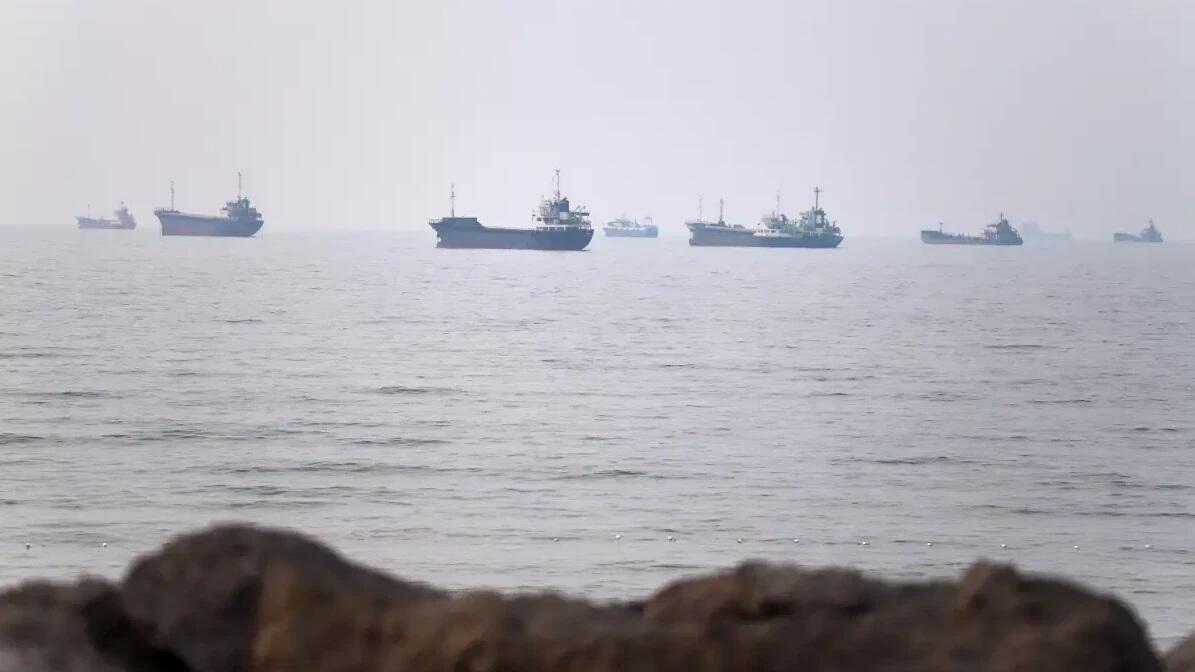
Hundreds of vessels still remain paralyzed, after Iran adopted an “eye for an eye” policy to re-establish deterrence and impose sever costs on both America’s Gulf partners and the global economy. Here’s the latest on Iran’s statements and policy regarding passage:

Iran has said that “non-hostile” ships may transit the Strait of Hormuz amid a collapse of maritime traffic through the waterway that has prompted the biggest global energy crisis in decades.

In a statement on Tuesday, Iran’s mission to the United Nations said vessels may avail of “safe passage” through the waterway, “provided that they neither participate in nor support acts of aggression against Iran and fully comply with the declared safety and security regulations.”

Tit-for-Tat Hits On Key Infrastructure

US-Israeli strikes on Iran continue, while Iranian missiles trigger alarms across Israel. Gulf states are still feeling the pain, with Saudi Arabia and Bahrain intercepted incoming threats, while Kuwait reported a fire at its main airport after a fuel tank was hit, according to Bloomberg.

Israel says it has crossed the 15,000-munitions mark in strikes on Iran since late February – highlighting the scale of the conflict, now far exceeding prior rounds of fighting. On Wednesday, the Israel Defense Forces (IDF) said the air force has carried out multiple new waves of airstrikes over Tehran, targeting what it described as Iranian regime infrastructure.

This has apparently included Iran’s only submarine development facility, as part of a broader wave of attacks on weapons production sites around Isfahan. According to the IDF, the targeted underwater R&D center is the “only site in Iran responsible for the planning and development of submarines and auxiliary systems for the Iranian navy.” It added: “The regime produced various models of unmanned vessels at the site.”

Reports say Iran again targeted Israel’s largest power plant in Hadera (Orot Rabin):

Israel is also escalating in Lebanon, bombing Beirut and pushing deeper into the south as it signals plans for a longer-term occupation zone.

Tehran ‘Closely Monitoring’ US Troop Deployments

Iranian officials are issuing stark warnings, most importantly with parliament speaker Mohammad-Bagher Ghalibaf having declared: “We are closely monitoring all US movements in the region, especially troop deploymentsDo not test our resolve to defend our land.” He added, “What the generals have broke, the soldiers can’t fix; instead, they will fall victim to Netanyahu’s delusions.” 

Official casualty latest per Pentagon: 232 U.S. service members have been injured since the start of the conflict, a U.S. Central Command spokesperson has said. Of those, 207 have returned to duty and 10 are seriously wounded. At least 13 have been killed.

As for the US troops, it’s anything but clear at this point what comes next after they finally arrive in the region. There’s talk that Trump could order a Kharg Island takeover, which itself would be ultra high-risk, given how deep inside the narrow strait that the island lies. 

Meanwhile WSJ reviews of the above mentioned Ghalibaf: “Iran’s combative Parliament speaker, Mohammad-Bagher Ghalibaf, is emerging as an unlikely figure in Washington’s search for a deal to halt a widening Middle East war.”

“Ghalibaf, a former Islamic Revolutionary Guard Corps air-force commander and Tehran mayor, has denied any talks with the U.S. are under way,” the report continues. “He has taunted President Trump and Defense Secretary Pete Hegseth and called the U.S.-Israeli air war with Iran a quagmire. He served in the Revolutionary Guard during Iran’s brutal war with Iraq in the 1980s and is known as a hard-liner’s hard-liner.”

But, the report notes, “At the same time, he is credited with helping to modernize Tehran while he was mayor, becoming famous for riding his motorcycle around town and expanding major highways and the metro system in a traffic-clogged city. In 2008, he traveled to the World Economic Forum in Davos, Switzerland, portraying himself as a leader with a more business-friendly attitude than other parts of the regime.” Some analysts have said that Washington could eventually work with him. 

Tyler Durden
Wed, 03/25/2026 – 10:10

Trapped: The Private Credit Exit Door Has Been Locked And Sealed Shut

Trapped: The Private Credit Exit Door Has Been Locked And Sealed Shut

Submitted by QTR’s Fringe Finance

While headlines are fixated on the Iran war and today’s “feel good” market rally, it is worth noting that beneath the surface, hours ago credit markets just got worse.

The latest example comes from Apollo, which has been forced to put the brakes on investor withdrawals from one of its largest retail focused funds, according to Bloomberg. Its $25 billion Apollo Debt Solutions vehicle is the latest private credit flaming bag of shit that has hit redemption limits after investors tried to pull more than double what the structure allows.

In other words, investors want out and are being treated like the old ladies on line at the South Philly Acme trying to buy liverwurst and chicken salad at the deli counter. That is, to say, they’re being told to take a number.


As I’ve been documenting, BlackRock recently hit similar limits in its own fund, and Morgan Stanley has been dealing with pro rated withdrawals at roughly the same levels. The difference now is scale and urgency. Apollo investors tried to redeem over 11% of the fund in one window. That’s a quintessential “race for the exits”.

And it was an Apollo executive himself who said just days ago that “all” marks in private credit are “wrong”. Oh, the irony.

The size with these funds is not trivial. These are not obscure niche strategies. These are $25 to $30 billion vehicles seeing real redemption pressure. That is large enough to matter, even if people would prefer to pretend otherwise. Combined, we’re already talking about stress on nearly $100 billion in assets.

It is worth remembering what these funds actually own. They are not sitting on piles of cash waiting to hand it back. They hold loans that are illiquid, often priced off internal models, and extended to companies that depend on continued access to financing. Those loans have counterparties. Those counterparties have their own problems. That is how stress spreads.


🔥 50% OFF FOR LIFE: Using this coupon entitles you to 50% off an annual subscription to Fringe Finance for life: Get 50% off forever


When investors want liquidity and the assets cannot be sold without taking a hit, the system does not magically fix itself. It just stalls. Gating redemptions buys time, but it also quietly concentrates risk in a smaller pool of remaining investors. Not exactly the kind of feature you have McKinsey highlight in the $3,000 per hour, focus group approved marketing deck.

To put this in context, none of this should come as a surprise. What we are seeing in private credit is part of a broader unwind across lower quality lending that only looked stable when money was free. The buy now pay later space is probably the cleanest example. It scaled by extending tiny, unsecured loans to increasingly questionable borrowers, all funded by investors desperate for yield. I noted that here: The Private Credit Crisis Is Spreading

For a while that got labeled as innovation. In reality it was just credit being pushed further down the spectrum. If someone needs to finance a $40 discretionary purchase in installments, you are dealing with someone who either cannot or does not want to pay upfront, which tends to matter a lot more once rates go up.

That model worked beautifully when capital was abundant and refinancing was easy. It worked during years when liquidity was effectively unlimited. It works a lot less well when rates normalize and credit markets start behaving like actual credit markets again.

What we are seeing now is the same story repeating itself across different areas. First it showed up in names like Carvana, then in private credit, now in BNPL. Subprime lending with better branding is still subprime lending.

Funds like Stone Ridge’s LENDX made that painfully clear. Investors tried to exit and discovered that the structure would not let them.


Chart: FT

What has really changed here is psychology. For years private credit worked because investors believed it was stable, illiquid by design, and somehow insulated from the volatility you see in public markets. That belief is starting to crack. Once investors begin to question marks, liquidity, and exit mechanics at the same time, the whole pitch unravels quickly. The genie is out of the bottle now. People have seen gates, they have seen prorated withdrawals, and they have realized that “long term capital” often just means “you are not getting your money back when you want it.” Once that shift happens, it tends to feed on itself. More redemption requests lead to more restrictions, which leads to even more urgency to get out.

And historically, that kind of psychological break does not just stabilize on its own. It keeps going until something forces it to stop.

We are in the early stages of a credit cycle turn where liquidity is no longer hiding asset quality. Valuations across private markets look increasingly questionable, recovery assumptions are likely too optimistic, and investor confidence is starting to crack at the edges.

When multiple large funds start limiting withdrawals at the same time, that is not random. That is a signal.

And just to state the obvious, since it apparently needs to be said:

This is not the time to be buying dips in private credit, in my opinion.

The entire sales pitch for this asset class was built on steady income, low volatility, and the illusion of insulation from public markets. Now that liquidity is tightening, those assumptions are getting tested in real time. Marks start to matter, structure starts to matter, and suddenly that extra yield does not look quite as comforting.

There will be opportunities in credit eventually. There always are once things break enough. But those tend to show up after forced selling, after repricing, and after people stop pretending everything is fine.

We are not there yet.

Tracking the private credit meltdown:

QTR’s Disclaimer: Please read my full legal disclaimer on my About page hereThis post represents my opinions only. In addition, please understand I am an idiot and often get things wrong and lose money. I may own or transact in any names mentioned in this piece at any time without warning. Contributor posts and aggregated posts have been hand selected by me, have not been fact checked and are the opinions of their authors. They are either submitted to QTR by their author, reprinted under a Creative Commons license with my best effort to uphold what the license asks, or with the permission of the author.

This is not a recommendation to buy or sell any stocks or securities, just my opinions. I often lose money on positions I trade/invest in. I may add any name mentioned in this article and sell any name mentioned in this piece at any time, without further warning. None of this is a solicitation to buy or sell securities. I may or may not own names I write about and are watching. Sometimes I’m bullish without owning things, sometimes I’m bearish and do own things. Just assume my positions could be exactly the opposite of what you think they are just in case. If I’m long I could quickly be short and vice versa. I won’t update my positions. All positions can change immediately as soon as I publish this, with or without notice and at any point I can be long, short or neutral on any position. You are on your own. Do not make decisions based on my blog. I exist on the fringe. If you see numbers and calculations of any sort, assume they are wrong and double check them. I failed Algebra in 8th grade and topped off my high school math accolades by getting a D- in remedial Calculus my senior year, before becoming an English major in college so I could bullshit my way through things easier.

The publisher does not guarantee the accuracy or completeness of the information provided in this page. These are not the opinions of any of my employers, partners, or associates. I did my best to be honest about my disclosures but can’t guarantee I am right; I write these posts after a couple beers sometimes. I edit after my posts are published because I’m impatient and lazy, so if you see a typo, check back in a half hour. Also, I just straight up get shit wrong a lot. I mention it twice because it’s that important.

Tyler Durden
Wed, 03/25/2026 – 10:05

Days After Trump Delays Xi Summit, Chinese Carrier Unveils 101-Jet Airbus Deal

Days After Trump Delays Xi Summit, Chinese Carrier Unveils 101-Jet Airbus Deal

Days after President Donald Trump delayed a planned meeting with Chinese President Xi Jinping over the now 26-day-old U.S.-Iran conflict, one of China’s top state-owned airlines unveiled a major narrow-body aircraft deal with Airbus.

China Eastern Airlines announced a $15.8 billion deal for 101 Airbus A320neo aircraft on Wednesday, with deliveries scheduled between 2028 and 2032.

The Shanghai-based carrier, which operates domestic and international passenger and cargo flights, said it negotiated prices well below list value and expects to fund the order through a mix of internal resources and external financing, with installment payments not expected to materially affect cash flow or operations.

The timing of the China Eastern Airlines-Airbus deal comes as a report earlier this month said China was expected to announce a massive deal for 500 Boeing 737 Max jets, with possible orders for 100 widebody aircraft, including 787 Dreamliners and 777Xs.

But the Trump-Xi summit was originally planned for March 31 through April 2. Trump requested that China delay it by “a month or so,” explaining, “We got a war going on. I think it’s important that I be here.”

As seen in past trade war flare-ups between the two superpowers, aircraft orders have often signaled goodwill, while restrictions on jet parts have signaled heightened tensions.

At the same time, surprisingly, Beijing is not angrier at Trump, even though the U.S.-Iran conflict has sparked a fuel crisis across Asia.

The key question now is whether a future Trump-Xi summit will still yield a Boeing jet deal.

Tyler Durden
Wed, 03/25/2026 – 07:45

Italy Cuts Fuel Taxes As Iran Crisis Drives Oil Higher; Germany Refuses Relief Despite Windfall

Italy Cuts Fuel Taxes As Iran Crisis Drives Oil Higher; Germany Refuses Relief Despite Windfall

Submitted by Thomas Kolbe

A robust market economy unfolds its maximum absorption capacity precisely during external shocks. In such cases, policymakers would essentially only need to sit still, as the storm clouds usually pass on their own—true to the principle that high prices are the cure for high prices. This, of course, only applies to energy markets if governments have not already removed themselves from the equation through grotesque political interventions long before the crisis.

For European economies, however, the opposite holds true. They are overregulated, fiscally overburdened, and structurally fragile systems that can barely deploy effective shock absorbers in the face of the Iran crisis. High energy prices hit relentlessly, and national policy responses now diverge sharply across competing European jurisdictions.

Italian Prime Minister Giorgia Meloni reacted swiftly to the tightening situation at the country’s gas stations. Following a cabinet decision on March 18, an immediate reduction in fuel excise taxes came into force via decree, applying to both gasoline and diesel. Prices are expected to fall by 25 cents per liter—across the board for households, businesses, and all market participants, according to government sources.

In Italy, policymakers appear to keep a close ear to the ground—attuned to the realities faced by citizens, businesses, and traders alike. In stark contrast to the government of Chancellor Friedrich Merz, Rome is opting for relief measures aimed at the private sector amid a crisis that is steadily eroding purchasing power. Meanwhile, Merz and his finance minister Lars Klingbeil are entangled in debates over tax increases—detached from the Hormuz disruption and largely disconnected from the realities of workers, commuters, and companies. Berlin’s fiscal apparatus appears self-referential and monotonous, advancing to the next act of its own tragicomedy.

Italy—once more statist in spirit than its northern rival—now acts swiftly, pragmatically, and decisively. The tax cut will initially remain in place for 20 days but is likely to be extended should the situation in the largely blocked Strait of Hormuz fail to improve. The Italian government thus demonstrates a capacity to act that is sorely lacking in Germany. Merz, by contrast, remains hesitant when it comes to rolling back state intervention—a committed statist who, even in a moment of acute crisis, fails to initiate the necessary fiscal steps to shield businesses and consumers from the gathering storm.

In Berlin, policymakers continue to deny both citizens and businesses the long-overdue relief from soaring fuel prices—despite the fact that roughly two-thirds of the price flows to the state through various taxes. Perhaps that is precisely why the issue is being postponed. What prevails in Berlin is a mentality of extraction, even as public coffers run dry. Spending cuts that could create room for relief are being avoided at all costs in the 2026 super-election year.

The situation in Rome is markedly different: In addition to cutting fuel taxes, the Italian government is granting tax credits to transport companies, directly linked to verified diesel consumption.

These credits are intended to relieve the logistics sector—one of the hardest hit by rising energy prices—and to prevent escalating costs and extreme volatility in energy markets from fully passing through to freight rates and consumer prices.

But the measures do not stop there. The Italian government has quickly assembled a broader package aimed at curbing potential price speculation at the pump. To prevent excessive markups, an anti-speculation mechanism is being introduced to detect and limit unjustified price increases.

In practice, this means that retail fuel prices will be tightly linked to actual movements in global crude oil prices, ensuring that unjustified markups are immediately suppressed.

Oil companies and gas station operators are required to regularly report their prices to authorities, which monitor the entire supply and distribution chain. Deviations from price movements justified by changes in crude oil markets may result in sanctions.

In the acute emergency triggered by the Iran crisis, the executive power of the Italian government proves to be a clear advantage. It can enact temporary measures swiftly via decree. The decision to cut fuel taxes is particularly notable given that Italy, like Germany, imposes very high fuel taxes. Up to 62% of gasoline prices and around 58% of diesel prices are collected by the state.

The importance of the tax cut became evident on commodity markets Thursday afternoon, when WTI crude rose to around $114 per barrel. The attack on Iran’s South Pars energy complex delivered another shock to the market overnight.

For Italians, there is hope that this acute crisis will ultimately lead to a broader realization—especially for Transport Minister Matteo Salvini and Prime Minister Giorgia Meloni—that relieving citizens of fuel costs is fundamentally the right approach. Mobility and affordable transport costs remain key competitive factors.

The state must learn to exercise restraint. A lean state protects citizens in times of crisis far better, thanks to its flexibility, than the bloated bureaucratic apparatus we know today. Though this is a conclusion Germany’s chancellor and finance minister would strongly dispute.

* * * 

About the author: Thomas Kolbe, a German graduate economist, has worked for over 25 years as a journalist and media producer for clients from various industries and business associations. As a publicist, he focuses on economic processes and observes geopolitical events from the perspective of the capital markets. His publications follow a philosophy that focuses on the individual and their right to self-determination.

Tyler Durden
Wed, 03/25/2026 – 07:20

Russia Launches Largest One-Day Drone Blitz Of Ukraine War

Russia Launches Largest One-Day Drone Blitz Of Ukraine War

At least seven people were killed in Ukraine on Tuesday after Russia launched a truly massive drone attack that’s said to be the largest of the four-year war. Counting both drones and cruise missiles, 979 warheads poured into Ukrainian airspace as diplomatic efforts at ending the war remain stalled and the world’s attention focused almost entirely on the US-Israeli war on Iran.  

Daylight death from above: A Russian Shahed drone above central Lviv (Reuters via New York Times)

Ukrainian officials said it began with an overnight attack comprising almost 400 long-range drones and 23 cruise missiles. Then, in a surprise twist, Russia unleashed even more in broad daylight. Startled Ukrainians were sent rushing to bomb shelters after alarms rang out around noon, as a swarm of 556 drones hammered cities across the western part of the country, including Lviv, Ternopil, Vinnytsia, Ivano-Frankivsk, Zhytomyr, Zaporizhzhia and Dnipro.

Ukraine’s air force claimed it shot most of them down, with only 15 of the daytime drones supposedly hitting anything. Ukraine said the impacted structures included apartment buildings, hospitals and a UNESCO World Heritage site. Video captured the dramatic sound and site of a Shahed drone as it descended and then smashed into a what is said to be a residential building in Lviv: 

Beyond the broad-daylight aspect of the attacks, the onslaught was noteworthy for its inclusion of the historic city of Lviv in the targeting package. To this point, Lviv — a city of 700,000 only 40 miles from Poland — had gone relatively unscathed compared to many other Ukrainian cities. The region’s governor, Maksym Kozytskyi struck an alarmed tone, posting, “The threat remains high. Stay in shelters!!!”

“Iranian Shaheds, modernized by Russia, hit a church in Lviv — it’s absolute perversion,” Ukrainian Prime Minister Volodymyr Zelensky said in his nightly national address. “The scale of today’s attack strongly indicates that Russia has no intention of really ending this war.” 

Efforts at ending the war have gone into a lull, as the United States and western European governments are fully occupied with the war on Iran, which threatens to plunge the world into an economic catastrophe that surpasses the Great Depression. Via social media, Ukrainian First Lady Olena Zelenska noted that global diversion of attention, writing, “Amid the news the world is drowning in every day, we will not let Ukrainian grief get lost, become just another statistic, a headline that will be casually skipped over.”

Though the war on Iran is depriving the Ukraine war of attention, it will likely have a profound effect on the battlefields, as surging energy prices will give a major shot in the arm to Russia’s armed forces, just as the war is set for its latest return to fighting season. Per reporting in Financial Times earlier in March, Russia is generating up to $150 million per day in extra budget revenue amid its increased taxes on oil exports to markets like China and India, with potential total added revenue reaching billions by the end of this month. 

...it’s just one more way Trump’s decision to start a regime-change war on Iran is looking like one of the greatest strategic blunders in US history. 

Tyler Durden
Wed, 03/25/2026 – 06:55