53.5 F
Chicago
Friday, October 16, 2026
Home Blog Page 1261

Conspiracy Theories Revisited

0
Conspiracy Theories Revisited

Authored by Niall McRae via Off-Guardian.org,

Parked continually at a cliff-top near my town in Sussex is a dormobile, its windows covered in posters about conspiracy theories, particularly QAnon. Recently I had a chat with the owner, giving him a copy of the Light newpaper, a publication that focuses on powerful forces conspiring against the masses.

QAnon, however, is discredited by critical thinkers as a CIA trap, a fabricated paedophile extortion ring to divert attention from the real paedophile extortion ring (Jeffery Epstein and his ‘Lolita Express’). Middle-class moralists often complain, demanding that the authorities move this man in a van (they would not be so fussed if he was displaying Extinction Rebellion prophecies of doom).

How to understand what’s happening in our tumultuous world?

Coincidence theory is the most common perspective – incidents happen randomly, as reported on ‘the news’. A thorn in the sides of the establishment dies in a car accident (Epstein victim Victoria Giuffre, for example), and it is nothing but misfortune. This is lazy thinking, but another outlook on events is more cerebral.

Cock-up theory, as posited by Private Eye and commentators such as Toby Young, lampoons councils spending money on rainbow crossings instead of repairing the ruts on nearby roads, or responding to a coronavirus with a draconian lockdown, as bureaucratic folly. But I don’t regard the likes of health minister Matt Hancock as idiots; indeed, in some cases it is reasonable to suspect conspirators.

Having awakened to malevolent misrule during the covid-19 debacle, I am looking back as well as forward at major events. Did they really happen as presented at the time? I pulled from my bookcase the compendium Conspiracy Theories by Jamie King (2010; first published 1998). This guide covers 104 conspiracies, briefly summarising the official and alternative stories. King tends to reserve judgment, leaving intrigued readers to explore further. His introduction states:

One can argue that obsession with conspiracy theories serves only to demonstrate the lunatic paranoia running rife in today’s society. But in reality, history has proved all too well that politicians lie, presidents lie and bureaucrats lie. If we continue to be gullible and believe everything that is presented to us, the truth will never come out. It becomes not only interesting and revealing but an absolute priority to question authority, and, more specifically, the authoritarians

That’s a retort I’d like to use for hecklers, when distributing the Light paper to the public. ‘It’s all conspiracy theory’, is a typical heckle by arrested-development intellectuals who are doing fine with the status quo. But they rarely allow me to challenge their outright denial of any ulterior motives in the cloisters of power.

The term ‘conspiracy theorist’ is a smear, deployed by mainstream media to undermine independent journalism and dissent. One of the tactics is to take the most extreme idea from conspiracy speculators to tar then all with the same brush. For example, if you don’t believe the covid-19 narrative you must believe that 5G masts were erected to spread the virus.

Here, I have chosen six conspiracies from King’s book to reconsider.

1. AIDS

Auto-immune deficiency syndrome emerged in the 1980s in the homosexual communities of New York and Los Angeles. Some Christians regarded AIDS as divine retribution for a modern Sodom and Gomorrah. It was also rife in southern Africa, and the conspiracy theory was that the disease was introduced by the US military to cull black people. Such thinking was useful to the establishment, as it primed the public for the potential of a deadly pandemic caused by a hostile power.

The link between AIDS and the HIV virus has been contested, initially by Peter Duesberg, with suggestions that the syndrome is the result of prolonged illicit drug use and sexual promiscuity in gay men. All of this is relevant to covid-19, for which a common conspiracy theory attributes the outbreak to release (accidental or deliberate) by the Institute of Virology at Wuhan in China, where the disease first appeared. Many sceptics, however, believe that the lab-leak notion is a trap, manipulating people into validating the existence of the virus. The same may be said of cynics who asserted that HIV vaccines were actually spreading HIV.

Indeed, a niche of medical dissidents argues that the whole concept of viruses is a scam. Covid-19 was presented to the public as a virion in the form of a sphere with protruding rods (like a naval mine), as if this is seen under a microscope. Whatever the truth about viruses, clearly they have been exploited for fear, control and radically destructive interventions.

2. Vaccines and autism

According to King, ‘most people accept that childhood vaccinations are a necessary part of growing up’. He does not dismiss the putative link between the combined measles, mumps and rubella (MMR) vaccine and the surging incidence of autism, but he perpetuates simplistic rebuttals of Andrew Wakefield’s thesis. In fact, Wakefield was not found to have falsified the research, which was published by the Lancet, with sixteen fellow investigators (quite a conspiracy!). Wakefield’s wrongdoing was acting on behalf of research participants in a court case, which was a conflict of interest.

On MMR allegedly causing autism, King notes ‘Wakefield himself admitting that it was not based on any solid evidence’. That was merely stating the obvious. Wakefield and team had produced indicative findings, and that is how science works: begin with a hypothesis that can then be tested rigorously. Wakefield never got to pursue the research, because Big Pharma and the medical establishment stepped in, and media dutifully denounced him as a crank.

3. Peak oil

In the 1990s we were told of impending disaster for an oil-dependent world, because the ‘black gold’ was running out. Looking back, this scare was simultaneous to the launch of mass propaganda on anthropogenic climate change caused by burning of fossil fuels.

We now know that ’peak oil’ was artificial scarcity, pushed by an unholy alliance of political leaders and oligarchs to boost their power and profits. Some sceptics believe that oil is not a finite pool from decaying matter but an abiotic resource, as suggested by natural refilling of intensively drilled oil fields (e.g. at Eugene Island in the Gulf of Mexico).

The purpose of the OPEC cartel is to curtail supply, to protect price and profit. The goal of technocracy, as pushed by the World Economic Forum’s ‘great reset’, is to wield total control over resources, and this is never for the benefit of ordinary people.

4. Chemtrails

‘Overpopulation is becoming an increasingly serious problem, with living space and natural resources dwindling fast’, asserts King. The idea of chemtrails, using aeroplanes to drop heavy metals on people and crops below, seemed far-fetched until recent years.

Although the majority of the populace remain like cattle, never looking upwards, more people are alert to the troubling patterns in the sky. In the past, aircraft emitted thin vapour trails that soon dissipated, but now these often linger and spread, merging with other contrails to form clouds. Often a sunny morning is followed by a grey noon.

Chemtrails would be a form of geonegineering, an enterprise that is secretive but officially stated. For example, the British government recently announced funding for a project to dim sunlight by spraying particles high in the sky. Not only meteorological but also geological effects are possible, with suspicion that earthquakes have been caused by covert military operations.

There is no doubt that rainfall, and thus water distribution, are being manipulated. A recent flood in Dubai was caused, on official admission, by excessive cloud-seeding. The technology has existed for decades, and the deadly deluge at Lynmouth in Devon in the 1950s was probably the result of an early trial. Truth typically comes out decades after a suspected activity begins, maintained by a conspiracy of silence.

5. Moon landings

This is perhaps the most debated conspiracy theory in modern history. You may believe or disbelieve the official narrative, and there is also the possibility that astronauts completed their mission but that imagery was staged for greater impact. The live telephone call to the US president from the lunar surface was stretching the technological boundaries in 1969. Movie director Stanley Kubrick was working on Space Odyssey 2001, and his filming in the New Mexico desert would have been useful to NASA.

There are many signs of fakery, alongside scientific obstacles to the moon landings. Buzz Aldrin, in old age, told a school girl that ‘we didn’t go’. Why have no further visits to our satellite been attempted since 1972? NASA claimed that the technology has been lost, having been accidentally wiped from tapes.

The space show goes on. Two years ago an Indian mission to the moon was achieved with what appeared as amateur computer graphics. Singer Katy Perry and fellow ‘wonder women’ went into space this year, landing in a capsule that would hardly withstand a windy day on the beach. They are trolling us.

I believe that the two post-war achievements of space exploration and nuclear armament were planned, the latter following agreement at the Potsdam conference in 1945 on the new world order. The Soviet Union and the USA would compete, to a schedule.

6. 9/11 terror attack

Some conspiracies have become accepted truth, such as the Reichstag fire in 1933. That was a ‘false flag’ by Adolf Hitler’s National Socialists, justifying severe repression of communists. Similarly, the World Trade Center attack in 2001 was blamed on the extreme Islamists of al-Qaeda, licensing George W Bush’s ‘war on terror’.

King asks ‘could it be that the attacks were allowed to happen to create public clamour for a war that would otherwise have been inconceivable?’ American forces returned to Iraq, and then went into Afghanistan, with other countries targeted as an ‘axis of evil’. Like the moon landings, King’s question hints at a third option, that the act of terror happened but with state knowledge, facilitation and graphic embellishments.

For King, ‘the most likely explanation is that the attacks were planned by Osama bin Laden’, as an ‘inside job’ would have been too elaborate for the the government and its agencies. Yet covid-19 showed how widely and deeply a hoax can be orchestrated, supported by a managerial-professional class oiled by pay, perks and pensions. The bureaucrat’s job is not to ask questions.

There are many signs that 9/11 was not an unanticipated terrorist incident. The Saudi perpetrators’ passports found intact near the Manhattan site, where all other material (including human bodies) was pulverised to dust. For a large passenger plane to fly into the low-level Pentagon building was highly dubious. The collapse of Building Seven, after a BBC reporter stated that it had already fallen.

More controversially, were the Twin Towers really stuck by aeroplanes? If 9/11 happened today there would be hundreds of videos, at least of the second aircraft flying into the skyscraper. Back in 2001 there were no mobile phones with cameras. Imagery of the event could have been produced by computer graphic imaging, as increasingly used by Hollywood for blockbuster movies.

Far-fetched, maybe, but consider the aftermath of 9/11, and the emergence of the security state.

*  *  *

A conspiracy theory missing from King’s pages is that of demographic replacement. The daily sight of dinghies full of fighting-age African and Asian males crossing the English Channel is not, as some describe it, an invasion. These men are clearly being allowed and encouraged to come here. For what purpose, we can only speculate, because we are never told the truth by our leaders.

The UN Migration Pact was not accidentally signed by Theresa May, and the inflatable boats are not accidentally sent back across the Channel for reuse. Yet many critics of immigration blame only the incomers themselves.

Some mad ideas proliferate, but it has become more rational to be a conspiracy theorist than a conspiracy denier.

Views expressed in this article are opinions of the author and do not necessarily reflect the views of ZeroHedge.

Tyler Durden
Sun, 08/24/2025 – 23:20

These Are The Best And Worst Countries For Work-Life Balance

0
These Are The Best And Worst Countries For Work-Life Balance

When it comes to work-life balance, some countries are setting global standards while others lag far behind. A new analysis of 39 nations by CompareTheMarket reveals where employees enjoy the healthiest mix of work and personal life — and where long hours, limited leave, and lack of support take the greatest toll.

The study assessed 10 factors including working hours, paid leave, commute length, parental support, remote work availability, and happiness scores. The results show striking differences between the top and bottom performers, underlining how policy, culture, and workplace expectations shape daily life.

At the top of the ranking is Finland, with a total score of 71.45 out of 100. Finnish employees work an average of 1,499 hours per year, significantly less than countries such as Australia or the US, and are entitled to 36 days of paid leave. Family policies are especially generous: mothers can take up to 161 weeks of paid maternity leave while fathers are granted more than 16 weeks. People in Finland also spend about 15.2 hours each day on personal care and leisure, face an average commute of just over 25 minutes, and report a happiness score of 7.7 out of 10. Remote work opportunities are also strong, making Finland the clear leader.

Close behind is Norway with a score of 71.41. Norwegians work even fewer hours, averaging 1,418 per year, and receive 35 days of paid leave. The country also offers extensive support for parents and continues to prioritize personal well-being alongside professional life.

At the opposite end of the scale is the United States, ranked 39th out of 39 with a total score of just 28.01. Despite being known for innovation, the US suffers from some of the longest working hours in the study, averaging 1,799 annually. It is the only country in the ranking without federally mandated paid annual leave or paid parental leave. Americans devote only 14.6 hours per day to personal care and leisure, and while remote work is accessible and the national happiness score sits mid-range, these positives are overshadowed by limited structural support. For many Americans, “balancing work and life is largely an individual effort,” and the data confirms how challenging that can be.

The rest of the top 10 is dominated by Nordic and nearby European countries. Sweden (68.01), Iceland (67.85), and Denmark (66.8) join Finland and Norway, while the Netherlands (70.66), Luxembourg (69.58), Spain (69.12), and Estonia (70.08) also score highly. Estonia stands out in particular for offering 40 paid days off, the most in the index, alongside strong digital infrastructure and growing flexibility in work arrangements. What unites these nations is a shared culture where long hours are not seen as a badge of honour, paid leave is generous, and both mothers and fathers receive parental support. As the findings suggest, when shorter work weeks, higher happiness scores, and supportive policies align, people thrive.

Australia finds itself near the bottom, ranking 31st with a score of 45.9. Australians average 1,651 hours of work each year and receive 30 paid days off, which is lower than in many top-ranked countries. On a daily basis, people spend 14.4 hours on personal care and leisure, less than their Nordic counterparts. Parental leave is a weak spot: mothers get 18 weeks at 46.1% pay, while fathers are offered only two weeks. Commutes are long as well, averaging 37.4 minutes each way. On the brighter side, remote work is widely available, and the country’s happiness rating is 6.9 out of 10, showing that many Australians still manage to find balance despite the obstacles. With stronger leave entitlements, greater flexibility, and more support for families, Australia could improve its standing significantly.

The overall lesson from the data is clear. The countries at the top have built systems that encourage people to rest, spend time with family, and enjoy life outside of work. Meanwhile, those at the bottom place the burden on individuals to carve out their own balance, often with little institutional help. As the report puts it, work-life balance “is not just a luxury, it is essential for individuals, families, workplaces, and communities alike.” The evidence also shows that when “work complements life, rather than competing with it, everyone wins.”

The full study can be viewed here.

Tyler Durden
Sun, 08/24/2025 – 22:45

Crime Plunges In Washington DC After Trump Launches Historic Crackdown

0
Crime Plunges In Washington DC After Trump Launches Historic Crackdown

It’s hard to argue with the recent numbers.  Washington DC has long been a national embarrassment for the American public, consistently ranking high on the list of the most crime ridden cities in the US.  The city consistently ranks in the top 20 for overall crime, 13th out of 200 US cities with the highest property crime and it was ranked 4th in the US for homicide last year.     

While Democrats claim that the mayhem has been in decline since 2023, they don’t mention the fact that there was a dramatic spike in assaults, robberies, rapes and murders that year.  Meaning, even with the drop, in 2025 DC still ranks among the worst cities in the US.  There are also suspicions of data rigging by DC officials. 

Throttled prosecution numbers cloud the real picture of safety in the capital and one wonders if anything Democrats say can be trusted.  After all, these are the same people that tried to tell us there was no stagflation crisis.  These are the same people that tried to tell us there was no immigration crisis.  These are the same people that told us the BLM riots were “fiery but mostly peaceful”. 

Is it any wonder that the political left is now furious over the Trump Administration’s crackdown on crime in DC, even though the program has resulted in an immediate and dramatic decline in criminal activity?

Recent reports show that Washington crime has plunged in the past two weeks.  Property crime dropped 19%, violent crime dipped 17%-22% (depending on the source), robberies/muggings have dropped 40%-46% and carjackings have dropped 83%.  The average murder rate in DC is one killing every 36hrs – There has not been a single murder since August 13th.

This suggests that a large percentage of crime in the area is directly related to lack of police visibility on city streets and other public property where federal agencies are now patrolling.  Democrat efforts to reduce or remove police visibility in the name of “social justice” stemmed from “defund the police” activism.  It’s a policy that plagues their political record today and one that they are desperate to forget.

Residents of DC are noting on social media that the atmosphere of the city has changed completely after the deployment of the National Guard and federal law enforcement.  Some are leaving their homes and going for walks, sometimes at night, when they never would have done so a month ago.  This is what happens when the streets are civilized.

Around 43% of Washington’s population is black, and many black residents are relieved with the sudden drop in criminal activity. 

The examples are endless, but not everyone is happy about falling crime in the area.  Democrats and leftist activists are enraged by Trump’s cleanup efforts, calling the move “fascism”.  Protests have hit the city with activists chanting in the name of BLM.  If “black lives matter”, then why are leftists standing against making black neighborhoods safer?

Other protest groups are angered by the uptick in ICE operations in Washington, with deportations skyrocketing since Trump’s program was initiated.  Skeptics have noted that many of these protestors are highly organized, often with matching shirts and paraphernalia suggesting astroturf funding and even bussed in crowds.

The political left sees opportunity in crime.  They view criminal theft as cultural “reparations” and wealth redistribution.  They treat the lack of arrests and prosecutions as protection for a supposedly oppressed minority.  And, they view criminal chaos in US streets as a tool for the deconstruction of western civilization.  It’s not surprising that they are indignant over any action that might make the streets safer.    

Tyler Durden
Sun, 08/24/2025 – 21:35

It’s Now Twice As Expensive To Buy An Entry-Level Home Than Rent

0
It’s Now Twice As Expensive To Buy An Entry-Level Home Than Rent

Authored by Mike Shedlock via MishTalk.com,

Thinking of buying a starter home? Be careful!

The above image from John Burns Research.

Burns Criteria

  • Home payment, entry-level home mortgage

  • 5 percent down, 30-year fixed mortgage

  • Principal, Interest, Tax Payments, and Insurance (PITI) payment plus mortgage insurance payment

  • Annual maintenance costs ranging from 0.85 percent to 1.25 percent of home price

One might put down 10 percent to avoid mortgage insurance.

Looking ahead Burns see homeownership costs stubbornly high, 95 percent premium all the way through 2028.

That means home prices remain stubbornly high, mortgage rates remain stubbornly high, or the cost to rent drops.

20-City Comparison

The above image from John Burns Research via Realtor.Com article Top 20 Markets Where It’s Cheaper to Rent than Own a Single-Family Starter Home

Austin is the worst place to buy a starter home by percent and dollars.

In dollar terms, Denver is second. In percentage terms, Las Vegas is second. Phoenix and Riverside are high up the unaffordable list.

Better to Rent or Buy Calculator

The New York Times has a Better to Rent or Buy Calculator (free link, updated July 2025).

The NYT says the “winning choice is the one that makes more financial sense over the long run, not necessarily what you can afford today.”

The NYT philosophy assumes you can survive the short-term and you know where home prices are headed.

I know first hand of people who miscalculated what they can afford and now need tenants to manage.

A recession or job loss will complicate things greatly for millions.

The Housing Top Is Likely In, Case-Shiller Home Prices Drop Again

On July 29, 2025, I commented The Housing Top Is Likely In, Case-Shiller Home Prices Drop Again

Prices are now down the third consecutive month. [But it does not even register on a chart.]

Demographically, the upcoming boomer die-off will add tremendous supply to the housing market. Shutting down the border will slow the rate of current demand.

As a counter-balance, The Number of Housing Units Under Construction Continues to Crash

 The impact on rent will be whether or not builders overbuilt.

The Fed Is Incompetent by Design

Blame the Fed for wild swings in housing affordability.

I discussed this in Fedthink! The Fed Is Incompetent by Design and Can’t Be Fixed

Today’s Pertinent Conclusion

We are trapped in “Fedthink”, especially the nonsensical proposition that two percent inflation is a good thing despite the fact that the Fed is clueless on how to measure inflation in the first place.

The Greenspan Fed, Bernanke Fed, Yellen Fed, and the Powell Fed all ignored housing prices as a measure of inflation.

Yellen even wanted to make up for lack of not enough inflation.

Powell Admits Prior Monetary Framework Was Hugely Flawed

At the annual Jackson Hole meeting this year Powell Admits Prior Monetary Framework Was Hugely Flawed

The Fed just announced a new monetary framework. Is it any better?

The short answer is the new framework is nearly as flawed as before, and the Fed still holds many disproved economic theories. 

Tyler Durden
Sun, 08/24/2025 – 21:00

Facing Impending Crisis, California Lawmakers Pivot On Fossil Fuels

0
Facing Impending Crisis, California Lawmakers Pivot On Fossil Fuels

Authored by Beige Luciano-Adams via The Epoch Times,

California legislators on Wednesday considered a plan that would dramatically loosen restrictions on drilling and refining oil in the state, as it scrambles to reconcile ambitious climate goals with the sobering reality of continuing demand for conventional transport fuels.

The plan comes at the urging of Gov. Gavin Newsom—a major shift from his hardline decarbonization stance that would have seemed unlikely a year ago.

Citing rapid changes in the transportation fuels sector and the sudden exits of several refineries, the Democratic governor in April asked state agencies to work with refiners to stave off the impending crisis, as California faces mismatched supply and demand during a critical phase in its transition to carbon neutrality.

Phillips 66 refinery in Los Angeles announced in October it would close by the end of this year, and Valero announced the closure of a Northern California refinery by the end of 2026. Six refineries have closed since 2008, with two converting to renewable diesel. Operators have cited high operating costs and punishing state regulations as reasons for leaving.

In a presentation to lawmakers at a Joint Oversight Hearing on National Resources, Transportation and Utilities, and Energy in the State Assembly on Wednesday, state agencies recommended stabilizing fuel supply and infrastructure, and restoring investor confidence.

Some lawmakers noted the gap between the state’s projections about zero-emissions vehicles and the slower-than-expected decline in demand for conventional petroleum

“This is quite startling,” said Committee Chair Cottie Petrie-Norris (D-Irvine), reviewing a chart provided by the California Energy Commission. “This is the fundamental thing we’re trying to solve for, and I don’t think anyone believes that we’re actually going to [decrease] overall demand for some mix of transportation fuels, clean or otherwise, over the next 20 years.”

A CEC chart shows gasoline demand in “baseline” and “advanced electrification” scenarios plummeting over the next 25 years, but at far different rates, while the projected number of zero-emissions vehicles soars, with a similar gap between the current rate and an electrified scenario.

“You are projecting a tremendous, very rapid decrease [in gasoline demand], and this is not reflecting a very rapid decrease at all,” Petrie-Norris said.

Siva Gunda, vice chair of the Energy Commission, noted that the space between what regulators want to happen and their “conservative” projections based on current conditions is what the state should plan for.

“We need to think about how to supply California, no matter where we are in the middle of that,” he said.

“It’s one thing to assume very ambitious [zero emissions vehicle] adoption and implement those policies,” Petrie-Norris said. “But we’re expecting we’re going to somehow reduce overall demand for transport in the state that dramatically, I don’t think this is a realistic assumption.”

Any long-term transition plan, she added, would “need to make sure we’re coming back to very grounded core assumptions.”

Liane Randolph, chair of the California Air Resources Board, told the committee the state doesn’t expect to completely replace fossil fuels with electric and hydrogen as “it will take time.” Even with optimistic scenarios for electric vehicles, there will still be in-state demand from other sectors, including ocean vessels and aviation.

California has some of the highest concentrations of recoverable oil in the world– and also the most stringent oil and gas regulations in the country. Its carbon-rich, heavy crude is refined into finished products like gasoline, diesel, and jet fuel, blended into special mixes that adhere to strict environmental standards.

Officials credit these standards with a 70 percent drop in emissions since the 1970s, but note 18 million people still live in areas that exceed federal air pollution standards, with five out of the nation’s worst cities for air quality located in California.

Vehicles pass the Phillips 66 Los Angeles Refinery Wilmington Plant in Wilmington, Calif., on Nov. 28, 2022. Mario Tama/Getty Images

As drilling has declined across the state and refineries shuttered, California increasingly relies on imports, with more than 75 percent of crude oil coming from countries like Ecuador, Brazil, and Iraq. Around 10 to 20 percent of the state’s refined gasoline products come from out-of-state and foreign sources, according to the CEC.

The agency projects statewide oil imports could increase to 25–35 percent of demand by summer 2026, and up to 50 percent in Northern California following anticipated refinery closures. The fear is that this will result in supply disruptions, volatility, and price increases.

The decline in California’s crude oil supply relative to demand from in-state refineries, the Energy Commission acknowledges, is in large part a result of California Environmental Quality Act (CEQA) litigation that has stalled well permitting in Kern County, home to the state’s largest reservoirs and by far the state’s biggest producer.

As pipelines approach critically low levels, the CEC’s Gunda explained, the state is looking to stabilize crude coming through those pipelines at around 125 million barrels a year, or around 25 to 30 percent of overall consumption, which is between 500 to 580 million barrels a year.

But even if more refining stays in California, Gunda said, the state still has an increasing dependence on imports.

Recommendations from the Energy Commission, the Air Resources Board, and Conservation Board were presented to lawmakers as a painstaking balance between long-term planning for a clean energy future and the immediate need to avert a crisis that could result in soaring gasoline costs.

California’s average retail gasoline prices are already 40 to 50 percent higher than national averages.

Michael Mische, a professor at the University of Southern California’s Marshall School of Business, predicted in a May study that gas prices may skyrocket by the end of next year to more than $8 a gallon following recent refinery closures.

“The data and analysis are compelling and clear: California’s high gasoline prices and pending gasoline insecurity and shortage are largely self-created,” Mische writes, comparing decades-long trends of increased excise taxes, motor vehicles, and population, with precipitous declines in oil production, finished gasoline stocks, and refinery capacity.

Meanwhile, he notes, a potential permanent loss of 20 percent of production is unprecedented.

“Even if the surviving California refineries, which are some of the most sophisticated in the world, increased their production of California compliant gasoline, the increase would not completely compensate for the loss of two refineries,” he wrote.

And while California’s consumption of gasoline has declined by 11 percent since 2001, he added, it “is not expected to suddenly drop by 20% in the next twelve months to achieve equilibrium with the shortfall of in-state gasoline production.”

The state has only seen rapid declines in times of acute crisis–1973, 1978, the Financial Crisis of 2008, and during COVID, Mische noted.

Newsom at the time dismissed the study and accused Mische of industry bias.

Meanwhile, the prospect of price spikes and infrastructure collapse had forced a shift in direction.

Customers fuel their vehicles at a gas station in Los Angeles on March 25, 2025.  John Fredricks/The Epoch Times

Following announcements of the two refinery closures and the ensuing backlash, Newsom solicited recommendations from his Energy Commission in April. Their June 27 response named the looming crisis and recommended actions many Democrats and environmentalists have long seen as concessions to the oil industry, if justified by a need to prevent instability that could “erode support for continued decarbonization.” The same recommendations were circulated in draft legislative language last month.

Catherine Reheis-Boyd, president and CEO of the Western States Petroleum Agency, a Sacramento-based lobbying organization representing oil and gas in the state, told The Epoch Times that the Newsom administration’s shift came from seeing the dilemma spelled out in their own data.

“They trusted the data because they have the data. So it was not this issue of our science or their science… There’s no debate on, are you being transparent? Is this really true? There’s no debate on any of it,” she said.

“They all look at the same data and go, this is a big issue, and all of us see a big problem if we don’t address it,” she said.

Her members, she said, are in a “diversified portfolio position,“ seeing cleaner oil and gas, hydrogen, and electrification as the future. Before this recent shift, she said, California’s leadership had focused on 100-percent electrification, ”which in our opinion, is not a sustainable plan.”

Reheis-Boyd noted that California is one of the top oil consumers in the world. “That’s not going to change in the mid-term for sure,” she said.

“I think it’s just this realization now that if we have any chance of getting there,” she said of a clean energy future, “we have got to address this. Because if you can imagine losing two more refineries in the state, we will have a whole different conversation, and the focus will not be on the future. It’ll be on the immediacy of not having enough fuel supply and a cost that no one can afford.”

For state legislators, many of whom expressed concerns on Wednesday about rolling back environmental protections, the shift presents an uncomfortable and urgent conundrum that they may have to act on before the legislative session ends Sept. 12.

The state’s proposal includes making an Environmental Impact Report for Kern County, which has been stalled by a decade of litigation over environmental and health protections, compliant with the California Environmental Quality Act, exempting it from environmental review for the next decade.

There is also a provision from the Department of Conservation to exempt new drill permits outside of Kern County from CEQA, provided the well is on an existing field and that operators participate in a two-for-one scheme, plugging two idle wells prior to drilling a new one.

“The proposal is not a free pass for industry to drill indefinitely,” said Jennifer Lucchesi, director of the Department of Conservation. “It’s a targeted approach, with a sunset date of 10 years.”

Active pump jacks draw oil toward the surface in unincorporated Kern County, Calif., on Feb. 26, 2022. Robyn Beck/AFP via Getty Images

Environmentalists, many of whom showed up to denounce the governor’s plan at the Aug. 20 hearing, argue that oil production in Kern County and throughout the state has been in decline for decades, not because of stringent regulations but geological conditions and global economic trends.

In an Aug. 8 letter responding to the governor’s proposed legislation, environmental groups noted that the rate of decline only increased during a period when the county was unencumbered by legal challenges and tighter restrictions: From 2016 to 2020, despite thousands of drilling permits, production dropped from 186.7 million to 128.2 million barrels.

“Oil reserves are simply depleted in California, and oil operators must use more energy, more chemicals, and risk ever greater environmental damage to get the last remaining oil… Allowing operators to drill new wells without environmental review and mitigation requirements won’t reverse California’s decades-long production decline but will allow this dying industry to do more damage on its way out the door,” the letter states.

Prices at the pump, opponents of the governor’s plan contend, are not tied to in-state oil production, but to a complex set of global factors.

Asked by Assemblymember Rhodesia Ransom about the risk of exposure California faces as a result of increasing reliance on imports, Gunda said that the process began far before the state tightened regulations on drilling and refining.

“Even if we go to 1990, and you look at refineries like Shell in Carson City, you have seen those refineries close and convert to product terminals. They moved to an import strategy. This was 30 years ago, before any of these stringent regulations,” he said.

In the near future, in-state refining, Gunda said, will give California the most resiliency, but won’t shield it from broader market forces.

“So we can definitely expect refineries to leave California or convert to product terminals,” he said. “The question is—how fast will they do it and what do we do about it?”

Not just importing oil but having the capacity to store it, Gunda said, will become increasingly important.

The Apollo Voyager crude oil tanker anchored in the Pacific Ocean off the coast near the Chevron El Segundo oil refinery as seen from Manhattan Beach, Calif., on Nov. 16, 2021. Patrick T. Fallon/AFP via Getty Images

For Steve Young, mayor of Benicia, the Northern California town where Valero plans to close its refinery by April of next year, such is precisely the fate he’d hoped to avoid.

“It seems inevitable, the worst case scenario for Benicia,” Young said at the hearing, “the idea that refined gasoline would need to be imported from elsewhere and then stored before being reintroduced back into the domestic market.”

The city has a deep-water port and existing storage tanks, making it a prime target for conversion to a terminal, a “lose-lose-lose scenario,” according to the mayor.

“There [are] no jobs that come with this, there are no taxes that come with this, there will be continued emissions from those tanks that will need to be monitored,” he said.

Benicia has estimated the refinery brings in about $10-$12 million annually for the city, or around 10 percent of its general fund budget, employing 400 people and supporting various local businesses.

Worse, Young said, is that the city would not be able to plan for replacement or redevelopment of the site, because the port is old and not electrified.

“The most frustrating part of all this for me is that these decisions are being made in the boardrooms of San Antonio and here in Sacramento, and we’re not at the table. We have no influence over what’s going to happen. We are simply waiting for the decision to be made and for our fate to be revealed to us,” he said.

Various labor unions representing refinery workers voiced concern at the hearing over the knock-on effects of shedding jobs in the industry.

“We’ve had contracts in place for almost 100 years now. That’s 100 years of collective bargaining, so our wages and our benefits have gotten to a very good place,” said Norman Rogers, a representative for United Steel Workers Local 675. He noted a high degree of homeownership among the rank and file that would also be impacted by further closures, along with the hit on local city budgets, services, and public employees.

If proposed plans to relax regulations around drilling and refining are adopted, permits can be issued almost immediately, state officials said, but added there would be a lag time until operators can start using them to drill.

“We hope to see an increase in production throughout next year,” said Conservation Department Director Lucchesi, noting most would be in Kern County, with around 1,000 permits through next year and increasing from there. Currently, she estimates new wells will produce around 30 barrels a day on average.

Lucchesi said she expects around 360 new drill permits annually in other parts of the state.

“So this is a very rough estimate,” said Assemblymember Jacqui Irwin (D-Thousand Oaks), noting there was no information about local appetites for drilling in municipalities expected to make up the difference in overall output. “We have no idea what the local government will be doing in those counties.”

The Energy Commission will take action on a few key points at its Aug. 29 meeting, including pausing proposed adoption of refining margins and penalties for producers, as well as maintenance regulations. And Reheis-Boyd expects the legislature to take up recommendations on the Kern County environmental impact report and other production issues before their session ends in September.

While measures aimed at Kern County are “the cornerstone,” on which she expects a broad consensus, Reheis-Boyd said there is more on the table.

Despite the fact that the current plan put forth by Newsom’s administration maintains a ban on fracking, or well stimulation, and offshore drilling, Reheis-Boyd expects both might be reconsidered in the current climate.

Each could contribute another 20 percent to in-state supply, she said.

“I can tell you it’s all in play and should be as they deliberate what this package will look like,” she said.

Inquiries made to Reps. Lori D. Wilson, Isaac Bryan, and Cottie Petrie-Norris, co-chairs of Wednesday’s joint hearing, were not returned in time for publication.

Reheis-Boyd said whatever they approve will have to “be enough of a market signal to businesses like ours and others that California is open for business. You’ve just got to stop the cost impacts while we stabilize the market so we can really begin the conversation about the transition to the future, which has not started. There’s no plan yet,” she said.

“How can you talk about where you’re going to go if you can’t even stabilize where you are?”

Tyler Durden
Sun, 08/24/2025 – 19:50

Watch: Starship Megarocket Prepares For 10th Test Flight 

0
Watch: Starship Megarocket Prepares For 10th Test Flight 

The tenth flight test of SpaceX’s Starship megarocket is scheduled for 7:30 p.m. Eastern at the company’s Starbase launch site in southern Texas, just outside Brownsville. The stakes are high for Elon Musk and the SpaceX team after investigations into the Flight 9 loss found a static fire anomaly that led engineers to push for hardware fixes and operational upgrades. That’s the entire point of these test flights, pushing reliability higher in preparation for future missions to the Moon and eventually Mars. 

Here are the goals of today’s flight test of Starship:

Super Heavy Booster Objectives:

  • Conduct multiple landing burn experiments, including disabling one central engine to test backup performance.

  • Transition to a two-engine hover before shutting down and dropping into the Gulf of America (no return attempt).

  • Continue testing new flight profiles and off-nominal scenarios to refine reusability.

Starship Upper Stage Objectives:

  • Attempt first payload deployment with eight Starlink simulators (expected to burn up on reentry).

  • Perform a Raptor engine relight in space.

Conduct reentry stress tests, including:

  • Removing heat shield tiles to probe vulnerable areas.

  • Testing metallic tiles, including one with active cooling.

  • Evaluating catch fittings and new tile edge designs.

  • Forcing structural stress on rear flaps during peak reentry pressure. 

Roadmap of test flight:

Watch the 400-foot-tall megarocket with 33 engines, known as the Super Heavy, blast Starship into space and back: 

.   .   . 

Tyler Durden
Sun, 08/24/2025 – 19:15

Now Comes the California Fire Sale: China-Based Company Is Buying Up Land Incinerated by Firestorms

0
Now Comes the California Fire Sale: China-Based Company Is Buying Up Land Incinerated by Firestorms

Authored by Victoria Taft via PJMedia.com,

Now comes the fire sale. 

If foreign corporations want to buy burned-out properties, can those sales be stopped? Should they be stopped? 

When the feared firestorm hit Pacific Palisades, Malibu, and Altadena in Southern California last January, the Los Angeles mayor was MIA, the “public safety” guy in charge—the vice mayor—was on home confinement for making an anti-Israel bomb threat on city hall, fire fighters were not pre-deployed, there was no water in the reservoir, and fire hydrants went dry in the Palisades. 

Soon came vows by L.A. Mayor Karen Bass and elected officials in Malibu, Altadena, and the Palisades to streamline the rebuilding and permitting, which turned out to be a joke. Now, amid bad leadership, virtue signaling masquerading as help, incinerated FireAid money, and promises in name only, comes the fire sale. 

In early August came word from an exclusive story in Realtor.com that foreign investors were buying up prime lots in the burned-out area of an iconic Malibu beach.

Now, a foreign investor has been secretly scooping up many of the burned lots on the oceanfront side of the PCH—with the vision of rebuilding the mansions that dotted the coastline in the iconic beach town.

‘Once this beach is built back and it’s all brand-new construction, I think it’s going to be a very desirable spot for a lot of wealthy people to try to buy a beach house,’ Weston Littlefield with the Weston James Group tells Realtor.com®.

The luxury real estate agent and his colleague Alex Howe have been working with the investor who has, so far, purchased nine lots worth more than $65 million—but the process isn’t random.

The strip of homes nestled between the Pacific Coast Highway and the Pacific Ocean is the storied La Costa Beach.

Nine of the most desirable lots have been sold by people who can’t wait or can’t afford to rebuild.

Our RedState colleague, Jen Van Laar, reports that the buyers are a couple of Kiwis—New Zealanders. These businessmen are based in the once-free Hong Kong, China to be close to their toy manufacturing empire in Guangzhou and Shenzhen. They also own a business park in Issaquah, Washington.

Nick and Mat Mowbray run Zuru, a company well known for making mini toys and replicas. 

The Mowbray brothers also run another Chinese-based company, Zuru Tech, that makes modular pre-fab homes made of a concrete which they plan to use in their new Malibu real estate venture. Let’s hope they’re not mini homes.

Jen makes a good point about the old carbon footprint of shipping all those concrete housing pieces across the ocean. It does seem contrary to those California “values” we keep being hectored about. Remember, this is the state, after all, that made the LADWP restore brush to save an alleged endangered weed after LAWP cleared it due to fire danger. I do not stutter. See Stunner: California Saved a Shrub Instead of Protecting Humans From the L.A. Firestorm.

But back to the land grab. Yahoo News reported that one of the brokers says “the investor wants to rebuild the mansions and expects the investment will turn a considerable profit with ‘time and patience.'” The current estimate to get permits approved in Malibu is anywhere from one to two years.

How many Malibu fire victims have the time and money to wait that long? Probably a few, but not all. 

Here’s another question. Are California’s so-called “values” honored by allowing foreign investors to reshape the premier and most iconic real estate of the West Coast of the United States? Should stopping foreign ownership even be considered in a relatively free market? 

Gov. Gavin Newsom signed an executive order to protect people in Altadena, parts of Malibu, and the Palisades from lowball real estate offers while deploring “greedy speculators taking advantage of their pain.” Is that what buying a $10+ million property before the fire and settling for $6 million for a beach lot is—speculating?

In Altadena, Dwell Magazine reports that at least half of the properties for sale following the devastating January fires have been purchased by corporations; however, “individuals can purchase property through LLCs to limit legal exposure.” The publication reports, however, that’s higher than the national trend and furthermore, “42 percent of those sales are now held by just six companies, each of which has acquired four or more homes.”

Dwell reports, “Black Lion Properties, LLC—recently confirmed to be operated by Edwin Castro, the record-breaking Powerball winner… The company has quietly acquired at least a dozen fire-damaged or distressed properties in Altadena, spending nearly $9 million in the process.”  

Interesting side note. Castro, the top buyer in Altadena, is a local Powerball Lottery winner who’s putting his winnings in real estate rather than hookers, blow, and trinkets. In 2022, Castro won “$2.04 billion,” but by the time Uncle Sugar got his cut, the lump sum payment ended up being “$997 million.” He bought his parents a new home in Altadena, and he bought one in Malibu, which was ironically, torched in the firestorm.

Another company, “Sheng Feng Global Inc., formed in 2022, is associated with several shell-like entities related to real estate” has purchased six home sites in the Altadena area. The company is connected to multiple real estate entities and “hints at possible international ownership, but the full picture remains murky.” It sure does. A logistics company in China could be connected, but, as Dwell reports, things are “murky.” 

By design.

California Democrats have turned down at least three proposed laws to limit or ban foreign ownership of large amounts of land. Assembly Bill 475 would have halted foreign land ownership within 50 miles of military installations, and Senate Bill 224 would have, had it passed, stopped foreign governments from a controlling interest in agricultural land. The legislature did pass, however, Senate Bill 1084, in 2022, that would have restricted ownership of California agricultural land. 

Gavin Newsom vetoed it, saying the feds were already handling the problem. The Biden administration wasn’t.

To what extent, if any, should California officials stop the foreign ownership of American land?

Tyler Durden
Sun, 08/24/2025 – 18:40

Mapping Poverty Rates Across America

0
Mapping Poverty Rates Across America

America’s economic landscape looks very different depending on where you live.

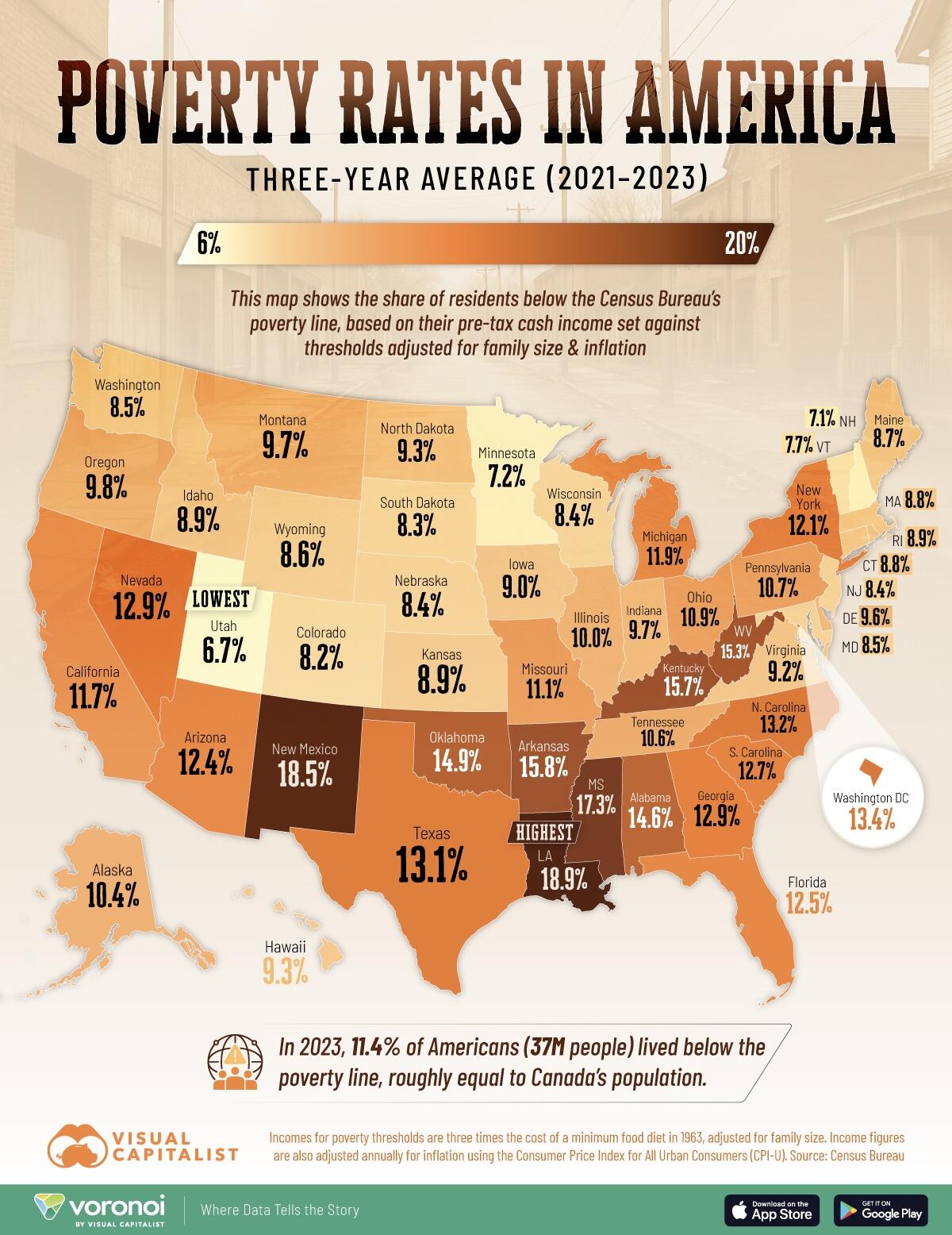
This map of U.S. poverty rates by state, via Visual Capitalist’s Pallavi Rao, makes that disparity clearer.

Each shade represents the share of residents living below the poverty line, inviting quick comparisons across the country.

The data for this visualization comes from the U.S. Census Bureau.

The U.S. Census Bureau calculates poverty lines using pretax household income against a threshold at three times the cost of a minimum food diet from 1963, adjusted for family size and inflation.

For reference, this is a quick guide on how much a household needs to be earning to be considered below the poverty line in 2023.

  • One person: ≤$15,480

  • Two people: ≤$19,680

  • Three people: ≤$24,230

  • Four people: ≤$31,200

Ranked: U.S. Poverty Rates by State

Louisiana tops the list at 18.9%, leaving nearly one in five residents below the poverty threshold despite the state’s large energy sector.

Rank State State Code Share of Population
in Poverty
# in Poverty
1 Louisiana LA 18.9% 853K
2 New Mexico NM 18.5% 388K
3 Mississippi MS 17.3% 501K
4 Arkansas AR 15.8% 473K
5 Kentucky KY 15.7% 699K
6 West Virginia WV 15.3% 268K
7 Oklahoma OK 14.9% 589K
8 Alabama AL 14.6% 727K
9 District of Columbia DC 13.4% 88K
10 North Carolina NC 13.2% 1.4M
11 Texas TX 13.1% 3.9M
12 Georgia GA 12.9% 1.4M
13 Nevada NV 12.9% 409K
14 South Carolina SC 12.7% 673K
15 Florida FL 12.5% 2.8M
16 Arizona AZ 12.4% 903K
17 New York NY 12.1% 2.3M
18 Michigan MI 11.9% 1.2M
19 California CA 11.7% 4.5M
20 Missouri MO 11.1% 675K
21 Ohio OH 10.9% 1.3M
22 Pennsylvania PA 10.7% 1.4M
23 Tennessee TN 10.6% 744K
24 Alaska AK 10.4% 74K
25 Illinois IL 10% 1.2M
26 Oregon OR 9.8% 415K
27 Indiana IN 9.7% 659K
28 Montana MT 9.7% 109K
29 Delaware DE 9.6% 98K
30 Hawaii HI 9.3% 133K
31 North Dakota ND 9.3% 72K
32 Virginia VA 9.2% 783K
33 Iowa IA 9% 287K
34 Idaho ID 8.9% 172K
35 Kansas KS 8.9% 255K
36 Rhode Island RI 8.9% 96K
37 Connecticut CT 8.8% 318K
38 Massachusetts MA 8.8% 604K
39 Maine ME 8.7% 120K
40 Wyoming WY 8.6% 49K
41 Maryland MD 8.5% 524K
42 Washington WA 8.5% 658K
43 Nebraska NE 8.4% 165K
44 New Jersey NJ 8.4% 776K
45 Wisconsin WI 8.4% 490K
46 South Dakota SD 8.3% 74K
47 Colorado CO 8.2% 473K
48 Vermont VT 7.7% 49K
49 Minnesota MN 7.2% 409K
50 New Hampshire NH 7.1% 98K
51 Utah UT 6.7% 226K
N/A U.S. US 11.4% 37.6M

Neighboring Mississippi (17.3%) and Arkansas (15.8%) tell a similar story of limited job diversity and chronically low household incomes.

In fact, a contiguous belt stretching from Louisiana and Mississippi through Arkansas and up to West Virginia contains every state with poverty rates above 15%.

Historic underinvestment, weaker safety-net programs, and lower average wages all help explain why the South accounts for four of the five worst-affected states.

Northern and Plains States See the Lowest Poverty Shares

In stark contrast, Utah (6.7%), New Hampshire (7.1%), Minnesota (7.2%), and Colorado (8.2%) post some of the lowest poverty figures in the country.

These states benefit from stronger labor markets, higher median wages, and broader access to education and healthcare.

Even populous Midwestern states like Illinois and Wisconsin keep poverty near or below 10%, underscoring how economic structure and public policy can insulate households from hardship.

Geography, then, is a reliable—if imperfect—proxy for opportunity in today’s America.

Population Size Skews the National Picture

Looking only at rates can mask the human scale of poverty.

California’s poverty rate sits near the national average at 11.7%, yet its sheer population means 4.5 million Californians live in poverty.

Texas tells a similar story: its 13.1% rate translates into 3.9 million people, the second-largest total nationwide.

Altogether, the U.S. counted 37.6 million residents in poverty during in 2023, almost the size of Canada’s entire population

If you enjoyed today’s post, check out Mapped: Average Salary by State in 2025 on Voronoi, the new app from Visual Capitalist.

Tyler Durden
Sun, 08/24/2025 – 18:05

Home Sales See Record July Cancellations As High Mortgage Rates Weigh On Buyers

0
Home Sales See Record July Cancellations As High Mortgage Rates Weigh On Buyers

Authored by Tom Ozimek via The Epoch Times,

A growing share of U.S. home sales collapsed in July as wary buyers pulled back, underscoring the strain of elevated mortgage rates despite a modest uptick in overall existing-home sales.

Roughly 58,000 purchase agreements fell through last month, equal to more than 15 percent of homes that went under contract, according to real estate brokerage Redfin. That’s the highest cancellation rate for July since the company began tracking the data in 2017.

Texas and Florida saw the most scrapped contracts, with San Antonio topping the list at nearly one in four deals canceled. Florida metros, including Fort Lauderdale, Jacksonville, and Tampa, also recorded some of the highest cancellation rates.

Real estate agents say buyers are taking advantage of a market where listings linger longer, giving them time to keep shopping or back out during inspections.

The most common reasons buyers back out are cold feet, high standards, and inspection issues, according to Bonnie Phillips, a Redfin agent in Cleveland.

She added that cancellations are especially common in borrowers using Federal Housing Administration loans and Department of Veterans Affairs loans, who can face more financing hurdles.

The cancellations came alongside a small uptick in overall sales. The National Association of Realtors (NAR) reported on Aug. 21 that existing-home sales rose 2 percent in July to an annual rate of just over 4 million units, up slightly from June’s nine-month low.

“The ever-so-slight improvement in housing affordability is inching up home sales,” NAR chief economist Lawrence Yun said in a statement.

“Wage growth is now comfortably outpacing home price growth, and buyers have more choices.”

Still, affordability remains the biggest challenge. The median existing-home price stood at $422,400 in July, barely changed from a year earlier, according to NAR data. Mortgage rates averaged 6.7 percent in July, more than double what buyers could lock in three years ago.

The strain is also evident among homebuilders.

A closely watched gauge of builder sentiment from the National Association of Home Builders (NAHB) fell in August to its lowest level in more than two-and-a-half years. More than a third of builders reported cutting prices by an average of 5 percent, while two-thirds offered incentives such as help with closing costs to attract wary buyers.

“Affordability continues to be the top challenge for the housing market, and buyers are waiting for mortgage rates to drop to move forward,” NAHB Chairman Buddy Hughes said in a statement.

“Builders are also grappling with supply-side headwinds, including ongoing frustrations with regulatory policies connected to developing land and building homes.”

Construction data point to the same slowdown. Government figures showed single-family housing starts fell in June to an 11-month low, while permits for future construction sank to the lowest level in more than two years. July data, however, showed some improvement.

Mortgage rates have eased slightly in recent months, trimming typical monthly payments and boosting purchasing power for some buyers. Markets widely expect that the Federal Reserve will cut rates soon—but analysts warn that mortgage rates won’t necessarily follow the Fed’s rate down if inflation remains elevated.

“A Fed rate cut does not mean lower mortgage rates. With inflation still sticky, mortgage rates could remain elevated even if there is a cut,” Lisa Sturtevant, chief economist at real estate data company Bright MLS, said in a recent commentary.

“Prospective home buyers who have been waiting for mortgage rates to come down may continue to be disappointed.”

Sturtevant noted that after years of higher prices for everyday goods and rising consumer debt, households have become increasingly cautious about taking on a mortgage.

“As a result, as we head into fall, more and more would-be buyers are going to decide to hold off and push their home buying out to 2026 when the economy may be more certain, inflation may come down, and rates may be lower,” she said.

Tyler Durden
Sun, 08/24/2025 – 17:30

Dirt Bike Gangs Terrorize Streets From D.C. To Baltimore

0
Dirt Bike Gangs Terrorize Streets From D.C. To Baltimore

It’s no secret that Democrats have failed the residents of the Mid-Atlantic. Whether it’s a power bill crisis fueled by disastrous green policies to “save the planet” in the name of some alleged climate crisis, or social-justice experiments at the local and state levels that have epically backfired and transformed parts of Washington, D.C., and Baltimore into crime-ridden hellholes, the days of law-abiding citizens tolerating this mess are over. 

Things have gotten so bad that President Trump deployed the National Guard across the D.C. metro area to support local law enforcement, which has suffered from a dangerous officer shortage in recent years after Democrats in the nation’s capital had the bright idea to defund the police… 

And – shocker, crime is coming down in some areas, according to official government data.

But it seems Trump has more work to do – as lawless assholes on dirt bikes and ATVs are terrorizing the DC area:

This extends across the Baltimore metro areas as well. 

Time for a little more ‘law and order’ – eh? 

Tyler Durden
Sun, 08/24/2025 – 16:55