In yet another tragic incident underscoring the dangers on America’s highways, a Punjabi migrant truck driver allegedly executed an illegal U-turn on Florida’s Turnpike near Fort Pierce on August 12, resulting in a catastrophic collision that killed three innocent Americans. The semi-truck, attempting the prohibited maneuver in an “official use only” area, was struck by a minivan carrying a 30-year-old driver from Pompano Beach and his passengers—a 37-year-old woman and a 54-year-old man from Miami. All three perished, with two dying at the scene and the driver succumbing later in the hospital.
Video footage captured the horrifying moment, showing the 18-wheeler blocking lanes and causing the fatal impact. The driver, reportedly an Indian migrant suspected of being part of a California Eco-System that exploits cheap labor, walked away uninjured. This crash mirrors a disturbing trend we’ve repeatedly highlighted: untrained migrant drivers flooding U.S. highways, leading to preventable deaths.
As American Truckers United has warned in previous reports, the Biden-era surge in foreign and non-domiciled CDLs has turned interstates into killing fields. From the deadly pileups in Austin, Terrell, Thomasville, and Chattanooga involving suspected non-citizen truckers, to cargo thefts by “ghost carriers,” these incidents are no coincidence. We’ve urged Transportation Secretary Duffy to ban CDLs issued to non-citizens and probe these threats, but inaction persists amid record migrant influxes into the industry.
This Florida tragedy, involving a California-based trucking profile from this cheap labor ecosystem, fits the exact mold: reckless actions by undertrained foreigners endangering American lives. Multilingual signs at Walmart and Amazon depots signal the scale, yet mom-and-pop U.S. truckers face bankruptcy while migrants fuel fraud and fatalities.”
For the edification of the group, here are the most common last names of trucking companies started since 2018. pic.twitter.com/IPz80w3H30
How many more Americans must die before we secure our highways? American Truckers United demands immediate federal intervention to halt this national security nightmare.
The American Trucking Industry has been gutted by unregulated immigration over the past five years. These “California ” drivers are part of an eco system that puts profit over safety. That puts greed before your family.
Concealing missile and rocket artillery launchers, or even swarms of kamikaze drones, inside civilian-style trucks and shipping containers fits directly into next-generation warfare, especially under the umbrella of deception and the ability to distribute lethality in plain sight.
The latest setup to pique our interest is a truck-mounted launch system for AGM-114 Hellfire missiles, developed by the 209th Arsenal, a production facility within Taiwan’s Armaments Bureau under the Ministry of National Defense.
According to military blog The War Zone, the twin-rail Hellfire launcher inside the bed of a box truck has a roof-mounted sensor mast that carries a small radar and an electro-optical/infrared sensor turret. The system can fire laser-guided Hellfires and radar-guided AGM-114L Longbows.
Video of the box truck with missiles in the rear first appeared on the Military News Agency’s YouTube page on Thursday, in a short feature from Taiwan’s Ministry of National Defense showcasing the latest military technology.
TWZ noted, “Missile and rocket artillery launchers hidden in plain sight inside civilian-style trucks, as well as unassuming shipping containers, have become something of a trend globally in recent years. China, Iran, North Korea, Russia, and even the United States have all been developing and/or fielding systems that fall into these categories,” adding, “Terrorists and other non-state actors have also employed improvised concealed launch systems over the years.”
Which brings us to the other side of the world, where Ukraine recently launched a brazen drone swarm attack deep inside Russia using shipping containers packed with armed drones. These containers were hidden in plain sight, allowing the drones, armed with mini warheads, to penetrate far into Russian territory and strike Moscow’s fleet of long-range bombers, damaging several.
We found a warehouse where containers with drones were collected.
Chelyabinsk, Sverdlovsk tract 28A. It was rented for 350,000 rubles. That’s why the truck in the Amur region had Chelyabinsk license plates – they were leaving from there. pic.twitter.com/rf5DJy8RDa
— Elizaveta Igorevna 🇷🇺 🇷🇺 (@ElisaIgorevna) June 1, 2025
Ukraine just mounted an attack that marks a turning point in the history of warfare
Hundreds of drones were pre-deployed and then struck 40+ aircraft 1000+ km inside of Russia
The bigger picture here is that militaries are disguising weapon systems as ordinary vehicles, shipping containers, and likely other in-plain-sight platforms that can bypass traditional countermeasures. This points to a very dangerous world ahead of the 2030s, one we would characterize as a high-threat environment.
We’re frogs in a pot that’s being heated so gradually that we no longer notice the sewage is extinguishing the utility of the Web.
Let’s take “Show me the incentives, and I’ll show you the outcome” and direct it on the Internet, the digital realm that is now central to modern life The incentives are making money from attention, i.e. clicks, engagement, etc. by any means available, and a burgeoning universe of cons, deception, extortion and fraud.
And with those incentives, the outcome is an ever-expanding river of toxic sewage, a river of AI slop, deep-fakes, phishing, clickbait and spam, spam, spam on every device, every platform, every screen.
This is not inconsequential. A physician-correspondent recently reported that he was researching a cardiovascular condition online and realized the article he was reviewing was AI slop, a conglomeration of inaccurate diagrams and plausible-sounding nonsense slapped together to get whatever meager income would be generated by a modest number of views.
That’s the incentive the Big Tech platforms set up: since it’s a low-odds gamble that any post will go viral on a large enough scale to make serious income, the incentive is to post 1,000 AI slop posts which each collect 1,000 views. In other words, make it up on volume.
Since the Internet is global, people in low-income nations have an incentive to generate AI slop to earn what is a pittance in developed nations. The barrier to entry is low–anyone can produce veritable mountains of AI slop with free tools and low-cost bandwidth–and the gains, however modest, are welcome if paid work is scarce.
The same “make it up on volume” approach incentivizes churning out millions of phishing and spam SMS, emails and posts on every platform under the sun. If there’s only one sucker per 10,000 entreaties, then send out 10 million.
Since views and engagement generate income, the more outrageous the clickbait, the better. And of course, the greater the volume of clickbait, the greater the income stream flowing to platforms hosting the clickbait.
AI tools incentivize creating deep-fakes of celebrities’ voices and personas which can then be deployed to con older Internet users who are often credulous enough to believe that yes, Owen Wilson is talking to me, see, it’s him.
Every legitimate institution is now a tripwire for phishing and spam.Your USPS package can’t be delivered, here’s your Social Security Statement, and so on.
AI Search is broken, too. I couldn’t find the original PropOrNot “fake-news about fake-news” list from 2016, and AI search concluded it was not available. Then a correspondent sent me a post on Zero Hedge which prominently displayed the entire original PropOrNot list. (oftwominds.com was on the list, thank you very much.)
The burden of shadow work required to delete, unsubscribe and purge our lives of all this sewage is growing heavier by the day. This calls to mind the boiled-frog analogy: we’re frogs in a pot that’s being heated so gradually that we no longer notice the sewage is extinguishing the utility of the Web.
And the reason is–drum roll–that’s how everyone makes money: views, engagement, scams, cons, fraud and above all, sheer volume. And who makes money from volume? The Big Tech platforms. So what if it’s misleading AI slop, deep-fake scams or clickbait, the more “engagement” we get, the more money we make.
So where’s the incentive to staunch the flood of sewage? There isn’t one. The incentive is to shrug and let the user sort it out by burning their own time.
If we want a different outcome, we have to change the incentives.
WoodMac Sounds Alarm On Transformer Shortage Amid AI Data Center Boom
The AI data center boom could soon face some serious headwinds, and the problem isn’t a shortage of Nvidia GPUs, but America’s fragile power grid.
A combination of disastrous green policies and soaring data center power demand has already sparked a power bill crisis across the Mid-Atlantic states, while a nationwide grid-tightening crisis unfolds. This has triggered a growing wave of discontent among residents in Maryland and New Jersey, who are angered by Democrats’ prioritization of green policies that have retired stable fossil fuel power generation in favor of unreliable solar and wind, resulting in power bill inflation like never seen before.
Making matters worse, AI data centers are counting on an upgraded grid to handle new base loads of power. This massive, multi-layered supply chain needed to upgrade the grid spans raw materials, transmission lines, circuit breakers, cables, control systems, and power generation systems.
Yet one of the most critical components in that upgrade cycle, transformers, is already in dangerously short supply.
A new report from global research and consultancy group Wood Mackenzie highlights that U.S. efforts to upgrade power grids for AI-driven data centers will push transformer demand beyond supply by 30% this year, driving up costs and delaying projects. Analysts warn the shortage will only worsen and persist well into the decade’s end.
The supply deficit, fueled by AI-related data center growth and broader electrification trends, threatens grid reliability and the whole data center buildout.
Viewed as a national security threat, the U.S. production of transformers can’t keep pace, meaning about 80% of units will be imported, mostly from South Korea, Mexico, and other countries.
“We have seen such a large increase in power demand,” said Ben Boucher, a senior analyst of supply chain and data analytics at Wood Mackenzie, adding, “AI is necessitating data center expansion, which is pushing up electricity usage.”
Just weeks ago, we warned that U.S. transformer wait times have ballooned from 50 to 127 weeks, crippling grid resilience, whether it’s upgrading power grids or replacing units damaged by storms, wildfires, or domestic terrorism attacks by radical leftists.
In short, the AI data center boom is colliding with a power grid already under strain from failed green policies, surging electricity demand, and a worsening transformer shortage. This is far from ideal in the era of massive data center buildouts, and wait until outrage over skyrocketing power bills goes fully mainstream. We bet that’s coming.
Ron Paul, the libertarian leaning former Texas congressman and GOP candidate for president, has always maintained that sanctions are acts of war. The Lancet Global Health recently published a study that proves him right.
Economists Mark Weisbrot, Francisco Rodríguez, and Silvio Rendón have found that the yearly total excess human death toll associated with economic sanctions across the world is roughly equivalent to the annual human death tolls of active wars and combat. In fact, the study reveals that on average the civilian deaths caused by sanctions exceed battle-related casualties in kinetic conflicts each year.
According to the study, the worst effects on populations across various age groups are caused by unilateral US and EU sanctions against targeted countries. The researchers argue “unilateral sanctions imposed by the USA or the EU might be designed in ways that have a greater negative effect on target populations.” UN sanctions, they add, “have been framed as efforts to minimise their impact on civilian populations, although the extent to which they have achieved this goal remains debated.”
In the period of 2012-2021, for example, the unilateral sanctions’ annual global death toll on average was 564, 258. The study also notes that most of the civilian deaths attributeable to sanctions between 1970 and 2020 were children less than five years old.
Economic and unilateral sanctions kill the most vulnerable members of a population including primarily children, the elderly, and the sick. The press release regarding the study, published by the Center for Economic and Policy Research, states “The researchers studied sanctions’ effects on age-specific mortality rates. They found that children under five made up 51 percent of total deaths due to sanctions over the 1970–2021 period. Most deaths (77 percent over the same period) were aged 0–15 and 60–80.”
The press release continues, “The study is the first to systematically examine the effects of sanctions on age-specific mortality in cross-country data using methods designed to address causal questions on observational data.” The researchers conclude that “the effects of sanctions on mortality generally increase over time, with longer-lived sanctions episodes resulting in higher tolls on lives.”
Washington has imposed brutal “maximum pressure” or “crippling” sanctions on poor countries across the world such as Venezuela, North Korea, Syria, Iraq, Afghanistan, and Cuba. Over the years, it has been documented that these sanctions have contributed to the preventable deaths of tens of thousands and in some cases hundreds of thousands of people in Venezuela and Iraq alone.
The US also imposes extensive sanctions regimes on more powerful countries than those listed above such as Russia and Iran. By cutting off the possibility of economic cooperation and interdependence, war has resulted in both cases during the last three years.
In 2021, erstwhile Secretary of State Antony Blinken declared that Washington was absolutely committed “to [opposing] the reconstruction of Syria” absent regime change. To that end, the US implemented a callous sanctions regime on Syria using the bipartisan Caesar Act, a law which targeted any person or entity of any nationality that attempted to do business with the war-torn country. These sanctions deliberately targeted the country’s engineering and construction sectors.
As a result, the civilian population was devastated. In 2022, Alena Douhan, a UN special rapporteur on unilateral coercive measures, visited Syria. She explained at the time that the sanctions “severely harm human rights and prevent any efforts for early recovery, rebuilding and reconstruction.”
Douhan stressed that “12 million Syrians grapple with food insecurity” and “90% of Syria’s population currently lives in poverty,” with limited access to food, shelter, water, electricity, healthcare, heating, cooking, fuel, and transportation. Partly as a result of the bipartisan economic war on Syria, Al Qaeda offshoots were able to seize Damascus and take over the country. Since then, sectarian violence has seen thousands of civilians slaughtered.
The use of sanctions, largely spearheaded by the US, has spread across the world over the last several decades. “25% of all countries [were] subject to some type of sanctions by either the USA, the EU, or the UN in the 2010–22 period, by contrast with an average of only 8% in the 1960s.”
Rodríguez insists the entire policy of economic warfare must be reevaluated. “We have seen economic sanctions — especially those imposed by the US — contribute substantially to economic collapse in targeted countries, such as Venezuela… Sanctions often fail to achieve their stated objectives and instead only punish the civilian populations of the targeted countries. It is well past time that the US, EU, and other powerful actors in the international community seriously reconsider this cruel and often counterproductive mechanism.”
The German federal government is already staggering into its first major crisis just months after its election. That it also stands economically bare amidst mostly self-inflicted turbulence has gone largely unnoticed. Meanwhile, no one in Berlin seems concerned about the country’s economic catastrophe.
To call Chancellor Friedrich Merz’s first 100 days a false start would be the understatement of the year. His initial report card is a disaster. His ostentatious alignment with the Left in fighting the AfD, the catastrophic decision to halt arms deliveries to Israel, and the break with Germany’s last vestiges of state raison d’être will contribute to the premature end of this coalition just as much as Merz’s wobbly course in the debate over the SPD-nominated Federal Constitutional Court judge Brosius-Gersdorf.
Fear-Driven Shock Paralysis
Merz is fear-driven, fleeing to the international stage to project an aura of strength domestically against the background of bellicose noise in Russia policy, avoiding the looming collapse of his government and the embarrassment of a short-lived chancellorship. Armament, military readiness, and a pinch of patriotism—this is the thin veneer of Merz’s last line of defense.
It is the nature of the media that the EU’s disastrous handling of the trade conflict with the US, the Gaza crisis, and the escalation of the Ukraine conflict dominate headlines. Meanwhile, Germany’s economic decline accelerates. To be fair, Merz inherited a poisoned political legacy. The country’s deep recession was handed down by his predecessor Olaf Scholz, along with the dire state of the German social funds, which currently show a deficit of around €47 billion.
The extreme imbalances in Germany’s social system – resulting from the recession, demographic aging, and uncontrolled migration – cannot be blamed on Merz any more than the hyperstate-like public sector, now managing half of all economic output through its channels. The energy crisis is also a fact the new government must confront, layered atop a complex mix of structural deficits that have rendered Germany nearly untouchable in the global competitive landscape.
Problem Recognized?
The question must be: Has Merz at least recognized the severity of the country’s economic crisis? And if so, what measures does his government plan to reverse it? In the third year of recession and with a loss of 700,000 jobs since 2019, it is clear Berlin knows the political course leads Germany toward catastrophe.
On the plus side, Merz can claim his so-called “investment booster,” mainly composed of two measures: the temporary reintroduction of declining balance depreciation until 2029 and a corporate tax cut from 15% to 10% starting 2028. These measures would relieve the economy by €11.3 billion, roughly 0.23% of GDP—laughably small given the economy already carries €146 billion in unnecessary bureaucracy costs.
Merz should have wielded the chainsaw here, but no German politician dares challenge a bureaucracy that has grown into a state within a state, adding half a million employees in the last six years.
Reform Refusal and Course Maintenance
Merz’s original promise to cut electricity taxes for business and consumers also signals, unspoken, that the green transition is seen as the root of the energy crisis, driving energy-intensive firms out of the country. Last year alone, €64.5 billion in direct investments left Germany, a long-standing trend now accelerating.
Consequently, Germany is losing its economic foundation, on the verge of becoming Europe’s Rust Belt, much like parts of the US. Yet Berlin does nothing: no electricity tax cut, no return to nuclear, no scrapping of the burdensome heating law. Merz refuses any reforms in the green transition. We are witnessing the continuation of Habeck’s deindustrialization agenda.
Merz avoids all conflict with Brussels’ Green Deal. The core of centralist policy, the key to Germany’s economic liberation, remains untouched, regardless of how sharply the recession bites.
An orderly withdrawal of the state from the frozen energy sector, weighed down by subsidies and regulations, is nowhere in sight. Talks with Moscow over gas imports are unthinkable—Brussels stubbornly polishes the 19th sanctions package. Merz watches as a policy takes root that delivers Germany a fatal economic blow.
Systemic Collapse
Even social fund problems, the scandalous citizen’s allowance, now promoted globally as aid for migrants, fall under economic policy. Like a rabbit before a snake, the government freezes amid widening deficits, attempting to fix health and pension insurance with new debt and supplementary transfers. Only an effective migration policy shift and painful reforms to social benefits could reverse the downward spiral.
Merz allows Germany to head toward French-style conditions—his historically and legally dubious €1 trillion debt program will push Germany into the middle ranks of European debt states, raising the debt-to-GDP ratio to 95%, turning the federal budget into an unbearable weight. Infrastructure spending is nice, but with social funds in crisis and defense commitments rising, resources will barely suffice to maintain existing assets.
No Regulatory Turnaround
Unless Germany’s economic course turns 180 degrees, this government will go down as a temporary continuation of the red-green agenda and a footnote in the country’s history. With a coalition backed by the Left, Merz lacks the political capital and personal reform drive to pull Germany out of crisis.
In Argentina today, one can observe the recipe for political turnaround: drastic state downsizing and deregulation should guide policy. The state’s share must shrink enough that private markets regain control of investment allocation.
Merz would need to break the ideological wall of his structurally leftist coalition, cancel the Green Deal with Brussels, and restore diplomatic relations with Moscow to turn the tide. Germany is light-years from such a paradigm shift. Until then, the economic substance left by two postwar generations will be politically squandered.
Washington Cancer Patient Has Car Stolen On First Day Of Treatment
On what should have been a day focused solely on fighting prostate cancer, Washington state resident Val Mohney got blindsided by a different kind of battle — car theft.
Mohney, who lives in Davenport, had traveled to Columbia City to stay with his friend Kristen Dean while starting treatment, according to Yahoo. But at around 6 a.m. Tuesday, the police called with news guaranteed to ruin anyone’s morning: his car had been stolen, joyridden, and crashed into a fence at a nearby middle school.
“Unfortunately, I started my day off with having my car ripped off and driven through a fence,” he told KING5. “I’m just trying to deal with cancer, and now I have to deal with that.”
Yahoo writes that the car was in bad shape — the ignition looked like someone had “taken a grenade” to it — and it was left abandoned in the school parking lot. For Mohney, a real estate agent, the loss isn’t just inconvenient; it’s income-threatening. “I’m the sole bread winner so if I’m not making money there’s no money coming in,” he said.
On top of everything, Mohney is caring for his mother, who has dementia, and his partner, whose disability limits how much they can work. Life has been throwing him lemons, bricks, and the occasional flaming bowling ball, but he’s focusing on his supporters.
“Really, I’m very fortunate because I have a big community of people that love me and I don’t know how people that don’t do it when stuff like that comes up,” he said.
Dean is now shuttling him to work between treatments — a job that apparently now comes with “personal chauffeur” in the description. Seattle police are combing through surveillance footage to find the joyrider, who remains at large. Meanwhile, a GoFundMe is helping Mohney keep going while he battles cancer and, apparently, other people’s bad life choices.
London’s Metropolitan Police has been accused of failing to protect the public after an asylum seeker housed at the Britannia Hotel in Canary Wharf entered an elderly woman’s home without permission — and was returned to the hotel without arrest.
The incident took place on Aug. 13, when police were called to Marsh Wall at 6:07 p.m. Officers claimed in a statement posted on social media that the man entered the property through an open door while “being followed by a group of men” in the street.
Police claim no intent could be proven, and the man was not arrested.
🇬🇧‼️ An illegal migrant staying in the Britannia Hotel in Canary Wharf was caught in an elderly woman’s house earlier today and was chased out.
Despite entering the house without permission, the police are not pursuing the matter further, and he was returned to his… pic.twitter.com/qyVBR2JZn0
However, the response was markedly different toward protesters angry about the housing of asylum seekers in the area. Three demonstrators outside the migrant hotel, questioning why the man was not arrested, were themselves detained — including a 22-year-old woman facing multiple charges such as common assault on a security guard, possession of an offensive weapon, and affray. A Section 35 dispersal order was issued in the area, leading to the arrest of a 28-year-old man and a 57-year-old woman for breaching it.
A statement regarding videos circulating online relating to an incident that officers were called to at 18:07hrs on Wednesday, 13 August at Marsh Wall, E14. pic.twitter.com/Wj4nNLrjUL
The police statement has triggered a wave of condemnation from commentators and public figures. Firas Modad, a presenter at Lotus Eaters, posted on X: “Wait. An illegal migrant enters a home. Three people get arrested. But not the trespasser?! And the person who objected to his presence gets the book thrown at her?” He called out Home Secretary Yvette Cooper, asking her if she would be demanding any resignations from the police force over the matter.
British barrister and political commentator Steven Barrett said, “Thanks, Evil Bot 3000, for trying. But do you mind telling your masters at the Metropolitan Police that this is both gibberish as law — and really, deeply, disturbing. Be normal people again.”
Rory Geoghegan, the founder of the Public Safety Foundation and a former police officer, wrote: “A world-class police service would recognize that it needs to do more than pump out statements like this. Why are senior officers and comms teams in the UK so afraid of holding proper briefings for the media and public?
People are openly talking about the prospect of civil war and that the country has ‘had enough’ — but those in HQ think the answer is a few lines of text?”
Conservative political commentator Sophie Corcoran said, “So you’re telling me this demonic-looking man, whom we know nothing about, can walk into a woman’s flat and not get arrested. Women are doomed.”
Met Police confirm that this thing entering your home is NOT a crime.
“Met Police confirm that this thing entering your home is NOT a crime. But being angry about it is. This is the UK 2025,” added nationalist activist Tommy Robinson.
The Met Police say they are reviewing body-worn video footage and other evidence, describing the incident as “a complex set of events.”
Trump Calls For “Peace Agreement” To End “Horrific War Between Russia & Ukraine”
Update (0748ET):
Good morning from the ZeroHedge desk.
After a night to digest the historic Trump-Putin summit in Alaska aimed at ending the devastating war in Ukraine – a conflict that has left more than a million killed or wounded and destroyed an entire nation- the European Council has released a joint statement. At the same time, the U.S. president posted his update on Truth Social.
Historic.
Let’s begin with President Trump’s Truth Social post:
A great and very successful day in Alaska! The meeting with President Vladimir Putin of Russia went very well, as did a late night phone call with President Zelenskyy of Ukraine, and various European Leaders, including the highly respected Secretary General of NATO. It was determined by all that the best way to end the horrific war between Russia and Ukraine is to go directly to a Peace Agreement, which would end the war, and not a mere Ceasefire Agreement, which often times do not hold up. President Zelenskyy will be coming to D.C., the Oval Office, on Monday afternoon. If all works out, we will then schedule a meeting with President Putin. Potentially, millions of people’s lives will be saved. Thank you for your attention to this matter!
Next, the European Council released a joint statement by the French president, Emmanuel Macron, the Italian prime minister, Giorgia Meloni, the German chancellor, Friedrich Merz, the British prime minister, Keir Starmer, the Finnish president, Alexander Stubb, the Polish prime minister, Donald Tusk, the European Council president, António Costa and the European Commission president, Ursula von der Leyen.
EU leaders welcomed Trump’s push to end the war in Ukraine. They backed his call for further talks with President Zelenskyy and signaled support for a potential trilateral summit.
Here’s a summary of the statement:
Security Guarantees: Ukraine must receive ironclad security guarantees, with no restrictions on its military or foreign partnerships.
Sovereignty: Territorial decisions rest solely with Ukraine; borders cannot be changed by force.
Western Support: The U.S. and Europe pledged continued military and economic backing, with sanctions pressure on Russia maintained until a just and lasting peace is achieved.ent, Emmanuel Macron, the Italian prime minister, Giorgia Meloni, the German chancellor, Friedrich Merz, the British prime minister, Keir Starmer, the Finnish president, Alexander Stubb, the Polish prime minister, Donald Tusk, the European Council president, António Costa and the European Commission president, Ursula von der Leyen.
What’s next: Ukrainian President Zelenskyy is scheduled to arrive in Washington on Monday to discuss a potential peace deal with President Trump in the Oval Office. If talks go well (unlike last time), Trump is expected to meet with Putin to push toward ending the war. This conflict, as explained by Putin yesterday, would never have happened if Trump had been president, implicitly blaming the rogue deep staters in the Biden-Harris regime for the mess.
* * *
Update (2032ET):
During a joint press conference following their multi-hour summit on ending the war in Ukraine, President Vladimir Putin said that if Donald Trump had been president in 2022, Russia would not have invaded Ukraine. This is essentially Putin blaming the Biden-Harris regime and its corrupt Deep State pals. We’re sure Western corporate media will be all but silent on this new development.
Putin stated:
“I’d like to remind you that in 2022, during the last contact with a previous administration, I tried to convince my previous American colleague it should not…the situation…should not be brought to the point of no return when it would come to hostilities. And I said quite directly back then that’s a big mistake. Today, when President Trump saying that if he was the president back then there will be no war. And I’m quite sure it would indeed be so. I can confirm that. I think overall me and President Trump have built a very good business-like trustworthy contact. And every reason to believe moving down this path better to the end of the conflict in Ukraine.”
🚨 BREAKING: Vladimir Putin CONFIRMS that the war in Ukraine NEVER would’ve happened if Trump was in office
Trump was RIGHT!
“Today, when President Trump says that if he was President back [in 2022], there would be no war. And I’m quite sure that it would indeed be. I can… pic.twitter.com/glYtFFWCG5
Political commentator Rogan O’Handley emphasized on X that “Democrat Media isn’t going to like this clip, but it’s true Biden and Kamala pushed for Ukraine to be added to NATO and then all hell broke loose Plus we all know Ukraine was Biden and the Deep State’s money laundering playground And don’t even get me started on the biolabs…”
After nearly three hours of talks, President Trump said, “Many points were agreed to, and there are just a very few that are left,” but gave no specifics, while Putin reiterated Russia’s hard-line demands for Ukrainian territorial concessions, disarmament, NATO exclusion, and regime change in Kyiv.
Both Trump and Putin seemed upbeat about finding a resolution to the war in Eastern Europe. They even shared a laugh…
🇷🇺🤝🇺🇸 Putin and Trump share a laugh after their JOINT press conference
Putin agreed with Trump that Ukraine’s security must be guaranteed, and framed the agreement as a starting point for resolving the Ukraine situation, as well as restoring economic relations.
“I would like to hope that the agreement we’ve reached together will help us bring closer that goal and will pave a path towards peace in Ukraine,” Putin says.
“I expect that today’s agreements will be the starting point, not only for the solution of the Ukrainian issue, but also will help us bring back businesslike and pragmatic relations between Russia and the US.”
He also notes that US and Russian investment and business cooperation have “tremendous potential.”
Trump then spoke:
“We had an extremely productive meeting and many points were agreed to. There are just a very few that are left.
Some are not that significant; one is probably the most significant, but we have a very good chance of getting there.
We didn’t get there but we have a very good chance of getting there.”
“There’s no deal until there’s a deal,”Trump added.
Trump added that he will confer with the leaders of NATO and Ukraine.
“I’m going to start making a few phone calls and tell them what happened,” he said.
Putin suggested the next meeting of the two leaders should be in Moscow. Trump frowned and suggested he would “take some heat” for that.
Neither Putin nor Trump fielded any questions from reporters.
* * *
Update (1830ET): Discussions concluded after more than two-and-a-half hours at the summit in Alaska, marking the longest in-person meeting by Trump and Putin and offering a sign that by the US leader’s own metric the talks went well.
Trump aide Dan Scavino said a three-on-three meeting was still ongoing at 1:25 p.m. Alaska time, more than two hours after reporters were ushered out of the room for the start of the formal discussions.
The Kremlin later said the narrow-format talks had finished.
Joining the leaders in Friday’s meeting were US Secretary of State Marco Rubio and Trump special envoy Steve Witkoff, with Russian Foreign Minister Sergei Lavrov and Kremlin foreign policy aide Yuri Ushakov accompanying Putin.
RT reports that Defense Minister Belousov is “in a great mood.”
Fox News is reporting that Trump is currently holding a call with Ukrainian President Zelensky and other European leaders.
Big B-2 flyover with both leaders on the tarmac, just after the handshake…
Footage showing the fly-over earlier of a U.S. Air Force B-2A “Spirit” Long-Range Strategic Stealth Bomber escorted by 4 F-35 Lightning IIs as President Donald J. Trump and Russian President Vladimir Putin meet at Joint Base Elmendorf–Richardson in Anchorage, Alaska. pic.twitter.com/yDx6nQFm9u
Update(1430ET): President Trump said just before landing in Anchorage that “there’s a good respect level on both sides” – but he has also threatened to “walk” if things don’t go well.
Trump told Fox News’ White House correspondent aboard Air Force One that if his meeting with Russian President Vladimir Putin doesn’t go well, “I would walk.” According to the brief exchange:
“I mean, if it doesn’t, you walk?” Baier asked.
“I would walk, yeah,” Trump said.
But Trump also struck a tone of optimism: “I think we’re going to do very well. Our country is doing very well. We’re setting records economically like we never have before, including the stock markets are all at record high,” he said.
Trump told Fox further, “We’re taking in trillions and trillions of dollars with tariffs. We’re going for a meeting with President Putin in Alaska, and I think it’s going to work out very well. And if it doesn’t, I’m gonna head back home real fast.”
“Look, he’s a smart guy. Been doing it for a long time, but so have I,” Trump said of Putin. “We get along. There’s a good respect level on both sides.” Per ABC and others:
A White House official confirms President Donald Trump’s meeting with Russian President Vladimir Putin will now be a three-on-three meeting. The president will be joined by White House Special Envoy Steve Witkoff and Secretary of State Marco Rubio.
For the expanded working lunch, the president will be joined by Rubio, Witkoff, Defense Secretary Pete Hegseth, Treasury Secretary Scott Bessent, Commerce Secretary Howard Lutnick and White House chief of staff Susie Wiles, according to a White House official.
Air Force One lands…
BREAKING: President Trump has arrived at Alaska military base for summit with Putin on the Russia-Ukraine war
President Trump has boarded Air Force One and is en route to Anchorage, Alaska – where what could be the most historic summit of his presidency is set to begin at 3pm Alaska time, which is 3pm eastern, and as the Russian delegation headed by Putin has already landed at Elmendorf-Richardson Air Force Base, which is venue for the talks.
Trump himself has been busy trying to temper expectations, calling it a “feel-out” meeting and the White House elsewhere referring to a “listening exercise” on the Ukraine war and bilateral Moscow-Washington relations.
While the consensus among Western officials and pundits is that deal to finally end the war is likely yet still far away, “we do expect some progress in today’s meeting and a path set for further discussions,” according to Mohit Kumar, chief European strategist at Jefferies International. “If we move toward a peace deal, it would be positive for the European markets.”
🚨President Trump is officially on his way to Anchorage, Alaska where he will meet with Russian President Vladimir Putin.pic.twitter.com/MHDw6NzjUx
Below is everything you need to know (via Newsquawk):
Trump-Putin Summit in Alaska on Friday 15th August 2025; Summit to begin at 15:00 EDT/20:00 BST; Trump assigned a 25% chance the meeting will not be successful.
OVERVIEW
MEETING FORMAT
US President Trump is to meet Russian President Putin in US territory at Elmendorf-Richardson Air Force Base near Anchorage, Alaska, on Friday, 15 August 2025.
White House said US President Trump will participate in a bilateral program with the President of the Russian Federation in Alaska at 11:00AM (15:00EDT/20:00BST) and will depart Alaska at 17:45 (21:45/02:45BST).
The Alaska summit will begin at 11:30 local time on Friday (20:30 BST/15:30 EDT), according to Russian Kremlin’s Ushakov on Wednesday.
Russian President Putin and US President Trump to have a one-on-one meeting with translators; also to have a wider meeting with delegations.
US President Trump on Thursday said that he does not know if there will be a joint press conference with Russian President Putin after the Alaska meeting. Trump will have a press conference however the talks go.
Russian delegation to include Russian Foreign Minister Lavrov, Advisor Ushakov, Defence Minister Belousov, Finance Minister Siluanov and Special Envoy and head of Sovereign Wealth Fund Dmitriev.
The meeting will be the first time the Russian leader has set foot on US soil since 2015.
Ukrainian President Zelensky is not invited to the Alaska summit.
PURPOSE:
The meeting aims to explore ways to end Russia’s war against Ukraine.
Russia’s Kremlin said the central topic is Ukraine. The sides are to discuss trade and economic cooperation where there is “huge untapped potential”.
White House spokeswoman Leavitt described it as a “listening exercise” to hear what Putin proposes.
“At the end of that meeting, probably the first two minutes, I’ll know exactly whether or not a deal can be made,” Trump said at a White House press conference.
EXPECTATIONS
The White House downplayed expectations, describing the meeting as a listening exercise. President Trump called it a leel-out meeting.
US President Trump on Thursday assigned a 25% chance that the first meeting (Alaska) is not successful; and said he could be more sanctions if the meeting is not successful. Trump added Have economic incentives and disincentives at his disposal for the meeting; would rather not say about specifics. Incentives/sanctions are “very powerful”.
There are no plans to sign documents on the outcome of the Alaska summit between Russia and the US, via Ifx citing the Kremlin; would be a mistake to predict the outcome of the talks.
“All in all, it is difficult to envision a smooth solution to the Russia-Ukraine war through this summit, with Moscow demanding Ukraine give up some territory, a red line for Kyiv.”
Analysts at Rane suggest the Friday summit “risks side-lining Ukraine, fracturing Western unity and creating space for Russia to delay sanctions, consolidate battlefield gains and promote a US-Russia framework that advances Russian strategic interests.” Markets will likely focus on several factors:
the prospect of looser US sanctions on Russia.
how far Russia is willing to go on concessions.
any tangible progress towards a Russia-Ukraine ceasefire.
TRUMP’S CALL WITH EUROPEAN LEADERS ON WEDNESDAY
US President Trump held a call with European leaders and Ukrainian President Zelensky, which he said was a very good call and “rate it a 10”, while he will meet with Russian President Putin, then will call Zelensky and European leaders.
Trump said there is a good chance of a second meeting and he would like to do a second meeting almost immediately which would include Zelensky if the first meeting goes okay, but there may not be a second meeting if he feels it is inappropriate or if he does not get the answers he wants.
Furthermore, he said the first meeting is finding out what they are doing and a second meeting will be more productive, but warned that Russia will face consequences if the war is not stopped.
US President Trump discussed with European leaders possible locations for a meeting between Zelensky, Trump and Putin after the Alaska summit, while locations include cities in Europe and the Middle East, according to Reuters citing sources.
US President Trump reportedly told those on Wednesday’s call that he is willing to contribute US security guarantees for Ukraine with some conditions, via Politico citing sources; openness that helps explain the cautious European optimism. Guarantees which are seen as key by Europe and Ukraine. However, Politico caveats that Trump did not elaborate on what he meant by security guarantees, and would only make this commitment of the effort is not part of NATO.
RUSSIA’S PRE-MEETING COMMENTS
Russian Foreign Ministry says Moscow expects Trump’s visit to Russia after Alaska summit, according to AI Arabiya.
“We have a clear position that we will present at the Alaska summit and hope to continue the dialogue”.
“We do not speculate on anything in the future and we have clear arguments and positions that we will present during the Alaska summit”.
Russian President Putin said the US is making a sincere effort to find a solution for the Ukraine crisis; US are seeking agreements that are acceptable to all, via Ifx. Peace will be strengthened if at the next stage Russia and US reach agreements in the field of strategic offensive arms control. New arms agreements with US are possible.
UKRAINE INVOLVEMENT
President Trump said he may arrange a subsequent meeting involving Zelensky and Putin, but he dismissed Zelensky’s desire to participate directly, noting that the Ukrainian leader has ‘ been to a lot of meetings’ without ending the war.
Zelensky criticised the summit’s bilateral format, warning that any peace deal must be approved in a national referendum and that the absence of Ukraine would render an agreement illegitimate.
RENEWED OFFENSIVE
Ukrainian President Zelensky on August 12th posted, “We see that the Russian army is not preparing to end the war. On the contrary, they are making movements that indicate preparations for new offensive operations.”
Zelensky added that Russia is moving troops from the Sumy region to Pokrovsky, Zaporizhzhia, and is preparing for a new assault at the start of September.
Zelensky said the current Russian push in eastern Ukraine is timed to coincide with Trump-Putin talks.
Ukrainian President Zelensky has repeatedly stated that Ukraine will not cede land.
Russian President Putin reportedly appears ready to test new nuclear-armed, nuclear-powered cruise missiles even as he prepares for talks with US President Trump, according to US researchers and Western security sources cited by Reuters.
Ukraine’s military says it struck Russia’s port Olya in the Astrakhan region on Thursday and hit a ship with drone parts and ammo from Iran.
STANCES
RUSSIA’S POSITION
Russian President Putin is seek ng to lock in Russia’s territorial gains and prevent Ukraine from joining NATO. Reports suggest Putin may have floated a ceasefire that asks Ukraine to cede much of Donetsk and to demilitarize
Bloomberg reported on August 5th that the Kremlin is said to be mulling options for a concession to US President Trump that could include an air truce with Ukraine, in a bid to minimize the threat of secondary sanctions
US and Russia reportedly planning Ukraine deal to cement Russ an territorial gains, according to Bloomberg (Aug 8th). Russia would halt its offensive in the Kherson and Zaporizhzhia regions of Ukraine
Russian President Putin reportedly demands Ukraine cede Donetsk Lunansk and Crimea.
Putin told Witkoff he would agree to a complete cease-fire if Ukraine agreed to withdraw forces from all of Ukraine s Eastern Donetsk region.
UKRAINE’S POSITION
Ukrainian President Zelensky said he understood that Russia wants Kyiv to pull out of Donbas and will not advance in other directions in exchange, he added that Ukraine will not pull out of Donbas as such a move would open the way for Russia to attack Dnipropetrovsk. Zaporizhzhia regions, and Kharkiv
Zelensky added that territorial issues should be discussed after the ceasefire and along with security guarantees for Ukraine.
In a press conference, he warned that Russia wants Ukraine to withdraw from the remaining 30% of the Donetsk region, but Ukraine’s constitution prohibits surrendering territory.
He also emphasized that giving up Donbas would become a springboard for future invasions; he insists Ukraine will not leave its fortifications or open an avenue for a Russian offensive.
Ukraine insists on a durable ceasefire before any discussion of territorial issues. According to Politico Zelenskyy and European allies will use Wednesday’s call tc push for a deal that demands a lasting ceasefire.
Prior reports of softened Ukraine Stance
Ukraine could agree to stop fighting and cede territory already held by Russia as pal of a European-backed plan for peace, according to The Telegraph (Aug 11th)
Ukrainian President Zelensky reportedly told European leaders that they must reject any settlement produced by Trump, which sees them giving up Ukrainian land they still hold, but that Ukrainian territory in Russia’s control could be on the table. This would mean freezing the frontline where it is and handing Russia de facto control of the territory it occupies
EU/NATO POSITION
EU and NATO leaders insist that Ukraine’s sovereignty and security guarantees are non-negotiable while analysts caution that land-swap proposals risk legitimizing aggression.
NATO Secretary-Genera Rutte described the Alaska summit as a way to test Putin’s seriousness and stressed that Ukraine must decide its own future he argued that only involving Ukraine and Europe will make any settlement
EU Foreign Policy Chief Kallas said on August 11th that the EU will work on a 1st package of sanctions against Russia while she warned against concessions to Moscow.
Germany said it will fund a USD 500m n package of military equipment and munitions
Polish PM Tusk said they cannot allow the biggest powers to decide the fate of smaller countries without their participation and Russia wants to ink a reduction in NATO troops in Poland to the talks about Ukraine, while he added It will be easier for Poland’s opponents to “play us” if we are not united.
POTENTIAL SCENARIOS AND MARKET ANGLES
No Deal [most likely]:
Analysts consider it likely that the summit results n no ma or agreement Trump may simply gauge Put n s intentions and then coordinate with Zelenskyy and Europe.
Broader sentiment will likely not be too swayed by a “no deal” amid low expectations heading into the meeting
Limited Ceasefire [possible]
This could be seen as progress toward de-escalation: on and potential easing of sanctions
A “limited ceasefire” could be short-term negative for oil. defense stocks whilst stocks and EUR equities and EGBs could be buoyed
Some analysts suggest Russia could use a limited ceasefire to regroup and delay sanctions.
US-Russia Tensions Escalate [possible but not in bilateral interests]
A further breakdown in relations between Moscow and Washington could see risk avers on and a rise in oil prices.
Goldman Sachs: While lack of progress towards a ceasefire may lead renewed threats of secondary oil tariffs/sanctions, we see limited risk of large disruptions in Russia supply given the large volumes of Russian exports the possibility for deepening price discounts to maintain demand, and Iikely eagerness of the key buyers, India and especially China to continue energy cooperation with Russia
As a reminder. US President Trump recently ordered two nuclear submarines to be “positioned in the appropriate regions” in response to “highly provocative ’ comments by former Russian President Medvedev
Land-Swap Proposal [possible but unlikely to be accepted]:
If Trump agrees to a ceasefire that frontloads territorial concessions, analysts warn that Ukraine and Europe will reject it. Such a deal could trigger political backlash in Ukraine and may collapse due to constitutional and public opposition
Short-term risk across markets amid progress toward de-escalation and potent al easing of sanctions with energy likely to slip. However, the reaction will likely fade if/when rejected by Ukraine.
Comprehensive Framework [near-zero]
Neither side currently appears willing to make the necessary concessions. Without Ukraine’s participation on any framework is likely to faiI.
Risk on. energy sold
Goldman Sachs “While a lasting peace agreement may potentially lead to a relaxation of US sanctions on Russian oil we wouldn’t expect a significant short-term increase in Russian oiI supply in this scenario. The reason is that Russian production, in our view, has instead been constrained by CPEC+ quota decisions, low oi: investment, and a strong Ruble
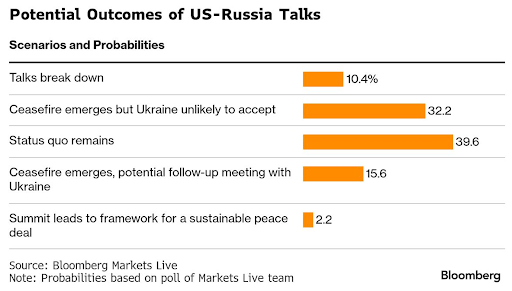
Here is what the most likely outcomes are according to a Bloomberg Markets Live poll:
BLOOMBERG: Bloomberg’s John Authers citing Christopher Smart of the Arbroath Group says “European defence stocks should fly on any lopsided deal that rewards Russia’s aggression with oil prices likely to slump on even the whiff of looser sanctions on Russian oil… Beyond Europe, markets appear to have long since moved past the 2022 invasion, implying Friday s meeting has little potential to trigger a significant market shift. “
GOLDMAN SACHS: We don’t expect the announced meeting between President Trump and President Putin, scheduled for Friday August 15 to cause a significant shift in Russian oil supply in key scenarios”.
ING: If we do see some level of de-escalation, it could remove sanction risk from the oil market. This would likely drive prices lower, given the Bearish fundamentals .
Libya To Hold Rare Elections As Post-Gaddafi Chaos Persists
Since 2011 and the NATO-led overthrow and killing of longtime leader Muammar Qaddafi, Libya has remained factured and divided into at least two major rival governments.
At times there have existed even three or up to four governments in sectors of the country, largely commanded by warlords – and yet the media has largely forgotten ‘Obama’s war’ – also under then Secretary of State Hillary Clinton.
Libya is now preparing to hold rare municipal elections, due to happen on Saturday, which is widely being viewed as a significant and uncertain test for the country’s fragile attempts to jump-start democratic institutions. Election locations are under threat of gunfire and attack.
But things are already looking to fail, given that the key cities of Benghazi, Sirte, and Tobruk have made clear they are opting out of the vote.
The United Nations has characterized the elections as “crucial for maintaining democratic governance” – but has warned of significant security threats.
Nearly 400,000 Libyans are expected to participate in the vote:
Initially, elections were planned in 63 municipalities across Libya — 41 in the west, 13 in the east, and nine in the south — but the High National Elections Commission (HNEC) suspended voting in 11 eastern and southern districts due to irregularities, administrative problems, and pressure from local powerbrokers.
In some areas around Tripoli, delays in distributing voter cards led to further postponements.
But days ago gunmen attacked the electoral commission’s headquarters in Zliten, which lies 160 kilometers east of Tripoli. No deaths were reported.
Despite a 2020 ceasefire and several diplomatic efforts to unify the country, Libya remains fractured, with heavily armed factions vying for power, and seeking to influence and control of lucrative oil and gas resources.
Here is the map of Libya after 14 years of NATO’s regime-change war. I’m sure Syria will be different though 👍🏽 pic.twitter.com/UGGpAeQ1fB
There’s long been a UN-backed Tripoli-based government in the West, and in the East powerful warlord Khalifa Haftar, based out of Benghazi. They have intermittently clashed, but with both Russia and the US having generally positive relations with Haftar.