France’s Debt Time Bomb Is Ticking Beneath The Summer Calm
Submitted by Thomas Kolbe
France remains a politically immovable monolith. A toxic mix of a ballooning budget deficit, an overgrown welfare state, and a persistent recession makes the country a prime candidate for a full-blown sovereign debt crisis. If the government fails to pass its budget, Europe could be in for a heated autumn.
Cuts to social benefits, pension freezes, or reductions in health coverage have historically ended in general strikes, highway blockades, or suburban riots. The media tends to romanticize this as “character strength” — a people resisting the stingy state and fighting for their rights.
What’s left unsaid is that France operates with a staggering government spending ratio of 57% of GDP — the largest welfare state in the EU, possibly even the democratic world champion of redistribution. This deeply socialist policy mix has driven the country into a fiscal and economic dead end.
Interest Costs Explode
Public debt stands at around 114% of GDP, with Prime Minister François Bayrou’s government planning fresh borrowing of 5.4% of GDP this year — figures so far removed from the defunct Maastricht criteria they make you dizzy. In July, Bayrou managed to trim the projected deficit from 5.8% to 5.4%, a €5 billion reduction.
But in the face of a €3 trillion debt mountain, this is less than a drop in the bucket — a faint pulse from a policy in terminal decline. Bond markets have taken notice: yields on 10-year French debt have climbed 30 basis points over the past year to 3.3%. That means at least €67 billion in interest costs this year — €16 billion more than last year — squeezing government room to maneuver like ice melting on the Côte d’Azur.
Calm Before the Storm
For now, the summer news drought has swallowed the debt crisis narrative. Since Bayrou’s mid-July reform package, the media has gone silent. In truth, budgets like France’s, Spain’s, or Italy’s have only been kept afloat thanks to the ECB’s willingness to crush bond market unrest with massive interventions — a habit developed since the last debt crisis 15 years ago.
Short of Luxembourg, no major EU state could fend off a sovereign debt crisis alone. At this point, real reforms may already be too late: any drastic cuts would collapse economies hooked on subsidies, cheap credit, and state interventionism, triggering mass unemployment and social unrest.
Still, Paris seems to have recognized the urgency. Three weeks ago, Bayrou unveiled the next consolidation package: €44 billion in spending cuts for next year (about 1.5% of GDP). The plan includes a hiring freeze for civil servants, merging inefficient agencies, and freezing welfare and pensions in 2026 at 2025 levels — a “blank year” for the welfare state. Only the defense budget will rise, in line with NATO demands.
Wealthy taxpayers will lose certain breaks, the healthcare system will be trimmed, and sick leave will be monitored more strictly. If the economy holds, the deficit could drop to 4.6% next year, with the government aiming for Maastricht’s 3% cap by 2029. But given France’s track record, few expect the numbers to hold once the social peace bill comes due.
Symbolic Misstep
The package also scraps two public holidays — Easter Monday and, controversially, May 8, the WWII victory day. While aimed at boosting productivity, many patriotic French will see this as a provocation, hardly a way to win public backing for fiscal reform. Facing organized resistance and the threat of another no-confidence vote, Bayrou has floated the idea of a 2026 budget referendum — an unusual gamble that may backfire.
Like Germany, France’s budget crisis is unfolding amid recession. Weak consumer sentiment and falling retail sales are partially offset by tourism, expected to grow 6% this year. But France is deindustrializing, its manufacturing PMI stuck around 48, and construction output at 43 — deep in recession territory.
For now, the summer lull allows Paris to bury its own fiscal mess beneath coverage of America’s debt drama. But Brussels fears that a French bond market panic could bring down the EU’s entire debt edifice. With a deepening U.S. trade war and a worsening recession, France’s crisis could be back in the headlines within weeks — possibly ushering in a hot autumn in Paris and a new European debt drama.
* * *
About the author: Thomas Kolbe, a Germany graduate economist, has worked for over 25 years as a journalist and media producer for clients from various industries and business associations. As a publicist, he focuses on economic processes and observes geopolitical events from the perspective of the capital markets. His publications follow a philosophy that focuses on the individual and their right to self-determination.
Some readers might recall a year ago the internet was in an uproar about a commencement speech given by Kansas City Chiefs kicker Harrison Butker at Benedictine College, a private Catholic liberal arts school in Kansas. The speech went viral due to his denouncement of abortion, Pride Month, COVID-19 lockdowns and the tyranny of diversity, equity and inclusion.
However, it was his comments on women in the workforce that really put a twist in the panties of the leftist media:
“I want to speak directly to you briefly because I think it is you, the women, who have had the most diabolical lies told to you, how many of you are sitting here now about to cross the stage, and are thinking about all the promotions and titles you’re going to get in your career…
Some of you may go on to lead successful careers in the world. But I would venture to guess that the majority of you are most excited about your marriage and the children you will bring into this world.”
“I can tell you that my beautiful wife Isabelle would be the first to say that her life truly started when she began living her vocation as a wife and as a mother…”
Leftists were enraged and attempted to cancel Butker. The problem was that cancel culture was in steep decline and the activist mobs had already lost much of their previous influence. More than DEI, more than ESG, more than CRT or the LGBT movement, leftists are most protective of feminism. It is, in a way, the “mother” of all other progressive propaganda movements in America.
As I have noted in the past, there are many Marxist and globalist ideologies focused on social engineering, but the first and perhaps most dangerous in the US is feminism. It’s not a coincidence that Karl Marx and Friedrich Engels published their Communist Manifesto in February of 1848, and feminism traces its roots directly to the Seneca Falls Convention in New York, held in July of 1848 (many of the women involved in the event would go on to express ties to socialism, including Fabian socialism).
Feminism was originally predicated on the idea that women should have access to the same legal rights as men. This was achieved many decades ago, yet activists continue to demand more privileges as the movement seeks to justify its ongoing existence. This begs the question: What is the real purpose of feminism?
In my research I recently stumbled across an article titled “Global 7 Billion: Half A Solution From Ted Turner” published by Forbes Magazine in 2011. For those who are unaware, Turner has been deeply involved in the globalist population control agenda prescribed by the Club of Rome and the UN since the 1970s. Turner publicly called for population reduction on a number of occasions and admitted that he thinks that an 80% decline in human beings would be ideal.
This agenda was launched in the name of “man-made climate change”, which has been thoroughly debunked as fraudulent (see my articles on the lack of correlation or causation between carbon emissions and temperatures in long term climate history, as an example).
Turner made it clear that population control primarily targeted women through increased access to contraception and abortion (the obvious), but one comment in the article stood out immediately. Forbes notes:
“There’s never a golden bullet to a systemic problem such as this, but the closest thing that does exists is not contraception provision, it is girls’ education.
Educating girls enables them to see and enact opportunities outside of childraising, and once they have other options they become much more likely to reach for the birth control after 2.5 children, just like their Western counterparts (often in direct contravention of patriarchal and religious doctrine — which education empowers them to resist)…”
The article goes on to argue that the educational focus on girls over boys is not unfair, but an act of historical correction for previous injustices (reparations). For any DEI agenda, abandoning meritocracy in order to enforce“fairness” requires that we subsidize one group over another. Feminism is no different.
Women today outnumber men in college admissions because colleges deliberately overlook male applicants (often with superior merits) and give female applicants special preference. Beyond that, women are more likely to be given grants and scholarships. Scholarships specifically designated for women number in the thousands, while male only scholarships number in the dozens.
In the business world, women are once again given special preference due to subsidies. State and federal governments have established numerous grants (Women in Apprenticeship and Nontraditional Occupations (WANTO) Grant Program), programs and tax deductions (like the Work Opportunity Tax Credit) for companies that hire more women. ESG related initiatives (funded by globalists) were the greatest driver of women-centric hiring, with companies getting access to a number of loans and incentives in exchange for a hiring focus on women and minorities. There are no such programs or incentives specifically for hiring men, especially white men.
The disparity is undeniable – Most women can only “succeed” in the working world when they are propped up by governments, NGOs and corporations seeking government payouts.
And, as Ted Turner and Forbes assert, this is by design. The longer women stay within the educational system and the more they are pushed into the workforce, the more likely they are to take contraception and the more likely they are to reject traditional relationships and not start a family. As a bonus, the longer women stay in the current far-left academic environment the more they can be indoctrinated with feminism and the less they will want to have children anyway.
In other words, feminism is primarily about population control and it is proving to be wildly effective. Within the next five years, 45% of women ages 25-44 will be single and childless. Western population growth is in steep decline and by the next generation there will be a societal crisis with the elderly greatly outnumbering the young.
We need to start asking hard questions as a civilization, and this is where we come back to Harrison Butker and his commencement speech in Kansas. In an open minded, liberal and “democratic” society we’re not supposed put limits on personal freedom. For around 70 years America has functioned on an “anything goes” playbook (the liberal playbook). If it feels good, do it. Don’t let “the man” hold you back. But this philosophy is not working, it’s destroying us. It turns out that gender roles are actually important.
What can we do about it? I suggest adopting a principle that weighs costs vs. benefits when it comes to women in the workforce. Not just women as a group, but individual women and their potential. I call this the “Butker Principle”.
The Butker Principle requires that women consider the advantages of the career they are pursuing and ask: “Is my job more valuable to the world than raising a healthy family?”
Is she working in STEM improving important technologies? Is she saving lives as a doctor or nurse? Is she providing a service that most people cannot provide? Does she own and operate a business that is creating jobs? Or, is she working as an HR representative taking mindless complaints from other women who should be at home?
Furthermore, we need to ask: “Can a man do the same job better?”
If so, then a man should be in that position providing greater value and greater productivity. At bottom, there are not many women in many fields of expertise that are offering the world more than if they were simply nurturing children to become better adults in the future.
This might sound like the kind of “greater good” argument the political left is known for, but I would point out that the greater good for leftists is always the worst case scenario for everyone else. We’ve had many years to observe the effects of feminism on our society and it is a clear net negative. The “greater good”, in this case, is to simply correct that mistake.
We must also consider the economic benefits if most women were to leave the labor pool. For example, the larger female workforce has saturated markets and throttled wage growth over the years. You want to know why almost 70% of American families used to be able to live on a single income in 1970 and that number has dropped to 25% today? Inflation is not the only factor.
Wages are about supply and demand, like anything else. Women flooded into white collar and retail environments and gave corporations a massive gift – Not only could these conglomerates keep wages low because of too much competition, they could also get subsidies for hiring females and making them feel independent (relying on big daddy CEO is apparently independent while relying on a husband is not…).
Beyond driving down wages, single women also eat up a large portion of the US housing market (more than illegal immigrants). The extra demand throttles supply and drives up home prices and rent payments. Imagine if just 20% of working women left the labor pool and abandoned single life – The housing supply would skyrocket and prices would drop dramatically. Women could save the economy simply by not taking up space.
This is not to say that there are not women out there doing great work. I’m sure there are many, but again, if we were to examine the situation case by case I think we would find that the majority of women are not working in jobs that are more important than building a family. The Butker Principle must be applied to save our nation, to save the nuclear family and to save the psychological health of the west.
Women have been conned by feminist propaganda into believing that they can have it all – They think they can pursue a stunning career in which they receive endless accolades and applause. They think they can gain masculine power and financial parity and they think they can have a family whenever it suits them. This false assumption has led many women to waste their 20s struggling for “boss babe” status and missing out on their prime years finding a husband and building a home.
To be sure, liberals (and many libertarians) will argue that if a woman wants to waste her life away working in a meaningless office job instead of having kids, then that is her right. I probably would have said the same thing twenty years ago but history is not kind to people who ignore the hard data. The west is decaying at a rapid rate and drastic measures need to be taken.
Does this mean forcing women to stay home? In a way, yes, but not by erasing their freedom to work. Rather, the solution may be as basic as returning to meritocracy in business environments. How? By canceling all government incentives and educational scholarships specifically for women of child bearing age. And, by eliminating affirmative action laws that push companies to maintain a female labor quota, specifically Title VII and the Equal Employment Opportunity Act of 1972.
In other words, level the playing field back to the days before second wave feminism and let women compete. Most will not be capable, which means they will be forced to temper their expectations and fantasies, find a man, have children and, God forbid, become happy housewives. What a tragedy that would be…
To summarize, the Butker Principle is meant to defeat an agenda that was set in motion over a century ago to undermine western civilization, drive down wages and artificially suppress the population. The poisonous fruits of that agenda are now widely visible. Some of the people involved in the early movement might have had good intentions, but this is ultimately irrelevant. The results are the results, and feminism is a disaster for everyone except the globalists and the corporate oligarchy.
The fastest way to end feminism is to end the majority of female participation in the jobs market. It’s the only solution that makes sense.
“Detect, Track, Neutralize”: Autonomous Turrets With Low-Cost Firepower To Counter Kamikaze Drones
The modern battlefield in Ukraine has seen a multi-year proliferation of low-cost, first-person-view (FPV) drones that cost around $500 per unit and are modified to deliver small explosive payloads.
Ukrainian and Russian military forces both deploy electronic countermeasures, including radio-frequency jamming systems, along the front and secondary lines. These measures have achieved partial success, yet the move by both sides to deploy non-jammable fiber-optic drones has rendered these electronic jammers useless.
Engaging low-cost FPV drones can involve anything from sticks to 50-cent shotgun shells to $100,000 surface-to-air missiles. It is economically unsustainable for any military force to rely on expensive missiles to counter cheap, Chinese-made FPVs, and this mismatch risks rapidly depleting precision munitions inventories for higher-value targets.
The proper response in the era of FPV kamikaze drones, which will only get faster and more intelligent with artificial intelligence, is for immediate development and deployment of cost-effective, scalable counter-unmanned aircraft systems (CUAS).
Military startup Sentradel is developing a low-cost, easily deployable CUAS system designed to target small drones using inexpensive kinetic interceptors, such as bullets.
“In today’s threat landscape, a $500 FPV drone can easily destroy a $10M tank,” Sentradel stated on its website, warning, “We’re losing this asymmetric cost warfare. The solution is NOT $100,000 missiles, it’s affordable systems like Sentradel.”
These CUAS systems appear to be autonomous turrets packed with AI that are designed to detect, track, and destroy small drones. The weapon of choice mounted on the turret seems to be an AR-platform shotgun.
Israel is concerned about a surge in military cooperation between the Islamic Republic of Iran and China, according to a report by Yedioth Ahronoth.
The report notes that the concern lies with Chinese–Iranian cooperation on the manufacture of surface-to-surface missiles. It also says western intelligence agencies, particularly European agencies, have observed close cooperation between Tehran and Beijing recently.
“We do not know China’s intentions yet, and we have sent clear messages to them, but Beijing does not confirm that it intends to supply Iran with surface-to-surface missiles,” Israeli officials are cited as saying by the outlet. According to the report, China “is now actually rebuilding the Iranian capabilities.”
In late July, Israel’s Ambassador to the US, Yechiel Leiter, warned that there were “troubling” signs of Chinese support for Iranian efforts to rebuild and restock its missile arsenal following the 12-day, US-backed Israeli war in June.
“There’s some traffic that is troubling for us … and we want to make sure that we’re not dealing with chemicals [and] the ability to reconstitute a ballistic missile program,” Leiter said in an interview with Voice of America.
He said Israel bears responsibility for ensuring that “China or other bad actors don’t allow them to reconstitute” missile stockpiles. “There’s no reason why we couldn’t have good relations with the people of China. But we certainly don’t want to see China acting alongside those who threaten our very existence.”
Weeks before the ambassador’s remarks, Middle East Eye (MEE) reported that China sent surface-to-air missile batteries to Iran after the 12-day war. The report said Tehran has paid for new Chinese deliveries with shipments of Iranian oil.
The Israeli army stated it would prevent Iran from being able to fire ballistic missiles at Israel during the war, but failed to achieve that goal.
Iran’s missiles caused widespread destruction across Israel. Key universities, research centers, and technological hubs were struck. Several military bases were also hit, yet media censorship has prevented much of the details from being released.
The Yedioth Ahronoth report comes as there is talk of a renewed war between Israel and Iran. Israeli officials have publicly threatened to resume strikes on the Islamic Republic. Israeli Defense Minister Israel Katz announced on 27 June that he instructed the Israeli army to prepare an “enforcement plan” against Iran’s nuclear and missile programs.
Tehran has vowed to continue pursuing nuclear enrichment and a peaceful nuclear energy program, despite threats. Intelligence assessments have confirmed that US President Donald Trump’s bunker-buster attack on Iran, while damaging, failed to “obliterate” the country’s atomic energy program.
An analysis byForeign Policy released on August 11 suggested a potential resumption of the Israel–Iran war.
“Israel is likely to launch another war with Iran before December – perhaps even as early as late August. Iran is expecting and preparing for the attack. It played the long game in the first war, pacing its missile attacks as it anticipated a protracted conflict. In the next round, however, Iran is likely to strike decisively from the outset, aiming to dispel any notion that it can be subdued under Israeli military dominance,” it said, warning that the next battle would “be far bloodier than the first.”
After 18 Years Without A Voice, AI-Powered Brain Implant Helps Stroke Survivor Speak Again
At age 30, Ann Johnson’s life in Saskatchewan was full. She taught math and physical education at a high school, coached volleyball and basketball, and had recently married and welcomed her first child. At her wedding, she delivered a 15-minute speech filled with joy.
Everything changed in 2005, when she suffered a brainstem stroke while playing volleyball with friends. The stroke left her with locked-in syndrome – near-total paralysis and an inability to speak. “She would try to speak, but her mouth wouldn’t move and no sound would come out,” researchers said. For nearly two decades, she communicated slowly using an eye-tracking system, spelling out words one letter at a time.
In 2022, Johnson became the third participant in a clinical trial run by researchers at the University of California, San Francisco, and the University of California, Berkeley. The project aimed to restore speech using a brain-computer interface, or neuroprosthesis, that bypasses the body’s damaged connections.
“We were able to get a good sense of the part of the brain that is actually responsible for speech production,” said Gopala Anumanchipalli, an assistant professor at UC Berkeley who began the work in 2015 as a postdoctoral researcher with Edward Chang, a UCSF neurosurgeon. “From there, they figured out how to computationally model the process so that they could synthesize from brain activity what someone is trying to say.”
The device records signals from the brain’s speech centers, sending them to an AI model trained to translate the activity into text, sound, or even facial animation. “Just like how Siri translates your voice to text, this AI model translates the brain activity into the text or the audio or the facial animation,” said Kaylo Littlejohn, a Ph.D. student and co-lead on the study.
To give Johnson an embodied experience, researchers had her choose from a selection of avatars, and they used a recording of her wedding speech to recreate her voice. An implant plugged into a computer nearby rested on top of the region of her brain that processes speech, acting as a kind of thought decoder. Then they showed her sentences and asked her to try to say them.
“She can’t, because she has paralysis, but those signals are still being invoked from her brain, and the neural recording device is sensing those signals,” said Littlejohn. The neural decoding device then sends them to the computer where the AI model resides, where they’re translated. “Just like how Siri translates your voice to text, this AI model translates the brain activity into the text or the audio or the facial animation,” he said. –Berkeley.edu
For Johnson, the trial was emotional. “What do you think of my artificial voice? Tell me about yourself. I am doing well today,” she asked her husband during one session. The researchers had used a recording of her wedding speech to recreate her voice and paired it with a digital avatar she had chosen.
“We didn’t want to read her mind,” Anumanchipalli emphasized. “We really wanted to give her the agency to do this. In some sessions where she’s doing nothing, we have the decoder running, and it does nothing because she’s not trying to say anything. Only when she’s attempting to say something do we hear a sound or action command.”
The early version of the system had an eight-second delay between prompting Johnson and producing speech. But a March study in Nature Neuroscience described a streaming architecture that reduced that to about one second, enabling near-real-time translation. While the avatar in earlier tests bore only a passing resemblance to her, researchers say more lifelike 3D photorealistic versions are possible. “We can imagine that we could create a digital clone that is very much plugged in … with all the preferences, like how Zoom lets us have all these effects,” Anumanchipalli said.
Johnson’s implant was removed in February 2024 for reasons unrelated to the trial, but she continues to advise the research team. She has urged them to develop wireless implants and told them the streaming synthesis “made her feel in control.”
Looking ahead, Anumanchipalli said the goal is for neuroprostheses to be “plug-and-play” and part of standard medical care. “If that means they have a digital version of themselves communicating for them, that’s what they need to be able to do,” he said.
Johnson hopes to work as a counselor in a physical rehabilitation facility, ideally using such a device. “I want patients there to see me and to know their lives are not over now,” she wrote to a UCSF reporter. “I want to show them that disabilities don’t need to stop us or slow us down.”
By any normal standard, the recent filing from Voice of America (VOA) Director Michael Abramowitz – alleging the U.S. Agency for Global Media (USAGM) is trying to fire him illegally – should have been a Beltway bombshell. Instead, it barely rippled the news cycle. That’s convenient for the people who prefer the U.S. government’s vast international broadcasting complex to remain a black box, opaque, unaccountable, and – most importantly – under their control.
I remember the last time a VOA director was shown the door. On January 20, 2021, less than two hours after Joe Biden took office, Robert Reilly told me over the phone, “The guards are escorting me out of the building right now.” That same day, the new administration swept out Trump appointees across the USAGM—VOA, RFE/RL, RFA, and MBN—leadership, included—and dissolved boards on the spot. Media outlets applauded, framing it as a restoration of “experienced journalists.” The subtext was unmistakable: the right people were back in charge.
Here’s the problem. “Back in charge” at VOA under Biden did not mean neutral, mission-driven journalism beamed to the world. It meant a taxpayer-funded megaphone that echoed the ruling party’s priorities while targeting Donald Trump and his voters. Programming celebrated progressive policies, blurred the line between reporting and advocacy on immigration, and, in multiple languages, provided content that critics say veered into how-to guides for navigating U.S. benefits. When your transmitter reaches 45 language services, the line between domestic influence and foreign broadcasting doesn’t just blur—it disappears.
At the center of the current drama is Michael Abramowitz, a former Washington Post editor tapped by then–USAGM chief Amanda Bennett. To Trump supporters, Abramowitz represents continuity with Washington’s media-political nexus; to his defenders, he’s a credentialed professional trying to keep politics out. Both can be true in Washington—and that’s precisely why the structure matters more than the personality.
Donald Trump understood VOA’s strategic value. After his 2024 victory, he named Kari Lake, an experienced broadcaster, to lead VOA and redirect it to its core mission: telling America’s story credibly, not carrying any administration’s water. Instead, she ran headlong into a new maze of “reforms” installed during Biden’s tenure. Agency directors could no longer be removed by the CEO; ultimate authority now rested with a seven-member International Broadcasting Advisory Board (including the Secretary of State), whose members meet sporadically and require Senate confirmation—a process famous for taking forever when the minority decides it should. Another tweak eliminated the ability to appoint an interim CEO; the VOA director—inevitably a holdover—would automatically act in the role.
Translation: permanent government beats elected government every time.
This wasn’t a policy debate about programming standards. It was a procedural encirclement—belt-and-suspenders bureaucracy designed to outlast elections. If you think that’s too cynical, ask Michael Pack, Trump’s first-term USAGM nominee, who waited three and a half years for confirmation. Or ask Kari Lake, who arrived in Washington prepared to lead VOA and discovered she first had to run the gauntlet of a never-ending confirmation calendar.
Trump adjusted.
If the front door was barricaded, he’d use a side entrance—naming Lake a special adviser with a mandate to unwind a “defunct” agency (Hillary Clinton’s word, not his). That move triggered the present standoff with Abramowitz, who, according to staff accounts and his own legal filing, decided he would not step aside, would not facilitate reforms, and would instead force a legal-political confrontation that keeps the old machine humming.
This is not a small fight.
USAGM’s $1-billion apparatus shapes how hundreds of millions abroad understand America. If it becomes a domestically resonant propaganda arm—soft power turned inward—then we’ve crossed a line the charter was designed to prevent. And suppose its leadership can be insulated from electoral accountability by clever rule changes and Senate slow-walking. In that case, the “administrative state” has discovered yet another pressure point where it can outlast voters.
The fix is simple in principle: restore electoral accountability while preserving the VOA Charter’s editorial independence, set firm timelines for Senate confirmation so nominations can’t be buried by delay, and re-center VOA on its core mission of telling America’s story abroad—measured annually by independent audits. Elections must have operational consequences, and the public should be able to see if the agency is living up to its mandate.
Critics will object that giving a president more control risks politicizing coverage. That objection arrives decades too late.
The choice isn’t between politicization and purity; it’s between politicization hidden inside an unaccountable bureaucracy and politicization constrained by law, sunlight, and elections. I’ll take the latter.
Abramowitz’s lawsuit is not the story—it’s the symptom. The disease is a governing class that prefers to win by rule change rather than persuasion. If the people cannot change the direction of their own government media through the ballot box, then the “deep state” isn’t a conspiracy theory. It’s a workflow.
Kari Lake promised to make VOA programming fairer, sharper, and more recognizably American. Let her try—or defeat her vision in the open, not by burying it in process.
Sunlight, not stalemate, is the real test of confidence. If USAGM’s defenders believe in their product, they should welcome both.
U.S. SOUTHCOM Deploying 4,000 Troops To Latin American Waters As Counter-Narco-Terror Operations Loom
The Trump administration is preparing for a large force projection across the Latin American and Caribbean theater.
U.S. Southern Command (SOUTHCOM) will deploy 4,000 Marines and sailors to counter narco-terrorist cartels. The move aims to enhance hemispheric defense and deter or limit Chinese activity in the region, particularly around critical infrastructure and trade chokepoints.
The news of this first comes from CNN, citing unnamed officials who stated:
The deployment of the Iwo Jima Amphibious Ready Group (ARG) and the 22nd Marine Expeditionary Unit to US Southern Command, which has not been previously reported, is part of a broader repositioning of military assets to the SOUTHCOM area of responsibility that has been underway over the last three weeks, one of the officials said.
A nuclear-powered attack submarine, additional P8 Poseidon reconnaissance aircraft, several destroyers and a guided-missile cruiser are also being allocated to US Southern Command as part of the mission, the officials said.
A third person familiar with the matter said the additional assets are “aimed at addressing threats to US national security from specially designated narco-terrorist organizations in the region.”
While the deployment is intended primarily as a deterrent, it gives SOUTHCOM prepositioning and allows Trump broad military options if he orders action against narco-terrorists. Officials note the Marines aren’t trained for drug interdiction and would need Coast Guard support.
The incoming buildup follows a Pentagon directive making border security, counter-narcotics, and protection of the Panama Canal top priorities. The deployment shifts U.S. assets from earlier Northern Command border operations to a sustained SOUTHCOM presence.
Last week, The New York Times reported that Trump issued a directive authorizing the Pentagon to conduct direct military operations against certain Latin American drug cartels. Shortly afterward, Mexican President Claudia Sheinbaum rejected the future presence of U.S. military forces on her soil.
By Wednesday evening, open source intelligence analysts posted flight tracking data of a General Atomics MQ-9 Reaper spy drone operated by U.S. Customs and Border Protection (CBP) that flew deep into Mexico.
The broader move here by the Trump administration is clear: Enhance hemispheric defense through counter-narcotics operations and maritime security. The second objective is to deter and limit Chinese activity in the region.
By making moves to secure the Western Hemisphere, the Trump administration plans to disrupt command-and-control nodes between China and Latin American drug cartels that have waged irregular chemical warfare on the American people through the fentanyl crisis.
City planning is a task that is often seen as a unique realm of governmental necessity.
The existence of externalities means that the market could create extremely sub optimal outcomes when creating a city.
For example, a house with a messy front yard hurts everyone, but the people in this house might have little incentive to clean up. A network of streets might not benefit its creator as much as the people who use it. While there are certainly some examples where the government intervening can be very helpful for most people, there are also many circumstances where government intervention is actually the key to a city’s demise.
The importance of city planning is so great that it truly cannot be the decision of any one individual.
Governmental city planning has many wins, but even more losses, not as a result of any specific government’s choices, but as a result of the institution’s inherent inability to capture information.
The first problem with governmental urban planning is that they cannot effectively gather information on what people want.
It would be uncommon for them to even run surveys on individual preferences. Beyond this, preferences themselves fluctuate. Predicting people’s preferences far into the future is almost impossible, and even more impossible for cash-strapped governments. People often cannot predict even their own preferences, so even if this information was to be gathered, there is no guarantee it would remain true. This harms city planning practically in the example of deciding how walkable a city will be versus how much it will allow people to live in the suburbs and commute in. The usefulness of a city is derived from how well it fulfills the preferences of its residents. People who try to make city planning a science don’t account for the fact that the exact same city would be a success or failure, depending entirely on the people who live within it.
The second problem with government driven urban planning is that there is an extremely poorly-functioning feedback loop.
Governments obscure their understanding of their own successes because they typically benchmark against other cities. They can only see their actions in conjunction with so many other environmental factors that it is difficult to disentangle the results of their policy and what would have happened anyways. The problem with benchmarking against other cities is that the inherently different environmental, social and legislative conditions of each city mean that a success for one city would truly be a failure for another city. However, there is too much pressure for urban planners to compare between fundamentally different cities. Sometimes a city will view itself as a failure and take drastic remedial action, but not realize that they have actually improved greatly from their previous state and would have kept proving with even less drastic action. Like anything in the study of humans, it is almost impossible to isolate factors within city planning. The relative success of a given district within a city might arise from 30 different subjective factors but also allow urban planners to falsely attribute the success to either outcome variables, or insignificant elements of the urban tapestry.
A final limitation of governmental urban planning is the lackluster incentive structure.
People are voted into office based on a wide variety of factors, but most often the most divisive policy points. Except for a few extreme cities, urban planning and infrastructure are not often in this list of big ticket items. While it directly affects people’s lives, they are more likely to attribute their sense of unhappiness on their commute to any policy other than the policies that actually created their roads and city structure. People like to think that things can be changed after one electoral cycle, but the problems that towns and cities face require years of complicated work in the same direction. Elected officials have the strongest incentives to satisfy the people’s desires, but the people who do most of the city planning lack this incentive as strongly. Urban planners are much more concerned with pleasing the bureaucrats and politicians who hired them then they do in developing an understanding of what the people of the city want. They are incentivized to present ideas that have worked in other places and are theoretically agreed-upon in general which leads them to creating spaces that work well in many places but not incredibly well in any one place. It is easy to tell when something has been created in this way because there are specific types of public transportation and urban spaces that seem to have been given the greenlight in the prestige-driven industry of urban planning.
Putin: “No Ukraine War If Trump Were President”; Trump: “No Deal Until There’s A Deal”
Update (2032ET):
During a joint press conference following their multi-hour summit on ending the war in Ukraine, President Vladimir Putin said that if Donald Trump had been president in 2022, Russia would not have invaded Ukraine. This is essentially Putin blaming the Biden-Harris regime and its corrupt Deep State pals. We’re sure Western corporate media will be all but silent on this new development.
Putin stated:
“I’d like to remind you that in 2022, during the last contact with a previous administration, I tried to convince my previous American colleague it should not…the situation…should not be brought to the point of no return when it would come to hostilities. And I said quite directly back then that’s a big mistake. Today, when President Trump saying that if he was the president back then there will be no war. And I’m quite sure it would indeed be so. I can confirm that. I think overall me and President Trump have built a very good business-like trustworthy contact. And every reason to believe moving down this path better to the end of the conflict in Ukraine.”
🚨 BREAKING: Vladimir Putin CONFIRMS that the war in Ukraine NEVER would’ve happened if Trump was in office
Trump was RIGHT!
“Today, when President Trump says that if he was President back [in 2022], there would be no war. And I’m quite sure that it would indeed be. I can… pic.twitter.com/glYtFFWCG5
Political commentator Rogan O’Handley emphasized on X that “Democrat Media isn’t going to like this clip, but it’s true Biden and Kamala pushed for Ukraine to be added to NATO and then all hell broke loose Plus we all know Ukraine was Biden and the Deep State’s money laundering playground And don’t even get me started on the biolabs…”
After nearly three hours of talks, President Trump said, “Many points were agreed to, and there are just a very few that are left,” but gave no specifics, while Putin reiterated Russia’s hard-line demands for Ukrainian territorial concessions, disarmament, NATO exclusion, and regime change in Kyiv.
Both Trump and Putin seemed upbeat about finding a resolution to the war in Eastern Europe. They even shared a laugh…
🇷🇺🤝🇺🇸 Putin and Trump share a laugh after their JOINT press conference
Putin agreed with Trump that Ukraine’s security must be guaranteed, and framed the agreement as a starting point for resolving the Ukraine situation, as well as restoring economic relations.
“I would like to hope that the agreement we’ve reached together will help us bring closer that goal and will pave a path towards peace in Ukraine,” Putin says.
“I expect that today’s agreements will be the starting point, not only for the solution of the Ukrainian issue, but also will help us bring back businesslike and pragmatic relations between Russia and the US.”
He also notes that US and Russian investment and business cooperation have “tremendous potential.”
Trump then spoke:
“We had an extremely productive meeting and many points were agreed to. There are just a very few that are left.
Some are not that significant; one is probably the most significant, but we have a very good chance of getting there.
We didn’t get there but we have a very good chance of getting there.”
“There’s no deal until there’s a deal,”Trump added.
Trump added that he will confer with the leaders of NATO and Ukraine.
“I’m going to start making a few phone calls and tell them what happened,” he said.
Putin suggested the next meeting of the two leaders should be in Moscow. Trump frowned and suggested he would “take some heat” for that.
Neither Putin nor Trump fielded any questions from reporters.
* * *
Update (1830ET): Discussions concluded after more than two-and-a-half hours at the summit in Alaska, marking the longest in-person meeting by Trump and Putin and offering a sign that by the US leader’s own metric the talks went well.
Trump aide Dan Scavino said a three-on-three meeting was still ongoing at 1:25 p.m. Alaska time, more than two hours after reporters were ushered out of the room for the start of the formal discussions.
The Kremlin later said the narrow-format talks had finished.
Joining the leaders in Friday’s meeting were US Secretary of State Marco Rubio and Trump special envoy Steve Witkoff, with Russian Foreign Minister Sergei Lavrov and Kremlin foreign policy aide Yuri Ushakov accompanying Putin.
RT reports that Defense Minister Belousov is “in a great mood.”
Fox News is reporting that Trump is currently holding a call with Ukrainian President Zelensky and other European leaders.
Big B-2 flyover with both leaders on the tarmac, just after the handshake…
Footage showing the fly-over earlier of a U.S. Air Force B-2A “Spirit” Long-Range Strategic Stealth Bomber escorted by 4 F-35 Lightning IIs as President Donald J. Trump and Russian President Vladimir Putin meet at Joint Base Elmendorf–Richardson in Anchorage, Alaska. pic.twitter.com/yDx6nQFm9u
Update(1430ET): President Trump said just before landing in Anchorage that “there’s a good respect level on both sides” – but he has also threatened to “walk” if things don’t go well.
Trump told Fox News’ White House correspondent aboard Air Force One that if his meeting with Russian President Vladimir Putin doesn’t go well, “I would walk.” According to the brief exchange:
“I mean, if it doesn’t, you walk?” Baier asked.
“I would walk, yeah,” Trump said.
But Trump also struck a tone of optimism: “I think we’re going to do very well. Our country is doing very well. We’re setting records economically like we never have before, including the stock markets are all at record high,” he said.
Trump told Fox further, “We’re taking in trillions and trillions of dollars with tariffs. We’re going for a meeting with President Putin in Alaska, and I think it’s going to work out very well. And if it doesn’t, I’m gonna head back home real fast.”
“Look, he’s a smart guy. Been doing it for a long time, but so have I,” Trump said of Putin. “We get along. There’s a good respect level on both sides.” Per ABC and others:
A White House official confirms President Donald Trump’s meeting with Russian President Vladimir Putin will now be a three-on-three meeting. The president will be joined by White House Special Envoy Steve Witkoff and Secretary of State Marco Rubio.
For the expanded working lunch, the president will be joined by Rubio, Witkoff, Defense Secretary Pete Hegseth, Treasury Secretary Scott Bessent, Commerce Secretary Howard Lutnick and White House chief of staff Susie Wiles, according to a White House official.
Air Force One lands…
BREAKING: President Trump has arrived at Alaska military base for summit with Putin on the Russia-Ukraine war
President Trump has boarded Air Force One and is en route to Anchorage, Alaska – where what could be the most historic summit of his presidency is set to begin at 3pm Alaska time, which is 3pm eastern, and as the Russian delegation headed by Putin has already landed at Elmendorf-Richardson Air Force Base, which is venue for the talks.
Trump himself has been busy trying to temper expectations, calling it a “feel-out” meeting and the White House elsewhere referring to a “listening exercise” on the Ukraine war and bilateral Moscow-Washington relations.
While the consensus among Western officials and pundits is that deal to finally end the war is likely yet still far away, “we do expect some progress in today’s meeting and a path set for further discussions,” according to Mohit Kumar, chief European strategist at Jefferies International. “If we move toward a peace deal, it would be positive for the European markets.”
🚨President Trump is officially on his way to Anchorage, Alaska where he will meet with Russian President Vladimir Putin.pic.twitter.com/MHDw6NzjUx
Below is everything you need to know (via Newsquawk):
Trump-Putin Summit in Alaska on Friday 15th August 2025; Summit to begin at 15:00 EDT/20:00 BST; Trump assigned a 25% chance the meeting will not be successful.
OVERVIEW
MEETING FORMAT
US President Trump is to meet Russian President Putin in US territory at Elmendorf-Richardson Air Force Base near Anchorage, Alaska, on Friday, 15 August 2025.
White House said US President Trump will participate in a bilateral program with the President of the Russian Federation in Alaska at 11:00AM (15:00EDT/20:00BST) and will depart Alaska at 17:45 (21:45/02:45BST).
The Alaska summit will begin at 11:30 local time on Friday (20:30 BST/15:30 EDT), according to Russian Kremlin’s Ushakov on Wednesday.
Russian President Putin and US President Trump to have a one-on-one meeting with translators; also to have a wider meeting with delegations.
US President Trump on Thursday said that he does not know if there will be a joint press conference with Russian President Putin after the Alaska meeting. Trump will have a press conference however the talks go.
Russian delegation to include Russian Foreign Minister Lavrov, Advisor Ushakov, Defence Minister Belousov, Finance Minister Siluanov and Special Envoy and head of Sovereign Wealth Fund Dmitriev.
The meeting will be the first time the Russian leader has set foot on US soil since 2015.
Ukrainian President Zelensky is not invited to the Alaska summit.
PURPOSE:
The meeting aims to explore ways to end Russia’s war against Ukraine.
Russia’s Kremlin said the central topic is Ukraine. The sides are to discuss trade and economic cooperation where there is “huge untapped potential”.
White House spokeswoman Leavitt described it as a “listening exercise” to hear what Putin proposes.
“At the end of that meeting, probably the first two minutes, I’ll know exactly whether or not a deal can be made,” Trump said at a White House press conference.
EXPECTATIONS
The White House downplayed expectations, describing the meeting as a listening exercise. President Trump called it a leel-out meeting.
US President Trump on Thursday assigned a 25% chance that the first meeting (Alaska) is not successful; and said he could be more sanctions if the meeting is not successful. Trump added Have economic incentives and disincentives at his disposal for the meeting; would rather not say about specifics. Incentives/sanctions are “very powerful”.
There are no plans to sign documents on the outcome of the Alaska summit between Russia and the US, via Ifx citing the Kremlin; would be a mistake to predict the outcome of the talks.
“All in all, it is difficult to envision a smooth solution to the Russia-Ukraine war through this summit, with Moscow demanding Ukraine give up some territory, a red line for Kyiv.”
Analysts at Rane suggest the Friday summit “risks side-lining Ukraine, fracturing Western unity and creating space for Russia to delay sanctions, consolidate battlefield gains and promote a US-Russia framework that advances Russian strategic interests.” Markets will likely focus on several factors:
the prospect of looser US sanctions on Russia.
how far Russia is willing to go on concessions.
any tangible progress towards a Russia-Ukraine ceasefire.
TRUMP’S CALL WITH EUROPEAN LEADERS ON WEDNESDAY
US President Trump held a call with European leaders and Ukrainian President Zelensky, which he said was a very good call and “rate it a 10”, while he will meet with Russian President Putin, then will call Zelensky and European leaders.
Trump said there is a good chance of a second meeting and he would like to do a second meeting almost immediately which would include Zelensky if the first meeting goes okay, but there may not be a second meeting if he feels it is inappropriate or if he does not get the answers he wants.
Furthermore, he said the first meeting is finding out what they are doing and a second meeting will be more productive, but warned that Russia will face consequences if the war is not stopped.
US President Trump discussed with European leaders possible locations for a meeting between Zelensky, Trump and Putin after the Alaska summit, while locations include cities in Europe and the Middle East, according to Reuters citing sources.
US President Trump reportedly told those on Wednesday’s call that he is willing to contribute US security guarantees for Ukraine with some conditions, via Politico citing sources; openness that helps explain the cautious European optimism. Guarantees which are seen as key by Europe and Ukraine. However, Politico caveats that Trump did not elaborate on what he meant by security guarantees, and would only make this commitment of the effort is not part of NATO.
RUSSIA’S PRE-MEETING COMMENTS
Russian Foreign Ministry says Moscow expects Trump’s visit to Russia after Alaska summit, according to AI Arabiya.
“We have a clear position that we will present at the Alaska summit and hope to continue the dialogue”.
“We do not speculate on anything in the future and we have clear arguments and positions that we will present during the Alaska summit”.
Russian President Putin said the US is making a sincere effort to find a solution for the Ukraine crisis; US are seeking agreements that are acceptable to all, via Ifx. Peace will be strengthened if at the next stage Russia and US reach agreements in the field of strategic offensive arms control. New arms agreements with US are possible.
UKRAINE INVOLVEMENT
President Trump said he may arrange a subsequent meeting involving Zelensky and Putin, but he dismissed Zelensky’s desire to participate directly, noting that the Ukrainian leader has ‘ been to a lot of meetings’ without ending the war.
Zelensky criticised the summit’s bilateral format, warning that any peace deal must be approved in a national referendum and that the absence of Ukraine would render an agreement illegitimate.
RENEWED OFFENSIVE
Ukrainian President Zelensky on August 12th posted, “We see that the Russian army is not preparing to end the war. On the contrary, they are making movements that indicate preparations for new offensive operations.”
Zelensky added that Russia is moving troops from the Sumy region to Pokrovsky, Zaporizhzhia, and is preparing for a new assault at the start of September.
Zelensky said the current Russian push in eastern Ukraine is timed to coincide with Trump-Putin talks.
Ukrainian President Zelensky has repeatedly stated that Ukraine will not cede land.
Russian President Putin reportedly appears ready to test new nuclear-armed, nuclear-powered cruise missiles even as he prepares for talks with US President Trump, according to US researchers and Western security sources cited by Reuters.
Ukraine’s military says it struck Russia’s port Olya in the Astrakhan region on Thursday and hit a ship with drone parts and ammo from Iran.
STANCES
RUSSIA’S POSITION
Russian President Putin is seek ng to lock in Russia’s territorial gains and prevent Ukraine from joining NATO. Reports suggest Putin may have floated a ceasefire that asks Ukraine to cede much of Donetsk and to demilitarize
Bloomberg reported on August 5th that the Kremlin is said to be mulling options for a concession to US President Trump that could include an air truce with Ukraine, in a bid to minimize the threat of secondary sanctions
US and Russia reportedly planning Ukraine deal to cement Russ an territorial gains, according to Bloomberg (Aug 8th). Russia would halt its offensive in the Kherson and Zaporizhzhia regions of Ukraine
Russian President Putin reportedly demands Ukraine cede Donetsk Lunansk and Crimea.
Putin told Witkoff he would agree to a complete cease-fire if Ukraine agreed to withdraw forces from all of Ukraine s Eastern Donetsk region.
UKRAINE’S POSITION
Ukrainian President Zelensky said he understood that Russia wants Kyiv to pull out of Donbas and will not advance in other directions in exchange, he added that Ukraine will not pull out of Donbas as such a move would open the way for Russia to attack Dnipropetrovsk. Zaporizhzhia regions, and Kharkiv
Zelensky added that territorial issues should be discussed after the ceasefire and along with security guarantees for Ukraine.
In a press conference, he warned that Russia wants Ukraine to withdraw from the remaining 30% of the Donetsk region, but Ukraine’s constitution prohibits surrendering territory.
He also emphasized that giving up Donbas would become a springboard for future invasions; he insists Ukraine will not leave its fortifications or open an avenue for a Russian offensive.
Ukraine insists on a durable ceasefire before any discussion of territorial issues. According to Politico Zelenskyy and European allies will use Wednesday’s call tc push for a deal that demands a lasting ceasefire.
Prior reports of softened Ukraine Stance
Ukraine could agree to stop fighting and cede territory already held by Russia as pal of a European-backed plan for peace, according to The Telegraph (Aug 11th)
Ukrainian President Zelensky reportedly told European leaders that they must reject any settlement produced by Trump, which sees them giving up Ukrainian land they still hold, but that Ukrainian territory in Russia’s control could be on the table. This would mean freezing the frontline where it is and handing Russia de facto control of the territory it occupies
EU/NATO POSITION
EU and NATO leaders insist that Ukraine’s sovereignty and security guarantees are non-negotiable while analysts caution that land-swap proposals risk legitimizing aggression.
NATO Secretary-Genera Rutte described the Alaska summit as a way to test Putin’s seriousness and stressed that Ukraine must decide its own future he argued that only involving Ukraine and Europe will make any settlement
EU Foreign Policy Chief Kallas said on August 11th that the EU will work on a 1st package of sanctions against Russia while she warned against concessions to Moscow.
Germany said it will fund a USD 500m n package of military equipment and munitions
Polish PM Tusk said they cannot allow the biggest powers to decide the fate of smaller countries without their participation and Russia wants to ink a reduction in NATO troops in Poland to the talks about Ukraine, while he added It will be easier for Poland’s opponents to “play us” if we are not united.
POTENTIAL SCENARIOS AND MARKET ANGLES
No Deal [most likely]:
Analysts consider it likely that the summit results n no ma or agreement Trump may simply gauge Put n s intentions and then coordinate with Zelenskyy and Europe.
Broader sentiment will likely not be too swayed by a “no deal” amid low expectations heading into the meeting
Limited Ceasefire [possible]
This could be seen as progress toward de-escalation: on and potential easing of sanctions
A “limited ceasefire” could be short-term negative for oil. defense stocks whilst stocks and EUR equities and EGBs could be buoyed
Some analysts suggest Russia could use a limited ceasefire to regroup and delay sanctions.
US-Russia Tensions Escalate [possible but not in bilateral interests]
A further breakdown in relations between Moscow and Washington could see risk avers on and a rise in oil prices.
Goldman Sachs: While lack of progress towards a ceasefire may lead renewed threats of secondary oil tariffs/sanctions, we see limited risk of large disruptions in Russia supply given the large volumes of Russian exports the possibility for deepening price discounts to maintain demand, and Iikely eagerness of the key buyers, India and especially China to continue energy cooperation with Russia
As a reminder. US President Trump recently ordered two nuclear submarines to be “positioned in the appropriate regions” in response to “highly provocative ’ comments by former Russian President Medvedev
Land-Swap Proposal [possible but unlikely to be accepted]:
If Trump agrees to a ceasefire that frontloads territorial concessions, analysts warn that Ukraine and Europe will reject it. Such a deal could trigger political backlash in Ukraine and may collapse due to constitutional and public opposition
Short-term risk across markets amid progress toward de-escalation and potent al easing of sanctions with energy likely to slip. However, the reaction will likely fade if/when rejected by Ukraine.
Comprehensive Framework [near-zero]
Neither side currently appears willing to make the necessary concessions. Without Ukraine’s participation on any framework is likely to faiI.
Risk on. energy sold
Goldman Sachs “While a lasting peace agreement may potentially lead to a relaxation of US sanctions on Russian oil we wouldn’t expect a significant short-term increase in Russian oiI supply in this scenario. The reason is that Russian production, in our view, has instead been constrained by CPEC+ quota decisions, low oi: investment, and a strong Ruble
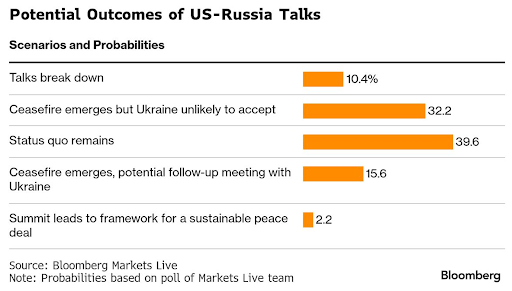
Here is what the most likely outcomes are according to a Bloomberg Markets Live poll:
BLOOMBERG: Bloomberg’s John Authers citing Christopher Smart of the Arbroath Group says “European defence stocks should fly on any lopsided deal that rewards Russia’s aggression with oil prices likely to slump on even the whiff of looser sanctions on Russian oil… Beyond Europe, markets appear to have long since moved past the 2022 invasion, implying Friday s meeting has little potential to trigger a significant market shift. “
GOLDMAN SACHS: We don’t expect the announced meeting between President Trump and President Putin, scheduled for Friday August 15 to cause a significant shift in Russian oil supply in key scenarios”.
ING: If we do see some level of de-escalation, it could remove sanction risk from the oil market. This would likely drive prices lower, given the Bearish fundamentals .
Modern farming is destroying small communities as we move more and more toward the “go big or go home” model—thousands of acres of the same monocrop, managed by one or two people on a tractor spraying chemicals. What used to be 20 or 30 small farms—each with a household and family that supported the local restaurant, gas station, feed store, and the veterinarian who served a few counties—is now replaced by a single sprawling operation with no animals, no neighbors, and no community.
Over the past decade, roughly 140,000 U.S. farms have vanished, and it’s not just those farms that have collapsed—but the entire ecosystem they supported: diners, auction barns, schools, vets, and feed stores have all felt the blow. The economic destruction radiates outward—every boarded-up business is a ripple from a missing farm.
Despite this, small farms are often treated as quaint, inefficient, and economically irrelevant in the modern food system. But the numbers tell a different story. Globally, farms under 2 hectares (about 5 acres) produce around 30 to 34 percent of the world’s food, while using only about 24 percent of agricultural land. That’s not inefficiency—that’s productivity. If you expand that to farms under 5 hectares, they produce more than half of the world’s food. These farms grow a diverse range of crops and raise animals in ways that serve local and regional markets—feeding people directly, not just supplying commodity markets or overseas exports.
Small farms matter because they produce food where it’s eaten, keeping supply chains short and resilient. They’re often the ones growing the vegetables at your farmers market, the eggs from down the road, the beef from a rancher you know by name. They support biodiversity, employ more people per acre, and keep profits circulating locally. Dismissing them as outdated isn’t just wrong—it’s dangerous to our food security.
While most of the farms we’ve lost were small family operations, the fight to save rural America isn’t just about acreage—it’s about approach. It’s not the size of the farm that determines its value to a community, but the farming practices it uses and the relationships it sustains. A larger farm can still operate in a way that regenerates the soil, employs local people, and feeds its neighbors—if it’s run with vision and courage.
That’s exactly what Will Harris has done at White Oak Pastures, his 1,250-acre family farm in Bluffton, Georgia (held by his family since 1866). In the mid-1990s, Harris made a radical break from industrial agriculture. He replaced chemical inputs and confinement feeding with rotational grazing, diversified livestock, and on-site, USDA-inspected processing facilities. White Oaks Pastures is now one of the only farms in the country with separate abattoirs for red meat and poultry.
To make this transformation, Harris took an extraordinary risk—borrowing $7.5 million against the family land to build these processing plants in 2008. It was a gamble most would never dare, but it paid off. His farm now operates as a zero-waste, closed-loop agricultural ecosystem, where nothing goes to waste, and grass-fed meats, eggs, organic vegetables, and byproducts like hides are turned into artisanal goods and compost. His regenerative practices have rebuilt topsoil, captured carbon, and sparked a local economic revival.
Today, White Oak Pastures employs up to 180 people, making it Clay County’s largest private employer. What was once a dying ghost town now has a general store, a restaurant, lodging, and an event center—because one man chose to bet everything on a different way forward. His example proves it’s not the scale that matters—it’s the soil health, the humane treatment of animals, the jobs created, and the way the farm integrates into the life of the town.
The wake-up call is already ringing: boarded-up Main Streets, closed auction barns, veterinarians relocated to cities, feed stores shuttered, schools shrinking. And make no mistake—this is not just an economic issue. It’s a matter of national security. If we lose the ability to feed ourselves, we lose the ability to protect ourselves. Food has been a weapon in almost every war in history. Without control over our food supply, we surrender control over our future.
When we allow small and mid-size farms to fail, we don’t just lose their food production—we lose the skills, the infrastructure, and the intergenerational knowledge that comes with them. We also lose the community glue they provide. Farmers don’t just grow food—they buy feed, fix equipment locally, hire the local vet, and send their kids to the local school. Multiply that by dozens of farms in a county, and you see why their disappearance hollows out whole regions.
That’s why I am thrilled that Will Harris will be joining us at Sovereignty Ranch at the end of September for our Food is Medicine retreat—a gathering dedicated to restoring health, community, and resilience through the way we grow, cook, and share food. We’ll be talking about soil, nutrition, farm economics, and the urgent need to rebuild regional food systems—because the fight for our farms is the fight for our future.
If you care about your country, your health, and your freedom, start now: support small farmers. Buy from them directly. Demand that your grocery stores and restaurants source from them. And most importantly—eat the small farm diet. This means real food from real farms, grown in a way that nourishes the soil and the people. Every purchase is a vote for the kind of America we want to live in. The survival of rural America—and perhaps the survival of America itself—depends on it.
Views expressed in this article are opinions of the author and do not necessarily reflect the views of The Epoch Times or ZeroHedge.