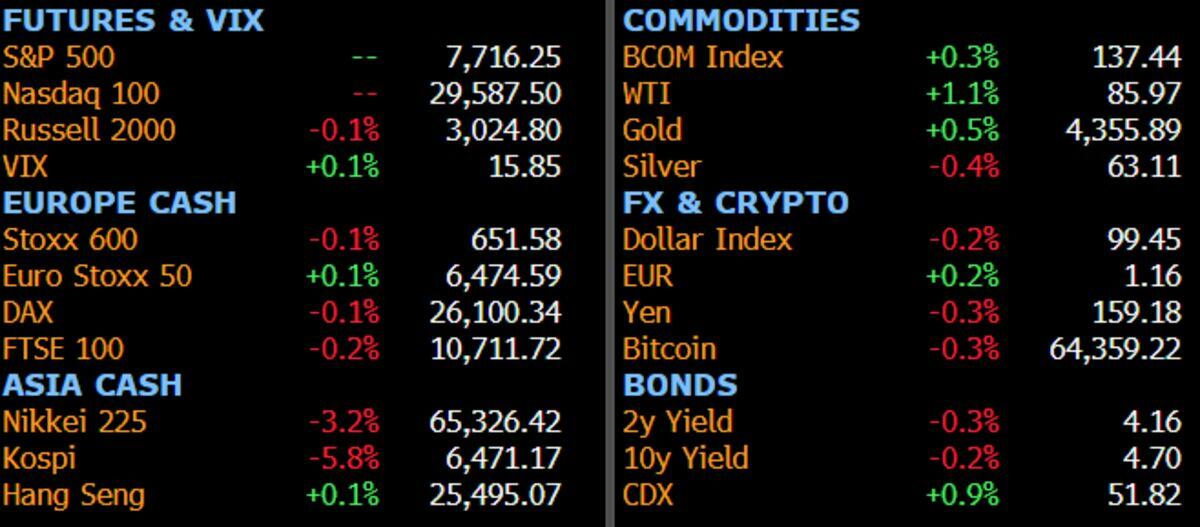
Futures are flat but off their lows as Tech gets a boost from a huge Hynix buyback, which erased ~8% decline to trade up as much as 2% and reversed a 5.8% drop in the Nikkei; the ADRs are +5.6% pre-mkt boosting both Memory and Korea ETFs. As of 8:15am ET, S&P futures are fractionally in the green, with Nasdaq futures down 0.1% even as momentum looks to retrace some of yesterday’s losses. In premarket trading, Semis, Memory, and Mag7 are higher with Software and Low Profitable Tech weaker. Cyclicals and Defensives are both mixed as the market has not yet decided on direction. Bond yields are flat to down 1bp, following from yesterday with USD weaker. Commodities are bid with all 3 complexes moving higher. Brent crude rose 0.8% and briefly topped $92 barrel for the first time since July with little evidence of progress toward a resolution of the US-Iran war. Today’s macro focus is on the 20Y bond auction, which is likely to need a concession, and on the Fed Minutes where investors seek clarity on the Fed’s reaction function in a tape that lacks significant catalysts. NVDA and Jackson Hole loom large.

In premarket trading, Mag 7 stocks are mixed (Amazon +0.2%, Nvidia +0.2%, Meta +0.1%, Microsoft -0.5%, Apple 0.0%, Tesla -0.2%, Alphabet -0.5%)
- Estée Lauder (EL) climbs 7% after posting quarterly results that beat estimates. The company ended a run of three straight declines in annual revenue, a sign the beauty conglomerate’s turnaround efforts are gaining momentum.
- La-Z-Boy (LZB) sinks 16% after the home-furniture maker gave a weaker than expected sales forecast for the current quarter.
- Mercury Systems (MRCY) falls 9% after the maker of display systems used in combat vehicles posted fiscal fourth quarter adj. EPS that came in a penny shy of expectations.
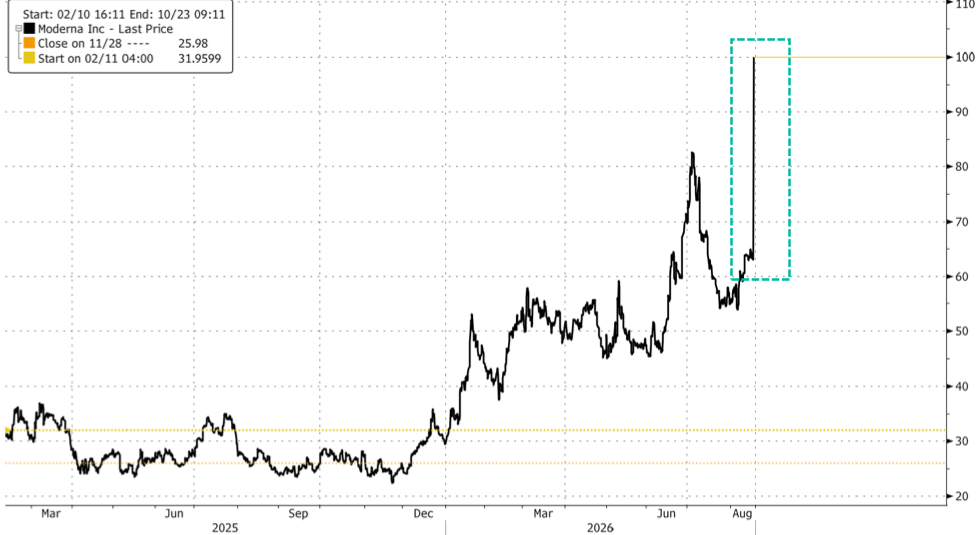
- Moderna (MRNA) soars as much as 100% after the company and Merck said their personalized cancer vaccine helped cut the recurrence of melanoma in a large, late-stage trial. Shares of Merck (MRK) are up 8%.
- Norfolk Southern Corp. (NSC) rises 2% as the company and Union Pacific Corp. can move forward with plans to create the nation’s first coast-to-coast freight network after a federal regulator decided to resume consideration of their joint application.
- SK Hynix ADRs (SKHY) rise 3% after the South Korean memory-chip maker said it plans to buy back $29 billion of its own shares, in a bid to assuage investors concerns about AI spending durability.
- Target (TGT) slips 1% despite the retailer’s comparable sales and adjusted EPS topping expectations, while also getting a boost from tariff refunds. Shares have climbed 56% this year through Tuesday’s close.
- WhiteFiber (WYFI) falls 22% after the artificial intelligence infrastructure firm announced its intention to offer $250 million of convertible senior notes due 2032 in a private placement.
In other corporate news Novo Nordisk is testing small doses of its blockbuster Wegovy pill in a new study that will help establish how low patients can go in their dose and still lose weight. Anthropic plans to give Chief Executive Officer Dario Amodei and other co-founders shares with extra voting power as the firm prepares to make its Wall Street debut, The Information reported. Cerebras Systems introduced a new speedier computer built with the company’s chips, saying the device will give it a wider advantage over Nvidia equipment.
Fairly benign price action in early trading contrasts with Tuesday’s cash session, when stocks struggled for direction and long-dated bonds remained under pressure as higher oil prices kept traders cautious following days of yields at multiyear highs. As noted above, tech got a boost from Hynix buyback, announced just moments after the Kospi closed to get the biggest bang for the lack of liquidity buck, which erased a 8% plunge to trade up as much as 2%; the ADRs are +5.6% pre-mkt boosting both Memory and Korea ETFs. Moderna Inc. surged more than 100% after a positive result from its personalized cancer vaccine trial with Merck & Co. Momentum looks to retrace some of yesterday’s losses even as brent crude rose 0.8% and briefly topped $92 barrel for the first time since July with little evidence of progress toward a resolution of the US-Iran war.
Longer-term bonds trimmed early gains as Brent approached $92 a barrel. The yield on 30-year Treasuries hovered around 5.27%, while rates for most European counterparts were little changed. Investors remained on guard as concerns over major governments’ loose fiscal policy and heavy borrowing by the biggest spenders on artificial intelligence are expected to keep yields elevated. The threat of sticky inflation also lingered as the US-Iran conflict continued to curb oil flows from the Middle East.

“The question is no longer whether higher yields matter, they clearly do, but whether the strength of earnings and capital expenditure implies that the economy can absorb them,” said Florian Ielpo at Lombard Odier Investment Managers. On the other hand, the weakness in tech may be a sign that rising bond yields are starting to keep stock prices in check, he said.
The impact of growing demand for cash among AI hyperscalers was on display as Alphabet paid just under 7% to borrow longer-dated funds in its debut Australian bond offering, the company’s highest-ever yield on a note. The generous rate means some investors could be lured into buying bonds from tech titans rather than their stocks, according to Stephan Kemper, chief investment officer at BNP Paribas Wealth Management Germany.
“AI stocks are increasingly in competition with their own bonds,” he said. “Yields close to multiyear highs in combination with a higher visibility of expected cash flows are making a compelling case for many investors.”
Meanwhile, as we have noted extensively, the lack of a clear path to a resolution in the Middle East is putting upward pressure on oil prices. Regional tensions intensified as the United Arab Emirates said it was cutting all economic ties with Iran after accusing the Islamic Republic of firing ballistic missiles at its territory.
Elsewhere, the Trump administration delayed 50% tariffs on Canadian products for three days, citing a tentative agreement to resolve a trade dispute. Trump is said to have chosen White House policy aide Heidi Overton to lead the FDA.
In politics, Democratic Socialist Angie Nixon stormed to a surprise win in Florida’s US Senate primary against the man who concocted the Russia collusion hoax, Alex Vindman. Democrat Mary Peltola and incumbent Republican Senator Dan Sullivan will advance in Alaska’s Senate primary, setting the state up to be one of the most fiercely contested races in November that could determine control of the US Senate.
Today, top of traders’ minds are a plethora of retail earnings, Fed minutes and the ongoing investor focus on AI. Minutes from the Federal Reserve’s July meeting, due later on Wednesday, may offer investors a better sense of the degree to which officials were losing patience with high inflation. Policymakers voted 9-3 to keep rates unchanged. Money markets currently price around a 50% chance of a hike in October, with the odds of such a move rising to around 90% for December.
In Europe, the Stoxx 600 was little changed at 651.82, snapping a five-day stretch of losses after a tech-led selloff in Asia failed to carry over. Here are the biggest movers Wednesday:
- FLSmidth shares gained as much as 10%, hitting their highest level since April, after the mining-equipment maker delivered earnings comfortably ahead of expectations
- Geberit rose as much as 8.6%, the most since November 2023, following second-quarter results which ZKB says showed “surprisingly strong” revenue momentum
- Ambea gained as much as 13%, the most since November 2024 and to a record high, after the Swedish healthcare group’s earnings beat estimates
- Implenia rose as much as 9.4%, the most since early March, as ZKB says the construction, civil and underground engineering services company’s results “turned out slightly better” than expected
- Sensirion shares rose as much as 8% after the Swiss sensor technology company raised its full-year guidance and drew analyst praise for its results
- Oxford Nanopore shares rose as much as 7.8%, the most in two months, after the British DNA-sequencing company reported a narrower adjusted Ebitda loss for the first half
- Ithaca Energy shares jumped as much as 7.4%, hitting a three-month high, after the oil and gas company delivered record quarterly production and raised its dividend guidance
- Straumann dropped as much as 9.1%, the most in a year, after the Swiss dental implant maker said Christopher Norbye would replace Guillaume Daniellot as CEO. Analysts at Bernstein and JPMorgan said Daniellot was “well-liked”
- Trainline shares fell as much as 17%, the most in five years, after the UK competition watchdog opened an investigation into whether the rail-booking platform breached consumer law through “drip pricing”
- Carlsberg shares fell as much as 4.1%, the most in five months, after the Danish brewer’s first-half volumes disappointed
- Smith & Nephew shares dropped as much as 3.8% to the lowest intraday level since May 12 after the medical devices maker said Chief Financial Officer John Rogers will leave his position at the end of next month
- BKW shares fell as much as 4.6% after the power company’s first-half Ebit dropped by a more-than-expected 15%
Asian stocks slumped, led by a selloff in chipmakers, as elevated bond yields and a stalemate in US-Iran peace talks kept investors cautious. The MSCI Asia Pacific Index dropped as much as 2.3%, the most in three weeks, with chip heavyweights Samsung, SK Hynix and TSMC among the biggest drags. Most major markets were in the red, with Korea’s Kospi sliding 5.8% and Japan’s Nikkei losing 3.2%. A Bloomberg gauge of Asian semiconductor stocks tumbled 3.7%. US-listed shares of SK Hynix climbed in pre-market trading after the firm unveiled plans to buy back 40 trillion won ($29 billion) of stock and return more of its profits to shareholders in an effort to calm worries about the durability of AI spending.
A number of consumer-focused reports due before the market opens include Target, Lowe’s, TJX and Estee Lauder. Placer.ai, directionally accurate in seven of prior eight periods, estimates Target’s adjusted revenue grew 4% year-on-year in fiscal second quarter, while Bloomberg Second Measure notes that observed sales through end July are tracking above industry growth rate. Earnings from Analog Devices are also on deck.
In rates, treasuries rose, giving bond investors some respite after a sharp rise in yields that began last Friday. 10-year Treasury yields fell about 2bp to 4.68%.Long-dated bonds lagged the rest of the curve; 30-year yields were little changed at 5.28%. Front and belly of the curve slightly is richer on the day with long-end lagging ahead of a $16 billion 20-year bond auction which remains on course to be offered at the highest yield since the sector was reintroduced back in May 2020. Gilts outperform in Europe as traders pared BOE tightening bets after UK headline CPI matched estimates. UK 10-year borrowing costs fall 2 bps to 5.07%. Bunds lag following a €3.769b 10-year auction at an average yield at highest level since 2011. Treasury auctions resume with $16 billion 20-year bonds, before a $8 billion 30-year TIPS sale on Thursday. The WI 20-year at around 5.27% sits ~11bp cheaper than the July stop-out and remains around 2.5bp cheaper than the October 2023 yield stop-out. IG dollar issuance slate includes an ADB 10-year benchmark offering. Three issuers priced $6.4 billion on Tuesday after at least seven issuers decided to stand down from announcing deals.
In commodities, WTI futures higher by around 1%, adding to underperformance of bunds vs. Treasuries, rising to highest levels in almost three weeks as a spat between the United Arab Emirates and Iran heightened regional tensions.
“Some of the recovery came from equities finally reacting to the level of yields, some likely from short-covering, and some from the market taking profit on what is now looking like a very crowded steepener,” said Evelyne Gomez-Liechti, multi-asset strategist at Mizuho. Money markets price a 35% chance of a September Fed hike and 23bps of tightening by year-end.
In FX, the Bloomberg Dollar Spot Index falls 0.2% as traders continued to pare bets on a Federal Reserve rate hike ahead of minutes from the last policy meeting. The yen is the strongest of the G-10 currencies, rising 0.3% against the greenback. The Aussie dollar underperforms. The Canadian dollar climbed against most of its Group-of-10 peers after US President Donald Trump delayed 50% tariffs for three days pending the finalization of a trade deal. USD/CAD dropped as much as 0.2% to 1.3872. In a social media post, President Donald Trump said he’s pausing the tariffs “based on the fact that Canada and the U.S.A., subject to the finalization of documents, have a DEAL!”. “The durability of CAD gains will depend on whether a formal agreement is reached within the three-day window,” Kristina Clifton, a senior strategist at Commonwealth Bank of Australia wrote in a note to clients.
Today’s US economic data calendar includes FOMC minutes release from the July 29 meeting at 2pm New York. No Fed speakers scheduled for the session. earnings releases include Target, Lowe’s, and TJX
Market Snapshot

Top Overnight News
- Iranian attacks on shipping in the Strait of Hormuz are piling up without an American military response, raising the risks of crossing the strategic waterway and frustrating some Arab allies who worry the U.S. doesn’t have a strategy to wind down the conflict. WSJ
- Iran has weighed attacking US military targets in Europe should Donald Trump escalate the war, according to people close to the regime, as Tehran considers its options to increase the stakes of the conflict. FT
- The UAE said it was cutting all economic ties with Tehran after accusing Iran of firing ballistic missiles at its territory. Oil rose with no signs of a peace deal. BBG
- Even as Iran projects resilience in the war with the United States, its leaders are worried that a threat of more economic punishment by Donald Trump could increase hardships, reignite unrest and further erode the Islamic Republic’s legitimacy. RTRS
- President Trump said he would pause a 50% tariff on certain goods from Canada for three days while the two countries seek to finalize an agreement. “I have paused the 50% Tariffs against Canada, that were scheduled to kick in tomorrow morning for a three-day period, based on the fact that Canada and the U.S.A., subject to the finalization of documents, have a DEAL!” Trump said on social media Tuesday night. WSJ
- China will expand the use of a $1.6 trillion fund to boost housing-related spending, including renovations, under revised regulations taking effect next month. BBG
- SK Hynix will buy back and cancel 40 trillion won ($28.61 billion) of treasury shares and allocate more than 50% of free cash flow generated between 2025 and 2027 to boost shareholder returns, it said on Wednesday. The chipmaker’s shares plunged nearly 10% on Wednesday before trimming some losses in post-market trading. The shares hit record highs in June but have since declined, partly on investor concern over the durability of AI spending by U.S. technology companies. RTRS
- Target lifted its guidance after results outpaced estimates. Shares initially rose premarket before sliding around 4%, a sign that investors were expecting even stronger results. BBG
- Big pharma is increasingly licensing drugs developed in China. For US drugmakers, the expanding tie-ups means lower costs and more access to breakthrough treatments. For critics in Washington, the deals spell risk. BBG
- Global stocks are meaningfully net bought so far in August, driven almost entirely by US equities which have been net bought for three straight weeks. Notably, on a trailing 3-week basis in % terms, the recent buying in US equities is the largest since March 2020 and second largest in the past decade. Goldman Prime Brokerage
A more detailed look at global markets courtesy of Newsquawk
APAC stocks were mostly lower following the tech-led declines stateside, as yields remained elevated and oil continued to edge higher amid the ongoing geopolitical stalemate. ASX 200 retreated amid a deluge of earnings and with RBA Deputy Governor Hauser sticking to the hawkish script, while Australian wage data matched estimates and spurred little reaction. Nikkei 225 failed to benefit from stronger-than-expected Machinery Orders data and was pressured by the tech weakness, despite yields pulling back from multi-decade highs. KOSPI underperformed amid pressure in the tech heavyweights, while sentiment was also not helped by strained US-South Korea ties after US President Trump reduced the joint drills with South Korea and is said to be pushing for a meeting with North Korean leader Kim as soon as this fall. Hang Seng and Shanghai Comp were ultimately mixed, with the Hong Kong benchmark kept afloat as participants digested earnings releases including from Baidu and Xiaomi, while the mainland conformed to the broad downbeat mood with notable losses seen in the ChiNext Nasdaq-style board.
Top Asian News
- Japanese Ministry of Defence is reportedly to request JPY 8.9tln spend in budget request, Nikkei reported.
- Japanese Machinery Orders (Jun MM) 9.7% vs. Exp. 7.8% (Prev. -12.4%).
- Japanese Machinery Orders (Jun YY) 16.9% vs. Exp. 10.8% (Prev. -1.9%).
European bourses are broadly lower, following on from the risk-off tone overnight as Asian chipmakers were weighed by the weakness stateside. Switzerland’s SMI outperforms, supported by Geberit, after it reported strong results. Sectors point to a mixed picture. Construction outperforms, with Energy and Retail rounding out the top 3 sectors. To the downside is Media, followed by Banks and Food, Beverages & Tobacco. The latter has been pressured by post-earning losses in Carlsberg (-3.7%) after its H1 EBIT missed consensus.
Top European News
- UK PM Burnham said No. 10 North will take over responsibility for economic growth from the Treasury as part of a transfer of power, according to The Times.
FX
- Focus on yields remain with the USD weaker against most G10 peers today as bonds stabilise around recent lows; the oil story is similar, Brent remaining above USD 90/bbl. Action this morning has been isolated to FX, USD weakness emerging against all peers without a clear driver, EUR/USD rising back above 1.16 while Cable breached 1.3550, DXY below 99.50, familiar levels in recent sessions. The summer conditions likely a factor in the news-absent moves, especially ahead of risk events 1) FOMC minutes, and 2) 20yr auction, both of which have increased focus amid 1) the lack of Fed Chair Warsh’s communication, 2) recent weakness in the long end and it being potentially the most expensive for the Treasury in 25 years. Ahead of this, STIRS are steady with the market assigning a c. 30% probability of Fed tightening in September.
- No major GBP move to UK CPI, which, in short, continues the narrative that the BoE is comfortable at 3.75% with data continuing to not surprise vs. market and BoE’s July MPR forecasts. The headline rise reflects the Ofgem price cap introduced this month, a point which was partially offset by a decent moderation in food inflation. Services moderated as expected, while ING notes the BoE’s core services measure of inflation has picked up a little to 3.8% Y/Y, which, while hotter, shouldn’t be too much to encourage those on the fence for tightening. In conjunction with the soft LFS on Tuesday, both show sufficient evidence to keep the BoE on hold for the rest of the year, with risks tilted both ways.
- JPY is the G10 outperformer, benefitting from a softer Buck as the pair looks to return towards 159.00 after nearing 160.00 in the previous few sessions. Macro catalysts were light, though strength seen in KRW could have given a helping hand also. USD/JPY marked a session low of 159.05, a little off this level at the time of writing.
Fixed Income
- Global fixed benchmarks are mixed this morning, though yields ultimately remain near recent multi-year highs as concerns surrounding geopolitical/fiscal remain. Price action today has been fairly rangebound given the lack of pertinent newsflow. The geopolitical environment remains tense, with President Trump continuing to threaten Iran; recent Iranian sources have rejected the White House’s claim that there have been direct negotiations between Iran and the US.
- USTs (+2 ticks) currently holds towards the upper end of a 108-16 to 108-23 range. The docket is lacking for the remainder of the day, aside from the FOMC Minutes. It will be eyed to gauge hawkish sentiment among the wider FOMC, with markets currently leaning towards a hold in September. However, given recent soft US data, the Minutes could be looked through.
- Bunds (-10 ticks) are slightly lower this morning. EZ HICP Final metrics were unrevised, spurring little move. Thereafter, a poor German auction (high retention), also spurred little action in primary markets. The subdued outing is likely due to the ongoing summer lull, and as European banks taper their bond purchases as they approach their minimum reserve holdings.
- Gilts (+6 ticks) are outperforming this morning, taking lead from the region’s inflation report. Headline inflation rose from the prior (in-line with expectations), but much of the acceleration was attributed to Ofgem’s utility price hike. Dovish factors stem from a decent moderation in food inflation and cooling Services inflation (though mainly due to low air fares reading). Overall, the report will do little to shift the BoE away from its holding policy; ING expects the Bank to keep rates on hold for the remainder of the year, before delivering cuts in Spring 2027.
- Germany sells EUR 3.769bln vs exp. 6bln 3.00% 2036 Bund: b/c 1.15x (prev. 1.10x), average yield 3.26% (prev. 3.13%), retention 37.2% (prev. 25.05%).
Commodities
- WTI and Brent October futures are higher for a fourth trading day, with Brent rising towards USD 92/bbl (vs low and WTI near USD 85/bbl (USD 84.36/bbl), as the US-Iran conflict showed no sign of resolution. Furthermore, weekly API data yesterday reported a modest draw in crude stockpiles. Elsewhere in energy, Dutch TTF is modestly softer and around an intraday low after gradually fading from levels above EUR 64.50/MWh to lows just above EUR 63/MWh. In shipping, China’s seaborne crude imports averaged around 6.8mln bpd in Aug 1-15 , vs ~7.3mln bpd in the same period in July, according to Vortexa. Tanker arrivals point to a pickup in the second half of August, though smaller than initially expected, leaving Chinese seaborne buying below pre-war levels for now.
- Precious metals are mixed and within tight ranges. Spot gold remains under its 100 DMA (USD 4,381/oz) in a narrow USD 4,325-4,363/oz range vs yesterday’s USD 4,329-4,436/oz range. Spot silver is conversely subdued in a USD 62.54-64.33/oz range after dipping under yesterday’s USD 66.56/oz low. Gold edged higher as easing US bond selling reduced pressure after Tuesday’s decline, though analysts note that uncertainty over US-Iran relations and higher energy-led inflation remain potential headwinds.
- Copper eased this morning towards the lower end of a tight USD 13,887-13,990/t. Reports note that the backwardation between immediate and three-month delivery eased to USD 248/ton (vs as much as USD 545 on Monday). Bloomberg notes that LME copper inventories available to buyers rose by more than 20,000 tons on Tuesday, the largest single-day jump since April, easing a historic supply squeeze; Trafigura was behind a significant share of the deliveries.
- US Private Weekly Inventory Data (bbls) Crude -0.3mln (prev. +9.1mln), Gasoline +1.1mln (prev. -1.5mln), Distillate -2.8mln (prev. -0.6mln), Cushing -1.4mln (prev. +0.4mln)
- ADNOC is reportedly aiming to trim the amount of crude sold to Asian customers in August and September, Bloomberg reported citing sources.
Trade/Tariffs
- US President Trump posted “I have paused the 50% tariffs against Canada that was scheduled to kick in tomorrow morning for a three day period, based on the fact that Canada and the U.S.A., subject to finalization of documents, have reached a DEAL!”
- USTR Greer said the deal with Canada will include comprehensive market access for all American goods, economic security commitments and digital trade alignment.
- Canadian PM Carney said the US has agreed to postpone implementation of its 50% tariffs on a range of Canadian goods under Section 338 of the US Tariff Act of 1930 until the end of August 21st.
Central Banks
- RBA Deputy Governor Hauser said inflation is too high, adding that monetary policy needs to bring inflation down and needs to reduce demand in the economy. Hauser added that they are not seeing recession, but just a slowdown. Worried about inflation and upside risk to inflation and that if inflation doesn’t come down, will have to raise rates again.
- ECB’s Rehn said the wage growth and outlook remain moderate, there are no clear signs of second‑round effects and that keeping inflation expectations anchored is essential.
- Indonesia Central Bank leaves rates unchanged at 5.75%, as expected.
Geopolitics: Iran
- US President Trump told top administration envoys to halt their conversations with Iran, according to CNN citing a US official.
- US President Trump is waiting for Iran to cave to his economic pressure, but Tehran may be willing to wait even longer, according to Politico.
- A source close to Iran’s negotiating team said there had been no direct Iran-US negotiations and that talks with Oman concerned sovereignty over the Strait of Hormuz, according to Fars News.
- Iranian Deputy Chairman of the Parliament’s National Security Commission said “A ‘new passage’ in the Strait of Hormuz, other than the southern route, will soon be announced in the form of a joint statement with Oman.”
- Iran’s Foreign Minister said the framework of Tehran’s foreign policy will be based on a strong Iran, an Iran that is self-confident and in control of the situation.
- Iran Foreign Ministry spokesman Baghaei dismissed UAE claims that Iran launched missiles, citing false flag operations in warning against ‘baseless’ accusations.
- Iran has weighed attacking US military targets in Europe if US President Trump escalates the war, according to people close to the regime cited by FT.
- Yemeni Houthis have placed Saudi Aramco and all its facilities, oil tanks, crude transfer pipelines and export ports on their list of targets, Al-Akhbar sources said. The source added that the process of monitoring and tracking Saudi oil tankers in the Red Sea is ongoing.
- UAE Foreign Ministry said all trade, commercial exchanges and financial transactions with Iran have been halted until further notice.
- UKMTO has received a report of an incident 40NM southeast of Al Mukha, Yemen. The cargo vessel was unmanned at the time of the incident, however the damage has resulted in a complete constructive loss.
- The Israeli PM Office said Israel and Syria have agreed to maintain the status quo on security matters, which Syria was about to violate by allowing Turkish forces to deploy at an air base near Aleppo.
- Syria’s petroleum company said an explosion occurred at the gas export pipeline at the Al-Jabsah gas plant, leading to a halt of pumping through the pipeline
Geopolitics: Other
- US President Trump is pushing for a meeting with North Korean leader Kim Jong Un as soon as this fall, according to WSJ citing US officials.
- US-South Korea joint military drills schedule is expected to be cut in half, according to South Korean media. It was later stated by a US Pentagon official that the US military substantially reduces exercise with South Korea and exercises will conclude one week early.
- North Korea denounced US-South Korea military drills and said exercise of its right to self-defence will continue to completely neutralise enemies’ military threat.
US Event Calendar

DB’s Henry Allen concludes the overnight wrap
Markets had another rough session over the last 24 hours, with equities hit by a sharp selloff in chip stocks, just as several countries’ bond yields hit multi-year highs. To be honest, there was little respite for investors anywhere, and with no sign of any US-Iran talks, oil prices saw a fresh move higher as well. So, it was a bad day for the most part, with the S&P 500 (-0.69%) posting a 3rd consecutive decline, whilst Germany’s 10yr bund yield (+3.7bps) hit a post-2011 high of 3.26%. The main exception came from US Treasuries, with the 10yr yield (-1.8bps) falling back a bit. But even that was thanks to a weaker batch of US data, so it was hard to generate a positive narrative wherever you looked.
The bond selloff was the biggest story yesterday, as the relentless rise in yields showed no sign of easing. In part, that’s been driven by longer-term structural forces, including concerns around fiscal deficits and the AI boom. But near-term inflation concerns stepped up a gear yesterday, with 1-year US (+6.3bps) and Euro (+12.0bps) inflation swaps moving higher. That came as Brent crude (+0.17%) edged up to a 3-week high of $91.02/bbl, while European natural gas futures (+3.06%) also hit a 3-year high of €63.65/MWh. So that added to the pressure, particularly for European bonds more exposed to the energy shock. And that trend has continued overnight as well, with Brent crude up another +0.76% this morning to $91.71/bbl.
That backdrop saw yields hit fresh highs around the world, although Europe saw some of the biggest increases. For instance, yields on 10yr bunds (+3.7bps) hit a post-2011 high of 3.26%, 10yr OAT yields (+4.7bps) hit a post-2008 high of 4.11%, and 10yr BTP yields (+6.0bps) hit a 2-year high of 4.07%. Otherwise, there were similar records at the 30yr horizon, with German 30yr yields (+2.4bps) at a post-2011 high of 3.77%, and France’s 30yr yield (+2.8bps) hit a post-2008 high of 4.89%.
The main exception to this pattern yesterday were US Treasury yields, which initially looked set for new highs before falling back. That was thanks to a soft batch of US data, which cast fresh doubt on how rapidly the Fed could hike rates. That included data on housing starts, which fell to an annualised rate of 1.239m in July (vs. 1.345m expected). Meanwhile, industrial production only rose +0.2% in July (vs. +0.3% expected), whilst pending home sales were down -2.3% (vs. unch expected). So with all that now out, the Atlanta Fed cut their GDPNow estimate for Q3 to an annualised pace of +4.0%, down from +4.3% beforehand. And in turn, those releases helped Treasury yields to pull back again, with the 10yr yield (-1.8bps) ultimately closing slightly lower at 4.70%. Another test of demand for long-dated Treasuries will come with today’s 20yr auction, but yields have continued to fall overnight, with the 10yr yield down another -1.6bps this morning to 4.69%.
As all that was going on, there were still no signs of any negotiations to reopen the Strait of Hormuz. Indeed, President Trump said in a post that “There are no talks or conversations going on, or scheduled” with Iran and that the US “Naval Blockade remains in full force and effect”. Meanwhile, Iran’s parliamentary speaker Ghalibaf said that Hormuz would remain shut until the US meets conditions of the interim deal agreed in June, which include lifting the US blockade, removing oil sanctions, and unfreezing Iranian assets. So that led to growing pessimism that the Strait of Hormuz would reopen anytime soon, and we saw oil prices move up throughout the futures curve. In fact, the 12-month Brent future (+0.38%) hit a 2-month high of $78.31/bbl, with fears about a protracted period of high oil prices adding to the pressure on bonds yesterday.
For equities, the stagflationary backdrop meant it was another difficult session, with fresh declines on both sides of the Atlantic. In the US, that saw the S&P 500 (-0.69%) lose ground for a third consecutive session, with chip stocks as the biggest driver of the declines. In fact, the Philly semiconductor index (-4.98%) had its worst day of August so far. The NASDAQ (-1.33%) also underperformed, while the Mag-7 (-0.88%) was led lower by Meta (-4.42%). But the weakness was also broad-based, with the equal-weighted S&P 500 down -0.45%. Meanwhile in Europe, the STOXX 600 (-0.69%) posted a 5th consecutive decline for the first time in 2026 so far, alongside losses for the DAX (-0.80%) and the CAC 40 (-0.82%) as well.
Overnight in Asia, there’s been a similar theme, with the selloff in chip stocks contributing to sizeable losses for the major indices. South Korea’s KOSPI (-5.44%) has seen the biggest declines this morning, but there’s also been sharp moves for the Nikkei (-2.85%), the CSI 300 (-2.41%) and the Shanghai Comp (-1.96%). The main exception to that pattern has been the Hang Seng (+0.24%), with a modest advance. But equity futures are pointing to further declines today in the US and Europe, with those on the S&P 500 (-0.11%) and the DAX (-0.17%) both moving lower.
In other news overnight, President Trump announced a 3-day pause on the 50% tariffs on Canada that had been scheduled. He said this was “based on the fact that Canada and the U.S.A., subject to the finalization of documents, have a DEAL!” We don’t have the full details, but in a White House proclamation, it said that “Canada has expressed a commitment to remove the discriminations or unreasonable and unequal impositions” relating to US alcohol, dairy, and autos. Meanwhile on the Canadian side, Prime Minister Carney didn’t say there’d been a deal, but a statement from him said “Substantial progress has been made, although there is important work still to be done.” The announcement led to a small rally for the Canadian Dollar, which is up +0.13% against the US Dollar this morning.
Otherwise yesterday, UK gilts outperformed their European counterparts after the latest labour market data came in on the dovish side. It showed payrolled employees falling by -13k in July (vs. unch expected), whilst the unemployment rate was at 4.9% in the three months to June (vs. 4.8% expected). Moreover, private sector wage growth (ex bonuses) was only at +2.8% year-on-year in the three months to June, the slowest pace since 2020 during the pandemic. So 10yr gilt yields were only up +2.1bps on the day to 5.08%, a smaller increase than elsewhere.
In Germany, the latest ZEW Survey came in stronger than expected, with the expectations component rising to 34.2 in August (vs. 30.0 expected). That’s the highest level since February, before the Iran conflict began.
Looking at the day ahead, data releases include the UK CPI release for July. From central banks, we’ll get the minutes from the FOMC’s July meeting and hear from ECB President Lagarde. Finally, earnings releases include Target, Lowe’s, and TJX