65.9 F
Chicago
Sunday, September 20, 2026
Home Blog Page 1462

Amazonian Tribe Sues New York Times, TMZ, For Defamation Alleging They Were Framed As “Addicted To Porn”

Amazonian Tribe Sues New York Times, TMZ, For Defamation Alleging They Were Framed As “Addicted To Porn”

Here’s one you don’t see every day.

The Marubo Tribe of Brazil’s Amazon has filed a defamation lawsuit in Los Angeles against The New York Times, alleging its coverage of the tribe’s first internet access portrayed them as tech-addicted and obsessed with pornography, according to the New York Post.

The suit, seeking hundreds of millions in damages, also names TMZ and Yahoo for amplifying and sensationalizing the story.

The article “portrayed the Marubo people as a community unable to handle basic exposure to the internet, highlighting allegations that their youth had become consumed by pornography.”

The suit continues: “These statements were not only inflammatory but conveyed to the average reader that the Marubo people had descended into moral and social decline as a direct result of internet access. Such portrayals go far beyond cultural commentary; they directly attack the character, morality, and social standing of an entire people, suggesting they lack the discipline or values to function in the modern world.”

The Times responded to AP saying: “Any fair reading of this piece shows a sensitive and nuanced exploration of the benefits and complications of new technology in a remote Indigenous village with a proud history and preserved culture. We intend to vigorously defend against the lawsuit.”

In his original piece, NYT reporter Jack Nicas wrote the tribe was experiencing challenges familiar worldwide: “teenagers glued to phones; group chats full of gossip; addictive social networks; online strangers; violent video games; scams; misinformation; and minors watching pornography.” He added a tribal leader “is most unsettled by the pornography,” noting young men were sharing explicit videos despite cultural norms that “frown on kissing in public.”

The Post report says that TMZ amplified this angle, publishing a video titled “Elon Musk’s Starlink Hookup Leaves A Remote Tribe Addicted To Porn,” which the lawsuit says “falsely framed the Marubo Tribe as having descended into moral collapse.”

In response, the Times published a follow-up stating, “The Marubo people are not addicted to pornography,” and that the article didn’t suggest otherwise. But the tribe says the follow-up “failed to acknowledge the role the NYT itself played in fueling the defamatory narrative.”

The lawsuit also disputes Nicas’s reporting, claiming he stayed less than 48 hours, not the full week he said. Plaintiffs include community leader Enoque Marubo and journalist Flora Dutra, who helped bring internet access to the tribe and say TMZ’s coverage created the “unmistakable impression” they had introduced harmful content.

Tyler Durden
Mon, 05/26/2025 – 21:40

Teaching Or Treason? U.S. Alleges Fed Economist Spied For Beijing

Teaching Or Treason? U.S. Alleges Fed Economist Spied For Beijing

In May 2013, John Rogers, a longtime Federal Reserve economist, was in Shanghai for an academic forum when he received an email that would eventually alter the course of his life and career.

The message was from someone claiming to be a Chinese graduate student. Rogers says he declined an offer of payment but kept in touch, later accepting an all-expenses-paid invitation to return to China. That visit, U.S. prosecutors allege, marked the beginning of a yearslong effort by Chinese intelligence to extract sensitive information from inside one of the most important economic institutions in the United States.

John Rogers

In January of this year, Rogers was arrested by the FBI on federal charges of economic espionage, the Wall Street Journal reports. He is accused of conspiring with Chinese operatives posing as students, handing over internal Federal Reserve materials in hotel rooms in China, and accepting travel accommodations arranged by his handlers. Authorities said they found $50,000 in cash at his Washington-area apartment, which his wife claimed as hers.

Rogers, who left the Fed in 2021, has denied all charges, maintaining that he never knowingly assisted a foreign government. His attorney argues that the indictment is misleading and lacks critical context. “The indictment presents an overly-simplistic, one-sided, and skewed version of events,” the lawyer said, adding that the defense team would mount a full rebuttal in court.

The case is one of the most detailed yet in exposing Beijing’s efforts to cultivate informants within U.S. institutions not traditionally seen as espionage targets, such as the Federal Reserve. American officials say China has broadened its intelligence gathering under President Xi Jinping, targeting not just defense contractors and tech companies, but also government economists and financial policymakers.

A 2022 Senate committee report alleged a coordinated campaign by China dating back at least to 2013 to gain insight into the Fed’s internal operations and decision-making. In one incident cited by the report, Chinese authorities allegedly detained a Fed employee in a hotel and threatened to jail him unless he shared economic data. The Chinese Foreign Ministry at the time dismissed the allegations as “political disinformation.”

In response to the report, Fed Chair Jerome Powell defended the central bank’s security policies, noting that staff travel and contacts with foreign nationals are subject to strict review. The Fed tightened its rules further in 2021, banning staff from accepting gifts or compensation from individuals or organizations in countries under U.S. export controls, including China.

Rogers’s academic and personal ties to China deepened over the years. He earned a Ph.D. in economics from the University of Virginia and joined the Fed in 1994, later becoming a senior adviser researching currency and interest-rate issues. Though he held an impressive title, people familiar with his role said he had limited access to high-level Fed deliberations and did not attend Federal Open Market Committee meetings.

Still, his resume and position appeared to make him an attractive target. In 2017, Rogers returned to China after accepting an invitation from the same “graduate student” who first contacted him. According to an indictment unsealed earlier this year, Rogers asked that his travel and lodging be covered, which the individual agreed to. 

That same year, Rogers began an online relationship with Liu Yu, a 31-year-old makeup artist from Shanghai, whom he met through a Chinese matchmaking service called Sky Love. After months of exchanging messages, Rogers arranged to meet her in person during a stop in Shanghai. They spent two days sightseeing, exchanging gifts, and sharing a hot-pot dinner, according to Sky Love, which later publicized the relationship as one of its success stories. The couple married in Hong Kong in March 2018, and Liu gave birth to their daughter later that year in Shanghai.

During this period, Rogers exchanged information with his Chinese contacts, including internal Fed materials and research reports. In one 2018 text message to a handler, he cautioned: “There has to be a lot more done to make this legitimate in the eyes of the Fed. Remember, it has to be teaching and not consulting. I am only allowed to teach.” Rogers added, “That would cause me a lot of trouble!” if the nature of the relationship were questioned.

His attorneys argue that these messages show Rogers’s intent to operate within Fed rules, not to conspire with foreign agents. In court filings, they described the exchanges as part of a teacher-student dynamic.

By the end of 2018, Rogers had taken a sabbatical and was working as a visiting professor at Shanghai’s Fudan University. He allegedly continued to supply notes to his Chinese contacts, including materials prepared for a Fed official awaiting Senate confirmation.

In 2020, Fed officials began raising concerns about Rogers’s foreign connections. In an interview with the Office of Inspector General, Rogers downplayed any wrongdoing but admitted: “They’d come out with packets of hundred-dollar bills.” He denied sharing classified materials, but prosecutors later charged him with making false statements in that interview.

He lost access to most Fed resources soon after and was formally forced out in 2021. Months before leaving, he signed a teaching contract with Fudan offering roughly $150,000 for one semester per year. He also secured a $300,000 research grant from a Chinese government-affiliated institution.

Even after his departure from the Fed, Rogers continued receiving messages from his Chinese contacts. In 2022, one invited him and his wife to Qingdao for another paid engagement, writing, “All related expenses will be covered by us, and we can pay for the class.” It remains unclear if Rogers accepted the invitation.

Tyler Durden
Mon, 05/26/2025 – 20:30

About The So-Called Trump-Ramaphosa ‘Ambush’

About The So-Called Trump-Ramaphosa ‘Ambush’

Authored by Victor Davis Hanson,

Nothing highlights the poverty of the media-Democratic mind than its weary use of echo-chamber buzzwords. 

Once Pravda-like instructions are sent out from DNC operatives, mindless media anchors mouth them in lockstep as gospel.

So, it was with the supposed “ambush” when South African President Cyril Ramaphosa met Donald Trump. Trump indeed pressed his guest on a number of issues, from the decades-long targeted killing of white agriculturalists on their farms by black hit teams that have totaled somewhere between 1,500 and 3,500, depending on how one defines such targeted killings.

Trump further wanted an explanation from Ramaphosa on his government’s new legislation aimed at land confiscation without compensation, and the de facto vanishing number of Boer farmers.

Trump was further bewildered by Ramaphosa’s assertion that the new law would not be used to take private property without paying for it (“No, no, no, no. Nobody can take land”), when in fact that was the very purpose of the new legislation in the first place. 

Trump also showed Ramaphosa videos highlighting a resurgence of South African extremism of the tired “Kill the Boer” sort.

The dictionaries define “ambush” roughly as “a surprise attack by people lying in wait in a hidden or concealed position.”

Ramaphosa’s visit was no surprise. He, not Trump, requested it. Ramaphosa spoke openly to the media before the meeting that he was planning to convince Trump that there were neither widespread killings of white farmers nor arbitrary confiscation of land.

In sum, Trump was the host; Ramaphosa was the guest, who requested the meeting to present his case for a return of a number of concessions from the U.S. He knew Trump would raise issues that had estranged South Africa from both the president and Congress, and he was calmly prepped, as expected, to offer counterarguments.

But why was Ramaphosa so eager for a meeting?

He knew that South Africa had enjoyed a rare, sweetheart, one-of-a-kind, no-tariff deal from the U.S. that had empowered his nation in the last few years to vastly expand its exports. In 2024, South Africa achieved a staggering near $9 billion surplus with the U.S.

Yet Ramaphosa and South Africa have a funny way of expressing gratitude for the free trade magnanimity accorded by the U.S.—especially both as a recipient of nearly $500 million in annual foreign aid and after raising asymmetrical high tariffs on lots of U.S. imports.

Recently, the South African ambassador to the U.S., Ebrahim Rasool, was expelled after he gratuitously slandered his host, the president, as a white “supremacist”—supposedly playing on “white victimhood as a dog whistle” out of fears of non-white demographics.

Like most globalist diplomats and intellectuals, Rasool had forged long ties with the American left and was accustomed to cheap, virtue-signaling trashing of the U.S. to his sympathetic progressive audiences. 

Most in South Africa supported the expelled diplomat’s allegations and smearing of his host president, as he returned home a hero rather than an embarrassment.

South Africa still trades on Nelson Mandela’s conciliation policies abroad, even as it has largely rejected his principles and insidiously transmogrified into an illiberal, violent, and racialist state.

In a characteristic fit of schizophrenic hypocrisy, the supposedly “ambushed” President Ramaphosa recently called the few South African white farmer families “cowards” who dared to consider fleeing his government-institutionalized harassment to resettle in the U.S.

I suppose he meant that they were to play the odds and hope they were not among the 60 to 70 farmers murdered each year for their race, and the hundreds assaulted. Or perhaps they were to take solace from the American left that such stuff happens because South Africa is one of the most violent places on earth, where thousands of blacks are murdered each year—though by other blacks and not for their race.

Why, then, the anger at seeing a handful of farmers leaving? And why would Ramaphosa want any largesse from an administration his own ambassador condemned as racist?

On the one hand, most South African politicians would like nothing better than to see the final riddance of the vestigial seven percent of the population.

But on the other hand, the lesson of Zimbabwe’s expulsions reminds them that such mass flight might well collapse the entire South African agricultural sector, if not the economy in general.

That same incoherence characterized Ramaphosa’s relationship with Elon Musk and his Starlink global internet system. He desperately wants Musk to do for South Africa what he has done for lots of countries, including Ukraine—ensuring high-speed internet at a cut-rate cost to remote areas.

But in contrast, his government uniquely insists that Musk essentially turn over about a third of any South African franchise to black South African partners. Ramaphosa will back down because he wants good Internet more than reminding the world that investors in South Africa must follow its racialist laws of partnership. Nonetheless, Ramaphosa has developed a bad habit of cultivating foreign magnanimity, but in a fashion that is ultimately insulting, often racist, and full of ingratitude.

In other areas, South Africa has sided with Russia in the Ukraine War—an embarrassing fact rarely mentioned by the adoring left. 

Indeed, it has facilitated arms transfers between Russia and North Korea, as well as opposed U.N. sanctions on Russia.

South Africa is one of the most anti-Israeli, if not anti-Semitic, nations in the world, and supported the International Criminal Court’s issuance of arrest warrants for Israeli Prime Minister Benjamin Netanyahu. It usually votes at the UN in lockstep opposition to the U.S.

Of course, all that business is South Africa’s own.

But it should not expect most-favored-nation trade status and generous aid from a government its chief diplomat has smeared.

Nor should Ramaphosa have counted on an ebullient White House welcome when he and his predecessors have opposed U.S. policy on almost every international issue. (The media was excited before the meeting that far from being an ambush, Ramaphosa was going to confront Trump and set him straight.)

Indeed, South Africa has aligned itself on most key fault lines with dictatorial China and Russia—without a word of worry about the plight of the Uighurs.

The American Left and the media have blasted Trump, claiming there is no effort to kill white farmers in South Africa. 

They claim the “Kill the Boer” mantras belong to a long-ago age of legitimate resistance to apartheid.

Not true. 

In fact, Julius Malema, the leader of the “Economic Freedom Fighters,” the third largest party in South Africa, led a huge stadium crowd recently in 2023 in the “Kill the Boer, Kill the farmer” chants. And he added, “The revolution in South Africa is guaranteed.”

Malema is no aberration. 

The South African “Equality Court” in 2022 ruled that “Kill the Boer, Kill the Farmer” was not “hate speech.”

If calling for the mass death of an entire minority group is not hate speech in South Africa, then one wonders what possibly could be hate speech in that nation?

Trump hardly needed more evidence that by any traditional measure, South Africa is an ungracious, illiberal “democracy” that relies on U.S. largesse while opposing every element of its foreign policy.

That is why Trump stripped away America’s singular no-tariff policy and slapped a 30 percent tariff on South Africa’s exports to reduce the U.S. trade deficit with Pretoria. The state department will likely not be so ready to issue carte blanche travel, green card, or student visas to South Africans unless applicants can demonstrate credible fear of systemic, institutionalized violence.

Again, there was little animus in Trump’s meeting, and no “ambush” at all. Like the denouement of the so-called Zelensky “ambush,” Ramaphosa will likely be back, realizing that he, not Trump, is the president in need.

The end of the session was more or less a visually aided wake-up call to South Africa. In the future, President Ramaphosa might be wiser to look for Belt and Road help among his apparent true friends and allies. Russia and South Africa are similarly aligned on the Ukraine War, friendship with China, North Korea, and Iran, and share a like-minded common hatred of Israel.

Trump is simply reminding the world that the long-ago optimism of a new Mandela South Africa has long vanished. And U.S. foreign policy needs to readjust to the alterations that South Africa, not the U.S., had previously made to our relationship.

Ramaphosa apparently thinks, like the thousands of South African residents in the U.S., that the adoring, institutionalized, left-wing administrative state, media, universities, and foundations still run the U.S. But at least for the foreseeable future, they do not.

As a result, Trump is wishing South Africa well, not as an enemy, but simply as no longer truly a friend, given its undeniable serial and passive-aggressive hostility.

Tyler Durden
Mon, 05/26/2025 – 19:55

Uncertainty: Wall Street vs Main Street

Uncertainty: Wall Street vs Main Street

By Peter Tchir of Academy Securities

Memorial Day

We hope you are all enjoying the Memorial Day long weekend! We could all use a nice long weekend after the past few months, which have been quite intense on the news, policy, geopolitical, and market fronts. Today is meant to honor members of the military who were killed in service. I am thankful for all that the military does, and have been incredibly lucky to be part of the growth of Academy Securities, which continues to grow our capital, increase the size and scope of the Geopolitical Intelligence Group, and, most importantly, is continuing to hire veterans.

To allow you to more fully enjoy your Memorial Day, and because, quite frankly, it is difficult to think of something new to add, we will keep today’s T-Report short and hopefully sweet.

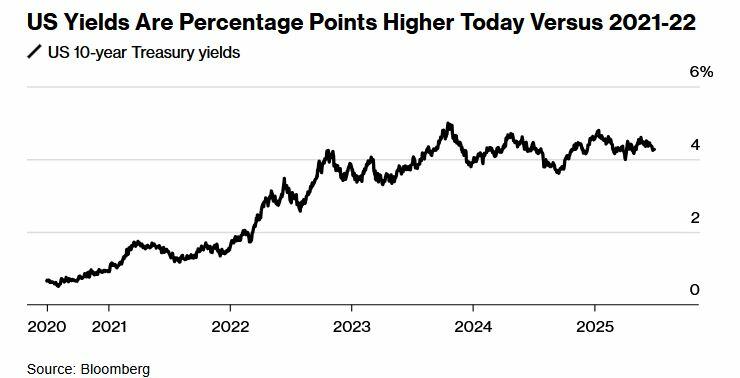
While somewhat squeamish about Thursday’s shift to recommending Start Adding Duration, we will stick to that for now (but are closely watching foreign bond yields and the dollar, as we think we need some support there for U.S. yields to move much lower).

Uncertainty – Main Street vs. Wall Street

It was less than 2 months ago that markets were “bracing” for Main Street over Wall Street. Basically, policies that would be good for Main Street would be followed, even if they hurt Wall Street.

At the time, we argued that Main Street and Wall Street were more closely aligned than that simple message implied. There are differences, and we could certainly see (or see again) things that could hurt margins and therefore stocks, while helping people with jobs and taxes, but overall, the two are probably going to have to move in the same direction.

Wall Street seems less uncertain:

  • VIX is slightly elevated at 20. Elevated yes, but with a high degree of uncertainty, no.
  • Friday’s tariffs posts from the President regarding iPhones and the EU moved markets a little (yes, I think we can call 1% “a little” in this trading environment). But markets didn’t panic, and we saw buying throughout the day, because guess what? A few weeks ago, the President seemed happy with Tim Cook and just ahead of negotiations in Geneva with China, the President put out on Truth Social that “80%” seemed right – and we came back with 30%. Lo and behold (surprising absolutely no one) the EU tariffs have been put back on delay (to the July 9th date that was the original date of the April 9th 90-day pause). Stock futures are now slightly higher than where they closed Thursday night (before that recent set of posts that markets have learned, correctly (for now) to largely ignore).
  • Putin. Peace? Sanctions? Markets seem nonplussed to the headlines. New sanctions would likely be bad for markets (similarly, if new sanctions are imposed on Iran), but markets seem to have very little concern about that risk.
  • The CNN Fear and Greed Index is back to a reading of Greed. Personally, I don’t think this index has kept up with the times, as so many new tools for investors have been developed, but it is a proxy of something and does indicate that markets have become relatively docile again.
  • It would be remiss not to point out that TQQQ (3x leveraged QQQ) continues to see outflows, and retail has been timing this market pretty darn well. This works against the narrative about Wall Street becoming less uncertain, but it is what it is.

What was the point of all that?

The point, I think, is that while Wall Street is less uncertain (or less concerned about uncertainty), Main Street seems VERY Uncertain.

Anecdotally, most things we are hearing fit the narrative that Main Street (call it, Corporate America of all shapes and sizes) is highly uncertain and is struggling with the uncertainty. The degree of the struggle varies, from minimal to severe (small companies dependent on China form the bulk of the latter). Make no mistake, there are pockets of the economy that are humming along. Some companies stand to benefit, even benefit greatly, from Budget 2026, deregulation, and spending linked to improving national security through national production.

But the vast majority of what we hear is uncertainty. The difficulty is figuring out when, where, or if that uncertainty will hit the economic data.

The difficulty with finding evidence that this higher uncertainty on “Main Street” will actually impact the economy stems from several issues:

  • The initial ramp up in orders to get ahead of the tariffs, and then the renewed effort to take advantage of the pauses in case the pauses turn out to be temporary. Amidst the backdrop of uncertainty has been the need to stockpile resources, making the economy potentially look stronger than it is.
  • Contracts and commitments don’t change quickly. If you entered into a contract when everything seemed geared towards growth (and we are hopeful the administration is pivoting back to that, rather than starting to double back down on tariffs), you are committed to that. It is only as contracts get renewed, or decisions for new projects get made, that uncertainty would start to show up. It might be early for that, hence little evidence of actually slower spending, despite the message of caution.
  • Supply chain problems and tariff-linked inflation. Can you see that? Maybe if you squint really hard (seeing some people point to a turn in Truflation data, that I need to explore more). Here again we have two issues with timing:
    • Given the inventory ordered to prepare for tariffs, we wouldn’t expect to see much until June/July (which are approaching). All of the “temporary” reductions will likely have pushed risks of “unstocked shelves” further down the road. Which may mean that the issue will never materialize, but also makes it easy to ignore the risk.
    • Increased pricing tends not to get implemented overnight. There will be some absorption of the tariffs. First step is to get the exporter to cut a deal. Then the importer will likely “eat” some of the cost. Even what they decide to pass on will take some time, as many prices have been contractually agreed upon, forcing it to take time before we see it in the system. Also, it seems like it would be wise not to draw the President’s ire by ratcheting up prices, so you would slow play it.

We will be spending the better part of this week trying to figure out where we might identify early warning signs that Wall Street’s lack of concern is unwarranted and Main Street’s concerns will impact the data, the economy, and then markets.

Bottom Line

Wall Street seems less concerned than Main Street, but much of the data doesn’t support the anecdotal evidence that Main Street is concerned.

That is the conundrum.

  • Is Main Street even concerned, or do we face a time where “talk is cheap” and it is easier to talk about uncertainty than it is to change behavior?
  • Even if Main Street is concerned, have they done enough to bide their time, and as policy shifts towards pro-growth, the concerns will reverse course?
  • Or have we already set in motion, with even 10% tariffs, a chain of events that will lead to a slower economy and higher prices in the short-term? This is probably my base case, but other cases are certainly plausible.

The more the administration focuses on growth, deregulation, and national production for national security, the better. Late last week, there were indications that we might be getting away from that. Minor indications, that have been assuaged by the extension, but we might all need to be thinking that while peak tariff uncertainty (danger) is behind us, we may also be past peak “dealz” optimism.

Finally, what I think is more likely is that as we digest the uncertainty going forward and the certainty of what has already been done, we should brace for a change in the economic winds again.

In no way, shape, or form do I see the current trajectory leading to Depression or even Deep Recession (unlike the pre-delay, no budget in sight policies) but that doesn’t mean markets haven’t gotten ahead of themselves (both equities and bonds).

The worst of the volatility and price action is almost certainly behind us, but that doesn’t mean the market won’t over-reach and it seems like currently there is a risk that Wall Street is ignoring Main Street’s uncertainty.

As we do some data dives this week trying to figure out what the “steady” state of the economy is likely to look like by the end of the summer (assuming we are roughly on the current policy glidepath), we will share that.

There is a chance the data dive makes us more optimistic about current market levels, but my sense is that in digging deeper, we will highlight some impacts that the market isn’t pricing in.

Enjoy the weekend and hopefully we all have an enjoyable and productive summer!

Tyler Durden
Mon, 05/26/2025 – 19:20

The Democratic Party’s Death Spiral Is Even Worse Than We Thought

The Democratic Party’s Death Spiral Is Even Worse Than We Thought

Authored by Matt Margolis via PJMedia.com,

Make no mistake about it: The Democratic Party is facing an existential crisis that even their media allies can’t spin anymore. The New York Times, the crown jewel of the liberal media establishment, just published a devastating analysis showing how the Democrats’ supposed stronghold on American politics has crumbled under the MAGA movement.

While Democrats continue their tired routine of Trump-bashing and pretending to care about working Americans, the numbers tell a completely different story. The Times’ analysis reveals a political earthquake that’s reshaping the electoral landscape, and it’s not in the Democrats’ favor.

“All told, Mr. Trump has increased the Republican Party’s share of the presidential vote in each election he’s been on the ballot in close to half the counties in America — 1,433 in all,” the paper writes

“It is a staggering political achievement, especially considering that Mr. Trump was defeated in the second of those three races, in 2020. By contrast, Democrats have steadily expanded their vote share in those three elections in only 57 of the nation’s 3,100-plus counties.”

In the 2024 election, six times as many counties shifted toward the GOP as toward the Democrats. 

While 435 counties trended more Democratic compared to 2012, 2,678 moved more Republican—by an even larger average margin of 13.3 points versus 8.8 for Democrats.

That’s not just a loss; that’s a political bloodbath.

The Democrats’ problem? 

They’re increasingly becoming the party of coastal elites and college-educated snobs. 

Meanwhile, Trump has built an unstoppable coalition that includes working-class voters across all racial and ethnic backgrounds. 

The New York Times didn’t sugarcoat the situation for the Democrats.

Counties that have become steadily more Republican exist in some of the country’s bluest strongholds, including New York City, Philadelphia and Honolulu. Mr. Trump’s party is still losing in those places, but by significantly less. At the same time, Mr. Trump has driven Republican margins to dizzying new heights in the nation’s reddest bastions.

In New York, 43 out of 62 counties shifted at least 10 points more Republican in 2024 compared to 2012, cutting the statewide Democratic margin in half. The only county to consistently trend Democratic was ultra-progressive Tompkins County, home to Ithaca. Meanwhile, even deep-blue and diverse areas like the Bronx, Queens, and Brooklyn have trended Republican in multiple elections, alongside rural upstate counties like St. Lawrence and Lewis.

“We could be entering a world where the greatest predictor of voting behavior is no longer race,” Rep. Ritchie Torres (D-N.Y.) told the New York Times.

“Donald Trump’s greatest achievement — his greatest electoral achievement — lies not in breaking the blue wall in the industrial Midwest, but in beginning to break the blue walls in states like New York, and in counties like the Bronx.”

The Democrats’ old playbook is dead, and they know it. 

Their own pollster Ben Tulchin admitted “the math doesn’t work” anymore. 

While they’re stuck pandering to wealthy urbanites and pushing radical policies that normal Americans reject, Trump’s MAGA coalition keeps growing stronger.

The only thing that could derail this momentum is if Republicans get complacent or drop the ball. 

I hope they don’t.

Tyler Durden
Mon, 05/26/2025 – 18:45

No MAHA Without The Heartland: Trump Must Forge Strong Ties With Farmers

No MAHA Without The Heartland: Trump Must Forge Strong Ties With Farmers

The MAHA Report, released last week, focuses on deliverables that actually fall within the executive’s constitutionally limited scope of authority. Where some have argued that increased federal authority is justified to “Make America Healthy Again,” the report outlines the ease of corporate capture when control becomes centralized.

Instead, the administration is going all-in on partnering with America’s farmers and ranchers. “We Can Not Succeed in This Movement Without the Partnership of the American Farmer, “said RFK Jr during the MAHA Report presser. 

With consensus being rare within the agricultural industry, ZeroHedge set about finding what a farmer-focused partnership might look like to MAHA Ag leaders. Surprisingly, we found consensus on key issues ranging from regulatory reform to mission realignment and consumer choice.  

Judith McGeary, the Executive Director of the Farm and Ranch Freedom Alliance (FARFA), tells ZeroHedge that a partnership with America’s farmers looks like regulatory reforms first. 

We need an overhaul of government programs — not simply eliminating regulations, but a careful re-crafting of them — to develop scale-appropriate regulation that fosters fair and open competition in the marketplace for consumers to have real choices and access to healthy food.”

McGeary further explains that current regulations, crafted by monopolies, prevent small producers from marketplace access

“Regulations in almost every area of food — including meat processing, egg grading, and produce safety — are designed to be workable for large-scale, chemical and confinement-based producers. And even when small, regenerative producers find a way to manage to comply with the regulations, they are largely either kept out of the markets due to corporate control or undercut by misleading labels and marketing.”

Bill Bullard, the CEO of R-CALF USA, shares McGeary’s call for regulatory reform.

We appreciate that this report identifies key problems within our beef supply chain that our government has refused to address, until now,” Bullard said. “These problems include undue corporate influence over national dietary guidelines; a revolving door between government regulators and regulated corporations; and the corporatization and consolidation of our cattle and beef market.”

Bullard adds that partnering with America’s farmers must include the USDA’s original mission of antitrust enforcement and restored consumer confidence with a return to Mandatory Country of Origin Labeling (MCOOL) requirements.

Partnering with us will include an emphasis on antitrust and Packers and Stockyards Act enforcement to curb corporatization and consolidation; an end to the demonization of beef and recognition of its critically important dietary role; reinstatement of MCOOL, as where beef is produced and under whose production standards it was produced is important to ensure safety and wholesomeness,” Bullard said, adding that he’s hopeful Congress can make headway in the next Farm Bill.

Bullard appeared on Fox Business last week, warning about the ongoing hollowing out of rural communities across America.

For Tennessee rancher and Agricultural attorney, Dustin Kittle, the corporate capture of the Farm Credit Administration (FCA) has hit too close to home. Kittle, who has dedicated his career to saving the family farm, tells ZeroHedge a partnership must include the mission realignment of the FCA.

The Farm Credit System was originally created to safeguard family farms.  It’s now funneling half of its $400 billion loan portfolio into mega-loans ($25 million and higher) to the usual suspects of Big Ag,” Kittle explains.  “In fact, there are Fortune 500 companies who have taken out billion dollar loans, at reduced interest rates, through the U.S. Farm Credit System.”

Kittle continues by outlining the impacts. 

“If we eliminate the Big Ag mega-loans draining Farm Credit’s funding dry, it frees up $200 billion in lending capital; enough capital to provide a $400,000 farm loan to 500,000 family farms; near identical to the same number of farms the USDA found to be in need of financing in a 2023 Report issued by its Economic Research Service.”

Cole Bolton, rancher and Senior Vice President of Frontier Bank of Texas, spends his time trying to educate ranchers on proper leverage, debt reduction discipline and how to build a balance sheet to even qualify for lending. 

Bolton tells ZeroHedge that regulatory reforms are needed more than ever. 

Now, more than ever, producers need access to liquidity for expansion or just simple stability,” Bolton said. “For too long ranchers have been indentured to leverage and the banking regulatory guidelines are making it harder for them to qualify for operating loans.”

According to the report Kittle referenced, the United States is losing farms at an alarming rate. Over the last five years, 141,733 farms have disappeared. That’s an average of approximately 28,347 farms per year—about 77 farms per hour.

Given that small family farms make up 96-98% of all American farms, it’s easy to understand how an industry – that rarely agreed on anything  – has been able to find consensus on what partnership looks like.  

Time is of the essence. This is why ZeroHedge has launched the first farmer-focused partnership with the Beef Initiative—a rancher-direct think tank. Together, we are committed to leading by example and creating innovative solutions to inject liquidity directly back into the hands that produce our food supply.  

As monopoly-guided regulations disproportionately burden small players, and public funds are prioritized for mega-donor reciprocity, we must look to consumer choice and free markets over bigger government

Simultaneously, MAHA farmers welcome the opportunity to partner and stand united in calls for regulatory reforms and the mission realignment of executive agencies.

Tyler Durden
Mon, 05/26/2025 – 18:10

Iran, China Launch New Commercial Railway Bypassing US Sanctions

Iran, China Launch New Commercial Railway Bypassing US Sanctions

The Cradle

A new commercial rail route connecting China to Iran has officially launched with the arrival of the first cargo train from the eastern Chinese city of Xian at the Aprin dry port near Tehran.

Aprin’s CEO highlighted the port’s strategic role in lowering transport costs and reducing reliance on coastal freight hubs.

Image source: IRNA

Railway infrastructure connecting Iran and China allows freight trains to travel from Shanghai to Tehran in 15 days, compared to 30 days via the maritime route.

On May 12, railway officials from Iran, China, Kazakhstan, Uzbekistan, Turkmenistan, and Turkiye met in Tehran to advance a transcontinental rail network linking Asia to Europe, Tasnim News Agency reported on May 25.

The six nations agreed on competitive tariffs and operational standards to streamline regional rail services and boost trade connectivity.

China and Iran have expanded trade and economic relations in recent years, as Tehran seeks to bypass US economic sanctions seeking to strangle its economy and oil exports.

The rail line between the two countries enables Iranian oil exports to China and allows Chinese goods to reach Europe without US naval interference.

In 2018, Iranian Supreme Leader Ali Khamenei stated that Iran should look to the east rather than the west. Since that time, China has become Iran’s largest oil purchaser, while Beijing has been able to supply Tehran with virtually all its needed manufactured goods, including electronics such as computers and cell phones.

The following year, Iran joined China’s “One Belt One Road” (BRI) initiative – President Xi Jinping’s hallmark strategic foreign policy initiative, seeking to recreate the economic ties that existed between ancient China and ancient Persia along the “Silk Road” dating back to the third century BCE.

China and Iran signed a historic 25-year economic cooperation agreement in 2021, reportedly worth $400 billion in trade.

In 2023, China’s growing relations with Iran helped it mediate a Saudi–Iranian rapprochement, which led to the resumption of diplomatic relations that had been cut in 2016.

Tyler Durden
Mon, 05/26/2025 – 17:35

Medvedev Issues Map Showing Putin’s ‘Buffer Zone’ Could Swallow Most Of Ukraine

Medvedev Issues Map Showing Putin’s ‘Buffer Zone’ Could Swallow Most Of Ukraine

If there’s a ‘good cop, bad cop’ routine happening at the Kremlin, mostly assuredly the role of bad cop always falls to Russia’s former president, Dmitry Medvedev. In his maximalist and hyperbolic threats, he can be seen as the “John Bolton of the Kremlin”. It is most often this top official who warns that Russia could go nuclear if red lines are crossed in Ukraine. But certainly his statements are calculated and approved by the Kremlin.

The current deputy chairman of the country’s Security Council has once again issued a hardline threat aimed at Ukraine and its Western backers, warning that President Putin’s newly ordered buffer zone in Ukraine could extend over almost the the whole of the country. “If military aid to the Banderite regime continues, the buffer zone could look like this,” Medvedev wrote on his Telegram channel on Sunday.

He issued a map of the envisioned zone, covering practically all of Ukraine.

 View his automated map below:

A tiny sliver of what could pass for Ukrainian territory was left along the Polish border. He cited that Western long-range weapons might make this necessary, though Putin has never articulated or affirmed any plan to take over the whole of Ukraine. From a strategic perspective, occupying the whole country would be a nightmare for Moscow forces – on the manpower, economic, logistical, and political blowback fronts. 

Still, Medvedev wrote in reference to the reach of NATO-supplied weapons, “In other words, Russia must be present there: 550 km plus another 70 to 100 km just to be safe.

Tyler Durden
Mon, 05/26/2025 – 15:50

The War On Us

The War On Us

Authored by James Howard Kunstler,

“Is the Blue Party really only the customer service desk for the administrative state?” 

– Jeff Childers

It’s pretty universally acknowledged that America’s recent wars — say, starting with Vietnam — have been stupid, pointless, and fake in instigation. And yet the soldiers we sent into these fiascos acted bravely and honorably for the most part. So, it has felt a little weird to celebrate their sacrifices minus any sense of political justice, victory, or meaning in the endeavors they sacrificed for. Ergo, the holiday is lately reduced to a celebration of grilled meat.

This Memorial Day, for a change, the USA is not actively at war in some distant land, only against ourselves. One faction in this as yet cold civil war seeks to Make America Great Again (MAGA), and the other side seeks what. . . ? To do the opposite of that? Make America Disintegrate (MAD). It’s hard to come to another conclusion.

MAGA is led, of course, by Mr. Trump, president again after the strangest executive interregnum in our history.

At its plainest, MAGA means returning to an economy based on producing things of value. To many, this might conjure up the image of humming factories, good pay for honest work, and a well-ordered, content, patriotic populace grateful for their prosperity, in other words, something like the America of 1958, when Mr. Trump was entering puberty.

It’s a comforting vision. Parts of it seem possible to achieve. Maybe we can rebuild an industrial infrastructure of up-to-date factories. Didn’t we voluntarily deep-six all the old ones only a few decades ago? And for what reason? So that faraway nations rising out of darkness could make all the stuff we wanted at a fraction of the cost? Turned out to be a bad bargain based on supremely foolish short-term thinking.

It also came with a set of very corrosive financial arrangements based on the US dollar as the world’s reserve currency. These are pretty abstruse, but suffice it to say they enabled us to rack up phenomenal debt that we will never be able to pay off. We even fooled ourselves into thinking that we could replace that old economy of factory production with financial games based on jiggering interest rates and innovating ever more complex swindles. That merely produced a fantastic divide between the financial gamesters raking in billions while the former factory workers were left broke, demoralized, sick, and strung-out on drugs.

As a basic proposition, it’s doubtful that we can return to anything like a 1958 disposition of things based on rising continental-scale enterprise, as in the Big Three automakers and General Foods. It all seemed like a good idea at the time, and the zeitgeist pushed it, but we can see where it landed us: in the ghastly suburban sprawl clusterfuck and the overall ill health of the people. Also the scale of things is done rising; is, in fact, contracting.

And yet we are surely lurching into a new disposition of things, probably featuring a reduced population (disease and infertility induced by the Covid vaccine op), falling energy production (despite the whoop to drill-baby-drill), and much smaller-scaled, re-localized production of goods and food — if we’re lucky. (Events are in the driver’s seat, not personalities, even gigantic ones like Mr. Trump’s.) If we’re not lucky, the disorders of change itself may overwhelm our ability to remain civilized.

The MAD faction is led by the Democratic Party, the party of Hoaxes, Hustles, and Hatred. Being more a religious cult (of envy, grievance, and revenge) than a political faction, this Memorial Day they celebrate their patron saint George Floyd, a fake martyr whose death by fentanyl overdose sparked a summer of looting, arson, and homicide followed by a fraud-saturated election.

The Black Lives Matter operation proved to be hustle, that is, an effort to extract money dishonestly. But it morphed into the even more pervasive DEI op, seeping into every institution of American life and contaminating each of them with incompetence and grift, larded with sanctimony. That’s over now, but what is the MAD Democratic Party left with? It has put itself at the service of the depraved Deep State, the rogue permanent bureaucracy that has developed a malevolent hive-mind dedicated to maintaining its perquisites at all costs. In other words, it is vested solely in power. . . power over the people of this land. . . to dominate, regulate, asset-strip, and punish for the crime of wishing to be civilized.

The MAD party is on the wane now. Its insanity has become so exorbitant that no one of healthy sensibility can bear to be associated with it. Those who remain involved in Democratic Party politics are largely those liable to prosecution for manifold crimes against the country, now using the most unprincipled dregs of the legal system to keep them out of prison. The party will be defeated utterly.

The Deep State it served is getting disassembled systematically by MAGA, deprived of funding, de-staffed, shut down. It has nothing left but lawfare and a claque of judges who will lose their battle with legitimate law and the Constitution. If it attempts to revive its street-fighting proxies this summer, that too will get shut down swiftly and harshly. Lessons will be learned. All of which is to say that the Deep State’s war against the American people could be drawing to a close. That is something to be grateful for this Memorial Day.

MAGA will then be left to battle with the forces of nature, which basically means physics, especially as applied to the mechanisms of money. MAGA could easily founder if it fails to face the current deformities of finance, namely the gross, untenable debt hanging over the country. I’m not so optimistic about how that might work out.

Tyler Durden
Mon, 05/26/2025 – 15:15

“Looked Clearly Deliberate” – Man Arrested After Car Ploughs Into Crowd During Liverpool FC Victory Parade

“Looked Clearly Deliberate” – Man Arrested After Car Ploughs Into Crowd During Liverpool FC Victory Parade

As 10s of 1000s of Liverpudlians crowded the streets to celebrate their team’s long-await English Premier (Football) League victory

…a car collided with a number of people in Liverpool city center.

Emergency services descended on Water Street after Merseyside Police were contacted just after 6pm on Monday with reports of the incident.

An unknown number of people were injured, with images capturing one person being taken away on a stretcher and a man walking with his arm around a police officer for support.

A crowd of fans immediately descended on the vehicle as emergency services surrounded it…

“The car stopped at the scene and a male has been detained,” said Merseyside Police in a statement.

UK Prime Minister Keir Starmer on Monday expressed his shock: “The scenes in Liverpool are appalling — my thoughts are with those injured or affected,” he wrote on X, thanking the emergency services for their swift response.

Harry Rashid (48) from Solihull, was at the parade with his wife and two young daughters when he witnessed the collision.

He said: “It happened about 10 feet away from us. We were just in a crowd and we had no control over where we would be, because it was a very narrow street. The vehicle came to our right. It emerged from just right next to an ambulance, which was parked up. This grey people carrier just pulled up from the right and just rammed into all the people at the side of us.

“It was travelling south, down Water Street, straight towards this strand, which is where the docks are. It was extremely fast. Initially, we just heard the pop, pop, pop of people just being knocked off the bonnet of a car.

Mr Rashid described how crowds began trying to smash the car windows: “Then he stalled for a few seconds, probably about 10 seconds. Then the crowd that was a bit further back started rushing at him trying to smash his windows.

“But then he put his foot down again and just ploughed through the rest of them, he just kept going. It was horrible. And you could hear the bumps as he was going over the people. Then my daughter started screaming and there were people on the ground.

“It looked clearly deliberate. They were just innocent people, just fans going to enjoy the parade. There were hundreds and thousands of us there because this is probably the busiest part of Liverpool.”

“We were shocked, couldn’t believe it.”

“I saw people lying on the ground, people unconscious. It was horrendous. So horrendous.”

A 53-year-old man has been arrested, and Merseyside Police said the suspect was white, British and from the Liverpool area.

Developing…

Tyler Durden
Mon, 05/26/2025 – 15:03