Israel Reportedly Rejects New US Ceasefire Proposal, Citing ‘Impossible’ Hamas Demands
On Sunday President Trump declared once again that he wants to end the Gaza war “as quickly as possible,” stating publicly what he had long previously been saying privately, according to Axios.
Sky News Arabia is among several outlets to cite unnamed sources Sunday into Monday as saying Trump is likely to announce a new big ceasefire deal, which aims to see the rest of the Israeli hostages come home, within the next days.
“We want to see if we can stop that. And Israel, we’ve been talking to them, and we want to see if we can stop that whole situation as quickly as possible,” Trump said to reporters on Air Force One. He then said he hopes he can give the world good news soon.
But at the moment Israel’s government and military seems set on implementing an expanded offensive and occupation of the Gaza Strip. Axios cites the following:
An IDF official told reporters Sunday that in two months the IDF will occupy 75% of the Strip.
The official said most of Hamas’ military command has been wiped out but its core fighting brigades are still functioning.
The reality also is that tens of thousands of Hamas and Islamic Jihad militants are still operational, utilizing the Strip’s vast tunnel network to wage a guerilla-style insurgency.
On Monday, Israeli and other regional media are reporting that Israel is already rejecting Trump’s reported plan, citing the “impossible conditions” still being set by Hamas, and the continued threat to Israeli national security and sovereignty.
Responding to a Lebanese report that a new outline for a hostage and ceasefire proposal had been agreed upon in principle by Israel, a senior Israeli official said Monday the deal has been rejected.
“The proposal received by Israel cannot be accepted by any responsible government,” the official told the media, without giving any further details.
“Hamas is setting impossible conditions that mean a complete failure to meet the war goals, and an inability to release the hostages,” he said.
Like with the Ukraine war, President Trump has expressed increasing frustration over the Gaza situation. He wants to ‘stop the killing’ – and yet has continued massive amounts of arms and money flowing to one side of the war (the Israelis of course).
Meanwhile, internal unrest over Netanyahu’s commitment to war grows…
Given the gruesome and heart-wrenching images of dead civilians and even children burning to death which continue to come out of the war-ravaged Gaza Strip, the White House could just be responding to international pressure. No deal at this point seems to have any real potential at getting the warring sides to agree. Things continue to slide amid already hellish conditions in Gaza.
Increasingly, conflict is being renewed in the West Bank as well, amid fears of a new intifada which would see the Israelis go to war on several fronts. While Lebanon has been relatively quiet, Israeli warplanes have sporadically renewed attacks on sites in Beirut and south Lebanon.
X Money, the payment and banking app tipped by Elon Musk in 2022 after he acquired Twitter, has started beta testing, Musk confirmed in an X post on May 25.
Tesla Owners Silicon Valley, a fan X account focused on Elon Musk and Tesla, took to X on May 25 to report that Musk has confirmed that X is “launching X Money soon.”
The billionaire businessman subsequently jumped on the X thread to confirm the news, writing that the test will be a “very limited access beta at first.”
“When people’s saving are involved, extreme care must be taken,” he wrote.
X Money expects launch in 2025
Musk’s confirmation comes amid X Money’s planned launch this year, according to the platform’s X account.
Musk’s silent confirmation of X Money trials followed a series of reports suggesting the platform may launch this year based on alleged software code leaks in January.
X has been actively working to obtain multiple transmitter licenses for X Money across the United States, having secured 41 such licenses at time of publication, according to the Nationwide Multi-State Licensing System.
X Money plans date back to 2022
Some of the early public indications of Musk’s plans to integrate payments into X date to October 2022, when Musk referred to his $44 billion Twitter acquisition as “an accelerant to creating X, the everything app.”
In 2023, Twitter rebranded to X, with CEO Linda Yaccarino disclosing that the social media app planned to feature “unlimited interactivity,” support multiple media formats, and feature payments and banking. At the time, many speculated that the platform would likely support cryptocurrencies like Bitcoin.
The platform apparently gathered more steam with US President Donald Trump taking office in January and appointing Musk as the head of the Department of Government Efficiency’s Workforce Optimization Initiative (DOGE).
Heavily involved in administration through DOGE, Musk quickly received pushback from US officials like US Democratic Senator Elizabeth Warren, who criticized X’s payment platform plans in February.
“Musk has lost money hand over fist on X. So he has this idea of X becoming a big money platform where he would get everyone’s personal financial data,” Warren said, referring to Musk’s efforts to dismantle her agency, the Consumer Financial Protection Bureau.
Russia Cautions Of ‘Emotional Overload’ Right Now After Trump Calls Putin ‘Absolutely Crazy’
Moscow has responded Monday to President Trump’s latest fierce criticism of Russian President Vladimir Putin, cautioning of “emotional overload” at this “very important moment.”
“We are really grateful to the Americans and to President Trump personally for their assistance in organizing and launching this negotiation process,” began Kremlin spokesman Dmitry Peskov when asked about Trump’s late Sunday remarks.
“Of course, at the same time, this is a very crucial moment, which is associated, of course, with the emotional overload of everyone absolutely and with emotional reactions,” Peskov said. Other translations used “emotional overstrain”.
There’s been a noticeable frustration and impatience coming from the White House at the lack of progress toward peace. At first more of the pressure seemed to be on Zelensky and the Ukrainian side, but recent weeks have seem Trump’s rhetoric shift to more pressure on Putin and the Kremlin.
“I’ve always had a very good relationship with Vladimir Putin of Russia, but something has happened to him. He has gone absolutely CRAZY!” Trump wrote on Truth Social on Sunday night.
The below full statement is mainly aimed at Putin, but Trump has notably taken swipes at both sides over the weekend, as pointed out by the WSJ correspondent…
“I’ve always had a very good relationship with Vladimir Putin of Russia, but something has happened to him. He has gone absolutely CRAZY! He is needlessly killing a lot of people, and I’m not just talking about soldiers. Missiles and drones are being shot into Cities in Ukraine, for no reason whatsoever.”
Earlier on Sunday President Trump had told reporters aboard Air Force One that he is not “happy” with the Russian leader. “I don’t know what the hell happened to Putin,” Trump said.
Russia has clearly ramped up attacks over prior consecutive nights. Last night it hit Ukraine with another record number of drones along with nine cruise missiles, according to The Associated Press. However, no deaths were immediately confirmed and an emergency response continued in Monday.
But Trump had caveated in his remarks Sunday, “Likewise, President Zelenskyy is doing his Country no favors by talking the way he does.“
We detailed previously how Russia’s current stepped-up attacks are the result of drone waves from Ukraine which are unprecedented in size and intensity over the past week:
Trump says Putin has gone crazy and threatens to walk away from Ukraine peace talks. What he ISN’T saying is that the Ukrainians launched a massive drone attack on Russia on May 20 – targeting Putin’s helicopter during a visit to Kursk – using US intel. pic.twitter.com/GxlmtYZTF5
All of this is likely calculated to press the Kremlin to get serious about negotiations. But as Trump has long admitted, Putin holds all the cards, and more villages in the Donbass were taken by Russian forces this weekend.
As for what “happened” to Putin… the reality is that nothing has changed, and like it or not this is how powerful world leaders wage war in the 21st century.
Democrats actively oppose the Trump administration’s efforts to arrest and deport illegal immigrants, despite the administration’s focus on those with criminal histories.
To support their opposition, Democrats frequently claim, almost as an article of faith, that illegal immigrants are less prone to commit crime. “The crime rate among immigrants is far lower than the crime rate among native-born Americans,” New York Rep. Jerrold Nadler asserted confidently. “So the whole issue is wrong.”
“Immigrants commit crimes in this country at a rate lower than natural-born citizens,” added Connecticut Sen. Chris Murphy.
“So, if you want a safe town or a safe neighborhood, you are better off if you have immigrants.”
Speaking on the Senate floor last year, Murphy added, “Whether you choose to want to believe the facts or not, that is not my decision, it’s your decision, but…but it is the truth.”
This barrage has achieved its intended goal: A McLaughlin & Associates survey commissioned by the Crime Prevention Research Center on April 29, 2025, reveals that 41.6% of voters believe illegal immigrants commit crimes at lower rates than U.S. citizens, compared to 33.3% who think otherwise.
Like most issues, U.S. public opinion on this question has a demographic and partisan component.
Only men, Republicans, conservatives, whites, and those aged 41 to 55 believe illegal immigrants commit more crimes. +
The majority of young voters (18-29), Democrats, liberals, and African Americans most strongly assert that illegal immigrants commit fewer crimes.
But is this “the truth”? Are these “the facts”?
The data suggests that the answer is pretty clearly “no.”
These claims usually conflate legal and illegal immigrants. Legal immigrants tend to follow the law, but illegal immigrants are a different story.
One big problem is that the government databases are a mess in identifying illegal aliens. You can see this in terms of errors in the NICS background checks that are supposed to stop non-citizens with criminal records from buying guns.
There is more direct data linking illegals to crime. Just last year, the Biden administration admitted that 9% of the so-called “non-detained” illegals who were released into the U.S. had criminal backgrounds (662,566 out of 7.4 million released). The problem is that these were overwhelmingly those who had voluntarily turned themselves in at the border, presumably the ones we should be least concerned about. It doesn’t count the 2 million “gotaways” we detected crossing the border but failed to apprehend during the Biden administration, nor the unknown millions we never saw coming across the borders. All this also depends on us believing that the Biden administration didn’t undercount these criminal backgrounds. And many countries, such as Venezuela, won’t provide information on the criminal backgrounds of their citizens.
A prior Maricopa County Attorney’s Office study revealed that illegal immigrants committed 21.8% of felonies sentenced in Maricopa County Superior Court, over twice their proportion of Arizona’s population. Mexican nationals alone accounted for 13% of inmates in the state prison system.
Earlier work that the Crime Prevention Research Center did for the Arizona County Prosecutor’s Association also found that illegals made up a disproportionate share of the Arizona prison population and that legal immigrants were more law-abiding than the general population. Illegal immigrants are at least 142% more likely to be convicted of a crime than other Arizonans. They also tend to commit more serious crimes and serve 10.5% longer sentences, are more likely to be classified as dangerous, and are 45% more likely to be gang members than U.S. citizens.
Critics like the Washington Post cite academic studies asserting illegal immigrants are relatively law-abiding. There are numerous problems with these studies. None of them account for changes in police, arrest, or conviction rates, or imprisonment in explaining crime rates. They look at states like California but ignore the impact of cutting crime rates from laws such as California’s 1994 three-strikes law during the period studied.
They ignore a key issue: Criminals often target those similar to themselves. Illegal immigrants, therefore, are more likely to commit crimes against other illegal immigrants. These crimes often go unreported—for fear of deportation—and as the local population of illegal immigrants grows, underreporting almost certainly increases. While these studies acknowledge that illegal immigrants who are victims hesitate to report crimes, they neglect to adjust their empirical analyses for this factor, particularly when relying on FBI Uniform Crime Reporting data. Notably, the FBI data captures only about 40% of all violent crimes and 30% of all property crimes reported in the National Crime Victimization Survey.
The media’s relentless narrative that illegal immigrants don’t commit crimes has shaped Americans’ perceptions. And these numbers, as bad as they are, likely undercount the number of criminal illegals. Even if some believe undocumented immigrants commit crimes at lower rates, ignoring ICE detainers for convicted undocumented immigrants to prevent their deportation raises doubts about whether they really care about the criminal rate of these illegal immigrants.
“Bomb Data Center”: Eric Schmidt Warns AI Arms Race Could Spark Global Conflict
Since Russia’s early 2022 invasion, the all-out war in Ukraine has claimed an estimated one million lives, if not more. Now, President Trump is pushing to broker a peace deal between the two nations in a bid to halt an exploding war cycle and prevent a broader escalation that could spiral into World War III elsewhere around the world.
The world is fracturing into a bipolar state as a global artificial intelligence arms race intensifies, particularly between superpowers like the U.S. and China. President Trump has emphasized that securing hemispheric defense across North America is critical, whether building the ‘Golden Dome‘ or re-shoring critical supply chains, it’s all about preparing for a volatile period in the 2030s.
Former Google CEO Eric Schmidt recently gave a TED Talk, presenting a hypothetical scenario to highlight how geopolitical tensions could accelerate the AI arms race—especially between the U.S. and China. He warned that this race could escalate to include sabotage or even attacks on data centers in the event of a conflict.
Schmidt said that China’s open-source AI development—exemplified by DeepSeek’s breakthrough in efficiency—poses a strategic risk to the U.S., which currently favors closed, tightly controlled AI models. Because China shares its AI advances openly, the U.S. benefits from them but risks falling behind in a global open-source race.
Schmidt said this dynamic could escalate into a new kind of arms race, where the first country to achieve superintelligence gains irreversible dominance due to network effects.
Schmidt warned that if one country falls even slightly ahead, the trailing side may resort to increasingly desperate actions—including sabotage or even preemptive strikes on data centers—to prevent being overtaken.
Schmidt outlined the steps a nation might take if it began falling behind in the AI race:
So what am I going to do? The first thing I’m going to do is try to steal all your code. And you’ve prevented that because you’re good. And you were good.
Second, then I’m going to infiltrate you with humans. Well, you’ve got good protections against that. You know, we don’t have spies. So what do I do? I’m going to go in, and I’m going to change your model. I’m going to modify it. I’m going to actually screw you up to get me so I’m one day ahead of you.
What’s my next choice? Bomb your data center. Now do you think I’m insane? These conversations are occurring around nuclear opponents today in our world. There are legitimate people saying the only solution to this problem is preemption.
Schmidt draws parallels to Cold War-era nuclear deterrence, suggesting that today’s policymakers have not yet developed a framework to manage the geopolitical risks of hyper-AI development. Without such guardrails, the world could face destabilization by the 2030s.
With Schmidt confirming that foreign policy and military circles are already discussing scenarios involving preemptive strikes on critical AI infrastructure—including data centers—Trump’s push for a hemispheric missile defense shield appears to make much more sense now. Relocating data centers deep into America’s Heartland isn’t just about access to cheap energy; it’s also a matter of geographic security, offering far greater protection than vulnerable West or East Coast locations.
The Iranian Foreign Minister expressed optimism that the US and Iran could reach an agreement over his country’s nuclear energy program. Italy hosted the talks with the Omani mediator issuing a less optimistic statement following the talks.
“This round was one of the most professional stages of negotiations we have ever experienced. In this meeting, the positions and principles of the Islamic Republic of Iran regarding the negotiation process were once again presented with complete transparency,” Abbas Araghchi said.
He continued, “Although we have not yet reached the final agreement stage, the atmosphere prevailing in today’s negotiations, especially given the proposals made by Oman to remove obstacles, has strengthened the possibility of achieving progress.”
The optimistic statement followed multiple Iranian officials stating that Tehran would not give up its nuclear enrichment program.
Several US officials have said that Washington will not reach a new deal with Tehran unless the Islamic Republic dismantles its enrichment program.
Donald Trump’s Middle East Envoy Steve Witkoff, who is leading the US talks with Iran, said Sunday that Washington would not allow Tehran to keep any enrichment capabilities.
“We have one very, very clear red line, and that is enrichment. We cannot allow even one percent of an enrichment capability,” he said.
Iranian Supreme Leader Ayatollah Ali Khamenei responded last Tuesday, calling Witkoff’s remarks “utter nonsense.” “For them to say, ‘we won’t allow uranium enrichment,’ is utter nonsense,” he explained.
Before the talks on Friday morning, Araghchi wrote on X that demanding Iran dismantle its nuclear enrichment program was a red line. “Figuring out the path to a deal is not rocket science. Zero nuclear weapons = we DO have a deal. Zero enrichment = we do NOT have a deal. Time to decide…”
While Araghchi’s remarks following the meeting were positive, the Omani mediator’s statement was notably less positive.
“The fifth round of Iran-US talks have concluded today in Rome with some but not conclusive progress. We hope to clarify the remaining issues in the coming days, to allow us to proceed towards the common goal of reaching a sustainable and honorable agreement,” Muscat said.
Drone ‘Targets’ Russian Embassy In NATO Country, Kremlin Says
The Kremlin and Russian state media sources have alleged a drone ‘targeted’ the Russian Embassy in the Swedish capital of Stockholm on Sunday.
However, the drone didn’t appear to be military in nature, and it dropped a container of paint near the main entrance, in what seems to be an extreme and provocative form of protest by an unknown entity. Some sources say multiple glass containers of paint were dropped during the ‘attack’.
Still, RT states that “the drone operators used a glass vessel which could have caused serious injuries had it struck anyone.”
Russian Foreign Ministry spokeswoman Maria Zakharova on Sunday said that “Tomorrow, Stockholm will receive a note of protest. Sweden must tame its ultras, take control of the situation, and strictly observe the Vienna Convention,” as cited in TASS.
Moscow has complained of similar incidents at the embassy in the recent pasts, and has lodged several notes of protest with the Swedish government, pointing out that the host country has an obligation to investigate as well as protect.
The full foreign ministry statemen on this fresh incident reads as follows:
“On May 25, at about 03:40 in the morning, the Russian Embassy in Sweden was subjected to another attack using a drone,” the embassy explained. — Flying over the territory of the diplomatic mission, the drone dropped a container of paint on the platform in front of the main entrance. A special cynicism to the incident is given by the fact that the drone operators used a glass container, which, when dropped from a height, can cause serious injury to people.”
The Kremlin has said of this and the several security incidents before, that when it notifies Swedish police and security services “there are no results.”
Since the Ukraine war began, there have been tit-for-tat diplomatic expulsions and consulate shutters between Russia and several European states. For example, EU nations – most especially Poland – have accused Moscow of “intimidation, the instrumentalization of migrants, sabotage, disinformation, foreign information manipulation and interference.” Moscow has in return charged Western capitals with similar dirty tactics.
Meanwhile, apart from this relatively minor paint incident, Sweden is actually developing new drone swarm technology, as the newest member of NATO…
Sweden will test new drone swarm technology developed by defence equipment group Saab in upcoming Arctic Strike 25 exercises.
New revolutional drone-technology & software allows drone swarms work independently without human operators. pic.twitter.com/fUwDpi3DBy
But Moscow has alleged a conspiracy against it and its diplomatic facilities abroad, which have even at times come under fire bomb attacks, or other dangerous acts of vandalism, in protest of the war in Ukraine. More significantly, there have been apparent sabotage operations targeting industrial and military sites in both Russia and the West.
Doug Burgum, the soft-spoken Interior secretary responsible for managing the more than 507 million acres of federally owned land, is haunted by a fear that seems, at first glance, outside his mandate. He worries the free world will lose dominance in the field of artificial intelligence, and with it, the future.
So does the president.
“When President Trump declared a national emergency on his first day in office it was, in large part, because of what we’re facing with our electrical grid and making sure that we’ve got enough power to be able to win the AI arms race with China,” Burgum said Wednesday in remarks first reported by RealClearPolitics. “That is absolutely critical.”
Thus the stated policy of this White House: “It’s called drill, baby, drill,” Trump said earlier this spring.
The immediate goal, the one touted at every campaign, is to bring down the average price of a gallon of gas. The concurrent and long-term mission that Burgum obsesses over: AI dominance. The former governor from fracking-friendly North Dakota and tech entrepreneur who sold his software to Microsoft, Burgum laid out an abbreviated formula on stage at the America First Policy Institute.
Electricity generation via fossil fuels, like natural gas and coal, powers data centers “filled with these amazing chips,” the secretary said, “and you know what comes out the other side? Intelligence. A data center is literally manufacturing intelligence.” He envisioned a new world that follows, where the best computer programmer, or the most brilliant lawyers, could “clone themselves” again and again to train AI models to do the work of thousands in a process “that can be repeated indefinitely.”
No longer science fiction, the process has been headline news for some time. AI models like ChatGPT and X’s Grok are already available in every home with an internet connection. And the U.S. was the undisputed leader. That is, until recently.
American tech companies enjoyed a clear edge with not just the most powerful AI models, the most funding, and top engineering talent, but also the easiest access to those “amazing chips” that Burgum referenced. Former President Biden banned the export of the most advanced semiconductors to China. And yet DeepSeek, an unknown Chinese startup with less money and allegedly less sophisticated chips, still managed to one-up Silicon Valley earlier this year with a more powerful AI model.
The latest development in the battle for tech supremacy, in what some likened to “a Sputnik moment,” the DeepSeek launch rattled both markets and geopolitics. A new kind of AI nationalism now consumes heads of state convinced that their nations must develop their own technology or fall behind in the future. Said Russian President Vladimir Putin in 2017 of AI, “The one who becomes the leader in this sphere will be the ruler of the world.”
Burgum does not disagree. He would just prefer the West take on that role. “Trust me, you do not want to be getting your data from a Chinese data center,” he told the crowd, adding that “Whoever controls the manufacture of intelligence is going to control the world. The next five years is going to determine the next 50.”
This is the goal of the White House, including Vice President JD Vance, who once warned that falling behind on this front could mean that the U.S. meets China “on the battlefield of the future” with the equivalent of digital “muskets.”
Democrats on Capitol Hill are not thrilled. The day before, Maine Rep. Marie Pingree complained in the House Appropriations Committee that Burgum had gutted the department he leads and sought to slash Biden-era clean energy tax credits.
“In just four months, the department has been destabilized, and there’s been a stunning decline in its ability to meet its mission,” she told Burgum. “This disregards the climate change concerns that we have.”
The secretary replied that he was concerned with a more pressing order of operations. “The existential threats that this administration is focusing on are Iran cannot get a nuclear weapon, and we can’t lose the AI arms race to China,” Burgum said in committee. “That’s the number one and two. If we solve those two things, then we will have plenty of time to solve any issues related to potential temperature change.”
His immediate focus, then, is on how the U.S. can boost energy production. Burgum reported that industry leaders tell him electricity demand will soon outpace supply with astronomical numbers measured not in megawatts, but gigawatts. The power needed to run one data center, he said, would be equivalent to the electricity needs of Denver times 10.
Because AI has the potential to supercharge nearly every business, he said, “the demand for this product is like nothing we’ve ever seen in our lives.”
Concluded the Interior secretary, “The fundamental principles here again, as they say, we’re going to sell energy to our friends and allies, and we’re going to have enough energy here at home to be able to win the AI arms race. And this requires electricity.”
On this Burgum and Trump are simpatico. During the campaign, the president likened artificial intelligence to “the oil of the future.”
Stock Futures Soar, Yields Rise After Trump Extends Deadline For EU Tariffs
US equity futures surged and European stocks climbed after President Donald Trump extended a deadline on aggressive euro area tariffs, reinforcing the pattern of leaving markets guessing and flip-flopping by making trade threats before backtracking, all in keeping with the gamebook established during the Trump 1.0 trade wars. With US cash markets closed for Memorial Day, US equity futures jumped 1.2% and Nasdaq 100 futures surged 1.4%, erasing all of Friday’s losses.
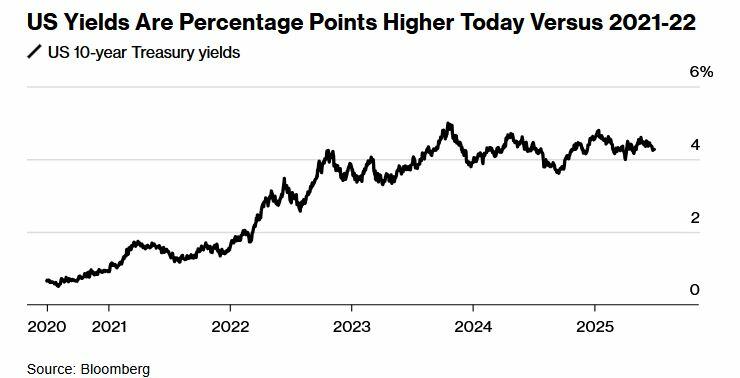
A gauge of the dollar hovered near its lowest level in almost two years. Cash Treasuries didn’t trade due to holidays in the UK and US but futures dipped, indicating a 10Y yield about 4.53%
Trump’s decision to extend the deadline came after a phone call with European Commission President Ursula von der Leyen. Von der Leyen, who heads the EU’s executive arm, said earlier Sunday in a post on X that “Europe is ready to advance talks swiftly and decisively,” but “a good deal” will need “time until July 9.” That’s the date on which Trump’s 90-day pause of his so-called reciprocal tariffs had originally been set to end.
Trump’s tariff threats on Friday also included a 25% levy on smartphones if companies including Apple Inc. and Samsung Electronics Co. failed to move production to the US.
Even as the Big Beautiful Bill is now stuck in the Senate where any changes threaten to undo its razor thin passage in the House, the trade war has made a return as the major risk driver once again after concerns about Trump’s proposed tax cuts, and their impact on the US deficit, churned markets much of last week. Trump’s whiplash moves have increased uncertainty in markets and his broadside against Europe on Friday, followed by a backtrack, was a stark reminder of the president’s volatile policy making.
“The stock market seems to dance to Trump’s tune: first a threat, then a pullback, quickly followed by a rebound as speculative investors anticipate a concession from the U.S. President,” said Jochen Stanzl, chief market analyst at CMC Markets. “This morning’s confirmation of such expectations reinforces the so-called ‘Trump Pattern,’ which is increasingly seen as a successful strategy for risk-tolerant investors.”
“One thing that is starting to concern us a bit is the fact that the rebounds that follow these selloffs are losing strength as we go on,” said Frederic Rozier, a portfolio manager at Mirabaud France. “We can sense investor fatigue about this back-and-forth and there’s a risk sentiment will erode as markets run in circles on tariffs. The only thing we know is that even if there’s an agreement, there will be a cost for European stocks.”
Europe’s Stoxx 600 index also erased Friday’s losses sparked by Trump’s threat of 50% tariffs on the European Union. The US President later said he had agreed to delay the date for the levies to July 9 from June 1. Among individual movers in Europe, Thyssenkrupp AG jumped more than 7% after a report that the firms chief executive plans to turn it into a holding company, allowing it to cut overhead costs as it divests further units. Volvo Car AB climbed as much as 4.8% after announcing plans to eliminate around 7% of its global workforce to cut costs and protect profits.
Earlier in the session, Asian equities were steady as weakness in China offset gains in Japan and South Korea. The MSCI Asia Pacific Index traded little changed after rising as much as 0.4%. Japanese firms Sony Group and Tokyo Electron were the biggest boosts to the gauge, while Chinese shares including Tencent and BYD were among the biggest drags. A broad sense of optimism buoyed markets in the region after President Donald Trump delayed duties on EU imports. Benchmarks in Japan got a lift as the country’s chief tariff negotiator indicated plans to resolve talks with the US before a G-7 meeting in June. Trump’s nod of a partnership between Nippon Steel and US Steel also helped sentiment. Shares in Korea led gains in the region, while Indian gauges also gained. That’s helped the regional measure remain on pace for its best close since October.
The trade tensions and weak demand for US assets are showing up in the dollar. Bloomberg’s dollar spot index was track for its lowest close since July 2023, while the greenback is at or approaching key levels against a host of currencies including the euro, Britsh pound, yen and Swiss franc.
Enthusiasm has faded for the world’s reserve currency this year. Speculative traders remained bearish on the dollar but trimmed their positioning to $12.4 billion in the week ending May 20 from $16.5 billion in the week prior, according to CFTC data reported Friday.
A key event this week will be Nvidia Corp.’s results on Wednesday. The chip-making giant is seen as a bellwether for so called growth stocks and the sustainability of the artificial intelligence boom. It’s outlook will be crucial given macro risks and tariff uncertainty.
Investors are also gearing up for the Federal Reserve’s preferred inflation measure, the US personal consumption expenditures price index excluding food and energy, which will be released Friday. The April reading is forecast to rise 0.1% based on consensus expectations.
Elsewhere, signs of port congestion in northern Europe and other hubs suggests trade wars could lead to maritime disruptions around the world, increasing shipping rates.
Trump on Friday announced a partnership between US Steel and Japan’s Nippon Steel Corp., shocking markets with an agreement he said would keep the once-iconic American firm in the US, but otherwise providing no specifics. Nippon Steel shares jumped as much as 7.4% in Tokyo, while shares in US Steel rose 21% Friday.
When Jeffrey Epstein purchased Little Saint James, the teardrop-shaped island south‑east of St. Thomas, in the late 1990s, he was seen as a mere oddity. A one-time math teacher who claimed to manage the fortunes of billionaires, he told U.S. Virgin Islands officials that he was seeking privacy. He also appears to have purchased impunity.
The alleged crimes that Epstein committed on that emerald island reachable only by helicopter or ferry would explode into an international scandal. Investigators accuse him of raping and sexually abusing girls as young as eleven at his island compound where he also hosted many A-list politicians, business leaders and celebrities. One 15-year-old, whom Epstein allegedly forced into sex acts, attempted to escape by swimming away from the island. She was caught and her passport was taken away.
While Epstein was alive, Virgin Islands officials appear to have shielded him from scrutiny – customs agents at the airport, for example, reported seeing Epstein leave his plane with girls between the ages of 11 and 17, yet there is no record that anyone checked on their safety.
After his death in 2019, other officials who aided Epstein began profiting from continued secrecy and a string of legal settlements associated with his behavior that put hundreds of millions of dollars under the government’s control. No one appears to have benefited more than Albert Bryan Jr., the governor of the territory. Court records show that Bryan had previously overseen the agency that granted nearly $300 million in illicit tax credits to Epstein’s company, which fraudulently claimed to provide “biomedical and financial informatics” services. Bryan, after securing a gubernatorial victory in 2018 with the support of Epstein and his aides, would later push for a waiver for Epstein to avoid compliance with the island’s sex offender laws.
Bryan fired the attorney general who led the island’s cases against Epstein’s estate, and his appointed successor ended an explosive case over J.P. Morgan Chase’s ties to the former financier before a new round of discovery.
Over the last few months, legislative records show, Bryan has tapped the Epstein settlement funds to pay for a variety of his domestic political agenda items. The money was secured from Epstein’s estate and his associates, including the case with J.P. Morgan Chase and a close financial supporter, private billionaire Leon Black, who was also accused of abusing women. The settlements, which collectively account for nearly a quarter of a billion dollars, werechampioned as a measure of accountability, and the proceeds werepromised to assist victims of sexual assault, human trafficking, sexual misconduct, and child sexual abuse.
In late April, Bryan, at his weekly briefing at the Government House on St. Thomas, announced the allocation of $22 million in retroactive wages to government workers, a move his office touted as strengthening public trust. “This is real money – money in the bank,” Bryanboasted. Left unmentioned was the source – the Epstein settlement money.
Earlier this year, Bryan applied the Epstein funds forvendor payments and sought to use the money for a variety of other earmarks, such as a $25 million makeover for the Justice Building on St. Croix. The lack of transparency around the funds has faced scrutiny from legislators and some Virgin Islands residents.
The total amount remaining in the Epstein settlement fund is not clear. Motley Rice, a private law firm that assisted the U.S. Virgin Islands (USVI) Justice Department with the cases, is projected to receive about $23.35 million of the settlement as its share of the fees.
“We have a situation where some of the monies might have been spent, even though they were appropriated for specific purposes,” said USVI Senator Alma Francis Heyliger. “The legislature did not give approval for this.”
In a letter posted online last year, David Silverman, a retiree living in St. John, stated, “This money was promised to be used to protect vulnerable young women, among other things. But for reasons that nobody can explain, the money is nowhere to be found.”
The U.S. Department of Justice maintains oversight of the USVI, a jurisdiction that has been plagued by corruption. In recent years, FBI agents have raided territory agencies over the mismanagement of public money. In June 2024, several senior USVI officials were charged with defrauding $4 million in housing funds. The FBI declined to comment on whether it is investigating the USVI’s use of Epstein settlement funds.
The Bryan administration did not respond to a request for comment.
Questions continue to swirl over the Epstein secrets still buried in government vaults. The much-hyped Trump administration release of files related to the Epstein case quickly turned to disappointment in February as the government distributed binders with no new information. Attorney General Pam Bondi, in response to criticism of the fizzled press event, has said she is still pushing for the release of more files held by the FBI and her department.
While attention still focuses on the 256,000 square-foot warehouse in Winchester, Virginia, where unreleased FBI records, including CDs, hard drives, and recordings from Epstein’s homes, are still held, the Virgin Islands side of the story remains unresolved. The tropical territory remains one of the last redoubts of intrigue related to the scandal.
The island territory was the nexus for Epstein’s alleged human trafficking operation. It was there that Epstein entertained his VIP rolodex of guests and is believed to have engaged in some of his worst sexual crimes.
The abrupt settlement with J.P. Morgan Chase prevented the release of more disclosures about the nature of Epstein’s network, including documents and depositions from key figures who aided and abetted the former financier.
The U.S. Virgin Islands government and JPMorgan Chase both denied claims of complicity in Epstein’s abuses. In a previous statement to reporters, the bank claimed it “would never have continued to do business with him if we believed he was using our bank in any way to help commit heinous crimes.”
Nearly two years ago, Bryan shut off the valve of a smattering of unflattering documents released as part of the island territory’s lawsuit with J.P. Morgan. After initially seeking $190 million from the bank for its role in aiding Epstein’s operations, Bryan shocked observers by firing his own attorney general and reportedly pushed to end the lawsuit.
The initial 2022 lawsuit charged that J.P. Morgan had “turned a blind eye” to clear evidence that Epstein had used the bank to facilitate his sex trafficking operations. USVI claimed in court that it had uncovered evidence that J.P. Morgan officials had repeatedly raised red flags about Epstein, who maintained around 55 accounts and routinely referred his network to the bank’s wealth management services. Meanwhile, J.P. Morgan executives joked over email about his interest in young girls.
But the bank hit back with a countersuit and filed hundreds of documents, exhibits, and emails alleging “a decades-long quid pro quo between Epstein and the USVI government.” The legal probe revealed the former financier’s extensive system of alleged bribes and influence payments to USVI officials – money, J.P. Morgan’s lawyers claimed, that “created a haven for Epstein’s criminal activity.”
These records show that Epstein placed the former first lady of the island, Cecile de Jongh, on his payroll. She suggested campaign donations and targeted gifts to universities, civic groups, and the families of powerful politicians. The gifts appear to have helped Epstein win special benefits, including visas to bring young girls to the island and $300 million in illicit tax exemptions for his fraudulently registered information technology company.
J.P. Morgan’s attorney filed documents with the court charging that de Jongh suggested Epstein pay monthly retainers to local politicians, including former USVI Senator Celestino White, to gain “loyalty and access.” The records showed he also gave free Thanksgiving turkeys to 78 federal customs agents at the St. Thomas airport after dealing with one “difficult” officer.
The ties extended to the governor and the territory’s representative in Congress, the incumbent lawmaker Stacey Plaskett. In his previous role as head of the economic development office, Bryan signed off on a string of tax exemptions for Epstein’s Southern Trust business entity. At the time, Plaskett served as counsel to the tax office.
Plaskett went on to work at Kellerhals Ferguson Kroblin PLLC, a USVI law firm Epstein retained for tax and legal issues. In 2014, as Plaskett geared up to run for Congress, de Jongh advised Epstein to support her bid against a popular local politician, Shawn-Michael Malone. “Shawn is the one who came after you in the senate hearing last week. He is nasty and needs to be defeated and we have a friend in Stacey,” de Jongh wrote in an email uncovered by J.P. Morgan’s attorneys.
During the election, Epstein’s closest aides and advisers, including Darren Indyke, Lesley Groff, and Erica Kellerhals, donated to Plaskett, helping her defeat Malone by just 737 votes in what local press called “one of the biggest upsets in Virgin Island politics.” De Jongh wrote to Epstein to confirm that a $13,000 corporate donation planned for the Democratic Party would be made “for the benefit of Stacey Plaskett.”
Epstein repeatedly donated to Plaskett’s campaign committees untilhis suicide in a New York City prison cell in 2019. In an email made public by the litigation, Plaskett wrote to Kellerhals and Lesley Groff, another Epstein aide who reportedly helped him recruit young women, to request the financier’s fundraising assistance. She also met with him at his New York City home in a bid to request larger donations to the DCCC, the House Democrats’ campaign arm.
Plaskett did not respond to a request for comment. In March, a federal judge in New York ruled that Plaskett will continue to serve as the sole defendant in a case brought by multiple victims of Epstein. The Racketeer Influenced and Corrupt Organizations Act case charges that USVI officials conspired with Epstein to sustain his sex-trafficking scheme.
The case relies on much of the evidence that the J.P. Morgan countersuit uncovered nearly two years ago.
The Epstein network also helped to elect Bryan governor. Kellerhals, campaign finance disclosures exclusively obtained by RealClearInvestigations show, donated$1,000. Records from the J.P. Morgan litigation provide further evidence of support, including an email from de Jongh suggesting $25,000 to an inauguration party in Bryan’s honor and a reminder that Bryan had requested $30,000 in support for the USVI Little League.
Bryan, as governor, requested that the USVI Justice Department provide Epstein with a waiver for the territory’s sex offender registry. Epstein’s legal requests for special exemptions to the law, notably, were facilitated by Kellerhals.
“Not every sexual offender or any person, you know, are in the position to have the governor make the request to the attorney general … that by itself indicated to me that [Epstein] was flexing his political influence over or with the governor,” Denise George, a former USVI attorney general said in a deposition she gave as part of the JPMorgan lawsuit.
Bryan, in a deposition with J.P. Morgan’s attorneys, dismissed concerns about Epstein’s operations in the USVI. He said he was only aware that “he copped a plea to having sex with a hooker who was under age,” a reference to Epstein’s 2008 conviction over child prostitution.
On New Year’s Eve 2022, Bryan unexpectedly fired Denise George, the attorney general responsible for the J.P. Morgan lawsuit and the island’s landmark case against the Epstein estate. George had previously opposed Bryan’s requests for a waiver for Epstein to get around the island’s sex offender laws.
As the litigation continued to mount, J.P. Morgan’s attorneysthreatened more discovery and depositions of USVI officials. In a filing to the court in September 2023, they argued that they planned greater investigations of a host of USVI’s elite, including Bryan and Plaskett.
A few weeks after the filing, USVI announced its settlement, agreeing to end its case in exchange for $75 million, an amount far below the initial amount sought by the lawsuit.
The sudden end to the case closed the rare window of disclosure into Epstein’s private power structure and the ways in which he carried out his political operation.
Some lawmakers and island residents believe secrets from the Epstein scandal are still hidden. The J.P. Morgan case proved too harmful for the USVI elite as it exposed embarrassing documents on all sides.
“Listen, as a community, I would rather these things come out so we can clean up our community instead of sticking our heads in the sand,” said Senator Francis Heyliger. “The more we clean up this territory, and more things are exposed, I think in the long run, it will be better for us and as a community and for the people.”
The senator was clear that President Trump should release new, unredacted Epstein files or pressure USVI officials to provide more clarity over the financier’s influence. “If this administration, on a national level, chooses to put out more information, I am never one that believes you should hide from the truth.” she said.