WASHINGTON—When President Donald Trump joins world leaders at the Group of Seven (G7) summit in Canada on June 15, he’ll find a different agenda awaiting him. In a significant departure from recent years, the host nation is sidelining climate action and gender equality, issues that were once central to the summit’s mission.
This year’s gathering will prioritize issues such as energy security, artificial intelligence (AI), critical mineral supply chains, and global economic stability, reflecting a shift in priorities driven by Trump’s return to the White House and a renewed focus on the G7’s original mission, according to experts.
Trade tensions, heightened by recent U.S. tariffs, along with geopolitical crises like the Israel–Iran escalation, the Russia–Ukraine war, and the Gaza conflict, will also be key topics in the leaders’ discussions.
Many believe Canadian Prime Minister Mark Carney, as the host of this year’s summit, is adopting a pragmatic approach to ensure the meeting addresses the most pressing challenges that resonate with all member countries.
If topics such as climate change or gender are raised, leaders are unlikely to go beyond existing agreements or make new commitments, Paul Samson, head of the Centre for International Governance Innovation, a Canada-based think tank, told The Epoch Times.
Many organizations and even some countries are hoping for new commitments on gender and climate, he noted, “but it’s not going to happen at this table.”
“They wouldn’t even be able to get it in the communiqué with President Trump there,” he said.
The upcoming meeting, which marks the 50th anniversary of the G7, will be held in Kananaskis, Alberta, from June 15 to 17.
The group—which comprises the United States, Canada, France, Germany, Italy, Japan, the United Kingdom, and the European Union—represents more than half of global GDP.
“We applaud the back-to-basics approach the Canadians have taken on the G7, focusing on core economic issues and actionable issues where the G7 can have a meaningful, measurable impact,” a U.S. official told The Epoch Times.
Summit Agenda
Canada’s priorities for this year’s summit focus on three main areas. The first one is protecting communities and the world by addressing issues such as “foreign interference and transnational crime,” according to the agenda, and improving joint responses to wildfires.
The second priority is enhancing energy security and accelerating the use of AI and quantum technologies. This involves strengthening critical mineral supply chains.
Lastly, Canada aims to discuss future partnerships by increasing private investment in infrastructure, creating high-paying jobs, and opening dynamic markets.
“The G7 Leaders’ Summit in Kananaskis is a moment for Canada to work with reliable partners to meet challenges with unity, purpose, and force,” Carney said in a statement. “Canada is ready to lead.”
The leaders will focus on areas where common ground is possible, according to Samon, particularly around energy supply chains and how to power the AI and data revolution. Discussions may include joint projects, shared data centers, and ways to strengthen supply chains, possibly through partners like India.
The first Trump administration believed the G7 had strayed from its original mission by focusing too much on controversial issues, according to Caitlin Welsh, director of the Global Food and Water Security Program at the Center for Strategic and International Studies (CSIS).
Welsh previously served on the National Security Council and National Economic Council during Trump’s first term.
Speaking at a recent CSIS press briefing, she said that this year’s agenda appears to align with the G7’s original mission of promoting global economic stability and growth.
“You can note the absence of terms like ‘climate change’ and ‘gender’ and other things from this leaders’ summit agenda,” she said. “This list of priorities conveys to me that Canada knows its audience.”
Trump’s First Canada Summit
The last time Canada hosted the G7 summit in 2018, during Trump’s first term, relations between then-Prime Minister Justin Trudeau and Trump were notably strained. The summit in Charlevoix, Quebec, ended with heightened tensions over trade. Trump left early and declined to endorse the joint communiqué. It was the first time in G7 history that the final statement was not unanimously backed by all leaders.
A widely circulated photo from the 2018 summit captured the tension of the moment with Germany’s then-Chancellor Angela Merkel leaning over a table, speaking to Trump, who sat with his arms crossed, looking up at her.
CSIS experts believe such drama is unlikely in 2025.
“For most European leaders, the political incentives really aren’t there to sort of manufacture a confrontation with Trump,” Max Bergmann, director of the Europe, Russia, and Eurasia Program at the CSIS, said during the briefing.
As seen in recent months, most leaders are expected to take a cordial approach similar to their one-on-one meetings with Trump at the White House, he said.
China Looms Large
China will be a central focus at the summit.
Leaders are expected to express concerns over rising tensions in the East and South China Seas and China’s ongoing military build-up. As in past years, they will likely emphasize what the G7 has said is the need for “peace and stability across the Taiwan Strait.”
According to Samon, China will be an underlying theme across the summit’s discussions, even if not named in the final communiqué. He noted that key agenda items like transnational crime, critical minerals, and advanced technologies are designed to counter the Chinese regime’s growing global influence.
Meanwhile, Carney’s interactions with Trump will draw close attention, particularly amid trade tensions. The United States recently doubled tariffs on steel and aluminum, citing the flood of low-cost Chinese metals into global markets.
Trump has also pressed Canada and Mexico on fentanyl trafficking and suggested Canada should become the 51st U.S. state to get free “golden dome” protection—a proposed multilayered defense system.
In contrast to the retaliatory measures of previous years, Carney has adopted a measured approach, exempting certain products from counter-tariffs to protect Canadian businesses and consumers from rising costs. He is also engaged in direct talks with Trump to finalize a trade agreement, according to the Canadian media.
While no deal has been finalized, it remains to be seen whether an agreement will be reached before Carney and Trump meet one-on-one on the summit’s sidelines.
Across the European continent, despite gaining considerable proportions of the vote, populist parties are increasingly being frozen out of governing in coalitions by political opponents who regard them as extremist.
Proponents of the tactic known as a “cordon sanitaire” or “firewall” say it’s not an attack on democracy but a defense of it. But one war expert said the tactic will only arouse anger in voters and that “there is no potential for peaceful political change.”
Coalitions are part and parcel of political life in many European countries.
But the cordon sanitaire, a measure normally directed at keeping out fringe outliers, is now being used to keep out parties that are gaining majority-level support.
Such parties include the Alternative for Germany, France’s National Rally, Austria’s Freedom Party, Spain’s Vox, and the Netherlands’ Party for Freedom.
They all deny being “far-right” as they are often dubbed by media, opponents, or academics, but their political opponents regard them as beyond the pale and have formed coalitions on the promise of shutting them out of governance.
AfD
The AfD, an anti-mass immigration party, which came second in Germany’s national parliamentary elections, earning nearly 21 percent of the vote, was recently denied allotted committee chairmanships and vice-chairmanships.
The party is locked in a legal battle with the state to avoid being branded an “extremist” right-wing movement by Germany’s domestic intelligence agency.
AfD’s policies include strong support for traditional marriage between a man and woman and the nuclear family, the preservation of national independence in the face of the European Union’s increasing power, the preservation of German culture amid “European integration” and Islamization, and border security, including the expulsion of illegal immigrants.
But this doesn’t seem to have dented the party’s popularity in the polls. According to a recent INSA survey, the AfD is at 24.5 percent, hot on the heels of the CDU at 26 percent.
A similar pattern is being seen in other countries.
Early in June, the Dutch government collapsed after Party for Freedom (PVV) leader Geert Wilders said his party would pull out of the governing coalition.
Wilders asked coalition partners to sign up to a plan to cut illegal immigration, which included using the army to protect Dutch borders, rejecting all illegal immigrants, sending Syrian refugees back to their country, and closing asylum shelters.
At the time, he said that if the country’s immigration policy was not strengthened, the PVV would be “out of the Cabinet.” He followed through on the threat.
In Austria, conservatives, Social Democrats, and liberals formed a coalition in March to block the anti-immigration and euro-skeptic Freedom Party from taking power, even after it won an electoral victory with 29 percent of the vote last September.
The party was founded in 1956 by Anton Reinthaller, a former SS officer and member of the Reichstag.
Last year, French President Emmanuel Macron called a surprise snap election on June 9, following his centrist Renaissance party’s poor performance in European Parliament elections when the populist and nationalist party National Rally (RN) performed very strongly.
But RN has increased its voter share ahead of the French presidential elections, which are scheduled to be held in or around April 2027, and is currently polling at 35 percent.
In 2023, Socialist Spanish Prime Minister Pedro Sanchez called a snap national election after his party was beaten in local government polls by the conservative People’s Party (PP) and the nationalist Vox.
Sanchez managed to retain power but only after months of wrangling with regional parties and a controversial power deal with Catalan separatists.
Vox, founded in 2013, is now the third-largest force in the Spanish Parliament.
‘We Were Excluded’
Explaining the AfD situation in Germany, Richard Schenk, research fellow at MCC Brussels, told The Epoch Times that freezing out the AfD will have “certain consequences.”
“AfD can now just exactly claim: ‘We were excluded from the decisions that led to this chaos. You excluded us. We wanted to participate, to put forward proposals, to take responsibility, but you excluded us. So we really do not have to do anything with the mess that’s currently going on,’” said Schenk.
“This is, in the long run, making the AfD more powerful than any committee chairmanships.”
Efforts in the European Parliament have also seen the Greens and liberal Renew Europe groups join forces with the pro-European EPP (European People’s Party) to enforce the cordon sanitaire.
Members of Patriots for Europe, which includes the parties of France’s Marine Le Pen and Hungary’s Viktor Orbán and the ESN (Europe of Sovereign Nations), in which the AfD plays a leading role, were sidelined last year without gaining any senior committee posts, according to The Parliament magazine.
‘Militant Democracy’
Some analysts say the cordon sanitaire is rooted in democracy’s built-in safeguards.
The think tank German Marshall Fund said in a report last year that it believes mainstreaming such parties will further legitimize “the far right and normalize previously marginal or unacceptable policy positions, including ones contrary to European values.”
David Ucko, nonresident senior fellow at the Global and National Security Institute (GNSI) at the University of South Florida, told The Epoch Times that it is a long-running tradition “to set out certain rules of the game” within democratic institutions.
“If you don’t follow [the rules], you don’t get to play the game,” he said.
“What you’re seeing with the various efforts, sometimes called ‘militant democracy,’ is simply an attempt by the state, albeit through the serving government, to ensure that the constitutional rules of democracy are being followed.”
He said the targeted party could be “left wing or right wing,” but if they abrogate the rules of the game, then they “break the constitutional entry requirement to be a democratic contender. “
“The notion of shutting a party out or sanctioning a party for values or speech or for actions that go against a constitutional setup of that democratic system is neither unprecedented nor, I think, inherently wrong,” he said.
‘No Potential for Peaceful Political Change’
Others say that such a high-stakes tactic could encourage a drift toward confrontation.
David Betz, professor of war in the modern world in the department of war studies at King’s College London, has discussed in his studies that forces are driving the West toward civil war.
“I’m not going to say it leads; I’d say it is part of the overall picture,” he told The Epoch Times.
He said that governments are “closing off other political voices.”
“We’re not doing natural politics anymore, and all it does is it convinces people that the system itself is invidious, and that there is no potential for peaceful political change.”
Betz has noted in his work that approximately 75 percent of post-Cold War civil conflicts have been fought by ethnic factions, and that immigration is a central bone of contention for the populist parties.
“The two things are deeply interrelated,” he said.
“These are movements which are almost completely animated by people’s sense of frustrated nationalism, essentially frustrated patriotism.
“They are movements which are animated by a perception of being displaced in their own lands, but also at the same time of having been betrayed by their own political elite. So you have both an ethnic conflict and a conservative revolt or a nationalist revolt at the same time.”
Demetrius Floudas, a former policy and geopolitical adviser to cabinet-level decision-makers for several governments, including the British Foreign Office, warned of a potential backlash.
Floudas told The Epoch Times by email that “historically, political exclusion has often led to increased radicalisation and occasionally to a surge in popularity for the excluded parties. Besides, such tactics may backfire by eroding public trust in democratic systems.”
“For God’s sake, fire!” A return volley of musket and rifle fire boomed across the Concord River near the North Bridge. “The shot heard round the world” had just been unleashed upon the 220 British soldiers by the colonial militia and minutemen. The volley sent the British retreating to Concord and then to Lexington, where they had earlier fired upon and dispersed the 70 local militia, killing eight and wounding 10. Their return to Lexington would be the start of a 12-mile scramble back to Boston.
Throughout the night of April 18 and the early morning hours of April 19, 1775, word had spread in the Boston area that the British were coming to confiscate or destroy the locals’ gunpowder and materiel in Concord. By the time British soldiers reached the North Bridge, hundreds of militia members were out in force. By the time the British began their retreat back to Boston, thousands descended upon them, firing from behind trees, stone walls, houses, and buildings. What began as an act of suppression by imperial troops turned into a route by a mass of colonial volunteers.
This was the beginning of arguably the greatest military upset in history. Four days later, the Massachusetts Provincial Congress attempted to organize the disjointed militias across several colonies to create the Army of Observation. It was not until June 14 that the 13 colonies agreed to combine their disparate militias into one fighting force: the Continental Army.
This decision to combine militias marked the beginning of what would become known as the United States Army. Though originating from very humble beginnings, the Army would end the Revolutionary War with quite a first feather in its cap: defeating the British—the most powerful military at the time. To witness its rise from scrappy underdog during the 18th century to becoming a peer of imperial states in the 19th century to becoming the greatest military power the world has ever witnessed by the 20th century is to witness the rise of America itself.
Indeed, just as neither could have existed without the other, the heart behind their existence was mutual. To understand that mutuality, one must recall the volunteers who arrived in Lexington and Concord and all along the 12-mile strip now known as Battle Road.
Worth Fighting For
Before the start of the American Revolution, the colonies had successfully practiced self-government for 150 years by way of Great Britain’s unofficial policy of salutary neglect. The British Americans had established a way of life in the colonies, and it was believed that, although living 3,000 miles from London, they were represented fairly in Parliament. The colonists—-despite the name and despite the distance from the mother country—believed they were English citizens, and therefore subject to all the rights and privileges thereof. These—though certainly not at the same level as we appreciate today—included freedom of movement, religion, and trade; equality before the law; and political participation. In 1765, when the colonists were informed that Parliament passed the Stamp Act, it began a decade of changing perspectives and, eventually, a change of loyalty.
This change of loyalty to Parliament, and eventually the monarchy, however, was never directed toward what the colonists believed were rightfully theirs: the rights and privileges of British subjects. The heart behind what led to the commercial boycotts and the political gatherings and pamphleteering of the late 1760s and early 1770s was the same as that which led to their taking up arms in 1775. What had been gained by their ancestors over the past 150 years was much too precious to relinquish.
A 250-Year Legacy
Undoubtedly, those who hurried toward Lexington, Concord, and the road to Boston, had their beliefs summarized precisely by Patrick Henry, less than a month before that historic day. He stated, “Is life so dear, or peace so sweet, as to be purchased at the price of chains and slavery? Forbid it, Almighty God! I know not what course others may take, but as for me, give me liberty or give me death!”
This sense of urgency to protect what Americans have viewed as their most precious commodities—the right to be free in their persons, equality before the law, and the power of consent—has fueled the purpose behind the United States Army for 250 years.
The U.S. Army has long served to protect its people and the core values of this nation. It befriended the French and the Spanish to defeat the British during the Revolution. It sailed with the Navy to humble the Barbary pirates. It fought to fend off the British again during the War of 1812. For nearly a century, it protected settlers against tribal attacks. It defeated the Mexicans and opened the path across the continent. It fought, defeated, and forgave its southern compatriots in the War Between the States. It enforced the Monroe Doctrine by ousting the Spanish from the Western hemisphere. It rescued the world from militarism—twice. It bled and died in the struggle against communism, resulting in the ultimate fall of the Soviet Union. It has pursued terrorists around the globe.
The American conviction that people generally should be free and equal has led the U.S. Army across the continent and across the globe. As with America itself, there have been missteps. In step with its nation’s geostrategic goals, the Army has often followed an idealistic and, at times, wrongheaded approach in the name of freedom and equality, and at times more crudely for reasons of trade and expansion.
Even in these missteps, this now greatest military power in the world has never been subject to itself, but to the American people. Consider that during its 250 years—a year longer than its nation’s existence—it has never attempted a coup. What nation—powerful or weak—can make such a boast?
A Promise Kept
When it comes to the pride of America, what is more prominent in our minds than the military? And this pride does not simply stem from its incredible victories across two and a half centuries, from Trenton to Baghdad. Or its brilliant soldiers and commanders—certainly far too many to name. Furthermore, a third of our 45 presidents—George Washington, James Monroe, Andrew Jackson, William H. Harrison, Zachary Taylor, Franklin Pierce, Ulysses S. Grant, Rutherford B. Hayes, James A. Garfield, Chester A. Arthur, Benjamin Harrison, William McKinley, Theodore Roosevelt, Harry S. Truman, and Dwight D. Eisenhower—served in the Army. The fact that none of those presidents gained the highest political office via a coup only further highlights that aforementioned shared purpose between the state and the military. Washington’s resignation from his military position at the end of the Revolutionary War set this high and noble standard.
Yes, the United States stands for freedom and equality. “All men are created equal,” wrote our famous statesman, Thomas Jefferson. “They are endowed by their Creator with certain unalienable Rights, that among these are Life, Liberty and the pursuit of Happiness.”
But those rights must be defended. The initial disdain the Founders, among them Jefferson, had for standing armies soon melted away. The initial understanding the militia and minutemen volunteers possessed in April 1775, that what they held most dear—the rights and privileges of English subjects—was worth fighting and dying for, matured into the Continental Army on June 14, and became, through thick and thin, the United States Army—the greatest military power on Earth and, since 1973, an all-volunteer army—endeavoring to protect, through great sacrifice, what we hold most dear—the rights and privileges of American citizens.
Throughout this 250-year existence, side-by-side with its country, has been the motto, a practical statement of faith, that encapsulates the purpose, the heart, behind the Army’s existence: “This We’ll Defend.” It is the “This”—freedom, equality, and national sovereignty—that makes such a promise worth keeping.
When Dan Cnossen opened his eyes, he saw the sterile walls and beeping medical devices of a hospital room. He also saw his mother’s face, just a few feet from him, looking into his own. How could she be here, in Afghanistan? But then Cnossen realized he wasn’t in Afghanistan anymore. He was back in the United States. Then the memories began to flood.
In 2009, during a nighttime operation in Afghanistan, Cnossen stepped on a pressure plate, igniting an IED that cost him both his legs. His comrades-in-arms transported him down the rocky face of a craggy hill, each step they took jarring his body, engulfing him in indescribable pain. The last thing he remembered before waking up in the hospital was being loaded onto a chopper.
Cnossen chose to tackle his recovery with the same determination and grit that had carried him through the notoriously grueling training to become a U.S. Navy SEAL and subsequent deployments to Iraq and Afghanistan. Cnossen not only recovered from his wounds, but went on to become a Paralympic athlete of the highest order, winning multiple gold medals in skiing. All these experiences have honed Cnossen’s resilience to a diamond-hard edge. Drawing on his past, Cnossen shared five rules for resiliency.
Surrounding yourself with likeminded individuals who share your goals is a key to getting through challenges.
Cnossen’s always been a planner. When he was just a high school freshman, he’d already established a plan to get into the Naval Academy. Once there, he developed an interest in becoming a Navy SEAL. Cnossen knew that to achieve his goal, he needed to improve his swimming. Even basic swimming drills unleashed the butterflies in his stomach.
But at the Naval Academy, he gravitated toward other students with similar interests and goals, many of whom were excellent swimmers. By building relationships with these friends and learning from them, Cnossen was able to improve his swimming skills and eventually enter BUD/S (Basic Underwater Demolition/SEAL training). Similarly, during this notoriously difficult training—with an attrition rate of 70-80 percent—Cnossen’s cohort of comrades helped him get through and become a SEAL. The mutual support provided by a strong social network of likeminded individuals forms one of the pillars of resiliency.
2. When Things Get Tough, Sharpen and Narrow Your Focus
From being pushed to his mental and physical limit in BUD/S to facing an interminable uphill climb to recovery, including 40 surgeries, after his injury in Afghanistan, Cnossen has returned again and again to a simple principle of interior strength: Break it down.
Mentally tackling the entirety of BUD/S or all the training needed for a Paralympic race at once is a recipe for discouragement and failure. Instead, Cnossen says, when things get difficult, “sharpen and narrow your focus.” Set a simple goal or a small milestone and reach that. Then set another.
In BUD/S, that might mean reaching the next landmark during an arduous run. During rehab, that might look like regaining some arm mobility. This process of “segmentation” turns insurmountable tasks into smaller, achievable ones. Over time, small steps like these lead to bigger and bigger results, like becoming a Navy SEAL or running on prosthetic limbs.
The temptation in a stressful situation is to “think big”—to try to obliterate our difficulties in one stroke. But instead, we need to “think small.” What can I do right now? What’s the next step, the next thing to work on?
Every situation can be viewed from a huge number of perspectives, according to Cnossen. There are as many perspectives on a situation as the 360 degrees of a circle. Each point of view yields a different view of the issue. To build mental toughness, we have to learn to break out of a single, narrow perspective of some difficult or tragic circumstance. So often, this knee-jerk perspective is a negative one, which can dominate us if it goes unchecked.
Instead, Cnossen explains, we have to break out of that negative perspective to unveil the hundreds of other ways of looking at the situation. Cnossen’s initial reaction to losing his legs was understandably negative. But he forced himself to consider his circumstance in a different light. He decided to look at it as something to overcome. He also expressed gratitude that his life had been spared, that he still had two working arms, and that no one else on the hill that night had been injured.
Furthermore, he began to look at his experience as a means to inspire others. These shifts in perspective allowed him to find meaning in what happened. They helped him rise above adversity, climb higher, and perform the most heroic of human maneuvers: turning something tragic into something glorious.
4. Let Go of What You Can’t Control, Focus on What You Can
A positive perspective doesn’t mean refusing to face reality, however. Cnossen knew right away that there were some things he’d never be able to do after his injury. He wasn’t going to be able to continue a career as a Navy SEAL. He wasn’t going to become a champion long-jumper. He had to process and accept these realities as part of the journey toward healing and resiliency.
Instead of indulging in self-pity over these lost opportunities, Cnossen focused on what he could do, if he set his mind to it. He became a Paralympic skier and won multiple gold medals. To do it, he doubled-down on the things he was good at, the things that were still under his control: putting in the work, developing a new skill, practicing discipline and determination. At first, this applied to relatively small things like the daily physical therapy sessions, which he threw himself into wholeheartedly. Eventually, it transformed into bigger things, like training for races. Capitalizing on his abilities paid off in the long run.
Facing extraordinarily difficult situations is often overwhelming, especially when those situations seem meaningless. Yet meaning is often hidden under the veils of suffering. Learning to see this is one of the most powerful ways to be resilient.
Cnossen found meaning in what happened to him through many avenues, but one of the most important was helping others. He focused on the fact that his detonation of the IED may have spared the other men on his team. In recovery, he set a good example for other injured veterans by putting in long hours of physical therapy. Today, he’s a public speaker who uses his life’s trials to inspire others with hope, determination, and resiliency.
Cnossen summed up his message at the end of a TED talk: “There is a very real and powerful sense of self ownership and agency in acknowledging that despite all the uncertainty and risk in life … you do indeed control your reaction, your attitude, your mindset, your perspective.”
Nutrition Sciences tops the list, with only 0.4% unemployment rate. Graduates can expect a median salary of $75,000 by age 35-45.
Construction Services and Animal & Plant Sciences follow, also with low unemployment rate (0.7% and 1.0%, respectively), but diverge significantly in earnings—$100,000 versus $70,000 per year.
Science, Technology, Engineering, and Mathematics-related degrees (STEM) tend to yield high returns.
Aerospace Engineering, for example, ranks eighth in unemployment rate but first in compensation within this list at $125K. Similarly, Mechanical, Electrical, and Chemical Engineering all boast six-figure salaries while having unemployment rates between 1.5–2.2%.
Rank
Field of Study
Unemployment Rate (%)
Median Salary
1
Nutrition Sciences
0.4%
$75K
2
Construction Services
0.7%
$100K
3
Animal & Plant Sciences
1.0%
$70K
4
Civil Engineering
1.0%
$100K
5
Special Education
1.0%
$55K
6
Agriculture
1.2%
$75K
7
Early Education
1.3%
$49K
8
Aerospace Engineering
1.4%
$125K
9
Nursing
1.4%
$84K
10
Earth Sciences
1.5%
$88K
11
Mechanical Engineering
1.5%
$115K
12
Social Services
1.7%
$54K
13
Elementary Education
1.8%
$53K
14
Accounting
1.9%
$88K
15
Engineering Technologies
1.9%
$100K
16
Chemical Engineering
2.0%
$120K
17
Electrical Engineering
2.2%
$120K
18
Health Services
2.2%
$65K
19
Business Analytics
2.4%
$100K
20
General Engineering
2.4%
$100K
21
Miscellaneous Education
2.5%
$60K
22
Environmental Studies
2.6%
$75K
23
Ethnic Studies
2.6%
$83K
Education-related fields like Early Childhood Education (1.3%, $49,000) and Special Education (1.0%, $55,000) show lower median earnings despite low unemployment rate, highlighting the income disparity across academic disciplines.
Fields like Business Analytics and General Engineering have 2.4% unemployment rate, with both yielding strong salaries of $100,000.
Meanwhile, areas such as Ethnic Studies and Environmental Studies offer moderate pay ($83,000 and $75,000, respectively) with 2.6% unemployment rate.
These Are the Worst Degrees for Finding a Job
In a previous graphic, we listed the worst degrees for finding a job. At the top of the list is anthropology, with an unemployment rate of 9.4%, the highest rate analyzed.
Fine arts and sociology follow closely, with unemployment rates of 7.0% and 6.7%, respectively. These degrees tend to offer mid-career salaries around $70,000, placing them on the lower end of the earnings spectrum.
Interestingly, some of the highest-paying degrees also have relatively high unemployment rates.
For instance, computer engineering majors earn a median of $122,000 mid-career, but face a 7.5% unemployment rate. Physics ($100,000) and computer science ($115,000) also show above-average jobless rates, at 7.8% and 6.1%, respectively.
If you enjoyed today’s post, check out the Highest Paying College Majors on Voronoi, the new app from Visual Capitalist.
Bluesky has become a safe space for liberals seeking to avoid the triggering presence of opposing views since the Trump reelection. The relatively small site now has over 30 million followers (in comparison 260 million for X and 3 billion on Facebook). Now, however, users like billionaire Mark Cuban are complaining that Bluesky is just another intolerant echo chamber on the left and some are reportedly returning to X.
Billionaire Mark Cuban was one of the early champions of the site, writing “Hello Less Hateful World” in joining the site in November 2024.
At the time, some of us criticized the premise of the Bluesky devotees. Many supported the anti-free speech and censorship efforts during the Biden Administration. Bluesky offered a replication of the echo chamber in higher education, where liberals can go unchallenged or uncontradicted. This included some of the most intolerant figures in media, academia, and the government.
Now, Cuban and others are experiencing what many of us have lived through in higher education for years, an orthodox environment where even marginal disagreements are treated as litmus tests.
Cuban this week decried that “Even if you agree with 95% of what a person is saying on a topic, if there is one point that you might call out as being more of a gray area, they will call you a fascist etc.”
In his post on Monday, Cuban notes that “the replies on here may not be as racist as Twitter, but they damn sure are hateful. Talk AI: FU, AI sucks go away. Talk Business: Go away. Talk Healthcare: Crickets.”
“Because the Musk and Trump haters are the largest and most passionate group, the result is something of an echo chamber where it’s hard to get positive engagement unless you’re saying things progressives want to hear — and where the negative engagement on things they don’t want to hear can be intense.”
The problem is that many users went to Bluesky because they did not want to be challenged in a free-speech environment. It is a site for those who do not wish to be “triggered” by opposing views. If you only watch MSNBC and post on Bluesky, you can live within a hermetically sealed liberal space without the fear of contradiction or opposition.
Ultimately, 30 million users are not a significant threat to social media companies like X or Facebook. The hope that Bluesky would drain X of revenue has not materialized. Analysts are reporting that X appears to be rebounding after years of boycotts and ad revenue could grow by 17.5% to $1.31 billion, with global ad sales expected to rise by 16.5% to $2.26 billion.
Bluesky will still be able to capitalize off the draw as a safe space draw for the left with uniformly favorable media coverage. It also offers a concentrated membership of liberal users for Democratic politicians and pundits. However, it does little in terms of impact outside of that space.
That is the reason why most liberal politicians and pundits are still actively posting on X. Some belong to both — engaging a broader audience on issues on X while retreating to the safe space of Bluesky for reaffirmation.
However, it is harmful to the left in further insulating themselves from reality. Take a typical user like a Harvard professor who watches MSNBC and reads the New York Times. She then goes to work at a university with a faculty that has less than three percent of conservatives or Republicans and less than ten percent conservative or Republican students. She then goes to Bluesky to converse within a liberal ecosystem on social media. It is a virtual bio-containment tent that filters out any discordant elements.
The reason that many on the left were shocked by the election results is that they lived within these protected spaces. They have removed themselves further from the majority of this country, disengaging with anyone who objects to their priorities and values. Within that echo chamber, opposing views become more intolerable and shocking.
Bluesky will continue to be a draw for free-speech-phobic and viewpoint-intolerant users. Fortunately, most people want to be part of a larger discourse and engage with the world around them, despite the presence of trolls and hateful commentators.
Cuban’s call for greater diversity of thought on Bluesky is unlikely to alter the culture of a site that is maintained as a safe space for liberals. That cloistered environment only increases sensitivity and intolerance for opposing views. It is akin to developing an immune deficiency from a lack of exposure to certain elements.
If Cuban and others want robust debate, they will not find it in digital safe spaces like Bluesky.
Sanctuary State Governors Double Down On Illegal Immigration In Tense Capitol Hearing
The conflict surrounding the Trump Administration’s deportation of illegal aliens is driven by a complex web of NGOs and astroturf activist groups, but Democrat politicians continue to play a considerable role in fomenting civil unrest. State leaders were a key element of the BLM riots in 2020, providing a governmental green light for the mobs by exempting them from covid mandates. City officials ensured that rioters and looters were released without charges, cycling them back out onto the streets to wreak havoc day after day. Other Democrat leaders hobbled local law enforcement and prevented them from intervening in the riots.
The pattern seems to be repeating, with Democrats doubling down on their defense of illegal immigration and interfering in ICE operations. The law, once again, is only important to progressives when it works in their favor. When it doesn’t, they ignore it.
This week multiple Democrat governors defended their sanctuary state policies in a hearing on illegal immigration on Capitol Hill. Illinois Governor JB Pritzker, Minnesota Governor Tim Walz, and New York Governor Kathy Hochul testified at the hearing, asserting that the immigration issue was being overblown by the Trump Administration and diminishing concerns over violent migrant crimes.
Tim Walz argued that Trump was using the DHS as his personal “gestapo” and Kathy Hochul called deportations an “assault on American values”.
Keep in mind that both Walz and Hochul implemented some of the most draconian covid restrictions in the country during the pandemic hysteria, oppressing citizens and rendering their supposed concerns over freedom and “American values” irrelevant.
The three governors defended themselves, claiming that immigration enforcement is a federal responsibility, not a state one, and suggested that Republicans on the panel were creating a political spectacle to impress Trump. House Democrats led the criticism of Trump directly, with some calling him a “gangster” or a “dictator” and others lambasting his decision to deploy National Guard troops and U.S. Marines to Los Angeles to maintain control of protests against Immigration and Customs Enforcement raids.
“No one here wants to hear these horrific stories. But we have a job to do on limited resources,” Walz said in reference to migrant crimes. He added that it was a mistake for Republicans to say “that not doing ICE’s job means we’re not cooperating.”
“Nothing we do precludes them from doing their job,” Walz said. “We have the responsibility of the American public to work together, and I think threatening arrests on elected officials … doesn’t help any of us.”
Democrats have continued to deny that the protests are violent, despite an endless supply of video evidence on social media showing activists looting businesses, burning cars, attacking police and assaulting any counter-protesters that dare to come close to them. After four years of the Biden Administration, leftist protesters are now under the impression that they can do whatever they please without repercussions.
The sanctuary efforts of blue states go well beyond the notion of refusing to aid the federal government in deportations. Democrat officials have been caught trying to hide illegal immigrants from DHS. They have attempted to warn migrants when ICE agents are operating in the vicinity. They have even openly encouraged activists and migrants to obstruct or fight ICE agents when they are trying to carry out their duties.
Events in Los Angeles this week are the most egregious example so far, with California Governor Gavin Newsom claiming that Trump was “manufacturing a crisis” in LA by trying to enforce immigration laws, but petty interference has been ongoing for many years.
The bottom line is this: The majority of voters backed Donald Trump’s campaign based in large part on his deportation promises. Not just the deportation of violent criminals, but the deportation of all illegal aliens in the US. The law is the law yet Democrat leaders continue to obstruct, which means they are obstructing the will of the voters, not the will of the Trump Administration.
Last week, EPA Administrator Lee Zeldin announced the proposed repeal of the Biden-era’s Clean Power Plan 2.0, which ruled that coal-fired and many new natural gas power plants must capture and store over 90% of their carbon emissions by the 2030s—or shut down by 2040. It’s a costly mandate, resting on shaky legal and technical foundations. Americans would be fortunate to have it repealed.
President Biden issued his Clean Power Plan 2.0 after the Supreme Court ruled in West Virginia v. Environmental Protection Agency that President Obama’s Clean Power Plan 1.0 exceeded the Environmental Protection Agency’s (EPA) statutory authority. The Court’s 2022 decision concluded that the EPA had overstepped by attempting to reshape the nation’s energy grid without clear congressional approval.
In a world where energy security and affordability are paramount, one might assume that when the Supreme Court strikes down a sweeping environmental regulation, the EPA would reconsider its approach. But in Washington, ideology often trumps reason, and undeterred, the Biden administration returned in 2024 with a sequel that EPA now proposes to end.
The Clean Power Plan 1.0 attempted to force states to overhaul their energy systems entirely, compelling them to adopt renewable energy and shutter fossil fuel plants, regardless of local needs or economic consequences.
Its successor, the Clean Power Plan 2.0, imposed an estimated $15 billion in regulatory costs over 20 years, and greater costs through increases in prices of electricity and slower economic growth. EPA argues “that GHG emissions from fossil fuel-fired power plants do not contribute significantly to dangerous air pollution.”
Just as Chief Justice John Roberts warned in 2022 that the EPA had claimed “an unheralded power representing a transformative expansion of its regulatory authority,” the EPA was trying to do through regulation with the Clean Power Plan 2.0 what Congress had repeatedly declined to do through legislation.
Fifteen years ago similar legislative proposals—the Waxman-Markey and Kerry-Lieberman bills—failed in the U.S. Congress even when Democrats held strong majorities. That should have signaled to regulators that such sweeping changes lacked democratic legitimacy.
Yet ideology brooks no dissent, and the Biden administration’s Clean Power Plan 2.0 pressed ahead, relying on technologies that are neither commercially viable nor widely demonstrated. Carbon capture and storage, the linchpin of the Biden plan, remains prohibitively expensive and technically uncertain. Hydrogen, another favored solution, is not cost-effective. The EPA’s cost-benefit analysis glossed over these realities, assuming generous tax subsidies and benefits from reduced CO2 emissions would bridge the gap.
The consequences of this regulatory ambition are stark. The North American Electric Reliability Corporation warned in 2024 that the Biden plan’s disincentives for baseload power would destabilize the electricity grid, increasing the risk of blackouts. Spain’s recent 12-hour blackout offers a cautionary tale: rapid transitions to solar without reliable baseload power can lead to lack of backup power, causing the grid to crash.
Moreover, the Biden plan was regressive. It would raise electricity prices, disproportionately affecting low-income households, farmers, and small businesses. It would also undermine a reliable electricity grid and economic growth. By constraining energy supply and inflating costs, it would drive economic activity and jobs offshore, where goods would be manufactured with coal-fired energy in China.
The dirty secret, which Mr. Zeldin forced into the open, is that the Biden plan would not have helped the climate. The greenhouse gases emitted by the power sector do not significantly affect human health, and moving energy intensive manufacturing overseas where it is made with coal-fired power using older technology would have raised emissions, not lowered them.
There is also a deeper constitutional issue at play. The EPA is misusing its authority under the Clean Air Act to pressure states into adopting policies that lie outside its jurisdiction. The plan’s emissions targets are so stringent that no state has voted them into law.
The Clean Power Plan 2.0 amounts to a form of federal commandeering. States are faced with a loss of a significant portion of their electricity generation capacity, and their manufacturing base, by restructuring their energy systems to align with the EPA’s vision. This is not cooperative federalism; it is coercion.
And it is unnecessary. America’s carbon emissions have declined by about a billion metric tons over the past 15 years without such mandates. This progress has been driven by technological innovation, not federal diktats. Cleaner air and efficient power generation are worthy goals, but they must be pursued within the bounds of the law and with respect for democratic processes.
The lesson from West Virginia v. EPA is clear: transformative policy changes require legislative backing. Agencies cannot conjure sweeping powers from ambiguous statutes. The rule of law demands clarity, accountability, and restraint.
As America grapples to ensure grid reliability, there is a cautionary tale here. The path to a reliable energy future lies not in top-down mandates, but in innovation, cooperation, and respect for the institutions that safeguard our freedoms. Administrator Zeldin should be congratulated.
Diana Furchtgott-Roth is director of the Center for Energy, Climate, and Environment at The Heritage Foundation.
Following the opening salvo in Israel’s bombardment of Iran, many members of Congress rushed to declare their support for the Jewish state. Some went further, demanding the White House defend Tel Aviv from retaliation. A small number of lawmakers criticized Israel and urged Washington to stay out of the conflict.
Shortly after the start of the Israeli attack on Iranian nuclear facilities, military bases, and residential buildings early on Friday morning, Senator Lindsey Graham (R-SC) posted on X, “Game on. Pray for Israel.”
Graham led a chorus of largely Republican lawmakers who called for prayers for Israel as it attacked Iran.
Some lawmakers hoped the war would bring down the Iranian government. “The threat from Iran will only stop when the regime is destroyed,” Rep. Carlos A. Gimenez (R-FL) said. “Anything less is just a temporary respite from the existential threat Iran poses to our allies and the free world.”
Many US lawmakers claimed that Israel’s preemptive attack on Iran was an act of defense. “Make no mistake: Israel is not the aggressor. It is defending itself against an existential threat that long predates the present preemptive strike. The true aggressor is the Islamic Republic and its empire of terror—an empire stained with the blood of innocent Israelis,” New York Democrat Ritchie Torres wrote on X.
Other members of Congress, including Rep. Jimmy Panetta (D-CA), framed the Israeli strikes as “defensive.”
Rep. Mike Lawler said the Israeli strike was “justified,” but added that the US should attack Iran should it retaliate. “Let there be no doubt, we will defend our ally Israel, our other partners in the region, and our military and diplomatic personnel. Iran should understand that there will be grave consequences for any actions they take in response to this justified strike on their nuclear facilities,” he said.
A frequent argument made by members of Congress is that the Israeli attacks are justified by the supposed nuclear weapons threat posed by Tehran.
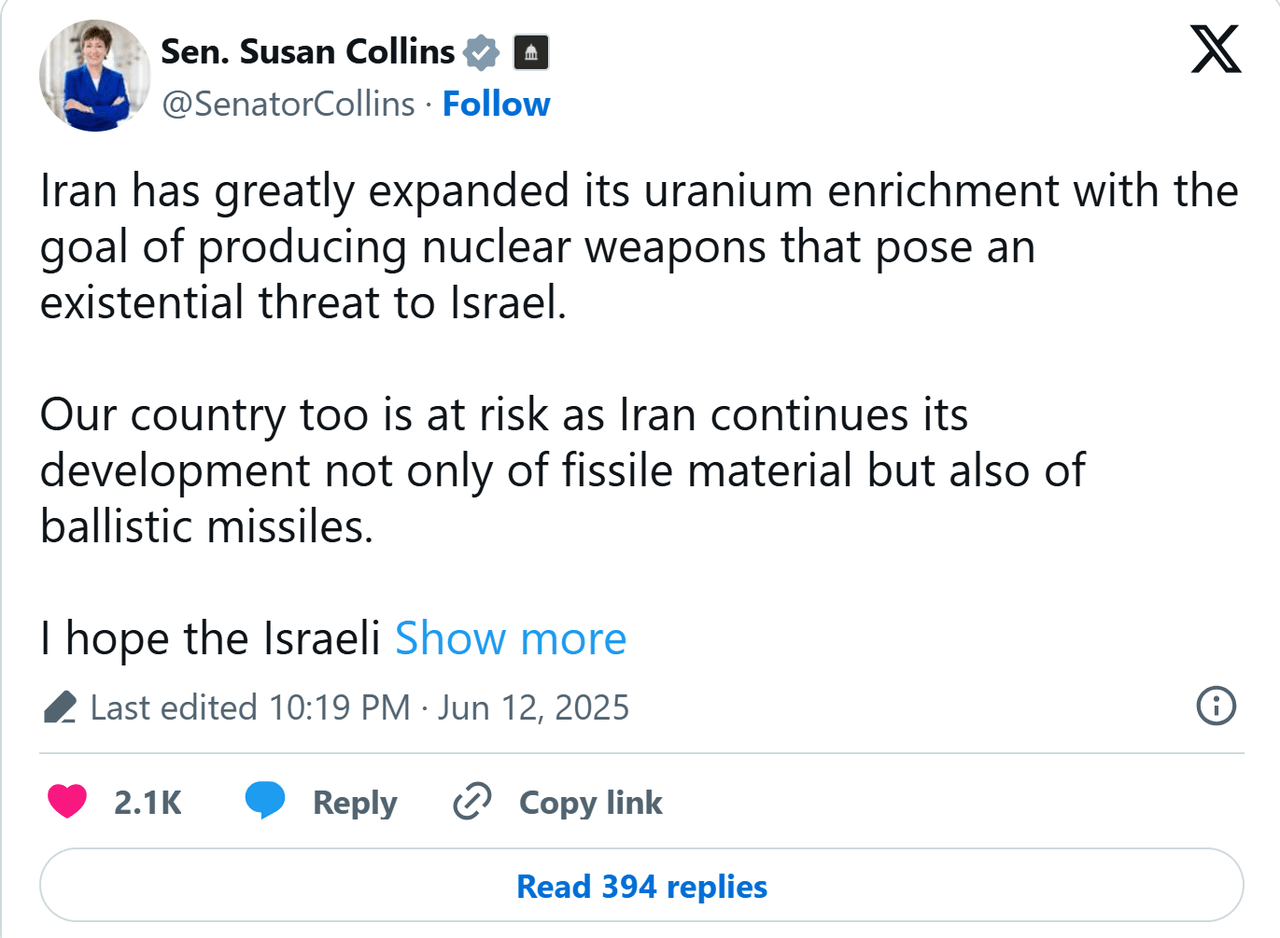
“Iran has greatly expanded its uranium enrichment with the goal of producing nuclear weapons that pose an existential threat to Israel,” Maine Republican Senator Susan Collins wrote. “Our country too is at risk as Iran continues its development not only of fissile material but also of ballistic missiles. I hope the Israeli operation to eliminate Iran’s nuclear capability is successful.”
However, top intelligence officials in both the Trump and Joe Biden administrations repeatedly stated that Iran was not attempting to develop a nuclear weapon. During recent nuclear talks with Washington, Tehran said it was willing to agree to caps on its energy program to ensure it was only used for civilian purposes.
Though the director of national intelligence affirmed in March that Iran was not making a nuclear weapon, that did not stop Rep. Nancy Mace from asserting that the Islamic Republic was just “days” from building a bomb.
“We stand with Israel, fully and without hesitation. Iran was days away from a nuclear weapon. They fund terror and want Israel wiped off the map. Israel has the right, and the duty, to fight back,” she wrote on X. “America must never flinch.”
One of the most vocal Democrats supporting Israel is Sen. John Fetterman, who demanded that the White House aid the Israeli assault. “Our commitment to Israel must be absolute and I fully support this attack. Keep wiping out Iranian leadership and the nuclear personnel.” The post continued, “We must provide whatever is necessary – military, intelligence, weaponry – to fully back Israel in striking Iran.”
A handful of lawmakers did oppose the Israeli strikes, however. Senator Chris Murphy (D-CT) argued that Tel Aviv’s war interfered with Trump’s effort to strike a new nuclear deal with Iran. “Netanyahu wasn’t trying to help diplomacy; he was trying to destroy diplomacy. How do we know? They reportedly targeted and killed Iran’s chief negotiator with Trump,” he wrote.
Additionally, Democratic Reps. Hank Johnson and Rashida Tlaib called on Congress to exercise its war-making authorities. “As America is mired in internal turmoil – and with Hegseth, Gabbard, and Rubio at the controls – foreign leaders like Netanyahu are emboldened to achieve their narrow objectives at America’s expense.” Johnson continued, “Before it’s too late, Congress must stop being a rubberstamp and start exercising oversight to prevent America from being dragged into another war.”
Among Republicans, Senator Rand Paul and Congressman Thomas Massie called on Trump to avoid direct US involvement in the war. “War with Iran is not in America’s interest. It would destabilize the region, cost countless lives, and drain our resources for generations,” Paul explained. “We should pursue diplomacy, not destruction. Engaging in dialogue with adversaries is not weakness; it’s the strength of a confident nation seeking peace. Our primary responsibility is to protect American lives.”
Rep. Massie was the only member of Congress to point out that the attack Israel launched on Friday was an offensive war of aggression. “Israel doesn’t need US taxpayers’ money for defense if it already has enough to start offensive wars.” His X post added, “I vote not to fund this war of aggression.”
Trump Rejects Netanyahu’s Request To Join War, As Israel Needs Large US Bunker Buster Bombs
Latest updates (2015ET):
In the past 48 hours, Israel has asked the Trump administration to join its war effort, per Axios
Israel seeks help targeting & destroying the fortified Fordow uranium enrichment site
Axios says the Trump administration is so far rejecting the Israeli request
But if Fordow remains intact, Israel’s mission to dismantle Iran’s nuclear program will be considered a failure
AJ: At least 80 people – including 20 children – have been killed in Iran and four in Israel, with hundreds wounded on both sides in the ongoing tit-for-tat attacks.
Axios underscores that “Israel lacks the bunker buster bombs and large bomber aircraft needed to destroy Iran’s Fordow uranium enrichment site, which is built into a mountain and deep underground. The U.S. has both within flying distance of Iran.”
Meanwhile, the images coming out of Iran show unprecedented and shocking scenes of oil refineries burning uncontrollably while nearby highway traffic has been forcibly stopped…
An unconfirmed Israeli airstrike has targeted Iran’s defense ministry headquarters, causing minor damage.
The Israeli Air Force reportedly bombed the Shahran oil depot near Tehran, Iranian state media reports.
Two Israeli citizens have been arrested on suspicion of carrying out security offenses under instructions from Iran.
Iran struck a two-story home in Tamra, east of Haifa, killing three.
Jordan has suspended all flight operations in its airspace until further notice
Several missiles were observed streaking above Jerusalem on Saturday night
Israel also carried out airstrikes in Yemen Saturday night, aiming to eliminate Abdul Malik al-Houthi, a senior Houthi military leader
Al Jazeera, citing Iran’s Tasnim news agency, reported that an Israeli airstrike targeted the country’s defense ministry headquarters in Tehran on Saturday evening, causing minor damage to one of its buildings
Israeli forces carry out an attack on an administrative building of the Iranian Ministry of Defense in northern Tehran.
“[A]n attack on Tehran this evening by the air force of the Zionist regime, the headquarters of the defence ministry was targeted. One of the headquarters’ buildings was lightly damaged,” the state news agency reports.
The Iranian government did not comment on the reported strike.
Additionally, Iran’s Islamic Revolutionary Guard Corps (IRGC) claimed its missiles and drones targeted fighter jet fuel production facilities and energy supply centers in Israel, according to a statement reported by state media. The IRGC warned that its “offensive operations will continue more fiercely and widely” if Israel’s actions persist.
The IDF has not confirmed the attack.
* * *
Several missiles were observed streaking above Jerusalem on Saturday night, a witness told Reuters, as Iran launched another direct assault on Israel.
The IDF confirmed that missiles fired from Iran had been detected, with defense systems actively engaged to intercept them.
“Upon receiving an alert, the public is instructed to enter a protected space and remain there until further notice,” the IDF said in a statement, Reuters reports. The IDF did not comment on possible injuries or damages.
Meanwhile, Israeli authorities have arrested two citizens suspected of carrying out security offenses under instructions from Iran, officials told the Jerusalem Post. A gag order has been issued on further details, according to Channel 12’s Amit Segal.
Yesterday, two Israeli citizens were arrested on suspicion of committing security offenses under Iranian direction.
A gag order has been issued on the rest of the details.
Jordan has suspended all flight operations in its airspace until further notice due to escalating tensions between Israel and Iran, the Guardian reported, citing Jordan’s state news agency. Similarly, the Syrian Civil Aviation Authority announced a temporary closure of Syrian airspace to civilian flights, according to SANA.
* * *
The Israeli Air Force reportedly bombed the Shahran oil depot near Tehran, Iranian state media reports. The IDF said not officially commented on the alleged strike. The purported attack comes after Iranian media said Israel struck on the South Pars field in the southern Bushehr province.
#BREAKING Electricity has been cut in Tehran’s Shahran neighborhood after Israeli airstrikes targeted gasoline and oil depots in the western part of the city. pic.twitter.com/5PSaxzGKe7
— Iran International English (@IranIntl_En) June 14, 2025
Initial reports of an Israeli airstrike at Shahran oil depot in western Tehran. pic.twitter.com/NnWM9uuCjz
The strikes have disrupted electricity supply in the area, though the full extent of the damage remains unclear. The Israel Defense Forces have not yet commented on the operation.
* * *
Iran confirmed an Israeli airstrike struck the Shahran oil depot but said the situation was “fully under control,” according to SHANA, the news agency of Iran’s oil ministry, Reuters reports. The state media outlet reported that the targeted tank contained a limited fuel volume. No further details on damage or casualties were disclosed.
* * *
Israeli Defense Minister Israel Katz wrote on X, “Tehran is ablaze” amid reports of the strike on the oil depot.
* * *
Update (1713ET): ‘Hundreds’ of Iranian missiles were launched at the Israeli cities of Tel Aviv and Haifa – which Iran described as ‘cluster missiles’ in what was the fifth salvo today.
Iran launched shortly after Israeli Air Forces completed “a wave of strikes against military and strategic assets, nuclear program sites and high-ranking figures” according to a Saturday evening statement by the IDF. The latest Iranian launch came after Iranian state TV said ‘heavy and destructive’ attacks against Israel were expected within hours.
Air raid sirens could be heard in Haifa and northern Israel.
It appears that Israel intercepted most of the rockets, though some got through – as footage has been posted on social media of a refinery on fire in Haifa.
Iranian new attack managed to direct hit some of the very crucial strategic assets of Israel after Israel started unprovoked attacks against Iran pic.twitter.com/GuaWxEMw6G
“At this hour, Israeli Air Force pilots continue to conduct widespread strikes across various regions in Iran — an ongoing operation lasting nearly 40 hours and targeting over 150 objectives,” said IDF spokesman Brig. Gen. Effie Defrin, who added that protective measures will remain in effect.
CCTV footage captures the impacts of Iranian missiles on Haifa
The death toll from the Iranian ballistic missile strike on a two-story home in Tamra, east of Haifa, has climbed to three, first responders told the Times of Israel. A 20-year-old woman was killed when missile directly struck her home, according to authorities. Firefighters extracted four individuals from a four-story building in the area, but two were pronounced dead at the scene, according to the Jerusalem Post.
The Magen David Adom (MDA) reports that a two-story home was struck by an Iranian ballistic missile in the Arab city of Tamra to the east of Haifa, resulting in 14 injuries, one of which is critical. pic.twitter.com/G3bkU1xbZv
Israel also carried out airstrikes in Yemen Saturday night, Israel’s military carried out airstrikes in Yemen on Saturday night, aiming to eliminate Abdul Malik al-Houthi, a senior Houthi military leader, according to Israel Defense Forces (IDF) sources cited by the Jerusalem Post.
The operation’s outcome remains uncertain, with one Israeli official tell the Israeli publication, “We will soon know if it succeeded.”
The target of an assassination strike by the Israeli Air Force earlier in Houthi-controlled Yemen is reported to be Houthi Chief-of-Staff Muhammad Abd Al-Karim Al-Ghamari. pic.twitter.com/gekkXl5SSh
The IDF has not issued an official statement on the airstrike.
The airstrike in Yemen comes as the IDF continues conducting strikes on targets in Tehran while intercepting a barrage of ballistic missiles launched from Iran, the IDF said.
Earlier, the International Atomic Energy Agency announced on Saturday that there was “no damage seen” at the Fordow Fuel Enrichment Plant or at the Khondab heavy water reactor under construction in Iran. There has also been no further damage at the Natanz nuclear plant since Friday.
* * *
Update(1300ET): Israel’s military on Saturday has been busy touting that its warplanes have total air superiority over Western Iran and the capital area, as the Islamic Republic’s defenses have been largely degraded and destroyed. A senior IDF military official has been cited in local media as saying very significant damage has been inflicted on key nuclear sites and that the IDF will “continue”.
“Since the beginning of the operation, Iran’s nuclear project has suffered heavy blows in two main areas: Damage to the production of the weapon core through strikes on uranium enrichment and conversion sites in Natanz and Isfahan [and] damage to the regime’s weaponization group through the elimination of nine nuclear scientists with unique knowledge and experience in developing the nuclear detonation device,” the official said. And further that “all the scientists eliminated in the opening strike had, over the years, been involved in developing the nuclear detonation device.”
The CIA at this moment still assesses that Iran does not produce a bomb, and was likely not actively seeking it. Iran’s latest response is as follows:
“This aggression pushes the region into a dangerous cycle of violence,” Iranian Foreign Minister Abbas Araghchi says during a call with his Chinese counterpart Wang Yi, according to a statement from his ministry. “Iran has responded and will respond in a firm manner to the barbaric actions of the Zionist regime.”
Netanyahu is meanwhile maintaining that the has the “clear support” of US President Donald Trump, in a new televised address:
In an English video statement, Prime Minister Benjamin Netanyahu says Iranian leaders are “packing their bags” amid Israel’s airstrikes.
“I’ll tell you what would have come if we hadn’t acted. We had information that this unscrupulous regime was planning to give the nuclear weapons that they would develop to their terrorist proxies. That’s nuclear terrorism on steroids. That would threaten the entire world,” he says.
He adds that the operation has the “clear support” of US President Donald Trump.
“Our enemy is your enemy… We’re dealing with something that will threaten all of us sooner or later. Our victory will be your victory,” Netanyahu says, wishing the US leader a happy birthday.
“This is what Israel is doing with the support, the clear support of the president of the United States, Donald Trump, and the American people and many others in the world.”
Below are sites the IDF has claimed to have hit:
From nuclear sites to air defense systems, we’ve dismantled some of Iran’s most dangerous military assets.
At least 80 people – including 20 children – have been killed in Iran and four in Israel, with hundreds wounded on both sides in the ongoing tit-for-tat attacks.
US President Donald Trump has lauded Israel’s premeditated assault and warned of much worse to come unless Iran quickly accepts the sharp downgrading of its nuclear programme.
Continuing Iran-US nuclear talks is unjustifiable while “barbarous” Israeli attacks persist on the country, Iranian Foreign Minister Abbas Araghchi says.
The Israeli military says its air strikes on Iran killed more than 20 Iranian army and Revolutionary Guards commanders.
Israel’s latest attacks on an Iranian gas field takes tensions to a different level
* * *
Overnight has seen the continual trading of tit-for-tat missile salvos between Israel and Iran, with Israeli fighter jets busy over western Iran, where they’ve claimed to have achieved complete domination of the skies after taking out anti-aircraft missile batteries.
Images of large-scale destruction have emerged from both capitals, with Israeli authorities saying at least four citizens have been killed – though casualty figures could be much higher amid an ongoing emergency response – and Iran says Israeli attacks have killed at least 78, including women and children, and wounded over 320 others.
Israel has shared footage of successful aerial attacks on Iran’s ballistic missile launchers in some cases, while the IDF has announced that 70 Israeli Air Force fighter jets participated in the overnight operation in Tehran to establish “aerial freedom of action” over the Iranian capital.
Some 40 sites were targeted, including air defense systems, IDF Spokesman Brig. Gen. Effie Defrin has said. Israeli jets were able to fly over and around the capital for some two-and-half hours.
“The dozens of aircraft are flying freely over Tehran, thanks to the opening blow that removed the threat of Iranian air defense systems,” he declared. Characterizing this as the deepest operation the Israeli Air Force (IAF) has ever been involved in over Iran, he announced:
“Tehran is no longer immune; the capital is exposed to Israeli strikes.”
The IDF releases new footage showing Iranian ballistic missile launchers being struck in Israeli airstrikes. pic.twitter.com/dCcliwun7V
— Emanuel (Mannie) Fabian (@manniefabian) June 14, 2025
Israeli jets have yet to strike all of Iran’s nuclear facilities, and Prime Minister Netanyahu has warned that this could continue for several days more. There is serious damage reported at Natanz nuclear site. There have been conflicting reports over whether there is any radiation or chemical contamination at the site.
Some sections of the Isfahan site have been damaged, the IDF has said, while the other key site of Fordo has yet to be targeted.
Important, Israel says that nine nuclear scientists have been killed as a result of Friday aerial operations. Clearly Israel is going for leadership decapitation of military and nuclear programs.
Impact scene from Tel Aviv:
⚡️#BREAKING First video from the site of the Iranian missile impact that took place in southern Tel Aviv moments ago pic.twitter.com/Y5FckSCIf5
Still, even with Iran’s military capabilities now being steadily degraded, the Islamic Republic has to some degree shown it can regroup and hit back. Israeli media has described a state of panic on the streets, and in some cases residential areas have been demolished:
Israelis on Saturday described the fear, chaos and confusion as several Iranian missiles slammed into houses and apartments in central Israel overnight, causing widespread destruction, killing three people and wounding dozens.
Warning sirens sent millions of people rushing for safe rooms and bomb shelters as Iran fired several waves of missiles in response to Israeli strikes on its military leadership and nuclear program. While the IDF said most were intercepted, several missiles — apparently armed with large explosive warheads — slammed into homes in Tel Aviv, Ramat Gan and Rishon Lezion.
“We shut the door, started watching the news through the computer, and suddenly there was a boom so loud that the whole building teetered,” Tali Horesh, resident of a Tel Aviv high-rise that was hit Friday night, told the Ynet news site.
⚠️RAW FOOTAGE: Iran launched multiple ballistic missiles toward Israel in the past hours.
Meanwhile President Trump has been nowhere to be seen, and certainly hasn’t faced reporters’ questions on where the United States stands in all this.
Is Israel committed to full war for regime change in Iran at this point?
Israel has decided to assassinate Iran’s Supreme Leader Ali Khamenei to try to cause total state collapse. Unless Iran establishes deterrence in the very short term by striking both Israeli and US assets in the region and eliminating top figures in the Israeli regime, they will…