62.3 F
Chicago
Monday, September 21, 2026
Home Blog Page 1518

The Two Catalysts Driving The Next Great Monetary Reset

The Two Catalysts Driving The Next Great Monetary Reset

Authored by Nick Giambruno via InternationalMan.com,

All of this points to something big on the horizon, driven by two key catalysts.

We’re entering a pivotal moment—one where the economic, monetary, and geopolitical landscape is shifting.

These changes aren’t random or isolated; they are the result of deep structural pressures that have been building for decades.

While the signs have been there for some time, recent developments make it clear that the system can no longer hold as-is. A reset is not only possible—it’s likely. And two key forces are pushing us there faster than most realize.

The first is the long-ignored, but now unavoidable, debt crisis.

The second is the Trump administration’s strong belief that an overvalued dollar has hollowed out the US economy, weakening exports, offshoring jobs, and undermining American industry.

Let’s break down these two powerful catalysts driving the next great monetary reset—starting with the one that has silently eroded America’s financial foundation for decades: the debt.

Catalyst #1: The Debt Crisis Has Arrived

The financial decline of the US government has been unfolding for decades, creating a false sense of security. Many people have grown complacent—they’ve heard warnings about the debt crisis for years, yet nothing seemed to happen.

But last year, a crucial tipping point was reached: For the first time, interest payments on the federal debt surpassed the defense budget. It’s on track to overtake Social Security, which would make it the largest single item in the federal budget.

While the US government has an unmatched ability to extend the illusion of solvency, history is clear—even the most powerful empires cannot escape financial collapse once they can no longer service their debt.

A moment of reckoning is coming—and soon.

Historian Niall Ferguson put it bluntly:

“Any great power that spends more on debt service (interest payments on the national debt) than on defense will not stay great for very long.

True of Habsburg Spain, true of ancien régime France, true of the Ottoman Empire, true of the British Empire, this law is about to be put to the test by the US beginning this very year.”

In other words, debt kills empires.

The hard truth?

Cutting spending is meaningless unless it includes chainsaw-like reductions to entitlements, national defense, and the welfare state—while also reducing the national debt to lower interest costs.

In other words, the US would need a leader willing and able to:

  • Return to a limited constitutional government

  • Shut down the 750 military bases abroad

  • End entitlements

  • Dismantle the welfare state

  • Repay a large portion of the national debt

However, that’s a completely unrealistic fantasy. It would be foolish to bet on that happening.

Here’s the bottom line.

The US government cannot and will not even slow the rate of spending growth, let alone reverse it. This is a well-established trend that has been building for decades. At this point, it’s impossible to change course.

It’s like trying to stop an avalanche after it has already gained unstoppable momentum.

No matter what happens, the federal debt will not level off—it will continue expanding exponentially until it reaches a full-blown crisis. That crisis is closer than most realize.

That’s why there is an excellent chance this debt disaster will explode under Trump’s watch—though it is not entirely his fault.

Simply put, it’s game over. The federal debt charade is at the end of the line.

When governments are trapped, they reset the system.

That’s what happened in 1933 with gold confiscation, in 1971 when Nixon ended the gold standard, and at several other pivotal moments in American history. Now, history is repeating itself—and another major reset appears to be on the horizon.

The Trump administration has no other option—and all signs suggest they are preparing for what comes next.

Catalyst #2: A Strong Dollar Creates Economic Instability

The Trump administration sees the dollar as dangerously overvalued, blaming it for America’s worsening economic imbalances.

A strong dollar makes US exports uncompetitive, while making foreign imports relatively cheap, accelerating the offshoring of jobs and the hollowing out of American industry and manufacturing.

After the worst inflation surge in over 50 years, the idea that the dollar is “too strong” might sound absurd.

But the reality is that the dollar has soared against other fiat currencies like the euro, yen, yuan, pound, and the rest of the world’s government-issued confetti.

The Real Broad Dollar Index tracks the dollar’s value against a trade-weighted basket of currencies from 26 major US trading partners. As the chart below illustrates, the dollar has been on an upward trajectory for over a decade and now sits near an all-time high.

President Trump has consistently stressed the importance of leveling the playing field for American industry in global trade. However, a strong dollar directly undermines his goal of revitalizing US manufacturing. It makes American exports less competitive internationally and incentivizes companies to shift production overseas.

In short, the Trump administration believes the US must weaken the dollar against foreign currencies to boost American exports and bring manufacturing back to the US.

So, what can they do?

One historical precedent is the Plaza Accord of 1985.

In the early 1980s, after former Fed Chair Paul Volcker raised interest rates above 17%, the US dollar skyrocketed against foreign currencies. While this helped control inflation, it eventually hurt US exports and domestic industry.

Recognizing the problem, the Reagan administration took action. The US government convened a meeting with finance ministers from Japan, the UK, France, and Germany—its largest trading partners—at the Plaza Hotel in New York City. They agreed to a coordinated devaluation of the US dollar and committed to keeping exchange rates within a controlled range to prevent further volatility.

While a multilateral approach has worked in the past, it’s uncertain whether US trading partners will agree to the scale of devaluation Trump envisions. Trump doesn’t just want minor adjustments—he wants a permanent shift in favor of US industry.

A unilateral response may become the only option if other countries refuse to cooperate.

In my view, the notion that weakening the US dollar is a cure-all for America’s economic problems is misguided. It’s the equivalent of believing that prosperity comes from eroding the savings of everyday Americans while driving up their cost of living. It’s not just flawed—it’s ridiculous.

If the Trump administration truly wants to restore competitiveness, it must slash regulations and other burdens that make American products less attractive than their foreign counterparts.

If weakening a currency truly made a country more competitive, then Argentina and Zimbabwe would be global economic powerhouses.

Currency devaluation props up a handful of inefficient, politically connected industries and enables a reckless government to keep spending, but it does so by impoverishing everyone else in the process.

No country has ever achieved and sustained wealth solely through a weak currency. Yet, this is precisely what those in power seem to believe. And they appear to be moving toward a reset that fundamentally realigns the US economy and trade system.

The Reset Is Coming—Here’s What You Need to Know Before It Hits

Everything you’ve just read points to one conclusion: a major monetary reset is coming—and it’s accelerating fast.

What will it look like? Who wins? Who loses? And most importantly—how can you protect yourself and come out ahead?

I break it all down in an exclusive new report:

Inside, you’ll discover:

  • Why the debt crisis and dollar devaluation are converging
  • How gold could be used to reset the system
  • What steps you can take right now to prepare and profit

Click here to download the PDF report now.

Because by the time the reset becomes obvious… it’ll be too late to react.

Tyler Durden
Thu, 05/08/2025 – 13:05

“Gates Is A Huge Liar”: Musk Hits Back After Bill Gates Claims DOGE ‘Killing World’s Poorest Children’

“Gates Is A Huge Liar”: Musk Hits Back After Bill Gates Claims DOGE ‘Killing World’s Poorest Children’

Update (1257ET): Elon Musk responded to Gates on Thursday, saying “Gates is a huge liar” in response to Gates’ assertion that “DOGE will cost 2 million lives.”

If we know Musk, this is only the beginning of his response…

*  *  *

Microsoft co-founder Bill Gates has reignited his ongoing feud with Tesla CEO Elon Musk, accusing the world’s richest man of “killing the world’s poorest children” through funding cuts to the U.S. Agency for International Development (USAID) overseen by the Department of Government Efficiency (DOGE).

In an interview with the Financial Times published Thursday, Gates pointed to the slashing of grants to a hospital in Mozambique’s Gaza Province, claiming the cuts have undermined efforts to prevent mothers from passing HIV to their newborns. “The picture of the world’s richest man killing the world’s poorest children is not a pretty one,” Gates said, adding, “I’d love for him to go in and meet the children that have now been infected with HIV because he cut that money.”

Notice a messaging trend?

Gates’s comment targeting Musk is the latest salvo in the pair’s longstanding beef.

According to Musk, Gates once approached him to “discuss philanthropy possibilities,” but Musk rebuffed the overture, citing Gates’ $500 million short position on Tesla stock, which Gates confirmed he has not closed. “Sorry, but I cannot take your philanthropy on climate change seriously when you have a massive short position against Tesla, the company doing the most to solve climate change,” Musk texted Gates, per the Tesla CEO’s account.

Gates has also taken swipes at Musk’s financial decisions after Tesla announced a $1.5 billion investment in Bitcoin. Speaking to Bloomberg, Gates said, “Elon has tons of money and he’s very sophisticated, so I don’t worry that his Bitcoin will sort of randomly go up or down.” He cautioned retail investors, however, saying, “If you have less money than Elon, you should probably watch out.”

In 2022, Musk publicly mocked Gates on X, tweeting a meme that compared the Microsoft co-founder to an emoji depicting a pregnant man.

Gates’ comments targeting Musk coincide with his announcement that the Bill & Melinda Gates Foundation will invest over $200 billion in the next 20 years to advance its public health mission, with plans to cease operations by 2045.

“In our first 25 years, fueled partly by Warren Buffett’s generosity, the Gates Foundation distributed over $100 billion,” Gates stated, adding “We aim to double that impact in the next two decades.”

Founded in 2000, the Bill & Melinda Gates Foundation began the same year Bill Gates stepped down as Microsoft CEO. In 2024, Melinda French Gates departed the foundation, three years after the couple’s divorce.

*  *  *

New Rancher-Direct Bundle! Only 12 In Stock…

Tyler Durden
Thu, 05/08/2025 – 12:57

Trump Hails U.S.-U.K. Trade Deal As “Breakthrough”, Says Lower Barriers Will Unlock Transatlantic Growth

Trump Hails U.S.-U.K. Trade Deal As “Breakthrough”, Says Lower Barriers Will Unlock Transatlantic Growth

Update (1215ET): 

Summary… 

President Trump unveiled a U.S.-U.K. trade framework he called a “breakthrough,” designed to lower trade barriers and expand market access for American exports, especially in agriculture, energy, and industrial goods. While the full details remain under negotiation, the deal promises expedited customs clearance for U.S. products entering the U.K. and retains the existing 10% universal tariff rate, with carveouts for steel, aluminum, and automobiles (reduced to zero).

“It’s very conclusive and we think everyone’s going to be happy,” President Trump told reporters, adding, “Many countries want to make a deal, and many countries are very unhappy that we happened to choose this one.” 

Trump continued: “The deal includes billions of dollars of increased market access for American exports, especially in agriculture, dramatically increasing access for American beef, ethanol and virtually all of the products produced by our great farmers.” 

U.K. Prime Minister Keir Starmer told reporters via phone that the trade deal is job-protecting and job-creating. U.K. automakers can export 100,000 vehicles to the U.S. at a 10% tariff—down from the previous 25%. Additionally, Rolls-Royce parts will enter tariff-free. A news headline is expected later this afternoon from a major British airline that has committed to a $10 billion Boeing purchase. 

“This is going to boost trade between and across our countries,” Starmer said. 

Both Trump and Starmer pointed out that today is the 80th anniversary of the two countries celebrating the victory of World War II. 

After Trump, Commerce Secretary Howard Lutnick told reporters: “We’ve opened up new market access—ethanol, beef, machinery, all the agricultural products they’ve agreed to open their markets and that will add $5 billion of opportunity to American exporters.”

Here is UBS’ first take on the major trade announcement:  

President Trump has announced a trade agreement with the U.K., the first to be struck between the U.S. and a foreign country since tariffs were announced. Trump says the deal with the U.K. includes billions of dollars of increased market access for U.S. exports, most notably in agriculture.

The summary of the trade announcement via Bloomberg’s Top Live Blog: 

  • Trump announces trade framework with U.K. that lowers barriers

  • U.K. agrees to $10 billion Boeing procurement, Trump says

  • U.K. tariffs on British steel and aluminum cut to zero,

  • U.K. says China tariffs could be lowered if talks go well: Trump

In markets, the U.S. main equities jumped, with the S&P 500 up as much as 1.4%. The VIX sank to the 21-handle as Trump told reporters, “Better go by stocks now.” 

More market commentary from Bloomberg:

The S&P 500 is now up 1.4%. This isn’t the first time we’ve seen an advance in equities in the wake of a Trump call to buy. Remember on April 9, the president said “THIS IS A GREAT TIME TO BUY,” in a social media post. That came hours before he put a 90-day pause on “reciprocal” tariffs for everyone except China. Equities have basically not looked back since that pause – the S&P 500 is up almost 15% since April 8.

Looking ahead, U.S. Treasury Secretary Scott Bessent and his Chinese counterpart will begin the first round of trade talks in Switzerland on Saturday. 

Expect a lot more trade headlines over the weekend. 

Btw, BTC/USD > 100K. 

Rewatch Trump’s trade deal announcement. The streaming of the event was filmed by Right Side Broadcasting Network. 


*   *   *

Update (1255ET): 

Trump announced in the Oval Office that the U.S. and the U.K. have finalized a “great deal” on trade.

Highlights of Trump’s announcement (courtesy of Bloomberg):

  • Trump says the UK will reduce or eliminate numerous non tariff barriers that discriminated against American products

  • “Today’s agreement with the UK is the first in a series of agreements on trade,” Trump says

  • “The final details are being written up. In the coming weeks we’ll have it very conclusive,” Trump says

  • Tade deal will lead to the creation of an aluminum and steel trading zone, and a secure pharmaceutical supply chain, Trump says

Commerce Secretary Howard Lutnick spoke after Trump:

  • Our 10% tariffs on the UK will stay on 

  • Says the UK will purchase $10 billion in Boeing planes

Additional headlines from Bloomberg:

  • From the UK trade deal, the U.S. will raise $6 billion in external revenue from 10% tariffs, $5 billion in new export opportunities

The UK government responds:

  • US tariffs on automotives were immediately slashed from 27.5%, with steel and aluminium reduced to zero

  • US trade deal gives unprecedented market access for British farmers with protections on food standards maintained

  • We will also remove the tariff on ethanol coming into the UK from the us, down to zero

  • We have agreed new reciprocal market access on beef, with UK farmers given a tariff free quota for 13,000 metric tonnes

Make it bigger…


*   *   *

Update (0859ET)

Ahead of the Trump administration’s big unveiling of a U.S.-U.K. trade deal, new reporting from CNN offers a more precise picture of what to expect. Citing sources familiar with the trade deal, the report suggests the agreement will be narrow in scope, packed with forward-looking commitments, and will not roll back existing 10% universal tariffs. 

Meanwhile, the Financial Times adds that the deal’s key focus areas will likely include automobiles and steel—two sectors at the center of trade tensions. 

US main equity indices slid a bit after the headlines hit, but overnight gains have largely been maintained amid elevated trade optimism from President Trump’s series of Truth Social posts. 

The official announcement is expected around 1000 A.M. ET.


*   *   *

Yet another signal that the trade war has hit its peak came overnight, as President Trump took to Truth Social to tease a “big news conference” Thursday morning, where he plans to unveil a “major deal.” As U.S. markets began coming online, Trump continued promoting what he called “a very big and exciting day” for U.S.-U.K. trade. 

Late Thursday night, the president wrote on Truth Social:

Big News Conference tomorrow morning at 10:00 A.M., The Oval Office, concerning a MAJOR TRADE DEAL WITH REPRESENTATIVES OF A BIG, AND HIGHLY RESPECTED, COUNTRY. THE FIRST OF MANY!!!

Around 0542 ET, he posted again:

This should be a very big and exciting day for the United States of America and the United Kingdom. Press Conference at The Oval Office, 10 A.M. Thank you!

Trump continued in a separate post around 0608 ET:

The agreement with the United Kingdom is a full and comprehensive one that will cement the relationship between the United States and the United Kingdom for many years to come. Because of our long time history and allegiance together, it is a great honor to have the United Kingdom as our FIRST announcement. Many other deals, which are in serious stages of negotiation, to follow!

Then followed by: 

“The Golden Age of America is coming!” 

A resolution to the US-UK trade spat would be the Trump administration’s first step in renegotiating trade worldwide. 

Last month, the U.S. imposed a 10% tariff on most imported goods from the UK as part of the baseline tariff it imposed on all nations. On March 12, the administration also imposed a 25% tariff on all steel and aluminum imports.

UK officials would most likely want to see the 25% tariffs on steel and aluminum completely removed. If this is part of the upcoming trade deal, the UK could then give concessions on a digital tax it levies on Silicon Valley tech giants.

Trump’s series of Truth Social posts provided fresh tailwinds for equity markets overnight in Europe. 

Goldman analyst Jasmin Schneider told clients:

Europe trading firmly in the green this morning (SXXP +70bps, SX5E +1.3%) on progress surrounding US-UK trade talks and some solid earnings on the tape. The big focus overnight on trade talks between the U.S. and UK: *TRUMP: TRADE DEAL ANNOUNCEMENT `THE FIRST OF MANY’. Trump is expected to announce a limited trade agreement with the UK later today (UKX +30bps), which may signal the direction of the U.S. president’s global trade war. Our EU Tariffs Exposed basket (GSXETRFS +1.2%) and UK Consumption names (GSXEUKCO +1.7%) trading well with the deal likely to focus on reducing tariffs on cars and steel, and may include discussions on tech, AI, and digital trade (BBG).

Across the Atlantic, equity futures are also higher, with hopes that the US-UK trade deal will be the first of many resolutions. 

Goldman analyst Rich Privorotsky’s take on the developing trade situation:

Will be watching to see what the shape of the UK deal looks like as it could serve as a global template. Into the weekend the market should grow hopeful for a temperature reduction in the China/U.S. escalation. Although I’m a long term bearish  on U.S./China trade relations, I’m of the opinion that U.S. corporates have a degree of urgency in reducing the 100%+ tariffs imposed (can’t replace supply quickly). Think the landing zone is something back to the 30-50% mark and that will be the travel and arrive event.

Looking ahead, U.S. Treasury Secretary Scott Bessent and his Chinese counterpart will discuss the framework for a trade deal on Saturday in Switzerland.

“The negotiations will begin on Saturday,” Bessent said in testimony before the House Financial Services Committee on Wednesday.

Goldman offered some good news last week: Peak trade war.

Goldman chief economist Jan Hatzius noted earlier this week: “The mood music with China has improved, and we expect the U.S. tariff rate on China to drop from around 160% to around 60% relatively soon. (China is likely to reduce tariffs on the U.S. by a similar amount.)”

Earlier this week, attendees at the Milken Institute Global Conference in Beverly Hills warmed up to Trump’s trade war but wanted to see near-term trade deals. KKR co-founder George Roberts told the audience: “Stay calm and carry on.” 

Tyler Durden
Thu, 05/08/2025 – 12:55

Pakistan Says It Killed Up To 50 Indian Soldiers In Fresh Border Clashes

Pakistan Says It Killed Up To 50 Indian Soldiers In Fresh Border Clashes

In the latest developments along the war-ready Indian-Pakistan border, the Pakistani military says it has downed 25 Indian drones over its territory, while India in in turn is announcing it thwarted a Pakistani drone and missile attack on its military.

The official Pakistani death toll after the Wednesday missile ‘retaliatory’ attacks on Punjab province and Pakistan-administered Kashmir yesterday is at least 31 killed and dozens more wounded. Heavy artillery fire across the Line of Control (LOC) has remained steady, but the kind of feared wider and out of control all-out war has yet to be sparked. Islamabad is now claiming to have killed scores of Indian troops.

Shell hits the main town of Poonch district in Indian-administered Kashmir, AFP

On the other side, the last 48 hours of hostilities has resulted in at least 13 people killed in Indian-administered Kashmir, with others wounded due to Pakistani fire.

India’s ‘Operation Sindor’ to avenge the 26 tourists killed last month’s terror attack has been called an ‘act of war’ by Pakistani leaders. Islamabad has denied any involvement in supporting or harboring the gunmen, amid repeat Indian accusations.

As for the newest major Indian drone attack, it mainly targeted the second-largest city of Lahore, and India’s government hailed that the operation successfully took out air defense radars at several locations. However, Pakistani Defense Minister Khawaja Asif rejected this, saying there was no damage, amid an ongoing fog of war where it’s hard for international observers to confirm much.

But as for a much bigger claim which has yet to be confirmed or substantiated, Al Jazeera reports that “Attaullah Tarar, the Pakistani information minister, has said the country’s armed forces have killed 40 to 50 Indian soldiers in the exchanges along the Line of Control dividing Indian- and Pakistan-administered Kashmir.” The assertions were made before legislators in the National Assembly.

Indian Foreign Secretary Vikram Misri’s latest words suggest New Delhi is still seeking to prevent escalation, claiming that all our air strikes were against “carefully selected terror targets” and that Indian drones and shelling have only hit sites connected to “incidents of cross-border terror in India and terrorist infrastructure.”

And provocatively, he alleged that Pakistan has been “using religious sites as a cover to train terrorists” – which strongly suggests India’s assaults on Pakistan-administered Kashmir will continue, given the presence of armed Islamist factions. Much of this was directed at rejecting Pakistan’s claim that Indian air strikes have damaged the vital Neelam-Jhelum dam.

But the question of disinformation, and the motive for India’s ‘counterterror’ strikes, have been called “domestic theater” by one regional analyst

Yet as tensions between the nuclear-armed neighbors escalate hour by hour, with Pakistan accusing India of launching a wave of drones into its territory on Thursday, military and geopolitical analysts question whether India’s approach serves as a deterrent against armed groups eager to target it. They argue that New Delhi’s actions are more symbolic and aimed at addressing its domestic audience rather than tactical advancement in the so-called “fight against terror”.

“This is all a domestic theatre,” said Ajai Sahni, executive director of South Asia Terrorism Portal (SATP), a platform that tracks and analyses armed attacks in South Asia. “The Indian strikes [in Pakistan] have no deterrent value.”

A steady spread of the border conflict…

Source: @detresfa_

Markets in India and Pakistan have again closed in the red, with India’s benchmark stock market indices – the Sensex and Nifty – having fallen around half a percent in trade.

Pakistan’s Karachi Stock Exchange was halted Thursday, with the benchmark KSE100 index losing more than 6% in trade. Amid the deep uncertainty the Indian rupee has slipped more than a percent against the US dollar.

Tyler Durden
Thu, 05/08/2025 – 09:10

U.S.-U.K. Trade Deal Expected To Leave 10% Universal Tariffs In Place, Focus On Future Commitments

U.S.-U.K. Trade Deal Expected To Leave 10% Universal Tariffs In Place, Focus On Future Commitments

Update (0859ET)

Ahead of the Trump administration’s big unveiling of a U.S.-U.K. trade deal, new reporting from CNN offers a more precise picture of what to expect. Citing sources familiar with the trade deal, the report suggests the agreement will be narrow in scope, packed with forward-looking commitments, and will not roll back existing 10% universal tariffs. 

Meanwhile, the Financial Times adds that the deal’s key focus areas will likely include automobiles and steel—two sectors at the center of trade tensions. 

US main equity indices slid a bit after the headlines hit, but overnight gains have largely been maintained amid elevated trade optimism from President Trump’s series of Truth Social posts. 

The official announcement is expected around 1000 A.M. ET.


*   *   *


Yet another signal that the trade war has hit its peak came overnight, as President Trump took to Truth Social to tease a “big news conference” Thursday morning, where he plans to unveil a “major deal.” As U.S. markets began coming online, Trump continued promoting what he called “a very big and exciting day” for U.S.-U.K. trade. 

Late Thursday night, the president wrote on Truth Social:

Big News Conference tomorrow morning at 10:00 A.M., The Oval Office, concerning a MAJOR TRADE DEAL WITH REPRESENTATIVES OF A BIG, AND HIGHLY RESPECTED, COUNTRY. THE FIRST OF MANY!!!

Around 0542 ET, he posted again:

This should be a very big and exciting day for the United States of America and the United Kingdom. Press Conference at The Oval Office, 10 A.M. Thank you!

Trump continued in a separate post around 0608 ET:

The agreement with the United Kingdom is a full and comprehensive one that will cement the relationship between the United States and the United Kingdom for many years to come. Because of our long time history and allegiance together, it is a great honor to have the United Kingdom as our FIRST announcement. Many other deals, which are in serious stages of negotiation, to follow!

Then followed by: 

“The Golden Age of America is coming!” 

A resolution to the US-UK trade spat would be the Trump administration’s first step in renegotiating trade worldwide. 

Last month, the U.S. imposed a 10% tariff on most imported goods from the UK as part of the baseline tariff it imposed on all nations. On March 12, the administration also imposed a 25% tariff on all steel and aluminum imports.

UK officials would most likely want to see the 25% tariffs on steel and aluminum completely removed. If this is part of the upcoming trade deal, the UK could then give concessions on a digital tax it levies on Silicon Valley tech giants.

Trump’s series of Truth Social posts provided fresh tailwinds for equity markets overnight in Europe. 

Goldman analyst Jasmin Schneider told clients:

Europe trading firmly in the green this morning (SXXP +70bps, SX5E +1.3%) on progress surrounding US-UK trade talks and some solid earnings on the tape. The big focus overnight on trade talks between the U.S. and UK: *TRUMP: TRADE DEAL ANNOUNCEMENT `THE FIRST OF MANY’. Trump is expected to announce a limited trade agreement with the UK later today (UKX +30bps), which may signal the direction of the U.S. president’s global trade war. Our EU Tariffs Exposed basket (GSXETRFS +1.2%) and UK Consumption names (GSXEUKCO +1.7%) trading well with the deal likely to focus on reducing tariffs on cars and steel, and may include discussions on tech, AI, and digital trade (BBG).

Across the Atlantic, equity futures are also higher, with hopes that the US-UK trade deal will be the first of many resolutions. 

Goldman analyst Rich Privorotsky’s take on the developing trade situation:

Will be watching to see what the shape of the UK deal looks like as it could serve as a global template. Into the weekend the market should grow hopeful for a temperature reduction in the China/U.S. escalation. Although I’m a long term bearish  on U.S./China trade relations, I’m of the opinion that U.S. corporates have a degree of urgency in reducing the 100%+ tariffs imposed (can’t replace supply quickly). Think the landing zone is something back to the 30-50% mark and that will be the travel and arrive event.

Looking ahead, U.S. Treasury Secretary Scott Bessent and his Chinese counterpart will discuss the framework for a trade deal on Saturday in Switzerland.

“The negotiations will begin on Saturday,” Bessent said in testimony before the House Financial Services Committee on Wednesday.

Goldman offered some good news last week: Peak trade war.

Goldman chief economist Jan Hatzius noted earlier this week: “The mood music with China has improved, and we expect the U.S. tariff rate on China to drop from around 160% to around 60% relatively soon. (China is likely to reduce tariffs on the U.S. by a similar amount.)”

Earlier this week, attendees at the Milken Institute Global Conference in Beverly Hills warmed up to Trump’s trade war but wanted to see near-term trade deals. KKR co-founder George Roberts told the audience: “Stay calm and carry on.” 

Tyler Durden
Thu, 05/08/2025 – 08:59

Initial Jobless Claims Refuse To Weaken In Face Of CEO Dissonance

Initial Jobless Claims Refuse To Weaken In Face Of CEO Dissonance

So, are CEOs all talk?

After a brief spike last week, initial jobless claims are back in their four year range at 228k – at the same level as in Q4 2021…

Last week’s spike – largely driven by New York – has now been erased – largely driven by New York…

Continuing claims fell back below the 1.9 million American Maginot Line once again…

Continuing jobless claims across The Deep TriState are back up near post-DOGE highs…

But initial claims across the three states have stopped rising as various lawsuits halt layoffs across federal agencies.

Tyler Durden
Thu, 05/08/2025 – 08:41

In ‘Divided’ Decision, BoE Cuts Rates, Plays Down Tariff Fears; Trump Trounces “FOOL” Powell For No Fed Cut

In ‘Divided’ Decision, BoE Cuts Rates, Plays Down Tariff Fears; Trump Trounces “FOOL” Powell For No Fed Cut

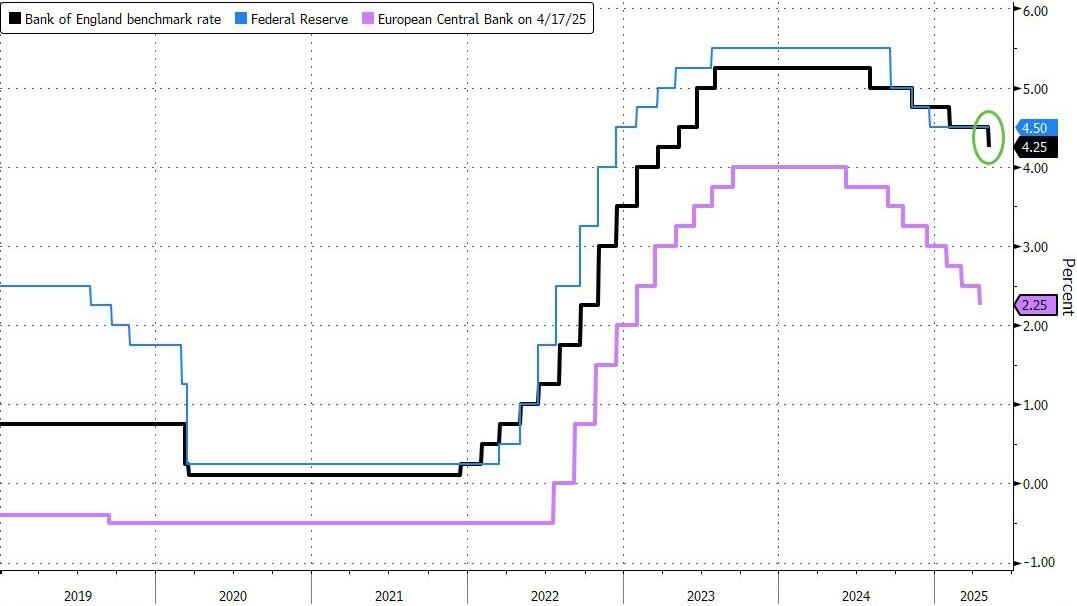
Ahead of an expected trade deal between US and UK, the Bank of England cut rates by 25bps to 4.25% (as expected) this morning.

However, the divided decision surprised markets by showing a more cautious-than-expected approach toward easing monetary policy.

Five members of the BOE’s Monetary Policy Committee voted for a quarter-point cut, while two wanted a larger half-point reduction

Another two voted to hold rates steady. 

The committee held its guidance that easing should continue to be “gradual and careful” in light of volatility in the global economy caused by Trump’s sweeping tariffs.

“Inflationary pressures have continued to ease so we’ve been able to cut rates again today,” Governor Andrew Bailey said in a statement accompanying the decision.

“The past few weeks have shown how unpredictable the global economy can be. That’s why we need to stick to a gradual and careful approach.”

Today’s guidance may have disappointed market expectations partly because investors had overstated the role tariffs would play in the bank’s decision-making, economists at ING suspect.

They wrote:

“While the added uncertainty and weaker outlook for global growth will become a headwind, the reality is that the direct impact of US tariffs so far looks very limited — particularly if Britain is granted sizable carveouts from US President Donald Trump’s sectoral tariffs later today.”

The pound is stronger following the BoE, but has been choppy since the initial FT headlines and later confirmation that a trade deal is imminent:

Gilt yields remain up across the curve, with the increases skewed towards the short end given its sensitivity to monetary policy.

The Fed’s lack of rate-cut (following China’s cut and now BoE’s cut), prompted a further outburst from President Trump

“Too Late” Jerome Powell is a FOOL, who doesn’t have a clue. Other than that, I like him very much! Oil and Energy way down, almost all costs (groceries and “eggs”) down, virtually NO INFLATION, Tariff Money Pouring Into the U.S. — THE EXACT OPPOSITE OF “TOO LATE!” ENJOY!

Notably, amid the panic in the US over tariffs and (hyped) inflation, BoE policymakers had worried that tariffs could push prices higher but are now more confident that those risks will be avoided. 

The BOE now estimates tariffs will lower U.K. inflation by 0.2 percentage points in two years.

Finally, traders are still pricing in another two rate cuts from the BoE this year.

If that comes to pass, that would result in 100 basis points of easing in 2025 – pretty much bang in line with the guidance from Governor Bailey late last year.

credittrader
Thu, 05/08/2025 – 08:32

Futures, Global Markets Jump On Trump Trade Deal With UK

Futures, Global Markets Jump On Trump Trade Deal With UK

US equity futures storm higher, and are back to their post-Liberation Day highs on positive trade news (Imminent “comprehensive” trade agreement with UK the first of his promised deals; removal of chip export restrictions) and a neutral Fed (economy has strength to wait to see trade war impact hit hard data) even as China again reiterated that the US should cancel unilateral tariffs ahead the first official meeting between the countries this weekend amid reports the US is considering exempting child-related goods from its 145% tariffs on China. As of 8:00am ET, S&P futures rose 0.9% while Nasdaq futures are 1.2% higher, both near session highs. Elsewhere FTSE +40bps, DAX +1.2%, CAC +1%, Shanghai +28bps, Hang Seng +37bps, Nikkei +41bps. Intel rose more than 3% in premarket trading, while peers such as Nvidia and Micron also gained on news Trump will rescind restrictions regulating the export of semiconductors to various countries. Outside of tariffs, Norway and Sweden central banks left rates unch (expected) while we get the BoE this morning (25bps cut expected). US Bond yields are 4-5bp higher across the curve and USD is poised to have its best day 6 sessions with DXY +50bp. Today’s macro data focus is on jobless claims, NY Fed 1-year inflation expectations, and labor costs.

In premarket trading, Mag 7 stocks climb as the Trump administration plans to rescind some Biden-era AI chip curbs as part of a broader effort to revise global semiconductor trade restrictions (Nvidia +1.6%, Alphabet +1.9%, Meta +2%, Tesla +1.3%, Apple +1%, Amazon +1.6%, Microsoft +0.9%). Cryptocurrency-exposed stocks rise as Bitcoin approaches the $100,000 mark for the first time since February as global trade tensions show signs of easing. AppLovin climbs 14% after the AI-powered advertisement platform reported first-quarter results that beat expectations. Arm Holdings tumbled 9% after giving a disappointing sales forecast for the current quarter, stoking concerns about a tariff-fueled slowdown for the chip industry. Here are some other notable premarket movers:

  • Carvana (CVNA) rises 4% after the online used-car retailer doubled its profits in the first quarter with record vehicle volume.
  • Coherent (COHR) gains 6% after the semiconductor device company reported third-quarter results that beat expectations
  • Dave Inc. (DAVE) rises 28% after the digital banking services company boosted its revenue and adjusted Ebitda forecast for the full year, surpassing expectations.
  • Eli Lilly (LLY) drops 1.5% and AbbVie (ABBV) dips 1.7% following a Politico report that President Donald Trump plans to revive an effort to dramatically slash drug costs by tying the amount the government pays for some medicines to lower prices abroad.
  • Fortinet (FTNT) tumbles 8% after the security software company reported its first-quarter results and gave an outlook
  • Fluence Energy Inc. (FLNC) falls 15% after the provider of energy storage systems cut its total revenue guidance range for the full year, a reduction of $700m at the midpoint.
  • Fortinet (FTNT) tumbles 14% after the security software company reported its first-quarter results that Jefferies says missed “elevated investor expectations.”
  • Krispy Kreme Inc. (DNUT) falls 19% after saying the company will no longer pay quarterly cash dividends in order to pay down its debt and focus on growth.
  • Magnite Inc. (MGNI) rises 11% after the advertising technology company reported first-quarter results that beat expectations on profitability metrics. It also said it was taking a cautious approach in its outlook given tariff-related uncertainty, a move analysts support.
  • MercadoLibre (MELI) climbs 8% after the e-commerce and fintech giant beat analysts’ expectations in the first quarter of the year, delivering strong growth in its credit portfolio.
  • Peloton Interactive Inc. (PTON) falls 4% after reporting that revenue sank 13% last quarter, marking the third straight year-on-year decline in sales.
  • Shopify Inc. (SHOP) slips 8% after projected sales in the current quarter that just met expectations, suggesting steep tariffs on goods from China present a challenge.
  • Tapestry Inc. (TPR) gains 9% after the handbag maker raised its annual outlook, shrugging off broader concerns about worsening consumer sentiment and the trade war.
  • Tutor Perini Corp. (TPC) climbs 15% after the construction company boosted its year profit outlook. First quarter revenue increased 19% from the year-ago period and beat estimates.

Global markets were lifted after Trump administration’s plan to rescind some Biden-era curbs on chipmakers and news of a trade agreement with Britain, which followed news that US and Chinese officials will meet this weekend to discuss trade. Investors are waiting to see if crippling levies mooted by Trump will be negotiated down, averting lasting damage to economic growth and corporate profits. 

“The fear has been of higher prices, company profit margins being squeezed, and the economy going into recession as a result of higher tariffs,”  said Kenneth Broux, a strategist at Societe Generale. “If you start unwinding all of that, it’s got to be bullish for risk assets.” 

In the UK, gilt yields rose about five basis points, reversing an earlier slide, after the BOE reduced interest rates to 4.25% in a decision made before the US trade deal was announced. However, the BOE upgraded its annual growth forecast for 2025 while two officials voted not to cut rates this time due to inflation risks and a recent easing in financial conditions. 

For Neil Birrell, chief investment officer at Premier Miton Investors, the split BOE vote “goes to show the scale of the uncertainty that exists amongst a key group, namely the actual setters of policy. It’s going to be difficult to make a call on future policy on the back of that.”

Meanwhile, while there was little international fallout from the conflict between India and Pakistan, investors were monitoring signs of escalation. Pakistan’s main equity index shed as much as 8.8%, while India’s Nifty 50 Index lost as much as 01.1%. The Indian rupee slid over 1% against the dollar.

The trade headlines also lifted Europe’s Stoxx 600 index by about 0.9%, as tech, industrials and travel are the best-performing European sectors. Chip stocks including ASML were among the top gainers. Siemens Energy rose after it said the impact of tariffs was going to be limited, while Danish container giant Maersk declines after cutting its forecast amid trade war. Britain’s domestically focused FTSE 250 index rose to a two-month high. Here are the biggest winners:

  • Siemens Energy shares gain as much as 4.1%, touching a record high, shrugging off US tariff chaos and saying the effect of import duties on its bottom line will be small.
  • Adecco shares gain as much as 4.3% after the Swiss staffing company posts a top line beat in a mixed set of first-quarter results.
  • Puma shares jump as much as 6%, hitting their highest level in almost two months, after the sportswear retailer delivered a small sales beat and reiterated its guidance for the year.
  • Rheinmetall shares rise as much as 2% to a new record after the German firm’s weapon and ammunition sales for the first quarter beat the average analyst estimate.
  • Novonesis shares rise as much as 4.3% after the Danish biotechnology firm reported strong results for the first quarter, including a small beat on organic sales growth.
  • J. Martins shares advance as much as 6.3% after retailer maintained Ebitda margin for 1Q even as an unfavorable calendar with a late Easter slowed same-store sales in Poland.
  • Argenx shares drop as much as 9.5% after the biotech firm reported Vyvgart sales for the first quarter that were slightly weaker than JPMorgan analysts had been expecting.
  • Maersk shares fall 2.2% after the Danish container giant’s earnings beat was overshadowed by it cutting its forecast for the global transport market rattled by trade war.
  • Zurich Insurance shares slip as much as 1.4% as Switzerland’s largest insurer cautioned that prices are moderating in Europe, the Middle East and Africa and North America even as it reported solid results for the first quarter.
  • Amadeus shares fall as much as 3.6% after the travel IT services provider reported sales and Ebitda that missed estimates.
  • Centrica shares drop as much as 8%, the most since last July, after analysts warned the British Gas-owner’s AGM update suggests there is downside risks to consensus numbers for this year.
  • Zealand Pharma shares fall as much as 5.9% after the Danish drug developer released results for the first quarter which Van Lanschot Kempen analysts said were “uneventful.”

Earlier in the session, stocks in Asia declined, on course to end a four-day run of gains, as earnings caution in Japan outweighed optimism over signs of easing trade tensions.  The MSCI Asia Pacific Index fell 0.6%, reversing an earlier 0.3% gain. Japanese firms Nintendo Co. and Toyota Motor Corp. were among the biggest drags, with the carmaker expecting a $1.3 billion profit hit in just two months on tariffs. Nintendo projected weaker-than-expected initial sales of the Switch 2. Trading was halted in Pakistan after its benchmark KSE-30 Index slumped on intensifying military conflict with India. Indian stocks were slightly lower. Markets were in the green in Hong Kong, China and South Korea as signs of progress in trade negotiations supported sentiment. The confirmation of US-China trade talks starting this weekend, and Thursday’s report that the US is about to announce a deal with the United Kingdom, boosted optimism that the global tariff war has entered a de-escalation stage. Foreign investor flows into Asian stocks excluding China and Japan reached $3 billion so far this week, according to Bloomberg-compiled data.  

In FX, the dollar was 0.2% higher against a basket of peers, benefiting also from the Federal Reserve’s signal that it’s in no hurry to ease monetary policy. The Fed held interest rates steady as expected on Wednesday, and warned that higher tariffs could raise inflation and unemployment. The pound climbed after the Bank of England cut interest rates as expected, but stuck to signaling “gradual and careful” moves in the coming months. 

In rates, treasuries are cheaper across the curve as US stock futures rally; rate-sensitive two-year Treasury yields rose about five basis points as traders trimmed the odds of a July cut to around 80%. US yields are 3bp-4bp higher across maturities with intermediate tenors leading losses, flattening 5s30s spread by 1.5bp and unwinding a portion of Wednesday’s steepening move. 10-year at 4.30%, just off day’s high. Supply also a factor, with an auction of 30-year bonds ahead at 1pm New York time. Gilt futures fell to session lows after Bank of England cut rates to 4.25% as expected in a three-way split. UK front-end yields cheaper by about 5bp, flattening the gilt curve after the BOE rate decision. The week’s Treasury auction cycle concludes with $25 billion 30-year new issue, following strong demand for 10-year notes Tuesday. WI 30-year yield near ~4.795% is about 2bp richer than last month’s, which stopped through by 2.6bp. Investors will now monitor weekly jobless data, which is expected to show claims slipped marginally in the latest week to 230,000. 

In commodities, oil climbs 1.4% higher to near $58.86. Bitcoin rose toward the $100,000 mark for the first time since February. Spot gold falls about $10 to near $3,350/oz. 

Looking ahead, the US economic calendar includes 1Q nonfarm productivity and weekly jobless claims (8:30am), March wholesale inventories (10am) and April New York Fed 1-year inflation expectations (11am)

Market Snapshot

  • S&P 500 mini +1%
  • Nasdaq 100 mini +1.4%
  • Russell 2000 mini +1.3%
  • Stoxx Europe 600 +0.5%
  • DAX +1.2%
  • CAC 40 +0.8%
  • 10-year Treasury yield +4 basis points at 4.31%
  • VIX -1 points at 22.52
  • Bloomberg Dollar Index +0.3% at 1225.78
  • euro little changed at $1.129
  • WTI crude +1% at $58.67/barrel

Top Overnight News

  • President Trump is expected to announce a framework of a trade deal with the U.K. on Thursday, the first in what the White House hopes is a series of trade agreements since it imposed tariffs against allies and adversaries. Trump said there would be a press conference in the Oval Office at 10 a.m. WSJ
  • Pakistan said it shot down 12 drones from India that had killed one civilian and injured four soldiers. India’s rupee weakened 1%. BBG
  • Ukraine has discussed ways to pressure Russia into agreeing to a 30-day ceasefire with U.S., French, British and German senior officials, President Volodymyr Zelenskiy’s top aide said on Thursday, part of a flurry of diplomacy to try to end the war. RTRS
  • US President Trump’s big announcement is regarding a Medicare drug plan, according to Politico.
  • US President Trump posted “We are making great progress on “The One, Big, Beautiful Bill.” Our Economy is doing well, but it’s going to BOOM in a way never seen before. We are going to do NO TAX ON TIPS, NO TAX ON SENIORS’ SOCIAL SECURITY, NO TAX ON OVERTIME, and much more. It will be the biggest Tax Cut for Middle and Working Class Americans by far, and it is time for Main Street to WIN. MAKE AMERICA GREAT AGAIN!”
  • White House said the Treasury and Commerce departments have formulated plans for a sovereign wealth fund, but no final decisions have yet been made.
  • China is considering largely scrapping its pre-sales model for homes, people familiar said. The move aims to address the country’s housing crisis, but may exacerbate cash flow pressure on developers. BBG
  • The BOJ can’t ignore the potential downside risks to prices stemming from US tariffs, Kazuo Ueda said. BBG
  • The Bank of England cut interest rates by a quarter point to 4.25% as Donald Trump’s global trade war weighs on UK growth, in a decision that split senior officials into three groups and was made before the US President hinted at an imminent deal to lower tariffs on British exports. BBG
  • Brazil’s central bank raised its interest rate by a half-point to 14.75%, the highest level since 2006. Policymakers kept their options open for either another hike or a pause at its next decision. BBG
  • GOOGL +2% … Google issued statement overnight, responding to AAPL’s intraday comments on search traffic: We continue to see overall query growth in Search. That includes an increase in total queries coming from Apple’s devices and platforms. More generally, as we enhance Search with new features, people are seeing that Google Search is more useful for more of their queries — and they’re accessing it for new things and in new ways, whether from browsers or the Google app, using their voice or Google Lens. We’re excited to continue this innovation and look forward to sharing more at Google I/O.”
  • Trump tapped Casey Means to be the next US surgeon general after his prior nominee was withdrawn. The health app founder is a vocal critic of the pharmaceutical industry and Big Food. BBG

A more detailed look at global markets courtesy of Newsquawk

APAC stocks were mostly higher amid some trade optimism and following the mildly positive handover from Wall St where price action was choppy in the aftermath of the FOMC meeting as the Fed kept the FFR at 4.25-4.50%, as expected, and noted that risks to the economic outlook increased further, while Fed Chair Powell reiterated a wait-and-see approach and ruled out a pre-emptive cut during the presser. ASX 200 marginally gained amid strength in gold miners, industrials and tech but with the upside capped by weakness in the top-weighted financial sector after Big 4 bank ANZ’s earnings. Nikkei 225 was underpinned by recent currency weakness and trade deal optimism, although a return to the 37,000 level remained elusive. Hang Seng and Shanghai Comp remained positive following the previous day’s PBoC’s policy loosening, but with further upside in the mainland limited after recent comments from US President Trump, who was unwilling to lower tariffs to get China to the table.

Top Asian News

  • HKMA maintained its base rate at 4.75%, as expected, in lockstep with the Fed.
  • BoJ Minutes from the March 18th-19th Meeting reiterated they are to raise rates if the economic outlook is realised and a member said it’s appropriate to pay close attention to the new US policies and their impact on the global economy. Furthermore, a member said the BoJ would need to be particularly cautious when considering the timing of the next rate hike as downside risks stemming from US policies had rapidly heightened, while a member said that even with heightened uncertainties, it did not warrant BoJ to be always cautious and the BoJ may face a situation where it should act decisively.
  • China is weighing housing market overhaul to curb pre-sales, via Bloomberg

European bourses (STOXX 600 +0.3%) opened mostly firmer and have traded with an upward bias throughout the European morning. European sectors are mixed; Tech takes the top spot, joined closely by Industrials whilst Healthcare lags. Tech benefits from post-earning strength in Infineon (+3%) – despite missing on headline metrics and highlighting that it sees 2025 rev. slightly lower Y/Y due to tariff impact. US equity futures (ES +0.8%, NQ +1%) are broadly in the green, in-fitting with the broader risk tone as markets await Trump’s trade announcement.

Top European News

  • UK PM Starmer is expected to promise on Thursday that his government will deliver a defence dividend for voters, framing an increase in military spending forced by a US shift away from underwriting Europe’s security, as an economic opportunity, according to Reuters.
  • Sky’s Coates says his sources are confirming that the US-UK trade deal claims are correct. Will be a “heads of terms” agreement, rather than a full deal, but substantive.
  • NIESR lowered its UK 2025 GDP growth forecast to 1.2% from 1.5%, while it said Chancellor Reeves looks set to miss her budget targets again, partly due to the economic impact from her tax increase on employers, which raises the prospect of more tax hikes.
  • Swedish Riksbank Rate 2.25% vs. Exp. 2.25% (Prev. 2.25%); it is somewhat more probable that inflation will be lower than that it will be higher than in the March forecast. This could suggest a slight easing of monetary policy going forward.
  • Norges Bank Key Policy Rate 4.5% vs. Exp. 4.5% (Prev. 4.5%); outlook implies that the policy rate will most likely be reduced in the course of 2025.

FX

  • DXY saw an uptick in early European trade, taking the index back above the 100 threshold; no obvious driver was seen behind the move at the time. Last night’s FOMC policy announcement had little follow-through into the USD with the Fed keeping rates unchanged as expected whilst noting that risks to the economic outlook increased further and risks to both sides of the mandate have risen. From a trade perspective, attention is on the details of the expected upcoming UK trade deal announcement whereby the agreement will be eyed as a proxy of what is to come. DXY has hit a new high for the week at 100.20.
  • EUR is fractionally softer vs. the USD with Eurozone newsflow on the light side. On the trade front, the EU is set to announce today a provisional list of tariffs against the US which will be enforced if talks with the US fail. EUR/USD has reverted back to a 1.12 handle and hit a fresh low for the week at 1.1271.
  • JPY is softer on account of the positive risk sentiment which has stemmed from hopes on the trade front. BoJ Minutes was a non-event given it recaps the March meeting. USD/JPY has ventured as high as 144.51.
  • GBP is a touch softer vs. the USD but to a lesser degree than peers amid increased optimism on the trade front with the US and UK expected to announce a trade deal later today. That being said, it is worth noting that the announcement is set to be a “heads of terms” agreement, rather than a full deal, but substantive, according to Sky News. Attention now turns to Thursday’s BoE meeting, which is expected to see policymakers deliver a 25bps rate cut; focus will be on any potential tweaks to guidance. Morgan Stanley expects the “gradual and careful” language to be removed to provide the MPC “space to accelerate cuts if needed”.
  • Antipodeans are both slightly softer vs. the USD with domestic newsflow from Australia and New Zealand on the light side.
  • SEK is a touch softer in the aftermath of the Riksbank policy announcement which saw the central bank stand pat on rates as expected. The accompanying statement noted that “it is somewhat more probable that inflation will be lower than that it will be higher than in the March forecast”, adding that this “could suggest a slight easing of monetary policy going forward”. However, the Bank did stress the uncertainty surrounding the outlook. EUR/SEK has been as high as 10.9424 but is yet to approach its 50DMA to the upside at 10.9491.
  • Little follow-through seen in the NOK after the Norges bank stood pat on rates at 4.5% as expected. The accompanying statement noted that restrictive monetary policy is still needed, adding that, if the policy rate is lowered prematurely, prices may continue to rise rapidly. However, the outlook implies that the policy rate will most likely be reduced in the course of 2025.
  • PBoC set USD/CNY mid-point at 7.2073 vs exp. 7.2385 (Prev. 7.2005).
  • Brazil Central Bank hiked the Selic rate by 50bps to 14.75%, as expected with the decision unanimous, while it stated that additional caution is needed for the next meeting and the scenario also demands flexibility to incorporate data that impact the inflation outlook. Furthermore, the BCB said it will remain vigilant and the calibration of the appropriate tightening of the monetary policy will continue to be guided by the objective of bringing inflation back to the target in the relevant horizon.

Fixed Income

  • The Fed’s decision to keep rates steady (as expected) and Powell stressing a wait-and-see approach to policy, sparked some two-way action in USTs – before then extending a little lower into the APAC session. As for today, US President Trump saying he will announce a trade deal (with the UK) today has managed to boost the risk tone. USTs currently a touch into the red but above yesterday’s low in a 111-11 to 111-19 band. Ahead, weekly jobless claims are due before the NY Fed SCE, in March it showed an increase in near-term inflation expectations and a slight moderation further out alongside an expected deterioration in the labour market. A 30yr auction is also scheduled.
  • Gilts opened bang on the unchanged mark and despite an initial slip to a 93.35 low, comfortably above Wednesday’s 92.79 base, the benchmark has since been on a gentle grind higher despite the constructive risk tone as participants prepared for upcoming UK-specific risk events. Holding around its 93.54 session peak. Awaiting Trump’s 15:00BST press conference for details on a trade announcement which has since been confirmed to be between the US and UK. But before that, attention will be on the BoE where rates are expected to be cut by 25bps in a unanimous decision though the magnitude could be subject to dovish dissent.
  • Bunds are softer, in-fitting with USTs and the constructive risk tone. In contrast to the US and UK, newsflow for the bloc has been a little lighter. No move to a surprisingly strong set of German Industrial data for March this morning. At the low end of a 131.35 to 131.65 band.
  • Spain sells EUR 6.2bln vs. Exp. EUR 5.5-6.5bln 2.40% 2028, 2.70% 2030, 4.00% 2054 Bono & EUR 0.672bln vs. Exp. EUR 0.25-0.75bln 1.00% 2030 I/L

Commodities

  • Crude is bid, but off best as the USD fights back in the European morning (see FX). Currently holding around the mid-point of today’s parameters which are just under USD 1/bbl in size and in very familiar levels from the last few days/weeks. At best, WTI and Brent got just above the USD 58.50/bbl and USD 61.50/bbl marks but failed to make any further ground as the DXY picked back up above the 100.00 mark.
  • Gold is under pressure as the risk tone is supported by Trump’s trade announcement, an event we now know relates to the UK, and also the discussed recovery in the USD. Currently trading in a USD 3,320.68-3,414.50/oz range.
  • Copper has been rangebound since APAC trade after the pressure seen on Wednesday with 3M LME Copper basically holding at the bottom end of yesterday’s USD 9.36-9.47k band.
  • PBoC is reportedly to allow local lenders to purchase more USD to fund increased gold import quotas, via Reuters citing sources.
  • Citi revises its 0-3 month point price for Brent to USD 55/bbl (prev. 60/bbl). No US-Iran deal and escalatory action could see prices return to USD +70/bbl.
  • Iraq sets the June Barah medium crude OSP to Asia at plus USD 0.45/bbl to Oman/Dubai average, Europe minus USD 3.20bbl vs. dated Brent, North and South America minus USD 0.75/bbl vs. ASCI, according to SOMO.
  • Kazakhstan (Apr) oil and condensate daily output +6.5% to 277k tons, according to Interfax; production in May seen at similar levels to April.

US Event Calendar

  • 8:30 am: 1Q P Nonfarm Productivity, est. -0.75%, prior 1.5%
  • 8:30 am: 1Q P Unit Labor Costs, est. 5.1%, prior 2.2%
  • 8:30 am: May 3 Initial Jobless Claims, est. 230k, prior 241k
  • 8:30 am: Apr 26 Continuing Claims, est. 1895k, prior 1916k
  • 10:00 am: Mar F Wholesale Inventories MoM, est. 0.5%, prior 0.5

DB’s Jim Reid concludes the overnight wrap

In a Trump 2.0 world it often seems like the news flow doesn’t really get going until after the US market closes and today is another example of that as overnight Mr Trump has teased that a “major trade deal” will be announced today at 10am DC time (15:00 BST). This must be the very big announcement he flagged on Tuesday. The media are all lining up behind the deal being with the UK. Given that full trade deals take years to negotiate, this will likely be a framework and it will be interesting to see whether the 10% baseline tariff stays as that will provide an important template for negotiations with other countries and a good guide to the long-term tariff strategy of the US.

Asian equity markets and European/UK futures are responding positively to the news that comes a couple of days before trade talks between Washington and Beijing over the weekend. Across the region, the Hang Seng (+1.10%) is leading gains with the CSI (+0.75%) and the Shanghai Composite (+0.38%) also higher. Elsewhere, the Nikkei (+0.28%), the KOSPI (+0.49%) and the S&P/ASX 200 (+0.21%) are also edging higher. S&P 500 (+0.84%) and NASDAQ 100 (+1.16%) futures are building on a strong close that we will discuss below. Euro Stoxx futures are +0.80% and FTSE futures +0.75%. Sterling is around half a percent higher.

This news has slightly overshadowed the Fed last night, where as widely expected, the FOMC kept the fed funds rate on hold for a third meeting running at 4.25-4.50%, while sticking to a patient tone amid heightened uncertainty. The prepared statement noted that uncertainty had “increased further” as risks of both “higher unemployment and higher inflation have risen”. In the press conference Chair Powell acknowledged opposing pressures on its dual mandate stemming from larger-than-expected tariffs announced so far and offered little guidance on the policy path ahead. Powell emphasized the elevated uncertainty but also noted that the economy remains resilient and repeated that policy is well positioned to respond, while pushing back on the idea of pre-emptive rate cuts. Our US economists continue to expect the next rate cut to come in December, with risks tilted towards earlier cuts if unemployment rises more sharply. See their full reaction here.

Rates initially saw a moderate rally following the Fed decision, but this then reversed as Powell emphasised a wait-and-see approach. The next rate cut is now 80% priced by the July meeting while the amount of Fed cuts priced by December declined by -3.1bps yesterday to 78bps, though this move had already played out pre-FOMC. 2yr Treasury yields were little changed (-0.6bps to 3.78%), while 10yr yields declined -2.6bps to 4.27%. This morning in Asia, Treasury yields have reversed higher again with 2yr (+2.3bps) and 10yr (+1.9bps) yields settling at around 3.80% and 4.29% respectively as we go to print.

Equities saw a muted response to the Fed decision, but the S&P 500 managed to post a +0.43% gain by the close thanks to a late rally following a Bloomberg report that the Trump administration is planning to rescind Biden-era AI chip curbs as part of a broader move to revise semiconductor trade restrictions. The reporting helped the Philadelphia semiconductor index rise +1.74% on the day, with Nvidia +3.10% higher.

However, the overall Mag-7 underperformed (-0.26%) as Alphabet (-7.26%) and Apple (-1.14%) lost ground following comments by a senior Apple executive that the company was “actively looking at” revamping its Safari web browser to focus on AI-powered search engines. The comments came amid a DoJ lawsuit against Alphabet that could threaten the companies’ partnership that makes Google the default offering in Apple’s browser. In addition to highlighting the anti-trust cases against big tech, the news is a reminder that while the Mag-7 stocks have benefited immensely from AI optimism, their existing business models also face risks from AI-driven disruption.

Ahead of the Fed’s decision, European markets experienced a risk-off move, with the STOXX 600 (-0.54%) posting its biggest decline in four weeks. The moves occurred across the continent, and even the FTSE 100 (-0.44%) moved lower, ending its record winning run of 16 consecutive gains. A remarkable stat. Let’s see what today’s trade deal does for the UK. Otherwise, France’s CAC 40 (-0.91%) saw a particular underperformance, losing ground for a third day running, and Germany’s DAX was down -0.58%. And the risk-off tone was echoed on the rates side, as yields on 10yr bunds (-6.6bps), OATs (-6.4bps) and BTPs (-7.9bps) all took a sharp turn lower. The moves also got a boost from the latest decline in oil prices, with Brent crude down -1.66% on the day to $61.12/bbl. The peak this year was $82.03/bbl on January 15.

Looking forward, central banks will stay in the spotlight today, as the Bank of England are announcing their own policy decision. It’s widely expected they’ll deliver a 25bp cut today, which would take the Bank Rate down to 4.25%, and continue the pattern of quarterly rate cuts that we’ve had since August. As with the Fed, it’s their first decision since Liberation Day, so all eyes will be on the new forecasts, and our UK economist thinks that meaningful changes are likely. He expects them to cut their growth projections as the unfolding trade shock hits GDP. And he also sees the inflation forecasts being revised lower thanks to stronger sterling and lower energy prices.

Finally on the geopolitical side, there’s been increasing market attention on the situation between India and Pakistan. In terms of the latest, Pakistan said yesterday that they would retaliate against India’s air strikes, and Pakistan’s KSE-100 equity index closed -3.02% lower. By contrast, Indian equities have been much less affected, and the NIFTY 50 index was up +0.14%. This morning, the NIFTY 50 (-0.04%) is fairly flat. The situation has raised fears about an escalation between the two counties, and it represents another example of how the Global South is likely to prove increasingly important for the global backdrop.

To the day ahead, and one of the main highlights will be the Bank of England’s latest policy decision, along with the subsequent press conference with Governor Bailey. Separately, the Bank of Canada will release their Financial Stability Report, and we’ll hear from Governor Macklem too. Elsewhere, US data releases include the weekly initial jobless claims, as well as nonfarm productivity for Q1.


Tyler Durden
Thu, 05/08/2025 – 08:24

Jet-Setting Jihadi Jolani In Paris: From ISIS To The Elysee Palace

Jet-Setting Jihadi Jolani In Paris: From ISIS To The Elysee Palace

On December 8 we reported that Damascus is Now Ruled By ‘Al Qaeda In Suits’ As Assad Emerges In Moscow. A mere months later, these Al Qaeda in suits have already been invited to Paris.

Syrian President Ahmad al-Sharaa (aka. Abu Mohammad al-Jolani) arrived in Paris on Wednesday for his first official visit to a European country since declaring himself interim leader, state news agency SANA reported. He was issued formal invitation by French President Emmanuel Macron.

Ahmed al-Sharaa lands in Paris, via Jerusalem Post

Sharaa, or Jolani, is still at this very moment a designated terrorist according to the United States and several other countries. The FBI dropped its long-running ten million dollar bounty on his head, but the terror designation still stands.

The Syrian leader’s ruling Islamist faction – Hayat Tahrir al Sham (HTS) – has been conducting sectarian attacks on ethno-religious minorities in Syria. Thousands of Alawites, Druze, and Christians have been killed and/or driven from their homes.

All the while, Sharraa has sought to claim before international cameras that he’ll ensure equality for non-Muslims as well as women, but the actions of his HTS gangs are the opposite.

The Syrian leader will seek to press President Macron on sanctions relief and funds for the war-ravaged country’s reconstruction. France, it should be remembered, was part of the US-Gulf coalition behind the decade-long covert push for regime change in Syria targeting Assad.

Macron has meanwhile expressed hope for a “new, free, and stable Syria that respects all components of its people.” This is darkly ironic, given Jolani first came back to Syria from Iraq as a high-ranking ISIS emissary early in the Syria conflict.

He started in ISIS, founded Al-Qaeda in Syria (al-Nusra Front), and is now jet-setting off to the Elysee Palace. 

Whatever London or Washington PR firm is advising Damascus, they thought it good for al-Qaeda linked HTS leader Jolani to shoot some hoops this week… for ‘normalcy’ or something:

Regional Middle East observer Kevork Almassian summed up the Paris trip, amid ongoing HTS attacks on Druze communities in Syria’s south and Damascus suburbs, and attacks on Alawites along the coast, in saying

So, Emmanuel Macron has no problem with a self-appointed President who just committed genocide and ethnic cleansing. The land of “Liberté, Égalité, Fraternité.”

Tyler Durden
Thu, 05/08/2025 – 07:45

Trump To Reveal “Major Trade Deal” Between US-UK

Trump To Reveal “Major Trade Deal” Between US-UK

Yet another signal that the trade war has hit its peak came overnight, as President Trump took to Truth Social to tease a “big news conference” Thursday morning, where he plans to unveil a “major deal.” As U.S. markets began coming online, Trump continued promoting what he called “a very big and exciting day” for U.S.-U.K. trade. The official announcement is expected around 1000 A.M. ET.

Late Thursday night, the president wrote on Truth Social:

Big News Conference tomorrow morning at 10:00 A.M., The Oval Office, concerning a MAJOR TRADE DEAL WITH REPRESENTATIVES OF A BIG, AND HIGHLY RESPECTED, COUNTRY. THE FIRST OF MANY!!!

Around 0542 ET, he posted again:

This should be a very big and exciting day for the United States of America and the United Kingdom. Press Conference at The Oval Office, 10 A.M. Thank you!

Trump continued in a separate post around 0608 ET:

The agreement with the United Kingdom is a full and comprehensive one that will cement the relationship between the United States and the United Kingdom for many years to come. Because of our long time history and allegiance together, it is a great honor to have the United Kingdom as our FIRST announcement. Many other deals, which are in serious stages of negotiation, to follow!

Then followed by: 

“The Golden Age of America is coming!” 

A resolution to the US-UK trade spat would be the Trump administration’s first step in renegotiating trade worldwide. 

Last month, the U.S. imposed a 10% tariff on most imported goods from the UK as part of the baseline tariff it imposed on all nations. On March 12, the administration also imposed a 25% tariff on all steel and aluminum imports.

UK officials would most likely want to see the 25% tariffs on steel and aluminum completely removed. If this is part of the upcoming trade deal, the UK could then give concessions on a digital tax it levies on Silicon Valley tech giants.

Trump’s series of Truth Social posts provided fresh tailwinds for equity markets overnight in Europe. 

Goldman analyst Jasmin Schneider told clients:

Europe trading firmly in the green this morning (SXXP +70bps, SX5E +1.3%) on progress surrounding US-UK trade talks and some solid earnings on the tape. The big focus overnight on trade talks between the U.S. and UK: *TRUMP: TRADE DEAL ANNOUNCEMENT `THE FIRST OF MANY’. Trump is expected to announce a limited trade agreement with the UK later today (UKX +30bps), which may signal the direction of the U.S. president’s global trade war. Our EU Tariffs Exposed basket (GSXETRFS +1.2%) and UK Consumption names (GSXEUKCO +1.7%) trading well with the deal likely to focus on reducing tariffs on cars and steel, and may include discussions on tech, AI, and digital trade (BBG).

Across the Atlantic, equity futures are also higher, with hopes that the US-UK trade deal will be the first of many resolutions. 

Goldman analyst Rich Privorotsky’s take on the developing trade situation:

Will be watching to see what the shape of the UK deal looks like as it could serve as a global template. Into the weekend the market should grow hopeful for a temperature reduction in the China/U.S. escalation. Although I’m a long term bearish  on U.S./China trade relations, I’m of the opinion that U.S. corporates have a degree of urgency in reducing the 100%+ tariffs imposed (can’t replace supply quickly). Think the landing zone is something back to the 30-50% mark and that will be the travel and arrive event.

Looking ahead, U.S. Treasury Secretary Scott Bessent and his Chinese counterpart will discuss the framework for a trade deal on Saturday in Switzerland.

“The negotiations will begin on Saturday,” Bessent said in testimony before the House Financial Services Committee on Wednesday.

Goldman offered some good news last week: Peak trade war.

Goldman chief economist Jan Hatzius noted earlier this week: “The mood music with China has improved, and we expect the U.S. tariff rate on China to drop from around 160% to around 60% relatively soon. (China is likely to reduce tariffs on the U.S. by a similar amount.)”

Earlier this week, attendees at the Milken Institute Global Conference in Beverly Hills warmed up to Trump’s trade war but wanted to see near-term trade deals. KKR co-founder George Roberts told the audience: “Stay calm and carry on.” 

Tyler Durden
Thu, 05/08/2025 – 07:20