Zelensky Announces Western Supplied F-16 Shot Down, Pilot Killed
In a rare moment, Ukraine’s military as well as President Zelensky have announced that a Western-supplied F-16 fighter jet was shot down Saturday while conducing operations over Ukraine. Zelensky confirmed the pilot’s death in an announcement.
The Ukrainian Air Force (UAF) command has identified the that 26-year-old fighter pilot Pavlo Ivanov was killed during a combat mission in an F-16 Viper fighter aircraft.
Ukraine has not released details or the location of the plane downing, but both Russian and Ukrainian military bloggers have described the F-16 Viper was struck by a surface-to-air missile.
There’s been some speculation that it may have been a ‘friendly fire’ incident – but these details aren’t known at this point. The military’s statement said that the country’s F-16 pilots operate “in incredibly difficult conditions” and that the pilot died while “defending his native land from the occupiers,” according to a translation.
This only the second officially revealed downing of a Western-supplied F-16. “Saturday’s loss is only the second confirmed F-16 loss that Ukraine has faced, delivering a symbolic blow to Kyiv’s forces,” Newsweek writes.
“The F-16 aircraft are more advanced than the Soviet-era aircraft Ukraine’s forces had been using for much of the ongoing Russia-Ukraine war that began in February 2022. The aircrafts delivery from European allies was also hoped to change the battlefield calculus,” the report notes.
A Ukrainian Air Force message said there will be an investigation: “All the circumstances of the tragedy are being established by an interdepartmental commission,” it said.
Zelensky’s message posted to social media in English and Ukrainian began as follows:
Today, Captain Pavlo Ivanov was tragically killed during an F-16 combat mission. The guy was only 26. My condolences to his family and to all of Pavlo’s brothers-in-arms.
The first known downing of an F-16 over Ukraine happened last summer:
It is the second confirmed death of a Ukrainian F-16 pilot. On August 26, 2024, Oleksii “Moonfish” Mes, was killed when he was reportedly responding to a Russian missile attack.
He had visited the United States in 2022 to lobby for the aircraft to be sent to Ukraine. In May 2023, the Biden administration allowed other countries to provide Kyiv with the U.S.-made aircraft.
The F-16 program has been ultra controversial as pilots were hastily trained in both Europe and the United States. Moscow has complained that F-16s are actually capable of carrying NATO nukes, and so has warned a mishap could lead to WW3.
Russia has vowed to destroy the F-16s both in the air and on the ground, and as even in the recent past warned that if they take off from neighboring countries then those European bases are fair game for attack. This would certainly spark direct conflict with the Western military alliance.
Colorado Gov. Jared Polis (D), signed a bill into law on April 10 requiring people to obtain a permit and undergo safety training before they buy certain guns.
The legislation also bans the purchase and sale of devices that enable guns to be fired rapidly, including bump stocks.
“For folks who haven’t had any gun safety training, it’s very important that they get that, and this bill will make sure that people will get that education on how to operate the weapons safely and—just as important—how to store them safely,” Polis said at a press conference on Thursday.
Senate Bill 25-003, the legislation, is set to take effect on Aug. 1, 2026.
Under the law, people cannot buy semiautomatic rifles or semiautomatic shotguns with detachable magazines unless they’ve completed hunter education training offered by the Colorado Parks and Wildlife and a “basic firearms safety course.”
Local sheriffs must sign off on completion of the course, with applicants also undergoing a background check and vowing not to violate state laws on guns.
Individuals who violate the law face a class 2 misdemeanor on the first offense and a felony charge on subsequent offenses.
Dealers found to have violated the law shall have their licenses revoked.
State Rep. Andy Boesenecke, a Democrat who co-sponsored the bill, said in a statement after the signing that the legislation “will help save lives and prevent future tragedies in Colorado.”
Everytown for Gun Safety, which advocates for gun restrictions, was among the organizations praising the bill.
“Colorado’s new law is the definition of common sense: If you want to buy a military-style rifle that can kill dozens without needing to reload, you need to get a permit that requires passing a background check and taking a safety course,” John Feinblatt, president of the group, said in a statement.
Other groups said the bill infringes on constitutional rights.
Ian Escalante, executive director of Rocky Mountain Gun Owners, said in a video that the bill is “the worst, most sweeping gun restriction in U.S. history.”
Escalante said the group is reviewing its legal options.
“We’re not going to stand for it. We’re not going to allow Jared Polis … and the legislature to force us to buy back our right to purchase the most commonly-used rifle in America,” he said.
The U.S. Supreme Court in 2024 struck down a federal ban on bump stocks.
Rep. Lauren Boebert (R-Colo.) also criticized the Colorado legislation.
“SB25-003 converts our constitutional rights into a privilege—one that becomes only accessible to those who can afford it,” she wrote on social media platform X.
Boebert and other Republicans called on the U.S. Department of Justice to sue Colorado over the law.
Trump Envoy In First ‘Direct, Constructive’ Contact With Iran After Laying Down Red Line
Not very much happened at the much-anticipated ‘indirect’ meeting between Iranian and US delegations in Oman on Saturday. While Tehran has been emphasizing the indirect nature of the dialogue, President Trump and his top officials have been calling these ‘direct’ talks.
The main ‘positive’ is that the two sides didn’t yell each other out the room, or make new accusations – instead they agreed to keep the diplomatic engagement going.
“Iran and the United States will hold more negotiations next week over Tehran’s rapidly advancing nuclear program, Iranian state television reported Saturday at the end of the first round of talks between the two countries since President Donald Trump returned to the White House,” The Associated Press reports as the meeting wrapped up.
As for whether they were ‘direct’ or not, Iranian state did say that Trump regional onvoy Steve Witkoff and Iranian Foreign Minister Abbas Araghchi “briefly spoke in the presence of the Omani foreign minister” at the end of the talks.
This does indeed mark the first direct interaction between the Islamic Republic and the Trump administration. It is Trump during his first term who pulled the US out of the 2015 JCPOA nuclear deal (in April 2018).
The Iranian side has announced that the next round of talks will take place April 19, in a clear sing that both sides could be ready to do a new deal. This is precisely what Trump has demanded – the inking of a new nuclear deal – while threatening military action against Tehran. Trump has also warned that Israel might ‘lead’ such strikes on nuclear facilities.
According to more details from Muscat, Oman on Saturday:
American officials did not immediately acknowledge the Iranian reports, which Tehran likely speeded out to its public ahead of a possible Trump post on a social media. But declaring that the two sides spoke face-to-face — even if briefly — suggests the negotiations went well.
The talks began at around 3:30 p.m. local. The two sides spoke for over two hours at a location in the outskirts of Oman, ending the talks around 5:50 p.m. local time. The convoy believed to be carrying Witkoff returned to Muscat, the capital of Oman, before disappearing into traffic around a neighborhood that is home to the U.S. Embassy.
Baghaei in follow-up stated that “The objective of the Islamic Republic of Iran is very clear — we have only one goal, and that is to safeguard Iran’s national interests.”
“We are giving a genuine and honest opportunity to diplomacy, so that through dialogue, we can move forward on the nuclear issue on one hand, and more importantly for us, the lifting of sanctions,” he added. No one is in the mood for war (though perhaps Israel?).
The US president Donald Trump is expected to achieve today what no other president has ever achieved since July 1776: Prevent Iran from having nuclear weapon, a decision that has never been taken by Iran before.
Iran’s Foreign Minister Abbas Arachgi headed to Oman today.
“Look, this is just a beginning. So it is natural that, at this stage, both sides will present their foundational positions through the Omani mediator,” Baghaei continued. “Therefore, we do not expect this round of negotiations to be lengthy.”
Witkoff had previewed to The Wall Street Journal just ahead of the trip, “I think our position begins with dismantlement of your program. That is our position today.”
He added: “Where our red line will be, there can’t be weaponization of your nuclear capability.” However Iran has maintained all along that its program is only for peaceful nuclear energy to meet the nation’s power needs, and further several Ayatollah’s have declared nuclear weapons to be ‘unIslamic’.
But recent conflict with Israel means Tehran is likely eyeing escalation of its program, possibly seeing in this the only final deterrent to Israel, and the potential for US-led regime change (as happened in neighboring Iraq and Afghanistan).
“At least at this juncture and on this record, the plaintiffs have not made the requisite showing of a ‘credible threat’ of enforcement,” U.S. District Judge Dabney Friedrich of the U.S. District Court for the District of Columbia wrote in an opinion.
The ruling came in a case brought by religious groups, including the Mennonite Church USA.
The federal government’s new policy, announced after President Donald Trump took office, rescinded a policy labeling churches and schools as sensitive places, making it easier for agents to carry out immigration enforcement at these locations.
The groups said the policy unconstitutionally interferes with their exercise of religion.
“Immigration agents already have begun exercising this newfound authority to snare worshippers and other visitors at Plaintiffs’ places of worship, inflicting grave harm on Plaintiffs’ ability to freely exercise their religious beliefs and to assemble,” the plaintiffs said in a motion for a preliminary injunction, or an order blocking the policy. “Absent preliminary relief, these enforcement activities in and near sacred spaces will multiply and so, too, will the intense burden this government action places on Plaintiffs’ religious exercise.”
Government lawyers said in a filing in response that the groups’ only outlined possible injury from future immigration raids, which was insufficient to prove standing. They also said that “those speculative harms are outweighed by the Government’s strong interest in immigration enforcement and avoiding interference with discretionary law enforcement decisions.”
Friedrich noted that just one enforcement action has taken place at one of the plaintiffs’ churches, with another four reporting immigration agents having conducted surveillance at or near their premises. She said that the evidence presented by the parties showed that churches and other places of worship are not being singled out as special targets by DHS agents.
“Absent evidence of specific directives to immigration officers to target plaintiffs’ places of worship, or a pattern of enforcement actions, the Court finds no credible threat of imminent enforcement,” she wrote. “Accordingly, the plaintiffs lack standing to assert a pre-enforcement challenge.”
Friedrich also said that the religious organizations have not shown that drops in attendance are linked to the new policy, as opposed to the government’s broader effort to arrest illegal immigrants. Evidence exists indicating congregants are staying home not to avoid agents at churches, but because agents may be in their neighborhoods, she said.
The denial means the policy will remain enforceable as the case proceeds. The court could eventually rule in favor of the plaintiffs.
A separate case challenging the same policy, lodged by Quakers in federal court in Maryland, resulted in a different U.S. judge ruling that immigration agents cannot make arrests at churches belonging to the plaintiffs.
U.S. District Judge Theodore Chuang, the judge, wrote in his order that the policy lacked “meaningful limitations or safeguards” on enforcement and “likely does not satisfy these constitutional and statutory requirements as to Plaintiffs.”
Watch: Bill Maher Says ‘Mind Blown’ After Meeting With Trump
While Bill Maher may change opinions like a windsock depending on who he’s pandering to, the “Real Time” host told his mostly-Democrat audience that Donald Trump, aka Hitler-Stalin-Mussolini, was “gracious and measured” at their recent meeting last week.
We know, duh… but considering the influence Maher has on the left, his comments are interesting nonetheless.
“You can hate me for it, but I’m not a liar. Trump was gracious and measured,” Maher said. “And why isn’t that in other settings- I don’t know, and I can’t answer, and it’s not my place to answer. I’m just telling you what I saw, and I wasn’t high.”
Maher said the meeting, brokered by their mutual friend Kid Rock, wasn’t “some kind of summit.”
“I have no power. I’m a fucking comedian, and he’s the most powerful leader in the world!” he continued. “I’m not the leader of anything, except maybe a contingent of centrist-minded people who think there’s got to be a better way of running this country than hating each other every minute.”
Maher admitted that he went in ready for a fight – only to find Trump absolutely charming.
“Everything I’ve not liked about him was, I swear to God, absent. At least on this night, with this guy,” Maher, 69, said – seemingly shocked at his own admission.
“I never felt I had to walk on eggshells around him. And honestly, I voted for Clinton and Obama, but I would never feel comfortable talking to them the way I was able to talk with Donald Trump,” he continued, adding “Make of it what you will.”
“I’ve had so many conversations with prominent people who are much less connected. People that don’t look you in the eye. People that don’t really listen because they just want to get to their next thing. People whose response to things you say just doesn’t track. None of that with him,” Maher continued. “Mostly he steered the conversation to ‘what do you think about this?’ I know. Your mind is blown. So is mine.“
Maher added that Trump gave him a bunch of MAGA hats, which are stored in the same room where former President Bill Clinton and Monica Lewinsky engaged in extracurricular activities.
At one point in the dinner, Maher says Trump asked him about his thoughts on the Iran nuclear situation. After he allegedly gave Trump shit for eliminating the Obama-era nuclear deal, Trump “didn’t get mad or call me a left-wing lunatic. He took it in.”
Trump admitted he ‘lost’ in 2020 (allegedly)
According to Maher, Trump used the word ‘lost’ in relation to the 2020 presidential election.
“And I distinctly remember saying, ‘Wow, I never thought I’d hear you say that.’ He didn’t get mad. He’s much more self-aware than he lets on in public,” Maher said, adding that in private, Trump is just normal.
“Just for starters, he laughs,” Maher stated in disbelief. “I’d never seen him laugh in public. But he does — including at himself — and it’s not fake. Believe me, as a comedian of forty years, I know a fake laugh when I hear it.”
Watch:
Twelve days ago, I had dinner with President Trump, a dinner that my friend @KidRock set up because we share the belief that there has to be something better than hurling insults from 3000 miles away. pic.twitter.com/KE2t2eyBkI
Meanwhile, journalist Laura Loomer is jumping all over conservative “Bill Maher Simps,” while she says she had “a productive week in Cali, which included my deposition of Bill Maher,” who she’s suing for defamation.
So sick of Bill Maher Simps.
Conservatives are so desperate to be friends with people who hate them.
All I know is I had a productive week in Cali, which included my deposition of Bill Maher @billmaher.
Trump Exempts Computers, Handsets, Chips From Reciprocal Tariff Blitz, Still Subject To Original 20%
Update (1255ET): As Trump adviser Stephen Miller points out, the products are still “subject to the tariff under the original IEEPA on China of 20 percent.”
Washington Post: maybe your reporters should try reading before posting. These products are subject to the tariff under the original IEEPA on China of 20 percent. https://t.co/MI4oDEb8S3
U.S. Customs and Border Protection (CBP) issued an updated guidance late Friday night on product exclusions from President Trump’s reciprocal tariffs, imposed under Executive Order 14257 and its amendments (EO 14259). The exclusions cover a wide range of electronic devices, including smartphones, laptops, and related components.
First, President Trump paused reciprocal tariffs for non-retaliating countries (e.g., China) for 90 days last week. Now, updated guidance from CBP reveals that some of the highest-value trade—particularly a wide range of electronics—is excluded from the reciprocal tariffs.
Among the 20 tariff codes listed for exemption, three stand out in particular:
8471 – Automatic data processing machines and units thereof (e.g., laptops, desktops, servers).
8517.13.00 – Smartphones and other telecommunication apparatus for cellular networks.
To close out the week, the U.S.–China trade war escalated in a highly predictable tit-for-tat fashion. The U.S. now imposes a 145% effective tariff rate on Chinese goods, while Beijing has retaliated with a 125% rate on American products.
Meanwhile, Wall Street analysts have already trimmed sales estimates for U.S. companies with Chinese exposure, including Apple and Tesla, as economic storm clouds gather over global trade.
Notably, most of the products now exempt from reciprocal tariffs are those the U.S. lacks the capacity to produce at scale—highlighting the need for significant reshoring, investment, and supply chain restructuring.
Many of these products are also consumer essentials—items Americans couldn’t live without, such as smartphones and computers—making them politically sensitive. The Trump administration likely chose not to risk upsetting consumers ahead of the Midterms.
In markets, this news will be fuel to stage a further recovery…
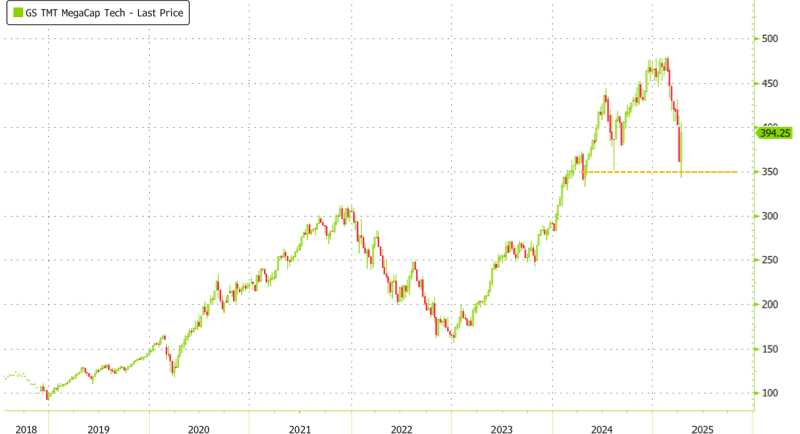
Nasdaq Breadth…
As Wedbush’s Dan Ives notes, Big Tech and investors ‘got the dream news’. . .
This is for all reciprocal tariffs including China….Big Tech and investors got the dream news🐂🔥🏆 https://t.co/tWEv0WwNxU
It costs more to be an American now than it did five years ago—more than 50 percent more. The U.S. government spent more than half again as much in 2024 as it did in 2019, and interest payments on the national debt more than doubled during that time, according to the Congressional Budget Office.
Since 2019, federal spending, the national debt, and the size of the federal bureaucracy have all grown rapidly. Federal regulations also increased over the half-decade, with some 290 additional rules and nearly 10 million words added to administrative law books.
President Donald Trump’s effort to reduce the size and scope of the federal government, mainly through the Department of Government Efficiency (DOGE), has met with some early success. There have also been roadblocks in the form of legal challenges and public protests.
Here’s an overview of recent trends in federal spending, borrowing, and staffing that lend perspective to the scope of current and planned reductions to the federal bureaucracy.
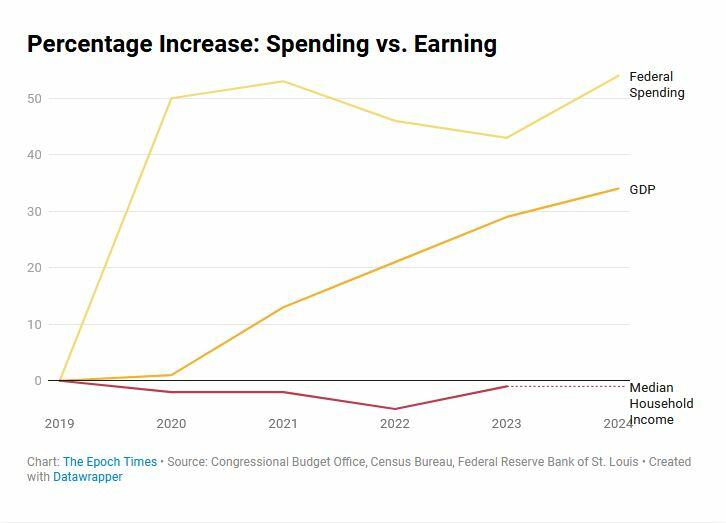
Federal spending grew by about 55 percent from 2019 to 2024. The initial increase appears to have been driven by COVID-19-related spending, which trended down beginning in 2021. Yet even before the public health emergency was declared over in May 2023, spending began to increase again.
Meanwhile, the median household income in the United States declined slightly over that period. At the end of 2023, the last date for which data is available, the typical American family was earning $600 less per year than in 2019.
Spending grew faster than the nation’s economy, measured as the gross domestic product; the total value of all goods and services sold.
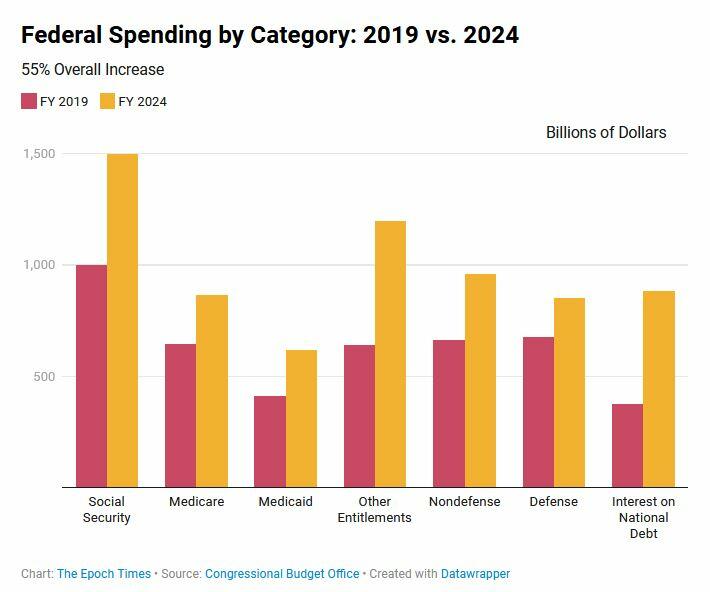
The fastest-growing category of federal spending is interest on the national debt, which more than doubled during that period. Interest payments on the national debt (not including repaying the debt itself) now cost more than any single government program except Social Security. America pays more to its lenders than it pays for national defense, Medicaid, or Medicare.
Spending on Social Security, Medicare, Medicaid, other entitlement programs, and interest on the debt is mandatory because it is dictated by longstanding federal laws. Other defense spending and other non-defense spending are considered discretionary because Congress sets those amounts each year.
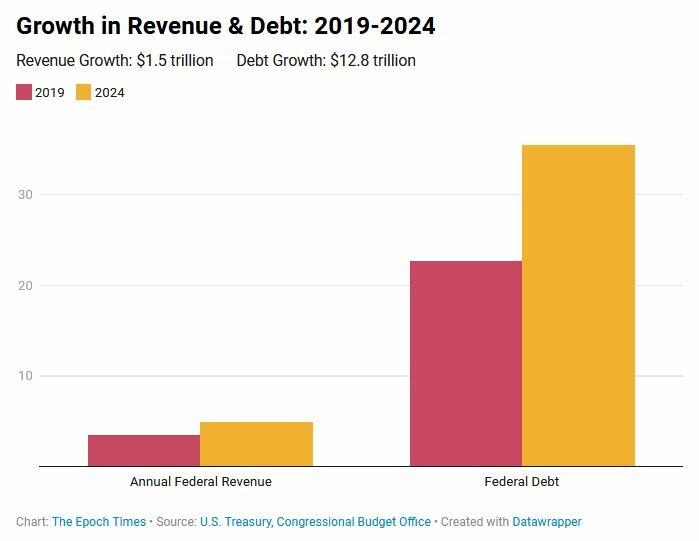
The national debt grew by 56 percent from 2019 to 2024, topping $35 trillion. Since 2012, it has exceeded the value of all goods and services sold in the United States, known as the gross domestic product. As of 2024, the federal debt was about 120 percent of the nation’s gross domestic product.
From 2019 to 2024, federal revenue increased by 40 percent from $3.5 trillion to $4.9 trillion.
To compare the changes in income and debt over that period in everyday terms, a family earning a household income of $60,000 in 2019 could have increased its salary to $72,000 by 2024. Over the same five years the family had credit card debt and student loans that increased from $390,000 to $520,000.
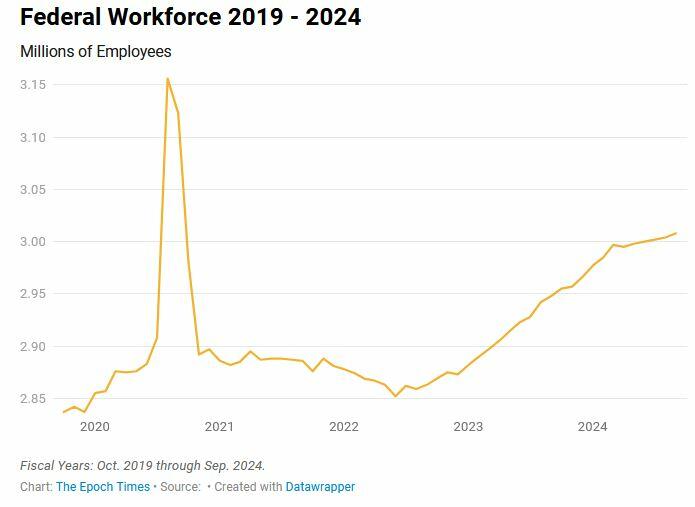
The federal workforce grew significantly from 2019 to 2024. Discounting the approximately 500,000 temporary employees hired to conduct the 2020 census, the federal government grew by about 150,000 during those five years. That increase is more than the total number of people employed by either Boeing or Verizon.
The federal government employs about 3.1 million people, not including the military or federal contractors. Contractors are people employed by private companies to perform work for the federal government, such as processing Medicare claims.
Uncle Sam employs more people than Walmart and nearly double that of Amazon. The federal government is the largest employer in 37 states.
Trump Orders Military To Seal Southern Border As US Accelerates Hemispheric Defense
Days after NBC reported that the Trump administration had considered launching drone strikes on drug cartels in Mexico, President Trump issued a memorandum Friday night to the heads of four federal departments, expanding the U.S. military’s role in securing the southern border in accordance with Executive Order 14167 (Clarifying the Military’s Role in Protecting the Territorial Integrity of the United States) and Proclamation 10886 (Declaring a National Emergency at the Southern Border of the United States). The move aligns with a broader strategic theme known as hemispheric defense.
It states, “Our southern border is under attack from a variety of threats. The complexity of the current situation requires that our military take a more direct role in securing our southern border than in the recent past.”
Here’s a breakdown of the memo:
Key Objectives:
Repel border invasion and seal the U.S.–Mexico border from unlawful entry.
Empower the Department of Defense (DoD) to use federal lands (excluding Indian Reservations) for:
Military operations,
Border barrier construction,
Surveillance infrastructure,
Designation of National Defense Areas.
Agency Coordination:
Secretaries of Defense, Interior, Agriculture, and Homeland Security must coordinate to:
Transfer jurisdiction of necessary lands to DoD.
Allow military installations and operations on designated federal land (e.g., Roosevelt Reservation).
Expedite land withdrawals under 43 U.S.C. 155 to bypass Engle Act restrictions.
Rules of Engagement:
Armed Forces to operate under DoD-prescribed rules of force.
Installation commanders maintain authority to exclude individuals under 10 U.S.C. § 2672 and 50 U.S.C. § 797.
Implementation Timeline:
Initial Phase: Conducted on a limited sector of federal land.
Within 45 Days: DoD to assess and potentially expand operations to more sectors.
Trump mandated that the U.S. military beef up its presence along the southern border days after NBC reported that Trump administration officials mulled over kinetically dismantling the command and control structures of Mexican drug cartels now designated as terrorists. As previously noted, two months of signals intelligence have been conducted across the region via U.S. military spy planes.
The broader theme readers should understand is that securing the border plays into a much larger theme of national and hemispheric defense across the Americas. Hence, a push for stronger economic integration between the United States and Canada, coupled with a hardened defense perimeter stretching from the Arctic to the Panama Canal.
Boosting hemispheric defense doesn’t stop with the southern border, Panama, Canada, or Greenland, but also the American financial system. The number one mission has been ridding the system of Chinese Triads and cartel terrorists, hence the TD Bank AML penalty. All of this is preparing the Americas for 2030 to challenge China.
In 1974, Congress created the Legal Services Corporation to connect lower-income Americans involved in civil disputes with free legal help. The law that established the agency stipulated that authorization for its funding would expire in 1980, when lawmakers were required to vote on whether to keep it alive.
They never did. Still, Congress has funded LSC every year since. In fiscal 2025, its 51st year, LSC’s 135 employees will spend 95 percent of its now $560 million annual budget paying legal groups to represent Americans in cases such as eviction, domestic violence, and disputes over government benefits, according to Ron Flagg, the agency’s president since 2020.
“LSC would welcome reauthorization,” Flagg said. “We haven’t hidden from it. Every budget cycle, we go through an exhaustive process before Congress appropriates funds — dozens of meetings with leaders of both parties. We demonstrate our return on investment, how we help 2 million Americans get life-saving legal help.”
The Legal Services Corp. now stands as America’s oldest “Zombie” program, but it’s far from unique. At a time when the Trump administration is moving aggressively to scale back government, including eliminating the entire Education Department, it’s sobering to note that 1,503 agencies or programs live on despite expired authorizations, according to the Congressional Budget Office. Another 155 will expire on Sept. 30. The Zombies, nearly half of which have been officially dead for more than a decade, persist in a budgetary netherworld. In a deep dive last year, CBO analysts were able to find dollar amounts for 491 of the programs, with total expenditures of $516 billion. They don’t know how much funding the other programs received.
“A lot of programs don’t get reauthorized because Congress is okay with how they’re operating,” said Josh Huder, former congressional staffer now at the Georgetown University Government Affairs Institute. “They continue to get annual appropriations because most members think they’re worthwhile.”
Many Zombie programs now soak up far more funding than lawmakers originally envisioned. The Federal Election Commission, for example, was expected to spend $9.4 million per year before its authorization expired in 1981. Yet the agency continued to receive funding and spent $95 million in 2024, auditors at government watchdog Open The Books found. The Federal Communications Commission was originally allocated $339.6 million per year. Its funding authorization expired in 2020, yet it spent $28.4 billion last year.
Elon Musk’s Department of Government Efficiency hasn’t addressed the Zombies that are prowling the federal spreadsheets. Given DOGE’s headlong push to first root out alleged waste, fraud, and abuse and ask questions later, experts say, Zombies may offer a ripe target.
“One could imagine that if DOGE is clued into the notion of expired authorizations, they’ll think a program is defunct,” said Sarah Binder, senior fellow at Brookings and professor of political science at George Washington University. She said this would be a mistake. “If Congress is still appropriating money to the programs, they’re not Zombies. They’re living, breathing agencies.”
Binder says the fault lies not with the agencies, some of which have become important enough to be household names, but Congress. Lawmakers have made it so difficult to accomplish their most fundamental tasks, such as funding the government for another year, that they hardly ever get around to doing other important things, such as reauthorizing existing programs.
The Foreign Relations Authorization Act, for example, expired in 2003. Yet in 2024, Congress spent $38.4 billion on 24 of the law’s programs, allowing legislators to influence the White House’s foreign policy and security assistance to other nations.
The House Committee on Energy and Commerce, now led by Rep. Brett Guthrie (R-KY), supported the funding of 346 expired programs, more than any other committee, the CBO found. The Senate Committee on Health, Education, Labor and Pensions, now chaired by Sen. Bill Cassidy (R-LA), spent more identifiable money than any other group: $153.5 billion.
“Congress’ job doesn’t stop when they allocate the money,” said Casey Burgat, professor at George Washington University’s Graduate School of Political Management. “They have to oversee it. And when they fail to do that they open themselves up to somebody else doing that. In this case, an aggressive executive branch in the form of DOGE.”
Of the 1,503 agencies or programs, 22 remain alive that required a reauthorization vote as long ago as the 1980s, according to the CBO. In addition to the Legal Services Corp., whose authorization expired in 1980, and the FEC (a 1981 reauthorization deadline), the Federal Energy Regulatory Commission, or FERC, which oversees the country’s power grids (1984) and the Energy Information Administration, or EIA, whose data informs U.S. policymaking (1984), are among the Zombies pushing middle age.
Congress has appropriated annual funding for EIA since its inception in 1977, the agency said in an emailed statement. “Subsequent legislation has continued to direct EIA to conduct data collection, analysis and dissemination activities consistent with our mission as the nation’s premier source of energy information.” Spokespeople for the FEC, FERC, and the CBO declined to comment.
Another Zombie, the U.S. African Development Foundation—whose authorization expired in 1987—made headlines earlier this month when its officials blocked DOGE staff from entering their offices in Washington.
Congress has a history of denying or skipping reauthorizations. In the 1980s and 90s, former North Carolina Republican Sen. Jesse Helms became famous for holding up authorizations of the State Department, which he often found insufficiently vigilant against communism. The frequent flare-ups between Helms and the diplomats of State earned him the nickname “Senator No.” And NASA, the widely respected space program, recently went through periods of time when Congress funded it but didn’t reauthorize it.
The CBO’s list of 1,000-plus agencies and programs with expired reauthorization deadlines offers a window into the variety and volume of federal government activity, from grants to remove lead from drinking water and protect against radon to collecting statistics on prison rape. Lawmakers seem to be nursing a mild obsession with fish. Over the years, they’ve funded without reauthorization a herring study, for instance, and programs to help Atlantic striped bass and tuna thrive. It seems part of a larger interest in wildlife, which includes conservation programs for elephants, rhinos, and tigers and the control and eradication of the venomous brown tree snake, an invasive pest infamous for devouring a scary chunk of Guam’s bird population.
Environmental and health programs populate the list, from monitoring water quality at beaches and the Energy Star appliance program to medical care for children with asthma and funding for the National Center for Birth Defects and Developmental Disabilities. There are also provisions for improving airport security, protection for railroad first responders, and working capital for the Department of Homeland Security. Like a cherry on top, there’s also funding for the Office of Government Ethics.
Congress, whose 29 percent job-approval rating in February was the highest in four years, would probably “have a hard time assembling a list of programs that they’ve authorized,” said Burgat of George Washington University. “It’s a power void.”
‘Congress Doesn’t Have the Time’
‘DOGE steps into that vacuum with constitutional limitations. In 1974, Congress enacted the Impoundment Control Act, which prohibits presidents from refusing to spend the money that Congress allocates.
The Trump administration has challenged the constitutionality of the impoundment law, and DOGE is an ongoing test of the separation of powers between the legislative branch and the executive.
“Authorizations and appropriations are both law,” said Brookings’ Binder. “As long as Congress is voting to spend money on these programs, it would be an impoundment to close them. It would be unconstitutional.”
To remedy the situation, Congress would have to go through the list of Zombies and decide whether to reauthorize each one, a tedious process that evidently has hovered nowhere near the top of its priority list. “Congress doesn’t have the time to do good institutional housecleaning,” Binder said. “There are a lot of little programs, but also a good deal of big ones. They don’t have the capacity to keep tabs on the authorizations.”
For now, Ron Flagg of Legal Services Corp. waits with a cautious optimism, wary about how DOGE will perceive his agency but confident that after a half century, LSC has the ability to stand up for itself.
“During the first Trump administration we got a raise in money because Congress members don’t view our work as a partisan issue,” Flagg said. “LSC has an ability to go to Congress with the facts. We publish grants, we tell you how many people were served and how many cases were closed and how technology has been advanced and how funding has been leveraged by volunteers. We’re able to make those points to Congress as part as the annual funding process.
“I’m not sure other agencies have the same ability to advocate for the quality of their work.”
NYPD Seeks Suspect Accused Of Having Sex With A Homeless Man’s Corpse On Subway
Just another day in New York City, another man wanted by New York City police for allegedly committing a disturbing act in a subway car.
How much more disturbing can things get in New York?
Try this one on for size: authorities say the suspect engaged in sexual misconduct with the corpse of a homeless man on a southbound R train near the Whitehall Street station around 12:30 a.m. Wednesday, according to ABC 7.
Investigators believe the victim died of natural causes prior to the incident and that the suspect did not know him. The suspect was last seen wearing a blue baseball cap, black hooded jacket, yellow hoodie, jeans, red and white sneakers, and carrying a backpack.
The suspect reportedly left the Whitehall Street station shortly after midnight, the Post added.
He is a heroin addict who had been living with his brother in the Bronx after getting out of prison, the brother toldThe Post.
“He has never done anything like this in his life — not what they said he did. I don’t think that he did that. He’s not that type of person,” he said. “They said he took his thing out and put it in the guy’s … yeah I don’t think he did that he’s not a pervert.”
The family is “in shock” and “mad,” and believes police need to investigate further.
“No matter how bad the heroin addiction is, he’s not like that,” his brother added. Police are also looking for a woman who gave the victim a cigarette before he died and was later seen going through his pockets.