

60.4 F
Chicago
Monday, September 21, 2026
Home Blog Page 1602

Last Gasp Of The Landfill Economy

Last Gasp Of The Landfill Economy

Authored by Charles Hugh Smith via OfTwoMinds blog,

It seems we’re supposed to mourn the last gasp of The Landfill Economy. Perhaps we should celebrate its demise.

Globalization’s great gift wasn’t low prices–it was the collapse of durability, transforming the global economy into a Landfill Economy of shoddy products made of low-cost components guaranteed to fail, poor quality control, planned obsolescence and accelerated product cycles–all hyper-profitable, all to the detriment of consumers and the planet.

Globalization also accelerated another hyper-profitable gambit: . Since all the products are now made with the same low-quality components, they all fail regardless of brand or price. The $2,000 refrigerator lasts no longer than the $700 fridge. Since the manufacturers and retailers all know the products are destined for the landfill by either design or default, warranties are uniformly one-year–and it’s semi-miraculous if the consumer can find anyone to act on replacing or repairing the failed product even with the warranty.

In The Landfill Economy, Consumer choice is pure illusion. I’d like to buy once, cry once, so where is the option with a 10-year all parts and labor warranty? There isn’t one, because nothing is durable–by design or default.

As a result, The Landfill Economy is fundamentally extortionist. We know this product will fail, you know this product will fail, and so here’s our offer: buy a 3-year extended warranty for a hefty sum, because we’ve engineered the product to fail in four years.

If the product is digital, then even if it still functions, we’ll force you to replace it via a new product cycle: we no longer support the old operating system, and since your device is out of date (heh) it can’t load the new OS, and since all the apps now only function with the new OS, your device is useless.

The low price is also illusory, as we now have to buy four, five or ten products instead of one durable product. Appliances that once lasted 40 years now fail in 6 or 7 years if not sooner, so over the course of 40 years we have to buy five, six or seven appliances instead of one.

Note that these durable products weren’t super-expensive commercial appliances; they were ordinary consumer appliances produced domestically in vast quantities.

Digitization is a key driver of The Landfill Economy, as cheap electronics all fail, and the product / vehicle / tool becomes a brick. Since inventory is an expense, it’s been eliminated, so parts for older products are soon out of stock and unavailable.

In a few years, the firmware is no longer supported, and in a few decades, nobody will even know what coding was embedded in the chipset, but it won’t matter anyway, because the chipsets are long gone.

Readers tell me vehicles are now wondrously reliable. Um, yeah, until they need to be repaired. Then the cost is higher than what I’ve paid for entire used cars.

A friend was showing us his 1957 Chevrolet Bel-Air. Unlike the stainless steal and low-quality chrome of today, the original parts are still untarnished. Since the entire vehicle is analog, parts can be scrounged or fabricated or swapped out with a similar set-up.

Does anyone seriously believe that a chipset-software-dependent vehicle today will still be running 68 years from now? Analog parts can be cast or welded; customized chipsets and firmware coding cannot. The original components will all be history.

Our friend recounted a very typical story about repairing his recent-model pickup truck. Since the engine was no longer responding to the accelerator, he borrowed a diagnostic computer (horribly expensive to maintain due to the extortionist monthly fee to keep the software upgraded) and came up with zip, zero, nada.

After swapping out the fuel pump at great expense and finding the problem persisted, he went online to YouTube University and found one video that explained the relay box from the accelerator to the engine didn’t show up in the diagnostic codes, so the problem could not be identified.

The relay box cost $400, and likely consisted of components worth no more than a few dollars each. So after $1,000 in parts and his own labor, the problem was finally fixed. If this qualifies as “super-reliable and maintenance-free,” then the diagnosis is obvious: mass delusion.

So now the status quo is desperate to maintain the global assembly lines feeding the hyper-profitable Landfill Economy. This may well be the last gasp of The Landfill Economy, as the supply chains of shoddy products designed to fail will break and consumers may well awaken to the high cost over time of an economy based on planned obsolescence, accelerated product cycles and extortionist illusions of choice.

Last week I bought an expensive portable solar panel manufactured in China from a local distributor. The U.S. brand distributing the product has a good reputation for quality. Of course the warranty is for one year.

The panel failed in less than a week: I smelled the unmistakable odor of an electrical short (insulation melting) and noticed the plastic rectangle that the output cord extended from was dimpled by high heat. The plastic part had no visible way to open it, and no visible way to replace it. So the entire panel is unrepairable.

(The local distributor had one in stock, so I was able to get a replacement. Here’s hoping it has a non-defective set of components.)

It’s doubtful anyone has the parts in stock, and it’s also doubtful that it could be repaired even if one pried open the plastic casing to examine the melted bits. The parts are in one place–the factory that assembled the panel.

So this panel, manufactured at great expense of costly materials, will end up in the landfill after five days of service. And no, it won’t be recycled, as there’s no system to do so, and it doesn’t make financial sense to even try.

Wow, isn’t The Landfill Economy fantastic? Look how profitable it is, as consumers must constantly replace or repair at great expense everything that comes off the wonderful global supply chains. And since we worship “growth” and profits, The Landfill Economy is the ideal arrangement–for those making and selling all the stuff.

For the consumers–not so much, but who cares, since they have no choice but to keep buying shoddy products designed to fail.

Add the defective solar panel to the long list of other failed products in our household: the iPhone screen that failed, the washer that failed, the dryer that failed (which I was able to fix by replacing the motherboard, which only cost half the price of a new dryer with my “free” labor), the failed fridge, defective toaster from Walmart, shoes from Costco that fell apart in a few months, and the failed AC system in our 2016 Honda Civic. (Mention this to any mechanic and they quickly nod, “oh yeah, those all fail.”)

All of this failure generates “growth” and profits, the two Grails every economist worships. Here’s another load of “growth” going straight into the landfill.

It seems we’re supposed to mourn the last gasp of The Landfill Economy. Perhaps we should celebrate its demise.

*  *  *

Become a $3/month patron of my work via patreon.com.

Subscribe to my Substack for free

Tyler Durden
Sat, 04/12/2025 – 10:30
Trump Exempts Computers, Handsets, Chips From Reciprocal Tariff Blitz 

Trump Exempts Computers, Handsets, Chips From Reciprocal Tariff Blitz 

U.S. Customs and Border Protection (CBP) issued an updated guidance late Friday night on product exclusions from President Trump’s reciprocal tariffs, imposed under Executive Order 14257 and its amendments (EO 14259). The exclusions cover a wide range of electronic devices, including smartphones, laptops, and related components.

First, President Trump paused reciprocal tariffs for non-retaliating countries (e.g., China) for 90 days last week. Now, updated guidance from CBP reveals that some of the highest-value trade—particularly a wide range of electronics—is excluded from the reciprocal tariffs

Among the 20 tariff codes listed for exemption, three stand out in particular:

  • 8471 – Automatic data processing machines and units thereof (e.g., laptops, desktops, servers).

  • 8517.13.00Smartphones and other telecommunication apparatus for cellular networks.

  • 8542 – Electronic integrated circuits (e.g., microprocessors, memory chips).

Here’s the complete list:

  • 8471 – Automatic data processing machines and units thereof (e.g., laptops, desktops, servers).

  • 8473.30 – Parts and accessories for automatic data processing machines (e.g., computer parts).

  • 8486 – Machines and apparatus for the manufacture of semiconductor devices or electronic integrated circuits.

  • 8517.13.00 – Smartphones and other telecommunication apparatus for cellular networks.

  • 8517.62.00 – Machines for the reception, conversion, and transmission/regeneration of voice, images, or other data (e.g., modems, routers).

  • 8523.51.00 – Solid-state non-volatile storage devices (e.g., flash memory, SSDs).

  • 8524 – Media for the recording of sound or other phenomena, not elsewhere specified (can include CDs, DVDs, etc.).

  • 8528.52.00 – Monitors capable of directly connecting to an automatic data processing machine (e.g., computer monitors).

  • 8541.10.00 – Diodes, other than photosensitive or light-emitting diodes (LEDs).

  • 8541.21.00 – Transistors with a dissipation rate of <1 W.

  • 8541.29.00 – Other transistors.

  • 8541.30.00 – Thyristors, diacs, and triacs (semiconductor switching devices).

  • 8541.49.10 – Light-emitting diodes (LEDs) – chips mounted in discrete packages.

  • 8541.49.70 – Other LEDs, not listed elsewhere.

  • 8541.49.80 – Infrared LEDs.

  • 8541.49.95 – Other light-emitting semiconductor devices.

  • 8541.51.00 – Silicon-based photovoltaic devices (solar cells), whether or not assembled in modules or panels.

  • 8541.59.00 – Other photovoltaic devices.

  • 8541.90.00 – Parts of the goods of heading 8541 (e.g., parts for diodes, transistors, LEDs).

  • 8542 – Electronic integrated circuits (e.g., microprocessors, memory chips).

To close out the week, the U.S.–China trade war escalated in a highly predictable tit-for-tat fashion. The U.S. now imposes a 145% effective tariff rate on Chinese goods, while Beijing has retaliated with a 125% rate on American products.

Meanwhile, Wall Street analysts have already trimmed sales estimates for U.S. companies with Chinese exposure, including Apple and Tesla, as economic storm clouds gather over global trade.

Notably, most of the products now exempt from reciprocal tariffs are those the U.S. lacks the capacity to produce at scale—highlighting the need for significant reshoring, investment, and supply chain restructuring. 

Many of these products are also consumer essentials—items Americans couldn’t live without, such as smartphones and computers—making them politically sensitive. The Trump administration likely chose not to risk upsetting consumers ahead of the Midterms. 

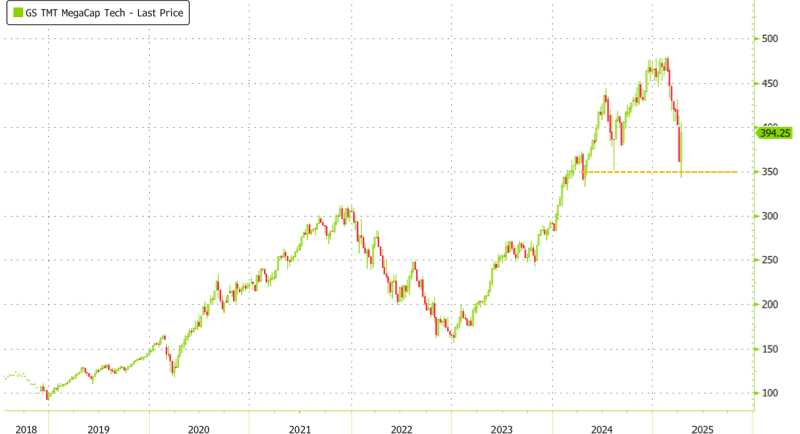
In markets, this news will be fuel to stage a further recovery…

Nasdaq Breadth…

As Wedbush’s Dan Ives notes, Big Tech and investors ‘got the dream news’.  .  . 

Tyler Durden
Sat, 04/12/2025 – 09:55

Minority Report: UK Government Developing ‘Murder Prediction’ Program

Minority Report: UK Government Developing ‘Murder Prediction’ Program

Authored by Steve Watson via Modernity.news,

The UK government is in the process of developing a system to predict whether people will commit homicide in the future.

What could possibly go wrong with that?

The idea is the literal plot line of Philip K. Dick’s dystopian story ‘Minority Report,’ where individuals are arrested before they are able to commit crimes thanks to a ‘precrime’ predictive policing system.

It’s the exact same thing, minus the mutant human precogs. In reality the program will be much more boring, using ‘algorithms’ to churn through data and spit out results.

Given that the data will presumably include spicy social media posts, which are now being punished with prison sentences in the UK, you can see where this is going.

The Guardian reports:

The UK government is developing a ‘murder prediction’ programme which it hopes can use personal data of those known to the authorities to identify the people most likely to become killers.

Researchers are alleged to be using algorithms to analyse the information of thousands of people, including victims of crime, as they try to identify those at greatest risk of committing serious violent offences.

The scheme was originally called the ‘homicide prediction project,’ but its name has been changed to ‘sharing data to improve risk assessment.’ The Ministry of Justice hopes the project will help boost public safety but campaigners have called it ‘chilling and dystopian.’

Questions…

Can you imagine…

Another backdrop to all this is the fact that the government just enacted racially biased criminal codes to punish white men more harshly than women or minorities.

Will the Minority Report program reflect this? Or will it reflect reality…

JD Vance was right, the UK now operates within a full on dystopian apparatus:

Your support is crucial in helping us defeat mass censorship. Please consider donating via Locals or check out our unique merch. Follow us on X @ModernityNews.

Tyler Durden
Sat, 04/12/2025 – 09:20

Finland Bans Russians From Buying Property As Zelensky Says ‘Hatred’ For Them Is Justified

Finland Bans Russians From Buying Property As Zelensky Says ‘Hatred’ For Them Is Justified

On Friday Finland’s parliament unanimously approved a government proposal for a complete ban on real estate acquisitions from Russian nationals. The country’s leaders are hailing that the resolution was passed.

The Finnish Defense Ministry announced Friday that the measure aims to strengthen national security and that “This decision sends a clear message: we will not allow Finland to be undermined,” according to the statement.

Helsinki file image: Getty 

It applies to those from countries which “wage a war of aggression and pose a potential threat to Finland’s national security” – who are now barred from carrying out real estate transactions.

Finland will of course deny that its policies which target Russians are racist or xenophobic based on the following caveat:

The ban would not apply to Russians or other foreigners with a Finnish permanent residence permit or an EU residence permit granted by Helsinki, allowing them to seek approval from Finland’s Defense Ministry for transactions.

The legislation also seeks to prevent Russians from buying property through a third party, in any arrangement which tries to conceal the real buyer’s identify.

During the first year of the Russia-Ukraine war, Western countries and institutions waged a cultural ‘war’ against all things seen as ‘Russian’ – from cancelling Russian classical music and ballet performances, to boycotting things as simple as Russian tea rooms or restaurants. Even books by the famous author Fyodor Dostoevsky were subject of hysterical denunciations in some corners.

Since then, it’s apparently been OK for people to hate an entire nationality or ethnicity based on mere association with the Russian nation or identity. Western ‘enlightened liberals’ have advanced such an agenda, but also the Ukrainians themselves.

For example, Russian media has highlighted some of President Zelensky’s latest comments on all of this as follows:

Ukraine’s Vladimir Zelensky has admitted that his “hatred” of Russians is one of the driving forces propelling him to “keep going” in the conflict against Moscow.

In an interview with the French daily Le Figaro published on Wednesday, Zelensky identified the emotion as one of his three key psychological drivers since the escalation of the conflict in February 2022.

Zelensky said he hated “Russians who killed so many Ukrainian citizens,” adding that he considered such an attitude appropriate in wartime. His other motivations included a sense of national dignity and the desire for his descendants to live “in the free world.”

Of course, the Ukrainian government has also welcomed Finland’s move to ban all property purchases by Russians, something which is likely to be mimicked by some other EU and NATO member states.

Regardless, Washington is pursuing a different track, with ongoing bilateral meetings with Moscow with a goal of restoring diplomatic normalization. A Thursday meeting of delegations in Istanbul was toward this end, as is Special Envoy Steve Witkoff’s third visit to Moscow to meet with Putin on Friday.

Tyler Durden
Sat, 04/12/2025 – 08:45

Sweden: The Number Of Mosques Has Surged Nearly 4,200% In Just 25 Years

Sweden: The Number Of Mosques Has Surged Nearly 4,200% In Just 25 Years

Via Remix News,

Sweden has seen massive demographic changes over the last 25 years, and this is not only reflected in the demographic composition, but also the religious composition of the country. While churches continue to close their doors, the country went from approximately seven mosques in 2000 to now 300 in 2025.

The exact figures are difficult to ascertain, however, the 300 mosques refers to permanent prayer places built for Muslim worship, which often feature a minaret and a dome. If unofficial places of Muslim worship are factored in, such as converted shops or basements, the number would likely be far higher, according to Swedish newspaper Samnytt.

“If by mosque you mean a Muslim place of worship, the number may be close to 300,” said Frederic Brusi, the knowledge officer of the Swedish Agency for Support to Religious Communities.

As in other European countries, many of these mosques receive funding from abroad, and overall, the finances behind many of them remain murky.

“In several cases, Swedish mosque construction has been partially or completely financed with money from Saudi Arabia, Iran, Qatar or Turkey. In the case of Saudi Arabia alone, there is talk of billions. There is also information in the media that every fourth Swedish mosque is financed by the Sunni Muslim and Wahhabi kingdom,” writes Samnytt.

Keeping track of the growth in mosques is very difficult due to a lack of public statistics, with the Swedish paper pointing to mosques like Masjid Aysha, which is run by the non-profit association Scandinavian Islamic Organization (SIO) based out of Stockholm. While the mosque has been operating for 20 years, it remains unclear if it is even registered as an official mosque in the country, as there is no public list of registered mosques.

More and more mosques are in the pipeline as well, with construction taking place across the country. In one city, Helsingborg, a mosque being billed as “Scandinavia’s largest mosque” has so far raised 68 million kroner (€6.3 million) for its construction.

The money has been collected through influencers and social media campaigns on TikTok and Instagram, but money is also flowing from international locations. Due to the huge sum the mosque has raised, questions are being asked about where the money is actually coming from. In one video clip posted by the mosque, recipients chant “Allahu Akbar” when their funding reached 10 million kronor.

Another mosque, which organizers are billing as the largest mosque in all of Northern Europe, is under construction in Skärholmen, a neighborhood in Stockholm. The money is not only financed by Swedish taxpayers but also foreign donors, which has sparked controversy within the country.

“According to information from the local newspaper Mitt i, the association behind the construction of the Skärholmen mosque has chosen to hire the Turkish construction company EMUG, which is linked to the Islamist movement Milli Görüs. The organization has previously been criticized for anti-democratic values ​​and anti-Semitism, as well as for working to replace the Western social model with an Islamic social order,” writes Samnytt.

Government officials also say more mosques are on the way.

“We have freedom of religion in this country, we have countless churches and not nearly as many mosques, so of course we need to build more mosques as long as it takes for people to be able to practice their religion,” said Karin Wanngård, Stockholm’s finance mayor.

Certainly, the country’s demographic picture has been radically transformed, with Muslims making up a significant voting bloc, especially in the country’s cities.

Last year, Remix News reported that Yasir Qadhi, a Pakistani-born American theologian, predicted that in just one generation, half of Malmö’s population would be Muslim.

“Walking through the streets of Malmö is like walking through Baghdad, the capital of Iraq, or Damascus, the capital of Syria,” said Yasir Qadhi, a Pakistani-born American theologian, as reported in the Swedish newspaper Samnytt.

He also shared his theory with the world that the towns he mentioned would become Muslim towns because while Swedes have few children, it is not uncommon for a Muslim family to have five or six. In a generation’s time, Malmö will not be dominated by Swedes, according to the Muslim theologian.

As Remix News previously reported, ethnic Swedish children are already a minority in the school system of Malmö, with one Swedish academic reacting to the massive demographic transformation known as the Great Replacement by claiming that schools should be taught in Arabic, as Swedish is now a minority language.

Conservatives in Sweden have long pointed to Malmö as a picture of the future that the majority of Swedes remain opposed to, as the city has completely transformed from nearly all ethnic Swedes into a multicultural area marked by urban decay, no-go zones controlled by migrant clans, and a city unsafe for women in many areas.

Data also shows that migrants and those of a migrant background are responsible for the vast majority of murdersshootingsgang rapes, and robberies in Sweden. Unfortunately, many of these killings are perpetrated by members of the Middle Eastern community, which is predominantly Muslim.

In 2023, the leader of the right-wing Sweden Democrats, Jimmie Åkesson, said many mosques need to be torn down. He says that Islamic places of worship in Sweden are a breeding ground for radicalized thought and the anti-West propaganda that is infiltrating the country’s social fabric and sowing discord in Swedish communities.

“It is not a right to come to our country and build monuments to a foreign and imperialist ideology,” Åkesson told his party’s faithful. “In the long term, we need to start confiscating and demolishing mosque buildings where anti-democratic, anti-Swedish, homophobic, or anti-Semitic propaganda or general misinformation about Swedish society is spread.”

Read more here…

Tyler Durden
Sat, 04/12/2025 – 08:10

Points For Honesty: UK Tech Firm Says “Only Immigrants From India Will Be Considered” In DevOps Want Ad

Points For Honesty: UK Tech Firm Says “Only Immigrants From India Will Be Considered” In DevOps Want Ad

UK tech firm Avantao Technologies has apologized after posting a job ad stating “only candidates who are immigrants from India will be considered”, according to the Daily Mail.

The listing, for a DevOps engineer role in Ilford, also asked visa-related questions like “What is your native country?” and “Are you seeking sponsorship for employment in the UK?”

The Daily Mail report says that the company claims the ad was a staff training “test” that was mistakenly published. Sure.

“Unfortunately, that has been published, and we are unable to retract it because it was a mistake made by the employee who posted it live and then departed on holiday,” a spokesperson told MailOnline.

“We are very sorry to hear that this has occurred… a mistake is a mistake, and we have taken action against the individual… we genuinely apologise.”

Avantao has offices in Hyderabad, Bangalore, and New Jersey. Chitra Ranjeeth serves as the director of the Ilford branch, which operates out of a shared business center in London alongside various other unrelated businesses.

No one was hired, and the advert expired on March 24.

Tyler Durden
Sat, 04/12/2025 – 07:35

NATO Is A Corpse

NATO Is A Corpse

Authored by Andrew Latham via RealClearDefense,

NATO is a corpse. All that remains is the grotesque performance art of a diplomatic zombie stumbling from summit to summit, mouthing tired clichés about “shared values” and “burden sharing,” even as its core strategic logic lies rotting beneath the surface. The Atlantic Alliance, once the steel scaffolding of Western security, has become a hollow ritual. Its military readiness is an illusion. Its political cohesion is fraying. Its future, if it has one, lies not in revival—but in reinvention or replacement.

This is not a triumphalist declaration from the Kremlin or Beijing. It is a sober diagnosis, grounded in realism and restraint. And it should be a wake-up call in Washington, Ottawa, Berlin, and beyond.

NATO’s death was not caused by Donald Trump, though he may soon become its undertaker. Nor was it caused by Vladimir Putin’s invasion of Ukraine, though that war has exposed the Alliance’s hollowness in ways no war game or communique ever could. The real cause lies in decades of European free-riding, American strategic drift, and a foundational lie at the heart of the Alliance: the idea that an empire can masquerade as a collective defense pact without consequences.

Let’s start with the numbers. Most NATO members still do not meet the 2 percent of GDP defense spending benchmark, despite years of promises and performative panic. Canada, which has taken freeloading to an art form, has shown no serious intention of meeting its obligations. As I’ve written elsewhere, Trudeau’s empty pledges mask a decaying defense industrial base, a stagnant recruiting system, and an Arctic strategy made of snow and sentiment.

Germany—the economic motor of Europe—still can’t field a combat-ready army for more than a few weeks at a time. The Bundeswehr is a shell. Its special fund is already mostly spent, and its political class remains addicted to strategic ambiguity and military minimalism. France wants “strategic autonomy” but lacks the scale and will to lead Europe alone. Poland, despite its impressive rearmament, cannot carry the continent’s defense burden on its shoulders—certainly not while Berlin dithers and Washington increasingly looks west, not east.

Meanwhile, the United States—still NATO’s military backbone—faces a fiscal cliff, a recruitment crisis, and an overstretched force posture. The era of limitless resources is over. American global primacy has ended. Multipolarity has arrived. The U.S. must now prioritize. And that means making hard choices about where its forces are truly needed—and where others must finally step up or face the consequences.

The war in Ukraine has laid these contradictions bare. NATO as an institution is not fighting the war. The United States is. Some European countries are helping—but most are hedging. NATO has been bypassed in favor of bilateral and ad hoc coalitions. Article 5 hasn’t been tested, and it may never be. The idea that NATO is “more united than ever” is a comforting fiction, trotted out to conceal the fact that the Alliance can no longer mount a serious, conventional defense of Europe without massive and prolonged American escalation.

Even the so-called Nordic expansion—Sweden and Finland joining NATO—has not changed the equation. It’s a strategic sideshow. Unless Europe can build up a credible, conventional deterrent in the East, without expecting Washington to always bail it out, the Alliance will remain a Potemkin village: flags, acronyms, and summits without substance.

Trump’s likely return to the White House in 2025 should not be viewed as a cataclysm but as an overdue reckoning. He will not end NATO. He will force Europe to decide whether it is willing to pay for its own defense or not. He will not blow up the Alliance. He will make it answer for its contradictions. And that, frankly, is what a serious ally should do.

Some critics will scream that this is the death knell of the “rules-based international order.” But the order they mourn was already breaking down—long before Trump, long before Ukraine, long before Brexit or Crimea. What we are witnessing is not a collapse but a transition: from the illusion of Atlanticism to the reality of multipolarity. And NATO, if it is to matter at all in this new world, must either become a true European-led military alliance with American support—or fade into history like SEATO and CENTO before it.

This doesn’t mean abandoning Europe to Russian domination. It means telling uncomfortable truths. Europe is rich. Europe is populous. Europe is not helpless. The United States can and should support its European allies—but it should not subsidize their illusions indefinitely. A more self-reliant Europe is not a threat to American interests; it is a precondition for strategic focus on the North Pacific, the Arctic, and the Western Hemisphere—where the real contests of the 21st century will be decided.

In my writing here and elsewhere, I have repeatedly argued that Canada must stop pretending it is a global power and start acting like what it is: a North Pacific, Arctic, and North Atlantic state. That means prioritizing regional defense, rebuilding naval and aerospace capabilities, and getting serious about continental defense. NATO is not the vehicle for that anymore—if it ever was. For Canada, continuing to hide behind NATO rhetoric while failing to meet even the most basic obligations is not only cowardly—it is dangerous.

A dead NATO still carries risks. Strategic ambiguity, brittle expectations, and performative deterrence are a recipe for miscalculation. The Alliance’s political leadership must either acknowledge the need for transformation or risk a future crisis that reveals, in real time and in blood, what we already know: that the emperor has no tanks.

The solution is not sentimental nostalgia. It is clear-eyed realism. NATO in its current form is not worth saving. But its core idea—collective defense among likeminded powers—still has value. What’s needed is a reset: a reimagined Euro-Atlantic security framework led by capable European states, with American support but not American dominance. A NATO that deters by capability, not by assumption. A NATO that can say no as well as yes. A NATO, in short, that lives in the real world.

The alternative is strategic decay. A slow slide into irrelevance. More summits, more selfies, more hollow communiqués. Until, one day, NATO doesn’t die with a bang—but with a bureaucratic whimper.

That future is already here. NATO is dead. The only question now is what comes next—and whether we have the courage to build it.

Andrew Latham,Ph.D., a tenured professor at Macalester College in Saint Paul, Minnesota. He is also a Senior Washington Fellow with the Institute for Peace and Diplomacy in Ottawa and a non-resident fellow with Defense Priorities, a think tank in Washington, DC.

Tyler Durden
Sat, 04/12/2025 – 07:00

Escobar: Russia–Iran–China – All For One, And One For All?

Escobar: Russia–Iran–China – All For One, And One For All?

Authored by Pepe Escobar via The Cradle,

Russia and Iran are at the forefront of the multi-layered Eurasia integration process – the most crucial geopolitical development of the young 21st century. 

Both are top members of BRICS+ and the Shanghai Cooperation Organization (SCO). Both are seriously implicated as Global Majority leaders to build a multi-nodal, multipolar world. And both have signed, in late January in Moscow, a detailed, comprehensive strategic partnership. 

The second administration of US President Donald Trump, starting with the “maximum pressure” antics employed by the bombastic Circus Ringmaster himself, seems to ignore these imperatives.       

It was up to the Russian Foreign Ministry to re-introduce rationality in what was fast becoming an out of control shouting match: essentially Moscow, alongside its partner Tehran, simply will not accept outside threats of bombing Iran’s nuclear and energy infrastructure, while insisting on the search for viable negotiated solutions for the Islamic Republic’s nuclear program. 

And then, just like lightning, the Washington narrative changed. US Special Envoy for Middle East Affairs, Steven Witkoff – not exactly a Metternich, and previously a “maximum pressure” hardliner – started talking about the need for “confidence-building” and even “resolving disagreements,” implying Washington began “seriously considering,” according to the proverbial “officials,” indirect nuclear talks.

These implications turned to reality on Monday afternoon when Trump allegedly blindsided the visiting Israeli Prime Minister Benjamin Netanyahu with the announcement of a “very big meeting” with Iranian officials in the next few days. Tehran later confirmed the news, with Iran’s Foreign Minister Abbas Araghchi saying he would engage in indirect nuclear negotiations with Witkoff in Oman on Saturday.

It’s as if Trump had at least listened to the arguments exposed by the Islamic Republic’s Supreme Leader Ayatollah Ali Khamenei. But then again, he can change his mind in a Trump New York minute. 

The finer points of the Russia–Iran–China axis

Essential background to decipher the “Will Russia help Iran” conundrum can be found in these all-too-diplomatic exchanges at the Valdai Club in Moscow.

The key points were made by Alexander Maryasov, Russia’s ambassador to Iran from 2001 to 2005. Maryasov argues that the Russia–Iran treaty is not only a symbolic milestone, but “serves as a roadmap for advancing our cooperation across virtually all domains.” It is more of “a bilateral relations document” – not a defense treaty.  

The treaty was extensively discussed – then approved – as a counter-point to “the intensified military-political and economic pressure exerted by western nations on both Russia and Iran.”

The main rationale was how to fight against the sanctions tsunami. 

Yet even if it does not constitute a military alliance, the treaty details mutually agreed moves if there is an attack or threats to either nation’s national security – as in Trump’s careless bombing threats against Iran. The treaty also defines the vast scope of military-technical and defense cooperation, including, crucially, regular intel talk. 

Maryasov identified the key security points as the Caspian, the South Caucasus, Central Asia, and last but not least, West Asia, including the breadth and reach of the Axis of Resistance.  

The official Moscow position on the Axis of Resistance is an extremely delicate affair. For instance, let’s look at Yemen. Moscow does not officially recognize the Yemeni resistance government embodied by Ansarallah and with its HQ in the capital Sanaa; rather, it recognizes, just like Washington, a puppet government in Aden, which is in fact housed in a five-star hotel in Riyadh, sponsored by Saudi Arabia. 

Last summer two different Yemeni delegations were visiting Moscow. As I witnessed it, the Sanaa delegation faced tremendous bureaucratic problems to clinch official meetings. 

There is, of course, sympathy for Ansarallah across Moscow intel and military circles. But as confirmed in Sanaa with a member of the High Political Council, these contacts occur via “privileged channels,” and not institutionally. 

The same applies to Lebanon’s Hezbollah, which was a key Russian ally in routing ISIS and other Islamist extremist groups during the Syrian war. When it comes to Syria, the only thing that really matters for official Moscow, after the Al-Qaeda-linked extremists took power in Damascus last December, is to preserve the Russian bases in Tartous and Hmeimim. 

There’s no question that the Syrian debacle was an extremely serious setback for both Moscow and Tehran, further aggravated by Trump’s non-stop escalation over Iran’s nuclear program and his “maximum pressure” obsession. 

The nature of the Russia–Iran treaty differs substantially from that of Russia–China. For Beijing, the partnership with Moscow is so solid, it develops so dynamically, that they don’t even need a treaty: they have a “comprehensive strategic partnership.” 

Chinese Foreign Minister Wang Yi, in his recent visit to Russia, after coining a pearl – “those who live in the 21st century but think in Cold War blocs and zero-sum games cannot keep up with the times” – neatly summarized Sino–Russian relations in three vectors: The two Asian giants are “forever friends and never enemies;” Equality and mutually beneficial cooperation; Non-alignment with blocs; Non-confrontation, and non-targeting of third parties. So even as we have a Russia–Iran treaty, between China and Russia, and China and Iran, we have essentially close partnerships.

Witness, for instance, the fifth annual joint Russia–Iran–China naval exercises that took place in the Gulf of Oman in March. This trilateral synergy is not new; it has been under development for years.

But it’s lazy to characterize this improved RIC Primakov triangle (Russia–Iran–China instead of Russia–India–China) as an alliance. The only “alliance” that exists today on the geopolitical chessboard is NATO – a warmongering outfit composed of intimidated vassals corralled together by the Empire of Chaos. 

Cue to yet another hard-to-resist Wang Yi jade pearl: “The US is sick but forces others to take the medicine.” Takeaways: Russia is not switching sides; China won’t be encircled; and Iran will be defended. 

When the new Primakov triangle meets in Beijing 

At the Valdai discussion, Daniyal Meshkin Ranjbar, assistant professor in the Department of Theory and History of International Relations at the Moscow-based RUDN University, made a crucial point: “For the first time in history, the diplomatic outlooks of Russia and Iran converge.” He’s referring to the obvious parallels between official policies: Russia’s “pivot to the east” and Iran’s “look east” policies. 

All those interconnections plainly escape the new administration in Washington, as well as bombastic Trump–Netanyahu rhetoric that has zero basis in reality – even the US National Security Council admitted that Iran is not working on a nuclear bomb.

And that brings us to the Big Picture.  

The Circus Ringmaster – at least until he changes his mind again – is essentially working on a triangulation deal, allegedly offering Russia a transportation framework, access to grain exports in the Black Sea, and Russian banks off the sanction list of SWIFT so he may execute his “pivot” to then attack Iran (deadline to Tehran included). 

And if Russia defends Iran, no deal. 

That’s as mendacious as Mafia-style “offer you can’t refuse” maximum pressure can get. Russian Deputy Foreign Minister Sergey Ryabkov – an exceptionally able diplomat – destroyed the whole rationale: “Russia cannot accept US proposals to end the war in Ukraine in their current form because they do not solve the problems Moscow considers the cause of the conflict.” Even as Moscow “takes the models and solutions proposed by the Americans very seriously.”

As the Russian angle of Trump’s triangulation falters, Tehran is not merely watching the river flow. How Iran adapted for decades to a sanctions tsunami is now firm knowledge deeply shared with Moscow, part of their deepening cooperation enshrined in the treaty. 

For all of Trump’s volatility, non-Zionist-contaminated voices across the Beltway are slowly but surely imprinting the rational view that a war on Iran is absolutely suicidal for the Empire itself. So the odds resurface that Trump 2.0 verbal barrages may be paving the way for a temporary deal that will be spun to death – after all, this is always a battle of narratives – as a diplomatic victory.

Bets can be made that the only leader on the planet capable of making Trump understand reality is Russian President Vladimir Putin, in their next phone call.  After all, it is the Circus Ringmaster himself who created the revamped “nuclear Iran” drama. RIC – or the revamped Primakov triangle – duly addressed it, together, in a crucial, discreet, not-publicized recent meeting in Beijing, as confirmed by diplomatic sources. 

Essentially, the RIC has developed a “nuclear Iran” road map. These are the highlights: 

  • Dialogue. No escalation. No “maximum pressure”. Step-by-step moves. Build mutual confidence.
  • As Iran re-emphasizes its veto on developing nuclear weapons, the much-debated “international community”, actually the UN Security Council, recognizes, again, Iran’s right to peaceful nuclear energy under the NPT.
  • Back to the JCPOA – and reboot it. To get Trump back on board, the reboot will be an extremely hard sell. 

This roadmap was ratified during a second round of RIC trilateral talks in Moscow on Tuesday, where senior officials from the allied nations discussed collaborative efforts to address the challenges faced by Iran.

That summit in Moscow

As it stands, the road map is just that: a map. The breathless Zionist axis from Washington to Tel Aviv will continue to insist that Iran, if attacked, will not be supported by Russia, and extra, non-stop “maximum pressure” will force Tehran to eventually fold and abandon its support to the Axis of Resistance. 

All that, once again, eschews reality. For Moscow, Iran is an absolutely key geopolitical priority; beyond Iran, to the east, is Central Asia. The Zionist obsessive fantasy of regime change in Tehran masks NATO’s then penetrating into Central Asia, building military bases, and at the same time blocking several strategically crucial Chinese Belt and Road Initiative (BRI) projects. Iran is as essential to China’s long-term foreign policy as it is to Russia’s. 

It’s not by accident that Russia and China will meet at the presidential level – Vladimir Putin and Xi Jinping – at a summit in Moscow around 9 May, Victory Day in the Great Patriotic War. They will be analyzing in detail the next stage of “changes that we have not seen in 100 years,” as formulated by Xi to Putin in their groundbreaking 2023 summer in Moscow. 

They, of course, will be discussing how the Circus Ringmaster dreams of closing down one Forever War just to start another: the specter of a US–Israel attack on their strategic partner Iran – complete with the counterpunch of blocking the Strait of Hormuz (transit for 24 million barrels of oil a day); a barrel of oil skyrocketing to $200 and even more; and the collapse of the humongous $730 trillion pile of derivatives in the global economy.

No, President Circus Ringmaster: You don’t have the cards.    

*  *  *

Views expressed in this article are opinions of the author and do not necessarily reflect the views of ZeroHedge.

Tyler Durden
Fri, 04/11/2025 – 23:25

These Are Most Common Types Of Fraud In America

These Are Most Common Types Of Fraud In America

Americans are losing more money to scams than ever before. The Federal Trade Commission (FTC) estimates that Americans lost $12.5 billion to fraud schemes in 2024, up $2.5 billion from the previous year.

In 2023, consumers around the world lost almost half a trillion dollars to scams.

While certain scams were much more commonly reported, other types led to bigger financial losses for consumers.

This visualization, via Visual Capitalist’s Kayla Zhu, shows the 10 most common types of fraud in the U.S. by the number of reports made to the FTC in 2024, and the total dollar value lost from each type of fraud.

Data comes from the FTC and is updated as of March 2025.

What Type of Fraud is the Most Common?

Below, we show the top 10 most commonly reported fraud types to the FTC, the total dollar value lost from each type of fraud, and the median loss per incident.

Imposter scams—where fraudsters pose as government officials, friends, coworkers, or other trusted parties to steal money or personal information—were the most frequently reported type of fraud in the U.S. last year, with over 840,000 cases filed with the FTC.

This cost consumers almost $3 billion in losses last year.

However, while imposter scams were the most common, investment-related scams led to the biggest financial losses, costing Americans a total of $5.7 billion. The median loss per victim exceeded $9,000.

According to the FTC, scams through email made up the highest number of reports while scams through social media had the highest losses.

Text message scams are also common, making up 22% of all fraud reports to the FTC in 2022.

Types of Fraud

A full list of all fraud types can be found on the FTC website.

  • Imposter scams: Someone pretends to be a trusted person to get consumer to send money/give personal information

  • Online shopping/negative reviews: Undisclosed costs, failure to deliver on time, non-delivery, business preventing honest reviews

  • Business/job opportunities: Fraudulent franchise opportunities, multi-level marketing schemes, job scams

  • Investment related: Fraudulent investment opportunities in day trading, gold, art, other products

  • Internet services: Problems with website content, difficulty canceling online account, issues with payment service, undisclosed charges

  • Prizes, sweepstakes and lotteries: Promotions for free prizes for a fee, foreign lotteries offered through phone or e-mail

  • Telephone and mobile services: Unauthorized charges, problems with mobile applications

  • Health care: Fraudulent, misleading or deceptive claims for treatments or products

  • Travel, vacations, timeshare plans: Deceptive offers for free or low-cost vacations, misleading time share offers

  • Mortgage foreclosure relief, debt management: Lenders/brokers making false promises to save consumers’ homes from foreclosure, credit organizations charging excessive fees

To learn more about common scams, check out this graphic that visualizes companies are impersonated most often in online scams.

Tyler Durden
Fri, 04/11/2025 – 23:00

The Sahel: Emerging Center Of Global Islamism

The Sahel: Emerging Center Of Global Islamism

Authored by Nils Haug via The Gatestone Institute,

The center of world terrorist activity and violent death is no longer the Middle East. The “Sahel region of Africa is now the ‘epicentre of global terrorism,'” responsible for “over half of all terrorism-related deaths” worldwide, according to the respected Global Terrorism Index.

The sub-Saharan Sahel is largely unknown to much of the world. It can be described as the large, mostly flat, strip, nearly 600 miles wide, located between the savannahs of Sudan to the south and the Sahara desert to the north.

During the last ten years or so, according to the Royal United Services Institute, the world’s oldest defense and security think tank, headquartered in London, the Sahel has undergone a “significant surge in jihadist violence. Armed actors take advantage of porous borders, fragile states, and local grievances to extend their operational reach,”

Global Terrorism Index 2025, published by the Institute for Economics & Peace, reveals that the primary instigator of global terrorism during 2024 was the Islamic State (ISIS) and associated groups — such as al Qaeda, Jamaat Nusrat Al-Islam wal Muslimeen, Tehrik-e-Taliban Pakistan, and al- Shabaab — together responsible for more than 7,500 deaths.

Although the West is experiencing escalating terrorism in countries such as Sweden, Australia, Finland, the Netherlands, Denmark, Germany and Switzerland, the Sahel region evidently remains the “global epicentre of terrorism, accounting for over half of all terrorism-related deaths in 2024.” 

Here, conflict deaths exceeded 25,000 for the first time, of which nearly 4,000 were directly connected to terrorism.

A perturbing factor is that in Europe, “one in five persons arrested for terrorism is legally classified as a child.” This is understandable, as children in Islamist-jihadist communities are exposed to Jew-hatred and the desire for an Islamist caliphate from a very tender age. The same statistics would apply to terrorist actors in the Sahel, as the ideology of martyrdom and sacrifice is ubiquitous to jihadism.

Susceptible countries in the region include Senegal, Sudan, Niger, Burkina Faso and Mali. Unsurprisingly, the region’s rich mineral resources – with Niger the world’s seventh-biggest producer of uranium — also attract attention. China and Russia are increasingly represented, while Western nations withdraw from Africa due to growing anti-Western attitudes. Specifically, the US base in Niger in August 2024 and France’s base in Chad closed in December 2024.

The consequence is, of course, that with the West’s retreat, ISIS has free rein to action their visions of global influence. 

They are present in 22 countries at present and, as the report points out: “Despite counterterrorism efforts, the group’s ability to coordinate, inspire, and execute attacks highlights its resilience and evolving operational strategies.” In the remoteness of the Sahel, ISIS finds an accommodating environment to consolidate and establish a central base.

Russia’s Wagner mercenary militia, although rebranded as an “Expeditionary Corps,” continues its predatory activities in the area, offering “governments in Africa a ‘regime survival package’ in exchange for access to strategically important natural resources.”

Covertly obtained Russian documents reveal how the group strives to “change mining laws in West Africa, with the ambition of dislodging Western companies from an area of strategic importance.” The upshot is accelerating anti-Western sentiment, resulting in the local states seeking to expel hitherto entrenched foreign interests.

A February 20, 2024, report by Jack Watling, Fellow for Land Warfare at the Royal United Services Institute, explains that there “was a meeting in the Kremlin in which it was decided that Wagner’s Africa operations would fall directly under the control of Russian military intelligence, the GRU.”

Watling concludes, “This is the Russian state coming out of the shadows in its Africa policy.” Russia’s patent objective is therefore to “seize control of critical resources,” and “aggressively pursue the expansion of its partnerships in Africa, with the explicit intent to supplant Western partnerships.”

Unlike the West, Russia is not particularly interested in countering terror groups such as ISIS but, instead, focuses on its core objectives concerning “critical resources” and replacing “Western partnership” in the Sahel. With the retreat of Western anti-terror forces, ISIS and associates have freedom to expand their activities, while Russia focuses on eliminating Western influence. The result is a vacuum of experienced Western counter-terror forces, a situation in which jihadist groups thrive.

Fortunately, North African nations, such as Morocco and Algeria, realize the dangers of unchecked jihadism in the Sahel, which reaches towards their southern borders. To give effect to its objectives, Rabat implemented the Morocco Atlantic Initiative, which,

“aims to provide landlocked Sahel countries with access to vital maritime trade routes via Morocco’s Atlantic port infrastructure. The plan aims to foster economic regional integration to reduce dependence on unstable transit routes, while fostering Morocco’s ties with its southern neighbours to counter instability, terrorism and illicit trafficking in the region in the long term.”

Similarly, Algeria, with its common “borders and historical ties to Mali, has always played a pivotal role in the region.”

In addition, some Sahel states are taking it upon themselves to counter jihadists in their domain. Recently, an alliance of three prominent Sahel states — Burkina Faso, Mali and Niger — “unveiled plans for a unified military force of 5,000 soldiers.”

“Each of the three AES armies are expected to contribute troops, tasked with conducting joint operations in areas of intense jihadist activity. In their view, establishing a self-sufficient military partnership is the most dependable way to safeguard sovereignty.”

This local move came about as a lack of available Western forces to quell jihadism – an absence brought about by the Sahel nations “severing long-standing military and diplomatic ties with regional allies, France, and other Western powers.” In 2024, the three Sahel nations agreed “to tackle security threats jointly.”

Although a joint force of 5,000 soldiers is a fair starting point, it is to be noted that the region under discussion covers over 2 million square miles – a vast area. It is anticipated that Russia, China and Turkey, who already provide “bilateral military assistance and equipment” might partner, to some degree, with the Sahel forces to counter terrorism.

Meanwhile, ISIS and al-Qaeda, with associates, extend “greater influence over trans-Saharan networks which will expand their external reach and increase the threat of external plots in North Africa and potentially Europe.”

In the result, the Sahel predominantly remains the locale of non-Western actors and local states, acting together for mutual benefit, including the possible control of terrorism. Whether or not efforts by these parties, with some North African countries, will have much impact on jihadism activity in the region remains to be seen. Currently, the significant strategic, political, and economic benefits in the region are reaped by Russia, China and Turkey. The West is nowhere to be seen.

Tyler Durden
Fri, 04/11/2025 – 22:35
