59.9 F
Chicago
Tuesday, September 22, 2026
Home Blog Page 1620

2 States Poised To Be First Since 1980 To Eliminate Income Tax

2 States Poised To Be First Since 1980 To Eliminate Income Tax

Via Headline USA,

About 45 years have passed since a U.S. state last eliminated its income tax on wages and salaries. But with recent actions in Mississippi and Kentucky, two states now are on a path to do so, if their economies keep growing.

The push to zero out the income tax is perhaps the most aggressive example of a tax-cutting trend that swept across states as they rebounded from the COVID-19 pandemic with surging revenues and historic surpluses.

But it comes during a time of greater uncertainty for states, as they wait to see whether President Donald Trump’s cost cutting and tariffs lead to a reduction in federal funding for states and a downturn in the overall economy.

Some fiscal analysts also warn the repeal of income taxes could leave states reliant on other levies, such as sales taxes, that disproportionately affect the poor.

Which governments charge income tax?

The 16th Amendment to the U.S. Constitution grants Congress the power to levy income taxes. It was ratified by states in 1913. Since then, most states have adopted their own income taxes.

Eight states currently charge no personal income tax: Alaska, Florida, New Hampshire, Nevada, South Dakota, Tennessee, Texas and Wyoming. A ninth state, Washington, charges no personal income tax on wages and salaries but does tax certain capital gains income over $270,000.

When Alaska repealed its personal income tax in 1980, it did so because state coffers were overflowing with billions of dollars in oil money.

*  *  *

Though income tax eliminations have been proposed elsewhere, they have not been successful.

“It’s a lot easier to go without an individual income tax if you’ve never levied one,” said Katherine Loughead, a senior analyst and research manager at the nonprofit Tax Foundation. “But once you become dependent on that revenue, it is a lot more difficult to phase out or eliminate that tax.”

What is Mississippi doing?

Republican Mississippi Gov. Tate Reeves recently signed a law gradually reducing the state’s income tax rate from 4% to 3% by 2030 and setting state revenue growth benchmarks that could trigger additional incremental cuts until the tax is eliminated. The law also reduces the sales tax on groceries and raises the gasoline tax.

If cash reserves are fully funded and revenue triggers are met each year, Mississippi’s income tax could be gone by 2040.

Supporters of an income tax repeal hope it will attract both businesses and residents, elevating the state’s economy to the likes of Florida, Tennessee and Texas. Their theory is that when people pay less in income taxes, they will have more money to spend, thus boosting sales tax collections.

The tax repeal “puts us in a rare class of elite, competitive states,” Reeves said in a statement. He added, “Mississippi has the potential to be a magnet for opportunity, for investment, for talent –- and for families looking to build a better life.”

Mississippi is among the most impoverished states and relies heavily on federal funding. Democratic lawmakers warned the state could face a financial crises if cuts in federal funding come at the same time as state income tax reductions.

The income tax provides “a huge percentage of what the state brings in to fund things like schools and health care and services that everybody relies on,” said Neva Butkus, senior analyst at the nonprofit Institute on Taxation and Economic Policy.

What has Kentucky done?

A 2022 Kentucky law reduced the state’s income tax rate and set a series of revenue-based triggers that could gradually lower the tax to zero. But unlike in Mississippi, the triggers aren’t automatic. Rather, the Kentucky General Assembly must approve each additional decrease in the tax rate.

That has led to a series of tax-cutting measures, including two new laws this year. One implements the next tax rate reduction from 4% to 3.5% starting in 2026. The second makes it easier to continue cutting the tax rate in the future by allowing smaller incremental reductions if revenue growth isn’t sufficient to trigger a 0.5 percentage point reduction.

Democratic Gov. Andy Beshear signed the legislation for next year’s tax cut but let the other measure passed by the Republican-led legislature become law without his signature. Beshear called it a “bait-and-switch” bill, contending lawmakers had assured the guardrails for income tax reductions would remain in place while pushing for the 2026 tax cut, then later in the session altered the triggers for future years.

What actions have other states taken?

New Hampshire and Tennessee already did not tax income from wages and salaries, but both states had taxed certain types of income.

In 2021, Tennessee ended an income tax on interest from bonds and stock dividends that had been levied since 1929.

New Hampshire halted its tax on interest and dividends at the start of this year.

Some other states also are pushing to repeal income taxes. The Oklahoma House passed legislation in March that would gradually cut the personal income tax rate to zero if revenue growth benchmarks are met. That bill now is in the Senate.

New Missouri Gov. Mike Kehoe, a Republican, also wants to phase out the income tax. The House and Senate have advanced legislation that would take an incremental step by exempting capital gains income from taxes.

Tyler Durden
Mon, 04/07/2025 – 17:40

Farewell, Fugazy!

Farewell, Fugazy!

Authored by James Howard Kunstler,

“Ah, the delicious smell of peak fear on Sunday/Monday…and max NOISE on X.” 

– Raoul Pal

That ruckus you hear in the capital markets is the sickening howl of the Fugazy Economy meeting its extinction. 

Fugazy means fake, unreal, dishonest, misaligned to what societies need to thrive. Fugazy means mis-using the time-value of things that purport to be wealth to multiply fake wealth in the hands of a few at the expense of the many. The pernicious effects of that system are visible all across the ruined landscape of our country, a nation of broken cities, failed towns, and a demoralized populace.

Mr. Trump apparently aims to convert the expiring Fugazy economy into a production economy — yikes! — based on making things of value, and perhaps more importantly, of people at all social levels having meaningful roles in the making and moving of things.

The Trump tariffs are the first big step in a process that is already generating a whole lot of friction, heat, and ferment. The aim of the tariffs is straightforward: the end of a trade regime that punishes and cripples American production.

The response so far is heartening. 

Many other countries suddenly seek new trade arrangements with the USA, correctly sensing that Mr. Trump means bidness. (This ain’t no Mud Club. . . this ain’t no foolin’ around. . . .) It’s even possible that these readjustments will happen so swiftly that the tariff differentials will be a wash before summer, and everybody will be, at least, on a firm footing, knowing what the clear new rules say. This new disposition of things required forceful incentives to change entrenched, harmful practices.

Another angle on this process is the dynamic known as import-replacement. It means exactly what it sounds like: where you used to get stuff from other lands, you now make it here. It should be obvious that this can’t be accomplished overnight. But the question is: okay, when are you going to start? Part of the answer is: we can’t afford to put it off any longer. There’s an awful lot of stuff, from machine tools to pharmaceuticals to military equipment that we had better start making again — or else slide into collapse, perhaps even slavery to other powers.

That process starts with deploying real capital — as opposed to Fugazy capital — to re-start businesses and industries. That will take money away from hedge funds and other rackets that exist to play games with evermore abstract layers of things that only pretend to represent money. As that occurs, a lot of pretend money will vanish. Don’t be too shocked by this. That’s what happens when a society bends back toward reality: you start sorting out the real money from the fake money. That’s why the price of gold keeps marching up.

I sense that Mr. Trump and his colleagues knew full-well that the tariff play would rattle the markets badly, that these “corrections” are an unavoidable consequence, and are better gotten-over as quickly as possible. 

What else would you expect in a system that has dedicated itself for decades to mis-pricing the value of just about everything? The snap-back is sure to be harsh.

The psychopathocracy that drives the Global Left lost more traction last week in its quest to keep all of its old rackets running. Their foot-soldiers in the USA have been defunded effectively by Mr. Musk’s DOGE, starting with the immense network of rackets that were run around the USAID program. The Woke NGOs are no more and the fat paychecks are no longer going out to the nose-ring-for-lunch-bunch who came to infest the DC Beltway — and their satellite offices in Democratic Party controlled cities. Hence, the feeble turn-outs in last weekend’s street actions.

The Baby Boomers have gone especially psychotic. That’s why there are so many old folks waving those Soros-made placards in the astroturfed crowds of the “Hands-off” protests. After an eighty-year run of the most mind-blowing comfort and convenience enjoyed by any generation in world history, America’s Boomers stare into the abyss of their fading Fugazy fortunes as their stock portfolios tank. Kind of too bad. Maybe you shouldn’t have gone along for the ride. Maybe you should have cared for your country a bit more.

Here’s your poster-boy for that: the retarded slob rock-and-roller Neil Young, performing in support of the US Intel blob, the Covid-19 vaccine campaign, the degenerate Democratic party, Senator Adam Schiff, and BlackRock. Neil Young’s estimated net worth is about $200-million. 

He could lose ninety percent of that and still live a life of luxury. In 2022, he inveighed against Covid vaccine “misinformation” and promoted the shots. Guess, what? You were dead wrong about that, Neil, and now a lot of people are dead and dying because of those vaccines. He has many compadres in showbiz who took the same position against reality.

The time is not far-off when they will be revealed as disgraceful tools — Public vaxx champions such as Stephen Colbert, Jimmy Kimmel, Arnold Schwarzenegger, Oprah Winfrey, Howard Stern, Ryan Reynolds, Lady Gaga. . . the list is long and discouraging. Meanwhile, they’re all out there rallying the Woke troops against the Golden Golem of Greatness as the Left’s leaky lifeboat goes down, gurgle, gurgle. In the process, they’ve destroyed Hollywood, rock and roll, and comedy. The country will recover from that, too. You’ll have plenty of opportunity to laugh at them in the years to come as the obituaries roll in.

Meanwhile, brace and rejoice! Great changes are set in motion. Roll with the turbulence. 

You’ll come out the other end, stronger, wiser, steadier, perhaps even happier.

And, mark ye, the silence emanating from the DOJ and the FBI these budding spring days. The New York Times is nervous as all git-out.

Tyler Durden
Mon, 04/07/2025 – 16:20

Not Funny… This DEI ‘Sensitivity Training’ Video Is Absolutely Hilarious…

Not Funny… This DEI ‘Sensitivity Training’ Video Is Absolutely Hilarious…

Authored by Steve Watson via Modernity.news,

A ‘Harassment and Sensitivity’ employee training video that is really used by top Fortune 500 companies has gone viral, because it’s unintentionally hilarious.

It features a guy called Ken (straight and white, obviously) being over the top insensitive toward disabled, transgender, and obese people.

No one in the real world actually behaves like this except for absolute c*nts, and if they did they would be instantly and rightly fired, which is what makes this fantastic comedy. It’s almost exactly like Ricky Gervais’ The Office.

Ken calls a small person, midget, dwarf, whatever you want to call them, in an electric wheelchair “speedy gonzales” and says “slow your role and come talk to me.”

The little guy tells Ken to stop, and Ken says it’s just a joke.

He then turns to the camera, rolls his eyes and says “remember before all this PC stuff, when we could just be ourselves?”

Ken then asks another “old dog” colleague, “did you get any this weekend?” presumably meaning sexual action.

Ken also calls a transgender dude a ‘man’ who is “creeping everyone out” and says he knows the guy is doing stinky shits in the guys stalls.

LOL.

The video was produced by a company called Skillsoft, which has an online learning platform that it claims is “building the teams that companies need.”

Presumably companies need more transgender, disabled and obese people and fewer Kens.

The company has other videos which are not quite as funny but still entertaining, like when the small person goes to complain about Ken, and the manager doesn’t really care.

Others include guys playing pranks and just generally being dicks.

We’d suggest that the guy’s extremely aggressive reaction to being pranked is more concerning than the fifth grade level immaturity of the bros in this one.

Another has a guy (white again obviously) complaining to other colleagues about a ‘muslim’ who has been hired possibly being a fundamentalist terrorist, except that he’s talking about a sikh who wears a turban. The guy is obviously an absolute prick, which is again why it’s hilarious.

Another video features the aggressive locker guy bragging at the bar about how he’s been sucking dick all night long, which is insensitive to the muslim, sorry Sikh, guy and the old white cleaning lady, who seems jealous more than anything.

Another video features a delivery man just relentlessly perving on the secretary in the office before he’s brutally smacked down by the diverse girl boss manger lady.

The poor secretary is perved on by other guys in the office too, because seemingly every white man they’ve hired is a mentally retarded sex starved deviant. This one, called Zack, is also an absolute asshole who bullies women when they won’t go to dinner with him.

Zack also left a laptop open with a porn video playing… or something.

The overriding question we’re left with is who on earth is in charge of hiring at this company. Is it literally Satan?

Can someone turn this into an actual show? There are way worse things on Netflix and Disney +.

*  *  *

Your support is crucial in helping us defeat mass censorship. Please consider donating via Locals or check out our unique merch. Follow us on X @ModernityNews.

Tyler Durden
Mon, 04/07/2025 – 15:35

Trump Officials Debate Exporter Tax Credit As Tariff Fallout Mounts: Leaks

Trump Officials Debate Exporter Tax Credit As Tariff Fallout Mounts: Leaks

With markets in turmoil thanks to Commerce Secretary Howard Lutnick’s bull-in-a-china-shop tariff math, senior officials in the Trump administration are quietly debating the creation of a new exporter tax credit, a move that signals growing internal concern over the economic costs of the White House’s sweeping tariff policies.

Jim Watson/AFP via Getty Images

According to Bloomberg, the rebate – which is still in early stages of discussion, would be aimed at supporting U.S. manufacturers by offsetting the burden of retaliatory tariffs imposed by trading partners. The credit would be issued at year’s end and could also extend to U.S. firms that export services abroad, according to people familiar with the deliberations who spoke on the condition of anonymity to discuss private talks.

That said – the proposal has yet to be formally presented to President Trump or Treasury Secretary Scott Bessent, and it has sharply divided members of the administration’s economic team, those people said.

While support for the tax credit remains uncertain, its emergence reflects the broader tension within the administration over the fallout from President Trump’s aggressive trade posture. The president last week announced plans to impose sweeping tariffs on nearly every country – a move that sparked swift retaliatory measures from global trading partners and sent financial markets into one of their sharpest downturns since World War II.

In response, China matched Trump’s new tariff levels with a 34% duty on U.S. goods – while on Monday, Trump threatened an additional 50% levy on Chinese exports. European Union trade ministers convened the same day to discuss their own retaliation strategies.

The proposed exporter credit is seen by some in the administration as a way to cushion the impact on U.S. companies now facing steeper barriers abroad. It would function as a subsidy to help manufacturers and service providers weather foreign retaliation. But the economic pain has not been confined to exporters. U.S. importers are bearing the brunt of the new tariffs, absorbing higher costs for goods they rely on from global suppliers.

Some advisers are exploring whether the credit could be extended to help importers as well – an idea that would be more complex to implement, according to people briefed on the discussions.

The deliberations are notable for what they imply: that even within the administration, confidence in the tariff strategy is not absolute. The credit proposal “offers an implicit acknowledgment” of the damage tariffs could inflict on American firms, one person familiar with the talks said.

Trump has argued that his tariffs will spur more companies to relocate manufacturing back to the United States. But economists and business leaders have warned that restructuring supply chains is a long-term undertaking, and that the short-term impact of the levies could push the global economy toward recession.

Tyler Durden
Mon, 04/07/2025 – 15:20

After The Tariff Earthquake

After The Tariff Earthquake

Authored by Charles Hugh Smith via OfTwoMinds blog,

The fires that have been ignited are not yet visible.

There’s a eerie calm after an earthquake. Those trapped in collapsed buildings are aware of the consequences, but the majority experience a silence, as if the world stopped and has yet to restart. The full consequences are as yet unknown, and so we breathe a sigh of relief. Whew. Everything looks OK.

But this initial assessment is off the mark, as much of the damage is not immediately visible. As reports start coming in of broken infrastructure and fires break out, we start realizing the immensity of the damage and the rising risks of conflagration. Uncertainty and rapidly accelerating chaos reign.

President Trump used a medical analogy for what I’m calling The Tariff Earthquake: the patient underwent a procedure and has had a shock, but it’s all for the good as the healing is already underway.

We often use medical or therapeutic analogies, but in this case the earthquake analogy is more insightful in making sense of what happens to economic structures that have been systemically disrupted.

The key parallel is the damage is often hidden, and only manifests later. The scene after the initial shock looks normal, but water mains have been broken beneath the surface, foundations have cracked, and though structures look undamaged and safe, they’re closer to collapse than we imagine, as the structural damage is hidden.

Another parallel is the potential for damage arising from forces other than the direct destruction from the temblor. The earthquake that destroyed much of San Francisco in 1906 damaged many structures, but the real devastation was the result of fires that started in the aftermath that could not be controlled due to the water mains being broken and streets clogged with debris, inhibiting the movement of the fire brigades, which were inadequate to the task even if movement had been unobstructed.

The earthquake damaged the city, but the fire is what destroyed it.

What was considered rock-solid and safe is revealed as vulnerable in ways that are poorly understood. Structures that met with official approval collapse despite the official declarations. What was deemed sound and safe cracked when the stresses exceeded the average range.

The Tariff Earthquake exhibits many of these same features. Much of the damage has yet to reveal itself; much remains uncertain as the chaos spreads. Like an earthquake, the damage is systemic: both infrastructure and households are disrupted. The potential for second-order effects (fires in the earthquake analogy) to prove more devastating than expected is high.

(First order effects: actions have consequences. Second order effects: consequences have consequences.)

The uncertainty is itself a destructive force. Enterprises must allocate capital and labor based on forecasts of future supply and demand. If the future is inherently unpredictable, forecasting becomes impossible and so conducting business becomes impossible.

Just as the 1906 fires sweeping through San Francisco were only contained by the US Army blowing up entire streets of houses to create a fire break, the containment efforts themselves may well be destructive. We had to destroy the village in order to save it is a tragic possibility.

Here is a building damaged in the 1989 Loma Prieta earthquake that struck the San Francisco Bay region. The residents may have initially reckoned their home had survived intact, but the foundation and first floor were so severely damaged that the entire structure was at risk of collapse.

On this USGS map of recent earthquakes around the world, note the clustering of quakes on the “Ring of Fire” that traces out the dynamic zones where the planet’s tectonic plates meet. Earthquakes can trigger other events along these dynamic intersections of tectonic forces.

In a similar fashion, The Tariff Earthquake is unleashing economic reactions across the globe, each of which influences all the other dynamic intersections, both directly and via second-order effects generated by the initial movement.

Anyone claiming to have a forecast of all the first-order and second-order effects of the The Tariff Earthquake will be wrong, as it’s impossible to foresee the consequences of so many forces interacting or make an informed assessment of all the damage that’s been wrought that’s not yet visible.

The fires that have been ignited are not yet visible. They’re smoldering but not yet alarming, and so the observers who are confident that everything’s under control have yet to awaken to the potential for events to spiral out of control.

*  *  *

Become a $3/month patron of my work via patreon.com.

Subscribe to my Substack for free

Tyler Durden
Mon, 04/07/2025 – 15:05

‘Betrayed, That’s The Word’: Small Business Owners Reel as Google AI Destroys Google Search

‘Betrayed, That’s The Word’: Small Business Owners Reel as Google AI Destroys Google Search

In March 2024, Morgan McBride stood in her half-renovated kitchen posing for a photo shoot. The images were for a new Google ad campaign, a celebration of the ways the search engine had empowered her family’s do-it-yourself home improvement site, Charleston Crafted, to flourish. Just weeks later, she said, traffic from Google dropped more than 70%.

Morgan McBrideSource: Morgan McBride (via Bloomberg)

McBride had weathered Google algorithm changes before. But this time, the recovery never came. She suspects that more of her readers are getting advice from Google’s AI-generated summaries, which now appear prominently atop many search results  – sometimes giving renovation tips that she says are incorrect or potentially unsafe. “You can’t just sit around waiting for things to turn around,” she said. Advertising revenue on her site has since dropped by 65%, costing her tens of thousands of dollars.

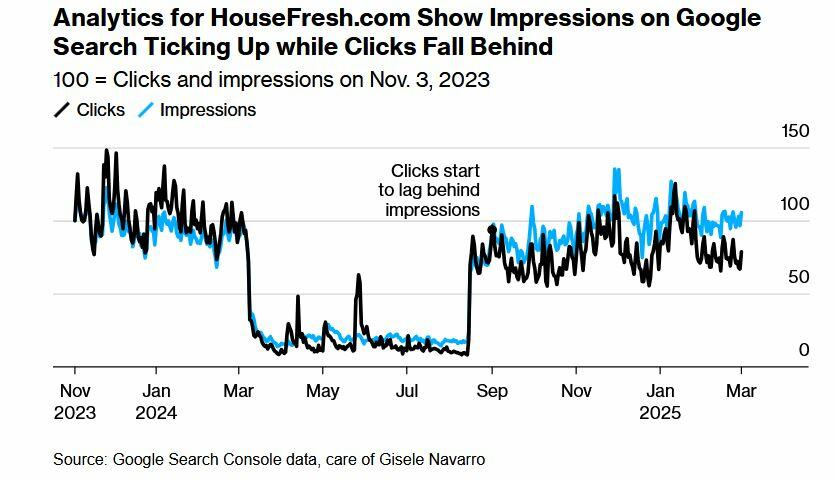
These summaries often draw directly from websites – like Charleston Crafted – but don’t send users to them, according to a report by Bloomberg. That’s left publishers like Gisele Navarro, managing editor of HouseFresh, watching as her content appears in summaries without translating into clicks or revenue. Internal analytics, which she shared with Bloomberg, show a growing share of impressions without traffic.

Across the web, independent publishers are reporting similar experiences. The rise of Google’s AI Overviews – which deliver synthesized answers from across the internet – along with a series of search algorithm changes, has upended the traffic patterns many small websites once relied on. Bloomberg, which conducted interviews with 25 publishers and digital experts, found widespread concern that Google’s shifting strategy is unraveling a symbiotic relationship that has powered the internet for years: websites provide helpful content, and Google delivers the audience.

Now, many creators say they’re being cut out of the equation entirely.

*  *  *

You can support this small business by giving Brain Rescue a try! 

On sale now! 100% satisfaction guaranteed or your money back, just let us know. No need to return.

According to SEO expert and digital marketer Pritam Ghosh (citing a recent study by BrightEdge), Google’s AI overviews dominate 74% of problem-solving queries.

Key Insights by Query Category

Analyzing over 100,000 keywords, BrightEdge categorized searches into four types and tracked AI Overviews’ presence:

  • Problem-Solving Queries: 74% (e.g., “how to fix a leaky faucet”)
  • Informational Queries: 63% (e.g., “what causes climate change”)
  • Navigational Queries: 13% (e.g., “Facebook login”)
  • Transactional Queries: 5% (e.g., “buy running shoes”)

The data suggests Google prioritizes AI-generated answers for complex, research-based searches, while minimally using them for navigational or commercial intent queries.

Impact on Click-Through Rates (CTR)

AI Overviews significantly alter user engagement:

  • When AI Overviews appear in position #1, organic CTR drops by 25% compared to traditional “blue link” results.
  • These AI-driven responses dominate visibility, appearing in the top five positions for 87% of queries where they’re triggered.

A Fractured Compact

Google has denied that AI Overviews is the root cause of these sharp traffic declines, saying it is “misleading to make generalizations about the causes” based on individual cases. The company attributes changes in web traffic to seasonal trends, evolving user preferences, and its regular search updates.

Still, evidence of broader disruption is mounting. An analysis by the data firm Similarweb – conducted at Bloomberg’s request – found consistent declines across 67 small publisher sites in categories including lifestyle, travel, DIY, and cooking. Travel sites saw the sharpest losses, coinciding with Google’s introduction of robust AI-generated content in that domain.

Privately, Google has acknowledged the challenges. In October, the company invited about 20 web creators to its headquarters in Mountain View, Calif., for a closed-door meeting. There, according to attendees, Google’s search team apologized and said the sites represented the kind of high-quality content it wanted to highlight. But officials also admitted they could not guarantee a return to previous traffic levels — the search experience had fundamentally changed.

Mike Hardaker, who runs Mountain Weekly News, shared during that meeting that his site had once generated $250,000 in revenue. By late 2024, he was relying on a food bank. “I need to know as a business owner, and personally, if you think there’s a chance that some of our sites have the ability to recover,” he asked at the time. Google’s chief search scientist, Pandu Nayak, apologized – but offered no assurances.

Digital marketing firm Semrush reports the same pattern: more content visibility within Google, but fewer visits to the actual websites.

Raptive, a media company representing over 5,000 creators, estimates publishers could ultimately lose up to 25% of their traffic to AI Overviews. Google, for its part, says it is delivering “high-quality clicks,” but hasn’t released detailed data. BrightEdge, a data firm, found that the top beneficiaries of AI Overviews traffic are giants like Wikipedia, TripAdvisor, and YouTube — the latter being owned by Google itself.

Other changes – such as recipe summaries Google is piloting – are also raising alarms. While some participating food bloggers are receiving compensation, Raptive estimates that overall traffic to food sites could fall by half if the feature is rolled out more broadly.

“The big fear,” said Lisa Bryan, creator of the food site Downshiftology, speaking on behalf of fellow bloggers, “is that Google is severing the relationship that we have with our communities and our audiences.”

The power dynamic between Google and publishers has always been unequal. But some creators say the balance has tipped into unsustainable territory.

“I don’t understand how Google thinks this is sustainable,” said Jake Boly, founder of That Fit Friend, a site that reviews training shoes. “If you drive away all enthusiasts and small publishers, then we’re going to be overrun by spam and the few players who can afford to pay to play.”

The results, critics say, are already showing. Some AI-generated summaries have surfaced bad or bizarre advice. Laura Longwell of Travel Addicts said Google is recommending places to go to the beach near Philadelphia based on advice from a luggage storage company and a driving school. “The idea that any of that is based on experience or expertise is laughable,” she said.

Google continues to push its EEAT framework — emphasizing Experience, Expertise, Authoritativeness, and Trustworthiness — but even sites that align with those principles say they are being punished. “For years, Google has had the audacity to gaslight us, saying, ‘Don’t write for search,’” said Hardaker. “Well, then, who am I writing for?”

‘Betrayed, That’s the Word’

For some creators, the damage is already irreversible.

Toronto-based couple Dave Bouskill and Debra Corbeil launched their travel blog The Planet D in 2008. For years, Google Search was their lifeblood, eventually driving 90% of their traffic. When AI Overviews rolled out, traffic dropped by half. It kept falling. Revenue plummeted. They laid off staff. Eventually, they stopped updating the blog.

They’ve since pivoted to YouTube, another Google property, to try and rebuild their audience. But the sting remains.

I do feel betrayed by Google,” Bouskill said. Corbeil cut in: “Betrayed, that’s the word.”

Tyler Durden
Mon, 04/07/2025 – 14:25

‘The Canary Is Sick’: Blackrock’s Fink Says Most CEOs Telling Him ‘We’re Already In Recession’

‘The Canary Is Sick’: Blackrock’s Fink Says Most CEOs Telling Him ‘We’re Already In Recession’

Blackrock CEO Larry Fink says most CEOs he talks to say the country is ‘already in recession,’ and that the 20% market drop in three days will have ‘potential ripple effects’ on clients, and added that he “still won’t rule out another 20% market decline.

“Are we in a recession?” asked Bloomberg TV host Erik Shatzker.

“Most CEOs I talk to would say we are probably in a recession right now,” Fink replied, adding that the canary “is sick.”

The economy is weakening as we speak,” Fink told Bloomberg TV, adding that US markets could drop further – and that 62% of Americans are exposed to equities. He also suggested that fed rate cuts are unlikely this year, and that a hike may actually be in store.

He also says that the administration needs to deliver on the pro-growth policies Trump promised on the campaign trail, such as tax cuts, deregulation and streamlining permitting for big infrastructure projects.

Long Term Buying Opportunity?

That said, Fink sees this as a buying opportunity “in the long run.”

When asked by Shatzker whether corporate leaders need to tread more carefully under Trump, Fink deflected, answering that they always need to tread carefully. When pressed further on recent controversies involving Big Law firms who have capitulated to Trump, Fink replied: “Let’s move on.” 


*  *  *

Grow your own food with HEIRLOOM SEEDS (39 varieties – 4,500 seeds) from ZH Store!  Free shipping in the USA.

Click pic… buy seeds… take food supply into your own hands…

Tyler Durden
Mon, 04/07/2025 – 13:22

US Companies’ Chapter 11 Bankruptcies Jump 20%: Report

US Companies’ Chapter 11 Bankruptcies Jump 20%: Report

Authored by Naveen Athrappully via The Epoch Times,

More companies filed for Chapter 11 bankruptcy protection in March than a year ago, indicating economic stress among U.S. businesses, according to the American Bankruptcy Institute (ABI).

“Commercial Chapter 11 bankruptcy filings increased 20 percent in March 2025, with filings climbing to 733 from the 611 filings registered in March 2024,” ABI said in an April 3 statement. Small business filings fell 1 percent year over year, while total commercial filings rose 10 percent.

The 20 percent jump in Chapter 11 filings “signals persistent economic pressure, mirrored by a 10 percent increase in total commercial filings,” said Michael Hunter, vice president of bankruptcy data provider Epiq AACER.

Individual filings jumped 13 percent last month. Hunter said credit card delinquencies are close to a 10-year high, with factors such as interest rates and debt burdens contributing to the problem.

Delinquency rates in the Federal Housing Administration mortgage portfolio have risen to 11 percent, “surpassing pre-pandemic levels,” he said.

“Adding to this, government job layoffs threaten to exacerbate financial instability for federal workers reliant on stable income to service debts.”

Last month, ABI executive director Amy Quackenboss said geopolitical tensions, elevated interest rates, tighter lending terms, and inflation were creating more challenges for both businesses and individuals who are financially distressed and looking to ease down rising debt burdens.

“Bankruptcy provides an established process for struggling households and businesses looking to access a financial fresh start,” she said.

One well-known company that filed for bankruptcy last month was OTB Holdings LLC, owner of the On the Border Mexican Grill & Cantina chain of Tex-Mex restaurants.

In a court filing, chief restructuring officer Jonathan Tibus said the restaurant chain’s operations had been negatively affected by macroeconomic factors over recent years.

“Casual dining restaurants are acutely impacted by consumer sensitivities to eating out versus staying in. And because of inflationary pressures, restaurant menu prices across the industry have risen significantly faster than grocery and other consumer prices,” the court filing said.

On March 25, 23andMe, a company offering genetic testing services, filed for bankruptcy protection, seeking to sell off its assets amid financial difficulties.

Corporate Bankruptcies

U.S. corporate bankruptcies jumped to a 14-year high in 2024, according to a Jan. 7 report from S&P Global. S&P analysis only takes into account bankruptcies involving large businesses with certain asset and liability thresholds.

There were 694 such corporate bankruptcies last year, up from 635 in 2023 and 372 in 2022. Some of the well-known bankruptcy filings were made by Tupperware Brands Corp., Party City Holdco Inc., Spirit Airlines, Big Lots Inc., and Steward Health Care System LLC.

The consumer discretionary sector saw the largest number of filings, followed by industrials, healthcare, consumer staples, and information technology.

“Businesses continued to face pressure in 2024 from elevated interest rates, especially as total debt among credit-rated nonfinancial U.S. companies reached a quarterly record of $8.453 trillion and interest coverage remained weak in the third quarter of the year,” the report said.

Last month, credit monitoring company Creditsafe published a study revealing that, while clients’ erratic payment practices are often highly indicative of their financial distress and bankruptcy risk, only a few businesses knew how to identify such red flags.

Just 3 percent of businesses were found to be accurately spotting signs of trouble after analyzing clients’ payment behaviors. The company said this is crucial since sudden shifts in customer payment behavior tend to occur prior to bankruptcy.

Steve Carpenter, Creditsafe’s chief operating officer handling North American operations, said the study highlights the need to give finance teams proper training to tackle the issue.

“It’s not just about why it’s important to regularly review and analyze the historical trade payment data of customers. While that’s very important, it’s also necessary to provide helpful tips and training, so finance teams can accurately identify problematic patterns that are indicative of cash flow issues and an increased likelihood of late payments over time,” he said.

“Otherwise, businesses will continue to miss and misread clear red flags—costing them dearly in terms of the amount of time it takes to chase unpaid invoices and the negative impact it has on the bottom line.”

Tyler Durden
Mon, 04/07/2025 – 12:45

The End Of Globalization

The End Of Globalization

By Benjamin Picton, senior macro strategist at Rabobank

There was a clear message emanating from Western policy makers over the weekend: the world is facing the end of the era of globalization. The ECB’s Isabel Schnabel made the point in a speech to business leaders in Italy on Saturday when she said that “Liberation Day was not liberating, but it seems to have marked the end of global free trade.”

Similarly, UK Prime Minister Keir Starmer is set to give a speech later today where he will say that globalization has “failed” as an economic model, and its time is now at an end.

Such comments are staggering for their candor and gravity, if not for their unexpectedness. Equity markets were in freefall on Thursday and Friday of last week as the announcement of long-flagged tariffs rapidly unwound hopium-driven Trump trades and markets came to the cold realization that it’s not all just a negotiating ploy and tariffs really are happening. 

The Chinese government announced that it would be retaliating by placing a 34% tariff on all imports from the United States and European officials said that they would be throwing up fresh trade barriers of their own to prevent industry-destroying dumping of cheap goods while they also prepare “countermeasures” against US tariffs.

Trump cabinet members did nothing over the weekend to assuage fears of further market falls. Commerce Secretary Lutnick simply insisted “tariffs are coming” and Secretary of State Marco Rubio shrugged at the market losses by saying “I don’t think it’s fair to say economies are crashing. Markets are crashing because markets are based on the stock value of companies who today are embedded in modes of production that are bad for the United States.” The TLDR on that is: “we don’t care about your portfolio, we’re making America Great Again.” As I noted late last week, ‘Making America Great Again’ means making America a production-based economy again.

With no government knights-in-shining-armour riding over the hill to save equity markets, futures this morning are deep in the red. The S&P500 looks set to open down 3.8%, and NASDAQ futures are pointing to a 4.9% loss at the open. Asian markets are also looking ugly. The Nikkei is down 8% and the highly China-adjacent ASX200 has shed 5.90% at time of writing. Might the Fed ride to the rescue this week with some cheap liquidity?

Brent crude is down 3.40% this morning to $63.33 after falling 6.42% on Thursday and a further 6.50% on Friday. Despite its status as a safe-haven asset, Gold was sold down below the $3000/oz level (liquidating to meet margin calls elsewhere?), but it caught a bit of a bid early on Monday following news that China had added to its state gold reserves for a fifth-straight month. US 10-year Treasury yields are now down to 3.92% (and falling). That ought to come as welcome news to Treasury Secretary Scott Bessent, who has the job of refinancing something like $25 trillion worth of US debt over the next four years. 

Bessent echoed Rubio’s “the market is not the economy” line over the weekend by saying that he didn’t expect a recession in the United States this year and suggesting that lower interest rates and energy prices were actually very good news for American business. He also made some interesting comments in an appearance on the Tucker Carlson podcast where he said that 88% of the US stock market is owned by the top 10% of Americans, 12% is owned by the next 40% and that the bottom 50% of households basically own none of it and instead have debt (discussed first on ZH in The US Is Officially A Banana Republic: The Top 1% Now Own More Wealth Than The Entire Middle Class). 

Bessent said that it is these people in the bottom 50% who needed help so, again, the subtext here seems to be: “We don’t care about your stock portfolio. We care about rebuilding America’s manufacturing base, and with it the blue-collar middle class”.

Hedge fund manager Bill Ackman is making headlines today by describing the tariffs as an “economic nuclear winter” and calling for a 90-day “timeout” on their implementation. Trump Administration officials are reportedly claiming that more than 50 countries have reached out offering to reform their trade practises in exchange for a reduction in announced tariffs. 

Taiwan has offered to drop all tariffs on US goods imports to zero and begin investing more money into the USA. Vietnam has also offered to drop its tariffs on US imports to zero, but White House Trade Advisor Peter Navarro dismissed the offer by saying that it is not enough to close the persistent trade imbalance because of all of the non-tariff “cheating” that goes on.

Of course, many economists and world leaders have been outraged by the crude simplicity of the reciprocal tariffs, which have seemingly been calculated by taking each country’s goods trade balance with the USA, dividing by exports and then dividing by two. Plenty of economists have pointed out that tariffs are not ‘welfare-maximizing’ because they create deadweight losses and that Ricardian trade theory says welfare would be maximized if every economy has no barriers to trade and specializes according to comparative advantage.

The problem with this is that Ricardian trade theory also says that persistent trade imbalances shouldn’t happen (because exchange rates should adjust to prevent it) and assumes that both labor and capital are not internationally mobile. Clearly, this is not the case in the real world, and the US Dollar’s status as reserve currency has caused it to remain overvalued relative to peers, thereby hampering US trade competitiveness. It’s no coincidence that artificial devaluation of various currencies against the US Dollar is one of Navarro and Trump’s major gripes, so keep an eye on USDCNY this week and any announcements from the PBOC to cut the reverse-repo-rate.

From the perspective of the Americans, what is happening now is that countries all around the world who have been quietly practising a great deal of protectionism where it has suited them are suddenly becoming death-bed converts to free trade. Adam Smith is back in vogue, but given that the US is adopting these protectionist policies to rebuild its manufacturing base just in case it ever needs to fight a major war again, recent converts seem to be forgetting this little gem from Smith: “defence is of much more importance than opulence”.

Given the zeitgeist, this Millennial financial market analyst is suddenly wondering if he might have been better served by learning how to weld.

Tyler Durden
Mon, 04/07/2025 – 12:05

Great News Europe: US-China LNG Trade Freezes 

Great News Europe: US-China LNG Trade Freezes 

The escalating trade war between the US and China could increase liquefied natural gas flows to energy-stricken Europe, as China remains on a multi-month buying strike. 

Bloomberg cited marine traffic data from Kpler, showing that no US LNG shipments are currently inbound or about to be inbound to China.

Zero LNG trade between China and the US is likely to continue for the rest of 2025, with a further increase in China’s tariff on US LNG from the previous 15% to 49%, as a counterstrike against Trump’s steepest tariffs,” Wei Xiong, head of China gas research at Rystad Energy, wrote in a note. 

She added, “In the meantime, we expect to see more reselling by Chinese companies.” 

On Feb. 10, China—the world’s largest LNG buyer—imposed a 15% tariff on US LNG shipments. Last week’s tariff escalation, which pushed Beijing’s effective tariff rate on US goods to around 54%, is expected to disrupt trade flows further.

In President Trump’s first term, China paused US LNG shipments for about 400 days through April 2020. There’s no telling how long the current buying strike will last as both superpowers duke it out on trade. The good news is that some US trading partners, including Vietnam and Taiwan, have capitulated to the trade war.

The other piece of good news is that US LNG shipments originally destined for China can be rerouted to Europe, offering relief as the energy-stricken continent works to replenish inventories after winter and offset the loss of Russian pipeline gas.

Goldman’s Samantha Dart told clients late last year that American LNG could “theoretically” replace Russian LNG imports in the EU. 

Tyler Durden
Mon, 04/07/2025 – 11:25