Bibi In Washington: 1st Foreign Leader To Negotiate Removal Of Trump’s Tariffs In Person
Israeli Prime Minister Benjamin Netanyahu arrived in Washington on Sunday for a visit to the White House, in a stay which is planned through Tuesday. The two leaders are meeting Monday afternoon.
He will be the first foreign leader to meet President Trump in-person in an effort to negotiate a deal to remove Trump’s tariffs, which for Israel is a 17% rate, the result of a significant US bilateral trade deficit.
“Upon his arrival in Washington with his wife, Sara Netanyahu, the premier headed from the airport to Blair House in a convoy, where he met with US Commerce Secretary Howard Lutnick and Trade Representative Jamieson Greer,” Israeli media wrote.
And Axios noted just ahead of the the trip that Israel tried to “avoid the tariffs Trump imposed on nearly every country in the world by announcing it would preemptively lift all tariffs on U.S. products. It didn’t work.”
This visit, which is Netanyahu’s second to the White House since Trump took office (the first was in early February), was by all accounts rather hastily put together, and also high on the agenda will be the Gaza crisis. Currently there are still 59 hostages still in Hamas and Islamic Jihad captivity – with many feared deceased.
Israel has controversially expanded the war, and now has Rafah surrounded once again and has ordered an evacuation of the civilian population. Hundreds of thousands have fled the southern Gaza city, also as basic necessities of life for the Palestinian population are running out.
Netanyahu’s office has has further indicated that “Israel-Turkey relations, the Iranian threat and confronting the International Criminal Court” will be on the agenda.
Trump may emerge from the meeting declaring that Israel is an example of how his tariff policy is working – that foreign capitals will come scrambling to negotiate.
One interesting aspect to Netanyahu’s travels is the impact the International Criminal Court (ICC) warrant is having on his itinerary. He’s still not able to visit most of the European continent, and last week’s Hungary trip was the first, after Budapest declared it would not arrest him or cooperate with the ICC.
Times of Israel pointed out that “The Wing of Zion state plane took a flight path that increased the journey from Budapest to Washington by some 400 kilometers in order to avoid flying over countries seen as likely to enforce the arrest warrant issued against him by the International Criminal Court should the plane be forced to make an emergency landing.”
Isn’t it interesting that Israel had huge tariffs on American goods, despite the billions in money we send them, and nobody who is currently outraged at Trump ever said anything about this nonsense? pic.twitter.com/iNmDSDuRnF
“As Israel believes that Ireland, Iceland and the Netherlands would all enforce the ICC warrant, issued for alleged war crimes in Gaza, Wing of Zion instead flew over Croatia, Italy and France,” the report added.
Hungary last week declared it is exiting membership in the The Hague-based ICC due to the action against Netanyahu, with PM Viktor Orban decrying that it’s a “political tool” of Israel’s enemies. The Trump White House is certainly on board with Orban’s decision.
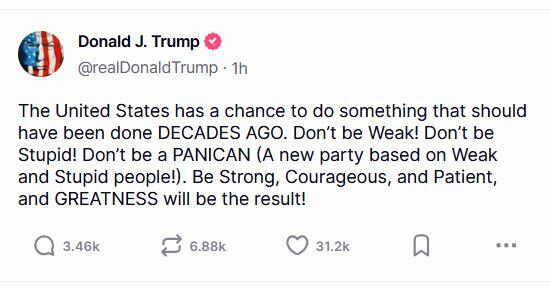
“Don’t Be Weak, Don’t Be A PANICAN”: Trump Urges Americans To Hold Tight As “Countries From All Over The World” Negotiate On Tariffs
President Trump on Monday urged Americans not to panic over tariff-driven turmoil in the markets, and said that “Countries from all over the World are talking to us.”
“The United States has a chance to do something that should have been done DECADES AGO. Don’t be Weak! Don’t be Stupid! Don’t be a PANICAN (A new party based on Weak and Stupid people!). Be Strong, Courageous, and Patient, and GREATNESS will be the result!” Trump posted Monday morning on Truth Socialabout 15 minutes before cash open on US exchanges.
Ten minutes later, Trump posted that “Countries from all over the World are talking to us.”
“Spoke to the Japanese Prime Minister this morning. He is sending a top team to negotiate! They have treated the U.S. very poorly on Trade. They don’t take our cars, but we take MILLIONS of theirs. Likewise Agriculture, and many other “things.” It all has to change, but especially with CHINA!!!”
Trump has insisted that tariffs are necessary to rebalance global trade and rebuild domestic manufacturing – singling out China as “the biggest abuser of them all,” and has called on the Federal Reserve to lower interest rates.
In a Friday conversation, Federal Reserve Chair Jerome Powell didn’t give much of an indication on how the fed would react – suggesting only that the tariffs could increase inflation, and that “there’s a lot of waiting and seeing going on, including by us.”
Over the weekend, Trump suggested that the market turmoil was part of the plan – saying “Sometimes you have to take medicine to fix something.”
* * *
Grow your own food with HEIRLOOM SEEDS (39 varieties – 4,500 seeds) from ZH Store! Free shipping in the USA.
Jamie Dimon Urges Quick Resolution To Tariff Standoff
There was a brief glimmer of hope for equity futures this morning, when amid the market rout, JPM CEO Jamie Dimon urged a quick resolution to the uncertainties sparked by Trump’s tariffs and warned against a potentially “disastrous” fragmentation of America’s long-term economic alliances.
“The quicker this issue is resolved, the better because some of the negative effects increase cumulatively over time and would be hard to reverse,” Dimon wrote in his annual shareholder letter. In the near term, “we are likely to see inflationary outcomes, not only on imported goods but on domestic prices, as input costs rise and demand increases on domestic products.”
While Dimon cited a raft of lingering questions around the new policy, including potential retaliatory actions by other countries, the impact on investments and capital flows, and the possible effect on the US dollar, he conceded that there are “of course” some legitimate reasons for the action, and that he hopes “the long-term effect will have some positive benefits” for the US.
And how can he not: after all, as Bessent said over the weekend, the US market and economy had been cruising ever higher on the artificial sugar rush of ever higher debt, which would one day end in a cataclysm and far worse than the current market selloff, which is why until now everyone was only talking about fixing the problem – Trump is the first one to actually do something about it. And sure, it will be extremely painful, and it remains to be seen if Trump can even hold the course.
Dimon’s letter marks Dimon’s first public commentary on the measures since they were announced. Days after Trump won the US presidential election last year, Dimon said the future president’s tariff threats would “get people to the table” and that he hoped it would be “done wisely.”
Dimon refrained from mentioning Trump directly in the letter. The CEO, 69, has run JPMorgan for nearly 20 years, building it into the largest US bank and becoming the industry’s elder statesman along the way. His annual letters are wide-ranging and closely followed, and this year’s missive stretches to nearly 60 pages, including footnotes.
JPMorgan, which is set to report first-quarter earnings this week, notched the highest annual profit in the history of American banking in 2024 — besting its own record from the prior year.
In addition to addressing tariffs, Dimon wrote about America’s economic alliances more broadly. The US derives strength from its military and economic ties, and maintaining these relationships is essential to avoid the kind of weakening and fragmentation its adversaries would seize upon, he wrote.
Dimon warned against a “false sense of security” that oppressive nations won’t use their military and economic powers to advance their goals, particularly against perceived weak or disorganized Western democracies.
The CEO called for reforms that fortify international systems and institutions like NATO, the United Nations and the International Monetary Fund. He urged European leaders to make economic reforms and boost military spending to help strengthen ties. As for the “complex relationship” between the US and China, the latter would be “better off” forming partnerships with a strong Western world than with nations like Russia and Iran, he wrote.
“America First is fine, as long as it doesn’t end up being America alone,” Dimon wrote. He added that America’s global leadership role is being challenged not just by other nations but also from within the country by its “polarized electorate.”
And as expected, the CEO weighed in on the state of the economy, noting it was already weakening when he began writing his letter — which was before Trump announced his tariff plans. Dimon reiterated his concerns about persistent inflation thanks to the high fiscal deficit, ongoing wars, the need for infrastructure investment in addition to the recasting of global trade and tariffs. How these things play out will impact interest rates, he said.
“The slower the growth, the lower the interest rates, and the higher the inflation, the higher the interest rates,” he said.
Other highlights from the letter, courtesy of Bloomberg:
On JPMorgan’s excess capital: “After reading the first section of this letter about the state of the world and the many risks facing the global economy, we hope you can see why we also believe that now is a good time to retain lots of extra capital and liquidity.”
As he has done in the past, Dimon called for an elimination of the US debt ceiling. He wrote that it is “essentially a ‘weapon of mass destruction’ that can be misused by politicians who don’t understand the damage it can do.”
In his letter last year, Dimon defended the bank’s diversity, equity and inclusion policies but said that the firm would comply with evolving laws. This year, he wrote: “While we have modified our approach to certain corporate responsibilities to conform to new guidance, we remain committed to reaching out to all communities in an effort to create a stronger, more inclusive economy.”
Dimon also took aim at bureaucracy, complacency and the “BS” which he said kills companies and invited staff to send him an email highlighting “bureaucratic stuff we do”. In February, Dimon made some candid remarks about inefficiency and remote work at an internal townhall event.
Futures, Global Markets Tumble In Panic Selloff As VIX Hits 60
US equity futures are pointing to another day of staggering losses – even as they rise from session lows – as Trump doubled down on sweeping tariffs and as the world continues its flight to safety.
S&P futures had plunged as much as 5.5% around the time Europe opened but the stock selling stampede abated as traders boosted expectations for Fed rate cuts amid economic fears just days ahead of Trump’s deadline for reciprocal tariffs to take effect. The rout accelerated late on Sunday after the president struck a defiant tone and repeatedly defended the tariff barrage unveiled last week. His remarks underscored those of his top economic officials, who on Sunday doubled down on Trump’s plan, dampening risk sentiment further. Some comments this morning by Jamie Dimon urging a quick resolution to the trade war, helped calm sentiment. As of 8:00am S&P futures are down -2.6% with Nasdaq futures dropping around 3.0% but there is zero liquidity so it’s pretty much impossible to ascribe a snapshot to what is happening. The yield curve is bull steepening, with 5x rate cuts now fully priced in by YE25. USD is flat and commodities are being sold with Energy complex the biggest laggard, though oil is also well off session lows. The VIX is rising again, and is around 50, while oil falls below $60/barrel for the first time since April 2021 on fears that demand will collapse. Ten- and two-year Treasury yields are falling with traders pricing in five Fed cuts this year and a possible emergency move. This is a light macro data week with CPI on Thurs the highlight as earnings kick off later this week, although nobody will care about anything besides tariffs and trade war.
For a sense of how much panic there was around the European open, look no further than the VIX which briefly topped 60.
Pre-market, Tesla shares slumped in premarket trading after one of the stock’s biggest bulls — Wedbush analyst Daniel Ives — slashed his price target by more than 40%, citing Trump’s trade policies and a brand crisis created by Elon Musk. The rest of the Mag7/TMT are also underperforming so we may see traditional defensive play outperform today (Microsoft -1.3%, Meta -2.6%, Alphabet -2.1%, Apple -3.3%, Amazon -2.2%, Nvidia -3.4%, Tesla -5.7%). Here are some other movers:
US-listed Chinese stocks extend losses over the escalating trade war between the US and China. Alibaba (BABA) -6.4%, JD.com (JD) -6%.
Apple Inc. (AAPL) slips 3.3% as Wedbush cuts the price target to $250 from $325, citing the Trump administration’s tariff policies.
Dollar Tree (DLTR) inches higher, up about 1%, after Citi turned bullish, anticipating that the higher across-the-board tariffs will be positive for the discount retailer.
It wasn’t just the US, the panic gripped the entire world. Here is a summary of notable moves around the globe:
The S&P 500 looks set to open around 4,945 points, just above the level of 4,915 that would mark a 20% drop from its Feb. 19 record.
Japan’s Nikkei 225 Stock Average slid into a bear market. The Nikkei has fallen more than all other major Asian indexes this month as the yen’s strength threatens to erode the profits of exporters.
A gauge of Chinese shares listed in Hong Kong tumbled 14%, putting it into a bear market. Hong Kong’s Hang Seng Index had its biggest drop since 1997, wiping out all of its gains for the year.
The yield on the US two-year bond, among the most sensitive to monetary policy, fell as much as 22 basis points to 3.43%. German bonds also rallied hard, sending the two-year bund yield as much as 20 basis points lower to just above 1.60%, the lowest since October 2022.
MSCI’s emerging-market stock index dropped 7.9%, erasing its gain for the year and notching its biggest intraday drop since 2008.
Brent crude fell by almost 4% to $63.01 a barrel, a four-year low, before paring losses, while West Texas Intermediate was near $60.
Cryptocurrencies, an asset class that Trump has been promoting, wiped out almost all their gains since his election win in November. Bitcoin tumbled below $75,000 for the first time since Nov. 7 before paring the drop.
Meanwhile, Trump is giving no sign of backing down on his trade war: “I don’t want anything to go down, but sometimes you have to take medicine to fix something,” he said.
Today’s repricing ‘reflects the fear sweeping global markets, with Trump showing little appetite to back down on aggressive trade tariffs. Wall Street billionaires Bill Ackman and Stanley Druckenmiller slammed Trump’s decision to launch expansive global tariffs, and JPMorgan CEO Jamie Dimon urged a quick resolution. EvenTrump chimed in just before 7am on Truth Social writing “Oil prices are down, interest rates are down (the slow moving Fed should cut rates!), food prices are down, there is NO INFLATION, and the long time abused USA is bringing in Billions of Dollars a week from the abusing countries on Tariffs that are already in place.” Trump isolated China, slamming them for retaliating to reciprocal tariffs and said “they’ve made enough, for decades, taking advantage of the Good OL’ USA! Our past “leaders” are to blame for allowing this, and so much else, to happen to our Country. MAKE AMERICA GREAT AGAIN!”
Meanwhile, S&P 500 Index targets are getting slashed on Wall Street while Fed rate cut bets are rising. UBS strategists say “stagflation on steroids” is possible. Other strategists are also ripping up their previous forecasts as the meltdown continues. Oppenheimer’s John Stoltzfus cut his year-end S&P 500 target to 5,950 points from 7,100, while Morgan Stanley’s Michael Wilson warned the benchmark could sink another 7%-8% if the Trump administration stays firm on levies. Goldman Sachs strategists warned that a recession is not yet priced in.
The magnitude of moves across equities, rates, and many commodities is resulting in hedge funds being hit with some of their largest margin calls since the Covid pandemic. The good news is that this forced de-risking may be near completion, which could offer US stocks the chance for a rebound in the American session when cash trading gets going.
“Are we there yet?” asked Jonathan Krinsky at BTIG. “Many metrics are at panic levels associated with meaningful bottoms over the past 40 years. The issue is when you get into the capitulation zone, markets often move beyond what many think is likely or possible.”
To Matt Maley at Miller Tabak, the tariff issue is far from the only one that has caused this decline, so those looking for a V-shaped recovery in the stock market will likely be very disappointed. “We should see a strong bounce at some point soon, but the process of repricing the market to its realistic economic outlook will take time,” Maley said. “There will be plenty of time to get aggressive when it becomes more evident that the worst of the decline is behind us.”
HSBC strategist Max Kettner is making the case for a “very short-term bounce” in stock markets, with the Magnificent Seven possibly benefiting the most. However, any rebound will only set the stage for another leg lower, he warns. To Morgan Stanley’s Michael Wilson, investors should be prepared for the S&P 500 to drop further if tariff angst doesn’t subside.
BNP strategist Stephan Kemper said “people’s hopes for getting some positive signs on the tariff front during the weekend have been clearly disappointed. Thus, it starts to feel as if the market is getting into a ‘sell now, ask questions later’ kind of mood.”
Europe’s Stoxx 600 plunged 5%, earlier touching the lowest since December 2023 as EU trade ministers meet in Luxembourg to discuss their response. Energy and defense stocks are among the biggest drags, while telecommunications and health care shares are top outperformers. Shell plunged 8.4%, touching the lowest in two years, after the oil major forecasts lower natural gas production and LNG volumes in the first quarter of 2025 than previously expected, citing unplanned maintenance in Australia and adverse weather. European defense stocks, one of this year’s best-performing groups, also slump amid a broad market rout. Some of the biggest movers include: Rheinmetall falls 5.8%, Hensoldt drops 7.1%, Rolls-Royce falls 4.9%, while Thyssenkrupp slumps 7.6%. Here are the biggest movers Monday:
Volex shares rise as much as 12%, rebounding after ending last week at their lowest level since 2020, as the connectivity and power product specialist said growth and profit for the year to the end of March was ahead of market expectations
European defense stocks, one of this year’s best-performing groups, slump amid a broad market rout. Meanwhile, Reuters reports that US firm Howmet Aerospace told customers it has declared a force majeure event in the wake of the tariffs announced by Trump
UK homebuilders are trading lower on Monday after house prices fell in March and the shares got swept up in a broader tariff-driven selloff
Germany’s DAX Index falls as much as 10%, most since March 2020, as Rheinmetall tumbled by a record 27%
While the US is in pain, nothing compares to what Asia went through, and especially China which was closed on Friday and which saw record drops across several of its indexes this morning. As Goldman trader Sean Navin writes, flows were – obviously – all to sell, and the bank was “very busy across the franchise as we saw notional on the pad vs. the 4 week average in China+10%, in Japan+38%, in Korea+75%, and in Hong Kong +115%. We were net to sell across the region with the heaviest skews in China >3X Better to sell, Korea 2.5X Better to sell and Japan 1.63 X better to sell.”
Some more details:
We had LO and HF’s active today across the pad but it is worth noting that we saw relatively more LO money active in Japan and Korea as those markets are now in day 3 of the recent unwind. Markets such as HK, China and Taiwan (Which were closed at times of last week) still seemed to be driven more by HF money which is in the earlier stages of digesting the recent tariff headlines. Although we saw historical price moves in almost all markets in Asia, the flow was orderly and there was no panic in our engagement. We saw above average selling in Industrials, Materials, Financials and Discretionary; buyers of Communication Services. In addition, although we were active trading in SPYs earlier in the session, there were no risk/bid wanted situations
China
Several indices suffered single-day loss records today including ChiNext / CSI 500 / CSI 1000 / CSI 2000 (details in below table). Besides the record single day loss, local press reported that National Team is active the market today as large cap ETFs trading volume rose significantly today: CSI 300 trading volume grew to over 52bn Rmb today while daily avg in past few weeks was only 6bn Rmb. On sector wise, almost all sectors closed below water with Exporters / TMT taking the most impact, Agribusiness and certain pharma makers closed a few bps above water.
Hong Kong (HSI -13.22%)
This marked the second worst day in HSI price action in history (outside of 1987). In recent memory, the only day that had a worse impact on the HSI was October 27, 2008 when the index closed down 12.7%. Every single thematic sector closed in the red today with export / US exposed names bearing the brunt of the sell pressure. Leading the index lower were Chinese Exporters -19.94%, China Bio -18.14%, HK Tech -17.46% and China Data -16.32%. This was the worst day in HSTech history as the sector closed down vs. the previous 17.6% decline witnessed on October 8th of last year. The most outperforming sectors if you can call them that were Chinese domestic focused Banks -6.32%, Liquor names -6.27% and SOEs -6.60%. The move lower in the index could not be contained today even by SB investors who have been the buyers of last resort for the better part of 2-3 years. SB investors net bought +$2 bn.
Taiwan (TWSE -9.72%):
According to BBG data, today’s TWSE -9.72% move is the biggest percent drop ever; the second largest was August 5th 2024, -8.35% (on the back of NVIDIA GB200 delay reports driving NVIDIA -26% session prior); and the third being -8.01% on 5/1/1976. The day finished with just 4 stocks trading above limit up on the day. Amongst major sector groups, communications generally performed the best, being led up by telecoms (Taiwan Mobile 3045.TT, -3.9%; Far Eastone, 4904.TT, -5.2%; Chunghwa Telecom, 2412.TT, -5.8%). TSMC closed the day -10.0% and also had its biggest drop ever, the second largest also being 8/5/24 with a 9.8% drop, while the third largest drop was October 11 2022, -8.3%, following increased reports at the time of further export restrictions on chips. Lastly, TWSE turnover came in @ ~147bn TWD which was the lowest since December 2022 (the driver today of course being order that could not get filled at limit down).
Korea (KOSPI -5.57%)
KOSPI closed down -5.6%, marking its largest one-day drop since Aug 5, 2024 (-8.8%). Foreigners net sold -$1.5bn today, which was the largest one-day selling since Aug 13, 2021. Foreigners net sold more than $1bn every day for 3 consecutive sessions since last Thursday (Apr 3), totaling net selling of -$3.7bn. This was the largest 3-day selling spree since May 11-13, 2021 when foreigners net sold more than $1bn every day & total net selling was -$4.2bn. Turnover was -2% vs YTD average. VKOSPI surged +56% reaching its highest level since Aug 6, 2024. GS PAD: Korea pad was 3.5x better to sell with LOs more active. That said, we didn’t see much panic selling flows on our pad.
Japan (NKY -7.83%)
NKY-783bps, TPX-779bps. NKY has officially entered bear market(-20% from recent peak) while TPX still has 129bps buffer. Both NKY and TPX futures hit circuit breaker in the morning, for the first time since Aug 2024. From a thematic perspective, Semis, AI and higher rate sensitive names were the worst performers while domestic consumption, strong yen beneficiaries and low beta were relatively strong. All TSE 33 sectors ended with more than -4.5% drop with clear shifting from cyclicals to defensives. No surprise in underperformance of bank sectors again after seeing 37bps drop in JGB 10y yield over the past 4 working days.
In FX, the Bloomberg Dollar Spot Index reverses an earlier loss and adds 0.2%; the Swiss franc outperforms G-10 currencies on haven demand, rising 1% against the greenback. The Japanese yen is close behind with a 0.3% gain.
In rates, treasuries rally, led by shorter-dated maturities as traders ramp up their bets on Federal Reserve interest-rate cuts this year, nearly pricing in five quarter-point reductions earlier. US 10-year yields reverse all overnight gains (having dropped as low as 3.86%), as yields rise briefly above 4.0% before settling around 3.98% amid speculation foreign nations are selling US paper. Markets also see more easing from the ECB and Bank of England which has underpinned gains in European government bonds, led by German debt.
In commodities, US crude futures fall another 4% to a four-year low near $59.60 a barrel. Spot gold is shockingly unchanged to trade around $3,035/oz. Bitcoin tumbles 3% to the lowest since November.
US economic calendar includes February consumer credit at 3pm; March CPI and PPI are ahead this week. Fed speaker slate includes Kugler at 10:30am. Daly, Barkin, Logan, Schmid, Goolsbee, Harker, Musalem and Williams speak later this week
Market Snapshot
S&P 500 down -2.0%
Nasdaq 100 mini -3.0%
Russell 2000 mini -4.0%
Stoxx Europe 600 -5.9%
DAX -6.4%, CAC 40 -6%
10-year Treasury yield -4 basis points at 3.96%
VIX +8.9 points at 54.2
Bloomberg Dollar Index -0.2% at 1262.64,
euro flat at $1.0949
WTI crude -3.4% at $59.88/barrel
Top Overnight News
The carnage in financial markets unleashed by President Donald Trump’s tariffs is continuing unabated as equities get pummeled and US stock futures show that last week’s $5 trillion wipeout isn’t over.
China’s policymakers discussed measures over the weekend to stabilize the economy and the markets in the face of US President Donald Trump’s tariff onslaught, including whether to accelerate plans to unleash stimulus to bolster consumption, according to people familiar with the matter.
Japan’s nominal wages rose more than expected in a positive sign for the domestic economy just as external headwinds related to trade are clouding the outlook.
Shell-shocked investors are piling into US Treasuries on concern that Donald Trump’s trade war will trigger a worldwide recession — ignoring for now, at least, the risk that the same punitive tariffs may unleash another bout of inflation.
Bill Ackman and Stanley Druckenmiller slammed President Donald Trump’s decision to launch expansive global tariffs, which have plunged markets into chaos.
Tariffs/Trade
US Treasury Secretary Bessent sees no reason to anticipate a recession based on Trump tariffs and downplayed the stock market drop which he said was a short-term reaction: NBC
US Senate passed the budget blueprint for US President Trump’s tax cuts and border agenda, sending the measure to the House.
JP Morgan now expects real US GDP to contract under the weight of the tariffs, and for the full year (4Q/4Q), JPM now looks for real GDP growth of -0.3%, down from 1.3% previously. The recession in economic activity is projected to push the unemployment rate up to 5.3%.
Goldman Sachs expects the Federal Reserve to begin a series of interest rate cuts in June (previously, it saw cuts in July, September, November). Under its base case, which assumes the US avoids a recession, GS now sees the Fed delivering three consecutive 25bps cuts, bringing the federal funds rate down to a range of 3.5-3.75%. GS also lifted its probability of a US recession to 45% from 35%
US President Trump said China has been hit much harder than the US and that it is not even close, while he told Americans to ‘hang tough’ and it won’t be easy, but the end result will be historic. Trump separately commented that unless they solve the trade deficit with China, he is not making a deal, while he noted the Chinese trade surplus is unsustainable and he was not intentionally engineering a market selloff. Furthermore, he said he has spoken to European and Asian leaders on tariffs.
US President Trump posted on Truth “We have massive Financial Deficits with China, the European Union, and many others. The only way this problem can be cured is with TARIFFS, which are now bringing Tens of Billions of Dollars into the U.S.A. They are already in effect, and a beautiful thing to behold. The Surplus with these Countries has grown during the “Presidency” of Sleepy Joe Biden. We are going to reverse it, and reverse it QUICKLY. Some day people will realize that Tariffs, for the United States of America, are a very beautiful thing!”
US Commerce Secretary Lutnick said there is no postponing tariffs and April 9th tariffs are coming, while he stated tariffs are going to stay in place for days and weeks, according to CBS News.
US NEC Director Hassett said he would expect that job numbers are going to go up back and forth now that tariffs are in place, while he added that more than 50 countries have reached out to the White House to begin trade negotiations. Hassett also stated that President Trump decided not to apply tariffs to Russia due to continuing negotiations over the war in Ukraine, according to ABC News.
A more detailed look at global markets courtesy of Newsquawk
APAC stocks resumed last week’s heavy selling as the trade war and growth concerns continued to unhinge investor sentiment, while Chinese markets slumped as the broad selling pressure rolled over into Greater China following the extended weekend and Beijing’s tariff retaliation. ASX 200 declined heavily amid notable losses across all sectors with energy and mining stocks the worst hit owing to demand and growth-related concerns. Nikkei 225 slumped after futures triggered circuit breakers heading into the Tokyo open although the index was slightly off today’s worst levels amid currency moves. Hang Seng and Shanghai Comp were hit on return from the long weekend with the former suffering double-digit losses as participants reacted to Beijing’s retaliation against Trump’s reciprocal tariffs in which China announced to impose tariffs of 34% on all US goods from April 10th.
Top Asian News
Central Huijin, a Chinese Sovereign Fund, has added to ETF holdings and vows to increase them, via Bloomberg citing a statement.
Japan’s Keidanren Chair says they need to examine if reducing rates could be effective with real interest rates remaining still far from neutral.
Taiwan’s financial regulator announced limits on the number of short-selling of stocks and will raise the minimum short-selling margin ratio to 130% from 90%.
BoJ Osaka branch manager says they must scrutinise the impact of each nation’s trade policy, and impact on the global economy a well as markets. Firms int he region plan solid wage hikes, proceeding with cost pass-through, hard to say how tariffs impact.
Japanese PM Ishiba is to speak with US President Trump today at approximately 13:00BST/08:00ET.
European bourses (STOXX 600 -5.8%) are entirely in the red as risk sentiment continues to get hammered, with focus still on Trump’s tariffs, China’s retaliatory measures and the associated economic growth woes. Indices have managed to improve a touch off worst levels, but still remain firmly in negative territory. European sectors are entirely in the red, in-fitting with the broader risk tone; as it stands, every sector is lower by more than 4%. Tech is unsurprisingly the laggard today, given the risk tone; Industrials, Energy and Consumer Products follow closely behind.
Top European News
French PM Bayrou warned that Trump tariffs could cut France’s GDP growth by 0.5 percentage points.
German Chancellor-in-waiting Merz’s key ally voiced optimism regarding talks with the SPD on forming the next government.
ECB’s Schnabel said some people had the view that ‘Liberation Day” could be the day of peak uncertainty although she is not entirely sure that is the case and noted that they face a dramatic surge in uncertainty.
ECB’s Stournaras said Trump tariffs risk large Euro-area demand shock and warned the looming global trade war was likely to weigh heavily on Europe’s economic growth, while he added the negative impact on Euro-area growth could be anything between 0.5 and 1ppt, according to FT.
FX
USD is net softer vs. the majors but showing a mixed performance vs. peers (weaker vs. havens but stronger vs. activity currencies). Trump’s tariff agenda very much remains the key driving force in the market with the President not looking to back down from the measures announced last week. Agenda today is relatively light aside from US Employment Trends and some appearances from US President Trump. DXY has picked up in recent trade and is towards the top end of Friday’s 101.54-103.18 range.
EUR is firmer vs. the broadly softer USD and remains underpinned despite the current risk environment. ING attributes the support to the EUR’s “role as a liquid alternative to the dollar and the fact that the euro runs a 3% current account surplus”. However, the open and trade-focused nature of the Eurozone economy clearly remains a risk. EUR/USD has ventured as high as 1.1050 but failed to sustain a move above the 1.10 mark.
JPY is firmer vs. the USD and one of the best performers across the G10 complex. Support for JPY has been provided by the risk-aversion across the market with Japanese stocks hit particularly hard overnight (Nikkei 225 -7.7%). Elsewhere, commentary out of Japan has seen PM Ishiba is to speak with President Trump at 08:00ET, whilst Kyodo News reported that the PM is reportedly instructing the compilation of an extra budget as soon as this month. Furthermore, the Japanese business lobby chair has stated that it needs to be examined whether reducing rates could be effective with real interest rates remaining still far from neutral.
GBP is steady vs. the broadly softer USD with UK-specific newsflow on the light side aside from weekend calls between PM Starmer are other world leaders over the trade situation.
Antipodeans are both softer vs. the USD and at the bottom of the G10 leaderboard alongside the risk-off price action in the market. AUD/USD has extended on the downside seen on Friday in the wake of China’s retaliation to the US tariff measures, which sank the pair to its lowest level since April 2020. AUD has been unable to materially benefit from a Bloomberg report that China is considering frontloading stimulus in order to counter the tariff hit.
Fixed Income
USTs are firmer, at best have been above the 114-00 handle to a 114-10 peak, a high that printed just after the re-opening of trade when the selling in Asia was at its most pronounced and saw the Nikkei 225 hit circuit breakers. The main development this morning came from China, with reports via Bloomberg sources that they are considering frontloading stimulus. An update which prompted a bit of a pullback from highs for fixed, though only modest at the time. Thereafter, as the risk tone came off worst levels, USTs pulled back to a 113-12+ low. Though, still firmer on the session with the 10yr yield still just below 4%; Friday’s base was 3.86%.
Bunds are in-fitting with USTs, notched a 132.02 peak around the European cash equity open when sentiment for the morning was at its worst. Since, as the tone improves, a pullback has occurred with Bunds down to 131.35 though still markedly clear of Friday’s close. Markets are still awaiting the EU’s response; the Industrial Commissioner Sejourne reaffirmed that the EU response to the US will be united and proportionate, Sejourne also indicated that we should hear the response in the next few days. The 132.02 high in Bunds is just a tick shy of the peak from the week of Germany’s fiscal reform and is a significant bounce from the 126.53 low that printed in the days after. EZ Sentix Index printed below the forecast range and at its lowest since October 2023 – no impact on German paper.
Gilts are in-fitting with the above, opened higher by 69 ticks and then extended further to a 94.50 peak before pulling back from best in-fitting with EGBs and USTs. However, the pullback has been more pronounced with Gilts slipping into the red.
JGBs opened higher given the risk tone and continued to climb to a 142.61 peak with the odds of tightening by the BoJ trimmed further with just 5bps of tightening implied for the remainder of 2025.
Commodities
Crude is on the backfoot continuing last week’s hefty downside as Trump’s tariff woes continues to weigh on sentiment; further fuelling downside is Saudi Arabia cutting its oil prices to Asia to their lowest in four months. Price action in the European morning has been fairly rangebound, given the lack of recent energy-specific updates and despite a slight pick up in risk tone across markets.
WTI and Brent lower by in excess of 4% at worst, but as the tone improves from lows this has moderated to downside of just over 3%.
Spot gold remains subdued, but is off overnight lows which saw the yellow-metal slip below the USD 3k mark to a USD 2,970/oz low. Trade throughout the European morning has been fairly lacklustre; currently trading around USD 3035/oz in a USD 2,972.94-3,055.22/oz range.
Base metals are broadly lower given the risk tone; 3M LME Copper is incrementally lower/flat and currently trades in a USD 8,153.85-9,074.25/oz range.
OPEC+ JMMC meeting made no changes to oil output policy and stressed the need to ensure full compliance.
Saudi Arabia cut oil prices to Asia to their lowest in four months with May Arab Light Crude set at a premium of USD 1.20/bbl vs Oman/Dubai, while it set May Arab Light Crude official selling price NW Europe at + USD 2.55/bbl vs ICE Brent and to US at + USD 3.60/bbl vs ASCI
Qatar set May marine crude OSP at a premium of USD 0.60/bbl vs Oman/Dubai and set land crude at a premium of USD 0.50/bbl vs Oman/Dubai.
Chile’s government plans to cut the 2025 estimated average price of copper to USD 3.90-4.00/lb from the current USD 4.25/lb projection. It was also reported that the Chilean Mining Minister said copper could reach a technical support price at USD 3.90/lb amid uncertainty.
US is reportedly closing in on a critical mineral deal with the Democratic Republic of the Congo.
Morgan Stanley cuts its Brent forecast to USD 65/bbl (prev. 70/bbl) for Q2.
Citi has cut its 0-3 month Brent forecast to USD 60/bbl.
Citi has cut its 0-3 month copper and aluminium forecasts to USD 8k/tonne and USD 2.2k/tonne respectively.
Geopolitics: Middle East
Israel and UAE foreign ministers met in Abu Dhabi and discussed efforts to achieve a ceasefire in Gaza and secure the release of hostages.
White House official said Israeli PM Netanyahu is visiting Washington on Monday.
Geopolitics: Ukraine
Ukraine’s team will reportedly travel to the US this week to discuss the minerals deal, via Reuters citing a Ukrainian source
Russia reportedly launched its biggest attack on Kyiv in weeks. It was separately reported that Russian troops were pushing into Ukraine’s Sumy region and troops captured Basivka in Eastern Ukraine. Furthermore, Russia’s Defence Ministry said Ukraine attacked Russian energy infrastructure.
Poland scrambled an aircraft to ensure airspace security after Russia launched strikes over Ukraine.
Russian court cut the sentence of a jailed US soldier to three years and two months from nearly four years, according to RIA.
Geopolitics: Other
G7 Foreign Ministers expressed deep concern about China’s provocative actions, particularly recent large military drills around Taiwan.
US Event Calendar
3:00 pm: Feb Consumer Credit, est. 15b, prior 18.08b
DB’s Jim Reid concludes the overnight wrap
As we go to press this morning, markets are still reeling from the announcement of US reciprocal tariffs last Wednesday, which has seen investors price in a growing probability of a US recession. In fact, S&P 500 futures are currently down another -3.55% overnight, which if realised would see the index fall into bear market territory today, down more than -20% from its closing peak in mid-February. In light of these seismic developments, Jim has just published a note with our economists overnight called “The cause and the aftermath of Liberation Day” (link here). The report runs through various factors to consider over the days ahead, the main one being whether the US administration tries to find an off-ramp from the tariffs, potentially moving to negotiations, or whether they double down. This is crucial as it will impact not just trade, but the whole geopolitical relationship between the US and the rest of the world.
As it stands, all the rhetoric so far from the administration has shown no sign of backing down. For instance, Trump said on Air Force One yesterday, “Forget markets for a second — we have all the advantages”, and he also said that “I don’t want anything to go down, but sometimes you have to take medicine to fix something”. Meanwhile on Saturday, the 10% baseline tariffs came into effect, and those tariffs are set to escalate this week, because on Wednesday we’ll then see the higher reciprocal tariffs imposed on top of that 10% baseline. Then on Thursday, China will be imposing the 34% retaliatory tariffs they announced on Friday. That retaliation from China sparked a fresh wave of selling pressure at the end of last week, with futures on the S&P 500 moving sharply lower at that point, before the index fell to its worst-daily performance (-5.97%) since March 2020, at the height of the initial pandemic wave.
In terms of where things are this morning, the major equity indices in Asia are all sharply lower. That includes the Nikkei (-6.69%), which is on course for its worst daily performance since the turmoil last summer, whilst the Hang Seng is down -10.70% as it reopened after Friday’s holiday, which would be its worst daily performance since October 2008. Over in South Korea, the KOSPI is also down -5.05%, and Australia’s S&P/ASX 200 is down -4.38%. When it comes to other asset classes, investors have continued to move into sovereign bonds, with the 2yr Treasury yield plummeting another -14.8bps to 3.50%, whilst the 10yr yield is down -6.7bps to 3.93%. Oil prices have lost further ground as well, with Brent crude (-2.65%) down to $63.84/bbl, which would be its lowest closing level in almost four years. So as we go to press, there’s no sign yet that markets are finding a bottom and beginning to stabilise.
Those overnight movements follow an incredibly aggressive selloff last week. In fact, over Thursday and Friday, the S&P 500 fell by a massive -10.53% in total, making it the 5th-worst two-day performance since WWII. Indeed, the only other times we’ve seen a double-digit loss over two sessions were during Covid-19, the height of the GFC, and Black Monday 1987. And if you want to look at the scale of these moves in chart form, I published a note this morning (link here) with 10 charts on how last week’s selloff compares to other periods in history. In a particularly notable turnaround, Europe’s STOXX 600 is even negative on a YTD basis now, moving into technical correction territory with the moves on Friday.
The selloff now leaves the S&P 500 down -17.4% relative to its peak on February 19 (just over 6 weeks ago). And as mentioned at the top, if the index moves in line with futures this morning, that would leave it down more than -20% relative to its peak, putting it into bear market territory for the first time since 2022. So the scale of the selloff is now coming into line with some of the most aggressive drawdowns of the last decade. For instance, the current moves would be roughly around the level of the late-2018 selloff, when a growth slowdown and trade tensions saw the S&P 500 fall -19.8% peak-to-trough. But so far at least, it’s not quite reached the levels of the 2022 selloff, when the Fed’s rate hikes and recession fears led to a -25.4% drawdown over the course of the year. Meanwhile, the biggest drawdown of the last decade came with the pandemic, when the S&P 500 fell -33.9% in just over a month (marking the quickest decline for the index since the Great Depression).
Looking to the week ahead, tariffs are clearly set to dominate the agenda, but the big question is also how other countries might retaliate. That’s something markets are watching for closely, as it was China’s retaliation that led to the fresh selloff on Friday. Moreover, if other countries retaliate, then that also raises the risk that the US might raise tariffs even further, which is something they’ve warned about. So any signs of an escalatory spiral would pose an obvious downside risk over the coming days. On the other hand, if we begin to see signs of negotiations emerging, or an openness to the tariffs coming down over time, then that would start to open upside risks relative to the existing baseline. For a big-picture perspective on tariffs, Peter Sidorov published a note on Friday (link here) looking at how the tariffs compare historically, as well as the implications for fiscal policy, supply chains and capital flows.
Of course, one of the main consequences of the tariffs will be inflation, which is an issue that will also remain in focus this week. Last week saw a big jump in inflation expectations, with the US 1yr inflation swap up +22.6bps to 3.39%. And this week, we’ve got the US CPI release coming out for March, which should show some of the initial tariff impacts from February, given that higher tariffs came into place on China. So one to keep an eye on. Our US economists expect headline CPI to come in at +0.13%, taking the year-on-year measure down to +2.6%. And they see core CPI at a stronger +0.26% on the month, taking the year-on-year rate down to +3.0%. On Friday, we’ll also get the University of Michigan’s preliminary consumer sentiment index for April, where the inflation print will be closely followed. Last month the long-term inflation expectations measure jumped up to +4.1%, the highest since 1993, so all eyes will be on that for signs of expectations become unanchored.
Doing our usual recap of last week, as you’ll be aware President Trump on April 2 announced a baseline tariff of 10% on imports from all countries, along with reciprocal tariffs ranging from 10-50%. That featured a 20% tariff imposed on EU and a 34% tariff on China (on top of an earlier 20%). Following Trump’s announcement, risk assets saw their worst two-day run since the Covid shock, with the S&P 500 down -4.84% in Thursday, followed by an even larger -5.97% slump on Friday. Outside the US, many European indices slid into correction territory on Friday, with the STOXX 600 (-5.70%), DAX (-4.95%) and FTSE MIB (-6.53%) all down sharply the close. European bond yields also fell lower across the board, with those on 10yr bunds (-7.7bps) and OATs (-4.6bps) moving lower.
Cyclical and internationally-exposed stocks saw the worst decline, with the S&P 500 Banks index down over -15% in two days. Friday’s other notable moves included a sharp spike in the VIX (+15.29pts to 45.31) to its highest closing level since April 2020. Credit markets suffered too, with US HY spreads seeing their biggest 2-day widening since the Covid-19 pandemic (+93bps over Thursday and Friday). Otherwise, Brent crude oil prices fell to their lowest since August 2021, at $65.58/bbl.
It feels like ancient history now, but the US payrolls data on Friday was better than expected, with payrolls up +228k in March (vs. +140k expected). So that continues the pattern (so far at least) where the hard data has held up a lot better than the surveys, which have pointed in a more negative direction. The unemployment rate did tick up a tenth to 4.2%, but at the second decimal place it only went from 4.14% to 4.15%, so there was little change there either.
After the release, we heard from Fed Chair Powell, who sounded more concerned about inflation than before. He warned that the tariffs were “significantly larger than expected”, and that the Fed had an “obligation” to keep long-term inflation expectations anchored. The comments meant Treasury yields pared back their declines, with the 10yr yield only closing -3.3bps lower on Friday at 4.00%, having fallen as low as 3.86% intraday. Nevertheless, the overall risk-off tone meant markets priced in more Fed rate cuts, with 99.9bps of cuts now priced in by the December meeting, up +26.7bps on the week.
California did not materially comply with the requirements for seven of the 22 federal programs the state auditor examined, including “pervasive” noncompliance in its unemployment benefits program, which could put essential federal funding at risk.
“This report concludes that the State did not materially comply with certain requirements for seven of the 22 federal programs or clusters of programs (federal programs) MGO audited, including one program for which the noncompliance was pervasive,” wrote Deputy State Auditor Linus Li.
“Additionally, although MGO concluded that the State materially complied with requirements for the remaining federal programs it audited, the State continues to experience certain deficiencies in its accounting and administrative practices that affect its internal controls over compliance with federal requirements.”
The audit found that even in 2023 — years after the state made $55 billion in fraudulent COVID lockdown-era benefits payments — the state likely made “potentially ineligible payments” of nearly $200 million. The audit also found that of 138 pandemic unemployment assistance claimants that were tested, 91, or 66%, had verification issues.
“While Gavin Newsom chases the national spotlight, Californians are left with an administration that can’t accomplish the basic functions of government,” said California State Assembly Minority Leader James Gallagher to The Center Square.
“The federal government is right to take a look at this spending and decide if it’s appropriate to keep throwing resources at an administration that treats it like Monopoly money.”
Last year, the state’s Legislative Analyst’s Office said the state’s unemployment fund runs a structural deficit of $2 billion per year, beyond the $20 billion debt and $1 billion in annual interest payments to the federal government. Because the unemployment fund is paid for by payroll taxes on employers and their employees, the LAO said payroll taxes would need to rise from $42 per employee making $46,800 or more per year, to $889.20, or over 21 times higher than the existing base payroll tax.
UK PM Starmer To Make Stunning Admission: ‘Globalization Is Over’
British Prime Minister Keir Starmer will soon declare something ZeroHedge readers have known for quite some time – the economic system championed by the international elite is dead and gone.
Starmer’s office told the Sunday Times that, “The world has changed, globalization is over and we are now in a new era.”
“We’ve got to demonstrate that our approach, a more active Labour government, a more reformist government, can provide the answers for people in every part of this country,” his office added, emphasizing a pivot toward proactive governance.
Starmer’s admission, albeit late, follows President Donald Trump’s tariffs announcement, which slapped a 10% fee on all goods from the United Kingdom.
In a high-profile speech this week, Starmer will sharply criticize Trump’s decision to impose tariffs on the UK, while belatedly conceding the shortcomings of free trade and unfettered mass migration.
Starmer’s upcoming remarks come alongside persistent efforts by UK officials to finalize a trade agreement with the United States. Downing Street has confirmed that negotiations are in an “advanced stage,” with officials indicating, per The Guardian, that the core framework of a deal is largely settled.
The Guardian revealed this week that as part of its negotiations towards a deal, the government has drawn up proposals to reduce the amount paid by US tech titans and broaden the tax to apply to a wider range of companies – without reducing its total take. This is thought to be among the most significant concessions the UK has offered the US.
On Sunday, top Trump officials said that 50 countries have already reached out to the administration in response to U.S. tariffs. “We already have 50 countries that have come to the table over the last few days, over the last weeks that are willing and desperate to talk to us,” Agriculture Secretary Brooke Rollins told CNN on Sunday. “We are the economic engine of the world, and it’s finally time that someone, President Trump, stood up for America.”
.@SecRollins: “In the last four years, the cost of inputs for our farmers went up 30%. In the last four years, we had an agricultural export deficit that increased from zero when President Trump left to $49 billion.” pic.twitter.com/erfbjExNPP
— Rapid Response 47 (@RapidResponse47) April 6, 2025
“This whole concept is about rebuilding an American economy around American goods, around American industry,” Rollins added. “We do already live under a tariff regime in this country, but it’s the tariff regime of China, of Mexico, of Brazil, of Australia, of countries that Mexico won’t take our corn, Australia won’t take our beef. The country of Honduras takes more pork than the entire European Union does, American pork.”
The markets are closely monitoring the European Union’s response to U.S. tariffs, with a proposal expected on Monday and a vote scheduled for Wednesday, according to Reuters. French President Emmanuel Macron has adopted the most hardline public position against President Trump, calling on European companies to halt investments in the United States.
Maybe President Trump’s tariffs will cause a prolonged trade war and a Great Depression in the United States the likes of which we’ve never seen before, sending the nation into a spiral of chaos and hell on earth.
But walking around outside today, three days after the tariffs were announced and barely a day after many of the minimum tariffs went into effect, life seems oddly normal.
I’m in In New York City this morning, so I took a walk around Central Park. Despite the cool, rainy weather, the park was littered with tourists taking photos, New Yorkers playing with their dogs, couples holding hands, and joggers getting in their workout for the day. Yesterday, as I went on my own run up Park Ave. at lunchtime, I watched junior bankers pour out of J.P. Morgan’s office by Grand Central Station, joking with each other, smiling and happily ordering their lunches.
If we’re in the midst of armageddon, it sure doesn’t seem like it.
So imagine my surprise today when I read that the Wall Street Journal editorial board had declared China’s Xi Jinping as the person emerging as the “winner” from President Trump’s tariffs.
President Trump’s across-the-board tariffs will change the world order in many ways, and one winner is already emerging: Xi Jinping. The Chinese President has had an excellent week.
Putting aside whether you think tariffs are a good idea or not, to me it just seems stunning to declare a “winner” barely a day after the 10% minimum tariff has gone into effect. What if China came to the table tomorrow and wanted to strike some type of deal? I’m not saying this is going to happen, but if it did, it would immediately render such a headline completely erroneous.
I don’t want to argue the merits of whether or not Trump’s tariff policy is going to yield results. I did that all day yesterday and I feel like I understand clearly the argument against his policy and how he arrived at it. We will know at some point in the future just how effective or ineffective they are going to be.
If it turns out to be a horrific idea, I will admit as much and, as I have done many times before in the past, simply state that I got it wrong. My take isn’t consequential. I’m not advising the President on trade. But just hours after these policies have gone into effect seems like an awfully minuscule amount of time to be declaring winners and losers.
Let’s get one thing straight. The vicious pushback on these tariffs is, in my opinion, completely being driven by the move in the stock market. People were marching around waving Jeremy Siegel’s quote from yesterday that the tariffs are the ‘biggest policy mistake in 95 years’ like it was handed down from God himself.
…then was promptly neutered by analyst and trader Guy Adami on-air that same night, and then immediately issued a mea culpa two days later when the market didn’t crash as he thought it would.
He’s throwing around 75bps rate cuts — which in the balance hangs the homeostasis of the entire $100 trillion global economy — like he’s daytrading a memecoin.
I believe the impetus for his reactionary response is the same now as it was back in August: “the stock market is going down, and I don’t like the way that makes me feel.”
Again, I wrote back in February that this next market crash would break people’s brains because of how erroneously conditioned we’ve been to believe that the stock market should always go up and always be on solid footing, regardless of valuations, geopolitics or current events. But that simply isn’t the reality of things, as we are seeing this week.
If we hadn’t been conditioned to think that everything should be perfect all the time, this correction in the markets wouldn’t be treated as though it’s a guarantee of a coming century of Armageddon, like people are doing. The fact is, anybody who’s ever had a brokerage account knows that when you look at your portfolio and the numbers are red instead of green, it elicits a full-body nervous system response to panic. This is what sets great traders, who can endure volatility and make money on the way down as well as up, apart from unsophisticated traders.
The panic is why people sell at lows, it’s why people overtrade, and it’s why economists and financial news media hosts panic on live television and break down, crying for relief at the first sign of any distress.
And the market driving decisions and commentary is almost irrelevant because this sell off was gonna happen one way or the other. With rates where they are now, it was a mathematical certainty that the economy was going to slow and that the market would eventually have to correct. There’s no mystery as to why Warren Buffett raised his cash pile to $330 billion just two months ago. He did it because the market was, on any historical valuation metric possible, extraordinarily overvalued.
The Shiller price-to-earnings ratio was at its third highest level in recorded history, second only to right before the housing crisis and right before the 2000s tech bubble.
To the layperson, this means that going into this tariff announcement, stocks were almost the most aggressively valued they have ever been in history.
And so President Trump comes along with his tariff strategy and pricks the bubble that was going to burst relatively soon anyway, and people react to the bubble bursting — not the effects of his policy.
Items aren’t missing from store shelves yet, prices haven’t gone through the roof yet, and despite sensationalist headlines about businesses shutting down as a result of these tariff plans, most measured, reasonable business owners haven’t even had time to recalibrate and adjust, as many businesses will do.
For example, Restoration Hardware — whose stock has been decimated over the last few sessions as a result of the tariff news — recently said they are relocating some of their manufacturing to North Carolina. They watched their stock get cut in half due to the market’s reaction, but their CEO still had the clarity to say of Trump’s policies:
“I think we’ve got a very smart administration negotiating at a level we haven’t seen any administration, at least in our lifetimes, negotiate.”
That makes it clear the company has competent, levelheaded management.
Any business owner who preemptively shuts down their business or claims that these tariffs — which are in no way guaranteed to go on for any prolonged duration of time — have caused them to shut down, may have been mismanaging things to begin with or may be reacting to feelings, not facts.
Make no mistake about it: the overwhelming reaction we are seeing in the media over the last 3 days is coming directly from the pullback in the stock market, which is tied directly to the nervous systems of the people writing the headlines and publishing the commentaries.
I got thrashed in the market on Thursday and, especially Friday — even though my 25 Stocks I’m Watching for 2025 list (part 1 here and part 2 here) continue to perform well relative to the S&P – when gold and silver sold off.
I didn’t let that blind me from keeping an open mind about these policies. I’ve been saying since 2022 I thought gold and silver would get smashed during the period before the Fed steps in to save markets the next time. I understand change causes discomfort, and the stock market doesn’t like that. I also understand chaos creates opportunities. I calmly nibbled away at some names I like and trusted that over a longer period of time, we’ll reach a new homeostasis in markets.
🔥 50% OFF FOR LIFE: Using this coupon entitles you to 50% off an annual subscription to Fringe Finance for life: Get 50% off forever
And sure, the market has “crashed,” as people have been saying in the media and on television — but in reality the average price-to-earnings ratio of the S&P 500 right now, 25.1x, is still about 40% higher than the historical average of 16.1x.
That’s not the historical low — it’s the historical average.
That means that despite this “Armageddon,” stocks are still really expensive compared to where they have traded throughout the course of history.
The Dow Jones is trading at about 38,000 — where it was almost one year ago to the day. It’s still up 82% over the last 5 years.
Again, store shelves aren’t empty. People aren’t fist fighting at Costco yet. The price of oil has gone down, not up. To me, it looks like the only thing other than the stock market that has changed as a result of Trump’s tariff policy is the amount of screeching from market participants, economists, financial news media commentators, and columnists, all eager to declare the United States as the loser in this new world of trade — simply because looking at their brokerage statement is making them uncomfortable for the day.
Again, this tariff policy may not work, and everyone’s entitled to their opinion.
As for my opinion? These quick, reactionary declarations of failure — when this policy has only been in place for three days — simply seem like people rushing to throw our country under the bus the very second someone picks up and shakes the precious, coddled economic snow globe that they live in.
QTR’s Disclaimer:Please read my full legal disclaimer on my About page here. This post represents my opinions only.In addition, please understand I am an idiot and often get things wrong and lose money. I may own or transact in any names mentioned in this piece at any time without warning. Contributor posts and aggregated posts have been hand selected by me, have not been fact checked and are the opinions of their authors. They are either submitted to QTR by their author, reprinted under a Creative Commons license with my best effort to uphold what the license asks, or with the permission of the author.
This is not a recommendation to buy or sell any stocks or securities, just my opinions. I often lose money on positions I trade/invest in. I may add any name mentioned in this article and sell any name mentioned in this piece at any time, without further warning. None of this is a solicitation to buy or sell securities. I may or may not own names I write about and are watching. Sometimes I’m bullish without owning things, sometimes I’m bearish and do own things. Just assume my positions could be exactly the opposite of what you think they are just in case. If I’m long I could quickly be short and vice versa. I won’t update my positions. All positions can change immediately as soon as I publish this, with or without notice and at any point I can be long, short or neutral on any position. You are on your own. Do not make decisions based on my blog. I exist on the fringe. The publisher does not guarantee the accuracy or completeness of the information provided in this page. These are not the opinions of any of my employers, partners, or associates. I did my best to be honest about my disclosures but can’t guarantee I am right; I write these posts after a couple beers sometimes. I edit after my posts are published because I’m impatient and lazy, so if you see a typo, check back in a half hour. Also, I just straight up get shit wrong a lot. I mention it twice because it’s that important.
Jaguar Land Rover Pauses Vehicle Exports To US After Trump’s “Liberation Day”
President Trump’s “Liberation Day” kicked off the beginnings of a grand global economic reordering—something that may result in or be “equivalent of a new Bretton Woods or if you want to go back like something back to the steel agreements or the Treaty of Versailles, there’s a very good chance that we are going to have to have that over the next four years, and I’d like to be a part of it,” Bianco Research President Jim Bianco wrote on X.
The economic reordering will bring disruption—and the companies that failed to heed President Trump’s warnings during his first term will be the most impacted unless their respective countries strike a fair trade deal with Trump.
UK automaker Jaguar Land Rover (JLR) appears to have ignored the memo to onshore some manufacturing lines in the US as a new report from The Times says JLR will be pausing vehicle shipments to the US beginning on Monday to assess the fallout from Trump’s 25% tariff on imported cars.
Here’s more color on the situation from the UK media outlet:
The month-long move is just one of the measures being prepared by the Indian-owned carmaker, which employs 38,000 people in Britain, as it scrambles to assess the damage inflicted on its business from Trump’s trade war. It is thought that JLR has a couple of months’ supply of cars already in America that have not been subject to the new tariffs. It takes about 21 days to ship vehicles across the Atlantic.
Coventry-based JLR sells 400,000 vehicles a year and almost a quarter of these are exported to America where its bestselling cars are the Rover Defender and Ranger Rover Sport. Range Rovers have been embraced by American celebrities including Jennifer Lopez and Bruce Springsteen.
JLR sits at the heart of Britain’s car industry, which accounts for every £1 in £8 of the country’s exports.
. . .
The IPPR think tank has warned that 25,000 jobs are at risk. That does not take into account the extensive supply chain, largely in the West Midlands, which provides carmakers with steel, plastics, fabrics and engine parts.
The latest sales figures from JLR indicate that the Jaguar F-PACE, F-TYPE, I-PACE, and XF are among the most popular vehicles sold in the US market. It’s unclear what JLR will decide after pausing US exports on Monday—whether this will lead to onshoring production lines in the US or prompt the UK auto industry to hold an emergency meeting with UK trade officials.
A former automotive consultant in the UK warned The Guardian on Friday, stating, “It will kill Jaguar Land Rover here in the town. There could potentially be job losses because JLR exports enormously to America. The knock-on effect is going to be enormous.”
Foreign automakers that produce vehicles in the US:
Japanese Automakers
Toyota
Plants: Georgetown, Kentucky; Huntsville, Alabama; Blue Springs, Mississippi; Princeton, Indiana; San Antonio, Texas.
Models: Camry, Corolla, RAV4, Highlander, Tundra, Sienna, among others.
Notes: Toyota’s largest US plant is in Georgetown, producing over 550,000 vehicles annually in recent years. The company has been building cars in the US since 1986.
Honda
Plants: Marysville and East Liberty, Ohio; Lincoln, Alabama; Greensburg, Indiana.
Notes: Honda started US production in 1982 in Marysville, making it one of the first foreign automakers to build here. The Alabama plant focuses on SUVs and trucks.
Nissan
Plants: Smyrna and Decherd, Tennessee; Canton, Mississippi.
Notes: Smyrna opened in 1983 and has produced over 14 million vehicles. Canton builds trucks and SUVs.
Subaru
Plant: Lafayette, Indiana (Subaru of Indiana Automotive).
Models: Outback, Ascent, Impreza, Legacy.
Notes: The only US plant for Subaru, operational since 1989, producing over 367,000 vehicles in 2020 alone.
Mazda
Plant: Huntsville, Alabama (shared with Toyota via a joint venture).
Models: Mazda CX-50, CX-70 (production started in 2022).
Notes: Mazda’s US production is relatively new, leveraging Toyota’s infrastructure.
Mitsubishi
Notes: Mitsubishi no longer has active US plants. It previously produced vehicles in Normal, Illinois (closed in 2015), but now imports all models to the US.
South Korean Automakers
Hyundai
Plant: Montgomery, Alabama.
Models: Elantra, Sonata, Santa Fe, Tucson, Santa Cruz.
Notes: Opened in 2005, this $1.7 billion facility supports over 3,000 direct jobs.
Kia
Plant: West Point, Georgia.
Models: Telluride, Sorento, K5 (formerly Optima).
Notes: Since 2009, this plant has built over 2.7 million vehicles, supplying 940 dealerships in the US and Canada.
German Automakers
BMW
Plant: Spartanburg, South Carolina.
Models: X3, X4, X5, X6, X7.
Notes: Opened in 1994, it’s BMW’s largest plant globally, producing over 1,500 vehicles daily and more than 5 million total.
Mercedes-Benz
Plant: Tuscaloosa, Alabama.
Models: GLE, GLS, C-Class, EQE SUV (electric).
Notes: Since 1997, this plant has seen over $6 billion in investment, with recent expansions for electric vehicle production.
Notes: Operational since 2011, it’s VW’s only US plant, with plans for potential expansion.
Porsche
Notes: Porsche doesn’t have a dedicated US plant but assembles some Cayenne and Macan models at Volkswagen’s Chattanooga facility under shared production.
Other European Automakers
Volvo (Swedish, owned by China’s Geely)
Plant: Ridgeville, South Carolina.
Models: S60, EX90 (electric SUV).
Notes: Opened in 2018, this is Volvo’s first US plant, focusing on both gas and electric models.
Stellantis (Multinational, headquartered in Amsterdam; includes Italian and French brands)
Plants: Multiple US locations (e.g., Belvidere, Illinois; Detroit and Warren, Michigan; Toledo, Ohio).
Models: Jeep (Wrangler, Grand Cherokee), Dodge (Durango), Chrysler (Pacifica).
Notes: While Stellantis is foreign-based, it inherited Chrysler’s US operations, making it a hybrid case. Its US plants predate the 2021 merger of Fiat Chrysler and PSA Group.
Clearly, JLR didn’t receive the memo during Trump’s first term.
Sofia never really felt like she fit in as a preteen, so she turned to a place where she could get lost and go numb.
She sat scrolling on her smartphone, hour after hour, day after day, searching for her identity. It was an easy distraction from the social isolation of the COVID-19 quarantine and the pain of her parent’s divorce.
“I was so enraptured by what was going on in my phone,” Sofia, now 15, told The Epoch Times. She hated herself, caught up in standards she didn’t think she could achieve and was genuinely terrified by the thought of talking to peers.
“After quarantine, I would go out, I’d be profusely sweating. I would be nervous, my face would be burning when I was talking to people.” Rather than discuss her feelings, she’d let them build up inside until she’d explode with emotion.
Sofia considered her options. She watched peers brag about anxiety medications on social media and saw them isolating further into unchecked phone scrolling. Like Sofia, today’s teens are prone to a common trap of social media that germinates anxiety and depression and grooms them to believe medication is the only way to escape the uncomfortable—and sometimes normal—feelings that accompany adolescence.
Platforms like TikTok have amplified a broad spectrum of voices around drugs for teen anxiety and depression. Those voices include psychiatrists educating about various medications, sponsored influencer content, pharmaceutical advertisements, and even teens boasting about their own anti-anxiety prescriptions.
Teen Anxiety Then and Now
The barrage of medicalized anxiety messaging is a sharp contrast from two generations ago when selective serotonin reuptake inhibitors (SSRIs) were first hitting the market for depression and anxiety. Drugs were a relatively unfamiliar—and often private—solution for mental health struggles.
Social media has brought more awareness and normalization to teen mental health issues. Experts are concerned, however, that lopsided attention given to the quick fix of medication interferes with efforts to prevent anxiety and depression and holistic approaches to dealing with mental health.
Research shows risks associated with anti-anxiety and antidepressant medications—like drug dependence and tolerance, as well as overdosing and suicide—are rising among teens while therapy is becoming less common.
“In the United States, there’s so much advertising from drug companies that talk about mental health problems. So, teens are less likely to see anxiety as an understandable response to stress and more like a physical problem,” said Dr. Josef Witt-Doerring, a board-certified psychiatrist who specializes in treating adverse effects from psychiatric drugs.
“Because of that, they either get prescribed medications by the doctors, or they actually go to doctors and say, ‘There’s something wrong with me. I need medication,’” he told The Epoch Times. “And this is also amplified on social media.”
Witt-Doerring noted that anxiety is especially normal for teens and young adults who are in the midst of life transitions.
Yet, he said teens are especially prone to a preconceived notion that they have a chemical imbalance in their brains. There’s no test that can accurately assess neurotransmitter levels related to depression and anxiety, he said, and no evidence drugs fix imbalances.
Algorithm Aggravations
A survey by EducationWeek, a publication for educators, found widespread evidence of teens using social media as a platform to diagnose their own and their peers’ mental health conditions.
65 percent of school leaders and teachers reported that students sometimes or frequently use social media to diagnose their own mental health conditions.
55 percent of high school students admitted to using social media to diagnose their own mental health conditions at least once; 28 percent, sometimes; and 10 percent, all the time.
Nearly half of TikTok’s most viewed content revolves around poor mental health and includes mental health hashtags, a European Child and Adolescent Psychiatry systematic (scientific) review noted.
It found trending mental health topics—tics, dissociative identity disorder, and self-harm in particular—were associated with an uptick in treatment for those conditions.
TikTok has made it a badge of honor for teen users to belong to a community of other teens and celebrities who struggle with anxiety and depression, Witt-Doerring said.
“There’s a lot of content out there with people saying, ‘This is a day in the life of someone with major depressive disorder, and here are all the drugs that I’m taking,’” he said. “And it really normalizes it for people. You see it enough times and you’re just like, ‘Oh, I guess everyone has these brain diseases, and they need to be on all these drugs.’”
TikTok did not respond to The Epoch Times’ request for comment.
The influence social media has on young girls is especially concerning to Aaliyah Kissick, who has worked as a teen mentor.
“It’s amazing how persuasive these posts can be,” the 24-year-old told The Epoch Times. “It’s even more dangerous for people whose brains are developing because it’s targeting them based on commentary.”
Algorithms reach beyond the content a user is already engaging with, showing teens the kinds of videos their friends are viewing. Teens can be bombarded with content about the antidepressant Zoloft simply because that’s what their peers are into, Kissick noted.
“Unfortunately, when you get a bunch of people together talking about mental illness and ruminating on the symptoms rather than working toward solutions, it can create an echo chamber where you’re all just getting sicker,” she said.
Over-Reliance on Medication
Many current treatment approaches overlook the complex underlying factors contributing to teen anxiety, such as academic stress, social dynamics, family instability, and undiagnosed learning challenges, Dr. Cammy Benton, a family physician and integrative practitioner, told The Epoch Times. These root causes often require a more holistic and developmental approach rather than immediate pharmacological intervention.
The increasing tendency to prescribe medication can inadvertently mask fundamental issues, potentially preventing teens from developing critical coping mechanisms and understanding the contextual origins of their mental health challenges.
Nearly 12 percent of children had been told by a health care professional that they have depression or anxiety in 2020—up from 9.4 percent four years earlier.
Youth complaints of anxiety during doctor visits were three times higher in 2018 than in 2006, or from 1.4 percent to 4.2 percent, respectively, according to a National Ambulatory Medical Care Survey of doctor visits among youth.
In that same period, anxiety diagnoses were three times as high in teens and nearly three times as high in young adults. The rate receiving therapy dropped from 49 percent to 33 percent.
About 62 percent of those diagnosed were given an anxiety medication, with 45 percent receiving SSRIs and 18 percent receiving benzodiazepines, which can be dangerous. Moreover, child psychiatrists were more likely to practice in high-income counties, higher levels of education, and metropolitan counties versus surrounding areas. In other words, disparities limit access to these services.
SSRIs—particularly Prozac, Lexapro, Celexa, and Zoloft—are a first-line treatment for anxiety, along with cognitive behavioral therapy—psychotherapy that focuses on helping teens identify unhelpful patterns of thought and behavior and develop better coping strategies.
“The reduction in therapy during office visits and the greater reliance on medications for anxiety disorders may reflect growing resource constraints in office settings in the context of a child and youth mental health crisis that has been building over time,” the authors wrote.
That could be at least in part due to a geographical shortage of child psychiatrists. A Pediatrics report noted that while the profession was growing, access wasn’t. In 2006 and 2017, 70 percent of U.S. counties had no child psychiatrist.
Any prescribing doctor can give a teenager SSRIs or other anxiety medications, which are considered safe by the American Psychiatric Association. Although The Epoch Times reached out to the American Psychiatric Association for their input, they didn’t respond.
Doctors may not share adverse effects because they think they are rare, Witt-Doerring said. Health care professionals may not discuss therapy or exercise, adequate sleep, and good nutrition—foundational factors that can contribute to poor mental health.
“Lifestyle changes can offer significant therapeutic advantages for patients, therapists, and societies, yet are insufficiently appreciated, taught or utilized,” author and psychiatry professor Dr. Roger Walsh wrote in an American Psychological Association article. Some of the lifestyle changes he suggests are a healthy diet, time in nature, exercise, religious involvement, and recreation.
Witt-Doerring said medication should be a last resort, particularly for teens, used only for immense suffering. A rush to a fast solution with drugs can turn into a game of Russian roulette, he said.
“If the system sees people in very transactional 15-minute visits where they just talk about drugs and don’t really try to help the person with the issues causing the problem, then that’s a big problem,” he said. “The fallout is there’s going to be a lot of people on these medications that can’t come off.”
Teen Anxiety Treatment and the Compliance Gap
Complicating teen anxiety and depression is that teens are not stellar at adherence—with medication or behavioral changes. Issues like emotional maturity and developmental and family support systems influence their commitment to treatment.
Habit formation can be difficult at any age, Benton noted.
In cases of complicated compliance, she likes to use magnetic resonance therapy, a form of transcranial magnetic stimulation that has shown promise for anxiety. Treatment sessions involve directing magnetic pulses to specific areas of the brain.
“It doesn’t require them to be compliant to things, because that’s super hard for them and then they feel like failures because they aren’t able to do what you tell them to,” she said.
Antidepressant Side Effects
The way most antidepressant drugs work is by numbing the brain in much the same way that alcohol and narcotics do—therapeutic in severe cases of anxiety, Witt-Doerring said. However, relying on drugs also inhibits long-term resilience.
“The other thing that happens is some people end up feeling really flat on the medications, and so they become kind of somewhat dissociated from life. They have less connection with people around them,” he said.
Other consequences of taking SSRIs can be life-altering. Among them are:
Suicidal thoughts and behaviors
Mania
Seizures
Sexual dysfunction, including decreased libido, erectile dysfunction in men, and delayed or absent orgasm in women
Discontinuation syndrome, which causes nausea, sweating, mood and cognitive issues, insomnia, and other symptoms after abruptly stopping medication
Some patients can experience these symptoms long after stopping drugs, Witt-Doerring said.
“Most young people put on antidepressants aren’t told they can cause permanent sexual dysfunction,” he said. “Some people—they never recover. That’s obviously a nightmare if that happens to you.”
Many aren’t warned how difficult it may be to stop using SSRIs and other drugs. Protracted antidepressant withdrawal can affect one in six to seven patients who discontinue their medication.
Worse Off After Medication
A survey of 1,148 mostly white female patients who wanted to quit taking antidepressant drugs found that 40 percent had withdrawal symptoms that lasted more than two years, and 80 percent were moderately or severely impacted by these withdrawal symptoms. Results published in the Journal of Affective Disorders Reports noted that 25 percent were unable to stop using their medication.
Problems with cessation could be due to protracted antidepressant withdrawal damaging the brain. More than 75 percent of survey respondents experienced new symptoms that aren’t common in anxiety and depression, including:
Dizziness
Memory problems
Difficulty concentrating
More sensitive to light and noise
Headaches
Feelings of electric shocks in the brain
Feelings detached or disconnected from their body or mind
Feelings of detachment from surroundings, making the world feel distorted
Adverse impacts of withdrawal included impaired work function—56 percent, losing jobs—20 percent, taking sick leave—27 percent, and relationship breakdown—25 percent.
One qualitative study based on 69 patient narratives described two cases of suicide related to withdrawal symptoms, including one person with three years of unresolved sexual dysfunction who posted online the day before taking her life that she didn’t think she could go on her current state.
In the study, the 21-year-old patient remarked, “To be honest, now I’m in absolute hell. I don’t see much hope in this situation anymore. It’s been 3+ years, and I’m still in pretty much the same situation. I don’t know how much longer I’ll be here, honestly.”
It was the next day that the young woman killed herself.
Another risk is tardive dysphoria, a condition of worsening depression after long-term antidepressant use.
“Sometimes getting on these medications just makes people worse over time. The doctors miss that the drug is making them worse, and then they just end up piling [other] drugs on them,” Witt-Doerring said.
“Patients start accumulating multiple different drugs, and they’re still not getting better, but it’s actually the original drug that they were put on that’s harming them.”
According to French media, quoting multiple corporate leaders and company directors throughout France [LINK], the leadership of France’s biggest companies told Macron to ‘get stuffed’ following the French president’s demand to divest their interests from America.
President Macron ordered 50 of the largest companies with positions in the USA to attend an emergency economic meeting at Elysée Palace. As reported by French media, “Some of us fell out of our chairs,” confided one of the 50 or so French business leaders invited.”
“We are not in an administered economy,” thunders the leader of an employers’ movement.
And the CEO of a CAC 40 giant bluntly asserts:
“I don’t give a damn about what Macron says. We have operations in the United States. There is no question of abandoning them just like that. We must respect our commitments to our employees, our customers and our shareholders.
An opinion shared by a manager of a spirits producer:
“It is out of the question to stop investing in the United States, especially in the current economic slump.” [link]
This type of reaction should not be surprising at it reflects the transparent disconnect between ideological government officials and generally pragmatic business leaders. Macron can stomp his reactionary feet, but corporate leaders and company owners are focused on the purpose of their enterprise, profit.
The American consumer market is the most valuable consumer market in the world. We do not have the largest population; however, we do have the largest population with the ability to purchase things. It is the ability to buy stuff that makes access to the U.S. market the golden ticket for foreign company sales and profit.
Despite the erosion of disposable income, an outcome of the exfiltration of U.S. wealth, Americans still have the ability to purchase goods and services at a level that is much, much higher than any other nation. Lessening that wealth was/is the goal of modern leftists; Barack Obama stated so openly in his, “share the wealth” worldview. Hence, the ideologues fight any policy, system or enterprise which protects or enlarges the American slice of the economic pie.
President Trump is putting American wealth, middle-class quality of life, at the forefront of policy. Reciprocal and national security tariffs are arrows in his very unique quiver. Multinational corporations, Democrats and professional leftists under multiple party names around the world are reacting to his policies that return the U.S.A to a position of gaining economically.
The EU taxes and subsidizes their population at a level that ultimately restricts and limits disposable income. Meanwhile the population of India, southeast Asia and Africa spend most of their income sustaining basic life needs. Travel the world and you will see how most of these areas welcome the tourism of Americans.
Reciprocity is the term but ultimately President Trump’s goal is a zero-tariff trade relationship with each nation. That targeted reciprocity includes direct duties and elimination of non-tariff barriers.
It’s not just other nations making our exports more expensive, the issue is also other nations putting rules, regulations and barriers against U.S. companies and products in order to make it impossible to sell our products into their countries.
The leaders of the tariff-affected governments well understand the objective; they are thrashing and gnashing their teeth because they want to retain the imbalance. The companies within those nations, like this example of France, understand there is simply no way for them to pull out of America and still maintain their earnings and profits.
As stated, the various foreign governments will surge in opposition, then fail as the reality of the situation is encompassed in the brutally honest approach by President Trump. However, it is important to remember, those foreign governments and foreign corporations also purchase influence in U.S. politics through lobbying.
We are the only government that has a formal and legal process by which another country can purchase influence for their specific interests.
No other nation OPENLY permits American companies to pay government officials to change policy in their nation.
When foreign politicians accept money for influence Washington DC publicly calls it bribery and corruption. However, when those same DC politicians accept foreign money for influence, Washington DC calls it “lobbying.”