57.5 F
Chicago
Tuesday, September 22, 2026
Home Blog Page 1625

Judge Leans Toward Contempt Proceedings For Trump Admin In Venezuelan Deportations Case

Judge Leans Toward Contempt Proceedings For Trump Admin In Venezuelan Deportations Case

Authored by Sam Dorman via The Epoch Times (emphasis ours),

U.S. District Judge James Boasberg seemed inclined during a hearing on April 3 to find there was probable cause that President Donald Trump’s administration was in contempt of court by disobeying his order prohibiting deportations of suspected Venezuelan gang members under the Alien Enemies Act.

James Boasberg, chief judge of the U.S. District Court for the District of Columbia, attends a panel discussion at the annual American Board Association (ABA) Spring Antitrust Meeting at the Marriott Marquis in Washington on April 2, 2025. Drew Angerer/AFP via Getty Images

The Trump administration has said it didn’t violate two of Boasberg’s orders, which prohibited illegal immigrants from being deported under that particular law but allowed deportations under other authorities.

During the April 3 hearing, Boasberg seemed incredulous while asking Department of Justice (DOJ) Attorney Drew Ensign about his knowledge of deportations of suspected and confirmed foreign gang members on March 15. He also told Ensign it seemed likely that the administration didn’t follow his directions and acted in “bad faith.”

Toward the end of their exchange, Boasberg said he thought he could make a finding of probable cause and could do so without related information that the administration said was protected by a legal doctrine known as the state secrets privilege. Both Ensign and American Civil Liberties Union attorney Lee Gelernt, who represented the Venezuelan plaintiffs suing Trump, fielded questions from Boasberg about the best way to proceed if he did find probable cause.

A ruling is not expected until next week when the court will hear arguments over whether Boasberg should issue a firmer block—known as a preliminary injunction—on the administration’s activities. It’s unclear how Boasberg will proceed with potential contempt. He asked about the possibility of the administration submitting declarations or the court having a hearing on the issue.

The hearing was the latest in a series of tense confrontations between the Trump administration and a federal judge overseeing multiple cases against the government. Trump is currently seeking the Supreme Court’s intervention to halt Boasberg’s orders after the U.S. Court of Appeals for the D.C. Circuit rejected a similar request before three other judges.

The case—J.G.G., et al. v. Trump, et al.—has raised questions about where executive authority ends and judicial authority begins. Trump has called for Boasberg’s impeachment while the administration has more generally told appeals courts that the judge encroached on the president’s powers.

In a March 19 filing, the administration told Boasberg that “what began as a dispute between litigants over the President’s authority to protect the national security and manage the foreign relations of the United States pursuant to both a longstanding Congressional authorization and the President’s core constitutional authorities has devolved into a picayune dispute over the micromanagement of immaterial fact-finding.”

In a subsequent March hearing, Boasberg said from the bench that the language he saw in the case was “disrespectful” and “intemperate.” At one point, he advised Ensign to ensure that his team at the DOJ retained a lesson he taught his clerks about their reputation and credibility being the most valuable treasure they possess.

On March 15, the Trump administration deported more than 250 Venezuelan nationals accused of being members of either the Tren de Aragua gang or the MS-13 gang, both U.S.-designated terrorist organizations. That same day, Boasberg ordered that the flights cease after several anonymous Venezuelans filed an emergency bid to block their deportations. Officials have said the flights already took off when the judge issued his written order.

In a March 27 TruthSocial post, Trump cast doubt on the likelihood of Boasberg being randomly assigned to a fourth case against him. That was the same day that Boasberg, in another case, ordered government officials to preserve messages transmitted via the Signal app after a watchdog group sued Defense Secretary Pete Hegseth and other top officials in the administration.

During the April 3 hearing, Boasberg seemed to indirectly respond to suspicions that he wasn’t randomly assigned to the deportation case. At one point, he said he was alerted around 7 a.m. ET on March 15 and suggested that because he was available to review the plaintiffs’ pseudonymous filing, they were able to get relief. The case was assigned to him after he was initially alerted, Boasberg said.

Jacob Burg contributed to this report. 

Tyler Durden
Sat, 04/05/2025 – 18:40

Other Countries Seem To Like Tariffs… So Why Are People Opposed To Trump’s Tariffs?

Other Countries Seem To Like Tariffs… So Why Are People Opposed To Trump’s Tariffs?

Via The Daily Signal,

April 3, President Donald Trump announced it as “Liberation Day.” And by that he meant we were going to be liberated from asymmetrical tariffs of the last 50 years. And it was going to inaugurate a new what he called “golden age” of trade parity, greater investment in the United States, but mostly, greater job opportunities and higher-paying jobs for Americans.

And yet, the world seemed to erupt in anger. It was very strange. 

Even people on the libertarian right and, of course, the left were very angry. The Wall Street Journal pilloried Donald Trump.

But here’s my question. 

China has prohibitive tariffs, so does Vietnam, so does Mexico, so does Europe. 

So do a lot of countries. 

So does India. 

But if tariffs are so destructive of their economies, why is China booming? 

How did India become an economic powerhouse when it has these exorbitant tariffs on American imports? 

How did Vietnam, of all places, become such a different country even though it has these prohibitive tariffs? 

Why isn’t Germany, before its energy problems, why wasn’t it a wreck? It’s got tariffs on almost everything that we send them. 

How is the EU even functioning with these tariffs?

I thought tariffs destroyed an economy, but they seem to like them. And they’re angry that they’re no longer asymmetrical. 

Apparently, people who are tariffing us think tariffs improve their economy. Maybe they’re right. I don’t know.

The second thing is, why would you get angry at the person who is reacting to the asymmetrical tariff and not the people who inaugurated the tariff?

Why is Canada mad at us when it’s running a $63 billion surplus and it has tariffs on some American products at 250%. Doesn’t it seem like the people who started this asymmetrical—if I could use the word—trade war should be the culpable people, not the people who are reluctantly reacting to it?

Sort of like Ukraine and Russia. Russia invaded Ukraine. Do we blame Ukraine for defending itself and trying to reciprocate? No, we don’t. We don’t blame America because it finally woke up and said, “Whatever they tariff us we’re gonna tariff them.” 

Which brings up another question: Are our tariffs really tariffs?

That is, were they preemptive? Were they leveled against countries that had no tariffs against us? Were they punitive? No. They’re almost leveled on autopilot. Whatever a particular country tariffs us, we reciprocate and just mirror image them. And they go off anytime that country says, “It was a mistake. We’re sorry. You’re an ally. You’re a neutral. We’re not going to tariff this American product.” And we say, “Fine.” Then the autopilot ceases and the automatic tariff ends. In other words, it’s their choice, not ours. We’re just reacting to what they did, not what we did.

Couple of other questions that I’ve had. We haven’t run a trade surplus since 1975—50 years. So, it wasn’t suddenly we woke up and said, “It’s unfair. We want commercial justice.” No. We’ve been watching this happen. For 50 years it’s been going on. And no president, no administration, no Congress in the past has done anything about it. Done anything about what? Leveling tariffs on our products that we don’t level on theirs.

It was all predicated in the postwar period. We were so affluent, so powerful—Europe, China, Russia were in shambles—that we had to take up the burdens of reviving the economy by taking great trade deficits. Fifty years later, we have been deindustrialized. And the countries who did this to us, by these unfair and asymmetrical tariffs, did not fall apart. They did not self-destruct. They apparently thought it was in their self-interest. And if anybody calibrates the recent gross domestic product growth of India or Taiwan or South Korea or Japan, they seem to have some logic to it.

There’s a final irony. 

The people who are warning us most vehemently about this tariff quote the Smoot-Hawley Act of 1930. But remember something, that came after the onset of the Depression—after. The stock market crashed in 1929. That law was not passed until 1930. It was not really amplified until ’31.

And here’s the other thing that they were, conveniently, not reminded of: We were running a surplus. That was a preemptive punitive tariff, on our part, against other countries. We had a trade surplus. And it was not 10% or 20%. Some of the tariffs were 40% and 50%. And again, it happened after the collapse of the stock market.

In conclusion, don’t you find it very ironic that Wall Street is blaming the Trump tariffs for heading us into a recession, if not depression, when the only great depression we’ve ever had was not caused by tariffs but by Wall Street?

As a follow up to Victor Davis Hanson’s brief essay, hedge fund billionaire Bill Ackman commented on X that while Hanson made a compelling case for the Trump tariff strategy, he gets one issue incorrect. He describes the Trump tariffs as reciprocal and proportional to those other nations have assessed on us.

In actuality, the Trump tariffs were set at levels substantially above, and in many cases, at a multiple of the counterparty country’s tariff levels.

Initially, the market responded favorably, up more than one percent when Trump referred to ‘reciprocal tariffs’ in his Rose Garden speech. It was only when he put up a chart showing the actual tariffs that the markets plunged.

We can divine from this response that market participants are supportive of the administration using tariffs as a tool to lower the asymmetrical tariffs of our trading partners, but are highly concerned with tariff levels set well in excess of a corresponding country’s levels.

So why did Trump take this approach?

The answer goes back to ‘The Art of the Deal.’ Trump’s negotiating style is to ask for the moon and then settle somewhere in between. It has worked well for him in the past so he is using the same approach here.

The market’s response is due to the fear that if this strategy fails and the tariffs stay in place, they will plunge our economy into a recession. And we don’t need to wait for failure as it doesn’t take long for a high degree of uncertainty to cause economic activity to slow.

Press reports today have said that all deals are now on hold. This is not surprising. Capitalism is a confidence game. Uncertainty is the enemy of business confidence.

The good news is that a number of countries have already approached the negotiating table to make tariff deals, which suggests that Trump’s strategy is beginning to work.

Whether this is enough to settle markets next week is unknowable, but we will find out soon.

The idea that Wall Street and investors are opposed to the President’s efforts to bring back our industrial base by leveling the tariff playing field is false.

Our trading partners have taken advantage of us for decades after tariffs were no longer needed to help them rebuild their economies after WWII.

The market is simply responding to Trump’s shock and awe negotiating strategy and factoring in some probability that it will fail or otherwise lead to an extended period of uncertainty that will sink us into a recession.

The market decline has been compounded by losses incurred at so-called pod shops and other highly levered market participants that have been forced to liquidate positions as markets have declined.

Stocks of even the best companies are now trading at the cheapest valuations we have seen since Covid. If the President makes continued progress on tariff deals, uncertainty will be reduced, and the market will begin to recover.

As more countries come to the table, those that have held out or have reciprocated with higher tariffs will have growing concerns about being left behind. This should cause more countries to negotiate deals until we reach a tipping point where it is clear that the strategy will succeed. When this occurs, stocks will soar.

Trump’s strategy is not without risk, but I wouldn’t bet against him. 

The more that markets support the President and his strategy, the higher the probability that he succeeds, so a stable hand on the trading wheel is a patriotic one.

An important characteristic of a great leader is a willingness to change course when the facts change or when the initial strategy is not working. We have seen Trump do this before. Two days in, however, it is much too early to form a view about his tariff strategy.

Trump cares enormously about our economy and the stock market as a measure of his performance. If the current strategy works, he will continue to execute on it. If it needs to be tweaked or changed, I expect he will make the necessary changes. Based on the early read, his strategy appears to be working.  

Let’s help him succeed. It’s the least we can do.

Tyler Durden
Sat, 04/05/2025 – 17:30

PLA Blasts US ‘Dangerous’ Actions Near China Which Can Lead To ‘Misjudgment’

PLA Blasts US ‘Dangerous’ Actions Near China Which Can Lead To ‘Misjudgment’

A rare cooperative security meeting was held between the US and Chinese militaries this week. Called the China-US Military Maritime Consultative Agreement (MMCA), it just wrapped up its annual working group summit held Wednesday through Thursday.

During the proceedings the Chinese People’s Liberation Army (PLA) made clear it will respond to any “dangerous provocations” by the US military in the waters and airspace near China. The strong statement came at the end of the meetings.

China’s military this week simulated an attack on Taiwan, deploying dozens of assets off the self-ruled island’s coast and some 50 warplanes in the air.

“The reconnaissance, survey, and high-intensity drills conducted by US warships and aircraft in the sea and airspace near China are highly likely to cause misjudgment, jeopardizing China’s sovereignty and military security,” the PLA Navy said.

The Chinese military delegation made clear that “the safety of vessels and aircraft is closely related to national security.” But ironically these words were issued just after huge PLA ‘live fire’ drills around Taiwan were just wrapped up. The PLA had specifically denounced the ‘separatist’ rhetoric of Taiwan’s leadership.

Already several US warships have traversed the contested Taiwan Strait under President Trump. Still, the PLA Navy overall assessed that two sides had “candid and constructive” exchanges in Shanghai.

This after a series of ‘close encounters’ between the two rivals in recent years. China has also had clashes with Japanese and Philippine coast guard assets and fishing vessels as jockeying over regional waters continues.

This past week’s PLA drills near Taiwan appeared to be based on invasion plans, including simulated strikes on Taiwan’s key ports, and military and energy infrastructure. 

Taiwan’s Ministry of National Defense listed out the following Chinese military weaponry which was moved near Taiwan on Tuesday into Wednesday: 71 sorties by military aircraft and drones, 21 navy ships ranged around the island, and the aforementioned Shandong carrier which was spotted about 220 nautical miles east of Taiwan.

A PLA spokesman had at the start of the week described drills which “test the troops’ capabilities” in areas such as “blockade and control, and precision strikes on key targets.”

Source: @Detresfa_

The Trump administration’s rhetoric has of late reflected the ‘strategic ambiguity’ which has long defined US policy on the question of defending Taiwan from a mainland attack. But the White House has been largely focused on achieving peace in Ukraine, though the Pentagon still considers China the ‘top pacing threat’.

Tyler Durden
Sat, 04/05/2025 – 16:55

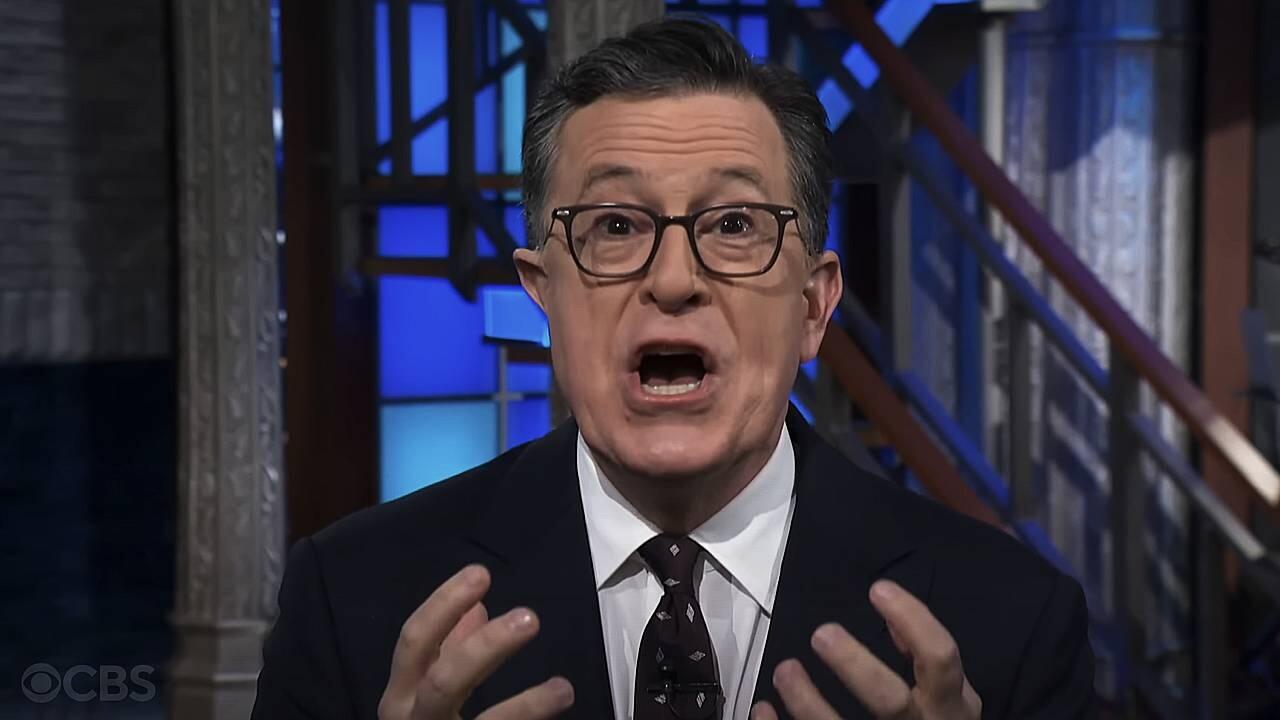
Watch: Colbert Begs The Deep State To Stop Trump

Watch: Colbert Begs The Deep State To Stop Trump

Authored by Steve Watson via Modernity.news,

Late Show host Stephen Colbert called for the “deep state” to step in and stop President Trump enacting his tariff policy, pleading “we’re f*cking dying.”

The ‘comedian’ packaged the plea as a comedy skit, but its not comedy when you don’t even have to scratch the surface to tell he’s deadly serious.

As we highlighted yesterday, the stock markets plunged when it was reported that China would put retaliatory tariffs on US goods of 34%.

However, that plunge started to reverse on news of Trump being open to deals with countries to reduce the tariffs.

It’s part of a long term economic strategy to bring manufacturing back to the US after years of globalist ‘free trade’ agreements such as NAFTA eroded away millions of jobs and businesses.

Trump announced “our Declaration of Economic Independence” Wednesday at a “Liberation Day” event to mark the introduction of reciprocal tariffs on other countries.

Trump said American taxpayers have been “ripped off for more than 50 years, but it’s not going to happen anymore.”

“They watched in anguish as foreign leaders have stolen our jobs, foreign cheaters have ransacked our factories, and foreign scavengers have torn apart our once-beautiful American dream,” he further stated.

“For years, hardworking American citizens were forced to sit on the sidelines as other nations got rich and powerful, much of it at our expense,” Trump urged, adding “But now, it’s our turn to prosper, and in so doing, use trillions and trillions of dollars to reduce our taxes and pay down our national debt and it will all happen very quickly.”

“With today’s action, we are finally going to be able to Make America Great Again — greater than ever before,” he added.

Trump displayed charts showing how much other countries are charging the US in tariffs, noting they are “Reciprocal — that means they do it to us, and we do it to them. Very simple, can’t get any simpler than that.”

Commenting on the development, Colbert asked “Anyone feeling liberated?” telling viewers it is the “Worst day for our economy since COVID. Just a little reminder: This time, he’s the disease.”

Colbert suggested that the stock market plunge must mean the “deep state” isn’t really the all-powerful entity its made out to be.

“Because if there was, they would’ve stopped this shit,” he continued, adding “But if they do exist, I just want to say to the cabal of financial and governmental elites who pull all the strings behind the scenes: Maybe put a pause on your 5G chip JFK Jr. adrenochrome chemtrail orgy and jump in here cuz we’re f*cking dying.”

The only thing dying is his ratings and consequently his advertising revenue.

*  *  *

Your support is crucial in helping us defeat mass censorship. Please consider donating via Locals or check out our unique merch. Follow us on X @ModernityNews.

Tyler Durden
Sat, 04/05/2025 – 16:20

Waste Of The Day: Out Of Control Grants In Massachusetts

Waste Of The Day: Out Of Control Grants In Massachusetts

Authored by Jeremy Portnoy via RealClearInvestigations,

Topline: Back in 2010, local officials in the City of Lynn, Massachusetts bragged to The Daily Item about an “inexpensive” way to beautify their own city: use federal grants to send the cost to taxpayers in other cities.

The city spent $2.8 million renovating a goldfish pond, a Mexican restaurant and more, using multiple grants and no-bid contracts.

That’s according to the “Wastebook” reporting published by the late U.S. Senator Dr. Tom Coburn. For years, these reports shined a white-hot spotlight on federal frauds and taxpayer abuses

Coburn, the legendary U.S. Senator from Oklahoma, earned the nickname “Dr. No” by stopping thousands of pork-barrel projects using the Senate rules. Projects that he couldn’t stop, Coburn included in his oversight reports.   

Coburn’s Wastebook 2010 included 100 examples of outrageous spending worth more than $11.5 billion, including the City of Lynn’s spending spree — which would be worth $4.2 million today.

Key facts: Lynn’s funding came out of Community Development Block Grants from the Department of Housing and Urban Development.

The city had already renovated its heart-shaped goldfish pond in 2005, but apparently residents were still unhappy with the stone walls on the island in the pond’s center. Lynn officials solicited bids for renovations and hired a nonprofit instead of private companies that offered a cheaper price.

Businesses in downtown Lynn, just north of Boston, were reimbursed up to $4,000 each to redecorate their storefronts. A vacuum cleaner store, a video rental store and more took advantage. 

One local official explained: “It‘s an inexpensive way to fix up a storefront, especially for the business owner.” It was yet another example of a city treating federal grants like free money. 

Other projects included a new gazebo, a water play area and a boat dock.

Today, Lynn is using its own taxpayers’ money to pay out generous local salaries. Twenty-six public employees earned more than $200,000 in 2023, according to payroll records obtained by OpenTheBooks.com. 

Search all federal, state and local government salaries and vendor spending with the AI search bot, Benjamin, at OpenTheBooks.com

Summary: All public funds ultimately come out of Americans’ wallets, even if some lawmakers would like to ignore that simple fact.

The #WasteOfTheDay is brought to you by the forensic auditors at OpenTheBooks.com

Tyler Durden
Sat, 04/05/2025 – 15:10

Reports That Trump Will Pull Out Of NATO Are Pure ‘Hysteria’: Rubio

Reports That Trump Will Pull Out Of NATO Are Pure ‘Hysteria’: Rubio

One of the most interesting moments from US Secretary of State Marco Rubio’s trip to Brussels this week where he met with NATO leaders for a security summit was when he reassured allies that Washington is committed to NATO, and will without doubt remain a member of the military alliance.

He dismissed as “hysteria” recent Western media reports and headlines which suggest President Trump could bail on NATO altogether. Rubio stressed that Trump has been clear that America will remain in NATO.

The United States is in NATO … As we speak right now, the United States is as active in NATO as it has ever been,” Rubio told reporters in Brussels late this week.

AFP via Getty Images

“And some of this hysteria and hyperbole that I see in the global media and some domestic media in the United States about NATO is unwarranted. President Trump has made clear he supports NATO. We’re gonna remain in NATO. He’s made clear,” Rubio added.

He emphasized that Trump was “not against NATO” but rather against a bloc “that does not have the capabilities that it needs to fulfil the obligations” under its founding treaty. He then called for “every single” NATO state to forge a “realistic pathway” to eventually commit 5% of its GDP to defense.

In reality this could take years or even decades, but ‘eastern flank’ countries like Poland are the most out front in nearing the goal. Warsaw is aiming to commit 4.7% of GDP by year’s end, and tiny Estonia is already at 3.7%. Many Western European allies are lagging far behind this.

NATO Secretary-General Mark Rutte stood alongside Rubio and offered the same assurances of America’s lead role in the alliance:

NATO Secretary-General Mark Rutte insisted Friday that “we are united in our commitment to each other in this alliance,” and that the “transatlantic relationship remains the cornerstone of European security and of global stability.”

“I know there has been some tough language. I know that there have been allies, for example, this side of the pond being worried about the long-term commitment of the U.S. to NATO,” said Rutte, adding: “The Americans have stated again and again, ‘We are committed to NATO. We are committed to Article 5.'”

In the recent past Trump has made some provocative comments telling Europe it can forget about Article 5 if it can’t shoulder more of the burden long taken on by the United States.

Watch: America’s top diplomat blasts media claims that US is pulling out of NATO…

In early March he pondered somewhat sarcastically the scenario in which America came under attack. He said of NATO allies, “Do you think they’re going to come and protect us? Hmm. They’re supposed to. I’m not so sure.”

Since then speculation has grown that Trump could grow weary of dealing with NATO partners, also as Washington has dialed down its Ukraine support, and sought to forge peace with Putin’s Russia.

Tyler Durden
Sat, 04/05/2025 – 14:35

Follow The Science: Why Peter Marks Was Asked To Leave The FDA

Follow The Science: Why Peter Marks Was Asked To Leave The FDA

Authored by George F. Tidmarsh via RealClearPolicy,

On Friday, Dr. Peter Marks announced his resignation from the U.S. Food and Drug Administration (FDA) as Director of CEBR (Center for Biologics Evaluation and Research) citing differences with Health and Human Services (HHS) Secretary Kennedy regarding vaccines. The New York Times, Washington Post, and other media outlets such as STAT News breathlessly reported that “FDA’s top vaccine scientist had been pushed out.” We have been told that science is at risk. The irony of these reports is that Marks didn’t resign and is not a vaccine scientist. Dr. Marks was asked to leave and then subsequently wrote that he did not want to become “subservient to [Secretary Kennedy’s] misinformation and lies.”

Peter Marks is not a hero of the resistance but instead has been subverting the scientific process at FDA for years.

The media proclamation that Dr. Marks’ is “FDA’s top vaccine scientist” is ironic because he decided to give himself that position. Marks is a physician but has no clinical or scientific training in vaccines or immunology. Dr. Marks trained as an oncologist, a field far from the important and complex area of vaccine biology. At FDA in 2021, Dr. Marks removed top career vaccine scientists so he could force through the approval of the COVID vaccine to meet an arbitrary Biden administration deadline. He also declined to convene the FDA Vaccine Advisory Committee to review his decision. These events are clearly outlined in the June 2023 House Judiciary Hearings. Marks ousted Dr. Gruber and Dr. Krause, the top scientists at the Office of Vaccine Research, due to “intransigence” of these real vaccine experts to not ram through the approval of the vaccine. Drs. Gruber and Krause had voiced concerns that they needed more time to understand the safety of the vaccine especially as it relates to inflammation of the heart, now a well known and accepted toxicity of the COVID vaccine. Marks approved the use of the vaccine in children despite the known fact that children have an extremely low risk of serious health effects of COVID-19 infection and yet a known significant increased risk of serious vaccine related toxicity.

On at least three additional, documented occasions during the Biden administration as Director of CBER, Marks disregarded the opinions and expert advice of long-time career scientists to advance his own dangerous agenda. In addition to ignoring and overruling FDA’s top vaccine scientists during the pandemic, Marks also overruled FDA career scientists and supported the approval of the Alzheimer’s drug ADUHELM; a decision later overturned. In 2023, he overruled his own staff scientists amid their concerns and those raised by an FDA Advisory Board to grant approval of ELEVIDYS, a gene treatment for Duchenne muscular dystrophy (DMD). Furthermore, in 2024 Marks expanded the approval of ELEVIDYS despite FDA staff objections and without FDA Advisory Committee input.

*  *  *

WEEKEND SALE AT ZH STORE!

Neuro Ignite $50.01 $39.95 (add to cart to see price)

ZeroHedge Multitool $34.95 $29.95

Rosewood Big Bowie Knife $400.00 $374.95

14-Day Emergency Food Bucket $149.99 $124.95

IQ Biologix Brain Rescue $74.95 $44.95 (add to cart to see price)

As tragic evidence of Marks’ failed judgement, just 2 weeks ago, the company that markets the therapy ELEVIDYS announced that a treated patient died of fulminant liver failure. Marks overruled his own career staff and experts to drive through a risky and unproven therapy that has now killed a patient. This tragedy should not have happened. After the initial FDA approval, the company conducted a subsequent trial which failed to meet the primary efficacy endpoint. On top of that, ELEVIDYS has proven toxicity including liver failure (22% of patients) and increase in serious adverse events. Despite the lack of proven efficacy and the concerning toxicity profile, Dr. Marks rammed through the initial ELEVIDYS approval and the full approval in June of 2024 against the counsel of his staff and the expert panel. While advocates point to the need for new therapies in severe debilitating diseases such as DMD, giving patients and families hope on a toxic therapy that does not provide a clinical benefit rises beyond simple incompetence. A patient died needlessly, and others have been harmed due to this incompetence.

Dr. Marks also failed to protect public health when he overruled career FDA scientists and supported the approval of the Alzheimer’s treatment AUDHELM, a controversial approval that was subsequently overturned. ADUHELM was approved in June 2021 despite strident objections from FDA staff and against the recommendations of an Advisory Board. In fact, two prominent members of that advisory board resigned in protest of the decision. These members cited a lack of clear efficacy and the risk of serious toxicity including brain swelling and bleeding that can be life threatening. These events led to a congressional investigation which found that FDA had “unusually close” interactions with Biogen, the AUDHELM sponsor and applicant. In January 2024, Biogen decided to remove ADUHELM from the market after confirmatory trials failed to show patient benefit. So, Dr. Marks again supported a dangerous and ineffective therapy that cruelly gave patients hope and provided nothing but risk and cost to Americans.

Both the ADUHELM initial approval and the ELEVIDYS approvals demonstrate that ignoring basic tenants of the use and interpretation of clinical trial data can be very damaging to public health. By ignoring these well-tested tenants of FDA review and approval, Marks endangered patients, gave false hope to those in desperate need and cost vast amounts of money that our health case system can ill afford. It cannot be overstated how destructive this practice is to drug development. This uneven application of basic clinical trial data interpretation calls into question the impartiality and credibility of the FDA. This is particularly relevant now as a patient who otherwise could have lived many more years died from an expected toxicity. And we have yet to fully determine the harm caused by Dr. Marks decision to remove the most experienced and trusted vaccine scientists that simply wanted more time to understand the, now proven, risks of the COVID vaccine.

While Dr. Peter Marks may try to claim differences with Secretary Kennedy on vaccines and the legacy media try to paint Marks as the FDA hero, the real reason he was terminated is that he made bad decisions that were contrary to FDA long-standing policies and which ran counter to the evaluations of professional career staff at FDA. Thanks to Dr. Marks’ terrible decisions, we are left with a drug that has no proven benefit and that just killed a young patient, a vaccine that is not completely safe is being administered to children that have no significant risk of harm from the underlying infection, and an overburdened healthcare system that had to pay billions for another unproven, harmful therapy. Advocates for Dr. Marks claim that he has acted to help patients with life-threatening conditions which have no alternative treatments. But in reality, he catered to industry and hurt patients. Of course, we should strive to advance safe and effective therapies for such conditions, but we should not approve ineffective and dangerous therapies simply to put something out on the market.  Unfortunately, Dr. Marks has repeatedly disregarded long-held FDA policy that is in place to protect patients. That is malpractice not heroism.

George F. Tidmarsh, MD, PhD, Stanford University School of Medicine, Adjunct Professor, Pediatrics and Neonatology.

Tyler Durden
Sat, 04/05/2025 – 14:00

California Lawmakers Reject Bills To Ban Males From Female Sports

California Lawmakers Reject Bills To Ban Males From Female Sports

Authored by Kimberley Hayek via The Epoch Times,

California state lawmakers have rejected a change to state policies that would have required male student athletes identifying as transgender to compete on sports teams consistent with their sex.

On April 1, Democratic lawmakers on the state Assembly’s Committee on Arts, Entertainment, Sports and Tourism rejected two bills introduced by Republican lawmakers—AB 89 and AB 844. Democrats hold a supermajority on the committee.

AB 89 would have required the California Interscholastic Federation, which governs high school sports, to follow rules banning male students from playing on girls’ sports teams at school.

AB 844 would have effectively repealed the 2013 California School Success and Opportunity Act, which permits students to play in sex-segregated school programs, including on sports teams, as well as use bathrooms and other facilities based on their gender identity. The bill would have applied to K-12 and college students.

Democratic Assemblyman Chris Ward, the committee chair and leader of the legislative LGBTQ+ caucus, alleged the bills to be part of an attack on transgender youth.

“Let’s be clear—this isn’t about fairness,” he stated in a post on Instagram.

“It’s about fear and exclusion, and I won’t stand for it.”

“Targeting trans athletes doesn’t protect anyone—it harms all girls,” said Ward, who represents large parts of San Diego. 

“This must stop.”

Republican Assemblyman Bill Essayli, author of AB 844, said the measure would restore fairness to women’s sports.

“California will come into compliance with Title IX either through the legislative process or the court process,” Essayli said during the hearing on Tuesday. “Title IX was passed to protect sex-based sports, to protect girls so they could have their own teams, so they can compete and be champions.”

Essayli said that even one woman disenfranchised due to current state law is too many.

“You’re taking rights away from women,” Essayli said.

Cross country athlete Taylor Starling testified at the hearing that a biological male identifying as a female took her varsity cross-country spot. She had been co-captain of the team.

“After having my spot taken away from me that I earned, I missed out on running with my varsity team in one of the top cross-country invitationals of the season,” Starling said. “My Title IX and free speech rights as a female matter too. Why are girls being told that we must sit down and be quiet while boys unfairly get ahead of us in life?”

Essayli took to social media to condemn Assembly Democrats for continuing what he perceives as a war against women’s rights.

The Corona lawmaker said that most Californians want to keep transgender females out of girls’ sports.

“Assembly Democrats are radically out of touch with common-sense Californians, and the voters will hold them accountable to restore justice and fairness in girls sports,” he said in a statement.

According to a recent Pew Research Center poll, 66 percent of Americans think that transgender athletes should play in sports based on their birth sex.

“Our young women are being forced to undress in locker rooms with boys,” Assemblyman and Republican leader James Gallagher of Chico said at the press conference after the vote.

“It’s an absurd result of flawed policy.”

Republican Assemblywoman Kate Sanchez of Rancho Santa Margarita wanted to make it clear in the press conference that the bill targeted CIF competitive high school sports.

“We stood for all high school athletic females. They deserve a safe space. They deserve to be protected,” she said.

Gov. Gavin Newsom, a Democrat, made headlines in March when he said on his podcast that he believes allowing transgender-identifying male athletes to participate in girls’ sports is unfair.

Later Tuesday, Essayli resigned from the Assembly to accept President Donald Trump’s appointment as interim U.S. attorney for the Central District of California.

Tyler Durden
Sat, 04/05/2025 – 12:50

Belgium Is Latest To Declare It Won’t Arrest Netanyahu, In Reversal

Belgium Is Latest To Declare It Won’t Arrest Netanyahu, In Reversal

Did Hungary’s Viktor Orban start a trend? He is hosting Israeli Prime Minister Benjamin Netanyahu on a four-day trip to Budapest through Sunday. PM Orban used the occasion to declare that Hungary, an ICC founding member, will pull out of The Hague-based International Criminal Court.

The ICC slammed the move, and said that member states have an obligation to enforce its arrest warrant against Netanyahu. Interestingly, Belgium too has declared in all likelihood it would never arrest the Israeli head of state.

Prime Minister Bart De Wever on Thursday said his country would ignore a warrant for the arrest of Netanyahu, in a reversal from the stated policies of the prior government. This could lead to more and more countries declaring the same, also amid ongoing US pressure to not confirm to ICC dictates.

source: theparliamentmagazine.eu

“To be completely honest, I don’t think we would either,” De Wever told a journalist from the VRT broadcaster. He was specifically responding to Hungary’s announcement that it wouldn’t arrest the Israeli leader, who is accused by The Hague of overseeing war crimes in Gaza.

“There is such a thing as realpolitik, I don’t think any European country would arrest Netanyahu if he were on their territory. France wouldn’t do it, and I don’t think we would, either,” the Belgian prime minister added.

Likely this is accurate especially when it comes to France. European leaders have shown a willingness to criticize Israeli policies in Gaza, and the extremely high civilian death toll – but typically stop short of taking any drastic or serious action against the Israeli government.

Belgium’s prior deputy prime minister, Petra De Sutter, wrote on X in November: “Europe must comply. Impose economic sanctions, suspend the Association Agreement with Israel and uphold these arrest warrants.” Former Prime Minister Alexander De Croo had also said in November that his government would “assume its responsibility” in relation to the ICC case and that “there can be no double standards.”

Meanwhile, Netanyahu will travel from Hungary to the United States next, where he’s expected to meet with President Trump on Monday.

Axios explains that “If the visit takes place as planned, Netanyahu will be the first foreign leader to meet President Trump in person to try to negotiate a deal to remove Trump’s tariffs. The leaders are also expected to discuss the Iran nuclear crisis and the war in Gaza.” Trump set a 17% rate for Israel, stemming from what’s been described as a significant US bilateral trade deficit.

Netanyahu’s trip to Washington will mark his second US visit since the ICC issued the warrant last year, and he’s had to avoid Europe altogether until this week’s Hungary visit

Tyler Durden
Sat, 04/05/2025 – 12:15

Mission Impossible: 2 Percent Inflation

Mission Impossible: 2 Percent Inflation

By Dhaval Joshi of BCA Research

Mission Impossible: 2 Percent Inflation – The Sequel

Executive Summary

  • Hitting and sustaining a precise 2 percent inflation target is more about luck than judgement. It requires both the starting point for inflation expectations and any inflation/deflation shock to combine perfectly to 2 percent.
  • The euro area and Japan got lucky, because the pandemic inflation shock moved their inflation expectations close to the 2 percent target. But the US and UK got unlucky because the inflation shock moved their inflation expectations away from the 2 percent target.
  • Hence, relative to current rates and expectations, the BoJ has the greatest scope to increase rates; the Fed and the BoE have limited room for manoeuvre; and the ECB has the greatest scope to cut rates.
  • FX markets will also be influenced by capital flows into and out of risk-assets. Specifically, USD/EUR is just tracking the rise and fall of the superstar ‘Mag-7’ stocks.
  • Tactically, this means that a relief rally in Mag-7 will cause a relief rally in the dollar.
  • A relief rally in the dollar also implies a tactical reversal in gold, confirmed by gold’s collapsed 65-day price complexity.
  • On a longer-term horizon though, our favourite currency is the Japanese yen.

Tariffs have rekindled fears about inflation at a time that most economies’ inflation rates are already above central banks’ 2 percent targets. But after the pandemic inflation shock, the current low-single digit inflation rates feel like bliss. Causing some commentators to argue: can we really distinguish between low rates of inflation – and if not, then why not settle for inflation at 3 or 3.5 percent rather than the quasi-religious commandment of 2 percent?

To support this argument, some commentators have dug up an archive op-ed by the late Paul Volcker, What’s Wrong With the 2 Percent Inflation Target – Bloomberg 

Volcker’s overarching point was that in trying to manage an economy, “false precision can lead to dangerous policies”. Price stability is that state in which expected changes in the general price level do not effectively alter business or household decisions. But, said Volcker, it is ill-advised to define that state with a point target, such as 2 percent.

Volcker was only partly right. He was right about ‘false precision’ when inflation is below 2 percent, but he was wrong about it when inflation is above 2 percent. Below 2 percent, inflation is imperceptible. So, yes, the distinction between 1 percent and 2 percent is a false precision. But above 2 percent, inflation becomes perceptible. Meaning that there is a big difference between imperceptible 2 percent and perceptible 3 percent.

Crucially, therefore:

There is a huge onus for central banks to bring inflation down from above 2 percent to at, or below, 2 percent.

There’s A Huge Difference Between 2 Percent And 3 Percent Inflation

The human brain cannot distinguish between very low rates of inflation, a range we just perceive as ‘price stability’. In ‘Real-Feel’ Inflation: Quantitative Estimation of Inflation Perceptions by Michael Ashton : SSRN Michael Ashton confirms that “it would be challenging for a consumer to distinguish 1 percent inflation from 2 percent inflation – that fine of a gradation in perception would be extremely unusual to find.” As the entire range of ultra-low inflation just feels like one state of price stability, sub-2 percent inflation does not alter business or household decisions.

Still, cumulative sub-2 percent inflation over years will eventually result in a meaningful increase in prices. Why do we not notice this? The answer is that our productivity also increases at a rate of 1-2 percent. And to the extent that our wages increase in line with our productivity, we will not notice any loss in spending power when inflation is running at, or below, 2 percent.

Above 2 percent though, there is a phase-shift. We do notice higher rates of inflation, both in the short-term and the long-term, so it alters business and household decisions. This makes it crucial for central banks to phase-shift inflation and inflation expectations from the perceptible 3 percent back to the imperceptible 2 percent or below. Yet this is easier said than done because of the way that inflation expectations are formed.

Inflation Expectations In The US And UK Will Stay Too High

Long-term inflation expectations are nothing more than a simple weighted average of long-term historic inflation and extremely recent inflation (Charts 1-4). But the long-term historic component dominates with an 85 percent weighting. Specifically: 

10-year expected inflation = 0.85 * 10-year inflation + 0.15 * 3-month inflation 

This basic maths for inflation expectations has a crucial takeaway: inflation or deflation shocks that cause the long-term historic inflation rate to gap up or gap down will also cause long-term inflation expectations to gap up or gap down.

Or, put in simple English: Inflation and deflation shocks stay in the collective memory for a long time. This leads to another crucial takeaway. The pandemic inflation shock caused long-term inflation expectations to gap up by about 1.5 percent in every major economy. But depending on where those inflation expectations started, the inflation shock was either ‘benign’ or ‘malign’. 

In the euro area and Japan, where long-term inflation expectations were well below 2 percent, the pandemic inflation shock was benign – because it finally lifted those inflation expectations to the required level of 2 percent.

But in the US and the UK, where long-term inflation expectations were close to 2 percent, the pandemic inflation shock  as malign – because it lifted those structural inflation expectations to well above the 2 percent threshold at which inflation becomes perceptible.

In the case of the US and the UK therefore, the pandemic inflation shock must be neutralized by a new deflationary shock to restore long-term inflation expectations back to 2 percent. But the source and timing of that deflationary shock are unclear.

Until such a deflationary shock arrives:

Long-term inflation expectations in the euro area and Japan will be close to the sweet spot near 2 percent, while those in the US and the UK will be stuck uncomfortably above 2 percent.

Tariffs will only make matters worse, as it will add an extra ‘risk-premium’ to an already elevated level of long-term historic US and UK inflation (Chart 5).

The Euro Area And Japan Got Lucky, The US And UK Got Unlucky

Ten years ago, I wrote a heterodox report: Mission Impossible: 2% Inflation. In it, I argued that hitting and sustaining a precise 2 percent inflation target is more about luck than judgement. Rather like pulling a brick with an elastic band to a precise target. To end up at the target, you need to get lucky. Hitting the inflation target requires both the starting point for inflation expectations and any inflation/deflation shock to combine perfectly to 2 percent.

Ten years on I stand by that report. The euro area and Japan got lucky. Their pre-pandemic structural inflation expectations at below 0.5 percent combined perfectly with the +1.5 percent pandemic shock to get close to the 2 percent sweet spot. 

Conversely, the US and UK got unlucky. Their pre-pandemic structural inflation expectations near 2 percent combined with the pandemic shock of +1.5 percent to take those expectations well above the 2 percent sweet spot.

Versus the current level of interest rates and expected moves through the next year or so, we can therefore say:

The Bank of Japan has the greatest scope to increase rates; the Fed and the Bank of England have limited room for manoeuvre; and the ECB has the greatest scope to cut rates.

In the rates market this means short Japanese rates; neutral US and UK rates; and long euro rates.

The FX markets are more complicated because they will also be influenced by capital flows into and out of risk-assets. Specifically, USD/EUR is just tracking the rise and fall of the superstar ‘Mag-7’ stocks (Chart 6).

Tactically, this means that a relief rally in Mag-7 will cause a relief rally in the dollar.

A relief rally in the dollar also implies a tactical reversal in gold, which is confirmed by gold’s 65-day price complexity reaching the point of collapse that has signalled previous tactical reversals (Chart 7).

More in the full BCA note available to pro subs.

Tyler Durden
Sat, 04/05/2025 – 11:40