Trump administration Commerce Secretary Howard Lutnick defended new tariffs announced Friday, noting “Today was the day of the beginning of saying, I’m sorry, you can’t just live for free off of us.”
In a CNN interview, Lutnick explained that “the largest tariff and trade barrier country in the world is China. And they don’t have inflation.”
“So these things don’t occur the way people suggest they do. This is a reordering of global trade for the benefit of America,” Lutnick continued.
He further urged, “these people have all been living in our house. They have been driving our car. They come by and visit, open our fridge and eat our food whenever they want.”
“They have taken advantage of us,” he emphasised.
“You have to pay,” Lutnick reiterated, adding “And what’s going to happen is, the United States of America will get stronger. Our economy will grow much, much faster than the rest of the world, right?”
Watch:
🚨 COMMERCE SEC. HOWARD LUTNICK with an absolute masterclass against a combative CNN host. pic.twitter.com/QdCD8ElMbb
LUTNICK: “Let Donald Trump fix the American economy.”
HOST: “The first time he did tariffs, we did see prices rise on products that were tariffed.”
President Trump declared Friday that the tariff policy is already working and that every country has already contacted him looking to make a better trade deal.
“Every country has called us, that’s the beauty of what we do, we’ve put ourselves in the driving seat,” Trump declared.
He added, “If we’d asked most of these countries to do us a favour, they’d have said no, now they’ll do almost anything for us… the tariffs give us great power to negotiate”.
Trump rejected the assertion that the tariffs will be damaging, saying ” We inherited a terrible economy, as you know, with a lot of problems, including the loss of manufacturing and plants closed up and down the country.”
“We’ve lost 90,000 plants since NAFTA… and about six million jobs, it’s a sick patient that went through an operation on liberation day, it’s going to be a booming country,” he further proclaimed.
Watch:
🚨 PRESIDENT TRUMP announces his tariffs have brought pretty much EVERY COUNTRY to the negotiating table already
“Every country’s called us. That’s the beauty of what we do. We put ourselves in the driver’s seat.”
Your support is crucial in helping us defeat mass censorship. Please consider donating via Locals or check out our unique merch. Follow us on X @ModernityNews.
Pentagon’s Yemen Operations Nearing $1 Billion Price Tag
Fresh analysis in both the NY Times and CNN have estimated that America’s Yemen operations will soon hit the $1 billion mark. Still, war-planners are admitting only ‘limited success’ in degrading and dismantling the Houthis sophisticated weapons network.
‘Operation Rough Rider’ has seen warplanes and warships in the Red Sea go through at least $200 million in launched munitions alone since March 15, the Times report says. An in total, CNN says the overall operation is “nearing $1 billion in just under three weeks, even as the attacks have had limited impact on destroying the terror group’s capabilities,” according to several US defense officials.
US military assets in the region have utilized JASSM long-range cruise missiles, JSOWs (GPS-guided glide bombs), and Tomahawk missiles – all of which are very costly, advanced munitions.
Pricey air operations are also being run out of Diego Garcia in the Indian Ocean:
US defense officials announced earlier this week that B-2 bombers out of Diego Garcia — a British-administered atoll — are also being used against the Yemeni military, and an additional aircraft carrier as well as several fighter squadrons and air defense systems will soon be moved into the Central Command region.
“They’ve taken out some sites, but that hasn’t affected the Houthis’ ability to continue shooting at ships in the Red Sea or shooting down US drones,” said one of the sources, referring to Yemen’s Ansarullah resistance movement.
“Meanwhile, we are burning through readiness—munitions, fuel, deployment time.”
American taxpayers, who are ultimately the ones footing the bill, are unable to have a say in any of this given the Trump-ordered military action has not been brought before Congress.
Washington has actually been bombing Yemen off-and-on for years, spanning back to the Obama administration, without so much as a single vote in Congress. Past efforts by Libertarian-leaning Republicans to reign in the Executive’s war powers have failed.
However, CNN notes that as Pentagon resources become more and more strained, also amid the Ukraine war, this could force Congress to take up the question of funding down the line:
One of the sources said the Pentagon will likely need to request supplemental funding from Congress to continue the operation, but may not receive it — the offensive has already been criticized on both sides of the aisle, and even Vice President JD Vance said he thought the operation was “a mistake” in a Signal chat published by The Atlantic last week.
Some analysts have pointed out that the major anti-Houthi operations actually mainly benefit Israel, while others have said that Europe should shoulder more of the burden in protecting Red Sea shipping lanes, however the consensus is that European navies are relatively weak, and don’t have advanced enough technology to properly defend against Houthi missiles and drones.
There are also fears this could turn into another US quagmire in the Middle East with little to show for in terms of strategic gains or positive results. The White House is characterizing this as a blow to Iran, given the Houthis have long been Tehran’s proxies, but it’s also clear the Yemeni group acts independently.
The Middle East’s poorer countries have been struggling with warped, barely functioning economies for decades. Jordanians and Egyptians watched Southeast Asia develop manufacturing industries that lifted millions out of poverty, whereas they withered under bloated governments, layers of red tape and an elite engaged in rent-seeking.
Donald Trump’s decision to tear up the global trading system on Wednesday with a torrent of tariffs is, therefore, being met with a mixed reaction in these countries. “We have lived through all this before. It’s not new for us,” an Egyptian paper manufacturer who wished to remain anonymous, told Middle East Eye. “You could even say we have an advantage now because everyone else just got more expensive.”
Indeed, countries like Vietnam and Cambodia were slapped with 46 percent and 49 percent tariffs, respectively. Because the Trump administration calculated its tariff rate based on the difference between how much stuff the US buys from and sells to its trading partners, cheap manufacturing powerhouses that had their acts together got hit hardest.
Countries like Jordan and Egypt have been trying to get into the game of low-skilled manufacturing for years but have been outcompeted by Southeast Asia. Although all countries will feel the sting if Trump’s tariffs spark a global recession, some sniff out an opportunity in a chaotic new world.
“The Southeast Asian tariffs are the ones that will make a difference for Egypt and the Middle East,” Hisham Fahmy, the CEO of the American Chamber of Commerce in Egypt, told Middle East Eye.
“This is absolutely a boost for Egypt’s garment industry. One of the main exporters just sent me a message saying this is good for us, but we have to see.”
Egypt was hit with just a 10 percent tariff rate, the lowest baseline introduced by the Trump administration.
‘Trump just made it easier for Egypt’
On the surface, Egypt doesn’t have much to attract industrialists.
Its economy is in a crisis, having been decimated by inflation and successive currency devaluations. The drop in the Egyptian pound’s value has made importing raw materials more costly for Egyptian manufacturers, and the country has been suffering from electricity rationing.
Egypt’s exports to the US have never been that impressive. Garments and textiles make up 51 percent of its total exports. Iron and steel come in next at barely nine percent.
But experts say that in Trump’s world, all Egypt needs to do is be cheaper than Southeast Asia in low-skilled manufacturing. The prime example is the garment industry, which is fairly mobile and requires relatively little up-front investment.
“Trump has just made it easier for Egypt, with all our corruption and more expensive labor costs to compete with Asia,” the paper manufacturer told MEE.
Egypt’s manufacturing industry goes back to the days of Muhammad Ali Pasha, the Ottoman governor who fashioned the modern Egyptian state in the early 19th century. By WWII, Egyptian manufacturing was well established but in the hands of Greek, Italian and Armenian industrialists. When Gamal Abdel Nasser overthrew Egypt’s monarchy in 1952, he nationalized the factories and imposed trade restrictions – not unlike Trump.
Hosni Mubarak unleashed post-Soviet-style crony capitalism on Egypt. By then, its market had already been overrun with cheap imports. In sum, Egypt’s manufacturing sector is creaky and old, but it has a foundation to build on if global supply chains adjust to Trump’s tariff in the medium to longer term.
The situation is more complicated in Jordan. Jordan’s economy keeps spinning thanks to a vast government patronage system backed by American aid, but it has some manufacturers.
Jordan has a small garment industry that has struggled to compete with Egypt and especially Turkey. However, some manufacturers have carved out a niche for themselves exporting to the US by capitalising on Jordan’s Free Trade Agreement with the US.
Jordan and nearshoring
Jordan’s bilateral trade with the US, a small $5.4bn, is paltry from the US perspective, but for Jordan, it is a lot, Nael al-Husami, CEO of the Amman Chamber of Industry, told MEE. Jordan’s exports to the US have been growing in recent years. US goods imports from Jordan totalled $3.4bn in 2024, up 15 percent from 2023.
“For the US, Jordanian exports are meaningless, but if these tariffs continue, we will be affected. We lost our privileges of the FTA,” Husami told MEE. Jordan has benefited from exporting potash, a fertiliser, to the US amid the war in Ukraine.
One of the most prominent companies exporting to the US in Jordan is Petra Engineering Industries, a manufacturer of customised heating and cooling, or HVAC systems. MEE visited the plant in 2022 when Jordan hoped to benefit from trade tensions between the US and China.
MENA and Trump’s tariffs
🔲 All Middle Eastern countries now face a 10% base US tariff on goods exports, with added reciprocal tariffs pushing rates to 41% for Syria, 39% for Iraq, 20% for Jordan, and 17% for Israel. Steel, aluminium, and auto parts still face 25% tariffs,… pic.twitter.com/nnahSR17MN
— Naser al-tamimi | ناصر التميمي (@nasertamimi) April 5, 2025
A Jordanian executive speaking to MEE on the condition of anonymity said that even with the 20 percent tariff rate imposed on Jordan, relative to China and the European Union, Jordan will remain competitive. “Everyone is getting tariffed. Jordan’s tariff rate is not nearly as bad as other countries,” the executive said.
“The tariff is going to be a killer for Jordanian exporters who are doing tenders and have merchandise with specific profit margins locked in. But most Jordanian exporters won’t feel it because they are just selling and shipping from the factory floor. The American consumer will pay a higher price,” the executive said.
Executives in the Middle East say other countries like Morocco could also pinch new business thanks to Trump’s tariffs.
The North African country is primed to pounce as companies look for easy options to re-orient supply chains with limited investment. Morocco is already the leading car manufacturer in Africa and could snag more business from Europe and potentially Canada and Mexico. Morocco was slapped with a 10 percent tariff by Trump.
So, as Trump’s tariffs turn the tables on the global trading system, the Middle East may be the least bad place to be for making relatively cheaper products.
The Israeli army is organizing hiking tours for civilians inside recently occupied Syrian territory during the upcoming Passover holiday, according to Israeli media reports.
The tours, coordinated by the Israeli military’s Northern Command and 210th Division alongside the “Friends on Excursions” group, are supported by the Golan Heights Settlements Council and the Israeli Nature and Parks Authority.
Participants, who must receive special permits, will be escorted by Israeli troops as they travel up to 2.5 kilometers into Syrian land, near the village of Maaraba. Tour highlights include visits to Wadi al-Ruqad (a tributary of the Yarmouk River), the Hejaz Railway Tunnel, and the Shebaa Farms – a contested strip of Lebanese territory occupied by Israel at the base of Mount Hermon.
Though registration has closed, the army said additional tours may be offered depending on the security situation. The excursions mark the first Israeli civilian presence in areas of Syria recently taken over by Israeli forces following the fall of Syrian President Bashar al-Assad in December.
In recent months, Israel has intensified airstrikes on Syrian military bases and moved beyond the Golan Heights’ demilitarized buffer zone, occupying strategic areas like Mount Hermon in violation of the 1974 disengagement agreement. Initial Israeli security plans reportedly envisioned a 15-km demilitarized zone and a broader 60-km zone of influence inside Syria.
Prime Minister Benjamin Netanyahu has since called for the complete demilitarization of southern Syria, declaring that Israeli troops would remain in the Golan buffer zone and Mount Hermon indefinitely to block Syrian army access south of Damascus.
Israeli Finance Minister Bezalel Smotrich has openly expressed support for expanding Israel’s borders beyond Palestinian territories, hinting at ambitions for a “Greater Israel” encompassing parts of neighboring Arab countries, including as far as Damascus.
In a French documentary, Israel: Extremists in Power, Smotrich endorsed a Jewish state governed by Jewish values and smiled when asked if Israeli sovereignty should extend beyond the Jordan River.
Chinese woman vlogger travel to see Israel newly occupied Syrian territory near Golan Heights.
Her Syrian driver told her that Israeli has setup road blocks and snipers to keep Syrians from visit what was still unoccupied Syria 1 month ago. pic.twitter.com/emR3TwTQc2
He referenced a biblical prophecy about Jerusalem stretching “until Damascus.” While the Israeli government maintains its official goal as defeating Hezbollah, Smotrich’s comments—and settler support—raise concerns about broader expansionist intentions in Syria, Lebanon, Jordan, and beyond.
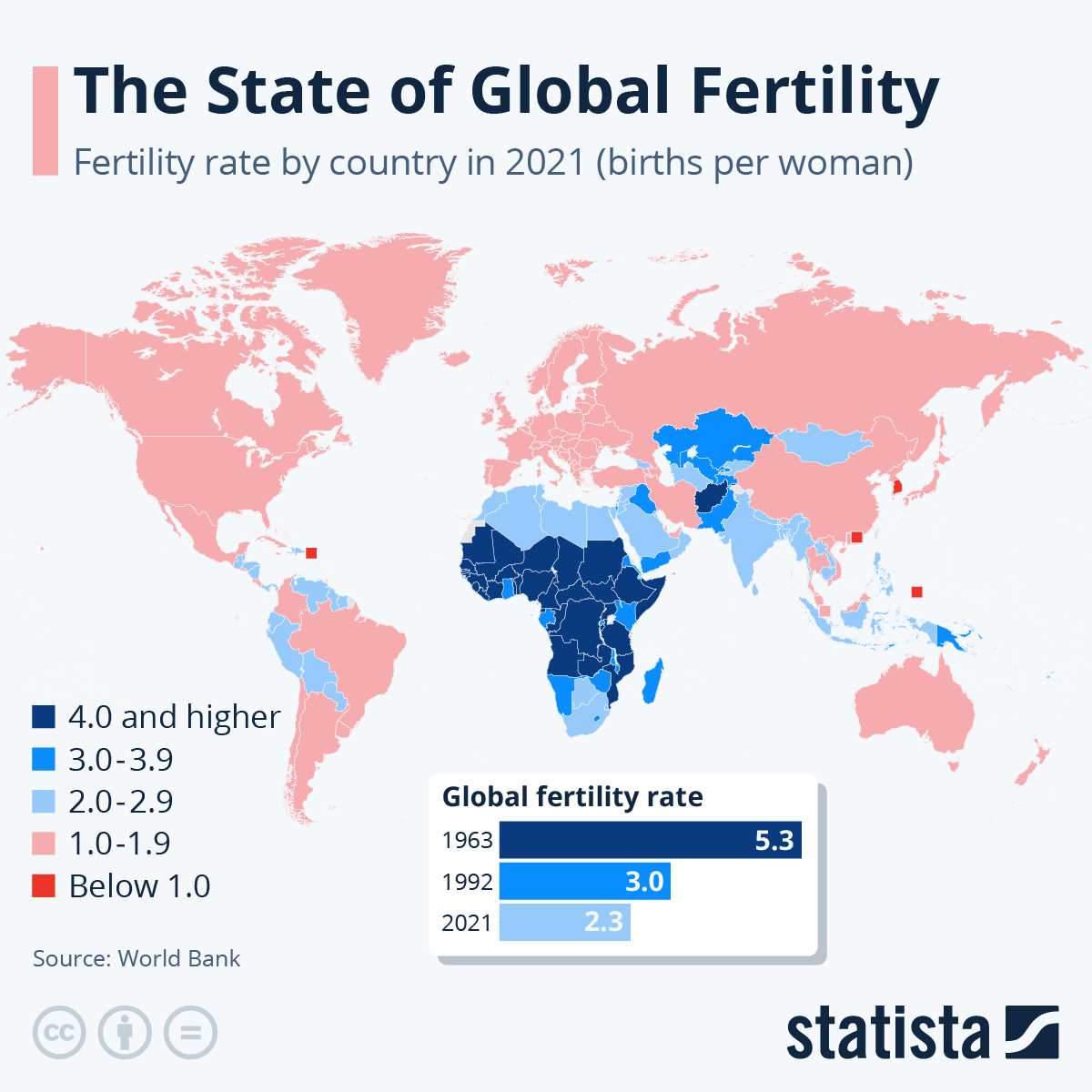
Throughout the developed world, birth rates have crashed.
But the “population bomb” that author Paul Ehrlich warned us about in the 1970s still exists; it’s just confined to the nations with the lowest per capita income. The correlation is almost perfect. The average number of children per woman in extremely poor nations is still extremely high.
For example, births per woman in Niger stand at a world-leading 6.6, which means that every generation the population of that nation will more than triple. Meanwhile, the per capita income in Niger, even based on purchasing power parity, stands at a dismal $2,084 per year. Exponential national population growth is occurring across most of the African continent, where in 1950, the population was estimated at around 225 million compared to an estimated 1.5 billion today. By 2050, Africa’s population is estimated to rise to 2.5 billion and is not estimated to level off until 2100 at nearly 4 billion people.
There are pockets of fecundity elsewhere in the world, primarily in the Middle East, but if you exclude Africa and some Islamic nations, the entire global population is on a path to oblivion. From China (1.2 children per woman), Korea (0.9), and Japan (1.3) to Germany (1.5), Italy (1.3), and the United Kingdom (1.6), populations are on track to descend by 50 percent in at most two generations. The European numbers are only slightly better than the Asian numbers because of immigration.
Because of the sensitive nature of the information, it is difficult to get reliable statistics on the birth rates of indigenous European women. But according to official data from the German government, nearly 50 percent of all children under the age of five in Germany have a “migration background.” Since 80 percent of Germany’s population is still reported as having “German origin,” it is clear that immigrant birthrates are far higher than the birthrates of indigenous German women.
This pattern repeats itself throughout the European nations and nations of European origin. According to the Office of National Statistics in the United Kingdom, the most common name for baby boys is now Muhammad. In the hopefully more assimilative United States, according to Pew Research, “minority” births now outnumber white births.
What these demographic trends portend for our future is central to every major issue we face. Can we maintain economic health if we accept a population in terminal decline? So far, the Asians are betting they can, relying on automation and AI to fill the labor gaps. Can we maintain cultural stability if we import Africans and Moslems to have babies since we don’t want to anymore? That’s the bet the European nations are making.
But there is an even more fundamental question that ought to be the topic of massive public debate, without stigmatizing the participants or restricting the theories offered up. Why don’t women in developed nations want to have babies anymore?
Answers to this question typically travel into safe spaces.
It’s economics: the cost of living is too high. Or the slightly conspiratorial but increasingly mainstream explanation that endocrine disruptors in our food and water have lowered the fertility and the libido of men and women alike. And, of course, the likely possibility that social media has spawned a younger generation that is isolated, socially stunted, and intimacy challenged.
To some degree or another, all of these explanations are true, but they ignore countervailing facts: Our nations are now filled with subcultures for whom none of these reasons apply to nearly the same effect. What are they doing that we stopped doing? And here is where we dive into the topics and theories that one may risk career and political suicide to utter.
There is a pundit on X who goes by the name “hoe_math” and bills himself as “history’s manliest and most hilarious sex genius.” He recently released a brief video post on his X account that squeezes several inflammatory explanations for low female fertility into 2 minutes and 14 seconds. Something this succinct deserves analysis, despite being horrifically biased, sexist, etc., etc., etc., because even if he is overstating his case and ignoring other factors and being deliberately offensive, he is covering the forbidden bases that need to be covered. If there were more honest scholarship available on these topics, we might by now have a more sanitized and more credible compilation. But we don’t. So here goes.
The video opens with a clip of a woman who claims women don’t need men anymore. To which “hoe_math” goes to work. He begins by saying that women’s need for men is not gone, just more indirect now, stating that “men have always been between women and the real world.”
Relying on hand-drawn pictographs, he shows seven women in pink dresses, safe inside a circle that is shielded by men who are getting killed (denoted by being crossed out with red X marks), protecting them from danger. “Your office job is not the real world,” he continues. “Men face danger and build things in order to create a safe space for women. You just don’t understand that because you’re too comfortable… If all men stopped working right now, we would all die. That’s because men make all the food and build all the houses and the walls.”
If the first half of the video asserts that that base reality still exists, requiring the presence of men, the second half explores the consequences of denying that assertion. Speaking about women, he says, “And then you look around and go, ‘Hey, men have more than us. No fair,’ so you go to the government, which writes some laws for you that make you equal, and then you are disgusted by men who are equal to you.” He then ventures his primary argument, saying, “So without equality laws, it’s very easy for women to find men they respect, and with equality laws, it’s very difficult.”
Moving from the impact of financially empowering women to the impact it has on men, he states, “And then everyone tells these men they are worthless,” while in the video placing a “not people” card over the first seven levels of men on a pictograph that has columns of men and women ranked from 10 down to 1. He then says the men who are deemed worthless decide not to work anymore and instead turn themselves into a Peter Pan type character that rejects personal responsibilities and refuses to grow up.
Whatever else you may say about this video, and despite its glib oversimplifications, it has too much substance to be dismissed. A study conducted in 2006 by academics from MIT and the University of Chicago evaluated the role of height and annual income in determining male attractiveness to women. It found that for a man 5′ 6″ in height to be as attractive as a man 6′ tall, the shorter man would have to earn $175,000 per year more than the six-footer. For a 5′ 8″ man, the gap he would have to fill drops to $138,000 per year. A man only 5′ 2″ tall would have to earn a whopping $269,000 per year more than the six-foot man to be considered equally attractive to women.
Income matters. A 2022 study of dating site behavior found that “Men with combined income and education that was one standard deviation greater than the mean received 255%—over three times—more indicators of interest than men with combined income and education that was one standard deviation less than the mean.” A 2018 study published in the journal Evolution and Human Behavior found that women consistently rated men with greater income as more attractive and that these findings “tally with a much broader corpus of scientific work which found high-status men were considered more attractive by women.”
If women aren’t attracted to men who make less money, that would help explain why they aren’t marrying these men and having children. But also relevant to the decline in births are two myths that are slowly disintegrating despite ongoing mainstream denial.
The first is the familiar trope that women only make 83 cents for every one dollar earned by men. Not true.
When normalizing for job type, qualifications, and hours worked, the “gender pay gap” all but disappears, thus diminishing the pool of eligible males.
The second myth is that women are more likely to find fulfillment in careers than in having children. Also not true.
A study of American women aged 18-55 found that married women with children were twice as likely to be “very happy” as unmarried women with no children and only half as likely to be “not too happy.” As long as this myth persists, however, women are impelled to choose career over children.
These findings all come with uncomfortable implications.
Are women choosing to be alone because they have an innate need to only be with a man who is more able to provide for them than they can provide for themselves, and there are no longer enough of those men to go around? Are the only cultures where women still have babies above a replacement level those cultures that discourage women from having education and careers?
The cost of living, toxins in the environment, and the isolating impact of technology are all playing a role in the catastrophic decline in birth rates in developed nations. But there are also profound and very recent changes in how we collectively choose mates and choose to have families that are probably playing the larger role. If we ignore these cultural factors, we risk losing everything. The heritage we have painstakingly built over millennia may be erased because we didn’t want to talk about it. Babies don’t yet come in bottles. Women either get pregnant and give birth to them, or we go extinct.
For decades, fear of being called racist has suppressed honest debate over mass immigration. Similarly, fear of being called sexist prevents honest debate over why there is a population crash and what to do about it.
* * *
Views expressed in this article are opinions of the author and do not necessarily reflect the views of ZeroHedge.
The law makes it a criminal offence, punishable by up to five years in prison, for anyone who delivers or performs conversion practices that cause serious mental or physical harm.
Taking someone out of NSW to undergo such practices elsewhere can also attract a maximum three-year jail term.
Conversion practices include so-called “conversion therapy” and other actions aimed at changing or suppressing a person’s sexual orientation or gender identity. These practices are based on the belief that LGBTQ+ people need to be “cured” or “fixed.”
Civil Complaints and Education Measures
The law also introduces a civil complaints mechanism through Anti-Discrimination NSW.
From April 4, 2025, complaints can be made about conversion practices occurring in the state. If appropriate, matters may be resolved through conciliation, or referred to the NSW Civil and Administrative Tribunal.
Anti-Discrimination NSW will also run education sessions and distribute resources to inform the public about the law. These include free online tools and referrals to support services.
While the law targets practices aimed at forcibly changing or suppressing identity, it does not ban general religious teaching or private conversations between parents and children.
“This legislation is focused on protecting people from targeted, sustained efforts to change who they are,” the NSW government said.
Last year, the Premier issued a formal apology to those convicted under now-defunct laws that once criminalised homosexual acts.
In September, the NSW Government endorsed all 19 recommendations from the Special Commission of Inquiry into LGBT hate crimes. The inquiry highlighted significant failures in how past governments and police responded to the violent deaths of LGBT people.
A new LGBT Advisory Council has also been created to help shape the state’s first Inclusion Strategy. The government also backed the amended Equality Bill, introduced by independent MP Alex Greenwich, which passed Parliament.
Activists: “There Is Nothing to Fix”
The law comes just three days after South Australia passed similar legislation.
NSW joins Victoria and the ACT in banning LGBT conversion practices outright. Queensland has implemented a partial ban limited to health settings, while Western Australia has committed to introducing its own reforms.
Attorney General Michael Daley said the law sends a clear message: “Everyone deserves to be respected for who they are. There is nothing ‘wrong’ with LGBT people. They do not need ‘fixing’ or to be ‘saved.’”
Founder of Ambassadors and Bridge Builders International, Anthony Venn-Brown OAM, welcomed the move.
“I grew up when being gay was a criminal offence and mental health professionals believed they could cure homosexuality,” he said.
Opposition: Concerns About Overreach
Lyle Shelton, Family First’s lead Senate candidate for NSW, opposed the new laws, calling them an overreach into personal and religious freedoms.
“No one wants to see anyone coerced or converted to anything. But these laws are not about that,” he said.
“Trying to prevent a child from receiving puberty blockers, cross-sex hormones, or irreversible surgery could be labelled ‘conversion therapy’ under this law.
“They could criminalise parents, counsellors, or medical professionals who caution children about the risks of LGBT gender fluid ideology.”
He described the legislation as “another attack on religious people whose views align with science—that there are two genders and that true marriage is between a man and a woman.”
He said the laws could empower activists to have “good people jailed.”
House Fiscal Conservatives Blast “Unserious And Disappointing” Senate GOP Budget Blueprint
Hours after Senate Republicans approved their latest budget plan Saturday morning, at least three GOP deficit hawks in the House – the maximum number of R’s Speaker Mike Johnson can lose – blasted the package over a lack of spending cuts.
“If the Senate’s ‘Jekyll and Hyde’ budget is put on the House floor, I will vote no,” Rep. Chip Roy (R-TX) posted to X on Saturday, adding “Failure is not an option. And the Senate’s budget is a path to failure.”
If the Senate’s “Jekyll and Hyde” budget is put on the House floor, I will vote no.
In the classic ways of Washington, the Senate’s budget presents a fantastic top-line message – that we should return spending back to the pre-COVID trajectory (modified for higher interest, Medicare, and Social Security) of $6.5 Trillion, rather than the current trajectory of over $7 Trillion – but has ZERO enforcement to achieve it, and plenty of signals it is designed purposefully NOT to achieve it.
The House Budget is seemingly more modest in its objectives – perhaps OVERLY modest – in laying out a floor of $200B in reductions in spending increases (not cuts). But that “floor” establishes important guardrails to force Congress to pump the brakes on runaway spending and to achieve critical reforms to badly broken Medicaid, food stamp, and welfare programs currently being abused to subsidize illegals, the able-bodied, and blue states.
The America First agenda requires boldness from Congress, not timidity. President Trump’s leadership – and risk taking – requires the same from Republicans in Congress, not more of the same selfish vote-buying, big-spending pork that got us into this debt crisis. We can and must cut BOTH the statutory taxes Americans pay AND the inflation tax they increasingly pay because of Congressional failure.
Failure is not an option. And the Senate’s budget is a path to failure. Instead, we should get busy drafting a reconciliation package that will work – that will ACTUALLY produce spending reductions that will, as a start, return to the pre-COVID spending path – and deliver on the promises we campaigned upon.
Maryland Republican Rep. Andy Harris also chimed in, saying he “can’t support House passage of the Senate changes to our budget resolution until I see the actual spending and deficit reduction plans to enact President Trump’s America First agenda.”
Rep. Lloyd Smucker (R-PA) said he “certainly can’t support it as written” Thursday night.
We all agree: keep taxes low for individuals & small businesses, drive economic growth. But we must reduce the deficit as well.
House Budget Chair Jodey Arrington (R-TX) called the plan “unserious and disappointing” Saturday morning, but didn’t go so far as to explicitly say he would oppose it.
As noted above, Johnson cannot lose more than three Republicans on a party-line vote with his 220-213 majority, which doesn’t bode well considering that several other House Republicans have characterized the Senate’s plan as fiscally irresponsible, and insist that any budget plan should at least be deficit-neutral, while any tax cuts should also be tied to tax cuts. The Senate’s plan, however, essentially kicks the can down the road once again on these issues by providing different targets to critical committees in the House and Senate, Politico reports.
For instance, while the Senate plan sets a modest $4 billion floor for spending reductions, the budget blueprint that House Republicans passed in February calls for $2 trillion in spending cuts.
There are also significant differences in the tax portion of the plan. The House budget provides its tax writing committee $4.5 trillion for spending on tax cuts. Meanwhile, the Senate budget uses an accounting tactic that zeroes out the cost of extending trillions in expiring tax cuts. It allows for potentially up to $800 billion more in tax cuts than the House plan.
In a Saturday letter to their members, Johnson and the other top three House GOP leaders said that approving the Senate budget would “allow us to finally begin the most important phase of this process: drafting the reconciliation bill that will deliver on President Trump’s agenda and our promises to the American people.”
“With the debt limit X-date approaching, border security resources diminishing, markets unsettled, and the largest tax increase on working families looming, time is of the essence,” they wrote.
The wildcard here is of course, President Trump, who has previously leaned on key holdouts to muscle through an earlier House budget vote. This week Trump demanded that “[e]very Republican, House and Senate, must UNIFY” behind the Senate plan.”
“Big business is not worried about the Tariffs, because they know they are here to stay, but they are focused on the BIG, BEAUTIFUL DEAL, which will SUPERCHARGE our Economy,” he wrote on Friday, referring to the reconciliation bill.
A federal judge ruled Friday the U.S. government acted illegally when it deported an MS-13 gang member to El Salvador and ordered that he must be returned to the United States.
“This was an illegal act,” said U.S. District Judge Paula Xinis of Maryland, an Obama appointee. She gave the administration until 11:59 p.m. Monday to free Kilmar Abrego Garcia, a citizen of El Salvador, from the El Salvadoran prison where he is being held, and return him to the United States where he is not a citizen.
Abrego Garcia, 29, was among the hundreds of illegal immigrants—a large percentage of them MS-13 and Venezuela’s Tren de Aragua gang members —expelled from the U.S. to El Salvador last month.
Although the Trump administration acknowledged in court records earlier this week it made an “administrative error” when it deported Garcia without an interview, the fact remains that he has no legal status in the United States.
Garcia crossed the border illegally in 2012 by his own admission, and claimed he had to flee El Salvador as a teenager to escape gang violence when he was detained in 2019. Both the original immigration judge and the Board of Immigration Appeals found there was sufficient evidence that Garcia was a member of MS-13 and, as such, a danger to the public.
According to USA Today,“Garcia was pulled over by federal immigration agents near his home in Beltsville, Maryland, on March 12 and arrested.”
Three days later, he was expelled and sent back to El Salvador even though he had won a court order six years earlier barring his removal.
Abrego Garcia’s wife, Jennifer Vasquez Sura, and their 5-year-old son, who are both U.S. citizens, sued the government demanding his return.
During a hearing on Friday, Xinis ripped into Justice Department lawyers over Abrego Garcia’s arrest and questioned the government’s claim it could not get him back. If federal authorities were able to strike terms and conditions for his placement in El Salvador, “then certainly they have the functional control to unwind the decision – the wrong decision,” she said.
The judge questioned the government’s claim that Abrego Garcia is a member of MS-13.
“In a court of law, when someone is accused in such a violent and predatory organization, it comes in the form of an indictment, complaint, a criminal proceeding that has then a robust process so that we can assess the facts,” she said. “I haven’t heard that from the government.”
In response to the ruling, White House Press Secretary Karoline Leavitt suggested on X that the judge take it up with the president of El Salvador.
“We suggest the Judge contact President @nayibbukele because we are unaware of the judge having jurisdiction or authority over the country of El Salvador,” she wrote.
Bukele, meanwhile, responded to the judge’s order on X with a gif of a confused bunny.
Department of Homeland Security Spokeswoman Tricia Ohio told Fox News’ Martha MacCallum Friday that Garcia was “involved in human trafficking.”
“He’s actually a member of MS-13 and was involved in human trafficking,” Ohio insisted, arguing that he needed to be “locked up” either in the U.S. or in El Salvador.
She added that MS-13 “is a gang that rapes, maims, and kills Americans for sport” who “should not be on U.S. soil.”
DHS Secretary Kristi Noem also told Newsmax Friday that Garcia was a “gang member and violent criminal” who didn’t belong in the United States.
Nearly two months after a top Department of Government Efficiency (DOGE) official and support team arrived at IRS headquarters to investigate waste and fraud—aiming to streamline a bloated and corrupt federal bureaucracy—the Trump administration has begun a sizeable workforce reduction across the federal agency.
Fox News reported late Friday evening that the IRS will begin laying off about 20,000 staffers — up to 25% of the workforce — on Friday and through next week.
Most job cuts will center around the IRS Office of Civil Rights and Compliance, which protects taxpayers from discrimination, audits, and investigations.
White House spokesperson Liz Huston told Fox News, “In a stark contrast to the previous administration’s wildly unpopular plan to hire thousands of additional IRS agents, President Trump is focused on saving tax dollars, eliminating bloat, axing useless DEI offices, and increasing the agency’s efficiency.”
Here’s more from Fox:
In addition to the layoffs, the agency said in a letter to employees that it is eliminating its Office of Civil Rights and Compliance, which is responsible for protecting taxpayers from discrimination, audits and investigations.
. . .
“This action is being taken to increase the efficiency and effectiveness of the IRS in accordance with agency priorities and the Workforce Optimization Initiative outlined in a recent Executive Order,” the letter states, referring to President Donald Trump’s executive order directing the Department of Government Efficiency to get rid of wasteful spending.
The agency said it was approved to offer Voluntary Early Retirement Authority (VERA) and Voluntary Separation Incentive Payment (VSIP). Information about those programs will be shared with employees at a later date, the message said.
“This calendar year to date, approximately 5% of this office left through the Deferred Resignation Program and attrition,” the message said. “An additional 75% of the office will be reduced through a RIF (Reduction in Force).”
A Treasury Department spokesperson told Fox News, “The rollback of wasteful Biden-era hiring surges and consolidation of critical support functions are vital to improving both efficiency and quality of service. ” The spokesperson added, “The Secretary is committed to ensuring that efficiency is realized while providing the collections, privacy, and customer service the American people deserve.”
Meet the largest individual taxpayer in IRS history…
DOGE is now auditing the IRS to identify waste, abuse, and fraud.
The IRS will now explain how it spent over $10 billion in taxes paid by Elon Musk, making him the largest individual taxpayer in history. pic.twitter.com/lBx4Uo7tqi
In the 1980s, peanut allergies were almost entirely unheard-of. Today, the United States has one of the highest peanut-allergy rates in the world. Disturbingly, this epidemic was precipitated by institutions that exist to promote public health. The story of their malpractice illuminates the fallibility of respected institutions, and confirms that public health’s catastrophically incorrect guidance during the Covid-19 pandemic wasn’t an isolated anomaly.
The roots of this particular example of expert-inflicted mass suffering can be found in the early 1990s, when the existence of peanut allergies — still a very rare and mostly low-risk phenomenon at the time — first came to public notice. Their entry into public consciousness began with studies published by medical researchers. By the mid-1990s, however, major media outlets were running attention-grabbing stories of hospitalized children and terrified parents. The Great Parental Peanut Panic was on.
As fear and dread mounted, the American Academy of Pediatrics (AAP), a professional association of tens of thousands of US pediatricians, felt compelled to tell parents how to prevent their children from becoming the latest victims. “There was just one problem: They didn’t know what precautions, if any, parents should take,” wrote then-Johns Hopkins surgeon and now-FDA Commissioner Marty Makary in his 2024 book, Blind Spots: When Medicine Gets It Wrong, and What It Means for Our Health.
Ignorance proved no obstacle. Lacking humility and seeking to bolster its reputation as an authoritative organization, the AAP in 2000 handed down definitive instructions: Parents should avoid feeding any peanut product to children under 3 years old who were believed to have a high risk of developing a peanut allergy; pregnant and lactating mothers were likewise cautioned against consuming peanuts.
The AAP noted that “the ability to determine which infants are at high risk is imperfect.” Indeed, simply having a relative with any kind of allergy could land a child or mother in the “high risk” category. Believing they were erring on the side of caution, pediatricians across the country started giving blanket instructions that children shouldn’t be fed any peanut food until age 3; pregnant and breastfeeding mothers were told to steer clear too.
What was the basis of the AAP’s pronouncement? The organization was simply parroting guidance that the UK Department of Health had put forth in 1998. Makary scoured that guidance for a scientific rationale, and found a declaration that mothers who eat peanuts were more likely to have children with allergies, with the claim attributed to a 1996 study. When he checked the study, however, he was shocked to find the data demonstrated no such correlation. The study’s author, Irish pediatric professor Jonathan Hourihane, was himself shocked to see his study used to justify the policy. “It’s ridiculous,” he told Makary. “It’s not what I wanted people to believe.”
Despite the policy’s lack of scientific foundation, the US government’s National Institute of Allergy and Infectious Diseases (NIAID) fully endorsed the AAP guidance. In time, it would be all too apparent that — as with public health’s later response to Covid-19 — the experts weren’t erring on the side of caution, they were erring on the side of catastrophe.
It didn’t take long. By 2003, a study found that the rate of peanut allergies being self-reported by US children and their parents had doubled from 1998 levels. Critically, it wasn’t only the frequency that was soaring, but also the severity. “We saw a new type of allergy, which is the severe anaphylactic reaction, the ultra-allergy where, if someone used the same ice cream scooper…even though they rinsed it, that kid could end up in the emergency room,” Makary explained in a September podcast appearance.
All along, the right thing to do was the opposite of what the AAP and NIAID had instructed: The best means of avoiding peanut allergies wasn’t to shield young children from peanuts, but rather to intentionally feed them peanuts. That was consistent with established principles of immunological tolerance — specifically, the knowledge that early-life contact with various substances can promote tolerance of would-be allergens.
Rather than decreasing peanut allergies, AAP and NIAID created an all-out epidemic, and then prolonged it by fiercely resisting the stark reality of what they’d done. Instead of re-examining the rationale for the peanut-avoidance instruction, the public health establishment only became more emphatic in pushing its bad medicine, assuming noncompliant parents must be to blame. In reality, as the allergy rate soared, parents were growing even more dedicated to keeping children away from peanuts. The vicious circle of the growing epidemic prompting even more peanut avoidance brought disaster, with ER trips for peanut allergy attacks tripling from 2005 to 2014.
There were dissident voices in medicine from the very start of the UK-led madness. One of them, London pediatric allergist and immunologist Gideon Lack, set out to prove the guidance was wrong. His initial, 2008 study showing that genetically similar populations with vastly different exposures to peanuts in infancy had correspondingly divergent peanut allergy rates wasn’t enough to overcome the entrenched dogma.
It was only after he created a randomized controlled trial — comparing the effects of peanut exposure on children between 4 and 11 months old — that he proved that, as is the case with so many other allergies, peanut exposure is preventative, not causative. Specifically, he observed that the group of children who were exposed to peanuts in their infancy had 86% fewer peanut allergies than children who’d been shielded from peanuts.
Lack’s study was published in 2015, but the AAP and NIAID held tight to their 2000 stance for another two years. Their final surrender to reality was just the beginning of the end, as they and the broader public health apparatus now faced the daunting task of undoing a 17-year campaign that chiseled the no-peanut approach into the minds of parents and medical practitioners. A 2017 USA Today headline about the reversal summed it up bluntly: “Peanut Allergy: Everything They Told You Was Wrong.”
Of course, the greatest burden fell on the many children and young adults condemned to living with peanut allergies because their parents followed the 180-degree-wrong instructions of federal public health authorities and the country’s largest pediatric association. That means living in fear of accidental exposure, which, depending on the patient and the exposure, can result in itchiness, hives, eczema, swelling of the face, lips and eyes, nausea, vomiting, diarrhea, difficulty breathing, cardiac arrest or even death. For some, having a peanut allergy means carrying an expensive EpiPen, and making concessions like avoiding social events and restaurants.
With an eye on eliminating these allergies or at least reducing their severity, various therapies are being honed; unsurprisingly, they typically center on some form of controlled exposure to peanuts. Last month, a new study brought welcome news for children with milder versions of peanut allergies. By consuming increasing amounts of peanut butter over an 18-month period, all 32 children in the study were ultimately able to eat three tablespoons — comparable to the content of a peanut butter and jelly sandwich — without a reaction.
Beyond patients, others in our society have faced different kinds of consequences of the expert-inflicted epidemic. Families and insurers have had to shell out money for treatments — and for those expensive EpiPens, which come with expiration dates. Schools have created peanut-free zones or banned peanuts altogether. Food manufacturers and restaurants faced new labelling requirements. Some airlines have stopped serving the widely-loved snacks. Spurred on by specialty law firms, people who’ve suffered allergic reactions to peanuts have filed suits against schools, restaurants, grocery stores and amusement parks. Then there’s the guilt, regret and resentment that hangs heavy on parents who heeded bad advice to the detriment of their children’s health.
Those parents might feel a little better if they received the apologies they’re due from AAP and NIAID. It’s unlikely one will ever come, and it’s clear that nobody should expect one from Anthony Fauci, who was NIAID director during the entire 17-year span covering the both bad advice and its reversal. In a 2019 interview on CBS Sunday Morning, Fauci put on a truly grotesque display of arrogant indifference to the suffering his organization had inflicted. Attempting to distance himself from his own agency’s flawed guidance, Fauci shared a hearty laugh with CBS’s Tony Dokoupil, telling him, “I didn’t make the recommendation, that’s for sure!!”
A few years later, Fauci would make similar obfuscating statements about his hand in pushing the Covid-era lockdown regime. “Show me a school that I shut down and show me a factory that I shut down,” he told the New York Times. “I gave a public-health recommendation that echoed the CDC’s recommendation, and [other] people made a decision based on that. The CBS interview aired almost exactly a year before the Covid pandemic exploded. To look at the interview now is to appreciate that Fauci has always been the slippery, turf-guarding bureaucrat in a lab coat we witnessed as he and the public health establishment mismanaged Covid with truly devastating consequences.
Much as we’d see when the Covid era unfolded, in 2019 Fauci refused to acknowledge that public health had made a mistake regarding peanut allergies. “I wouldn’t say it was an error,” he said. “I think…it was a judgement call that in retrospect was the wrong call…It was a recommendation based on this intuitive feeling that if you withhold, therefore you’re going to protect the children.” The man who later claimed that “attacks on me, quite frankly, are attacks on science” wouldn’t even volunteer that AAP and NIAID were dead-wrong to rely on “intuitive feelings.”
Beyond Fauci’s self-aggrandizing arrogance, there are other similarities between the disastrous public health responses to peanut allergies and Covid-19. In both crises, public health:
Disregarded knowledge that suggested a different approach. Much as knowledge of immune response suggested peanut avoidance could be a counterproductive avenue, public health “experts” disregarded pre-Covid studies that rejected the notions of quarantines, widespread school, restaurant and workplace closures, and the use of surgical masks to mitigate contagious respiratory ailments.
Mindlessly followed the bad example of the first country to react to the crisis. For peanuts, that meant copying and pasting the guidance of the UK Department of Health. With Covid, Western public health took its cues from Communist China.
Blamed poor outcomes on noncompliant citizens. In the face of soaring allergy rates, health officials pinned the blame on parents failing to heed their advice. In the Covid era, public health was likewise prone to pushing failed health interventions ever-harder.
Marginalized and demonized dissidents. Adherents to the standing peanut dogma attacked Lack for even initiating his pivotal study. “I was accused of unethical behavior. There was huge pressure to stop the study,” he told Makary. “Testing the hypothesis was seen as unethical because it seemed preposterous.” Of course, the Covid era saw even the best-credentialed questioners of the lockdown, mask and hyper-testing regime treated far worse.
None of this is to say that prominent health organizations and officials are always wrong. However, what’s true at the individual healthcare level is true at the societal level: When the stakes are high, one should always be eager to hear dissenting second opinions.
Stark Realities undermines official narratives, demolishes conventional wisdom and exposes fundamental myths across the political spectrum. Read more and subscribe for free at starkrealities.substack.com
Views expressed in this article are opinions of the author and do not necessarily reflect the views of ZeroHedge.