62.1 F
Chicago
Wednesday, September 23, 2026
Home Blog Page 1641

Repeating 2022?

Repeating 2022?

Authored by Lance Roberts via RealInvestmentAdvice.com,

In last week’s post, “Is the correction over?” we wrote about the potential for a rally back to the 200-DMA. However, the failure of that test increased short-term concerns. As we noted in that post, there were early indications of buyers returning to the market. To wit:

“The chart below has four subpanels. The first is a simple price momentum oscillator. This measure is currently deeply oversold after the recent bout of selling and, like the MACD, is beginning to turn higher. That signal is confirmed by the following two indicators, which measure the volume and breadth of the market (are transactions increasing along with more buyers than sellers). With those two indicators also increasing and the number of stocks on “bullish buy signals” rising, the early clues of a market bottom are appearing.”

However, while the trading action early last week was encouraging, the announcement of additional tariffs and ongoing “trade uncertainty” from the White House reversed those early gains. Most notable was the failure of the market to hold above the 200-DMA, which has increased the risk of a continued market correction or consolidation process.

Previous History

Historically, failures at the 200-DMA have elicited heightened concerns from investors. Technically speaking, “nothing good happens below the 200-DMA.” Still, over the last 30 years, previous failures at the 200-DMA have often been buying opportunities. That is unless some “event” of magnitude creates a massive shift in analyst’s estimates.

For this chart, I label “bear markets” as periods when the market fails the 200-DMA and repeatedly fails subsequent retests of that moving average. If the market fails at the 200-DMA and recovers shortly thereafter, it is considered a “correction.” As shown, during the first two “bear markets,” earnings fell sharply as the economy slowed and a recession took hold. Outside the brief “Covid” pandemic, earnings remain well anchored to ongoing economic growth. If the current failure at the 200-DMA is the beginning of a deeper market correction, we should see earnings estimates beginning to fall more quickly.

What is notable is that previous to the massive Federal Reserve interventions beginning in 2008, bull and bear markets were well defined by the 200-DMA. However, post-2008, repeated interventions have kept the market from entering deeper valuation-reversion cycles. More often than not, since 2008, investors have been rewarded by “buying the dip” during corrective periods.

Is this time different? Are we entering a more significant corrective cycle? The outlook for earnings by Wall Street is the key we want to watch closely.

The Outlook For Earnings Is All That Matters

As we discussed in the latest #BullBearReport, the recent corrective action in the market has been driven by a short-term “tariff” narrative rather than the realization of a negative shift in economic activity.

“That catalyst turned out to be President Trump’s “on again, off again” tariff announcements, which created turmoil in earnings expectations. The flux in tariff policies makes it difficult for markets to predict future earnings and corporate profitability. With the “E” in forward valuation measures in flux, markets struggle to price in expected outcomes.”

This is why, while we see minor tweaks to previously very optimistic earnings estimates, expectations for 2025 and 2026 remain very bullish. As noted, during previous “bear markets,” earnings sharply declined as either a financial event or recession reduced consumer spending drastically. Currently, earnings estimates remain well above the long-term growth trend and show little sign of deterioration so far.

The focus on earnings is because both earnings and forward estimates reflect changes in the market’s assessment of the risk of all other events. Investors often get lost in the media headlines about rising recession risks, debts, deficits, or valuations. While those risks are important, they are terrible for predicting where markets will likely move nextFurthermore, if or when those risks become an issue, the market will begin to reprice for a reduction in forward earnings.

This is why the markets tend to be a leading indicator of economic recessions, as the change in earnings and forward estimates reflects changes to the economy in real-time. We discussed this point in “Economist Expect A Recession.”

“The chart below shows the S&P 500 with two dots. The blue dots are when the recession started. The yellow triangle is when the NBER dated the start of the recession. In 9 of 10 instances, the S&P 500 peaked and turned lower before the recognition of a recession.

The Best Indicator

As noted, given that slowing economic growth, a contraction in consumer demand, or economic policies that directly impact earnings (like tariffs) are quickly factored in by Wall Street into forward estimates. Given that investors value the market based on future earnings, it’s no surprise there’s a clear correlation between the market and earnings.

Looking at forward estimates, while there has been a minor cooling in the previous exuberance, analysts still expect a 16% annualized growth rate in earnings into next year. Unless those estimates begin to reverse sharply, it is unlikely that the current correction will devolve into a deeper corrective cycle.

We see the same correlation when comparing forward estimates to the market. Deeper corrections correlate to a reduction in forward operating earnings, which currently does not exist.

Could that change? Yes, which is why we watch the changes to earnings estimates closely. If analysts begin to factor in risks of a deeper economic contraction, a tariff-related impact, or some other financial event, then the risk of a more profound correction increases. However, the recent market failure does not indicate a larger corrective cycle, given the lack of more drastic negative earnings revisions—at least not yet.

However, if you are looking for a warning signal, the weekly data is sending a warning.

Repeating 2022?

The chart below is a long-term weekly chart of RSI and MACD indicators. I have denoted when the indicators are trading in bullish and bearish trends. The primary signal is the crossover of the weekly moving averages, as noted by the vertical lines. While the MACD and RSI indicators provided early warning signals, the moving average crossover confirmed a market correction or consolidation. These indicators will not necessarily cause a risk reduction precisely at the top. However, they generally provide sufficient indications to reduce risk ahead of more significant market corrections and consolidations.

Conversely, they also offered signals when investors should increase market equity risk. These signals were instrumental in avoiding the 2008 market crash and the 2022 correction. Currently, the RSI is crossing below 50, which may suggest a continued correction process with the MACD beginning to revert. However, the moving average crossover has not yet confirmed the RSI and MACD messages.

The market tells us that the risk of a more significant correction or consolidation process is increasing. While such does not preclude a significant counter-trend rally in the short term, the longer-term risks seem to be growing.

If we enter another corrective period like 2022, given some of the same technical similarities, there is a decent “playbook” to follow despite substantial differences. In 2022, the Fed was hiking rates, inflation was surging, and economists were convinced a recession was on the horizon. As noted above, earnings estimates were revised lower, causing the markets to reprice valuations. Today, the Fed is cutting rates, inflation is declining, the risk of recession is very low, and estimates remain optimistic. However, we must realize that the analysis can change as time passes.

In March 2022, the market triggered the weekly “sell signal” as it declined. Notably, the market rallied sharply higher after the “sell signal” was initially triggered. This is unsurprising, as when markets trigger “sell signals,” they are often profoundly oversold in the short term. However, that rally was an opportunity to “reduce risk,” as the failure of that rally brought sellers back into the market. The “decline, rally, decline” process repeated until the market bottomed in October.

Suppose the recent failure at the 200-DMA begins a larger corrective cycle without the onset of a financial event or deep economic contraction. In that case, we should most likely expect a similar reversion process. As noted above, that correction process will be more evident if we trigger the weekly sell signal. Declines will likely be punctuated by short-term rallies that allow investors to rebalance portfolio allocations and reduce risk as needed. With the market approaching decently oversold levels, I expect a rally to start as soon as this week or next.

Revert To Your Process

If that happens, here is the process that we will follow.

Step 1) Clean Up Your Portfolio

  1. Tighten up stop-loss levels to current support levels for each position.
  2. Hedge portfolios against significant market declines.
  3. Take profits in positions that have been big winners.
  4. Sell laggards and losers.
  5. Raise cash and rebalance portfolios to target weightings.

The next step is to rebalance your portfolio to the allocation that will most likely weather a “cold snap.” In other words, consider what sectors and markets will improve in whatever economic environment you believe we will experience in 2025.

Step 2) Compare Your Portfolio Allocation To The Model Allocation.

  1. Determine areas requiring new or increased exposure.
  2. Calculate how many shares to purchase to fill allocation requirements.
  3. Determine cash requirements to make purchases.
  4. Re-examine portfolio to rebalance and raise sufficient cash for requirements.
  5. Determine entry price levels for each new position.
  6. Evaluate “stop-loss” levels for each position.
  7. Establish “sell/profit taking” levels for each position.

Step 3) Have positions ready to execute accordingly, given the proper market set-up. In this case, we are looking for positions that have either a “value” tilt or have pulled back to support and provide a lower-risk entry opportunity.  

While market conditions remain uncertain, preparing and adjusting strategies can help investors navigate volatility confidently. As technical indicators flash warning signs, a well-structured risk management approach will protect capital and preserve long-term gains.

I hope this helps.

Tyler Durden
Tue, 04/01/2025 – 14:45

Mercedes May Abandon U.S. Entry-Level Market In Trump Era

Mercedes May Abandon U.S. Entry-Level Market In Trump Era

As President Trump’s long-anticipated reciprocal tariff deadline approaches tomorrow, early signals suggest that the global trading system may soon undergo disruptions and structural shifts. These changes eventually set the path for the administration’s ‘America First’ trade agenda to flourish and raise barriers for foreign automakers seeking to access the U.S. market. In turn, domestic automakers like Ford Motor Company, General Motors, and Tesla will have massive competitive advantages. 

One of the first major changes is that Mercedes-Benz Group AG will potentially stop flooding the U.S. with cheap entry-level cars after spending the last three decades shifting down-market to attract younger and broader demographics.

The car company once catered to executives, professionals, and the affluent, but that all changed in the late 1990s with the introduction of the … 

  • 1997: Mercedes-Benz C-Class (W202)

  • 2001: Mercedes-Benz C230 Kompressor Coupe

  • 2013:  CLA-Class (Front-Wheel Drive)

  • 2020s: A-Class Sedan and GLA Crossover

Bloomberg first reported Tuesday that Mercedes has been mulling over discontinuing the small GLA sport utility vehicle because tariffs would make sales economically unfeasible. The report was based on multiple sources. 

Here’s more from the report: 

The German automaker is mulling cutting sales of more entry-level models like the small GLA sport utility vehicle as part of broader tariff contingency plans, the people said, declining to be identified because the deliberations are private. Trump’s 25% duties are scheduled to take effect this week.

Mercedes hasn’t made a final decision and may still shift course depending on how the levies are implemented, the people said. A lack of clear guidance from Washington is leaving executives frustrated and unsure how to respond, they said.

In the 1980s and 1990s, Mercedes was widely regarded as an executive status symbol.

But by the late ’90s, the brand diluted its image with a push toward “affordable luxury.”

If BBG’s report is correct, other German automakers could follow Mercedes and focus on ultra-luxury models in the U.S. market. This only suggests domestic brands may gain a larger share of the entry-level segment, thanks to their competitive manufacturing advantage in America. 

Tyler Durden
Tue, 04/01/2025 – 14:25

USDA Paid To Study Queer Farmers, Latinx Masculinity, More On Taxpayer Dime

USDA Paid To Study Queer Farmers, Latinx Masculinity, More On Taxpayer Dime

Authored by Casey Harper via The Center Square,

U.S. taxpayers have shelled out tens of thousands of dollars in recent years to the U.S. Department of Agriculture for research on LGBT issues, the kind of funding now under scrutiny by the Trump administration.

The research relies on conducting interviews – in one case for $373 per Zoom call – to explore a researcher’s hypothesis of widespread discrimination.

For instance, one taxpayer-funded research grant studied “queer farmers quality of life in Pennsylvania,” federal records show, one of several grants of its kind.

The Sustainable Agriculture Research and Education Projects – a federally funded research arm of the U.S. Department of Agriculture – paid $14,997 for the 2018 grant.

While this grant is relatively small, there are others, and critics argue the spending is a distraction from helping farmers and lowering food prices, which soared during the Biden administration alongside this kind of research funding.

The aforementioned 2018 queer farmers grant went to Pennsylvania State University for a project titled: “Sexuality and Sustainable Agriculture: Examining Queer Farmers’ Quality of Life in Pennsylvania.”

The grant proposal says the topic is “woefully understudied.”

“The deeply entrenched assumption of heteronormativity in farming has excluded queer farmers from full inclusion and benefits from agriculture, even within sustainable agriculture,” the grant’s proposal abstract said.

The graduate student who assisted with the project, Michaela Hoffelmeyer, presented the findings to the Rural Sociological Society Annual Meeting in Richmond, Virginia.

Her research highlighted some of the challenges faced by queer farmers, reporting that “findings suggest that transgender, non-binary, and women farmers faced additional hurdles” but create support networks to overcome those challenges.

Hoffelmeyer has since gone on to join the faculty at the University of Wisconsin, where she has become a voice in the media and public policy on LGBT issues.

Hoffelmeyer says on the university website that she applies “feminist, queer, and labor theories” in her research to “inform agricultural programming and policy on how to make shifts to support viability, well-being, and sustainability.”

The faculty advisor for Hoffelmeyer’s project, Penn State University Assistant Professor Kathleen Sexsmith, oversaw another taxpayer-funded project along the same lines.

Latinx Gender Identities

Sexsmith’s 2021-2024 grant for $14,923 was awarded during the Biden administration and was titled: “Farming as a Latinx: Analyzing how ethnic and gender identities shape Latino/a participation in sustainable agriculture in Pennsylvania.”

The grant proposal points to the shift from white farmer in the U.S. to Hispanic farmers because of immigration and takes a moment to consider Hispanic masculinity.

“How do rural Latin American masculinities become reproduced or reshaped in the U.S. as they establish themselves as sustainable farmers, and how does is it impact the ability of women and men to meet sustainable agriculture goals?” the grant’s proposal abstract reads.

The researcher conducted 40 interviews over Zoom, averaging about 45 minutes, putting the taxpayer cost at about $373 per Zoom call.

“Initially, the project aimed to interview farmers directly, but due to the difficulties in accessing this hard-to-reach population, the focus shifted to institutional perspectives,” the report said.

The researcher said in the final report that Hispanic farmers suffer from systemic discrimination.

Queer Farmers’ Relationships

Another $15,000 grant in the federal database is titled: “Gender, Sexuality, and Social Sustainability: Exploring Queer Farmers’ Relationships, Ethics, and Practices in the Midwest.”

That 2022 grant went to the University of Notre Dame in response to a grant proposal promising to develop “a more comprehensive understanding of queer farmers’ experiences.”

The proposal for that grant posited that “we still have much to learn about the specific ways that narratives which posit heterosexuality and cisgender identities as ‘normal’ continue to uphold hegemonic power dynamics within alternative agriculture.”

The research’s final report said “findings show that queer farmers often struggle to find safe, supportive work or learning opportunities as a result of how other farmers, customers, and community members perceive their gender or sexuality, and even though many queer farmers having family connections to farming, they struggle to secure access to land because their family’s agricultural or social values don’t align with theirs.”

The faculty advisors for all three projects did not respond to a request for comment or declined to comment to The Center Square.

President Donald Trump signed an executive order upon taking office banning federal funding for Diversity, Equity and Inclusion projects, initiating a purge within the federal government.

Since then, Elon Musk and the Department of Government Efficiency have been combing through federal spending records, exposing controversial taxpayer-funded projects, many of which the Trump administration has since terminated.

Musk and the Trump administration have faced legal challenges to these cuts, but the administration’s cost-cutting momentum has been fueled by examples of all kinds of controversial federal spending, particularly on DEI and LGBT issues.

The USDA said in a news release in February that it had “begun a comprehensive review of contracts, personnel, and employee trainings and DEI programs.

“In many cases, programs funded by the Biden administration focused on DEI initiatives that are contrary to the values of millions of American taxpayers,” USDA added.

Tyler Durden
Tue, 04/01/2025 – 12:40

Authorities Probing Fire That Damaged Headquarters Of New Mexico Republican Party

Authorities Probing Fire That Damaged Headquarters Of New Mexico Republican Party

Authored by Zachary Stieber via The Epoch Times (emphasis ours),

Federal and local authorities are investigating a fire that damaged the headquarters of the New Mexico Republican Party in Albuquerque, New Mexico, on March 30.

Fire damage to the Republican Party of New Mexico’s headquarters building, in Albuquerque, N.M., on March 30, 2025. Republican Party of New Mexico via AP

Agents working with local authorities recovered unspecified “incendiary materials” at the scene, Bureau of Alcohol, Tobacco, Firearms, and Explosives (ATF) spokesperson Cody Monday said. He declined to say what the materials were or to share further details.

Albuquerque Fire Rescue stated that it was on the scene with teams from the ATF and the FBI.

Firefighters responded just before 6 a.m. on March 30 and brought the fire under control within five minutes of their arrival, the fire department stated.

There was damage to the building’s entryway, as well as smoke damage throughout the building.

The fire follows numerous acts of vandalism in recent weeks directed against Tesla, the electric car company owned by Elon Musk, who has led President Donald Trump’s effort to slash federal spending. Several of those cases involved Molotov cocktails that were used to start fires at dealerships.

The Republican Party of New Mexico said in a statement that the entryway of the headquarters “was destroyed in a deliberate act of arson.”

The party stated that some person also spray-painted the words “ICE=KKK” on the building. ICE is an acronym for Immigration and Customs Enforcement, the federal agency responsible for immigration enforcement in the interior of the United States, while KKK refers to the Ku Klux Klan, a white supremacist group.

We are deeply relieved that no one was harmed in what could have been a tragic and deadly attack,“ Amy Barela, chairwoman of the New Mexico GOP, said. ”Those who resort to violence to undermine our state and nation must be held accountable, and our state leaders must reinforce through decisive action that these cowardly attacks will not be tolerated.”

She said the party is working with local and federal investigators.

“The Republican Party of New Mexico will not be silenced,” Barela said. “We will emerge from this stronger, more united, and more determined to fight for the people of New Mexico and the future of our country.”

Albuquerque Mayor Tim Keller, a Democrat, said in a statement that all of the details on the fire are not yet known.

But let me be clear, arson is a violent and cowardly act that has no place in our city,” he said.

“Politically motivated crimes of any kind are unacceptable, and I am grateful to our fire department for their swift response. This incident is being investigated at the federal level, and I urge anyone with information to report it immediately.”

The Associated Press contributed to this report. 

Travis
Tue, 04/01/2025 – 12:05

“Smacks Of Racism” – Activist Judge Halts Trump Admin’s Move To Revoke Protected Status Of Venezuelans

“Smacks Of Racism” – Activist Judge Halts Trump Admin’s Move To Revoke Protected Status Of Venezuelans

Another activist judge has blocked the Trump administration from carrying out its mandate – this time, regarding a plan to lift protections from deportation for more than 600,000 Venezuelans.

In his order to temporarily pause DHS Secretary Kristi Noem’s plan, California-based US District Judge Edward Chen, an Obama appointee, said the move “smacks of racism.”

According to Chen’s 78-page order, the government did not follow proper procedures for stripping Temporary Protected Status (TPS) from potential deportees.

“As discussed in other parts of this order, the Secretary’s rationale is entirely lacking in evidentiary support. For example, there is no evidence that Venezuelan TPS holders are members of the [Tren de Aragua]  gang, have connections to the gang, and/or commit crimes,” wrote Chen, adding that “Venezuelan TPS holders have lower rates of criminality than the general population and have higher education rates than the broader U.S. population.

“Generalization of criminality to the Venezuelan TPS population as a whole is baseless and smacks of racism predicated on generalized false stereotypes.”

Homan Hits Back

In response to the block, Trump border czar Tom Homan called it “Another activist judge making a stupid ruling,” adding “I’ve been around since 1984 — and ‘temporary protected status’ is never temporary.”

“If you look at that decision, it’s based on opinion, not the rule of law.”

h/t Western Lensman

Is this even legal?

As the Epoch Times notes further, TPS is a designation that allows individuals from countries affected by armed conflict, natural disasters, or other extraordinary events the ability to remain in the United States.

In 2021, the Biden administration granted TPS to Venezuelans, citing a “severe humanitarian emergency” caused by political and economic crisis under the South American nation’s leader, Nicolas Maduro. The TPS designation was initially set for 18 months but was later extended until October 2026.

According to the court ruling, about 600,000 Venezuelan immigrants have been granted TPS since the 2021 designation.

Noem said in February that the new Trump administration would revoke the legal status of 350,000 immigrants, while the remaining set to lose their protections in September. The DHS secretary stated that Venezuela no longer meets the conditions for the designation, citing “notable improvements” in the country’s economy, public health, and crime.

*  *  *

Best sellers at ZH Store:

*  *  *

Jose Palma, coordinator of the National TPS Alliance, called the ruling “a legal win” and “a testament to the strength” of the TPS community. “We will continue this fight with unwavering resolve, not only to protect the future of 350,000 Venezuelans, but to defend all TPS Holders in this Country,” Palma said in a statement.

The Epoch Times has reached out to the Department of Homeland Security for comment and did not receive a response by publication time.

The National TPS Alliance, a member-led organization of TPS holders, filed the lawsuit in March, alleging that Noem does not have the authority to revoke TPS granted to immigrants and that her actions were driven by racism.

The move to end TPS for Venezuelan immigrants was part of President Donald Trump’s broader campaign to ramp up border security and crack down on immigration and humanitarian programs he says go beyond the intent of U.S. law. 

DHS also planned to revoke the temporary legal status of more than 530,000 immigrants who entered the United States under the Biden administration’s humanitarian parole program, known as the CHNV program.

This program allowed entry of people from Cuba, Haiti, Nicaragua, and Venezuela if they meet certain requirements, including having U.S. sponsors. Noem said in a March notice that such parole programs “do not serve a significant public benefit” and are not effective in reducing the levels of illegal immigration in the United States.

She stated that the CHNV program should be terminated because it was not serving the intended purposes and is not aligned with the Trump administration’s foreign policy goals.

Tyler Durden
Tue, 04/01/2025 – 11:45

Bitcoin Could Reduce Dominance Of US Dollar, BlackRock’s Larry Fink Warns

Bitcoin Could Reduce Dominance Of US Dollar, BlackRock’s Larry Fink Warns

Authored by Christopher Tepedino via CoinTelegraph.com,

The US dollar could lose its status as the world’s reserve currency to Bitcoin or other digital assets if the United States does not get its debt under controlaccording to BlackRock CEO Larry Fink.

Fink wrote in his Annual Chairman’s Letter to Investors that “decentralized finance is an extraordinary innovation” that makes “markets faster, cheaper, and more transparent.”

“To be clear, I’m obviously not anti-digital assets (far from it),” Fink states, but “that same innovation could undermine America’s economic advantage if investors begin seeing Bitcoin as a safer bet than the dollar.”

“The U.S. has benefited from the dollar serving as the world’s reserve currency for decades. But that’s not guaranteed to last forever.

If the U.S. doesn’t get its debt under control, if deficits keep ballooning, America risks losing that position to digital assets like Bitcoin.”

According to Trading Economics, the US debt equaled 122.3% of the country’s gross domestic product in 2023. That is a considerably higher percentage than the 105% observed in 2018. Moody’s Ratings retains the US’s AAA credit rating but has downgraded its outlook to negative, indicating a possible future rating downgrade.

The US’s Joint Economic Committee wrote that as of March 5, the country’s gross national debt was $36.2 trillion, growing $1.8 trillion, or roughly $4.9 billion per day, over the past year and $12.8 trillion in the past five years. The Bipartisan Policy Center warned this month that the US could default on its debt as early as July 2025.

Bitcoin has been branded as a safe haven for investors who are looking to avoid the perils of fiat currency, including inflation. Some believe that the end of the debt ceiling suspension could lead to a Bitcoin price boom. Others think, as Fink has stated, that the dangers of the national debt could increase Bitcoin adoption.

In 2025, cryptocurrency has gained prominence as an asset class due to adoption by countries such as the US and companies like Strategy. However, some argue that stablecoins could, in fact, increase the dominance of the US dollar.

Fink: Tokenization is democratization

In the letter, Fink says that “tokenization is democratization” with the technological innovation “enabling instant buying, selling, and transferring without cumbersome paperwork or waiting periods.”

If every asset ends up being tokenized, Fink said, “it will revolutionize investing. Markets wouldn’t need to close. Transactions that currently take days would clear in seconds. And billions of dollars currently immobilized by settlement delays could be reinvested immediately back into the economy, generating more growth.”

What exactly is tokenization? 

It’s turning real-world assets – stocks, bonds, real estate – into digital tokens tradable online. Each token certifies your ownership of a specific asset, much like a digital deed. Unlike traditional paper certificates, these tokens live securely on a blockchain, enabling instant buying, selling, and transferring without cumbersome paperwork or waiting periods.

Tokenization democratizes access, shareholder voting, and yield, Fink wrote.

It can democratize access. Tokenization allows for fractional ownership. That means assets could be sliced into infinitely small pieces. This lowers one of the barriers to investing in valuable, previously inaccessible assets like private real estate and private equity.

It can democratize shareholder voting. When you own a stock, you have a right to vote on the company’s shareholder proposals. Tokenization makes that easier because your ownership and voting rights are digitally tracked, allowing you to vote seamlessly and securely from anywhere.

It can democratize yield. Some investments produce much higher returns than others, but only big investors can get into them. One reason? Friction. Legal, operational, bureaucratic. Tokenization strips that away, allowing more people access to potentially higher returns.

According to RWA.xyz, the tokenized real-world assets market amounts to $19.6 billion. There are currently around 93,000 asset holders, with 174 issuers. Industry projections indicate that the market could reach $4 trillion to $30 trillion by 2030.

BlackRock’s own BUIDL real-world tokenized asset fund is currently the largest such fund available for trading, with Tether Gold and Franklin Templeton’s BENJI funds coming in second and third place, respectively.

Tyler Durden
Tue, 04/01/2025 – 11:30

“Someone Will Be Arrested”: Elon Musk’s DOGE Finds Massive Social Security Fraud Scheme 

“Someone Will Be Arrested”: Elon Musk’s DOGE Finds Massive Social Security Fraud Scheme 

One day after Elon Musk and Antonio Gracias—founder and CEO of the Chicago-based investment firm Valor Equity Partners, and now a DOGE official—unveiled a “mind-blowing” chart showing a surge in Social Security numbers issued to illegal aliens over the Biden-Harris administration’s first term during an America PAC town hall in Wisconsin on Sunday, Musk’s America PAC hosted an online tele-town hall with Wisconsin voters on Monday night, where he provided more color on the SSN fraud. 

During the tele-town hall, one Wisconsin voter asked Musk: You found a lot of fraud in Social Security. Do you know whether the Attorney General will investigate and prosecute that fraud?”

Musk responded: “I believe someone is going to be arrested tomorrow, because there’s someone who actually stole 400,000 Social Security numbers and personal information from the Social Security database… And was selling Social Security numbers and all the identification information in order for people to basically steal money from Social Security.

This is a particular avenue of fraud for illegal immigrants and voter fraud – because the main way identification is established in the US is via Social Security. If you comprise the Social Security system, you can basically get people to get defacto registered to vote – even if they’re not citizens – and get a bunch of benefits and to milk the system – this is pretty insane,” Musk said. 

On Sunday, Musk and Gracias showed the audience of a town hall a chart titled “New Non-Citizen Social Security Numbers Issued” … 

Then again, Democrats are against DOGE’s efforts to find waste and fraud at Social Security. Wonder why?

American citizens deserve full transparency, accountability, and swift reforms to ensure this kind of fraud is never repeated and used to game elections and drain resources of citizens by illegals. 

Also, handing out stolen SNNs is a national security threat and can end up in the hands of bad actors, such as members of transnational gangs or terrorist networks.

*  *  *

Best sellers at ZH Store last week:

Tyler Durden
Tue, 04/01/2025 – 11:10

China Holds Huge Military Drills From ‘Multiple Directions’ Around Taiwan

China Holds Huge Military Drills From ‘Multiple Directions’ Around Taiwan

China on Tuesday launched major combined forces exercises around Taiwan as a “stern warning” in the wake of US Defense Secretary Pete Hegseth’s pledge to counter “China’s aggression” on his first visit to Asia, as well as alleged recent ‘separatist’ statements by Taiwan President Lai Ching-te.

The People’s Liberation Army (PLA) army, navy, air force and rocket force are involved in the drills, which seek to “close in” on the self-ruled island  from “multiple directions” and practice maneuvers including “assault on maritime and ground targets” and “blockade on key areas and sea lanes.”

China’s Shandong aircraft carrier sailing near Taiwan on Monday, March 31, 2025. Taiwan Ministry of National Defense via AP

“It is a stern warning and forceful deterrence against ‘Taiwan Independence’ separatist forces, and it is a legitimate and necessary action to safeguard China’s sovereignty and national unity,” a PLA Eastern Theater Command statement said.

At least 20 Chinese warships and 50 jets were involved in the drills, the biggest in many months – and since early last year – to which Taiwan’s military responded by dispatching its own aircraft and ships, and land-based missile systems on coastal areas.

Taiwan’s Ministry of National Defense listed out the following Chinese military weaponry which was moved near Taiwan by early afternoon:

  • 71 sorties by military aircraft and drones
  • 21 navy ships ranged around the island
  • Shandong aircraft spotted about 220 nautical miles east of Taiwan

The Eastern Theatre Command simultaneous to all of this issued a brief video calling Lai a “parasite” in English, also depicting him as a green bug dangled by chopsticks over a burning Taiwan.

According to the NY Times:

Ms. Zhu singled out a speech by Mr. Lai on March 13 in which he described China as a “foreign hostile force” and laid out 17 measures that Mr. Lai said would combat deepening Chinese subversion and spying in Taiwan.

Those included restoring military tribunals for cases against military personnel who spy and strengthening oversight of cultural, political and religious exchanges with China. Beijing says that Taiwan is its territory, and that it will eventually absorb the island, by force if Chinese leaders deem that necessary.

Taiwan officials have blasted the drills as “reckless” and “irresponsible”. Taiwan’s military subsequently elevated its readiness level to ensure China does not “turn drills into combat” and “launch a sudden attack on us.”

During the kick-off to Hegseth’s Asia visit, he hailed Japan in Sunday remarks as an “indispensable partner” in deterring Chinese aggression in the region. He further unveiled an upgrade in the US military command in Japan to a new “war-fighting headquarters”.

China’s Foreign Ministry in turn on Monday slammed the US’ use of “China threat” rhetoric which is bent on provoking confrontation, but which will end in regional countries being used as “cannon fodder” for US hegemony.

Taiwan’s Presidential Office posted on X that “China’s blatant military provocations not only threaten peace in the Taiwan Strait but also undermine security in the entire region, as evidenced by drills near Australia, New Zealand, Japan, Korea, the Philippines & the SCS. We strongly condemn China’s escalatory behavior.”

Tyler Durden
Tue, 04/01/2025 – 10:20

Manufacturing PMIs Sink Despite Surge In ‘Hard’ Data; Prices Paid Spike To 3-Year-Highs

Manufacturing PMIs Sink Despite Surge In ‘Hard’ Data; Prices Paid Spike To 3-Year-Highs

While hard data continues to improve, ‘soft’ data hit a new six-month low yesterday as more regional Fed surveys signaled trouble ahead (because of tariffs)…

Source: Bloomberg

And so all eyes are on the premier ‘soft’ data today as Manufacturing PMIs drop their final print for March.

The S&P Global Manufacturing PMI improved intra-month, rising from a  flash print of 49.8 (contraction) to a final print of 50.2 (expansion), but that was still well down from February’s 52.7.

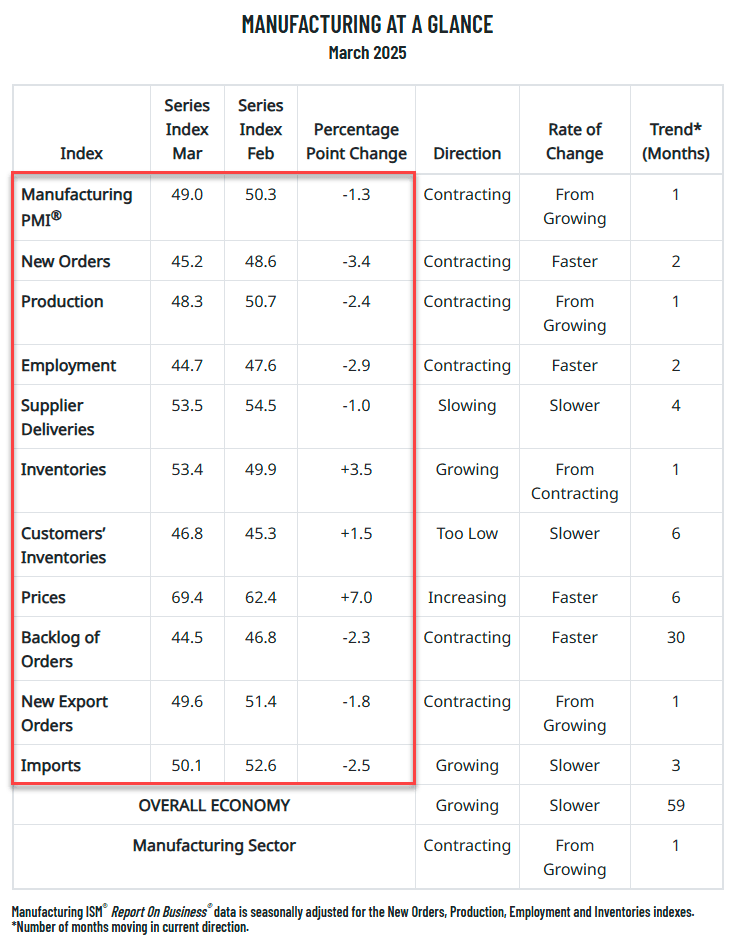
The ISM Manufacturing PMI weakened notably from 50.3 to 49.0 (below the 49.5 expectation) – the lowest since November.

Source: Bloomberg

Under the hood it was even more messy…

…with Prices Paid soaring to its highest since June 2022 and New Orders & Employment tumbling…

Source: Bloomberg

Inventories surged as manufacturers front-run the ‘Liberation Day’ headlines…

As Chris Williamson, Chief Business Economist at S&P Global Market Intelligence, notes:

The strong start to the year for US manufacturers has faltered in March. A combination of improved optimism surrounding the new administration and the need to front-run tariffs had buoyed the goods-producing sector in the first two months of the year, but cracks are now starting to appear. Production fell for the first time in three months in March, and order books are becoming increasingly depleted.

Trump-based optimism is fading?

“While business confidence about the outlook remains relatively elevated by standards seen over the past three years, this is based on companies hoping that the nearterm disruption caused by tariffs and other policies will be superseded as longer-term benefits from the policies of the new administration accrue. However, March has seen more producers question this belief. Business optimism about the year ahead has deteriorated further from January’s near threeyear high, and has dropped sharply over the past two months, causing firms to stop raising payroll counts for the first time since October. 

And of course, it’s all about tariff terror…

A key concern among manufacturers is the degree to which heightened uncertainty resulting from government policy changes, notably in relation to tariffs, causes customers to cancel or delay spending, and the extent to which costs are rising and supply chains deteriorating in this environment

Tariffs were the most cited cause of factory input costs rising in March, and at a rate not seen since mid-2022 during the pandemic-related supply shock. Supply chains are also suffering to a degree not seen since October 2022 as delivery delays become more widespread. 

“Data in the coming months will provide important insights into how the inflationary aspects of policies such as tariffs balance out against any benefits to US producers.”

So, both Services PMIs are in expansion (above 50) and Manufacturing is mixed (50.2 vs 49.0) – take your pick on ‘recession’ talk.

Tyler Durden
Tue, 04/01/2025 – 10:07

Trump Dials Back Putin Criticism, Renews Attacks On Zelensky For Stalling Minerals Deal

Trump Dials Back Putin Criticism, Renews Attacks On Zelensky For Stalling Minerals Deal

It was only on Sunday that President Trump declared he’s “very angry” at Russian President Putin, statements which featured the threat of secondary tariffs on Moscow, but now the US leader is already dialing back this criticism, Bloomberg observes.

Instead he’s once again focused his ire on Ukrainian President Volodymyr Zelensky, warning of “big problems” if he doesn’t sign the controversial minerals agreement and tries to renegotiate. 

“I see he’s trying to back out of the rare earth deal. And if he does that, he’s got some problems. Big, big problems,” Trump earlier told reporters aboard Air Force One. “We made a deal on rare earth and now he’s saying, ‘well, you know, I want to renegotiate the deal.’”

AFP/Getty Images

“He wants to be a member of NATO. Well, he was never going to be a member of NATO. He understands that. So if he’s looking to renegotiate the deal, he’s got big problems,” Trump said.

Zelensky has signaled that Ukraine is positive about the deal but has complained that its conditions are “constantly changing”.

Trump has still kept up some pressure on Putin, however, saying Monday of the Russian leader, “I want to make sure that he follows through, and I think he will.” He continued in Monday remarks from the Oval, “I don’t want to go secondary tariffs on his oil, but I think, you know, something I would do if I thought he wasn’t doing the job.”

All of the weekend criticisms of Putin appeared to arise from the Russian president’s comments late last week declaring that Zelensky’s ‘illegitimacy’ could be fixed by a UN transition process guiding Ukraine to new elections. Only then would Moscow negotiate an end the war, Putin stipulated.

“He’s supposed to be making a deal with him, whether you like him or don’t like him,” Trump told reporters Sunday, referring to Putin. “So I wasn’t happy with that. But I think he’s going to be good.”

But again, he reserved blunter criticism for US ally Zelensky: “I heard that they’re now saying, well, I’ll only do that deal if we get into NATO or something to that effect,” Trump had said.

Bloomberg has concluded the following of this latest back-and-forth:

The result is a geopolitical whiplash on the eve of Trump’s global tariff announcement on April 2 and shows US impatience with the process of securing a temporary truce between Russia and Ukraine more than three years after Putin’s invasion of its neighbor. 

Trump had vowed he would end the war within 24 hours of taking office but has found Russia to be a tough negotiator and able to wrest concessions from the US by exploiting Trump’s desire to get a deal done quickly. On Sunday, Trump told NBC he was “pissed off” at Putin. 

Of course, this is also due to Russian forces rolling up several villages and towns on the battlefield in Ukraine’s east and south just this week alone. Putin has less incentive for a hasty deal, and is in the driver’s seat – but surely the White House knows this, which is perhaps why the pressure is ramping up on Zelensky once again.

As for the apparently ever-changing draft minerals deal, Ukraine and its supporters have continued to charge that it’s tantamount to a big resource grab by Washington.

Ukraine received its latest version of a new draft of the text on Friday, its foreign ministry stated. CNN writes that “The new proposal for a natural resources agreement, of which CNN has obtained a copy, was put forward by the US Treasury Department and goes well beyond the initial draft, particularly on future US rights and reimbursement for past assistance.”

Some independent geopolitical observes have said the deal effectively imposes ‘indentured servitude’ on Ukraine. “This ‘deal’ is pure extortion and robbery. It would bind Ukraine indefinitely. It would also discourage any investment in any natural deposits in Ukraine. There is no chance that any such deal will be ratified by the Ukrainian parliament,” Moon of Alabama writes.

The source then questions, “one wonders then: Why does the Trump administration even bother?

Tyler Durden
Tue, 04/01/2025 – 10:00