Ultra-Wealthy Make It Rain On Luxury Brands As Main Street Tightens Belt
While middle-market retailers brace for a slowdown, luxury’s upper echelon continues to soar – underscoring a growing economic divide that may prove as precarious as it is profitable.
Signs of strain are increasingly visible among mass-market players. Retail giants like Target and Macy’s are reporting that their customers are pulling back, trading down to less expensive alternatives as tariffs and inflation weigh on household budgets. But across the gilded corridors of high-end commerce, the story is markedly different.
Italian automaker Ferrari is sticking to its 2025 guidance even as peers trim forecasts. Hermes, the Parisian icon of leather and silk, has responded to U.S. import duties not with cost-cutting but by raising prices on its signature scarves. Brunello Cucinelli, the Perugian prince of cashmere, expects double-digit sales growth through next year. And Life Time, the luxury fitness chain with $200 monthly memberships, has seen its shares rise 85% since its 2021 IPO – well ahead of discount rival Planet Fitness, according to Reuters.
The persistence of the ultra-wealthy’s spending power is providing a rare pillar of strength in an otherwise uncertain macroeconomic environment. An index tracking Europe’s largest luxury companies has outpaced the S&P 500 by roughly 80 percentage points over the past decade. Luxury travel is seeing a similar divergence: upscale hotels have reported 6% higher revenue per room this year, while mid-tier lodging has struggled.
The logic behind the divergence is simple: scarcity and craftsmanship. Ferrari limits production. Hermes clients wait years for a Birkin bag. Cucinelli’s hand-stitched coats command prices north of $8,000. These brands are built not just on goods, but on exclusivity, and their customers are less sensitive to price shocks or economic headlines.
That insulation is quantifiable. According to Moody’s Analytics, spending by the top 10% of U.S. earners rose 58% from 2020 to 2024, compared to meager real gains for everyone else once inflation is accounted for. The Federal Reserve reports that the top decile of Americans gained over $30 trillion in net worth since 2019—a 40% jump. Globally, UBS estimates the richest 1.5% hold $214 trillion, while the bottom 40% share just $2.4 trillion.
This consumption chasm is lifting profits for the luxury sector even as it exposes the fragility of broader economic growth. For now, high-end brands may act as ballast against a slowdown. But they are also a mirror: reflecting a bifurcated economy in which prosperity is increasingly concentrated, and resilience ever more reliant on a narrow tier of consumers.
The risk, economists warn, is that such reliance is ultimately unsustainable. If the ultra-rich pull back—or if political pressures begin to target wealth disparities more aggressively—the entire structure could wobble.
In the meantime, the champagne keeps flowing—even as the beer taps slow to a trickle.
US President Donald Trump seems to think Israel could ruin his big trip to the Middle East, and it’s causing trouble. Trump appears to want the Middle East to have a respite from war and mass starvation during his trip to the oil-rich Gulf starting on Tuesday. He is signaling that he can leave Israel in the dust if it doesn’t go along for the ride.
“Rift is too strong of a word, but frustration is bubbling,” a senior western official in the region told Middle East Eye.
Several sensitive dossiers are jostling together ahead of Trump’s visit that are irking Israeli Prime Minister Benjamin Netanyahu, analysts and diplomats say.
The most consequential file for Trump is the ongoing nuclear talks with Iran, which US Vice President JD Vance said this week have been “so far, so good”.
For months, Trump has scorned Netanyahu on the talks as his closest media allies attack “Mossad agents” trying to hamstring the US leader. By his own admission, Trump even resisted Israeli pressure to launch a preemptive attack on the Islamic Republic.
At the same time, Trump gave Netanyahu his full backing to wage war on Gaza and choke it of supplies. He also won plaudits in Israel for unleashing a bombing campaign on the Houthis in Yemen.
Now, Trump is moving to silence the guns in Yemen and come to an accommodation with Israel on Gaza that is upsetting Netanyahu’s base.
“At this stage, it’s clear Trump will take some big decisions unilaterally without significant consideration of Israeli interests when he wants to, like on Iran or Yemen,” Michael Wahid Hanna, director of the US programme at International Crisis Group, told MEE. “But we haven’t seen that so much on the Palestinian file,” he added.
On Friday, Israeli media reported that US Secretary of Defence Pete Hegseth had cancelled an upcoming visit to Israel. The visit was scheduled to begin a day before Trump’s visit to the Gulf on 13 May. Hegseth was set to meet Netanyahu and Defence Minister Israel Katz.
An ‘Aramco moment’ for Israel?
On Tuesday, Trump made a surprise announcement to enter a “ceasefire” with the Houthis. The decision is likely to remove an irritant in the nuclear talks with Iran because the Houthis receive weapons and training from Tehran. The US and Iran are scheduled to meet in Oman for their fourth round of talks on Sunday, just before Trump arrives in the Gulf.
Trump’s announcement also delighted US Arab allies and Saudi Arabia. The former had been lobbying Trump for an end to the attacks before his arrival in the kingdom, MEE reported. It also appeased Trump’s war-wary “America First” base.
But the decision shook Israel because Trump conditioned the truce on the Houthis not attacking global shipping, leaving Israel out in the cold. The ceasefire came just days after a Houthi missile struck near the main terminal of Israel’s Ben Gurion Airport.
One US defense official told MEE that the ceasefire had the whiff of an “Aramco moment,” referring to Trump’s decision in 2019 not to respond to a massive drone attack claimed by Yemen’s Houthis on Saudi Arabia’s oil installations.
Indeed, the US’s commitment to the ceasefire was reaffirmed by Trump’s own ambassador and staunch Israel supporter, Mike Huckabee, on Friday. The same day a Houthi missile was shot down over Israel, setting off sirens, Huckabee told Israeli reporters that the US would only intervene if one of the casualties had a US passport.
There are 700,000 dual US-Israeli citizens, Huckabee added, warning the Houthis about their odds. With the nuclear talks scheduled for Sunday and a fragile truce in Yemen, Trump is turning his attention to the Gaza Strip, which aid workers warn could descend into mass starvation just as Trump arrives in the region.
BIG: Netanyahu:
I think we’ll have to DETOX from U.S. security assistance.
“Trump is still shackled with Gaza ahead of his visit. He cannot wish it away,” Aaron David Miller, a former US Middle East negotiator who is a senior fellow at the Carnegie Endowment for International Peace, told MEE.
“He needs an aid plan in his talking points because he is going to be hammered by the Saudis for what is not happening there [in Gaza]. In sum, Trump is going to face Arab leaders delighted about his talks with Iran and truce with the Houthis, but very unhappy about Gaza,” Miller said.
Trump appears to be scrambling to address those concerns, while accommodating Israel’s chokehold over the enclave, experts say.
Trump returns to Gaza plans
Trump’s Middle East envoy turned global troubleshooter, Steve Witkoff, briefed the UN Security Council on Wednesday about Gaza. Israeli media reports have said that Trump could unveil a new Gaza ceasefire plan this weekend. According to the reports, Trump could float a role for Hamas in Gaza’s future governance.
MEE reported that the US is trying to insert a previously unknown nonprofit, The Gaza Humanitarian Foundation, into the enclave, citing a 14-page document circulating with aid groups and diplomats.
The foundation will take control of humanitarian aid distribution in the besieged enclave while a private US security contractor vetted by Netanayhu’s government secures the hubs where some Palestinians will receive 1,750 kcal meals costing donors a little more than a dollar each, according to diplomats and aid workers.
One UN official told MEE that the Trump administration was “putting the pressure on” to get the UN and aid groups to acquiesce to the plan, but they have raised concerns that the project runs against international humanitarian law.
The plan goes a long way to addressing Israeli objectives to diminish the UN’s role in Gaza. The plan would effectively militarise and privatize the trickle of aid into the enclave, two Arab diplomats briefed on the matter told MEE.
Although the foundation will be run by an American citizen and the US hopes to bring Qatari, Saudi and Emirati money onboard, Israel will have wide oversight, the officials told MEE, adding that Israel is loath to give the Palestinian Authority a role.
But even this plan elicited criticism from Netanyahu’s far-right coalition partners, who have ramped up calls for a full Israeli occupation of the strip and forced displacement of Palestinians. “It is foolishness and a moral and strategic mistake for Gazans to get supplies while our hostages are starved,” National Security Minister Itamar Ben Gvir said on Friday.
It’s unclear how the aid plan with a US footprint would sit with Trump’s America First base, which rallied against Trump’s call earlier this year for a US takeover of the Gaza Strip.
Conservative podcasters like Tucker Carlson and Congresswoman Marjorie Taylor Greene have been highly critical of deepening US engagement in the Middle East. “I think these people will ask, ‘Why on earth should the US be involved in administering aid to Gaza as a result of Israel’s war?’” Chas Freeman, a former US ambassador to Saudi Arabia, told MEE.
Can’t overstate the importance of this. Trump broke with Biden and didnt allow Israel to be in charge of negotiations over the fate of Americans in Gaza. Biden put the faith of the Americans in Netanyahu’s hand, though he knew Israel didn’t want a deal.https://t.co/mVrbXHuny6
Freeman added that when Trump arrives in the Gulf, he will also face new concerns that he didn’t during his 2017 trip to the region. “The Gulf countries traditionally relied on the US to restrain Israel. Trump’s going to the region with that balance of power gone,” Freeman said. “Trump has acquiesced to the Israeli tactics and strategy in Gaza and the occupied West Bank.”
Saudi nuclear energy deal on the table
Trump’s coveted normalization deal between Israel and Saudi Arabia appears more distant than ever, experts say. Riyadh has effectively pre-negotiated Trump’s visit to block talk of normalization without a ceasefire in Gaza or movement towards a Palestinian state, Arab officials told MEE.
But Trump doesn’t appear to want to wait for Netanyahu. His energy secretary, Chris Wright, said last month that the US had made progress with Saudi Arabia toward an agreement on helping Riyadh develop a commercial nuclear power industry.
Meanwhile, Trump’s National Security Council spread the word with business figures ahead of his visit that the administration was not tied to linking a nuclear energy deal – worth billions of dollars – to normalisation with Israel, a former senior US official told MEE.
That represents a pivotal change that removes one of three key pillars that the Biden administration was using to entice Riyadh into signing a normalization deal with Israel.
Although analysts say the talks are far from complete, just the possibility that Trump could sell Saudi Arabia nuclear technology without normalization alarmed Republican Senator Lindsey Graham, who was helping the Biden administration negotiate a normalization deal.
“I would like to make it crystal clear that I will never support a defense agreement with Saudi Arabia or other elements of a proposed deal that does not include normalizing the relationship with Israel as a part of the package,” Graham wrote on X on Thursday.
But the Trump administration is already set to expedite billions of dollars in arms sales to Riyadh, including potentially F-35 warplanes. This was another pillar in the grand bargain.
Experts say that leaves just the promise of a US defence treaty, a tall order that requires Senate backing, to offer Saudi Arabia in exchange for normalization. So, from Yemen to nuclear energy, Trump is telling Netanyahu he won’t let him spoil his second Arabian Gulf debut.
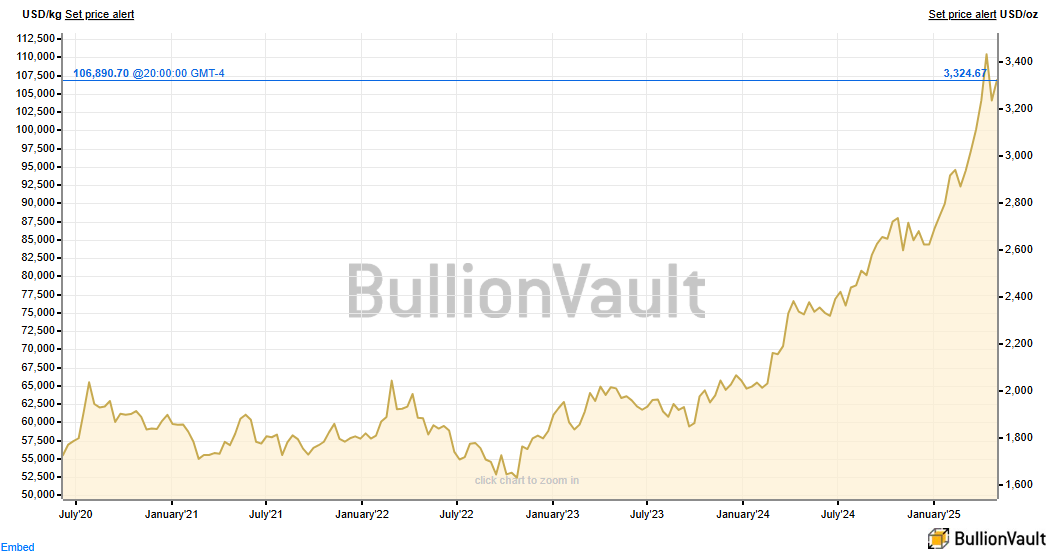
In April 2025, the gold market continued its unprecedented surge in physical deliveries from futures exchanges, signaling a significant shift in global financial dynamics. The COMEX reported the delivery of 64,514 gold contracts, equivalent to approximately 6.45 million ounces or $21.3 billion in value, marking the second-highest delivery volume on record.
The CME Comex is a key marketplace for trading futures in gold, silver, and other commodities, where contracts can also be converted into physical metal through delivery.
Typically, open contracts decline sharply before delivery starts, but this time, positions unexpectedly surged and were then largely cash-settled instead of delivered, raising speculation about potential behind-the-scenes shortages and high incentives for cash settlement. Despite this, demand for immediate delivery remained strong, with over 10,000 new contracts opened, the second-highest on record.
Concurrently, gold inventories have fallen since early April, possibly linked to these unusual settlements and subsequent physical withdrawals. Even with predictions that tariff changes would reduce arbitrage and slow gold flows from London to the U.S., demand for futures and physical deliveries remains robust as the market heads into May.
This extraordinary movement has prompted speculation about the underlying causes. Geopolitical tensions, such as the ongoing conflicts involving Russia and Ukraine, Iran and Israel, and the complex dynamics between India and Pakistan, have undoubtedly contributed to a heightened demand for safe-haven assets like gold. Additionally, the intensifying trade disputes between major economies have further fueled uncertainty, making gold an attractive option for preserving wealth.
However, beyond these immediate factors lies a more profound transformation in the global financial system. Since 2008ish, countries like Russia and China have been actively reducing their reliance on the U.S. dollar, a process known as de-dollarization. This trend has been accelerated by recent developments, including Saudi Arabia’s decision to settle oil transactions in currencies other than the dollar. Such moves indicate a collective shift towards a more diversified and resilient monetary framework.
In this excellent new interview, Luke Gromen argues that the current dollar-centric system is unsustainable due to escalating deficits and debt levels in the United States and suggests that transitioning to gold as a neutral reserve asset could facilitate a more balanced global economic structure. This approach would allow commodities to be priced in multiple currencies, reducing dependency on any single nation’s economic policies. This hour with Luke is a must listen.
🔥 70% OFF FOR LIFE: Using the below coupon gives you 70% off an annual subscription to Fringe Finance for as long as you wish to remain a subscriber. Your discount under this plan will never expire, but this offer is good only for today! Get 70% off forever
Gromen also notes that the conflict in Ukraine has exposed the limitations of conventional military strategies, emphasizing the need for economic tools to assert influence. By adopting gold as a reserve asset, nations can navigate geopolitical challenges without resorting to direct military confrontation, which is increasingly untenable in a world with nuclear capabilities and deeply interconnected economies.
The implications of such a shift are profound. The market revaluing gold to levels of $7,500 and even $10,000 per ounce could enable the U.S. Treasury to significantly bolster its financial position, should a shift take place. By adjusting the official price of its gold holdings, the Treasury could effectively generate $2 to $3 trillion in value, providing a substantial infusion into the Treasury General Account without increasing debt.
In this context, the massive gold deliveries observed in April may not be coincidental, Gromen notes. They could represent strategic moves by state actors, possibly including the U.S. itself, to prepare for a redefined monetary landscape.
The scale of these transactions suggests involvement at the highest levels, as such significant movements would typically attract regulatory scrutiny unless conducted by entities with sovereign authority.
It is starting to seem clear that as the global economy stands at the cusp of a potential monetary reset, the role of gold is being reevaluated. I can’t help but feel like I should continue to closely monitor these developments, as they may herald a new era in the architecture of global finance.
QTR’s Disclaimer:Please read my full legal disclaimer on my About page here. This post represents my opinions only.In addition, please understand I am an idiot and often get things wrong and lose money. I may own or transact in any names mentioned in this piece at any time without warning. Contributor posts and aggregated posts have been hand selected by me, have not been fact checked and are the opinions of their authors. They are either submitted to QTR by their author, reprinted under a Creative Commons license with my best effort to uphold what the license asks, or with the permission of the author.
This is not a recommendation to buy or sell any stocks or securities, just my opinions. I often lose money on positions I trade/invest in. I may add any name mentioned in this article and sell any name mentioned in this piece at any time, without further warning. None of this is a solicitation to buy or sell securities. I may or may not own names I write about and are watching. Sometimes I’m bullish without owning things, sometimes I’m bearish and do own things. Just assume my positions could be exactly the opposite of what you think they are just in case. If I’m long I could quickly be short and vice versa. I won’t update my positions. All positions can change immediately as soon as I publish this, with or without notice and at any point I can be long, short or neutral on any position. You are on your own. Do not make decisions based on my blog. I exist on the fringe. The publisher does not guarantee the accuracy or completeness of the information provided in this page. These are not the opinions of any of my employers, partners, or associates. I did my best to be honest about my disclosures but can’t guarantee I am right; I write these posts after a couple beers sometimes. I edit after my posts are published because I’m impatient and lazy, so if you see a typo, check back in a half hour. Also, I just straight up get shit wrong a lot. I mention it twice because it’s that important.
Hamas To Release American-Israeli Hostage As Goodwill Gesture To Trump
Israeli media is reporting Sunday that Israeli-American hostage Edan Alexander could be released by Hamas as early as Monday, after direct engagement between Hamas and Washington.
“After Hamas confirms that it will release Israeli hostage Edan Alexander, which it is reportedly doing as a gesture of goodwill to US President Donald Trump during his visit to the region this week, Israeli journalist Barak Ravid says US special envoy Steve Witkoff will arrive in Israel tomorrow to facilitate the process,” The Times of Israel reports.
Witkoff will “finalize the details ahead of the release of Edan Alexander, according to a source familiar with the matter,” Ravid wrote on X.
Trump will travel to the region, stopping in the Gulf countries of Saudi Arabia, Qatar, and United Arab Emirates. Surprisingly, and apparently without official Israeli knowledge or input in behind-the-scenes US-Hamas diplomatic engagement on the issue, Hamas has formally confirmed the release is coming, but without saying exactly when.
Hamas announced Sunday that the decision to release Alexander comes after recent talks with US officials and “intensified efforts to achieve a ceasefire, open border crossings, and allow humanitarian aid into the Gaza Strip.”
Importantly, the Palestinian group which has warred against Israeli going back to the terror attack of Oct.7, 2023, has also said it is ready to resume intensified negotiations.
Hamas says it is ready to establish a mutually “agreed prisoner exchange, and enable Gaza to be administered by an independent professional authority.”
President Trump could be readying a big announcement on the prospect of Gaza peace as he gets ready to depart for the region in Air Force One.
All of this, interestingly enough, comes amid unverified reports of a new rift between Israeli Prime Minister Benjamin Netanyahu and Trump. While US Ambassador to Israel Mike Huckabee has denied the accuracy of the claims, the below widely circulated last week:
President Trump has “cut contact” with Netanyahu, slamming the Israeli PM and his allies for acting “arrogant” and trying to push him around. Trump reportedly feels disrespected and manipulated by Netanyahu.
It’s been months since the last hostage exchange, with no new meaningful progress from this Administration to bring them all home.
Ahead of @POTUS Trump’s trip to the Middle East, I’m urging him to prioritize the release of 21-year-old Edan Alexander, the last surviving American… pic.twitter.com/JnGqqNtw0J
This new breakthrough where Hamas is willing to release the Israeli-American suggests that Israel may have been cut out of US-Palestinian talks.
If true, this would be a huge blow to Netanyahu. He’s facing growing domestic pushback, and accusations that he is intentionally prolonging the war, at the expense of the safety of the remaining living hostages.
While coming in much stronger than expected, the latest employment data confirmed what we already suspected: the economy is slowing. The reason the employment data is so important is that without employment growth, the economy stalls. It takes, on average, about 200,000 jobs each month to keep up with population growth, which ultimately keeps the economy growing. That is because, as discussed in last week’s #BullBearReport, the consumer comprises about 70% of economic growth. To wit:
“There is currently no evidence that the economy is slipping into a recession. However, if you want to know if an economic decline will evolve into a recession, there is one key factor to consider: consumer spending. Consumer spending comprises nearly 70% of the GDP calculation, and everything else, from business investment to imports and exports, is a function of the consumer’s “demand.” In other words, if the consumer is slowing down or contracting spending, businesses will not “invest” in expansion projects, increasing employment, or buying more products for resale. That relationship is shown in the chart below, which compares PCE to employment and private investment.”
However, most crucially, consumers can not consume without producing something first. Production must come first to generate the income needed for that consumption. The cycle is displayed below.
Here is the most critical point. Not all jobs are equal.
“For a household to consume at an economically sustainable rate, such requires full-time employment. These jobs provide higher wages, benefits, and health insurance to support a family. Part-time jobs do not.”
While the media touts the ‘strong employment reports,’ such is mostly the recovery of jobs lost during the economic shutdown. However, the reality is that the full-time employment rate is falling sharply. Historically, when the rate of change in full-time employment dropped below zero, the economy entered a recession.
Notably, given the surge in immigration into the U.S. over the last few years, the all-important ratio of those employed full-time relative to the population has dropped sharply. As noted, given that full-time employment provides the resources for excess consumption, that ratio should increase for the economy to continue growing strongly. However, full-time employment has decreased since the turn of the century as automation, technology, and offshoring have risen. While President Biden recently touted strong employment growth in his SOTU address, full-time employment as a percentage of the working-age population failed to recover to pre-pandemic levels.
Notably, sharp downturns in full-time employment have been coincident with recessionary onsets.
No Recession, But Slower Growth Coming
The latest employment data put to rest recession concerns, at least for now. Employment growth remains strong enough to support economic growth and quell concerns that CEOs are withdrawing from the job creation process. However, compensation continues to decline as economic demand slows.
As is always the case, as the economy slows down, employers begin to change the most costly aspect of any business – employment. Cutting full-time jobs is the most efficient way to protect earnings and profitability. However, employers tend to hang on to employees as long as possible, as good employees are expensive to train and hard to replace. Eventually, if the demand falls too much, full-time employees are sacrificed to protect profits. As such, a reasonably predictable cycle continues until exhaustion is reached.
While we are seeing declines in full-time employment as the economy slows, we are now also seeing cuts in temporary help, which, as shown, is consistent with slowing growth. The reason is that cutting temporary employment is the first step by business owners to reduce employment costs while hanging on to full-time, and mostly crucial, employees. However, as noted above, once temporary workers are exhausted, the next step will ultimately be full-time employees.
The latest employment data did not provide much support for the “recession” crowd in 2025. As such, Wall Street analysts are quickly reversing their recession calls for this year, and are becoming more focused on slowing economic growth. However, that assessment can certainly change promptly if personal consumption expenditures take a turn for the worse. As noted above, nearly 70% of economic growth is derived from consumption; therefore, if consumption declines, employment falls, reducing consumption and further employment declines. When it accelerates, that cycle is the foundation for recession outcomes.
Indicators We Are Watching
As noted, while the employment data is weak, there are certainly indicators we are watching closely to confirm whether “job loss” is accelerating. First, we pay attention to the Conference Board’s measure of CEO confidence. Since the October 2022 lows, CEO confidence has continued to improve, and as of Q1, it rose to 60 from 51 in Q4 of 2024. That confidence increased full-time employment as the outlook for economic growth was improving heading into 2025. However, this is a lagging indicator, and the results of the Q1 survey were taken in February before the market decline and tariff announcements. Later this month, we will get an update to see if sentiment has changed, which could give us clues about future employment reports.
The second indicator we are watching is the NFIB small business confidence index. Specically,.it is their “plans” to increase employment versus what they do. Notably, employment by small businesses, roughly 50% of the total employment in the U.S., has remained stagnant since the pandemic. However, small business owners were very optimistic about hiring post-pandemic, expecting sharp improvements in sales. However, that optimism is fading quickly.
The reason is that, as discussed at the opening of this discussion, employment is a function of the demand for goods and services that businesses supply. As shown, expectations for sales surged following President Trump’s election, but given that actual sales have failed to materialize, that optimism is fading rather quickly. Expectations for business owners are one thing, but without actual increases in sales, which drive revenue, there is little reason to increase full-time employment, which is why it has remained stuck at lower levels since 2020.
Conclusion
Given the importance of consumption in the economy and that employment (production) must come first in the cycle, attention to employment data, particularly full-time employment, is crucial to determining economic risk. The risk of a recession remains very low; however, that can change if something causes consumption to contract quickly. Aside from an unexpected, exogenous impact, investors should expect economic growth to continue to slowly weaken to a longer-term trend slightly less than 2% annually. Unfortunately, while not recessionary, that growth rate will make it hard for corporate profitability to remain at record levels.
Eventually, a valuation adjustment in the financial markets will reflect the reality of a slow-growth economy. However, that isn’t today. However, the risk of a decade of low returns as markets normalize for a slow-growth economy is steadily increasing.
Adolescents diagnosed with mental health conditions spend nearly an hour more on social media daily than their peers and are twice as likely to compare themselves negatively to others online, according to new research.
The study, involving 3,340 adolescents in the UK, suggests troubling patterns for teens with anxiety and depression, who report having less control over their social media use and greater mood fluctuations depending on the comments and likes they receive on social media.
“Our study doesn’t establish a causal link, but it does show that young people with mental health conditions use social media differently than young people without a condition,” said lead author Luisa Fassi, a researcher at the University of Cambridge’s Medical Research Council Cognition and Brain Sciences Unit, in a press statement.
She said the differences between children with and without mental health conditions may stem from the way these conditions influence how adolescents interact with online platforms—or possibly from social media use contributing to their symptoms. “At this stage, we can’t say which comes first—only that these differences exist,” Fassi added.
Differences by Condition Type
The study, recently published in Nature Human Behavior, analyzed data from a 2017 survey of 3,340 UK adolescents between the ages of 11 and 19. Professional clinicians interviewed the teenagers and, in some cases, their parents and teachers.
Researchers distinguished between conditions affecting internal feelings—such as anxiety, depression, and post-traumatic stress disorder—and those involving outward behaviors like attention-deficit/hyperactivity disorder (ADHD), oppositional defiant disorder (ODD), and conduct disorder.
Teens with conditions affecting internal feelings, like depression and anxiety, showed the most significant differences in social media behavior.
Social comparison—meaning comparing themselves to others online—was twice as prevalent among adolescents with anxiety and depression compared to those without mental health conditions: 48 percent and 24 percent, respectively.
These teens were also significantly more likely to report mood changes in response to social media feedback—28 percent versus 13 percent—and felt less in control of their time spent on these platforms.
This pattern was not seen in children with ADHD, ODD, and conduct disorders.
Dr. Ritu Goel, a board-certified integrative psychiatrist specializing in child, adolescent, and adult mental health, told The Epoch Times that the pattern makes clinical sense.
Teens dealing with anxiety or depression are often more emotionally sensitive and vulnerable to criticism or rejection, she said. “Social media amplifies these feelings because it’s filled with unrealistic portrayals of happiness and success. They might feel left out or not good enough, significantly deepening their emotional struggles.”
The researchers also found that teens with diagnosed conditions spend approximately 50 minutes more on social media compared to those without.
Beyond time spent online, all adolescents with mental health conditions also tended to report greater dissatisfaction with the number of online friends they had.
“Social media platforms assign a concrete number to friendships, making social comparisons more conspicuous. For young people struggling with mental health conditions, this may increase existing feelings of rejection or inadequacy,” Fassi said.
She noted that friendships play a key role in shaping adolescents’ sense of identity.
Why Social Media May Worsen Symptoms
Teens with mental health conditions often use social media in ways that can reinforce or worsen their symptoms, said Sanam Hafeez, a neuropsychologist and director of Comprehend the Mind in New York.
When people passively scroll through social media, they encounter idealized images that lead to negative social comparisons.
“Many people develop an obsession with checking likes, comments, or messages, which leads them to base their self-esteem on online reactions,” Hafeez said. “People who post online to confirm their worth experience disappointment when their posts don’t receive the positive feedback they expected.”
The constant exposure to idealized images, peer conflicts, and subtle exclusion can heighten feelings of anxiety and rejection. Nighttime social media use can also disrupt sleep, which plays a key role in emotional health. Together, these patterns can deepen the cycle of depression and anxiety.
Interestingly, aside from the time spent on social media, researchers found few differences in social media behavior among teens with externalizing conditions like ADHD or conduct disorders.
How Parents and Doctors Can Help
Parents and mental health professionals should collaborate to guide teens toward healthier social media use, Goel said.
“Mental health professionals can teach teens critical thinking skills about online content and emotional self-regulation strategies,” she said. “Parents can support these efforts by actively monitoring social media usage, setting clear boundaries for online and offline activities, ensuring a balanced daily routine, and promoting open conversations about online experiences.”
Goel emphasized that encouraging regular offline interactions and hobbies can further help teens build resilience and maintain a healthy emotional balance.
Hafeez recommended establishing tech-free times and encouraging offline social connections, emphasizing that teens should “feel supported rather than controlled,” making it easier for them to develop lasting, healthy digital habits.
Supreme Court Justice Sonia Sotomayor told a lawyers’ conference that amid escalating criticism in the nation of some federal judges, lawyers need to “stand up” and “fight this fight.”
Sotomayor made the comments during an on-stage conversation on May 8 at an American Bar Association conference at the Smithsonian Museum of African American History and Culture in Washington.
The remarks by Sotomayor came after President Donald Trump, members of his administration, and Republicans in Congress have repeatedly criticized court rulings in recent months that have blocked or delayed the president’s agenda. Trump and some lawmakers have accused some judges of overstepping their authority through such rulings and called for them to be impeached.
Several federal judges have said the Trump administration has not complied with various court orders on immigration enforcement, federal spending, the firing of government employees, and foreign aid. The administration denies that it disobeyed the orders.
Sotomayor did not identify Trump or other officeholders who have criticized judges’ rulings by name.
“Our job is to stand up for people who can’t do it themselves. And our job is to be the champion of lost causes,” said the associate justice who joined the Supreme Court in 2009 after being nominated by President Barack Obama.
“But right now, we can’t lose the battles we are facing. And we need trained and passionate and committed lawyers to fight this fight.”
“With all the uncertainty that exists at this moment, this is our time to stand up and be heard. For me, being here with you is an act of solidarity,” Sotomayor added.
Sotomayor also praised “diversity,” which she said “is important for its own sake because it inspires everyone to believe that it’s possible for them to be in a position to help others.”
“I am more grateful that in my role as a public servant, I can continue to serve all communities and represent America as the very best version of itself,” she said.
Sotomayor’s comments came after two of her colleagues on the high court had also recently made public statements directed at the criticism of judges.
On May 7, Chief Justice John Roberts said an independent judiciary was needed to check the power of the president and Congress.
Roberts did not mention Trump or other officeholders by name during his comments that came during a visit to his birthplace of Buffalo, New York.
Judicial independence is “the only real political-science innovation in our Constitution,” said Roberts, who became chief justice in 2005 after being nominated by President George W. Bush.
In the Constitution, “the judiciary is a co-equal branch of government, separate from the others, with the authority to interpret the Constitution as law and strike down … acts of Congress or acts of the president,” he said.
“And that innovation doesn’t work if … the judiciary is not independent. Its job is to … check the excesses of Congress or of the executive, and that does require a degree of independence.”
Roberts also said, “impeachment is not how you register disagreement with [judicial] decisions.”
“That’s what we’re there for,” he said, in reference to the appeals process.
On May 1, Justice Ketanji Brown Jackson said that recent criticisms of judges are “attacks on our democracy.”
Jackson was apparently commenting on Trump’s rhetorical barrages against some judges, although she did not specifically mention the president during her speech and instead spoke about “the elephant in the room.”
“The attacks are not random. They seem designed to intimidate those of us who serve in this critical capacity,” Jackson said at a judicial conference in Puerto Rico.
“The threats and harassment are attacks on our democracy, on our system of government. And they ultimately risk undermining our Constitution and the rule of law.”
Jackson took her seat on the high court in June 2022 after being nominated by President Joe Biden.
The battle between the Trump administration and the federal courts on the topic of deportation is intensifying.
The outlines are clear. Biden and his corrupt cronies left the U.S. southern border wide open for four years. Estimates vary but it’s likely 8 million illegal aliens crossed the border. But the actual number could be 10 million or higher. Of course, some just came for a better opportunity, but many were murderers, terrorists, rapists, sex traffickers, Chinese spies and every sort of violent low life you can imagine.
It’s nearly impossible to find and deport 8 million people. Biden made sure of that by ignoring the procedures for tracking and documenting the alien invasion. Trump’s policy of “remain in Mexico” while immigration cases were pending was abandoned by Biden. Many of the illegals got court dates, but those were scheduled years in advance. The expectation was that the court notices would be thrown in the trash, the illegals would not show up in court, and no enforcement action would be conducted.
Trump has launched a major deportation effort despite these handicaps. In any situation where you can accomplish part of the task but not all, the first move is to prioritize elements so you can devote resources to the best effect. Trump has done that also. He has prioritized the worst of the worst – criminals and terrorists – for early deportation. That reduces crime and violence in the U.S. and gives Immigration and Customs Enforcement (ICE) a chance to hone their techniques for the larger task ahead.
The New Obstacle – The Courts
Now, Trump has encountered a new obstacle. It’s not the illegals, the Democrats or the media. It’s the federal court system, especially rogue district court judges appointed by Biden and Obama. To be clear, the rogue judges don’t work in a vacuum. The plaintiffs are hand selected to create sympathy in the media (although there’s little sympathetic about a rapist) and are represented in court by lawyers backed by well-funded NGOs and activist organizations.
It’s not as if the illegals have the resources to appeal cases to the Supreme Court on their own. They don’t need them. From Soros on down, the fight against deportation is well-funded and skillfully lawyered. The lawyers present everything the judges need to tear down Trump’s agenda.
There are hundreds of cases involving thousands and potentially millions of illegal aliens now pending in the courts. Trump has been losing most of these cases at the district court level, but it’s reasonable to expect some success at the circuit court and Supreme Court levels. But that takes time.
Rather than review the docket case-by-case and issue-by-issue, it may be useful to step back and look at the forest instead of the individual trees. The radical neo-Marxist lawyers don’t care about the individual defendants. They don’t care about blocking individual deportations. They don’t even care about the law. What’s going on is far more pernicious and damaging to Trump and the country.
There’s a lot of talk about the Constitution, but a pure illegal does not have full constitutional rights. The courts have afforded them some limited rights such as freedom from torture and freedom of religion. The difficulty with the pending Trump deportation cases is that radical lawyers are concocting status arguments that allow the illegals to upgrade their status.
The Goal Is Not Justice – It’s Delay
This legal upgrade can be based on asylum claims, pending immigration court dates, and some blanket grants for temporary residence. Some illegals are married to legals, etc. Once you’re in one or more of those categories as a plaintiff, you receive more rights including due process and habeas corpus, even if not full constitutional rights.Alexjandro Mayorkas knew what he was doing when he opened the border under Biden. He wanted the illegals to have a one-way ticket and made it extremely difficult to deport any.
Here’s the point. What the left is trying to do is to create a set of rulings that will force Trump to litigate every single case. No mass deportations. No deals with foreign countries to take plane loads of illegals for incarceration in local prisons. Instead, each case will be heard individually. Each claim will be raised in a separate proceeding. Each due process argument will be heard in a separate trial.
This approach will do more than delay deportations. It will jam the court dockets. It will overwhelm the judicial branch. It will prevent the smooth functioning of a range of government functions.
Now imagine this technique expanded beyond deportation. You can apply this court-jamming massive litigation approach to the closing of government agencies, the termination of government employees, the cuts in government spending and the entire Trump agenda. Don’t just litigate. Grind the entire system to a halt. That’s the plan.
Do individual legal victories in certain cases help Trump? Not necessarily. The activist lawyers and their armies of illegals just file a new lawsuit in a different jurisdiction with slightly varied facts and start the process all over again. Is there any end to it?
Three Solutions To The Problem
One is for the Supreme Court to issue a definitive ruling that district courts cannot issue nationwide injunctions, can only issue orders for the plaintiffs in the case and not the entire class of illegals, and that the courts have almost no jurisdiction over the conduct of foreign policy. Those rulings would empower Trump’s deportation programs.
The second way is for Trump to ignore the courts and proceed as planned. Critics will scream this is “unconstitutional”, but it’s just as unconstitutional for courts to ignore their limitations and intrude on the power of the executive branch. It’s an outcome the courts will have brought upon themselves.
The third way is to abolish the district courts, or at least some of them. That’s not as radical as it sounds. The Constitution clearly gives Congress the power to structure the court system any way it likes with the exception of the Supreme Court. Congress created the district courts and Congress can abolish them as well.
If one of those three paths is not taken, then the left wins. In that case, the country loses. We already have four Supreme Court votes to support Trump’s program (Alito, Thomas, Gorsuch and Kavanaugh). It only takes one more vote to win. Roberts and Barrett are the two swing votes. Let’s hope they lean the right way when the crucial case arrives.
Bessent Says US, China Made “Substantial Progress” On Deal After “Very Constructive” 2 Days Of Negotiations
Just hours after Trump praised China tariff talks, saying that “great progress” had been made and that a “total reset” of relations was on the table, the second day of trade negotiations between the US and China concluded moments ago, and there was more good news: Treasury Secretary Scott Bessent and US Trade Representative Jamieson Greer said that the US and China made “substantial progress” adding that they will share more details on Monday.
The announcement followed hours of meetings between Bessent, Greer and Chinese Vice Premier He Lifeng. The talks were hosted by the Swiss ambassador to the United Nations, whose residence was used as the venue for the two countries’ teams.
Here are the Bloomberg and Reuters headlines after day 2:
BESSENT: US, CHINA MADE ‘SUBSTANTIAL PROGRESS’ ON DEAL
GREER: IMPORTANT TO UNDERSTAND HOW QUICK WE CAME TO AGREEMENT
Bessent said that “talks were productive” and involved China’s Vice Premier, two Vice Ministers who were integrally involved, Ambassador Jamieson and myself.” Bessent said that he “will be giving details tomorrow.”
“I spoke to President Trump, as did Ambassador Jamieson last night, and he is fully informed of what is going on. There will be a complete briefing tomorrow morning.”
Treasury Secretary Scott Bessent’s statement regarding US-China trade/tariff talks in Geneva ⬇️
“We will be giving details tomorrow. But I can tell you that the talks were productive.” pic.twitter.com/MvfALA5IzR
— Tucker Carlson Network 🇺🇸 Fan Account (@TCNetworkFans) May 11, 2025
Separately, USTR Jamieson Greer said that “it’s important to understand how quickly we were able to come to agreement which were that perhaps the differences were not so large as maybe thought.”
“That being said, there was a lot of groundwork that went into these two days… we’re confident that the deal we struck with our Chinese partners will help us to resolve, work toward resolving that national emergency.”
🚨 JUST IN: A DEAL has been struck with the Chinese on trade after Scott Bessent’s discussions…
GREER: “It’s important to understand how quickly we were able to come to agreement which were that perhaps the differences were not so large as maybe thought.”
Tensions between the world’s two biggest economies reached a new high point after President Donald Trump steadily increased tariffs on Beijing to 145%. The duties are supposed to address China’s role in the fentanyl trade, its massive trade surplus with the US, and respond to Beijing’s retaliatory measures imposed after Trump’s opening salvo. China in response increased its tariffs on US goods to 125%. Looking forward, however, Goldman expects a substantial drop in tariffs, expecting them to be cut by at least a half.
The tariff tit-for-tat led to a standoff between the world’s two largest economies, with neither side wanting to budge and no off-ramp in sight; however amid the economic slowdown, both sides acknowledged a reduction in tensions and tariffs is necessary and public talks were announced.
“Absurd Conspiracy”: French Media Rushes To Quash Claims Macron, Merz & Starmer Caught Hiding Cocaine On Kiev-Bound Train
French media are on the defensive after journalists unexpectedly entered a train carriage carrying French President Emmanuel Macron, along with the German and British Prime Ministers, en route to Kyiv on Friday, which sparked a firestorm on social media with allegations of cocaine use by the top leaders.
“They [social media users] cite videos that allegedly show Emmanuel Macron discreetly hiding a strange white bag on the table,” the French daily newspaper Libération said, adding, “And according to these accounts, Friedrich Merz even had a straw to use to take drugs. These conspiracy accusations fit with the narrative that Western elites are depraved and approach war unconsciously.”
When reporters entered the room, Macron was meeting with German Chancellor Friedrich Merz and UK Prime Minister Keir Starmer on a train ride from Poland to Ukraine.
The video.
NEW: French media is shutting down social media rumors that French President Emmanuel Macron was caught with a bag of cocaine during a trip to Ukraine.
The moment was caught during a train ride from Poland to Ukraine when reporters entered the room.
Libération rushed to the defense of Macron and the Western leaders:
Several internet users, sharing posts favorable to Vladimir Putin, have claimed that the three men had used cocaine together. “Coke will decide World War III,” one of them feigned concern.
Libération even suggested:
High-quality photographs and videos, such as those taken by the AFP or AP news agencies , show that the mysterious bag of white powder is actually a handkerchief rolled into a ball that was placed on the table before Keir Starmer arrived and the cameras entered the booth, where Macron and Merz were already seated. The straw looks more like a stirrer or a toothpick, which the German chancellor is said to have been fiddling with. This explains why the two leaders do not want these objects immortalized in the images of the meeting.
Maybe Libération’s defense of Macron and the other Western leaders is accurate — perhaps it really was just a ‘handkerchief’ and a ‘toothpick.’ But the real red flag is the leaders’ abrupt and suspicious behavior as they scrambled to cover up whatever was on the table when journalists unexpectedly entered the train carriage.
Cocaine allegations come as no surprise, considering the leaders were inbound to visit this guy…
Zelensky is visibly high as hell on MSNBC…
How much longer are we going to let this clown show go on?
This man is coked out of his mind while getting asked about the war he is losing. This is the guy Congress wants to give another $60 billion of our money to… pic.twitter.com/K0m06ZvRE9