Romania Bars Another Nationalist From Presidential Race For Opposing EU, NATO Membership
Not long after sparking outrage inside and outside the country by barring right-wing frontrunner Calin Georgescu from running in May’s presidential election, Romania has barred another populist from the contest, attributing the decision to the candidate’s supposedly unacceptable policy stances and “making declarations “contrary to democratic values.”
Romania’s electoral commission on Saturday announced that Diana Sosoaca would be banned from competing for the country’s presidency. That news is troubling enough on its face, but the Central Election Bureau’s rationale makes the development all the more chilling: Sosoaca is unfit for office because she has publicly voiced opposition to Romania’s memberships in the European Union and NATO.
The court said Sosoaca’s stances are disqualifying because EU and NATO memberships are explicitly acknowledged in Romania’s constitution. However, constitutions can be changed via legal processes, and any rational champion of democratic principles should think political candidates should be free to advocate for changes.
Like Georgescu, Sosoaca has also been condened for advocating for friendly relations with Russia. Last fall, she was banned from the November ballot on similar grounds. “I am proof that we do not live in a democracy,” the morbidly obese Sosoaca said on Facebook this weekend as she promised to appeal the latest decision against her.
A 49-year-old European MP and leader of the nationalist S.O.S. Romania Party, Sosoaca has struck Trump-like tones in her oratory. When she filed her candidacy, she told supporters she was on a mission to “make Europe and Romania great again.” Following the election commission’s ruling, she posted a public letter to Trump, declaring that “the democratic system has been destroyed and the elections have already been rigged.”
On a positive note, another right-wing candidate managed to survive the election bureau gauntlet: George Simion, who leads the Alliance for the Unity of Romanians (AUR), will appear on the May 4 ballot — for now, at least. The 38-year-old is being investigated for having allegedly incited violence after Georgescu was banned from the race. Like other nationalist party’s in Europe, Simion’s AUR party has been surging.
Back in December, Romania’s Constitutional Court declared it had “to annul the entire electoral process for the election of the President of Romania… to ensure the correctness and legality of the electoral process.” The 62-year old Georgescu — who is also a NATO and EU skeptic — had come out on top in November’s first round of voting. That shock outcome that left political opponents scrambling and claiming Russian intelligence was behind the massive and sudden rise in his popularity. Winning the presidency requires receiving more than 50% of the vote; Georgescu had promising prospects of clearing that hurdle in the December run-off that never happened.
Last month, Georgescu was arrested and questioned as he faced Orwellian allegations of disseminating “false information” and “incitement to actions against the constitutional order.” Upon his release, he was forbidden from appearing on mass media or creating social media accounts.
Sadly, the Romanian leftist establishment has adopted the twisted, dishonest philosophy of its US and Western European counterparts — “we have to destroy Our Democracy to save it.”
Following last month’s 0.9% MoM plunge, which was revised down a 1.2% MoM drop, February saw retail sales disappoint (rising just 0.2% MoM vs +0.6% MoM exp)…
Source: Bloomberg
Food Services & Gas Stations saw the biggest drop in nominal sales…
Biggest drop in food services spending in two years…
Non-store retailers (online) saw sales soar the most…
Core retail sales met expectations (+0.3% MoM) but also saw downward revisions…
Source: Bloomberg
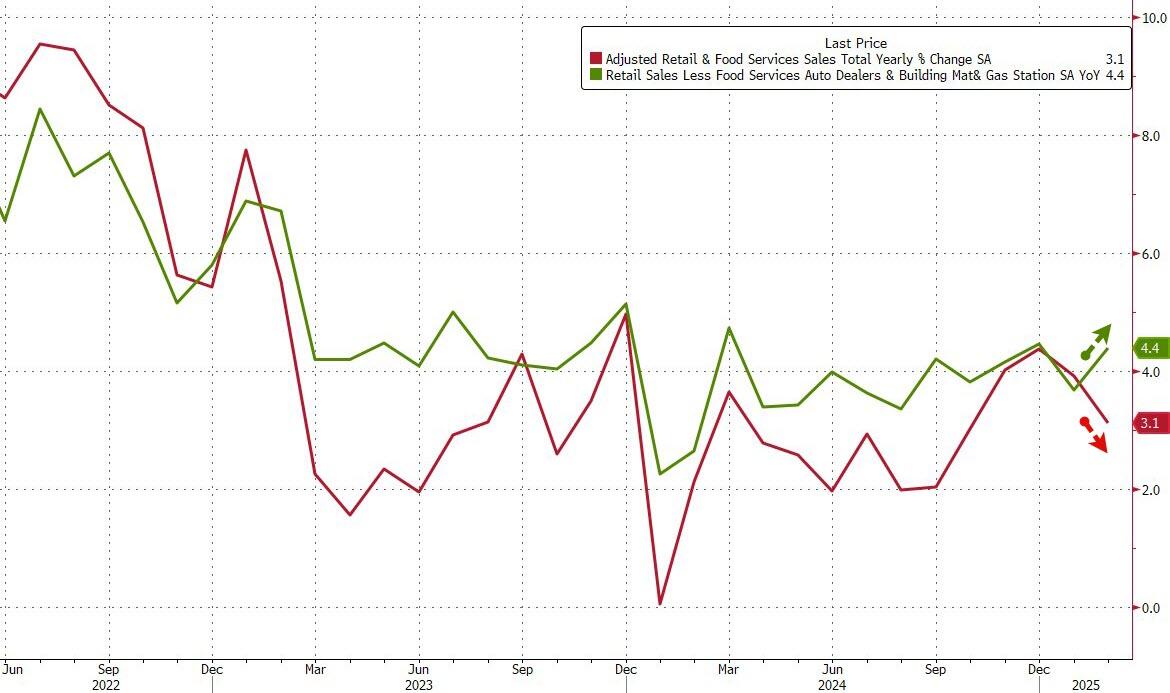
On a non-seasonally-adjusted basis, retail sales are actually down YoY…
Source: Bloomberg
Adjusted roughly for inflation,. real retail sales is basically flat year-over-year…
Source: Bloomberg
Finally, on the bright side, Retail Sales Control Group – which is used for GDP calculations – surged 1.0% MoM in February (more than double the 0.4% rise expected), after puking a revised lower 1.0% MoM in January…
Source: Bloomberg
So, while headline sentiment may be weak, this is a solid report for signaling economic growth.
Trump learning from Biden: January revised much lower, means lower base and can beat estimates
Ten days or so after the Heritage Foundation’s Oversight Project disclosed that nearly every document bearing former President Biden’s signature during his first term had been signed by an autopen—except for one—questions arose over whether executive orders and pardons could be deemed invalid, as we noted that Biden’s staff likely leveraged his rapid cognitive deterioration to sign those documents via autopen.
Overnight, President Trump declared that the 11th-hour pardons, including those given to members of Congress who investigated the January 6 insurrection, were “void, vacant, and of no further force or effect, because of the fact that they were done by autopen.” Some of those last-minute pardons include Deep Staters, such as former Representative Liz Cheney, retired General Mark Milley, and government scientist Anthony Fauci.
“The “Pardons” that Sleepy Joe Biden gave to the Unselect Committee of Political Thugs, and many others, are hereby declared VOID, VACANT, AND OF NO FURTHER FORCE OR EFFECT, because of the fact that they were done by Autopen,” Trump wrote on Truth Social late Sunday night.
The president continued: “In other words, Joe Biden did not sign them but, more importantly, he did not know anything about them! The necessary Pardoning Documents were not explained to, or approved by, Biden. He knew nothing about them, and the people that did may have committed a crime.”
He went on to say that members of that House committee are “subject to investigation at the highest level”…
“Therefore, those on the Unselect Committee, who destroyed and deleted ALL evidence obtained during their two year Witch Hunt of me, and many other innocent people, should fully understand that they are subject to investigation at the highest level. The fact is, they were probably responsible for the Documents that were signed on their behalf without the knowledge or consent of the Worst President in the History of our Country, Crooked Joe Biden!“
Here’s the full statement:
Trump told reporters aboard Air Force One late last night: “It’s not my decision — that’ll be up to a court — but I would say that they’re null and void, because I’m sure Biden didn’t have any idea that it was taking place, and somebody was using an auto pen to sign off and to give pardons.”
🚨 REPORTER: “Are those [autopen] pardons from the former President now null and void?”
TRUMP: “I would say that they’re null and void because I’m sure Biden didn’t have any idea that it was taking place … What they did is criminal.” pic.twitter.com/R9OD7kAtJb
Futures Fall After Bessent Says “Not Worried” By Slide In US Stocks
Futures are lower to start the week – but well off the lowest levels of the session – following the best day for US stocks since November, as the market digests trade war news and the Trump Put remains absent. Over the weekend, Scott Bessent dismissed recent stock declines as healthy, reinforcing the view that President Donald Trump’s administration is unlikely to step in to boost markets (the Fed is a different matter). Trump also reminded investors over the weekend that he would be imposing both broad reciprocal tariffs and additional sector-specific tariffs on April 2. As of 8:00am ET, S&P futures are down -0.2% having been down as much as 0.6% earlier; Nasdaq futures are down 0.1% as Mag 7 stocks edged lower, though Nvidia gained before its much anticipated conference on artificial intelligence. Europe’s Stoxx 600 index rose 0.4%, extending its year-to-date outperformance against US stocks. In global news, Trump will speak with Russian President Vladimir Putin on Tuesday about ending the war in Ukraine. So far the Ukraine ceasefire news is having a muted impact. Trump also said reciprocal tariffs and additional sector-specific tariffs will hit on April 2. Meanwhile, the US retail operator of Forever 21 filed for bankruptcy after years of poor performance. Bond yields are lower as the curve bull flattens while the USD falls to fresh 4 month lows. Commodities are bid higher led by Ags and Energy, following the latest stimulus vows from China. Today’s macro data focus is on Retail Sales where a stronger number may give the market comfort in trying to create a relief rally and the Fed on Weds could be supportive too.
In premarket trading, Tesla leads losses among Mag 7 stocks (Alphabet -0.1%, Amazon +0.3%, Apple -0.2, Microsoft -0.4%, Meta +0.1%, Nvidia +1.4% and Tesla -0.5%), DocuSign rose 1% after William Blair upgraded the e-signature software firm to outperform, noting market opportunity for the company’s Intelligent Agreement Management platform. Incyte (INCY) sinks 14% after reporting topline results from a Phase 3 clinical trial program evaluating the safety and efficacy of povorcitinib. Here are some other notable premarket movers:
Netflix (NFLX) gains 1% as MoffettNathanson turns bullish, saying the company’s ability to better monetize its engagement remains an underappreciated aspect of its scale.
Norwegian Cruise Line (NCLH) rises 4% after JPMorgan upgraded the stock to overweight, noting that management signaled during an investor conference that there were no detectable changes in demand and that their 2025 outlook was cautious. The stock is down 25% year-to-date.
Science Applications (SAIC) climbs 10% after the government IT services contractor posted 4Q results and provided guidance.
Sprouts Farmers Market (SFM) climbs 1% after Deutsche Bank raised its rating to buy from hold following the stock’s recent pullback.
Bessent told NBC’s Meet the Press Sunday that he’s not worried by the slump in US stocks, after about $5 trillion was wiped from the S&P 500’s value and the index tumbled into a correction. “Corrections are healthy,” he told NBC. Traders still don’t seem convinced. His comments are a blow to those harboring hopes that President Donald Trump will seek to cushion the market impact of his policies.
“This statement caused some alarm for many Wall Street types who had been counting on Bessent to be the second Trump administration’s ‘voice of reason’ on economic policy,” said Benjamin Picton, a strategist at Rabobank. The comments effectively dash prospects that policymakers will throw “liquidity bones to financial markets whenever they showed signs of wobbling,” Picton added.
Meanwhile, fears of a protracted global trade war are benefiting haven assets, with gold holding close to record highs around $3,000 an ounce, and Treasury yields edging lower. Bund yields dropped five basis points as jitters mounted over Tuesday’s parliamentary vote on Germany’s landmark spending package.
Another source of concern is the US threat of “unrelenting” military strikes on Yemen’s Houthi militants, who said they would respond by targeting US vessels in the Red Sea. The events lifted Brent crude futures above $71 a barrel, while European shipping stocks, including AP Moller-Maersk A/S and Hapag-Lloyd AG, gained.
It’s a busy week on the macro front as the Federal Reserve, Bank of England and the Bank of Japan are set to hold policy meetings. While they are not expected to change interest rates, investors will watch in particular for any clues from the Fed on what kind of support could be offered to the economy. Swaps see high odds of three Fed cuts this year, but Fed chair Jerome Powell faces the task of assuring investors the economy remains on solid footing, while signaling policy support will be provided when required. US retail sales data due later Monday are expected to reinforce the picture of a slowing economy, following on from below-forecast inflation readings last week.
In Europe, the Stoxx 600 rose 0.4%, with energy and utilities shares leading gains after China said it would take steps to revive consumption, while consumer products and retail stocks are the biggest laggards. Here are the biggest movers Monday:
Phoenix Group shares rise as much as 7.8%, the most since May, after the insurance and pension fund company delivered operating profit ahead of expectations and upgraded its outlook through to 2026
ProSieben shares climb as much as 5%, the highest intraday since July. The German media company is nearing a deal to give General Atlantic up to 10% in the firm through a convertible bond
CVS Group advances as much as 13%, the most since Sept. 2021, following an upgrade of the veterinary health company to outperform by RBC based on factors including strong Australian margins
U-blox rises as much as 9.3% to the highest since July, after the Swiss semiconductor company signed an agreement to divest its Cellular business to Trasna
Forterra shares rise as much as 3.5% after the building products company was upgraded by analysts at Peel Hunt, who argue there is major earnings upside when volumes recover
QinetiQ shares drop as much as 22%, the most on record, after analysts warned of sharp cuts to consensus after the company downgraded growth expectations for this year and next
Energean slides as much as 11% after the oil and gas company warned Carlyle has not yet obtained regulatory approvals in Italy and Egypt for a deal to buy a portfolio of assets from the London-listed company
Siltronic slides as much as 4.7% as Jefferies cuts its rating on the semiconductor equipment manufacturer to hold from buy, cautioning that the outlook remains difficult
Stocks across Asia also rose, pulled higher by a rebound in technology shares and a sense of optimism over China’s plans to boost consumption. The MSCI Asia Pacific Index gained as much as 1.2%, with chip makers TSMC and Samsung Electronics giving it the biggest boost as they tracked a recovery in US tech shares Friday. Benchmarks in Hong Kong, Japan and South Korea all moved higher. The biggest news for traders to digest came from China, after a weekend report from the state news agency said Beijing will promote “reasonable growth” in wages and set up a mechanism to adjust the minimum salary, something it seems to do every other months.A raft of economic data also showed signs of recovery in the economy, including a pickup in retail sales. The response of mainland Chinese stocks was muted. Although a gauge of Chinese shares listed in Hong Kong rose around 0.6%, the onshore benchmark CSI 300 Index drifted lower. The market appeared underwhelmed with a Monday press conference. Elsewhere, we get the Bank of Japan’s policy decision due on Wednesday, with the central bank widely expected to keep rates steady.
“China’s latest measures reinforce that boosting consumption is a top priority this year, with a multi-pronged approach involving several ministries and a host of different measures,” said Charu Chanana, chief investment strategist at Saxo Markets. “This could help to broaden out the momentum we have seen in China stocks this year, primarily led by tech.”
In FX, the Bloomberg Dollar Spot Index is set for a second daily loss and is down 0.2%, hitting a fresh four-month low as investors awaited US retail sales and manufacturing data for further clues on the state of the world’s biggest economy. The Norwegian krone is the best performer among the G-10 currencies, rising 0.9% against the greenback. The pound and euro rise 0.3% each.
In rates, treasuries are slightly richer across the curve, following a wider bull-flattening rally seen across bunds which find support from short covering flow ahead of Tuesday’s vote on the spending package. 10-year Treasury yields drop 3 bps to 4.28% in a slight bull-flattening move. Gilts are steady. Bunds rally, led by longer-dated maturities before Tuesday’s vote in the Bundestag on the spending package. German 30-year yields fall 8 bps to 3.13%. Treasury auctions this week include $13 billion 20-year bonds Tuesday and $18 billion 10-year TIPS Thursday.
In commodities, Bitcoin is little changed around $83,500. Spot gold climbs $12 to near $3,000/oz having topped that level for the first time on Friday. WTI rises 1% to $67.80 a barrel.
Looking at today’s calendar, US economic data calendar includes March Empire manufacturing, February retail sales (8:30am), January business inventories and March NAHB housing market index (10am). Fed officials are in external communications blackout ahead of March 19 policy announcement
Market Snapshot
S&P 500 futures down 0.6% to 5,607.50
STOXX Europe 600 up 0.4% to 548.55
MXAP up 0.9% to 187.43
MXAPJ up 0.9% to 586.91
Nikkei up 0.9% to 37,396.52
Topix up 1.2% to 2,748.12
Hang Seng Index up 0.8% to 24,145.57
Shanghai Composite up 0.2% to 3,426.13
Sensex up 0.4% to 74,153.00
Australia S&P/ASX 200 up 0.8% to 7,854.06
Kospi up 1.7% to 2,610.69
German 10Y yield little changed at 2.85%
Euro little changed at $1.0880
Brent Futures up 0.6% to $70.99/bbl
Gold spot up 0.0% to $2,985.40
US Dollar Index little changed at 103.71
Top Overnight News
Treasury Secretary Scott Bessent said he’s not worried about the recent downturn that’s wiped trillions of dollars from the equities market as the US seeks to reshape its economic policies. “I’ve been in the investment business for 35 years, and I can tell you that corrections are healthy, they are normal,” Bessent said Sunday on NBC’s Meet The Press. “I‘m not worried about the markets. Over the long term, if we put good tax policy in place, deregulation and energy security, the markets will do great.” BBG
Trump and Russia’s Vladimir Putin will speak tomorrow as the US presses for a deal on Ukraine. Trump said much of the discussion will be about territory. BBG
US President Trump invoked the Alien Enemies Act against Tren De Aragua which he declared is attempting and threatening invasion against the US, while he said any Venezuelans aged 14 or older who are TDA members and not US citizens or lawful permanent residents are liable to be “apprehended, secured and removed as alien enemies”.
Voters are souring on the economy even as Trump’s second term boosted positivity about the US as a whole, an NBC News poll showed. The Democratic Party got its lowest approval in the poll’s history at 27%. BBG
US Senate voted 54-46 to pass the stopgap funding bill to keep the government funded through September 30th, while President Trump signed the budget appropriations bill into law.
Trump’s trade war w/Europe risks damaging an economic relationship worth ~$9.5T (in terms of goods/services trade and foreign direct investment). WSJ
US President Trump’s administration was reportedly considering a new travel ban that would impact 43 countries, with a draft plan developed by the State Department several weeks ago: NYT
Oracle is accelerating discussions with the White House on a deal to run TikTok’s US business. Politico
Chinese consumption, investment and industrial production beat estimates at the start of the year, pointing to signs of economic resilience. However, Beijing’s consumption-focused press conference underwhelmed. Bloomberg Economics called the plan to boost spending “skeletal.” BBG
China’s economic data for Jan/Feb comes in ahead of plan, including industrial production (+5.9% vs. the Street +5.3%) and retail sales (+4% vs. the Street +3.8%). RTRS
Plans are being made for global CEOs to meet Xi Jinping on March 28 following an upcoming forum in Beijing, people familiar said. BBG
GIR revised our 2025 and 2026 earnings to $262 and $280 respectively (previously $268 and $288), reflecting growth of 7% in both 2025 and 2026 (vs. 9% and 7% previously). Furthermore, we now expect the S&P 500 will trade at a forward P/E of 20.6 by year-end vs. 21.5 previously. Our revised 3-, 6-, and 12-month S&P 500 price targets are 5600 (-1%), 5900 (+5%), and 6500 (+15%). GIR
OECD Economic Outlook, Interim Report March 2025; cuts global growth outlook – cites trade tensions
A more detailed look at global markets courtesy of Newsquawk
APAC stocks began the week on the front foot following last Friday’s resurgence on Wall St and amid encouraging Chinese activity data but with gains capped owing to geopolitical tensions after the US conducted strikes on Yemen’s Houthis and with participants awaiting this week’s central bank decisions. ASX 200 gained with the advances led by notable strength in the commodity-related sectors and following encouraging data from Australia’s largest trading partner. Nikkei 225 climbed at the open despite the lack of obvious catalysts, while Japan’s largest labour union anticipates an average 5.46% wage increase this year which would surpass 5% for the second consecutive year and would be the highest in 34 years but is still below the union’s 6.09% pay increase demand. Hang Seng and Shanghai Comp were positive with sentiment underpinned following recent support pledges and after encouraging Chinese activity data in which Industrial Production topped forecasts and Retail Sales matched estimates. However, gains in the mainland were limited as data also showed an increase in Urban Unemployment and House Prices remained in deep contraction territory.
Top Asian News
China’s State Planner Vice Chair says consumption is improving, though consumer confidence remains weak.
PBoC detailed measures to improve the quality and efficiency of financial services and will grow the financial ecosystem that supports tech innovation, while state media reported that China should choose the right timing and strength for monetary easing.
China’s State Council released a special action plan to boost domestic consumption which includes measures to increase residents’ income, pensions and wages, as well as establishing a childcare subsidy scheme and increasing revenue from land reform including rural areas.
China’s NDRC said it is to encourage foreign investment in technology and manufacturing with the state planner to release an expanded list of industries it seeks to attract foreign investment in.
China’s stats bureau spokesperson said China’s economy remains resilient but achieving the 2025 growth target will not be easy and the external environment is becoming more complex and severe. The spokesperson added that China’s property market faces some pressures, despite signs of stabilising but they expect China’s consumer prices to improve further and expect Q1 economic operations to be steady. Furthermore, it was stated that macroeconomic policies will provide more support for the economy and the employment situation remains largely stable with the rise in the February jobless rate still within normal ranges.
PBoC says Official says it will use policy tools such as reserve requirement ratio and relending and discount facilities.
Dozens of foreign CEOs set to attend Beijing’s CDF business summit this month; some expected to meet President Xi, according to Reuters sources.
CAICT says shipments of phones within China are down 14.3% Y/Y in January. Shipments of foreign-branded phones, such as Apple (AAPL) -20.6% Y/Y.
European bourses (STOXX 600 +0.3%) opened mixed, and traded indecisively on either side of the unchanged mark; though sentiment gradually picked up as the morning progressed. European sectors hold a positive bias, but with the breadth of the market fairly narrow. Energy takes the top spot, lifted by underlying strength in oil prices; the complex is buoyed by heightened geopolitical tensions after the US struck Houthi targets. On that, the militant group said it would continue naval operations until the Gaza blockade is lifted and aid is let in. Basic Resources benefits from the risk tone, and after constructive Chinese activity data overnight, with particular focus on the stronger-than-expected Industrial Production data. US equity futures (ES -0.4%, NQ -0.4%, RTY -0.6%) are lower across the board, with slight underperformance in the RTY, giving back some of the significant strength seen on Wall Street on Friday. Intel’s (INTC) new CEO plans to overhaul the chip design and manufacturing business, plans to restart AI efforts and produce chips at annual cadence as it looks at further cuts, Reuters reports.
Top European News
ECB’s de Guindos says that the administration of US President Trump has increased economic uncertainty due to tariff deregulation. Trade was is bad for the global economy. Effect of tariffs on inflation may be compensated by lower economic activity. Believes inflation is converging on 2% and everything is going in the “right direction”. Increased uncertainty has made the current situation more opaque compared to six months ago. Spain will need to spend 2.7% GDP on Defence in four years and raise its budget by EUR 6bln per year. Seeing a decrease in services inflation due to evolution of wages, should lead overall inflation to the 2% target.
UK Chancellor Reeves is to pledge to change the law to restrict merger investigations by the Competition and Markets Authority, according to FT.
Britain’s largest regulators will be given performance reviews by ministers and set targets for cutting red tape and growing the economy, according to The Times.
Moody’s raised Greece’s sovereign rating from Ba1 to Baa3; Outlook revised to Stable from Positive and affirmed Spain at A; Outlook Stable. It was also reported that Fitch affirmed France at AA-; Outlook Negative, affirmed Portugal at A-; Outlook Positive, and affirmed Poland at A-; Outlook Stable.
German Economy Ministry says economic weakness continues at the start of 2025 amid subdued domestic/foreign demand and increased uncertainty.
German Ifo institute has lowered their economic forecasts to 0.2% for 2025 and 0.8% in 2026.
FX
USD net softer vs. peers in what has been a weekend lacking in incremental newsflow on the trade front aside from Trump reiterating that he has no intention of creating exemptions on steel and aluminum tariffs, adding that he will impose reciprocal and sectoral tariffs on April 2nd. Focus is also on the US government averting a shutdown. DXY is currently tucked within Friday’s 103.57-104.09 range, ahead of US Retail Sales.
EUR is steady vs. the USD and tucked within Friday’s 1.0830-1.0912 range. Incremental macro drivers over the weekend for the EZ are lacking and therefore markets are bracing for the outcome of tomorrow’s vote in the Bundestag on the German reform package. ECB’s de Guindos remarked that he believes inflation is converging on 2% and everything is going in the “right direction”. However, this provided little traction for the EUR.
GBP is a little firmer and trades within a 1.2926-58 range, in what has been a catalyst-thin session thus far, but has focus remains on Thursday’s BoE meeting.
JPY is a little lower and the marginal G10 underperformer today, partly thanks to slightly positive risk tone following constructive Chinese data which has lifted Antipodeans and European stocks. USD/JPY currently towards the mid-point of a 148.47-149.09 range.
Antipodeans continue to extend on the upside on Friday, with gains today facilitated by the constructive Chinese activity data and after China unveiled a special action plan to boost consumption.
PBoC set USD/CNY mid-point at 7.1688 vs exp. 7.2199 (Prev. 7.1738)
Fixed Income
EGBs bid with OATs outperforming after Fitch left France’s rating alone on Friday. More broadly, benchmarks bid with yields weighed on by pressure in European gas benchmarks ahead of the Putin-Trump call. Action which has lifted OATs by over 70 ticks at best with Bunds not far behind.
Bunds also potentially acknowledge further complaints lodged with the Constitutional Court ahead of Tuesday’s Bundestag vote on fiscal reform, reform which Merz believes will pass though he acknowledges it will be close; firmer by over 50 ticks and just shy of the 128.00 mark.
USTs await US Retail Sales before the latest update to Atlanta Fed’s GDPnow tracker which is currently running at -2.4% though the gold-adjusted figure is -0.4%. Firmer by a handful of ticks but essentially contained with yields mixed and the curve flatter.
Gilts are following EGBs but magnitudes are much less pronounced. UK specifics light once again but the clock counts down to next week’s OBR update and before that a welfare reform announcement.
Crude
Crude is on a stronger footing today, with gains attributed to heightened geopolitical tensions after the US struck Houthi targets. Further for the region, the militant group said it would continue naval operations until the Gaza blockade is lifted and aid is let in. Brent’May currently sits at the upper end of a USD 70.68-71.80/bbl range.
European gas is lower, after optimistic updates from Trump over the weekend, where he said he would speak to Russian President Putin on Tuesday.
Precious metals are mixed, with spot gold firmer by around USD 7/oz, whilst silver is a little lower. The yellow-metal has slipped below the USD 3,000/oz mark, to currently trade at the upper end of USD 2,982.36-2,994.12/oz range; upside today has been facilitated by the aforementioned heightened geopolitical tensions.
Base metals are mixed, with the complex failing to materially benefit from the constructive Chinese activity data overnight, where Industrial Production printed above expectations but with Urban unemployment and House Prices remaining at subdued levels. 3M LME Copper is a little firmer today and trades within a USD 9,776.45-9,845.35/t range. Elsewhere, Trump reiterated his firm stance on tariffs, stating there would be no exemptions on steel and aluminium duties and confirming reciprocal and sectoral tariffs will be imposed on April 2nd.
Iraq agreed to double electricity imports from Turkey.
India’s February Gold imports at USD 2.3bln; February oil imports at USD 11.8bln
Geopolitics: Middle East
US President Trump ordered the US military to launch ‘decisive and powerful’ military action against Houthis in Yemen and told Iran to end support for Houthis immediately, while the Pentagon said US strikes against Houthis will last days or weeks., Furthermore, it was later reported that the death toll from the US attacks on Yemen reached 53.
US Defence Secretary Hegseth said the US campaign will be unrelenting, while he added that Iran has been enabling the Houthis far too long and they better back off.
US Secretary of State Rubio commented that the US military campaign in Yemen will go on until the Houthis no longer have the capability to strike ships and said there is no way Houthis would have the ability to attack shipping unless they had support from Iran.
US Secretary of State Rubio spoke with Russian Foreign Minister Lavrov on Saturday and told him about US operations against Houthis, while Lavrov stressed the need for an immediate cessation of the use of force against Yemen Houthis and said it is important for all parties to engage in political dialogue in order to find a solution that avoids further bloodshed, according to Reuters.
Yemen’s Houthis said naval operations will continue until the Gaza blockade is lifted and aid is let in, while the group said it targeted a US aircraft carrier with ballistic missiles and drones in the Red Sea but showed no proof, according to Reuters.
Iranian Revolutionary Guards top commander Salami said Tehran will respond decisively and destructively to any enemy taking threats into action and noted that Yemen’s Houthis take strategic and operational decisions on their own, according to state media.
Israeli air strike killed nine in Gaza amid ceasefire disputes. It was separately reported that the Israeli PM’s office said Israel will continue Gaza ceasefire talks in accordance with the US proposal for the immediate release of 11 living hostages and half of the dead. Furthermore, an Israeli delegation was in Egypt discussing hostages with senior Egyptian officials and PM Netanyahu moved to dismiss the head of the Shin Bet security service, according to the PM’s office cited by Reuters.
Syria’s military fired rockets and shells at Lebanon on Sunday after accusing Iran-backed Hezbollah of executing three Syrian army personnel, according to Bloomberg.
Geopolitics: Ukraine
Ukrainian President Zelensky said Ukraine’s partners must define a clear position on security guarantees and the path to peace must begin unconditionally, while he added there must be a foreign troop contingent based on Ukraine soil as part of a peacekeeping arrangement and the question of territory is complex and should be discussed later.
Russian Defence Ministry said Russia will demand Kyiv’s neutral status and NATO’s refusal to accept Ukraine in a peace treaty on Ukraine, while Russia opposes any troops in Ukraine as part of post-conflict guarantees, not just NATO troops. Furthermore, it was stated that the issue of unarmed observers as part of post-conflict international support for Ukraine may be discussed only once a peace treaty is worked out.
US President Trump said he will be speaking with Russia’s President Putin on Tuesday and may have something to announce on Ukraine-Russia talks by Tuesday. Trump added that land and power plants are the focus of talks toward a Russia-Ukraine deal and they are already talking about “dividing up certain assets” between the two sides.
US President Trump said it feels like Russia is going to make a deal with them and stated that they had pretty good news coming out of Russia. Trump also announced that General Kellogg was appointed as Special Envoy to Ukraine and will no longer be an envoy to Russia.
US envoy Witkoff said differences between Ukraine and Russia have narrowed and they had positive discussions with Russian President Putin, while Witkoff said he expects Trump and Putin to speak this week and that US negotiating teams will meet with Ukrainians this week and will also meet with Russians.
UK PM Starmer said following a meeting with world leaders that they reaffirmed commitment to Ukraine’s long-term security and agreed that Ukraine must be able to defend itself and deter future Russian aggression, while they agreed military planners would convene again in the UK this week to progress practical plans for how militaries can support Ukraine’s future security. Furthermore, Starmer said they will accelerate military support, tighten sanctions on Russia’s revenues and will continue to explore all lawful routes to ensure that Russia pays for the damage it has done to Ukraine, as well as commented that Putin’s response to the ceasefire proposal is not good enough.
Russia launched an air attack on Ukraine’s capital of Kyiv and the Russian Defence Ministry said its forces retook control of two settlements in Russia’s Kursk region.
Ukrainian drone attack targeted energy facilities in Russia’s Astrakhan region and sparked a fire, according to the regional governor.
Geopolitics: Other
Azerbaijan’s Defence Ministry said Armenian forces opened fire on Azeri positions on Sunday, while Armenia’s Defence Ministry said the statement by Azerbaijan does not correspond to reality.
North Korea said its nuclear forces will ‘exist forever’ and criticised G7 states for nuclear hegemony, while it will steadily update and strengthen its nuclear armed forces and said demand by G7 for North Korea to abandon nuclear weapons is a provocation. It was also reported that North Korea condemned the US deployment of additional stealth fighter jets to Japan, according to KCNA.
US Event Calendar
08:30: Feb. Retail Sales Advance MoM, est. 0.6%, prior -0.9%
08:30: Feb. Retail Sales Ex Auto MoM, est. 0.3%, prior -0.4%
08:30: Feb. Retail Sales Control Group, est. 0.3%, prior -0.8%
08:30: March Empire Manufacturing, est. -2.0, prior 5.7
10:00: Jan. Business Inventories, est. 0.3%, prior -0.2%
10:00: March NAHB Housing Market Index, est. 42, prior 42
DB’s Jim Reid concludes the overnight wrap
This morning we’ve launched our latest global market survey, which we’re doing on a quarterly basis now. We ask simple questions to tease out your thoughts on tariffs, whether your view on Germany has changed, your preference for US or European equities, whether the US equity correction is over just as it began, and a few other topical questions. We would very much appreciate all responses. They are all anonymous. We’ll publish the results later this week. The link to fill it in is here.
A reminder that late last week we launched our Deutsche Bank Research Institute (DBRI), a new offering designed to provide valuable insights for corporates, investors and policymakers navigating today’s complex and rapidly evolving global landscape. The Institute will connect the world to Europe and Europe to the world, across geopolitics, macroeconomics, technology, and the evolving corporate landscape. The new Institute website is here and is open to the public so you can share widely. It contains the inaugural “What Germany’s economy needs now” paper which outlines a series of necessary reforms which will demand a historic effort from the next government. Hopefully the huge fiscal stimulus package that will likely get approved this week (more later) will give them the opportunity to implement these reforms. See the English version here and the German here.
It’s a busy week for central bank watchers with decisions due from the Fed, the BoJ (both Wednesday) and the BoE (Thursday), amongst others. Economic data highlights include retail sales in the US (today), various US housing data, labour market stats in the UK (tomorrow) and inflation in Japan (Friday) and Canada (tomorrow). After we had the white smoke of a deal on Friday, the spotlight will be on the vote around the huge proposed fiscal expansion in Germany. The Bundestag and the Bundesrat are expected to hold votes tomorrow and Friday, respectively, before the new Bundestag sits from March 25. We’ll preview these below. Note that overnight Trump has said he’ll speak to Putin tomorrow so that’s another thing to watch
The full day by day week ahead is at the end as usual but let’s preview a few of the key events. Firstly, the Fed is widely expected to stay on hold on Wednesday. In their preview (see “March FOMC preview: Patience is a virtue amidst cross currents”), our economists still expect limited guidance about the policy path ahead given all the extreme uncertainty. The statement is likely to announce a pause in QT beginning in April, and we expect forward guidance indicating that QT is expected to resume once the debt ceiling is resolved and the liability composition of the balance sheet normalises. There are risks that a slowing is announced rather than a pause. Our economists also expect the SEP to maintain two rate cut dots this year but with an upward drift in individual dots that could push the median dot to one cut as a risk. The economic projections will likely show higher inflation, somewhat weaker growth, and an unchanged forecast for the unemployment rate this year. Last week’s inflation data looked softer on the surface but as our economists pointed out, they still point towards another strong core PCE print. Today’s retail sales will likely be the last piece of data influencing the Fed.
In terms of Germany, this week will be a landmark one with votes on the deal in the Bundestag tomorrow and the Bundesrat on Friday. With the deal agreed on Friday the bulk of the execution risk has been averted. Assuming it goes through, which must be now over 95% probability wise (on my crude guestimates), our economists believe this could lead to a fiscal stimulus of 3-4% of GDP by 2027 at the latest. So don’t underestimate how huge this package is. Our economists’ note here from Friday outlines the remaining risks both in terms of the vote and the constitutional court ruling around whether not enough time was provided to scrutinise the deal. However the legislation is covered by less than 20 pages of text, so we think the legal risk here is low. We also don’t think there is a large risk that the constitutional court rules against the legitimacy of this outgoing parliament given that most experts believe they have constitutional power until the last session. I still don’t think markets have fully caught up to how much of a game changer this will be for Germany over the next few years. Longer-term though our inaugural Institute paper suggests Germany should use this period to embark on significant structural reform. Hopefully the comfort of higher growth towards the latter part of this decade won’t reduce the likelihood of this.
Back to central banks, the BoJ is expected to keep rates steady and the current monetary policy framework maintained on Wednesday. See our economists’ preview of the meeting here. For the BoE, our UK economist expects the BoE to keep the Bank Rate unchanged at 4.5% (his full preview can be found here).
Asian equity markets have begun the week on the front foot after mixed China data but in anticipation of a domestic 30-point action plan to stimulate consumer spending and bolster stock and real estate markets. There is a press conference at 3pm local time (7am GMT so just after we go to print). As I check my screens, the KOSPI (+1.52%) is leading gains in the region with the Hang Seng (+1.07%), Nikkei (+1.20%), and the S&P/ASX 200 (+0.83%) also notably higher. Mainland Chinese stocks are more mixed with the CSI (-0.24%) lower but with the Shanghai Composite (+0.19%) edging higher. S&P 500 (-0.55%) and NASDAQ 100 (-0.59%) futures are slipping after the strong rally on Friday but are also being weighed down by an interview with Bessant over the weekend who suggested stock market corrections are normal and didn’t suggest the administration is going to shy away from what it would see as difficult but necessary changes to the economy.
Coming back to China, industrial output accelerated at a faster pace in the first two months of 2025, advancing +5.9% (v/s +5.3% expected) while retail sales rose by +4.0% in the January-February period from a year ago, against market expectations for a +3.8% y/y growth. Fixed asset investment rose by +4.1% on a year-to-date basis, beating the +3.2% growth estimated by Bloomberg. The unemployment rate rose to 5.4% in February (v/s +5.1% expected), the highest level in two years. Meanwhile, new home prices dipped -0.1% versus a month earlier after two months of relatively steady prices indicating that the nation’s property slump lingers despite the country’s latest efforts to prop up the market. Used-home prices dropped -0.34%, the same pace as the previous month, and fell -0.1% from January in top-tier cities. The market has moved on to focus on the announcement as we go to print.
Looking back at last week now and markets saw a fresh selloff as tariff uncertainty mounted and investors grew more cautious on the US outlook. That meant the S&P 500 fell -2.27% in what was also its 4th consecutive weekly loss. Moreover, if the index sees a 5th weekly decline this week, that would be the longest run of declines since the 2022 bear market. However, on Friday there was then a very sharp recovery, which saw the S&P 500 pare back its losses for the week to rise +2.13% on the day, marking its best daily performance since Trump’s election victory back in November. And there were other signs by the weekend that market volatility was easing, as the VIX index closed at 21.77pts, which was its lowest level since the start of March.
Nevertheless, that recovery on Friday wasn’t enough to save most assets from a significant slump, with US HY spreads (+30bps last week) posting their biggest move wider last week since the turmoil last summer. Those losses were echoed around the world, albeit to a lesser extent, and Europe’s STOXX 600 fell -1.22% (+1.14% Friday) in its worst week of 2025 so far. Notably, Friday even saw gold prices move above the $3,000/oz mark for the first time intraday, before closing slightly beneath that at $2,984/oz.
There were also big moves in European sovereign bond markets, as Germany’s CDU leader Friedrich Merz reached an agreement with the Greens on proposals to amend the constitutional debt brake to allow more borrowing. That meant yields continued to push higher in Europe, with those on ten-year bunds up +3.9bps last week (+2.1bps Friday) to 2.87%, whilst the French 10yr OAT yield was up +1.3bps (+1.0bps Friday) to 3.57%.
For US Treasuries, it was a more stable story, with the 10yr yield up +1.1bps last week (+4.4bps Friday) to 4.31% despite having traded as low as 4.15% early last Tuesday. Friday’s rise in yields came amid a significant jump in inflation expectations in the University of Michigan’s preliminary index for March. It showed 1yr expectations rising to +4.9% (vs. +4.3% expected), which is their highest since November 2022. And 5-10yr expectations also jumped up to a 32-year high of +3.9% (vs. +3.4% expected). In turn, that led investors to dial back their expectations for Fed rate cuts this year, with just 65bps priced in by the December meeting at the close, the fewest in over two weeks. The UoM survey continues to show extreme polarisation of inflation and economic views along party lines but the rise in expectations overall and from Independent voters is starting to be a concern.
NORTHCOM Deploys Guided-Missile Destroyer For “Southern Border Mission” As Hemispheric Defense Takes Shape
The USS Gravely (DDG-107), an Arleigh Burke-class guided-missile destroyer in the US Navy, departed Naval Weapons Station Yorktown on the Virginia Peninsula on Saturday. The warship will operate in US and international waters in support of the “southern border mission,” according to a press release published by the US Northern Command.
“USS Gravely’s deployment will contribute to the U.S. Northern Command southern border mission as part of the DOD’s coordinated effort in response to the Presidential Executive Order. Gravely’s sea-going capacity improves our ability to protect the United States’ territorial integrity, sovereignty, and security,” Gen. Gregory Guillot, Commander, USNORTHCOM, stated.
USNORTHCOM explained that Gravely’s mission will be “restoring territorial integrity at the U.S. southern border and reinforces the nation’s commitment to border security by enhancing maritime efforts and supporting interagency collaboration,” adding, “The ship’s deployment highlights the Department of Defense and Navy’s dedication to national security priorities, contributing to a coordinated and robust response to combating maritime related terrorism, weapons proliferation, transnational crime, piracy, environmental destruction, and illegal seaborne immigration.”
Ship tracking website Vessel Finder showed Gravely’s position (20 hours ago) off the Virginia Beach coast, transiting south…
USS Gravely’s advanced radar and electronic warfare systems allow the US military to track multiple drug cartels—now designated as foreign terrorist organizations—threats simultaneously, including aircraft, missiles, and surface vessels.
As we’ve been detailing, the US government has been conducting round after round of signals intelligence (SIGINT) operations near the US-Mexico border and over Mexico using spy planes and CIA drones…
What you see above is part of the preliminary work to disrupt, dismantle, and eliminate the command and control structures of drug cartels that kill 100,000 American lives per year.
Of course, Democrats are melting down on social media over the deployment of the Arleigh Burke-class guided-missile destroyer to the region—potentially the Gulf of America.
— Mostly Peaceful Memes (@MostlyPeacefull) March 16, 2025
The party is full of open-border globalists who have flooded the nation with millions of unvetted migrants, including thousands of terrorists, while offering no solutions to the ongoing migrant crisis that has overwhelmed local, state, and federal governments. That’s because Democrats see illegals as future voters and weaponized their rogue federal judges to obstruct President Trump’s efforts to restore national security by blocking deportations.
At CERAWeek 2025, Saudi Aramco’s CEO Amin Nasser challenged the IEA’s forecast of peak oil demand.
The IEA maintained that even with peak demand, ongoing investments in oil and gas will be necessary due to natural field declines.
Aramco’s ambitious plans to scale blue hydrogen and ammonia face high costs and weak market demand, particularly in Europe and Asia.
With the CERAWeek 2025 conference in Houston drawing to a close, C-Suite executives, ministers and top officials have weighed in on the trajectory of the global oil and gas sector with experts debating whether tariffs, trade, and competition will replace security, affordability, and sustainability in shaping energy markets and policy. However, one of the biggest highlights of the conference has been the showdown between Saudi Aramco’s CEO Amin Nasser and IEA Executive Director Fatih Birol and their highly divergent views on the future of the global oil industry. Once again, the Aramco CEO was adamant that there were “inherent flaws” in the energy transition away from conventional fuels, saying, “So I pay little attention to forecasts claiming that next year will be peak this, or peak that,” in a thinly-veiled dig at the IEA which has predicted a peak in oil demand by the end of the current decade.
In its defense, the IEA says an oil demand peak doesn’t necessarily mean a rapid plunge in fossil fuel consumption is imminent, adding that it will probably be followed by “an undulating plateau lasting for many years.” Indeed, Fatih Birol reiterated that position in his remarks to the Houston conference, where he said investments in existing oil and gas fields are still needed to counter steep natural declines. Whereas some analysts interpreted this as an about-face, designed to pander to Trump and his “drill baby drill” agenda, in reality the IEA has never advocated for an end to investments in upstream oil and gas.
“Even as demand for fossil fuels falls, energy security challenges will remain since the process of adjustment to changing demand patterns will not necessarily be easy or smooth. For example, the peaks in demand we see based on today’s policies do not remove the need for investment in oil and gas supply, given how steep the natural declines from existing fields often are,” the IEA stated in its 2023 World Energy Outlook.
Republican lawmakers have threatened to reassess funding for the IEA, accusing it of becoming an “energy transition cheerleader.”
Cutting Emissions, Not Oil
With the global energy transition picking up steam, hundreds of companies have laid out plans to cut their greenhouse gas emissions with the more ambitious ones pledging to achieve net zero emissions. Given this backdrop, Big Oil companies are finding themselves in a dilemma whereby they are under pressure to join the fight against climate change at a time when demand for the energy commodities they produce remains high. Not surprisingly, many are coming up with innovative ways to clean up their act without giving up their legacy businesses.
Saudi Aramco is not any different. The world’s biggest oil and gas company has unveiled plans to reach net-zero by 2050 without sacrificing oil and gas production.
During a rare two-day visit by Fortune last May, the world’s largest fossil fuel company lifted the curtain on dozens of research projects underway at its headquarters in Dhahran, in eastern Saudi Arabia, which the company believes will help it tackle climate change, even while pumping a mammoth 9 million barrels or so of oil a day. Aramco claims its tech breakthroughs have the potential to cut carbon emissions from each barrel of oil it produces by 15% by 2035, equivalent to 51.1 million tons of carbon a year.
“We don’t see any contradiction. Combating emissions from these conventional energy sources is a very viable option,” says Ashraf Al-Ghazzawi, Aramco’s executive vice president for strategy and corporate development.
“We need all sources of energy to meet the growth in demand, which is just tremendous in the developing world. The main pillar of our strategy and technology is efficiency and optimization of our existing production,” he told Fortune.
According to Khowaiter, the company has tripled its research-and-development staff since 2010, and listed 1,033 patents with the U.S. patent office. Aramco now spends about $800 million a year on R&D, 60% of which is focused on “sustainability”.
Carbon capture is one of the technologies Aramco has adopted to cut emissions.
At its Hawiyah gas plant, the company captures carbon emitted during oil and gas production; transports it 50 miles away then injects it into an oil well to boost the recovery of crude, as well as to store the carbon. Khowaiter revealed that the company aims to cut the cost of carbon capture by 50%, making it commercially viable. In December, Saudi Aramco signed a shareholders’ agreement with LindePlc (NYSE:LIN) and Schlumberger Limited (NYSE:SLB) for dthe evelopment of a 9mn t/y CCS hub at Jubail. Under the agreement, Aramco will hold 60%, with Linde and SLB each taking 20%. The 9mn t/y first-phase facility is due online by end-2027.
Aramco also aims to produce 11 million tonnes of blue ammonia from its Jafurah natural gas field by 2030. For over a decade, the company has explored potential technologies to produce lower-carbon hydrogen from hydrocarbons, including Thermo-Neutral Reforming (TNR) with a goal to produce ‘blue’ hydrogen from about two million tonnes of blue hydrogen–by capturing the CO2 emissions from the production. However, Aramco is likely to struggle to find a buyer for its blue ammonia, with CEO Amin Nasser revealing its blue hydrogen costs the equivalent of about $250 a barrel of oil– three times higher than the current Brent spot price.
“It is very difficult to identify any off-take agreement in Europe [for blue hydrogen]… and they explained it’s because of the high cost. Even the customers in Japan and Korea [which are planning massive H2 economies] are waiting for government incentives. Until they get these incentives, it’ll be costly for them to pursue that blue hydrogen,” Nasser told a call with analysts.
Figuring out which among the multiple lines of R&D will finally work could take years for Aramco to determine, with time not on its side. Still, the company has rejected any notion that it should cut fossil fuel output, “We were never an either-or company. Aramco provides a great example where emissions can be dealt with, it can be managed,” Ghazzawi, Aramco’s strategy chief, has declared.
Visualizing Billionaire Migration Over The Last Decade
Key Takeaways
Since 2015, China has gained the most billionaires on a net basis globally, despite economic headwinds.
Western Europe follows next, with strong inflows into Switzerland.
With net outflows of 29 billionaires, Eastern Europe saw the largest decline likely influenced by the Russia-Ukraine war and the COVID-19 pandemic.
Since 2020, 176 billionaires holding over $400 billion in wealth have relocated to a new country.
This equals about one in 15 of the world’s billionaires, driven by factors like tax advantages and business-friendly environments. China, Switzerland, and the U.S. are among the top destinations, while Eastern Europe has experienced the largest billionaire outflows over the past decade.
On a net basis, China has gained more billionaires than any other global region over the past decade, reaching a total of 501 in 2024.
Overall, 73 ultra-wealthy individuals moved to the country while 48 exited, resulting in a net increase of 25 billionaires. Despite recent economic challenges, collective billionaire wealth has doubled since 2015, reaching $1.8 trillion.
From a regional standpoint, Western Europe follows next in line, gaining 20 billionaires.
Altogether, billionaires in the region hold $2.7 trillion in wealth, rising 16% since 2023. Germany leads with the highest number of billionaires, at 117, followed by Switzerland (85) and the United Kingdom (82).
When it comes to North America, 55 billionaires relocated here over the past 10 years while 42 left. Amid the 2024 stock market boom, the U.S. housed a total of 835 billionaires with a combined wealth of $5.8 trillion, growing by 27.6% over the year. Together, California and New York are home to roughly 40% of the country’s wealthiest individuals.
Similarly, billionaire wealth in the Middle East and Africa grew significantly in 2024, rising by 21.5%. In the UAE, for example, billionaire wealth surged by 39.5% between 2023 and 2024 alone. With 18 billionaires, it has the most in the region outside of Israel, which has 32.
Since 2020, the Middle East and Africa attracted the highest influx of billionaire wealth across global regions tracked by UBS.
To learn more about this topic from a U.S.-based perspective, check out this graphic on the wealth of America’s 20 richest billionaires.
Is this the last call for alcohol? Younger generations, particularly Gen Z, are driving a sober revolution fueled by social media and a growing interest in wellness and mental health.
An NC Solutions consumer sentiment survey of more than 1000 people over 21 found that nearly half of Americans expressed a desire to cut back on drinking in 2025. The shift is most pronounced among Gen Z—those born between 1997 and 2012, with 65 percent aiming to drink less in 2025 and 39 percent planning to abstain entirely.
This contrasts sharply with older generations. Only 30 percent of Boomers—those born between 1946 and 1964—plan to reduce their alcohol consumption, suggesting they are less inclined to waver from their established drinking habits. Some may even be increasing their intake.
Research does indeed indicate a concerning rise in alcohol use and related health issues among the 65-plus age group. A recent Norwegian study further revealed that certain groups of women, including those around retirement age, were more likely to increase their drinking, particularly of wine.
According to the latest National Survey on Drug Use and Health, seven million seniors said they binge drank in the past month.
This generational divide raises questions about the future of drinking culture and points to the potential rise of mind-altering alternatives among young adults, like THC, mushrooms, and ketamine.
“I’m hearing less about drinking and the allure of it,” Justin Wolfe, the director of Aliya Institute and a therapist for adolescents dealing with substance use and mental health concerns, told The Epoch Times.
Drive Behind Gen Z’s Shift
Gen Z’s motives for abandoning alcohol are multifaceted, but social media lies heavily at the core.A 2024 study published in Frontiers in Sociology found that Gen Z tends to seek information from peer influencers rather than traditional sources, demonstrating how digital media increasingly shapes and spreads values. This influence manifests in several ways.
Public Perception and the “Clean Girl” Aesthetic
It’s natural for young adults to care about how they are perceived, but social media amplifies this pressure exponentially.
“I think that a lot of times we’re so consumed with how other people are looking at us that we don’t even want to risk being considered messy,” Sofie Ruiz, a sophomore at Texas Christian University and journalism major, told The Epoch Times.
This fear of being perceived as “messy” is fueled by the popularity of the “clean girl” aesthetic, said Ruiz, who recently penned a piece about her peers’ drinking habits. This aesthetic is known for its focus on wellness and self-care.
A “clean girl” is often associated with healthy habits like yoga, pilates, green smoothies, and journaling—definitely not heavy drinking. The epitome of the popular girl is now one who projects an image of a balanced, healthy, and often sober lifestyle. This ideal is heavily promoted on social media, influencing what is seen as desirable and aspirational.
College campuses also have school-specific social media apps, such as Yik Yak, where a drunken night out can get posted by peers with lasting and embarrassing consequences, said Ruiz. With social media comes permanent and wide-reaching evidence, and students are choosing not to be seen in a certain way in perpetuity.
The reputation repercussions can run deep. Ruiz has a friend who attends a university with its own dedicated Instagram account. Students can send in anything, and it will likely be posted. A female student was kicked out of her sorority for being drunkenly featured on the page.
“We grew up a lot hearing the concerns of a digital footprint. People don’t want to risk their future on stuff like that,” said Ruiz.
Gender and Public Image
The pressure to maintain a certain image on social media is not felt equally differently across genders.
“I think just as a society, even though obviously we’ve progressed so much, there’s so much more pressure on girls,” said Ruiz.
“Guys don’t have as much to be scared about, I think. Because even if they do something embarrassing and it gets posted, they, by history, most likely will not get the same repercussions as a girl might.”
Ruiz explains that while a drunken guy might be seen as just funny and “messing around,” a drunken girl can be labeled as “messy” and is also more vulnerable to sexual assault and crimes.
Health Consciousness and Self-Care
Social media also coincides with a growing emphasis on health and self-care. Wolfe noted that Gen Z is bombarded with messages promoting self-love and self-improvement. There is a trend toward wanting to be the best version of yourself and social media is spearheading it.
“If you struggle with anxiety or you struggle with depression, there’s a lot of evidence and there’s a lot of publicity about just how substance use can make that worse. And so you’re seeing that prioritization of people’s mental health,” he notes.
This focus on well-being, often heightened by social media, is leading young adults to reconsider the role of alcohol in their lives.
Ruiz acknowledges that some students shun alcohol to prioritize their health, “You don’t want to be hungover, you don’t want to feel sick, which also goes into the clean girl aesthetic thing.”
However, ultimately, she believes many abstain only because they feel forced by the looming invisible threat of how others perceive them.
“I think that if social media wasn’t a component, it would definitely be a lot different,” she said.
Shifting Stigma and the Influence of Social Movements
Social media isn’t just about individual image. It also fosters broader social movements that are changing perceptions of alcohol. Wolfe notes that Dry January, Sober October, and other popular trends are helping remove the stigma of being a teetotaler.
“All of these movements that have taken hold are saying, ‘Hey, you really need to take care of yourself and your body,’ which has led people to evaluate and assess how alcohol fits into that,” he said.
“Historically, there’s always been that stigma, where either you’re a drinker, or you’re in recovery. It doesn’t have to be either/or. There’s a big gray area in between those two realms.”
This gray area of mindful drinking and self-awareness is increasingly visible and accepted, thanks partly to social media.
However, while drinking is losing its appeal, the journey into self-exploration is leading to a rise in alternative substances. Gen Z may not be fully embracing the true definition of sobriety. Instead, some seem to be reaching for other mind-altering experiences.
The Rise of Alternative Substances
While drinking is often used to numb and remove oneself from emotional discomfort, said Wolfe, Gen Z seems to be eager to explore their inner workings and are enlisting other substances as an aid. It’s not necessarily a direct trade but an intersection of experimentation and shifting preferences.
“The pendulum kind of swung in the other direction,” he said.
The fall 2024 National College Health Association Executive Summary found that 22.2 percent of college students surveyed used cannabis in the past three months, and approximately seven percent had used hallucinogens—defined in the report as including ecstasy, MDMA, Molly, LSD, acid, mushrooms, PCP, Special K.
The National Institutes of Health supported study observed a dramatic surge in hallucinogen use among young adults since 2020, after decades of relative stability. By 2021, a record 8 percent reported past-year use, up from 5 percent in 2016. The reported hallucinogens included LSD, MDMA, mescaline, peyote, psilocybin (mushrooms), and PCP.
For some, this exploration may be related to self-medication for mental health challenges or a tool for self-exploration.
Wolfe noticed a striking trend: “The adolescent young adult men are tapping in and acknowledging that ‘I’m having a hard time sitting here in my own skin and I’m not going to look at alcohol and try and give me that relief—I want to try and find that answer for myself.’”
“They read the anecdotal research out there and it’s like, ‘hey, this is somewhat natural. Let me try and microdose myself,’” noting a particular trend with ketamine, which can remove barriers to accessing emotional content that people tend to keep under lock and key. Per Wolfe, Gen Z is enlisting encrypted messaging services, such as Telegram, to connect with sources that are selling ketamine.
Cannabis use is also prevalent. A Substance Abuse and Mental Health Services Administration survey found that of the 3.7 million people aged 12 or older who initiated marijuana use in 2022, 1.2 million were adolescents (12 to 17), and 1.2 million were young adults (18 to 25). Young adult marijuana use is at its highest level since the late 80s.
Ruiz said that cannabis’s popularity may stem from its perceived social acceptability: “You’re kind of at less of a risk to embarrass yourself because if you’re high, you’re normally just going to chill out. Whereas when you’re drunk, you don’t really have control over your actions.”
She notes the emergence of distinct social groups. “There’s still the people that drink, but now there’s an equal group where they only smoke—they’re either a smoker or a drinker.”
While a decrease in alcohol consumption among Gen Z is apparent, whether it translates into a direct increase in other substances is not yet definitively proven. It’s likely a combination of factors, including genuine shifts towards sobriety, experimentation, and potentially, for some, replacing one substance with another.
Perhaps social media is also driving the spread of information and normalization of alternative substance use as well. The research on Gen Z’s use of alternative substances is still in its early stages. More studies are needed to fully understand the trends and motivations behind their use.
The Future of Drinking Culture
Gen Z’s changing relationship with alcohol raises questions about the future of drinking culture. It remains to be seen whether this is a fad driven by social media and concerns about image and wellness or a fundamental shift in how young people view alcohol and social connection.
The exploration of alternative substances, including cannabis and hallucinogens, adds a layer of complexity. While some may find benefits in these alternatives, particularly in the context of mental health and self-discovery, the risks are undeniable. Adolescents are particularly vulnerable to the effects of drugs, as early drug use can alter brain maturation, impair cognitive functions, and significantly increase the risk of developing a substance use disorder.
Social media’s influence on Gen Z’s substance use is complex and nuanced. While it may contribute to positive shifts in their alcohol consumption, it is seemingly simultaneously creating a heightened risk environment for illicit drug use.
Is Gen Z simply trading one substance for another, or are they forging a new, more nuanced approach to substance use, one that prioritizes well-being and mindful consumption? Only time will tell.
Telegram’s Durov Finally Allowed To Leave France, But Only Temporarily
Telegram founder Pavel Durov has finally been allowed to leave France after his shock arrest and detention by French authorities at Le Bourget airport outside Paris back in August 2024.
“He departed France this morning,” a source close to his case told AFP, while emphasizing Durov is traveling with authorities’ permission. He is reportedly going to Dubai, where he maintains citizenship and a residence (he became a UAE citizen in 2021). The UAE government has been closely monitoring his case.
A judge had authorized the 40-year old billionaire and Telegram CEO to leave France for “several weeks.” Thus his exit from France appears merely temporary.
Authorities has alleged that the messaging platform he oversees enabled organized crime and other criminal content, such as trafficking and abusive images.
In August he had been briefly detained and questioned, as French officials railed against Telegram’s not conforming to censorship efforts and requests for data related to criminal investigations. He was later released on a five-million-euro ($5.6 million) bail, and ordered not to leave France.
In September, shortly after Durov’s arrest, Telegram revised its privacy guidelines, stating it would provide user data, including IP addresses and phone numbers, to law enforcement upon receiving valid legal orders.
Prior to this, the company had maintained a policy of only sharing data for terrorism-related investigations, asserting that it had never actually shared any user information under those circumstances.
In January he told prosecutors he “realized the seriousness of all the allegations” and Telegram has made greater efforts to crack down on criminality on its platform.
That same month, the popular social network and messaging application known for its stringent privacy policies had sharply increased its cooperation with US authorities.
Critics have characterized the arrest of Durov as part of the drive of governments to gain access to and monitor innocent users’ private communications and data:
The arrest of @Durov is an assault on the basic human rights of speech and association. I am surprised and deeply saddened that Macron has descended to the level of taking hostages as a means for gaining access to private communications. It lowers not only France, but the world.
For most of 2024, Telegram’s data-sharing with US law enforcement was minimal, fulfilling only 14 requests which impacted 108 users by the end of September. However, the final quarter of the year saw an exponential increase – from 108 affected users to 2,253.
Telegram had blasted the French government for going directly after its CEO, instead of the more normative measure of bringing punitive actions against the company. The arrest after getting off his private jet was somewhat unprecedented when it comes to heads of popular internet and tech companies.
A new survey has revealed that an overwhelming majority of Austrians support stricter asylum measures, including a halt to family reunification for asylum seekers.
Conducted by UniqueResearch for ATV, the poll found that more than 80 percent of respondents back tighter asylum regulations, with 59 percent expressing strong support and an additional 22 percent indicating moderate approval. Only 12 percent of Austrians opposed the policy.
Support for the measure is consistent across the political spectrum, with a majority of voters from all major political parties calling for an asylum crackdown.
The poll follows an announcement by the new Austrian coalition government to impose a temporary “zero quota” on family reunifications, a step officials say is necessary to address the ongoing asylum crisis and the strain on Austria’s social systems.
Austria’s new government announced it will “temporarily” suspend family reunification for migrants.
The right-wing FPÖ says it’s all smoke and mirrors.
“The quota is supposed to be zero for only half a year, then more people will be reunited.” said FPÖ leader Herbert Kickl. pic.twitter.com/7n807KB4vm
Cynics believe the move is a token gesture to appease supporters of the Freedom Party of Austria (FPÖ) — the party that won the most seats in last year’s federal election but is not represented in the new coalition after talks with establishment parties failed.
On Wednesday, the Council of Ministers initiated the first steps towards implementing the policy. The government stated that all “necessary steps” would be pursued at the European level to enforce the halt on reunifications. While the Austrian People’s Party (ÖVP) has been in government for years, critics argue that previous efforts to impose stricter family reunification policies have stalled, despite mounting pressure from the public and rising concerns over the sustainability of Austria’s asylum policies.
ÖVP voters were the most vociferous in their support of the plan, with 96 percent in favor of a more restrictive policy.
This was followed by FPÖ supporters at 94 percent, with voters of the liberal NEOS even backing the proposal overwhelmingly at 83 percent.
Voters of the Socialists (SPÖ) and the Greens also backed the plans by a majority, with 68 percent and 61 percent in favor respectively.
Political analyst Alexandra Siegl told Heute that while the government’s ability to enforce such a measure at the EU level remains uncertain, the shift in public sentiment toward more restrictive immigration policies is clear.
“It is not surprising that FPÖ and ÖVP supporters overwhelmingly back the halt on family reunifications,” Siegl said. “However, the fact that majorities within the NEOS, SPÖ, and even Green voter bases are in favor highlights how attitudes on immigration have become more restrictive in recent years.”
The government’s push for stricter asylum measures comes in the wake of a contentious political climate. After coalition negotiations between the Freedom Party of Austria (FPÖ) and the ÖVP collapsed, a new alliance was formed between the ÖVP, the Social Democratic Party (SPÖ), and the liberal NEOS. Despite the FPÖ’s strong electoral performance, the establishment parties have once again taken the reins of government.
Following its formation earlier this month, FPÖ leader Herbert Kickl accused the ÖVP of holding “sham negotiations” with his party while simultaneously hashing out talks with the “losing traffic light coalition in back rooms.”
The FPÖ had amassed considerable support for its anti-mass immigration pledges that would have seen deportations ramped up, naturalizations halted, and far stricter measures impacting new arrivals into the country.
Last month, Kickl had proposed extending the current 10-year waiting period for naturalization to 15 years, aiming to prevent migrants who arrived during the 2015 crisis from obtaining citizenship in the near future.
“Asylum means temporary protection! Our citizenship is a high asset, not a gift for everyone,” Kickl said at the time. It would have become the longest residency duration requirement in the European Union.